




Abstract
Reporting and investigating research misconduct can lead to disciplinary proceedings being initiated, and ultimately to disciplinary sanctions being imposed on convicted scientists. The conversion of research misconduct findings into disciplinary sanctions is poorly understood. This article analyses all the disciplinary decisions handed down on appeal by the Conseil national de l'enseignement supérieur et de la recherche (CNESER) between 1991 and 2023, concerning breaches of research integrity by academics and doctoral students (n = 333). Three findings are highlighted. Firstly, the article describes how the CNESER sanctioned research misconduct even before the notion of research integrity became part of French law, by monitoring scientists’ compliance with “deontological rules”. Secondly, we show that assessing disciplinary fault involves evaluating a much broader set of circumstances than the mere existence of research misconduct, which can explain why the latter do not result in disciplinary sanctions or lighter sanctions. Thirdly, the research highlights situations where research misconduct is intertwined with other allegations, blurring the relative importance of these motives in the awarding of disciplinary sanctions. The article concludes with a call for greater accessibility to the disciplinary decisions handed down by universities in the first instance, as a key next step in gaining a better understanding of the disciplinary response to research misconduct.
Keywords
Introduction
The research integrity community has paid particular attention to determining the prevalence of research misconduct. Violations of research integrity, being assumed to be hidden, cannot be measured directly and have therefore been addressed using imperfect proxies such as surveys of scientists (Anderson, 1993; Dubois and Guaspare, 2022; Fanelli, 2009; Haven et al., 2019; Palla and Singson, 2023; Seadle, 2017; Zuckerman, 2020), the number of retractions (Fanelli, 2013; Fang et al., 2012; Grieneisen and Zhang, 2012; Hesselmann et al., 2017; Palla et al., 2020; Steen et al., 2013; Wray and Andersen, 2018) and the nature of referrals received by research integrity officers (RIO) (CNRS, 2023: 73; National Academy of Science National Academy of Engineering Institute of Medicine (NASEM), 1992: 80; Siegerink et al., 2023). On the other hand, little is known about what happens after a case of research misconduct has been found by the authority responsible for receiving reports: are the people whom the RIOs consider to have committed research misconduct subject to disciplinary proceedings in their employing institutions? Are the alleged perpetrators of research misconduct typically convicted, and if so, to face what penalties? Only a few articles deal with these issues (Dal-Ré et al., 2020; de Gourcuff, 2021; Dresser, 1993; Moret-Bailly, 2012; Shore, 1993; Touzeil-Divina, 2012).
While the principles of research integrity are very similar from one country to another and are set out in international documents (e.g. All European Academies (ALLEA), 2023; World Conference on Research Integrity (WCRI), 2010), the way in which misconduct is reported, handled and acted upon depends very much on the specific characteristics of each national legal system (Desmond and Dierickx, 2021; Perković Paloš et al., 2023; Resnik et al., 2015; Shahare and Roberts, 2020). This article looks at the situation in France and draws attention to the disciplinary sanctions taken by universities against those involved in research misconduct.
Disciplinary sanctions are sanctions taken by the employing institution against people who fail to meet their professional obligations. 1 These sanctions are distinct from sanctions imposed by scientific communities, such as retraction, withdrawal of funding, or more intangible loss of reputation. They also differ from the sanctions imposed by national courts for civil and criminal violations of the law by scientists (harassment of doctoral students, misappropriation of laboratory research funds, damage to equipment, theft, etc.). These different categories of sanctions can, of course, be cumulative: for example, plagiarism can give rise to a retraction by a journal, a disciplinary sanction by the university employing the author, a civil action for damages or a criminal sanction imposed by a state court for forgery.
Since 2021, in France, the law entrusts the reporting of research misconduct to an RIO appointed within each university or research institution. After an investigation, the RIO sends the head of the institution a report concluding whether or not there has been any research misconduct. Before the RIOs were created, misconduct cases were reported directly to the head of the institution. It is then up to the head of the institution to decide whether or not to initiate disciplinary proceedings against the alleged offender. In the first instance, responsibility for judging members of university staff lies with the academic councils of the universities set up in disciplinary sections within each university. The disciplinary sanctions decided in the first instance can be appealed before a single body, the Conseil national de l’enseignement supérieur et de la recherche [National Council for Higher Education and Research] (CNESER). In exceptional circumstances, when the university’s disciplinary section has been unable to reach a decision within 6 months of the case, the case may be referred directly to the CNESER for a ruling at first instance on alleged disciplinary misconduct (between 1991 and 2023, this represented only 3.9% of CNESER decisions). Just as university disciplinary bodies are composed of elected peers, 2 the CNESER comprises almost exclusively academics “of a rank equal to or higher than that of the person [being judged]”. The composition of these disciplinary bodies illustrates the significant role played by self-regulation within French universities. 3 CNESER rulings may themselves be appealed to the Conseil d’État [Council of State], France’s highest administrative court, which does not review the facts but examines whether the ruling complies with the law, both in terms of the procedure followed by the CNESER and its application of the rules of law. The Conseil d’État may either reject the appeal or quash the CNESER’s decision. In the latter case, the Conseil d’État refers the case back to the CNESER, which rules on the case again, being obliged to follow the Conseil d’État’s analysis.
There are many difficulties in accessing data on the disciplinary decisions taken against those accused of research misconduct, whether they result in conviction or acquittal. In the United States, this has led the Office of Research Integrity to increase the information disseminated about sanctioned research misconduct, despite the unwillingness of a number of universities to comply (Mervis, 2023). In France, no overview of the decisions taken in first instance is available and transparency is flagrantly lacking. Under French law, it is up to the president of the university to decide whether or not to make public the decision to sanction a scientist and the reasons for it. 4 Disciplinary decisions are generally made public within the university but are not accessible to the outside world, which makes it difficult to get an overview. However, the CNESER’s decisions are all published in the official bulletin of the Ministry of Higher Education and Research. The CNESER’s case law therefore provides exhaustive access to disciplinary decisions given on appeal in cases involving academic staff at universities and higher education establishments (such as engineering schools, institutes of political studies and certain public business schools), as well as their students, including doctoral students.
Based on an analysis of all cases decided by the CNESER between 1991 and 2023, this article examines the disciplinary measures taken on appeal against academics and students 5 at French higher education institutions with regard to research integrity. Section 2 describes the methodology of our research. Section 3 presents the main findings of the research regarding the CNESER’s handling of research integrity. Section 4 discusses the results and draws conclusions from the analysis. We advocate better access to disciplinary decisions taken in the first instance at universities, as well as greater consistency between the assessment of research misconduct and disciplinary sanctions.
Methods
For the purpose of our research, we examined all decisions handed down by the CNESER in disciplinary proceedings concerning faculty and students. To this end, we compiled all the decisions published in digital form in the Official Bulletin of the Ministry of Higher Education and Research, after anonymisation. All decisions handed down by the CNESER from late 2007 onwards were digitised (n = 1329, academics and students combined). In order to access the decisions taken by the CNESER prior to 2007, which have not been anonymised and are not accessible to the public, we submitted a request for prior consultation of the Archives of the Ministry of Higher Education and Research. Once the Ministry of Higher Education and Research had granted our request, we were able to visit the office of the administrative head of the CNESER, located within the Ministry, in order to consult the archived decisions concerning academics and students, covering the period from 1991 to 2008 (n = 280). We have had access to a total of 1609 decisions handed down by the CNESER between 1991 and 2023. 6
We have examined all these decisions and collected a number of variables in a table: the author of the appeal, the professional status of the respondents, whether they were assisted by a lawyer, the university involved, the nature of the request, the facts alleged, the content of the judgement and the motivation for the decision. To ensure consistency in coding such a large number of decisions, we regularly exchanged information on coding choices and any difficulties encountered. 7
The vast majority of decisions handed down by the CNESER since its creation have concerned students (78.6%, n = 1264), mainly prosecuted for exam fraud (31%), falsification of documents (9%) and violence (8%). Insofar as students do not carry out research activities, and as such are not subject to research integrity, we have excluded disciplinary decisions concerning students. However, we did include in the analysis decisions concerning students conducting research, in particular doctoral students (n = 20). We added all decisions concerning university staff (n = 313), for a total of 333 decisions. 8 Of these 333 decisions, 182 were requests for ‘reversal’, that is, requests for the CNESER to annul the disciplinary penalty imposed at first instance. The other requests concerned transfer of the case to another university (n = 52), requests for suspension of execution (n = 53), withdrawal of appeal (n = 19) and cessation of prosecution (n = 5). 9 In 254 cases (76.3%), the case was referred to the CNESER by the alleged offender. The other referrals (79) were made by the academic rector, the director, or the president of the institution, contesting the absence or weakness of the sanction decided at first instance by the university’s disciplinary board. In more than half the cases (59.4%, n = 198), the CNESER ruling mentions that the respondents were assisted by a lawyer. The Table 1 below describes the allegations made against academic staff and doctoral students.
Facts alleged by the applicants bringing the case before the CNESER.
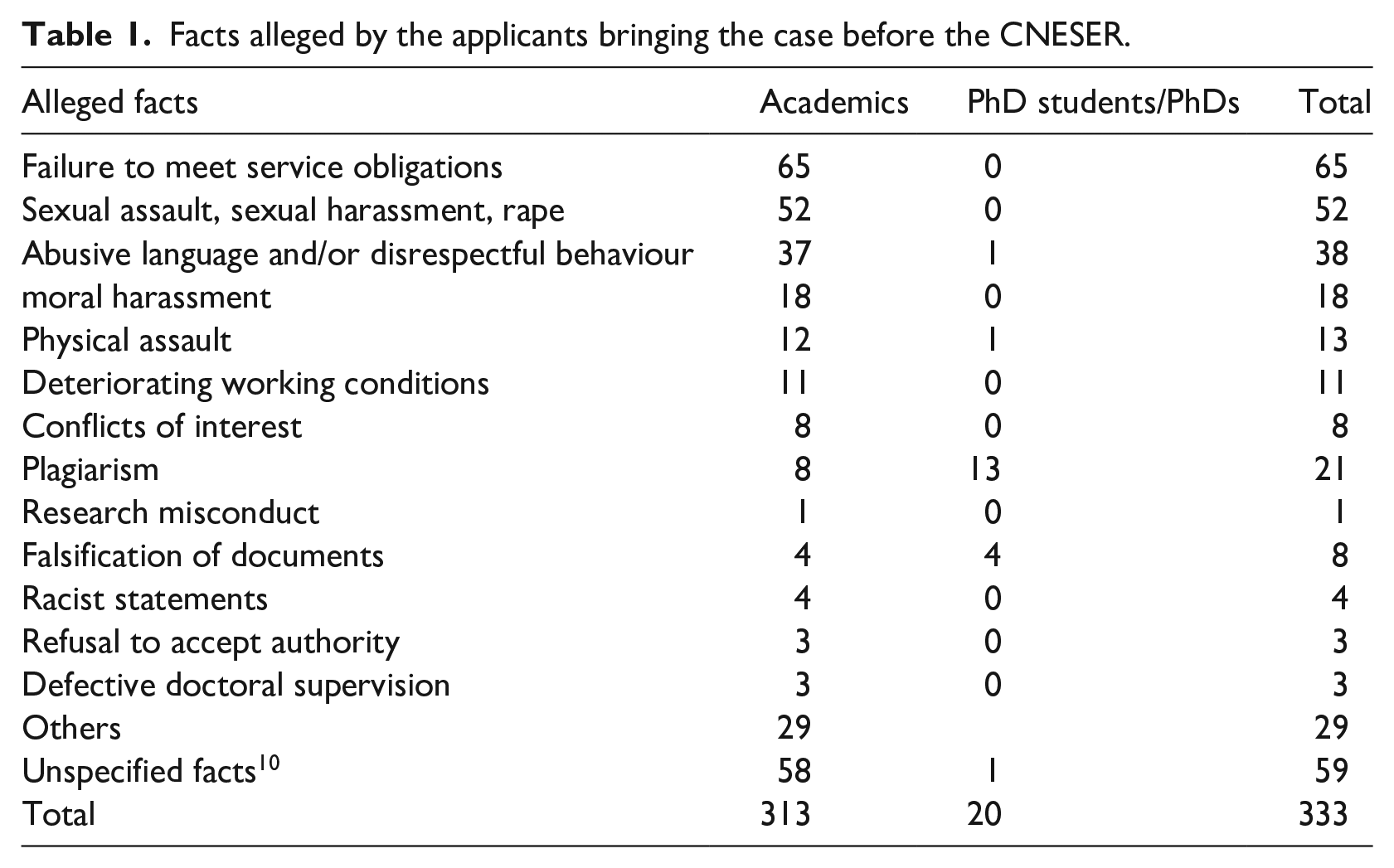
In order to identify which of the disciplinary decisions taken against university staff and doctoral students relate to allegations of research misconduct, we could not confine ourselves to the terms used by the CNESER, since the very notion of ‘research integrity’ has only recently been incorporated into French law by a law of 24 December 2020. Indeed, of the CNESER decisions examined, only one explicitly concerns breaches of scientific integrity. We therefore searched for cases involving practices that fall within the scope of research integrity as defined by European codes of conduct and the French Charter of professional conduct for researchers (2015). These include fabrication, falsification and plagiarism (FFP) as well as certain questionable research practices (QRP). Boundary issues can occasionally arise, as discussed below, but this should not be surprising if one accepts the view that research misconduct forms a continuum (Bouter, 2023). Two categories of decisions relating to ‘research integrity’ emerged from the decisions analysed, on which we focused the qualitative approach: the first concerns those that refer directly to integrity, either by explicitly mentioning the notion of ‘violation of research integrity’ (n = 1), or by mentioning cases of plagiarism (n = 21). The second category includes decisions which, in view of the facts of the case, concern issues related to research integrity, such as cases of inappropriate behaviour in the management of the laboratory, harassment of colleagues, falsification of documents, etc., without the terms ‘research integrity’ being mentioned. In these cases, the CNESER used concepts similar to those of ‘research integrity’ in French law, such as breaches of ‘deontology’, ‘probity’, ‘objectivity’ and ‘academic ethics’ (n = 46).
Results
The decisions issued by the CNESER illustrate how disputes over disciplinary sanctions relating to research integrity differ from the RIO’s assessment of the existence of research misconduct. Three key points will be highlighted: that the concepts used to assess disciplinary misconduct are not the same; that the reasoning methods used to reach a decision differ; and that the circumstances taken into consideration are different.
Professional deontology and research integrity
Our study of disciplinary decisions reveals that the term ‘research integrity’ is virtually absent from CNESER decisions, as are fabrication and falsification of data, two of its components recognised by the main codes of conduct governing research integrity. This is explained by the recent introduction of research integrity as a legal concept in France, which is only gradually making its way into disciplinary case law. This does not mean, however, that violations of research integrity are not dealt with in disciplinary proceedings: research misconduct is addressed by reference to other legal concepts, some narrow and specific such as plagiarism, others much broader and encompassing such as violations of deontological rules.
Plagiarism
From 1991 to 2023, The CNESER issued 102 decisions in which accusations of plagiarism were made. Of these, 8 concerned academics, 10 doctoral students and 84 undergraduate students. With regard to scholars, the CNESER unambiguously states that “‘all researchers have an obligation to cite and reference rigorously each of the works they use.
11
Similarly, for the CNESER, it is clear from the debates and the documents in the case file that Mr XXX falsified the content of his CV to include [plagiarised] publications, in order to obtain a position as a university professor; in the eyes of the appeal judges, such behaviour, which makes him guilty of the acts of which he is accused, constitutes a serious breach of the deontological obligations incumbent on all academics and exposes the defendant to a disciplinary sanction appropriate to his misconduct.
12
For the CNESER, the fact that academics are subject to pressure to register patents does not exonerate them from their responsibility. Thus, the existence of possible rivalries in a laboratory ‘over patent-related issues’ ‘does not exonerate them from the offence of plagiarism with a view to obtaining the title of doctor from the University of YYY’. 13 On the other hand, plagiarism is not subject to disciplinary sanctions when the results presented in two different academic publications were the fruit of ‘joint work within the laboratory’. 14
For the period in which the CNESER was competent to take disciplinary decisions against students, a substantial part of its activity concerned cheating by students in examinations and the production by students of falsified documents in order to justify an absence or to obtain enrolment in a selective course. A reading of the CNESER’s decisions revealed the litany of cheating at university and echoed a rich literature (Allen and Kizilcec, 2023; Bertram Gallant and Drinan, 2016; Boubée, 2015; East, 2010; Hutton, 2006; Simonnot, 2014; Waltzer and Dahl, 2023). The CNESER also takes disciplinary action against students and doctoral candidates who have committed plagiarism in their academic work. In most cases, these are students who reproduce in their essays or theses the words of authors (other students’ essays or Internet pages) without giving them credit. In a high-profile case (Soufron, 2021), the CNESER adopted a legal definition of plagiarism, independent of the offence of counterfeiting organised by intellectual property law (Dreyer, 2012; Latil, 2017; Loui, 2002; Marino, 2011): Plagiarism refers to the act by a university user [i.e. students] of copying entire passages from documents without indicating their source or mentioning the authors; the purpose or effect of such an intellectual operation is necessarily to appropriate, without citing them, the ideas of others, regardless of the medium (academic, such as a master’s thesis; official, such as public reports or documents from the [Data Protection Authority]; or specialised, such as articles in the written or electronic press or posts on blogs) and the nature of the ideas and opinions expressed. Plagiarism [. . .] constitutes a disciplinary offence in higher education organizations committed to awarding degrees based on the production by doctoral students of work that respects scientific integrity.
15
Plagiarism is assessed in the final report submitted by the students and not in ‘the interim report [which] must be considered as a working document that does not play a part in the evaluation of the defendant’. 16
Furthermore, with regard to students and doctoral students, the CNESER is attentive to the quality of the supervision received and to the fact that students have been effectively warned against plagiarism and have benefitted from sufficient supervision to avoid this practice. For example, in acquitting a student accused of plagiarism, the CNESER noted that the work produced was not ‘a slavish copy of the scientific results [of the plagiarised work]’ and that the student was ‘a first-year Master’s student who, as such, is being introduced to research, whereas research training does not really begin until the second year of the Master’s degree’.
17
On the question of fault, the CNESER considered that the fact that the university had not set up a working environment that prevents plagiarism did not exonerate the student from disciplinary liability. However, this failure on the part of the university led the CNESER to reduce the penalty imposed.
18
In the first decade of the new millennium, when Internet use became widespread, the CNESER noted that this tool offered new opportunities for plagiarism by students and that although all students should be aware that they are forbidden to produce written material by copying documents of which they are not the author without specifying the passages borrowed by placing them in inverted commas, [this new tool] nevertheless requires specific information and warnings given the ease of access to this documentation, which is incomparable to that of access to written documents, and the particularities of this new form of fraud.
19
As a result, the penalty imposed on the student was reduced. This approach echoes the request made by the European Code of Conduct for Research Integrity to research institutions and organisations ‘to develop appropriate and adequate training in ethics and research integrity to ensure that all concerned are made aware of the relevant codes and regulations and develop the necessary skills to apply these to their research’ (ALLEA, 2023: § 2.2).
Deontological rules
On a broader level, beyond the case of plagiarism, violations of research integrity were primarily regarded by the CNESER as breaches of ‘deontological rules’. In France, deontological rules refer to the regulation of professional activities, such as those originally applied to doctors and lawyers (Moret-Bailly and Truchet, 2016, 2022). This concept has gradually been extended to other professions or functions, such as the ethics of elected representatives, magistrates and civil servants, which includes academics (Truchet, 2021). The notion of the ‘deontology’ of research refers to the regulation of researchers’ professional activities. As such, they must demonstrate dignity, impartiality, integrity and probity in the performance of their duties. Deontology also governs the conflicts of interest to which researchers acting as civil servants are exposed in the course of their research activities. Thus, in a perspective similar to the functional methods used in comparative law (Örücü, 2006, 442; Siems, 2018: 31), we argue that the concepts of ‘research integrity’ and ‘deontological rules’ fulfil a similar function in the CNESER’s case law, namely to ensure the disciplinary sanction of conduct that constitutes a breach of scientists’ professional obligations, whether these obligations relate to the production of scientific knowledge or to other aspects of their professional activity, such as teaching, mentoring, laboratory management, etc.
In all, the CNESER handed down 46 decisions relating to academics in which the notion of ‘deontology’ and its related concepts of ‘probity’, ‘dignity’, ‘honour’, ‘objectivity’, or ‘academic/university ethics’ were used. In 1991, on the grounds of deontological rules, the CNESER considered that ‘the rights and obligations of university academics concern the exercise of all their functions, in particular their research activities, the dissemination of knowledge and their links with the economic and cultural environment, as well as their teaching duties’. As a result, the CNESER considered itself competent ‘to rule on breaches by academics of their duties in the field of research, in particular publications in scientific journals’. 20 The concept of ‘deontology’ thus provides grounds for addressing potential violations of research integrity. But it also encompasses other types of misconduct concerning the conditions under which scientific professions are exercised, mostly moral and sexual harassment, 21 undeclared multiple employment, 22 and trafficking in diplomas. 23 All these allegations are regarded by the CNESER as matters of compliance with deontological rules. This approach contrasts with that adopted by the European Code of Conduct for Research Integrity (ALLEA, 2023), which counts ‘respect for colleagues, research participants, research subjects, society, ecosystems, cultural heritage and the environment’ among the fundamental principles of research integrity, making the prohibition of harassment a requirement of research integrity. Ultimately, moral or sexual harassment in the laboratory can be treated as a breach of deontological rules as well as a violation of research integrity, depending on how broadly or narrowly one defines research integrity.
Research misconduct and disciplinary offence
The study of the CNESER’s case law demonstrates that the determination of breaches of research integrity does not follow the same legal rationale as the assessment of the existence of a disciplinary offence. There is nothing automatic about the transition from a finding of research misconduct to the imposition of a disciplinary sanction. In order to assess whether a faculty member has committed misconduct justifying a disciplinary sanction, the CNESER pays attention to a number of circumstances.
The CNESER first takes into account qualitative aspects of the professional context in which the scientist works. For example, in a case concerning research integrity, the CNESER noted that the professor involved had indeed behaved inappropriately (‘he should have followed the procedure indicated by the managers of his research laboratory by submitting a verified and complete individual file’), 24 but that this had occurred in a tense professional context (‘Mr XXX’s colleagues in his laboratory had inspected his curriculum vitae and the list of his publications in obvious bad faith and found reprehensible elements’).
The CNESER also takes into account the university’s interventions, or lack thereof, to ensure a favourable working environment: a lecturer who had been condemned by the university for failing to meet his service obligations by not giving all the classes he was required to give was acquitted on appeal by the CNESER on the grounds that this dysfunction was commonplace at the university of YYY. 25 In another case, ‘it appeared to the appeal judges that the relational and organisational problem could have been solved beforehand by the university within the framework of the mediation procedure initiated, at which the defendant said he had not been heard even though he had requested an appointment’, and they concluded, ‘that in view of the documents in the file and the testimonies, it appears that the facts are not such as to justify the pronouncement of a disciplinary sanction’. 26
Finally, when deciding on a disciplinary sanction, the CNESER takes into account any mitigating circumstances relating to the personal situation of the accused. For example, the CNESER reduced the penalty imposed by the disciplinary section of a university on a secondary school teacher who was accused of a disrespectful attitude on the grounds that ‘she had worked as a secondary school teacher and had not necessarily understood all aspects of university operations, in particular those concerning the freedom of academic staff to carry out their teaching and research activities; the decision of the court of first instance should therefore be amended to take account of these mitigating circumstances’. 27 In another case, a university professor was convicted by the CNESER for ‘serious breaches of the obligations incumbent upon a university professor in the context of his responsibilities and duties’ (he had been photographed having sexual intercourse on university premises), but the penalty imposed was reduced on appeal because ‘according to the case file and the debates at the hearing, Mr XXX had been led into the incriminating practices by his mistress with a view to discrediting him in the eyes of the university and local civil society, where the affair received media coverage; that it is therefore appropriate to grant him the benefit of extenuating circumstances’. 28 Where a student has a very poor social situation the CNESER may also take this into account, for example in order to mitigate the penalty for cheating on exams 29 ; likewise it took into consideration an illness suffered by a faculty member and the treatment he had undertaken in a case where he had failed in his professional obligations. 30
Research misconduct and other allegations
The CNESER’s rulings also show that it is exceptional for allegations of research misconduct to be the only charges against a scientist. For example, in a case where three students were sued by an academic who accused them of insults, the CNESER acquitted them on appeal, noting, based on several testimonies, that the students had worked for 2 years on the preparation of a liber amicorum and that the university professor who had initiated the case had presented himself as the sole coordinator of the work, without acknowledging the role played by the students. The legal discussion on the characterisation of insult on the part of the students thus turned into an assessment of the behaviour of the faculty member, whom the CNESER ultimately found to have committed a ‘symbolic appropriation of the students’ work’. 31
In the vast majority of cases, the alleged plagiarism, cheating on the scientific track-record, and breaches of deontological rules tried before the CNESER occurred in a degraded professional environment in which there were conflicts, often long-standing, and in which the university did not fully assume its responsibilities by trying to remedy these tensions. For example, in a case where the CNESER was asked to declare the disciplinary section of another university competent to hear the case, the respondent is accused of having behaved inappropriately by failing to fulfil his professional obligations, in particular his obligation to obey his superiors. Mr XXX is also accused of behaviour likely to worsen working conditions and of having behaved inappropriately by creating a noxious and toxic atmosphere by blocking his colleagues’ publications and criticising said colleagues in the scientific community. Mr XXX is also accused of not performing his teaching duties for several years.
32
In another case, a professor was accused by several doctoral students under his supervision of ‘angry, verbally violent and even physically threatening behaviour’, giving rise to a feeling of fear and psychological problems, as well as ‘a tendency to point out the “subordination” characterising their position with regard to him, at the same time as personal solicitations (thesis meetings at home, attendance at parties, birthdays, moving house)’. In this case, the university’s RIO had already made recommendations to the professor to change his behaviour, but these had not been acted upon. 33
Discussion
The CNESER case law demonstrates that French disciplinary law covered all activities carried out by academics, even before the concept of research integrity was included in the law in 2020. To do so, it relied on the concepts of ‘deontological rules’, ‘university ethics’, ‘probity’, ‘honour’ and ‘objectivity’. This conceptual pluralism has the disadvantage of putting France out of step with the international discussion on research integrity, which makes virtually no reference to ‘deontology’. In France, deontology refers not only to ethics but, more broadly, to all the rules that govern the proper practice of a profession (doctors, lawyers and scientists alike). Deontological rules are laid down by the professions themselves, formally or informally, or by law in the case of civil servants (Moret-Bailly and Truchet, 2022). In the case of scientists, almost half of whom are civil servants in France, the rules of professional conduct therefore cover not only academic ethics and integrity, but also a vast range of good professional practices (compliance with legal and contractual rules, honesty, non-discrimination, secularism, etc.), in all the activities of scientists, whether in research, expertise, evaluation or mentoring (Leclerc, 2024).
The result is that the concept of deontological rules is highly flexible, not to say somewhat indeterminate, when used to verify compliance with the values and norms of research ethics. The concept of ‘acts contrary to honour and probity’ is used by the CNESER in disciplinary rulings concerning breaches of service obligations, 34 undeclared multiple employment, 35 moral harassment 36 and conflicts of interest. 37 For example, the CNESER found that a professor who had authored an article containing certain historical negationist statements had ‘seriously breached – in form and substance – the rules of intellectual probity and respect for others arising from university ethics (déontologie universitaire) and the principles of tolerance and objectivity’. 38 The vagueness of the concepts used by the CNESER to characterise behaviour contrary to scientific integrity was confirmed 3 years later in a 1997 judgement concerning a professor who, among other things, was convicted of having decided ‘alone and without transparency on the names of the signatories of articles published by his laboratory’. 39 At that time, the CNESER considered that ‘these regrettable actions cannot be qualified as a breach of probity or of other obligations laid down by law’. Another illustration of the plasticity of the concepts used is the reference to the ‘values of ethics, responsibility and exemplary behaviour expected of an academic’ to sanction physical violence on the part of a professor at the Faculty of Law. 40
Lastly, although students, as ‘users of the university’, are theoretically not concerned by the concept of deontology (which sets out the rules for professional activity), it does come into play in the case of a student who had committed fraud in her exam and had been verbally abusive, where the CNESER considered ‘that this accumulation of disciplinary faults is particularly serious on the part of a third year undergraduate student, who is therefore well aware of university rules and deontological rules’, 41 or in a case of plagiarism by a doctoral student, in respect of which the CNESER noted that ‘according to Mr Y, Ms XXX was aware of the deontological rules governing the drafting of thesis manuscripts’. 42
The reference to deontology in the case of doctoral students highlights the ambiguity of the position of doctoral students before the CNESER: not subject to deontological rules as ‘users’, their research activities are nonetheless controlled in the same way as those of academics. Although they remain students, doctoral students are already subject to the deontological rules of the scientific professions in all matters relating to their research work. A similar observation can be made with regard to a student who committed fraud in an exercise to prepare a ‘professional project’, for which he reproduced the same report as another student ‘replacing the names of the interviewees with names that he had invented’. In confirming the penalty imposed on this student, the CNESER found that this behaviour constituted fraud ‘contrary to honour and probity’, 43 a notion that is specific to the deontology of civil servants.
The French approach to disciplinary sanctions based on the concept of deontological rules should, however, undergo a change. The legal recognition by French law of the concept of research integrity in 2020, and the now mandatory introduction of RIOs in all universities, could in future result in increasing the volume of references to research integrity in CNESER case law, thus bringing the French debate on professional ethics closer to the debate on research integrity in the international scientific community. However, if such a change were to occur, it could only be gradual. As the time taken to deal with disciplinary breaches can be relatively long – that is, the period between the investigation of a report by an RIO, the disciplinary decision taken by the institution, and the appeal to the CNESER – the next few years will provide an opportunity to assess whether or not, and if so how, the notion of ‘research integrity’ is gaining ground in the disciplinary sections of universities and before the CNESER. One factor that supports this hypothesis is that the few CNESER decisions referring to research integrity all post-date the Corvol (2016) report on research integrity and the introduction of RIOs in universities (2021). Research integrity was mentioned for the first time in a decision in 2019, but the CNESER did not rule on the merits of the case. 44 In a second case, decided in 2022, concerning an allegation of plagiarism against a doctoral student in writing his thesis, the CNESER recalled that plagiarism constitutes a disciplinary offence and pointed out that ‘higher education organizations are committed to awarding degrees based on the production by doctoral students of work that respects research integrity’. 45
Our research also does draws attention to a better understanding of the issues involved in maintaining a healthy working environment in universities. The Council of the European Union points out the dual responsibility of scientists and their institutions with regard to research integrity: while respecting academic freedom, the primary responsibility for research integrity is with researchers themselves, with an overarching responsibility also being existent at institutional level. [The Council therefore calls] for the fostering of an institutional culture of research integrity in order to create, mainly through clear institutional rules, procedures and guidelines as well as training and mentoring based on the exchange of best practices, a climate in which responsible behaviour is expected at individual and institutional level.
46
Hence, when a breach of research integrity is alleged, the CNESER not only assesses whether there has been a breach of research integrity, but also weighs up the part attributable to the scientist involved and the part attributable to the university. The CNESER judgements show that the institutional responsibility to create an environment conducive to research integrity (ALLEA, 2023; WCRI, 2010) is not independent of the responsibility of scientists to behave in a manner consistent with research integrity. These two obligations do not appear to be parallel, but rather to be in constant interaction: the fact that the university has failed to meet its own institutional obligations may exonerate the scientist from disciplinary misconduct or mitigate the sanction imposed on them. In these cases, even though the scientist’s behaviour is clearly characterised as a research misconduct, it is not, however, characterised as a ‘disciplinary fault’ (in its legal sense) that may lead to the imposition of a disciplinary sanction. In order for a breach of research integrity to give rise to disciplinary action, it must be balanced against the obligations of the alleged perpetrator (academics or students), the personal circumstances in which they live and work, and any failure on the part of the university to put in place a professional framework conducive to compliance with deontological rules and research integrity. This balancing of misconduct against the circumstances of the case is a feature of all adjudication procedures, including disciplinary procedures. In contrast, this is not expected of the RIOs, which highlights the difference between their function of investigating research misconduct and the jurisdictional activity carried out by the disciplinary sections in universities. An RIO’s report is part of an overall process that involves considerations other than the existence or absence of research misconduct. A report by the RIO concluding that a violation of research integrity has occurred may therefore not result in a disciplinary sanction, without this necessarily being indicative of neglect of research misconduct. Thus, even if the RIOs’ investigations play a crucial role in establishing that research misconduct has occurred, the RIOs’ assessment is autonomous from the disciplinary procedure that follows. One difficulty lies in the fact that the RIOs may also be tempted to carry out such a balancing exercise when assessing research misconduct, thus anticipating the assessment to be made by the disciplinary panel. A clear division of roles is needed here.
Active intervention by research institutions in favour of quality working conditions has been shown to have an impact on the professional culture in which scientists work, and ultimately on their mental health (Abbott, 2020; Hall, 2023). Our research also suggest that a deteriorated professional environment might increases the likelihood of disciplinary proceedings. In this case, the violations as a whole are dealt with through disciplinary proceedings. This situation can encourage the effective sanctioning of research misconduct. But it also has the inconvenience of drowning research misconduct in disciplinary misconduct, which makes it impossible to isolate the sanction resulting from the research misconduct, the misconduct being considered as a whole, in the light of the particular circumstances of the case. For instance, breaches of research integrity are all the more likely to result in disciplinary proceedings when they are combined with other breaches of ethical obligations (abusive language, interpersonal tensions, moral harassment, sexual harassment, violence, etc.), which together constitute a disciplinary violation. In addition, when a number of allegations are made against the perpetrator (breaches of scientific integrity per se are added to harassment or violence, for example), sanctions are more likely to be imposed for acts of harassment and violence than for research misconduct, with which judges are less familiar. Conversely, a refined professional environment might favour the individual treatment of research misconduct, both in the investigation phase by the RIO and in the disciplinary judgement phase. It is only in this situation that the work of the RIO and the disciplinary panel will come closer together.
However, this hypothesis is proving hard to substantiate, and care must be taken not to over-generalise the conclusions that can be drawn from the material we have studied. Indeed, the data collected as part of this research has limitations. The first is that CNESER’s decisions are rendered on appeal: first instance decisions, issued by university disciplinary sections, are not accessible in their entirety and could therefore not be included in the analysis. Only a small proportion of disciplinary decisions taken by universities are appealed to the CNESER, and it is likely that they form a very selective sample of these instances. A second limitation is specific to the legal treatment of research integrity: not all breaches of research integrity are reported, and not all reports lead to an investigation, just as not all investigations lead to a finding of misconduct. Furthermore, not all breaches of research integrity result in disciplinary proceedings, as this decision is the responsibility of the president of the university concerned. Here again, the sample of cases at hand might be selective. This holds true both before and after the creation of research integrity officers in French universities in 2021. Therefore, the disciplinary decisions taken by the CNESER should not be taken as an indicator of the number and nature of cases of research misconduct in French universities.
Only the collection of all of the disciplinary sanctions imposed at first instance in France would enable a detailed understanding of the disciplinary treatment of research integrity. Given the impossibility of collecting such a corpus of material, our study was based on appeal decisions, with all the limitations that this entails, since appeal decisions are only an imperfect echo of first instance decisions. We therefore concur with Siegerink et al. (Siegerink et al., 2023) in advocating the need for a systematic collection of first instance disciplinary decisions. In France, a first step in this direction was taken with the law of 24 December 2020, which requires universities and research institutions to report every 2 years to the Ministry of Education and Research and the High Council for Research Assessment (which houses the French Office for Scientific Integrity) on the activities they have carried out to promote research integrity. 47 This measure is currently being implemented for the first time and aggregate information is not yet available. This data collection should make it possible to gain a better understanding of the activity of RIOs (number of reports received, number of cases investigated, nature of misconduct reported) and the disciplinary sanctions imposed within universities (nature of the charges, status of the accused, penalties imposed, proportion of acquittals). But while the statistics collected are eagerly awaited, they still don’t provide an access to the disciplinary decisions themselves. Making university disciplinary decisions available would fit in with the policy of open data on court decisions that France has been pursuing since the mid-2010s (Robin, 2022), though this has mainly been designed for civil, criminal and administrative court rulings, rather than disciplinary decisions.
In the past decades, scientific communities have been striving to establish a shared understanding of research integrity and misconduct. However, this effort to harmonise the notions of research integrity and research misconduct has no equivalent when it comes to the disciplinary sanctions for misconduct. Rather, in this area, we are witnessing a multiplication of authorities responsible for imposing disciplinary sanctions, who may have different cultures of research integrity. For example, university disciplinary committees are much more familiar with issues of research integrity than appeal bodies. Yet both may be called upon to judge such cases and this may lead to an unequal treatment of such misconduct. In this regard, the fact that the disciplinary decisions taken against faculty and students in the universities we studied were judged on appeal by the CNESER, which is a national jurisdiction, ensured the dissemination of a unified conception of research integrity. However, the decision taken in 2019 in France to change the remit of the CNESER, which now only has jurisdiction to appeal disciplinary decisions relating to academics, while students will have to take any appeals to an administrative court, introduces a possible dissociation between the CNESER and the 41 administrative courts established in France regarding the meaning of research integrity in the context of disciplinary litigation. Our research therefore calls for harmonisation of the concepts used to assess research misconduct, on the one hand, and to adjudicate disciplinary sanctions, on the other, as well as of the criteria used to evaluate the seriousness of misconduct in first instance and in appeal instances. Otherwise, the construction of a common understanding of research integrity within research communities would risk being compromised by the centrifugal forces exerted by the disciplinary sanctioning of research misconduct within a plurality of disciplinary and judicial authorities.
Footnotes
Acknowledgements
The authors would like to thank Jérôme Michalon and Thibaud Boncourt for their careful reading of an earlier version of this article, as well as anonymous reviewers of the journal for their time and helpful comments. The authors extend special thanks to the former president of the CNESER in its disciplinary formation, Professor Mustapha Zidi, and to the administrative head of the CNESER, Mr Eric Mourou, for allowing us access to the decisions of the CNESER under excellent conditions. We are also grateful to Mr Cyprien Henry, head of the Archives and Cultural Heritage Mission at the Ministry of Higher Education and Research, for the invaluable help he gave us in gaining access to the CNESER archives, and to Ms Anne Rohfritsch and Ms Cécile Fabris, respectively in charge of the Higher Education and Education-Culture-Social Affairs collections at the National Archives for their support in our research.
Funding
All articles in Research Ethics are published as open access. There are no submission charges and no Article Processing Charges as these are fully funded by institutions through Knowledge Unlatched, resulting in no direct charge to authors. For more information about Knowledge Unlatched please see here:  g This work was supported by the French Agence Nationale de la Recherche under Grant ANR-20-CE27-0016.
Ethics approval
Not required.