




Abstract
Animal behaviour and welfare research are part of a wider endeavour to optimize the health and wellbeing of humans, animals and ecosystems. As such, it is part of the One Health research agenda. This article applies ethical principles described by the One Health High Level Expert Panel to animal behaviour and welfare research. These principles entail that animal behaviour and welfare research should be valued equitably alongside other research in transdisciplinary and multisectoral collaboration. It should include and promote a multiplicity of marginalized voices, including those of animals, and it should apply and describe a harmonious balance between human—animal-environment interactions. Lastly, it should describe how humans need to change behaviour, adopt sustainable solutions and recognize the importance of animal welfare and the integrity of the whole ecosystem.
Introduction
One Health can be defined as ‘an integrated, unifying approach that aims to sustainably balance and optimize the health of people, animals and ecosystems. It recognizes the health of humans, domestic and wild animals, plants, and the wider environment (including ecosystems) are closely linked and inter-dependent’ (World Health Organisation (WHO), 2021). It aims to mobilize multiple sectors, disciplines and communities to collaborate to foster wellbeing, tackle threats and to improve health and wellbeing outcomes for humans, animals and the environment (WHO, 2021).
Animal behaviour and welfare research are directly relevant to One Health, and vice versa. One Health incorporates a concern for animal welfare in its reference to wellbeing and in its connection to the World Health Organization’s definition for human health that includes physical and mental wellbeing, and the World Organisation for Animal Health’s definition of animal welfare as ‘the physical and mental state of an animal in relation to the conditions in which it lives and dies’ (WHO, 2023; World Organisation for Animal Health (WOAH), 2023). Animals’ health and wellbeing matter to those animals insofar as they are determinants of animals’ behaviour and choices (Dawkins, 1990, 2004) and involve unpleasant or undesired states and experiences (Duncan, 2005; Webster, 2005). They matter scientifically in that they are part of the world (Broom, 1988; Dawkins, 1998; Fraser et al., 1997). They matter ecologically insofar as they affect the survival, interactions and responses of ecosystems (Yeates, 2022). They matter ethically as part of moral agents’ considerations in making research and other decisions (Balcombe, 2009; Singer, 2023). The concept of One Health is incomplete or misguided to the extent that it does not recognize and incorporate these values, alongside concern for the health and wellbeing of humans and the wider environment (Capps, 2022; Lederman et al., 2021; Lederman and Capps, 2018; Lindenmayer et al., 2022; Mumford et al., 2023).
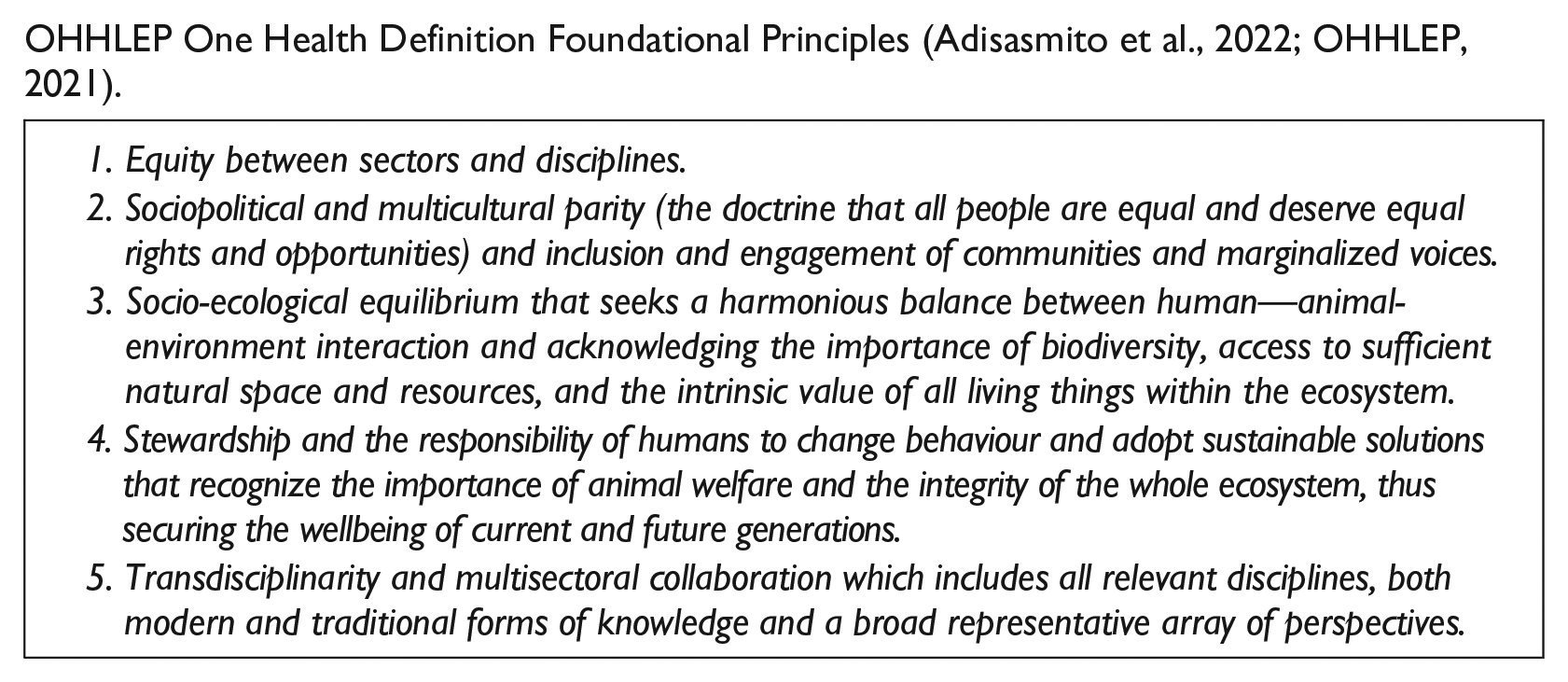
The One Health High Level Expert Panel (OHHLEP) has described foundational principles of One Health (Adisasmito et al., 2022; One Health High Level Expert Panel (OHHLEP), 2021). This paper aims to explore how we might apply these principles to considerations of animal behaviour and welfare research, in terms of what subject matter is studied and how it is studied within animal behaviour and welfare research.
OHHLEP One Health Definition Foundational Principles (Adisasmito et al., 2022; OHHLEP, 2021).
Equity between sectors and disciplines
Animal behaviour and welfare science is part of the wider effort to understand (and improve) the health and wellbeing of humans, animals and the environment. It contributes to creating a collective body of knowledge alongside other scientific disciplines, which can be seen as complementary and integrable components of this collective scientific endeavour. For example, since environmental harms often involve harms to animals’ health and welfare such as pollution/toxicity, disease and starvation of the animal members of species, communities and ecosystems, it can be useful to consider the health and wellbeing of animals within or alongside the assessment of environmental harms and impacts (Paquet and Darimont, 2010; Broom, 2019; Lanzoni et al., 2023; Sekar and Shiller, 2020), and reciprocally to consider the impacts of environmental harms on the animals within the ecosystems affected (Finn and Stephens, 2017; Fraser and MacRae, 2011). Researchers in animal behaviour and welfare science and other health and wellbeing fields should consider proactively the inter-relations of research questions, methodologies and data from these different fields, and endeavour to align and integrate them equitably.
In order to facilitate equality between One Health disciplines, animal behaviour and welfare and other relevant research can and should investigate health and wellbeing at individual and population levels (de Azevedo and Young, 2021; Hertel et al., 2020; Manteca and Deag, 1993; Merrick and Koprowski, 2017). Several aspects of ecological assessment require whole animal approaches (e.g. phenotypic plasticity: Forsman, 2015) and inter-individual variation is an important aspect of experimental variability (Voelkl et al., 2020) that should be considered when designing (van der Goot et al., 2021a) and interpreting (Volsche et al., 2023) research. Understanding animals’ experiences of their states or conditions provides one source of information about those conditions and potential changes that would improve them. This is particularly important where there can be intraspecific differences in responses between individuals of a given species, which suggest that animals’ health and welfare needs or impacts are variable and contingent (e.g. Allan et al., 2020; Honda et al., 2018; Komdeur, 2006; MacKay and Haskell, 2015; Mason, 2010; McDougall et al., 2006; Shepherdson et al., 2013; Stuber et al., 2022). Such inter-individual variation is important for animal behaviour and welfare science (e.g. Richter and Hintze, 2019; Winckler, 2019; Yeates, 2013), psychological sciences (e.g. van der Goot et al., 2021b), ecological science (Clutton-Brock and Sheldon, 2010; Réale et al., 2007; Sheldon et al., 2022), climate science (Wells et al., 2022), and conservation science (e.g. Dominey, 1984; Ferraro et al., 2023).
There should also be equity and integration between animal behavour and welfare and other disciplines and sources of data in how they are considered and applied in decision-making. Decisions should equitably draw upon data from all relevant fields in their assessments of situations and options and in their frameworks for decision-making. For example, economic forecasts should not be unthinkingly given greater weight by policymaking processes over data about non-market concerns (Berry et al., 2017), although Dewi et al. (2023) found economic instrumental concerns to tend to be presented formally while harmony-oriented relational concerns for nature tended to be expressed as stakeholder preferences.
Equality between disciplines relates also to data concerning different stakeholders (insofar as health and wellbeing disciplines are often defined primarily in terms of their primary stakeholders, e.g. medical vs veterinary science) and implies equality across how different groups of stakeholders’ interests are conceptualized, assessed, presented and considered in evidence-based decision-making. This has been recognized in considerations of human stakeholders, in the context of the need for sociopolitical and multicultural parity (e.g. Schaafsma et al., 2023), and can be applied to stakeholders of different species. Animal behaviour and welfare are often presented differently to humans’ (e.g. economic assessments, stakeholder interviews and participatory methods usually include direct representations of only the former). Alongside the assessments of human wellbeing factors, impacts on animal behaviour and welfare should be assessed (McCulloch and Reiss, 2017), and included or integrated with data on human and environmental impacts. Such assessments might not eliminate ethical debates about the underlying values (Sandøe and Gamborg, 2017), but they can help to frame discussions and at least ensure all data sources are considered.
Sociopolitical and multicultural parity, inclusion and engagement of communities and marginalized voices
Animal behaviour and welfare research should aim to include a diversity of voices in study design (Asmal et al., 2022), including those of research participants and others for whom the results are relevant (e.g. for human-animal interaction: Leighton et al., 2022). This should include stakeholders outside hegemonic power structures and animal use practices, such as affected indigenous communities (Adenle et al., 2014; Camino et al., 2023; Datta, 2018; Tugendhat et al., 2023) and the animals themselves (Meijer, 2019). At the same time, animal behaviour and welfare science is a key way to include animals’ voices in policy design (although the absence of scientific data should not mean voices are ignored or marginalized further).
Animals’ responses and motivations are a source of information about what animals assess as harms and benefits (Dixon et al., 2013; Leach et al., 2004; Mason and Mendi, 1993; Meijer, 2013; Rushen, 1996). A feature of sentient animals is that they have the capacity to evaluate situations, which may manifest in their emotions, moods, motivations and preferences, and which they may display though physiological changes and behaviour (Broom, 2014; Browning and Birch, 2022; Webster, 2022). Animals may be motivated to engage in rewarding research, for example, on play, palatability, curiosity, affective relationships and conditioned interactions (Held and Špinka, 2011; Yeates and Main, 2008). Conversely, animals might exhibit resistance or dissent to a research protocol or the background conditions, for example, through non-verbal communication, stress indicators, antagonistic behaviour, avoidance or escape behaviour (Hribal, 2010; Kantin and Wendler, 2015).
Taking participants’ voices into account can help in the project design and evaluation, and this is true for both human participants (Dresser, 2015; Hoddinott et al., 2018; McDonald et al., 2013) and animal participants (Edelblutte et al., 2023; Johnson, 2023; Sueur et al., 2023). Improving animals’ welfare can refine protocols (Neville et al., 2023) and study validity (Brill et al., 2021; de Waal, 2016; Schaller, 2023; Würbel, 2017) and information about the welfare of animal participants should inform our evaluations and interpretations of experiments (Volsche et al., 2023). There have been questions about data from studies using methodologies that compromise animals’ welfare, such as forced swim tests in depression research. For example, participants might stop swimming due to different psychological states such as despondency or because they have learnt that they will get removed from the water by a lab technician (Carvalho et al., 2021; Reardon, 2019). One meta-analysis by Stupart et al. (2022) found unconditioned tasks, such as the open field test and elevated plus maze, to be generally unreliable in demonstrating differences between control and separated groups, with small or non-existent pooled effect sizes.
One consideration for the acceptability of experimental interventions or experimental conditions may be whether there is (alongside other criteria) assent by participants (Ferdowsian et al., 2020; Healey and Pepper, 2021; Kantin and Wendler, 2015; Van Patter and Blattner, 2020). This approach has been suggested as a way to gain insights into procedures from the participants’ perspectives in order to design studies in line with their preferences, and to allow some degree of volitional choice within the protocols (e.g. Anthes, 2022; Fenton, 2014; Mancini, 2017). Animal behaviour and welfare science is a core method for ascertaining animals’ voices (Duncan, 2006). Researchers can also provide incentives to engender participants’ voluntary engagement with some protocols, particularly through designing enjoyable protocols or reinforcing positive associations (Perlman et al., 2012).
Participants need to meaningfully understand the procedures and risks involved, with sufficient information (Sreenivasan, 2003; O’Sullivan et al., 2021) that they can understand depending on their knowledge, communication, evaluations, and natural adaptive responses, including contexts’ similarity to subjects’ experiences or ecological niche (Yeates, 2018a).
In designing protocols, researchers might consider a combination of information that is specific to the individual participants and information that is more generically applicable. Information about individuals can inform us about their preferences, perception, evaluation and contextual responses to their protocols, so that we can tailor designs to their needs, preferences and welfare state (e.g. behavioural studies involving participant’s familiar companions in the protocol) or in real-time responses to participants’ experiences of the research (e.g. removing stressed animals from protocols). More general information about animals, based on intraspecific and interspecific extrapolations and generalisations, can help inform us what we can reasonably expect would cause health or wellbeing compromises without having to subject animals to those conditions (e.g. assuming that injuries are painful without needing to see individuals’ responses to them) This can also be helpful where we think particular individuals’ assessments might be prone to error (e.g. because of animals’ inexperience or lack of knowledge about medical procedures). We might combine these into overall assessments of what animals would want, in a way comparable to clinical decisions that combine veterinarians’ assessments about what generally involves poor health tailored to individual patients depending on their responses to treatment (Yeates, 2016).
Socio-ecological equilibrium that seeks a harmonious balance between human—animal-environment interaction and acknowledging the importance of biodiversity, access to sufficient natural space and resources, and the intrinsic value of all living things within the ecosystem
Sentience constitutes one aspect of animals’ and ecosystems’ intrinsic value (Lan et al., 2022), and respecting animal sentience is an important requirement for achieving a harmonious relationship with nature (United Nations, 2020). Animal behaviour and welfare sciences are important sources of data for determining what counts as meaningful access to natural space and resources of sufficient quality and quantity (e.g. Ross et al., 2009) to allow the fulfilment of postural, locomotive and other motivations, meet health needs, and facilitate interactions such as social grouping. Animal behaviour and welfare sciences thus informs efforts to protect the health, abundance and thriving that are needed for the maintenance of biodiversity (Beausoleil et al., 2018). As examples, assessment of enrichment can help assess conservation practices such as translocation (Gross et al., 2024), and field studies can identify challenges to biodiversity by identifying stress to individual animals at an earlier stage, before major impacts at a population level, the unravelling of ecosystems and the loss of human livelihoods (e.g. Baker et al., 2013; Hing et al., 2016; Huber et al., 2019; Sheriff et al., 2011).
Socio-ecological equilibrium and a harmonious balance can be understood as matters of justice, an important component of One Health (Ferdowsian, 2023; Lysaght et al., 2017). Acknowledging the importance of biodiversity, access to sufficient natural space and resources, and intrinsic value includes a recognition that humans should not treat other humans, animals or the environment as ‘mere means’, commodities or mere ‘research subjects’. This implies that basic broadly applicable protections should be afforded to human, animal and environment subjects (Coghlan et al., 2021). These might include protection from severe suffering (Lilley et al., 2014) or a life worse than death (Mehrkam and Fad, 2020; Yeates, 2011), having their basic natural needs fulfilled (Beauchamp and DeGrazia, 2019) and a degree of meaningful control or choices in scenarios for which their naturally evolved evaluative and decision-making capacities are adaptive (Yeates, 2018a), or using alternative research methods that do not require any harm to participants. Researchers should ensure that research participants are at least no worse off than they might be under natural conditions, specifically with regard to space and resources (Yeates, 2018b). Where sufficient space and resources cannot be provided, or their intrinsic value cannot be respected, the protocols should be adapted or those participants should not be included.
The recognition of the intrinsic value of humans and animals also implies that we might align ethical considerations of human and animal participants (Lund and Forsberg, 2009). Petkov et al. (2022) suggest combining principles from various sources including the Helsinki declaration; the 3Rs of replacement, reduction and refinement (Russell and Burch, 1959; Zemanova, 2021, 2023); the 3Ss of good science, good sense and good sensibility (Smith and Hawkins, 2016); and others (Tannenbaum, 2017; Beauchamp and DeGrazia, 2019; Würbel, 2017). We might similarly integrate ethical principles applied to specific areas of research, for example animal behaviour (e.g. Barnard, 2007; Cuthill, 1991; Olsson et al., 2022; Sherwin et al., 2003) and human psychiatric research (e.g. Jain et al., 2017; Roberts and Roberts, 1999; Tsao et al., 2008).
Decisions on what experiments are acceptable draw on animal behaviour and welfare assessments of animals’ interests and capabilities. Where this involves assessing what constitutes a legitimate ‘balance’ of interests between those involved and affected (Bateson, 1986; WOAH, 2023), the OHHLEP principles would suggest that this balance should be assessed holistically, unbiasedly, fairly, with the inclusion of marginalized voices, and with parity between stakeholders and disciplines. This includes minimizing biases against certain people or species (Arathoon, 2024; Hutchinson et al., 2021; Jackson, 2019), for example, not prioritizing measures of human wellbeing above those of animals or environment in project evaluations without thinking (Bovenkerk and Poort, 2019; Pound and Blaug, 2016; Sebo, 2023).
A socio-ecological equilibrium also requires guarding against undue influences on research, publication and policymaking. In recent years, there have been some concerns over the potential influences on policymaking from powerful actors with commercial interests in given outcomes (Dyer, 2019; Field and Lo, 2009; Nejstgaard et al., 2020; Rahman-Shepherd et al., 2021; Elver, 2017). For example, Legg et al. (2021) identified five potential strategies that might be used to increase the volume, credibility, reach, and use of industry-favourable science, while inhibiting or casting doubt about scientific evidence of the harms of industry practices or the efficacy of policies. Addressing unequal power-relations is required to achieve the needed transformation (Berry et al., 2017; Arias-Arévalo et al., 2023), and this should apply to power relations in science, in assessments (Jacobs et al., 2023) and in decision-making, including human-animal power relations, to ensure the voices of all affected people and animals are influential in policymaking.
Stewardship and the responsibility of humans to change behaviour and adopt sustainable solutions that recognize the importance of animal welfare and the integrity of the whole ecosystem, thus securing the wellbeing of current and future generations
Stewardship involves a responsibility to others. This includes our responsibilities to animals both in themselves (Seamer, 1998) and as part of environmental stewardship (Narayanan, 2016; Szücs et al., 2009). These responsibilities, in the One Health context, include a responsibility to protect the health and wellbeing of humans, animals and the environment (Sellars et al., 2021). The explicit mention of both animal welfare and ecosystem integrity both reinforces that researchers should take care of participants in their studies whether the subjects are humans, other sentient animals, or ecosystems, and highlights the relevance of animal behaviour and welfare sciences to behavioural ecology, epidemiology and other ecological and health sciences, and to identifying and describing sustainable solutions and human behaviour change to secure the wellbeing of current and future generations.
Animal behaviour and welfare science helps by identifying risks and benefits for animals, as well as benefits and risks for people and ecosystems, to help ensure that efforts to improve the health of one stakeholder subset do not harm others. For example, research within slaughterhouses might aim to improve animal welfare and human safety (Grandin, 2019). Similarly, many conservationists and animal welfare scientists are concerned with avoiding or minimizing harms to animals and ecosystems (Bruskotter et al., 2019) and would consider animal welfare to be an ethically relevant concern for wildlife management and conservation (Dubois et al., 2017; Gamborg et al., 2012; Kirkwood and Sainsbury, 1996; Minteer and Collins, 2005).
More widely, animal welfare and One Health are important aspects for sustainable development (Broom, 2010; Di Marco et al., 2020; Keeling et al., 2019, 2022; Labonte, 1991; Mumford et al., 2023; Sinclair et al., 2019; Stentiford et al., 2020; WFA, 2023). Sustainable development is itself an integrated, balanced approach across economic, social and environmental concerns (United Nations General Assembly, 2015). Animal behaviour and welfare science can play an important role in determining key drivers and inhibitors of sustainable development, accelerating sustainable development, and protecting future sustainable development from the impacts of poor animal welfare practices, not least from the setbacks of future zoonotic pandemics (Fourpaws, 2022; Guterres, 2023) that might have impacts similar to those of COVID-19 (see Shulla et al., 2021; United Nations, 2023). The population of ‘current and future generations’ might well be taken to include animals. Either way, safeguarding animal health and welfare is also necessary to secure the wellbeing of current and future generations of humans.
Achieving a harmonious relationship with nature will require transformative change (Díaz et al., 2019; United Nations Environment Programme, 2021; Visseren-Hamakers et al., 2021). Animal behaviour and welfare science can encourage positive human behaviour change. Studies often focus on disharmonious human-animal-environment interactions such as those that occur in intensive farm, laboratory or zoological collection settings, and identify behaviour change that could rebalance the interactions. Because One Health aims to optimize health and wellbeing, with a focus on equality, it favours upstream preventive interventions that can benefit a full range of beneficiaries (OHHLEP, 2023). To support this, animal welfare research should always be contextualized within underlying anthropogenic drivers (e.g. production and consumption systems) and the upstream economic, social, cultural, political and technological determinants (Paixao, 2021). This requires avoiding bias against research that questions current practices (Phillips and Molento, 2020; Phillips and Petherick, 2015; van der Schot and Phillips, 2013) and ensuring findings are widely applicable and disseminated (Eggel and Würbel, 2021).
Transdisciplinarity and multisectoral collaboration which includes all relevant disciplines, both modern and traditional forms of knowledge and a broad representative array of perspectives
The study of animal behaviour and welfare could be mutually enriched through multidisciplinary perspectives (Gao and Clark, 2023; Webb et al., 2019), including between researchers and practitioners (Gredig et al., 2021; Leighton et al., 2022). Transdisciplinary collaboration can help researchers to identify translational ideas and address shared practical or ethical challenges (Ferdowsian and Gluck, 2015; Webb et al., 2019).
Animal welfare might be better integrated with human health and environmental sciences. For instance, animal welfare and behavioural ecology study behaviour through particular lenses, which should be seen as complementary (Beausoleil et al., 2018). Conservation science is constantly evolving (Franklin and Seebacher, 2012; Madliger et al., 2018; Wikelski and Cooke, 2006) and becoming more integrative and interlinked (Cooke et al., 2020); the same is true for animal welfare science (Freire and Nicol, 2019). There have been recent efforts towards alignment of these disciplines (Beausoleil et al., 2018; Fraser, 2010; Soriano et al., 2017; Wallach et al., 2018), even if the approaches to integration to date have attracted some criticism (see Coghlan and Cardilini, 2022).
The equitable integration of multiple disciplines could be facilitated by methodologies to assess health and wellbeing that are applicable across humans, animals and environment. However, at present, there are many health and wellbeing concepts (e.g. Bracke, 2007; Diener, 2006; Kahnman and Riis, 2005; Kirkden and Pajor, 2006; Lyubomirsky et al., 2005; McMillan and Yeates, 2019; Nordenfelt, 2006), as well as variations in understanding of concepts such as suffering, biodiversity and value of life. The One Health approach implies that we should at least avoid reductive differentiation and see these as a compatible ‘cluster’ of related concerns. We should also recognize where differences between concepts are not conceptual distinctions between species, but just different methodological approaches to assessment for different research subjects (e.g. verbal versus non-verbal reportage or assessments at individual versus population levels).
The One Health approach calls on us to consider how we might align in our aims, scientifically and morally. This requires the pluralistic recognition of multiple worldviews within transdisciplinary collaboration (Hakkarainen et al., 2020) and its application to decision-making (Pascual et al., 2023), in an inclusive way (Raymond et al., 2023). For example the multiple ways in which nature is valued means we should not focus solely on market-driven values assessed by economic analyses (IPBES, 2022) and this should include the values related to animal (including human) sentience (Yeates, 2022). We need to recognize multiple values together, within a common, shared goal – this is needed for meaningful collaboration. These values and goal need to include the intrinsic value of the health and wellbeing of humans, animals and environment, human moral concerns, and animals’ perceived values as evidenced by animal behaviour and welfare science. An integrated and holistic approach to research needs to consider these and more, to create an overall approach that is applicable to research on the wellbeing of humans, animals and environment.
Discussion
The One Health principles described by the OHHLEP provide a useful framework for animal behaviour and welfare research to optimize the health and wellbeing of humans, animals and the environment.
While this paper provides an overview, further work is needed, for example, to explore how ethical principles applied to human health and wellbeing research might be applied to animal behaviour and welfare research, and to explore how well current research (and practice) conforms to the One Health principles.
There is a risk that scientific concepts or data in relation to animal behaviour and welfare are misused in ways that mean they do not achieve the necessary protection for animals (Reis and Molento, 2020; Souza et al., 2015). So any scientific claims that a practice does not harm animal welfare or sustainability should be well evidenced and justified by the data before a practice is expanded or extended (Ekstrand and Nilsson, 2011). Furthermore, insofar as misleading claims might be seen as linked to or part of environmental greenwashing (c.f. Furlow, 2010; de Freitas Netto et al., 2020; Pimonenko et al., 2020; Szabo and Webster, 2020; Toscano et al., 2022), it may be valuable to consider the risks of misleading information about animal health and welfare within assessments of potential greenwashing (Nemes et al., 2022).
Further work is also needed to integrate the principles, and their application, of One Health with those of other integrative approaches such as One Medicine (Humanimal Trust, 2023), Just One Health (Pheonix Zones Initiative, 2022), One Welfare (Pinillos, 2018; Tarazona et al., 2019), Ecohealth (Rapport, 2007), Planetary Health (Horton et al., 2014) and One Digital Health (Benis et al., 2021). Each of these have particular focuses, which can be useful. However, as approaches that aim to be holistic and systems-based (for instance, Pongsiri et al., 2017), and share some underlying concepts and history (for instance, Zinsstag et al., 2011) or the possibility of convergence (for instance, Zinsstag, 2012), they should aim to be compatible with one another. In the meantime, they too might be seen as a ‘cluster’ of approaches that can be used together without unnecessary differentiation. The principle of equity of disciplines might also be applied to and within holistic approaches, to ensure holistic approaches do not then exclude or deprioritise some concerns, subsystems or stakeholders. In any case, this review would suggest that animal behaviour and welfare should be considered part of all of these approaches.
Footnotes
Funding
The author is employed by the World Federation for Animals. All articles in Research Ethics are published as open access. There are no submission charges and no Article Processing Charges as these are fully funded by institutions through Knowledge Unlatched, resulting in no direct charge to authors. For more information about Knowledge Unlatched please see here: 