




Abstract
In 1974, the United States Congress asked a question prompting a national conversation about ethics: which ethical principles should govern research involving human participants? To embark on an answer, Congress passed the National Research Act, and charged this task to the newly established National Commission for the Protection of Human Subjects of Biomedical and Behavioral Research. The Commission’s mandate was modest however, the results were anything but. The outcome was The Belmont Report: a trio of principles - respect for persons, beneficence, and justice - serving as an ethical compass for scientists, researchers, and institutional review boards (IRBs). Almost 50 years later, the utility, legacy, and ingenuity of The Belmont Report continues to be both admired and challenged. Critics argue that Belmont is not fit for the 21st century, while supporters praise Belmont for its enduring wisdom. The goal of this paper is to equip IRB practitioners with the tools necessary to maximally interpret The Belmont Report and meaningfully engage in ethical analysis that reconsiders outmoded legacy thinking and fixed decision-making. Through historical and contextual reflection, this paper describes how IRB practitioners can contemporize review of ethical human research using their moral imagination – a skill found at the intersection of creativity, deliberation, and empathy.
Keywords
“A man, to be greatly good, must imagine intensely and comprehensively; he must put himself in the place of many others. . . the great instrument of moral good is the imagination.” - Percy Bysshe Shelley, A Defense of Poetry, 1821, p. 13
Introduction
In 1974, the United States Congress asked a question prompting a national conversation about ethics: which ethical principles should govern research involving human participants?
To embark on an answer, Congress passed the National Research Act (1974), and charged this task to the newly established National Commission for the Protection of Human Subjects of Biomedical and Behavioral Research. The Commission’s mandate was modest; however, the results were anything but. The outcome was The Belmont Report: a trio of principles – respect for persons, beneficence, and justice – serving as an ethical compass for scientists, researchers, and institutional review boards (IRBs).
The Belmont Report, published in April 1979, describes itself as “an analytical framework that will guide the resolution of ethical problems arising from research involving human subjects” 1 (National Commission, 1979: 1). Its authors sought to establish a reasonable, systematic guide to navigate ethical issues in the research context. The Belmont framers understood that unfamiliar, unknown ethical challenges were on the horizon. They saw their work in 1974 as stage-setting – just the beginning of a discourse foundational to an ethically defensible human research enterprise. Others viewed the publication of The Belmont Report as a resolution of Congress’ inquiry: principles stated, case closed.
Almost 50 years later, the utility, legacy, and ingenuity of The Belmont Report continues to be both admired and challenged. Critics argue that Belmont is not fit for the 21st century; that its scope is too narrow, its content antiquated, and its future reach limited (Brothers et al., 2019; Friesen et al., 2017). Supporters praise Belmont for its enduring wisdom, continued impact, and broad influence on adjacent fields such as medicine, public health, bioethics, academia, and health care.
Belmont interpreters are right to view The Report with a constant critical eye, but context must remain within that same field of vision. In this paper, I propose that maintaining a contextual lens can motivate practitioners to look deeper into the corners of their moral imaginations, maximizing the contemporary potential of Belmont. As a practitioner who has applied the Belmont principles to human participant research for my entire career, I insist we make that attempt before demands for a total rewrite of The Report get too deafening.
A Brief History of the Belmont Report
There are many excellent summaries of the historical context in which The Belmont Report was authored and published, and so this paper does not provide a lengthy chronicle of those facts. Instead, I refer interested Belmont enthusiasts to a number of engaging resources by ethicists, historians, academics, and several of the Belmont’s contributing authors: Adashi et al. (2018), Beauchamp and Childress (1979), Childress et al. (2005), Friesen et al. (2017), Hurley and Pierce (2019), Jonsen (1998), Nagai et al. (2022).
A very brief history goes something like this: In 1972, newspaper headlines grabbed the attention of the nation: “Condemned to Die for Science,” “Why 430 Blacks With Syphilis Went Uncured for 40 years,” and “Controversial Study of Untreated Syphilis Victims Added Little to Medical Knowledge,” to name a few (USDHEW, n.d.). This exposé referred to the blockbuster discovery that the US Public Health Service had conducted a 40-year-long research study of African American men designed to observe the long-term effects of syphilis. There was an array of unethical components to the “The Untreated Syphilis Study at Tuskegee” study, conducted from 1932 to 1972. However, the most stunning facts were that consent was not obtained from participants and researchers did not offer penicillin to those with syphilis, despite it becoming available in the 1940s. As the American public grappled with the unethical exploitation of Tuskegee study participants (i.e. primarily poor, illiterate, black sharecroppers), public discourse fixated on mistrust of and power differentials within the research enterprise (Fletcher et al., 2023). Occurring simultaneously with the Civil Rights and the Counterculture Movements of the 1960s, the Tuskegee study reinforced persistent macro-level social issues of racism in medicine, health inequities for disenfranchised populations, and deprivation of constitutional rights of marginalized communities. Against this historical and contextual backdrop, research ethics reform in the US was now in motion.
In response to Tuskegee, and an unfortunate number of other well-known unethical human research cases (e.g. Nazi Doctor’s Trial, Milgram obedience study, Stanford prison experiment), Congress passed the National Research Act in 1974 and established the National Commission for the Protection of Human Subjects of Biomedical and Behavioral Research (the “National Commission”). The Commission achieved two milestones influential to the field of human research protections: 1) publication of The Belmont Report in 1979 and 2) delivery of policy-shaping recommendations to Congress that led federal agencies (e.g. the NIH and FDA) to develop human research regulations. These two achievements coalesced into a third milestone: the Commission used The Belmont Report as the conceptual foundation of the 1981 version of the federal regulations governing human research. The federal regulations – established in 1974 and substantively updated in 1981, 1991, and 2019 – set forth appropriate standards for the responsible conduct of biomedical and social-behavioral research in the US.
The Commission’s Mandate
The National Research Act of 1974 directed the Commission: to identify the basic ethical principles which should underlie the conduct of biomedical and behavioral research involving human subjects. . .and to develop guidelines which should be followed to assure that [research] is conducted in accordance with such principles (p. 349).
It is critical that consumers, appliers, and interpreters of The Belmont Report remember this specific aim, and that this fact does not get lost to history. The framers of The Belmont Report were not charged with establishing a brand new ethical paradigm. They sought to establish a framework for applying ethics to human research, nothing more.
The Commission’s intention
The Belmont Report helpfully distinguishes the line between standard medical/clinical practice and research. It also provides a schema for connecting each Belmont principle to a conceptual directive associated with a research study. For example, respect for persons corresponds with an inherent valuing of a participant’s autonomy. Further, Belmont established how the application of its principles would work in practice. For instance, “Part C: Applications” deconstructs the consent process into its three component parts – information, comprehension, and voluntariness – and includes a precise operationalization of each element.
When the authors describe The Belmont Report as a “moral framework” they intend for it to be a document describing the values of the practice of research. The Belmont Report is more than just a three-item ethics punch-list – it aims to shape the moral viewpoint of those utilizing it within the research enterprise. Belmont Report co-author, Tom Beauchamp, reflects: “Belmont, in this way, [is] an applied, professional morality of research ethics” (Childress et al., 2005: 18).
This “professional morality” indirectly encourages a code of conduct within the research context by exacting moral demands that hold responsible parties accountable (e.g. researchers must obtain consent, IRBs must ensure the balance of risk/benefit). Bringing the principles to life in an “applied, professional” context places the individual research participant at the nexus of responsible research and participant protection. Research ethicists disinterested in esoteric, abstract, isolated moral philosophies may be compelled toward the framework of The Belmont Report as something more meaningful: a moral commitment to human research. In other words, responsible stewardship of The Belmont Report can refine a practitioner’s professional practice and point of view – and that was a primary intention of Belmont’s authors.
Belmont’s shortcomings
Omitted Principles
The established literature critiquing The Belmont Report has much to say about its flaws, ranging from broad calls for a complete redraft to the enumeration of niche areas glaringly omitted. For example, as a collection of principles, naysayers point out sizable gaps and exclusions, including maleficence, scientific integrity, social responsibility, trust, research misconduct, cultural adaptability, community harm, power and privilege, freedom, and so on.
The literature is also saturated with requests that Belmont provide direct, explicit ethical triage in dynamic areas such as big data, genomics, return of study results, emerging technology, novel research design, reproductive health, gun violence, HIV/AIDS, gender identity, conflicts of interest, public policy, online research, statistical power/sample size, secondary participants, community-based participatory research, just to name a few (Anabo et al., 2019; Brothers et al., 2019; DeStefanis and Brakman, 2022; Doerr and Meeder, 2022; Kimmelman, 2020; Mathews and Jamal, 2014; Parasidis et al., 2019; Raymond, 2019; Redman and Caplan, 2021; Shore, 2006; Smith, 2001; Stewart, 2021; Subramani and Biller-Andorno, 2022; Vitak et al., 2017; Yuste et al., 2017).
Insufficient scope
Alongside the topic area shortcomings, critics also point out larger issues with Belmont’s scope. First, that Belmont is too biomedical/clinical focused, rendering it tone-deaf to the distinct ethical needs of social and behavioral science research, observational research, community-based participatory research, and the like (Nagai et al., 2022). Second, the Belmont principles can oppose each other, creating more ethical dilemmas for researchers and IRBs (Brothers et al., 2019). For example, does the respect for persons principle obligate researchers to return research results (medical, genomic, environmental, etc.)? What if the return of those results creates harm (distress, financial repercussions, insurability risks) and consequently contradicts the principle of beneficence? Third, science, technology, and innovation are moving at a pace that is not conducive to pausing for ethical contemplation. For example, advances in medical imaging using artificial intelligence appear promising. Training interpretation models to recognize normal scans versus abnormal scans has both reliable diagnostic capabilities, as well as potential cost and time savings in processing such expensive scans (Korteling et al., 2021; West and Allen, 2018). Meanwhile, these technologies are already here and yet still need rigorous ethical examination. If Belmont is ill-equipped to prospectively assist researchers in anticipating the rapidly evolving risk potential of novel research, the unanticipated, unpredictable risks could pose significant potential for harm.
Critiques on Principlism
Broader critiques of Belmont arise from its principlist model (Clouser and Gert, 1990; Dale, 2023; Davis, 1995; Evans, 2000). Principlism approaches ethical decision-making through application of the three principles of The Belmont Report. Principlism does not subscribe to one theory or ideology; it encourages an expansive, multidisciplinary point of view on a wide variety of ethical dilemmas. Without a required theoretical grounding, principlism avoids tensions or contradictions between consequentialist, deontological, and virtue theories of ethics.
Meanwhile, critics of principlism highlight this feature as its primary flaw; the lack of philosophical grounding has created an unstructured hodgepodge of principles that often conflict with one another, providing insufficient instruction for practitioners (Agich, 2005; Dale, 2023; Tilburt, 2021). The Belmont Report authors knew principlism would not be in favor with strict ethical theorists and philosophers, but it was not intended for their use. Remember – the goal of The Belmont Report was to motivate the ethical conduct of research and to arm practitioners with tools to address pressing human research protections issues. Co-author of The Belmont Report, Albert R. Jonsen, acknowledges Belmont “was not tuned to philosophical precision” (Childress et al., 2005: 6).
Belmont was never meant to be a perfect, tidy, exhaustive summation of the whole of moral philosophy. Belmont is a source document for research ethics practitioners that guides the hands-on work of research review. Jonsen (as cited in Childress et al., 2005, p. 6) reminds us that “Belmont was a document directed to one enterprise – scientific research involving human subjects. . .It was not intended as a general exposition of the principles of bioethics or as a summary of principles that could be translated flawlessly into other areas of concern. It was a statement of the principles that should govern biomedical and behavioral research as understood at that time.”
Revise, Reprise, rebrand, Redraft, restart?
In addition to what Belmont lacks in content, critics have also offered better methods for revising the Report that does not involve a 4-day, closed-door meeting in Maryland (yes, even how Belmont was born is the subject of disapproval). Proposals in the literature recommend a range of ideas including abandoning the principlist approach (Dale, 2023), rebranding Belmont with a film industry-like “reboot” (Brothers et al., 2019) or automotive industry-like “tune-up” (Friesen et al., 2017), implementing a modern-day “fitness or failure test” of each principle (Brothers et al., 2019), augmenting the original Belmont text with an addendum inclusive of rising innovations (Adashi et al., 2018; DeStefanis and Brakman, 2022), calling on Congress and the World Health Organization to co-write a new Belmont (Raymond, 2019), and overhauling the whole framework to incorporate ongoing empirical examination and a supporting evidence-base (Brothers et al., 2019; Friesen et al., 2017), just to name a few.
Belmont’s strengths
The interplay between decision-making and sense-making
The central goal of The Belmont Report is to furnish practitioners with enhanced decision-making and increased action-guiding capacities (Childress et al., 2005). In deciphering what, how, when, and to whom they apply, responsible interpreters of Belmont consider its principles on a study-by-study basis. IRB professionals deepen their understanding of those study details through inquiry, exchange, and collaboration with researchers. Ultimately, the IRB-approved research protocol becomes the document that memorializes this reciprocal sense-making cycle.
For example, an IRB professional reviews a research proposal taking place in an urban study setting, recruiting English and Spanish speakers only. As they apply the justice principle, the reviewer inquires if this eligibility criteria is equitable, assuming there are multiple languages spoken in this community not just two. The researcher informs the reviewer that they did obtain local language statistics for the area. They found that English/Spanish account for 92% of spoken language in the community, and felt the eligibility criteria was justified as the study involves only a verbal interview. In this example, not only has the IRB reviewer used the justice principle to ensure standards of equity have been met, they have also gained knowledge about this community, helping them to make sense of the appropriateness of the researcher’s recruitment approach, response, and eventual approvability of the research.
Because there is no one unifying theory or philosophy that grounds The Report, its success has been reliant on its reflection of societal values held in the US. This alignment is of critical importance when using Belmont to make ethical decisions within the research context. In “Part B: Basic Ethical Principles” of The Belmont Report, the principles of respect for persons, beneficence, and justice are described as “those generally accepted in our cultural tradition.” Using norms agreed upon by society promotes solidarity in decision-making, and can actualize a defensible approach to resolving ethical issues involving human participants. In this way, the decision-making benefits of The Belmont Report are twofold: the principles used are valued, respected, and accepted by the public, and The Report, as an “analytical framework” guides cultural responsivity and decision-making according to standards already established within our society.
Decision-making in the face of ambiguity, doubt, challenges, or dilemmas can prompt individuals to return to their most habituated ways of responding (Weick, 1993). This reactive approach creates risk and vulnerability for oversight bodies like an IRB, as failures can happen when IRB reviewers outpace their own previous experiences and have no prospective foundation on which to base their decision-making or sense-making.
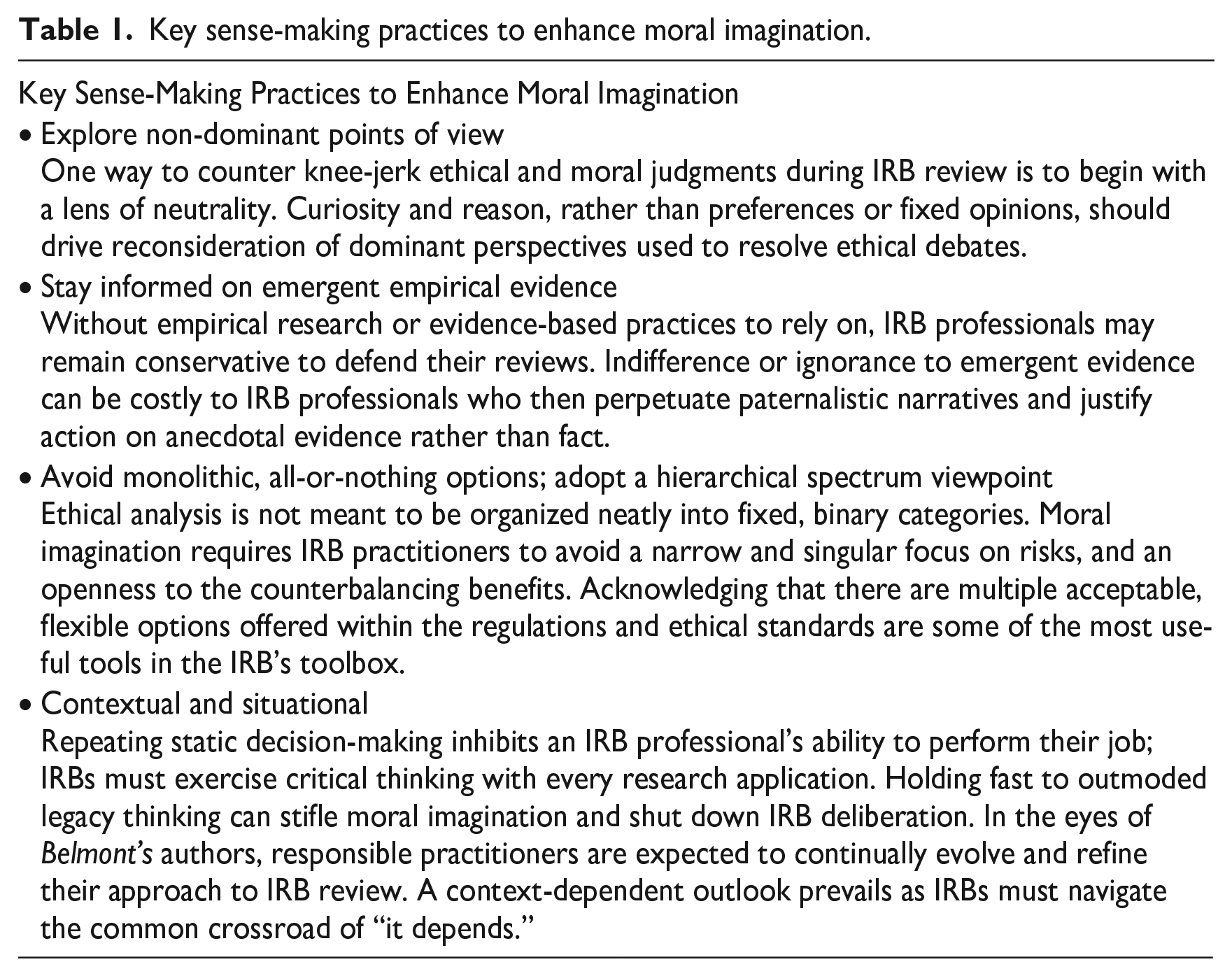
Weick (1993) pioneered the concept of sense-making and wrote: “The basic idea of sensemaking is that reality is an ongoing accomplishment that emerges from efforts to create order and make retrospective sense of what occurs” (p. 635). Sensemaking is found at the critical intersection of ambiguity and how human beings negotiate reality out of uncertainty. The unknown is a threatening place, especially with respect to human research where risks as extreme as death are possible. The possibility of failure in environments demanding high-reliability, such as participant protection, will motivate individuals to do whatever it takes to construct meaning in uncertain circumstances. However, sense-making with unclear or incomplete information can be dangerous and unproductive. Table 1 outlines key sense-making practices that IRB professionals can adopt to enhance their moral imagination. With those practices in use, the “analytic framework” of Belmont then provides a structure from which interpreters can meaningfully engage in ethical sense-making. Being able to effectively respond to unforeseen circumstances requires a well-rounded set of adaptive and proactive skills, and is ideally paired with a general roadmap. One of the Belmont’s biggest strengths is that its principles offer such counsel.
Key sense-making practices to enhance moral imagination.
The necessity of context
Prior scholarship confirms the importance of applying the Belmont principles on a study-specific basis (Bosk and De Vries, 2004; Denzin and Giardina, 2007). In agreement, Brothers et al. emphasize “the decisive role of context in the interpretation of the [Belmont] principles” (2019: 6) and Belmont framer, Albert R. Jonsen, concurs that Belmont “require[s] a constantly moving and creative interpretation” (Childress et al., 2005: 10).
Belmont Report co-author, Tom Beauchamp, reminds its readers that it is the application of respect for persons, beneficence, and justice to a research study that brings Belmont to life. He remarked: “Commissioners were always aware that this framework is too indeterminate by itself to decide practice or policy or to resolve moral conflicts. . .Belmont looks to educational institutions, professional associations, government agencies, and the like to provide the particulars of research ethics” (Childress et al., 2005: 18).
In a comparable paradigmatic shift within the landscape of human research, Faden et al. (2013) call for IRBs to adopt the “learning health care system” model. The concept of a learning model disrupts the traditional division between clinical research and clinical practice. In the authors’ view, medical practice, health care delivery, research, and continuous improvement efforts are so inextricably linked – in both their real-time goals and moral imperatives – that separating them may compromise patient protection and clinical effectiveness. Faden et al. (2013) offer a “learning health system ethics framework” to bridge the gap. Their “framework” is decidedly context-specific, which may create direct opposition between the framework’s norms of respect, risk minimization, quality improvement, common good, and addressing inequities. This should sound familiar; the same tensions arise when balancing The Belmont principles. As it happens, Tom Beauchamp, cowriter of The Belmont Report, is a contributing author to this appeal (Faden et al., 2013). It is heartening that Dr. Beauchamp’s recent work continues to: 1) reframe research ethics for interpreters at the intersection of practice, delivery, and improvement, and 2) reinforce that ethical analysis is context-dependent, no matter the framework.
Matters of ethical sense-making and problem-solving are unequivocally dependent on context and cultural responsiveness. We experience concerns of conscience across circumstances, locations, and time. Ethics is perpetually in motion, specific to the matter at hand, relative to the individual/population and their values, and situation-bound. Perhaps IRB professionals call on prior experience and wisdom as a guide, but past is not always prologue. Arriving at a moral crossroads while reviewing a research study demands practitioners explore those challenges uniquely each time and without fixed rules attached. Simply put, ethical decision-making demands moral imagination.
The role of moral imagination
As with the majority of standards that IRBs must follow, The Belmont Report is a natural floor. Higher ceilings can be envisioned though. The research enterprise should expect, and is owed, a maximal interpretation of The Belmont Report from their IRBs.
Belmont co-author, Albert R. Jonsen, insists that “The [Belmont Report], whatever form it takes on paper, must be delivered to a body of responsible interpreters who can make its words come alive in the particular circumstances of particular protocols, public policy, and the changing research enterprise” (Childress et al., 2005: 11). The most responsible interpretation of the Belmont principles is achieved when all three are precisely balanced.
Because Belmont’s goal was to put “an analytical framework” into the hands of practitioners, its purpose is to stir the moral imagination of those charged with applying it to the real world. IRB professionals, who typically do not have formal training in ethics or philosophy, are those “responsible interpreters” of Belmont, and need not be moral philosophers. Table 2 represents an integrated model of skills IRB professionals can call upon to initiate and prompt their moral imagination.
Integrated model of sense-making and moral imagination skills.
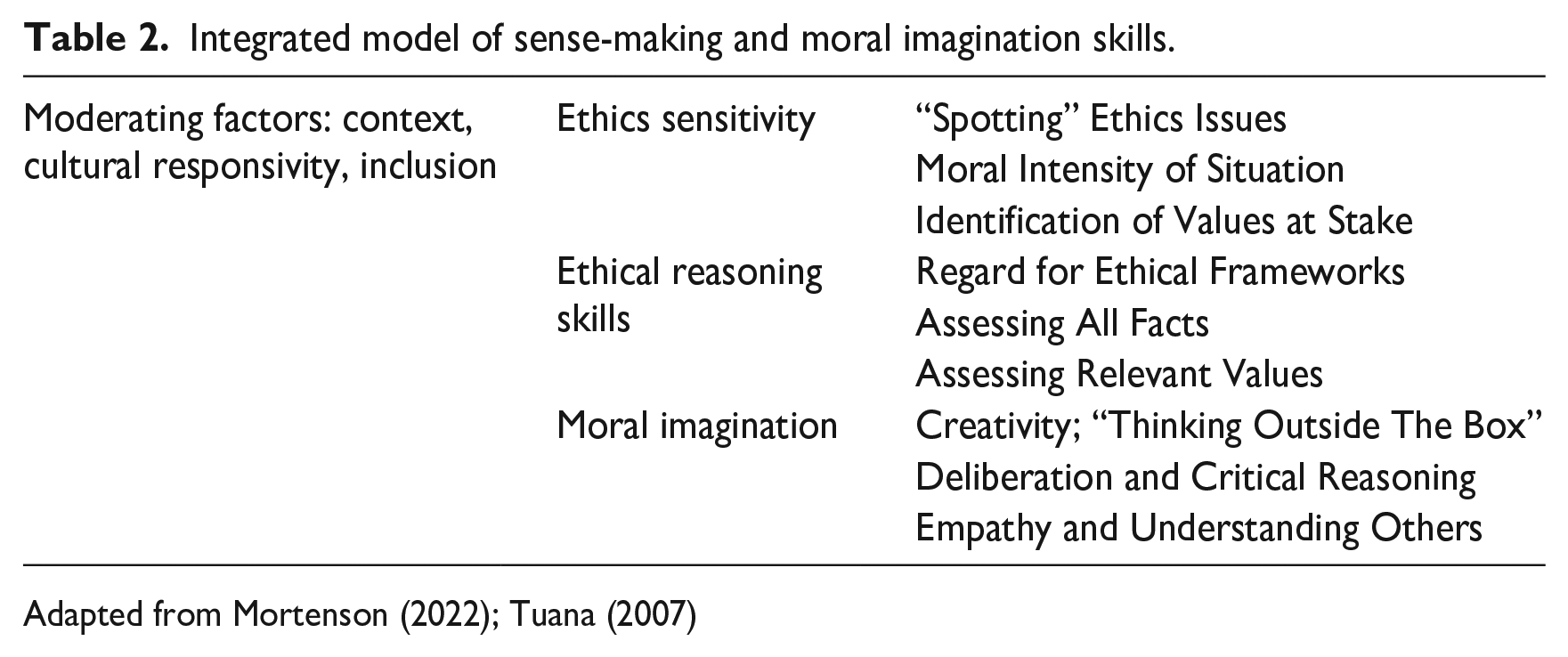
Adapted from Mortenson (2022); Tuana (2007)
The framers intent was to keep Belmont open ended, to encourage the moral imagination of its users and “responsible interpreters.” In tension is the demand from Belmont reformers for much more specificity throughout The Report, both in defining its terms with extreme precision to more concrete instruction on how each principle should be applied. However, American philosopher and educator, John Dewey, would reject those critic’s suggestions, as he said, “slavery to rigid formulas [is] the death of all high moral responsibility” (Beasley, n.d.).
To assert that The Belmont Report is limited in its utility is to make the assumption that researchers and IRBs have abstracted all of its value. I firmly disagree; Belmont appliers have simply not yet plumbed its full depth. Calling on one’s moral imagination – the recognition of challenging ethical questions and willingness to engage in a respectful struggle toward resolution – creates a pathway to creatively utilize Belmont’s principles by envisioning their use and value beyond conventional practice. Tuana defines this “imaginative processes. . .[as the] blend [of] reason and emotion through attending to what is taken for granted, what is left out of a situation, how possibilities could be otherwise envisioned” (2007: 375). It is here – at the intersection of creativity, deliberation, and empathy – that IRB practitioners can contemporize the review of ethical human research using their moral imagination.
Conclusion
On the eve of the National Research Act’s 50th anniversary, this paper offers a reflection on the genesis of The Belmont Report and a look toward the future. The authors of The Belmont Report hoped that introspection on its principles would inspire progressive growth and curiosity: “We look back not because we suppose that the Belmont principles are adequate for contemporary. . .practice but instead to recognize their historical and contemporary significance by engaging and interrogating them in current conversations” (Childress et al., 2005: 251). The “current conversations” needed by today’s Belmont interpreters are those concentrated on moral imagination, not on litigating Belmont’s fitness for the 21st century. Remember, Belmont’s authors recognized that without “responsible interpreters,” its principles would stagnate and be unrealized in real-world ethical debates.
There are unambiguously high standards associated with the IRB profession. Protecting the rights and welfare of research participants we will never meet is an enormous responsibility. Upholding those obligations and carrying out this work requires a deft command of the Belmont principles, as well as a “rich and affective commitment to being ethical” (Tuana, 2007: 375). Interpreting, applying, and maximizing the three principles should not be fixed or routinized; to do so falls short of those high standards we are entrusted with. As all professional practices do, summoning new skills requires effort, and refining them relies on repetition. Incorporating moral imagination into the daily work of IRB professionals is the most impactful way to sharpen our practices and perceive ethical dilemmas anew.
Final Note: In preparation to use the skills introduced in this paper, the Appendix includes three case studies for examination. Each case presents a commonly debated research ethics issue and demonstrates how a practitioner could apply their moral imagination to reach a resolution. Case studies can be a beneficial learning tool, translating theory to practice, as practitioners scrutinize complex information for the context-specific details essential to their analysis (Nohria, 2021). For IRB professionals, ethical case studies allow for low-stakes rehearsal, using sense-making and moral imagination as interpretive companions, in preparation for precision and decisiveness in their everyday practice.
Supplemental Material
sj-pdf-1-rea-10.1177_17470161241235772 – Supplemental material for The Belmont Report doesn’t need reform, our moral imagination does
Supplemental material, sj-pdf-1-rea-10.1177_17470161241235772 for The Belmont Report doesn’t need reform, our moral imagination does by Kimberley Serpico in Research Ethics
Footnotes
Acknowledgements
I would like to acknowledge several groups/individuals that inspired and encouraged this piece: Thank you to my peers in the 2022-2023 cohort of the Harvard Medical School Center for Bioethics Fellowship Program for supporting me and this idea, the incomparable Dr. Mildred Solomon (Director of the Harvard Medical School Center for Bioethics Fellowship Program) for pushing my thinking on this topic and advancing my ideas into maturity, colleagues within AEREO (The Consortium to Advance Effective Research Ethics Oversight) for all of their mentorship, Tonya Ferraro and Keren Dunn for their thought-provoking AAHRPP session on incorporating the community into human research protection programs, and Dr. Paige Williams and the entire Pediatric HIV/AIDS Cohort Study (PHACS) team for granting me permission to use their infant hair sample flyer in the Supplementary Materials document.2
Declaration of conflicting interests
The author declared no potential conflicts of interest with respect to the research, authorship, and/or publication of this article.
Funding
All articles in Research Ethics are published as open access. There are no submission charges and no Article Processing Charges as these are fully funded by institutions through Knowledge Unlatched, resulting in no direct charge to authors. For more information about Knowledge Unlatched please see here:  .
.
Ethical Approval
Research ethics approval was not required for this study.
Supplemental Material
Supplemental material for this article is available online.
Notes
References
Supplementary Material
Please find the following supplemental material available below.
For Open Access articles published under a Creative Commons License, all supplemental material carries the same license as the article it is associated with.
For non-Open Access articles published, all supplemental material carries a non-exclusive license, and permission requests for re-use of supplemental material or any part of supplemental material shall be sent directly to the copyright owner as specified in the copyright notice associated with the article.
