




Abstract
The increasing need for innovative research driven by rapid global changes gives doctoral supervisors of early-stage researchers a significant role in facilitating the ethical conduct of qualitative research. In the context of European Commission funding, the demands of research ethics and integrity place a tremendous responsibility on the supervisors of early-stage researchers involved in cross-national projects. This document study seeks to illuminate the role of the supervisors in facilitating research ethics in these projects. Specifically, we describe and discuss the supervisor role associated with five approaches to doctoral supervision of qualitative research, namely those described as ‘Functional’, ‘Enculturation’, ‘Critical thinking’, ‘Emancipation’ and ‘Developing a quality relationship’. The main challenges for supervisors of cross-national research projects are the cultural and linguistic mobilisation of ethical principles in qualitative research processes and the management of the future use of open data. The results from this study have implications for planning and conducting cross-national studies within research involving human participants. These results can guide supervisors in the codification and mobilisation of ethical qualitative research in practice.
Introduction
The term research ethics refers to the moral principles – including values, norms, and institutional requirements – that govern the conduct of research. Research ethics also encompass the wider social responsibility of researchers to ensure that scientific and technological development benefits society (European Commission, 2013). The moral principles of research ethics have a basis in philosophical assumptions (Holloway and Galvin, 2016) and are closely related to human rights (Beyrer and Kass, 2002).
Within studies involving human participants, various international codes of ethics have been developed. Codes of ethics are agreements concerning ethical standards aiming to express the shared understanding of a professional community, giving members a ‘pretext’ to oppose potential pressure by others, and to conduct an environment where ethical conduct is the norm (Sutrop et al., 2021). The Declaration of Helsinki (World Medical Association, 2008) and the Belmont Report (U.S. Department of Health and Human Services, 1979) are examples of codes of ethics. They were built upon the Nuremberg Code and list basic principles and ethical assumptions as guidance for researchers. An analysis of research codes of ethics in the EU project PRO-RES showed both that similar concepts are used for describing different ideas or different concepts are used for similar ideas (Parder and Juurik, 2019). This current study focuses particularly on qualitative research ethics, involving normative ethics and in large degree ongoing relational ethical assessments (Holloway and Galvin, 2016; Iphofen, 2020, n.d).
Over recent decades, there has been an increase in cross-national research projects, adding complexity to research ethics assessments. The international ethics literature has reported cross-national variation in research ethics committee membership (Druml et al., 2009; Hernandez et al., 2009) and practices (Goodyear-Smith et al., 2002; Tschudin, 2001). Desmond and Dierickx (2021) investigated the harmonisation of national-level ethical codes and guidelines in Europe. They found that national-level codes diverge on almost all aspects of research integrity except for what constitutes egregious misconduct. New regulations and norms are continually being developed to investigate misconduct and promote research integrity and ethics (Vie, 2022). Research ethics has had a long-standing attention in the European Union (EU), where all EU research funding programmes are based on the results of the ethics appraisal procedures designed around EU ethics review panels (Kritikos, 2020).
For European researchers, receiving research grants from the European Commission bestows high prestige and is of great significance for knowledge development across nations. Ethics reviews of research proposals for the European Commission focus on human rights, the protection of human beings, data protection and privacy, environmental protection, the malevolent use of research results, and compliance with international, European Commission and national laws (European Commission, n.d.). For the Horizon Europe programme (2021–2027), key changes concerning the ethics appraisal process involves research integrity, ethics self-assessment, and the ethics appraisal process. Several guidelines and tools are developed to help researchers in the ethics appraisal process, such as the Ethics issue checklist (European Commission, 2021c) and Guideline for promoting research integrity (SOPs4R Consortium, n.d.). The European Commission’s manuals also provide information on open access and data management. Open access to scientific publications and developing a data management plan are obligatory. For open access to research data, there is flexibility in consideration of research grants and the acknowledgement that some data cannot be made open. Taken together, the demands of research ethics in European Commission projects place a tremendous responsibility on the researchers, in particular on the supervisors of Early-Stage Researchers (ESRs) involved in cross-national European Commission projects. This present study focuses particularly on the supervisor’s role in the context of European Commission funding.
The accelerating shift towards cross-national research has led to a more complex role for doctoral supervisors, and even greater responsibility, placing increasing demands on the supervisors’ competence (Fossland and Gausdal, 2023). To assist beneficiaries and researchers supported by the Marie Skłodowska-Curie Actions (MSCA), the European Commission has published a guidance document on supervision. This document provides guidance for the role of the supervisor, the researcher, and the institution. It also provides guidance for training and professional development for supervisors (European Commission, 2021a). This current study bases on Lee’s (2008, 2018) five main approaches to doctoral supervision: Functional, where the issue is one of project management; Enculturation, where the student is encouraged to become a member of the disciplinary community; Critical thinking, where the student is encouraged to question and analyse their work; Emancipation, where the student is encouraged to question and develop themselves; and Developing a quality relationship, where the supervisor motivates, inspires, and cares for the student. Especially within the Functional approach, raising ethical issues is considered the task of the supervisor as the one responsible for direction and project management (Lee, 2018).
Over the years, researchers have gained experience in conducting cross-national, qualitative research in the context of European Commission funding. Still, to our knowledge, there has been sparse exploration of the doctoral supervisors’ role in such contexts. Requirements for facilitating research ethics within human sciences are high on the European Commission agenda. The aim of this study is to contribute to the literature on the supervisory roles in qualitative, cross-national research and ethical compliance within the framework of European Commission-funded research. The following research question has guided the study: how can doctoral supervisors facilitate research ethics in qualitative, cross-national research projects in the context of European Commission funding?
Materials and methods
This study has a case-study document analysis design. Document analysis is a systematic procedure for reviewing documents and is particularly applicable to qualitative case studies (Bowen, 2009). The empirical data for this study are taken from a wide range of documents, mainly from the qualitative European Commission Horizon 2020 research and innovation programme-funded project INNOVATEDIGNITY (Grant Agreement No 813928).
INNOVATEDIGNITY
The INNOVATEDIGNITY consortium is made up of scholars investigating experiential perspectives on human dignity, care, and well-being. These scholars are based in nine universities in five European countries: Sweden, Denmark, Norway, Greece, and the United Kingdom. The aims of the INNOVATEDIGNITY project are to evaluate existing care systems for older people and to develop a shared research and training agenda in order to educate the next generation of interdisciplinary healthcare researchers and care leaders across Europe. The project is a response to a widespread European need to provide sustainable and dignified care for older people at home and in residential, municipal, and hospital settings. The INNOVATEDIGNITY projects use mainly qualitative methodologies, such as interviews and observations, in addition to reviews. The research participants in INNOVATEDIGNITY projects include older people (www.innovatedignity.eu).
Fifteen ESRs were recruited into INNOVATEDIGNITY, hosted as doctoral students at the universities in the consortium and associated with their respective programmes. A recruitment criterion for the ESRs was that they could not have spent more than 12 months in the country of the hosting research institution in the 3 years immediately prior to the project start. Although the ESRs were recruited internationally, they needed good verbal and writing skills in English and proficiency in the relevant language for the local ESR project. ESRs were recruited from Africa, Asia, Europe, and North- America, and they have various professional backgrounds within health, social work, anthropology, and engineering.
Data collection and selection
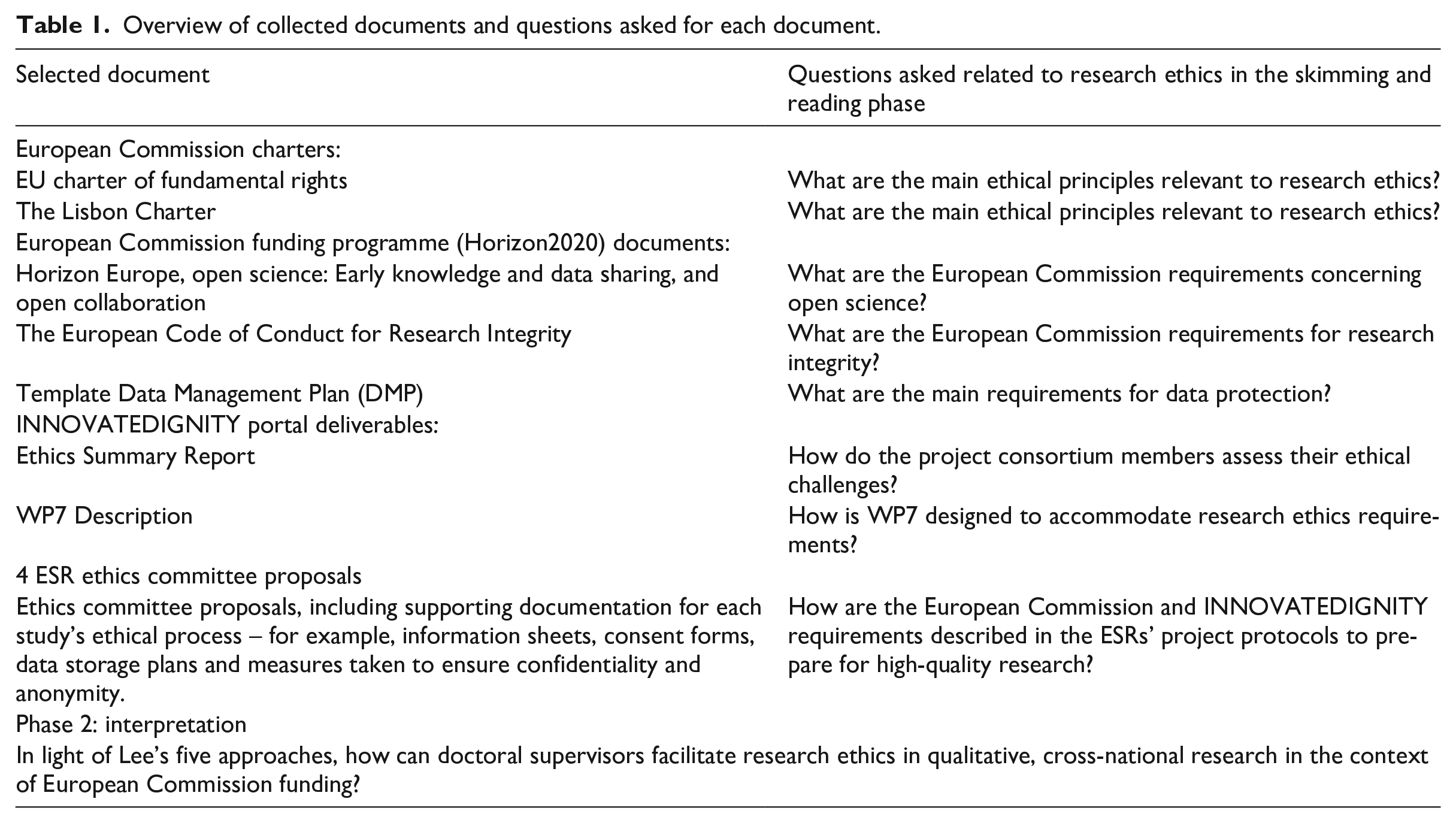
We collected a wide range of documents related to research ethics in the INNOVATEDIGNITY consortium. Documents related to research ethics from the INNOVATEDIGNITY consortium were made available for the analysis of the authors. We selected documents related to ethical values, research ethics, and data protection. Further we applied the ‘snowball’ method (Polit and Beck, 2012): Based on reviews of documents from INNOVATIVEDIGNITY, we selected cited documents that influenced the design and planning of projects. All 15 ESRs were invited to participate in this study by giving access to their ethics committee proposals. Four ESRs gave consent. An overview of the selected documents is presented in Table 1.
Overview of collected documents and questions asked for each document.
Data analysis
We followed the advice from Bowen (2009) regarding document analysis. Like all qualitative analyses, document analysis seeks to elicit meaning, gain understanding, and develop empirical knowledge. The analysis included skimming, reading, and interpretation (Bowen, 2009). The skimming and reading phases were characterised by an inductive process inspired by what Braun and Clarke (2006, 2019) described as a semantic thematic analysis approach. Themes were identified within the explicit meaning of the data – that is, without looking beyond what was written. We developed the themes by grouping together parts of the text (codes) that addressed the same topic. Themes included, for instance, data protection, coherence in research ethics through templates, and protection of participants through in situ ethical reflection. In the interpretation phase of the analysis, we used the framework of Lee (2008, 2018) with its five approaches to doctoral supervision. We interpreted this framework to identify ways that a doctoral supervisor can facilitate research ethics in qualitative research. During the analysis process, we critically evaluated findings by reflexively questioning the methods and interpretation processes. This involved reporting the results (Braun and Clarke, 2019). Inspired by a model from Bowen (2009), Table 1 gives an overview of the collected documents and the questions asked for each document in the skimming and reading phases as well as in the interpretation phase.
This study received ethics (data protection) approval from SIKT, the Norwegian agency for shared services in education and research (reference number 187199) on 18 January 2022.
Results
The results are structured and presented based on Lee’s (2008, 2018) five approaches to doctoral supervision. Doctoral supervision entails a combination of approaches, and the clear distinction of categories will not appear in ‘real life’. Still, the distinction of categories has guided us in structuring the supervisor role.
Facilitation of research ethics through a functional approach to doctoral supervision
The functional approach emphasises project management (Lee, 2018). Facilitating ethical research through the functional approach requires clarifying project management. For INNOVATEDIGNITY, there are at least two levels of project management. Each doctoral supervisor takes on the local project-manager role, and the INNOVATEDIGNITY consortium management has the overarching management role. Therefore, the functional approach to supervising INNOVATEDIGNITY projects involves planning how to organise research ethics mobilisation in the ESR’s local project in a way that is coherent with the overarching European Commission project. To ensure coherence, there are overarching guidelines for all ESR projects, complying with international and European guidelines such as the Declaration of Helsinki (World Medical Association, 2008) and the Charter of Fundamental Rights of the European Union (European Union, 2012). Through these guidelines, the consortium and the ESRs meet the requirements from the European Commission. Local institutional guidelines are also met since they align with international ethical principles and values.
The selected documents give considerable attention to data protection and data management. Accordingly, these issues are important for supervisors following the functional approach. The ESRs state in their ethics committee proposals that they will protect their data in accordance with the institutional requirements of the hosting university and provide open data by making their data ‘Findable, Accessible, Interoperable and Reusable’ (the FAIR principles). For the FAIR principles, all the ERS ethics committee proposals promise to follow European Commission data protection guidelines and store data safely in the European Commission database. In the collected documents (European Commission, INNOVATEDIGNITY and ESR), however, information is lacking on how open data are to be used and protected in the future. For supervisors, this can introduce a challenge in facilitating research ethics regarding the future use of qualitative data. To ensure consistency in data management, the ESRs use the European Commission template for their individual data management plans. Templates for information sheets and informed consent forms are collected from each participating university and country. All this conduct is in line with European Commission requirements and aligns with the EU General Data Protection Regulation (GDPR).
Doctoral supervisors operating within the functional approach need to ensure national-level ethics committee approvals (when required), permissions from each research site and compliance with the institutional requirements where ESRs are hosted as doctoral students. The ethics committee proposals from each ESR include detailed action plans, including ensuring that the duty of care is extended to the participants and that they give free and fully informed consent, receive accessible written information, and enjoy the right to withdraw and protection of confidentiality and anonymity. Research misconduct is regulated through the European Code of conduct for research integrity (ALLEA, 2023) and local institutional regulations. The supervisor’s role within the functional approach is to ensure that the necessary approvals are obtained, to ensure that the ethical deliverables to the European Commission are carried out and to avoid research misconduct. This role is not significantly different from the supervisor’s role in local ESR projects, but for the deliverables to the European Commission, all such preparations must be made explicit.
To ensure the quality of the ESRs’ ethical considerations and to respond to the European Commission’s question of how the INNOVATEDIGNITY consortium management would resolve the overarching aspects of research ethics for the whole project, the consortium management group conceived WP7, an extra work package. WP7 involves an external Ethical Scrutiny Advisory Board (ESAB), which conducts an independent scrutiny of ethics committee proposals for each ESR study. Recommendations from the ESAB are reported as a deliverable for the funder. The ESAB can thereby function as ethical quality assurance for the doctoral supervisors and consortium management. ESAB has in 2023 become almost obligatory and a guidance document are published by the European Commission (2023) on the roles and function of the ESAB.
Facilitation of research ethics through enculturation- oriented doctoral supervision
Enculturation offers a sense of belonging and an emphasis on being part of a group. The standards of the group are identified by the supervisor’s intent to include the ESR in a number of epistemological ways (Lee, 2018). Doctoral supervision in cross-national projects such as INNOVATEDIGNITY implies enacting enculturation for the ESRs, who have different cultural, linguistic, social, and academic backgrounds. Supervisors facilitate belonging to the overarching INNOVATEDIGNITY consortium group as well as to the local university’s research environment. For research ethics, enculturation can mean being culturally involved in research traditions, which can vary from site to site. The mobilisation of values and ethical principles can be embodied in members of research communities, and for enculturation through doctoral supervision it is advantageous to make such reflections explicit. Especially as the ESRs for INNOVATEDIGNITY cannot have spent more than 12 months in the country of the hosting research institute in the 3 years immediately prior to the project start, it is reasonable to assume that their master’s degree and cultural background is from another country, which implies their enculturation in other academic traditions as well. Enculturation can involve respecting institutional guidelines and also the tacit mobilisation of ethical principles in research, as when approaching gatekeepers and informants in a culturally sensitive way. Doctoral supervisors in this situation can face challenges in enculturation due to the various cultural backgrounds of ESRs.
Facilitation of research ethics through critical thinking-oriented doctoral supervision
Critical thinking emphasises intellectual rigour, offers the opportunity to think in new ways, encourages the ability to analyse arguments and recognise their flaws, and is identified as a supervisory approach by the supervisor’s intent to enable the candidate to analyse what is being planned or presented (Lee, 2018). In terms of research ethics, several templates and regulations limit the ESR’s space for critical thinking in the planning phase of the project. There is limited flexibility in laws, templates, and guidelines. For instance, for the recruitment of participants, the INNOVATEDIGNITY portal deliverables state that ‘participants will not be recruited by health service or social care professionals or any third party’ (INNOVATEDIGNITY, Deliverable D7.1, WP 7). Some ESRs state in their ethics committee proposals that to avoid any risk of coercion, a gatekeeper will be asked to send out invitation letters to potential participants. This is based on a general principle in the INNOVATEDIGNITY consortium that no contact will be made from the research team until participants have received some information, including the benefits and inconveniences of taking part in the project (INNOVATEDIGNITY, Deliverable D7.1, WP 7).
This statement limits the ESRs’ and supervisors’ space for critical thinking and creativity in the recruitment process. However, in the mobilisation of ethical principles during the research process, it is important for the ESRs to use their critical thinking. The ESRs state in their ethics committee proposals that they will follow good-practice guidance and ethical principles like respect, ensuring good consequences, fairness, and integrity. The role of the supervisors within the critical-thinking approach is to enable ESRs to critically analyse their own research process and to ensure that the ethical principles are given substantial content. For INNOVATEDIGNITY consortium ESRs, the supervisor teams consist of one or two supervisors from the hosting university and minimum one supervisor from a collaborating partner university. All ESRs carry out supplementary secondment stays with external partners in the consortium offering the possibility of broadening their insights and critical thinking. For supervisors applying the critical thinking approach, the challenge can be to balance having control over mobilisation of research ethics and the ESRs’ independent critical thinking in complex research settings. Host universities and their local PhD programmes can differ in their judgements on research ethics through the lens of a critical-thinking focus, making cross-national research projects complex.
Facilitation of research ethics through emancipation-oriented doctoral supervision
Emancipation is a core value in enabling the ESR to become autonomous. It offers the ESR support in discovering a personally meaningful framework and in personal transformation, and it is identified by the supervisor’s intent to develop ESRs in whatever direction they choose (Lee, 2018). Analysing the INNOVATEDIGNITY portal deliverables does not allow us to identify supervisors’ intent, although we can identify the relatively small space for ESR autonomy relating to the formal claims of research ethics. The European Commission guidelines are relatively bounded and cannot be adapted to local variations. Still, in the in situ ethical reflections during recruitment, data collection, and analysis, the ESR must ensure ethical research by conducting autonomous reflections throughout the process. As with the critical-thinking approach, the supervisor plays a significant role in supporting the ESR in making autonomous choices in compliance with ethical principles. A challenge for supervisors in cross-national projects can be the complexity and diversity of cultures, traditions, languages, and societal values (e.g. views on older people and vulnerability).
The four ESRs’ ethics committee proposals contained several descriptions and statements on how the ESRs planned for the mobilisation of research ethics throughout the research process. First, they presented strategies for ethical research practices in data collection. With interviews, for example, the participants would be informed that they could stop the interview at any time or choose not to answer any given question. In addition, a risk assessment and guidance for the researcher to create a positive and safe working environment when working with vulnerable older people were attached to the proposals. To work appropriately with vulnerable older people, the technique of capacity interviewing was chosen. To protect privacy and avoid the risk of intrusion, observations taking place at the institution would not last more than 4 hours at a time. The four ESRs reported on further strategies to avoid intrusion, such as offering to come back later, monitoring for distress through non-verbal signals, and ongoing communication and planning with care staff and managers. The ESRs devised strategies for safeguarding and actions to take upon observing or hearing about unsafe or harmful practices. The ESRs had undergone training on safeguarding for older people with dementia and included in their protocol a list of potential signs, such as changes in behaviour and signs of harm, to which they should be alert. The ESRs also prepared a list of examples of poor practice and possible actions to take in response. All these strategies are dependent on the ESR’s ability to make autonomous choices in situ during the research process. A challenge for the supervisor within the emancipation approach is to support the ESR in clarifying how such strategies can be approached in daily research practices.
Facilitation of research ethics through developing a quality relationship in doctoral supervision
Relationship development has the core value of affection and support. It is altruistic and benevolent, it demonstrates goodwill, and it emphasises friendship, wisdom in managing boundaries, agreeing on expectations, and preventing conflict (Lee, 2018). In the document analysis, we were unable to find descriptions of how supervisors in the INNOVATEDIGNITY consortium developed their relationships with the ESRs. However, through analysis of the four ESRs’ ethics committee proposals, we could recognise that the ESRs care for older patients as the research participants in their studies. Some older patients experience cognitive impairment and mental illness, making them vulnerable in the context of research ethics. The ESRs’ ethics committee proposals described several assessments and preparations in the event of residents’ vulnerability. Plans for dealing with this included an extensive information dissemination process encompassing posters, meetings, letters to families, staff meeting attendance, patient information sheets, sensible/pragmatic assessment of capacity, and liaison with ‘consultees’ followed by a written consent process. Given the extensive (weeks-long) observation period in one ESR study, willingness to participate should be checked at least daily. The ESRs engaged with legislative acts such as the Mental Capacity Act (2005) (applicable in England and Wales) and also familiarised themselves with relevant local legislation. With a culturally and linguistically diverse group of ESRs, it is hard to be certain whether not being native to the culture or familiar with the language where the research takes place may impact the mobilisation of research ethics in practice. It could impact relationships with participants due to ESRs’ missing subtle information in spoken language, or it could make them more aware of and sensitive to body language. The development of the relationship through caring for participants involves the mobilisation in research practices of ethical principles like respect, ensuring good consequences, fairness, and integrity. The documents’ descriptions of the prepared ethical assessments help to transform ethical principles into action. For doctoral supervisors, such descriptions make relational plans explicit and contribute to a common understanding of the relational aspects of the research process. The thorough descriptions of relational reflections in ESRs’ protocols indicates ethical discussions and reflections between ESRs and their supervisors. By spending time together reflecting upon the relational aspect of research ethics, in addition to the normative research ethics, we believe the supervisors facilitate research ethics through Developing a quality relationship in doctoral supervision.
Discussion
Our aim was to contribute to the literature on the supervisory roles in qualitative, cross-national research, and ethical compliance within the framework of European Commission-funded research. We have described our interpretation of the supervisor’s role in each of the five supervisory approaches – Functional, Enculturation, Critical thinking, Emancipation, and Developing a quality relationship – and the possible challenges connected with each. To the best of our knowledge, doctoral supervision in the context of European Commission funding for qualitative research is sparsely discussed in the research literature. We therefore make a contribution by showing the importance of the supervisor’s role in a situation characterised by increasing international complexity. Furthermore, we discuss the balance between the need for templates and guidelines to ensure consistency in research ethics and the need for autonomy and critical thinking to mobilise research ethics principles in qualitative research practices. Finding a balance between structure and freedom for doctoral students has been discussed in previous studies. Brodin (2016) states that freedom can increase critical and creative thinking, and a crucial factor in improving critical thinking is promoting students’ sense of agency in pragmatic action. However, we expect that ESRs, with their respective academic backgrounds, will also enact critical thinking independent of their supervisors’ impact. We therefore acknowledge that the supervisor’s role is not necessarily critical for how ESRs reflect and act.
The need for templates and guidelines to support supervisors in ensuring consistency in research ethics
Templates and guidelines can be important for project management and increase the degree of consistency, control, and structure in projects. Especially in European Commission consortiums, there is a need for consistency across national variations. The documents selected for this study provided consistency related to several parts of the research process, supporting the supervisor in research management. However, the documents did not provide information concerning open data. The FAIR principles represent one of the eight ambitions of the EU’s open science policy (European Commission, 2021b). The document analysis could not show how data would be de-identified, whether they would be translated, how the contextual conditions would be described, or how qualitative data could be downloaded for further use. The use of open qualitative data has been discussed in the research literature. As early as 20 years ago, Parry and Mauthner (2004) asked such questions concerning qualitative data and suggested that guidelines be developed for qualitative researchers. Such guidelines are not found in the reviewed documents, and we are not aware that any exist. For the doctoral supervisor, there can thus be a conflict between the managing approach of fulfilling the requirements of the European Commission and the mission of ensuring the ethical future use of data. Apart from the lack of any open data description, we found the guidelines and templates to be supportive for the doctoral supervisor, especially within the functional approach. Guidelines, templates, and procedures underpins the institutional responsibilities for ensuring ethical standards and compliance with the law. Research ethics is therefore not left in the hands of individuals only, but is also a matter for institutions.
The need for autonomy and critical thinking to mobilise research-ethics principles in qualitative research practices
Being a qualitative researcher involves a blurred boundary between being a fellow human being and being a researcher. Kjørholt (2011) asked whether such blurred boundaries extend the ethical space. Research participants might expect the ESR to care for them, support them, and resolve their needs. Such extended ethical reflections, which are sought after in the research literature (Carlsson et al., 2017), are identified in the reviewed documents through ESRs’ reflections on recruiting participants and collecting qualitative data. Despite detailed descriptions of data analysis, the trustworthiness of studies of people experiencing, for instance, mental illness is at risk if ethical considerations are not incorporated during recruitment and sampling (Carlsson et al., 2017). By reflecting upon ethical considerations in project protocols, the ESRs and their supervisors can be better prepared for continual ethical reflections throughout the research process. A close relationship between ESR and the doctoral supervisors can therefore prevent stress due to unexpectedly precarious interview and observation situations. The ESR are prepared for emerging situations, and a close relationship to supervisors make it easier for ESRs to share reflections after stressful situations in data collection. The approaches of enculturation, critical thinking, emancipation, and developing quality relationships can guide supervisors in such thorough planning. As previous research show that management researchers often claim a priority for the funder or commissioner over any other ‘overarching’ ethical principles (Iphofen, 2020), reflections in project protocols can make participants prepared and aware of ethical principles. Even though it may be impossible to maintain a consistent research strategy because settings are complex and changeable (Iphofen, n.d), a preparedness for the changeable will be beneficial for the ESR. Facilitating critical thinking and ethical reflection is also an institutional responsibility. The role and actions of supervisors are highly associated with whether their institution fosters an ethics culture, required for ensuring research ethics mobilisation.
For the INNOVATEDIGNITY consortium, there is a wanted complexity that stems from employing ESRs who have relatively little knowledge of the hosting university country and the spoken language. Adding to this complexity, the supervisor teams include a supervisor from a different collaborating university in the consortium. We do not know how this complexity influences ESRs’ prerequisites for autonomy and critical thinking. As reported in the results section, ESRs can miss subtle information due to language barriers, but they can also be more sensitive to non-spoken signals from research participants. Supervisors might need to be particularly alert to cultural and linguistic understandings in a complex cross-national research process.
Caring relationships are ontologically and epistemologically based on person-centred approaches and dialogue (Uhrenfeldt et al., 2018). In the INNOVATEDIGNITY consortium, regardless of the ESRs’ varied professional backgrounds, relationship-building is essential in all cases for ethical qualitative research (Kvale and Brinkmann, 2015). Through Lee’s (2008, 2018) approach of building relationships, the supervisor can facilitate ethical research by building trustful relationships with ESRs, making space for open dialogue and reflection.
Strengths and limitations of the study
The strength of this study is its collection of a wide range of documents relating to the INNOVATEDIGNITY consortium and the European Commission. Taken together, the documents provide various perspectives on research ethics in European Commission-funded projects within research involving human participants. A limitation of the study is the use of documents as data. These documents were not written for the purpose of being analysed for research, although we have been careful in our interpretation of the documents. Furthermore, the documents do not describe the supervisor’s role, so the findings are based on our analysis and interpretations. As the selected documents describe the plans for the project, the results from this study are normative (describing what the researchers believed they should do in the coming project). We do not know what they have actually done. Further research should explore emerging ethical tensions through qualitative research processes funded by the European Commission.
Conclusion and implications
The main challenges for the supervisors of cross-national research projects may be the cultural and linguistic mobilisation of ethical principles in qualitative research processes and the management of the future use of open data. The complexity of various languages, cultures and academic traditions do also provide a great richness in such projects. Documents from the INNOVATEDIGNITY consortium describe how to prepare for ethical qualitative research processes within the context of European Commission funding. Doctoral supervisors play an important role in the well-being of ESRs as well as the quality and completion of their doctoral theses. More research is needed to develop clarity on the supervisor’s role in a complex and demanding form of academic work. Also, future research should explore routines for protecting personal data in future use of qualitative open data.
The results from this study have implications for planning and conducting cross-national studies within research involving human participants. The current rapid global changes are intensifying the need for innovative care and research. Researchers and research institutions have an independent responsibility for their research to be ethical. The role of doctoral supervisors is crucial in facilitating research ethics as they are the ones training ESRs to become professional researchers. The study has also implications for all researchers conducting qualitative, cross-national research in the context of European Commission funding, not only ESRs. The results from this study can therefore help guide researchers in the codification and mobilisation of ethical research in practice.
Footnotes
Acknowledgements
We would like to thank the four Early-Stage Researchers for willingly sharing their ethics committee proposals for the purpose of this study. We would also like to acknowledge the coordinator of the INNOVATEDIGNITY consortium, Professor Kathleen Galvin for support in the research process and for providing access to INNOVATEDIGNITY Ethics Advisory and Supervisory Board documents from work package 7 of the project (with consent of ESRs). Finally, we would like to thank Dr. Judith Dyson for input to the early phase of research process.
Declaration of conflicting interests
The author(s) declared the following potential conflicts of interest with respect to the research, authorship, and/or publication of this article: Author one was a member of the external ethical scrutiny board for the INNOVATEDIGNITY consortium and authors two (being local project leader and project initiator) and three are INNOVATEDIGNITY consortium members and supervisors of Early-Stage Researchers. The authors have no financial competing interests to declare.
Funding
All articles in Research Ethics are published as open access. There are no submission charges and no Article Processing Charges as these are fully funded by institutions through Knowledge Unlatched, resulting in no direct charge to authors. For more information about Knowledge Unlatched please see here: 
Ethical and integrity statements
Data availability statement: Due to confidentiality, the data are not available.
Ethics approval statement
This study was previously discussed and approved by the co-ordinator of the INNOVATINGDIGNITY consortium. Documents related to research ethics from the INNOVATEDIGNITY consortium were made available for the analysis by the authors. Access to the Early-Stage Researchers’ ethics committee proposals was based on informed consent. The study is approved by the Norwegian agency for shared services in education and research (SIKT, reference number 187199). All ESR data have been treated confidentially. The selected documents were written without intention of being research material, so for the purpose of this study, documents are viewed as empirical material and ‘social facts’ produced, shared and used in socially organised ways within the research area (Coffey, 2014). We were aware of the ethical issues of using documents not written for the purpose of research, and we have shown awareness in our interpretations.