




Abstract
Arab researchers encounter formidable obstacles when conducting and publishing their scientific work. We conducted semi-structured interviews with 17 Arab researchers from various Arab Middle East countries to gain a comprehensive understanding of the difficulties they face in research and publication. We analyzed the transcripts using reflexive thematic analysis. Our findings revealed several key challenges. First, Arab researchers struggle to conduct high-quality research due to limited resources, inadequate funding, and a lack of a supportive research infrastructure. Furthermore, a shortage of teamwork and mentoring diminishes research productivity. Perverse promotion policies, heavy teaching loads, and low salaries force many researchers to seek external income sources, leaving them with insufficient time for research. Regarding publishing in high-impact journals, Arab researchers confront challenges existing of insufficient scientific writing skills, underrepresentation on editorial boards, and unconscious biases against researchers from economically challenged areas. Finally, achieving research integrity is closely tied to lack of access to essential resources. To address these issues, our participants proposed targeted interventions at the institutional and external levels. For example, universities can implement mentoring programs, offer workshops on scientific writing and publishing, and foster a supportive institutional culture for research. Addressing the underrepresentation of Arabic researchers on editorial boards is crucial for equity in global scientific publishing. In conclusion, acknowledging and addressing these challenges will empower Arab researchers, elevate research quality, and promote equitable global scientific collaboration. Our findings provide guidance for universities, governments, and international donors seeking to enhance research and publication practices in the Arab Middle East.
Keywords
Background
Disproportionate research outputs and unequal distribution of authorship among researchers from different world regions are well-known observed phenomena and serve as a barometer of research capacity and ownership (Schneider and Maleka, 2018). The overall pattern from several studies indicates that while there has been considerable growth in health research in low- and middle-income countries (LMICs), there has not been a fundamental change in the global proportion of research production (Franzen et al., 2017). Accordingly, disparities in output between researchers from LMICs and high-income countries (HICs) persist (Busse et al., 2022; Hasnida et al., 2017).
The underrepresentation of researchers from LMICs in the literature compared with their counterparts in HICs has been demonstrated in several research fields, including maternal health, community health, surgery, infectious disease, and psychiatry (Busse and August, 2020). These disparities are problematic, as locally produced research is essential to defining research priorities for health problems relevant to the local community to ensure that research informs policy and practice (Costello and Zumla, 2000; Sheikh et al., 2017). Challenges to conducting high-quality research include unavailable mentors (Malekzadeh et al., 2020; Sharma et al., 2021), limited funding opportunities, inadequate resources for professional development, and scarcity of skilled personnel and advanced laboratory facilities. Other studies report a deficient research infrastructure (Langhaug et al., 2020) and an unsupportive research culture as barriers to building successful research careers (Shumba and Lusambili, 2021). Additional factors that hinder research include a scarcity of research universities in LMICs and a lack of a critical mass of researchers and mentors (Shumba and Lusambili, 2021).
Regarding the Arab region of the Middle East, most universities involved with research activities are confronted with economic uncertainties, unstable political environments, and a lack of security that prevents them from functioning as “institutions of intellectual rigor and research” (Almansour, 2016). Finally, an underdeveloped regulatory and ethical framework can delay research approval (Khoja et al., 2019).
In addition to difficulties conducting high-quality research, other challenges prevent LMIC researchers from publishing in high-impact academic journals, which is essential to advance their careers and be competitive in obtaining grant funding. One mixed-methods study showed that publishing challenges included time constraints, poor scientific writing, difficulties with the submission process, lack of funding for publication fees, and statistically nonsignificant results (Majid et al., 2022).
Even when LMIC researchers submit their manuscripts to journals, problems persist with the publishing process. For example, Ehara and Takahashi analyzed the reasons for rejection from international authors who submitted manuscripts to the American Journal of Roentgenology and found that the inadequate novelty of the research represented a significant issue (Ehara and Takahashi, 2007). These authors highlighted that lacking new or valuable knowledge was among the common reasons for rejection in LMICs (44%–76% of all rejections).
Bibliometric studies on biomedical publications originating in Arab countries have shown a similar pattern of inequities in the published output. These have included biomedical fields such as HIV/AIDS (Saba et al., 2013), cancer studies (Hamadeh et al., 2017), mental health (Zeinoun et al., 2020), ophthalmology (Sweileh et al., 2015), rheumatology (Bayoumy et al., 2016), stroke (Salhab et al., 2018), and substance abuse and toxicology (Sweileh et al., 2014). While these studies reveal that the number of publications is increasing, they also show that Arab countries contribute a decreasing percentage of the total publication output among other regions worldwide.
Despite the above data, we are not aware of any study that has investigated the research and publication challenges based on the views of Arab researchers from the LMICs of the Middle East. Addressing these challenges is crucial for community health improvement and global research equality. Thus, we aimed to explore the challenges that Arab researchers 1 face in conducting and publishing their research in peer-reviewed journals.
Methods
Participants attended the interview either online using Zoom or face-to-face. Before the interview, we briefed the participants on the research objectives, methodology, and data security methods. After obtaining consent, we conducted the interviews in English, Arabic, or French, per the participant’s choice. All interviews were recorded, transcribed verbatim, and then translated to English if the original language was Arabic or French. The number of interviews was determined by reaching data saturation, which was established when no new major themes emerged from the interviews.
Subsequently, the authors explored themes and subthemes across the codes. The authors then held a second meeting to reach a consensus on the themes and subthemes. After the first draft of the themes was completed, the authors sought feedback from the senior author (experienced in qualitative research methods) to finalize the themes.
Regarding the researcher’s positioning on the subject matter, we embraced the notion that researchers are not merely value-neutral observers, as it has been challenged that researchers can “bracket” personal values and prior knowledge of a substantive field. As explained by Caelli and colleagues, “Some see it as a way of identifying and managing the researcher’s assumptions and presuppositions about the phenomenon” (Caelli et al., 2003). We approached this issue by having an interdisciplinary professional team conduct the interviews who shared equally in interpreting and analyzing the transcripts. As such, no a priori assumptions about the research were dominant.
Regarding strategies to establish rigor with the interpretation and analysis of the data, we kept a clear track of the codes, themes, and sub-themes (use of MAXQDA software), which helped the authors to re-review the responses to ensure that interpretations were not taken out of context of the complete responses of the participants. We also shared the results with several research participants to ensure accuracies of their comments. Additionally, we re-reviewed web-based recordings to correct for any ambiguous transcriptions. Finally, the concept of “challenges” represented the lens through which the data were analyzed.
• Few/Several: <8 participants.
• “Many”: 8–12 participants
• “Most”: >12–16 participants
• “All”: 17 participants
In reporting the study, we followed the Consolidated Criteria for Reporting Qualitative Research (COREQ); the checklist is presented in Supplemental File #3.
Results
Themes and sub-themes organized under four major factors.
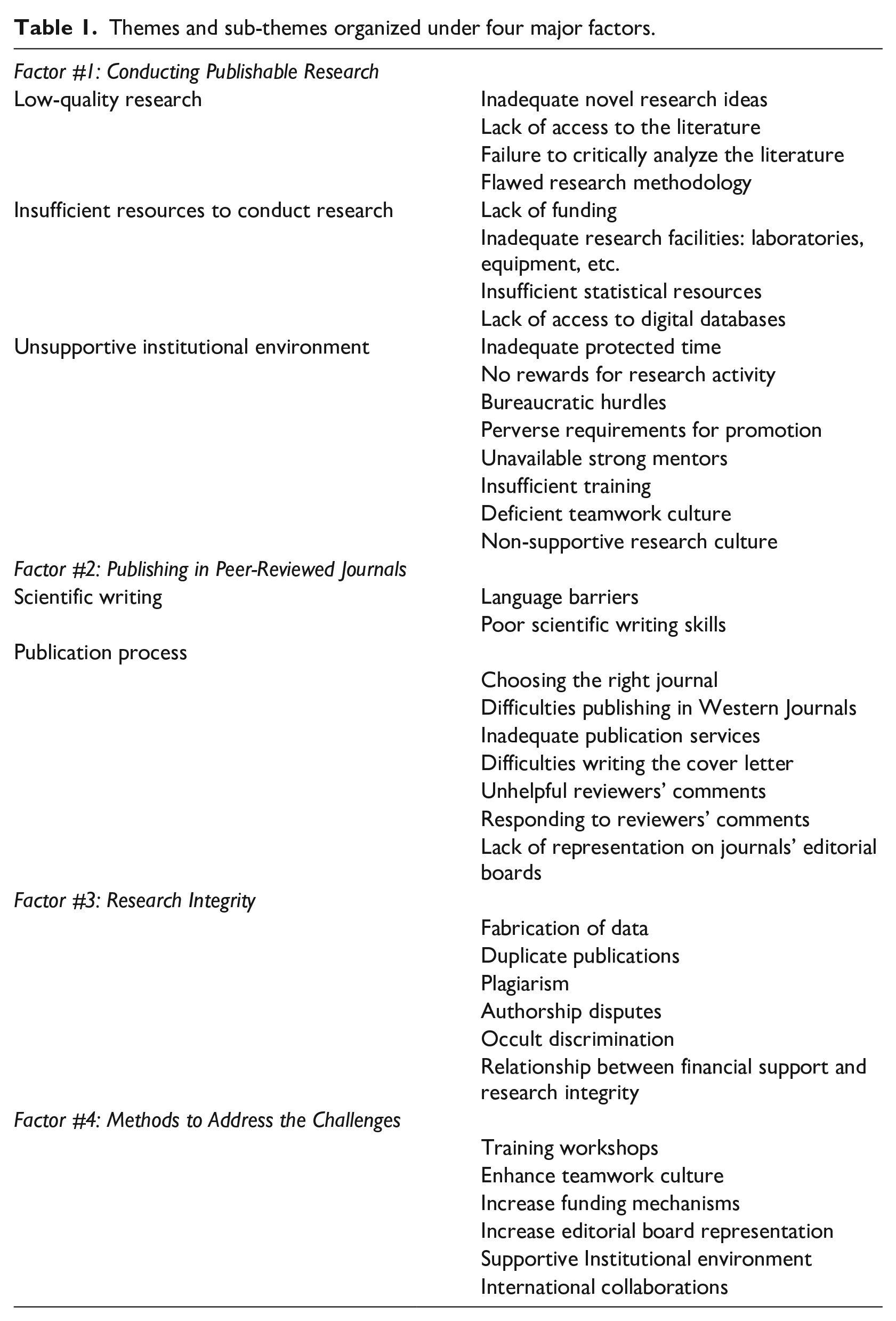
Factor #1: Conducting publishable research
Low-quality of research
“Arab researchers retake complicated topics that become old and solved. Therefore, it is common that much research made by Arab researchers are nothing, but the same topics of other research made by the European or Western Universities.” (Interview 4 Jordan, Pos. 27)
Another participant reported:
“They either select the same previously handled topics or unimportant topics. For example, I once received 17 pieces of research from a professor either for evaluation or promotion over the last two or three years. They were published either in non-international English journals or Arabic journals. Each study is the repetition of another study with a different topic. I have rejected 13 pieces of research from the 17 ones. Their topics are not worth researching.” (Interview 3 Jordan, Pos. 137)
In response to an interviewer inquiring about the reasons for journal rejections, one participant commented that:
“They [editors] mainly justify their rejection that there is much available data on the same topic and there are no new findings we provided in this research.” (Interview 1 Egypt, Pos. 76–77)
“The lack of literature might be a. . . starting point. It helps you highlight the gap and the need for your research. [However], we have limitations in locating the literature because the University does not give you wide access, for instance, to journals or publications. . .. In Jordan, paramount importance is given to gray literature, i.e., unpublished research.” (Interview 1 Jordan, Pos. 92).
Another participant mentioned the need for funding for library access:
“The institutions must pay. As you know, the national library should be the resource of knowledge. However, it must provide open access.” (Interview 5 Jordan, Pos. 57–59)
“To be honest. . . challenges start from the idea’s inception to come up with innovative ideas. Do you know why? Neither analytical thinking nor critical thinking is taught in our schools or universities. Our professional education or degrees do not teach us critical thinking in research.” (Interview 5 Jordan, Pos. 27)
“The quality of some of our scientific production is less than desired because of some choices of methodology and the purpose of the study. [The] justification is the lack of time and lack of resources.” (Interview 2 Jordan, Pos. 91)
Insufficient resources to conduct quality research
“I think that if we have funds, they should give $2000 to the researcher to fund his research requirements. Hence, he can do high-quality research that can be published in subscription journals.” (Interview 1 Egypt, Pos. 11)
Another participant mentioned that insufficient funds preclude performing prospective and randomized clinical trials:
“. . .given our means, we have very few resources, so we tend to have retrospective or cross-sectional studies. We have very few prospective studies and even fewer clinical trials. We hardly have any clinical trials despite knowing that in our field, it is essentially accepted by prestigious journals.” (Interview 2 Morocco, Pos. 37)
“. . .when I was doing my research, I first targeted a journal that is very specialized in the research topic. Six months after submission, they rejected it because they said simply, that I did not do a very tiny laboratory test that I could have done if I had the facilities in the lab. Therefore, this could be a real challenge.” (Interview 2 Sudan: 64)
Another participant said that:
“I know researchers with very old equipment but need spare parts or reactive agents. If the same researcher works on the same research outside Sudan, there is a huge difference in productivity”. (Interview 3 Sudan, Pos. 40)
“If you have a research department composed of biostat, and you will have your own [biostatistician], that will be available for you at any time. . .this will add a lot to the value of your research,” (Interview 1 Sudan, Pos. 145)
“We do not have a data collection which is electronic base. Therefore, we always use the manual one, this will be very difficult.” (Interview 1 Sudan, Pos. 23)
Several participants mentioned that the overall lack of financial resources from their institutions inhibits conducting quality research.
Another participant summarized succinctly the causes of low-quality research:
“Why do we face publishing obstacles? Because the quality of the research is low. Why? Because the resources – I mean financial and human resources – are few on all levels like logistics, requirements for research, the lack of time. All these resources are low. So, the resulting quality is low. As a product with low quality, its publishing is low as well.” (Interview 1 Egypt, Pos. 5)
Unsupportive institutional environment to conduct research
“The professor gets frustrated by his huge managerial and teaching responsibilities. Our responsibility is to teach students, supervise the masters, serve society, prepare the Ph.D., and do managerial tasks as the decider of one of the faculty committees, the dean’s assistant in a certain task, the manager of a department, and so on. All of this is time-consuming, frustrating, and energy consuming.” (Interview 2 Jordan, Pos. 87)
Several participants revealed that the meager salaries at academic institutions drive faculty to take on supplementary jobs to enhance their incomes, which causes additional workloads and time constraints. For example:
“The governmental salaries of a researcher are minimal. Therefore, he should work a second job in the private sector for his living. Therefore, he does not have sufficient time to perform scientific research for the academic Institution he is affiliated with”. (Interview 2 Egypt, Pos. 6)
“Researchers should be appreciated and financially rewarded for their contribution to the university’s global reputation. This reward is considered an incentive for them.” (Interview 2 Jordan, Pos. 192)
“By the time I have an innovative idea, then you go here and there many times. . . then [I fill in] the IRB form, so the research proposal can be reviewed, and then I submit for funding. Therefore, by the time when people [researchers] are ready [to work on it], the idea gets old. . . .that is why we go to the second-class of journals.” (Interview 5 Jordan, Pos. 71)
“The problem is that we look for quantity rather than quality. Maybe they are looking for both, but the universities want to be proud of the number of research that their students have done. There is a problem here with linking career promotions to the number of research [articles]. Such research has certain conditions that help those who put quantity over quality. Therefore, we have a general culture that encourages researchers to care for quantity more than quality. . . The researcher should be evaluated by the research activities and effort and not only by the publication number.” (Interview 6 Jordan, Pos. 59–63)
Several participants reported that when the primary motivation to publish research is to obtain a promotion, it hinders intrinsic motivation to generate original knowledge. One interviewee explained:
“Many researchers’ purposes are not the research itself, but their purpose is different: either achieving job promotion or other goals.” (Interview 3 Jordan: 135)
When asked whether “the desire of the researcher can affect publication and that the lack of desire may be a challenge to publish?” the participant responded:
“Yes, definitely, it will affect the research process. If you love something, you will do it, and you become obsessed with it.” (Interview 1 Sudan, Pos. 206–209)
“I remember when I was a dental student and I was doing, my undergraduate research, I told my supervisor about publishing it [and] .he said to me, yes, yes, you can do that, but he did not give me any guidance, and at that time, he was too ignorant, so basically, if I had a supervisor who has experience in publishing, I could have published when I was a student. Therefore, I think this is a very critical thing during undergraduate life.” (Interview 2 Sudan, Pos. 160)
“I think undergraduate is a very good starting point when they are they when they are given assignments, and these assignments are properly assessed for them. This will help them learn how to do um, scientific writing, and eventually how to publish their work.” (Interview 2 Sudan, Pos. 160)
Another informant mentioned the many different aspects of training that are needed:
“There is no training in scientific research, research ethics, publishing skills, and searching methods. Even in the English language, I can notice apparently that the language skill is weak.” (Interview 4 Jordan, Pos. 91)
“It is rooted in the culture. We did not learn to be in teamwork. Everybody wants to work secretly.” (Interview 4 Egypt, Pos. 123)
Another participant mentioned the lack of a culture for teamwork:
“We have not acquired the spirit of teamwork. The culture of teamwork and collaboration needs to be motivated. We are used to playing his role alone. Therefore, the researcher registers his study alone, works on it alone, and succeeds alone. This needs to be motivated.” (Interview 2 Egypt, Pos. 66)
“Our culture did not care for research. By ‘caring’, I do not mean that the professor requests his students to do research; I mean that the culture of designing scientific research is not proper. When students start to engage in higher studies, they begin to face unexpected challenges. . . . It takes a lot of time due to the challenges.” (Interview 6 Jordan, Pos. 42)
One researcher compared his experience in two universities, one in a Western country and the other in his home country; he said:
“At the University. . .where I did my higher studies, [there existed] an environment that encourages research. . . . . .Everybody behaves as if it is a culture there. Other environments suffer due to lack of this culture.” (Interview 6 Jordan: 44)
Another interviewee described the experience of a supportive culture:
“First thing, because it is a university, all people there surrounding you are always in an academic state of publication, research, and questions. Therefore, it is a very supportive environment that helps you to overcome a challenge. . . . This motivates us. It is a highly motivating university, except the pressure of work exists, especially in the first two semesters. . . . I adapted to the new environment and people. Then, I feel stability. I would like to continue researching.” (Interview 3 Sudan Pos. 39–40).
Factor #2: Publishing in peer-reviewed journals
Scientific writing
“Many Arab researchers suffer from deficiencies in the English language. This hinders them from publishing in highly indexed journals with international influences. Therefore, the English language is an essential obstacle. It is also an obstacle to follow the information of the most recent research of the advanced universities that are written in English.” (Interview 4 Jordan, Pos. 31)
“You could excel in the English language in terms of grammar and vocabulary, but how to write scientifically? How to divide your scientific writing? For example, what should I have in the introduction? What are the sections of the discussion part?” (Interview 5 Jordan, Pos. 27)
Publication process
Several aspects of the publication process proved to be problematic. These included the following:
“The challenge I am currently facing is how to choose the journal? This is my biggest problem.” (Interview 3 Sudan: 40)
“And this is one of the challenges that faced me personally. Therefore, when I was doing my research, I first targeted a journal that is very specialized in the research topic. . . . they rejected my work.” (Interview 2 Sudan: 64)
Interviewees mentioned the role of mentors in helping in selecting the correct journal. For example:
“They might not find appropriate support from the supervising researcher, or the lead researcher of the project. So, this is navigating how to publish, how to follow the guidelines, how to even find your journal, is the journal appropriate for the topic that you are trying to publish. There are a lot of journals out there, and there are a lot of predatory journals as you know. There is chaos. So, you need to have that support while a lot of people don’t have that.” (Interview 3 Egypt, Pos. 6)
“The most difficult problems that we face [with] the international journal. . .is that they serve certain goals and perspectives. . . . Such standards are defined based on . . .Western culture. This defines the kinds of topics that they accept. Our local topics are totally different from theirs. . .There is a big problem with the topics that are important for them”. (Interview 3 Jordan, Pos. 38)
“There should be an office to answer their questions about the publication. There should be a research publication assistant. He should assist you in publishing your papers.” (Interview 3 Sudan, Pos. 136)
Another participant mentioned the high cost of editing services to help with poor scientific writing skills:
“As our mother language is not English, we suffer from many linguistic issues. We also suffer from problems in scientific writing. However, this is not a problem limited to Arabs. For example, it is rare in Japan to find a person with good English. Most Japanese researchers send their papers to English proofreaders. . .The editing cost is very high. [The Japanese] write their papers in the Japanese language, and they send them to a company to rewrite them in English. . .the cost could increase by $1500-$2000.” (Interview 1 Egypt, Pos. 91)
“The problem with the funding budget for publishing is its costly fees.” (Interview 1 (Morocco: 4)
An additional interviewee mentioned:
“One of the obstacles was that we did not think of allocating funds, financial resources, or out of the fund, to allocate a chunk for publication fees.” (Interview 1 Jordan, Pos. 56)
Another revealing comment was the following:
“I have previously cooperated with Saudi researchers. They are ready to pay much for editing or publishing their papers. So, the financial resources are better in KSA.” (Interview 1 Egypt, Pos. 91–93)
“How to formulate a cover letter, which is a very important step in your application process, you need to write something that will grab the attention of the editor. Sometimes your manuscript will get rejected only at the editor level because your cover letter is simply rubbish, compared to today’s standards.” (Interview 2 Sudan: 32)
“They managed to get me a bad feeling because, or maybe because I could do not think about what they asked me.” (Interview 2 Sudan, Pos. 86)
Other participants explained that reviewers sometimes make unwarranted comments that delay the publication process. For example, one participant said:
“. . . we have found that the reviewers do not master some statistical aspects [but]. they make comments that the statistical methods are out of the context, which delays the publication.” (Interview 4 Morocco, Pos. 55–57)
“I would say responding to reviewers' comments is one skill that you need to have when publishing. [Y]ou cannot just agree with every reviewer’s comment because some of them are not valid. Therefore, you need to analyze what they are saying, agree with some and disagree with some.” (Interview 2 Sudan: 120)
“If you have a look at a prestigious journal, it is rare to find an Arab person on its editorial board. Most of them are either Americans or Europeans. Sometimes, it includes Chinese, Koreans, Indians, Russians, and even South Africans, but not Arabs. This could impact our rights.” (Interview 2 Jordan, Pos. 190)
Factor #3: Research integrity
Participants mentioned their concerns with several ethical issues in conducting research and publishing. These included that following:
“If you can notice the reality, you will observe many masters and Ph.Ds. are made upon fake data. Moreover, there are other research made by professors, but they are made upon unreal data.” (Interview 4 Jordan, Pos. 87).”
Another participant revealed the following incident:
“When the student gives us the data and we requested him to send us a copy of his surveys, we found out that they are totally different. . . Fake data is very easy.” (Interview 3 Jordan, Pos. 247)
“As a [reviewer], I find it hard to differentiate between fake data, delusive data, and real data, especially if the statistics analyst is very smart. He has methods to make his fake data look like the real one. So, the [reviewer] can’t detect it. There must be university training in ethics. . . . The researchers must be convinced that fake data [can] be a ‘killing factor.” For example, if there are fake data about some Covid-19 vaccines, this could kill people.” (Interview 4 Jordan, Pos. 90–91)
“It is stolen in terms of results, explanation, discussion, theoretical frame. The whole paper is stolen. I will give you an example: When I made a search for a topic, I found an Arab researcher in 2017 in an Arab journal. In 2020, the same paper with the same summary, same sample, same theoretical frame, and so on was published in another journal under the same name of the researcher.” (Interview 3 Jordan, Pos. 264–265)
“In Sudan. . . we were not trained during our undergraduate years to write scientifically and free of plagiarism. . . . In addition, one of the things that I believe helped me very much in publishing my article is that I did my masters in the UK, and plagiarism and scientific writing were an essential part of our training there.” (Interview 2 Sudan 36–46)
“I hear some of my colleagues are not interested in publishing their research because they know that even if they did most the most work, their supervisor would still be the first author because the supervisor just wants to be the first author. In addition, they cannot do anything about it. Because their supervisor would make the problems.” (Interview 2 Sudan: 146)
Another participant remarked how investigators could be left entirely off as authors in published papers:
“The only difference outside Sudan is that the rules are much stricter [regarding authorship], but in Sudan, I could engage in a project and still work on it, and then I am surprised by my work getting published under the author’s name of one of my colleagues. . . .” (Interview 3 Sudan, Pos. 37–38)
Others explained that guest, ghost, or gift authorship in publications represents a prevalent issue. They find this issue unfair to those who did the work and demotivates researchers from publication. For example:
“Just by the simple fact that he is the head of the department, we must include him.” (Interview 4 Morocco, Pos. 228)
“Yes, there is a clear bias against the Arab researchers. . .this is out of the perception of their poor quality, poor citation, so good journals stay away from accepting these papers from our side. Open-access journals are slightly open to us.” Interview 5 Jordan, Pos. 114).
An additional participant echoed this concern with unfair treatment:
“I understand that they get a lot, and they must choose what to publish, and how. But sometimes I get the feeling that once you are an Arabic or from specific demography, the threshold to publish is much higher. It is very easy to reject.” (Interview 3 Egypt, Pos. 8)
Another participant affirmed the difficulty in publishing if one is from an Arab country, but did not attribute this difficulty to discrimination:
“I know that researchers from the top 10 global universities [find that] it is more likely to get their work published than a professor from a Jordanian, Egyptian, Moroccan, or Sudanese Universities. However, the quality of researchers is probably equal. . . I can’t claim that this is deliberate. But we should admit that the minorities encounter disparities; I won’t say discrimination.” (Interview 2 Jordan, Pos. 48)
Another participant expressed the belief that journals are concerned with the ethical aspects of papers from the Middle East/North African Region:
“I’d like to emphasize that the journals we are trying to target hold a certain view, a negative view of the Maghreb and Arab researchers in terms of the reliability of their work results. So, most likely, certain articles get rejected because of this.” (Interview 2 Morocco, Pos. 28–29).
An additional respondent mentioned:
“. . .my colleagues told me that these journals are sensitive to accepting a paper from an Arab or a developing country. . . . Maybe it becomes well known that we do not have scientific research. [There is then an assumption from the journal that] all the Egyptian universities have no experience in scientific papers.” (Interview 4 Egypt, Pos. 72–73).
Another interviewee revealed the effects of the inferior quality of previous research on the subsequent ability to get published:
“. . .but I suppose there is a bit of a stigmatization regarding the Arabic research. So, I guess the articles that are submitted from the region are considered with great care already because of the reliability of the results due to plagiarism and due to the overall quality of the work.” (Interview 2 Morocco, Pos. 10).
These quotes highlight the challenge of Arab researchers bearing the consequences of past collective ethical lapses by their peers.
One interviewee noted that editors should not automatically presume that there are broad issues regarding research integrity:
“However, some journals can investigate his assumptions to make sure. others don’t! They always avoid publishing papers that come from Arab researchers. That’s why I told in the lecture of yesterday that we should make real research.”
“Sometimes, he criticizes the papers on a scientific basis. That is our fault. Other times, he was biased against us. All the mistakes that he extracts from our papers could exist twentyfold ones in the predatory papers made by the USA. . . . If he is honest, he should criticize all the papers, whatever the country they come from. However, these American journals are paid-subscription journals, so he cannot object to their work. It is, again, a bias.” (Interview 4 Egypt, Pos. 95–98)
“There should be real financial support to scientific research with control and laws so that there’s no corruption. Everything should be controlled.” (Interview 2 Jordan, Pos. 190)
“During the last ten years, the open access has increased whereas they don’t have the same integrity of the journals with subscription access. In other countries, if the research quality isn’t high, the fund covers it and gets to publish it in open access journals. As long as we don’t have this fund if the research is not of good quality, publishing it would be difficult.” (Interview 1 Egypt, Pos. x)
When asked to clarify why open-access journals do not have the same integrity as the other journals, the participant responded:
“Like for example, they send the manuscripts to reviewers who are not of good quality to meet the impact factor. If I contact a journal with an impact factor of 5, 6, or 7, the reviewers should be of high quality, or they should be specialized in the field of the research. . . .However, these journals don’t behave in this way. They contact non-specialized reviewers. . .So, there are many studies published by these journals that are of very low quality.” (Interview 1 Egypt, Pos. 5)
Factor #4: Methods to address the challenges
Participants offered suggestions for addressing the challenges of conducting quality research and achieving publications in high-impact journals. These included developing workshops in research methodologies, enhancing the teamwork culture that could increase efficiency and provide motivation, increasing funding mechanisms, and having individuals from the Arab countries serve on the journals’ editorial boards. Examples of representative quotes included the following:
“Another point is the training. It should include the new methods. . . . I submitted all my papers in the quantitative method. Even within the quantitative, there are several methods.” (Interview 3, Jordan, Pos. 231)
“. . .the more you have researchers engaged in the paper, the more everyone is motivated. I have succeeded in getting my two studies published since my coresearcher was active. He always encourages us throughout the research period and guides us to do it.” (Interview 3, Sudan, Pos. 62)
“Another important factor is the lack of real money for scientific research. I once requested 7000 Jordanian dinars for a scientific project, but they gave me only 4500. . . . There should be real financial support for scientific research with control and laws so that there is no corruption. Everything should be controlled.” (Interview 2, Jordan, Pos. 190)
“The Arab researchers should be more engaged in the editorial boards of the journals since we are not represented there.” (Interview 2, Jordan, Pos. 190)
Participants also mentioned the benefits of a supportive institutional environment.
When one interviewer asked, “Kindly tell me more about the role of the University in supporting in terms of guiding to avoid the fake data. One participant mentioned:
“There should be a proper mentorship for the researchers. . . . There should be training for professors, for example, how to publish in SCOPUS and the benefits of publishing in SCOPUS. The University must provide guidance, recommending some journals to them, send periodically some high-ranked journals. Also, training should be constant. There is [once] a course about the writing skills in the English language. This was so good.” (Interview 4 Jordan, Pos. 128–131)
“If an international institute invites me, this could be better, and you commit. The more formal the relationships are, the more commitment there is to the research.” (Interview 3, Sudan, Pos. 107)
“If you have a questionnaire, you will have another environment, and you are not limiting your research to your environment or culture; the publisher is always looking for something that can apply to everyone. Therefore, this adds value to research. The second is that sometimes you want to conduct the research, but you do not have the infrastructures that can support you. Therefore, if you make an international collaboration. . ., you can have help from other countries to help conduct the research.” (Interview 1 Sudan, Pos. 155–157)
Participants also emphasized the sharing of ideas. When asked, “How do you differentiate between the working within an Arab researcher’s team and an international team,” one said,
“The difference is in the sharing of ideas. Discussing with integrated researchers who have already published many papers is more valuable than discussion with others. They are not necessarily from Western countries. They could be from our Arab countries. Their experience is unique and meaningful” (Interview 6 Jordan, Pos. 80–81)
When asked whether it was easier or more challenging to work with international collaborators compared with local collaborators, one informant said:
“So, based on my experience, the local collaborators are involved mainly in giving data but not in the process of writing, the methodology and the design of the study, nor in the process of drafting the article, submitting it, and reviewing [it] with readers' remarks, etc. . . .Whereas when working with international researchers, we often have parts that are dedicated to this author, a second part dedicated for the writing to another author, etc. Therefore, we have a more responsive collaboration.” (Interview 2 Morocco, Pos. 75–76)
“Some of us were fortunate enough to get our Ph.D. in Western countries. So, they learned Western academic writing. . . . We learned from them how to write successfully. Sometimes, they cooperate with us as co-authors in some of our scientific productions. This increased our chances of getting published in prestigious journals.” (Interview 2 Jordan, Pos. 58).
Discussion
Our study reports on the challenges of Arab researchers regarding conducting and publishing their research. While one study investigated challenges in the Arab region of the Middle East from the viewpoints of academic leaders, for example, rectors and presidents (Almansour, 2016), this is the first study that explored the views of Arab researchers regarding the specifics of such challenges for them.
Our participants’ comments were divided into four broad categories with associated themes and subthemes. The first regards the conduct of research (and associated themes of inadequate quality of research, insufficient research resources, and unsupportive research environment). The second involves the publishing process (and the associated themes of insufficient scientific writing skills and difficulties navigating the publishing and peer-review systems). The third category addresses threats to research integrity, which could link to inadequate research infrastructure and lack of funding, training, mentoring, and time. The final category regards methods to address challenges. These includes establishing adequate training programs, providing funding, increased representation on the journal’s editorial boards, enhancing a supportive institutional environment, and the importance of establishing international collaborations, all of which can address the challenges mentioned in the first two categories.
In general, our results confirm findings from other studies. For example, Majid and colleagues performed a mixed-methods study to determine the barriers to conducting and publishing research by postgraduate trainees from Pakistan (Majid et al., 2022). Their survey showed that the main challenges included lack of time, statistically nonsignificant results, low priority for publication in their research culture, limited scientific writing skills, inadequate ability to navigate the journal submission pathway, and lack of funding for publication fees.
Similarly, Weathers and colleagues reported that the main challenges to performing research and navigating the publication process for postgraduate year-one pharmacy residents at the University of Utah, USA, included lack of time, inadequate mentorship, substandard quality of the study, and delays in obtaining approval from the respective institutional review board (Weathers et al., 2019). Finally, Almansour’s analysis of an interview study involving rectors and presidents from academic institutions in the Arab Middle East suggests that a “lack of research infrastructure, funding and resources, and English publications represent primary causes for the dilemma of Arab universities” (Almansour, 2016).
We now discuss the participants’ specific challenges regarding conducting and publishing their research.
Finally, the novelty issue begs the question of what counts as innovative research. While the journal’s scope can serve as a surrogate for what counts as innovative research, it often represents a “non-Arabic dominance” of the field of study (Orfali, 2022). Consequently, when Arab researchers conduct research investigating illnesses relevant to their health context, such research is often judged to be of low priority by American and European journals (Hanafi, 2011; Lages et al., 2015). Accordingly, to regain scientific authority, Arab academic and research institutions must increase the number of respectable Arabic journals with impact factors attracting Arab researchers (Orfali, 2022).
Unsupportive institutional research climate
Several aspects related to the research climate in Arab institutions inhibit research productivity. For example, due to the limited options for a research career, potential researchers might only implement research projects as a requirement for partial fulfillment of their degrees and not as a pathway to a defined career trajectory. Our participants cited other obstacles, including lack of funding, insufficient training in research methodology, paucity of resources to enhance scientific writing skills, and inadequate research infrastructures. Funding for LMICs research is deficient due to resource constraints and the failure of LMICs’ governments to allocate meaningful resources for research and capacity-strengthening for academic and research institutions (Shumba and Lusambili, 2021). Proper funding sits at the core of executing top-tier research. When adequately funded, researchers can design experiments, gather data, and interpret results with greater precision. Furthermore, a supportive institutional environment should offer essential services like statistical backing, library facilities, and editorial support.
However, our participants mentioned insufficient mentoring. Graduates pursuing research careers are inadequately prepared and often require intensive mentoring by senior researchers. Ineffective mentorship from senior investigators in graduate schools weakens the foundation to build their academic careers. Many of the LMICs’ universities are not research-intensive and lack a critical mass of researchers and mentors grounded in research (Sweileh et al., 2014). Shah et al. (2009) performed a focus group discussion study. They showed that many junior researchers look to mentors for support and reassurance and to play a significant role in guiding them.
The participants in our study revealed other challenges of the institutional research climate to conducting research that included perverse promotion policies, heavy faculty teaching loads, lack of incentives, and low salaries that prompt them to seek external sources of income (e.g. private tutoring and consulting) that leads to insufficient time to conduct research at their universities.
Finally, additional obstacles to scientific research at most Arab universities include economic (e.g. lack of governmental and private funding), political, and security uncertainties (e.g. the “Arab Spring” that caused unsafe institutional environments and migration of good faculty) (Almansour, 2016). Not surprisingly, conducting research represents a low priority among academic leaders as they are concerned with other issues vital to their survival (Almansour, 2016; Lages et al., 2015). However, international experts have emphasized the importance of building a research infrastructure based on sustainable financial resources and a research system that motivates researchers. Furthermore, employing English as the language of research is crucial to receiving global recognition (Almansour, 2016; González-Alcaide et al., 2017).
Navigating the publishing process
In addition to barriers to conducting research, Arab investigators face challenges with publishing in high-impact journals. These challenges include lack of proper representation of LMIC researchers on journals’ editorial boards because of the dominance of English in the research literature, power dynamics that determine the order of authorships, and the perceived or actual bias of editors toward LMIC researchers (Sharma, 2021; Smith et al., 2014). Our participants emphasized many of these issues.
Many participants also emphasized deficiencies in scientific writing that present publishing challenges. In addition, academic journals lack the staff and budgets to offer extensive writing support services to authors who submit promising but poorly prepared manuscripts (Busse and August, 2020). A potential concern is that international English journals adhere to specific writing style standards that might favor manuscripts written by native English speakers. Finally, Shah and colleagues found from their interview study that “cognitive burden” was a significant inhibiting factor in the writing process, as participants considered the writing task excessively complex and demanding (Shah et al., 2009).
Additionally, universities with a robust research program prioritize ethics training and establish committees to monitor research conduct. They set clear ethical guidelines and nurture a culture that emphasizes responsible research. Our participants’ insights shed light on the connection between the availability of these institutional factors and achieving research integrity.
What our participants found most troubling is the potential for latent or unconscious bias toward LMIC researchers, often rooted in prior misconducts from these regions. “Unconscious bias” refers to implicit prejudices about researchers from economically challenged areas, which are not always overtly acknowledged. This subconscious prejudice might surface during peer reviews, possibly leading to the undervaluing of research from LMICs or reluctance to collaborate with LMIC scientists. Addressing this requires recognizing and challenging our biases. As highlighted by our participants, Western journals need to reassess their perceptions of LMIC researchers.
Additionally, as one participant aptly questioned, why are not Western researchers subjected to similar scrutiny despite evident of their instances of misconduct? While research misbehaviors might be more prevalent in LMICs (Felaefel et al., 2015; Martinson et al., 2005; Okonta and Rossouw, 2013), it is crucial to understand that research misbehavior is not exclusive to any region. Even in the West, there are misconduct cases stemming from resource limitations, inadequate ethics training, and the “pressure to publish,” which dominates both world regions. Tackling these biases is imperative for fostering a more equitable and inclusive global scientific community.
Furthermore, the value of collaborative groups among LMIC researchers has become evident. For example, Galligan and colleagues highlighted that a sense of collegiality permeated writing groups, enhancing the writing process (Galligan et al., 2003). In their interview study, Shah and colleagues confirmed this sentiment, as participants appreciated the role of peers and mentors in group writing (Shah et al., 2009). Finally, Pololi and colleagues found that writing in pairs led to more concise and grammatically accurate texts (Pololi et al., 2004).
International collaborations
Many participants endorsed collaborations with international investigators as an important method to address barriers and increase the likelihood of quality research and subsequent publications. A multinational research team is advantageous because the diversity of viewpoints leads to a wider variety of novel research ideas for studying emerging diseases, treatment responses, novel clinical decision-making tools, and ways to reduce health disparities (Ilonze et al., 2022). Furthermore, LMIC universities can collaborate with institutions from HICs to obtain funding.
Despite our participants’ advocacy for international collaborations, problems exist. For example, power dynamics inhibit fair international collaborations between researchers from HICs and LMICs (Busse and August, 2020; González-Alcaide et al., 2017). Other significant issues involve the fairness of authorship rank and the sharing of funding (Smith et al., 2014). Power differences between researchers from HICs and LMICs and perceived bias in medical journals that favors prominent Western researchers as first authors lead to unfair authorship practices in North-South collaborations (Salager-Meyer, 2008; Smith et al., 2014). For example, one study showed that whereas the absolute number of LMIC first authors has increased, it has declined as a proportion of all authors. The relative rate increase in first authorships post-2000 was 11.8-fold for non-LMIC first authors and 2.8-fold for LMIC authors. LMIC first authorship increased over time for research funded by LMIC, but LMIC’s first authorship declined over time for research funded by high-income countries (HICs) (Hasnida et al., 2017). Additionally, in studies where authors from LMICs and HICs collaborate, authors from LMICs are less likely to be represented in the first and last author positions, which reflects disparities in leadership and decision-making power (Busse et al., 2022). This reduced participation among researchers in LMICs is further revealed by their limited presence as corresponding authors (González-Alcaide et al., 2017). The disparity between LMIC and HIC first authors can be partially rectified if international funders develop mechanisms that direct funding to LMIC researchers, which can lead to more significant equity in global health research (Charani et al., 2022; Kelaher et al., 2016).
Limitations and recommendations for future research
We acknowledge several limitations in our study. First, our small sample size of just 17 respondents from select countries in the Arab Middle East might not encapsulate the diverse experiences of the entire region. Accordingly, our findings make it difficult to generalize from a small sample (Lages et al., 2015). Additionally, given the limited sample size, themes dependent on faculty sub-categories and specific university contexts might remain unexplored.
Given these limitations, future studies should pursue a follow-up quantitative study to accurately obtain the extent of our themes occurring throughout the LMICs in the Arab Middle East. Additionally, targeted investigations could compare experiences based on gender, academic career stages, and disciplines like medicine versus surgery and explore the impact of varied research infrastructures, cultures, and national settings. These would offer insights leading to tailored recommendations for enhancing the research system.
Recommendations
Our results showed the myriad challenges that Arab researchers confront with conducting research and scientific writing. To address these, we propose several targeting interventions at the institution level and at entities external to the institution.
Entities external to the institution
Conclusion
Arab researchers face significant challenges in conducting and publishing their research. If these challenges are not addressed, they risk remaining dependent on external expertise, reinforcing the pre-eminence of scientists from high-income countries. Our study identified key obstacles that Arab researchers confront with publishing original, impactful research. These insights can inform the design of research training programs, both at undergraduate and postgraduate levels, tailored to the specific needs of Arab scholars. Universities can use our findings to shape training initiatives that bolster research productivity. Furthermore, governments and international donors can utilize this information to effectively allocate resources and foster collaborations that enhance research quality and scientific writing competencies.
Supplemental Material
sj-docx-1-rea-10.1177_17470161231214636 – Supplemental material for Challenges facing Arab researchers in conducting and publishing scientific research: a qualitative interview study
Supplemental material, sj-docx-1-rea-10.1177_17470161231214636 for Challenges facing Arab researchers in conducting and publishing scientific research: a qualitative interview study by Alya Elgamri, Zeinab Mohammed, Karima El-Rhazi, Manal Shahrouri, Mamoun Ahram, Al-Mubarak Al-Abbas and Henry Silverman in Research Ethics
Supplemental Material
sj-docx-2-rea-10.1177_17470161231214636 – Supplemental material for Challenges facing Arab researchers in conducting and publishing scientific research: a qualitative interview study
Supplemental material, sj-docx-2-rea-10.1177_17470161231214636 for Challenges facing Arab researchers in conducting and publishing scientific research: a qualitative interview study by Alya Elgamri, Zeinab Mohammed, Karima El-Rhazi, Manal Shahrouri, Mamoun Ahram, Al-Mubarak Al-Abbas and Henry Silverman in Research Ethics
Supplemental Material
sj-docx-3-rea-10.1177_17470161231214636 – Supplemental material for Challenges facing Arab researchers in conducting and publishing scientific research: a qualitative interview study
Supplemental material, sj-docx-3-rea-10.1177_17470161231214636 for Challenges facing Arab researchers in conducting and publishing scientific research: a qualitative interview study by Alya Elgamri, Zeinab Mohammed, Karima El-Rhazi, Manal Shahrouri, Mamoun Ahram, Al-Mubarak Al-Abbas and Henry Silverman in Research Ethics
Supplemental Material
sj-docx-4-rea-10.1177_17470161231214636 – Supplemental material for Challenges facing Arab researchers in conducting and publishing scientific research: a qualitative interview study
Supplemental material, sj-docx-4-rea-10.1177_17470161231214636 for Challenges facing Arab researchers in conducting and publishing scientific research: a qualitative interview study by Alya Elgamri, Zeinab Mohammed, Karima El-Rhazi, Manal Shahrouri, Mamoun Ahram, Al-Mubarak Al-Abbas and Henry Silverman in Research Ethics
Footnotes
Acknowledgements
None
Authors’ contributions
AE contributed to the design of the study, conducted interviews, analyzed, and coded the transcripts, and was a major contributor to writing the manuscript. ZM contributed to the design of the study, conducted interviews, analyzed, and coded the transcripts, and contributed to the writing of the manuscript. KE conducted interviews, analyzed, and interpreted the transcribed interviews, analyzed, and coded the transcripts, and contributed to the writing of the manuscript. MS contributed to the design of the study, conducted interviews, and contributed to the writing of the manuscript. MA contributed to the design of the study, conducted interviews, and contributed to the writing of the manuscript. AA conducted interviews and helped with the interpretation of the transcribed interviews. HS contributed to the study’s design, analyzed, and interpreted the transcribed interviews, and was a major contributor to writing the manuscript. All authors read and approved the final manuscript.
Availability of data and materials
Declaration of conflicting interest
The author(s) declared no potential conflicts of interest with respect to the research, authorship, and/or publication of this article.
Funding
All articles in Research Ethics are published as open access. There are no submission charges and no Article Processing Charges as these are fully funded by institutions through Knowledge Unlatched, resulting in no direct charge to authors. For more information about Knowledge Unlatched please see here:  .
.
Supported by Award Number R25TW007090 of the Fogarty International Center at the National Institutes of Health. This funding body had no role in any aspects of the study.
Ethics approvals
Ethics approval was obtained from the following research ethics committees:
• Sudan (Ministry of Health - Khartoum State No: KMOH-REC-03.45.5)
• Morocco (Avis Du Comite D’Ethique Hospital-Universitaire D’Ethiquesc sous le N° 33/20)
• Egypt (the University of Beni Suef, Approval FMBSUREC/07022021/Mohammed 2); Jordan (Jordan University Hospital, Ref 10/2021/428)
• Jordan (Jordan University Hospital, Ref 10/2021/428),
• USA (University of Maryland, Baltimore, Institutional Review Board, HP-00094497).
Supplemental material
Supplemental material for this article is available online.
Notes
References
Supplementary Material
Please find the following supplemental material available below.
For Open Access articles published under a Creative Commons License, all supplemental material carries the same license as the article it is associated with.
For non-Open Access articles published, all supplemental material carries a non-exclusive license, and permission requests for re-use of supplemental material or any part of supplemental material shall be sent directly to the copyright owner as specified in the copyright notice associated with the article.
