




Abstract
Ethics review processes are frequently perceived as extending from codes and protocols rooted in biomedical disciplines. As a result, many researchers in the humanities and social sciences (HASS) find these processes to be misaligned, if not outrightly obstructive to their research. This leads some scholars to advocate against HASS participation in institutional review processes as they currently stand, or in their entirety. While ethics review processes can present a challenge to HASS researchers, these are not insurmountable and, in fact, present opportunities for ethics review boards (ERBs) to mediate their practices to better attend to the concerns of the HASS disciplines. By highlighting the potential value of the ethics review process in recognising the nuances and specificity across different forms of research, this article explores the generative possibilities of greater collaboration between HASS researchers and ERBs. Remaining cognisant of the epistemic and methodological differences that mark different disciplinary formations in turn will benefit the ethical conduct of all researchers.
Introduction
While no single discipline ‘owns’ ethics and ethical thinking, the practice of reviewing research for ethical clearance sits at a significant disciplinary-paradigmatic intersection. Moral philosophy, as a field of philosophical enquiry, lays claim to declarations of the philosophical tenets underpinning ethical conduct, including the consideration of normative convictions around what is ethically right. MacIntyre (1998), for example, indicates how classical conceptualisations of ‘virtue’ and ‘justice’ provide a foundation for considering ethical practice and the enactment of ‘judgement’ as an important tenet in the determination of what is ethical. 1
By contrast, the ‘practical’ 2 review of research is predominantly conducted under codes and protocols that are rooted in the biomedical sciences. Emmerich (2013) notes that these disciplinary fields are ‘widely assumed to be the intellectual pater familias of the “research ethics community”’ (p. 181). The principles underpinning ethics review and the practices that define the conduct of ethics review boards (ERBs) developed largely in response to historical violations of human rights, adverse research events and their legal ramifications, with the fields of medicine and psychiatry specifically implicated. As Stark (2010) observes, ‘ethics codes are invented at moments of professional vulnerability, not at moments of strength’ (p. 339).
The codes and protocols that define approaches to the practical review of research compel ERBs to consider: (i) the methodological decisions and approaches proposed by researchers; (ii) the ways that research participants will be engaged in the conduct of the proposed research; and (iii) the implications that extend from the outcomes of the research intervention. Although concerns for the philosophical foundations of ‘virtue’ and ‘justice’ may be important in the deliberations that ERBs apply, it remains that the purpose of the ethics review corresponds more deliberately with the pragmatic determination of the appropriateness of the research and the implications it will exert, with these concerns codified within ‘specific institutional processes and procedures’ (Baloy et al., 2016: 6). Determination of such appropriateness is subject to various forces, such as institutional expectations, grant requirements, and research or committee culture.
Negative sentiment and perceptions of disciplinary prejudice
We draw attention to this distinction to illustrate how developments in the practical conduct of ethics review draws from defined disciplinary, methodological and epistemic perspectives. For researchers who work beyond the disciplinary and epistemic boundaries that define ethics review processes, perceptions of mis-alignment with the tenets of their research can result in negative sentiment towards ERBs and review processes. On this point Israel and Hay (2006: 1) observe that ‘social scientists are angry and frustrated’, believing that their research is being ‘constrained and distorted’ by ethics regulation that does not understand their research, or is driven by different (biomedical) imperatives. Existing ethics review processes are viewed in some quarters as irrelevant to the methodological choices and epistemic standpoints applied in the humanities and social sciences (Dingwall, 2008; Emmerich, 2013; Israel and Hay, 2006). Emmerich (2013), for example, notes that ‘it is not clear that the ethics and the form of ethical governance developed in one context are suited to application in another’ (p. 177), going on to highlight that ‘in “research ethics” there seems to be an assumption that “research” (and researchers) or, indeed, “science” (and scientists) are coherent or unified underpinning concepts and categories’ (p. 177). As Emmerich (2013) concludes, it is ‘on the basis of these assumptions [that] a specific form of [ethical] governance was conceived’ (p. 177).
Critics of ethics review processes highlight the ‘illegitimacy of extending the biomedical model of ethical regulation to the HSS [Humanities and Social Sciences] disciplines’ (Dingwall, 2008: 3), noting a difference between the harm of ‘injecting someone with potentially toxic green stuff’ and ‘a potential for causing minor and reversible emotional distress or some measure of reputational damage’ (Dingwall, 2008: 3). Dingwall (2008) is not alone in this assessment. Truman’s (2003) survey of the ‘ambivalent relationship’ (p. 73) of social science research to institutional review boards extends a similar argument, leading her to question the appropriateness of existing ethics review processes and the relevance these have for researchers from the humanities and social sciences (p. 70). Hammersley (2009) echoes these concerns, identifying how varying traditions in the consideration of ethics positionality mediate judgements ‘on what is intrinsically good or bad’ (p. 212).
We highlight these criticisms and the disciplinary distinctions they imply as the focus of this paper. Although we acknowledge the challenges that review processes present for different disciplines (and in particular, those defined under the designation of HASS), we highlight the potential value of the ethics review process as a provocation towards greater collaboration between HASS researchers and ERBs. The following discussion identifies that, although the hard edge of existing ethics review processes present disciplinary-epistemic challenges for HASS researchers, these are not insurmountable. We argue that opportunity to mediate ethics review practices to more readily attend to the concerns of the HASS disciplines are indeed possible; remaining cognisant of the epistemic and methodological differences that mark different disciplinary formations in turn will benefit the ethical conduct of all researchers. To visually summarise the debate we raise here, we conclude the discussion by presenting a conceptual diagram depicting how we see the tensions between disciplinary-epistemic approaches, combined with reflexive responses from the ERB that can accommodate these tensions.
Situating the argument: The context of higher education
In making this claim for the specificity of HASS research, we highlight that the contexts within which ethics review processes are enacted prescribe the practical conduct of the ethics review. As extensions of larger administrative and bureaucratic assemblages, ethics review practices operate within higher education contexts that exert influence over the ways that research is designated and evaluated. As most within this sector recognise, neoliberal managerialism is significant in determining how processes deployed in universities – including those processes associated with the ethics review – gain bureaucratic form and function (Connell, 2013; Giroux, 2002; Mintz, 2021; Olssen and Peters, 2005).
Since the late 1970s, this transformation has emerged in terms of the ways that ‘we think about, organise, and fund education’ (Mintz, 2021: 80), with the conjoined logics of ‘efficiency of the free market, the need for deregulation and the reduction of government spending on social services’ (Mintz, 2021: 81) reconfiguring the social function of higher education. An effect of this transformation is evident in the ways that higher education is administrated. Although the prerogatives of the free market shape the ‘outward’ function and funding landscape for higher education, increased control defines its ‘internal’ machinations. In Australia, the context from which we write, successive reform agendas and policy compacts since the 1980s have worked to impose greater levels of accountability, competition and economic rationalism into the Australian higher education system (Marginson, 2013). This is a situation that Barry et al. (1996) observe ‘involves less a retreat from governmental “intervention” than a re-inscription of the techniques and forms of expertise required for the exercise of government’ (p. 14). Scott (2004: 439) observes that in this climate, universities have transformed into ‘technically contrived service organisations’ driven to accept the values of industry, yet with the bureaucratic overlays of internally mandated governance.
Ethics review processes operate within this climate. In Scott’s (2004: 439) view of the external stakeholder-driven modern university, ‘ethical issues are in danger of becoming second-order issues’ that are conceived of in procedural terms rather than as fundamental to the values and practice of higher education and research. As James (2021) notes, under these conditions ethics review processes become enmeshed within ‘regulated, tightly administered practices within universities’ (p. 548), and function as points of enactment for accountability and compliance. James (2021) argument identifies that the ethics review process represents a tangible indicator of ‘a shift towards administration and the embedding of regulatory machinery within universities’ (p. 551), where the review board is activated as a locus for compliance-checking and disciplinary control (p. 550). A similar view is noted in Johnson et al.’s (2020) observation that, for many researchers, ethics review represents an ‘adversarial rather than a communicative’ (p. 742) function and that ‘close scrutiny, over-regulation and obsessive control’ (p. 742) define the conduct of ERBs.
While we are sympathetic to such criticism and acknowledge that the audit-culture inherent to the contemporary university provides a mediating context in the enactment of ethics review processes, we note that such processes can, when motivated by a spirit of engagement and collegiality (Allen, 2008; Hickey et al., 2022) alternatively provide the foundation for far more generative encounters. In our previous research (Hickey et al., 2022) we have noted that when ERBs approach ethics review with a conviction towards deliberative engagement, the ethics review process can be actively used to advocate for modes of research that might otherwise be proscribed. Providing that the constitution of the ERB’s membership is considered carefully and that ‘a wide range of expertise and disciplinary knowledge’ (Hickey et al., 2022: 553) is represented, the capacity for the ERB to advocate for and endorse approaches to research beyond narrowly conceived ‘rational, scientific and quantitative’ (Troiani and Dutson, 2021: 5) forms of research presents as a distinct opportunity.
It is in this way that the ERB can in fact work to confront the conditions of the neoliberal university. Rather than working to further entrench narrow conceptions of research (and researchers), a deliberative ERB provides a bulwark against proscription by provoking engagement and the development of broad understandings of what ‘counts’ as research conduct. A representative and deliberative ERB has within its purview this capacity, where the board affords an important function for recognising and supporting diverse forms of research activity. We now turn to consider the principles that underpin the constitution of an ERB working under this remit.
Challenges in current approaches to ethics review
The challenges inherent to prevailing approaches to ethics review include: (i) a higher education climate that is not favourable to HASS research, 3 and (ii) ethics review practices that are perceived as being inappropriate to HASS research. We argue that ERBs that apply generic and institution-wide review processes, and that maintain memberships with narrow disciplinary expertise are at risk of marginalising other research disciplines. On this point we note Busher and Fox’s (2021: 475–6) observation that ERBs invariably preference ‘research projects based on utilitarian understandings of ethical practice’, which may be an inappropriate response to much HASS research. Ignoring the disciplinary nuance and epistemic foundations of distinct research approaches generates prescriptive ethics review practices. In this sense, we argue that it is imperative that ERBs seek to maintain wide understandings of approaches to research and the concomitant epistemic and methodological foundations that inform diverse modalities of inquiry. We suggest that two factors must be considered by ERBs seeking to engage deliberative and engaged approaches to ethics review. In the first, we suggest that an ERB that maintains broad expertise within its membership maintains capacity to effectively review ethics applications. In the second, we argue that direct engagement with researchers by the ERB provides a basis from which to deliberate on the nuances that are inherent to specific research practices. We turn now to consider these factors in detail.
ERB membership and the disciplinary purview
Various ethics codes recommend or mandate the composition of ERBs with the expectation that it includes members with expertise in the research fields and methods of the applications it expects to receive. In our Australian context, The National Health and Medical Research Council’s (NHMRC, 2007: 5.1.30) National Statement on Ethical Conduct in Human Research mandates that Australian ERBs comprise the chair, at least two lay people, at least one person with counselling knowledge and experience, at least one pastoral member, 4 at least one lawyer, and at least two people with current research experience relevant to the proposals being discussed at the meeting they attend, in addition to requirements about gender diversity and external membership. Each of these membership categories bring an important perspective to the review process. For example, some researchers may not be entirely abreast of the legal implications of their research, while the pastoral member might provide insight on local community perspectives that could impact the recruitment of participants. The National Statement recommends that ERBs establish pools of members for each category as a general administrative principle, but notes this specifically in relation to the current researcher category, emphasising a disciplinary connection between the reviewing member and the research under review.
The expertise resident within the ERB itself presents a fundamentally important means for ensuring the enactment of informed review processes. To enact reviews that recognise the nuances and specificities across (and within) different forms of research and to promote trust in the ethics process as a legitimate point of assessment requires consideration of the disciplinary and methodological expertise resident within the ERB. The expertise of the ERB’s membership should be mapped against university research agendas and research priorities, to ensure that review board expertise aligns with the types of research conducted within the institution. Although we recognise that agreement within disciplines is not always unified and that variations in ways of conducting research are just as likely within a discipline as they are beyond the discipline, an ERB that attends to ensuring wide representation in its membership maintains a greater capacity to recognise diverse disciplines and specific methodologies.
In extension to this consideration of the ERB’s disciplinary expertise, opportunity also exists to draw on wider networks of expertise resident within the university itself. At our own university, the ERB that we represent has recruited ‘discipline experts’ (Hickey et al., 2022) to extend the ERB’s expertise and points of contact in Faculty. These members of the academic staff are situated within the university’s Faculty and are recognised for their expertise in specific methods and approaches to research. Following induction training that details the principles utilised at our university for enacting ethics review and an overview of the bureaucratic processes associated with assessing the ethical merit of a project, the discipline experts are called upon to work with researchers to develop applications and to ensure that aspects of the research are sound, comply with the law, and are ethically and culturally appropriate. 5 Beyond providing the ERB with further points of expertise, the preliminary reviews undertaken by the discipline experts has had the effect of producing better-quality and more refined applications, which in turn has resulted in a more rapid turn around and higher rates of approval of applications.
The discipline experts are also on occasion called on to advise the ERB on specific methodological applications. In this role, the discipline experts inform the ERB on how a particular approach to research should be considered. This involves the ERB deferring to the discipline expert to gain insight into the disciplinary nuance that inflects specific methodological applications. Such practices are especially pertinent in instances where applications for ethics review deal with sensitive topics, vulnerable participant groups, or seek to deploy novel research designs. The expert in these instances must maintain expertise and a track record of research practice that is directly relevant to the research under review and be in a position to provide an informed appraisal to support later deliberations by the ERB. Engaging faculty-based experts in this way enables the ERB to draw upon expertise without unduly over-populating the ERB’s core membership. 6
We have cast the role that the discipline experts play in terms of a ‘triage’, where the discipline experts provide a point of contact and advice on the research merit of a project and the broad ethical implications of its design. The discipline expert is positioned to relay to the ERB a sense of the nuance and specificity inherent to specific types of research, and relay broad trends emergent in their discipline/s and Faculty. This is especially prevalent where larger research teams that support cohorts of higher degree researchers seek to pursue particular modes of inquiry using specific methodological applications. The discipline expert in these instances provides a point of liaison to (i) relay advice on how the methodological and epistemological tenor of particular forms of research should be encountered and evaluated by the ERB, and (ii) appraise the ERB of emergent applications of research practice from the faculty unit.
Direct engagement with the research community
A second strategy involves the ERB’s members engaging directly with researchers. Hickey et al. (2022) identify that engaging researchers in the review process provides an opportunity to broach connections with researchers and inform ERB practice. This can be achieved by having researchers participate directly in the deliberations of the ERB, or via processes where representatives of the ERB convene with researchers to later report back to the full ERB (Hickey et al., 2022). Engaging directly with researchers as discipline experts enables the ERB to understand the objectives guiding the researchers’ prerogatives, and to deliberate in real-time with the researchers.
Deliberative engagement with researchers provides an opportunity to raise awareness of the ethical dimensions of research and the ethics review process. Providing researchers with a clear sense of the ethics requirements inherent to the ethics review process, and with clear lines of communication to seek advice and provide input, generates a distributed responsibility for the research ethics process. When researchers are positioned to engage in dialogue with the ERB and remain cognisant of the processes inherent to ethics review, responsibility for meeting the requirements of ethics review is shared.
As a means for moving beyond the ‘textual mediation’ (Smith, 1990) of the application and to expedite the approval process, liaising directly with researchers has the effect of: (i) providing an interpersonal forum for the relay of ERB concerns regarding an application; (ii) opening opportunities for researchers to clarify and illuminate aspects of the project and ethics application; and (iii) identifying, in collaboration with the researcher, appropriate ways forward for revising and progressing applications. Enabling researchers to engage directly with the ERB allows for the development and refinement of an application to occur in advance of formal submission, and in turn, generates opportunities for the enhancement of understanding around ethics review processes and the production of better-quality ethics applications.
Engagement of this type can take multiple forms. A first point of contact should be positioned within the ERB’s administration office. Having this initial ‘point of contact’ to receive inquiries and refer questions is important for relaying to researchers that the ERB remains contactable. Equally, having key members of the ERB – its chair and senior members in particular – available to engage with researchers further enhances the ERBs capacity to provide support.
More intensively, the ERB might undertake to convene formally constituted training and development activities. In the ERB that we represent, administrative personnel assigned to the day-to-day operation of the ERB are responsible for convening faculty-based workshops for early-career and higher-degree researchers (and others unfamiliar with our specific processes), along with more specialised programme and project specific workshops that attend to the specific attributes of defined programmes of research. These staff also convene weekly online ‘chat’ forums where researchers can contact the ERB and pose questions around aspects of an application and the wider ethical dimensions of a research project. Practical measures such as these enable direct contact with the ERB and provide the basis to not only support researchers, but allow the ERB to gain insight into the specifics of research projects.
The epistemology of the ethics review
We acknowledge that, even with the application of these strategies, that the basic epistemic assumptions inherent to ethics review represent a challenge for HASS research. Significant here is the epistemological division that defines qualitative-interpretivist and quantitative-positivist approaches to enacting research and producing data (Tolich and Fitzgerald, 2006). In their survey of ERBs in five different countries, Tolich and Fitzgerald (2006: 71) observed that they were ‘yet to find an ethics committee that reflects qualitative epistemological assumptions’ (p. 71). Their conclusion was to ‘accept that the epistemological assumptions [that they aligned with] fit ethics committee expectations like a round peg in a square hole’ (Tolich and Fitzgerald, 2006: 71).
Echoing Tolich and Fitzgerald (2006), Bell and Wynn (2020) observe that a ‘fundamental epistemological conflict’ (p. 206) emerges between qualitative researchers and ERBs in terms of the ways that framings of risk, benefit, and consent are configured in social science research. They apply the notion of ‘imaginations of risk’ to identify three key elements of risk inherent within prevailing ethical review process: the risk posed by research itself, the risk posed to the institution, and the risk posed to the researcher (2020: 10). For Bell and Wynn (2020) qualitative-interpretivist researchers hold antithetical views on risk to those applied by ERBs, with this posing a point of epistemic conflict. Various scholars have highlighted how these imaginations of risk can prevent important research from advancing, particularly in the humanities, social sciences, and fields using community-based participatory research methods, such as the creative arts (e.g. Ferris et al., 2021; Massoumi et al., 2020; Sluka, 2020; Tamariz et al., 2015).
These examples highlight inherent epistemic assumptions in the review of research. We suggest that the intersection of these with systemic pressures inherent to the managerial university context creates further tensions. While biomedical epistemic concerns drive the processual impetus of the ethics review, the mediation of its effects might be more deliberately associated with risk management and aversion. Hedgecoe (2016) raises this point in terms of ‘reputation management’. As Hedgecoe (2016) notes, reputation management ‘involves control of internal organisational behaviour as a precursor to managing external reputations’ (p. 488), with the implication for ERBs corresponding with the oversight role that they play. Beyond merely undertaking ethics review for the evaluation of the merit inherent to a specific research inquiry, ‘the expansion into higher education of specific ways of organising public sector work, known as “new public management”’ (Hedgecoe, 2016: 487) has had the effect of monitoring how research is conducted and disseminated with emphasis given to the implications for a university’s reputation. As Hedgecoe (2016) identifies, under this logic, an ERB serves ‘as an instrument of organisational reputation management, preventing the gathering of data that might, when published, harm the University’s interests’ (p. 490). The problem identified by Hedgecoe (2016) rests in how the work of the ERB is positioned, in whose interests, and for what purpose.
Reporting from our own experience, we note that our own ERB has not encountered similar pressure to conform to university mandated sensibilities. We remain autonomous to the point of assessing applications for ethics clearance based on merit. Having said this, we have however been active in bridging connections with the senior executive of the university and maintain close contact with the university’s research integrity office and directorate of research. This has encouraged a relationship that enables the ERB to relay details on its deliberations and practice, assert its presence as an important entity within the university’s administration and, perhaps most importantly, maintain autonomy in its statutory function. Undertaking our deliberation impartially to the university’s executive while maintaining close dialogue and representation with the university executive arm has enabled the ERB to avoid the pitfalls identified by Hedgecoe (2016) in functioning as a jurisdictional entity.
Notably, The NHMRC’s (2007) National Statement provides some coverage to ensure this impartiality. Under Making and Communicating Decision, section 5.2.23 notes, ‘A review body may approve, request amendment of, or reject a research proposal on ethical grounds’. This is extended under 5.2.24 (c) and further emphasis of the required impartiality of the review process is noted in 5.2.28. We take seriously this mention of the approval, amendment or rejection of an application ‘on ethical grounds’ and defer to the principles outlined in the Statement to defend decisions made. With the reporting and disclosure of ERB deliberations and processes, and a stated adherence to evaluation processes on ethical grounds, we are positioned to ensure that the ERB reviews the merit of the research and is not unduly influenced by university interests.
Discussion: Towards a humanities-oriented ethical review practice
Critiques of the appropriateness of ethics review processes in HASS have drawn attention to ‘the personal ethics of “self-regulation”’ (Alderson and Morrow, 2006: 407). Two dimensions define this position: (i) that social science research is intrinsically more ethical in its remit because it engages with questions of what Bosk (2007) refers to as the researchers’ sense of ‘moral certainty’ (see also Bærøe et al., 2022; De Wet, 2010; Peled-Raz et al., 2021; Sheehan et al., 2018), and (ii) that ethics review processes risk undermining the value and purpose of HASS research (Alderson and Morrow, 2006: 409).
We resist these assertions and suggest that there are good reasons to undertake ethics reviews of HASS research. Not least for the oversight and ‘quality assurance’ that the review process provides, the ethics review also broaches the possibility for nurturing a research community by providing a point of engagement, professional development and professional dialogue.
Views that position ethics review as simply a ‘control mechanism’ (Stolp, 2016: 16) miss the value that a deliberative and engaged ERB can provide. As our own experiences indicate, considerable capacity exists for the ERB to engage with researchers and nurture a larger climate of research conduct. We extend Alderson and Morrow’s (2006) suggestion that ethics processes can indeed inform research practice and provoke deeper understandings of the implications it generates. As they argue ‘research ethics can introduce practical, realistic insights in new dimensions’ (Alderson and Morrow, 2006: 412). Accordingly, we summarise the following as reasons for why HASS researchers should engage with ethics review processes. These processes present as:
- a mode of seeing a research inquiry from a distinct perspective: that of the impact on the research participant.
- a way of understanding research in terms of its impact.
- a means for considering the specificity of a research intervention and the intrinsic nature of the conduct of research.
- a way of situating a research inquiry in context of its epistemic assumptions.
- a final opportunity for a thorough and impartial check that the human research application is methodologically, legally and ethically appropriate to proceed.
Rather than hinder research activity, engaging with the ethics review process holds the capacity for enhancing understandings of the research process.
An ERB that is enabled to engage with its research community maintains ‘the potential to act as glue that helps to hold together what would otherwise be very disparate knowledge traditions’ (Scott, 2004: 445). Further, Brown et al. (2020: 764) found that educational researchers were more likely to see ERBs as ‘friend’ rather than ‘foe’ when the review process was built upon mutual understanding and learning, a flattened hierarchy, and deliberative application processes. We agree with this sentiment and, in Figure 1, present our depiction of how the ERB, through adopting a deliberative and engaging approach to its efforts, addresses the diverging methodologies of HASS researchers.
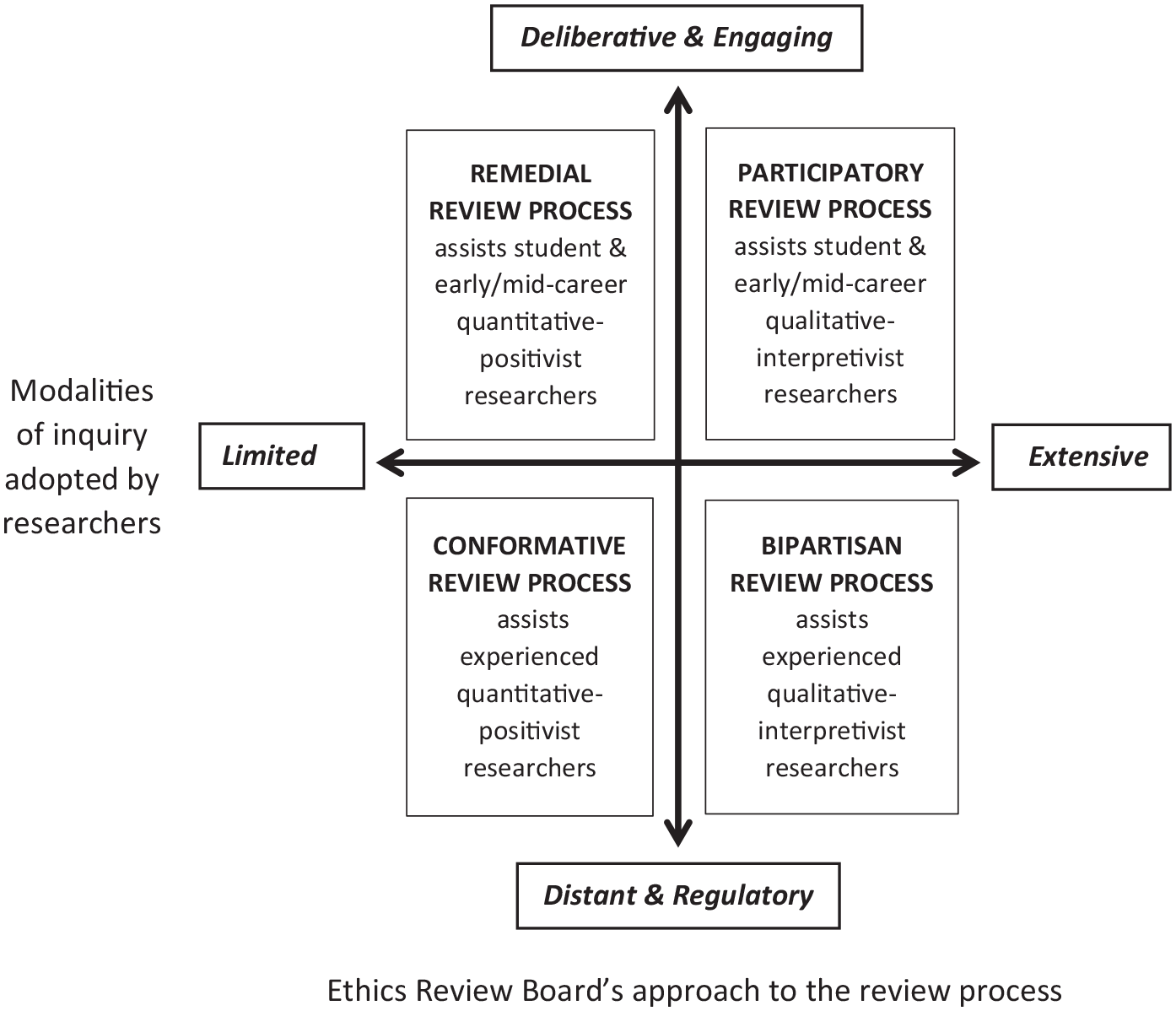
Broadening the traditional ethics review board’s approach to address the diverging needs of humanities and social sciences research.
The matrix presented in Figure 1 depicts the intersecting dynamics between (a) the variety in research designs contained within ethics applications submitted to ERB’s for assessment, and (b) the ERB’s approach to assessing these applications. On the horizontal axis, the methodologies proposed in ethics applications can range from narrowly prescriptive, positivistic designs to an extensive variety of interpretivist designs. The vertical axis reflects the ERB’s operational style, ranging from being distant and regulatory through to deliberative and engaging. We have argued in this paper that ‘traditional scientific’ methods associated with quantitative-positivist research are used extensively within the biomedical and ‘hard’ sciences. These methodologies are more likely situated at the ‘limited’ end of the modalities of inquiry spectrum, for which ERBs traditionally focused on providing a compliance and authoritarian assessment. Comparatively, HASS researchers use a wider variety of research methodologies, including extensive use of qualitative-interpretivist and mixed-pragmatic approaches. These approaches lead to what can be unusual and/or complex research designs that push and ultimately advance the ERB’s interpretation of how ethical obligations are enacted across different contexts.
By intersecting these dynamics, the resulting quadrants contain what we propose are four general ERB approaches to assessing ethics applications. The upper, ‘remedial’ and ‘participatory’ quadrants provide for traditional ERB’s broadening their approach to address nuances and specificities of HASS applications, as well as provide a supportive and advisory structure for student and early to mid-career researchers across all disciplines. The remedial review process of the upper quadrant might typically involve the ERB providing constructive written feedback on gaps in relation to more standardised quantitative research designs. In comparison, the participatory review process can involve additional, direct engagement, including meeting with the researcher(s) to clarify and/or better understand their research design and to offer advice for addressing the study’s ethical obligations.
The two lower quadrants reflect ERB operations that would be more appropriate for experienced researchers across disciplines, reducing the need for the educative aspects associated with the upper quadrants. Therefore, the pure, conformative review process involves a focused compliance assessment, best suited to highly structured, positivistic research approaches submitted by experienced researchers. Here, the ERB’s assessment tends to reflect a more rigid and expedient ‘yes/no’ outcome. In this approach, the ERB is more likely to be perceived as partisan or ‘foe’ by the researcher. Hence, the bipartisan review process prompts the ERB, prior to determining a ‘yes/no’ position, to represent the ‘friend’ stance and extend requests for further clarity in circumstances where experienced researchers are submitting novel and unfamiliar research designs associated with interpretivist-qualitative studies. Finally, notwithstanding our advocacy for ERBs to embrace a deliberative and engaging philosophy as a fundamental tenet for assessing any application before it, an assumption of this model is that ERBs tend to operate across these four approaches subject to the profile of each application before it.
The demand for ERBs to be increasingly reflexive and dynamic in the service they provide is apparent throughout this paper’s discussion. The conceptualisation and typology presented in Figure 1 highlights the importance of an ongoing conversation as to how ERBs need to remain relevant and productive in line with the veritable feast of research ethics applications they assess. We welcome further debate and refinement of the concepts introduced here. The need is clear for ongoing scholarship on the evolving practices of ERBs to continually evolve our understandings of ‘ethically safe’ research, and to optimise the service and value-add ERBs provide to university structures, the research community and broader stakeholders, within the context of societal, regulatory and environmental shifts.
Conclusion
We commenced this paper by drawing attention to the disciplinary distinctions that frame ethics review. Although the HASS disciplines might maintain association with the tenets of moral philosophy, ethics review processes have emerged from the pragmatic codification of biomedical epistemic concerns. This association presents a tension. The ‘chorus of complaint’ (Bosk, 2007: 196) that has emerged from HASS researchers, suggests that formalised ethics review processes fail to understand the tenets of HASS research, and consequently disempower its researchers. We hold a different view.
Fostering a deliberative institutional environment where the ERB ensures that its membership is representative of the research conducted within its institution, and that researchers are enabled to engage with the ERB, provokes a climate of mutual benefit for researchers and the ERB. Reflecting upon our own practices as an ERB in an Australian university, we note that the assessment of research for its ethical merit is enhanced when ERBs seek to understand the conditions and assumptions that inhere to specific disciplinary and methodological applications. Through these means, review processes develop as more deeply informed. Opening opportunities for ERBs and researchers to engage and deliberate on the ethical dimensions of research establishes the foundations for better research, with this especially significant for HASS researchers.
Footnotes
Ethical approval
Not applicable.
Funding
All articles in Research Ethics are published as open access. There are no submission charges and no Article Processing Charges as these are fully funded by institutions through Knowledge Unlatched, resulting in no direct charge to authors. For more information about Knowledge Unlatched please see here: 