




Abstract
Adolescent populations have become increasingly accessible through online data collection methods. Online surveys are advantageous in recruiting adolescent participants and can be designed for adolescents to provide informed consent without the requirement of parental consent. This study sampled 338 Australian adolescents to participate in a low risk online survey on adolescents’ experiences and perceptions of their learning in science classes, without parental consent. Adolescents were recruited through Facebook and Instagram advertising. In order to judge potential participants’ capacity to consent, two multiple-choice questions about the consent process were required to be answered correctly prior to accessing the survey. This simple strategy effectively determined whether middle adolescents had the capacity to provide informed consent to participate in low risk online educational research.
Introduction
Given that up to 98% of Australian adolescents have access to the internet (Australian Bureau of Statistics, 2018), online data collection methods offer researchers significant opportunities to access adolescent populations. Unsurprisingly, online methods of data collection are increasingly popular due to the potential to recruit relatively large samples of participants (Barchard and Williams, 2008) and the ability to make contact with populations that are difficult to access in-person (Harris and Porcellato, 2018). Furthermore, studies have shown that data obtained online is comparable in quality to that collected in-person (Krantz and Dalal, 2000; Ramsey et al., 2016; Shapka et al., 2016).
This paper focuses on the use of online tools to both recruit adolescent participants and administer surveys, an approach that is distinct from more traditional methods involving recruitment of adolescent participants through schools followed by online survey administration. In order to judge potential participants’ capacity to consent, we implemented a similar strategy to Friedman and colleagues (2016) which involved the inclusion of two multiple-choice questions about the consent process that were required to be answered correctly prior to accessing the survey. This study reports on this simple strategy that effectively determined whether middle adolescents had the capacity to provide informed consent to participate in low risk online educational research.
Literature review
Online studies of adolescent populations have been advantageous in providing increased access to hard-to-reach populations, reducing the time and cost of conducting such studies, and gathering data that is comparable in quality to that collected in-person (Friedman et al., 2016; Ramsey et al., 2016; Shapka et al., 2016). Researchers have conducted research online with adolescent populations, particularly those who might be difficult to reach in-person, for example, sexual minority youth (Friedman et al., 2016; Kaysen et al., 2011; Ybarra et al., 2015) and those experiencing specific health issues (Ahmed et al., 2013; Chu and Snider, 2013; Close et al., 2013). Despite the advantages of online studies of adolescents, there appear to be comparatively fewer studies that have used online recruitment for educational purposes. Online educational studies with adolescents may be more advantageous than traditional in-person research methods, which typically involve reaching adolescent participants via schools or school systems. Such approaches cause disruption to school activities and may be a burden for school communities (Gu et al., 2016). These barriers can be mitigated through conducting online studies of adolescents of school age, without parental consent. To achieve this, several ethical considerations must be addressed in relation to access to potential participants and organizational barriers, and attaining consent from adolescent participants.
Access to potential participants and organizational barriers in educational research
There are several significant challenges associated with recruitment of school-aged participants through school systems (Gu et al., 2016). In order to access potential participants, researchers must first seek approval from schools, and in some cases, approval from larger regulatory bodies. These layers of gatekeepers potentially restrict educational research in school settings. While the gatekeepers play an important role in considering potential legal, ethical and time-related implications related to research activities with children (Lamb et al., 2001; Rice et al., 2007), they also restrict researchers’ access to potential adolescent participants, restricting their right to participate in research that addresses issues that are potentially relevant and important to them. An adolescent who is capable of forming his or her own views should have a right to participate in online studies and to express their views on matters that affect them (OHCHR, 1990), particularly matters that relate to their own learning in schools. While most institution review boards require adolescent consent alongside parental consent (Friedman et al., 2016), adolescent consent alone is appropriate and ethical in online research studies where risks are minimal (Alderson and Morrow, 2011). Research is considered to be low risk when the most serious anticipated risk to participants is discomfort (National Health and Medical Research Council, 2018).
Consent
It is generally expected that parental consent is obtained prior to adolescents up to 18 years of age participating in research (Amon et al., 2014), reflecting the notion that parents or caregivers make decisions in the best interests of their child. This requirement is important when young people are incapable or unwilling to access and understand information about what participation in a study involves (Spriggs, 2010). However, a limitation of requiring parental consent prior to participation in research is that adolescents may be prevented from participating in research that they would like to be involved in (Skelton, 2008). This situation contradicts Article 12 of the United Nations Convention on the Rights of the Child, which states that “parties shall assure to the child who is capable of forming his or her own views the right to express those views freely in all matters affecting the child, the views of the child being given due weight in accordance with the age and maturity of the child” (OHCHR, 1990: 4). Accordingly, adolescents’ consent alone can be used if the risks associated with the research are minimal (Alderson and Morrow, 2011). For example, the Australian National Statement on Ethical Conduct in Human Research (National Health and Medical Research Council, 2018) states that “an ethical review body may approve research to which only the young person consents if it is satisfied that he or she is mature enough to understand and consent, and not vulnerable through immaturity in ways that would warrant additional consent from a parent or guardian” (p. 66).
Previous studies have also obtained waivers of parental/caregiver consent, particularly if youth would be placed at risk of increased harm by parents/caregivers being approached for consent, for example in studies of gender and sexually diverse youth (Ybarra and Mitchell, 2016). Adolescents who are mature enough to provide informed consent can therefore take part in online research studies and present their own views without this risk of harm. As there is no direct interpersonal approach by researchers or other parties interested in the research (e.g. school personnel/teachers), the anonymity afforded by online research means adolescents can truly decide whether they want to participate or not. In comparison to face-to-face recruitment, a benefit of anonymous online research is that potential participants are less likely to feel coerced into participating in the research, for example by teachers, parents, or other adult authority figures (Friedman et al., 2016). It is also easier for participants to withdraw from research during the study in anonymous online research because social pressures are minimal (Barchard and Williams, 2008), especially in comparison to research conducted in schools.
In conducting online research based on adolescent consent alone, it is critical that participants understand the requirements of participating in research (Amon et al., 2014). According to Alderson and Morrow (2011), factors such as having the ability to understand what is being asked and being informed about what the research entails can be considered when determining whether someone has the capacity to consent to participating in research. As age is not a reliable indicator of a young person’s capacity to consent, researchers in face-to-face settings may gauge participants’ maturity by undertaking individual telephone conversation with potential participants to determine capacity to provide informed consent (Amon et al., 2014; Ybarra et al., 2016). In online research, such strategies are not possible, and researchers need to implement alternative strategies in order to judge potential participants’ capacity to consent.
Several approaches have been implemented to ensure young people read and understand information to allow them to provide informed consent to participate in research administered online. In an Australian study, participants provided consent online as well as verbally over the phone (Ahmed et al., 2013). Similarly, Ybarra and colleagues (2016) recruited participants online and then individually phoned potential participants to discuss and determine capacity to provide informed consent. These procedures decrease the chance of individuals feeling coerced to participate in the study (Barchard and Williams, 2008), however participants were unable to remain anonymous. It has also been argued that distributing consent information online is insufficient as participants may indicate consent without reading documents (Pequegnat et al., 2007; Rosser et al., 2009). To mitigate this, Friedman and colleagues (2016) ensured anonymity and informed consent by recruiting adolescent participants online through a series of initial questions about the consent process. Adolescent participants were asked to answer two or seven multiple choice questions about the consent process to “ensure the potential study participants understand the nature of the studies they are being asked to participate in” (Friedman et al., 2016: 19). In this study, we adapted the two-question strategy to gage participant capacity and understanding of the consent process. In this paper, we report on the strategies used to ensure ethical administration of an online survey for 14 to 17-year-old girls and boys in Australia. The survey focused on learning in science classes and participants were recruited through paid Facebook and Instagram advertising. Parental consent was not required for participation in the survey.
Method
Participants
Recruitment of participants was conducted through paid Facebook and Instagram advertising targeted at 14 to 17-year-old girls and boys in Australia. The study advertisement reached 101,975 users (62.17% female). Of the users reached by the advertisement, 1200 (68.25% female) clicked on the link to access the study and consent information. After reaching the study information and consent form, 338 potential participants indicated their interest in participating in the study. No incentives were offered for participating in the study.
Procedure and measures
This study received institutional ethics approval prior to commencement. It was necessary to address several ethical issues in order to obtain approval for online recruitment without parental consent. First, the study was designed to minimize risks to participants by ensuring that survey questions were unlikely to cause discomfort for participants. The survey and participant information statement was also written using developmentally-appropriate language so that adolescents were likely to be able to understand what was asked of them. Second, we identified that there was no risk of coercion as there was no direct contact with researchers and the survey was not conducted in schools. Therefore, adolescents had the ability to decide whether to participate and could withdraw at any time without any perceived consequences. Third, we used two multiple choice questions to determine adolescents’ capacity to provide informed consent prior to them accessing the survey.
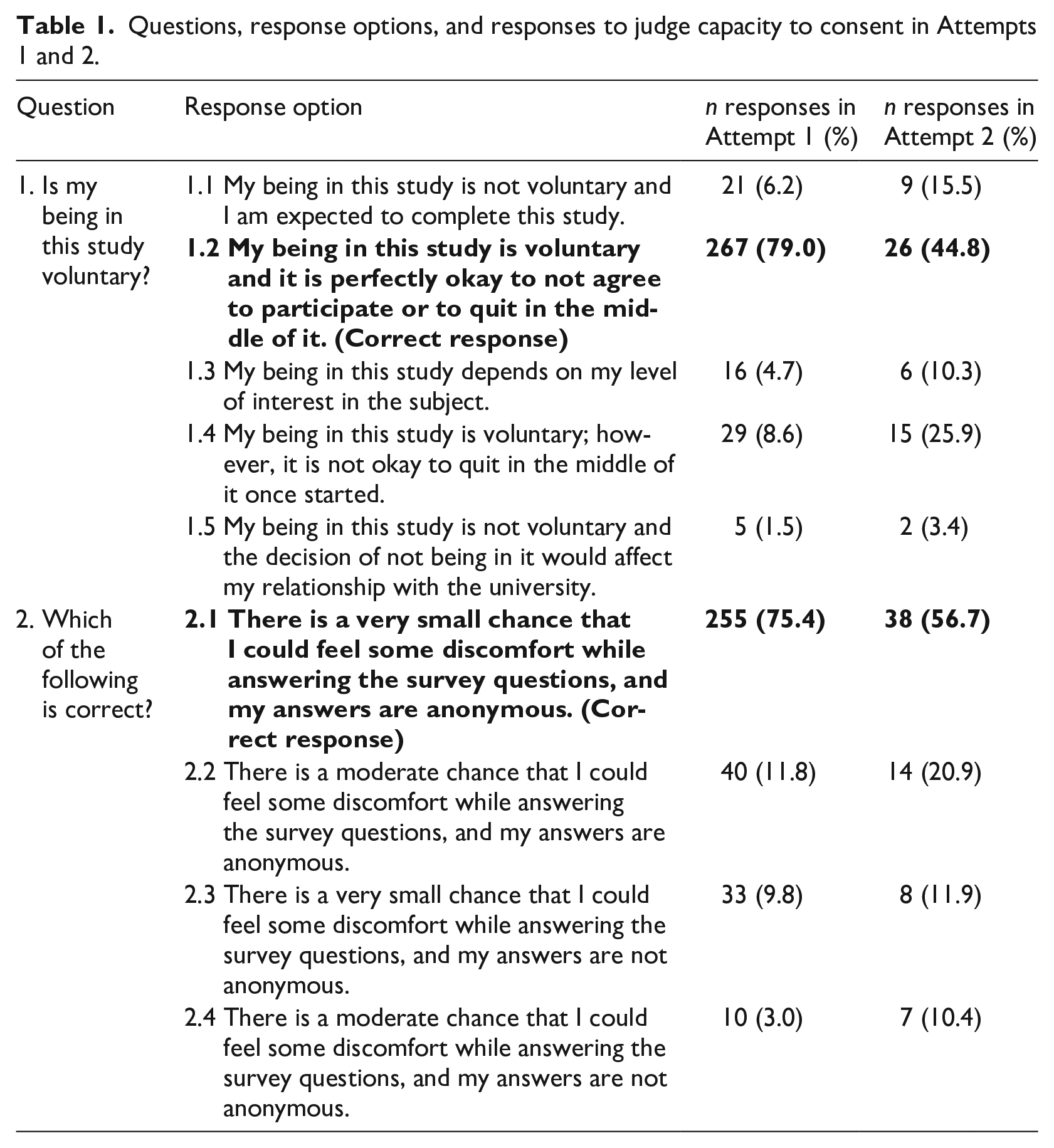
In order to judge potential participants’ capacity to consent, we presented potential participants with two multiple choice questions about the consent process as described in the information statement. These two questions were presented to potential participants after they were provided with the information statement and had indicated their willingness to participate in the study. Potential participants were given two opportunities to provide the correct response to prevent random guessing of the correct response, and were required to answer both questions correctly before they could access the survey. If an incorrect response to a question was given, the participant was provided with a link to the information statement to allow them to reread the information. We used the first question used by Friedman et al. (2016), and adapted the second to align with our study. The two questions and their possible responses are shown in Table 1.
Questions, response options, and responses to judge capacity to consent in Attempts 1 and 2.
Results
A total of 338 participants initially attempted the two capacity to consent questions. As shown in Table 1, 79.0% correctly answered Question 1. The most commonly selected incorrect response was “My being in this study is voluntary; however, it is not okay to quit in the middle of it once started” (8.6%), followed by “My being in this study is not voluntary and I am expected to complete this study” (6.2%). 75.4% of participants correctly responded to Question 2. The most commonly selected incorrect response was “There is a moderate chance that I could feel some discomfort while answering the survey questions, and my answers are anonymous” (11.8%), followed by “There is a very small chance that I could feel some discomfort while answering the survey questions, and my answers are not anonymous” (9.8%).
Figure 1 shows the number of participants who answered the two questions correctly in their first and second attempts. 61.24% of participants correctly answered both Question 1 and 2 in their first attempt, 31.95% answered one of the questions correctly, and 6.80% answered both questions incorrectly. Of those who answered only one question incorrectly, 48.15% answered that question correctly in their second attempt. In total, 77.81% answered both questions correctly and were eligible to begin the survey.
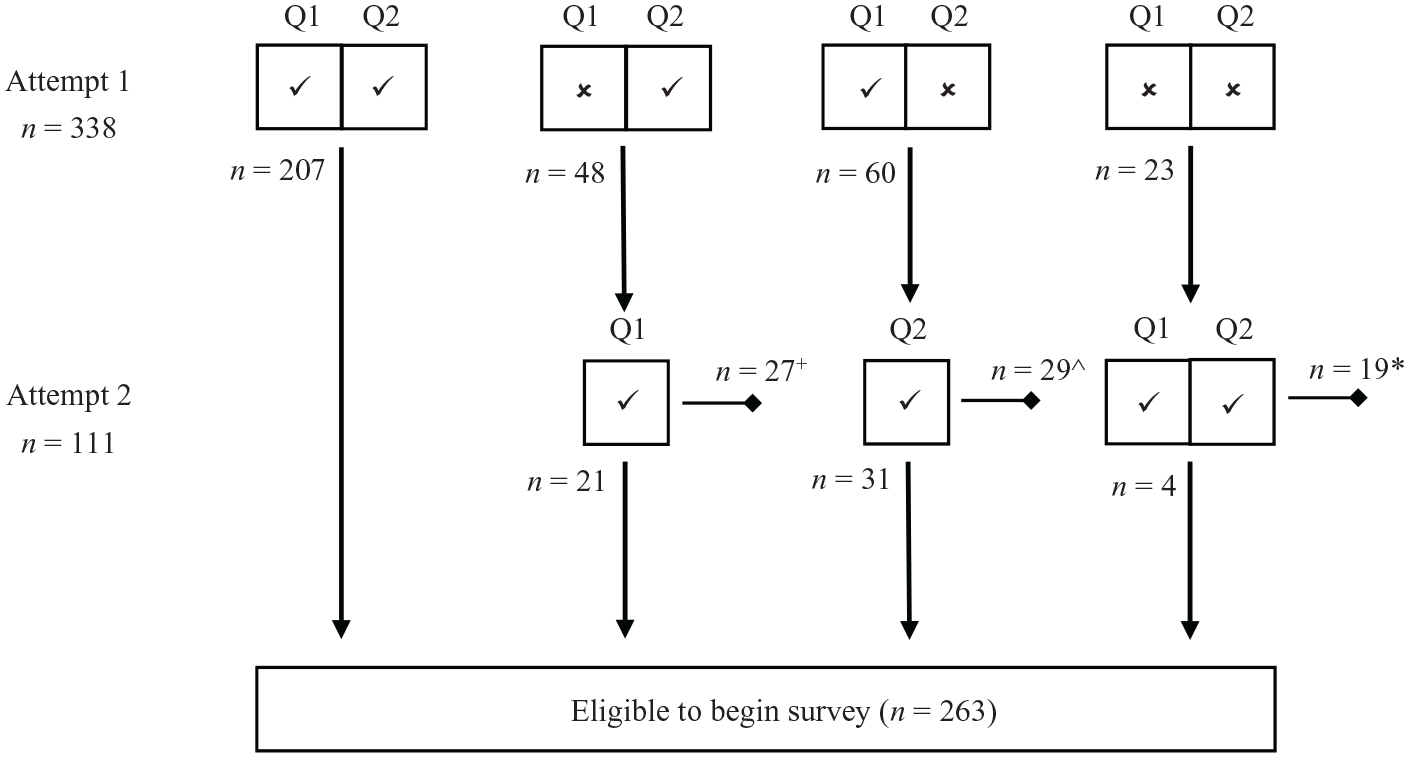
Participant responses to capacity to consent questions in the first and second attempt.
Question 1 tested participant understanding of the voluntary nature of participation in study and their ability to withdraw from the study at any time. Question 2 tested whether students understood the risk of experiencing discomfort as a result of participating in the study, and that the data collected would be anonymous. In order to determine the extent to which participants understood these key concepts in the consent process, responses across multiple attempts were combined (Table 2). For example, responses options 1.2 and 1.4 to Question 1 (Table 1) both indicated an understanding that participation in the study was voluntary; however, participants who selected response option 1.4 did not understand that they could withdraw at any time.
Understanding of key concepts in the consent process during Attempt 1 and 2.
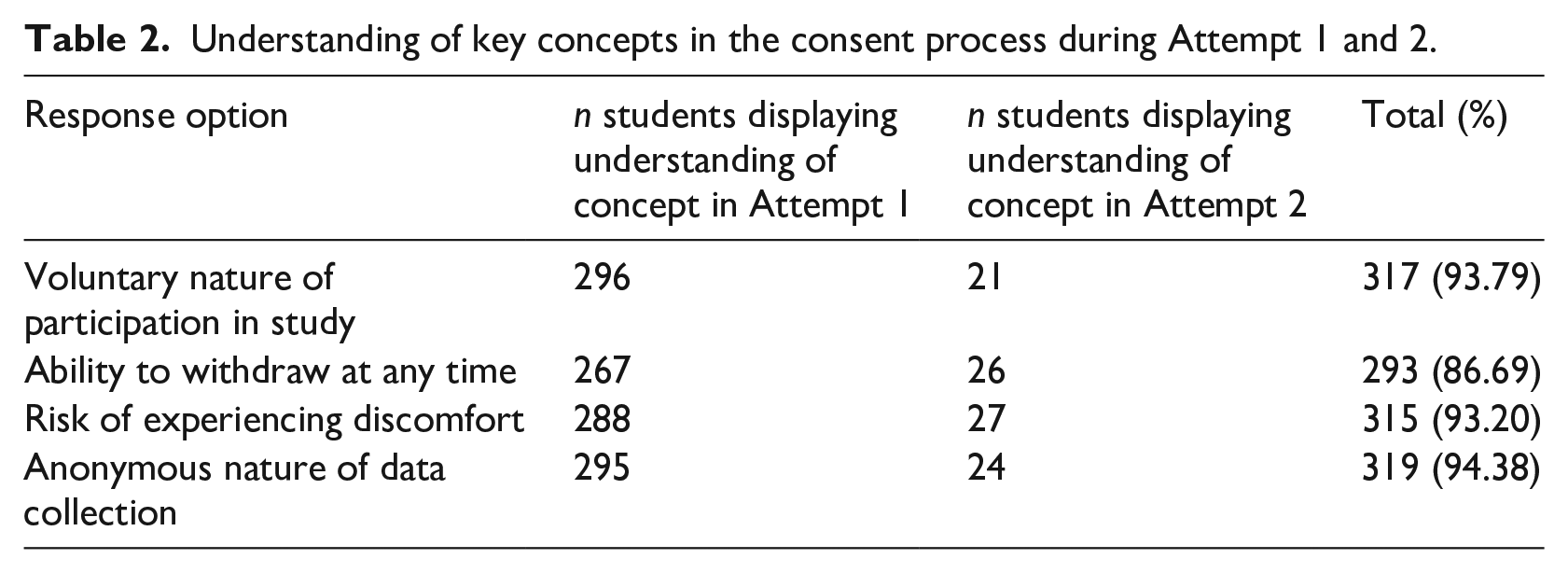
This analysis shows that the majority of participants understood these concepts, with over 90 % of participants indicating an understanding of the anonymous nature of data collection, voluntary nature of participation in the study, and risk of experiencing discomfort. The least well understood concept was the ability to withdraw from the study at any time, with 87% of participants indicating that they understood this concept across their two attempts at the questions.
Discussion
The use of multiple choice questions to determine adolescents’ capacity to provide informed consent was a successful strategy in this online study. The majority of middle adolescents (77.8%) who elected to participate in this study demonstrated an understanding of all key concepts in providing informed consent. The concept that was the most well understood was the anonymous nature of data collection with only 5.6% of participants answering this incorrectly. The concept that was the least well understood was the ability to withdraw at any time with 13.3% of participants answering this question incorrectly.
For other educational researchers who seek to implement a similar strategy, we offer some important considerations and limitations based on our experiences in using this strategy. First, researchers should consider the presentation of study information during online recruitment. Only 22.8% of those who clicked on the link to the survey elected to continue through to the survey, which may be due to the large amount of text presented to participants in the information statement. We suggest that alternative methods, such as brief videos or shorter information statements, may be more appropriate modes through which to communicate study information. Second, the nature of online study recruitment is that only adolescents who are intrinsically motivated to participate are likely to do so. This will have implications for many studies that are designed to investigate a range of perspectives. Third, we observed a significant gender bias in our recruitment approach, with the advertisement reaching more girls (62.17%), and more girls (68.25%) electing to click on the link to the study. This gender imbalance has been observed as a common recruitment bias in Facebook recruitment (Thornton et al., 2016), and future studies should consider how advertisements and images engage girls and boys differently.
Despite these limitations and considerations, there are several ethical advantages in conducting educational studies using an online recruitment method. Such methods allow adolescents to make their own choices about participation in research that focuses on issues that are of importance to them (Alderson and Morrow, 2011). Depending on the study design, adolescents also have the ability to remain anonymous, which is not possible when recruiting and collecting data in a school environment. While the advertisements for our study were broadly disseminated via Facebook and Instagram advertising, future studies could use school or school system Facebook pages to specifically target particular adolescents (for example, to investigate learning experiences and evaluate educational programs at a local level). Finally, online recruitment removes the burden of research from schools and school systems, and removes these as potential gatekeepers to adolescents making their own informed decisions about research participation. While these ethical advantages are considerable, it is critical that online recruitment of adolescents without parental consent is only considered for low or negligible risk research. The role of ethics committees in accurately determining the level of risk of future studies is particularly significant when researchers seek approval for adolescent participation without the protective layer of parental consent.
Conclusion
Online studies of adolescents in schools are advantageous to educational researchers and school communities as this method increases accessibility to student participants and causes minimal disruption to school activities (Gu et al., 2016). While parental consent is generally expected in studies of adolescents, this paper has argued that adolescents’ consent alone is appropriate when adolescents are mature enough to provide informed consent for low risk research (Alderson and Morrow, 2011; Friedman et al., 2016). This paper has reported on a strategy that ensured the ethical administration of an online survey of adolescents that did not require parental consent. Anonymity and informed consent was ensured using a two-question strategy that gauged participant understanding of the consent process. When ethical considerations are addressed, opportunities exist for researchers to conduct low risk online educational research on adolescents, and for adolescents to express their views on matters that relate to their own learning in schools (Alderson and Morrow, 2011; National Health and Medical Research Council, 2018; OHCHR, 1990). Using this method, future educational researchers can access large samples of middle adolescents from geographically diverse areas, causing minimal disruption to school activities, and ensure that adolescents make their own choice about participating in educational research.
Footnotes
Funding
All articles in Research Ethics are published as open access. There are no submission charges and no Article Processing Charges as these are fully funded by institutions through Knowledge Unlatched, resulting in no direct charge to authors. For more information about Knowledge Unlatched please see here: 