




Abstract
Writing reflects some of the different characteristics of the language being used and of the people who are communicating. The present paper focusses on the internal written communication in international and inter-disciplinary research projects. Using a case study of an international public health research project, it argues that the authorship and the languages used in internal project communication are not neutral but help to generate or reinforce power hierarchies. Within research partnerships, language thus raises ethical issues that have so far been neglected. Current ethics guidelines often focus on interactions between scientists and participants of social research and clinical trials, with less attention paid to the interactions among the scientists themselves. Describing all the different project phases based on writing within a research project, the paper distinguishes different influences on the distribution of power that emerge through a focus on written communication. The focus of the present paper is to illuminate the issues of ethics, power and the dimensions of hierarchy, physical location and native versus non-native English speakers that arise from paying attention to such communications.
Keywords
Introduction
A recent discussion of international collaborative research partnerships in the health sector concludes that: ethical partnership governance is not supported by the principal industry ethics guidelines . . . and that [guidelines for] such governance should stipulate the minimal requirements for creating an equitable environment of inclusion, mutual learning, transparency and accountability. Procedurally, this can be supported by (i) shared research agenda setting with local leadership, (ii) capacity assessments, and (iii) construction of a memorandum of understanding (MoU) (Ward et al., 2018).
The authors consider the effects of social and structural inequalities because partnership approaches have sustained old ghosts: north–south dependency, distorted health research priorities, weak and unprepared health care systems, underutilized local professionals and knowledge, unfair distribution of risks and benefits and insufficient access to life-saving interventions for populations most in need (Ward et al., 2018).
This is a welcome contribution to the literature on decolonising the researcher and research (Datta, 2017) and on authorship and research ethics (Bülow and Hegesson, 2018; Jeffery, 2014). But in this paper we argue that insufficient attention has been paid to the languages through which such partnerships are carried out. In order to maximise the possibilities for capacity building and locally led research, it is important to ensure equitable participation in collaborative knowledge production by taking seriously how linguistic competencies affect contributions to research activities. While the role of English language competencies in who contributes to published research outputs has been widely considered (see, for example, Ammon, 2001; Gnutzmann and Rabe, 2014), what has yet to be addressed is how authorship within research projects that include partners from both the Global North and South pose research ethics issues. Using a detailed analysis of collaborative writing, based on a case study from the area of public health, the present article argues that ethical research practice in large international research partnerships requires consciously adopting measures to redress the imbalances generated through language competencies. We take seriously one of Pimple’s questions about the ethics of any particular research product or project: ‘Is it fair?’, concerns social relationships within the world of research. In this category belong issues such as relationships among researchers (authorship and plagiarism). (Pimple, 2002: 192)
Context
Research in the sciences and – to a lesser extent – in the social sciences has become increasingly collaborative, often inter-disciplinary and cross-national. The increase in complex research networks in global health has led to a growing literature on the ethical issues involved (Parker and Kingori, 2016), leading also to the birth of Research Fairness Initiative (RFI). RFI aims to establish fair research processes including fair sharing of benefits, costs and outcomes (Ijsselmuiden, 2018). Reports on RFI have been published already (see, for example, WHO TDR, 2018) and different research networks and institutes are following this approach (see, for example, Saric et al., 2019). A neglected theme in general has been to address the consequences of the unremarked fact that globalisation of research has also led to an increased usage of English within research partnerships. In almost all disciplines, English is routinely used as lingua franca (ELF) for academic communications, especially publications (Abu-Zaid et al., 2014; Hanauer and Englander, 2011; Lillis and Curry, 2010; Morris, 2015; Perrin and Jakobs, 2014) Teixeira da Silva, 2011; but also in writing meeting agendas and minutes, draft press releases, emails, protocols and so on, which is often the major part of intra-project communication. Issues of power, different writing cultures, use of different languages and impact of language on the effectiveness of a project are significant aspects of project communication. These issues relating intra-project writing to research ethics remain ‘under the radar’ but contribute to asymmetries in terms of power. They are also directly linked to the external communication of the project. Not only is the writing carried out in these intra-project contexts often significant in terms of the direction of research, it can also help to develop patterns of interaction that affect, for example, who takes a lead in writing for publication.
This paper focuses on the contexts and the functions of these written texts, drawing most of its empirical material on intra-project writing by members of AMASA, 1 a large, international and inter-disciplinary research project. After defining the different forms of internal authorship, we address the issue of how language use influences how power flows, consciously or unconsciously, within such projects. Unless these concerns are taken seriously, and plans instituted at an early stage to mitigate their effects, writing in internal communication – often in taken-for-granted ways – can contribute unintentionally towards reproducing several forms of marginalisation without provoking overt conflict.
We also pay attention in this discussion to issues generated by different forms of academic culture. Academic cultures have both national (and sometimes sub-national) as well as disciplinary (and sub-disciplinary) aspects (Trowler et al., 2012). While there is some discussion of how disciplinary differences affect understandings of who should author publications (see, for example, Jeffery, 2014) and there are fairly clear standards of authorship in some disciplines (see, for example ICMJE, n.d.), attention has not been paid to how national and disciplinary identities might affect how research is achieved, through such mundane concerns as who writes the agendas and who attends meetings.
Many important ethical decisions are taken by technicians and fieldworkers [. . .] they do not feature prominently in academic publications, nor in ethics debates. (Aellah et al., 2016: 231)
With respect to ‘writing’ within a project, the identities of all project members affect who can write drafts of interview guides or the minutes of meetings. An international research project is one means by which ‘the global’ is locally instantiated, but not fully nor without resistance.
Background
From the various definitions of English as a lingua franca (ELF), we define it as ‘a vehicular language’ (Björkmann, 2013: 28) or ‘contact language’ (Seidlhofer, 2004: 11). ELF is used for communicating with others – often between EFL and those who speak English as a foreign (EFL) second (ESL) or third (ETL) language but also with those for whom English is a mother tongue. We concentrate here on ELF consisting of English for specific purposes (ESP) of academia as a workplace and English for academic purposes (EAP) (Mackie et al., 2011). The literature on ESP and EAP usually focuses on only a small part of project communication, the publications and other outcomes that appear on CVs, while neglecting internal communication, which is neither carefully documented nor addressed formally (European Commission, 2008; Pelikan, 2015). The language of internal project communication needs to be considered as an essential part of project management, because those who control internal communication are well-placed to author internal documents, and linguistic skills in English play an important part in who gets to take these roles. Project members allowed to communicate strategically relevant information to the whole project have a certain position, accompanied with a defined level of power. Although this is obviously an important topic, research on writing and written products in academia focuses on publications and deals with the difficulties of writing in a foreign language when writing for large audiences. They focus on final written products: text production itself is rarely discussed (Grésillon and Perrin, 2014). Following a sociolinguistic approach, this paper provides a case study of AMASA to focus on the contexts and the functions of written intra-project texts.
For interactional sociolinguistics (Marra, 2015: 374), language is understood as a social interaction embedded in complex settings, when synergies between power and efficiency mutually interact with internal communication in various ways, and thereby influence the efficiency of communication (Roelcke, 2002). We follow the approach of critical EAP research, which considers ‘hierarchical arrangements in the societies and institutions in which EAP takes place, examining power relations and their reciprocal relationship to the various players and materials involved’ (Benesch, 2009: 81). One of the threads running throughout complex international research projects is power gained through the ability to express oneself clearly and confidently in the project’s internal communication. Following Lukes, we note that ‘the most effective and insidious use of power is to prevent conflict from arising in the first place’ (Lukes, 2005 [1974]: 27). He later acknowledged that those whose actions prevent conflict taking place are not always ‘dominant’, they may not ‘know what they are doing’; and their privilege can ‘be a by-product of forces they do not understand’ (Dowding, 2006: 137). Domination may generate its own transcripts and forms of ‘everyday resistance’ in a variety of settings (Scott, 1990, 2008). The present paper shows how the unchallenged everyday internal written communication of a research project contributed to reproducing marginalisation, without leading to overt conflict.
Research questions
Here we address the following research questions:
Which of the many different forms of collaborative writing existed within AMASA?
Which different text types 2 of written communication took place within AMASA?
Does collaborative writing influence the efficiency of communication here?
How does power manifest itself in internal written communication and does this lead to issues concerning research ethics?
How might future projects learn from how intra-project writing was carried out in the AMASA project?
Data and analysis
The present paper analyses data from AMASA, a three-year research project led by the University of Edinburgh (UK), in collaboration with partners in London (UK), Ghent (Belgium) and Basel (Switzerland) as so-called Northern Partners as well as in Kampala and Mbarara (both Uganda), Cape Town (South Africa) and Pune (India) as Southern Partners. 3 Funded under the European Union’s Framework Programme 7, the research investigated how the interplay of patent regimes, pharmaceutical regulation, the availability of drug production facilities, health care infrastructure, service provision and engagement by foreign donors influence appropriate, affordable access to medicines.
Writing can be considered as the backbone of all complex research projects, and the AMASA project is no exception: beginning with drafting of the proposal, through regular internal communication (for instance emails, minutes, Skype written conversations, as well as occasional written contributions to Skype oral conferences), including research instruments, research monitoring, research data (e.g. transcripts), paper outlines, policy briefs, etc.) and ending well after the funding was exhausted. Together with writing, different topics related to power and therewith research ethics build a second thread through the project. In this discussion, all extracts from the archive of writings are anonymised. Our intention is not to assess the quantity or quality of individual project members or groups but to outline the emerging writing patterns and different stages of the project.
Languages used at AMASA
The different activities led to six project phases, also reflected in the languages used, as shown in Figure 1.
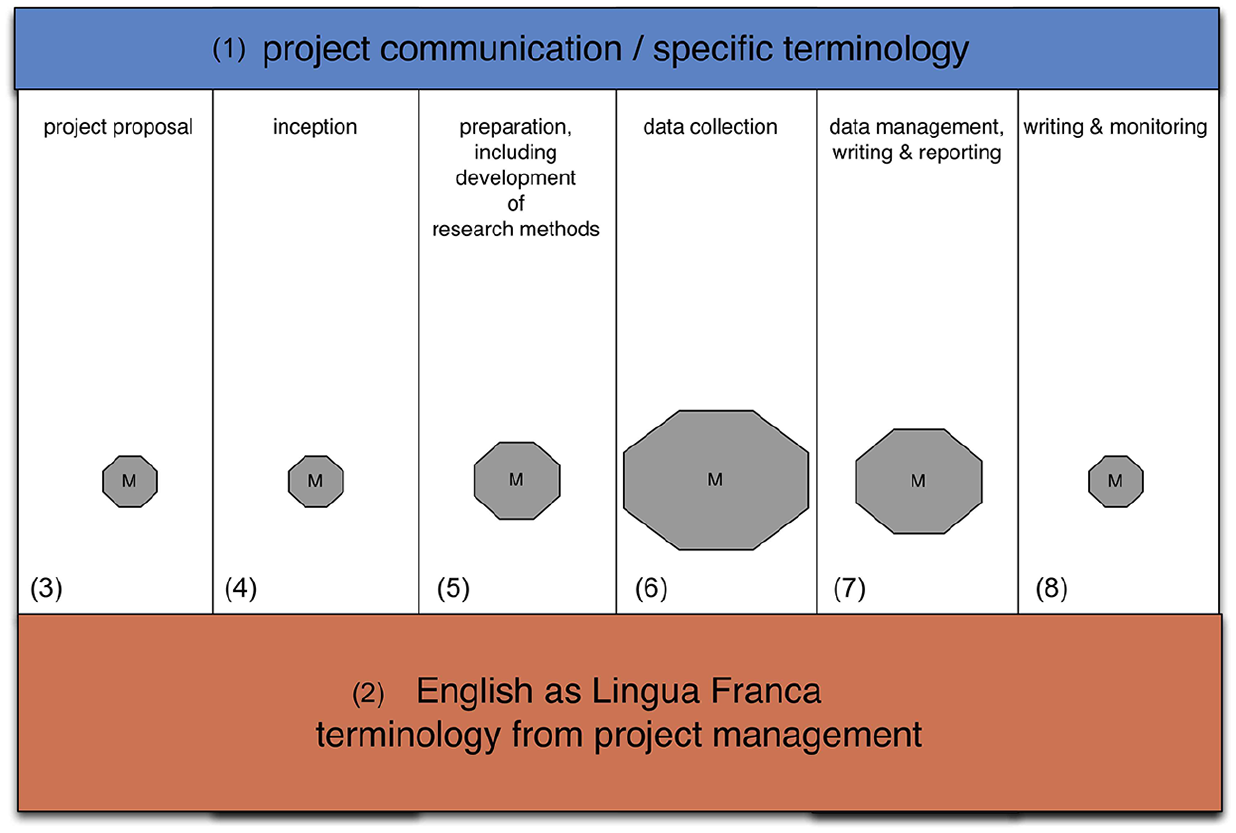
Project phases and used languages (Pelikan, 2019).
Every project member uses her or his own idiolect, consisting of mother tongue, language for specific purposes based on educational background and job as well as project-specific terminology (1) developed during the course of the project (Pelikan and Roelcke, 2015). Although it was acquired unconsciously, project-specific terminology was used throughout the project and adapted to different project phases (ibid.). This terminology was embedded in ELF as well as in terminology generated from the project management (2). For working in such complex projects, specific knowledge is mandatory and is reflected in specific terms that are acquired through peripheral to more inclusive participation (Lave and Wenger, 1991) while working with the project team. The first section of the project (3: June 2008–March 2009) dealt with the development of the project proposal – already here, ELF is complemented by multilingualism. Local language was used for internal meetings of single-country teams (for instance in India) from the beginning of the project and translations into local language were also mentioned in the project’s technical annex. During the inception phase (4: March 2009–July 2010), multilingualism was reduced to internal communications within single-country teams, while ELF and project-specific terminology was used for communicating with other project members. Within the development of the research instruments (5) of the project (August 2010–July 2011), multilingualism became increasingly important since instruments in local language were developed. These included the preparation of informed consent forms in local language to be used for data collection (6) where multilingualism played an essential role (August 2011–July 2012). Project partners hired for data collection often communicated in their local language with each other as well as with the interview partners. So, in this context, local language was a link between internal and external project members, used in both communication parts. During data analysis (7) and reporting (July 2012–October 2013), multilingualism became less important and even less during the writing phase (October 2013–June 2015), formally speaking, the last phase of the project (8).
The official end of the project is assumed when the funding ceases, regardless of whether all objectives have been achieved. Publications, the key factor for academic success, are understood as a reward for the research done and are not only to be achieved before the official end of the project: work on publications continues. Over three years after the official end of the AMASA project, project members were still writing collaboratively on publications based on data collected during AMASA. Academic publications are only one possible step of communicating research findings, which may also be disseminated to non-academic audiences (Bennet and Jessani, 2011: 1). Such dissemination requires different written (and oral) activities to be carried out after the official end of the project, leading to a further kind of writing that continues for several years after the funding has ceased. For the following sections of the present paper, however, only the writing activities carried out before the official end of the project will be considered.
Mother tongues of the project members
The project members of AMASA speak various mother tongues and can be classified as follows, based on the three-circle model of Kachru (Figure 2):
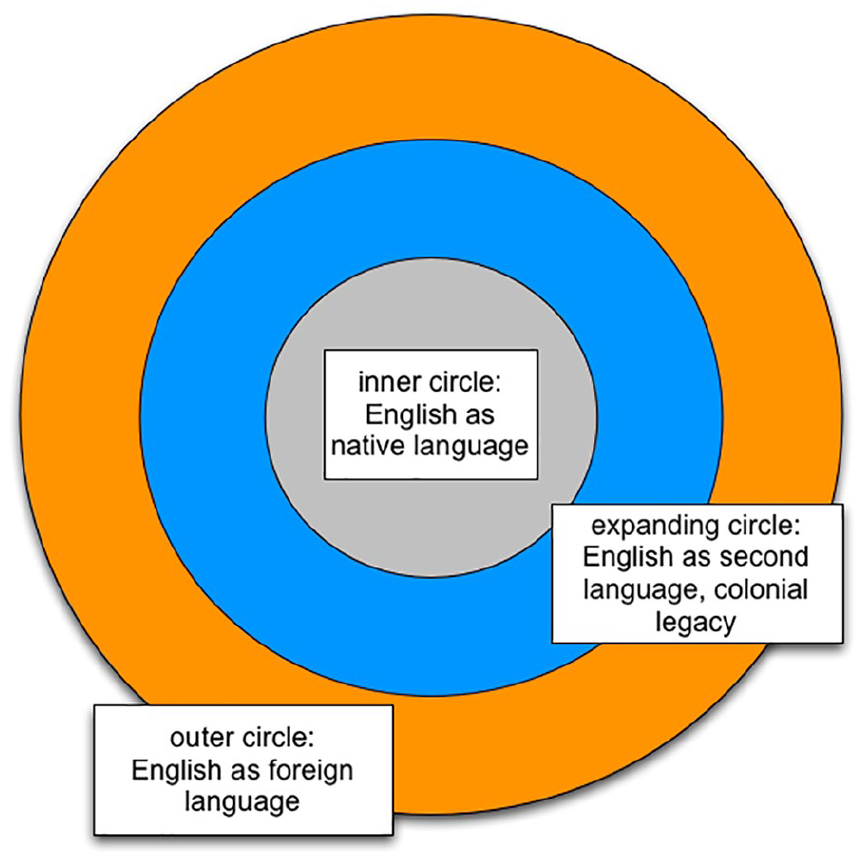
Circle model based on Kachru (1985).
AMASA members from countries classified as outer circle came from Slovakia, Belgium and Germany, while India, Uganda, Zimbabwe and Rwanda can be classified as expanding circle countries. Members from the UK, the United States and South Africa belong to the inner circle. This classification allows the overview of all project members who produced written communication shared with AMASA members outside of their local country team (Figure 3):
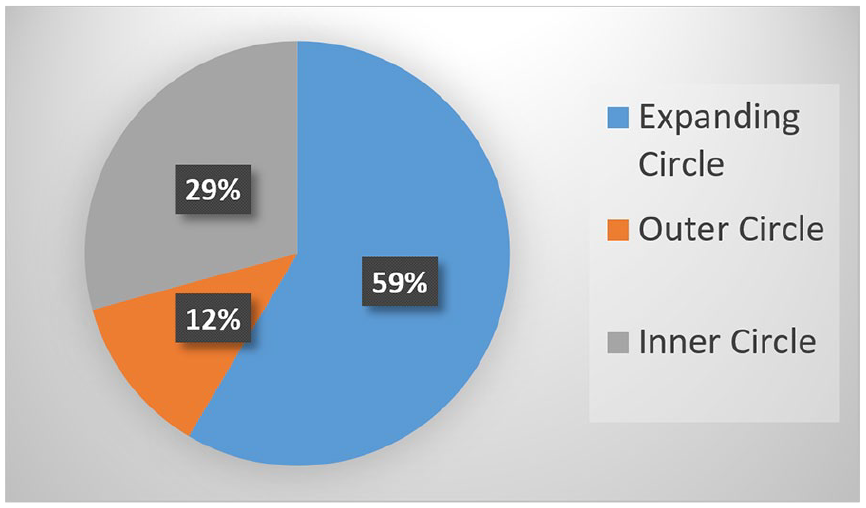
Distribution of AMASA members producing and sharing written communication.
In AMASA as a whole, most of the project members belonged to the expanding circle. Of the Northern Partners producing and sharing written material, 67 per cent belonged to the inner circle, 5 per cent to the expanding circle and 28 per cent to the outer circle. Based on their nationality, all the Southern Partners considered here belonged to the expanding circle. When developing these circles, Kachru focussed on ‘the historical context of English’ (Kilickaya, 2009: 35) referring to the different countries involved. But descendants of the former colonial masters and other English native speakers also grew up in the countries classified as belonging to the expanding circle. Classifying all AMASA project members in these three circles is not unproblematic: at least one project member grew up as an English native speaker in a former colony.
In addition to those project members who produced and shared internal written communication, some project members were not able to communicate. As members of the local teams, they helped with field research and belonged to the expanding circle. But based on decisions made by local team leaders, they were not allowed to communicate with the whole team or not even with single members of other project teams.
Types of written communication and the power included: like a thread
For the documents shared internally, different types of collaboration result in these types of written data:
The project proposal and the technical annex were written by the leading house, requesting and implementing input from all partners on specific parts. This was done without considering the possible implications of the leading house taking the lead in these important written documents. The authorship of these special documents implies a powerful position and leaves the other project partners less able to comprehend the full range of activities being proposed.
In addition to text production presented in Figure 4, there are also written products that are part of the linkage between internal and external communication, or dissemination, such as literature review reports. Created collaboratively and internally, these written products (such as policy briefs) were shared not only among project members but later also with persons outside the project.
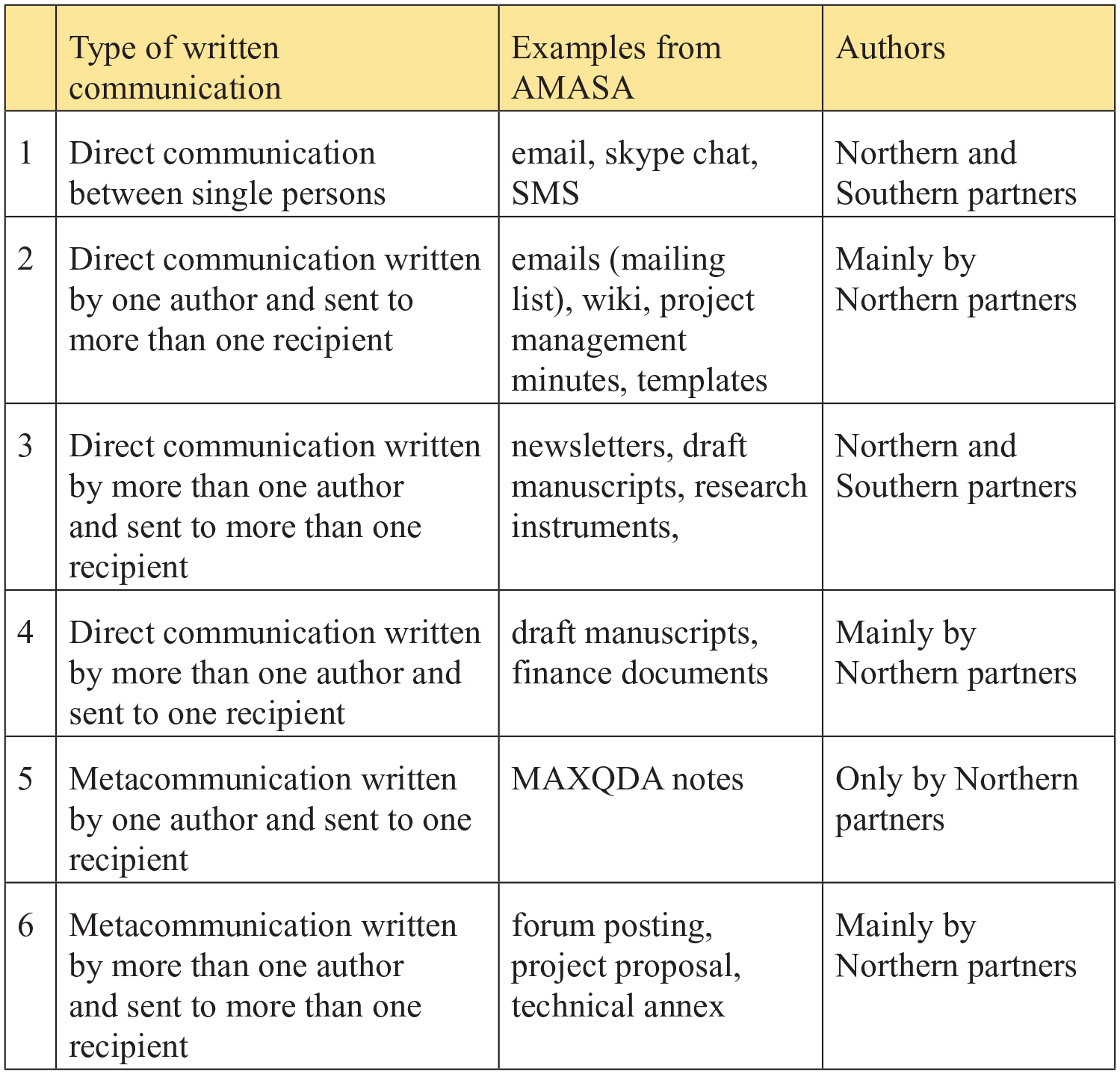
Types of written data.
Direct written communication between single people (row 1 in Figure 4) was produced equally by Northern and Southern partners; other types of written communication were mainly (or only) produced and shared by the project members from the North. The articles in internal Wiki (2) were written by Northern Partners only (from the inner and the expanding circle equally). The same people wrote the minutes of the project management meeting, where all relevant topics of the project were discussed via Skype. These minutes include several obligatory decisions and were shared with and agreed upon by the whole project team. Although the mailing list ‘AMASA all’ was maintained by the leading house (Edinburgh), all project members could send emails to this mailing list to be directly received by all project members, but only very few project members did so. While the Southern Partners used this communication channel for communicating private news (announcing a new-born or a new paper) or for responding to a note sent by someone from the leading house, relevant information such as minutes or important information on workshops or finances originated with and were sent by the Northern Partners. All Northern Partners used this communication channel, whereas only the principal investigators or their representatives from the South used the mailing list. The newsletter (3) was created and shared by the working group on ‘knowledge management and communication’ made up of members from all partner institutes. It included some private news (for instance weddings) as well as important project information and was used by all project members equally for sharing information – albeit it was edited, and the content needed to be agreed upon by the work group leader, a project member from the North belonging to the outer circle. All draft manuscripts had to be sent to the principal investigators as well as made available to all other project members, and the same was true for the research instruments (for instance surveys). Draft manuscripts were sent to single people for feedback (4) directly – this was an approach followed by Northern and Southern partners equally. Creating and sending finance documents for single-site principal investigators was the administrative task of the leading house only. Within the selected software for qualitative data analysis, MAXQDA, direct comments on the ongoing analysis can be implemented (5); this kind of metacommunication for supporting the data analysis was done by Northern Partners only. Metacommunication written collaboratively by different project members and shared with the whole team (6) came from Northern and Southern partners, albeit most of this kind of communication was written and shared by Northern Partners. For instance, only one Southern partner directly commented in the forum, while the others sent their comments via email.
The different text types in Figure 4 can be classified by their functions and then set in relation to the kind and extent of power implied. The texts following the appeal function, such as calls to action sent through the mailing list, were written by the Northern Partners only, while texts with information function were written by all project partners equally, for instance announcements in the newsletter. Texts with obligation or declaration function, such as templates, guidelines etc. were written only by the leading house, or by other Northern Partners on behalf of the leading house. These documents were essential and needed to be understood and applied by all project members. No consideration was given to the well-known finding that communication from native speakers is often not very easy to understand for non-natives (Lutz, 2014), whereas communication by non-native speakers is usually easier for other non-natives to understand. This may be caused by a reduced use of terminology but also by the increased readiness to accept deficient communication (Steinmüller, 1981). So essential texts written by non-native speakers on behalf of the leading house would be one way to ensure they are easy to understand, but this was never raised as a topic within AMASA nor in any other project with which we are familiar.
Culture
Here we understand cultures in the sense of cultural studies approaches, as something diversifying, emergent and newly arising. Within AMASA, there existed several different national cultures, which may have influenced who could contribute texts. The common culture of communication was a new arising culture within the AMASA project – contrary to the approach of Jäger et al., who see linguistic skills based on cultural factors (Jäger et al., 2016: 16); here the opposite is proposed: linguistic skills and collaborative communication lead to development of a new shared culture, in the sense of a think/thought collective (Fleck, 2015). As Baker (2015: 73) put it, ‘Culture and language are emerging from human interaction in the world but are not reducible to this interaction’. The culture of communication in AMASA was characterised by using mainly web-based communication media and by using ELF. Communication can only be successful if the communicating people share a defined set of social values and regulations (Hepp, 2010: 13). This common set can be based on the same culture, but it doesn’t have to be based on a national culture. Common forms of communication can also create a new culture, including sets of values and regulations. This leads to the hypothesis that the different communicating people participating in the AMASA project appropriated a kind of new communication culture, through collaborative communication and through communicating in ELF, which can have masked cross-cultural differences between participants, giving an ‘illusion that they also share a common culture’ (van Mulken and Hendriks, 2017: 107). Here we wish to highlight that using a lingua franca does not necessarily or automatically lead to the creation of a shared culture. The language used is only one part of this process: the shared modes of communication must also be considered.
Defining collaborative writing at AMASA
Collaborative writing (Hanauer and Englander, 2011; Lowry et al., 2004), and working together to reach a shared aim, can vary according to collaboration settings (Noël and Robert, 2004). Collaboration can have several benefits, for instance maximising input, creating joint knowledge and enhancing interpersonal relationships leading to a higher text quality (Lowry et al., 2004: 67). Although collaborative writing (CW) is ‘a group effort, many activities in CW are often divided and conducted on an individual basis’ (Lowry et al., 2004: 70).
CW is an iterative and social process that involves a team focused on a common objective that negotiates, coordinates, and communicates during the creation of a common document. (Lowry et al., 2004: 72)
Outlining the different types in detail, based on Lowry et al. (2004: 76ff.), CW at AMASA involved:
1. Group single-author writing
One author wrote on behalf of a group of project members and shared the document with the team afterwards – for instance, writing a protocol of a local working group meeting.
2. Sequential writing
Each writer wrote a part of a document and then passed it on to the next writer: this occurred sometimes with project reports.
3. Parallel writing
Every writer had his clearly defined task and wrote one part, and afterwards these parts were put together: this also happened with internal newsletters.
This typology of CW leads to the assumption that the writers sit alone while writing. At AMASA two more types of CW could be identified:
4. Writing within face-to-face meetings
Within meetings sometimes not only minutes were taken, but also abstracts or parts of manuscripts were written. All participants discussed, and one person took notes in continuous text for further development afterwards; sometimes these notes were even dictated.
5. Writing within web-based meetings
As the AMASA project members worked in several countries, web-based communication was essential. Videoconferences over several hours replaced face-to-face workshops and attending regular Skype meetings was mandatory. Within web-based communication, notes as continuous text were also written.
Authorship
‘Writing can be described as an interaction between author and reader via text’ (Schindler and Wolfe, 2014: 115). Several publications deal with authorship, referring to publications written and authored collaboratively (for instance Day and Eodice, 2001; Jeffery, 2014, ICMJE, n.d.), but none of them addresses authorship for internal communication. Authorship of internal communication at AMASA can be defined as the substantial intellectual contribution of at least one project member to a written product shared within the project. This definition is independent of the different forms of collaborative writing listed above. Referring to authorship of publications, Bülow and Helgesson (2018: 03) mention authorship practices to increase visibility. Of course, internal texts written by the project PIs have more power over the recipients within the project than ones written by assistants – they lead to faster responses, for instance. But the authors of the present paper can recall only a few cases in AMASA in which the PIs sent out texts written by someone else. Commonly, the author sent out the text by herself or himself.
Efficiency of communication
Efficiency is a major aim of every kind of communication (Roelcke, 2002): information, whether written or oral and in whichever medium, must be transferred as efficiently as possible from a sender to a recipient. If the appropriate recipient receives the transferred information and the expected result is thereby achieved, the communication can be denoted as effective (Pelikan, 2015: 131). For efficient communication, further action is required. For research projects, efficiency of communication needs to be defined based on the transfer expenditure or the transfer result (Pelikan, 2015: 130f.). This is not so easy, as research aims to create and acquire new knowledge. In this respect, research can be defined as epistemic work. At least some of the writing during research is epistemic: epistemic writing. Following Carl Bereiter (1980), epistemic writing is the highest level of an individual’s development of writing; it is reflective thinking that allows the generation of new ideas and thoughts while writing. The concept of epistemic writing involves, in general, the capacity of thinking via the reflective and conscious use of language. Applying this approach to the written internal communication of a research project and based on the assumption that effective communication has already been established, efficiency of communication requires (1) reaching the intended relationship between linguistic expense and linguistic result (Roelcke, 2002: 27) and (2) gaining knowledge by communicating. The synergies between power, ethics and efficiency of communication could not be more obvious than here. Those who can write in their mother tongue have a significant advantage for epistemic writing, compared to all non-native speakers.
Non-natives are knowingly disadvantaged in research collaboration in such projects leading to an important aspect of research ethics: whether the relationships between researchers are equitable, because ‘language is not only a cognitive resource, but also a social resource’ (Gu, 2017: 61). It is used for ‘social action within a language-use context in which interlocutors’ histories, identities, goals and motivations all have an effect on the ways they use language’ (ibid.). In a complex setting like AMASA, different languages and different social resources were introduced. But no language was defined consciously or even mentioned in the project proposal. The style guides of the involved universities were considered – for instance, the guide from the University of Western Cape. Although decolonising is a current and important topic in South Africa (see, for example, Heleta, 2016), there was no information on the individual languages to be used. It was taken for granted that English would be the lingua franca. This is common practice, neglecting the fact that this decision – made unconsciously – results in a disadvantage for a substantial section of the project membership. Without considering the ethical implications of this practice, power issues cannot be addressed and efficient writing cannot be established.
Discussion
‘The time where the British took the lead is over’, as a project member said during one of the workshop discussions referring to colonialism, which ended in Uganda in 1962, India in 1947 and South Africa at different times, depending on the definition. Colonialism may be over, but it remains an active topic in some countries and is dealt with in different ways. For example, at Makerere University in Uganda, a partner of the AMASA project, study programmes are discussed as methods for decolonisation (Serunkuma, 2019). But unfortunately, these efforts are not so far linked to the language used in research projects. Referring to linguistic relativity, ‘we experience the world as we do due to the language we speak’ (Baker, 2015: 76) but in South Africa, Uganda and India, the language of knowledge production in schooling, academia, commerce and industry is still contentious (Phaahla, 2006). Systematic eradication of Third World knowledges has been called ‘epistemicide’ (Bennett, 2015: 12). This was not done, consciously, at AMASA. On the contrary, the knowledge of the Southern Partners was repeatedly requested. Unfortunately, however, these efforts neglected the importance of language. Efficient communication, acquiring knowledge by epistemic writing, can hardly be reached while using a foreign language. Deciding about the language to be used in different contexts is a powerful decision: language is closely linked to power and thus also to ethical questions, in many ways. Failure to address these linguistic issues made the project less ‘fair’.
In AMASA, language and power influenced the internal project collaboration and thus also communication between the Northern and the Southern Partners. The leading house was based in the UK; it was supposed to take the lead in specific tasks defined from the outset. In our survey with project leaders of complex research projects like AMASA, the authors of the present paper could not find projects doing it differently. Leading institutions are also responsible for internal and external communication, because communication is an executive function. Our survey shows that it does not matter in which country the leading house is based, internal and external communications are always taken care of by the leading house: ‘I thought this is determined’ was a comment from one respondent. The approach of equating communication with external dissemination and thus of neglecting internal communication is also widespread. As internal communication is not seen to play a key role, it is not included in capacity building.
‘We only had experts’ was the explanation of one survey respondent: therefore, they did not consider internal communication, let alone the language used. Even if the project members are experts in their field, it cannot be taken for granted that they are also experts in intercultural communication. At AMASA as well as in the other projects involved in our survey, capacity building in terms of internal / intercultural communication was not given separate attention. This is not surprising. The commonly used guidelines for project members (for instance, European Commission, 2008, Swiss Academy of Sciences) include no advice on internal intercultural communication or dealing with postcolonial difficulties in multinational projects involving ex-colonial countries. With ‘communication’, the European Commission still addresses only dissemination, without taking internal communication into account (European Commission, 2008). All ethic committees of the universities involved in AMASA have been contacted for their approval but no guidance on project communication and language use could be found. The RFI notes that ‘we do not have a globally accepted framework of standards or benchmarks to design, operate or evaluate research and innovation partnerships’ (Ijsselmuiden, 2018). There is no Standard Operating Procedure (SOP) on how to deal with multilingualism in research projects – and if there would be an SOP, in which language would it be written? All the guidelines mentioned above were written in English and not translated to the local languages of the AMASA project partners.
As a way forward, we suggest including a consideration of internal project communication linked to research ethics in all project proposals submitted to ethics committees. An SOP on this needs to be developed (maybe in interaction with RFI or linked approaches (see, for example Kombe et al., 2017) and requested by the funding agencies for ensuring its implementation. Until this is developed, we argue that a discussion on internal communication needs to be established early in project development, in order to provide a sound basis for later dissemination or other external communication activity. This awareness needs to be increased and discussed transparently from the outset, for instance at the inception workshop. Inception workshops should also provide an opportunity to spread an awareness of the difficulties and opportunities of internal communications in situations of linguistic and cultural heterogeneity. Additionally, the difference between ELF and English as a Native Language (ENL) needs to be addressed. ELF speakers need to draw the attention of ENL speakers to the finding that most difficulties in understanding are caused by ENL speakers (Pelikan, 2019). Functional multilingualism also needs to be addressed early in a project. As Figure 2 shows, multilingualism plays a crucial role in some of the project phases and is also linked to power. For instance, in terms of data collection in rural areas, the power is with the project members speaking the required local languages, which is the basis for successful data collection.
Finally, linkages between the project language and research ethics must also be discussed. No project member should be disadvantaged because their language skills are neglected.
Thematising topics like these right from the beginning could improve the working climate so that the power is more equitably shared, not left with the Northern Partners, in particular, the leading house. Adding linguistic skills as a clearly defined part of capacity building might help project members from the expanding or outer circle to communicate more efficiently – a benefit for the whole project. Aiming to support cultural exchange and learning among the project members (Sieber and Braunschweig, 2005: 12) and therewith supporting efficient communication, the significance of intercultural and multilingual competence should no longer be underestimated. Efficient communication cannot be reached if ethical issues are unresolved. ‘Start discussing authorship when you plan your research’ (Albert and Wager, 2003) but include all the different forms of collaborative writing and their authors – especially the authorship of internal communication – when you do so. For researching the aims mentioned, research projects need relevant awareness and skills, with either one person who meets these needs or scope for regular advice and support from linguistic specialists.
Footnotes
Acknowledgements
The authors are grateful to Professor Allyson Pollock (Newcastle University, formerly professor at Queen Mary University of London / University of Edinburgh), the other project Principal Investigator, for permission to use this material.
Declaration of Conflicting Interest
There have no data been collected for this paper that cause any kind of conflict with the standards and guidelines on good scientific practice and ethics of the involved universities.
Funding
All articles in Research Ethics are published as open access. There are no submission charges and no Article Processing Charges as these are fully funded by institutions through Knowledge Unlatched, resulting in no direct charge to authors. For more information about Knowledge Unlatched please see here:  .
.