




Abstract
Background:
Medical research on children has increased in the last 20 years. International ethical regulations for conducting clinical research on children may not pertain to Muslim communities where religious beliefs play a big role in decision-making process.
Methods:
The aim of this paper was to illustrate the origins of bioethics principles in Islam, to appraise the existing regulations of Islamic countries, and to systematically review areas of improvements.
Conclusion:
This review recommends a customized approach for regulators to set culturally adapted ethical guidelines that highlight Islamic traditions in dealing with children of different ages.
Introduction
Importance of pediatric research in Islam
Since ancient times, even before Islam, doctors have sought cure for sick children as well as adults. Islam like other divine religions conforms with this aim. The five objectives of Islam are to preserve people’s lives, wealth, progeny, minds, and dignity. In many verses of the Glorious Quran, God encourages people to learn and look for wisdom to build the earth (Qur’an 35:28, 56:58–59). The Prophet Mohammed—Peace be upon him—is reported to have said “Allah has not made a disease without appointing remedy for it, with the exception of one disease, namely senility” (Sunan Abi Dawud 3855). These recommendations encouraged the scholars to put efforts into improving children’s health as well as that of adults by including them in research and experiments to obtain better treatments.
In the golden Islamic era from the 9th to the 11th century, many new discoveries and huge advances in science and medicine were revealed. For example, Mohammed Zakariya AlRazi (born in 854 CE) was the first to conduct clinical trials comparing two identical groups on monkeys and human (Zarrintan et al., 2014). He wrote about medical ethics in his book Kitab al Hawi fi al-tibb [The Comprehensive Book of Medicine], which is considered one of the most valuable books in medicine in all times (Amr and Tbakhi, 2007). Ahmed AlQirawani from Tunisia (born in 898 CE) wrote a book named Kitab siysat al atfal wa tadberahom [Politics in Dealing and Management of Children], which became a reference for pediatricians for many centuries afterwards (Browne, 2001).
In Islamic countries, medical ethical obligations come principally from Islamic beliefs, which play an important role in the decision-making process. Although great efforts have been made by Islamic jurists and bioethicists in solving medical ethical issues, there are limited resources about Islamic perspectives in regard to research among children. The aim of this review was to highlight the origins of research ethics in Islam, to review the existing Islamic regulations, and to suggest recommendations that help Muslims in making valid decisions.
Sources of legislations in Islam
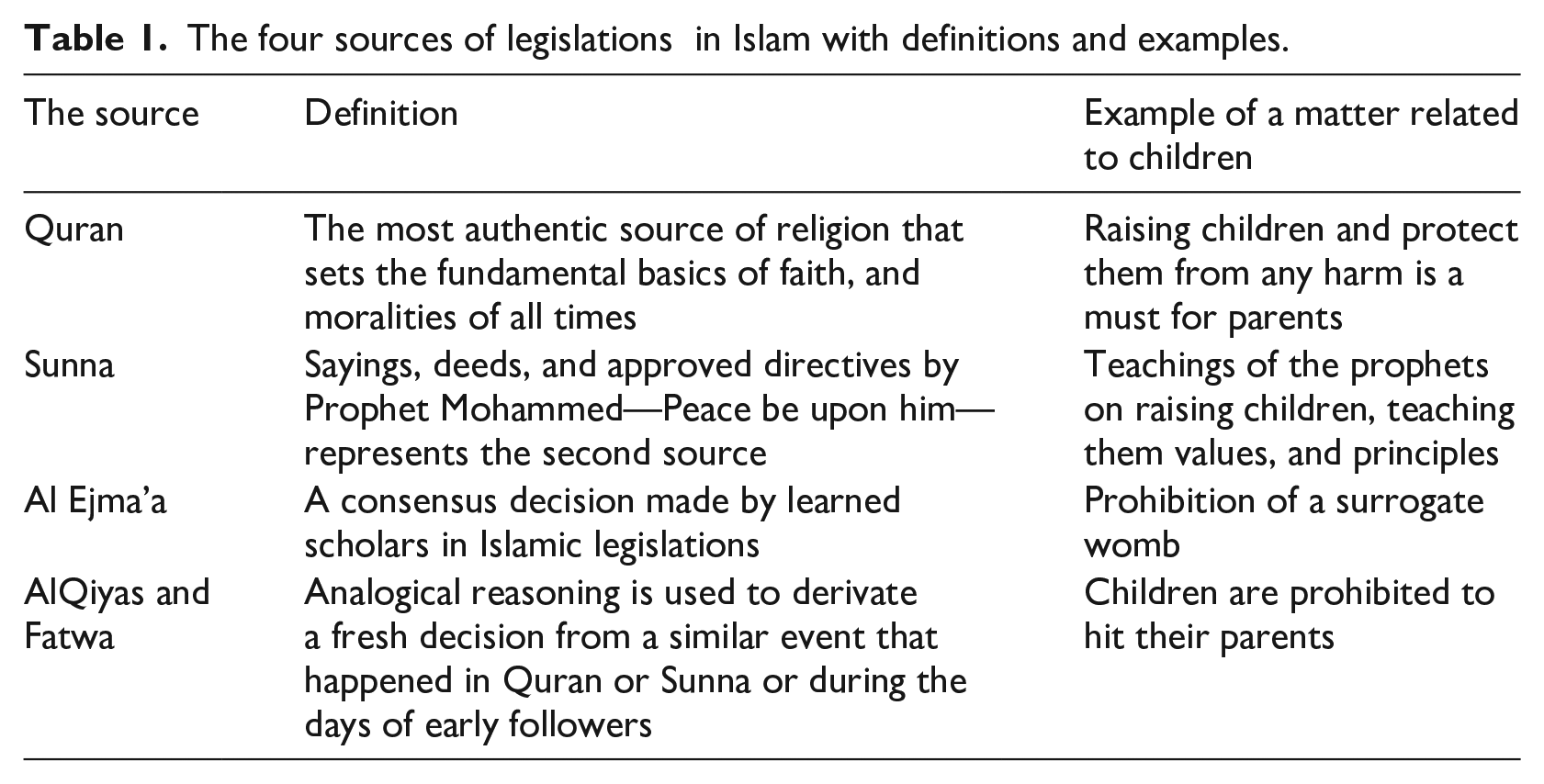
Muslims believe the Glorious Quran and Sunna to be the main resources for legislations in the Islamic nations. These sources put forth the general frames of human ethics. However, formulating civil regulations usually require more detailed guidance. Table 1 lists the four well-recognized sources of legislations on ethics in Islam that help Muslims in decision-making (Abu’l-Suroor, 2001; Al-Bar and Chamsi Pasha, 2015; FAwzan, 2005).
The four sources of legislations in Islam with definitions and examples.
Origins of Islamic research ethics
Allah and Prophet Mohammed have mentioned many values and principles in Islam to guide people in their lives, such as honesty, giving, helping the needy, justice, and respect. However, applying these values to children is different from that for adults. From among these values, this section discusses those related to research.
A basic cornerstone concept is the dignity, which is given by God to all humans “ولقد كرمنا بني أدم وحملناهم في البر والبحر و رزقناهم من الطيبات وفضلناهم على كثير ممن خلقنا تفضيل” [We have certainly honored the children of Adam and carried them on the land and sea and provided for them of the good things and preferred them over much of what We have created, with definite preference] (Qur’an, 17:70). Moreover, Allah has given people the freedom to choose between God’s way and the devil’s way. In another verse “لا إكراه في الدين قد تبين الرشد من الغير” [There is no compulsion in Faith. The correct way has become distinct from the erroneous] (Qur’an, 2:256). From this verse, scholars concluded that since people are not forced to follow the Islamic way, they should not be forced to take unwanted decisions especially when it comes to preserving their health. Their decisions must be respected, as long as they have the capacity for self-determination. This basic and important rule about human dignity guided early Muslim scholars to think about the “Autonomy” of children in clinical research, which is a complicated issue with many still unanswered questions (Sachedina, 2011).
Another value that was mentioned by Allah and highly enforced by his Prophet Mohammed—Peace be upon him—is
In pediatric research this value translated into justice is seen in terms of distributing benefits and harms of the drug used in a study between participants and whether the research will add a burden on the participants (Afifi, 2007a, 2007b). Taking child’s assent in pediatric research is a form of justice. The assent is the agreement of the child to participate in research when he/she is not competent to provide a legally valid informed consent. However, this process is not straightforward. First, children vary in age with regard to when they develop competency and capacity, and it is very difficult to assess their capacity. Second, children are constantly maturing mentally and emotionally, and their perspective toward a specific decision might change with time. For older adolescents, informed consent might be more suitable and assent no longer applies. Third, the complexity of scientific and technical information provided to a child during the assent process can affect his/her understanding, although efforts should be made to deliver it in simple language. It is the responsibility of the institutional review boards (IRBs) as well as the sponsors and the investigators to ensure the informed consent and the assent process are fair and adequate (Christina Tally, 2018).
The third value is
Overview of guidelines in pediatric research ethics in Islamic countries
It is historically known that participation of children in clinical research is essential because children develop different diseases and respond to treatment in a different way than adults. Nevertheless, 50% of the drugs approved in 2017 have inadequate information on toxicity and administration regimens for children according to US Food and Drug Administration (U.S. FDA, 2016).
In children, this matter holds distinct ethical challenges including the consenting process, the risk/benefit assessment, and the decision consequences (CPA, 2008). Many well-known international regulations and legal documents have been released to protect children involved in medical research and to ensure their welfare such as The Numberg Code in 1947 (Nuremberg Military, 1996), Declaration of Helsinki 1964 (WMA, 2013), Good Clinical Practice in 1995 (Ravinetto, 2017), and the ICH “International Ethical Guideline for Biomedical Research Involving Human Subjects” in 2002 (CIOMS, 2002).
Unlike in other countries, serious violations of research bioethics for children were not reported from Islamic counties. Yet, Muslim jurists joined the worldwide movement by developing a memoranda on medical research ethics derived from Islamic guidance of ethics. Regulations were published in Lebanon in 1994, and in Egypt in 2003 (MOHP Egypt, 2003). Similar guidelines were released from Kuwait, Qatar, United Arab Emirates (IMS Kuwait, 2009; MOH Qatar, 2009; MOH UAE Dubai, 2006), and Jordan (PMC Jordan, 2001). In 1998, Saudi Arabia (SCHS, 2007) released a regulation on bioethics. The last updated Saudi law released in 2010 titled “System of Ethics of Research on Living Subjects” (KACST, 2010) clearly references to the Declaration of Helsinki. It is stated in Article 25 of this law that “Research may not be conducted on minors, incompetent or disabled persons unless the interest of these categories is so required.” However, no detailed regulations were released after that, that is, regulations like, in case of divorce, who takes the decision to allow a child to participate in a research and who is eligible to take the financial benefit, if any.
According to a review of national research ethics regulations and guidelines in Middle East Arab countries by Al Ahmed in 2012, most of the mentioned guidelines are compatible with well-known international ones. However, these regulations can be of a greater benefit if they are edited and modified according to the customs and beliefs of the society. Few regulations released details about participation of children in clinical research (AlAhmad G. et al., 2012). This is considered a limitation for two reasons. First, in the Arab world majority of the population is young. In Saudi Arabia for example, 40% of the people are under 19 years old. Second, Middle Eastern and Islamic countries are favorable targets for drug companies to apply clinical trials, due to economic reasons and absence of a strong auditing system (Maal Economics Journal, 2016). Among the reviewed documents, the guidelines by the Islamic Organization of Medical Sciences—released in 2005 from Kuwait (IOMS, 2005) and updated in 2016—was the most balanced and included all key points of research ethics. The latter from Kuwait documents stated that “Children and adolescents must not be included in health-related research unless a good scientific reason justifies their exclusion.” They mentioned assent, legal guardian’s responsibilities, the IRB responsibilities, the waiver in case of emergency, and the balance of the potential risks and benefits (van Delden and van der Graaf, 2017). However, participation of children in clinical trials and research is still much less than what is needed (Joseph et al., 2015).
Among Muslims, three items might add to the inherent difficulties in children’s participation: the right knowledge, the uncertainty about religious judgment, and the cultural barriers in the relationship between parents and children (Rashad et al., 2004).
Thus, culturally relevant guidelines need to be added to the previous regulations. Cultural adaptation will help parents to understand their rights and duties when involving their children in research, especially when linked to correct, moderate, and wise religious origins, thereby improving their attitude and response. One way to solve that is to consider Islamic teachings on preserving children’s rights, dignity, and well-being, given that the Glorious Quran and Sunna have mentioned valuable directions regarding children’s rights and duties. In-depth study of Islamic teaching is recommended in order to understand how to deal with children in research.
Children’s rights and duties in Islam
In Islam, children are very precious. In the Glorious Qur’an it says: “المال والبنون زينة الحياة الدنيا” [Wealth and children are the embellishment of the worldly life] (18:46). Because children have limited comprehension and no ability to choose, they are vulnerable and they should be protected from any harm. Therefore, their rights to life and welfare have to be preserved. The Quran gives a complete guide on how to raise children through the stories of the prophets with their sons. There are also many verses about pregnancy, breastfeeding, and caring for orphans. There are other verses about infanticide and adoption (The Qur’an). Furthermore, in Islam, children are not like adults regarding the onus and punishments in case of sins; this aligns with the justice and respect principles in research.
Islam divides children into three categories in regard to their comprehension level and ability (Fawzan, 2005).
Prophet Mohammed—Peace be upon him—was the best role model role for treating children. He was patient, kind, caring, and compassionate. Moreover, he respected children and honored them. He cautioned against offending them underestimating their minds. It is told by him that one day, a mother called her child and promised that she would give him dates if he came. The Prophet—Peace be upon him—asked her if she would actually do that. She replied no. Then he told that it will be reported as a lie (Sunan Abi Dawud 4991). The Prophet also demonstrated through sayings and acts that children’s decisions should be respected. It was narrated by him—Peace be upon him—that he was sitting in an assembly where there were men on his right and a boy on his left. He wanted to pass a milk container to them, but before he passed it, he asked the boy if he would allow him to begin with the older men, and the boy told that he did not want to give his turn to anyone else due to his love for the Prophet. With full respect, the Prophet gave him first (Sahih al-Bukhari 2605). From such events, scientists deduced that asking the child for his/her permission when doing research is recommended. Regardless of the specific age, a child’s assent shall be sought if he/she is able to understand the research objectives, the benefits, the potential risks, and that his participation is voluntary. A child participant should be informed in a language that he/she can understand and be given enough time to decide. When thinking about how the Prophet Mohammed—Peace be upon him—treated children, this guidance, therefore, makes sense as it is very similar to his way.
Finally, a recent qualitative study from Kenya on different age groups showed that the idea of involving children and adolescents in decision-making for research was strongly supported. The conclusion is supported by the facts that adolescence carry similar levels of responsibility in everyday life, have existing capacity, hold excitement of understanding of new knowledge in science, and are exempt from parental control (Marsh et al., 2019).
Conclusion
Islam teachings pay great attention to children’s honor, respect, and well-being. Although religious obligations start after maturity, many daily decisions can be made by children according to the Islamic tradition. The key point here is their ability for understanding and comprehension. It is recommended that Muslim ethicists study these examples in the Quran and Sunna in order to extract a guidance for research ethics regarding participation of children in clinical research. This guidance may not be necessarily different from what has been mentioned in previous Islamic and international regulations, but it can include detailed directions that can better reflect the beliefs of an Islamic society.
Footnotes
Acknowledgements
The authors would like to acknowledge Ms Sanaa Hyder from King Faisal Specialist Hospital and Research Centre, Riyadh, KSA for her significant contribution in editing and reviewing this work.
Funding
All articles in Research Ethics are published as open access. There are no submission charges and no article processing charges as these are fully funded by institutions through Knowledge Unlatched, resulting in no direct charge to authors. For more information about Knowledge Unlatched please see here:  .
.