




Abstract
Background:
Research integrity has gained attention in the general public as well as in the research community. We wanted to investigate knowledge, attitudes, and practices amongst researchers that have recently finished their PhD and compare this to their responses during their PhD fellowship. In particular, we wanted to investigate whether their attitudes are related to their experiences of their immediate research environment.
Material and method:
Researchers (n = 86) awarded the PhD degree at the Faculty of Medicine at the University of Oslo in 2016 were invited to answer a questionnaire about knowledge, attitudes, and actions related to scientific dishonesty. Seventy-two responded (83.7%). The results were compared with results among first-year doctoral students who responded to the same questionnaire during 2010–2017.
Results:
Overall, 13% of PhDs reported that they knew of people in their immediate research environment who had committed serious forms of scientific dishonesty. A small percentage of PhDs (1.4%) indicated that they themselves had committed such acts. About 3% of the candidates had experienced pressure to commit serious forms of dishonesty and nearly a third of respondents had experienced unethical pressure with respect to authorship during the course of their fellowship. Thirteen percent reported that they had experienced unethical pressure in relation to other forms of dishonesty and 11% had experienced the consequences of some form of scientific dishonesty. Eighteen percent of the respondents believed that one or more actions, which in the literature were perceived as scientific misconduct, were not wrong. We find a connection between attitudes and the perceived research integrity of their research environment. The results also show a difference between PhD students and graduated PhDs in terms of scientific dishonesty. In some areas, the PhDs’ norms are stricter, such as for the use of statistical analysis methods, while there is little change in others, such as in misconduct in order to expedite publications.
Conclusion:
Many PhDs knew about serious forms of scientific misconduct from the research environment in which they are trained, and some also report misconduct themselves. Some experienced pressure to serious forms of misconduct and a large proportion of the respondents had experienced unethical pressure with respect to authorship during their fellowship. Attitudes change during the PhD studies, but ambiguously. Scientific misconduct seems to be an environmental issue as much as a matter of personal integrity.
Recently graduated PhDs in biomedicine know of serious forms of scientific misconduct from their research institutions and reveal attitudes that breach with internal norms for scientists. However, few report personal scientific misconduct.
Many PhDs report unethical pressure with respect to authorship.
The attitudes of PhD students change during their fellowship, however, in an ambiguous way.
Scientific misconduct appears to be an environmental problem as much as an issue of personal integrity.
Introduction
Knowledge about research integrity is increasing. We know that serious forms of scientific misconduct, such as fabrication, falsification, and plagiarism, appear sufficiently often to raise concerns about the confidence in research and researchers, and we know that other forms of misconduct related to authorship and data manipulation occur even more often (Ana et al., 2013; Anderson et al., 2007; Bakker and Wicherts, 2011; Bozeman and Youtie, 2016; Davis et al., 2007; De Vries et al., 2006; Fanelli, 2009; Fang et al., 2013; George, 2016; Hofmann et al., 2015; John et al., 2012; Komic et al., 2015; Lafollette, 2000; Martinson et al., 2006; Marusic et al., 2011; Okonta and Rossouw, 2014; Pryor et al., 2007; Pupovac and Fanelli, 2015; Ranstam et al., 2000; Redman et al., 2008; Sarwar and Nicolaou, 2012; Saurin, 2016; Stern et al., 2014; Tijdink et al., 2014, 2016). We have also gained some insights into the factors that affect scientific dishonesty, such as pressure to publish, research funding, the research community, and personality type (DuBois et al., 2013; Fanelli, 2010; Martinson et al., 2009; Tijdink et al., 2016).
This study is unique in that it compares knowledge, attitudes, actions, and experiences of people who have recently received their PhD with the same group while they were doctoral students. This provides the opportunity to investigate how knowledge, attitudes, and practices change from research fellows to finished PhDs and whether they are connected to experiences in the research environment they come from. In other words, we want to investigate if attitudes and actions are related to personal integrity or to the research environment. This is important information in deciding whether it is the students or the environments or both we should target to improve the integrity of researchers.
This study shows that even after completing a doctoral program in biomedicine, many still have attitudes that are not in line with general moral norms in science. Authorship issues are perceived as a major problem for the PhDs, and a significant proportion of them report attitudes and practices in their research environment that are inconsistent with research integrity.
Material and methods
All persons awarded the PhD degree at the Faculty of Medicine at the University of Oslo in 2016 with a traceable personal mail address were invited to participate in a two-page survey. While the first part of the survey was developed and first applied in Lund, Sweden (Nilstun et al., 2010), the second part was developed in the USA (Kalichman and Friedman, 1992). The third part was newly developed to investigate environmental factors. The first two parts of the survey have previously been used in Norway (Hofmann et al., 2013, 2015; Hofmann, 2016; Hofmann and Holm, 2016), Sweden (Nilstun et al., 2010), Denmark (Jensen et al., 2018), and is now applied in several European countries through the Organisation for PhD Education in Biomedicine and Health Sciences in the European System (http://www.orpheus-med.org/).
Questions about facts were scored as Yes/No/Uncertain. A Likert-type scale was used for questions about attitudes (strongly disagree/disagree/disagree or disagree/agree/strongly agree). Respondents were also given the opportunity for free-text comments. Table 1 shows the overview of the number of questionnaires distributed and returned together with answers about the background to respondents. Some of the survey responses were incomplete, as shown in the figures in the table.
Overview of questionnaires distributed and returned along with answers to background to respondents to completed PhDs in 2017 and PhD students during the period 2010–2017 (2010, 2014, 2015, 2016, 2017).
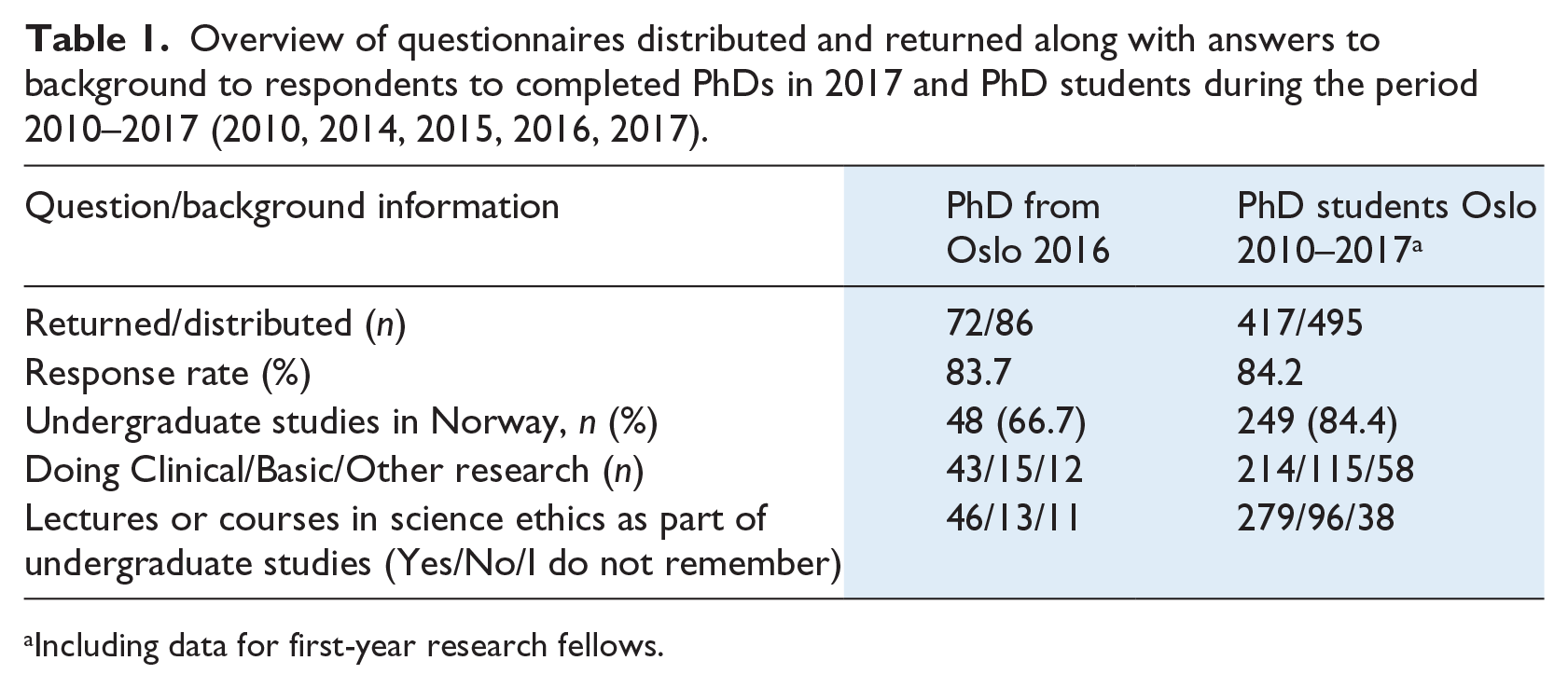
Including data for first-year research fellows.
In order to investigate whether studying for the PhD had influenced attitudes, we compared the results of the finished PhDs with the results of the research fellows who responded to the same questionnaire in 2010–2017 as first-year research fellows.
Statistical analyses are performed in IBM SPSS Statistics Version 23. We applied descriptive analysis and non-parametric methods as the data do not follow normal distribution. We show results with a significance level of 5%, but interpret these conservatively as several statistical tests were made in this material. The study is reported to the Norwegian Data Protection Official for Research (NSD, Project No. 55147). Participation was voluntary and it is not possible to identify individuals from the results.
Results
One hundred and ninety persons received a PhD from the Faculty of Medicine at the University of Oslo in 2016. We were able to identify the personal address of 86, of which 72 responded to the paper-based questionnaire. Fifty-six percent respondents still have research as a main activity. Demographic data for all responding PhDs and for the responding research fellows used for comparison can be found in Table 1.
Further, 2.8% of the responding PhDs reported that they experienced pressure to fabricate data during doctoral work, while 1.4% had experienced pressure to falsify data. A corresponding proportion (1.4%) had experienced pressure to plagiarize data, and the same proportion of respondents had experienced pressure to plagiarize entire publications. In addition, 4.2% experienced pressure to present results in other misleading ways. In the free-text field this was specified as “pressure to exclude experimental results,” “pressures to include co-authors,” “restrictions on presenting data contrary to mentor's ideas,” “encouragement to present results in an ‘over-positive’ way,” and “exaggeration of results.”
Moreover, 31.9% of respondents had experienced unethical pressure in relation to authorship during the course of the fellowship (in addition, 6.9% were uncertain). The PhDs also reported to have experienced pressure with respect to method (2.8%), analysis (4.2%), and results (4.2%). In total, 12.9% had experienced unethical pressure in relation to other issues than authorship, if we include those who were uncertain.
On questions about their own practices PhDs during their fellowships, 1.4% reported that they had fabricated data, 1.4% were unsure whether they had falsified data, and 1.4% reported to have presented results in a misleading way, while the same number were unsure whether they had done so. No one reported having plagiarized data or publications.
The proportion of the PhDs who reported to know about someone who had fabricated data at their department during their fellowship was 1.4%, and the same proportion were uncertain if anyone had done so. Twice as many, 2.8%, knew that some had falsified data while 1.4% was uncertain. The proportion who knew about someone who had plagiarized (data or publications) was 2.8% (and 2.8% were uncertain) while 4.2% knew about someone who had presented results in a misleading manner, and 5.6% were uncertain if anyone at the department had done so. Overall, 13% respondents knew of someone in their research environment who had committed serious forms of scientific dishonesty, such as fabrication, falsification, and plagiarism.
When asked if they had experienced the consequences of scientific dishonesty during their fellowship, some PhDs responded that they had experienced ethical (4.2%), legal (2.8%), methodological (1.4%), and other (4.2%) consequences. Overall, 11% respondents had experienced consequences of scientific dishonesty, including those who were uncertain.
Nearly half of the respondents were uncertain whether their department had written guidelines for research integrity (47.8%). 20.8% reported that the department did not have such guidelines.
The PhDs’ attitudes to different forms of scientific dishonesty are presented in Table 2, which also shows results from first-year candidates in 2010–2017. Eighteen percent respondents believed that one or more actions that breach with generally accepted norms in research integrity were not wrong, that is, the first eight questions in Table 2: Modify, falsify, or fabricate data, take credit for the work of others, or repeat analyses until you get statistically significant results. At the same time, respondents were willing to report scientific dishonesty. We compared the attitudes between the PhDs and the first-year candidate group using the Mann–Whitney U test for ordinal data and found a number of significant differences (see Table 2). The significant differences are all in a positive direction, in the sense that the PhDs adhere more closely to scientific norms than the first-year candidates.
Average (SD) attitudes, Kalichman scores for PhDs in Oslo 2016 and first-year research fellows 2010–2017.
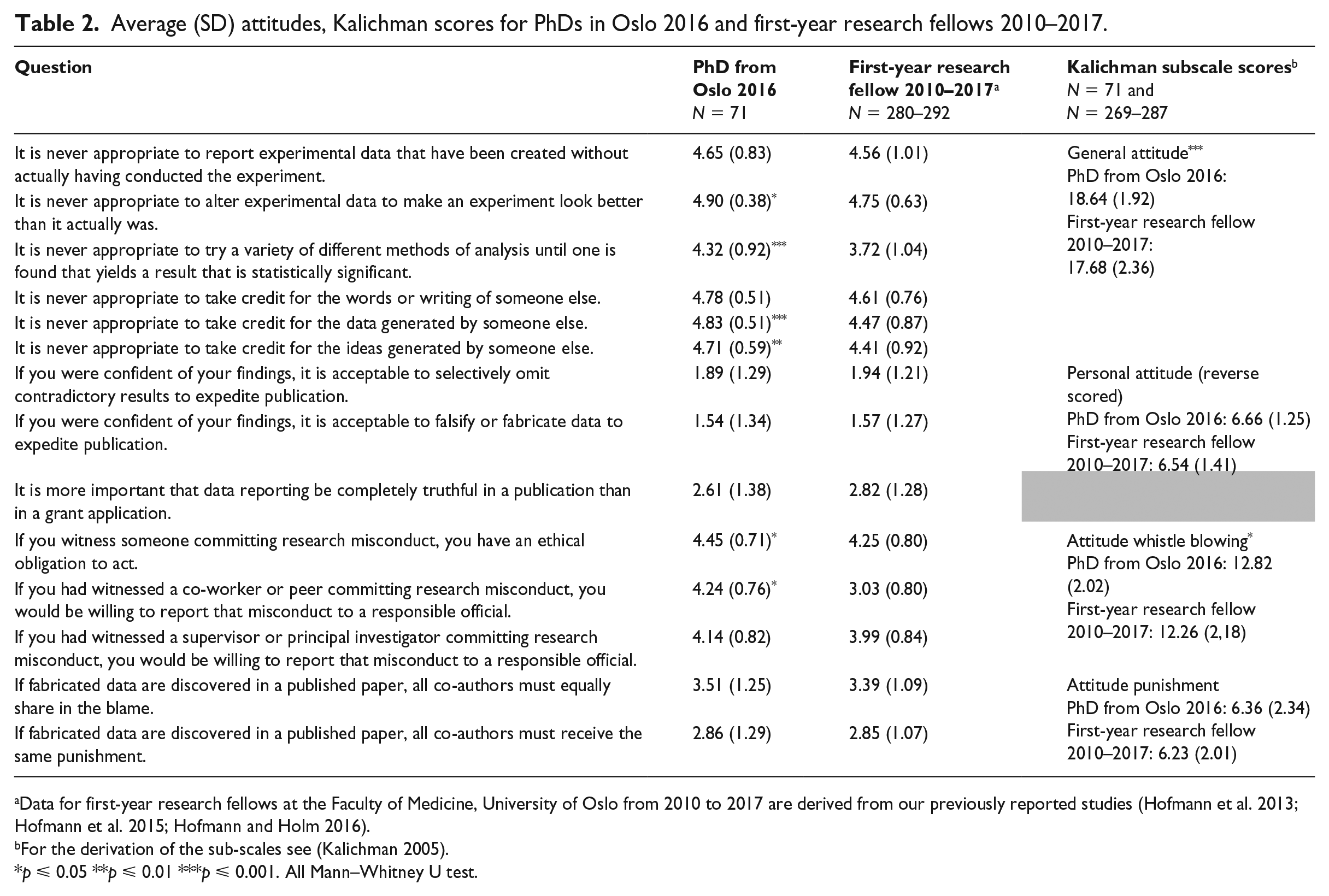
Data for first-year research fellows at the Faculty of Medicine, University of Oslo from 2010 to 2017 are derived from our previously reported studies (Hofmann et al. 2013; Hofmann et al. 2015; Hofmann and Holm 2016).
For the derivation of the sub-scales see (Kalichman 2005).
p ⩽ 0.05 **p ⩽ 0.01 ***p ⩽ 0.001. All Mann–Whitney U test.
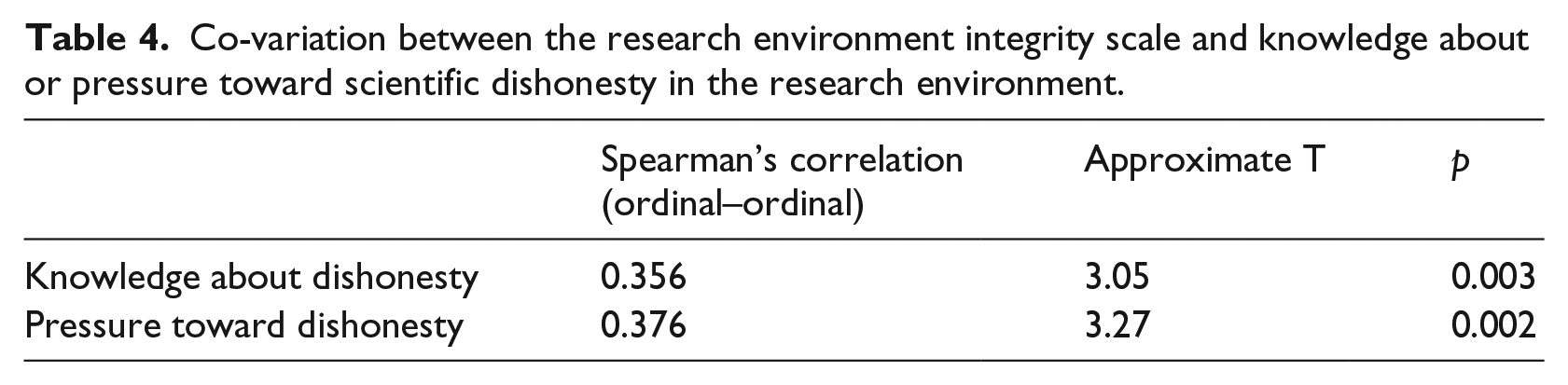
Table 3 shows the PhDs’ assessment of the integrity in their research environment. We conducted a scale validation using classical test theory and found a good Cronbach’s alpha = 0.825 for a scale containing all six questions and question number 5 reverse scored (see Figure 1). Table 4 shows the correlation between the integrity environment and a simple summative scale of the questions about knowledge about scientific dishonesty in the research group and a simple summative scale of the questions about experienced pressures where authorship pressure was excluded (as the results show that this can be considered to be normalized to a large extent in the environment). The correlations were calculated using Spearman’s rho test for ordinal data. We also conducted analyses of possible correlation between the integrity environment and attitude questions and scales, but found no co-variation.
Integrity of the research environment, N = 71.
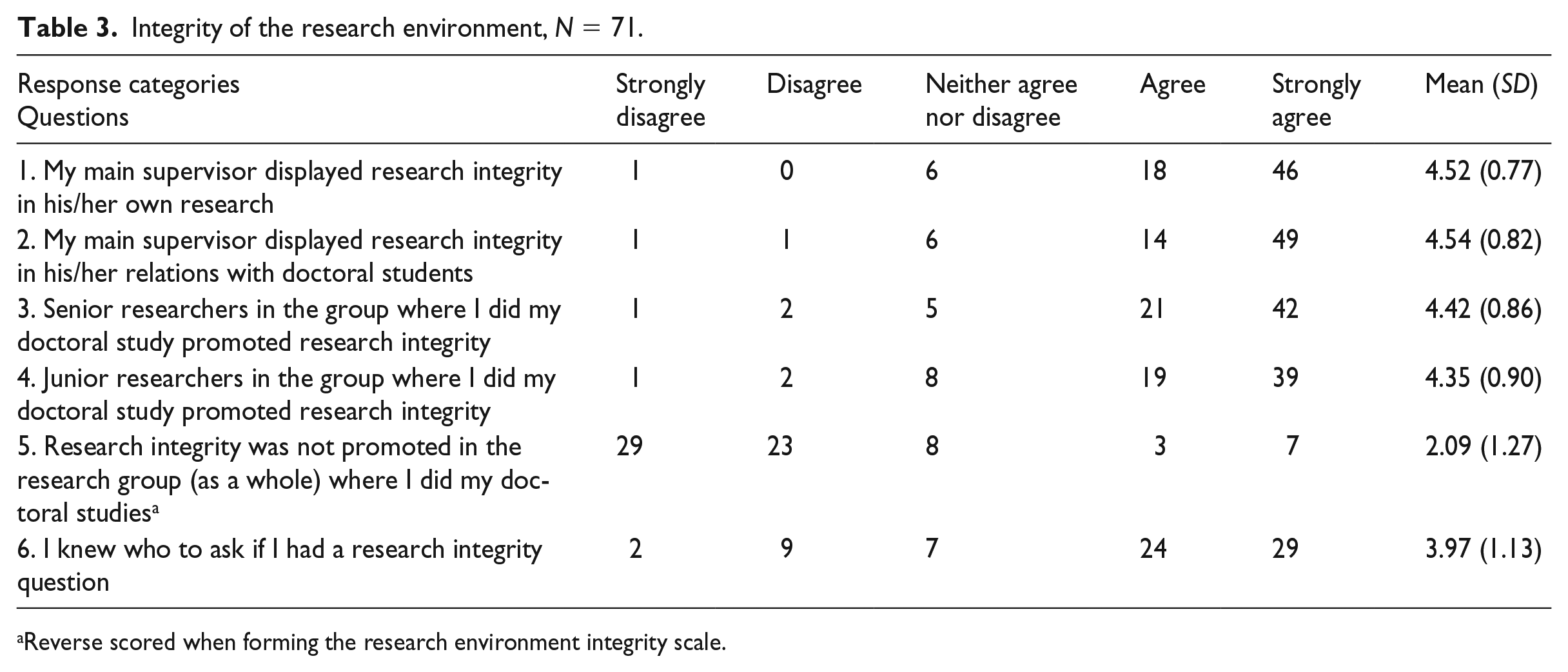
Reverse scored when forming the research environment integrity scale.
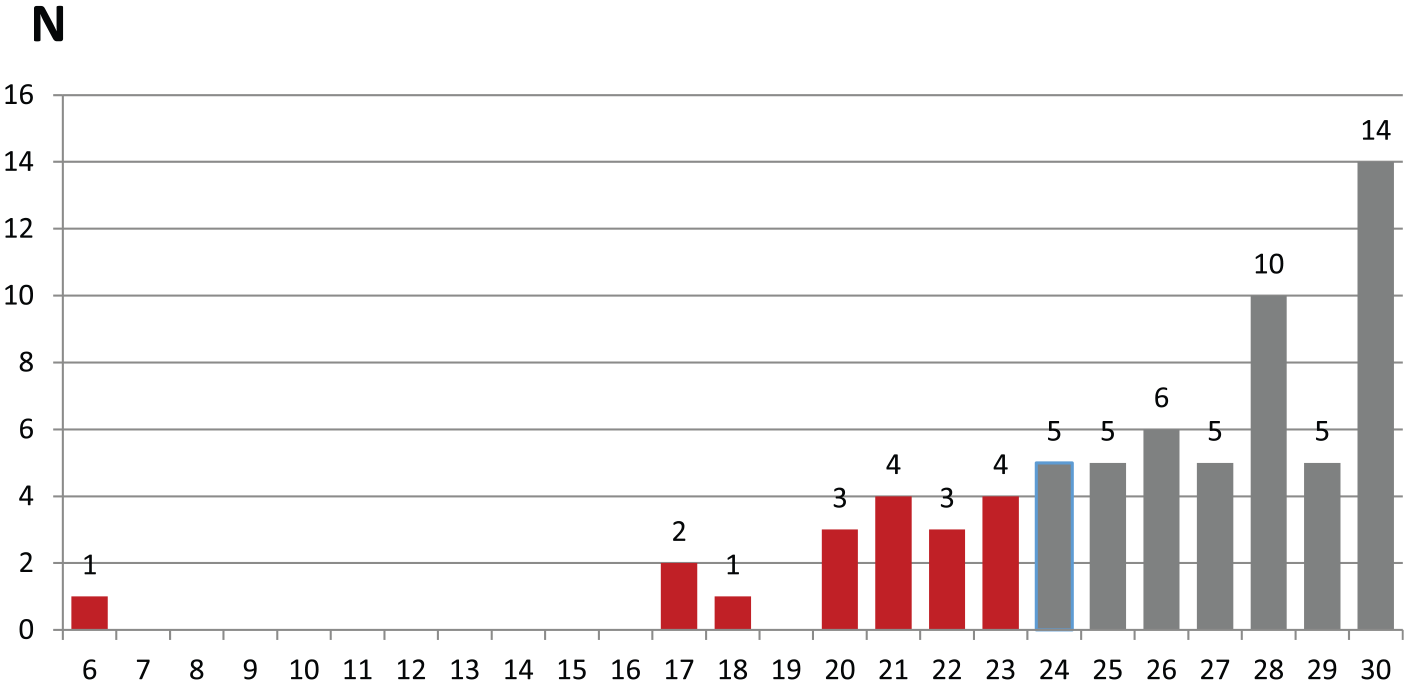
Research integrity environment scale (red indicates respondents with an average score below “agree” in relation to integrity environment items).
Co-variation between the research environment integrity scale and knowledge about or pressure toward scientific dishonesty in the research environment.
Discussion
The results show that recently finished PhDs from the Faculty of Medicine at the University of Oslo know of scientific misconduct within the departments in which they did their PhD research. This includes serious forms of dishonesty, such as fabrication, falsification, and plagiarism. A smaller proportion of the PhDs report pressure to commit serious forms of scientific misconduct and some even admit to having personally committed such misconduct. The results also show that some of the PhDs perceive that the research community they were part of during the fellowship does not promote scientific integrity. The study furthermore reveals a connection between the PhDs’ attitudes and their perception of integrity in the research community.
While it is encouraging to see that attitudes to some forms of misconduct change in the right direction, it is worrying that other forms of questionable research practices are still considered acceptable by some finished PhDs.
Our results concur with previous studies in Norway (Hofmann and Holm, 2016; Hofmann et al., 2013; Holm and Hofmann, 2018), Scandinavia (Hofmann et al., 2015; Jensen et al., 2018; Nilstun et al., 2010), and internationally (Fanelli, 2009). Reported breaches of scientific integrity are somewhat higher in our studies than in studies in Norway covering a wider range of disciplines (Elgesem et al., 1997; Hjellbrekke et al., 2018). This can of course be due to the fact that medicine and health care are worse than other disciplines, but most likely this is due to the low response rate of the transdisciplinary studies.
There are reasons to believe that researchers are reluctant to disclose their own scientific misconduct, even in anonymous surveys. Reported practice may therefore be underestimated in this study.
Interestingly, this study reveals a significant authorship problem. Only 60% of respondents reported that they had not experienced unethical pressure on authorship during the course of the doctorate. The fact that the percentage of reports of authorship problems is higher in this study than in previous studies is most likely due to the fact that the respondents who have recently finished their PhDs have more publishing experience than the PhD students surveyed in the previous studies. This high incidence of pressure toward authorship misconduct is seen, even though all respondents indicate in the answers to the attitude questions that they know this is wrong. This may indicate that the pressure is high and that this is an environmental problem more than an integrity problem with PhD candidates. This corresponds with the comment to a similar study in Denmark, where the editor of the Journal of the Danish Medical Association states that it would be odd if the main supervisor was not a co-author of the PhD student’s publications and also that “. . . I would, for example, not myself think it was fun to be a co-supervisor and then not to be a co-author of any of the articles. It is not reasonable, assumed - of course - that the Vancouver rules are met” (39). If there is also such a conception in Norwegian research environments that certain seniors should be co-authors and if they clearly indicate that everything else would be unfair and that they then would not consider supervising, because it would no longer be “fun,” it may be very difficult for PhD candidates to resist authorship pressures, even in those cases where the criteria in the Vancouver (i.e. ICMJE) rules on authorship are not met.
This study also shows that there is a difference in attitudes toward research integrity between PhD students and PhDs. In relation to some issues, the PhDs have stricter norms, such as using statistical analysis methods in inappropriate ways, while appearing to be more relaxed for others, such as in relation to expediting publications. However, the differences are only statistically significant for some of the stricter norms.
The results are also consistent with the “environmental hypothesis,” that is, scientific dishonesty is at least as much an environmental problem as a personal integrity issue (Mumford et al., 2007, 2009). However, the hypothesis that “good norms for research are something that one learns in the lab/clinic and not on a course” must be modified to also include bad norms.
Although this study has a high response rate, it also has some weaknesses. It was not possible to track all the PhDs after they had finished. We used a variety of methods to reach as many as possible, but some had moved (back) abroad and others may have changed names. Those who had the opportunity to participate represent 45% of all those who received their PhD from the faculty in 2016. Those who responded accounted for 38% of all PhDs. Although this still represents a very favorable response rate compared to other studies, we are reluctant to claim that our respondents are representative of finished PhD candidates. There is reason to believe that scientists refuse to disclose their own dishonesty, even in anonymous surveys. They may therefore have under-reported their own research misconduct.
Conclusion
We find that a significant proportion of recently finished PhDs know of serious forms of misconduct in their research environment and some report such actions themselves. A significant number of PhDs also report pressure to commit various forms of misconduct during their fellowship. Authorship problems appear to be a significant problem. The attitudes of the PhDs improve in some areas during PhD studies, but appear unchanged on others, when we compared to the results from same group when they were research fellows. There is a connection between attitudes and environmental integrity factors, which suggests that scientific fraud is as much an environmental problem as an integrity problem. If this is correct, integrity-promoting measures should as much target environments as individuals.
Footnotes
Authors’ contribution
SH and BH have designed the study. BH has gathered the addresses to the PhDs from public available lists of PhD defenses at the Faculty of Medicine at the University of Oslo and acquired the data. SH has analyzed the data after discussions with BH. BH wrote the first draft of the manuscript. SH has made essential contributions to the content of the manuscript and both authors have contributed significantly in several revisions of the paper. Both have approved the final version of the paper.
Funding
None of the authors have received extra funding for this study beyond their ordinary sallaries. Both authors have adjunct positions at the University of Oslo and are or have been involved in educating PhD students.
All articles in Research Ethics are published as open access. There are no submission charges and no Article Processing Charges as these are fully funded by institutions through Knowledge Unlatched, resulting in no direct charge to authors. For more information about Knowledge Unlatched please see here: 