




Abstract
The aim of the present article is to contribute empirically derived knowledge about Swedish researchers’ experience of ethical problems, conflicts and dilemmas in their research practice in relation to the ethical vetting legislation and procedure. The study has been carried out using the critical incident technique, with researchers from various disciplines providing examples from their own research practice of problems relating to research ethics. The analysis of the researchers’ responses indicates three phenomena, partly in line with similar studies in other countries: (i) the law of ethical vetting puts limits on the relevant research ethical questions; (ii) it is not possible to anticipate all questions of research ethics; and (iii) there are consequences to the fact that the boards for ethical vetting ignore problems that fall outside the law.
Background and previous research
The review of research ethics by committees has become an increasingly wide international practice. In Sweden, the Ethical Review Act (2003: 460), concerning ethical review of research involving humans, has been in force since 1 January 2004. A decision of the European Commission required all countries in the European Union to implement the directive concerning good clinical practice in the course of clinical trials of medical products for human use (2001/20/EC). The main reason why ethical vetting of research involving human beings should be regulated by law was, and is, that people who participate in research as the subjects of such research should be protected against physical and mental injury or the violation of their integrity. Consequently, the legislators who wrote the law had biomedical research in mind.
Researchers engaged in research ethics – ethicists as well as social scientists – argued that the law should encompass all research involving human beings, even in the social sciences. 1 The two main reasons given were that: (i) people who participate as subjects in such research also should be protected against physical and mental harm or violation of their integrity; and (ii) there would be a distinction in status between medical and other research if the law concerning ethical review did not include social research. The discussion resulted in a decision that the Act should encompass all research involving humans.
This resulted in social scientists being governed by the same model used in medicine. A further consequence was the replacement of collegial by legislative control. Research ethics previously was managed within the framework of on-going research activities, using ethical codes and the transmission of core values and norms, as mediated through the literature, supervision, courses and seminars, as well as by granting agencies and peer reviews. Before the legislative changes, ethical committees, which were composed of research peers and which had advisory and guiding functions, were established in some of the universities, as well as within the National Research Council for the Humanities and Social Sciences.
After the Act had been in force for some time, the law was criticized in respect to three paragraphs. There was not any public debate, however. The first point concerned the definition of the concept of research. The second change concerned the fact that not all research dealing with sensitive personal data was to be subject to ethical review. The changed Act of 2008 stated that the statute is applicable to research that involves sensitive personal data as defined by the Personal Data Act, whether or not the subject of the research has explicitly given his or her consent.
The third change is a consequence of the fact that social science is included in the law. There were problems of interpretation about which research the law was applicable to. The Act (§4) stated, ‘This statute is to be applicable to research that is concluded in accordance with a method intended to physically or mentally influence a person who is participating in the research’. The discussion concerned the interpretation of the wording, ‘method intended to physically or mentally influence a person’. This included most educational projects, because the purpose of such, mostly harmless, projects is meant to influence persons. In contrast, research that used methods that without intention or intervention ran the risk of harming persons, was excluded.
The statute from 2008 was expanded as follows to include, ‘[a] method intended to physically or mentally influence a person or which involves an obvious risk to cause physical or mental harm to a person who is the subject of the research’. This additional paragraph expanded the application of the law and is particularly relevant in relation to social science. Research using methods such as interviews evidently can cause harm even if they are not intended to influence the subjects of the research.
All research that is referred to in the statutes above ‘may only be conducted if it has been approved subsequent to an ethical vetting’ (§6) prior to its start. This is followed up in §38, which does not seem to be well known among researchers: ‘Anyone who intentionally breaches the first paragraph of §6 or a condition that has been stipulated with the support of the first paragraph is to be sentenced to fines or a prison sentence lasting no more than six months. In [a] trivial case nobody will be deemed liable’. The fact that ethics review has been made part of criminal law, unlike in other countries, has not been discussed at all in a public debate.
Research to which the law does not apply may be reviewed if the researcher asks for it – for example, to be able to be published in a certain journal or the researcher simply wants a qualified ethical review. The researcher will then get an advisory statement.
The Swedish legislation can be described as narrow in its application but strict in its legislative power. It is narrow in the sense that legislation addresses only certain specific situations and certain specific conditions, although these have expanded in the new version from 2008. Still, a great deal of research falls outside the law without being ethically problem-free. Research that does not use sensitive personal data and does not use methods at obvious risk of harming subjects is not to be reviewed, according to the Act. This does not mean that this research can be conducted without considering ethical aspects. The researcher must still observe the ethical criteria as cited in commonly used codes as well as personally reflect on his or her project (Swedish Research Council, 2011). However, the previous ethical guidelines, ‘The Principles of Research Ethics in the Humanities and Social Sciences’, have been moved to a hidden place on the home page, by the same council. The reason for that is said to be that the principles might compete with the law and mislead the researchers so that they do not apply for an ethical review.
The review is carried out by the regional boards for ethics vetting, which have two divisions – one for medical research and one for ‘other research’. The ‘other research’ is defined as all research involving human beings except medical research. The chairperson in each division is a judge. The same application form, comprising 22 points about the project, is used for all applications for vetting. It contains questions about, for example, animal experimentation, biobanks, power analysis and insurance coverage.
The professional discourse of research ethics, cultivated over many years, risks being replaced by a juridical one, when researchers of various disciplines try to adapt to the law. There has been surprisingly little public debate about the law or the application of the law; there have been just a few articles about the strong influence of the law on behalf of ethics (Colnerud, 2011, 2013; Petersson, 2013). Researchers seem to comply with the law and the organization of ethical vetting, although they privately question some aspects of it, which become apparent in this particular research project.
Previous research
The replacement of an earlier collegial control of the standards of research ethics by a legal control can be seen, in the terminology of Grimen (2008), as a change in the social contract that exists between the research profession and society as a whole. Researchers previously had managed their research ethical challenges without legal review. Bear in mind that there is the risk of harm to research subjects within the biomedical field if the local tradition holds low ethical standards. However, we actually know rather little about the risk of injury within the social sciences. Capron (1983) suggested that investigations of the real situation in the social sciences should be carried out to find out ‘how frequently such research actually generates any harm to its subjects’ (p. 396). Dingwall (2012) calls attention to, among other things, ‘the lack of evidence on the proportionality of the costs of regulation to the benefits achieved’ (p. 22). Nichols et al. (2012), like Schrag (2011), have requested empirical evidence to support the premise that ethical vetting of research actually results in improved research. The new arrangements for the ethical control of research in Sweden raise questions about whether the legislation is, in fact, appropriate for the ethical review of the social sciences or whether ethical vetting compels social scientists into the ‘wrong paradigm’ (Burr and Reynolds, 2010). It also confirms the relevance of the two models for research ethics review that Jennings (2010) calls the compliance model and the reflexivity-based model. Researchers in several countries have conducted studies similar to the present work, the first empirical one in Sweden, and found that ethics committees tend to pay attention to the wrong questions and ignore the main ethical concerns of the researcher (see, for example, Bell and Salmon, 2011; Fendrich et al., 2007; Wynn, 2011).
Questions relating to the application of the legislation to the ethical review of research and the regional ethical review boards of so-called ‘other research’ can be raised. Some of these questions are theoretical: for example, whether the legal control of the standards of research ethics can result in a de-professionalization of the research profession. Other questions require empirical research in order to obtain answers. Tranøy (1983) considered that research ethics should be developed through the application of ‘sober knowledge in depth and width of our present practices’ (p. 12). Questions that aim to elucidate such knowledge are posed in this study – for example: which ethical problems and dilemmas confront the researcher in the practice of research, and how do these dilemmas relate to the law of ethical vetting? Questions such as these constitute examples of descriptive research ethics, as opposed to normative research ethics, which highlights the preferable course of action and restricts that which is morally wrong (Petersson, 1994).
This article presents parts of a research project on descriptive ethics: Codes and practice. Researchers’ ethical dilemmas, funded by the Swedish Research Council. The aim of the present article is to contribute empirically based knowledge about social science researchers’ experience of ethical problems, conflicts and dilemmas in their research practice in relation to the ethical vetting legislation and procedure.
Method
The article presents findings taken from a larger study comprising various dilemmas experienced by researchers. The purpose of the main study is to examine, from multiple perspectives, the experiences that practicing researchers have had of ethical problems and dilemmas, and where ethical review is one of several research interests. Data have been collected by asking researchers about their experiences with regard to ethical problems in their research practice, according to the method described below. The data that are relevant to the specific part of the study with which this article deals relate in different ways to the ethical review legislation and the procedure for ethical review practised by the ethical review boards.
This investigation has been conducted using the critical incident technique, which has shown itself to be suitable for the investigation of ethical dilemmas in professional situations (Colnerud, 1997, 2014; Houston and Bettencourt, 1999; Lindsay and Colley, 1995; Pope and Vetter, 1992). The method has been in use since the 1950s and is appropriate for the study of events that occur discontinuously (see Travers, 1964). The research subjects themselves, in this case the researchers, make the selection of the events to be reported. In other words, it is the awareness and judgement of the researchers that defines what is an ethical problem, conflict or dilemma. This is the core of the method because it enables the search to include atypical events, which are not necessarily defined by the authorities or by codes and laws.
Procedures and sample
The procedure requires that the research persons answer one question about their own experience of ethical problems. The question was formulated as follows: ‘Describe a situation within the framework of your research in which you or a research colleague has had to tackle something which has raised difficult or challenging research ethical issues for you’.
The participants were researchers of post-doctoral status in the fields of medicine, humanities and social sciences. At the time of data collection, they all had been awarded grants from the Swedish Research Council. The sample was stratified with regard to academic discipline, but is randomized within each group. Twenty-three researchers answered in writing and 32 answered in an audiotaped telephone interview. Because several researchers have contributed two or more critical events, the total data collection comprises 109 examples of research ethical dilemmas, conflicts and problems, reported by the 55 researchers. Most of these concern ethical problems in relation to the subjects of the research. The analyses of those are published in other articles (Colnerud, 2013). This article focuses on ethical review.
Research ethics
The contributing research subjects were given written information regarding the aim of the project, the effort that participation would entail, information that participation was voluntary, that their answers would be rendered unidentifiable, that the results would be published, and who had overall responsibility for the project. The fact that an individual replied to the question has been taken as an admission of informed consent to participation.
The project does not fulfil the criteria for vetting, according to the legislation. We did not deal with sensitive personal data nor did we use methods which entailed an obvious risk of harming the subjects physically or mentally. It therefore was not encompassed by the ethical vetting legislation and, consequently, was not sent to the ethical review board for ethical vetting. The subjects were rendered unidentifiable and their statements were used in a way that prevents recognition.
Analysis
The reported events in the main study were analysed using qualitative data analysis (Bryman, 2001). The aim of the analysis was to discover which research ethical norms and values were at stake and revealed in the ethical problems that the subjects described. These ethical norms also conflict with other norms, such as quality norms of research methodology.
The analysis was carried out by examining and coding every critical incident in detail, so that the various conflicts of ethical norms that the researchers described were made clear. These provided the data for categorization. Thereafter, the analysis turned to focus within each of these categories specifically, in this article, the category ‘ethical vetting’.
The categories in the main study, as a whole, are shown in Table 1. This particular article focuses on the ethical problems related to ethical review, with regard to both the legislation and the procedures, category number 3.
Ethically troubling incidents in research practice.
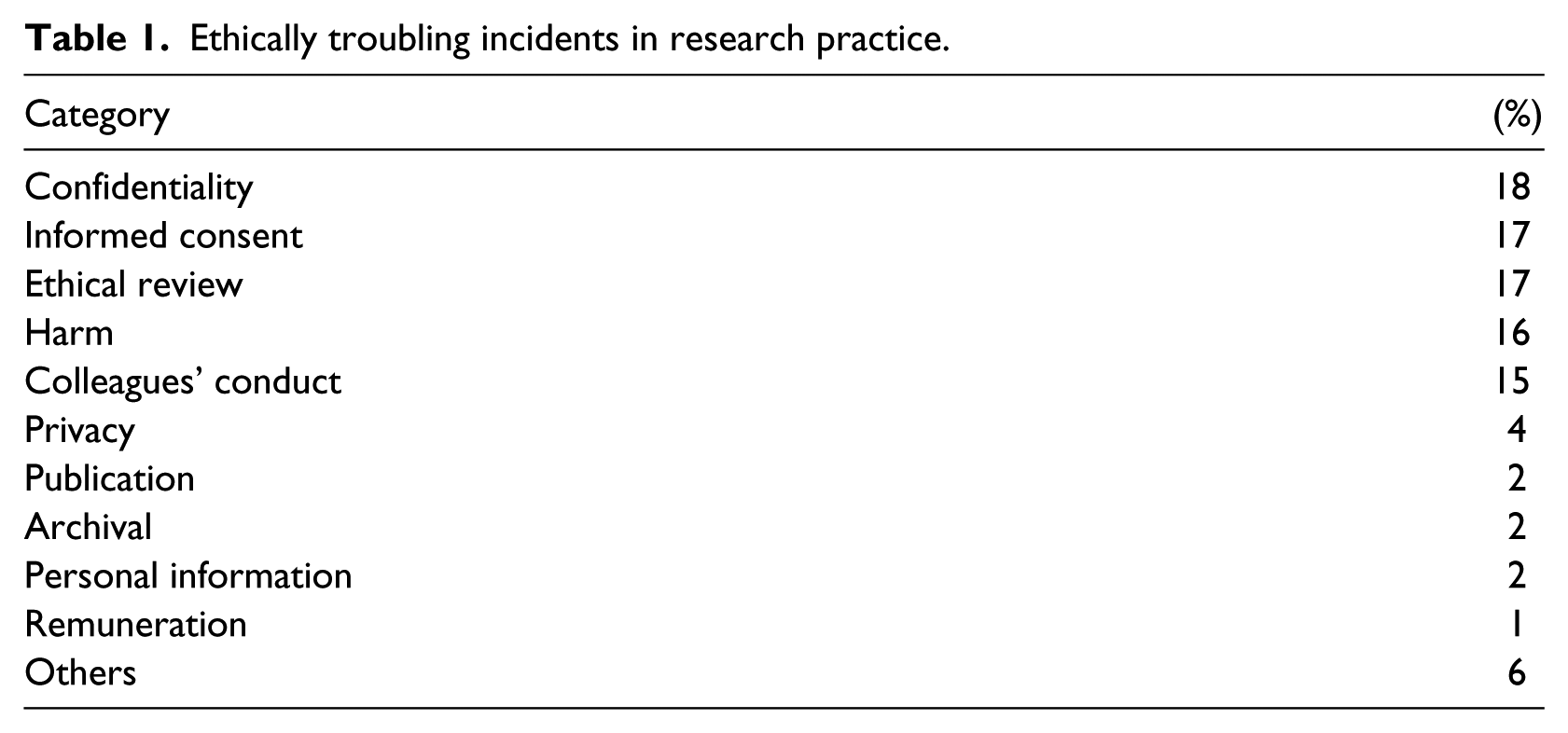
Table 1 illustrates the distribution of the categories of ethical problems, conflicts, and dilemmas that have emerged from the analysis of the main study. As can be seen, 17 percent of the cases represent problems related to ethical review; these comprise the central material of this article.
Results
The findings show that the researchers’ reported experiences of problems, conflicts and dilemmas related to research ethics bring to the fore broadly shared research ethical norms that are designed to protect research subjects from injury and various types of intrusion. They also show a remarkable attention to ethical vetting as a phenomenon and the way in which the ethical vetting boards carry out their duties.
Among these are found general comments which consider that the law of ethics vetting is too general and that it is poorly adapted to the social sciences because its starting point is to be found in a model of medical research. The boards of ethical vetting are seen, furthermore, as lacking necessary competence; respondents expressed a lack of confidence in the way that the boards manage social science. It is not too strong a claim that some of the researchers feel that the boards underestimate their own ethics vetting work. This is conveyed, for example, by a researcher who wrote that the board for ethical vetting does not seem to understand that researchers have been working actively with questions relating to research ethics long before the boards were formed.
It is important to bear in mind that this study belongs in the field of descriptive, and not normative, research ethics, meaning that the researchers’ descriptions of problems, as well as their reflections on and solutions for the same, have been reproduced in abstracts and quotations without normative judgement. The contribution of the analysis is, instead, a practice-related and detailed description of the ethical issues facing researchers.
On closer examination of the data, three themes dominate. These are:
Relevance: Relevant questions regarding research ethics lack support in the legislation.
Anticipation: The researchers show that it is difficult to anticipate all the questions relating to research ethics.
Dismissal: The researchers reveal that the ethical review boards ignore problems that fall outside the scope of the legislation and that the limits of the legislation are unclear.
Relevance
The first theme concerns the fact that relevant problems, or at least aspects of them, are excluded because the selection of problems set out in the law has its roots in medical research. As stated previously, the statutes for the law of ethical vetting encompass the management of sensitive personal information, the risk of injury, and issues of consent for methods that are intended to affect the research subject or which carry a risk of injuring them physically or psychologically. These types of problems are relevant to all disciplines. However, they also involve aspects that are not considered in the legislation.
Informed consent
Regarding informed consent, researchers pointed out three problems, which appear to be of particular importance for the social sciences. The first is that too detailed information about the project, which is requested by the vetting committee, can awaken anxiety and suspicion in the person being asked to participate. One researcher, who carried out tests with participants who were university students, found that detailed information could have a deterrent effect:
On a few occasions, the student became more suspicious than was intended; the idea was to defuse the situation … we had a very detailed form.
Signing a certificate of consent can arouse resistance to participation in a study that is actually quite harmless.
The second problem that researchers brought up was that for certain types of study the requirement for consent reasonably may have to be ignored. This is particularly relevant for covert studies (see Burr and Reynolds, 2010). In one case, the researcher described a study of discrimination in the labour market, for which the researchers wanted to use the method of submitting fictitious applications for work:
This relies on the subjects not knowing that they are being studied, as they would probably not behave in their usual manner if they did … which brings us to the dilemma: should they be informed that they are part of a study?
The problem is that an agreement of consent would automatically destroy the aim of the project. The board of ethics vetting did not approve the project because they stated that confidence in research would be at risk. Curiously enough, an almost identical project was approved by another board for ethics vetting.
In contrast, a medical researcher has had positive experiences of solving an issue of informed consent through dialogue with the ethical review board, which is, in fact, an exemption from the legislation:
A situation that is difficult in terms of research ethics is when studies are carried out on patients with acute illnesses who are admitted in an emergency, in our case during a cardiac infarction. In this situation, to ask a patient who is in pain and who, in addition, is under the influence of drugs to participate in a research study … it’s difficult to ask patients to make a decision, when there is an emergency … We had a discussion with the ethics committee and the patient was supposed to be given written and verbal information, and they should really sign [a consent form] … There is not always enough time. In this case, it was possible to do this with the approval of the ethics committee; the decision was that, if possible, we should obtain written approval from the patient when we initiate the procedure, and once the patient arrives on the ward and can read through everything in peace and quiet, they can sign retrospectively. The committee has given its approval for this.
In order to enable research, the researcher is permitted to use a so-called ‘postponed approval’.
The third problem concerns questions of consent when a child and his or her parents are of different opinions. In classroom research, for example, the situation sometimes arises that parents do not want their child to participate in a research project, whereas the children want to do as their peers do – in other words, to participate. The legislation, and therefore the committees, do not take children’s voices into account:
I often interview teenagers but I have also done interviews with younger children. Since they are young there is a claim for parents’ consent. I have been through situations where the parents have said no to the child’s participation, while the child has wanted to participate.
The opposite can also occur: the child wants to opt out of a psychological test whereas the parents want their child to continue participation:
I conduct research into children and their language development, and if the child does not want to participate, or if the parents have given the OK, but the child does not want to be involved I basically feel that it is time to stop and let the child decide, even if the parents and scientific community think it is OK to continue.
In neither case does ethics vetting provide any support for the researcher. The problems regarding informed consent mentioned in this section show that there are ethical problems concerning informed consent in practice but which lack relevance in relation to the law.
Risks of harm
Researchers have highlighted other relevant questions of research ethics which may arise during the research process. Ethical doubt may already arise during the choice of the research problem. One researcher was seized by doubts about his planned research project on self-harming and youths. Perhaps the attention given to the youths who merely participated in the project might reinforce their damaging behaviour. Ethics vetting would be of no help to the researcher in that dilemma.
Another question that can arise during field studies is whether the principle of ‘no harm’ is also applicable to third parties. When is it legitimate to abandon the role of researcher in order to intrude in a process one has observed if the intrusion may lead to harm to persons outside the study? This question was actualized for researchers who, during an observation study of a chemistry laboratory exercise, noticed that the children were pouring quicksilver into the sink. The injury that might result was a long-term poisoning of the public. The researchers were uncertain of the boundaries of their ethical responsibilities.
Confidentiality
Problems of confidentiality that have not been addressed by the law can also arise in field research. Such problems therefore lie outside the responsibility of the boards for ethics vetting. One researcher called attention to the weak protection that the law of ethics vetting provides to research persons. He emphasizes the need for anonymity in relation to the storage and publication of data. He studies interactions and relationships in organizations and is more concerned about internal anonymity than external:
For example, how to deal with internal anonymity. By internal anonymity, I mean that the individuals or representatives of organizations which are included in the study that you interview should not be able to recognize each other … They know, of course, that they have participated, and most of the time they can figure out who the other subjects were – it is not hard to do – but there is rarely any discussion on this topic. There was nothing on it in the ethical review.
Preventing source recognition for statements emanating from a workplace requires more than the demands made on the researcher by ethics vetting.
Another problem of confidentiality arose for an ethnographer who carries out investigations on institutions for youths with social problems. The board for ethics vetting requested that in addition to requesting informed consent from those whom she was interviewing, she should post a notice at the institutions to the effect that research was in progress. A consequence of this would have been that all visitors who read her report would be able to identify the institutions from which data had been collected. The researcher thought that the board of ethics vetting had put her in an ethically disturbing position.
We can state that because the law of ethical vetting focuses on only a limited number of ethical problems, others are left without consideration.
Anticipation
The second theme concerns the fact that all aspects of a research project are presumed to be foreseeable. To be legal, a research project which fulfils the criteria mentioned above cannot be begun without approval from a board of ethical vetting: this demands that the board has access to all planning that could have relevance for their decision.
This creates difficulties, particularly for researchers carrying out fieldwork – for example, observational studies over a long period, such as those used in ethnographical research. Researchers in action research also have pointed out this situation. Some researchers were of the opinion that it is ‘naïve’ to expect one to be able to foresee all the ethical problems that may arise. However, some researchers believe that ethical review can elicit reflection:
I think that ethical review is a good thing; you have to think through your research and sort of imagine what could happen, since you cannot know how the questions you ask will be perceived; something that seems neutral to me might turn everything upside down for my informant because I trigger something. As soon as people are involved, it is impossible to guarantee that there will be no incidents, and that is part of the excitement in working with people; the fact that it is not predictable, and if it was, it would be a terrible shame.
Another researcher has a more critical view of the anticipatory requirement:
I think that, from the committee’s point of view, they would like everything we do to be very clear-cut, and regulated and documented. They seem to think that it will not be quite right otherwise, that it will not be done properly … It fits better with experimental studies, those performed by psychologists, for example. Field studies are much more complex, and I would like to see a solution to that; this is more long term, the ethics committees should at least be composed of researchers from different fields; they need more humanists and field-oriented social scientists who are familiar with the type of dilemma you can find yourself in, which requires … all these types of documents and letters, etc. It is too formal, and it is not suited for adolescents and children; they do not accept it in the same way that adults do.
It is necessary to be prepared for unexpected ethical problems popping up and be ready to make quick decisions. This kind of research demands a well-developed ethical judgement and a good capacity for discrimination of ethical risks.
A social scientist reflects over the problem of foreseeing all possible incidents in an interview:
It doesn’t matter which research subject … There are always sad and difficult situations for people. If you are doing research which involves human beings, you have to be prepared that you don’t get only the happy and nice … Difficult things pop up when you least expect them. I am prepared for it. I have to do what I can as a fellow human. As a researcher I am responsible, but I do not have the competence to take care of someone who breaks down. If it happens I have to show the way to someone who can take care of them.
A further problem relates to the fact that the ethics vetting boards request only informed consent prior to the start of a study. However, in some long-term studies, the researcher, having become increasingly familiar with his informants, needs to remind them of his research role and renew his request for consent. The researcher is not prevented from doing this, but the boards for ethics vetting have not drawn attention to the problem.
Dismissal
The third theme stems from the way the committees handle ethical problems that fall outside the limits of the legislation. These limits also can be unclear. Some boards meet the ethical discourse of researchers with either silence or dismissive formulations. Because boards are bound by a legal framework, they ignore problems of research ethics that researchers have identified as genuinely difficult. A researcher can get a reply that ‘the project lacks ethical difficulties’ without any further illuminating comments.
The project may be unproblematic in relation to the legal definition of ethical relevance, but at the same time the problem can have importance for research ethics and be difficult to solve within social science, even if it is not encompassed by the law. One of the participating researchers who had not received any comments at all about sensitive parts of her project expressed that ‘the decision of the board was a great surprise’.
The boards keep within their mandate. The consequence of this, however, is that a good deal of what is ethically important to practical research falls outside the responsibility of the boards.
Researchers may also find it difficult to interpret the wording of the legislation – for example, the paragraph stating that research affecting the subjects must be examined by an ethical review board:
Another issue for us in psychology, which has been a major topic of discussion, is the question of where to draw the line. All research in which you affect people physically or mentally must be subject to ethical review, and the interpretation of what ‘affect’ means is, therefore, very important; I create an effect when I enter a room in which there are people and they will be affected. It has become common practice when you have made your submission for ethical review for the committee to say that there is no need to examine it, that it has no long-term effect like the types indicated. If you are just running a small experiment where you are showing words and testing memory, you do not require an ethical review because it is not long term; an interpretation of the concept is developed, which is still pretty implicit.
Some boards appear to have decided for themselves the practical limits of the legislation. This is a local practice, however, which the majority of researchers may be unfamiliar with.
Discussion
The researchers who participated in the project have described phenomena which emerge in the encounter between the social sciences and the design of the current ethical review legislation:
the law of ethical vetting puts limits on the relevant research ethical questions;
it is not possible to anticipate all questions of research ethics;
the boards for ethical vetting ignore problems that lie outside the law.
The classical research ethical principles that are intended to protect participants, emphasized, for example, by Beauchamp and Childress (1994), indeed have relevance for the social sciences; however, the questions to be formulated and the applications must, as Tranøy (1983) stated, start from criteria that are relevant to current practices. Amongst other things, this means an acknowledgement of the fact that these important values can be compromised in other situations and other phases of the research process than those in which one normally expects to find risks.
Schrag (2011) has already described a number of irrelevant requirements posed by the boards for ethics vetting. The present study reveals a further threat to standards of research ethics – namely, that the process of ethics vetting may narrow the field of vision and thereby also the sensitivity with which researchers themselves can detect ethical risks and also prevent injuries of various kinds. This lack of relevance may result in researchers posing the wrong questions and adapting to the wrong standards (Burr and Reynolds, 2010).
Furthermore, the boards appear to have missed an educational opportunity – that of providing respectful comments that show an understanding of the fact that some questions can be ethically important even if they fall outside the law and are therefore deserving of the same dignity as if they had been encompassed by the law.
It is thus the case that researchers consider that boards for ethics vetting are in some cases all too sparing in their comments, leaving the researchers without support in important ethical questions. At the same time, there is the perception that the boards are sometimes over-zealous and request information at a very detailed level, in particular regarding those questions that lie within the requirements of the law and its recommendations. This applies, in particular, to the information letters which are sent to those who are invited to be research subjects.
Ethical vetting of social science may be necessary. As Smyth and Williamson (2004) have pointed out, we cannot be sure that guidelines provide sufficient protection for research subjects. Vetting should be carried out with respect for the proper conditions pertaining to a field of research, however. The fact that research in social science can be performed in a great many different ways poses the requirement for the individual researcher of a well-developed sensitivity for and judgement regarding research ethics. The question reasonably may be asked whether the development of such judgement is advanced by replying to formalized questions in a standardized application form that was designed to meet the requirements of medical research. Supervisors have been known to teach their doctoral students to simply copy already approved applications so that their projects will pass the vetting procedure without the loss of valuable time. The focus is on an ability to complete the application form in an approved way rather than on cultivating awareness of ethical problems throughout the entire process. This can be seen as a warning example of how, to use the terminology of Jennings (2010), the compliance model extinguishes the reflexivity-based model. Ethical vetting is one aspect of research ethics, but a powerful normative one.
The problems that arise in the social sciences, in terms of the current model for ethical review which have emerged in this article, may be seen as an expression of the encounter between two discourses: the discourse developed in the practice of research ethics and the legal discourse. The legal discourse sets limits – limits between that which belongs within the legislation and that which falls outside it, and limits between permitted and not permitted – whereas the practitioner discourse celebrates research ethical sensitivity and judgement, which means that the researchers are constantly finding new applications for the basic principles of research ethics. However, the researchers do not seem to be critical primarily towards ethical review, but rather concerned that their problems regarding research ethics seem irrelevant and remain unresolved. If the legal discourse becomes dominant, it could be seen as a renegotiation of the social contract between research professionals and society as a whole, as explained by Grimen (2008). This, in turn, could constitute a risk that there is a de-professionalization of the researchers, in the sense that the researchers no longer take responsibility for the various ethical problems that arise within their research practice.
Footnotes
Declaration of conflicting interest
The author declares that there is no conflict of interest.
Funding
The author wishes to thank the Swedish Research Council for the funding of the study, and Lars Kåreklint, PhD, of Linköping University, who made the interviews.