




Abstract
Recruiting patients to participate in health research is challenging, and most studies struggle. Failure to recruit can jeopardise the quality of research, and threatens efforts to improve healthcare. Despite this, recruitment materials tend to be conservatively designed and unimaginative. One reason for this is ethical concerns regarding the risk of coercion and offence posed by recruitment materials. The OXTEXT research programme gave patients a leading role in the design of new recruitment materials, in an area (mental health) where stigma and discrimination make ethical risks particularly acute. We discovered that our patient-designed recruitment materials were much bolder than usual, and they put the existing ethical boundaries to the test. The materials were effective and well liked – patients regarded them as neither unacceptable nor coercive. This suggests we may need to rethink the ethics of recruitment to research such that we permit more creative recruitment materials. In addition, it suggests a new role for patient input into research as designers of recruitment materials.
The challenge of recruiting to health research
Recruitment to health research is difficult. A recent review of randomized trials found that significant problems with recruitment were widespread, with less than one-third of trials able to recruit their original target number of patients within the time originally specified (Campbell et al., 2007). Few, if any, medical research studies are unaffected by recruitment problems. This has led to studies investigating the process of recruitment to medical research (Gaffy et al., 2009). Various additional methods have been developed aimed at increasing recruitment, such as newsletters and mail shots, telephone reminders, the use of information and communication technologies (ICTs), or even payments (Treweek et al., 2010). These have met with mixed success. The struggle to recruit continues to be a problem recognized by all research teams.
Ethicists seek to balance the potential benefits of successful research against the risk to patients, including the risk of coercion or offence. Research may fail ethically if it is coercive, or if the recruitment materials were found to be upsetting or offensive. These issues are particularly sensitive in mental health, where stigma and discrimination increase the ethical risks to the patient. But research that fails to recruit a sufficient number of patients may also fail on ethical grounds. Statistically underpowered studies may be unable to provide evidence of sufficient quality. In addition, the lower the proportion of eligible patients recruited to a research study, the less likely is its sample to be representative, and the greater the capacity to mislead. Medical research is ethically justifiable because it can contribute to improvements in healthcare. If research cannot contribute to improvements in healthcare in the way envisaged by the various stakeholders (such as the research team itself, trial participants, the funding body, research ethics committees and wider society), then it may be judged to be an ethical failure. It may, therefore, be considered an ethical imperative to achieve full recruitment to health research and to pursue all reasonable steps to ensure this.
This highlights how important it is that researchers and research ethics committees are able to accurately assess the risk to patients of coercion or offence. These risks must be balanced against the potential benefits of the research, including the likelihood of full recruitment. Errors or misjudgements of risk on either side of the calculation may lead to faulty ethical reasoning and thus to ethical failure.
Designing recruitment materials
Given this, it might seem surprising that recruitment materials, such as posters, information sheets and invitation letters, produced by health researchers tend to be so predictable. They are usually bland, monotone, over-long and complex. It is remarkable, for example, that materials intended for research participants sometimes use medical jargon such as ‘cohort’ or ‘eligibility criteria’. At first sight, they seem to be attempting to discourage rather than encourage participation.
Within health research, there is little evidence regarding the design of recruitment materials beyond informal impressions and anecdote: high-quality research evidence is notably absent. Design is typically left to each individual research team, whose skills really lie elsewhere. They undoubtedly aim to do their best, but the impression created is that the real attention of health researchers is directed elsewhere – perhaps, even, that they do not really value their participants.
Recruiting to the OXTEXT cohort
All these problems were faced by the OXTEXT research team during its attempts to recruit patients with bipolar disorder in Oxfordshire and Buckinghamshire (Christensen and Thomas, 2013). OXTEXT is a programme of research to evaluate and develop a self-monitoring and self-management system known as True Colours. The programme has several component parts. True Colours itself is an easy-to-use technology that enables patients to monitor their mental or physical health by texting or emailing answers to simple health-related questionnaires. Answers are stored on an electronic record that may be viewed online or printed out by both the patient and by members of their care team. The online record may be annotated by patients and clinicians, to note items such as changes in medication, changes in environmental stressors, and behavioural changes made by the patient. Self-report naturally lends itself to self-management, and one component of the OXTEXT programme concerns a manualized self-help intervention, which integrates directly with True Colours self-monitoring.
Commencing in January 2010, the OXTEXT study aimed to recruit a cohort of patients with bipolar disorder. Recruitment was initially sluggish, generating concern that a sufficiently large cohort might not be recruited. In response, the OXTEXT team decided to include direct patient input to the design of the recruitment process, with an initial focus on the design of recruitment materials. 1
Involving patients in mental health research
Calls for increased patient input to medical research are commonly heard. All medical research needs to reflect patient needs or priorities. To achieve this, research focused on the experiences and attitudes of patients is seen as being vital. This reflects an awareness of limitations to the expertise of researchers and clinicians, who may not be able to fully and objectively understand health experiences from the patients’ point of view. Part of the solution might be the inclusion of additional qualitative work, such as interviews and focus groups, in research design (Shaw et al., 2014; Woolfall et al., 2014), but the need to involve patients in the process of research, whether in research design, research management, data gathering or data analysis, is increasingly recognized.
It is sometimes argued that patient involvement is particularly important in mental healthcare. This could be because health experiences and patient perspectives in mental health are more difficult to access for ‘illness-naïve’ researchers than in other areas of medicine, although evidence for this claim is mixed (Faulkner and Thomas, 2002; Rose et al., 2011). Understanding and evaluating the best role for patients in mental health research is complex in what can be a quite politicized field of debate. Some researchers suggest there are scientific benefits of increased patient input. There is some evidence that patient input into the design of scales that are intended to measure patient satisfaction can lead to findings that diverge from data gathered by scales that have had no patient input. For example, questionnaires designed with patient input that seek to measure patient responses to ECT can indicate lower levels of satisfaction when compared to existing clinician-designed instruments (Rose et al., 2003). A longitudinal study of patient input to mental health research assessed how much involvement patients had made in 374 studies listed in the Mental Health Research Network (Ennis and Wykes, 2013). The level of involvement was recorded according to five variables. These extended from the lowest level of involvement, ‘patient consultation’, via a mid-point ‘jointly-initiated collaboration’ to the highest, ‘patient-controlled studies’. The researchers found that studies that involved patients to a generally greater extent were more likely to achieve their recruitment targets.
What this suggests is that patient involvement is an emerging field in mental healthcare, and at present it is unclear how best to include patients in research. Despite the wider call for increased patient involvement in research, in the area of patient recruitment we know perilously little about what patients think. Giving patients a role in designing recruitment materials appears to be unusual.
Patient-led innovation in recruitment materials
The work of the OXTEXT project always had a high level of patient involvement, so no new contacts were required to include patients in the design team. The team devised four posters, which were printed in two formats – an A4 size poster printed on paper and a slightly modified 15cm by 10cm postcard size printed on card.
The posters were piloted with known patients in the OXTEXT cohort. All were supportive of the changes. None of the patients who were consulted reported that they were offended, or regarded the materials as coercive. Instead they appeared to be able to recognize the rationale behind them, and easily understood the materials as reflecting patient experience. The posters and postcards were then distributed across the county in healthcare settings – in drop-in centres for people with mental health problems, and on public noticeboards in social settings, such as cafes, student accommodation, and alternative and complimentary healthcare clinics.
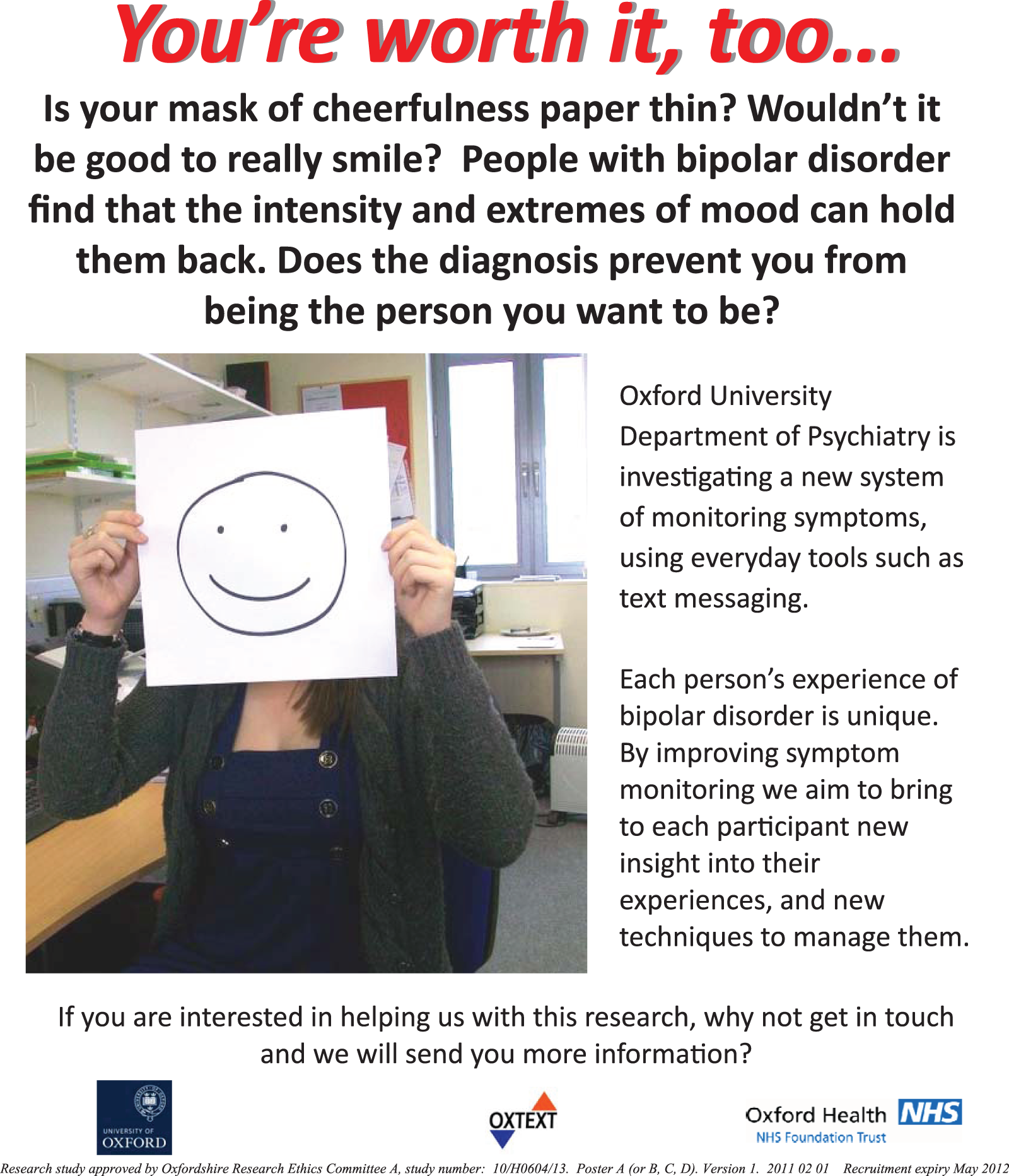
Because you’re worth it.
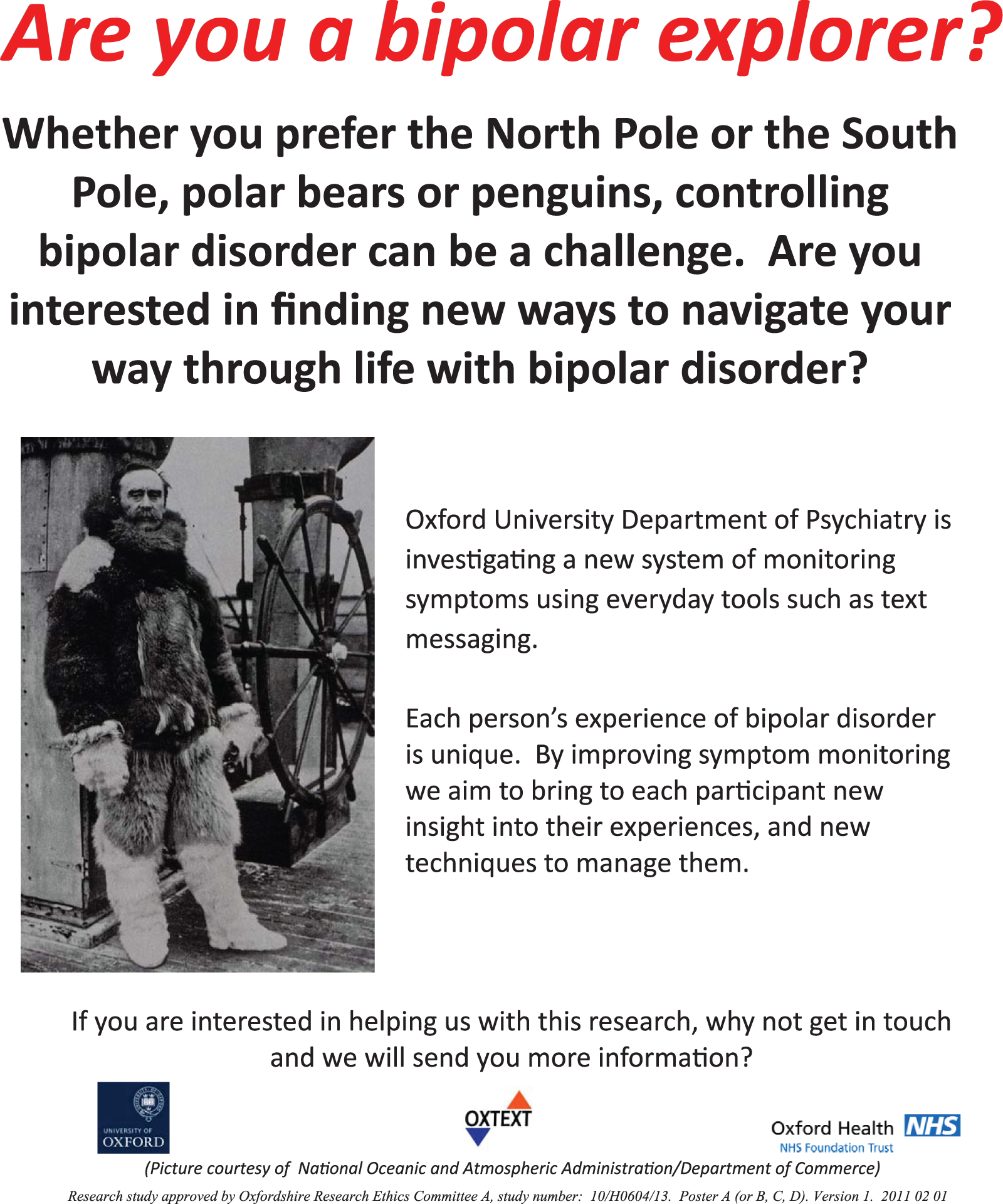
Bipolar explorer.
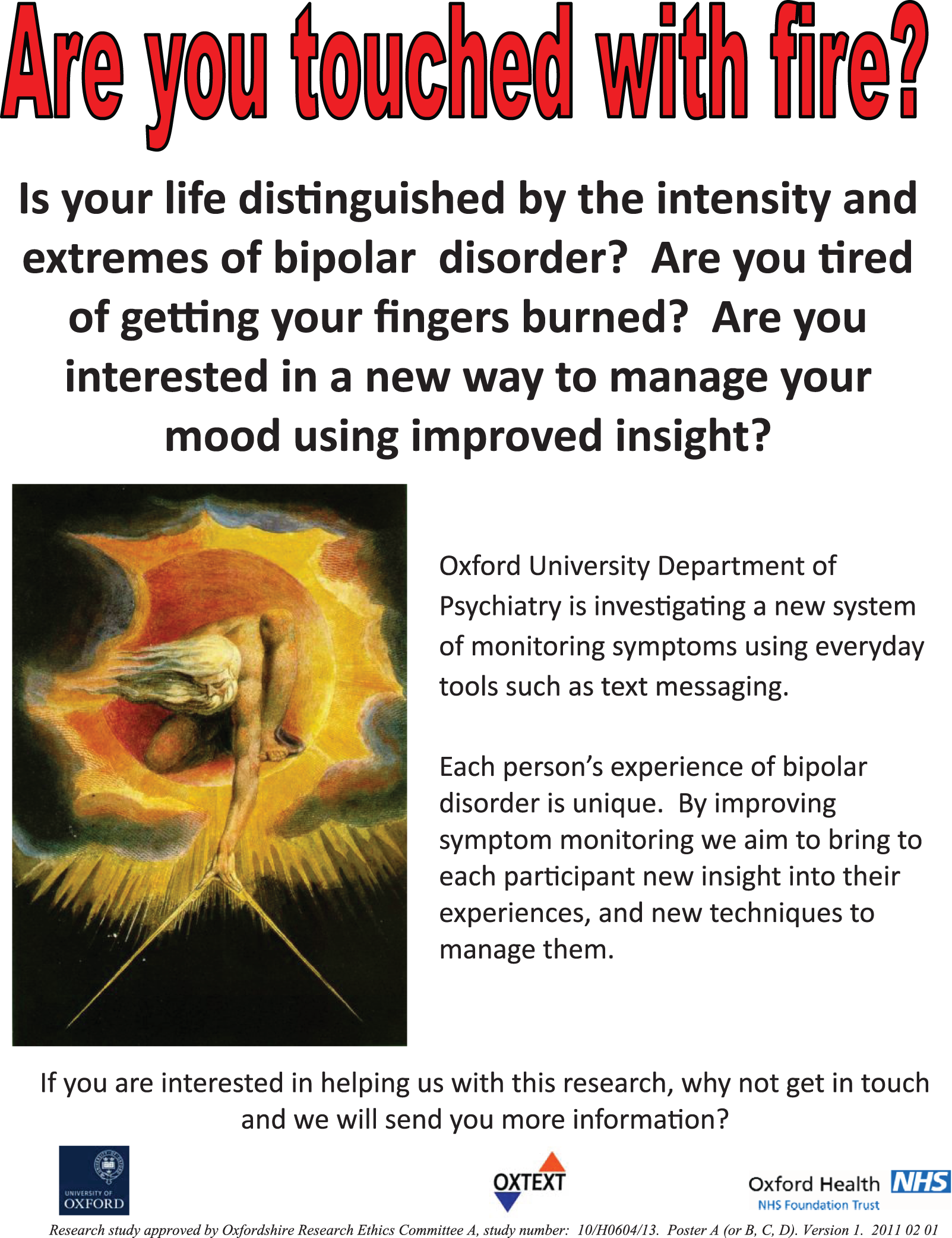
Fire.
As these new materials reflected a considerable shift in recruitment style, the design team produced a letter to respond to any criticisms or complaints, which presents the rationale for the designs: The patient recruitments posters for the OXTEXT research project (Grant Reference Number RP-PG-0108-10087) are the first outcomes of a service user led initiative aimed at creating a new style of communication between researchers and people with mental illness. At present, there is a fairly standard format for recruitment to research in all areas of medicine: simple statements of research objectives and methods, accreditation of the institutions involved and ethical guarantees, and an appeal to patient’s generosity, altruism or sense of having time on their hands. Typically, such posters are designed by clinicians and researchers who may have no personal experience of the disorders they work on. We believe mental illness deserves a more imaginative approach. Our intention here has been twofold: (1) to treat the patient as an adult accustomed to a multitude of advertising images and glossy marketing appeals and (2) to honour the patient’s complex and ambivalent relationship with Bipolar Disorder. To do this we have chosen unexpected and eye-catching images and deployed humour. Some of the phrasing is, or is intended to be, playful and fun. We have tried to entertain. We do so in full knowledge that bipolar disorder can have devastating effects on sufferers and on their families and friends. But in fact it is often patients themselves who are first to joke about it, or try to rescue something of value from the experience. For medical staff, bipolar disorder is a diagnostic category that describes a serious illness, but it is, for the patient, something else as well. It describes who they are and the life they lead and it is this lived experience we have tried to express.
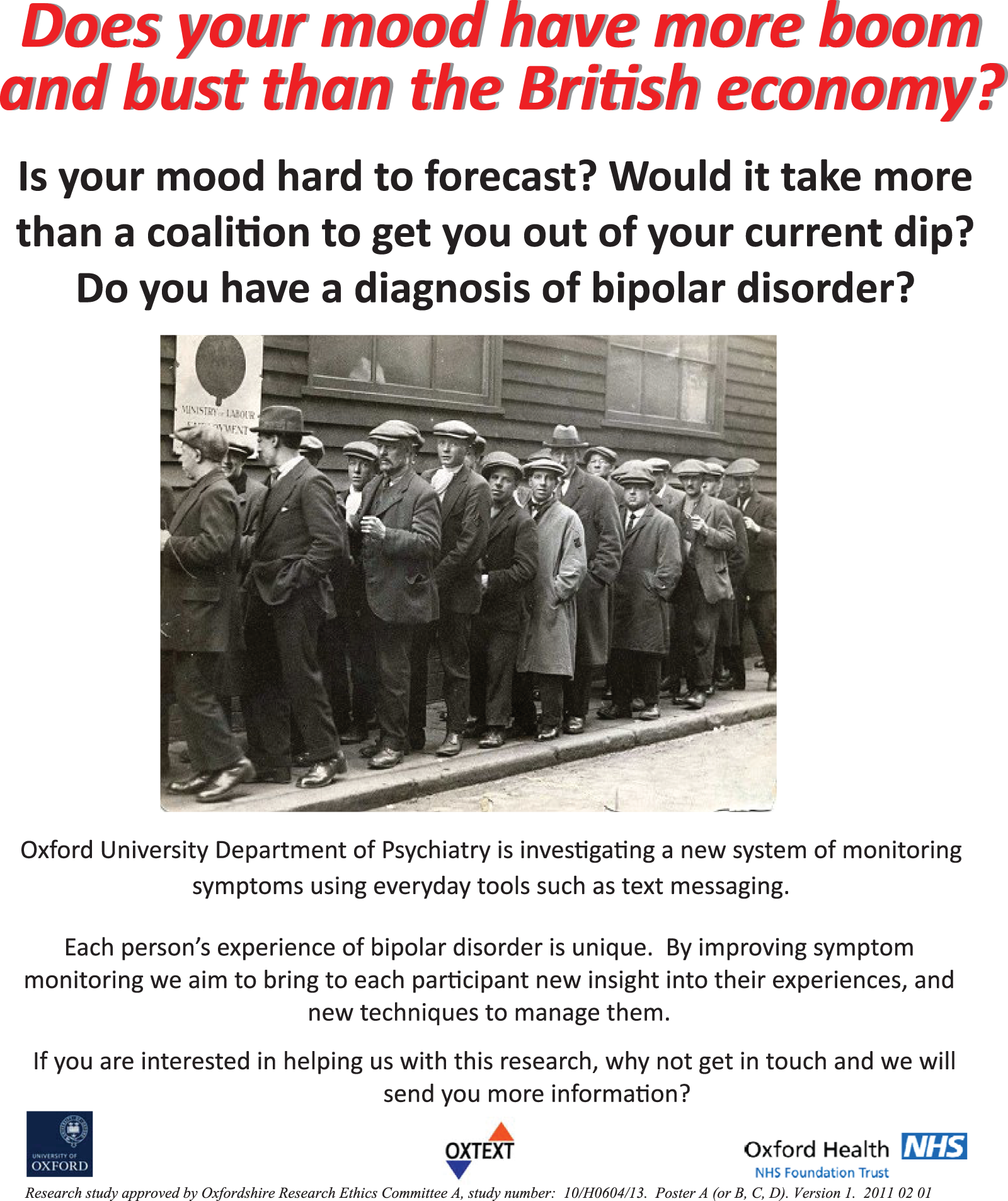
Boom and bust.
Recruitment using the patient-led materials has been highly successful. In the first 12 months the cohort successfully recruited 82 people with bipolar disorder. This rate of recruitment has been maintained, and the cohort currently contains 349 people with bipolar disorder. Despite the wide distribution of the new materials, no complaints or adverse comments were received. The pre-prepared explanatory letter was not required. No patient or carer queried or questioned the materials in any way. 2 The OXTEXT research programme has drawn on extensive formal and informal feedback from participants, some of which was quite critical of aspects of the programme. But no one reported finding the posters unduly forceful, too strong or misleading, as creating false hopes, or as being offensive in any way. Instead, the materials seemed to be liked, appreciated and understood. Without prompting, many patients remarked that the posters seemed to capture something of their personal experience of illness. Compliments to the designers were repeatedly sent to members of the research team. Rather than causing offence, goodwill seemed to have been generated.
Understanding the success of the OXTEXT posters: Patient boldness as evidence for a rebalancing of ethical risk in recruitment
Only a small number of studies have attempted to understand how patient input impacts on research. The longitudinal study of patient input into mental health research referred to above was not designed to investigate the nature of patient impact on research (Ennis and Wykes, 2013). However, in their discussion of possible mechanisms, the authors suggest that ‘the language used in materials such as information sheets is more appealing or easier to understand for patients because of vetting by other patients’.
A Cochrane systematic review takes quite a wide focus in assessing the effects of patient input to healthcare policy and research, including clinical practice guidelines and patient information materials (Nilsen et al., 2009). It considered several levels of involvement, from consultation exercises such as focus groups to deeper collaborative processes, such as active involvement in trial design. Overall, the authors found a scarcity of research and limited high-quality evidence, whilst noting: ‘there is moderate quality evidence that involving consumers in the development of patient information material results in material that is more relevant, readable and understandable to patients’ (Nilsen et al., 2009).
A more recent study has sought to examine researcher experiences of patient involvement in trials (Vale et al., 2012). Researchers from many areas of general medicine were sent a semi-structured questionnaire. The study was intended to establish the level of patient input, to evaluate the effects of patient input, both positive and negative, and to develop guidelines to maximize the benefits. Researchers who responded were generally enthusiastic about patient input and identified several beneficial impacts. They reported that patient researchers have a generally better understanding of patient experiences and perspectives. This meant that patients were better able to assess acceptability, including the acceptability of trial design and of patient information. Some aspects of patient perspectives appear to be difficult for researchers to access: ‘Researchers running studies that had involved consumers [patients] felt that patient’s experiences, for example, of treatments used in the trials were very valuable in trial design and provided insights into why patients may (or may not) consent to the study’ (Vale et al., 2012: 4). Some suggested that this led to improved recruitment and adherence.
These publications suggest a reason why OXTEXT patients designed bolder than usual recruitment posters and why they were well received by their target audience. The boldness arose out of a better ability on the part of patient designers to assess the responses of their fellow patients. This includes an increased capacity to assess the probability of causing offence or of being coercive. It includes an increased confidence in the accuracy of that capacity. The patient-designed OXTEXT posters appear to be tailored to patient responses in a way that most recruitment materials fail to achieve. In this case, at least, patient designers appear to be better informed than ‘illness-naïve’ researchers. If this is correct, the OXTEXT posters might count as evidence against current ethical norms. The usual tendency towards caution in the design of recruitment materials in mental health research might be a consequence of inaccurate estimations of risk to the patient from offence or coercion. Our recruitment materials are more creative and more adventurous than the current norm, and appear to be better liked as a result. Recruitment materials that are unduly cautious because of mistaken ethical calculations of risk are likely to contribute to poor recruitment and thus to research that fails ethically. These errors, made by researchers, could be corrected by more accurate assessments made by patients. The lesson from the OXTEXT project may be that it is time to rethink the risks associated with recruitment materials, and to consider establishing a new role for patients in research as experts in recruitment.
Footnotes
Funding
This article presents independent research funded by the National Institute for Health Research (NIHR) under its Programme Grants for Applied Research Programme (Grant Reference Number RP-PG-0108-10087). The views expressed in this publication are those of the authors and not necessarily those of the NHS, the NIHR or the Department of Health.