




Abstract
Over the last two decades sport-related research has become increasingly influenced by ethical propriety and institutional governance. Whilst there has been thorough consideration of biomedical and associated research in sport and exercise, social research in sport studies has received less attention. In this article, following a brief contextualization of the current climate for research ethics discourse, the planks of an argument for social research in sport without informed consent are addressed. Dealing with ideas linked to ecological validity, impracticality, averting alarm, public interest and ‘leaving only footprints’, a case is made based on two important questions: (a) is the research useful?; and (b) are other research methods available that are fit-for-purpose and allow informed consent to be secured? If the answers are ‘yes’ and ‘no’, respectively, the case should be considered. In such instances the principle of ‘McFee’s friends’ serves as an important source of guidance for researchers.
Introduction
Over the last two decades sport-related research has become increasingly influenced by consideration of research ethics. Early multi-disciplinary work included accounts of empirical scientists ‘coming clean’ about the realities of doing research in sport and exercise (Tomlinson and Fleming, 1997). Later, the British Association of Sport and Exercise Sciences affirmed its commitment to research ethics and professional practice by publishing a clear Code of Conduct for its members – since updated (BASES, 2009). More recently still, McNamee et al. (2007) have provided conceptually sophisticated and well-informed guidance about research ethics for sport, exercise and health. Predictably, there has been thorough consideration of biomedical studies and other research in the natural sciences.
In contrast, social research in sport studies has received less attention. Inspired, at least in part, by the rich accounts of sociologists’ own experiences in landmark edited collections (Bell and Newby, 1977; Roberts, 1981), the early volume by Tomlinson and Fleming (1997) also featured exposition of some of the challenges faced by social scientists researching sports cultures. As well as considering informed consent, risk, harm, privacy and so on, there were also researchers’ narratives about role conflict, ‘guilty knowledge’, deception and covert research 1 – themes that have since been addressed in similar ways elsewhere (Fleming and Jordan, 2006).
In this article I revisit, in particular, the need for informed consent in some social research in sport studies. In doing so, I focus on the way that recent commentaries about research ethics have unfolded, a set of premises upon which an argument explaining the absence of informed consent might be predicated, and suggestions that social researchers might embrace when they embark upon projects designed in that way.
Background and context
Since the early 1990s the landscape of research ethics governance in the UK has changed significantly. There is now, quite properly, more institutional interest than ever before. As a result, research ethics is often perceived by many practitioners not engaged by the principles and procedures of research ethics as a confusing and uncertain set of barriers and obstacles that obstruct research and researchers. Yet it is also clear that when there are problems that ensue from certain types of research, especially those in which there is a real risk of harm to the health and well-being of participants, the potential for reputational damage to individual researchers and to organizations can have far-reaching consequences (Fleming, 2011).
The last ten years have been a period of on-going and increasing concern about the role of research ethics governance and in particular research ethics boards/committees. There has been a climate of critique (even an appetite for it) in ‘mainstream’ social sciences (Ferdinand et al., 2007; Hammersley, 2006). In summary, the substantive points include: (a) a concern that the locus of control has shifted from researchers to centralized bureaucratic structures (Boden et al., 2009); (b) that these structures have only the veneer of being objective and ‘techno-rational’ (Mauthner et al., 2002); (c) organizations are essentially risk averse (Israel and Hay, 2006); (d) the academic freedom and creativity of some social scientists is stifled by the application of biomedical models of research ethics governance (Pothier, 2008); and as a result (e) some social research is required to appear more orthodox/conventional in order to satisfy inappropriate criteria for approval (Lincoln and Tierney, 2004).
At the same time a set of priorities has emerged that has shaped the way that research is undertaken in higher education institutions. These priorities are concerned with the interconnectedness of research ethics, methodology and methods, pedagogy, and legal requirements. First, there are instances when research ethics boards/committees intervene at the point when approval is sought and raise what can appear to be methodological objections. ‘Not their business’, some say. But consider the example of researchers gathering survey data, and that a particular volume of data is required for statistical analysis. A data-set that falls short of the necessary volume may be of no use to the researchers, and hence a harm (at the very least, wasted time) has accrued to those who did participate. If the failure to capture sufficient data was foreseeable, and this risk was not appropriately managed, the board/committee may be thought to have an obligation to prevent this harm. When the raw data are human tissue (e.g. blood samples, muscle fibres), the imperative is even more compelling.
Second, there is a view that pedagogic practice may sometimes present the ‘apprentice researcher’ with an opportunity to explore by ‘trial and error’ – or, as Scott et al. (2008: 141) put it, ‘You can’t stop undergraduates asking silly [research] questions’. Clearly, a totally laissez-faire approach to this is unsatisfactory. It would be an unwise research ethics board/committee that permitted a novice researcher without relevant practitioner engagement or experience to embark on an ethnographic research project concerned with membership of an illegal and violent sport subculture. At the same time, there is an alternative view expressed most clearly in the biomedical sciences that, in the main, student research does not yield valuable new knowledge, so it should not be permitted (Grimley Evans, 1997). The stakes are often, of course, much higher in the biomedical sciences than they are in social research. But the point of principle is the same, and this response is not satisfactory either. The case for the experiential learning involved in doing research is convincing and well established. Somewhere between these two extremes there exists a reasonable compromise for most social research in sport most of the time.
Third, the law of the land (and this is context-sensitive to the land in question) also regulates and shapes the conduct of researchers. In the UK, for example, the storage of the blood samples and muscle fibres in the example above is controlled by the Human Tissue Act (2004), the transfer of information about identifiable living persons is governed by the Data Protection Act (1998), and the Mental Capacity Act (2005) protects particular vulnerable populations. Furthermore, there are instances when researchers may have no legal protection from the obligation to disclose their sources (Ellen, 1984; Wiesenthal, 2002), especially about criminal activities (Cromwell et al., 1992). 2 There are also therefore questions about the commitments to confidentiality that researchers can reasonably make, as well as the possibility of legal action being taken against researchers for defamation and/or libel (Wallis, 1977).
Finally, it is clear that informed consent is a crucial point of departure for much of the discourse surrounding research ethics. The fundamental principles are explained and illustrated in Homan’s (1991) excellent book, The Ethics of Social Research, and have been explored in detail by McFee (2010). The application of informed consent has been argued as an ‘exceptionless’ gold standard in the biomedical sciences, but in the social sciences there may exist reasonable exceptions (McNamee, 2001). It is to the latter that the discussion now turns.
A case for research in sport studies without informed consent
In his account of the objections to covert research, Homan (1991: 112) notes that, ‘covert methods are seldom necessary’. 3 It follows from this that if covert methods (and by implication other forms of deception) are seldom necessary, there are instances when they are necessary. Indeed many of the codes of conduct from subject associations and professional organizations include a caveat to that effect about informed consent (in each case emphasis has been added):
Researchers must therefore avoid deception and subterfuge unless.... (British Educational Research Association, 2011: 6)
Avoid intentional deception of clients unless:.... (British Psychological Society, 2009: 14)
As far as possible, participation in sociological research should be based on the freely given informed consent of those studied. (British Sociological Association, 2004: 3)
Inquiries involving human subjects should be based as far as practicable.... (Social Research Association, 2003: 27).
These codes (and many others) also carry the force of sanction for failure to comply. For example, the Code of Conduct for the British Association of Sport and Exercise Sciences (2009: 3) includes an explicit ‘whistle-blowing’ imperative: ‘Members are under an obligation to report all instances of breaches of this code’.
In their different ways each of these codes leaves the door ajar for the possibility of research being conducted without the usual requirement that researchers secure informed consent from those who provide data directly or indirectly for research projects. So how then, can a case be built for research without the informed consent of those involved? There are (at least) five different arguments that have been advanced, which are presented below in the order of decreasing persuasiveness. 4
Ecological validity
The most forceful argument in favour of conducting research without informed consent is that disclosure of the nature of the research will create the possibility that those involved will modify their behaviour and hence compromise the ecological validity of the project (British Sociological Association, 2004). What is more, researchers will never know for certain whether or not they have. There are examples from investigative journalism where covert techniques have been used to reveal stories of public interest (MacIntyre, 1999; Mahmood and Evans, 2010), and though there are important differences in the practice of the investigative journalist and the empirical social scientist (Sugden, 2005), there is a general point about the capture and sharing of valuable knowledge that may not have been possible had those involved been invited to grant permission for the work to be conducted.
In social research there are examples when methods of investigation have been deployed without informed consent because the subject matter has been sensitive (Lee, 1993). In sport studies the argument is broadly the same (Sands, 2002). Yorganci’s (1997) study of sexual harassment by sports coaches and Donne’s (2006) evaluation of service quality at a watersports centre are examples. There have also been intervention studies in which researchers have sought to minimize the risk of the Hawthorne Effect by not seeking informed consent (Evans and Hardy, 2002).
Impracticality
On an operational level, occasionally there are problems associated with securing informed consent in the usual way (i.e. in advance and in writing). Some of these may be concerned with the particular environment or context – for example, in an observational study of large crowds at a sport stadium. Other difficulties include identifying from whom consent should properly be sought. In the case of some ethnographic and autoethnographic research projects, for example, it may be difficult to anticipate the importance of other persons in the later analysis. If there exists a requirement that ethnographers secure informed consent from everyone connected to their research, they would forever be asking those with whom they speak, ‘May I quote you? And if so, would you mind reading this information sheet and completing this form?’ (Mellick and Fleming, 2010). This is absurd.
Averting alarm
Social researchers sometimes defend the absence of informed consent because of the need to protect those involved from alarm and apprehension (Felzmann, 2009; Herrera, 1999). Even being confronted by an information sheet with disclaimers about public liability can distress those involved (Pothier, 2008). This is the social scientist’s equivalent of the ‘white coat syndrome’ in medical practice – patients experiencing anxiety when they consult medical practitioners simply because of the role of the latter or the clinical setting in which the consultation occurs.
An anecdotal example is illustrative. From an ethnographic study of youth sport (Fleming, 1995), the naïve revelation to members of an anonymized boxing club (in the spirit of providing a full account of the research) that racism was the theme of the research created inevitable suspicion. It was not until much later that one of the boxers explained the unfounded institutional context and fear: ... Yeah, because – how can I say – they were wondering if you were saying ‘Are these racist?’. Cos did you know that they were saying about us, that our club’s racist? They were trying to close us down. Everyone thought you were doing something on racism an’ that. Northbridge were accusing us of being racist. (Fleming, 1995: 55)
Public interest and ‘secrecy’
In some research contexts the nature of the work and what might be uncovered by it can be suppressed by powerful groups or organizations misusing their influence in their own interests at the expense of the public ‘right to know’ (British Sociological Association, 2004; Hammersley, 2006). In an explicit commitment to Gonzo-style investigative sociology, Sugden and Tomlinson used a form of deception in their investigation of FIFA – the international governing body for football (soccer). Taking up the challenge to penetrate the organizational cultures of major institutions at ‘the apex of a multibillion dollar global sports political economy’ (Sugden and Tomlinson, 1999: 389), they describe an episode in which a researcher actively misrepresented himself (as a press photographer) in a successful attempt to gain access. As they explain, the reason for this kind of deception was clear: organizations like FIFA ‘have much to show off, but even more to hide’ (Sugden and Tomlinson, 1999: 389).
Leaving only footprints
Leaving aside intervention studies of various kinds, for many social scientists the idea of leaving a research environment unaffected by the presence of researchers is, at most, only an admirable aspiration. Yet, helpfully, in the justification of his own use of a covert approach to part of his study of the Pentecostal movement, Homan (1980) also hints that as a result of not seeking informed consent those involved in the research remained free from disturbance and inhibition. That is to say, they were unharmed by the process of being researched.
A way forward in two parts
Having established that there are bona fide reasons why research without the usual informed consent might be possible (even desirable), there are now the linked issues of how to make the argument effectively and how to deal with those involved in research of this kind. The first is based on two fundamental conditions that may be posed as questions, and the second on the principle that I shall call ‘McFee’s friends’.
In order to make an effective case for research to be approved that does not have the informed consent of those involved, an essential plank of the argument is that the research is worth doing. That is to say, is the research useful? Quite simply, if the answer is ‘no’ then there is no need to pursue further the case for any kind of research design – much less one without informed consent (unless for the kind of pedagogic purpose described above). Worthiness is, of course, a contested and contestable term, but as a premise it seems reasonable to conclude that if it cannot be argued that the proposed project is worth doing, then approval for it should be withheld. For instance, worthiness might be argued on the basis that new knowledge might be yielded and that the new knowledge has value to an end-user, or that the proposed research is an important part of the research training of an ‘apprentice’ researcher. This in turn raises questions about who judges usefulness, against what criteria, how they are empowered to act in this way and with what authority – these are the sorts of governance questions that have provoked some of the most intense debate amongst social scientists and others.
Assuming that the research is worth doing, the second question is to ask whether there are other research methods available that are fit-for-purpose and allow informed consent to be secured. If the answer is ‘no’, then there may exist a prima facie case for research without informed consent. A piece of research from Piagetian social psychology sheds some light. In their work on egocentricity in adult conversation, Henle and Hubble (1938) equipped themselves with torches and clipboards and hid under the beds of university students in dormitories and noted what was discussed. At the time the research was conducted this approach might not have been thought irregular, but over 70 years on it is difficult to envisage reasons for approving a research design like this (Ballard et al., 1997). For although the research is both worthy and useful, there are other methods that would yield data to address just as effectively the aim of the research.
Hence, if the research is worth doing, and if there are no other methods available to answer the research question(s), then a case for research without the informed consent of those involved might be advanced successfully. Usually this will involve presenting the argument to the appropriate research ethics board/committee – see Figure 1. Embracing the principles of ‘reasonableness’ and ‘proportionality’, an effective board/committee will be open to persuasion providing that appropriate steps are taken by the researcher(s) to safeguard the interests of those involved. Normally, and consistent with the codes of conduct and practitioner guidance identified above, there will be a commitment minimally to non-malfeasance (to do no harm), and preferably to beneficence (to do some good).
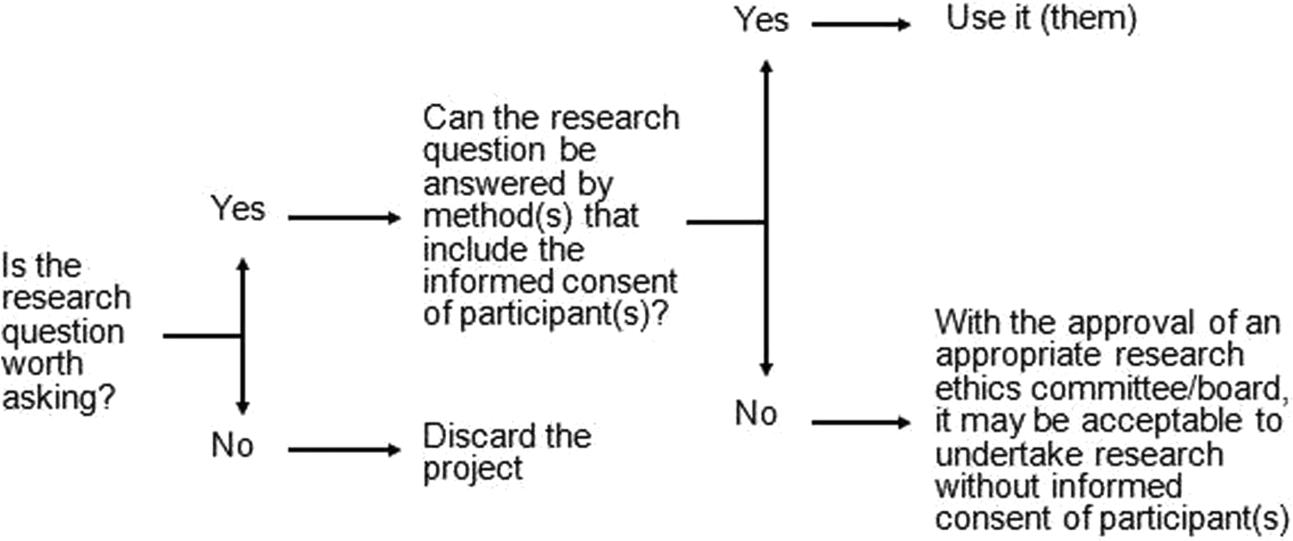
Making the case for social research without informed consent.
The principle of ‘McFee’s friends’ is an uncomplicated one (McFee, 2006), and places on researchers an obligation to ‘treat the ‘others’ in one’s research as though they were one’s friends’ (McFee, 2010: 155). The argument is part of a wider exposition of the possibility and practicalities of undertaking ‘ethically conducted covert research’ first explore, and predicated, in part at least, on links between naturalism and covertness (see above), and a sustained and compelling critique of voluntary informed consent as the ‘gold standard’. 5 In the spirit of friendship being based on a concern for the well-being of other persons, in addition to non-malfeasance, the further requirements are to protect one’s friends from exposé, to debrief them about the research afterwards, and to grant them the rights of persons (e.g. privacy). The principle of ‘McFee’s friends’ therefore serves as guidance or a reference point for researchers as they negotiate the inter-personal complexities of deceptive and/or covert research.
Inevitably there will be inconsistent behaviour by researchers towards those involved in their research. After all, we do not all treat our friends in exactly the same way. But it is reasonable to suppose that the commitment to non-malfeasance is likely to be very widely held, and represents a ‘one size fits all’ approach – albeit loose fitting.
Concluding comments
Considerations of research ethics governance have provoked considerable debate in recent times. In certain circumstances there exists an opportunity for social scientists in sport to depart from the exceptionlessness of informed consent in the biomedical sciences. The most persuasive arguments are those grounded in concerns for ecological validity, operational impracticalities and averting alarm.
There are two further conditions that ought to be satisfied before the decision to abandon informed consent is taken: first, that the research is worth doing, i.e. that it has some utility; and second, that there are no other methods of conducting the research with informed consent that are likely to be no less effective. For researchers, there is an imperative to act in the best interests of those involved in the research. Conceptual and pragmatic guidance is provided by the adoption of the principle of ‘McFee’s friends’ – that is to say, treat those involved in research as though they were friends. If researchers do this, a lot of concerns that may exist should (logically) be eased.
Footnotes
Acknowledgements
I am grateful to Graham McFee for his continued interest and contribution to these debates, and to the two anonymous reviewers for helpful comments on a previous draft. The shortcomings of the article are, of course, my responsibility alone. A version of the argument in this article was presented as a keynote address at the Leisure Studies Association annual conference at Southampton Solent University in 2011.
Funding
This research received no specific grant from any funding agency in the public, commercial or not-for-profit sectors.