




Abstract
This article details an oil paint-on-glass animation depicting posthumous portraits of unclaimed deceased from a Johannesburg mortuary in South Africa. The creative project engages with Western traditions of posthumous, focusing on the iconography of the corpse. The author explores how these traditions are approached through the moving image, metamorphosis and experimental animation processes. The animation uses metamorphosis not just as a symbolic strategy to serve the idea of transformation – but also as a self-referential engagement with animation’s contradictory life-giving and destructive traits. The article and the creative project it illuminates present a critical awareness of the ethical concerns associated with representing the dead and the cultural and historical traditions from which this subject emerges.
Keywords
Introduction
Harris et al. (2019: 1) note that experimental animation’s long history expands the boundaries of traditional animation, encompassing diverse and innovative approaches. These processes include ‘painting and scratching onto celluloid, collage, stop-motion, hand drawing, analogue and digital animation’ to contemporary approaches such as ‘2D/3D computer animation, spatial projection, and interactive installations’. Experimental animation reflexively emphasizes individual artistic expression and is characterized by modes and sites of viewing outside of the traditional single-screen format and cinema space. Hamlyn and Smith (2018) also see experimental animation as that which critically extends beyond traditional narrative formats ‘with increasing frequency referring to broader questions around performance, the social, political-documentary and so on’ (p. 2). This article discusses an experimental oil paint-on-glass animation entitled Do You Know Me? through the lens of animation and art theory, drawing on these expansive attributes of experimental animation.
The animation is made up of 44 posthumous portraits that metamorphose from one to the next. Photographs of unclaimed deceased individuals from a mortuary in Johannesburg serve as the basis for most of the portraits. The project has a formal association with the International Committee of the Red Cross (ICRC) and aims to bring attention to their Missing and Deceased Migrant Project. 1 This association will be detailed as it pertains to the photographic archive and to the issue of unclaimed deceased in South Africa.
The discussion engages with how various approaches and strategies associated with experimental animation inform the social, cultural, historical and political issues underlying the project’s content. Notably, this includes how the work employs a strategy of metamorphosis and repetition to engage with the issue of xenophobia. The author argues that this issue is symptomatic of current Nationalist rhetoric and is an inherent and systemic echo of South Africa’s colonial and apartheid past. Correspondingly, the exploration engages with the roots of the animated approach within the tenets of modernism and its Western primitivist and colonial associations. These aspects are debated as they relate to modernism’s complex and paradoxical trajectory in the early history of South African art. 2
The material and metaphorical strategy of metamorphosis adopted in the creative work extends to the exploration of notions of mortality, mutilation, regeneration and cycles of bodily and historical trauma. This reading of metamorphosis is traced from its roots in early animation and abstract film (in the US and Europe) to its exploration within experimental animation practice. Integral to the discussion is the animated project’s expansive exploration of fine arts practice – and the use of oil-paint-on-glass animation to expand painting and animation beyond their conventional boundaries.
The animation is created with an acute awareness that representing the dead brings into tension the obligation to the corpse and the desire to commemorate and hold on to a trace. The article engages with this discourse, focusing on the images of the dead in Western painting, citing specific examples from art history that inspire pathos but at the same time do not deny visible traces of death. The rich history of posthumous portraits and their many forms is acknowledged but the discussion will draw specifically on the iconography of the corpse – citing examples that exerted a profound influence on the creative work – from Holbein’s Dead Christ (1521–1522) to Marlene Dumas’s Dead Marilyn (2008).
The photographic archive in context
The photographic archive accessed for the animation project is from the Forensic Pathology Service (FPS) in Johannesburg. The FPS conduct secondary human identification examinations on unidentified deceased individuals and operate in association with the ICRC’s Missing and Deceased Migrant Project. This project is a humanitarian effort to identify the many unidentified and undocumented deceased who die in South Africa every day – most of whom are assumed to be irregular migrants. 3 The related creative project responds to images of unclaimed deceased and, in its association with the ICRC, importantly highlights a genuine tragedy underlying irregular immigration in South Africa. The confidential details regarding the dates and circumstances of death relating to the individual in the photographs were not disclosed. However, it is confirmed that these individuals remain unidentified and unclaimed, and are presumed to be undocumented, irregular immigrants; that they died because of homicide or illness and are almost exclusively black males (Fonseca, 2023). 4
South Africa is a primary gateway for migrants from Eastern and Southern Africa and beyond, either as a final destination or a transit point. However, the journey to and within South Africa is fraught with peril, often entailing severe violations of fundamental human rights. The city of Johannesburg has a significant migrant population attracted by perceived economic opportunities. This population comprises national and foreign migrants, many of whom lack official documentation. Undocumented migrants have usually entered the country irregularly without official documentation for entry, habitation and economic activity (Keyes et al., 2022). Tragically, many migrants lose their lives, disappearing without a trace. The uncertainty surrounding the fate of their loved ones profoundly affects the families they leave behind, who face the anguish of ambiguous loss. The many unclaimed dead in South Africa represents a significant humanitarian crisis, yet it garners less attention than the Central Mediterranean Route (Suwalowska et al., 2023). In response to this dire situation, the Pretoria Regional Delegation of the ICRC has undertaken commendable efforts across various initiatives. These endeavours aim to prevent the disappearance of migrants, establish and maintain contact with relatives and enhance the identification of unclaimed bodies in South African mortuaries (Fonseca, 2023).
The ICRC sees their project as presenting a global phenomenon where an extremely high number of unidentified dead bodies worldwide are similarly accompanied by minimal contextual data – a situation they refer to ‘as a silent mass disaster’ (Suwalowskaet al., 2023). In endorsing this project, Fonseca (2020) asserts, ‘This initiative is something that could bring greater visibility to the plight of unidentified human remains and promote their future identification.’ The humanitarian aspect of the animated film is an intrinsic part of the project, and a primary objective is to use exhibition and festival platforms to foreground the ICRC’s Missing and Deceased Migrant Project.
The problem of paint-on-glass animation and its affiliation to modernism’s colonial and perceived prejudiced paradigms
The question of choosing a medium (paint-on-glass) that has roots in European modernism needs to be addressed, especially within the socio-political context and geography of the subject matter, and against the primitivist ideals of modernism, which are sometimes associated with a colonial mindset. The ‘primitive’ in this case refers to both the modernist depiction of the ‘exotic’ other and to the abstraction of traditional forms ‘as pure and unsullied’, which critics believe expose ‘their foundation on basically racist assumptions of European superiority’ (Nettleton, 2011: 143). Indeed, modernism has a complex trajectory in the early history of South African art that both negates and affirms colonial and Apartheid Nationalist ideology. At the beginning of the 20th century, on the one hand, modernism was used by white artists to construct various colonial settler identities – either to claim a romantic identity with the landscape and to advance the cause of Afrikaner Nationalism or to assert a settler identity (not tied to Afrikaner Nationalism) that appropriated cultural forms of traditional black culture. This latter approach by white artists disregarded the lived realities of their compatriots, representing them as an ‘exotic’ other – corresponding to the equally sticky ‘noble savage’ paradigm of European modernism (Nettleton, 2011: 141).
On the other hand, some early black artists (notably Sydney Khumalo and Lucas Sithole) adopted primitivism and an African identity through a revival of traditional African forms. Still awkwardly explored through the lens of European modernism, their notion of primitivism was grounded on a nostalgic return to roots and on establishing an African identity disparate from a settler identity and European modernism. This idea of primitivism was not tied to the notion of the ‘noble savage’ or the appropriation of traditional abstractions and the association of these forms with a return to a primal, less ‘civilized’ state (Nettleton, 2011: 141). Conversely, other black artists, such as Gerard Sekoto and George Pemba, early innovators of ‘African modernism’, were in favour of showing lived realities – after the socially engaged art of the Weimar period. Relatedly, ‘they were convinced by the twentieth-century notion of modern art as the universal language of a universal humanity’ (Robbroeck, 2011: 119), and one that would bridge the gap between the colonisers and the colonised. As with European vanguards of modernism who perpetuated the notion of a global humanitarian art, which included the possibility of social change, this utopian ideal proved tragically hollow, especially considering the brutal and long history of colonialism and Apartheid that followed in South Africa (Robbroeck, 2011: 131).
Modernism’s redemptive primitive ideals, however problematic, are not to be equated with the primitivism of animated cartoons in the USA, especially the minstrel cartoon tradition associated with early American animation. While these animations celebrated the jazz music associated with the minstrel, Sammond (2015: 28) asserts that the modernist ‘high-culture fantasy of the redemptive power of raw primitivism was not what informed the racial inflection of American popular cartoons’. On the contrary, these are overtly racist caricatures that make direct associations of the minstrel with the deep South, Africa, and a crude idea of the primal as a wild, untamed spectacle. Do You Know Me? does not visually explore modernist primitivist ideals or subscribe to those of early cartoon animation in the US. However, as will be discussed, it does operate in dialogue with the fragmentation, mutilation and metamorphic characteristics associated with both these traditions.
Contemporary South African artist and animator William Kentridge’s works draw on themes of violence, memory, racism, atrocities, trauma, guilt and privilege – most of which are tied to the brutal colonial and apartheid past of South Africa. In this regard, Kentridge’s animations and multidisciplinary praxis frequently refer to early utopian vanguards of modernism, particularly artists of the Weimar period, such as George Grosz and Max Beckman. As with early South African modernists Pemba and Sekoto, his affinity with modernism also lies in the belief in modernism’s redemptive possibilities. However, in place of their gentle optimism, Kentridge’s redemptive belief is tied to a cynical, oppositional subject matter created within a state of siege and against the possibility of failure. Christov-Bakargiev asserts that Kentridge’s allegiance to modernism is mediated by his awareness of its colonial associations and the awkward positioning of this against his context and subject matter (Christov-Bakargiev and Kentridge, 1998: 34). Kentridge explains his reverence for modernist artists such as Beckmann in his reference to Beckmann’s painting Death (1938), positing that the work accepts the existence of a compromised society and yet does not rule out all meaning or value nor pretend these compromises should be ignored. It marks a spot where optimism is kept in check and nihilism is kept at bay. It is in this narrow gap that I see myself working – aware of and drawing sustenance from the anomaly of my position. (Stiles and Selz, 2012: 312)
Similarly, and within the context of Do You Know Me?, the choice to adopt a creative approach rooted in modernism was made with an awareness of the problematic utopian polemic of modernism and South African modernism’s paradoxical association with racist colonial narratives and humanitarian ideals. While the creative work does not draw on formal approaches to modernism (of abstraction or primitivism), it is in conversation with the modernist traditions of Sekoto and Pemba, and with Kentridge’s reflective reworking of modernist tropes in its attempt to both present a reality of life in South Africa, to engage with colonial and Apartheid narratives, and to challenge a status quo. However, as asserted later, the visual approach is associated with the grotesque realism adopted by modernists such as Otto Dix and Kurt Schwitters. The paint-on-glass approach draws on the tenets of modernism (and early experimental film) in its reflexive foregrounding of the medium, something that all strands of modernism have in common.
The colonial paradigm that Do You Know Me? engages with is that of xenophobia. Many of the deaths of undocumented deceased are associated with migrant vulnerability, which various commentators assert has direct links to systemic xenophobia. Hiropoulos (2019: 106) posits: ‘Through the scapegoating of migrants, public officials reinforce xenophobic attitudes and beliefs. The construction of migration as a crisis has enabled the xenophobic reception of migrants to the country. Further, it increases xenophobic sentiment, violence, and migrant vulnerability.’ Mpofu (2020) argues that what is commonly referred to as xenophobia in South Africa is better understood as ‘systemic and structural racism rooted in colonial and apartheid history’. He proposes that the systemic constructs of racism, both globally and locally, position black Africans from other countries as alien and undesirable. Within the context of South Africa, this perspective subjects them to ultimately racist sentiments, echoing historical patterns of exclusion subscribed by the previous nationalist apartheid government. Mpofu claims that xenophobia is endemic to the current nationalist government, which, rather than reflecting an opposing transitional ideology, is a grotesque caricature of the past, one that ‘constitutes the enduring coloniality that has survived colonialism and apartheid’ (p. 50). This historical pattern of repetition is implied in the repetitive cyclical nature of the animated metamorphosis in Do You Know Me? The animation is reversible and endless – the deaths continue, as does the cycle of violence and exclusion. This theme of material and metaphorical repetition is engaged with later on as it relates to Sobchack’s (2000) notion of the digital morph.
The transformation, mutilation and regeneration of the body in early animation in the US and Europe
Panofksy (1947: 160) notes, ‘The very virtue of the animated cartoon is to animate, that is to say, endow lifeless things with life, or living things with a different kind of life. It affects a metamorphosis.’ Pessimistic about Disney’s introduction of animated human characters, heralded by Snow White (1937), the movement of which to him approached vulgar caricature rather than transformation, Panofsky refers to the unpredictable and fantastic distortions and transformations of the animated cartoon in Europe and the US. In particular, he describes the ability of these early animations to operate in defiance of natural laws that govern time, form and space, especially in the animation of plants, animals, inanimate objects and nature. Eisenstein (1986[1941]) similarly perceived that the power of animation lay in its ‘ability to assume any form’, an ability he referred to as ‘plasmaticness’ (p. 21). Writing during World War II, he saw the transformative possibilities of early animation, especially early Disney, as redemptively representing an antidote to the ‘mercilessly standardised and mechanically measured existence’ of American society. Benjamin shared Eisenstein’s utopian view of metamorphosis in early Mickey Mouse cartoons, although his understanding of these early metamorphoses integrates the “self-sublation” of technology. Citing the redemptive potential of collective laughter, he saw the surreal distortions and technological absurdities played out during the relentless gags of these early shorts as promoting a cathartic response from a society haunted by the effects of war. In his essay Experience and Poverty (2005 [1931 – 1934]: 734), Benjamin famously notes that Mickey Mouse signified an antidote ‘for the sadness and discouragement of the day’, for a humanity still traumatized by the horror of technological warfare. Leslie (2004: 120) and Hansen (1993: 35) note that Benjamin, in later writings, distances himself from Disney – conceding that the animated metamorphosis in early Disney represented a fine line between horror and comedy, and in deference to Adorno’s caution that these early cartoons did not inspire redemptive and conciliatory collective laughter. Instead, Adorno argues that, through humour, violence and cruelty are legitimated, resulting in sadistic laughter, akin to that associated with Fascism.
An aspect of Benjamin’s (2001[1931]) writings on Mickey Mouse that resonates with the approach to metamorphosis in Do You Know Me? is his recognition of the potential of the animated medium to fragment and mutilate the body. He notes, ‘here we see for the first time that it is possible to have one’s own arm, even one’s own body, stolen’ (p. 545). This destructive potential of animation was even more common in other animated cartoons of the period. In the early days of animation, animators often showcased the flexibility of their characters by subjecting them to physical assault or deformation, whether through direct or indirect means. This progression from exploiting the destructive, mutable potential of the medium to the depiction of violence meted out from one character was an inevitable evolution of the animated cartoon (Sammond, 2015: 289). This destructive trait is exemplified in the characters and scenarios of Koko the Clown and Bimbo the Dog in Fleischer’s Out of the Inkwell series (1918–1929) and in Felix the Cat (1919), for example. It is also there from the outset of animation in Emile Cohl’s Fantasmagorie (1908). Cohl’s animation reveals this destructive characteristic and the contrasting ability to regenerate fragmented or mutilated forms. Referring to Cohl’s film, Leslie (2002: 2) notes: ‘From the very first, animation, self-reflexive and unmasking, establishes a circuit of life and destruction. Animation, the giving of life, battles with annihilation, and always overcomes, always reasserts the principle of motion, of continuation and renewal.’ The film comprises a series of animate and inanimate objects in metamorphosis presenting ‘an illogical narrative of cruelty and torture executed by people and things at war with each other. This notion of destruction and regeneration is not just at the level of narrative and imagery but is also foregrounded as an aspect of the medium. One is conscious of this at the beginning, with the artist’s (live-action) hand shown as part of the film – drawing the clown, and then at the end when the hand glues him back together. This reflexivity is also apparent in the animated abstractions that appear on a screen at the start of the film and is reiterated when the soldier appears to get blown up into tiny marks that dissipate, reminiscent of early abstract film.
It is this inherent violence that Sammond (2015: 288) asserts is at the heart of animation and that Do You Know Me? is in conversation with – reflexively at the level of the medium and at the level of content. The portraits start as violated forms bearing material signs of trauma either from decay or the marks of violent death, with some also bearing the marks of healed injuries. After that, they submit to a temporal metamorphosis via fragmentation, mutation and transformation from one face to the next. Even though Do You Know Me? does not draw on the aesthetics of the cartoon, it refers to the nature of the early cartoon, which, as envisioned by Eisenstein’s ‘plasmaticness’, represents the primal and revolutionary capacity of animation’s endless capacity to alter, transform and reshape. In Do You Know Me?, by recording the metamorphosis between portraits, the visual emphasis is on the way form is built up and broken down. The mutilation and regeneration of form not only explore the conceptual idea of transformation in the illusion it gives of a corpse coming to life but also comprise a self-referential engagement with the intrinsic life-giving nature of animation. Cholodenko (2014: 104) notes: Put simply, what is at stake in animation, including film animation, is life and death, as well as their inextricable commingling. And animation’s own life and death. As I have written: ‘Animation – the simultaneous bringing of death to life and life to death – not only a mode of film (and film a mode of it) but the very medium within which all, including film, “comes to be”’.
Hansen (1993) draws an apt correlation between the annihilation and regeneration of the body in early cartoons and within the treatment of the human form within Dadaism. Like the early animated cartoon, the body undergoes degradation and dissolution in Dada or is transformed and rejuvenated. These representations not only address the physical violation or dismemberment of the human form caused by military and industrial trauma or in the critique of colonial narratives but also the redemptive psychosocial regeneration of the body. Adamowicz (2019: 1) posits: ‘In their paintings, collages and assemblages, their readymades, manifestos, poems and films, the Dadaists exposed, expelled or exploded the human figure, loudly proclaiming its demise or tentatively announcing its renewal.’ Interestingly, John Hartfield, a Dada pioneer of photomontage, collaborated with fellow Dadaist George Grosz on a series of three animated films in 1918. None survived, and they were never formally released, but Zervigón (2012: 10) asserts they existed and ‘composed from Grosz’s powerful drawing’ functioned to ‘reinsert somatic terror into representations of the conflict’ during World War 1. Zervigón (2012) surmises from various accounts that these films unveiled the violence and trauma of the war and the tyranny of Nazi Germany and were inspired by the absurd and violent extremes inherent in early American animation. It is unlikely that Heartfield, during wartime Europe, would have had much exposure to early Disney cartoons. Importing foreign films from enemy countries was heavily restricted and only those passed for pure entertainment were approved for distribution. The only animated cartoons among these were the Mutt and Jeff cartoons, a series created by Charles Bowers and distributed throughout Germany in mid-1917. Zervigón notes that the extremes of violence, exaggeration and distortions meted out on the characters of this slapstick series were likely the primary influences for Hartfield’s animations.
Similar themes of violence and bodily trauma pervade the works of Dadaists Kurt Schwitters and Otto Dix. Evoking the tradition of grotesque realism, after painters such as the Northern Renaissance artist Matthias Grünewald, produced shocking images of physical trauma and dismemberment, which aimed to draw attention to the horrors and reality of wartime Berlin and in opposition to the rhetoric of heroism. Schwitter’s Merzbau, for example, was a sculptural, architectural installation that incorporated found objects, photos and newspaper cuttings – many of which depicted fragments of the mutilated human form – including an image of the mutilated corpse of a young girl, a disabled war veteran with his headless daughter; a headless man and an armless woman embracing beneath the large head of a child and the death mask of his first son. Also of note are Dix’s painting, prints and drawings of dismembered limbs and mutilated faces of war veterans that he took from photographs of war veterans with disfigured faces and amputated limbs, published in Die Freie Welt in 1920 by the noted pacifist Ernst Friedrich (Zervigón, 2012: 104). War Wounded (1992) for example, is a watercolour portrait of a soldier with a gaping facial disfiguration from a war wound rendered in graphic detail. The juxtaposition with the softened unblemished features heightens the horror of the wound but also, as with the aims of grotesque realism, evokes extreme empathy. Do You Know Me? has an affinity with Dix’s grotesque realism and the forensic photographic source material depicts a similar graphic horror to that of Dix. However, as with Dix’s approach, this horror is mediated by the attempt to present sensitively and empathetically rendered portraits. While Dix’s images are war portraits and Do You Know Me? represents the unclaimed dead – they commonly show faces disfigured by violence.
Early abstract animation and the origin of animation as an expanded practice within the fine arts
Leslie (2002) asserts that modernist artists were intrigued by cartoons. They saw the absurd temporal metamorphoses of the early animated cartoon as a welcome opposition to ‘painterly realism’. Pointing to the painterly experiments in film in the early part of the 20th century developed by artists such as Walter Ruttmann, Leopold Survage, Viking Eggeling and Hans Richter, which Leslie (2002: 37) posits ‘surfaced out of the extension of problems posed in the fine arts: how to represent rhythmic processes not just in space and on a flat surface but also in time’.
Zinman (2020) and others, for example Leslie (2014) and Dill (2019), note that recognition of the potential of the moving image and experimental animation to expand painting beyond its traditional boundaries and to address challenges proposed within the fine arts has existed since the early inception of the animation medium and film theory. The link between fine arts practices and experimental animation continues to define seminal contemporary experimental animators’ ideas and working methods. Curtis (2018: vi), in Experimental and Expanded Animation: New Practice and Perspectives, acknowledges the inventiveness and significance of the early cartoon but claims that to discover the intellectual, challenging and genuinely innovative potential of animation, one should look at the first inception of experimental animation and to the work of early 20th-century artists – animators who ‘demonstrated that anything material could be animated – wet paint, the filmstrip, silhouettes, a screen of pins, postcards, sand; and so, began the process of medium-expansion’.
In 1912, Leopald Survage created a series of 200 abstract watercolours, which he envisaged as colour, rhythm and abstraction in movement (Russet and Starr, 1976: 36). Even though Survage found no one to animate his series, he is seen as the first artist to present a theory of abstract animation, to make a link between painting and film, and to recognize the expansive potential of the medium of animation from its outset (p. 35). As Survage sought to release painting from its principal shackle of immobility, modernist painter and filmmaker Walter Ruttmann claimed that painting had suffered a crisis of meaning after World War 1 and could only be rescued if it was set in motion. Zinman (2020) sees Ruttmann’s importance as lying in his perception of painting in relation to time, which simultaneously denotes the interdisciplinary potential of the medium of film. In his unpublished essay, Painting with Light, Ruttmann (1989) implies that reductive principles of abstraction and static painting had reached their conclusion. This perceived redundancy was seen to be epitomized by the Constructivist modernist painter Malevich’s (1918) painting White on White – where he ‘used painting to delete painting’ (Leslie, 2002: 35). Other modernist painters and filmmakers, such as László Moholy-Nagy, Oskar Fischinger and Hans Richter saw this painting as paving the way for paintings’ transition into film, and the substitution of the canvas for the film screen. These early films ‘exemplify our first critical roots in experimental animation as a fine art mode and aesthetic discipline’ (Dill, 2019: ix).
The potential of animation to function as an extension of the fine arts and to move beyond the limitations of the still image was partly the spur for conceiving the creative project Do You Know Me? as a motion painting. The idea of a problem or question that promotes an investigation through a creative process underpins the notion of artistic research. In this case, the problem stemmed from a frustration with the painted still image and how to evoke a material and metaphorical relationship between this series of portraits that evoked notions of life, death and repetition. The solution was to incorporate animated movement. Correspondingly, Curtis (2018: vi) points out that potential of the experimental animation platform to incorporate fine art media and processes in critically expansive ways extends disciplinary boundaries and brings it into the realm of artistic inquiry.
Paint-on-glass animation, expanded practice and an exploration of a material and conceptual metamorphosis
Although I have a background and training in the fine arts, the project did not emerge solely from a traditional fine art context in that I have been making and teaching animation and a broad arena of digital art processes for more than a decade. In this way, I believe my extended engagement with animation and the digital platform, which, in terms of my work, is constantly in dialogue with fine art practice, enabled me to return to painting after a long hiatus. Oil-paint-on-glass, animation’s visceral and transformative qualities, allow us to reconceive ‘painting as an active expression of both material and temporal metamorphosis’ (Miller, 2020: 86), corresponding to the work’s technical and conceptual strategy. This transformative characteristic of the mediums (of both paint-on-glass animation and the medium of animation in general) was appropriate in dealing with the subject matter in that retaining anonymity was a specific contractual requirement. Conceiving the portraits as temporal, mutating images means that each ‘whole’ portrait is present on screen for less than a second.
For this work, I referred to the painterly paint-on-glass approaches of Ruttmann, Alexander Petrov, Joan Gratz and Caroline Leaf. Ruttmann’s colour-tinted early films represent the first experiments in paint-on-glass animation. He patented a setup not unlike an under-camera animation table with movable glass plates and used slow-drying paint to aid the maximum transformation of the form (Cowan, 2014: 176).
While Do You Know Me? is not abstract, it was informed by Ruttmann’s approach, which Taberham describes as ‘loosely evocative of figurative imagery’ (Taberham, 2019: 19). My creative process represents the build-up of paint and mark inspired by Ruttmann’s exploitation of the painterly, translucent qualities of this approach and, while each portrait begins as a figurative image, the transitions between each portrait present an abstraction of form and movement with an emphasis on rhythm and brush mark.
The formal approach and early painterly experiments of Ruttmann continue to be investigated and broadened by contemporary moving-image artists. Indeed, the aid of digital technology to facilitate the process and the use of stop-motion image capture software provides an opportunity to engage with the medium in a reflexive way that was not possible during the era of analogue technology. In the short film Hand-Crafted Cinema Animation Workshop with Caroline Leaf (Roberts, 1998), Leaf speaks about the difficulty of working with analogue film and not seeing an animated work in process but having to wait for the completed film to be developed to watch the animation. Parks (2016) suggests that the advent of digital technology has alleviated the anxiety of making mistakes within the process, has allowed experimental animators to take bolder risks and given rise to paint-on-glass animators who produce expansive and innovative works, such as Lynne Tomlinson and Patrick Jenkins.
An animator who most expertly demonstrates the underlit paint-on-glass approach is Alexander Petrov. Petrov exquisitely manipulates oil paint-on-glass mainly using his fingers, exemplified in his animated narrative adaptations of classics such as Dostoyevsky’s Dream of the Ridiculous Man, Pushkin’s Mermaid and Hemingway’s The Old Man and the Sea. Wells (2007: 133) describes Petrov’s approach as presenting animation as ‘an emotive and contemplative’ medium. This evocative nature is perhaps emphasized by the visceral and transformative quality of his work as well as the intimate presence of the artist’s hand. The visible contact of the finger with the paint and glass and the palimpsest traces of previous marks are as intriguing to watch as the narrative unfolding. The visual effect of Leaf’s paint-on-glass technique is less meticulous than Petrov’s. However, it is a similarly destructive process that is distinguished by visible traces of brush marks and its painterly fluidity. Leaf’s use of ink or guache and glycerine on glass exploits the mutability of the medium to create constant, ephemeral and visible shifts in forms that function metaphorically (evoke memory, for example) or to effect a change from one scene or action to another. Leaf’s film, The Street, is based on a segment of the autobiography of Mordecai Richler, who recalls experiences from his childhood as part of a Jewish family in Montreal during the 1940s. Leaf adapts his recollections of the last days of his grandmother. Wells (1998: 70) describes the film as ‘a sustained metamorphosis in which images literally flow on from one another’. Leaf’s metamorphoses not only function as transitions between scenes and shots but also evoke the imagination, thought processes and memories of a child.
Leaf’s approach to metamorphosis as an evocation of memory is echoed in the work of Michèle Cournoyer. The Hat (1999), an ink-on-paper animation, uses the body as a site of trauma and, through animated metamorphosis and violent distortion, recalls a childhood sexual assault (Richards, 2020: 144). The bodily metamorphosis in this work recalls the extremes of violence meted out to the body in the early cartoon – although the violation of forms in Cournoyer’s animation disturbingly refers to sexual harm rather than grotesque comic distortion. My exploration of metamorphosis also refers to distressing bodily trauma. However, it is tied to the realistic depiction of visibly inflicted wounds, postmortem decay and the mutation of one portrait into the next.
The metamorphic transformation between portraits was further influenced by the oil paint and clay on glass process of Joan Gratz’s animated film, Mona Lisa Descending a Staircase (1992). In this film, she merges the works (mostly portraits and the human figure) of 35 famous artists using an approach that combines time-lapse, metamorphosis and frame-by-frame movement (Bendazzi. 2016:134), not unlike Fischinger’s approach in his motion paintings. I was particularly interested in how Gratz combined the merging or metamorphosis of one image into another with animated movement. Her choice of images partially shaped the animated movement in Do You Know Me? (see Figure 1). For example, in her merging of three self-portraits by Vincent Van Gogh, the animation gradually moves from a frontal position to a three-quarter profile (see Figure 2). This gives the impression of the face turning to face the viewer. Gratz’s approach emphasizes the temporal space between frames (or artworks), where her thought processes are made visible in the reflexive fragmentation and transformation of form and brush mark, and the evocation of movement. Her material approach to metamorphosis most closely resembles that used in Do You Know Me?.
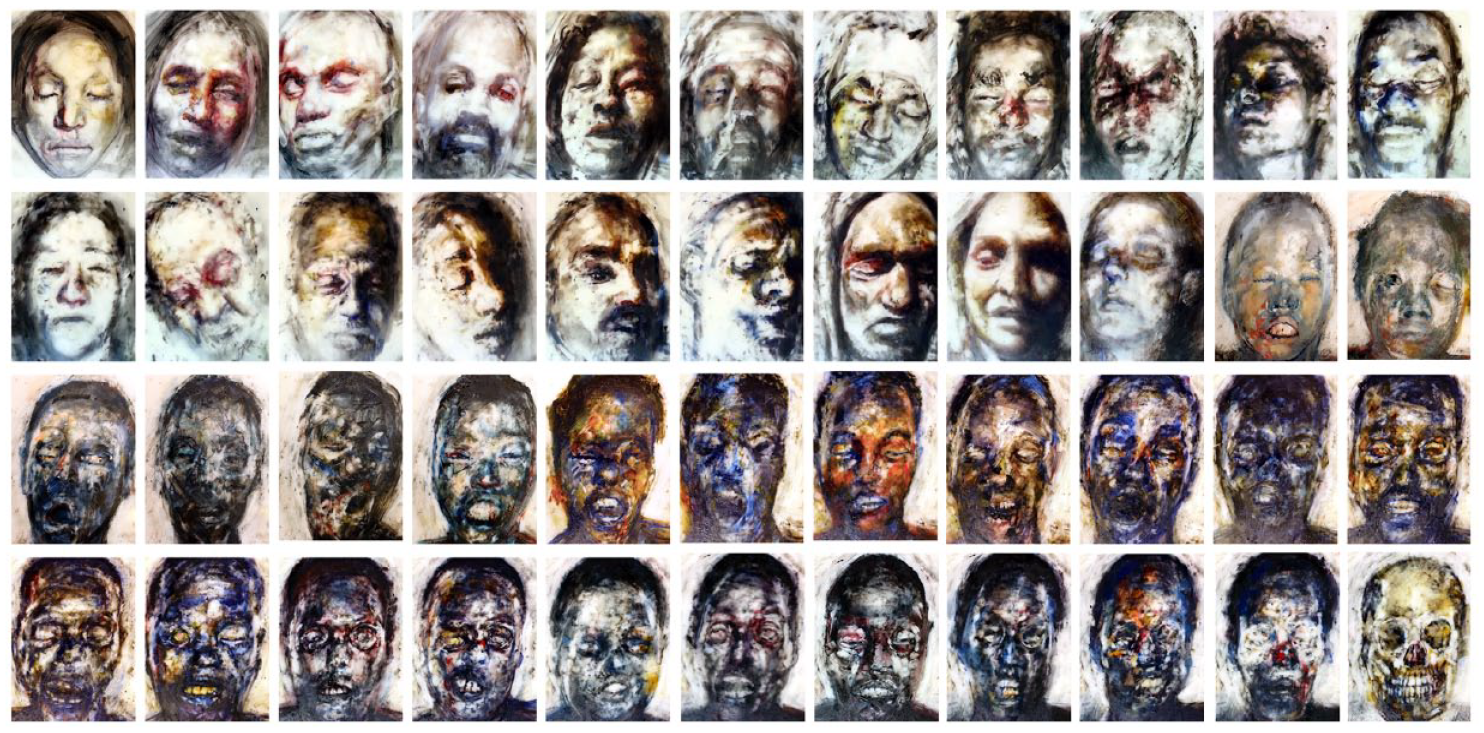
The 44 portraits that make up the main subject of the animation are only given autonomy as digital stills as they are present on screen for less than a second. Digital print from the animated film Do You Know Me? © Michelle Stewart, 2023. Reproduced with permission.
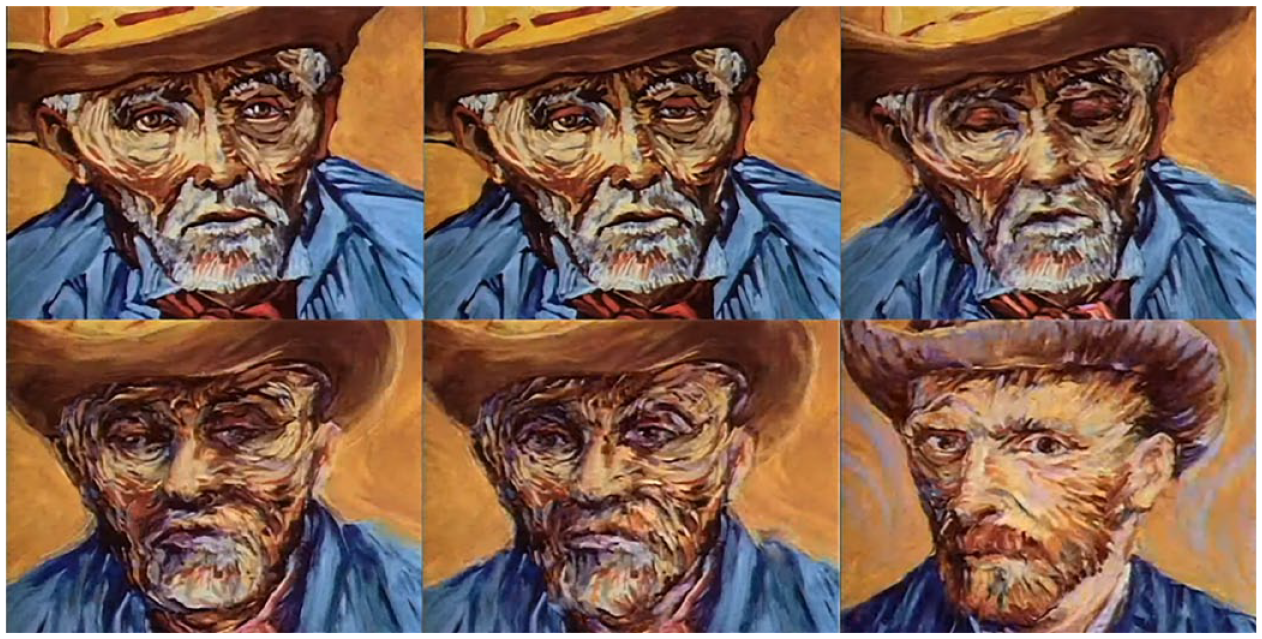
This image shows the gradual metamorphosis between two self-portraits of Van Gogh. The top left and bottom right images depict the original self-portraits, while the other images signify the temporal space between images. Screen grab from Mona Lisa Descending a Staircase, Joan Gratz (1992). Composite of screen grabs from a YouTube video. © Copyright Joan Gratz, 1992. Reproduced with permission.
This destructive process within paint-on-glass animation, and where the visible traces of the medium occur within and between movements, is evocative of the palimpsest. This is a trait that runs through the trajectory of experimental film and animated film ‘in which the palimpsest is evoked by the recognition that what has been erased remains in some sense present as something new is engraved, drawn, manipulated or layered upon it’ (Wells, 2020: 18). Palimpsest is a definitive trait of William Kentridge’s animated charcoal drawings which comprise ‘successive marks and erasures that, operating on the limits of discernibility, are permanently on the verge of metamorphosis’. Each final drawing contains sequential traces, a visual memory of its own making. These traces not only reflect on the mutable nature of both charcoal drawing and animation but, according to Huyssen (2009: 91), in Present Pasts: Urban Palimpsests and the Politics of Memory, the palimpsest operates on the level of metaphor – reflecting ‘the structure of political memory itself, which is always subject to erasure, effacement, evasion, and forgetting’. In Do You Know Me?, the visible traces reflect the space between frames and are vital to the temporal shifts between portraits. They evoke a brief evocation of life and are visible traces of the thought processes involved in shifting from one portrait to the next. Creating the metamorphosis between each portrait was a constantly challenging process that had no visual references but relied on the instinctive imagining of how each portrait would be metamorphosed into the next. In this way, the metamorphoses signified the space between two keyframes (or two portraits) – in which perceptual and creative processes unfolded. Correspondingly, in describing Kentridge’s process, Wells (2020: 18) posits: Kentridge’s technique seeks to use the interval between frames as a space in which his unconscious, intuitive thoughts emerge to prompt the new intervention in the image. This is closely related to the approach of animators – all working in different techniques – from Norman McLaren to Nick Park to Chris Landreth, and many others, in which the palimpsest is evoked by the recognition that what has been erased remains in some sense present as something new is engraved, drawn, manipulated or layered upon it.
Klein (2000: 21) pertinently coins this space between frames the ‘ani-morph’ – which he describes as that unstable space between frames. It is in this space, Klein posits, that one may glimpse the presence of the artist’s hand – much like the reflexive foregrounding of the ‘gesture’ in modern painting.
Serialism and repetition in the moving portrait
Sobchack (2000) distinguishes digital morphing (from its precedents in experimental cinema and analogue cinema technology) as having a sameness that allows for reversibility and repetition. She asserts: ‘Relations of similitude (and the morph), however, may foreground and assert difference, but indeed, they demonstrate and speak across sameness. They are nonhierarchical and reversible’ (p. 140). This aptly describes the nature of the morphing used in Do You Know Me? in that, although handmade, the morphs were consciously created to be reversible, cyclic and serial. They are naturally non-hierarchical; this is embedded in the subject matter and carries over into the transformations. The unclaimed dead are autonomous in relation to each other in that they have no hierarchical privilege.
Of interest to this article and in relation to the animated work are animators and experimental filmmakers who similarly explore serialism, repetition and metamorphosis in the moving portrait. György Kovásznai Kovásznai’s Metamorphosis (1964), for example, reveals a serial approach akin to that used in Do You Know Me? in that it presents a motion painting that shows various male and female portraits which metamorphose from one to the next. Drawing attention to both form and content, Metamorphosis traces the transformation between portraits via both the palimpsest and stop motion build-up of brush marks. Both films portray the physical and material collapse of one portrait into the next – but where this represents the unpredictable changeability of relationships (Wells, 2020: 23) in Kovásznai’s Metamorphosis, in Do You Know Me? this aims to suggest simultaneously a negation and affirmation of life and historical repetition. The use of a material metamorphosis from portrait to portrait suggests a continuous cyclical shift from death back to life and then back to death. This cyclical shift can also imply a reverse of movement and a reverse to before death, and implies a negation of the movement about to be suffered and that transformed a human being into a corpse. In this way, the animation symbolically attempts to reinstate a humanity within the portraits – to momentarily remove the status of an anonymous corpse
Kurt Kren’s 48 Heads from the Szondi-Test (1960) is a reconstruction of Leopold Szondi’s problematic perception test intended to identify a patient’s diagnostical leaning, whereby the examinee was shown a series of photographs of psychiatric patients with various perceived disorders ranging from homosexuality to sadism. Kren subverts the controversial act of superficial identification by reconstructing the visual experience, fragmenting, abstracting, morphing and focusing on details that would not have been immediately visible in the original test (Hamlyn et al., 2016). The seriality in Kren’s film builds and diminishes in cycles, transforming the subject matter and reconfiguring it as a test of perception for the viewer. While the photograph archives are vastly different in nature and intention, the original Szondi-Test photographs and the forensic photographic source material accessed for Do You Know Me? both present systematic visual processes of identification. As with Kren’s subversion of identification systems, however, Do You Know Me? similarly works against any formal and methodical portrayals of identification.
Sobchack’s notion of the digital morph and its reversible and cyclic nature refers equally to the characteristics of the loop. The idea of the loop and its association with repetitive, reversible, uninterrupted animated movement was around before the invention of cinema – exemplified in Reynaud’s praxinoscope and Muybridge’s zoopraxiscope. While these early looped displays were primarily for entertainment or demonstrative purposes, experimental filmmakers have long explored the metaphorical, conceptual and critical connotations looping offers. Takahashi (2014: 202) notes that looping gave ‘experimental filmmakers a way of figuratively, visually, and rhetorically opening up critical space’ and ‘allowed artists to open up a space of playful and transformative personal and political imagining’. In Do You Know Me?, as mentioned, the metaphorical notions of historical patterns of repetition and cycles of violence, life and death are embedded in the perpetual loop of the animated sequence. The notion of the loop, in general, has become a common attribute of contemporary expanded and experimental animation and is especially characteristic of animated installation (Harris et al., 2019).
Exhibition and presentation
Harris et al. (2019) note that, while short experimental shorts still feature as single-screen formats on dedicated film and animation platforms or as curated presentations, ‘others manifest as multi-channelled gallery installations, loops, site-specific projections, live performances, gifs, Virtual and Augmented Reality and video’ (pp. 6–7). It is these expanded modes of presentation and sites of viewing that have come to represent a significant part of what contemporary experimental animation has come to mean and pertain to exhibition and presentation strategies of Do You Know Me?
The animation will be part of a solo exhibition in a gallery space in May 2024 that includes the extended project that the animated film is a part of. The animated film will play continuously on a wall-mounted screen and will be accompanied by paint-on-glass stills from the animation and a series of 3D-modelled digital sculptures that refer to the tradition of the plaster-cast death mask and use the same photographic archive as a source. These images will feature as Augmented Reality (AR) artworks viewed via a handheld Android device. The AR display solves the problem of publicly ‘showing’ the dead and allows the viewer to choose whether to view the work. The exhibition will represent the ICRC and foreground their Missing and Deceased Migrant project.
Do You Know Me? premiered at the Artfluence (2023) Human Rights Festival for the Urban Projections ‘Designing Freedom’ event in 2023, where it was rear projected within a window (of the Denis Hurley Centre building in Durban) above a wall projection presented by the International Committee of the Red Cross (ICRC). Figure 3a (left) shows the projections in situ, while Figure 3b (left) shows a close-up of the two projections. The ICRC’s projection is a memorial image featuring a series of 60 images in an incomplete puzzle, with each puzzle piece representing individuals who migrated from Zimbabwe to South Africa and went missing along the journey or after arrival, and forms part of their Missing and Deceased Migrants Project. 5 The juxtaposition of these two projections and their proximity was intended as a cross-reference.
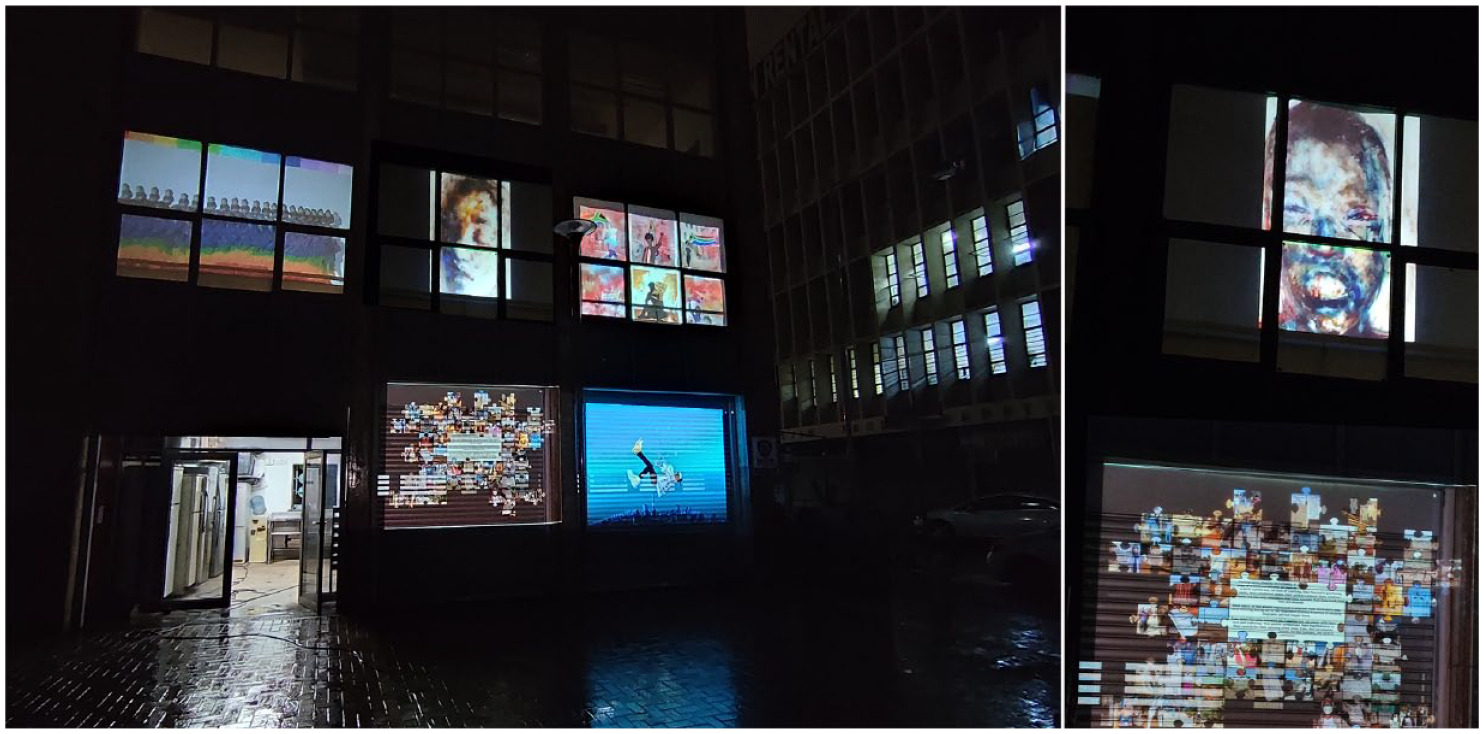
A backlit window projection of Do you know me? within the Denis Hurley Centre building and a wall projection of the ICRC’s memorial puzzle. The image to the left shows the projections in situ and the image to the right is a detail.
Bourriaud (2002: 50) notes that relational art is often in situ and involves an artistic event that incorporates ‘spatial and architectural configuration’. Correspondingly, the Denis Hurley Building – a memorial to the late Archbishop Denis Hurley, a noted anti-apartheid and human rights activist – informed the context of both installations in various ways, not least that they were projected within the unique architecture of a building that functions as a humanitarian centre. Serving the pastoral, community and educational needs of the poorest of the poor, the Denis Hurley Building is home to one of the few refugee pastoral care centres in the country. Moreover, the building is situated within the same complex as the Emmanuel Cathedral, where the poor, homeless and refugees from other parts of Africa look to the Cathedral for help and support. Notably, hundreds of refugees and immigrants were accommodated in the Cathedral in 2008 when violent xenophobic attacks gripped the country (Asmal, 2014). As a nod to this, Do You Know Me? was rear projected within a window that faces directly onto the Cathedral.
Correspondingly, animators such as Rose Bond describe her approach as comprising ‘animated work outside the traditional cinema, work that coexists with architecture’ and that is often ‘tied to a place’, an idea she notes is influenced by Bourriaud’s theory of relational aesthetics (Harris et al., 2019: 73). Her animated Illumination No 1 – a multi-channelled animated piece back-projected onto the second-storey windows of the historic Portland Seamen’s Bethel Building in Portland is informed by the historical archives of the building and its site, covering 120 years (Harris et al., 2019: 74–75).
Representing the dead and the influence of postmortem imagery
Traditions of postmortem portraiture pervade Western art history and are exemplified by the famous Fayum tomb portraits from Roman Egypt, deathbed portraiture popularized in the 1600s and that finds its climax at the end of the 18th century, and 19th-century memorial photography. Mostly these traditions refer to the ‘iconographies of beautiful death’ (MacTavish, 2002: 1701). This is an idealized version of death, one that veils the visible deformations of rictus, presents the illusion of a gentle death and protects the bereaved from the fear and reality of death. The focus is on showing the deceased in restful repose or as though still living. In contrast is the iconography of the corpse, which was seldom used as an approach to familial or memorial last portraits. These images include transi and memento mori images from the 15th century where the corpse is either skeletal or shrouded, the macabre tradition of the death mask, which proliferates from quattrocento Florence to well into the 19th century and 19th-century postmortem representations related to the anonymous dead, victims of crime, dissections, epidemic or execution. In the latter case, such images are often presented as human remains, separated from the individual that once was (Lahaeye, 2022). There are some final portraits (after the iconography of the corpse) and postmortem images from the 1500s to contemporary times that are persuasive in their empathy but do not deny the visible traces of suffering and pain of death. This discussion touches on the most compelling of these, particularly those that informed the approach of the animated portraits.
The first is Hans Holbein the Younger’s The Body of Dead Christ in the Tomb (1521–1522) (see Figure 4). A most persuasive analogy of this image of Christ’s body laid out in his Tomb is by Dostoevsky’s (1914) protagonist in his classic novel The Idiot (1914), who observes: ‘This was the presentment of a poor mangled body which had evidently suffered unbearable anguish even before its crucifixion, full of wounds and bruises, marks of the violence of soldiers and people . . .’ (p. 284). This account echoes Dostoevsky’s reaction on first seeing the painting where, according to his wife, he was so shaken by the image that he was brought to the verge of an epileptic fit (Bätschmann and Griener, 1943). In The Idiot, the protagonist imagines that the image may bring on a crisis of faith in that such an image of the unshakable reality of death makes it hard to believe in the transcendence of Christ. This argument is echoed by others such as Kristeva (Kristeva and Roudiez, 1980: 119), who suggests this image may evoke Holbein’s spiritual disillusion. Bätschmann and Griener (1943) agree that this is a ‘dreadful vision of a corpse, that of a man who had been condemned to death’ and one that is hard to reconcile with transcendence. Nonetheless, they assert that it unlikely represented a challenge to spirituality but rather that it is an image of piety (in the tradition of Grünewald’s lacerated, plague-ridden body of Christ in the Isenheim Altarpiece (1512–1515), intended to instil profound empathy (p. 88). The face of Christ, the open mouth, the bruised and swollen face, and the lifeless stare have an awful likeness to the battered faces of the photographic archive accesses for Do You Know Me? which similarly evoke a ‘dreadful’ reality.
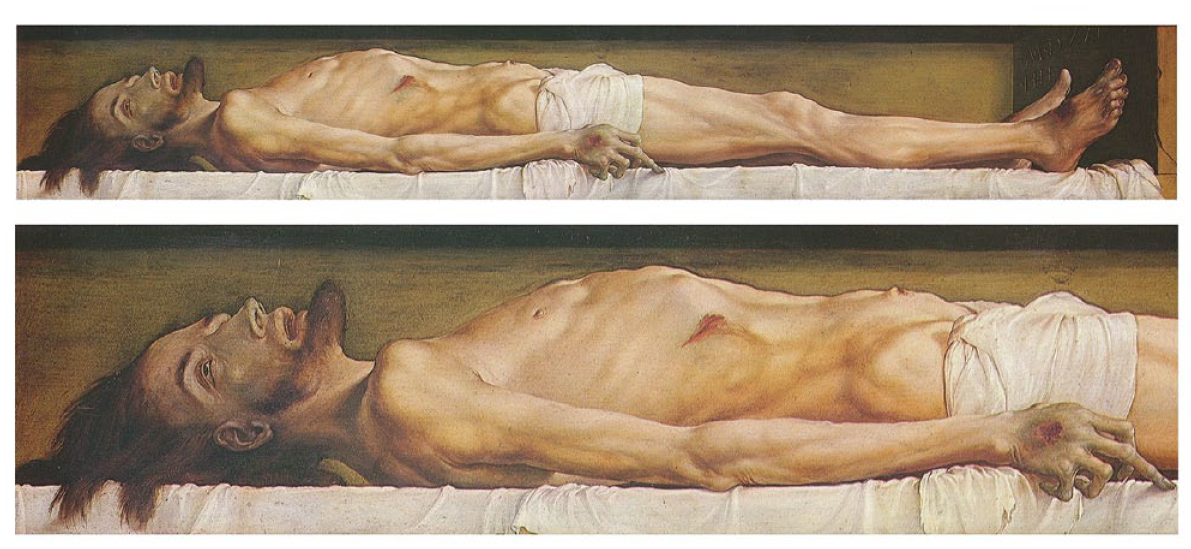
Holbein’s image of Christ shows a lacerated, decaying corpse. His features, sunken, unseeing; stare and open mouth are distorted by the effects of rictus and bear the greenish hue of decay. This is unmistakenly a dead body, laid out mortuary style, that appears to negate any potential for transcendence.
The French Romantic painter Théodore Géricault is an artist whose corpse paintings profoundly impacted the conceptual and painterly approach to the animated series. Géricault did several studies of severed heads and limbs, some presumably in preparation for his career-breaking Raft of the Medusa (1818–1819). Géricault’s Severed Heads (1818), believed to be torture victims of the Restoration guillotine, go beyond preparatory studies, however. They are seen to represent his political and aesthetic rebellion against the Bourbon Restoration regime’s brutal tactics and the idealistic tenets of neo-Classicism. These are grim, unsentimental portrayals of a violent death (see Figure 5). One is immediately confronted with the horror of placing the heads with the severed neck wounds exposed – thrust at the viewer who ‘has nowhere to hide’ (Nochlin, 1996: 21). They are abject forms, reduced to body parts, reminiscent of chunks of meat on a butcher’s block – but at the same time, they are last portraits. Each face is a grim imprint of their painful last moments. Nochlin suggests the male head – with his face contorted with pain and terror – represents the agony and horror of the decapitation. In contrast, the female’s head represents a restful repose and a release from the trauma of the event. Some commentators stress how these images represent the Romantic obsession with the macabre and the uncanny (Athanassoglou-Kallmyer, 1992; Germer, 2003). However, they are more than this. They evoke Géricault’s acute awareness of the human condition, his unapologetic portrayal of the reality and pain of death, and the tragic last moments of these unknown individuals. Géricault wrote to a friend in this regard, ‘Our earthly hopes and desires are only idle fancies, our successes mere illusions that we try to grasp. If there is one thing certain in this world, it is pain. Suffering is real, pleasure only imaginary’ (Christiansen, 2002: 9).
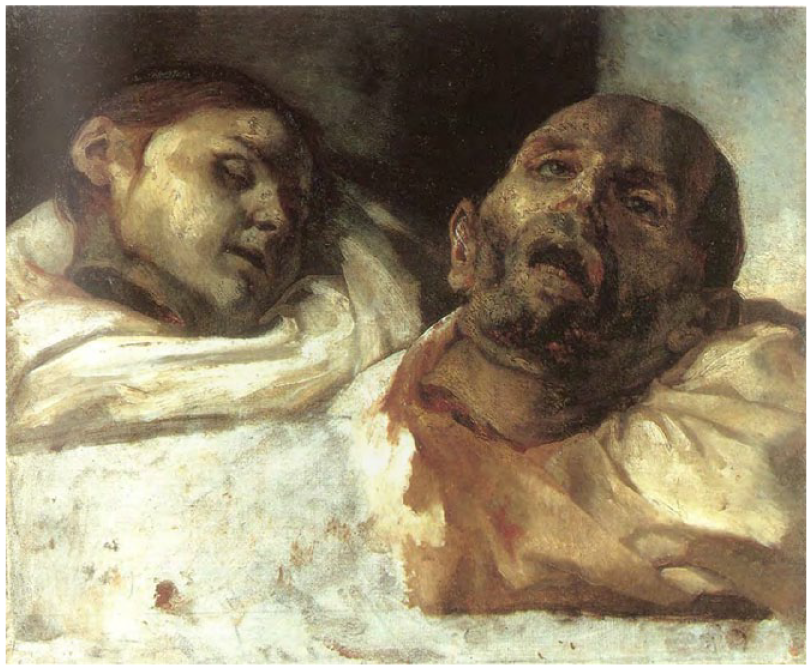
While this image is within the tradition of the corpse, Gericault manages to evoke empathetic final portraits. The head on the right presents an expression of the restful sleep. In contrast, the face on the right is contorted in pain and horror – possibly in the face of this brutal mode of execution.
Current artists who confront the subject matter of the corpse often do so with an acute awareness of the anathema and the contemporary taboo surrounding representation of dead. The elegant compositions of contemporary artist Andres Serrano’s morgue photographs and their evocation of advertising imagery have been considered controversial and even disrespectful by some who have accused him of trivializing death to service an aesthetic and commercial artistic vision. However, in view of the brutal and clinical reality of forensic photographs and the mortuary environment, one would assume he would have had to process a great deal of graphic horror to arrive at these images. Others argue that Serrano’s approach makes an otherwise challenging and taboo subject more accessible. Even though there is a disturbing tension in Serrano et al.’s (1994) images, their composed elegance echoes religious imagery after the tradition of grand painting and is in contrast to a content ‘traditionally considered objectionable’ (p. 21).
Conversely, it has been suggested that these images present layers of imposed violence – not just in the physical signs of the cause of death and the forensic damage caused by the pathologist – postmortem, but the violence of representation and its many nuances – in the face of which the dead are defenceless (Fitzpatrick, 2008: 32). This is a compelling point of view. However, Serrano’s images are more nuanced than this and draw on a complex history of posthumous imagery and representations of the dead that elicit various interpretations, with some that argue for these images being in the service of the dead. Correspondingly, Serrano states: ‘Well, I won’t say that I believe in a soul. But, I do believe that I’ve captured an essence, a humanity in these people. For me, these are not mere corpses. They are not inanimate, lifeless objects’ (Blume, 1993: 37).
Marlene Dumas’s series of paintings of corpses are taken from media images of forensic photographs and, in some cases, borrowed from famous artworks. For example, Dead Marilyn is taken from Marilyn Monroe’s postmortem photograph, Lucy from Caravaggio’s The Burial of St Lucy and Stern is from a newspaper photograph of the corpse of Ulrike Meinhof, the Red Army Faction terrorist who either committed suicide or was murdered in her Stammheim prison cell in May 1976. These images evoke a complexity of responses, complicated by the artist’s evocation of eroticism, empathy, death – and a sense of the taboo. Nevertheless, like Serrano’s morgue photographs, these issues are mediated by an evocation of humanity. Dumas’s corpse paintings are all laid out postmortem style, their flesh painted with lifeless undertones of cold blues and grey, yet they appear to hover between life and death. Searle (2015) attributes this to the alacrity of her brushwork, which leaves traces of reworkings, grappling and accident. This can be said of Dead Marilyn (see Figure 6). Dumas painted this image partly in response to the death of her mother, claiming she was responding not just to the sadness of this image of Marilyn Monroe but was also channelling her own feelings of sadness and loss (Brand, 2008). Moreover, Dumas remarks that painting is about ‘the trace of the human touch’, which she suggests becomes an expression of the sensations experienced by the artist when making the painting (Shift, 2008: 161).
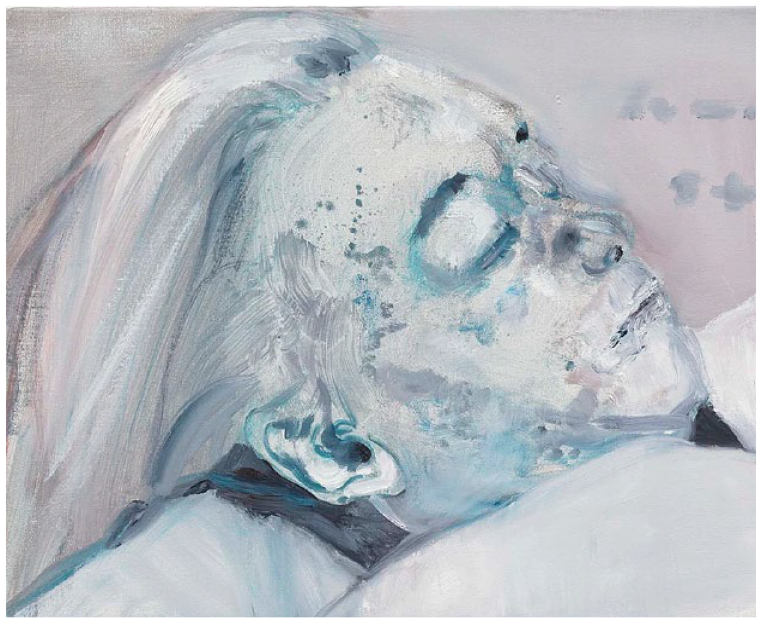
Although the source for this painting is a mortuary image, Dumas manages to inject humanity into this image. While this is clearly a postmortem image, there is a lightness of touch and gentleness in the colour and quality of the brushwork that can be seen as leaving visible traces of care.
Conclusion
This project’s challenge was presenting an empathetic creative response to the photographic archive while retaining anonymity and bringing attention to a grim reality. The conception of this project as motion painting was appropriate in that, while each individual, their wounds, expressions and state of decay are engaged with, confronted and recorded, these are visible for just a moment before the face becomes fragmented and distorted in the temporal metamorphosis that links one portrait to the next. As discussed, the illusive, visceral medium of oil-paint-on glass was conducive to eluding photographic realism and affecting a material metamorphosis. Even so, in engaging with each individual, the project is an attempt to commemorate each unknown person, to leave a permanent trace in paint to mark their existence.
The destructive and regenerative essence of animation, embodied in early animation and modernist abstract film reflexively at the level of medium and at the level of content – importantly informed the material and metaphorical notions of violation, mutilation, cycles of life and death of the animated project. It was also pertinent to contextualize how these genres were assimilated, considering the colonial and Apartheid paradigms that burden or are unavoidably tied to the animation. The expansive engagement with the medium beyond traditional narrative structures and modes and sites of viewing and as an extension of fine arts processes clarifies the animation as a particular instance of experimental animation. Lastly, I have touched on the historical art traditions of postmortem imagery and posthumous portraiture, which helped form my approach to and critical engagement with this challenging subject matter.
Footnotes
Declaration of conflicting interests
This author has a non-financial association with the International Committee of the Red Cross’s (ICRC) Mr Stephen Fonseca, Head of the ICRC’s African Centre of Expertise on Missing Persons and Forensic Systems in Africa and Forensics Specialist Ms Lucinda Evert. Both parties agree that any platforms the creative project, Do You Know Me?, is presented on will acknowledge the ICRC’s Missing Deceased Migrant Project. This agreement and association was relayed via email communication between the author and Mr Fonseca and Ms Evert (Fonseca, 2021). The author has kept Fonseca and Evert informed regarding the inclusion of content and imagery in this article related to the Missing and Deceased Migrant Project (Stewart, 2023/2024).

Funding
The author received no financial support for the research, authorship and publication of this article.