




Abstract
It is a gift to write this article as an opening piece to a twentieth anniversary Special Issue for the book Space Invaders (2004), with twenty pieces in the collection, initiated with generosity by Jo Littler and Anamik Saha, two of the co-editors of the European Journal of Cultural Studies, following a conference on Re-Visiting Space Invaders in 2022. The article offers an expanded spatial practice, with space invaders as a mode of analysis as well as space invading as a methodological research process. The discussion locates space invading as a verb, as a practice of co-existence, as well as an innovative intervention in different contexts; drawing on a large body of creative, critical, collaborative projects. In this piece I (1) return to a key research scene, Westminster, London in the contemporary political context; (2) reflect on how the remit of the book has been extended internationally, building towards an expanded methodological spatial practice of space invaders; and (3) I close by introducing how this collection on Re-Visiting Space Invaders extends issues and questions far beyond the original scope of the book.
Keywords
Introduction: carrying spaces
This article offers an expanded spatial practice: one that covers the arc from analysing the processes of space invaders when bodies take up positions not historically and conceptually reserved for them, to creatively mobilising space invading as methodological practice. These two moves – the observation of space invaders and the mobilisation of space invading as a form of critical collaborative intervention – are not entirely distinct.
In The Prison Notebooks (1995 [1971]) Antonio Gramsci famously refers to the importance of compiling an ‘inventory’ to understand the political and social traces influencing one’s social consciousness, in the movement towards transformation (1930–1932). For me this exercise, as much as it is possible, would take a great deal of memory work, possibly psychoanalysis and more pages than an article can hold. Pierre Bourdieu’s idea of a socio-biographical sketch for a self-analysis (Bourdieu, 2007) also aids in situating private problems as public issues, in the development of the Sociological Imagination (C.W. Mills, 2000[1959]). Ursula Le Guin (1989) refers to the Carrier Bag Theory of Fiction with stories of how life worlds have been made with technologies involved in gathering and holding items. Our lives are full of an inventory of acts of generosity, which we carry around but rarely fully register the significance of. In the current context of higher education, when an individualised capital calculus emphasising the statistics of student numbers and large research grants is accelerated and devaluing intellectual legacies, it is worth remembering how a research culture provides a rich environment for emerging scholars. A lot is ‘carried’ over (Puwar, 2020), between our embodied life, educational trajectories and the issues we focus on as researchers at different points of time. In this article, I will focus on some traces or threads in the manner of a cat’s cradle (Haraway, 2008), switch(ing) and shuttling between observing space invaders and enacting space invading as a spatial research practice.
Practice, in my case, involves building creative methods, within collaborative teams, interventions in consecrated spaces, cities and the walls of the academy. This is an expanded spatial practice: transcending traditional boundaries of place-based, social and cultural theory or architectural concepts, moving in multi-scalar ways with different materials and creative methodologies. There are crossovers between, for example, interviews, participant ethnographies, walks, performance, installation, video, sound, and digital technologies. Several centres at Goldsmiths have over time impacted on the development of this specific expanded spatial practice. Most directly, these have been CUCR (the Centre for Urban and Community Relations), the Unit for Global Justice, the Centre for Feminist Research and particularly the development of the Methods Lab, co-founded with my ex-colleague Les Back and co-directed with Mariam Motamedi Fraser (2006–2016).
The research for my 2004 book Space Invaders was conducted during an ESRC (1994–1997) project on ‘New and Established Elites’ with John Scott (Scott and Griff 1984; Scott 1988), known for his research on network analysis, developed by applying early computing technologies to consider the webs, nodes and matrixes of power. He originally worked with punch cards before moving on to databases. In the current political climate, elite studies is becoming a burgeoning field, requiring different types of ‘reconnaissance’ research tactics, as C W Mills (1956) identified for researching the Power Elite. Space Invaders brought gender, race and class into elite studies, along with post-colonial theory and feminism.
Notably I steered the project amid a feminist research culture at the University of Essex (Catherine Hall, Miriam Glucksman, Mary McIntosh, Leonore Davidoff and Vicky Randall in Politics), as well as questions of race, post-coloniality, and of course sexualities (Ken Plummer, Sean Nixon and Michael Roper were faculty), which were key subjects for my doctoral peers, especially Travis Kong and Igi Moon, who were fellow travellers for me between London, where we lived and the university campus in Essex. The Sociology department at Essex had a strong tradition of oral history (Paul Thompson), as well as critical theory, which included the historical materialist Ted Benton (1993, 2006), who went on to write Natural Relations: Ecology, Animal Rights, and Social Justice, plus the book on Bumblebees aimed at a public readership.
There are no references to ecology or animals in Space Invaders, except Ingrid Pollard’s 1988 photographic series on ‘Pastoral Interlude’, a consideration of landscapes, body and space. Further down the line I did write about monkeys in the Indian parliament (Puwar, 2012). My most recent collaborations concern global ecologies and Leather: caste, craft, class, carcass, with Catherine Hahn (discussed towards the latter part of the article). In an observational comment, John Scott noted the shift from space invaders to space invading when I spoke at his retirement conference at Essex about my latest research at the time, titled Noise of the Past, a creative collaboration that opened how we remember the war dead in the context of empire and post-war migration and outside of militarism.
The long arc between space invaders and space invading forms part of the podcast discussion curated by Agata Lisiak, in her ‘Spatial Delights’ series on the long-standing influences of the feminist geographer Doreen Massey, from whom I borrowed the term space invaders. Without formally studying cultural geography, Massey’s work became an inventive element of a growing reading list I acquired, collected from bookshops, conferences and engagements with feminist geographers and philosophers. It was an exposure that shaped my book Space Invaders, as well the development of an expanded spatial practice (Hirsch and Miessen, 2012; Liggett and Perry, 1995; Murrani, 2024; Rendell, 2018; Sioli et al., 2024), with space invading enacted as a research process and tactic (De Certeau, 1984).
Part I: the return of Westminster
The extent of the creativity of the engagement with Space Invaders can very easily lead us to forget the initial sites of research all those years ago. The book was based on 100 interviews with MP’s and senior civil servants, with particular attention to gender, race and class, and drew on artistic conceptual aids.
Methodologically, since the publication of Space Invaders I have studied parliaments with inventive dynamic modes of ‘live methods’ (Back and Puwar, 2012; Jackson and Paton, 2025). For instance, with the knowledge of Mari Takayanagi (see Takayanagi and Smith, 2025) at Parliamentary Archives, I designed an alternative feminist de-tour of parliament, published as ‘Architextures of Parliament: flaneur as method’ (Puwar, 2010). The presence of monkeys in the Indian parliamentary complex (due to de-forestation) and the ensuing discourse of invasion, capture, deportation and policing within a ‘monkey prison’, also informed the the writing and research for ‘Citizen and Denizen Space: if walls could speak’ (2012), on how monkeys raid secret files, screech at political press conferences and escape from designated monkey ‘prisons’.
Firstly, let’s re-visit Westminster in Part 1 of the article. At Westminster the political landscape has changed so much since Space Invaders was published. There is a messy mess of diversity, with more ‘diverse’ bodies across a spectrum of political noise. There continue to be persistent ongoing issues with bodies entering positions not conceptually or historically reserved for them. The terms of exclusion have become the terms of inclusion at an accelerated pace. How racialised figures become established and for the establishment, even while they remain irksome bodies, is a pressing question.
‘The great moving right show’
When Doreen Massey (1994) explains the notion of space invaders in Space, Place, Gender, with reference to her own unevenly gendered experiences over time of sports fields and football terraces, she simultaneously refers to change and the continuation of long-standing patterns. There is contradiction and tension, an opening and closing of places. Thinking in the contemporary context with conjunctural analysis, as events shift further to the right on a daily basis, we may turn to Stuart Hall’s classic essay ‘The Great Moving Right Show’ [1979], written at the height of Thatcherism and the rise of authoritarian populism, he urges for attention to what is ‘specific and particular to this historical conjuncture’ (Hall, 1983: 21). Hall (1983) defines ‘conjuncture as the coming together of often distinct though related contradictions, moving according to different tempos, but condensed in the same historical moment. . . .’
In a fast-changing political and social context, the messy mess of difference has been re-calibrated as racialised bodies have become, in increasing numbers, part of the political elite across the party spectrum. The contemporary particularities of ‘The Great Moving Right Show’ (Hall, 1983), are being both fronted and tackled in the political playing field by racialised figures, including prominent women of colour. Dissimilar currents in the air call for what Hall (1983) refers to as a ‘serious analysis of things as they are, not as we would wish them to be’ (p.22). This analysis means letting go of any simplifying schemas, including easy equations of race, gender and class: moving away from a bunched up intersectional analysis for a more granular analysis. Nobody would say that women of colour radically change a field just by their presence. While their presence can dent the naturalised figure of leadership, there are no equivalences between political ideas and social background or embodiment. No neat lines can be drawn between race-gender-class and progressive politics; in the words of Hall (1986), there are no political guarantees.
The technical and aesthetic understanding of colour in music builds on dynamics, volume, expression, loud and soft, subtle shades of depth between chords. The language of range and variation can be applied to how racialised marked bodies orchestrate within political and social forces; with their constituencies, in political chambers, as well as competing elements within and across parties, in constituting politics and in grabbing headlines. In 2027, for example, we have in Westminster both Kemi Badenoch as leader of the Conservative Party, as well as Zarah Sultana, who resigned from the Labour Party on 3 July over the erosion of democratic rights, to protest for Gaza and against welfare cuts. Dissenting voices quickly face charges of illegitimacy, particularly when they are racialised. In the process, these positionings – of political policies, rhetoric and autobiographies – change the terrain of colour within political participation.
The numbers
The geo-political landscape has changed on so many different registers since the publication of Space Invaders in 2004. Speaking of numbers, at the time of my research interviews for the book, there was one woman of colour in parliament, Diane Abbott, who was elected on 11 June 1987 as the first black female MP. In addition, Oona King was elected in 1997, serving until 2005. Today there is a marked statistical increase in the presence of women of colour on the left and right, across the political spectrum. With minority ethnic MPs increasing from 66 elected in 2019 (Uberoi and Carthew, 2023), to 90 in the 2024 general election, two thirds (66) were elected as Labour Party Members of Parliament, 15 were Conservatives, 5 Lib Dems and 4 new independent MPs. More than half of minority ethnic MPs (50) are women.
How do we compute these numbers, socially and politically? An increase in numbers of MPs does not mean the political environment is a level playing field; specific ‘hurdles’ remain, as mentioned by Jane Cassidy (2024). At the cusp of the May 2024 general election, she stated, I look forward to seeing more MPs of colour in the next parliament but I’m still sceptical about the extent to which their parties will protect them, support them to tackle the issues that affect their communities and work to dismantle the racism within their structures. Activists like me believe there is a reckoning that’s needed in all elite institutions.
How the ‘reckoning’ is formulated speaks to the continued dimensions of being a space invader in parliament. A report on ‘Ethnic and Gender Diversity in the New Parliament’ (2024), published by the Think Tank British Future, stated that ethnic diversity has become a cross-party ‘new norm’, while also registering the persistent ‘unequal experience of public life’, with, for instance, ‘a dramatically disproportionate share of online hatred’ directed towards women and minority ethnic MPs (Katwala and Rutter, 2024: 5). The tension of being ambivalently placed in parliament persists. At the same time, nothing stays the same; there are significant changes we must consider.
Online visibility
Undoubtedly the public interface has changed for MPs with the rise in social media. This is a distinctly different moment to the writing period of Space Invaders, when there was limited use of email and only some use of mobile phones. For instance, I wrote and posted paper letters to my interview participants. Political presence entails interlinkages between what happens on the benches in the House, constituency surgeries and different media platforms. Increased political openings and visibility also expands the scope for vitriolic attacks and intimidation. Amnesty International (2017) analysed the Twitter accounts of all 177 female MPs in the 6 months prior to the 2017 elections, and found elevated levels of abuse aimed at female MPs — 25,688 across a 6-month period. The harassment is also racialised among women, with Diane Abbott receiving slightly over 45% of all tweets to MPs of an abusive nature. When researchers took out Abbott from the equation, black and Asian MPs still received 35% more abusive tweets than white women MPs. Abbott has stated, “I have had rape threats and been described as ‘a pathetic, useless fat, black piece of shit’” (cited in Jasper 2017). Her staff too witness and stand in as moderators soaking up the daily stream of racist insults on Twitter, Facebook and email. The Forde Report (2022) by Martin Forde KC, underlined how Abbott was disproportionally targeted by racism and discrimination in the Labour Party.
The MP Zarah Sultana has been described as ‘a genuinely viral politician’ (Eaton, 2022: 12), whose connectivity with the electorate, especially the young, is enhanced on social media, which offer channels with potential to at least partially sidle away from mainstream media. Yet this is a double-edged sword, as Sultana has also been reported to be the most harassed MP. The space of women MP’s in the public realm can be placed in a wider context of extensive misogyny online. Sarah Banet-Weiser states, ‘. . . it is precisely technological access and a flourishing of a ‘public’ culture of comments and feedback that makes this moment feel different-and feel differently worse than past moments. The current climate is a substantively different mediascape’ (Banet-Weiser, 2015). Public abuse is cited to be one of the key reasons for why women across the board are hesitant to stand for political positions or go on to stand down as elected MPs. With a focus on how misogyny has gone viral, Emma Jane (2017: 3) notes ‘. . . while the Internet did not invent sexism, it is amplifying it in unprecedented ways’. Online abuse is amplified through racialised, sexualised and geo-political formations. For example, online hate has gone up exponentially as Sultana has spoken on behalf of Palestinian solidarity. The substance of the words, threads and networks is highly gendered, Islamophobic and politically directed. Across social media platforms there are ‘hotbeds of misogynistic activism’ (Massanari, 2017: 330), making concerted targets.
Messy mess of diversity
Politics is first and foremost a terrain of struggle, into which gendered racialised elements are actants, rather than epiphenomenal. In the current times, there are several significant developments at play, both with and against one another. There are multiple routes to the conditions of inclusion, hinging on the conditions of exclusion. The politically charged affective vocabulary that Margaret Thatcher (the first female PM) used to assert Britain was being ‘swamped’ and ‘invaded’ by migrants, has been cranked up by politicians whose families migrated to the United Kingdom. As a modality of inclusion, it is also a way into nation-making, to buttress legitimacy for outsiders in the higher ranks of political parties. There is also broader global alignment with what Jo Littler (2025) refers to as ‘model minority authoritarianism’. This includes an extensive regurgitation of anti-immigration, threatened borders political talk, rallying with the fuelling fires of media-led depictions across a platform of news channels. The tempo is speeded up, with instalments of spectacular words and scenes strummed out on a weekly basis. Social forces of the radical right are inside the political parties, and, not only in the growing Reform Party, there are anti-immigration public rallies and violent assaults on the hotels refugees are living in.
The perpetuation of racist and exclusionary immigration boundaries are the conditions through which, for example, recent South Asian Women MPs have been able to take the mantle of being Home Secretaries. The rallying call for anti-wokeness has become a device for providing a speaking platform. Wealth too has become an intensified denominator of inclusion for men of colour on the front bench, including the ex-Prime Minister Rishi Sunak or the ex-Chanceller of the Exchequer, Nadhim Zahawi, who set up YouGov.
It’s worth considering some of the accounts, narratives and spectacles harnessed to generate routes to becoming relative insiders, often seesawing tenuously very close to the precipice of sliding off. In the messy mess of diversity, many women of colour have front loaded their political portfolio with an anti-immigration stamp. The Home Secretaries Priti Patel and Suella Braverman amplified fears of an immigration crisis, creating one of the most anti-refugee agendas, with their spectacular declaration of the policy to send refugees to Rwanda. A highly visible spectacle of a hostile anti-immigrant agenda, it has gained absolute ascendency since Teresa May, who went as far as having patrolling vans (Jones et al., 2017). We are witnessing clearly marked women of colour attempting to secure a position in the hardline Conservative limelight by becoming the border guard writ large, and bringing legitimacy to potentially illegitimate space invader status as women of colour, by becoming defenders of the nation’s borders against ‘others’ vilified and characterised as space invaders. These are the terms of the conditions of inclusion for relative ‘outsiders’ to political regimes. They are promoted to a specific type of limelight; enabled to enable a championing of racialised right-wing politics. This is an optics of diversity granting inclusion on very specific grounds; a racialised straight jacketing of political acceptability.
Biographical passports
Racialised bodies so often need to provide a biographical account of themselves as they come with a burden of doubt when they are conceptually and historically space invaders. This was most marked in the leadership contest for the Conservative Party in 2022, triggered by Boris Johnson’s resignation. In one of the most diverse line ups, candidates vied with each other to perform as patriotic and nation serving leaders. One might have thought they were making a pledge for citizenship. The pledge was of course to be trusted as relative outsiders to have the right to pass as leaders of the party and to thereby become Prime Minister. In their analysis of the election campaign, Rima Saini et al (2023) refer to post-racial ethnic minority right-wing ideologues in the Conservative party.
In a climate where lockdown procedures and policies were flagged to be full of discrepancies, distrust of MPs was rife. Issues of race are so pronounced in their self-positioning in the Conservative Party, there was a huge effort invested in being true blue, truly British and patriotic. Each of the nominees vied to be authentically genuine and loyal to the nation and the people. Rishi Sunak, who was considered only a half serious contender, in his Ready4Rishi Campaign video (Sunak, 2022), presented the good migrant story, of educational mobility and a migrant professional family, while bearing a flag flying Britain. He self-presented as a MP of better and honest futures, with a message of change, without negativity. There were continuous references to the Conservative family for the British people, as well as pledges for record funding for the armed services, lifting tax burdens and controlling borders, as a man of the economy invested in traditional Conservative values. In the campaign video Sunak declares ‘my values are non-negotiable, patriotism, hard work’ https://www.theguardian.com/politics/video/2022/jul/08/rishi-sunak-launches-tory-leadership-campaign-video.
Suella Braverman (2022), also of Indian background, stated in her leadership campaign video: I love this country. My parents came here with absolutely nothing and it was Britian that gave them hope, security and education. This country has afforded me incredible opportunities, and education and in my career. And I owe a debt of gratitude to this country, and to serve as Prime Minister would be the greatest honour.
Braverman situates herself as a hardline Brexiter, an Attorney General who wants to withdraw from the European Convention on Human Rights (ECHR), aiming for tax and welfare cuts. Previously, she was a barrister of immigration and planning. Her campaign video started with the Union Flag, a war monument and her declaration of patriotism.
EDI as a political game
Both in the 2022 Conservative Party leadership and in her previous role as Equalities Minister, Kemi Badenoch utilises the social justice agenda of ‘freedom’ against what she claims as identity politics, woke politics and critical race theory. When she became Conservative Party leader in the United Kingdom in November 2024, she was congratulated by both major parties for being the first Black female leader of a party. Importantly, Kemi Badenoch and Rishi Sunak were voted in by the selectorate of the Conservative Party and not the electorate. Badenoch was narrowly selected, her political remit is absolutely racialised, and she has stood on an anti-woke agenda throughout her parliamentary career since 2017. Her rise and maintenance of power have been fundamentally tied to delegitimising EDI, white privilege and unconscious bias. These attacks are turbo-charged and legitimised by her blackness; this discourse is central to her conditions of existence. Her own auto-biographical pitch is very much part of the political performativity; she speaks of her opportunities as a daughter of immigrants from Nigeria, who ‘chose’ to live in the United Kingdom (Badenoch, 2022). In her maiden speech she stated there are few countries where you can in one generation become a MP (19 July 2025), upholding British traditions, which are identified as consisting of monarchy, church, parliament and family. There is no time for critics of colonialism. She shares respect and pride for Winston Churchill, Margaret Thatcher and Airey Neave. Her views on trans and queer lives continue to trump Keir Starmer’s; at a speeded up Prime Minister’s Question session, Badenoch piles on ridicule after ridicule, on trans lives and other issues, including taxation and welfare. Within the debates she has fully taken on board masculinised sexualised banter – using sexualised masculine words such as not having ‘balls’ – in her highly adversarial performativity in the chamber.
The broader global context in which far-reaching political shot puts are thrown at diversity, equality and inclusion policies in North America by Donald Trump, by blaming everything that malfunctions on Diversity, Equality and Inclusion (DEI) and wokeness, also legitimises such rollbacks and political banter in the United Kingdom. There is a political thunder against even limited appreciations of ‘diversity’ generative of atmospheres in the United Kingdom, the United States and beyond, with global rumbling murmurations.
Part II: an expanded spatial practice of space invaders
The earliest engagements with the book Space Invaders happened internationally, through critical experimental interactions. Right from the start, the conceptual work of space invaders became ‘stretchy’. Curious novel innovations with the text have also exercised me towards the development of an expanded spatial practice. The ways in which scholars, practitioners, activists and artists have travelled with the framing of Space Invaders has provided a pedagogic dialogue, informing my own shift from observing the processes of space invaders to also instituting space invading as a methodological practice. It is possible to be caught unaware of the need to analyse the dynamics of being a space invader right in the middle of creative interventions seeking to alter, layer and re-route places. Spaces are multidimensional, sedimented, plural, open and closed, imagined and protected, iterative, with edges, centres and marginalia that shift, break and mutate within dimensions and unsettling dynamics of experimentation.
Part II of this article undertakes the ‘slow research’ (Strauss, 2021) of reflecting on multi-faceted engagements across the span of 20 years by discussing an indicative sample from the extensive creative, critical collaborations I have had the fortune of co-leading and sharing.
Spacey times
The small book of essays and interviews titled Architecture from the Outside by Elizabeth Grosz (2001) was one of many feminist interventions in geography and space that enabled me to think of paradoxes. Very soon after Space Invaders was published, in October 2004, I was invited to deliver an opening lecture for the Annual City of Women Festival in Ljubljana, Slovenia on gender, nation making and transnational exchanges, which included a response to a spacey art documentary Otolith 3. Made by Kodwo Eshun and Anjalika Sagar, not long after they founded the Otolith Group in 2002, the film pivoted on a meeting between Russian cosmonaut Valentina Tereshkova, the first woman to travel into outer space, and Sagar’s grandmother, who was president of the National Federation of Indian Women.
A few months later, several intergenerational exchanges unfurled in Europe, after I had met doctoral students at a panel in Paris for the European Social Forum. Many of these engagements with ‘space invaders’ took place both inside and outside the academy, in activist social centres and art centres. This included a party and book launch panel discussion, held in the Casa de Cultura in Milan on International Women’s Day in 2005 (see the discussion with Galetto et al. (2024) in this SI). A dynamic dialogue of race and gender in social movements proliferated, especially in Italy and Spain. This included speaking in autonomous university spaces, re-orienting and re-inhabiting formal institutions, and creating new lines of co-learning in squats and social centres.
In Madrid, I sat in a classroom speaking of space invading in movements during the day, and in the evening attended the opening of a self-built feminist media centre, La Eskalera Karakola based on the site of a women-led bakery. The following day I visited Museo Reina Sofía in Madrid at a time when my attention was turning to sound and space, and here I stumbled into two large screen installations of the film Turbulent (1998) by Shirin Neshat. On one screen a man (Shoja Azari) dressed in white kurta pyjamas sings openly in an amphitheatre to a room full of men wearing the same attire. On the second screen a woman (Sussan Deyhim) is dressed in black singing scattered broken sounds of gasps and screams to an entirely empty theatre, because women can’t sing in public in Iran. Towards the latter part of the film the man stops after catching these distant disturbed sounds. I walked between the two screen installations, knowing that an embodied immersive installation did something more than a written text alone. By 2003 my approach was already moving towards stretching the walls of the academy from the inside and outside, veering to what I came to think of as a public curatorial sociology (discussed in Puwar and Sharma, 2012).
Social cinema scenes
I had worked on a project with film and installation at the centre of it for a knowledge exchange project titled ‘Re-Visioning Britishness’ (2003), located at the Herbert Art Gallery and Museum in Coventry. The social cinema scenes that prevailed in a network of South Asian cinemas in the inter-war and post-war period across the United Kingdom offered a unique viewfinder on inventive lives often eclipsed in predictable depictions of migration. Those who were characterised as space invaders in the post-war period applied their own financial and cultural resources to re-inventing failing cinemas. ‘Khabi Ritz Khabie Palladium’ became a six-month collaborative installation, with staff at the gallery and Kuldip Powar, of a two-screen film, audio interviews and archival materials, at the Herbert. This was a gallery I had frequented as a child when my father worked there in retirement as an attendant. The project expanded notions of migration away from familiar tropes, as well as predictable anthropological ethnicised objects – such as sarees, cooking utensils and musical instruments. Instead, the very ways in which spaces were invested, contested and subterranean were recollected as cultures in flux and on the move (Puwar, 2007). I went on to collaborate on two further site-specific films on architecture and these specific cinema scenes, Coventry Ritz and Cinema III (2010). Spatial practices are always ongoing in different ways. A creative oral history public project had strengths, but at the same time I felt the limits of my practice, and I wished I was the kind of academic who could restore cinemas, as the artist Yto Barrada (2012) did, when she restored the Art Deco Cinéma Rif in 2003 by co-founding the Cinémathèque de Tanger, where films are shown and a collection of training courses and community events are held.
Noise of the past
The stakes of re-visioning Britishness continued to run through me. It was not enough to teach modules on race and nation making; the conversation had to go public in nuanced ways. Inter-disciplinary crossovers with architecture continued, as a group project re-routed the relationship between remembrance and nation making, by considering post-colonial presence in a site from my hometown overwhelmingly associated with war and reconciliation, Coventry Cathedral. The collaborative skills of academics, archivists, artists, musicians and filmmakers were mobilised for Noise of the Past (Puwar and Sharma, 2011), a project which would have never happened if not for the commitment of a research administrator at Goldsmiths, Lynda Agili. We don’t often mention these minor-major players of academic research.
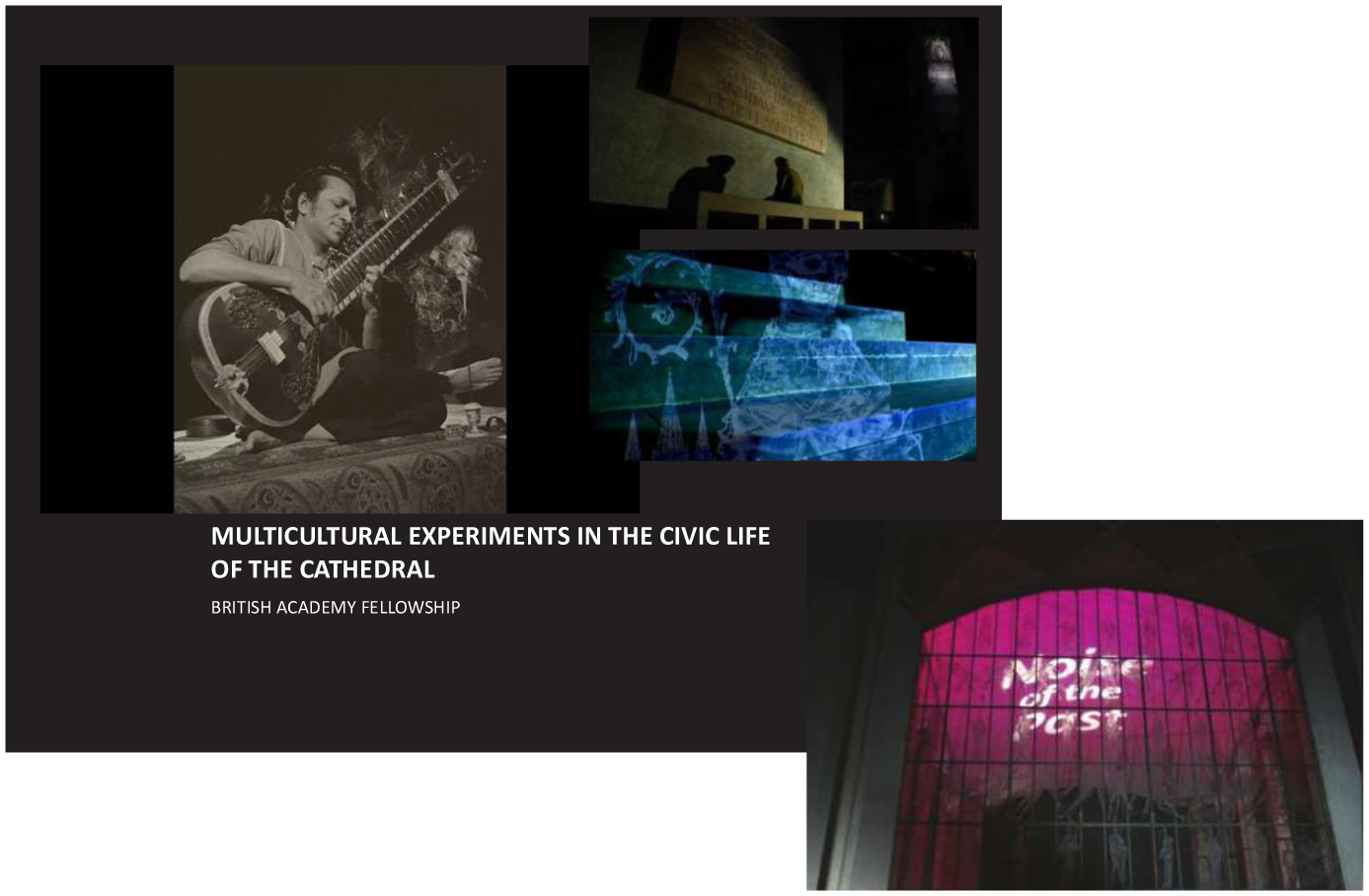
Coventry Cathedral was not a distant place like Westminster: it is a focal reference point in the city. While it is associated with WW2, a disconnect remains between the global connectedness of WW1 and WW2, with the large diverse multicultural population in the city of people from the ex-colonies whose lives and families were also part of the loss of lives through participation in the colonial armed forces. My father, Sawarn Singh, was a young soldier from the Punjab who fought in Asia, Africa and the Middle East, where he lost an elder brother, before moving to Coventry in 1957. This was a classic colonial and post-war story. Noise of the Past intervened with a call-and-response methodology, which produced the film Unravelling (directed and written by Kuldip Powar), with an original score by Nitin Sawhney, as well as the music performance Post-Colonial War Requiem written and conducted by Francis Silkstone. At the centre of both creative pieces was a poetic exchange in Urdu between my father and Kuldip (his paternal grandfather). Launched in Coventry Cathedral in 2008, Noise of the Past has intervened in how memory is collected and imagined within a post-colonial global context. Story-telling outside regular narratives get lost: they fall off the familiar circuit, needing the additional labour of reminders to make the familiar strange. A contrapuntal reading, as developed by Edward Said (1993) in Culture and Imperialism and across his scholarship, of that which is unacknowledged and submerged in a text, even though it is dependent on it, applies to narratives of remembrance. The colonies continue to be an interference in how stories of war, peace and reconciliation become stabilised through repetition.
Returning staying power
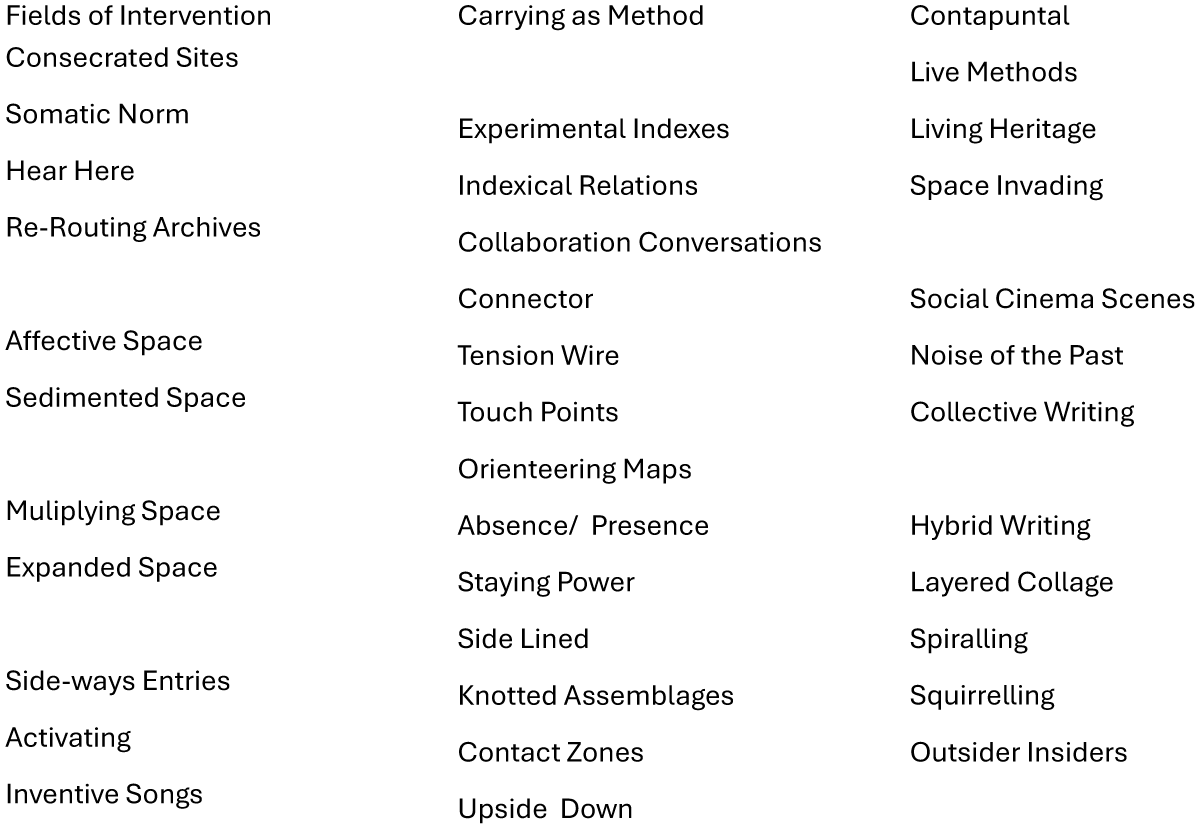
A British Academy Innovation Fellowship (2023–2025) has afforded me the time to go back to the cathedral, squirrelling along and against the grain of the archives for multicultural experiments in its civic life, forming creative spinning tops for future propositions. All institutions are a checkerboard terrain of interests. There is support and resistance to my presence, which has reminded me of the processes endured by space invaders. I have stuck with the staying power of persistence. Mary Louise Pratt (1991) describes contact zones in colonial and post-colonial travel writing as points of tension, exchange and power. Material site-specific archival stories, of rock (from Bethlehem), acorns (planted, lost and found), images bearing the ambiguous space of absence and presence of post-colonial builders, and a study centre with readings on empire and racism in the sixties, have become touch points for a network of contact zones. As a connector I often link academics, artists and publics together to consider the global and planetary connectedness in site-responsive activities. Walks, talks, film screenings, as well as artistic engagements with archives have led to the production of a podcast series, conversations, sketches and experimental zine indexes to the archives, under the title of Hear Here: Spatial Practices (Puwar, 2025), https://www.juncture-digital.org/mattering-press/Hear-Here-Spatial-Practices/essays/podcasts.md
Pedagogic contact zones
In the United Kingdom, experiments in learning are not part of social movements to the same extent as they are in Italy or Spain. Pedagogic contact zones are rich, but university learning has become expensive. Nonetheless pockets of re-learning emerge, sometimes in the margins or after-lives of university curricula. Ex-undergraduate art students from Goldsmiths, whom I had never taught, created a gallery installation in West London in 2016, focusing on space invaders and race in higher education. I heard how they mediated whiteness, gendered limitations and sedimented structures. Students who have studied the MA Gender, Media and Culture programme, which I co-convene, have taken space invaders into new directions too, such as queering toilets (see Chloe Turner in this Special Issue). A postgraduate Feminist Methods module has facilitated students to build concepts, research and creative experimentation. June Reid (see her piece in this Special Issue) has researched how inter-generational experiences of being space invaders as DJs have continued and changed.
Passageway of learning
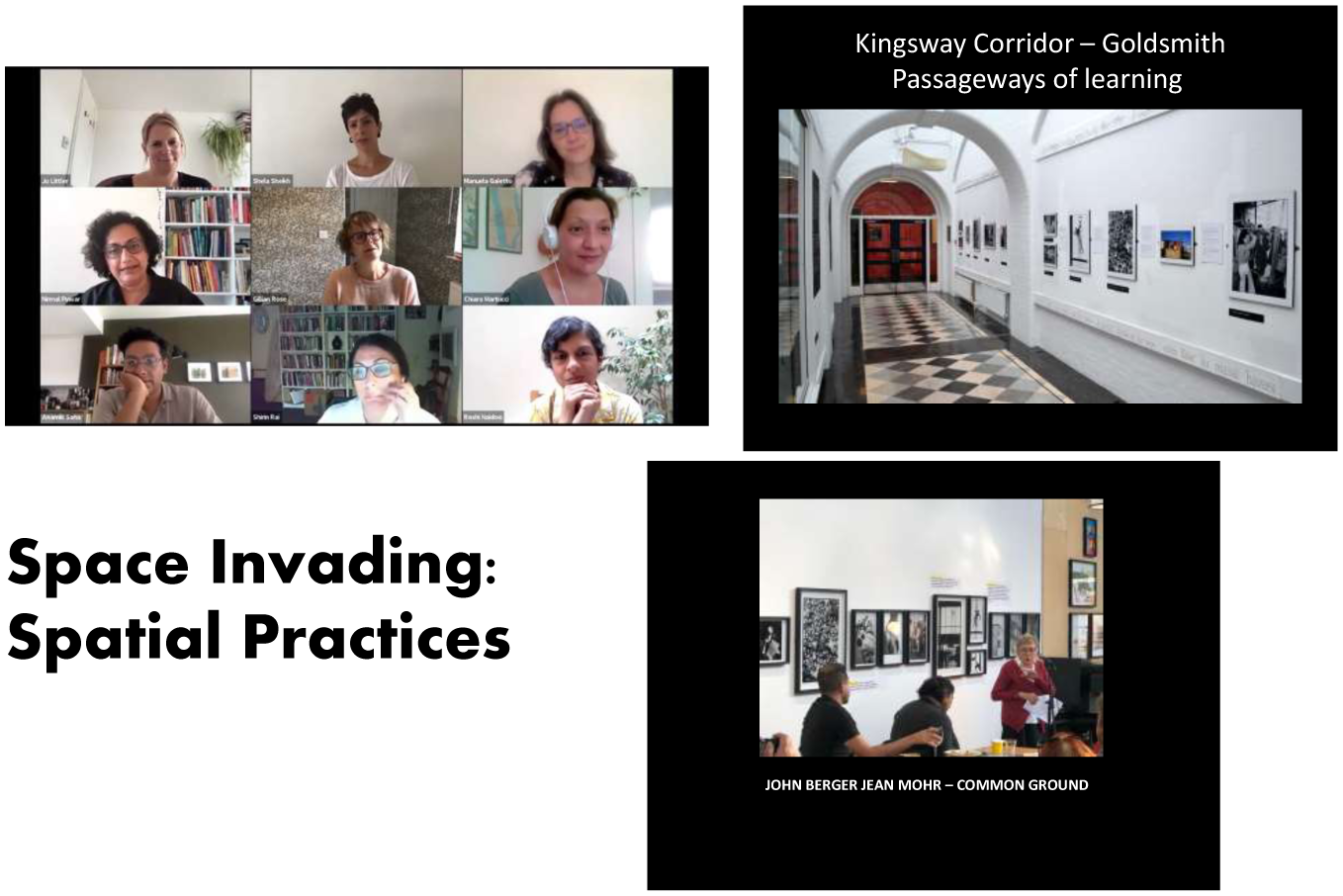
The spatial practice of learning as a contact zone offers a pedagogic approach. Via Goldsmiths’ Methods Lab, the walls of the academy have been reconfigured through five exhibitions over the course of 10 years. The Kingsway Corridor has been transfigured into a passageway of learning, with long term exhibitions and associated lectures, talks and screenings occurring in the rooms nearby. This has been co-created by staff and students, including tours and conversations with postgraduate students and international guests, such as Jean Mohr, Miriam Said and Angela Davis. A running theme across the exhibitions is space and displacement. The first exhibition, on ‘Pierre Bourdieu: testimonies of uprooting’ (Puwar, 2009), was a collaboration with Camera Austria. The second was ‘Space and Gaze: conversations with Said and Mohr’ (1986), with Annie Pfingst, Mariam Motamedi Fraser and several doctoral students including Samah Saleh, Aisha Phoenix and Dominika Blachnicka-Ciacek, developed from After the Last Sky. This led on to Migrating Dreams and Nightmares, with Mariam Motamedi Fraser and the artist Antoinette Brown, based on Berger and Mohr’s (2010[1975]) classic book A Seventh Man.
Staying with architecture, a focus on disability, jointly organised for students at the Bartlett and the Architectural Association with Jos Boys (2014), questioned where standards of the somatic body come from. Space Invading takes on very different and complex dimensions once neurodiversity is introduced into the room, on and off campus. I have often taken students to Westminster for tours led by archivist Mari Takayanagi (2012), with stopping points indicated by the article Architextures of Parliament. For one undergraduate student with neurodiverse needs, the echoes and stone walls generated a noise that was discombobulating and disorienting. They went on to write a brilliant piece on dyspraxia and learning environments in universities. There is much to transform in university spaces with respect to neurodiversity.
Feminist spatial practices
Afaina de Jong, resident architect at Architecture Centre Amsterdam, invited me to an online discussion, with Leslie Kern and Brady Burroughs, for a book club on Feminist Spatial Practice, which is also a podcast. This sits among a larger body of work in this specific field (see: Rendell, 2007, 2011, 2018; Rose, 1993; Schalk et al., 2017). Enacting layered and deep mapping (Murrani, 2024), Alternative Trails (n.d.), created an online interactive map of feminist activism, alongside oral histories and re-inventing transnational songs from India (boliyan and giddha) in a diasporic context. This was a collective project with Ravi Thiara, Preet Grewal, Mouli Banerjee, Vera Hyare, Jitey Samra and Inderjit Sahota [see https://coventrycreates.co.uk/project/boliyan/ and https://warwick.ac.uk/wie/events/alternative-trails/].
There are times when academic partnerships are sought by non-partners in an unequivocal manner. Sara Wajid, co-initiator of Museum De-Tox and the subsequent Space Invaders women leaders group, invited me on the basis of the book to speak at the Imperial War Museum for a ‘women and leaders’ conference. Based on a sample of interviews with women in the sector, the lecture expanded into the project ‘Space Invading in Museums, in the UK and South Africa’, led with Siobhán McGuirk (2020, 2024); and Catherine Hahn (see their pieces, as well as Roshi Naidoo’s on museums, in this Special Issue). 1 Narratives collected from interviews with sixty women in the museum sector of the United Kingdom have been analysed, with selections of words projected virtually on to the walls of a gallery in a film by Siobhán McGuirk, ‘If Walls Could Speak: space invading and the somatic norm’ https://youtu.be/otMPuo0thV4.
Mobius strip of invitations
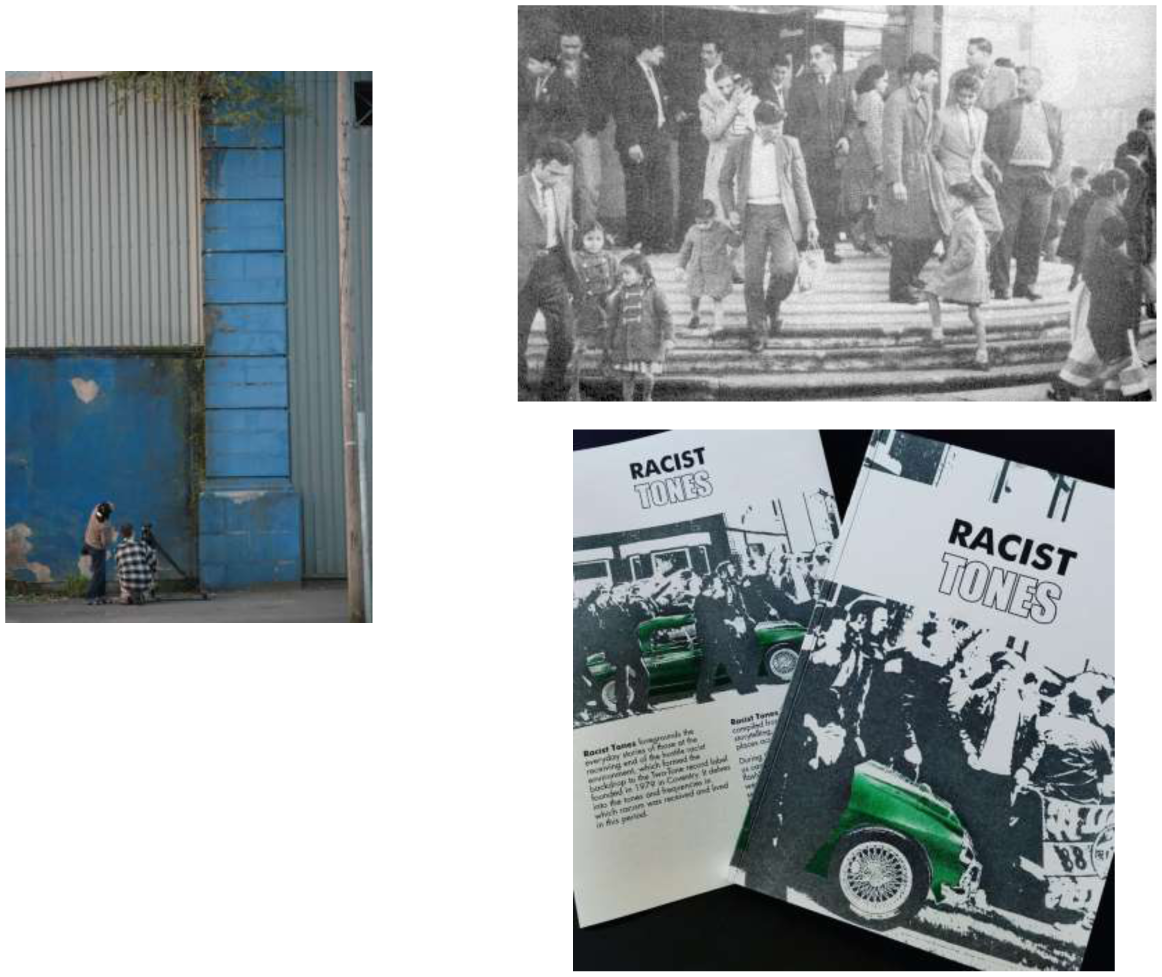
Juggling with invitations for participation can alter the space one can take up. The riso-graph printed book Racist Tones (2021) was collaboratively written and designed as a collective that we named the Four Writers Group (2021). Tarla Patel, Daksha Piparia, Jitey Samra and I responded to a call from the Herbert Gallery, during lockdown, for personal stories linked to the 2-Tone movement in Coventry in the late seventies. Maintaining curation of our stories, the four of us met regularly online for writing sessions on flashbacks of racism, from the time when the far-right was a burgeoning presence in the city. Hoping to make a zine, we had so much material that it led to a book, with artistic sketches by Paul Chokran and Tarla Patel. The book entered the 2-Tone exhibition by sitting on a shelf, as well as by being sold in the gallery bookshop, with a financial model that sought to support anti-racist work in the gallery and further re-prints. Engagements with the book continue as the far right once again take to the streets and hotels, deeming refugees space invaders.
Ecologies of space invaders
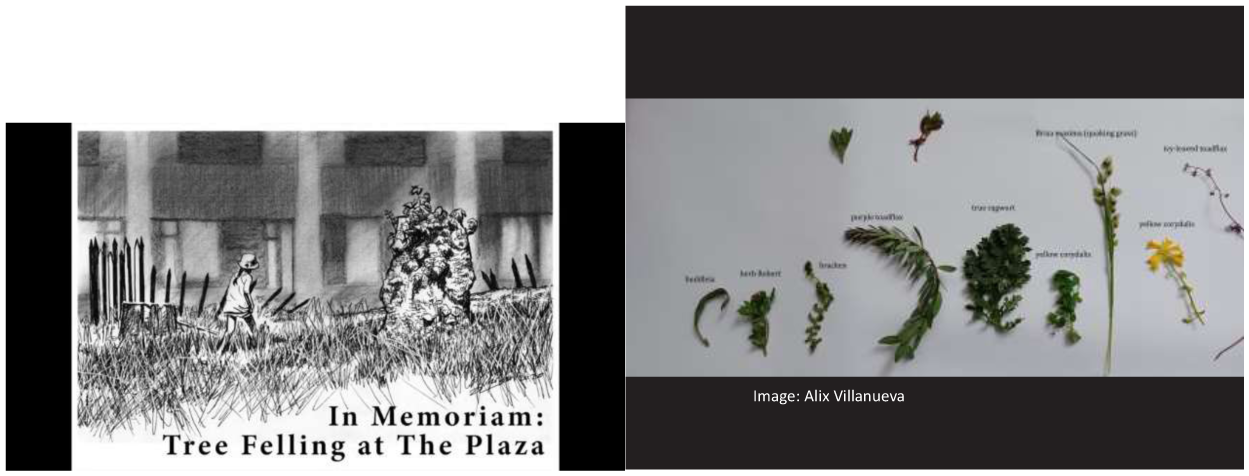
In an absolutely unexpected spin-off on the book, ‘Space Invaders and Climate Justice’, a two-day event aimed at global majority early career researchers and organised from the University of Warwick, voiced the difficult consequences of being doubted as an authority on climate issues within different kinds of structures of governance. This builds on the extension of space invaders to decolonising ecology by Gray and Sheikh (2021), as well as creative collaborative ecological interventions which have included (1) two films, ‘In Memorium: tree felling at the Plaza’ and ‘In Transition: Comrades of the City’, with artists Adele Reed and Paul Chokran, after protected trees were chopped down by Coventry University to make room for changes to a building, an expenditure which is now one element in the debts cited as reasons for sacking academics; (2) a multi-media garden zine, designed by Alix Villanueva, with a film by Duncan Whitley, commissioned by the Pod and Food Union, on a one-mile walk [see: https://thegardenzine.co.uk/Nirmal-Puwar-1]; (3) a film screening with panel discussions on global ecologies, particularly focused on gendered and settler colonial landscapes of inequalities, with communities of thinkers and growers. These gatherings become learning zones for assembling, pushing the linkages between different geo-politics, scales and ecologies. 2
Caste(ing) aside space
Finally, I turn my attention to caste; a classic case of space invaders, which I had previously overlooked, even though caste is an overwhelmingly spatialised phenomena, in terms of demarcations of bodies, places, pollution, waste and death. On 14th April 2024, B.R. Ambekar’s birthday, I delivered the Annual Equality Lecture for Coventry Council, this time foregrounding caste – an aspect not mentioned at all in Space Invaders, not least of all because caste was interestingly only a passing footnote in my education of social and political thought. It is mentioned in sociology, often in the equations of status, class, caste and race. This is the case in Max Weber’s Economy and Society, as well as in Caste, Class, and Race: a study in social dynamics by Oliver Cox (1948), which was very much responding to a North American understanding of race through caste in Gunnar Myrdal’s American Dilemma (1944).
Of course I could have educated myself further, but I didn’t. In fleeing towards modernities enabled by diasporic transnational migration patterns, it was easier to ignore than speak of embodied labouring histories carried in the transnational baggage from India to United Kingdom, even though I knew of the cast iron shoe last, sitting in the garage of my childhood home, both a material remnant and reminder of caste. For the project Leather: craft, caste, class, carcass, developed with Catherine Hahn, there is much to be noted on stigma, hierarchies of space, toxic work and materialising human-animal lives. Thinking with speculative futures, we might begin with a shoe last in the middle of a room, rather than in the corner of the dark, damp-prone garage. 3
The caste of space invaders
Bhimrao Ramji Ambedkar was a world-renowned activist for caste issues, whose political legacy continues to influence mobilisations globally. He was a jurist who Chaired the drafting of the Indian Constitution after British rule in India (Ambedkar (1936)) and was a social reformer and campaigner who published widely in different formats. His short biography Waiting for A Visa offers a powerful depiction of how he was violently treated as a space invader when he went ‘home’ to India at the request of his benefactor Maharaja of Baroda, after being educated in Columbia University, LSE and Gray’s Inn. Waiting is in the title, because untouchables might be legal citizens, but they are still not seen as fully belonging, being able to move in spaces as they want, without being seen as pollutants and dirt. Returning to India to work in a government job, he struggled to rent a room because of his caste. Hindu hotels would not take him. Eventually he stayed in a Parsi owned Inn, under the cover of a Parsi name. Once other Parsis found out, they protested, he was thrown out on the 11th day of his stay in the inn, and was forced to sleep under a tree. He recalls, I had gone to Baroda with high hope. I had given up many offers. It was war time. Many places in the Indian Educational service were vacant. I knew very influential people in London. But I did not seek any of them. I felt that my duty was to offer my services first to the Maharaja of Baroda who had financed my education. And here I was driven to leave Baroda and return to Bombay after a stay of only eleven days. This scene of a dozen Parsis armed with sticks lined before me in a menacing mood and myself standing before them with a terrified look imploring for mercy is a scene which so long a period as 18 years has not succeeded in fading away. I can even now vividly recall it and never recall it without tears in my eyes.
Ambedkar went on to become a Professor in India, to launch the Labour Party, to be at the spearhead of foregrounding justice and caste. He was also the First Law Minister in Prime Minister Nehru’s government, though he soon resigned due to frustrations with caste. He wrote numerous books – which are read throughout the world. There is also a vast global story to the afterlives of Ambedkar, stretched across time and place. In India, for a short period there was a Dalit Panthers movement, influenced by the Black Panthers, with J.V. Pawar as one of its co-founders! Caste matters persist in multiple forms of exclusion and violence, stretching from India to the diaspora (Dhanda, 2022; Nesbitt, 2020; Yengde, 2019). It is multi-scalar, from politics on the street, legal contestations and libraries or archives in India and Columbia University.
Several universities in the United Kingdom and North America now hold Annual Ambedkar Lectures; you will find them at Cambridge and Columbia, for example. Research on his adoption of pragmatist philosophy, while heavily influenced as a student in Columbia by John Dewey (Stroud, 2023), has also been studied, as has the correspondence between De Bois and Ambedkar (Kapoor, 2003). Nonetheless the appreciation is relatively recent in academia; while images of him sit on mantle pieces across India, as do statues in many locations, in the ranks of social and political theorists he is still a space invader and certainly not yet a thinker who is on the common curriculum.
Part III: expanded points of dialogue
The life of the book has grown in the hands of other scholars, artists and activists, way beyond the words I placed on the page all those years ago. I did not expect the book Space Invaders to have the resonance or the circulation it has activated across subjects, sectors or countries. The most interesting aspect of the circulation has been the many ways in which people have connected and expanded the framing by bringing new questions and issues, pushing at the scope and limits of the book. It has travelled beyond the sites of research in Westminster and Whitehall, extending the spatial points of investigation. In turn, this Special Issue has connected, jumped off and extended questions and methods of investigation in the horizon of the book.
Landscapes, place-making and the right to space resonate as issues across the collection of 20 pieces in this Special Issue. Historically changing demarcations of where and how specific bodies are deemed as space invaders, along with politically inventive ways of resistance through everyday quiet and large-scale noisy forms of activist space invading, are threaded across the pieces. In the following section I outline some of the key themes they connect to.
Movements
Mahsa Alami Fariman and Ahmadreza Hakiminejad politically situate the ‘Woman, Life, Freedom’ protests in Iran, discussing how mobilisations created a new generation of ‘space invaders’ who refused the boundaries of gender performativity in public spaces. Inequalities in air pollution and the capacity to breathe are drawn from the streets of Lewisham by Louise Rondel, as she engages with climate justice artistic mobilisations, as well as her own sensory research on the yoking of bodies and places.
Gender work
Through extended ethnographic research Yichen Zhang identifies different ‘moments’ of spatial mutation – including positional displacement and embodied transgression, when women enter snooker halls in China. The late DJ June Reid, from the Nzinga Soundz duo (with Lynda Rosenior-Patten) one of the UK’s first Black female sound systems, shares an intergenerational interview with a younger DJ to discuss space invading between the decks and dance halls. June checked the edits from her bedside in St Thomas’ hospital in London, whilst coping with stage four cancer; she wanted her writing to also be a register of her legacy. A transgender reading of Space Invaders is conducted by Chloe Turner at a pivotal point of amplification, noting how ‘out of place’ trans individuals are positioned as both ‘out of time’ and ‘out of affect’, an ontological disruption in a cisgender world. Phoebe Kisubi Mbasalak writes from long-term ethnography to centre the narratives of gender queer sex workers in Cape Town, moving between bridges, streets and theatres of co-learning.
Heritage
Roshi Naidoo presents an analysis of shifting spatial and somatic discomfort within the museum and heritage sector as structural and political, highlighting how entrenchment and change occur outside of limited notions of ‘inclusion’. Catherine Hahn takes us to Tate Britain, to evaluate how curatorial revisions and other display strategies – chronology, staging, portraiture and binaries – both disrupt and reinforce white hegemonic masculinities as British inheritance post-Brexit. Connecting changes across museums, – Siobhán McGuirk brings questions of class and economic possibility to consider new contours of space invading, with respect to gender and race. Katalin Halász discusses how white hegemonic masculinities, as channelled in social media platforms in the lead up to elections in Hungary, generate ambivalent bonds among white ethnic Hungarian mothers in reproducing a nation built on racialised exclusion
Migrations
A number of articles present different dimensions of migration. Writing under the most distressing conditions in Gaza, Ashjan Ajour reflects a nuanced understanding of the Palestinian struggle for existence within a repeatedly ruptured space of ‘homeland’, written from continued displacement, settler colonialism and dehumanisation of life. How differentiation exists along migratory moves from Brazil to the United Kingdom, pushes away from homogenising tendencies for understanding racialised formations in Angelo Martins Junior’s analysis of everyday encounters of work and leisure. Thinking with both slavery and asylum seekers in the contemporary context, Julia O’Connell Davidson highlights the parallels in spatial boundaries and distinctions that seek to repel racialised bodies. Nabila N. Islam is attentive to embodiment, dress, speech and comportment in her ethnographic study of a US immigration court in Boston.
Political representations
Returning to a long-standing exchange with Space Invaders, Manuela Galetto and Chiara Martucci and I hold a conversation to discuss developments in Italy and the United Kingdom, where seemingly more diverse – but also increasingly aggressive and exclusionary – forms of public discourse and social policies grow across Europe. Hannah Oorts draws on the case of Assita Kanko to discuss how minoritised representatives perform claim making with respect to representativeness in the bid for legitimacy. The aurality of sound cultures in the House of Commons, with a focus on intimidating disruptions to speakers, forms the basis of a conversation with Duncan Whitley on his performative sound art practice.
Class/rooms
By enacting the creative methodology of a fictional ‘Mad Hatter’s’ table, loaded with caricature, Lana Locke prompted a creative dialogue on how room is made in a changing higher sector with inequalities in place. Tré Ventour-Griffiths underlines rural lives and ableist whiteness, especially with respect to neuro-diversities. A conversation between Shana Almeida and Agata Lisiak takes us to the im/possibilities of racialised classrooms, as well as to the question of how Space Invaders could generate ways forward through collective action and solidarity.
Footnotes

Funding
The author received no financial support for the research, authorship, and/or publication of this article.
Declaration of conflicting interests
The author declared no potential conflicts of interest with respect to the research, authorship, and/or publication of this article.
Data Availability Statement
Data sharing not applicable to this article as no datasets were generated or analysed during the current study.