




Abstract
This article explores the growing presence of digital animation within the work of contemporary visual artists, architects and designers concerned with urban geography. While contemporary theorists such as Bernard Stiegler and Mark Hansen have emphasized the ways in which digital media technologies have colonized cultural memory and foreclosed access to a collectively envisioned future, socially engaged architects and artists have turned to animation as a medium that retains an important aesthetic potential. Digital animation has thus become a primary method for both envisioning alternative urban futures and reconstructing the traumatic past within politically engaged work. This article focuses on four examples, two past and two future-oriented. The conceptual artist Stan Douglas has recently, and uncharacteristically, adopted digital animation and gaming technologies in his Circa 1948 collaboration with the National Film Board of Canada (NFB). The interactive app allows Douglas to re-activate a repressed period of Vancouver’s past, thereby questioning the narratives of progress and property speculation that dominate the contemporary city. The work of Eyal Weizman and the Forensic Architecture project has increasingly involved the use of digital animation techniques to both reconstruct and visualize key dates or events within moments of humanitarian crisis. In the Rafah: Black Friday case study, for example, digital animation and 3D modelling are used to reconstruct a particularly intense four days of bombing during the 2014 Israeli military offensive in Gaza. The artist Larissa Sansour merges live action and digital animation to visually depict bleak and disturbingly convincing Palestinian futures, and the ‘speculative architect’ Liam Young has been employing animation techniques to present urban scenarios that teeter between the technologically utopian and dystopian.
Keywords
… the exhaustion of the future does not even leave us with the past. (Mark Fisher, 2009: 3)
The very unfortunate recent passing of cultural theorist Mark Fisher was met with a level of widespread grief that confirmed the resonance and impact of his writing. A consistent and powerful refrain within Fisher’s many books, essays and blog posts is the sense that meaningful access to a past and a future beyond the daily experience of contemporary life has been effectively foreclosed. In an increasingly financialized and digitized world, Fisher laments the diminished collective ability to establish either long-term memory or an alternative vision of what is to come. Current obsessions with ‘the new’ mask deeper indications of cultural inertia, according to Fisher, and significant change in late-capitalism has become difficult to imagine, let alone enact. He therefore observes in Ghosts of My Life: Writings on Depression, Hauntology and Lost Futures (2014: 8) that ‘the slow cancellation of the future has been accompanied by a deflation of expectations.’ Nowhere has this sense of temporal and political impotence been more pronounced, I would argue, than in contemporary urban life – the instability and displacement produced by property speculation and large-scale development projects has all but dismantled long-standing communities and prevented the public from being meaningfully involved in imagining the future trajectory of their cities. Looking forward or backward is a temporal luxury most urban dwellers in major cities cannot afford as they busy themselves with navigating the financial challenges of the immediate present.
Once regarded as possible tools for resisting these forms of destabilization, cotemporary digital media technologies are now more often assumed to be complicit in the intensification of these very processes. This article will begin by outlining a prominent strand of media philosophy that emphasizes the role that digital technologies have played in blocking access to our collective past and curtailing our ability to project forward into the future. Media theorists Bernard Stiegler and Mark BN Hansen have highlighted the ‘non-phenomenological’ or ‘non-experiential’ nature of contemporary media – the tendency of increasingly data-driven and corporatized digital technologies to condition our surrounding environment without being fully available to us as representations. These new forms of digital media, Stiegler and Hansen argue, attempt to instrumentalize our past and predetermine our future. While remaining cognizant of the temporal warnings issued by these thinkers, this article will nevertheless argue that we should not overlook the potential of digital media, and digital animation in particular, to productively intervene in the development of new urban imaginaries. If digital information is, as Stiegler and Hansen suggest, fundamentally inaccessible to our senses, then the importance of digital animation (a medium essentially defined by its translation of digital information into representational form) is arguably increasing rather than diminishing. This article will focus on the adoption of digital animation techniques by a growing field of artists, designers and architects concerned with re-potentializing and re-politicizing urban pasts and futures. In the hands of these artists and architects, animation becomes a tool for both visualizing digital information and accessing temporal registers beyond the restrictive confines of the immediate present. I will highlight here two examples of animation-based projects directed towards the past – artist Stan Douglas’s recreation of a forgotten period of Vancouver’s urban history and Forensic Architecture’s use of digital techniques to document unacknowledged urban atrocities – as well as two projects oriented towards the future – artist Larissa Sansour’s dystopian projections of a Palestinian future and ‘speculative architect’ Liam Young’s explorations of a coming techno-urbanity. 1
Philosophies of non-experiential media
Media philosophers Bernard Stiegler and Mark BN Hansen both identify a paradox at the heart of contemporary media experience. While the digital encroaches into ever more facets of everyday life, our current networked environments and computational media often operate below the threshold of our perception. Digital media, in other words, is everywhere in the contemporary world, yet it remains in important ways at a distance from us. Stiegler and Hansen, each in his own way, highlight the lack of direct access to digital media in two interrelated respects: firstly, that computational media or data is increasingly unavailable to our senses and is operating on a temporal scale that is machine rather than human-oriented; and secondly, that contemporary media is made inaccessible to us through its structures of ownership, storage and processing. While we all contribute to an accumulating reservoir of digital information through our participation in social media platforms, communication networks and online transactions, the ability to access this data pool and make this information actionable is reserved for those few companies and institutions with considerable algorithmic and analytical resources at their disposal. This situation of participation without access that characterizes our current digital media environments is important for this particular discussion because, as Stiegler and Hansen outline, it has implications for our formation and preservation of cultural memory and our ability to effectively imagine the future.
Although Stiegler has been considering the relationship between memory, technology and human life since the 1990s (the first of his multi-volume Technics and Time being published in French in 1994), his impact on considerations of media and politics is on the ascendance within Anglo scholarship. This is due in part to the growing number of English translations of his work, but also to the sense that his system of thought appears increasingly prescient and relevant in the context of our contemporary networked digital environments. One of Stiegler’s consistent theoretical preoccupations is the impact of exteriorized and technologically-based memory systems on the development of individual and collective life. More specifically, Stiegler (2009a: 97) is concerned with ‘the industrialization of memory’ that occurs when the symbols, images and sounds available to us are increasingly provided by commercialized culture industries. Stiegler calls these exteriorized or prosthetic forms of memory ‘tertiary retentions’, which he further defines as ‘memory support objects and mnemotechniques that make the recording of traces possible – notably those photograms, phonograms, cinematograms, videograms, and digital technologies that form the technological infrastructure of the societies of control in the hyper-industrial epoch’ (Stiegler, 2011: 57).
Stiegler’s position, while highly critical, is certainly not a call for a return to some kind of mythic pre-technological age, for he insists that humans are technical beings from the start. As Hansen (2006: 299) notes, ‘Stiegler argues for the co-originarity of technics and the human, in the sense that the break giving rise to the human as a distinct species simply is the invention of technics.’ Tertiary retentions, or mnemotechniques, also pre-date the current industrial age in material and symbolic technical systems ranging from libraries to the alphabet itself. These tertiary retentions are the means by which human knowledge and experience are transmitted through time and passed on intergenerationally, a process Stiegler (1994: 175) refers to as ‘epiphylogenesis’. The imperative for considering the relationship between humans and their technical supports at the present moment, according to Stiegler, is due to both the current ‘speed of technical evolution’ (p. 17) and the transformation of these new distributed memory infrastructures into systems of control through their entry into the logic of the industrial economy. He thus writes in the first volume of Symbolic Misery (2014: 6): Being increasingly constituted by images and sounds that the media streams through my consciousness, as well as by objects (and relationships with these objects) that these images lead me to consume, my past is less and less differentiated from that of other people. It loses, therefore, its singularity, which is as much as to say, I lose myself as singularity.
Stiegler’s image of an increasingly undifferentiated and homogenized collective past brings to mind relatively easily the scrolling timelines, sponsored content and accumulating databases of contemporary social media platforms.
The colonization of tertiary or prosthetic memory by economic or industrial forces is crucial to Stiegler precisely because of its growing influence on the forms of internalized perception (what he calls primary retentions) and memory (secondary retentions) that enable the formation of individual and collective identity. Stiegler describes a kind of retentional chain reaction, in which the increasingly dominant presence of industrialized tertiary retentions (now almost exclusively taking the form of online digital media) begins to condition our individual and collective forms of secondary retention, our individual and cultural memory. Our secondary retentions affect in turn the process of primary retention, for Stiegler (2013: 85) explains that ‘primary retention is a primary selection, and the criteria for this selection are furnished by secondary retention’ (emphasis in original). In other words, the replacement of ‘collective imaginaries and individual stories’ (Stiegler, 2011: 58) with the forms of homogenized memory we find on the commercial internet or broadcast media, impacts not only the constitution of our individual memory, but also, in turn, our process of perception and selection; it patterns what we choose to pay attention to – what we care for and what we care about. As Stiegler (2013: 87) suggests, ‘attention is conditioned by these retentional systems’ (emphasis in original).
The expanded influence of industrialized tertiary retentions has profound implications, Stiegler argues, for our ability to constitute a sense of self, but also for our capacity to envision a collective future. Stiegler makes frequent use of Gilbert Simondon’s concept of ‘individuation’ in his attempts to describe the correlated process of individual and group becoming – what Simondon refers to as ‘psychic’ and ‘collective’ individuation. For both Stiegler and Simondon, individuals constitutes themselves in relation to a group through the inheritance of a pre-individual reality or history. In Stiegler’s terms: The I, as psychic individual, cannot be thought except to the extent that it belongs to a we, which is a collective individual: the I constitutes itself through the adoption of a collective history, which it inherits and with which a plurality of Is identify. (Stiegler, 2014: 50, emphases in original)
Individuation is, therefore, a rather complex dynamic of subject formation in which the individual, in the process of self-constitution, draws from a collective reservoir of memory and potential. Stiegler translator Johann Rossouw (2011: 53) encapsulates this process neatly when he writes that: The pre-individual fund is that collective of knowledge, experience, and tradition that a group has accumulated over time, and it has to be continually reactivated through its simultaneous transmission from one generation to another … and through the singular way in which each receiver of the fund adopts it.
Tertiary retentions are crucial for Stiegler because it is these exteriorized memory systems that provide access to the reservoir of collective experience upon which individuation depends. He explains, ‘Tertiary retentions … undergird every collective and psychic individuation’s access to pre-individual funds’ (Stiegler, 2011: 57). As tertiary retentions become increasingly industrialized (and shared collective memory becomes commercialized and homogeneous), the very process of individuation falls under threat. The break-down of the process of individuation, cutting off the pre-individual fund, leads to an inability to constitute the self, but it also threatens the ability to imagine a collective future. As Stiegler (2009b: 53) suggests, ‘technicity, being constitutive and, in particular, constituting the condition of access to the past as preindividuality is what opens up temporality as such, the capacity for projecting the future.’ Or as Hansen (2015: 208) elaborates: For Stiegler, there can be no viable future because this industrially manufactured source has literally taken the place of ‘natural’ or ‘lived’ secondary memories, and thus of collective cultural traditions that could furnish a living source for the invention of viable futures.
Stiegler’s media theory represents a non-phenomenological or post-phenomenological turn in the sense that he believes we are increasingly estranged from the repository of memory images and objects available for us to draw from in order to constitute our sense of self. This claim may at first appear paradoxical within a contemporary digital media age in which we are encouraged to actively and persistently contribute to the development of this reservoir of cultural memory (by documenting, uploading and re-circulating our experiences and the experience of others), yet the protocols, conventions and prompts provided by these networks are not of our own making. Stiegler’s (2014: 3) claim is that a process of ‘aesthetic conditioning … has replaced aesthetic experience’ (emphasis in original), we circulate and reproduce symbols and memories, that are in fundamental ways not our own – we adopt aesthetic formats and content expectations encouraged by the platforms themselves and we relinquish ownership of the content we do produce, offering it up for the purpose of user profiling and algorithmic analysis. It is also worth bearing in mind the challenges raised to the common claim that digital media in the Web 2.0 era has fostered new forms of participatory culture and transformed consumers into producers. Lev Manovich (2009: 320), for example, reveals that according to 2007 statistics, ‘only between 0.5 percent and 1.5 percent of users of the most popular social media sites (Flickr, YouTube, Wikipedia) contributed their own content.’ And Henry Jenkins et al. (2013: 15) note that our contemporary digital media platforms, such as YouTube, facilitate ‘user-circulated content’ far more than they encourage ‘user-generated content’. We might therefore claim that the online fund of memory is becoming increasingly homogenized through both the conditioning or standardization of user-generated material and the perpetual re-circulation of a relatively small (and increasingly commercial, rather than amateur) pool of available content.
In his recent book Feed-Forward: On the Future of Twenty-First-Century Media (2015), Mark Hansen makes an even more explicit connection between our increasingly post-experiential digital media and the resultant foreclosure of the future. Here, Hansen considers the shift towards the atmospheric and encompassing media environments produced by computational networks, data-mining technologies and embedded micro-sensors. Hansen claims to distinguish himself from Stiegler by suggesting that, rather than recording and playing back past human experiences, 21st-century media now involve the storage of bits of data that ‘register molecular increments of behavior’ (p. 40) oriented towards anticipating and patterning future activity. Hansen’s concern is the expanding number of data-harvesting media technologies, from social media platforms to wearable bio-tech, that allow for the accumulation of aggregated information on a demographic scale, rather than personal or durational lived experiences. A mouse click is captured online, a biometric reading is registered on a smart watch, a geolocation is imprinted through a mobile phone, and the aggregation and classification of all these data points are used to identify a previously unperceived tendency. The situation Hansen delineates is post-experiential in the sense that we have no direct access to the digital processes of data analysis and pattern recognition involved. He explains: The digital computer … interrupts the circuits linking media and experience … computational processes occur at time frames well below the thresholds constitutive of human perceptual experience, they seem to introduce levels of operationality that impact our experience without yielding any perceptual correlate. (p. 4)
Many of the operations undertaken by digital technologies, in other words, take place autonomously (algorithmically, or machine to machine) with no direct human involvement or act of perception.
Not unlike Stiegler, Hansen is concerned with the ways in which contemporary digital media networks produce a kind of conditioning field for human experience, one that has pre-determining effects on cognition and behaviour. These increasingly enveloping digital media environments are described variously by Hansen as a ‘sensory confound’ (p. 69), an ‘atmospheric’ media system’ (p. 132) and a ‘peripheral ‘calculative ambience’ (p. 186). But while Stiegler emphasizes the conditioning effects of industrialized tertiary retentions, Hansen outlines an even more intimate intrusion into processes of self-actualization and individuation. He writes: It is precisely because today’s data and culture industries can bypass consciousness and go directly to behavioral, biometric, and environmental data that they are increasingly able to capture our ‘attention’ without any awareness on our part: precisely because it places conscious deliberation and response out of play, microtemporal behavioral data that evades the oversight of consciousness allows today’s data and culture industries to accomplish their goal of tightening the circuit between solicitation and response. (p. 58)
Through the accumulation and analysis of micro-behaviours, 21st-century media acquire knowledge about us and our world that is beyond, or rather prior to, our own sensory and conscious awareness. And it is the operationalizing of this knowledge, by the large data companies who possess it, that threatens to instrumentally shape or modulate future experience. It must be said that Stiegler’s current writings have actually brought him into much closer alignment with the depiction of computational 21st-century media presented by Hansen in Feed-Forward. For example, notions of algorithmic governance, automation and data profiling are central to the political analysis of Stiegler’s recent Automatic Society, Vol. 1: The Future of Work (2016), complicating Hansen’s claim that the philosopher is primarily concerned with durational or experiential media.
Hansen’s response to this data-empowered colonization of future experience is ultimately not to reject the digital technologies that enable its occurrence. Inspired by the philosophy of Alfred North Whitehead, he sees in 21st-century media the possibility of an expanded form of ‘word sensibility’, one that compels us to rethink the human as an inseparable part of a much larger environment. The forms of non-perceptual experience made available by contemporary digital media hold a surplus of potential and openness that is far from exhausted by the instrumental uses of the contemporary data and culture industries. The crucial question for Hansen (2015) is how we might gain access to and control over this micro-temporal domain of experience. He thus maintains: We must … embrace the technically accessible precognitive dimension of sensibility as the very ground on which to politicize media, to modulate our own becoming by intervening in how media shape sensibility, and to grasp the techno-sensible complexity involved in … shaping our own future experience. (p. 133)
The task of re-establishing the open-endedness of the future is, for Hansen, dependent on our ability to redirect the surplus potential of this new non- or pre-sensory data sphere. Representational media oriented directly towards the human senses and lived experience appear increasingly irrelevant, obsolete or ineffectual within Hansen’s depiction. Forms of media operating within the present time frame of human perception are, for him, already too late to meaningfully affect the future.
The continued relevance of animation
The relationships between digital media, collective memory and futurity articulated by Stiegler and Hansen are extremely relevant for considerations of contemporary urbanism and architecture, yet I think we should hesitate to accept too quickly their tendency to dismiss representational media (animation included) as either entirely industrialized or increasingly irrelevant due to the dominance of non-perceptual forms of computation. 2 It is certainly becoming clear that the built environment, despite its fundamental materiality, is a space that is far from immune from the effects of the media changes described by the two philosophers. In fact, the ways in which urban development has been absorbed into global networks of digital computation is largely illustrative of the processes outlined in their thought. For one, physical urban space has become so permeated by micro-sensors, smart grids and ubiquitous computing that the city itself can now be viewed as an extended data gathering system. Urban theorists such as Benjamin Bratton and Jennifer Gabrys have gone so far as to consider the city as one node within a larger structure of ‘planetary scale computation’ (see Bratton’s The Stack: On Software and Sovereignty, 2015, and Gabrys’s Program Earth: Environmental Sensing Technology and the Making of a Computational Planet, 2016). Who controls the data generated by cities and how effectively inhabitants are able to access the information they are collectively producing in order to influence urban decision making remain central issues within current discussions of ‘data citizenship’ and ‘algorithmic governance’ (see, for example, Leszczynski, 2016, and Graham, 2005).
The ability of urban communities to draw from their reservoirs of collective memory in order to formulate an effective vision of the future has also been significantly disrupted by the current structures of investment and real estate financing. The capacity to intervene in the production of urban space has appeared increasingly cut off to the general population as long-term development plans dictate city transformation well into the future. This process of constructing urban infrastructure or settlement for projective political or economic aims, rather than for the actual demands of an existing population, has been labelled ‘speculative urbanism’ or ‘speculative urbanization’ by urban scholars and planners such as Christopher Marcinkoski and Michael Goldman. Marcinkoski (2015: 16) highlights the ways that ‘new financial tools – increasingly complex transactional instruments’ allow local real estate to be transformed into an investable global commodity. The continued existence of urban communities thus becomes increasingly subject to the algorithmic calculations and automated risk assessments of global financial markets. Without access to this financial data and these analytical tools, city inhabitants often find themselves attempting to influence urban decisions that have long since been determined. Hansen’s notion of a future horizon pre-established by the accumulation and processing of unavailable data takes on a very real form in the example of speculative urbanism, as does Stiegler’s image of individuals alienated from their own resources of cultural memory. As Goldman (2011: 557) describes in reference to projective urbanism in the developing world, ‘the anxieties of high-rolling speculation not only affect people’s ability to hold onto their living spaces, but also their jobs, identities and communities.’ Stiegler (2013: 82) himself acknowledges the damaging impact of technologically-enabled forms of speculation when he warns, ‘speculators are typically people who pay little attention to the objects of their speculation – and who, moreover, take little care of them.’
Yet, despite the growing impact of data-oriented forms of urban computation, representational media (and animation, in particular) continue to play a significant role in the future development of our cities. In fact, the ways in which data-driven speculation and digital representations of proposed projects work in conjunction to shape urban futures warrants considerably more critical attention. The use of animated digital renderings within the marketing of speculative developments presents an architectural version of the CGI-fuelled ‘cinemas of transactions’ described by Leon Gurevitch (2010: 369), in which spectacular computer graphics become a value-generating currency independent of their specific representation content. As Degen et al. (2017: 2) reveal in their study of the role of digital visualization within a large-scale redevelopment project in Doha, Qatar, ‘computer-generated images (CGIs) have now become the most common type of image media used to visualise and market future urban redevelopment’ (emphasis in original). The production and circulation of increasingly sophisticated renderings of proposed developments is the final step in the temporal loop of urban speculation – financial opportunities are identified through market calculations, sections of the city are earmarked for investment and demographic change, then photo-realistic representations of these developments are produced that signal the apparent inevitability of this process before it has even begun. The expanding gap between the visualizations produced by developers and the needs of local communities is highlighted by designer Tobias Revell’s (2016) claim that, ‘very few renders evoke hope and aspiration at street level because they are harbingers of someone else’s ideal of your built future.’ Promotional renderings also often attempt to suture development projects to the cultural memory of their locations. Take, for example, the hybrid animation marketing The Stage, Shoreditch EC2, a luxury housing complex in East London. The video, involving a combination of live acting, real locations, animated characters and architectural renderings, presents the development (where one-bedroom flats start at £800,000) as a natural addition to the creative vibrancy of the area and as a cultural custodian of the remains of Shakespeare’s Curtain Theatre, on which the complex is built. The widespread circulation and particular aesthetic of these animated promotional videos have produced forms of parody and resistance by artists such as Hito Steyerl, in her 2013 work How Not to be Seen. A Fucking Didactic Educational .MOV File, and Lawrence Lek, in his Unreal Estate (the Royal Academy is Yours), a 2015 ‘speculative simulation’ (to use the artist’s own term).
The way in which computational data and animated renderings interact within the processes of urban speculation is more typical of our current media landscape than perhaps Stiegler and Hansen would care to concede. Rather than claim that representational or sensory media is becoming less relevant in a computational age, perhaps we should acknowledge instead that our contemporary media is increasingly constituted by mediations of media itself. Or, in other words, there is an increasingly preponderance of media that translates digital information into a humanly perceptible form. Seen from this perspective, the relevance of digital animation, comprised of everything from data visualizations to computer generated images, has actually expanded in our post-phenomenological or post-experiential computational environments. While Hansen is quite right to alert us to the growth of machine to machine communications and the computational harnessing of pre-cognitive affects and tendencies, animation may still remain as a kind of representational last stand and a viable form of resistance in relation to dehumanizing forms of digital calculation. It is perhaps not surprising then that so many contemporary architects and artists concerned with urban and geo-political topics are turning to digital animation as a tool for both representation and intervention. Animation, for these artists and designers, presents the possibility of reengaging with temporal frames outside the limited context of the present and restoring some of the lost potentiality of both the past and the future. In the remaining section of this article, I will briefly highlight four examples of artists and architects using digital animation as a means of contending with the temporal and political complexities of the urban. The first two, Stan Douglas and Forensic Architecture, are oriented towards the past and cultural memory, while the latter two, Larissa Sansour and Liam Young, are oriented towards the future.
Digital animation as urban and temporal intervention
Canadian conceptual artist Stan Douglas is not generally associated with digital animation or computer generated imaging (being more frequently recognized for his film, video and photography work), but his recent adoption of these technologies is indicative of their expanded use within critical art practice. In a constellation of related works set in his native Vancouver, Douglas has made use of computer generated images to explore a relatively unacknowledged period of the city’s history. Digitally rendered images of 1940s Vancouver appear as backdrops within the 2014 stage play Helen Lawrence; as standalone printed works, such as The Second Hotel Vancouver (2014) and Bumtown (2015) (see Figure 1); and in animated form in the interactive installation and app Circa 1948, produced in collaboration with the National Film Board of Canada (NFB) Digital Studio in 2014. The primary locations recreated by Douglas are the Hotel Vancouver (the second of three incarnations of the hotel, this iteration constructed in the Italianate revival style by the Canadian Pacific Railway in 1916) and Hogan’s Alley, the unofficial name of Park Lane, a ramshackle alley running through the neighbourhood of Strathcona. The Hotel Vancouver recreated by Douglas is a once grand, but now crumbling, railway hotel; having closed at the end of the great depression in 1939, the hotel had been taken over by homeless WWII veterans in the immediate post-war period before eventually being razed in 1949 (see Figure 2). The now demolished Hogan’s Alley area, located near the city’s train stations, was an ethnically mixed neighbourhood and a post-war red-light district known for its illegal drinking and music establishments, brothels and gambling dens. It is described within the Circa 1948 app as a place where ‘immigrant workers, drifters, and dreamers rub elbows with politicians and cops on the take’.
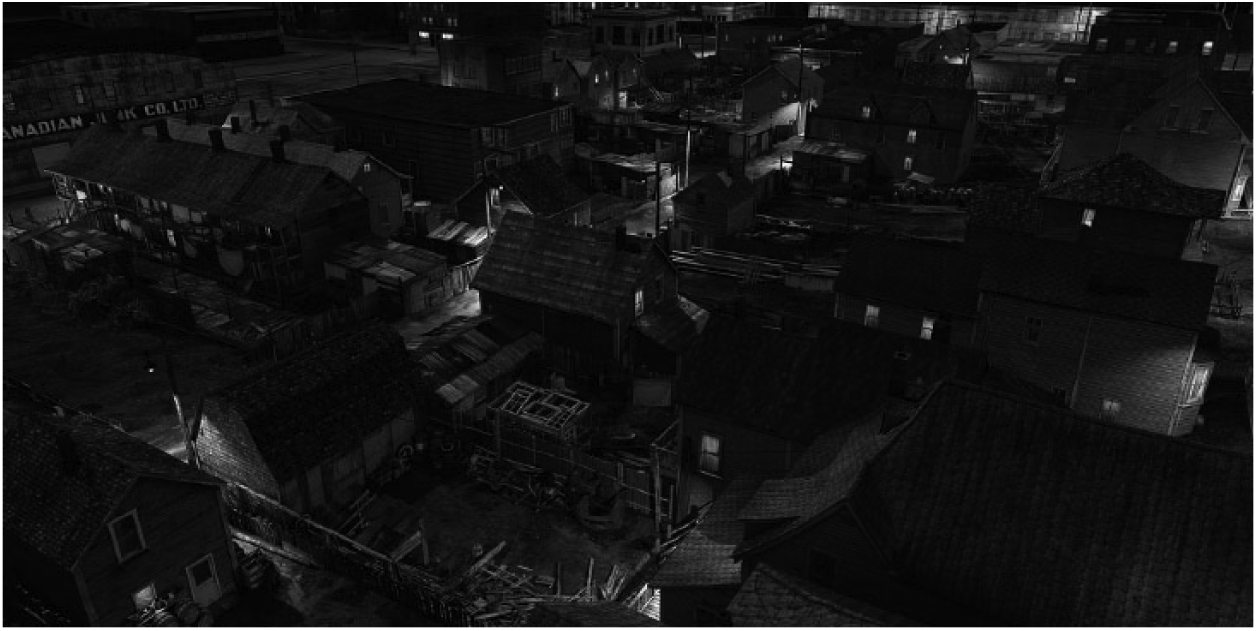
Hogan’s Alley, 2014. © Stan Douglas. Courtesy of the Artist, David Zwirner, New York/London and Victoria Miro, London.
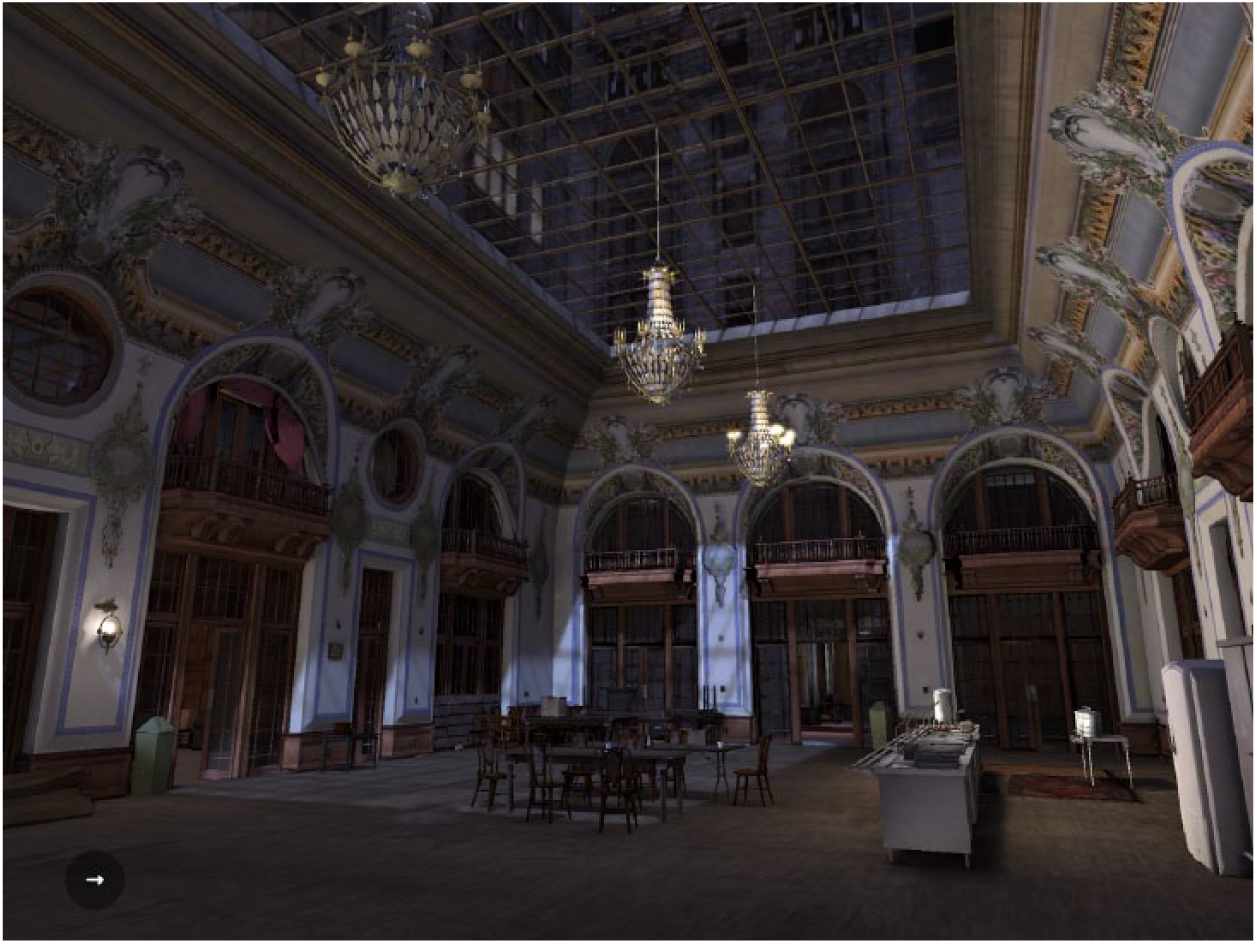
Circa 1948, 2014. © Stan Douglas and Dao Loc. Courtesy of the Artists.
Douglas’s digital reconstructions visualize a forgotten moment of Vancouver’s somewhat seamy past that stands in sharp contrast to the city’s current image as an affluent Western metropolis of gleaming condo towers. The 1940s are significant for Douglas in that they represent an uncertain and less often recalled interim period between the war era and ‘the sudden call to order and morality’ of the 1950s (Farago, 2014). The process of regenerating this past moment (the physical history of which has largely been erased from the urban environment) involves the animation of visual and written archival materials. The digital prints Douglas has produced of these locations are remarkably detailed and it is actually their slightly uncanny hyper-realism that gives away their status as renders. They are constructed through the digitization and selective overlay of multiple historical photographs. Curator and gallery director Fiona Bradley (2014: 13) describes the complex reconstruction process involving the use of ‘a computer programme to apply photographic images (textures) to three-dimensional geometry (meshes)’. The Circa 1948 app, employing a first-person point of view common to video games, allows users to navigate through the two locations, eavesdropping on conversations that form a disjointed narrative of political corruption and shady development plans. 3 As Douglas suggests, ‘We get a sense of the various real estate scams that are going on in this post-war period, and a lot about the reorganization of urban space ’ (Glassman, 2016). In 1948, Hogan’s Alley and its surrounding streets constituted one of the most diverse areas of the city and home to the largest black community in Vancouver at the time. This area of Strathcona has a long history of resisting the threat of demolition that came with each urban renewal project, Hogan’s Alley itself being eventually razed in the 1970s in preparation for the construction of the Georgia Viaduct overpass (originally planned as part of an extensive freeway system).
Douglas uses digital animation and rendering techniques to recover an otherwise lost period of Vancouver’s urban past, one that significantly disrupts the commonly promoted historical narrative and trajectory of the city. Revisiting this period of post-war transition is particularly relevant at a moment when the city is considered to have reached a point of crisis due to real estate speculation, processes of gentrification and soaring housing prices (Kassam, 2016). Douglas’s re-animation of a past moment of urban uncertainty and political unrest expands the available reservoir of cultural memory associated with the city. Digital animation is, in this case, a tool for resisting, rather than promoting, the unquestioned acceptance of a version of urban progress fuelled by unfettered real estate markets and non-transparent municipal development projects. Employing Stiegler’s terminology, we might say that Douglas re-establishes a connection with Vancouver’s complicated past in a manner that enables different processes of collective individuation and thus makes possible new responses to the present moment of urban crisis. And indeed, Douglas’s artwork has formed part of the recently reconstituted memory of largely forgotten elements of the city’s history, including Hogan’s Alley (Badelt, 2014).
The members of the Forensic Architecture research agency, established in 2011 at Goldsmiths’s Centre for Research Architecture and led by Eyal Weizman, have been developing new methods of spatial analysis and visualization with very explicit political applications. Weizman (2014: 9) describes the group’s mandate in terms of an attempt ‘to bring new material and aesthetic sensibilities to bear upon the legal and political implications of state violence, armed conflict, and climate change’. The projects completed by the collective of designers, architects and lawyers that make up Forensic Architecture are varied and are often undertaken in collaboration with NGOs, international institutions and political organizations, such as the UN, Human Rights Watch and Amnesty International. While developing new approaches to the collection of evidence in relation to human rights violations and state crimes (with the material ‘testimony’ of architecture placed at the centre of that forensic investigation), the agency is also producing innovative ways of representing that evidence involving a variety of advanced imaging technologies, including 3D animation.
The agency’s investigations have included the use of 3D laser scanning and Ground Penetrating Radar (GPR) to gather evidence of two former concentration camps (Staro Sajmište and Omarska) in operation during the Yugoslav war; visualizations of the effects of white phosphorus munitions used during the December 2008 to January 2009 Israeli attacks on Gaza; and the use of computer modelling (based on the testimony of a surviving witness) to digitally reconstruct a home in Mir Ali, Pakistan, destroyed in 2010 during a US drone strike that killed five people (see Figure 3). One of the most recent Forensic Architecture investigations makes particularly pronounced use of animation techniques in its presentation of evidence. The Rafah: Black Friday investigation, undertaken in collaboration with Amnesty International, documents the war operations that took place between 1 and 4 August 2014 in the city of Rafah in Gaza. These four days would become one of the deadliest episodes of the war after the Israeli army, in response to the capture of an Israeli soldier by Hamas fighters, appear to have implemented ‘the Hannibal Directive’, a controversial military command described by Amnesty International as one ‘designed to deal with captures of soldiers by unleashing massive firepower on persons, vehicles and buildings in the vicinity of the attack, despite the risk to civilians and the captured soldier(s)’ (Amnesty International, 2015). Although banned from travelling to Gaza, the Forensic Architecture investigation reconstructed the events of those four days through the analysis of hundreds of images and videos, taken by witnesses, professional and citizen-journalists, made available largely through social media platforms. Using a complex array of techniques, including geo-synching, image compositing, metadata analysis and correction, visual smoke plume and shadow studies and remote sensing analysis from satellite images, the Forensic Architecture group were able to piece together a detailed account of the extent of the bombing and damage occurring in four days of attacks that resulted in between 135 and 200 civilian deaths. These various elements of visual evidence are integrated into a computer generated 3D model of the city, indicating their relative location and time of occurrence. This complicated process of spatial and temporal mapping is made intelligible to viewers through the production of a sophisticated digital animation that visualizes these investigative steps, bringing together a multiplicity of data types (see Figure 4). The objective of the project is to provide evidence of the disproportionate and indiscriminate attacks of the Israeli forces and to urge an independent investigation into clear violations of international humanitarian law.
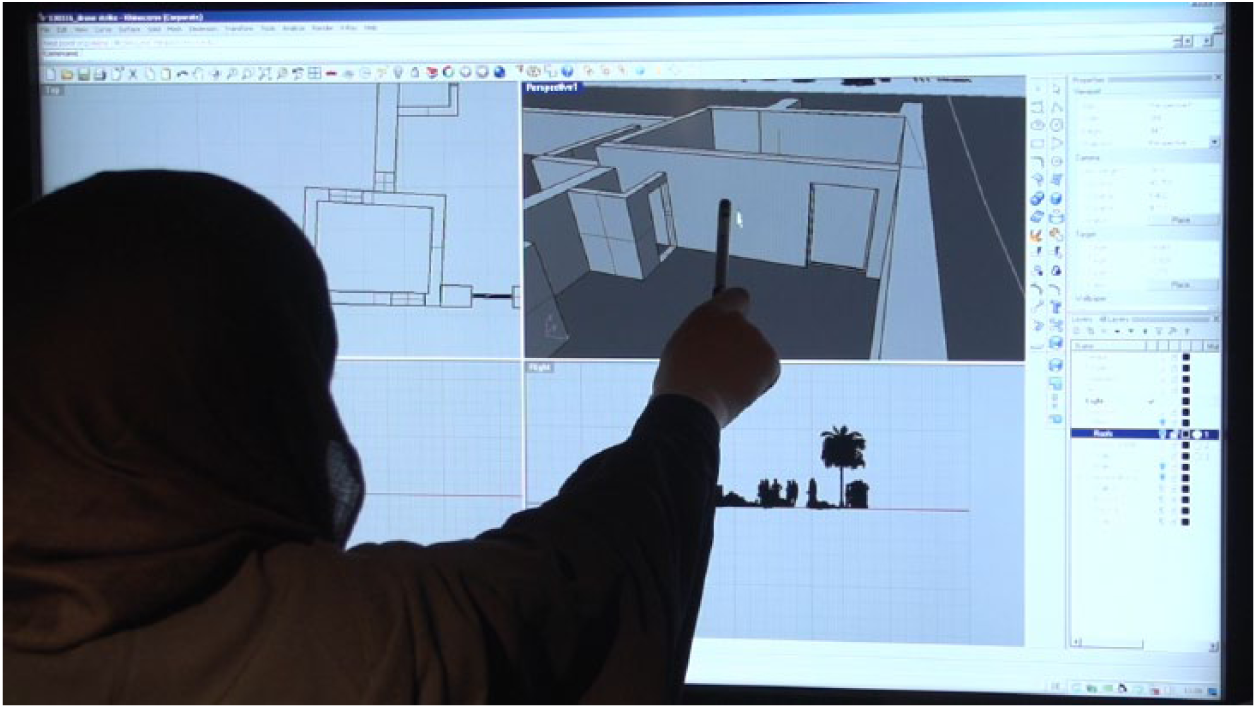
Drone Strikes. Courtesy of Forensic Architecture.
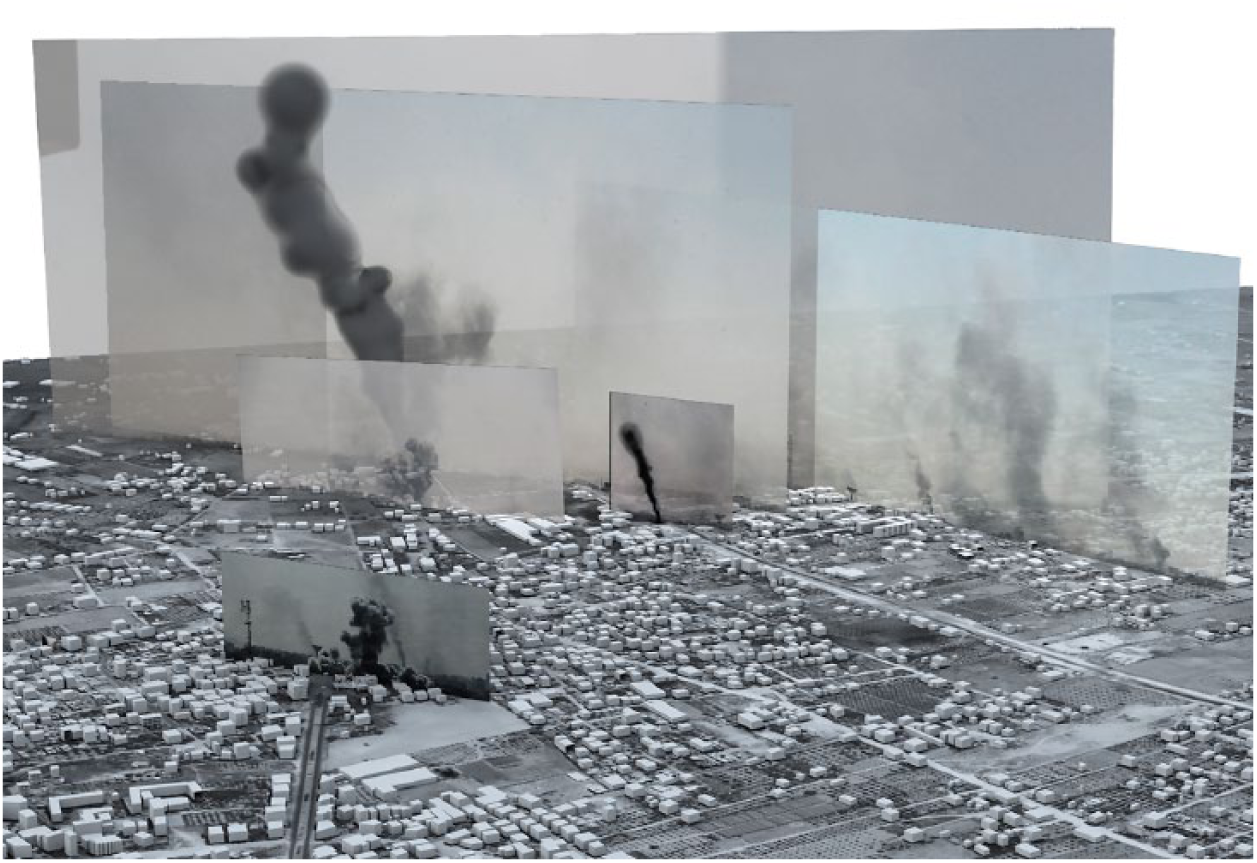
Rafah: Black Friday. Courtesy of Forensic Architecture.
In the work of the Forensic Architecture group, digital animation becomes a crucial method of visualizing the conflicts and violence of the recent past in a manner that makes these images operational within specific forums for political and legal action, such as international human rights tribunals. The group’s methods of data collection and analysis seem to be an important example of the expanded world sensibility identified by Hansen, this time directed towards a progressive goal. Here the repository of micro-temporalities and affects accumulated within social media become potentialized towards an end that could never have been predicted by the owners of these platforms. Weizman (2014: 12) describes how ‘new visibilities have emerged with the development and widespread accessibility of digital data derived from activist imagery and their accelerated dissemination via mobile phone, cloud, and social networks.’ The work of the group is an important reminder of the political possibilities of these technologies outside the context of their Western commercial origins. Weizman is acutely aware of the change in sensory awareness represented by the ‘forensic sensibility’ his research agency advocates and speaks of this shift in ways that are quite synchronized with Hansen’s own terminology. He describes bypassing ‘human testimony’ (p. 10) and the sometimes fallible narration of lived experience and memory in favour of the material evidence that manifests itself ‘well below the threshold of unenhanced visual perception’ (p. 14). In this forensic context, architecture operates like a sensor, according to Weizman, recording otherwise undetectable events and occurrences. But Weizman is also attuned to the ways in which these forms of technology enhanced imaging, combined with the accumulation of digital data circulating through social networks require new techniques of representation and mediation in order to be legible within specific political and legal contexts. He writes, ‘these images also call for new practices of trawling through, looking at, and looking again, interpreting, verifying, decoding and amplifying messages and broadcasting them further’ (p. 12). Expanded modes of sensory awareness and information processing must also be translated into perceptible and actionable forms, and digital animation is an important vehicle for this translation.
The work of Palestinian artist Larissa Sansour concerns a similar geographic and political territory, but employs a considerably different aesthetic approach. Making use of digital animation techniques and the genre of science fiction, both of which are more commonly associated with Western popular culture, Sansour envisions future scenarios in which the current political conditions of the Palestinian people are taken to their dystopian logical conclusions. In her 2012 work entitled Nation Estate, Sansour combines computer generated images with live acting (the artist herself taking the central role), to depict an architectural resolution to the deadlock of the Israeli/Palestinian peace process. The film introduces the viewer to a high-rise complex in which the entire nation of Palestine is now housed, each floor containing the remains of a former city (Jerusalem on floor 13, Ramallah on 14 …). In a conversation with the curator Nat Muller (2016), Sansour explains the irony of the scenario – the Palestinians are comfortable in the self-contained structure (there are no check points here), yet they are imprisoned. The protagonist exits the lift at the Bethlehem floor and proceeds to her living quarters, where she tends to an olive tree growing out of the pristine white floor of the apartment and looks out over the security wall that separates the building from the surrounding landscape (see Figure 5). The short film turns the aesthetic tropes of the glossy render-based animations promoting global real estate developments towards an even more disturbing speculative scenario.

Nation Estate – Olive Tree, C-Print, 75x150cm, Larissa Sansour, 2012. Reproduced with permission.
In her 2015 film In the Future They Ate from the Finest Porcelain, Sansour and her co-creator Søren Lind introduce another temporally complex scenario, again employing live motion and computer generated images. In the film’s sci-fi storyline, a resistance group deposits elaborate china in a desert landscape in anticipation of it eventually being unearthed, thereby proving the existence of an ancient civilization and supporting the group’s future claims to the territory (see Figure 6). This action is referred to in the film as ‘narrative terrorism’, the establishment of a fictional founding myth that has immediate implications for nationhood and land rights. The film’s narrator suggests the political nature of excavated history, stating, ‘In its most perverted form, archaeology galvanizes public sentiment, confirms myths of the past and defends them against scrutiny.’ The allegorical reference is not difficult to detect, the struggle for control of heritage sites within the ever shrinking occupied Palestinian territories has turned archaeology into a weapon of politics within the Middle East, with UNESCO sometimes placed in the position of reluctant arbiter (Gilbert, 2013). While the Forensic Architecture group produces alternative forms of material evidence, Sansour uses speculative fiction as another means to complicate state-sponsored historical narratives. Digital animation allows the artist to engage in an indirect, yet provocative investigation of the current politics of the region and thus to re-open the question of the future of Palestine.
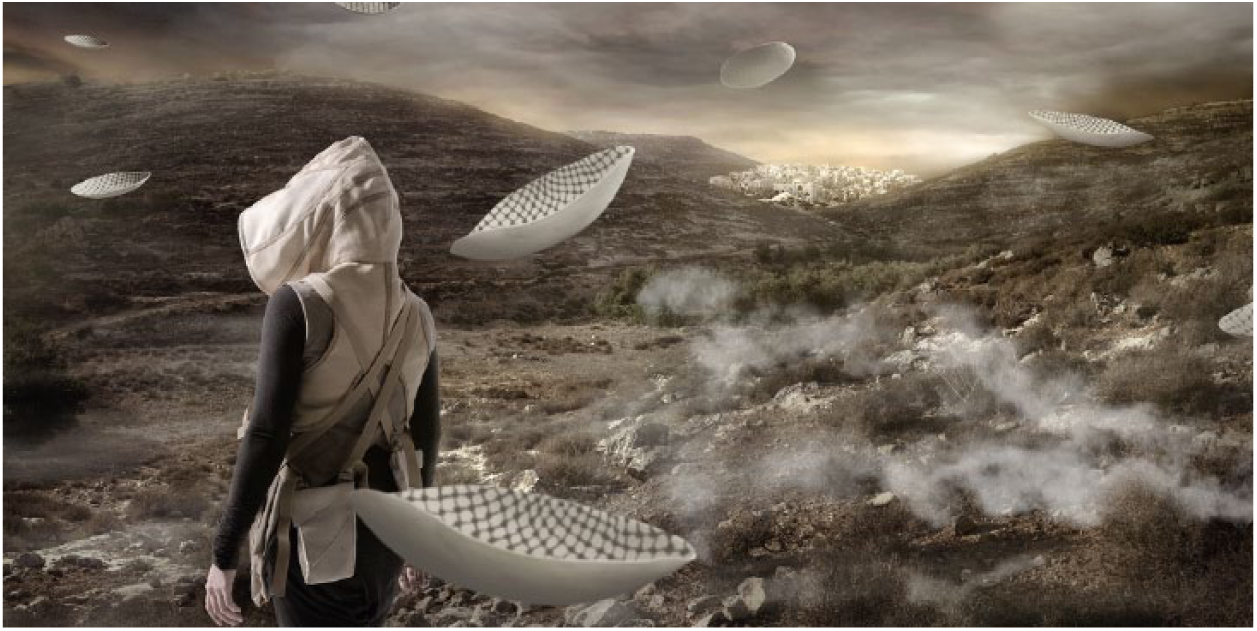
In the Future They Ate from the Finest Porcelain 2, C-Print, 100x200cm, Larissa Sansour, 2014. Reproduced with permission.
The final example I wish to highlight, the self-described ‘speculative architect’ Liam Young, also draws frequently from science fiction tropes and aesthetics in his future-oriented design practice. Through his numerous creative projects, Young attempts to restore the forward thinking and experimental vision once embodied within the discipline by figures such as Cedric Price and the members of Archigram. In a ‘think tank’ conversation connected with his 2012 Under Tomorrows Sky project, he explains: It’s the impulse to imagine and speculate that those failed futures had at their core which is exciting, which is what we’re trying to revitalize and trying to look back on. Because no one’s done it with the same kind of force as they did for a while. No one’s launched a future vision with such traction, that’s really captured the popular imagination. (Young, 2012)
Young therefore takes on the task of wrestling considerations of the future back from the narrow range of social actors and organizations that have delimited this field of vision. In doing so, he often makes use of advanced imaging technologies typically restricted to such large-scale operations as military departments or resource extraction industries – a visual strategy that is in many ways shared with Forensic Architecture, but is applied to quite different ends in Young’s work. Amongst his recently completed projects are a film shot entirely with 3D laser scanners, entitled Where the City Can’t See (a sci-fi narrative set in the Chinese-owned Detroit Economic Zone) and another, entitled In the Robot Skies, shot with autonomous pre-programmed drones.
Animation is again a frequently used visual resource for Young’s speculative projects. The previously mentioned Under Tomorrows Sky project brought together a varied group of thinkers, including the sci-fi writer Bruce Sterling, the graphic novelist Warren Ellis and the scientist Rachel Armstrong, to discuss the possible technological and biological development of a fictional future city. A room-sized movie miniature model of the city was established in Eindhoven, a platform for materializing some of the ideas proposed through the think tank. Animators and illustrators were commissioned to visualize specific regions or sectors of the city. In his description of the project, Young emphasizes the non-dystopian perspective of the initiative, suggesting that in the current moment establishing a hopeful vision of the urban future is a much more unusual and challenging task. He promises, ‘Under Tomorrows Sky imagines a post-capitalist urbanity full of optimism and joy, full of life and aspiration.’
In other completed animated works, Young is not always so reluctant to employ a dystopian register. In his ‘New City’ series of digitally animated skylines, the architect presents exaggerated versions of current technological and urban tendencies that are difficult to characterize as aspirational. Keeping Up Appearance (2014), for example, presents a homogeneous cityscape of high rises, in which Samsung holds a complete technological monopoly (from smart phones to air conditioners to city signage). Edgelands (2014) depicts a kind of data shantytown on the outskirts of a city centre in which scraps of personal information are salvaged for any remaining value (see Figure 7). These animated snippets of a possible urbanism to come are one part thought experiment and one part critical warning. An oscillation between fascination and dismay in relation to our potential urban future is common within Young’s work. It surfaces as well within his Unknown Fields Division project, a design research studio involving expeditions to remote locations that Young leads in conjunction with artist and architect Kate Davies. In their ‘Tales from the Dark Side of the City’ exhibition mounted at the Architecture Association in the winter of 2016–2017, the studio explores the multiple, often unseen geographies that resource our contemporary urban and media ecologies. The group documents the Bolivian salt flats of Salar De Uyuni where lithium is extracted for use in battery production, the Alaskan outposts where environmental scientists produce data for climate simulations and the black market mining towns of Madagascar that supply precious gems for the various products of luxury brands. Animation is used as a tool for both speculative exploration and information delivery within the exhibition. Animated and poetic ‘dramatizations’ of climate change data are presented, for example, as an alternative to ineffective traditional forms of information visualization. Logistical data pertaining to the various resource extraction sites explored by the studio are overlaid onto film footage of the workers involved in these often dangerous and unregulated industries, a technique that simultaneously presents the singular experience of individual participants and the statistical impact of their combined activities. Young’s most recent animated works include Renderlands (2017), a love story between an Indian render farm worker and his digital model, taking place in the ‘scavenged VFX movie models and 3D game assets that remain on studio hard drives – the remnants of cancelled production jobs‘ (Young, 2017) 4 (see Figure 8), and Tomorrow’s Storeys (2017), a visualization of a near future Athens, inspired by a public think tank of science fiction authors, visual artists, photographers and architects (and thus bringing him full circle back to the critical fiction methodologies of the Under Tomorrows Sky project) (see Figure 9).
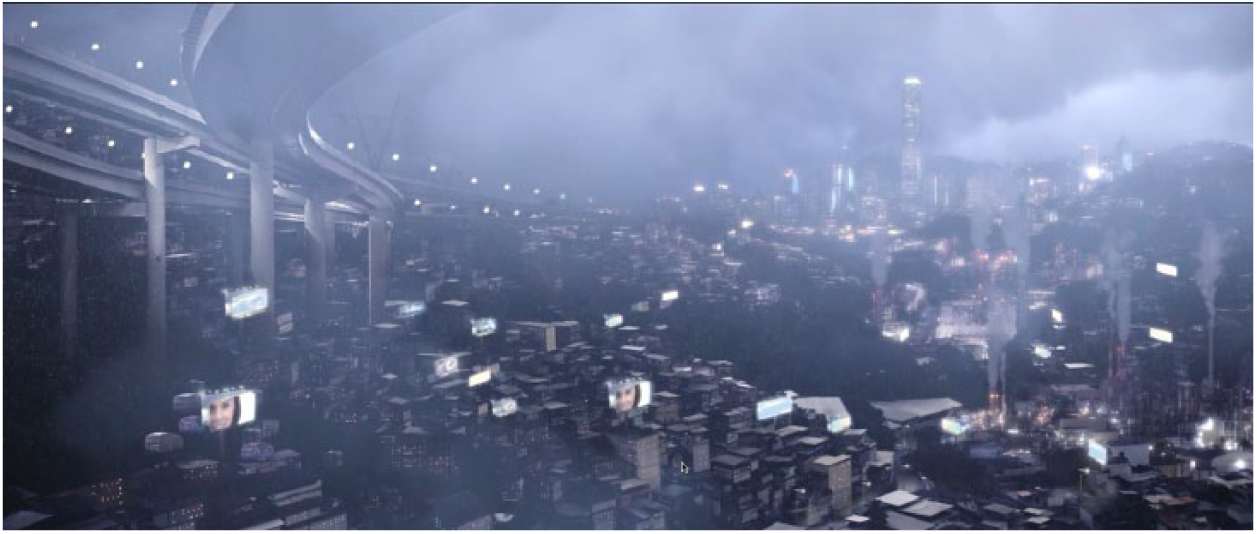
Still from New City: Edgelands, 2016, dir. Liam Young. Reproduced with permission.
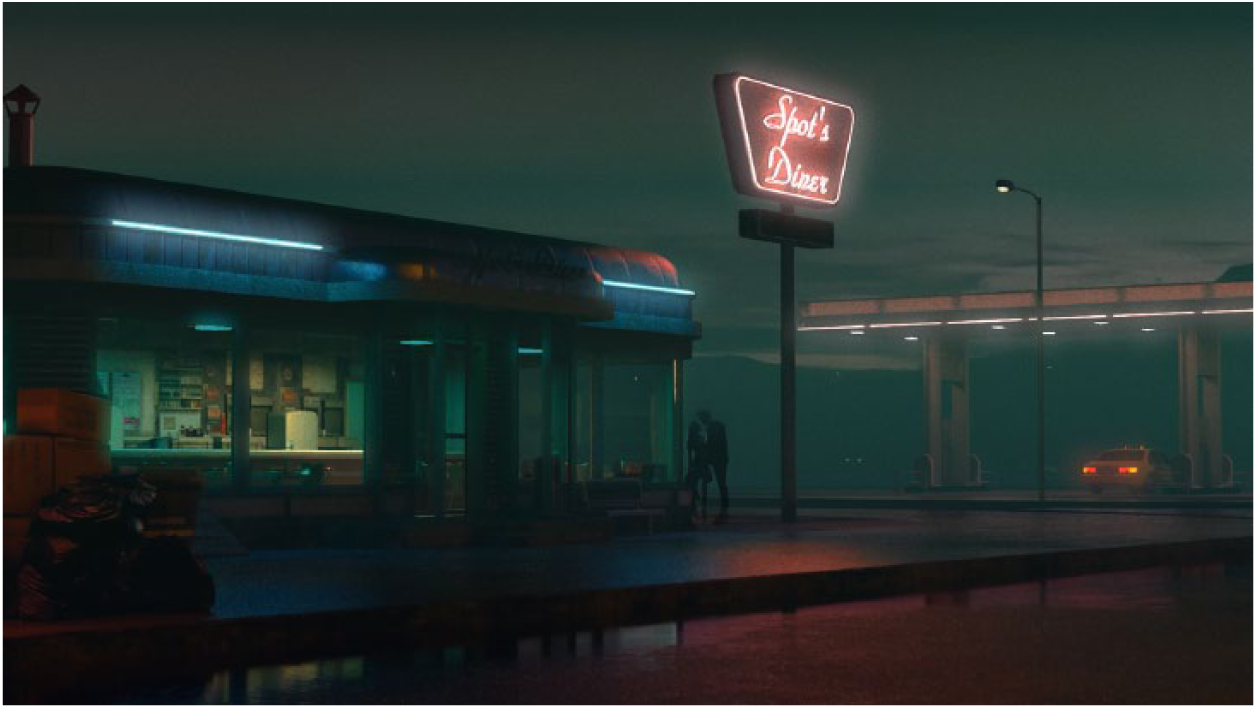
Still from Renderlands, 2017, dir. Liam Young. Reproduced with permission.
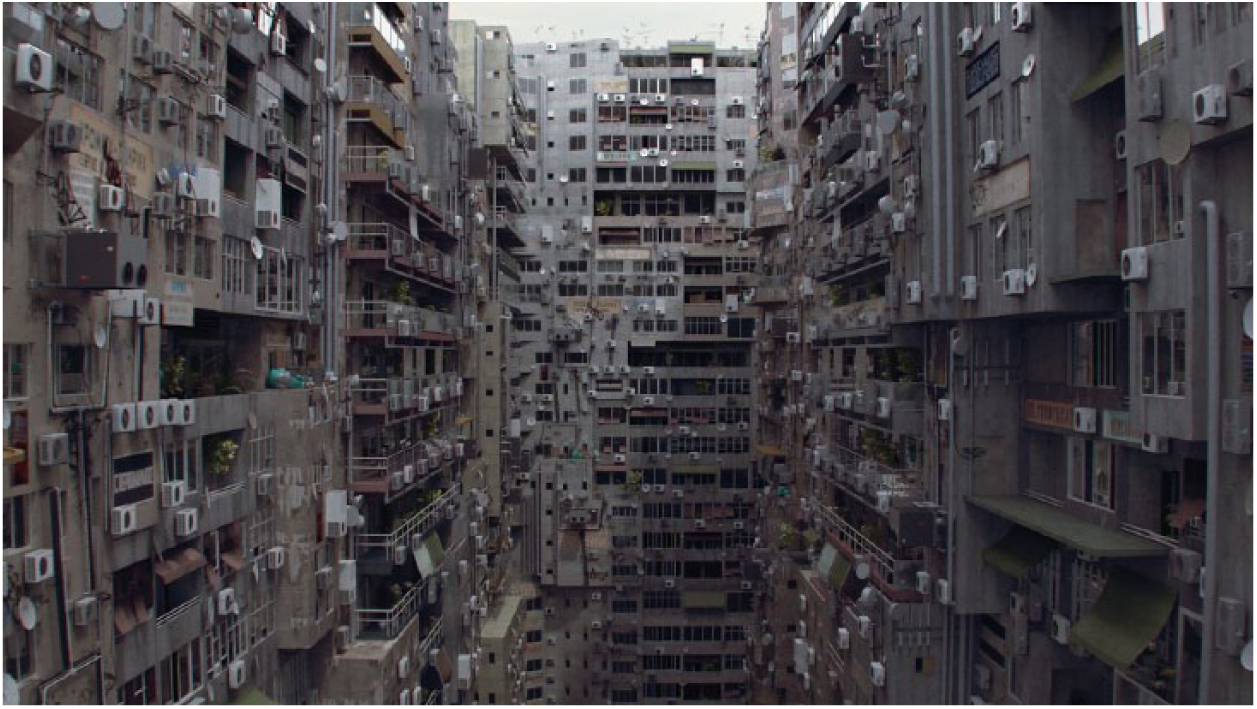
Still from Tomorrow’s Storeys, 2017, dir. Liam Young. Reproduced with permission.
The use of digital animation by Young in these and other projects can again be viewed as a manner of answering Hansen’s call for an expanded form of world sensibility. The visualization practices that Young employs are a means of integrating the complex geo-political and economic information underpinning our contemporary technical and urban environments in ways that make this accumulated data capable of being processed by the viewer. The forms of animated speculation that Young develops both illuminate elements of our contemporary media ecologies to which we are largely unaware and encourage us to reengage in the activity of imagining the future development of our urban condition.
This article has attempted to highlight the ways that architects and artists are employing digital animation to move beyond the temporal constraints of the present and productively engage with urban pasts and futures. The media philosophies developed by Stiegler and Hansen provide an important framework for considering the non-experiential nature of contemporary digital media and the implications this has for our ability to access shared cultural memory and envision possible collective futures. While drawing insights from both of these thinkers, I have also tried to counteract what I see as a tendency in their work to downplay the continued relevance of representational or experiential media forms in the current digital age. With its continued expansion into new domains of life and politics, and the privileged role it plays in the visualization of computational data, the contemporary importance of digital animation is arguably growing rather than diminishing. This certainly appears to be true in relation to media engagements with urban politics, as I hope is made clear by the four examples of art and architectural practice highlighted in this article. While Stan Douglas and Forensic Architecture utilize digital animation to examine past atrocities and restore forgotten elements of urban history, Larissa Sansour and Liam Young employ similar visual technologies to recover the speculative dimension of the future from the current monopolies of access. All these artists and architects resist the inaccessibility of the digital encouraged by industrialized contemporary technologies and platforms, attempting instead to realize the potential of these media forms to help overcome our current temporal constraints.
Footnotes
Acknowledgements
I would like to thank the anonymous peer reviewers of this article for their extremely thorough and helpful comments. I would also like to thank Stan Douglas, Loc Dao, Forensic Architecture, Larissa Sansour, Søren Lind and Liam Young for generously providing permission to publish images of their work.
Funding
This research received no specific grant from any funding agency in the commercial, public, or not-for-profit sectors and there is no conflict of interest.
Notes
Author biography
Joel McKim is Lecturer in Media and Cultural Studies at Birkbeck, University of London. He is also the director of the Vasari Research Centre for Art and Technology. His book entitled Architecture, Media and Memory: Facing Complexity in a Post-9/11 New York is forthcoming in 2018 from Bloomsbury. His writing on digital culture, design theory and aesthetics has appeared in such journals and collections as Theory, Culture & Society, Space & Culture and DIY Citizenship: Critical Making and Social Media.