



Abstract
Advances in information and communication technologies present remarkable potential for globally dispersed people to connect and engage around a variety of interests. While online communities seemed to initially offer vast potential for social cohesion, their ephemeral nature continues to raise doubts about their ability to facilitate meaningful togetherness. It has also been suggested that the largely automated nature of commercially driven social media can excite aggression and polarisation and thus bring about far-reaching negative social outcomes. Drawing from a long-term immersive online ethnography of the Red Pill, a conspiratorial collective battling their conception of feminine power in society, we adapt Bernard Stiegler’s philosophy of technology to assess its production of affect and social cohesion. Our findings reframe online counterculture, emphasising how its expressions are predicated on a techno-affective overdetermination that forecloses the possibility of meaningful participation and community-building.
Introduction
The development of information and communication technologies continues to raise questions about the social dynamics of online communities. Following the sociological tradition, online communities have been typically understood to organise around various social causes or interests (Castells, 2007; Hall, 2005) and to represent a ‘coming together’ that fosters care and a strong sense of solidarity among participants (Yuan, 2013). This optimistic outlook on the social promise of online communities has been waning in communication studies due to a recognition of their fleeting, fluid and ephemeral nature that has raised doubt about their ability to nurture meaningful social togetherness (Fernback, 2007; Yuan, 2013). It has also been suggested that online collectivity can readily descend into antagonistic aberrations that entrench social division (Bury, 2017; Just, 2019; Luo and Li, 2024).
While it has been noted that apart from socially embedded contexts of care, communities can also consist of ‘gangs, terrorists, anarchists, or racists’ (Fernback, 2007: 53), collective online expressions that are violent, broadly oppositional and politically on the fringe have received less scholarly interest than those linked to emancipatory struggles (see Cammaerts, 2012; Garrett, 2006; Neumayer and Rossi, 2018). Yet, already more than two decades ago, the capacity of countercultural collectives to manifest emancipatory politics was brought into question. John Downey and Natalie Fenton (2003) observed that any positive social purpose can be rendered impotent, as these radical groups rely on websites driven by the commercial interests of online platform providers and that these techno-social circumstances can readily proliferate further social division and discord. More recently, these concerns have been echoed in social criticism focussing on the online communication as predicated on cycles of affective intensities (Bucher, 2013, 2017; Just, 2019; Paasonen, 2015), where the increasingly automated nature of ‘black-boxed’ mediation (Bucher, 2012: 1176) and ‘opaque algorithms’ (Couldry, 2020: 1139) fragments sociality. This critique runs in parallel with broader theorising of the techno-social that alerts us to recognise the processes of communicative intensification that can hinder the sense of social togetherness and instead bring about increasing alienation and collective estrangement (see Andrejevic, 2020; Stiegler, 2019). As these contexts can be seductive and overwhelming, they can render the ‘hyper-stimulated body [. . .] simultaneously alone and hyper-connected: the more it is connected, the more it is alone’ (Berardi, 2017: 50). Today, such negative social outcomes are abundant, ranging from social isolation to the affective attractions of shared misery, antagonism and polarisation (Banet-Weiser, 2018; Nagle, 2017).
While online togetherness can certainly offer liberatory potential for oppressed groups in certain contexts (Carter Olson, 2016; Sundén and Paasonen, 2018), the contagious nature of ‘affective entanglement’ (Paasonen, 2015: 11) can equally intensify collectivity by drawing from resentment and conflict that draw from ‘post truth’ sensibilities (Boler and Davis, 2018). This is evident in the ‘networked enjoyment and infectious capture within affective circuits of drive’ (Sundén and Paasonen, 2018: 651) marked by simultaneous self-victimisation and hostility that lash out as diverse aggressive expressions (Jasser et al., 2023; Just, 2019). Today, such collective excitements attract participation in various countercultural movements that involve sexism, racism and various forms of political and religious extremism on a global scale. One notable subset of such movements is the ‘Manosphere’ that includes groups, such as Men Going Their Own Way (MGTOW), Involuntary Celibates (INCELS) and the Red Pill (TRP). These groupings vary greatly with regards to what values they espouse and thus any agglomerate categorisation of them is problematic. Yet, they all share grievances against what they construe as gendered power relations that render them socially subordinate (Cousineau, 2021; Ging, 2019; Nagle, 2017). The result is a sense of resentment that is channelled into collective cultivation of antagonisms directed at various outgroups: women, ‘superordinate’ men as well as the institutions understood to be supporting oppressive power relations. As these online communities can enact very real effects on social life, having been implicated in mass violence (O’Donnell and Shor, 2022; Regehr, 2022), reactionary politics (Cammaerts, 2015; Dignam and Rohlinger, 2019; Zhang and Davis, 2024) and online harassment (Just, 2019; Massanari, 2017), the need for a further understanding their emergence, constitution and proliferation is urgent.
Epistemologically, most inquiry towards online countercultural communities has been directed to their representational output. This work is typically focussed on their production of text from either quantitative (i.e. computational) or qualitative (i.e. discourse centred) perspectives (see Halpin et al., 2023; Regehr, 2022; Van Valkenburgh, 2021). While these approaches have greatly added to how we understand their communications, they have provided less clarity on what qualities enable these collectives, what allows them to proliferate and even less still on how they affect their participants and reproduce togetherness. To address this lacunae, we follow recent sociotechnical approaches centred on the ways affect and technology interact to constitute a ‘programmed sociality’ (Bucher, 2013) that manifests as collective participation and expression (Ananny and Finn, 2020; Couldry, 2020; Niederer and Van Dijck, 2010).
We draw on a long-term immersion into the Reddit community r/theredpill (TRP) and examine how (1) online communities emergently perform collective expressions in technological mediation, (2) how collectivity is affectively intensified and channelled into expressive action and (3) what tendencies subjectivation are amplified through these social processes. To theorise this process, we turn to Bernard Stiegler’s philosophy of technology and describe the productive capacity of the online countercultural collective from the perspective of the technological milieu they are embedded in. We thus focus on the possibilities of social cohesion and meaningful togetherness in the affective production of ‘radicalising’ online platforms and how technological mediation intensifies as a function of automation driven by commercial interests. Noting how in commercially driven automation ‘some forms of participation are more desirable than others’ (Bucher, 2012: 1176), we offer a sociotechnical critique of the proliferation of countercultural expression, with a particular sensitivity towards how it is mediated and conditioned through technics and affect.
Theorising online sociality
Traditionally, communities have been understood as collective formations where cultural norms are shared in spatial proximity (see Selznick, 2002). Conversely, online communities can be globally dispersed, ephemeral and are fundamentally contingent on communication technologies (Jones, 1995; Rheingold, 1991; Yuan, 2013). Following traditional views on community, online collectivity was at first often seen as having notable social possibilities – its emergent connectivity offering the promise of democratising and emancipatory potential (Calhoun, 1992; Castells, 2007; Preece, 2000). This optimistic view emphasised how online communities can foster ‘intense feelings of solidarity, empathy, and support’ (Yuan, 2013: 666). However, this outlook has become increasingly under scrutiny in communication studies due to growing doubts on whether the fleeting interactions in the online can be equated to real-life togetherness (Bury, 2017; Fernback, 2007; Yuan, 2013).
A notable critical engagement with the emancipatory potential of online communities was initiated in Downey’s and Fenton’s (2003) study focussing on social movements in the ‘counter-public sphere’ (p. 193). In offering a wide-ranging critique of the widespread optimism of ‘alternative, non-mainstream, radical, grassroots or community media’ (p. 185), they posited notable limits to the romantic idea that online communities are inherently forms of counter-hegemonic resistance constituting emancipatory politics. They identified tendencies of intensified social interactions that run on excited energies, and while these may offer a ‘sense of solidarity’ they may also bring about of further division and discord, ‘polarized in a reductive competition of victimizations’ (p. 194). Recently, Couldry (2020) adds how any optimistic notion of emergent tactics leading to emancipatory potentials are likely to be co-opted by far more cynical orders in the era of algorithmic mediation. Echoing the concerns of Fuchs and Dyer-Witheford (2013) – that if the social realm is occluded in research – capital’s ability for covertly ‘re-gearing of social order [. . .] to generate economic value from data’ (Couldry, 2020: 1140), will go unrecognised. Commercial online platforms mediate these processes of the financialisaton of everyday life (Arvidsson, 2018) and their ubiquity can increasingly resemble a ‘totalizing social order’ (Couldry, 2020: 1145), including the possibilities for spreading authoritarian control (Luo and Li, 2022). This is to say that capital’s accumulative processes are not contingent on social harmony and can instead readily turn to profit from attention building on antagonistic ‘othering’ that amplifies conflict and polarisation (Boler and Davis, 2018; Heslep and Berge, 2024; Just, 2019; Tuters and Hagen, 2020).
The literature on countercultural online communities broadly falls under either one of two epistemological categories: computational or quantitative corpus analysis (Ging, 2019; Halpin et al., 2023; Van Valkenburgh, 2021) or interpretivist analysis of texts aiming to capture discursive construction of subjective meaning and motivation (O’Donnell and Shor, 2022; Wright et al., 2020). The research thus tends to be ‘user-focused’ (Bucher, 2013: 480) and often views technologies as mostly neutral tools ready for use instead of ‘a mediating and productive force’ (p. 480) in themselves. While these approaches have provided a wealth of narrative examples of how meaning is produced by users, they have recently amassed critique from sociotechnical perspectives. This alternative tradition of non-representational theorising has emphasised the co-emergence of the social and the technical (Hansen, 2006; Paasonen, 2015; Pink and Leder Mackley, 2013; Thrift, 2007; Tinnell, 2015) and identified issues that arise when technologies are seen as largely inert and non-political, for example, in how commercial and technological contexts structure and intensify users’ engagement (Bucher, 2012, 2013, 2017; Couldry, 2020; Fuchs and Dyer-Witheford, 2013). It has been argued that such oversight can lead to a situation in which expressions produced in a profoundly mediated context are interpreted at face value, or even understood as indicative of a political ideology in a more traditional sense (e.g. O’Donnell and Shor, 2022). Instead, sociotechnical studies have turned their attention to how subjectivity is produced in mediation where the ‘speaking’ subject’s role is drastically diminished in the intensification of attention and immanent affective presence (Bucher, 2012; Dean, 2010; Lagerkvist, 2017).
Mark Andrejevic (2020) adds a direct confrontation with automation to this discussion, noting how algorithmically guided media has the distinct tendency to ‘anticipate the automation of subjectivity’ (p. 2) – a process geared towards the erosion of human subjectivity as a means eliminate ‘friction’ in communication. In effect, automation needs to be de-socialised to actualise its promise of commercial speed. In this situation, collectivity, when algorithmically mediated by online platforms, becomes a mere residual in a process geared towards proliferation and profit, and is thus in no way unproblematically subversive (see Dean, 2010). This echoes Mark Fisher’s (2014) premonition of how commerce stemming from peoples’ motivations and intentions is now increasingly morphing into ‘thought at the speed of business’ (p. 345). Following a similar vector, if indeed ‘humans are fundamentally ‘political animals’, the impulse toward automation might be understood, in this regard, as inhuman: the eradication of the characteristic practices of human social life’ (Andrejevic, 2020: 14). To maximise the speed of accumulation, such commercially driven communications work to ‘make individuals interchangeable’ (Bucher, 2012: 1171) to eliminate the ‘drag’ of subjective thinking and reflexivity (Haynes and Hietanen, 2023). As such, we seek to look beyond the representational content of online communications and consider ‘the social and political dispositions fostered by these conditions’ (Andrejevic, 2020: 46). To shed light on these processes, we move to Stiegler’s work on technogenesis, associated milieus and their connection to the possibilities of both psychic and collective individuation.
Technogenesis, associated milieus and the loss of individuation
Theorising online countercultural collectivity from a sociotechnical perspective requires a framework that can assess how its productive energy is catalysed in a coming together of social and technological forces. To incorporate a critique of the commercial nature of online platforms, we need theoretical means that can simultaneously account for how the social is embedded in the accumulative imperative of capital and in which technologies made in its image emerge drive the intensification of social productivity.
Both facets are central to Bernard Stiegler’s 1 philosophy of technology. His voluminous writings offer a critique of capitalist commodification that accounts for the interdependency of affective relations, technics and sociality (Roberts, 2012). We are particularly abetted by how Stiegler construes subjectivity in what he calls technically associated milieus and their relationship to social and collective individuation. For Stiegler, these processes constitute the very possibility of social togetherness, and they can either enable or disrupt the shared creation of symbols that grounds a telos, or the idea of a meaningful participation in society. Telos entails a fecund social and collective individuation, a general becoming as a recognisable and agentic carrier of social meaning that is in temporal connection to others. It denotes a subjectivation involving social togetherness – the experience of a capacity to act and to matter socially. This does not require a production of self-mastering subjects, but points to an escape from a misery of being ‘nothing’ and with no-one (Wambacq et al., 2018). Without telos, individuation is not realised and we are reduced to fleeting and alienating pseudo-participation.
From the start, for Stiegler, the view of technology as a neutral tool that is simply used by people is built upon a mistaken separation between humanity and technics. Instead, Stiegler (1998) elevates technics to all practices through which inorganic matter conditions the social in a process of exteriorisation – the ‘pursuit of life by means other than life’ (p. 17). Stiegler’s starting point, ‘The Fall’ of the animalistic man, coincides with the organising through technics as the technogenesis of humanity. Through technogenesis the post-animalistic human is no longer an animal adorned with fire and weapons, but rather sees and relates to the world entirely differently. What once were immanent perceptions and contextual problem-solving are now irreversibly bound up in a complex relationship to tertiary retention (memory externalised into technical objects) that exteriorises elements of our social memory into technical objects and their use (also De Preester, 2021; Tinnell, 2015). As such, technics open the very possibility of a social purpose – the rule of temporal ends – that ‘designates both the to-come and the distant, where the ends and the motive take shape, opens up a horizon of possibilities, individual and collective’ (Stiegler, 2009b: 35). The social is an emergent process of collective experiences, gestures, norms and knowledge. However, in technogenesis, this social memory is endowed to technologies manifesting as their use and capacity. From writing to conveyer belts to algorithmic automation, all technologies discipline society (Stiegler, 2019).
For Stiegler (2011), individuation co-constituted by technics creates the possibility for social togetherness, which transform animalistic a-subjective drives into collective desires (Venn et al., 2007). Desire is the expression of a search for a shared telos, to be a part of a community through the constitution of meaningful and socially recognised symbolic differences (Barthélémy, 2012). However, all technology also threatens the social with potential losses, processes of grammatisation, through which social memory is externalised and made discrete (also Tinnell, 2015). Examples of these include remembrance (writing, databases), or skills, know-how and gestures (the sling, the compass or automation). This suggests that all technologies are inherently disruptive. They both open new horizons for the social while also removing something immanent from human relations. Technology is not only created by people but simultaneously also creates a people.
All these processes are contextualised to our inherent embodiment in technically associated milieus, which are assemblages of the technological, physical and symbolic (also Alloa and Michalet, 2017). While Stiegler (2014b, 2015, 2019) generally remains optimistic about the potential of online technologies to actualise new creative forms of individuation, he argues that the superficiality and instantaneity of commercially driven online communication can also erode the possibility of meaningful social relations. As such, online interactions can ‘form dissociated milieus in which I am an addressee without being an addressor, and therefore do not participate in collective individuation’ (Stiegler, 2009b: 38). We must be alert to what is being taken away from out immanent sociality – grammatised by social media – and novel affective relations it can constitute. Stiegler’s work provides an extensive and nuanced vocabulary for recognising how psychic and collective individuation is both enabled and devastated by technology.
Guided by Stiegler’s philosophy of associated milieus, we now proceed to apply this conceptual apparatus to one of the most active and long-standing factions of the Manosphere: the Red Pill.
Method
The study of mediated sociality has nested challenges that call for methodological inventiveness as well as a careful consideration of the coherence between method and theoretical assumptions (Sujon and Dyer, 2020). We sought to reflect the affective experience of immersion into TRP through long-term online ethnography (see Hine, 2017; Robinson and Schulz, 2009). In practice, the procedure closely emulated the experience of an enthusiastic but non-contributing member of TRP. This ‘lurking’ approach (Murthy, 2008) has been used widely to explore the intricacies of online groupings (Hine, 2017), constituting a form of stealth ethnography (Denzin, 1999; Schaap, 2002). The immersion lasted for 42 months of intense engagement (2014–2017), 2 in which the first author spent an average of 20–40 minutes per day reading and documenting various forums (Supplemental Material Appendix 1).
The first author made extensive research notes and the authoring team had access to archived versions of TRP forums. This allowed the tracing of various concepts and the detailed examination of how practices of expression evolved over time. As online ethnography is inherently subject to fragmented and ephemeral experiences (see Caliandro, 2018), the first author’s long-term immersion in the milieu was central for detailing the affective aspects of the context. With this in mind, the first author took steps to experiment with how an enthusiastic lurker might experience the forums. Using different sorting and search functions, and by tracing debates on contentious issues, a detailed overview of the expressive practices of the forum gradually emerged. This entailed the affective experiencing of TRPs technologically mediated expression as it unfolded, as well as the often-overlooked aspect of the effects of long-term immersion into the associated milieu. This experience, while troubling for the first author as the immersion enacted a potent effect ‘back’ at them (see Knudsen and Stage, 2015), provided an in-depth understanding of taking part in the collective.
The first author’s impressions, experiences and notes were discussed and analysed by the authoring team throughout the research process. These discussions served to triangulate interpretations between researchers (Flick, 1992). They also facilitated analytical consideration of how to engage with the material and how to account for the degree of separation between the study and ‘true’ membership (Vanderstoep and Johnston, 2009). Instead of cataloguing the frequency of particular expressions (Halpin et al., 2023; Van Valkenburgh, 2021) or seeking to trace the motives of the users (O’Donnell and Shor, 2022; Sujon and Dyer, 2020), we focussed on inferring the affective intensity of expression and its mediation by technical features. As Stiegler emphasises the integration of culture, technology and sociality in the constitution of associated milieus, our analysis was geared towards accounting for how these aspects interact to discipline expression in a broad sense. With this focus on how the technically associated milieus bring about and channel affective flows, we followed affective methodologies (Blackman, 2007; Kahl, 2019) that frame online conversations as situated affective encounters rather than textual representations (Knudsen and Stage, 2015; Murthy, 2008; Paasonen, 2015; Robinson and Schulz, 2009). Although the affective investments in TRP interactions cannot be directly accessed (nor reported exhaustively), our interpretations draw from the language use and style in posts, tensions, votes and emotional ‘build-ups’ in commentary fields, with a focus on the conditions disciplining the emergence of expression. To represent this immersive experience as findings, we trace the genealogy of expression to the technically associated milieu of TRP and assess several tendencies of how its affective production mediates collectivity.
Findings
Symbolic reversal and affective alignment
TRP frames itself as a community for discussing ‘sexual strategy in a culture increasingly lacking a positive identity for men’ and contemporary social reality as characterised by ‘gynocentrism’. The conception of gynocentrism inverts the predominant cultural recognition of society as patriarchal to an alternative construal of a widespread ‘demonisation of men and the masculine and a corollary valorisation of women and femininity’. Building this alternative worldview relies on how an inherently contradictory social reality is resolved by this miraculous gesture, a ‘symbolic act’ (Jameson, 1981) that entails an appealing resolution to formidable cultural complexities. This conception produces the cultural-symbolic starting point of TRPs milieu, frames its alternative social reality and grounds its description through ‘observations’. This validates the premise of TRPs countercultural message to entail how:
[. . .] men are realizing that the sexual marketplace has shifted away from what we’ve been taught. [. . .] It’s too easy to blame feminism for our troubles. Men, our happiness is our responsibility. Culture has always shifted, it’s dynamic and fluid. It has never and will never stay still. Feminism was inevitable. Equal rights are something I strongly am in support of. [. . .] Reality is happening, and we need to make sure that we adjust our strategy accordingly. Welcome to the red pill. It’s a difficult pill to swallow (originally posted on reddit.com/r/theredpill November, 2012).
3
This post was one of the first to express TRPs ideals in 2012 when the Reddit forum was formed and it still serves as an introduction to new members. This ‘introduction’ establishes the coordinates of a gynocentric worldview and offers TRP as a remedy for the loss of a ‘positive identity’ for men (see Maloney et al., 2024). ‘Blue pilled’ betas (men exhibiting traits and behaviours that are of low sexual/social value) can become ‘red pilled’ alphas (men exhibiting traits and behaviours that are of high sexual/social value) and achieve romantic as well as more general social success. But, to successfully transform to oppose the gynocentric order, one must first be immersed in a world of alternative truths in which such a transformation is possible. This entails embracing TRPs social reality (referred to as ‘swallowing the red pill’ or ‘becoming red pilled’) and engaging in the prescribed regimen of various forms of self-improvement and social strategy the community endorses.
While the symbolic act that establishes the world of TRP offers a resolution to deeply problematic contradictions inherent in social and romantic life, it is laden with affective tension that carries with it an imperative of productive investment. In TRPs’ collective expression, this assumes the form of a constant proliferation of threat that looms over men’s relationships, ability to form relationships, happiness or even safety. Consider the examples given below in Figure 1.
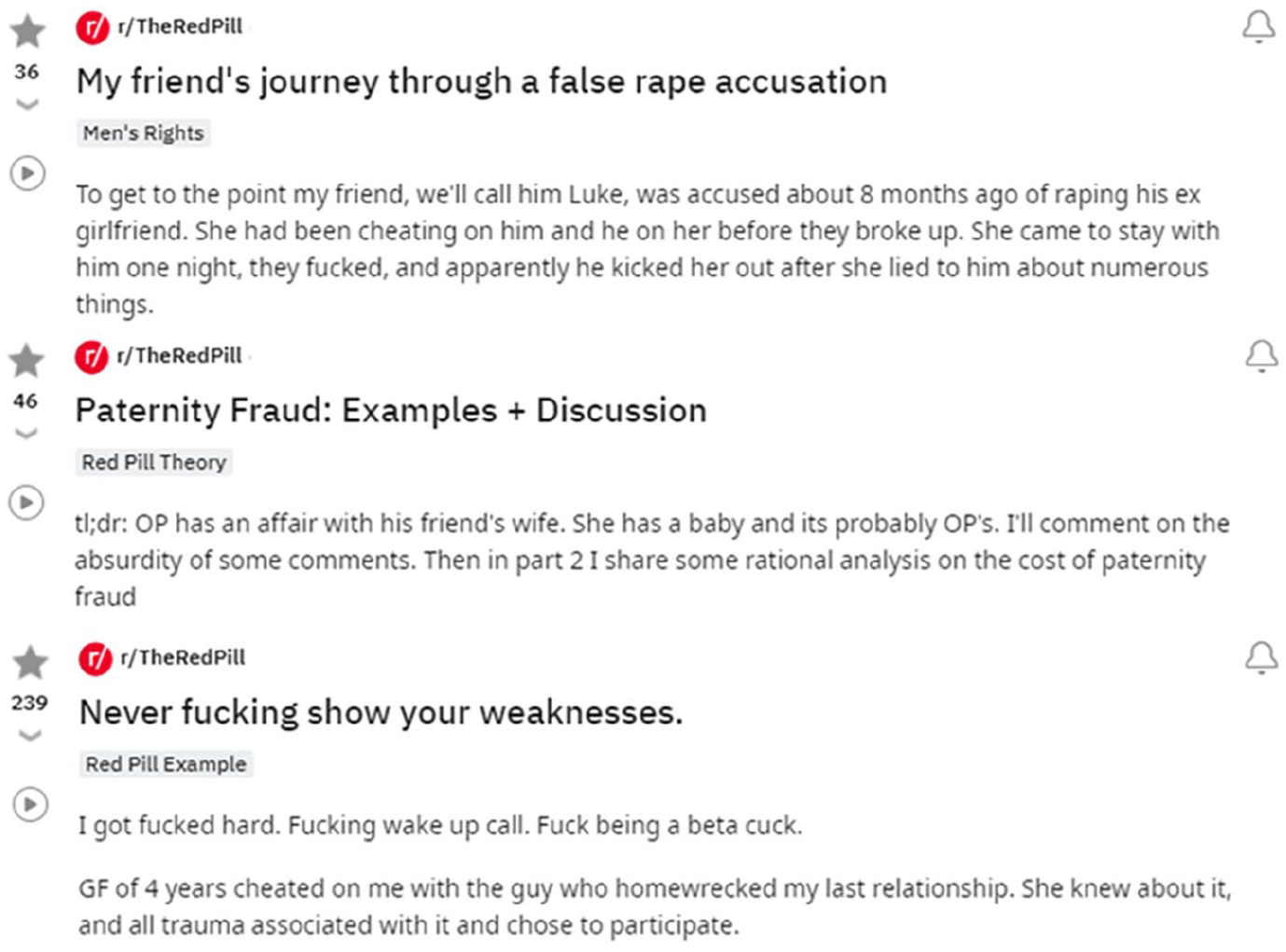
Screengrab: example posts promoting affective alignment, the posts have been edited for juxtaposition and the poster information withheld.
The examples illustrate an affective thrust of anxiety, antagonism and the promise of agency in a context where grievances can be aired anonymously with little risk of social sanction. TRP and similar countercultural collectives actively recruit members via the affective attractions associated with resentment (Kay, 2021; Scheler, 1994), disaffect (Nagle, 2017) or social alienation more broadly. A collective sense of disenfranchisement is mobilised into vilification of femininity and women as an entire social category. These expressions aggregate to generate an overwhelming and contagious threat-affect, which is both nebulously applicable (Tuters and Hagen, 2020) and ubiquitously immanent (Lupinacci, 2024). In TRP, this takes the form of construing men’s societal standing and well-being as being subject to significant risks. These risks range from the loss of social power and agency to more specifically impending subjection to paternity fraud, false rape accusations, financial exploitation, as well as many other forms of what TRP construes as gendered oppression.
By pairing a shared sensibility of threat with a materialised source constituted by a subversive hegemony 4 centred on a feminine imperative (see Aikin, 2019), a teeming production of affirmative expressions follows. This process allows for the mobilisation of various grievances to inspire ‘heroic’ responses that address the gynocentric world in which women have become the ‘real’ beneficiaries of their ostensible oppression. The cyclical production of these expressions constantly intensifies threat as well as the urgency of intervention. This is achieved by presenting a cascade of ‘observations’ that are portrayed as real-life examples. They proliferate a general mistrust of women, various institutions, such as court systems, and the media. What is intensified is an affective cyclicality poised to lash out at any threat deemed antagonistic in TRPs social reality.
TRP produces a technologically mediated alternative social reality rife with immanent threats that premise expressive action. From a Stieglerian perspective, TRP construes every aspect of sexual relationships as premised on power and transaction, and thus what is grammatised in the associated milieu is the very possibility of encountering romantic relationships in their prior connotation, that is, as situations often profoundly idealised and characterised by empathy, authentic selflessness and care. In its place, TRP engenders a sweeping reproduction of catastrophising reports and accounts of heroic subjectivity that seek to ‘regain’ agency and dominance. These processes, in turn, are intensified through a technologically contingent disciplining of communication.
Domination through technics of expression
The collective aligning of threat-affect occurs concurrently with another form of subversion: the gradual expansion of technics of expression. Some of which are explicit: There are official rules pertaining to posting which guides and restricts what can be uttered. The forum’s rules instruct participants to ‘stay on topic’ and to ‘follow our content guidelines’. Not abiding by the rules results in sanctions, such as ‘lengthy or permanent bans’ or the removal of posts, and thus one must comply or participate merely as a lurker. Contributions, or posts, must also be assigned a category, such as ‘field report’, ‘blue pill example’ or ‘Men’s rights’. This effectively creates a system of genres with their own expressive conventions. While these technics of expression enact explicit constraints directly, there are also more subtle aspects to TRPs expression. Note the listing given below.
The image in Figure 2 exemplifies a small selection of TRP neologisms. This expressive repertoire is under continuous expansion and serves as a loaded but discrete means of framing events, people and concepts. The tone of TRP forums is blunt, littered with expletives and often gratuitously sexist (Ging, 2019). While any post is naturally subject to the participant’s own writing style, the expression on TRP forums is highly uniform. This indicates that adherence to TRPs expressive norms is being effectively upheld.

Screengrab: core TRP neologisms with explanations, partial reproduction of the TRP glossary on reddit.com/r/theredpill.
The rules and expressive conventions serve to reinforce community boundaries and emphasise differences to antagonist groupings, such as adjacent communities or more abstract positions, such as ‘feminists’ or ‘betas’. Demonstrating mastery of the concepts and style is also a means by which posters can achieve recognition as valid members of TRP. This status is also contingent on the ability to reproduce TRPs ideological position, a perspective that undergirds a normative framework: women are understood to be ‘hypergamous’, human relations are premised on biological imperatives and transactions, and society is organised through interpersonal competition and manipulation (also O’Malley et al., 2020).
Apart from explicit rules and style conventions, participation in TRP is also significantly disciplined through the ways in which expression is channelled by the technological apparatus of the forums. All expressions are ordered via a user voting system which is intrinsically connected to Reddit’s algorithmic ‘visibility logic’. Posts are ranked based on a point-formula calculated from the difference between up- and down-votes and the age of the post. The algorithm values newer posts over older ones and automatically allocates higher visibility based on recency. Posts that receive negative voting scores are rendered near invisible. ‘Controversial’ posts (those that receive similar amounts of up- and down-votes) are made less visible than posts that attract positive reactions, all of which serves to privilege certain expressions (Buyukozturk et al., 2018; Copland, 2020). Participants can react to posts by voting, commenting and voting on the comments. Comment visibility is determined according to a distribution between up-votes and total votes. This logic privileges the ‘best’ comments, regardless of their relative age (Salihefendic, 2015).
Reddit forums also rely on volunteer moderators (mods) that assure that the expressions conform to forum rules and ideals. They can enforce the rules by deleting posts or banning participants from contributing, and thus serve as constitutive parts of collective mediation (see Schneider, 2022). However, they are retainers rather than rulers, constrained in their exercise of power through mutual expectation of adherence to TRP tenets. Orthodoxy is upheld through the elimination of dissent, but this curation remains covert to most participants. What results is a conformity of expression-reaction across the forum. Posts with low adherence to TRP ideology, tone or form of expression receive low voting scores prompting low visibility and are visible only for a short duration. For these posts, comments provide a reconstitutive function by identifying problems and offering alternatives in closer adherence to TRPs expressive orthodoxy. High adherence posts tend to receive high voting scores and their comments typically work to validate and expand on what is being expressed.
What results from this technological mediation is a form of covert communicative domination, which works to homogenise and intensify expression. TRP posters are provided with an affective template and scope of participation that corresponds to an emergent subjectivity ‘already defined by the system’ (Bucher, 2013: 482). Given this cyclicality, it makes little difference whether any particular expression on TRP is sincere or a form of ‘shitposting’, in which intentions can only be discerned through navigating manifold layers of dark humour and irony (Colley and Moore, 2022). In contrast to typical deliberate discussion, the expression of TRP is more akin to a swarm that runs on affective thrust (see Jones and Hietanen, 2023). In a Stieglerian sense, meaningful dialogue and reflection with a temporal structure of recognition and response gives way to affective immanence that constantly feeds off and reproduces itself.
Cyclical stasis towards disindividuation
TRPs expressive production brings about an experience of profound fragmentation. The temporality of the discussion breaks down due to the interchangeable nature of posts and comments and their continuous potential to appear, be deleted and then reappear in different formulations. Old posts drift into oblivion only to be constantly replaced by highly similar content. Comment threads are readily rendered illegible by their cascading form and how their chronological order is disrupted by their inherent vote-based visibility logic and how participants also frequently delete their contributions. What remains is an intensifying iterative flux (Lupinacci, 2024) held constant by its affective disposition. Individual posts and posters are made largely anonymous and interchangeable (Bucher, 2012) and remain subordinate to the reproduction of TRPs ideal expression. At the same time, TRP constantly propagates by translating diverse discourses into its own flows of expression. This takes place by subsuming material from various other sources, such as e-zine articles or posts from other Reddit forums. Through this process, TRPs scope of relevance and affective presence to further experiences, grievances and other events is expanded. Figure 3 illustrates this fragmentary form of communication:
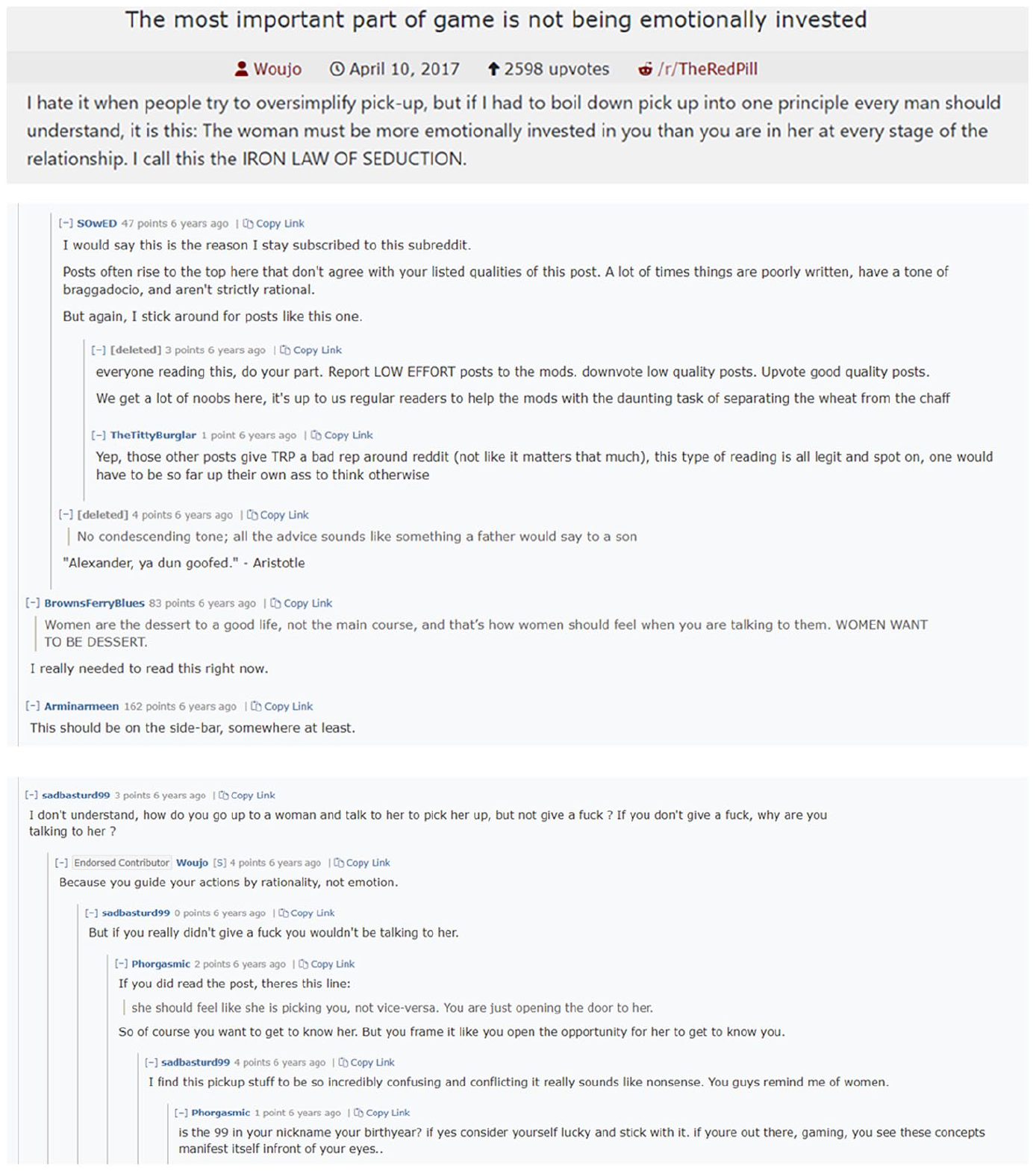
Top panel: excerpt of original post (April 2017; 6269 words; 2598 up-votes; 124 comments). Middle panel: comment cascade excerpt one – comment section top, deletion and cascading is notable. Bottom panel: comment cascade excerpt two – comment section middle, example of singular comment thread.
Here, the original post, a repurposing of a third-party article, prompts proliferate commentary that shoots off several tendrils. While these entries are framed as responses to the same post, their expressions draw from and are scattered across a diverse range of topics. The fragmentation of expression is amplified when some contributions are deleted while the replies to them are not. The algorithmic intensification works to break down dialogue, as experiences, norms, values and knowledge are not shared diachronically, and the temporal horizon becomes increasingly foreclosed and collapses into repetition. In a Stieglerian sense, the consequence of this process is a short-circuiting of dialogue resulting in a loss of individuation (Stiegler, 2015, 2019), as individuation is predicated on social processes of recognition that must share a temporal outlook to be meaningful and to channel a-subjective drives into collective desire for community formation. The posts are thus not simply representations of experience, but fragments that affectively co-constitute TRPs associated milieu.
In summation, how communication unfolds on TRP forums challenges the idea that online content principally reflects ‘individual beliefs’ of agentic ‘users’, from which purposeful collective identity construction and shared sense of community would naturally follow (see Selznick, 2002). Following Stiegler, the understanding of online collectives like TRP should thus not be limited to assessing the meaning of its content (sexism, resentment or aggression), but on the affective intensities reproduced by its associated milieu. The promise of community-building is increasingly reduced to its mere simulation, as the meaningful agency of participating in symbolic production is overridden by the very technology that first enabled it.
Concluding discussion: intensified all the way down
While online collectivity has been typically associated with emancipatory potential, various countercultural movements attract participants into a production of aggrieved and hateful expressions. These intensities in online spaces have been broadly recognised in the forms of hate speech (Massanari, 2017), echo chambers (Boutyline and Willer, 2017; Dignam and Rohlinger, 2019) and mass violence inspired by online content (O’Donnell and Shor, 2022; Regehr, 2022). Yet, we do not know all that much about the qualities that enable and sustain their assembling. To offer a sociotechnical perspective, we have sought to bring forth a speculative, yet thorough account of how culture and technology intertwine in ways that are necessarily ‘being built into algorithmic architectures’ (Bucher, 2012: 1178). While TRP and other similar countercultural collectives have received scholarly interest, much of this work continues to perpetuate certain limitations. Some efforts, perhaps partially owing to the expressions’ visceral offensiveness, seem to suspend the inclination to ask questions about how they came into being in the first place and how their capacity to produce intense participation manifests. There is a thus a tendency to interpret text produced on forums like TRP at face value (Colley and Moore, 2022; Dickel and Evolvi, 2022; O’Donnell and Shor, 2022; Regehr, 2022), or to analyse highly complex social phenomena by what is essentially counting words (see Halpin et al., 2023).
By engaging in a long-term ethnographic immersion and aided by Stiegler’s conceptual regime, our approach focusses on the affective relationality and expressive productivity of collectively mediated communication. Following Downey and Fenton (2003), Couldry (2020) and literature focussed on the affective qualities of automation in online mediation (Bucher, 2012, 2017; Paasonen, 2015; Sundén and Paasonen, 2018), we investigated how TRPs technically associated milieu is driven by affective intensification that precludes community-building in any traditional sense. This was foreshadowed by Downey and Fenton (2003), who observed that:
The ideal of community refers to a model of association patterned on family and kinship relations, on an affective language of love and loyalty, on assumptions of authenticity, homogeneity and continuity, of inclusion and exclusion, identity and otherness. The notion of a counter-public, by contrast, refers to a specifically modern phenomenon, contemporaneous with, and responding to, dominant capitalist communications. It offers forms of solidarity and reciprocity that are grounded in a collective experience of marginalization and expropriation, but these forms are inevitably experienced as mediated, no longer rooted in face-to-face relations, and subject to discursive conflict and negotiation (p. 192).
With regards to collective experience of marginalisation, the ‘chilling effects of fear’ (Sundén and Paasonen, 2018: 647) can be mobilised for the purposes of drawing in and proliferating affective attention. In TRP, we find a conspiratorially grounded threat-affect that is intensified to energise a homogenising collective investment in antagonism, resentment and aggression. The cyclical production of these expressions in TRPs technologically mediated milieu produces an ‘accelerant in the process of radicalization’ (Zhang and Davis, 2024: 12) and offers a view of how expressions of countercultural online affectivity can intensify, ‘feed on, and amplify, one another’ (Sundén and Paasonen, 2018: 646). What results from these processes might be called ‘templated subjectivation’ and its ubiquity casts further doubt on the emancipatory potential of online collectivity, as well as the constraints to agency in online discourse more broadly.
From a Stieglerian perspective, while TRP attracts its members with the promise to ‘construct coherent and socio-positive identities’ (Maloney et al., 2024: 17), its technical milieu serves to fragment any possibility of meaningful and socially participating individuation. Instead, it offers affective immersion into an alternate reality-in-the-making that is cyclically intensified by the Reddit site’s platform automation that in turn feeds off it. In this way, the potential of empathic togetherness that could collectively find social cohesion and care is precluded, and replaced by an affective mimesis that breaks the temporality of dialogue. The outcome is a socially disassociated milieu, which overdetermines the formation of its embedded subjects through overt rules, conventions of expression and technical affordances, and thus comes to merely ‘speaks within itself’ (Berardi, 2017; Stiegler, 2009b).
Andrejevic (2020) notes that in automation there is an inherent drive to reduce the drag of subjectivity for the purposes of maximising commercial speed and thus to eschew the friction of the social, amounting in ‘a self-devouring logic of purification’ (p. 17). Following his premonition of how one becomes ‘cast adrift in a sea of narratives and counter-narratives’ (p. 62) that only amplify ‘pre-existing preconceptions and prejudices’ (p. 62), we find in TRP a striking production of capitalised subjectivities. This ‘normative dimension of algorithms’ (Bucher, 2017: 35) manifests as an associated milieu of desperate solitude where everyone must fend for themselves and these ‘practices of subject-making’ (Sundén and Paasonen, 2018: 653) work to continuously disorient the social. Instead of producing any sense of solidarity for a political ‘cause’ or ‘resistance’, TRP’s mediation works to offer only its simulation. What is teeming behind the veil is a proliferate production of ruthless individualised competition, where community success means ‘winning’ and ascending away from the community altogether. Akin to a curious Stockholm syndrome, TRP is a community only in inverted form, and is thus not concerned with any social cause of resisting and redressing the various ills of an excessively competitive and commercially sexualised culture. Instead, its affective attractions side with the prevailing capitalist ideology and promote collective hyper-adaptation that perpetuates the very conditions of resentment.
This leads us to another aspect that has been largely overlooked in sociotechnical studies – the inherent commercial dimension of platformed phenomena (Bucher, 2012, 2013; Couldry, 2020; Fuchs and Dyer-Witheford, 2013). We have shown how instead of community-building or coherent and meaningful dialogue, a Reddit forum, such as TRP runs on the affective intensification of expression. For Stiegler (2015), such processes readily reduce communication into repetition and the libidinal ‘extreme pleasure of falling’ (p. 116). This results in technological domination or ‘algorithmic governmentality’ (Stiegler, 2019: 236) that works to create vertiginous echo chambers of radicalising alienation. For Stiegler (2014b, 2015, 2019), these forms of hyper-connectivity have become the malaise of our time, as they intensify the conditions where collective expression becomes drive-based, supplanting desires of collective individuation that could foster togetherness and care. Instead, the commercial objectives of social media platforms form a sociotechnical milieu predicated on mediating spirals of hyper-stimulation and profiting from this industrialisation of behavioural data production. While TRP may promise resistance through shared community, its technically associated milieu delivers its absence.
Optimistic premonitions of the online realm offered ideas of novel forms of democratic participation and the potential for political emancipation (Castells, 2007; Yuan, 2013). What rather seems to readily take place is a short-circuiting of temporality and meaningful presence in communication (also Abbinnett, 2015; Lupinacci, 2024). It should be noted that despite the pessimism inherent in Stiegler’s (2014a, 2014b, 2019) theoretical oeuvre, he continued to argue for the novel possibilities of solidarity to re-emerge in collective political resistance online. However, our analysis of TRP gives us further grounds for pessimism in the context of commercial algorithmic mediation.
Our theorising calls for thinking about collective social media expression in ways that highlight the sinister side effects of connectivity. The Reddit online platform features a specific set of sociotechnical conditions that offer a particular form of communicative mediation and TRP forums are but one example of how these conditions manifest. This potential is an embedded feature of technically associated milieus that dominate expression in profitable ways, idealise particular forms of participation and where collective affect is mobilised to construct alternative realities. For Stiegler, these are all signs of a social demise, where ‘control societies to themselves become uncontrollable’ (Stiegler, 2014a: 1) and can constitute the ‘fruits of the death drive, along with their strange pleasure’ (Stiegler, 2014b: 9). Without meaningful communicative exchange, the social is being increasingly substituted by an intensifying loop that serves the proliferation of drive-based excitations. Technologies of collective mediation affectively condition us towards instant gratification and a thirst for more. Its product is the grammatisation of the social itself – a profitable foreclosure of our shared temporal horizon and with it the possibility of meaningful individuation.
Supplemental Material
sj-docx-1-nms-10.1177_14614448241305420 – Supplemental material for Becoming Red-Pilled: Affective production in online countercultural collectives
Supplemental material, sj-docx-1-nms-10.1177_14614448241305420 for Becoming Red-Pilled: Affective production in online countercultural collectives by Mikael Andéhn, Joel Hietanen and Alice Wickström in New Media & Society
Footnotes
Funding
The author(s) disclosed receipt of the following financial support for the research, authorship, and/or publication of this article: This study is part of the ‘Automated Selves: The algorithmic intensification of societal control’ research project funded by the Finnish Cultural Foundation (Grant number 00210377).

Supplemental material
Supplemental material for this article is available online.
Notes
Author biographies
References
Supplementary Material
Please find the following supplemental material available below.
For Open Access articles published under a Creative Commons License, all supplemental material carries the same license as the article it is associated with.
For non-Open Access articles published, all supplemental material carries a non-exclusive license, and permission requests for re-use of supplemental material or any part of supplemental material shall be sent directly to the copyright owner as specified in the copyright notice associated with the article.
