




Abstract
This study draws on empirical data to fine-tune the theoretical concept, ‘bridging civic identity’, which we propose as an educational aim in conflict-affected settings. We analyse interview data from Liberian respondents and North Korean migrants living in South Korea, using a conceptual framework based on the notions of ‘bridge citizens’ and agency. The analysis reveals the following: (1) that a high sense of agency is related to resourcefulness and fortitude, (2) that identifying oneself as a ‘bridge citizen’ is connected to recognising others as such, and (3) that concrete, large-scale aspirations of social justice for the larger community – and therefore ‘imaginativeness’ – are central components of a bridging civic identity. The findings suggest that learners in similar settings ought to be trained in resourcefulness and fortitude, be shown the collective nature of working towards shared goals, and be given encouragement to visualise the just future they desire for their community or nation.
Keywords
Introduction
The role of ‘identity’ – particularly in the sense of self-identified group membership – in education is contentious. On the one hand, the view that identity contributes to conflict (e.g. Nussbaum, 1994; Sen, 2006) has led to arguments for educational approaches that seek to limit rather than strengthen pupils’ allegiances to identities (e.g. Sen, 2006). On the other hand, many citizenship education practitioners in liberal democracies identify particular attitudes and beliefs consistent with advancement in their societies’ ideals, and embrace the goal of shaping learners’ ‘civic identity’ – that is, the ‘set of beliefs and emotions’ that they have about themselves as ‘participant[s] in civic life’ (Hart et al., 2011) – according to these beliefs. Amidst these contrasting views, the question arises as to whether a particular form of civic identity might effectively promote social justice in conflict-affected settings. Being able to describe such an identity can be a useful educational intervention: in areas affected by conflict, schooling in general is seen to play an important role in restoring learners’ agency after the traumas of war and kindling a sense of hope among citizens (Davies and Talbot, 2008), which can be harnessed to promote a more peaceful and socially just future.
Save for a few exceptions that describe settings where identities are more fluid (e.g. Velez, 2021, 2022), much of the recent research related to this topic has focussed on contexts in which group identities have remained clearly delineated both before and after the conflict (e.g. Becker, 2023; Cunningham and Ladd, 2018; Nafziger, 2022; Petkovska, 2022; Tinker, 2020; Weinstein et al., 2007), and where educational interventions may therefore be incongruent with identity-based narratives that learners hear outside their schools. Less attention has been paid to conflict settings where identity distinctions have had a more fluid role in the persistence of social divisions. In such locations, identities are potentially more malleable (Azada-Palacios, 2021), suggesting the potential success of citizenship education interventions aimed at fostering new identities. In these settings, it may be particularly promising to help learners reimagine their identities beyond conflict-related oppositions in ways that highlight their capacity to be agents of change.
This study drew from empirical data gathered in Liberia and the Korean peninsula – two conflict-affected settings – to refine a conception of a civic identity that can be a suitable educational aim. We focussed on Liberia and the Korean peninsula for two reasons. First, as we discuss further in the next section, the status of their conflicts and identity-based differentiations are similar enough to justify their comparison but different enough to make our findings useful to other contexts. In both settings, segments of the population have experienced personal or vicarious stories of conflict- or autocracy-related trauma. In both places, the group identities associated with the conflict have been malleable, but in different ways: group identities have weakened in Liberia over the last two centuries, whereas they have strengthened in the Korean Peninsula over the last century. Apart from this, the two settings also have obvious geographical, linguistic, and cultural differences that give our findings breadth.
Second, these two settings hold the potential for revealing novel insights. In both of these understudied places, a significant portion of the population have not yet received civics education geared towards post-conflict reconstruction, peace-building, or social justice. In Liberia, this is true for most of the public, save for the small minority of former child soldiers who underwent reintegration programmes through the truth and reconciliation tribunals (Awodola, 2012; Brownell, 2020; Perry, 2009; Steinberg, 2011; Wainryb, 2011). In South Korea, this is true among the North Koreans who immigrated after they had completed most or all their basic schooling in North Korea (South Korean schools do have such a curriculum). The absence of existing peace- and social justice-oriented civics education programmes among these populations means that the respondents gave us ‘raw’ data not yet shaped by extant programmes.
The theoretical concept that we aimed to fine-tune in this study, ‘bridging civic identity’, was originally developed by one of the authors (Cheong, 2022). We analysed the empirical data through the lens of this concept, focussing specifically on the potential for such an identity to engender transformative agency that can promote social justice in both settings.
Conceptual and contextual background
Conflicts in Liberia and the Korean Peninsula and the malleability of identity
In contrast to the conventional heuristic of viewing collective national identities as either civic or ethnic, one of the authors of this paper previously argued for a fixed/malleable dichotomy to better analyse group identities on a national or subnational level (Azada-Palacios, 2021), owing to the malleability of ethnicity and the potential even for civic identities to be relatively fixed. In the case of identity groupings in Liberia and the Korean peninsula, this is especially evident.
The malleability of identities in Liberia is evident in the changing sources of the division across its two civil wars: group identities that were very strong almost 200 years ago have since weakened. Composed of lands colonised in the 19th century by formerly enslaved people and free black Americans to settle, Liberia received its independence from the United States in 1847 (Cavanaugh, 2021; Dennis, 2006), by which time a social hierarchy had emerged based on skin tone and inhabitants’ personal histories. Identity-based distinctions were primarily between three groups: (1) ‘Americo-Liberians’, descendants of Americo settlers, originally objectively distinguishable by their lighter skin colour and Western surnames, (2) so-called ‘Congos’, Africans originally from elsewhere who had been rescued from intercepted slave-trading ships, and (3) indigenous Liberians, themselves composed of various ethnolinguistic groups (Cavanaugh, 2021; Cheng, 2018). Among these three groups, Americo-Liberians formed the social elite, dominating government, business, employment, and education. They created a system that marginalised ‘Congos’ and indigenous Liberians from political power by limiting their educational opportunities (Thompson and Mowell, 1997). In 1980, Samuel Doe, an illiterate soldier, led a coup d’état and became the first indigenous leader of Liberia. After 10 years of chaotic rule, Doe was assassinated, creating a vacuum of leadership that ushered in 14 years of violent civil war. This first civil war (1989–1996) was attributed to ‘ethnic divisions, greedy elites who abused power, political corruption and economic disparities’ (Kieh, 2004: 60) and ‘the historical decision to establish Liberia as a state divided between natives and settlers’ (Truth and Reconciliation Commission [TRC], 2009: 47). Although group identities played an important role in the first civil war, the second war (1999–2003) was attributed to different reasons: the failures in ‘the disarmament, demobilisation, rehabilitation of and the reintegration of ex-combatants into society, reforming the security sector, the refusal of Charles Taylor’s government to address the human rights abuses, socio-economic problems, inequities, and social malaise’ of the first civil war (Kieh, 2009: 10–11).
Since the end of the civil war, inherited legacies of advantage or disadvantage have continued to be denoted, albeit more loosely, through differences in occupation, access to education, and general positive or negative treatment within society. Nonetheless, time, intermarriage, and increased educational equity have weakened the tensions between these groups (see Vinck et al., 2011). The starkest lingering effects of the civil war on the population are related not so much to group identities, but rather to the brutality of the war, which was experienced by all groups regardless of identity. It has been projected that a total of between 5% and 10% of Liberia’s 3 million people were killed during the civil wars, with over 1 million Liberians displaced (Cheng, 2018; Richards, 2019).
In the Korean peninsula, the malleability of identities is evident in the relatively recent creation of separate North and South identities. Koreans largely conceive their peninsula as having been a single nation prior to the Korean War, with a shared ethnicity, language, history, culture, and collective memory across more than a thousand years. The Korean peninsula was annexed by Japan from 1910 to 1945 and then split into two after the Second World War, with the South administered by the US and the North by the Soviet Union (National Institute of Korean History, 2002). Both Koreas, North Korea (officially, the Democratic People’s Republic of Korea [DPRK]) and South Korea (officially, the Republic of Korea [ROK]), claimed legitimacy over the entire peninsula, leading to the Korean War (1950–1953). The armistice established two distinct socio-economic and political systems (Cumings, 1995; Fields, 1995; Ford, 2018), with North Korea being socialist and led by the supreme power of a great leader (Suryong in Chosŏn’gŭl) and South Korea being a capitalist democracy with strong economic growth (Cornell University, INSEAD, and WIPO, 2020; Kim KS, 2008: 87; Watson, 2020).
The Korean War itself was thus not originally an identity-driven war. Rather, the division between the civic identities of North and South Koreans developed as a result of a conflict rooted in ideological and political differences (Jung et al., 2016; Kang JW, 2020). The seven-decade-long territorial division led residents on opposite sides of the peninsula to undergo divergent historical trajectories under starkly different governments and political conditions, leading Koreans to form a ‘division habitus’ (Park YG, 2010, p. 373) and internalise ‘conflict-attuned civic identities’ (see Cheong, 2022: 22) which embodied the hostility, structured misunderstanding, and distrust between the people of the two Koreas, in a process of identity transformation or ‘becoming, or avoiding becoming a certain citizen’ (Pavlenko and Norton, 2007: 590). Today, despite the ongoing armistice, the two Koreas are still technically at war, divided by the Korean Demilitarized Zone, the area of the world where the largest number of troops (1.5 million) have been deployed (Emamdjomeh et al., 2017), and the division in civic identities of the people in the two Koreas remains as a root cause of intractable tensions.
Both the Liberian and Korean cases highlight the malleability of identities (Azada-Palacios, 2021), showing that the defining boundaries that distinguish one group from another can shift over time. In situations of conflict and in their aftermath, such boundaries may be drawn, blurred, or redrawn. This highlights the promise of actively encouraging the development of particular forms of identities through educational interventions in conflict-affected settings.
Identities and civic identities
Identity theory distinguishes between personal identity, relational identity, and collective identity. Personal identity theory focuses on personal continuity over time, such as individual attitudes, personality or character (Bruner, 1986; Erickson, 1968; Freeman, 1984; Hammack, 2008, 2015; Hart et al., 2011; McAdams, 1988, McAdams and McLean 2013). Personal identities underpin the way individuals perceive themselves in relation to others and can be shaped and reshaped through their interaction with surrounding sociocultural structures. Relational identity refers to the identity within a specific relationship between two or more people (Burbano, 2017; Tracy, 2013: 17–20). Finally, collective identities refer to group membership and affiliations and their impact on the construction of self. These may, for example, include ‘distinctive national, ethnic, cultural and social identities [that] are part of the very basis of people’s sense of being-in-the-world’ (Held, 1995: 116).
Prior work on identity-related education in settings affected by identity-based conflicts have tended to focus on collective identities. Many proposed and actual educational interventions in such settings have aimed to intervene directly with such collective identities, such as by emphasising identities that exacerbate tensions or by seeking to replace strongly-held identities with a newer solidarity-building collective identity, such as a national identity in place of a sub-national ethnic one (Hajir, 2019; Metro, 2020; Selenica, 2022; Shah, 2012; Zembylas, 2014). Our work takes a different approach in that it aims to explore how a particular kind of personal identity – specifically a particular form of personal civic identity – might be a helpful educational aim in conflict-affected settings.
Civic identity has been defined by Hart et al. (2011) as ‘a set of beliefs and emotions about oneself as a participant in civic life’. These beliefs and emotions are often internalisations of socially constructed norms and conditions about the self and society, within a person’s habitus (Bourdieu, 1984: 474). These beliefs and emotions thus enable the individual citizen (in the case of a personal civic identity) and the collective citizenry (in the case of a collective civic identity) to engage with their specific civic context (Abbott, 2019; Bourdieu, 1984, 1986; Hart et al., 2011; Stokamer, 2011).
‘Bridging civic identity’: Agency for social justice
Cheong (2022) defines ‘bridge citizens’ as those within conflict-affected societies who can help others in the wider population understand the ingredients needed to create new civic knowledge, values, norms, and identities that enable all citizens to transform ‘conflict-attuned civic identities’ into peace-building civic identities. In this paper, we use the term ‘bridging civic identity’ to refer to identities held by such bridge citizens.
The term ‘bridge’ in the phrase ‘bridging civic identity’ refers to the characteristics of cosmopolitanism, interconnectedness, and imaginativeness within such an identity. First, it is cosmopolitan (Appiah, 2007; Kanno and Norton, 2003; Nussbaum, 2001; Osler and Starkey, 2005) in the sense that the person who holds this identity values every human, regardless of group affiliation. This does not mean that the person negates their own group affiliations, only that they do not consider a mutual similarity of group affiliations to be a condition for valuing another’s human life. In this regard, ‘bridging civic identity’ is an identity that values social justice through their valuation of the well-being of others across fissures of group identity. Secondly, a bridging civic identity is interconnected in that the person who holds this identity draws links across different contexts, cultures, experiences, values and knowledge. In this sense, they are able to build bridging social capital (Putnam, 2000), which helps people make sense of, interpret, and reflect on differences with more inclusive and interconnected perspectives (Zuckerman, 2013) for the purpose of attaining social justice. Third, a bridging civic identity is imaginative in that the person who holds this identity looks forward to an imagined future society (Kanno and Norton, 2003; Norton, 2013) that is characterised by such social justice.
Finally, the term ‘civic’ in the phrase ‘bridging civic identity’ refers to the component of civic agency and action that characterises a person who holds such an identity, that is, their recognition of their capacity to effect social change (Appiah, 2007; Beck, 2008; Norton, 2013; Reardon, 2012; Starkey, 2019). This last idea – the capacity to effect change – is closely related to the concept of ‘agency’. A term used widely across the social sciences, our own understanding of agency amidst difficult political situations is influenced by the work of the political thinker Arendt (1958). Although Arendt did not use the specific word ‘agency’, her political reflections on the range of global political catastrophes of the twentieth century highlighted each human person’s ‘natality’ and capacity for ‘action’, that is, their ability to initiate new actions that could lead political or social events in new directions. This ability was multiplied when people acted in concert, the phenomenon she termed as ‘power’. Following Arendt, we argue that a person who holds a bridging civic identity – that is, someone who sees themself as a bridge citizen – understands their own agency to be one that can alter the direction of political and social events and that can have exponential influence when joined together with the agency of others. In addition, we see this agency as being directed specifically towards social justice for all.
Methodology
Data gathering and analysis for this study were conducted separately among young North Koreans who had migrated to South Korea and participants in Liberia. The participants were initially selected using purposeful sampling to ensure they met the specific criteria for the study (Ims et al., 2021); however, constraints due to COVID-19 restrictions led to the need to use snowball sampling in Liberia to find additional interviewees, as recommended by Cohen and Arieli (2011) for certain constrained settings. In total, four North Korean and five Liberian participants were selected. In each location, the data gathering was conducted as part of larger research projects, which explains the disparate data-gathering methods across the two locations.
Data collection
Research about conflict-affected settings is known to be constrained by methodological challenges (see, e.g. Cohen and Arieli, 2011) and ethical complexities (see, e.g. Campbell, 2017; Kostovicova and Knott, 2022; Zwi et al., 2006). In our case, we attempted to anticipate and mitigate some of these challenges in different ways, which are detailed below alongside our descriptions of the data gathering processes.
The data from the Korean migrant youths were collected from October 2017 to February 2018 by one of the authors who was proficient in the Korean language. To mitigate the methodological constraint of having of a small sample size, which is characteristic of conflict-related research (Clark, 2006; Romano, 2006), the researcher used biographical narrative interviews (Schütze, 1984/2005, 2016), which allowed for comprehensiveness, enabling the authors to intimately explore participants’ life trajectories from their experiences of life in North Korea, their journeys of escape and migration, their adaptive strategies within South Korea, and their perspectives regarding the eventual reunification of the Korean peninsula. The interviewer’s proficiency in Korean also ensured that the interviews captured and interpreted nuances and emotions, enhancing the richness of the gathered data.
In Liberia, the data were gathered from January to April 2021 as part of a larger project centred around conceptualising quality education within higher education. The fact that the questions were centred around the respondents’ wider experiences of education rather than just about the conflict itself increased the chances of the interviewees speaking more freely about their experiences and aspirations, given the known methodological challenges of engaging people to share their views in conflict-affected settings (Cohen and Arieli, 2011) and the ethical complexities surrounding potentially ‘intrusive’ interviews (Bäärnhielm and Ekblad, 2002). The five participants were all immersed within Liberian higher education, but in different ways, which allowed us to explore varying viewpoints, mitigating the constraints of having a small sample size (Clark, 2006; Romano, 2006). Semi-structured interviews with them were conducted in English, which was spoken by the interviewing author as well as the participants.
Participant profiles
The four North Korean migrant youths – two female and two male – were aged 21–31. The interviewees in Liberia were all adults, but data about their age were not collected because of the lack of consistent birth-keeping records in Liberia during the civil war. Of them, four were men and one was a woman. Three of the four North Korean interviewees were students; the fourth was a florist. Two of the Liberian participants were teacher-students; one was a librarian; one’s work was related to securing accreditation for Liberian universities; and the final Liberian respondent worked with a bilateral organisation to secure funding for issues related to education. The participant profile is presented in detail in Table 1.
Profile of research participants.
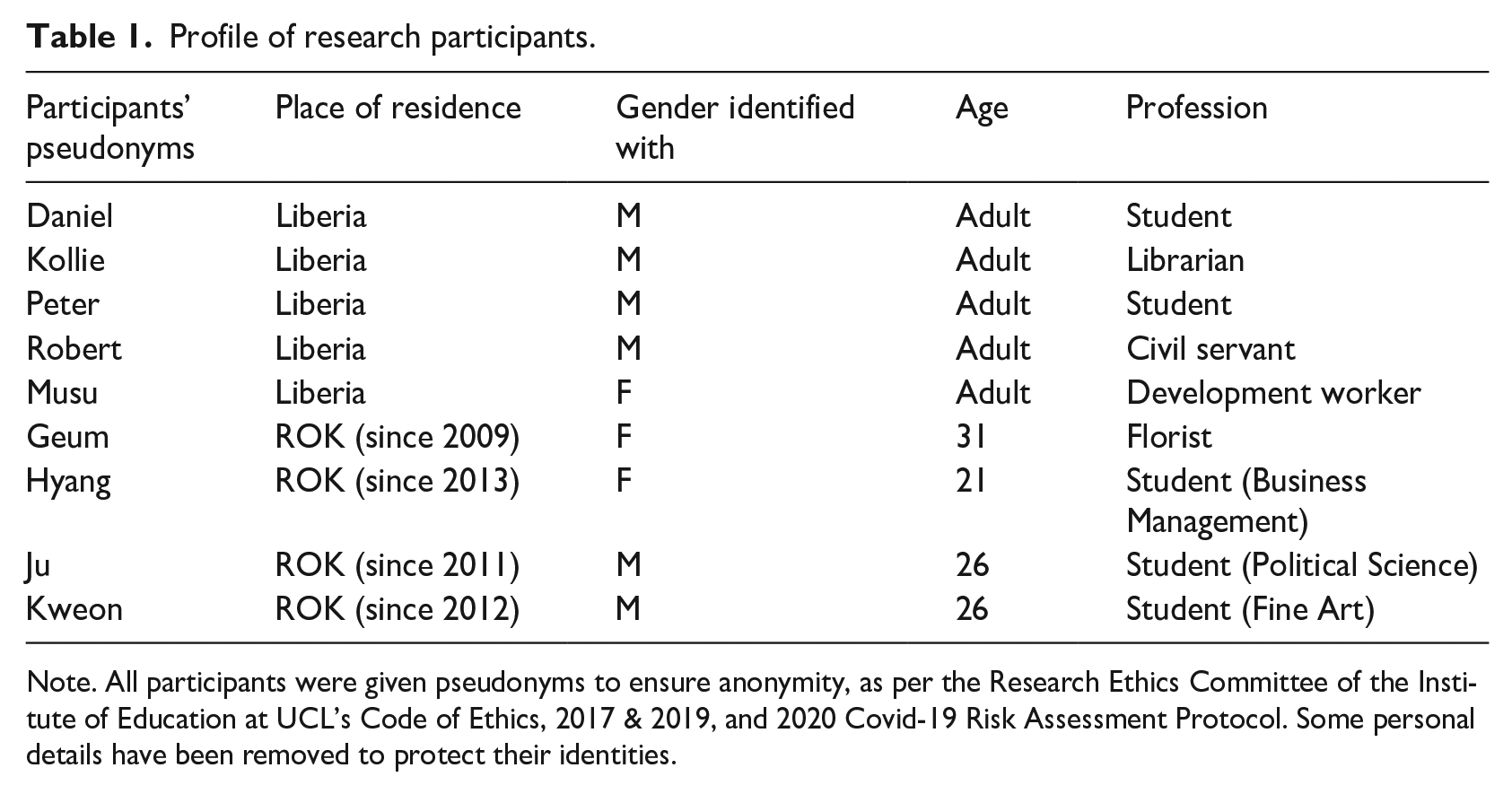
Note. All participants were given pseudonyms to ensure anonymity, as per the Research Ethics Committee of the Institute of Education at UCL’s Code of Ethics, 2017 & 2019, and 2020 Covid-19 Risk Assessment Protocol. Some personal details have been removed to protect their identities.
Data analysis
The interviews with the North Korean participants had been conducted in Korean by the only researcher who could speak the language. This researcher transcribed these interviews and conducted the data analysis on these transcripts. The interviews in Liberia were transcribed by the researcher who had conducted them, and the data were analysed by the two other researchers.
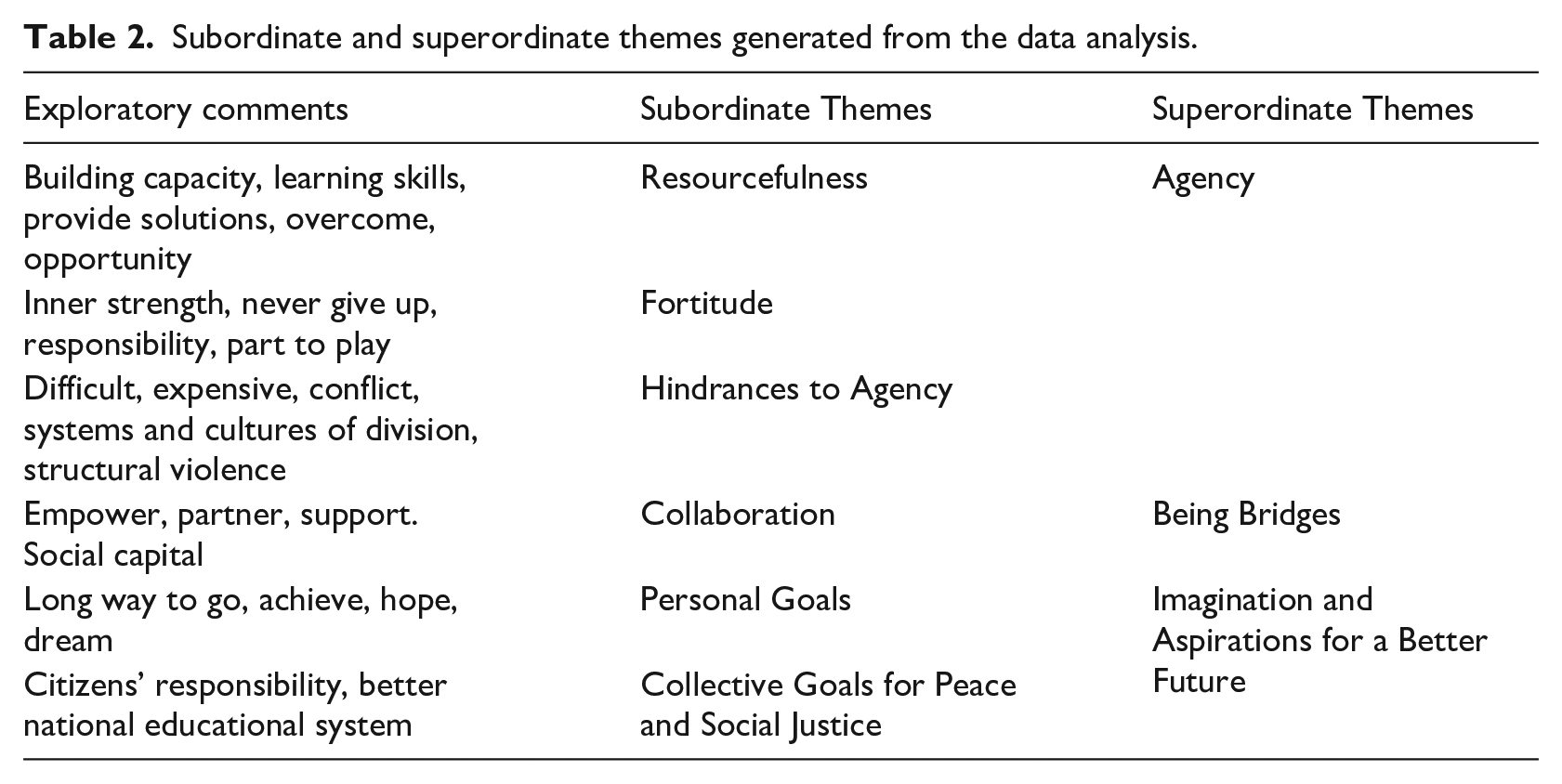
Interpretative Phenomenological Analysis (IPA) was used across both sets of data. Following the five stages outlined by Smith et al. (2009), we first focussed on the microscopic details of the individual participants’ accounts. Across multiple readings, we noted anything of interest from the data and made exploratory comments in three ways: descriptive, linguistic and conceptual. We identified significant words, phrases, or statements in the original transcriptions while asking ourselves what these meant and what the participants meant, and what the participants wanted to narrate, assuming their cultural backgrounds and experiences. We applied an interpretation-focussed coding strategy to reach the essential meaning of the empirical indicator identified in the third stage of IPA (Adu, 2019). Throughout the process of identifying the indicators for making meaning, we generated emergent themes, linking them to the concepts ‘bridging civic identity’ and ‘agency’. With the aid of NVIVO12, we looked for connections across the emergent ideas and searched for cross-case patterns, ensuring that the themes that were generated were present across both sets of data. This process was repeated until the themes became explicit and meaningfully covered the accounts’ major results. We eventually generated three superordinate themes – (1) agency, (2) being bridges, and (3) imagination and aspirations for a better future – with corresponding sub-themes, as summarised in Table 2.
Subordinate and superordinate themes generated from the data analysis.
To ensure the validity and reliability of our analysis, we gathered data from multiple sources, using various strategies, including biographical narrative interviews, semi-structured interviews, informal conversations, researchers’ field notes, and reflective journals. In analysing the North Korean migrants’ data, we employed CAQDAS and member checks, whereas for the Liberia data, two researchers conducted separate analyses and compared their results to confirm the analysis, with input from the third researcher who had conducted the interviews, who confirmed their analysis based on her field notes. Any disagreements in the analysis were discussed until a consensus was reached.
Findings
All the participants had undergone difficult experiences related to the conflicts in their respective countries and the aftermath. As the North Korean respondents had crossed into China and other Southeast Asian countries on their way to South Korea, they had undergone long periods of fear and anxiety about repatriation and experiences of discrimination and marginalisation. They had also suffered from a wide variety of migratory hindrances: obtaining legal documentation to apply for asylum, dealing with inadequate living conditions, and adapting to a new society. Meanwhile, our Liberian respondents described the difficulties associated with post-conflict life, such as having few resources to attain personal or professional goals such as not having a laptop for studying and being reliant on the few, yet expensive Internet cafés, not having the budget necessary to fulfil the mandates of a professional position, or having to temporarily stop schooling because of limited funding. Strikingly, despite these difficulties, all except one of our respondents’ responses revealed many of the characteristics of a bridging civic identity as we had originally theorised it. Our analysis of their responses revealed themes that helped us further refine this theorisation.
Agency
Some of the responses portrayed high levels of agency, whereas others portrayed lower levels of agency. The participants responses revealed some of the component ingredients of agency and factors that appear to hinder a strong sense of agency.
High levels of agency and its component ingredients
Some of the responses indicated that the participants considered themselves capable of creating opportunities to attain their goals, an indicator of a high level of agency. These included those of Kollie, a librarian from Liberia who described how he had supplemented his own studies with additional reading by collecting books from friends overseas. Similarly, two Korean participants, Ju and Kweon, arrived in South Korea without educational qualifications that were recognised in the country. In both cases, they took the secondary school equivalency exam, which then allowed them to apply to universities in a shorter amount of time.
One of the notable elements of agency that was revealed in their responses was the characteristic of resourcefulness. All the high-agency respondents described instances of identifying accessible material or social resources and creatively finding ways to maximise their use to help them attain their goals, whether these goals were individual or collective. The responses affirmed that North Korean migrants develop their own adaptive strategies related to the settlement of Korean society by taking advantage of institutional and non-institutional supports. Particularly, these acts of resourcefulness were undertaken even amidst huge gaps in institutional support for them. For example, two Korean respondents, Geum and Ju, both realised after their arrival in South Korea that English skills were important there; they both then used both informal and formal networks to find national and international funding to study English through the sessions at Teach North Korean Refugees (TNKR). This later paved the way for Geum to study in Canada and then the United Kingdom. While training as a florist in London, Geum again demonstrated resourcefulness as she formed friendships with native-born peers to quickly master the English language. Ju, on the other hand, was able to make the most of the tuition and CSAT exemptions extended to North Korean youths (The Ministry of Unification of the Republic of Korea [MoU], 2019) to pursue political science studies at university. While some of these opportunities were ultimately provided by larger institutions, finding these opportunites also required them to agentically harness their more informal social networks such as friends and religious groups, as well as non-formal educational opportunities such as those provided by NGOs and cram schools.
Similarly, Kollie went on to build a library using the books he had collected from overseas, so that both he and his peers could benefit from the collection. He used his library as a mechanism for increasing his knowledge, which aided him in attaining a scholarship to study abroad. After he earned a master’s degree in library science, Kollie was able to accelerate his capabilities to then, notably, help others also use books and digital resources for their educational pursuits. Along the same vein, Peter, a Liberian engineering student, described how he had, from the time he was a high school pupil, actively tried to improve his academic skills by seeking out training programmes that the state university offered the general public. Specifically, he found online training programmes taught by international lecturers which he felt could supplement his own local education. He also mentioned that similar programmes ought to be offered to other students as well, to increase their chances at academic success. Peter, who dreamt of becoming a geologist, attributed his future career choice to his being ‘passionate about building young people’s capacity in the use of ICT’, thus indicating his recognition that ICT skills would also help future students attain their goals.
Among some participants, a high level of agency appeared to be related to
Low levels of agency and possible hindrances to agency
Although a number of our respondents demonstrated high levels of agency, some of them portrayed more mixed levels of agency. Their descriptions of specific incidents in their lives highlighted restrictions to their agency. For example, although Daniel, a Liberian student-teacher, recognised that new forms of technology could enhance educational experiences, his description of these highlighted the many obstacles that he and others faced trying to access technology to improve their circumstances. Amidst Covid-19 restrictions, the university where he was studying shifted to remote modes of teaching. However, the limited and irregular electricity supply in Liberia, expensive Internet access, and lack of access to hardware hindered the participation of most students and lecturers in this scheme. His responses highlighted how his opportunities to engage with online classes were thwarted by the scarcity of digital infrastructure and access to technology within Liberia more generally.
In response to a different question about the quality of education in Liberia, Daniel’s response portrayed a sense of dependence, that is, his reliance on others to achieve his goals, and feelings of futility. His answer focussed on the need for the government of Liberia to improve the country’s education system. When asked how this was to be done, he highlighted the need for donors to ‘send money’ and the importance of funding from non-governmental organisations. In this participant’s response, the most salient resource that he identified as a path to systemic improvement was external support from other countries. In addition, he also determined that his own capacity to become a good teacher was dependent on external structures providing training and finances to move education, and therefore himself, forward.
Although all the Korean respondents demonstrated high levels of agency when talking about the present, their recollections of past experiences similarly portrayed previous conditions of low agency. Hyang, for example, recalled constantly comparing herself with her Southern counterparts and her feelings of being different from them. Geum described her struggles speaking to South Korean friends and colleagues because of her different speaking habits. These participants acknowledged their limited upward social mobility resulting from their marginalised social positions in ROK. Notably, these experiences of low agency appeared to be internalisations of the systems and cultures of division, whereby, both in North and South Korea, the identities of North and South Koreans were often portrayed as polar opposites of each other, in both government and social discourse. Ju referred to this in his description of the South Korean education system:
The current Korean education system focuses on criticising North Korea and Kim’s regime. Anti-communism – [which I would describe as] anti-North Koreanism – and hatred are still pervasive at all levels of society. It is not appropriate preparation for the successful reunification. I think the Korean government should be prepared for a stage wherein they can test unification.
Despite these accounts of situations of low agency in the past, these Korean respondents also showed their ability to reframe the limitations associated with their past lives as valuable assets. Some of them described their past identities as having potential socioeconomic utility in their present life and career trajectories, noting that their past lives, despite being restricted, gave them the ability to play positive peacebuilding roles in a future unified Korea.
Respondents who consistently showed high levels of agency in their responses did not shy away from describing problems that hindered the attainment of goals. However, the way they described these problems highlighted the ability to find solutions. For example, Peter recognised the magnitude of the problem of illiteracy in Liberia. However, he considered this problem to have a workable solution:
For that to be overcome. . . . the illiteracy rate, there should be an improvement in [ICT] infrastructure. . . . So, if they improve the infrastructure there . . . most young people will . . .come in to acquire these skills. When they acquire the skills now, then, you can empower.
Similarly, Kollie portrayed a problem-solving attitude in recounting how he dealt with students who could not find the resources they needed in the library he managed:
Sometimes some of them are very bold enough to say, ‘well, I have not seen what I really want’. And I then, I start to think. ‘How can I be of help to you? What really do you need?’ Sometimes I even go as far as . . . going to other sites and downloading some things . . . . ‘Is this what you are looking for? Is this helpful? . . . If not, come back to me and tell me exactly what’s wrong’. . . . I keep on . . . asking questions, because the more you ask, the better feedback you can give, then you can adjust yourself.
In this example, Kollie demonstrated his persistence in trying to find solutions to the students’ problems.
In sum, although many of the respondents identified hindrances to attaining their goals, there were differences in the ways they portrayed the solutions to these problems. Some respondents’ accounts portrayed a dependence on external sources of solutions, indicating feelings of having lower levels of personal agency. Others’ responses portrayed situations that restricted their agency, but only temporarily. These participants described how past restrictions on agency could be reframed as sources of agency in the present. Finally, participants who consistently showed high levels of agency saw hindrances as problems that had workable solutions.
Being bridges
Among some of the respondents who displayed high levels of agency, the concept of ‘bridge citizenship’ was evident in their recognition of the collective nature of attaining goals. For example, as indicated above, Kollie did not only use his book collection for himself; he also used it to help others, demonstrating that he recognised he could change both his own future (agency) as well as others’ (bridging civic identity). Similarly, the Korean participants recognised that their exposure to both North and South Korean society gave them the ability to help each side understand the other. For example, Hyang asserted that she could play the role of a connector between the North Korean and South Korean cultures. Similarly, Kweon envisioned himself developing programmes in the future that would equip young North Koreans with the competence to build a new nation.
The responses from the participants revealed another aspect of bridging citizenship that we had not anticipated: the role that others play as bridges for one’s own goals as well as for collective goals. The positive impact of these on them were a result of both the help that they received as well as their own agentic decision to build and develop new forms of social capital (Putnam, 2000). For example, all of the Korean participants emphasised that many supporters had helped them overcome challenges along their transitions and adapt to their new homes. These people included missionaries, ethnic Koreans with Chinese citizenship, South Korean friends and teachers, NGO staff members, and foreign colleagues. For instance, Geum recalled her boss in China who had helped her flee to South Korea safely. Ju remembered a broker who reminded him of the political and economic realities of North Korea, some of which even led him to reflect on his future life. Hyang and Kweon expressed their strong appreciation for teachers they had met at alternative schools run by Christian organisations who had been approachable and exceptionally willing to offer helpful advice.
Similarly, the Liberian participants acknowledged teachers, mentors, and colleagues whom they described as ‘partners’ in attaining collective goals. Robert, a civil servant who worked for the commission on higher education, acknowledged how, despite the limited resources of the education sector, the students themselves played a big role in ‘making noise’ to make sure that the government implemented changes that would improve university conditions. In the same vein, he explicitly mentioned stronger higher education institutions had the responsibility to pave the way for other institutions to improve.
Aspirations for social justice
We also discovered the role that aspirations played in developing a stronger sense of agency. These aspirations were large-scale in that they did not involve only their own lives, but a dream of a more socially just future for the larger community or nation. For example, when asked about goals related to her professional mandate as a development worker focussed on education in Liberia, Musu connected these to larger-scale goals: ‘Quality education above all should be linked to national goals and priorities’. Similarly, Kollie’s aspirations were related to developing Liberia’s quality of education, and specifically ‘transforming [students’] educational lives’ through the improvement of its libraries. He described the efforts that he was involved with in relation to this aspiration and which he described as ‘successes’, including the automation of the university’s library system, the offering of training programmes to librarians from across the country, and meetings with university lecturers to inform them of library services that could be used to support their classes: ‘We want to say yes, we have at least achieved a little. Though we still have a long way to go. We are still working harder to achieve that. I think we will achieve that’.
Among the Korean participants, the dream of a future unified nation appeared to be an important component of their identification of themselves as bridge citizens. For example, Ju expressed his dream of eventually becoming an elected lawmaker in a unified Korea. He noted that in a unified Korea, his experiences of two political systems might help other North Koreans recognise that they could help transform the North into a democratic society, whereas his background as a native-born North Korean would give him the ability to sympathise with the sentiments and emotions of North Korean citizens. Similarly, Geum expressed her hope of returning to her hometown as a teacher after unification, so that she could teach her friends and colleagues how to use the social welfare system of a capitalist economy. She also described this as a possibility for other South Koreans as well:
Many South Koreans might consider North Koreans to be aliens when they finally meet after unification occurs. Yet, imagine South Korean citizens getting married to North Korean migrants and possibly developing a curiosity about their partners’ hometown and what they have done in their hometown. These curiosities could be a critical factor in unifying two Koreas and social integration.
As Geum’s vignette showed, she recognised that she could help raise people’s aspirations for reunification. She described her role in a way that was consistent with our theorisation of ‘bridge citizen’: residents who came from the North had the ability to help South Koreans better understand their differences and similarities with North Koreans; opportunities of Koreans from both parts of the peninsula to encounter each other and foster personal or professional relationships with each other would allow for unification to be imagined.
The scale of the dreams described by these respondents contrasted with the aspiration described by Daniel, who, as mentioned earlier, demonstrated a lower sense of agency in his responses. Daniel also spoke of his aspirations, but these were smaller in scale in that they were related only to his own life. Specifically, he spoke of his dream to become a high school principal or education officer. When pressed for more information, he described his dream as ‘think[ing] big’ and borne out of a desire to ‘move forward’ but nonetheless limited his dream only to his personal professional goals.
Discussion
The aim of this study was to refine the concept of ‘bridging civic identity’ through empirical data collected from Liberia and South Korea. We suggest the inclusion of ‘bridging civic identity’ as a fundamental aim in citizenship education programmes in conflict-affected regions where identities are malleable. As we have argued above, within these settings, learners’ identities are more likely to be liberated from conflict-attuned identities, which would facilitate a successful identity-based citizenship education curriculum. Specifically, we propose a citizenship education programme that aims to develop a ‘bridging civic identity’, that is, a civic identity that is cosmopolitan, interconnected, and imaginative, and that highlights learners’ agentic capacity. Our findings indicate specific ways to cultivate these attitudes.
First, our findings uncovered two important components of agency in relation to bridging civic identity. The first is resourcefulness, which is also associated with an ability to see solutions to problems. We thus argue that citizenship education in conflict-affected settings should incorporate skills training to help students develop resourcefulness. One definition of resourcefulness in the mathematics education literature – the inclination to ‘seek out and use material and social resources to help them solve problems’ (Peck et al., 2020) – can be applied to citizenship education as well. Citizenship education modules in conflict-affected settings can be designed to encourage learners to think about community problems, particularly those related to social justice, and identify the material and social resources they can use to address these.
It was notable that many of the resources that the respondents were able to find were linked to civil society initiatives. For example, many of the non-formal educational programmes that our Korean respondents accessed had been initiated by religious organisations and NGOs. This highlights the important role that civil society plays in learners’ potential to become bridge citizens. In relation to this, citizenship education modules in conflict-affected settings may want to explicitly highlight the potential resources from the civil society sector. In addition, civil society groups may themselves want to take on the role of implementing educational initiatives that aims to help learners develop their resourcefulness and agency (see Cheong, 2022; Chopra and Dryden-Peterson, 2020).
The second component of agency that our findings uncovered was fortitude. Some of our informants in Liberia and Korea demonstrated high levels of resilience to overcome social injustices caused by physical, structural, or cultural violence across their lives. This indicates the usefulness of incorporating training for resilience in citizenship education programmes in conflict-affected settings. Ideas can be adapted from existing interventions for resilience that have been explored in diverse educational settings (Agosti et al., 2019; Razza et al., 2021). Recent literature in the field of peace and conflict studies has confirmed that cultivating resilience among citizens can help build sustainable peace (Chandler, 2014; de Coning, 2018).
A second finding from our analysis was that our respondents who displayed the qualities of bridge citizens recognised both themselves and others as potential ‘bridges’ to the attainment of personal and collective goals. This finding is related to past related research that social capital that helps marginalised groups adapt to new societies (Dryden-Peterson, 2019; Kingston, 2019). This finding has two implications. First, it suggests that it would be helpful for citizenship education programmes in conflict-affected settings to include opportunities for students to reflect on the collective nature of problem-solving and social justice work. This idea is related to Tronto’s (2013) argument that caring for others in the context of a larger collective – a principle found in societies across the world – can be regarded as citizenry accountability: citizens’ mutual care for each other paves the way for social justice. This idea also resonates with the collective problem-solving approaches advocated in the theoretical literature by Freire (1970/2017). Previous empirical research conducted in Liberia found that forum theatre was effective in two diverse Liberian communities at increasing participants’ willingness to engage in collective action (Feuchte et al., 2020); our findings suggest that similar interventions may be useful in educational settings as well. In addition, this finding also confirms previous research that supporting networks are vital to refugee students’ attainment of academic success students and overcoming of systematic barriers (Dryden-Peterson, 2019; Kingston, 2019). Such previous research may be relevant to other conflict-affected contexts as well, like Liberia, where, amidst the additional security challenges posed by unemployment (World Bank, 2023), the social capital gained through institutions such as local higher education helps students find paid work. This therefore suggests the value of encouraging learners to develop their social capital to enhance their bridge citizenship.
A third finding from our analysis was the central role that large-scale aspirations for social justice played in having a bridging civic identity. These findings suggest the usefulness of designing citizenship education modules in conflict-affected settings that help learners visualise a more socially just future to aspire to and work towards. Promising work on this has been done in the area of peace education. Hicks (2004), for example, advocated for a futures education approach that uses envisioning as a strategy to help learners imagine their preferred peaceful future. In the midst of the seeming intractable conflicts in both Liberia and the Republic of Korea (ROK), the notion of ensuring quality education and achieving peaceful reunification may appear as an unattainable, utopian dream. However, drawing inspiration from Levitas’s (2013, p.140) concept of transformative utopian realism, we posit that the utopian perspective should be understood as a method that empowers individual citizens to harness their imagination in envisioning a better way of existence and coexistence, and it serves as a catalyst for transforming the existing institutional framework into an ‘imaginary reconstitution of society’. The insights from these works can also be applied to social justice-oriented citizenship education in conflict-affected settings.
Despite the potential usefulness of these findings, our prior research on identity construction in the context of conflict situations indicates possible hindrances to implementing our recommendations. For example, the Korean setting shows that, despite the potential for education to dismantle violent structures and combat inequality, education can also be manipulated to reinforce conflict (Bush and Saltarelli, 2000). In both parts of Korea, the current educational systems highlight divisions and differences between the two sides, exacerbating perceptions that people from the other side are opponents (Ham, 2013; Kang, 2012; Kim, 2012). Responses from our North Korean respondents confirmed that within North Korea, the discourse around South Korea has led to dichotomous ways of speaking about the South and the construction of an ‘us versus them’ mentality. Meanwhile, despite a long-standing policy of multicultural education in ROK, current assimilationist approaches portray migrant students as incompetent learners, compounding the stresses that such marginalised students experience in relation to their socioeconomic status, cultural turmoil, language differences, identity confusion, discrimination, school maladjustment, academic underachievement, and other hurdles to acculturation (Choi and Park, 2011; Han et al., 2009; Nho and Hong, 2006). This suggests that the interventions we propose might only be effective if they are not contradicted by other forms of civic identities pushed in other parts of curriculum.
Whereas the Korean setting is an example of a context in which citizenship education is sometimes used for conflict-attuned purposes, the Liberian setting is an example of a context where citizenship education is not currently a priority at all. Under the auspices of the Liberia Vision 2030 Framework (Republic of Liberia [ROL], 2022), the current education policy focuses on the economic development of the country through improved education at the lower levels and strengthened vocational programmes. There is no focus on citizenship education. To secure the support needed to incorporate ‘bridging civic identity’ into the Liberian curriculum, it would be important to frame these in relation to the present development priorities of the government. To do this, the concept we introduced above of large-scale aspirations for social justice could be reframed as a collective vision for shared development.
We also observed among our Liberian respondents that the attainment of higher levels of education and greater exposure to new ideas appeared to be related to higher levels of optimism and agency among our Liberian respondents. This indicates that the cultivation of a bridging civic identity may ultimately be connected to or even conditioned on broader goals of improving education.
Conclusion and limitations
This study aimed to refine the theoretical concept of ‘bridging civic identity’ using qualitative data from Liberia and the Korean peninsula, and recommend it as an educational objective for citizenship education programmes in conflict-affected settings. The study identified several sub-components of bridging civic identity as target outcomes for educational programmes in such contexts.
Nonetheless, the study was constrained by a number of limitations. First, the sampling methods used may have created a biased sample. Because all the Korean respondents were North Korean refugees, this likely biased the sample towards people who had already exercised staggering levels of resourcefulness and inner strength to be able to make the dangerous journey out of North Korea. This may have been exacerbated as well by the size of the sample: the ‘success stories’ of our respondents, for instance, contrast with reports that many North Korean migrant youths struggle in South Korean educational settings (see, e.g. Park, 2020). Similarly, the use of the snowball sampling method to find additional Liberian respondents may have biased the sample towards people who were already seen by others as more willing to discuss their experiences with a foreign interviewer. As a result, our analysis did not generate broader findings about individuals whose experiences may be dominated by lower levels of agency. Future studies may thus benefit from a bigger and more randomised sample.
A second limitation is related to the differences in data gathering methods and questions asked of the two sets of interviewees. This limitation was a result of the fact that the interviewees undertaken in each location was part of a larger project. We thus recommend that future similar studies seek to employ identical data collection methods across the two settings, to improve the comparability between settings.
A final set of limitations is related to the feasibility of implementing our recommendations due to the lack of resources in conflict-affected areas, which has been discussed above.
Amidst these limitations, however, the decision to compare Liberia and South Korea also uncovers the potential for new directions of research related to citizenship and social justice education, such as the impact of international political configurations (e.g. the legacy of the Cold War) on domestic citizenship education.
Footnotes
Declaration of conflicting interests
The author(s) declared no potential conflicts of interest with respect to the research, authorship, and/or publication of this article.
Funding
The author(s) received no financial support for the research, authorship, and/or publication of this article.
