



Abstract
The purpose of this article is to compare teachers’ and students’ interpretations of citizenship education (CE) across different communities in conflict-affected societies. By drawing on qualitative research that was conducted in four different schools in Northern Ireland and Israel (Catholic, Protestant, Jewish-Israeli and Arab-Palestinian), we show what may be universal and particular about teaching and learning CE in these different contexts and why variations occur. Despite being a compulsory subject with a common curriculum in both jurisdictions, CE was subject to multiple and competing interpretations by teachers and students. It was variously deemed to be an empowering subject that teaches critical thinking and is relevant to students’ lives, a political tool that both stirs and silences controversies, and a subject that focuses on performance and whose importance was routinely underplayed. The findings illustrate the complex entanglement of CE with the particular political and community context that shapes its interpretations.
Keywords
Introduction
Education in conflict-affected contexts can have an important role in the transition to more peaceful societies (Loader and Hughes, 2017; Zembylas and Bekerman, 2013). Yet, competing policy agendas can skew and distort its role in contributing to peacebuilding (Davies, 2004). This is apparent in Israel and Northern Ireland, where despite a political commitment to CE that aims to inter alia explore issues related to the region’s conflict, evidence suggests that this is only partially addressed in the classroom (Donnelly et al., 2020; Muff and Bekerman, 2019).
Yet, such generalisations tend to belie variations in the pedagogy of CE across different communities. Variations in interpretations are to be expected in jurisdictions with separate school systems such as Northern Ireland and Israel, 1 which reflect and reinforce the different political and cultural aspirations of each community. For example, in Northern Ireland, research has revealed that Catholic and Protestant schools can diverge in their approach to teaching issues related to the conflict (also known as ‘The Troubles’) and identity. Donnelly and Burns (2017) have drawn on qualitative interviews to show that teachers in a Catholic school were more at ease in discussing issues allied to identity and the conflict, compared to those in a Protestant school who were more cautious and tended to avoid such issues. Similarly, Abrams (2020) undertook a survey of history teachers in Northern Ireland demonstrating that teachers in Catholic schools are more likely to report a willingness to teach about the conflict compared to teachers in Protestant schools.
Parallels are also found in research from Israel. Sabbagh and Resh (2014) compared citizenship orientations among students from different communities in Israel, using quantitative questionnaires. They found that Jewish religious students favoured ethno-republican citizenship orientations, while Jewish secular and especially Arab-Palestinian students tended to endorse liberal citizenship orientations. Qualitative research about teachers also found that Arab-Palestinian citizenship teachers discuss conflictual issues drawing on discourses about rights and equality (Agbaria and Pinson, 2019), while Jewish-Israeli teachers were shown to vary in their support or rebellion against the official presentation of conflictual issues in CE, depending on their political identities (Muff and Bekerman, 2019).
These findings reveal the complexity of the subject and strongly suggest that different interpretations of CE are entangled in particular community contexts that hold on to different versions of the conflict. In Protestant/Unionist/Loyalist and Israeli communities’, the conflict is more likely to be framed as a security or military campaign against the threat of terrorism in a hostile environment, while Catholic/Nationalist/Republican and Palestinian communities might frame the conflict as a foreign colonizer’s invasion and conquest, and a struggle for national and human rights against an oppressive regime (Rafferty, 2017; Rouhana, 2006; Tessler, 2006).
However, the nature and underlying reasons for these variations in teaching CE and how they are influenced by different community contexts have not been sufficiently explored. A better understanding of these issues is particularly important since the vast majority of students in Northern Ireland and Israel are educated in separate schools and mainly exposed to their own community’s interpretations of citizenship and the conflict, as these contexts arguably intensify the need to promote critical thinking, political literacy and universal values, which are key components of the CE curriculum in Israel and Northern Ireland (Council for Curriculum, Examinations and Assessment, 2020; Ministry of Education Israel, 2016).
In this article, we seek to investigate how teachers and students interpret CE in different schools (Catholic, Protestant, Jewish-Israeli and Arab-Palestinian). Exploring these differences can highlight areas of good practice and elucidate the sensitivities and controversies embedded in the concept of citizenship. Understanding issues on a cross-cultural basis provides an additional layer of analysis by drawing our attention to what may be universal and particular about teaching CE in conflict-affected settings. It can reveal the potentially transformative capacity of CE to affect societal change in areas where issues allied to citizenship continue to spark political strife.
Northern Ireland and Israel are similar as both are grappling with issues related to a violent political conflict. Yet, they differ in some important respects: Northern Ireland is often described as a post-conflict society, where the peace agreement in 1998 led to a significant reduction (although notably not eradication) in political violence (Holland and Rabrenovic, 2017), whereas Israel is bound up in a violent conflict without any prospect of political agreement (Carlill, 2021). These differences are also reflected in the pedagogy, goals and content that underlie both jurisdictions’ citizenship curricula. Before delving deeper into the contexts, the contested nature of citizenship and CE are explored.
What is citizenship and who is a citizen?
Inextricably linked to ideas of democracy, rights and identity, citizenship is a multi-faceted concept defining the relationship between the individual and the state, which is mediated through rights and obligations. Whilst definitions vary, it is most easily understood as a fluid concept on a continuum, which references its depth and reach. Thick and active forms of citizenship are described as emerging from below, connotating a form of political engagement that transcends both the private and the public sphere, while passive or thin forms are directed from above with little political involvement, defining citizenship mainly as a status (Turner, 1997).
These varying concepts have been translated into different approaches to CE: ‘thick’ approaches educate young people as active participants in a political community, who critically assess social and political structures of society and address injustices. ‘Thinner’ approaches focus on legal aspects and procedures and are framed in terms of individuals realising their rights (Kerr, 1999; Westheimer and Kahne, 2004). More recently, approaches to global CE have been incorporated into curricula in addition to local contexts, to teach young people about global challenges and sustainable development goals in a world that has become increasingly interdependent (Gaudelli, 2016; Goren and Yemini, 2017).
Different conceptions of citizenship and CE are derived from its internal paradox as an idea that promotes particularism and universalism simultaneously, being both a mechanism for inclusion and exclusion (Lister, 1998). This paradox has fuelled historical struggles for inclusive citizenship and namely redistribution and recognition of economic and cultural capital (Joppke, 2008). Even approaches to shared citizenship that bridge across societies’ ethnic, national, religious or cultural divisions (Heater, 2004) have not resolved this paradox as they still privilege societies’ most powerful and dominant groups (Isin and Wood, 1999).
Due to these internal tensions, citizenship and CE are sources of contention particularly in societies where different groups disagree about the identity of the state and where the state limits, or is perceived to limit, the rights of minority groups in favour of the majority (Baldwin et al., 2007). Hence, in Northern Ireland and Israel, members of the dominant community (traditionally Jewish-Israelis in Israel and Unionists in Northern Ireland) may see themselves as citizens of the state in which they reside and believe that the state protects their rights, whilst others (traditionally Nationalists and Palestinians) may dispute the state’s legitimacy. The role which CE plays in societies where education has been identified as both a source of conflict and conflict transformation is a key consideration of this paper (Bush and Saltarelli, 2000).
Citizenship education: Potential for political transformation?
Political conflicts complicate the notion of citizenship and in part rationalise its inclusion in the curriculum. Indeed, since the 1990s CE has become a key and often mandatory component of curricula, as societies have increasingly recognised the fragility of democracy and the need to educate young people about citizenship and democratic engagement to prompt greater political dialogue and change (Osler and Starkey, 2006).
That young people deepen their understanding of such issues is however not guaranteed, and a growing body of research highlights the challenges for schools and teachers. Much of the debate centres on the pivotal role of the school and the teacher as mediators of CE and emphasise the general lack of status accorded to the subject within an already crowded curriculum (McEvoy, 2007). Teachers with limited time, resources and motivation tend to avoid addressing the ‘thicker’ dimension of CE in favour of more palatable content related to cultural and social diversity (Bekerman and Cohen, 2017; McEvoy, 2007). Neoliberal trends in education also effectively limit the contribution which CE can make as teachers’ attention is directed towards assessment and performance whilst curricular content allied to harnessing critical capacity is easily de-valued (Gillborn, 2006).
Yet schools and classrooms are inherently social and political spaces where knowledge, meanings and identities are constantly negotiated (Donnelly et al., 2020; Pinson, 2007) and it has been shown that where political issues are addressed in the classroom, teachers’ political views and background play an important role in how they teach (Kitson and McCully, 2005; Muff and Bekerman, 2019). Similarly, students’ civic identities will also influence and be influenced by their classroom experiences (Rubin, 2007).
In conflict-affected societies, home and community cultures play a contested role in the (re)construction of the past: on the one hand, it has been argued that engagement with students’ interpretations of local histories and remaining injustices is important for meaningful CE (Bekerman and Zembylas, 2011; Rubin, 2016); on the other hand, however, it has been shown how community cultures undermine efforts to teach about the conflicts as these cultures constrain students’ capacity to fully absorb and accept new knowledge, particularly if that knowledge runs counter to the prevailing narrative in their home and community (Barton and McCully, 2005; Goldberg, 2018). This creates a dilemma as emotional discomfort has been deemed as essential for social transformation in conflict societies (Zembylas, 2015), while emotionally charged discussions prompted by conflict issues can in themselves also act as a barrier to careful consideration of evidence (Barton and McCully, 2007; Zembylas and Loukaidis, 2021).
Therefore, CE takes place in a highly contested space shaped by political interests of governments and communities as well as teachers’ and students’ political orientations and emotional experiences of conflict. To explicate a fuller picture of CE, we need to gain a better understanding of those contested interpretations by educators and students and how they interact with their particular contexts. But first, we will briefly outline the development of CE in Northern Ireland and Israel.
Citizenship education in Northern Ireland and Israel
In Northern Ireland, curricular initiatives addressing citizenship were initially developed by individual practitioners during the 1970s and supported by higher education, individual schools, or voluntary organisations (McCully and Emerson, 2014). In 1989, two cross-curricular themes, Education for Mutual Understanding (EMU) and Cultural Heritage (CH) became part of the curriculum within the 1989 Education Order; yet there was a perception that EMU was primarily a contact endeavour (Smith and Robinson, 1992). It was criticised for not sufficiently developing young people’s critical capabilities or understanding of human rights in a conflict-affected society (McEvoy, 2007). Subsequently, in the context of political transformations and evolving CE policies in other countries, a new statutory curriculum ‘Local and Global Citizenship’ (LGC) was introduced as part of the Learning for Life and Work curricular strand in all post-primary schools, on a phased basis in 2005. LGC addresses aspects such as equality, social justice and human rights and seeks to strengthen young people’s social, civic and political awareness (Council for Curriculum, Examinations and Assessment, 2007). Its core themes relate to the exploration of diversity in a local and global context, discrimination and inequality based on group identity. It is also focused on structural aspects of democracy and active participation, human rights legislation and how to balance conflicting rights in diverse societies (Council for Curriculum, Examinations and Assessment, 2015). While LGC presents a clear step towards a thicker approach to CE, concerns have been raised that it does not sufficiently mandate teachers to address past injustices or the state’s responsibility and accountability to uphold human rights (McEvoy, 2007).
In terms of the delivery of LGC, it is strongly recommended by the Council for Curriculum Examinations and Assessment [CCEA] that it is offered as a discrete subject although it can also be offered as a cross-curricular theme, on a whole-school basis and/or through extracurricular activities and community links (Council for Curriculum, Examinations and Assessment, 2007). Young people can take a public examination in Learning for Life and Work of which Local and Global Citizenship comprises one unit. Despite its status as a compulsory subject, it is notable that recent research has acknowledged that LGC is not liable for the same level of statutory inspection by the Education and Training inspectorate as other subject areas (O’Connor et al., 2020). It is also clear that recent reports are cautious in their assessment of its implementation. Whilst it is not entirely clear what constitutes effective delivery of Citizenship Education, a 2015 Education and Training Inspectorate (ETI) report stated that ‘one-quarter of the PDMU [personal development and mutual understanding] lessons in primary schools and one-third of citizenship and PD [personal development] lessons in post-primary schools were not effective’ (ETI, 2015: 10). The reasons may be explained by a subsequent report which found that some teachers ‘did not have the confidence and skills needed to handle sensitive and controversial issues and reported the need for ongoing professional learning and up-to-date resources, in particular in citizenship education’ (ETI, 2018: 19).
In Israel, citizenship or civics 2 did not exist as an independent subject until 1970 but as a cross-curricular theme, through subjects such as history and geography as well as extra-curricular activities (Cohen, 2019). The focus of the curriculum and textbook from 1976 was on the teaching of political procedures and institutions (Ichilov, 1999). During the 1990s, a committee was appointed to examine the state of CE and subsequently, a new curriculum was formulated to replace an outdated one. It was introduced in 2001 as a compulsory and unified subject in Jewish secular and Arab secondary state schools. In 2009, citizenship was also introduced as a compulsory subject for junior high schools, whereas before it was only taught from 10th to 12th grade when many students are preparing for their final examination (bagrut) (Cohen, 2019).
The new curriculum sought to develop a civic identity in addition to a national one, respect for human and civil rights, the use of higher thinking skills, the development of complex opinions and tolerance toward different opinions (Ichilov et al., 2005). Following political changes in 2009, the original curriculum text was revised and published as a new civics textbook in 2016 to reflect the more nationalistic agenda of the new government (Ministry of Education Israel, 2016). An analysis of the revised textbook revealed that it gives clear preference to a nationalistic-religious discourse over democratic universal principles, undermines the rights and civic status of Arab-Palestinian citizens, and downplays their national identity and historical connection to the land (Pinson, 2020). This change in political ideology was also reflected in the introduction of legislation that censors teaching about the Nakba, the Palestinian narrative about the 1948 events, by schools and non-governmental organisations. 3
The differences between both societies regarding their transition from conflict are clearly reflected in the CE curricula: in Northern Ireland, there is a rhetorical commitment to teaching aspects of the conflict and injustices as well as universal values, while in Israel, the national and militaristic nature of citizenship is prioritised over engagement with injustice and universalist values. However, neither jurisdiction has developed explicit accountability measures to ensure the teaching of human rights, critical thinking and past injustices. The potential therefore for teachers to teach these issues differently is clear, as citizenship learning is entwined with policy processes, community cultures and conflict legacies.
To gain deeper insights into how conflict-affected contexts shape understandings of citizenship learning, we will discuss findings from a study that investigated students’ and educators’ interpretations of citizenship and conflict across different schools. The limited comparative research in the field (comparing jurisdictions and schools within and between jurisdictions) offers a unique potential to provide a much-needed reference point for CE policy and practice, as it can shed light on variations between schools and jurisdictions and advance understanding of teaching CE.
Methodology
This article compares how CE is interpreted in different schools in Israel and Northern Ireland, drawing on data from a larger study about CE. This comparative case study was conducted between 2016 and 2018 across four different schools (Catholic, Protestant, Arab-Palestinian and Jewish-Israeli). The heuristic method of comparative case study applies the logics of first, comparing and contrasting CE across these different cases and second, to trace the processes of teaching and learning of citizenship across sites and scales (Bartlett and Vavrus, 2016). We employed a vertical comparison of how CE was interpreted in a conflict-affected society with attention to micro (classroom), meso (school and communities) and macro (curricula and policies) levels, a horizontal dimension of how the curriculum was understood and enacted in different classrooms and a transversal dimension of how CE was appropriated by educational policies and curricula over time. These three dimensions are interrelated and how they shape the teaching and learning of CE in Israel and Northern Ireland is discussed in another publication (Muff, 2019). However, since there is a lack of research about how CE is enacted and understood in separate schools, we focus on the horizontal comparison in this article to explore our research question of how students and educators from different communities interpret CE.
The study was guided by practice theory which argues that actors (e.g. teachers and students) appropriate or adapt ideas (e.g. curriculum content) and develop them further for their own purposes (Bourdieu, 1977). Accordingly, we have sought to understand how students and teachers influence and are influenced by social structures through their social practice by focusing on their interpretations of citizenship and conflict.
Process theory investigates questions about the meaning of events and activities for the participants, the influence of the context and the processes by which these events and activities took place (Maxwell, 2012). Drawing on this interpretive, constructivist and critical epistemology, we examined why and how phenomena take place. Instead, of focusing on specific ‘units’ for comparison, we followed processes of interpretation of citizenship and conflict in the context of CE. In contrast to positivistic claims to generalisability, this approach highlights the importance of context and interpretation of individuals’ understandings against the background of their social and cultural environment (Bronfenbrenner, 1976).
Sample
Overview of sample.
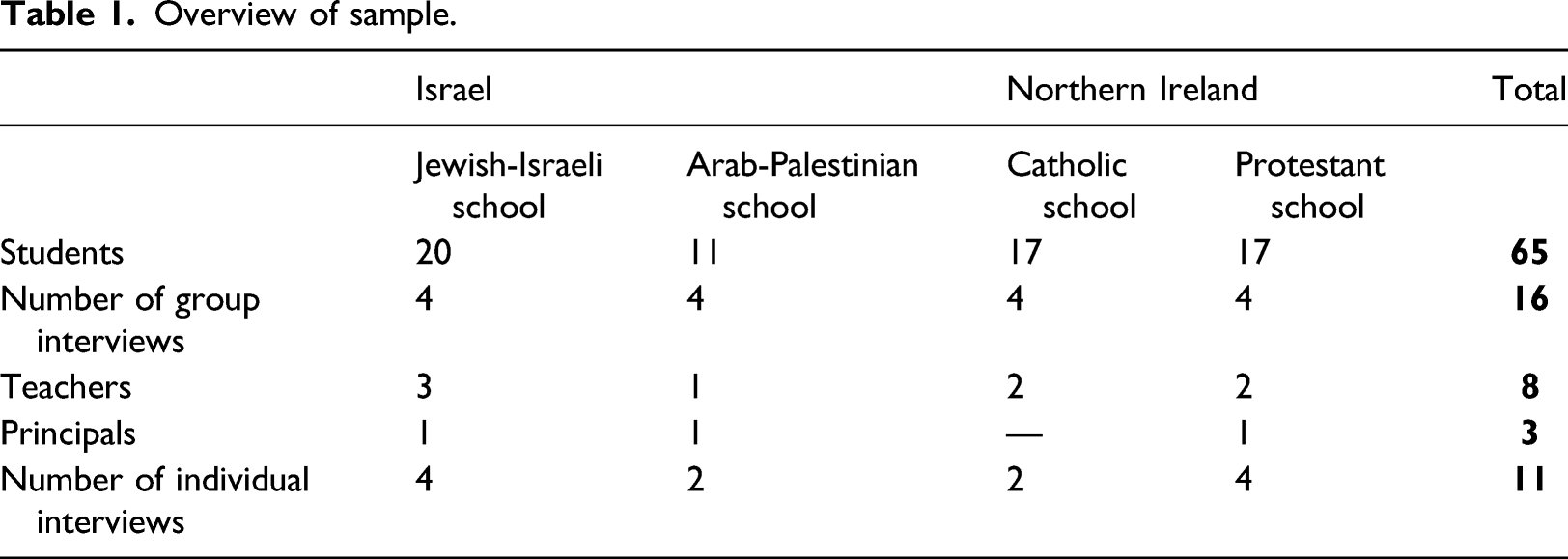
We gained access to the schools through citizenship teachers, who were recruited drawing on our existing contacts to teachers and educational NGOs. All schools were located in or in proximity of larger cities. The school populations in Northern Ireland were considered working-class, whereas in Israel the students came from more middle-class backgrounds. While we did not consider class affiliation as a selection criterion, it emerged as having an important role in our findings, as we will discuss in our conclusion. Individual interviews were undertaken with 3 principals and 9 citizenship teachers and group interviews were conducted with 65 students. In the Catholic school, the principal refused to be interviewed and in the Protestant school, the vice-principal was interviewed instead of the principal. Most students were recruited from years 9 and 10 (key stage three) in Northern Ireland and years 9–12 in Israel. They all had been recently taught CE or a closely related subject. 4
Ethics
The research was granted ethical approval by the School of Education’s Ethics Committee after which information and consent forms were forwarded to participants. The commitment to informed consent, voluntary participation, retrospective withdrawal, anonymity and confidentiality was conveyed to participants and adhered to during data collection and analysis. The research proceeded only when written consent was granted by participants. Young people were interviewed after they gave permission and after their parents or guardians’ consent was received. All forms were additionally translated into Hebrew and Arabic.
Methods
The study employed multiple methods (individual and small group interviews, observations of classroom interactions and analysis of teaching and curriculum materials). The interviews served as the main data source while observations and documents helped to gain a better understanding of the particular context of each setting.
Semi-structured individual interviews were conducted with principals and citizenship teachers from each school. Students were interviewed in small groups (2–6 students) to mitigate power imbalances between them and the interviewer and to provide opportunities to probe and comment on each other’s views. The questions focused on the participants’ understandings of citizenship and the conflict as well as their experiences of teaching and learning CE.
Analysis
Interviews were transcribed and then analysed using a reflexive thematic approach (Braun and Clarke, 2019). First, we organised the data using the software Atlas.ti and then combed it for emerging patterns and themes as an initial open-coding. We discussed these initial codes and focused on those that captured students’ and educators’ interpretations of CE, citizenship and the conflict. After multiple coding and re-coding processes, we organised codes into larger themes and refined those after we identified important relationships and patterns in the data. Our coding followed a latent approach in the sense that we sought to identify underlying concepts, assumptions and ideologies and a constructivist approach, as we also explored how participants construct their reality as teachers and learners of CE.
Reflexivity
Cross-cultural research in particular demands cultural sensitivity on part of the researchers who need to develop deeper cultural knowledge about themselves and the communities they study (Liamputtong, 2008). Our cross-cultural sensitivity was heightened by our prior experiences and varying positions as insider and outsider researchers (one author is German but has lived in both Northern Ireland and Israel for extended periods of time; the other is Irish Catholic and grew up during the conflict in Northern Ireland). Our different prior experiences and perspectives allowed for a robust exchange of views as our interpretations of issues pertaining to identity, citizenship and pedagogy were challenged by the data and by each other.
Findings
Participants interpreted CE in various ways, which we have summarised into three themes that shed light on the practice of CE in conflict-affected societies: Firstly, CE can empower students by providing a space to explore identities and conflict narratives, teaching about citizenship rights and challenging one-sided views. Secondly, CE can be a political tool, a controversial subject in which learning is compromised by the influence of state policies and community narratives; and finally, CE was framed as performance that succumbs to and is embedded in neoliberalist practices. It became evident that schools are reproductive places of particular communities’ interpretations of the conflict and citizenship, which teachers at times adopted or challenged.
Some themes were stronger in one school than others and some were heavily influenced by contemporary political events, the school context, or the teacher’s approach. We discuss the themes and situations simultaneously. All names that are mentioned in the following are pseudonyms that were chosen arbitrarily so that the readers cannot recognise the participants’ identity. Teachers are referred to as ‘Mrs’ or ‘Mr’ and students by their first names.
CE as empowerment
Being confronted with particular challenges in conflict-affected settings, active CE may be re-envisioned as empowering young people to transform conflict into dialogue and advocacy by drawing on human rights, diversity and problematising social injustices (Akar, 2020). Participants from the four schools engaged in discourses about the conflict and injustices, and some relied on rights discourses. They presented two main strategies that hold potential to make CE more relevant and empowering: first, by connecting it to students’ personal and community histories, and second, by challenging one-sided narratives and broadening students’ knowledge and perspective of the conflict. Importantly, the participants’ particular community background seemed to influence their interpretations of what meaningful CE constitutes.
In the Catholic school, teachers emphasised the importance of discussing the local context and conflict in CE. The conflict’s continuous relevance is exemplified by the fact that the area surrounding the school is decorated with murals and memorials depicting the ‘Troubles’ and the Catholic civil rights struggle. During the group interviews, some students mentioned that their families were affected by the conflict. For example, Emma (a pseudonym, as are all names in the following) recounted that her great-uncle was involved in the hunger strike of Irish republican prisoners.
5
The conflict was not only seen as historical but as still ongoing by the students who shared experiences about sectarian and paramilitary violence from their community in the interviews. Reflecting the historically difficult relationship between the Catholic community and the police, some comments suggested an ongoing distrust in the police, an observation that has resonance in the literature (Holland and Rabrenovic, 2017): Shauna: … [T]hey [the police] shoot people. […] Catriona: [T]he more people don’t like them [police] the more danger they are in because they [the police] are just going to arrest people […].
Since the conflict and its legacy remain relevant for his students, one of the citizenship teachers stated that he provides a space in class to discuss their perspectives of the conflict, while he also attempts to challenge one-sided accounts: They grow up [with the Troubles], they hear about it, their parents talk about it, their family has maybe been involved or imprisoned or died […]. So, it’s right there it is still living. […] You have to [address the conflict]! […] You don’t get into massive depth […], but you do listen to their stories and what they’re saying, what they have heard and what they have been told … But you know also try to show the other side of it too, … to make them understand that they are not the only victims […] [Y]ou just try to give like- … a broader understanding of what it was. (Mr Moore)
Similarly, another teacher highlighted the importance of discussing sectarianism and racism in Northern Ireland instead of addressing these issues in the context of other countries: Maybe there is not as much emphasis on local issues as global … Obviously you could re-do the racism [part]. You could look at racism in Northern Ireland and you can look at sectarianism in Northern Ireland […] I think it is more important to children to see their own community before they start looking out maybe. (Mrs Kelly)
Mrs Kelly argued for a better integration of local citizenship issues into the curriculum and named it together with strengthening students’ active participation as important goals of CE, echoing perhaps the tenets of active citizenship: Probably [the goals of CE are] to make children have a better understanding of their local as well their global community and to see you know what their responsibilities are as well as their rights and kind of make them have an active voice to participate more in society than being just you know quiet bystanders.
Mr Moore also described CE as empowering for his students who come from a socio-economically deprived and crime-ridden area. He argued that CE can increase their political and cultural awareness as well as their self-confidence: I suppose to develop an understanding and respect for other people and other cultures and for themselves [are the goals of CE]. […] through citizenship it helps broaden their awareness and helps develop their own self-confidence […].
Both teachers emphasised the importance of discussing the local conflict and conveyed active approaches to CE: Mr Moore stated that he tries to get his students to reflect on their conflict narratives while confronting them with other perspectives and increasing their awareness; Mrs Kelly highlighted the importance of addressing sectarianism in Northern Ireland and of equipping students with an ‘active voice’ in societal issues.
These approaches partly resonated with the students from the Catholic school, who also saw CE as an important subject because it allows them to learn about the conflict: Lucas: Especially here like [citizenship is an important subject]. Patricia: […] Like to help us get on cause like usually there is a lot of controversy between us and Protestants so like if we learn more about it and we like both say “let’s come together” and it’s not as bad as it is.
Like their teachers, these students interpreted CE as a space to explore the local conflict. Concepts such as equality and rights were frequently referenced during the group interviews, for example, ‘Everybody is a citizen like no matter what’s your race or what’s your colour or- […] Rich or poor no matter what’ (Emma), or ‘we are all different in different ways but we should all be treated equal’. (Mike). Both, teachers’ and students’ interpretations of CE suggest that they see discussions about the conflict and sectarianism as integral and some define citizenship as participation, claiming rights and equality – reflecting the notion of active citizenship discussed above (Akar, 2020).
The Protestant school was located in an area where a strong community identity was manifested in the proliferation of Union flags around the school area and most students came from areas with a similarly strong Unionist ethos. Here, importance was also attached to learning about the recent conflict. The school’s vice-principal (who also taught citizenship) stated that it is important to teach about ‘the Troubles’ and that it can help students to understand sectarianism and whether it plays a role in their families. According to him, his students do not have previous knowledge about the conflict: I would show them videos, maybe of atrocities that have happened, […] this is the legacy we had in Northern Ireland. […] And they have no knowledge of these things, you know and I’m showing them things that they never would have been told about. And it helps them [the students] maybe understand now some of the prejudices their parents still have. (Mr Adams)
While this statement only reflects Mr Adams’ personal experiences, it is interesting how it differs from the statements by the teachers from the Catholic school who stated that they discuss students’ views and narratives about the conflict in the classroom.
Yet, another teacher, Mrs Fox, explained that her students hold opinions about the conflict but that these are mainly shaped by their parents’ and community’s perspectives, suggesting that their views are one-sided. She argued that CE allowed new opportunities for students to engage with alternative perspectives and that encouraging students to reflect more critically on parental views was a key part of the teacher’s role: [I]t’s very important that you get pupils to think. Ok, you’re not going to necessarily change their mind, but at least, if they start thinking about things and form their own opinion rather than just following what their parents have done, or what their community does. […] I have pupils in class who are very adamant in their views and that’s what they are grown up with, that’s what you know is propagated at home or whatever. So, I see it as part of my role to try … to break into that and get them to think, get them to maybe question their own views. (Mrs Fox)
Instead of drawing on their students’ stories about the conflict as the teachers in the Catholic school did, the teachers from the Protestant school rather sought to challenge and complement their students’ knowledge about the conflict that they gain from home.
The students from the Protestant school had difficulties in defining citizenship, as some explicitly stated that they did not know what citizenship was or that it was not important to them (‘I don’t think it’s [citizenship] important to us’ (Ian)). This was striking as many of these students lived in high-conflict areas, which were deeply affected by ‘the Troubles’ and where paramilitaries remain active (Holland and Rabrenovic, 2017). In the group interviews, the students described the influence of the paramilitaries in their neighbourhood and how they affect young people’s lives in negative ways through drugs and violence. While their teacher hoped that by teaching them about the Northern Ireland conflict students would gain a better understanding of ongoing sectarianism and perhaps also community violence – students did not create this connection and did not seem conversant in central concepts of CE.
Although teachers in both schools were keen to empower students, the circumstance that teachers from the Catholic school framed CE in terms of rights and active participation is significant. The Nationalist community has traditionally invoked a rights discourse when articulating their grievances within the state, a discourse that is notably less evident within the Unionist communities (Cahill-Ripley, 2019). It also shows the greater difficulty for teachers from majority communities, who are often framed as the dominant power in the conflict to reappraise the past and to make concepts such as rights, equality and citizenship meaningful to students by connecting them to students’ personal experiences compared to teachers from minority communities, who are likely to be framed as the main victims. That these differences are asserting themselves within the classroom highlight the implicit and reproductive nature of schools in conflict societies and the importance of teachers and the curriculum in defining and legitimising the ‘right way’ to think for students (see also Bekerman and Zembylas, 2011).
In the Jewish-Israeli school, it also became apparent that the particular community ethos played an important role in how students and teachers interpreted CE and the conflict. The school was located in a kibbutz (a collective community), in proximity of a large city.
Two teachers from the Jewish-Israeli school rejected the citizenship curriculum, which had been revised to reflect the more national-religious agenda of the ruling government at that time (Pinson, 2020), as too theoretical, elitist, not relevant to the students’ lives and not teaching them the skills necessary for democratic deliberation. They stated that they created their own teaching materials to make the subject more accessible and relevant to students. Similar to the teachers from the Protestant school, one of the teachers explained the importance of teaching students to reflect critically on information they receive from parents and peers or the news: Mainly [the goal of CE is] I think to teach the students how to think and to fight for subjects that are important for them and to not take everything for granted and what the newspaper says that this is the only truth and things like that. […] I want them to learn how to ask questions …to criticise the information that they are getting from the parents, the school, from friends, from everyone. (Mrs Weiss)
Mrs Weiss constructs active CE as participation and critical thinking and perhaps in this way, she tries to strengthen students’ democratic skills and knowledge about social injustices that are downplayed by the new curriculum. This approach was reflected in some of the students’ comments who referred to racism and stereotypes towards Arab-Palestinians – a topic which is not discussed in the official curriculum: Alma: …[W]hen one Arab does something bad to our people, we think that all of them are like that. Jonathan: In the United States they have a lot of racist people like the black and white thing, here it is Jewish and Arab[...].
Parallels between the Protestant and Jewish-Israeli schools are notable: in both schools, teachers sought to empower their students by balancing one-sided views and strengthening critical thinking about the conflict among their students as a way of ‘correcting’ their views. Yet, in the Jewish-Israeli school, some students were aware of discrimination inflicted by the Israeli state on Arab-Palestinian citizens, which perhaps reflects their identification with the Zionist-left with which many students and teachers were affiliated, according to the participants. However, as will be discussed in the next section, debates that referred to more contested issues related to the Israeli-Palestinian conflict were more complicated.
Compared to the other schools, discussions about the conflict and active approaches to CE were most vivid in the Arab-Palestinian school. This school was located in a mixed city in Israel, where Arab-Palestinians and Jewish-Israelis live in separate neighbourhoods. Like in many other cities in Israel, most of the Arab-Palestinian population was expelled or fled during the 1948 war and the city was repopulated with Jewish immigrants. The school has a Christian ethos, serving both Christian and Muslim students, largely from middle-class backgrounds.
Many students referred to discrimination by the state and racism as part of their everyday civic experiences: ‘There are many, many examples [of how our rights are restricted]. We want and we expect from the country to treat everyone the same way! Not … because [someone] is Jewish’ (Nadia), or ‘we are just second-class citizens’ (Lina).
Even though topics related to racism and discrimination against the Arab-Palestinian population are not addressed in the curriculum, the citizenship teacher found ways to discuss these topics through concepts of rights and equality: There is nothing about racism [in the curriculum], but you know you have the right of equality, and from it, we can talk about racism and the different ways of practice with one and another, you know discrimination. So, we talk about it and of course, we talk about Arabs and Jews. (Mr Musa)
Similar to participants in the Catholic school, he drew connections between the concepts of rights, equality and discrimination, connecting them to the local conflict. Such approaches to CE by Arab-Palestinian citizenship teachers were described in previous research (Agbaria and Pinson, 2019).
Yet, arguably stemming from their conflictual reality, students from the Arab-Palestinian school could draw on experiences of rights violations, whilst their Catholic peers framed state violence mainly as a collective historical experience. These personal experiences and discussions about rights may have contributed to the fact that students also interpreted CE as an opportunity to learn about their citizenship rights – knowledge that can help them to hold the Israeli government accountable: Kaira: It’s important to learn and to know about our rights. Amira: To know how to deal with the situation. […] Kaira: If something happens we have to know what we have to do, what they [the government] have to give us. To know if I’m oppressed or not. Then I know how I can deal with the problem.
These interpretations of CE may reproduce a wider discourse of the Arab-Palestinian community that reframes citizenship in Israel as a means to improve their status and their struggle against discrimination by the state (Jamal, 2007).
CE was interpreted differently in the four schools: in the Protestant and Jewish-Israeli school, teachers highlighted critical thinking and balancing one-sided views as they perceive pupils to be socialised into a particular perspective of the conflict; while in the Catholic and Arab-Palestinian school there was a greater focus on learning about injustices as well as rights and participation. Differences were also noticeable between the conflict and post-conflict context, as rights violations by the state were perceived as more acute in Israel than in Northern Ireland.
These differences in the framing of CE illustrate how universal concepts of citizenship, human rights and democracy are translated against the background of particular communities – even in the context of a common curriculum. Notably, teachers from all four schools perceived the curriculum as not sufficiently relevant to the students’ lived reality, prompting them to reinterpret citizenship in more meaningful ways. While teachers from all schools seemed to envision CE as active citizenship building on human rights, equality and critical thinking in relation to the conflict, minority and majority groups vary in their readiness to adopt these concepts – an issue that has been noted in previous research (Agbaria and Pinson, 2019; Cahill-Ripley, 2019; Gordon, 2012; Goren and Yemini, 2018). It emerged that it is more difficult for teachers from majority communities (Protestant and Jewish-Israeli) to connect these concepts to their communities’ recent history and thus make them relatable for the students, whereas active forms of CE were more readily embraced by the minority communities.
In the following section, we discuss how CE is further complicated due to its emotional dimension and its politicised character.
Citizenship education as a political tool
Besides participants’ interpretations of CE that can empower students to become politically aware and active, CE was also utilised as a political tool – a space that students use to amplify dominant narratives of the conflict, which they likely have been socialised into through their communities. Previous research has established that even when contested narratives about the past are avoided in school curricula, they remain deeply politicised and implicated in teachers’ and students’ biographies and emotional experiences (Laketa and Suleymanova, 2017).
During the group discussions, partisan views were expressed and notably, this stultified the discussion about the conflict and injustices. This was particularly evident in the following exchange amongst students in the Catholic school. The students were asked to explain why the conflict emerged in Northern Ireland. Shauna began the discussion by stating that ‘the Troubles’ was underpinned and motivated by the claim to superiority of Protestants/Unionists over Catholics/Nationalists (a view that has resonances across the literature, see Ruane and Todd, 2014). Shauna: [I]t’s like because people think they are more superior to others, like because of their race or their religion or- all of that and that’s about it. Ciaran: No! Shauna: I haven’t really thought about it that much. Ciaran: It’s all wrong! Ireland is one! One day Ireland and Northern Ireland will come together and all 32 counties will be just one. Interviewer: Alright and what is your version [of the conflict]? Catriona [talking for Ciaran]: [I]t’s their fault, from the British people in the past- but they still kill so many innocent people! […] I know the IRA (Irish Republican Army) did it too! […] but the only reason why the IRA was ever made was because they couldn’t stay in their own country. Like if they had left us alone nobody would have died.
This exchange reveals the difficulty of engaging in conversations about emotionally charged topics related to the conflict – an issue that has been broadly discussed in the literature (McCully et al., 2002; Zembylas and Loukaidis, 2021). Specifically, it shows that even where spaces are granted for discussion, the strong views held by some can silence and prevent others from sharing their perspective and effectively allow the dominant and often partisan narrative to prevail. Whilst the curriculum and the teacher seek to broaden perspectives, it seems that students have not fully absorbed the need to listen and engage with alternative views. In this way, CE acts only as a space to reflect and reinforce deeply held views rather than challenge them.
This issue emerged also in the Jewish-Israeli school, where nationalistic sentiments and a concern for security dominated discussions about the conflict. One teacher referred to the controversy about Adam Verta (a citizenship teacher who was fired because he expressed critical views about the occupation and the army towards his students, which sparked heated debates in Israel (Gravé-Lazi, 2014)) and explained why some teachers fear to address the conflict: ‘[A] lot of teachers are afraid to create even - not only to say their opinions- to create a debate in the class. Because everyone is shouting and some of them [students] will get offended’ (Mr Kaplan).
How classrooms become emotionally charged spaces for students, as hinted by Mr Kaplan is shown by the following exchange. The students were asked to explain their perspective on the conflict to a foreigner (the interviewer). Perhaps the mentioning of the ‘foreigner’ triggered or contributed to the students’ emotional response, who strongly disqualified (foreign) critique of the Israeli governments’ policies towards Palestinians as ‘wrong’ and blamed the Palestinians for the conflict: Ariela: I’m so upset with all the world because everyone is angry about Israel but they don’t really understand what is going on here. […] We are so angry about what all the people say about us because it’s not right, they are wrong. […] Adam: Because we gave the Sinai [to the Arabs] and nothing happened. Ariela: They continued to fight. They want- in 1948, we wanted to give them 45 percent of this country but they said no. This is their problem! Doron: They want more! Something is not enough.
These comments reflect a wider nationalistic and security discourse that is also supported by the Zionist-left in Israel (Aronoff, 2019), thus perhaps reflecting dominant discourses from the students’ home and community. This exchange also suggests that students have only partial knowledge about events around the conflict and it shows how students’ selectively draw on historical events and curriculum knowledge to bolster dominant views (Barton and McCully, 2005). This impression was reinforced by their teacher, who complained about the students’ lack of knowledge about the Israeli-Palestinian conflict: They don’t know the history, they don’t know what their rights are, they don’t know what the Arabs’ rights are, they don’t know what is happening in the [occupied] territories, or even in Israel, they don’t know anything. They don’t know where the borders are. (Mr Kaplan)
Notably, this issue was mentioned in both the Protestant and Jewish-Israeli school, perhaps resulting from the circumstance that the conflict is more likely to be avoided in majority communities who are perceived as the dominating actor in the conflict. This avoidance by teachers and curricula creates a vicious circle because students do not gain sufficient background knowledge to engage in nuanced and multi-sided debates about the conflict.
Concerns about students’ and parents’ reactions were also mentioned in the Protestant school, where the vice-principal explained how confronting students with material that challenges partisan community narratives can be risky for teachers. Yet, instead of fear by government authorities and backlash by the students as is the case in Israel, he referred to the risk of being assaulted by parents who are affiliated with the paramilitaries that continue to ‘police’ certain areas in Northern Ireland and engage in violent and criminal activities (Holland and Rabrenovic, 2017): I think they were murderers [members of the UDA [Ulster Defence Association]). But I can’t say that to these kids, because some of those kids, their fathers are in prison, you know.[…] This was actually quite dangerous- I showed them a video of [an incident where someone from the UDA shot people from the IRA] [...] Now, I could have [the attacker’s] family contact the school saying “This was completely inappropriate”, but I was just showing a news article […] So, it is really difficult, it is a minefield. And this is actually why in some schools the teachers just think “it’s too much risk”. (Mr Adams)
This example shows how communities indirectly censor critical approaches to CE through a culture of fear targeting those who challenge dominant narratives.
Consequently, due to the absence of balanced discussions about the conflict, students’ sectarian views are not challenged. Such views are featured in the following discussion among students from the Protestant school. At the time of data collection, the local government decision to remove the British flag from Belfast City Hall came up in the discussions. This decision had prompted significant disturbance and street protests by members of the Unionist/Loyalist communities who believed that it represented an erosion of their British identity (Hearty, 2015). The views expressed by students in the Protestant school echoed these sentiments and for some, it represented the disproportionate and somewhat delegitimised position of ‘Catholics’: Jacob: It’s politics like- Stormont that like make like all these decisions that- basically nobody likes. […] They said take down the Unionist flags and that sparked protests and stuff. … that’s what starts the actual protests. Niall: Yeah, because like they chose to take down the Union flag. […] Nobody else had a choice in it. It’s cause Catholics didn’t want, they said to Sinn Fein- Lucas: But it’s not their country- Niall: Technically it is, but it is divided, that’s why it was divided.
These comments by students from the Catholic, Protestant and Jewish-Israeli schools are notable for their lack of nuance and partial understanding of the issues in Israel and Northern Ireland. This is however not surprising as students are rarely confronted with alternative views and knowledge about the conflict. Even though teachers stated that they try to have debates with their students or introduce alternative information, these seem overshadowed by hegemonic partisan perspectives of the conflict.
An exception to this was the Arab-Palestinian school, where the conflict was also an emotional topic, but different views were exchanged. Their teacher explained that heated discussions are common when they relate to students’ different identifications either as ‘Israeli’ or ‘Palestinian’. However, these identities were not only constructed as opposing but also as complementing the particular identity and political reality of the Arab-Palestinian community in Israel, as one student described: I feel confused about who I am. Most Arabs in the country are confused about their identity. I don’t know to which side I belong because both sides [Israeli and Palestinian] don’t accept me. […] I feel both of them, I understand both of them. (Fahad)
These different identifications that arguably stem from exposure to both cultures may inform multi-sided discussions about the conflict as the following exchange between two students illustrates. They debated whether to accept the status quo or to address injustices perpetrated by the state: Yasmin: There are people who think that it’s not enough what they [the Jewish-Israelis] give us, but I think that it’s enough – for me. I study here, I have family- Rabia: Shall I tell you why you feel so good - because you compare yourself to the Arab countries where there is no study, no family. We should compare ourselves to a better place, not to a bad place. (…) You think our life here is perfect because you see it on the TV on the news […] Yasmin: Yeah, compared to them we have a good life. Rabia: […] But there [are] things you can’t do, you can’t say in the street whatever you want.
Perhaps as a result of being acquainted also with Jewish-Israeli perspectives on the conflict through the curriculum and media, the students also criticised violence that was committed by the Palestinian leadership and civilians (and the political situation in other Arab countries, as the previous exchange showed): Amir: [We talk about] [d]ifferent perspectives. Also in class we are saying “you know guys the Arabs are not the poor guys here, they also do -” Sada: Some horrible stuff for example, the Hamas and the Fatah- Lina: Not necessarily, sometimes it’s like simple citizens they also- Sada: They are trying to defend themselves but they also kill some civilians so it’s not cool.
In contrast to the other schools, discussions that include different perspectives about the conflict actually took place. Pinson’s (2008) study has demonstrated that Arab-Palestinian youth draw on different citizenship discourses: ‘Israeli’ as an official citizenship identity and ‘Palestinian’ as a national identity. These two perspectives seem to inform the dominant discourses in the citizenship class and shape also students’ stances towards the conflict.
Nevertheless, similar to the Jewish-Israeli and the Protestant school, fear of being exposed as a ‘dissident’ was also mentioned. One of the students stated that he feared being monitored by Israeli authorities when searching for alternative information on the internet: Yeah, the internet [is a way to learn about our history]. You know you can’t look at anything on the internet without having somebody else seeing what you are looking at. […] They can take your information and turn it against you. (Amir)
Therefore, in both Northern Ireland and Israel censoring processes exist or are perceived to exist – albeit from different sources – that perpetuate fear among teachers and students from engaging with alternative perspectives and discussing those in the classroom.
There is wide agreement that the deliberation of different views contributes to effective political participation by teaching democratic values, commitment and critical thinking (see for example Hess, 2008). However, the data from the schools illustrate why educators and students may avoid engaging in these challenging debates, as they are overshadowed by dominant community discourses and a culture of fear and silencing. Students do not enter schools as ‘blank slates’ but bring their personal experiences, interpretations and myths of the conflict into the classrooms that are influenced by their social and cultural backgrounds (McCully et al., 2002).
In addition, the data also show how students and teachers can become accomplices in censoring processes that originate in partisan community cultures and oppressive state policies and together with teachers’ inability or unwillingness to challenge these narratives, discussions about different perspectives on the conflict do not seem to evolve. Yet, the example from the Arab-Palestinian school demonstrates that when students are exposed to different perspectives and citizenship discourses, deliberation about the conflict remains emotional but students seem more ready to engage in it.
However, as the next section will demonstrate, there was a danger across all schools for CE to be downplayed by neoliberal ideologies.
Citizenship education as performance
The dilution of CE through neoliberal policies and the privileging of a market rationale in education has been widely discussed in the literature (e.g. Donnelly et al., 2020; Mitchell, 2003). As a result of this shift, CE has increasingly focused on teaching necessary skills for individual success in a global economy, conceptualised citizens as entrepreneurs and consumers and reduced citizenship to passivity and political complacency (Brown, 2009). Neoliberal culture sets a clear focus on performance, defining examination preparation as the main task of educators and leaving them with fewer opportunities to foster critical thinking and discussions about controversial content (Journell, 2010).
A focus on performance was also apparent in the interviews with teachers and students. For example, Mr Kaplan from the Jewish-Israeli school stated that students and parents mainly focus on passing the matriculation examination: They [the students] don’t see in him [the teacher] a figure that they can speak with about it [values]. […] [T]hey want the teacher to help them to get past the exam. […] And also their parents are very strong[ly] opinionated about that.
Mr Moore from the Catholic school explained that when the focus shifts to public examinations at the end of year 12, CE loses its capacity for empowering students: ‘It’s almost like it’s going backward […] with citizenship you are building up these skills and this empowerment and this knowledge and then all of a sudden, all the participation stops’.
Similarly, Mrs Fox from the Protestant school argued that CE topics that require an in-depth study are only addressed superficially because of the time pressure: You don’t have time to really focus on anything, in my opinion, if you want to develop that kind of critical thinking. And there are aspects of it that are difficult for pupils to understand you know, unless they read a lot, watch the news, talk to people.
Perhaps resulting from the pressure of academic performance and the challenges imposed by the controversy of CE, the subject may be indeed interpreted as irrelevant for students, culminating in a statement by Lucas, a student from the Protestant school, who said: ‘I don’t know what citizenship is at all. […] No [citizenship doesn’t really matter to young people]. […] But you don’t really have a chance to understand it, because no one is like really explaining it to you’. Similarly, a student from the Catholic school stated other subjects are more conducive to finding a job: I think it [citizenship] is still an important thing to learn, but you have to think about getting a good GCSE [General Certificate of Secondary Education] or something, to get a job. It’s just nice to have you know, but the main things are Math, English, and Science maybe. (Max)
For students like Lucas and Max, who may be interested in thoroughly understanding CE, this opportunity is taken away by the performative culture that reduces CE to a grade.
Whereas the teachers from the Jewish-Israeli, Catholic and Protestant schools criticised the influence of the performative culture, Mr Musa from the Arab-Palestinian school described it as his role as a citizenship teacher to support his students’ professional careers. He argued that Arab-Palestinians can realise their rights and equality through social advancement in Israeli society: [The challenges for citizenship teachers are] just to teach the pupils, to go to study, get high jobs, and then university and after all that you can have your rights, not only your rights but you can live like a human being, equality!
Previous research has demonstrated that Arab-Palestinian schools in Israel promote a strong focus on individual success and socio-economic mobility (Pinson and Agbaria, 2015), and Christian Arab-Palestinian schools are considered particularly high-achieving (David, 2014). Pinson and Agbaria have argued, however, that this socio-economic mobility, which is also promoted by Mr Musa, only benefits a selected few and that the focus on testing erodes the schools’ role as contributors to community development and social change.
Therefore, across all schools the pressure of academic performance and employability among schools and students risks overriding the importance of CE as a space to explore the complexities of the conflict and identity by curtailing the time and opportunities needed to do so. Together with the challenges imposed by the conflict in Israel and Northern Ireland, the neoliberal culture contributes to reducing CE to a minimal and passive subject. As the example from the Arab-Palestinian school demonstrates, even when multi-sided discussions about citizenship and the conflict take place, these are subordinated to educational success.
Whilst there are obvious implications for policy makers who may need to offer stronger guidance in terms of what and how teachers teach this subject there is much that schools and teachers can do. For example, the tendency towards superficial and minimal approaches to teaching CE might be overcome if school leaders signal the importance of the subject and embed it in the culture of the school.
Conclusion
The three different ‘faces’ of CE that we found across schools in Northern Ireland and Israel show the deep entanglement of the subject with political and socio-economic contexts but also community cultures that are reproduced as different interpretations of citizenship in schools. Differences in interpretations of CE are also manifested between conflict and post-conflict contexts: In Israel, the ongoing conflict shapes state policies that censor criticism of governmental institutions and alternative perspectives of the conflict but also fuels the Arab-Palestinian struggle for equal citizenship rights that is reflected in teachers’ and students’ interpretations of CE. In Northern Ireland, censorship is largely exerted by communities who hold onto partisan views, while the curriculum provides an impetus for teachers to address human rights and social injustices.
However, across all schools, it became evident that students reproduce censorship in the classroom by drawing selectively on knowledge about the conflict to bolster partisan views and silencing others, and that censorship is further reinforced through neoliberal ideologies that downplay the importance of CE and force teachers to focus on examination preparation and curriculum knowledge. Even though CE curricula include important concepts to facilitate active CE, they do not sufficiently mandate teachers to teach critically about the conflict and challenge partisan views. These processes lead to thin and passive interpretations of CE that do not contribute to conflict transformation.
Nevertheless, identities and cultures are not monological but they respond to specific circumstances and contexts and can change when their political, social and economic conditions change (Appiah, 2010). Evidentially, as political changes affect identifications this also affects how citizenship is interpreted (Isin and Wood, 1999). Old binary clusters of Catholic Nationalist Republican and Protestant Unionist Loyalist are increasingly broken up and reinterpreted in Northern Ireland (Hayward and McManus, 2019; Mitchell, 2020). As Mitchell argued, social change has outpaced Northern Ireland’s still polarised social structure and political system that was set up by the peace agreement. Framed differently, while identity as groupness has provided legislation for minority rights and equality, identity as an experience, both as Nationalism and Unionism, has arguably moved on from the two traditions paradigm and constitute now more complex categories (Todd, 2021). Our data show that opportunities exist for educators and students to explore different meanings of being Catholic and Protestant despite structural barriers, giving hope that ‘politics can catch up with the people’ (Mitchell, 2020: 29).
In Israel, despite ongoing discrimination, it is clear that Arab-Palestinians have developed an awareness about their citizenship identity and rights in Israel and make pragmatic use of them for their individual and collective empowerment. Similarly, in the face of increasing control and intimidation by authorities and right-wing organisations (Pinson, 2021), it is powerful that some Jewish-Israeli teachers rebel against these silencing attempts by strengthening their students’ critical political awareness. However, the ongoing violent conflict continues to feed into opposing identity constructions of ‘Israeli’ and ‘Palestinian’, creating structural and contextual barriers to negotiating different meanings of these identities and reimagining transformative and active citizenship.
Nonetheless, in our study educators and students in both societies engaged in discourses about citizenship, identity and the conflict – however, they lack safe spaces and curricula that adequately mandate them to brave this ‘minefield’, as framed by Mr Adams.
Variations of interpretations of CE amongst different communities may point to their need for different educational approaches, as previous research has argued (McCully et al., 2002; Rubin and Hayes, 2010). Rubin and Hayes suggested that in majority settings there is a greater need to engage in critical civic issues that may be alien to many students, while in minority settings, where students are more likely to be familiar with these issues, there is a greater need for students to create opportunities to be heard and enable them to make use of the civic institutions available to them. Importantly, however, our data also showed the intersectionality of majority and minority contexts with class – as Arab-Palestinian students may have felt more empowered and Protestant students more disadvantaged based on their differing class backgrounds.
The findings further exemplify the tensions inherent in citizenship between particular community contexts and universal concepts. While it is important to acknowledge particular community contexts and the need to adjust CE to these, universal concepts should not be compromised to an extent to which they become merely rhetorical. It seems possible that when the tenets of transformative CE are upheld, new identifications and understandings of citizenship can be formed that are based on democratic values and human rights rather than protective community attachments. Human rights in particular have been identified as an important tool for education in conflict societies as it can provide a robust and legitimate framework for debates about the conflict that teachers can refer back to (Donnelly et al., 2020). Such frameworks are also important for integrated, bilingual and shared education contexts in conflict-affected societies. Despite their potential for cross-community encounters and discourses, these shared contexts have been found to be affected by similar structural issues of avoidance and a neoliberal educational culture (Cohen and Bekerman, 2022; Hughes et al., 2016). Yet, how CE is taught in separate and bilingual/integrated contexts warrants further research.
There is a need for a political discourse in Northern Ireland and Israel on how to anchor CE within concepts of human rights and transformative citizenship that go beyond a rhetorical commitment and that engage students critically with discomforting pasts.
Footnotes
Acknowledgements
We like to thank the participants in Northern Ireland and Israel for generously giving us their time and insights into their experiences.
Declaration of conflicting interests
The author(s) declared no potential conflicts of interest with respect to the research, authorship, and/or publication of this article.
Funding
The author(s) received no financial support for the research, authorship, and/or publication of this article.
