




Abstract
This study explores conceptualisations of global citizenship education expressed by teachers and students in international schools. Using qualitative research, three schools were investigated in the Netherlands, Finland, and Australia. Data for this study was drawn from phenomenological interviews with secondary school students, teachers, and school leaders. The study’s findings show that young people experience global citizenship through feelings of a global community, by participating in curriculum-based community service, within charity frameworks, but also in student activism. Teachers and school leaders displayed conceptual uncertainty of global citizenship education and tended to stay within their comfort zones. The article concludes that international schools could benefit from more social justice oriented approaches to global citizenship education.
Introduction
The fractured world of the early twenty-first century needs more people who see themselves as global citizens, with an informed humanitarian vision and a committed sense of social justice. Solidarity is a principle within cosmopolitan citizenship and human rights education (Osler, 2016). It is associated with a social and participatory form of citizenship education (Sant et al., 2018; Westheimer, 2015). When teachers and students absorb and start to live these ideals the results can be uplifting. This includes teachers like Ben:
‘I think when we talk about global citizenship, I think it’s, it’s understanding the world we live in so when we are doing something, for example, about sustainable development, they can understand, the older ones, the politics behind why it’s not being addressed, for example and what they as individuals might be able to do and what they as a group can definitely do’. (Ben, school leader and teacher, Finland).
It also encompasses students like Aran:
‘I think being a global citizen is not only living for yourself and surviving life, but you know, working for others and you know, the global cause and like, universally for everyone. Contributing’. (Aran, student, Finland).
If this sense of cosmopolitan citizenship is going to be nurtured anywhere, then it might be assumed that international schools would be a good place to look for clues and guides to educational practice and related challenges. Research into practices of global citizenship is crucial for determining imagined and real planetary futures. Creating global citizens is an explicit aim of international schools (Hayden, 2006; Tarc, 2009; Yemini and Maxwell, 2020). This paper examines differing conceptualisations of global citizenship education [GCE] articulated in interviews with school leaders, teachers, and students as part of a wider comparative study positioned within a social constructivist paradigm of identifying expressions of GCE and international mindedness in International Baccalaureate [IB] international schools in The Netherlands, Finland, and Australia (Ferguson, 2022). With the assumption that learners and educators will construct meanings of global citizenship in their social lives, this paper addresses the research question ‘What are the articulations of global citizenship education in International Baccalaureate international schools?’ The paper contributes to empirical research in the understandings and manifestations of GCE in international schools. It provides insight into the practical enactment of global citizenship education linked to the lives of students.
Literature review
Global citizenship education
Global citizenship education is defined by UNESCO as comprising cognitive, socio-emotional and behavioural learning to understand the world and actively participate for peace and inclusion (UNESCO, 2021a). Overall, however, GCE is a multifaceted and contested response to a globalised world, with multiple expressions, agendas, and theoretical frameworks (Andreotti, 2015; Marshall, 2011; Oxley and Morris, 2013; Sant et al., 2018; Yemini, 2017). GCE can be conceptualised as education for ‘human flourishing’ (Gaudelli, 2021: 137) and for the common good (Torres, 2017). It is also an ongoing development, a process of becoming (Guajardo, 2021) and a form of education that works towards future social, economic, and environmental justice (Waghid, 2021).
GCE can further be understood as a way of interrupting global injustices, ethically extending power (Abdi and Shultz, 2008), interrogating systems of difference and developing awareness of alternative ways of being in the world (Andreotti, 2012; Andreotti and de Souza, 2008). GCE has been framed as a force for decolonisation (Shultz et al., 2020) and for Freirean conscientisation (Torres and Bosio, 2020). GCE is often interpreted as a type of capital, or competency to thrive in the global economy (Dill, 2013; Marshall, 2011). Citizenship education in most national jurisdictions includes a global dimension (Davies et al., 2005). The UNESCO (2021b) report Reimagining Our Futures Together: A new social contract for education stresses the importance of GCE especially as a planetary consciousness (p. 113) and draws on a range of indigenous and spiritual knowledges to illustrate the need for integrating humans as part of the biosphere. The ways in which GCE is practised undoubtedly has implications for planetary futures. However, although it features prominently in international educational discourse, GCE as a practice, is under researched (Goren and Yemini, 2017; Myers, 2016; Peterson, 2020).
There are some significant gaps between the theory and practice of GCE – for example, a conceptual meta-analysis of empirical GCE studies by Goren and Yemini (2017) identified the need for attention to social contexts of research populations. Myers (2016) similarly observed that GCE needs more practical research linked to the lives of students, ‘scholars need to gain a more secure foothold in schools’ (p. 6). The gap in literature and research tends to occur in its practical enactment, especially through the lived experience of GCE (for exceptions see Bates, 2012; Whitehead, 2005). Gardner-McTaggart (2016) attempted to connect global citizenship with the sociological effects of the IB curriculum by examining how selected schools negotiated approaches to GCE and the accompanying possible aims of GCE as moral responsibility, intercultural understanding, and as social capital.
Previous research into GCE largely focuses on teacher perspectives in single locations (Christoff, 2021; Dill, 2013; Doherty and Mu, 2011; Lai et al., 2014; Larsen and Faden, 2008; Lee and Leung, 2006; Rapoport, 2010). Although some studies have included student perspectives in specific national contexts (Myers and Zaman, 2009; Peterson, 2020; Reilly and Niens, 2014; Shultz et al., 2020), comparisons are rarely made across countries. IB funded research by Hacking et al. (2018) illuminated various iterations of international mindedness in nine case study schools in seven global locations. Other recent research in secondary schools with an international curriculum include Hanley’s (2021) study of empathy-based pedagogy in Kazakhstan investigating both student and teacher perspectives with positive results for the role of emotions in GCE. The multinational study of IB students by Hayden et al. (2020) found more individualism than global citizenship in the Creativity Action Service curriculum component.
The international school context
International schools must satisfy GCE criteria for accreditation by the Council of International Schools (Chatelier, 2021; Council of International Schools, 2022a, 2022b). International schools are increasing in number and influence within the global educational landscape (Bunnell, 2020; Hayden, 2006; Hayden and Thompson, 2008) and they are fertile sites for educational research in a globalised world (Resnik, 2012; Tarc and Mishra Tarc, 2015). The typology of international schools is complicated as ‘international school’ can be used to describe local schools with global perspectives, national curriculum schools located in different countries which cater for expatriates, or international curriculum schools which attract many nationalities (Ezra, 2003; Hayden, 2006; Hayden and Thompson, 1995; Hill, 2007).
International schools, as part of the competitive free market, direct energy to achieving economic aims for their parental and student consumers (Apple, 2005; Yemini and Maxwell, 2020). Jackson (2019) illustrated how IB schools promote neoliberal global citizenship and highlighted the use of service-learning to improve students’ resumés rather than the quality of the service to those served. Dvir et al. (2018) similarly found evidence of neoliberal global citizenship in analyses of IB school websites, where competition and the benefits of global citizenship to the individual student’s future career were openly advertised. According to ISC Research there were 11,320 international schools in 2019 educating 5.7 million children (Bunnell, 2020) and in 2021 receiving USD $51.8 billion in school fees (Gardner-McTaggart, 2020). This is evidence of the big business of international schools serving the needs of those who can afford it.
International schools can therefore be considered elite institutions that strategically respond to globalisation through provision of education that creates and reproduces class privileges. Sklair (2001) theorises that transnational corporations and the transnational capitalist class, the most powerful elite in the global system, propel certain globalising practices such as internationalising leadership and patronising the services of a lower rung diverse mobile professional middle class. Recent literature has emphasised the importance of examining elite education and its role in these evolving global social formations (Bailey, 2022; Kenway et al., 2017) and casting light on how privilege becomes invisible (Howard, 2019). The development of global sensibilities through elite education and the use of such dispositions as a form of capital for social mobility has been explored (Maxwell and Aggleton, 2016; Weenink, 2008). Specific forms of multiculturalism, global citizenship or cosmopolitanism are promoted in some elite schools to prepare students for privileged mobile futures (Howard and Maxwell, 2021; Kenway et al., 2017; Resnik, 2009). Specific study of student experiences of international mindedness in an elite international school has shown evidence of shared global belonging that could suggest class solidarity (Bunnell et al., 2022). However, it is important to note that IB international schools are contextualised and tiered products in the marketplace (Bunnell, 2021), varied in articulations of global citizenship across geographic locations despite the corporate IB homogenising image (Dvir et al., 2018). Research into developing the status of global citizens can illustrate how education contributes to unequal wealth distribution.
Alongside their existence as educational businesses, international schools are often based on an articulated foundational ethos of global understanding and peace, described by Parish (2022) in IB schools as a human rights logic. With the purpose of preparing students for an interconnected world, including the skills to study and work worldwide, international schools seek to encourage intercultural relations and understanding (Crossley and Watson, 2003; Hill, 2002). Therefore, international schools are in a unique potential position to foster active global citizens (Bagnall et al., 2008). International schools also nurture global citizenship through non-formal learning, for example through the composition of students and staff (Hayden et al., 2000) since personal contact with multiple nationalities and cultures in international schools can promote intercultural experiences. International schools adapt curriculum offerings to serve both local needs and international expatriate communities (Hayden et al., 2003). This tension between utopian ideals and commercial reality creates unique challenges for inclusive, justice oriented GCE.
Paedagogy and practice
Much like a thick or thin, passive, or active form of citizenship education (Carr, 2008; Golmohamad, 2004; Zyngier, 2013), GCE can be expressed in a thin way, superficially in terms of identity and responding to global issues. It can also be conveyed in a thick way by deep examination of why global problems and inequality exist (Andreotti, 2006; Giroux, 2005; Giroux and Bosio, 2021; Pashby, 2011). Held (2015) similarly identified that the focus of GCE could be conveyed as a thick or thin cosmopolitanism. Westheimer (2019) outlines the current tensions and challenges to citizenship education and warned that the failure of schools to agree on what citizenship education entails has led to a ‘watered-down notion of civics that emphasises good character and patriotism over critical thinking and engaging with multiple perspectives’ (p. 4). Learning is central for developing the skills and knowledges of cosmopolitan citizenship, from global issues pedagogy to critical thinking, cultural awareness, and human rights education. The scope of the latter area is explained by Osler and Starkey (2010),
‘Cosmopolitan citizens act locally, nationally and globally. They make connections between issues, events and challenges at all levels. They critique and evaluate within contexts of cultural diversity. They have a sense of solidarity with those denied their full human rights, whether in local communities or in distant places’. (p. 24)
The challenge, in the context of international schools, is teaching for social justice. Described as a system of inequality (Bailey, 2022), international schools could perpetuate injustice without attempts to disrupt knowledge and promote transformation. Quality pedagogies as targeted methods for current educational needs are productive (Lingard, 2005) and ‘powerful technologies for certain purposes’ (Lingard and Mills, 2007: 235). We believe that with education, research knowledge, contextual understandings and autonomy, teachers as ‘professional and political actors’ (Jerome and Starkey, 2021: 73) can apply selected pedagogies to increase the potential for social justice and inclusion (Hajisoteriou and Angelides, 2020; Lingard and Mills, 2007). Teachers can use their active agency to explore fuller, thick interpretations of GCE for privileged students that confront self-interest and question the status quo.
Pedagogies that foster critical thinking, reflexivity and challenge the thin approaches are required in elite schools. Pedagogy of the privileged offers a transformative approach that may be useful in international school settings. Based on anti-oppressive practice, pedagogy of the privileged was developed by Curry-Stevens (2007) into a nine-step praxis of struggle, from awareness of privilege to allyship. However, with the main leadership of this pedagogy being privileged educators, and the premise that oppression affects everyone through the analytical framework of gender, class, and race (Collins, 2017), it is a controversial approach that Curry-Stevens (2010) has admitted requires intense reflexivity. External accountability structures are necessary for privileged educators who are ‘structurally unsound as leaders in the field’ (Curry-Stevens, 2010: 68). We also support frameworks of transformative children’s rights education (Jerome and Starkey, 2021) and human rights education (Bajaj et al., 2016; Osler, 2016) to guide pedagogical choices. Barratt Hacking and Taylor’s (2020) perspective through posthuman theory could be further developed to social justice-oriented ecopedagogy for GCE beyond anthropocentric constraints. Empathy-based pedagogy for GCE (Hanley, 2021) similarly offers potential for privileged learners.
A radical approach towards GCE views globalisation as a westernising imperialism. To solidify the pedagogy of a decolonising critical global citizenship, a methodology was created by Andreotti and de Souza (2008) called Learning to Read the World Through Other Eyes which offers Indigenous perceptions of global learning and prompts transformational citizens to engage deeply with complexity and nuance. Post-colonial approaches to GCE are intent on seeking to include voices that have been silenced or othered. Andreotti (2012) also developed an educational tool called HEADSUP to support reflexive, ethical and critical engagement with global issues. HEADSUP, a mnemonic, provides a structured framework for GCE, highlighting approaches to avoid. As a pedagogical tool, it is an entry point for discussion of global concerns but not a ‘checklist for transformation’ (Pashby and Sund, 2020: 69). The promising framework has been adapted in a curriculum-flexible secondary teacher resource in multiple languages (Pashby and Sund, 2022) which is adapted in Table 1.
HEADSUP.
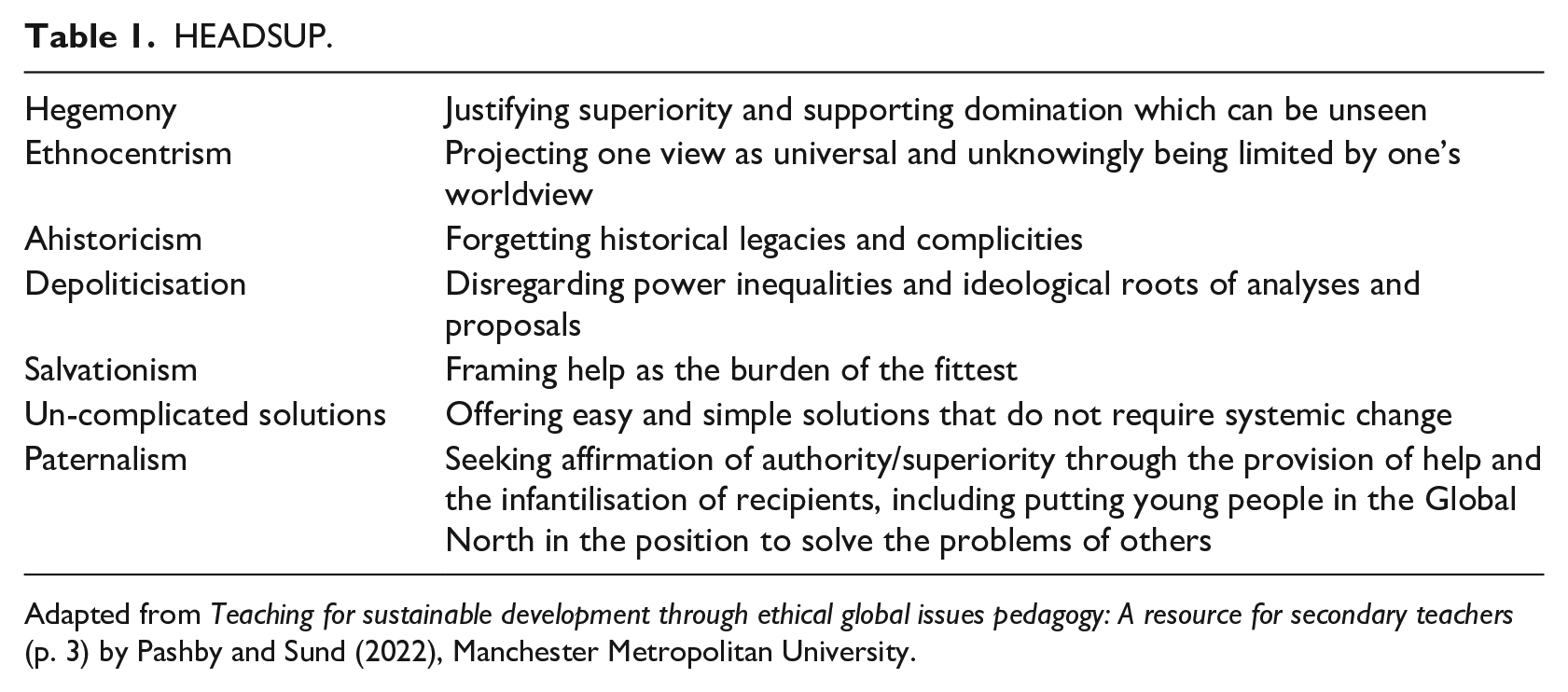
Adapted from Teaching for sustainable development through ethical global issues pedagogy: A resource for secondary teachers (p. 3) by Pashby and Sund (2022), Manchester Metropolitan University.
This methodology represents the development of practical initiatives to support teachers engaging with critical GCE.
Methodology
The research for this paper was conducted in English-medium international schools in The Netherlands, Finland and Australia that call themselves international schools in their official name, offering the IB Middle Years Programme [MYP] with school aims of global citizenship. This research project was conducted within a social constructivist paradigm with a qualitative approach. Phenomenological research methodology supports the investigation of contextualised experiences (Van Manen, 1990), which in this project were the lived experience of students and school leaders. The research was practical in scope and the sample was supported by the expected rich data, budget and schedule (Tracy, 2012). Interview data was collected in 2018–2019. Interviews took place over one full day in The Netherlands and 2 days in both Finland and Australia. The lead author communicated with the school directors online before visiting the schools to personally meet the participants for the first time at the time of data collection.
The participant school in Finland was a not-for-profit state-funded and administered English medium international school. It is open to expatriate and Finnish students and uses both the IB and the Finnish National Curriculum. The participant international school in The Netherlands was a government-subsidised international school operated by Dutch International Schools, an arm of the Ministry of Education. It is open to internationally mobile students of any nationality, including Dutch students who may have lived abroad or children of expatriates. The Australian participant school was a board-governed commercial, independent fee-paying school. All the schools were in metropolitan regions with bases for international corporations. The schools had diverse student populations, shifting according to global economic forces as industries in the region fluctuate, and varying degrees of teacher diversity. This paper does not make assumptions about GCE beyond the scope of the three participating IB schools as there are substantial differences between international schools (Hayden, 2006; Tarc, 2009). Table 2 conceptualises the research design and processes relevant to this paper.
Research design with research questions.
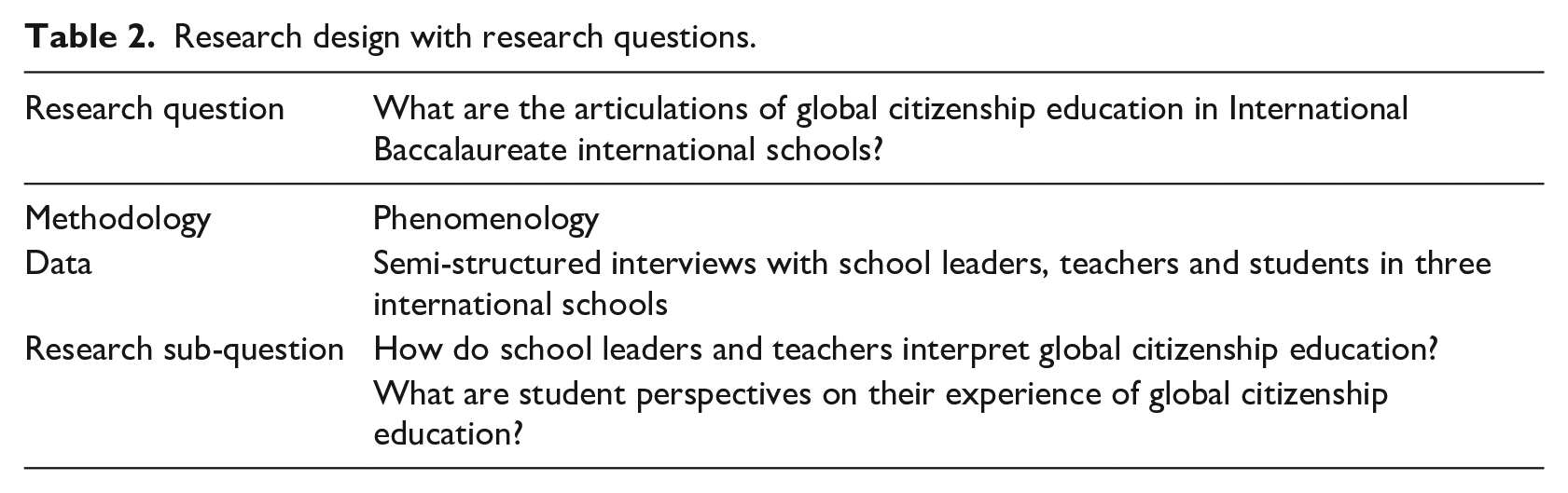
The main research question was explored via the first person lived experience of teachers and students, as their daily lives and ideas offer rich perspectives on their education and personal contexts, ‘behaviour as determined by the phenomena of experience rather than by external, objective and physically described reality’ (Cohen et al., 2011: 18). A qualitative targeted sample phenomenological analysis of the lived experiences of students and teachers drew upon interview data from 14 students, 3 school directors and 5 teachers/school leaders. The students were aged between 14 and 16 and were all enrolled in the MYP at the schools. Pseudonyms are used throughout for all participants and specific details of the participating schools are not identified. The project received ethical approval through the University of Tasmania.
Codes as ‘heuristic devices’ (Braun and Clarke, 2022: 59) were used to investigate the corpus of interview data to address the research questions. Thematic analysis of interview data allowed for thorough engagement with data and identification of patterns of meaning in transcripts (Braun and Clarke, 2006). Engagement with the data was an active process of finding meanings that answered the research questions, following the six non-sequential phases of reflexive thematic analysis proposed by Braun and Clarke (2022).
The interviews were conducted in a manner consistent with the social constructivist approach of the research and the phenomenological methodology. The interviewer position of ‘deliberate naiveté’ (Brinkmann and Kvale, 2015: 34) was conducive to the interpretive topic of GCE. The strategy proved helpful when probing the participants and encouraging them to revisit their understandings of GCE. This gave them further opportunity to develop their judgements and refine their opinions of how global citizenship is expressed in the school and their life.
Findings
Conceptual uncertainty about global citizenship education
The data analysis identified a significant theme in school leaders and teachers finding difficulty explaining what global citizenship was and a reluctance to describe it or how they model it. School staff frequently turned to curriculum resources or school mission statements to help them to define global citizenship. Teachers perceived global citizenship as an implicit and hidden part of the curriculum. This was seen in responses with elements of reticence, avoidance, antagonism or confrontation in answering interview questions about understandings of global citizenship. Responses included, ‘that’s going to be tricky’ (Mees, school leader and teacher, The Netherlands), ‘this is going to be the hardest part’ (Amy, school leader and teacher, Australia), and ‘it’s hard to answer that’ (Allen, teacher, Finland). Turning to a resource to explain global citizenship was a common reaction by school leaders and teachers and was included in coding as conceptual uncertainty.
Global citizenship education in the classroom is a mystery
GCE as a decentralised and somewhat mysterious school practice was seen in the responses. For example, ‘It’s dependent on what teacher you would speak to of how they would do it. . . it’s different in all the different facets of the school’ (Amy, school leader and teacher, Australia) and ‘. . .which teachers then actually cover it and which don’t. There isn’t a kind of understanding that even though we talk about it, it’s very teacher dependent’ (Alexandra, school director, Finland). Students also identified that global citizenship in the classroom was determined by the individual teacher, ‘It depends a lot on the teacher too I think, like, how much or like how strictly they follow the curriculum rather than let you think about it for yourself’ (Beth, student, Finland). The understanding of global citizenship in each school was found to be contingent on individual teachers. This provoked a sense of mystery in conceptualisations of global citizenship as some school staff did not have awareness of how global citizenship was being manifested in classrooms except for their own.
Global citizenship is implicit
Teachers warned that the students may not be able to know how or what GCE is in the school, as one interviewee put it, ‘I don’t think they’d notice it themselves. I think that because it’s something that we embed in everything that we do’ (Amy, school leader and teacher, Australia). In Finland, a teacher noted that the IB curriculum was more concealed about teaching for global citizenship than the Finnish National Curriculum, and admitted that it wasn’t an educational objective in lesson planning but an inferred ethos, ‘It’s part of the planning and the thinking that goes into the curriculum. It’s there increasingly in the new Finnish curriculum- it’s there and it’s more explicit’. (Allen, teacher, Finland).
Students also confirmed that they had not been taught explicitly about global citizenship. One interviewee said that the words global citizenship had not been used explicitly in the classroom, but it could be expressed covertly in some other way, ‘we haven’t learnt about it in those exact words’ and ‘I mean it hasn’t been taught to us directly but it’s kind of come into our education like, by itself’ (Lucas, student, Finland). GCE was therefore interpreted as a hidden, embedded component of the school’s education and there was difficulty in isolating where and how it exists.
Global citizenship lacks priority and time
Teachers expressed two serious barriers of inconvenience that prevent enacting GCE in their schools. The first was senior leaders’ lack of prioritisation which then impacts staff motivation. The second was curriculum time pressures. Exam preparation was categorised as a component of this code as well as IB curriculum administration work. This theme relates to the previous theme of conceptual uncertainty because understanding global citizenship takes time and effort, which are scarce for busy teachers. Past research has similarly found that time pressures hinder GCE in schools (Lee and Leung, 2006). Teachers under pressure is associated with the neoliberal shift to efficiency in education (Hajisoteriou and Angelides, 2020). Amy, a school leader and teacher from the Australian participant school explained this in her response,
If global citizenship lacks priority and time - teacher motivation depends on senior leadership commitment. With curriculum time pressures you’re in a school that doesn’t see the importance, why would a teacher challenge themselves? (Amy, school leader and teacher, Australia).
Having limited time makes GCE inconvenient. Teachers expressed that the workload involved in interpreting, teaching and assessing the curriculum caused significant time pressures in and outside the classroom. This curriculum time pressure theme was expressed by teachers in all participant schools. In Finland, teacher Allen expressed the pressure to cover the curriculum in class, which takes time away from more time-consuming discussion pedagogies, ‘whilst I want to allow time for things outside of the content, then we do need to get back to that’ (Allen, teacher, Finland). The extensive IB curriculum content was seen to add to the pressure, ‘Well, you know the IB, it’s a never-ending story’ (Mees, school leader and teacher, The Netherlands).
Global citizenship is celebration of diversity and difference
Analysis of the interview data identified a robust theme of global citizenship articulated in participant schools as celebrations of difference. The celebrations referred to in the data were characterised as national, cultural or diversity festivals. Assemblies were seen as important by school staff for global citizenship to showcase cultures and celebrate national days. Food fairs, international days (such as Harmony Day), flag parades or celebrations of cultural diversity were frequently named as expressions of global citizenship by school staff most notably in the Australian and Finnish participant schools. This theme represents a soft global citizenship orientation (Andreotti, 2006) centred on a thin cultural differentialist approach (Dervin and Simpson, 2021) which was also found in the international mindedness study by Hacking et al. (2018). The melting pot approach to multiculturalism is also apparent in descriptions of the celebrations of difference as a unified big happy family (Giroux, 2005). This finding is reminiscent of derided representations known in Britain as the 3Ss: saris, samosas and steel bands (Starkey, 2007).
Celebrations of national or cultural celebrations or units of study on celebrations were also recorded as taking place in classrooms accompanied by shallow investigation such as watching videos or doing presentations. The superficiality of the diversity day celebrations as an expression of global citizenship was raised by one participant school leader and teacher, ‘I know it looks really shallow but the kids can be very shallow’ (Jennifer, school leader and teacher, Australia). This response was poignant in that no students conceptualised global citizenship as celebrations or special days.
Global citizenship expressed as cosmopolitanism
Thematic analysis of the interview data showed significant conceptualisation of global citizenship as mostly surface-level cosmopolitanism. Codes which contributed to this theme were expressions of a belonging to a global community, positive outlooks of solidarity for dealing with global challenges, and discussion of the problems of universalism in cosmopolitan consciousness. This theme links closely with theories of cosmopolitanism based on the notion of common universal humanity with some consideration to dilemmas of communal human values (Appiah, 2006; Beiner, 1995; Osler and Starkey, 2010). The cosmopolitanism expressed in this theme resembles Appiah’s living together philosophy (Appiah, 2006). Understanding how students and staff in the participating schools interpret cosmopolitanism was important for revealing how they see themselves in the world.
School students and staff both referred to belonging to one global community when explaining global citizenship in the interview data. This notion of an imagined global community purports to unite all people (Appiah, 2006; Nussbaum, 2019) and forms the basis of cosmopolitan citizenship (Osler, 2016; Osler and Starkey, 2005, 2010). The central topic of a universal human family is evident in the data. Global citizenship explained as cosmopolitanism was conveyed by one school leader and teacher interviewee who said:
‘I think global citizenship is looking at ourselves as not something “other”. Something that is, that we are part of a global community. That we, I think first, should be citizens of our planet and after that of our smaller groups. And the global citizenship of course in education would be to promote that idea that their responsibility isn’t in (city name) or in Finland, it is to our neighbours and everyone else who exists on our planet. I think that is global citizenship’. (Ben school leader and teacher, Finland).
In this articulation, global citizenship transcends the local community and nation state, and the teacher introduced the idea of an educational project to encourage this. The notion of responsibility to global others was similarly expressed by students, such as in ‘I think everybody kind of owes something to everyone else’ (Beth, student, Finland). Students also expressed the expansion of boundaries of community and belonging from local community to the whole world, such as ‘being part of a community not limited to where you live. But community like, with the human race as a whole’ (Beth, student, Finland). Overall, however, expressions of cosmopolitanism were relatively superficial and apolitical.
Solidarity for global challenges
Humans working together in solidarity to deal with the challenges facing the planet was identified as a significant code in the data analysis, with an understanding that international cooperation is an exercise in negotiation. Solidarity is a tenet of cosmopolitanism citizenship with a sense of shared responsibility for humanity and the planet (Osler and Starkey, 2010). Students were especially aware of the need for unity in confronting global problems such as climate change. Students explained the idea of solidarity in their responses, ‘Like one team fighting against the problem that we’re facing’ (Lucas, student, Finland) and ‘everybody taking their own responsibility but also working together’ (Beth, student, Finland). Collaboration skills and engagement with diversity were woven into responses about global solidarity.
In some responses, students recognised that discussion and subjectivity are important for global cooperation. This implies the idea of an expanded communicative cosmopolitanism (Luczak et al., 2019). One interviewee expressed the pressure on her generation to solve global challenges, and highlighted the benefits of collaborative skills, ‘If you can’t work together with a group of people, and be open-minded about ideas and like, listen in and say “hey, that’s a good idea but what about if we did this”- it works much better’ (Mia, student, Australia). Students recognised their own learning of intercultural collaboration skills could be beneficial on a global scale for human solidarity, ‘So, if really the world started binding together and working together, it’s proving to us day in and day out that it makes things happen so much faster’ (Ashley, student, Australia). Students’ responses in the interview data integrated an acknowledgement of multiple perspectives in human solidarity, suggesting a more inclusive idea of cosmopolitanism that requires negotiation for dealing with global problems.
Global citizenship expressed as taking action
This multidimensional theme with seven code categories, was present in all participant schools in data collected from interviews with students as well as leaders and teachers (see Figure 1).
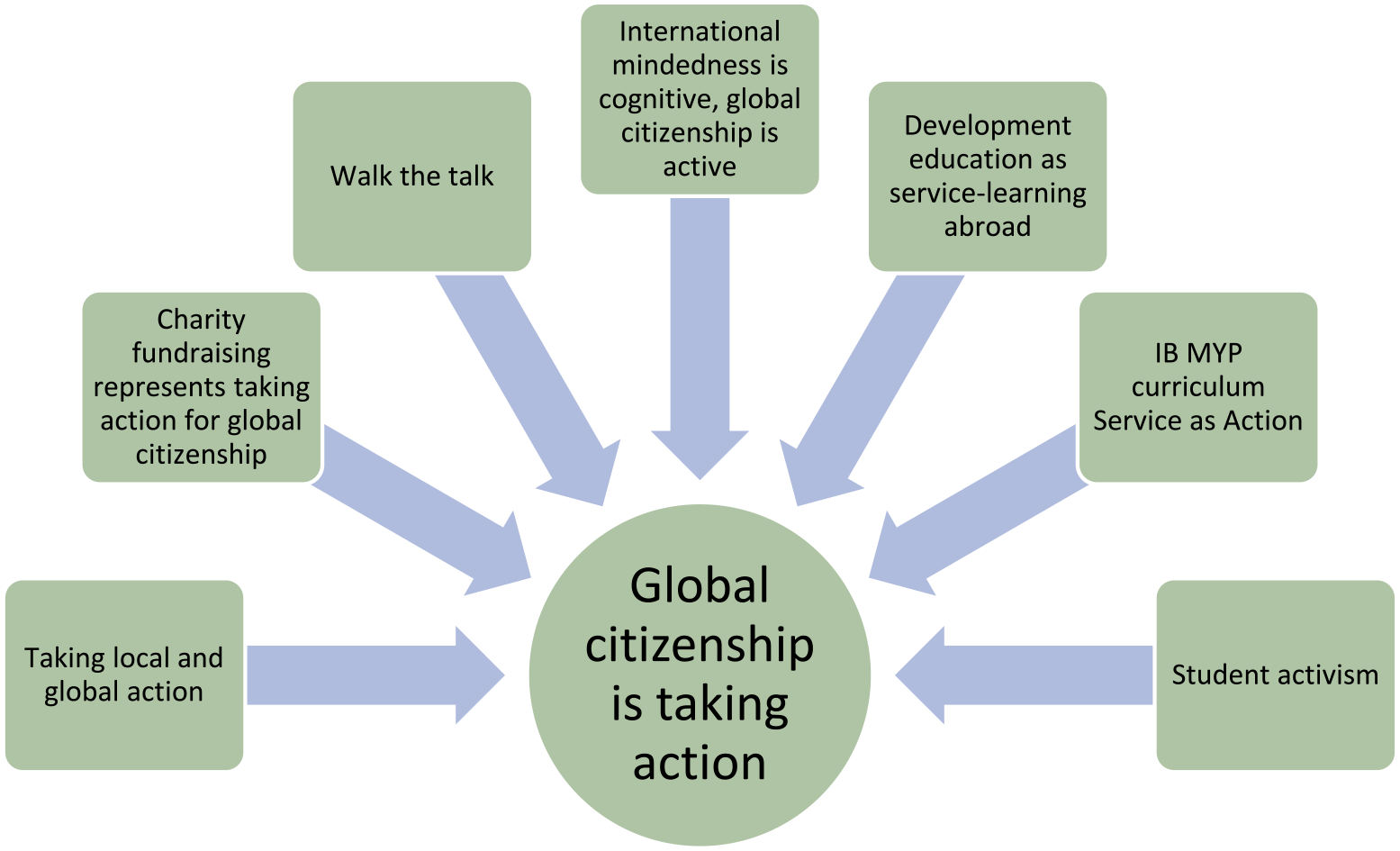
Code to theme model: Global citizenship is taking action.
International-mindedness and global citizenship
According to participant leaders and teachers, the IB curriculum idea of international mindedness and global citizenship can be conceptually distinctive. The point of difference articulated was that international mindedness is a cognitive exercise and global citizenship involves active doing. As one interviewee put it ‘International mindedness, I’m not sure to what degree that involves anything more than awareness. . .there’s no action involved’ (Mees, school leader and teacher, The Netherlands). Further commenting on this distinction and relationship between the ideas of international mindedness and global citizenship, another interviewee said, ‘I think international mindedness is the theory or the thought process and global citizenship is the action’ (Amy, school leader and teacher, Australia). Teachers spoke of the connection and interaction between the thinking of international mindedness and the action of global citizenship as a vague theory rather than practice, evident in the following response, ‘before you even take action, what do you think about it?. . . can I do a bake sale in this classroom? Or do we go a bit further than this? And if yes, why would we want to do so?’ (Jan, school director, The Netherlands). Overall, the way that the two ideas of international mindedness and global citizenship worked together was ambiguous and without specific instances except for the superficial example of a bake sale.
IB MYP curriculum service as action
The integration of global citizenship in the service as action IB curriculum component were expressed through relatively flat, ill-defined responses from school staff. Students provided some insight about how their service as action commitments develop global citizenship. Service as action is a key part of the IB MYP curriculum and designed for students to complete community service with a local and global dimension to make a positive impact in society. According to Andreotti’s (2006) soft versus critical global citizenship framework, service as action is a soft approach to global citizenship with no investigation, and possible perpetuation of, power differences. It classifies, in theory, as a humanistic form of global citizenship, however in practice could be more aligned with an individualistic neoliberal approach (Sant et al., 2018). In the paradigm of critical global citizenship theories, the service as action assignment raises the question of elitism; of who can act for global citizenship and who can provide service to whom?
Development education as service-learning abroad
Development education as service-learning trips abroad featured in the coding, expressing global citizenship as taking action. This code was only identified in interviews with school staff and not with students. Service-learning abroad as an articulation of global citizenship was described as volunteering experience in the Global South. The exploitative nature of service-learning volunteering abroad has been highlighted in previous research (Andreotti, 2016; Jackson, 2019; Jefferess, 2012; O’Sullivan and Smaller, 2019; Pashby, 2011). The need for criticality, informed by post-colonial theory in international service-learning projects has been emphasised (Bourn, 2015; McEwan, 2019), however there was no evidence of this in the interview data.
Development education experience was reported as a way of fostering global awareness and taking action, however, the service experiences were described as action entirely organised by the school and students as passive tourists, as one interviewee responded ‘There are some small initiatives from colleagues that do try to open the world to our students. And one of my colleagues is taking a group of students to Ghana later this year’ (Mees, school leader and teacher, The Netherlands). The school director of the participant school in Australia highlighted a service-learning trip to Bali that was described as predominantly a camp at a corporate fee-paying international school with a token visit to an orphanage ‘we went to the Green School Bali last year, did a five-day green camp, but then we went to Bali orphanage’ (Monica, school director, Australia). The ways in which this articulation of global citizenship was described indicates that the international service-learning visits are not based on social justice objectives and convey a patronising charity mindset.
Charity fundraising represents taking action for global citizenship
Global citizenship was interpreted in the interview data as taking action through fundraising for charity. This represents a superficial thin approach to global citizenship (Andreotti, 2006) that positions the international school students as ‘helpers’ for a deficient ‘Other’ (Sant et al., 2018: 19) previously identified in IB schools as noblesse oblige (Bailey and Cooker, 2018: 237). Students reported several versions of charitable civic action interpretations of global citizenship, such as through fundraising food stalls and donations, ‘we do bake sales and stuff to raise money to give to those organisations’ (Mia, student, Australia), and ‘we give books and toys for children’ (Talia, student, Australia). This vision of citizenship has been labelled the personally responsible citizen by Westheimer (2015), a citizen of good character but with no inclination to examine deeper social justice issues and their causes. The support of Ronald McDonald House, a charity founded through a partnership with the McDonald’s fast-food corporation was interpreted in coding as corporate global citizenship (Sant et al., 2018).
The responses suggested that motivation for taking action through charity fundraising were individualistic. This was evident in the response, ‘giving back to the community like, giving back to the homeless. . . making yourself involved into these kind of acts to kind of make yourself well-known as a nice person, ‘cause you would never want to be well-known as like a bad person’ (Sam, student, Australia). This example illustrates a self-centred, image-conscious approach to global citizenship. Osler (2016) argued that the service-learning charity agenda needs to be expanded to a human rights framework that includes more critical reflection and personal responsibility. The code of charity fundraising as action was found to be a manifestation of neoliberal global citizenship.
Taking local and global action
Students and school directors, leaders and teachers expressed global citizenship as taking local and global actions. These were mentioned as generic actions or meaningful actions in response to global challenges. Students conveyed conceptualisations of global consciousness (O’Byrne and Hensby, 2011), of global identity (Bagnall, 2017; Sant et al., 2018) and a sense of global duty in their responses, such as ‘recognising what’s happening around you and like, recognising that you’re a part of it or should be considering, at least, like taking part and supporting in some way’ (Lucas, student, Finland). The idea of – and the characterisation of spaces for – global duty are contested (Heater, 2004; Sant et al., 2018), and transnational adolescents at international schools are generally living in countries outside of their citizenship, limiting their political and civic engagement.
The connection of global consciousness with individual local action was further exemplified in the response from a student interviewee, ‘making the little contributions to their own community or, so that in order that, to like, make contributions to the, like, whole global aspect of it’ (Lucas, student Finland). Students also observed that in a globalised world, some have benefitted more than others, as seen in the statement by a student in The Netherlands,
‘I think to like help solve issues and if you help then you should, I think that goes for everyone. But I think for a global citizen it’s more like local problems, because there’s definitely countries that you go to that definitely have more local issues than international ones’. (Ethan, student, The Netherlands).
Students expressed a consciousness of being a part of a global community and connected local action with broader consequences. School leaders and teachers also described global citizenship as community-based action that has positive impacts globally. A school director explained this:
‘. . .To connect somehow the local with the global. So, when you do something here at school, as a student, if you choose, let’s say, a charity or an event that you’re doing. . .Perhaps, place it in a wider context, that would show that you are a global citizen. That what you do has an impact not just here, but elsewhere’. (Jan, school director The Netherlands).
Students showed that they had an emerging global consciousness and a sense of responsibility and duty in their choices for action. Students also highlighted some of the tensions between local and global action in the context of an unequal globalised world.
Walk the talk
School leaders and teachers often perceived that the best way to model and demonstrate global citizenship was by doing what they encourage the students to do. This was frequently described as ‘walking the talk. . .it’s one thing to say what I’m saying and it’s another thing to be seen to be doing it’ (Monica, school director, Australia), or ‘role modelling’ (Amy, school leader and teacher, Australia), and ‘I would say practice what you preach. . .you have to live it yourself. . .set an example’ (Mees, school leader and teacher, The Netherlands). These expressions of principles in action were perceived as important for student interest and motivation. Emphasis was placed on school staff exhibiting authenticity through global citizenship actions because students can detect false commitment, ‘I think they know. Students are quite clever. I think they know when things are genuine and when they’re not- “and ok now well we’re doing this because we have to, let’s get it over with”. I mean if that’s the kind of attitude from the teachers then I think that’s going to pass on to the students’ (Ben, school leader and teacher, Finland).
Undertaking professional development and networking featured as a way for school staff to demonstrate global citizenship. One school leader and teacher imagined that the best way to demonstrate global citizenship would be ‘international professional development. Not just of the management and like a trickle down’ (Jennifer, school leader and teacher, Australia). School directors were more likely to focus on networking as actions for global citizenship, ‘go that extra way to make sure that it happens’ (Alexandra, school director, Finland) ‘I’ve got an increasing presence in the international education community . . .I’m always out there networking and trying to meet whoever it is that might be interested in meeting me or that I think we should meet and try to build up what we’re doing’ (Monica, school director, Australia). The significance of this code is that school staff perceive global citizenship as an authentic committed action but framed that in the context of their working lives. This could indicate an articulation of a ‘technical-economic’ instrumentalist pragmatic form of GCE (Marshall, 2011: 419). School leaders and teachers did not mention actions in their daily lives outside of professional actions that demonstrate global citizenship.
Student activism
Although a few participant students did not know what activism was, others were enthusiastic most notably in Finland and The Netherlands. In the Netherlands, a student recalled a school sanctioned protest against use of ecologically destructive palm oil in consumer products outside the Nestle corporate offices. In Finland, the students interviewed were actively taking part in the Fridays for Future climate movement. Students spoke passionately about global citizenship and addressing climate change, as one interviewee stated, ‘everybody’s uniting and fighting this common enemy’ (Aran, student, Finland). The active engagement with the school climate strikes connects to theories of ecocosmopolitanism (Spector, 2015) as the students work internationally for political commitments around climate policy. The students discussed their combined interest in activism and the school’s encouragement,
“I was actually in school that day and then one of my teachers was like ‘Are you not contributing? Are you not part of the problem? You’re not doing anything about it.’ And I was like, that’s a good point! And then I went!” (Marcus, student, Finland).
Staff at the Finnish school were encouraging students to leave school to demonstrate for climate change awareness. Students stated that the school was supportive, as students said, ‘Our teacher said that like, they’re very happy and. . .Yeah, proud of us. You know, and kind of like, going at this young age being politically active’ (Aran, student, Finland). There was a sense of solidarity and cosmopolitanism amplified through the experience of living transnationally as a Third Culture Kid (Pollock and Van Reken, 2001). This was expressed by a student,
‘. . .seeing it happen all over the world as well. So, for example in all of my old schools and stuff, they’re doing the exact same thing. So, seeing like, oh! We’re doing that too, over here! That I don’t know, it’s a good feeling’ (Beth, student, Finland).
Conversely, in Australia, the school director had reticent attitudes towards student activism. The school director understood that students were passionate about focussing on issues of climate change and environmental destruction, ‘We can see this- this anger, we can see this- how can we deal with this? And what can we do?’ (Monica, school director, Australia). Students wanted to take action, however the school director explained that the action must fit with the school standards, and a sustainability committee would be more appropriate,
‘that sustainability committee has got to have a moral purpose and it’s got to fit into the standards and practices of the IB but which then fits into the ethos and values of the school’ (Monica, school director, Australia).
It was stressed that the students must be responsible in any action that they take, that they ‘act in a way that we would like them to act if they want agency and voice’ (Monica, school director, Australia). Activism in the form of demonstration or protest was perceived as inappropriate. The following response indicates a notion of dignified, serene and passive action,
‘I don’t think we’d have children here for example- I don’t think they would go and lie on a street and chain themselves up. That’s not the right way to go about it. It’s ugly’ (Monica, school director, Australia).
Protests were understood as violent and destructive political engagement. This view is consistent with conservative political rhetoric in Australia and a stigmatisation of student activism (Menzie-Ballantyne and Ham, 2022; Menzie-Ballantyne and Knight, 2019). The school director made clear that the students were being socialised into a particular way of behaving:
‘. . .whether it’s the environment and climate change, nothing is worth hurting another human being over, nor in fact damaging property over, it really isn’t - there has to be a better way and that’s through growth mindset. So I feel like, we are trying to role model that and we’re trying to teach that in the way we go about our business. We’re trying to make a difference in a good way and not an angry way’. (Monica, school director, Australia).
The reluctance to sanction student activism was reinforced during this interview through the reluctance to talk about it, and difficulty to find words perceived as acceptable. This hesitancy relates to citizenship theory and research on ideals and values of citizenship (Beiner, 1995; Heater, 2004; Osler and Starkey, 2010; Westheimer, 2015). Research shows that citizenship presented as compliant social and moral responsibility is often preferred by schools over political engagement and more active forms of citizenship supporting students as change agents (Osler and Starkey, 2005; Peterson, 2020).
Conclusion
Overall, it proved challenging to pin down coherent articulations of GCE in the three participating international schools. Reflexive thematic analysis of the interview data identified that school leaders and teachers displayed conceptual uncertainty about GCE. There was regular resort to definitional crutches. Furthermore, the expressions of global citizenship by school staff were superficial celebrations or limited to uncritical interculturalism, practical action within charity fundraising paradigms or as actions which had the effect of foregrounding students’ neoliberal economic advantages. The global citizenships that were described by participants were mostly soft humanistic or neoliberal types (Andreotti, 2006; Sant et al., 2018) and focussed on relational, social and cultural aspects (Oxley and Morris, 2013). There were few opportunities to unsettle status quo thinking (Stanton, 2019), to decentre (Andreotti and de Souza, 2008; Andreotti and Stein, 2021) or to think more critically about global inequities.
The participating schools aimed to nurture global citizenship but were hesitant to consider the process in practical terms and generally relied on relatively shallow and implicit pedagogies and methods. The research found that students have some meaningful experiences and emerging conceptualisations of global citizenship that could be further enriched through critical and transformative pedagogical approaches in the curriculum, community, and school culture. The student interview data indicated an openness towards more active approaches, especially around environmental action for the common good. Some students experienced global citizenship as activism, but this was not always encouraged by schools (with contrasting practices reported in the Finnish and Australian schools). Quality disruptive pedagogies could be effective interventions to consciously promote social justice in these privileged educational contexts.
GCE is a key element of the United Nations Sustainable Development Goal 4 and recognised as an essential factor in creating sustainable futures for the global common good. More than a competency, the GCE that is required involves the development of knowledge, values and dispositions to intellectually and reflexively engage with global events and an enhanced commitment to become ethically involved with global issues. With a social justice oriented human rights framework, GCE has the capacity to heal, envisage and promote fairer futures for the planet through nurturing young peoples’ exploration of their full humanity and place in the world as valued and active agents. The evidence from this study is that it will be an invaluable exercise for international schools to review and develop their practices in this space and their role in authentically nurturing their students as social justice oriented global citizens.
Footnotes
Declaration of conflicting interests
The author(s) declared no potential conflicts of interest with respect to the research, authorship, and/or publication of this article.
Funding
The author(s) received no financial support for the research, authorship, and/or publication of this article.
