




Abstract
This article addresses the question of how global citizenship, often an aim of international schools, is conceptualised as interculturalism by students and teachers. It presents selected findings of global citizenship expressed as interculturalism and perceptions of learning through interculturalism, from a larger empirical study which investigated articulations of global citizenship education in three International Baccalaureate international schools in different locations: Finland, The Netherlands and Australia. Reflexive thematic analysis of phenomenological interviews with students, school leaders and teachers in the three schools revealed two important themes: that global citizenship is interpreted as simplistic interculturalism, with students focusing more on relational aspects of intercultural experiences, and that global citizenship is perceived as being learned through intercultural engagement. The article contributes to research into the expressions and practices of global citizenship in International Baccalaureate international schools. The article proposes that school leaders, teachers and students could engage further with critical and human rights constructivist approaches to interculturalism.
Keywords
Introduction
Globalisation has resulted in intense interconnectedness. It has also highlighted humanity’s shared environmental and inequity problems that require collaboration (Gaudelli, 2016). The growth of the international school sector is a response to globalisation through mobility of transient professional groups and middle-class demand (Bunnell, 2020; Hayden, 2006). International schools often claim to nurture their students’ sense of global citizenship, but there remains an ongoing question of identifying what global citizenship means and how it manifests as lived experience for teachers and students. Global citizenship education (GCE) is recognised as a priority in international policy for planetary futures (UNESCO, 2021). This article examines conceptualisations of global citizenship as interculturalism and perceptions of global citizenship learned through interculturalism which were articulated in interviews with school leaders, teachers, and students, as part of a wider comparative study of identifying expressions of GCE and international mindedness in international schools in The Netherlands, Finland and Australia (Ferguson, 2023; Ferguson & Brett, 2023). Interculturalism was a major overarching theme across the data.
Literature review
Global citizenship education
Global citizenship education is a mutable and contested idea with a variety of conceptualisations (Goren and Yemini, 2017; Oxley and Morris, 2013; Sant et al, 2018). GCE is pedagogy with a view to the future that prepares young people for a globalised world, by encouraging the fullness of their own humanity and responsibility for fostering the humanity of others, through engagement with global issues and diversity alongside intercultural understanding and respect for human rights (Osler and Starkey, 2005; Torres, 2017). GCE can also be understood as a way of addressing injustice, ethically extending power (Abdi and Shultz, 2008), interrogating systems of difference and developing awareness of alternative ways of being in the world (Andreotti and de Souza, 2008; Andreotti, 2012).
Previous research shows that young people interpret global citizenship as a relational experience (ie the experience of two or more people connecting with each other), but teachers struggle with its conceptualisation. Shultz et al (2020) found that young people understand global citizenship as a compassionate and community-based relational phenomenon. Peterson (2020) found that students in Australian schools wanted more open discussions for global citizenship development in school. Research into teachers’ interpretations of global citizenship indicates that they often find it difficult to incorporate critical approaches (Peterson, 2020) and to overcome limited personally- contextualised understandings (Rapoport, 2010).
Interculturalism
How people meet together, bringing their unique socio-cultural backgrounds, is a much-debated topic in the field of global education. Intercultural interaction discourse written in English language uses different ill-defined and easily conflated terminologies for approaching diversity. Cognisant of the paradoxical dominance of English in discussions of intercultural interactions, and the limitations, and indeed arrogance, of only using literature written in English, I draw on Zapata-Barrero (2015) to define interculturalism as contact and interpersonal relations between people from different backgrounds. Interculturalism can be addressed in different ways: to underpin support for tradition, stability and social cohesion, or innovation and social change (Zapata-Barrero, 2016). Despite the various terms used in intercultural studies, human contact across cultures remains a consistently present key idea. This is seen in Cushner’s (2015) description of intercultural competence as interpersonal partnership across cultures. UNESCO (2023) focuses on intercultural dialogue construed as a bridge between cultures. These expressions of interaction imply equal, neutral and balanced intercultural connection. Pirbhai-Illich and Martin (2020) highlight that in intercultural work, histories and power are vitally important. Dervin’s (2023) notion of interculturality and problematising approach to studies of intercultural interaction are useful to critically interrogate the complicated concepts of self and other in interculturalism. Supported by shifting angles of ‘insiders-outsiders, coherences-contradictions, consistencies-inconsistencies and realities-imaginaries’ (Dervin, 2023: 7), an ethical exploration of interculturalism challenges the limits of knowledges and recognises the dynamism of intercultural interaction.
The emphasis on otherness, so prevalent in intercultural discourse, depends on the difference from a norm. Norms have grown from unequal hierarchies of culture (Dervin and Simpson, 2021) and intercultural communication developed in conjunction with colonialism (Piller, 2017). Cultural norms are also fabricated for nation building (Bhabha, 1994; Mullaney, 2011). This history results in power asymmetries and problematic intercultural frameworks that restrict the possibilities of positive intercultural interactions. Tolerance, for example, can be an indifferent acceptance of a negative (Osler and Starkey, 2010; Verkuyten et al, 2022). The notion of ‘respect-of-difference’ is also limited because it assumes that differences are all positive (Balint, 2010: 134). Furthermore, this difference from a dominant norm can be reframed and positively cultivated to question conventions in the mainstream culture that are damaging and to shine a light on supressed cultures (Bhabha, 1994). Therefore, interculturalism demands deliberation around differences in relation to socio-cultural power allocation.
Discourses of intercultural interaction easily slip into reified cultural characteristics. The assumed notion that intercultural relates to a meeting of cultures is criticised by Dervin and Simpson (2021) who argue that culture is an overused essentialising term. Intercultural communication is frequently reduced to a generalised set of definite national communicative styles (Piller, 2017). Therefore, ideas of interculturalism, intercultural dialogue and communication between cultures require critical reflection on the ethnocentrism of theoretical underpinnings (Dervin and Simpson, 2021; R’boul, 2021; Waisbord and Mellado, 2014). Critical perspectives of the term intercultural have consequently become more valued (Halualani et al, 2009) Cultural identities are increasingly understood as complex, flexible, intersectional, hybrid and multiple (Bagnall, 2017; Harris, 2013; Nilan and Feixa, 2006; Osler, 2016). Definitions of interculturalism are shifting to take constructionist concepts of culture and power asymmetries into account.
Interculturalism as a process is complex and subject to the politics of difference, social positionings and cultural relational norms. The need for new intercultural conceptualisations or frameworks is raised from various theoretical orientations (Tarozzi and Torres, 2016; Burbules, 1997). Martin and Pirbhai-Illich (2016: 359) place emphasis on active creation of culture: ‘the inter (the nature of the between and the processes that take place in “between” spaces) and culture (how this might be understood as a dynamic relation)’. Zapata-Barrero (2016) identifies this as a constructivist interculturalism which can challenge the status quo. Research by Butcher and Thomas (2006: 68) highlights the importance of cultural ‘in-betweenness’ that is simultaneously a location of both confusion and resources for connecting in various intercultural situations. Harris’s (2013) research illustrates the dynamic and interpersonal ways in which young people negotiate interactions across cultures intersecting with class and ethnicity.
Education for intercultural competence
Education for intercultural competence is pedagogy to engage effectively across cultures. The acquisition of skills to move with ease in the globalised world and being able to work with people from different places has been seen as an instrumental economic objective (Tarozzi and Torres, 2016). Rizvi (2009) states that this cultivation of cultural adaptability is a hallmark of international education for neoliberal corporate cosmopolitanism. While the word competence implies an achieved ability, Dimitrov & Deardorff (2023) state that developing intercultural competence is an ongoing process. Intercultural competence is also important for collaboration to solve global challenges (Cushner, 2015). This highlights a tension, in that intercultural competence can be understood and advocated as an outcome rather than a way of promoting peace and social cohesion (Goren et al, 2020).
Intercultural competence is closely linked with language learning and linguistic skills (Byram, 1997; Byram and Golubeva, 1997). Language learning facilitates intercultural competence by supporting people’s capacity to communicate with others (Toyoda, 2016). Goren et al (2020) identified in a large-scale literature study that intercultural competences scholarship includes a substantial strand of linguistics, language education and English as a second or foreign language. Byram’s popular model of intercultural competence with a focus on language involves five sets of knowledges and attitudes in categories of knowledge: knowing how to be, knowing how to understand, knowing how to learn, and do, and knowing how to engage (Byram, 1997: 34). This echoes the four pillars of education for living together in peace and social justice in the twenty-first century (Delors et al, 1996): learning to know, to do, to live together and to be. Linguistics and language learning is a key component of intercultural competency for self-awareness, identity representation and for communication and understanding.
Multicultural education
Multicultural and intercultural approaches to education share a goal of preparing young people for diverse societies. Intercultural education is favoured in European Union policy (Huber, 2012; Torres and Tarozzi, 2020) having derived from French literature (Akkari & Radhouane, 2022). Multicultural education, based on multiculturalism which is a model for diversity incorporation from the United States (Torres & Tarozzi, 2020) was historically part of the American civil rights movement (Banks, 2009; Osler, 2016). Banks (2009, 2020) positions multicultural education as a rights issue through validating minority students’ identities and participation in their communities whilst developing global, cosmopolitan values.
Multicultural education is still interpreted in many policy contexts as assimilation or integration into a dominant culture, without a human rights component (Osler, 2016; Tarozzi and Torres, 2016). Normative multiculturalism, much like simplistic interculturalism, uses more static and unchanging interpretations of culture and identity, whereas constructive multiculturalism recognises culture as dynamic and flexible (Torres and Tarozzi, 2020). Critical multiculturalism can address power differentials and privilege in education (Apple, 2018; Banks 2009). However, Banks and Banks (1995) warn that if interracial and intercultural interactions occur without structured equal-status settings, this can result in a perpetuation of stereotypes and potentially conflict.
Intercultural understanding and the International Baccalaureate
The International Baccalaureate (IB) programmes assign significant weight to intercultural understanding, which is a strand of the overarching IB aim of promoting international mindedness (Barratt Hacking et al, 2018). IB–commissioned research suggests that the curriculum can encourage openness to diverse cultures (Bullock, 2011). Hayden and Thompson (2013) underscore the personal dimension to intercultural understanding in the IB programmes, concluding that it is fundamentally a personal endeavour and that schools should provide cultural engagement opportunities for students.
A study by Wilkinson and Hayden (2010) found that a shift in attitude towards greater intercultural understanding throughout students’ experience of the IB Diploma Programme was influenced by formal and informal discussion, especially by being able to interact with staff and other students. The same study also found that expressions of culture were modified by minority groups in the school in order to fit with the cultural majority. Roiha and Sommier (2021) highlighted that teachers in an IB primary school in The Netherlands were unsure how to translate intercultural understanding into practice. Teachers were also found to be likely to use a cultural differentialist approach based on national cultures to raise intercultural understanding with children. The same authors also found that many teachers in their study were not aware of critical understandings of interculturalism.
Methodology
The research for this article was conducted in three English-medium international schools, one in each of Finland, The Netherlands and Australia, that offer the IB Middle Years Programme. The study sought to investigate the nature of global citizenship, directed by the research questions in Table 1. Data were collected in 2018-2019 from semi-structured phenomenological interviews with school leaders, teachers and Middle Years Programme students. Interviews took place over one full day in The Netherlands and two days in both Finland and Australia.
Research design and research questions.
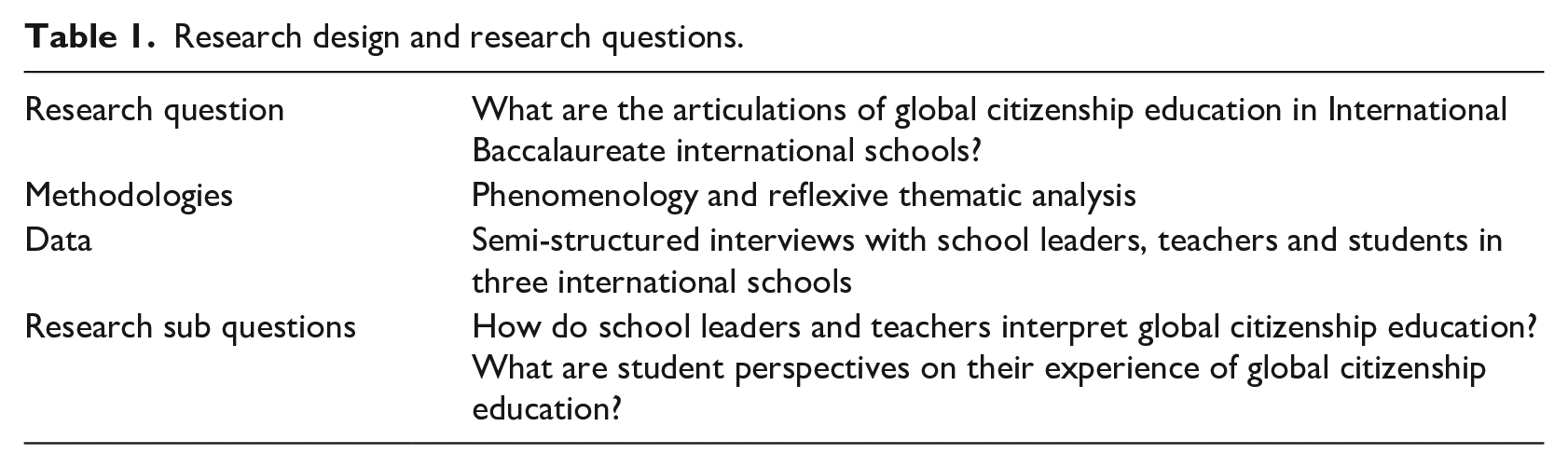
Interview data were analysed using the recursive phases of reflexive thematic analysis with a complete coding process of all data (Braun and Clarke, 2022). Themes were not pre-existing but were driven by the data and active analytic processes (Braun et al, 2022). Braun & Clarke’s (2022) six phases of reflexive thematic analysis were followed: familiarisation with the data set, coding, generating initial themes, developing and reviewing themes, refining, defining and naming themes, and writing up. This was a qualitative research project conducted within a social constructivist paradigm and therefore, as a researcher, I was an active part of the investigation. Reflexivity was central to thematic analysis coding. Examining, identifying and questioning assumptions and acknowledging positions were important to ensure validity with reflexivity as a repetitive process with accountability measures (Braun & Clarke, 2022).
The participant school in Finland was a not-for-profit no-fee English-medium international school educating both expatriate and local students. The participant school in The Netherlands was a government subsidised fee-paying international school operated by Dutch International Schools and governed by the Ministry of Education. The school was open to internationally mobile students of any nationality, including Dutch students who may have previously lived abroad. The Australian participant school was an independent fee-paying school open to international and local students.
The participants were 3 school principals/directors (one from each school) and 5 school middle leaders and teachers, as well as 14 students aged between 14 and 16 and all enrolled in the IB Middle Years Programme. All the schools were in metropolitan regions with bases for international corporations. The schools had diverse student populations, shifting according to global economic forces as industries in each region fluctuate, and varying degrees of teacher diversity. This article does not make assumptions about intercultural education or experiences beyond the scope of the three participating IB schools as there are substantial differences between international schools (Hayden, 2006; Tarc, 2009). Pseudonyms are used throughout for all participants and specific details of the participating schools are not identified. All interviewees were guaranteed confidentiality and gave their informed consent to participate. The project received ethical approval through the University of Tasmania. Questions asked in the semi-structured interviews are included in Appendix 1.
Findings
A strong overarching theme derived from the interview data was that global citizenship is experienced and interpreted as interculturalism. School leaders and teachers frequently discussed understanding between cultures when asked about their experience of teaching for global citizenship. Students also experienced global citizenship as development of understanding between cultures. This theme was multifaceted and included a central feature of global citizenship as a relational process, involving cultural adaptation, open-mindedness to others, and the problematic aspects of interculturalism. Analysis of the interview data identified that students perceived that global citizenship was learned through interculturalism informally outside of the classroom and within the classroom.
The conflation of global citizenship and interculturalism was recorded in every interview. As this research also investigated meanings of international mindedness, some participants merged international mindedness with global citizenship in their responses. All school directors, leaders and teachers were reluctant to express precisely their experience of global citizenship and international mindedness. Probing was required to ask participants to clearly express the difference between the two concepts. This probing was used more in the Finland and Australia participant schools. After probing, talking and reflection, the participants arrived at sharper conclusions in defining international mindedness and global citizenship towards the end of the interviews. However, throughout the interviews, global citizenship as interculturalism remained a consistent theme. A summary of both themes is provided in Table 2. Code to theme models are shown in Table 3 and Table 4.
Theme summary.
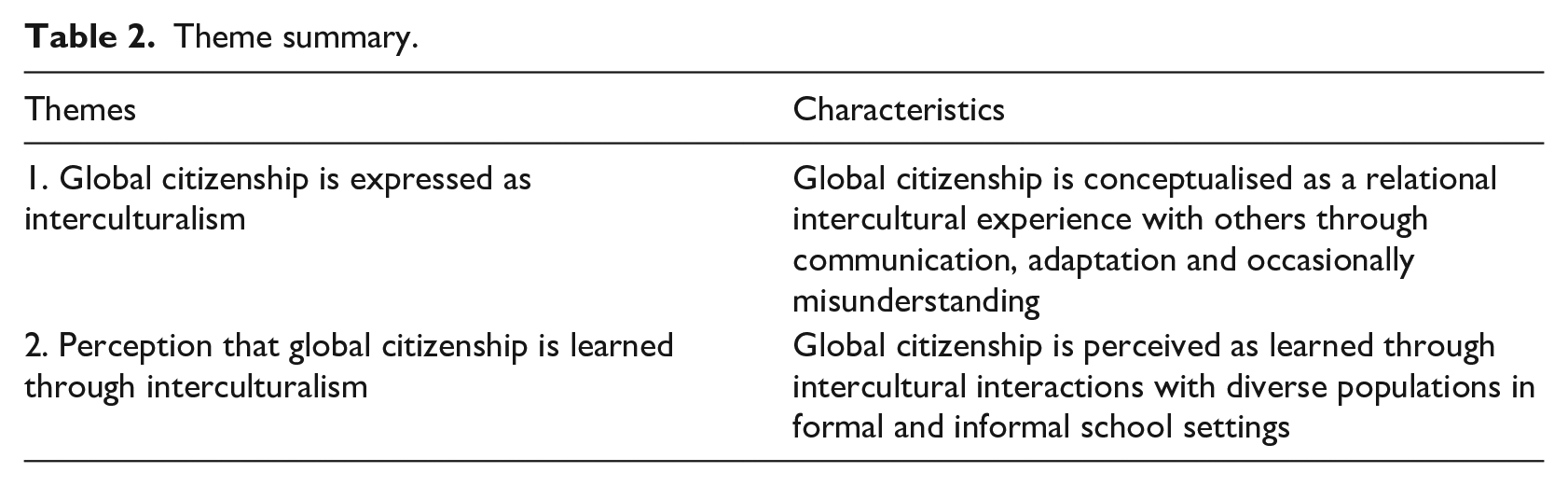
Codes and code categories to theme model.
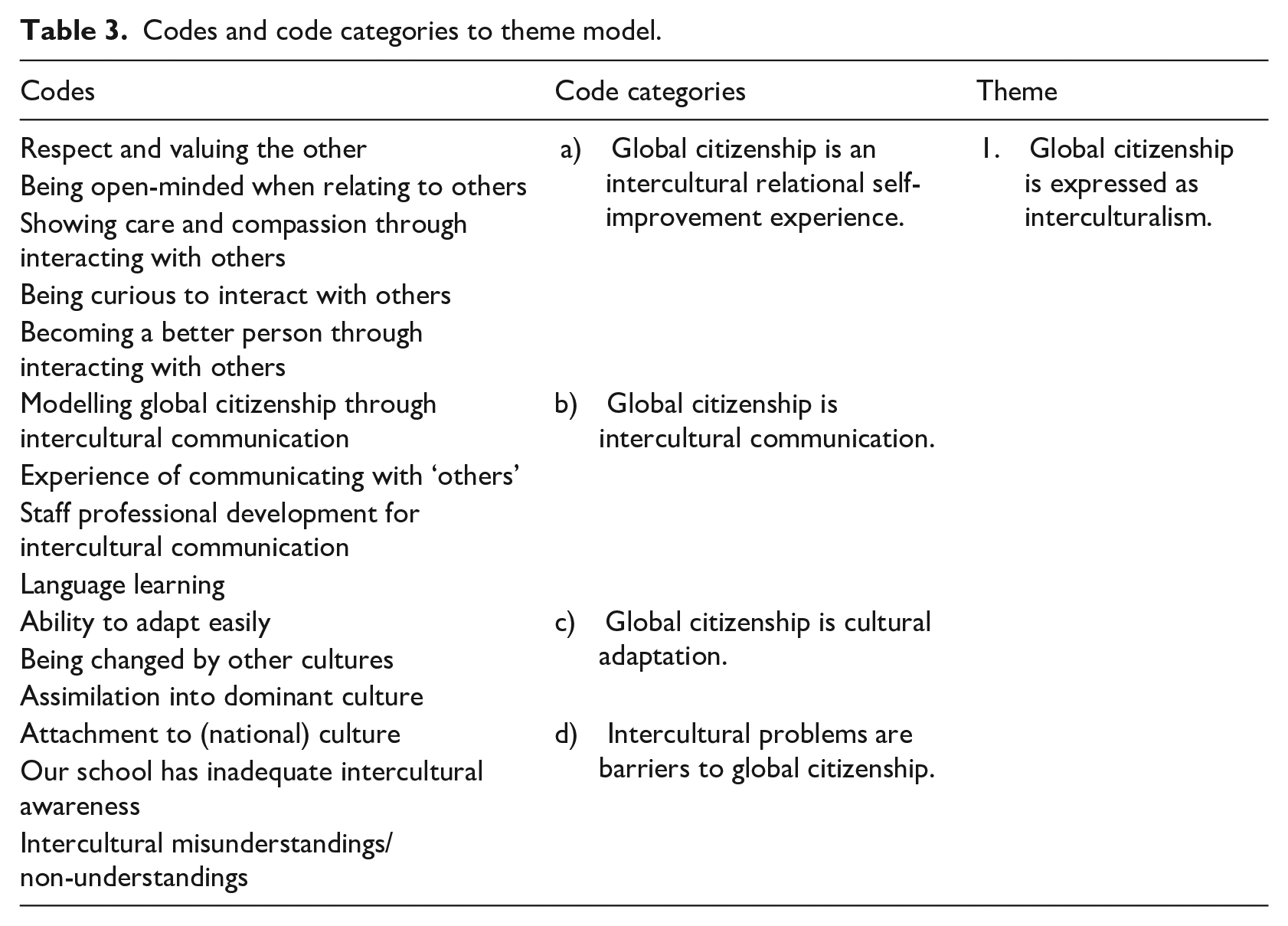
Codes to theme model.

The limited expression of critical intercultural understanding in the data was noted. Both themes presented in this article aligned with a soft approach to global citizenship (Andreotti, 2006) based on universal assumptions and equal relations. The findings within the themes were generally void of deep self-reflection, acknowledgement of power differentials and mutual negotiation characteristics of critical interculturalism (Dervin, 2023). Moreover, there was no evidence of decolonial approaches to address colonial relations. School directors, leaders and teachers did not mention equity pedagogy for intergroup interaction suggesting an assumption of an equal playing field. Neither students nor school staff mentioned race when talking about interculturalism. In the theme of global citizenship learned through interculturalism, issues of equity were not raised by students in descriptions of interactions. All learning through interculturalism was coded as a relational encounter. The theme of global citizenship expressed as interculturalism was multifaceted, as can be seen in the codes, categories and theme as shown in Table 3.
Global citizenship expressed as interculturalism
Global citizenship is an intercultural relational self-improvement experience
Global citizenship was expressed by participants as a relational experience and specifically as interpersonal interactions with people from other cultures which results in self-betterment. For example, student Talia from the Australian participant school explained the process of global citizenship through interpersonal interaction: I think it’s through experiences and . . . what other people say to you and how that affects you and how that makes you a better person because you can understand their ways and how in their daily life it might be different to yours. (Talia, student, Australia)
Encouraging interpersonal relations with others was coded as a way of being a good global citizen: ‘interact with lots of people, to not stay in your own bubble . . . lots of different people from different parts of the world in the neighbourhood, even in a place like The Netherlands, and then if you just go outside and interact with other people, soon enough you’ll come across lots of people’ (Noah, student, The Netherlands). Unintentional everyday relational experiences of global citizenship were expressed by Mia, a student in the Australian participant school: ‘they’re kind of following the ethos but they’re just kind of doing what they do with their friends’. This finding from the research project is consistent with the work of Shultz et al (2020) who similarly found that global citizenship is interpreted as a relational experience.
Analysis of the interview data identified that being open-minded to the other for social engagement and being approachable was a way of experiencing intercultural understanding, and a fundamental part of the relational experience. Open-mindedness is aligned with emotional openness in intercultural education literature (Huber, 2012), defined by a willingness to engage socially with others. This sentiment was expressed as a holistic interpersonal approach in the school community by Jennifer, school leader and teacher in the participant school in Australia: ‘it’s also the treatment of everyone – the relationships that you form and how open you are as well with your staff, with your students, with your parents’. Open-mindedness in engagement and availability of school staff was also identified by Talia, a student from the participant Australian school, as an aspect of global citizenship: A lot of other schools, they don’t really have the open-mindedness of other people and . . . if they’re doing ok, but teachers at this school have really good open-mindedness to see how other people are doing and if they’re ok in their daily life, and they check on them which I think is very important. (Talia, student, Australia)
Emotional openness in relationships, reducing power distance and sharing experiences between staff and students was perceived as easier in a small school: We’re a small secondary school which breaks the boundary of teacher-student relationships to quite an extent where you are not the font of all knowledge at the front, you do have more of a relaxed relationship with students, you are much more open about your own lives and your own experience. And I guess for some teachers . . . they wouldn’t do it, because in a tough school that would be vulnerability, right? Whereas in this school when you have such, you know, lovely kids, it breaks down that barrier much more. (Amy, school leader and teacher, Australia).
Codes of global citizenship as showing care and compassion through interacting with others were evident in both student and school staff responses in the interview data. Care and compassion are defined in this code as a motivation in interpersonal relational experiences to protect the wellbeing of others and to express respect and appreciation. A discussion between students in the Australian participant school illustrates the codes of care and compassion through interaction with others. Participants explained the motivation of compassion in the relational experience of global citizenship. When asked how you can be a global citizen, students responded: Talia: ‘I think that when a new student comes who is from a different country, there’s a leader who gets picked to show that person around the school, and make sure that their wellbeing is ok. And I think that’s important because then you get to understand where they’re from . . . I think that’s really cool’. Sam: ‘I feel like if you get picked to like help this person, and you go like oh I don’t really want to do that, then you’re also affecting them . . . like making them feel like they’re not really that important’.
This example also illustrates an aspect of global citizenship as compassion in interpersonal interaction within this code, of valuing and respecting the other. It is significant that these ideas are expressed in the data as fixed and universally understood. This code was also evident in school staff as expressed in vague statements such as: ‘You want to feel valued’ (Jan, school director, The Netherlands). Respect as a method in relational interaction with others featured prominently and was similarly explained imprecisely without acknowledgment of cultural subjectivity and often as a holistic approach within the school community: Respect, for me, is pretty much at the top of behaviour for my colleagues, between us but definitely also between students, and students and teachers. If there’s no respect, then yes especially in a community like this, it becomes really difficult. I always address this with my students like this. (Mees, school leader and teacher, The Netherlands).
Respect is problematic because although assumed as a feature of harmonious communities, it may not be an effective method for dealing with cultural differences (Balint, 2010). Respect was described by participants as positive and straightforward. Global citizenship was manifested in harmonious staff relations: We work very well together with very, very few problems. And I think the students can see that. I think that’s what teachers can do, besides treating the students with respect and treating everyone with equal respect. But when they see that the whole community functions that way, then I think you can draw this picture of, ok, well this is what a functioning community works like whether it’s here or on a macro level. (Ben, school leader and teacher, Finland).
Students interpreted global citizenship modelled by staff through relational compassion towards students: ‘sometimes actions speak bigger than words and going up to them and sitting down and eating lunch with them will be bigger than saying “hey, are you ok?”’ (Mia, student, Australia). Ideas of self-development through knowing others were evident in these codes of care and open-mindedness. However, the universalist approach and lack of cultural negotiation to these components of relational interaction is noteworthy.
Curiosity was coded within this category as an important ingredient to the relational experience of global citizenship. Curiosity in this instance was seen as the desire to interact with others to learn more about them. This code was more evident in the school directors, leaders and teachers. School leader Alexandra from the participant school in Finland expressed the rewarding experience of being curious: ‘I think that it’s a very enriching experience, interacting with people from different cultures and I’m curious to learn about different ways and understand’. This code featured in the data as staff modelling global citizenship through interpersonal engagement with students: . . . questioning the kids and they teach you because they’ll come from a country you don’t know well and you’ll be like, how does that work there? Oh right! And so, being that inquisitive person is modelling global citizenship because that’s what you want them to be. (Jennifer, school leader and teacher, Australia).
Global Citizenship is Intercultural Communication
The data analysis identified that intercultural communication was part of global citizenship as an intercultural experience. This coded category included all experiences of communicating with the cultural other through first-hand experiences, professional development training sessions in intercultural communication, bilingualism and modern foreign language learning. Patterns of meanings coded for English language learners were identified in this category, but more frequently identified as challenges to global citizenship education in the English medium schools.
Intercultural communication and language were included in the coding process and identified as a component code category of global citizenship as intercultural communication. Emphasis on professional development for intercultural communication was identified: ‘what we do consciously is we train staff in intercultural awareness . . . a different context that people think, live in, different values they might have, different ways of communication most of all . . . staff feel this is working really well’ (Jan, school director, The Netherlands). Some school directors, leaders and teachers expressed the importance of intercultural communication, and narrated personal accounts of communicating with people from different cultures when asked about experiences of global citizenship: There’s always the first time you do something . . . I think it was again a Middle Eastern family, and they sent the uncle of a child . . . I still remember that day and you spent almost thirty, forty minutes talking about something completely unrelated. (Jan, school director, The Netherlands).
Thoughtful caution and sensitivity to a holistic situation was expressed in intercultural communication: ‘being able to slow down, double check that you’re getting all the kind of nuances from whatever culture they might be from [or] influenced by, be able to get your overall picture and know how to respond appropriately’ (Jennifer, school leader and teacher, Australia). Reflection on conventions and styles of communication in culturally fixed, essentialist ways were evident in the data in addition to considerations of comparisons between perceived home cultural communication and the local culture or home culture and others. For example: [T]he Dutch have, I think, their own way of communicating, it’s very direct . . . ok there’s a problem and now we’re going to solve it. Whereas in many cultures, just indicating there’s an issue, for example in Thailand, that’s a tremendous loss of face. You really have to kind of talk around the whole topic before you actually get there. I myself am Dutch, so I sometimes am a bit abrasive, or too direct, sometimes forget that yes, I’m working in an international community and I have to keep this in mind. (Mees, school leader and teacher, The Netherlands).
The coding procedure found the dominance of intercultural communication education and an essentialist cultural approach over a view of culture as constantly modified.
Language learning was identified as part of the theme of global citizenship as interculturalism. Data from student interviews were not present in this code. Most participant students were at least bilingual and proficient in English. Language learning was conveyed as formal or informal, within and outside of the curriculum: ‘languages are very strong in Finland and there’s a lot of work that goes on there . . . in the classroom but also outside to do with sharing languages because of the close link between language and culture’ (Allen, teacher, Finland); ‘I think when you see their interest in each other and each other’s languages, you know, we might get a new Chinese student and they’ll be interested to learn some Chinese words’ (Amy, school leader and teacher, Australia). Parents from the school community were also seen as important for this element of global citizenship: ‘being able to teach each other languages or read books in mother tongue and those kind of things are important.’ (Jennifer, school leader and teacher, Australia). Language was identified as an expression of global citizenship as an intercultural experience for school staff.
Global citizenship is adaptation
A major component of the articulation of global citizenship as interculturalism in the interview data with leaders, teachers and students is the coded notion of global citizenship as cultural adaptation and assimilation. Global citizenship was equated with the capacity and process of adapting to a new environment and equally being culturally influenced by others. The code of assimilation recognised in the data indicated that global citizenship is the ability to adapt to a dominant culture for cultural homogeneity. This was seen as a necessity for some students who were not of the dominant national culture of school location.
The ability to culturally adapt to new environments and cultures was interpreted as an important, impressive and enjoyable part of the experience of global citizenship which frequently facilitated cultural self-reflection. This skill of global citizenship was found in the data to require cultural versatility and willingness to avoid fixed cultural identities as demonstrated in the thoughts of students: ‘I think it is like adapting to different cultures, and not like just sticking to one culture’ (Emma, student, the Netherlands); ‘not trying to stick to one thing, being very stubborn’ and ‘you can have global citizenship easily, adapting and letting that culture in’ (Noah, student, The Netherlands). Student Talia from the Australian participant school identified that learning how cultural adaptation happens is also important for global citizenship: ‘you’re able to understand how globally people are able to adapt and do different things depending on where they are’. This ability to adjust to different cultural settings was identified by students as important outside of the school environment, for example in employment: ‘if you’re in a job and it does things in a certain way then you’re able to adapt to that way and understand that people have different ways of doing something and that’s ok’ (Talia, student, Australia). Preparing students for a diverse world through cultural adaptation was evident: ‘they will go out in the world and have skills which will help them manage in any kind of cultural setting’ (Alexandra, school director, Finland).
The skill of cultural adaptation as an experience of global citizenship was further widened to any place, leading to intercultural understanding and framed by the experience of transnational adolescents: To try . . . to adapt to the whole world. So obviously a lot of us have moved around to a lot of different places and you obviously have to re-do, re-become a citizen and try to understand the culture again. Global citizenship is kind of like doing that in any country or place. I think it’s about trying to understand the people and the culture more than trying to understand the politics or the government system. (Ethan, student, The Netherlands).
This experience of global citizenship as cultural fluidity was coded in the data analysis as an overall positive and active experience that caused some self-reflection on behaviour: ‘I love to have this range of, you know, flexibility. Also, for myself where I have to be sort of on my toes’ (Jan, school director, The Netherlands). The experience of adapting provoked internal self-questioning for teachers on their own cultural identity and behaviour: ‘I find that’s kind of interesting . . . I guess I consider myself fairly liberal and so on but someone else could for sure you know catch me out . . . we’ve all got certain very ingrained opinions and it’s human isn’t it?’ (Allen, teacher, Finland). The self-reflection coded in the data was however strongly centred on the self and did not show any critical approach to interculturalism.
Assimilation to the dominant culture and reduction of cultural difference through fitting in was seen in the data as an aspect of cultural adaptation. This approach to interculturalism is accepted as outmoded by some multicultural education theorists, and public policy bodies (Banks, 2009; Tarozzi & Torres, 2016). School director, Jan in The Netherlands explained that his experience of global citizenship in the school was assimilating children into the school institution: ‘we discovered that after three months, they know exactly how things work’. Students expressed that their experience of global citizenship was learning the dominant culture: [I]f someone was to come to The Netherlands for example and they’ve never lived here before, I think it’s our job to help them to adapt quicker so they feel comfortable in the situation that they are in. Because that’s what helps us or me personally when someone helps from the local community, you feel more connected in a sense. (Noah, student, The Netherlands).
Ashley, a student in Australia, explained that assimilation is a reality of life outside of school: ‘it’s not still like catered to us to the point where it’s like we have a little shell around us, you know . . . ’cause we’re still in Australia. So, when we leave the school, we still face all Australian environments’. This was coded as a difficult experience for students who were not from the dominant culture, and who face language barriers: It’s kind of like we have to go out in The Netherlands, try to do community service even though we don’t speak Dutch. So, kind of to try to not enter their world but enter their country I guess. (Ethan, student, The Netherlands).
This reality for transnational students was recognised by some teaching staff: ‘the kids will say – it doesn’t matter what our country’s beliefs are or our personal beliefs are, you kind of do have to assimilate a bit to the beliefs or the citizenship views of the country’ (Amy, school leader and teacher, Australia). Conforming to the dominant culture of the school and/or the local country culture was identified in the data analysis. The approach identified and coded in the data to reduce cultural difference is more assimilation than acculturation as there was no moderation of the dominant culture (Banks, 2009).
Conversely, a constructive multiculturalism was identified in the data set showing global citizenship to be expanded and moderated through cultural interaction. This was more aligned with intercultural learning which focuses on the inter spaces between cultures (Martin & Pirbhai-Illich, 2016) and provides opportunity for authentic cultural re-negotiation. Participants recorded being personally changed through interaction, witnessing a modification in others or learning about other cultures: It’s like they influence you but you also influence them. Because like you’re not instantly going to have this country’s culture or any country’s culture, you’re still going to have stuff from your blood, like the countries that you’ve lived in before. (Ethan, student, The Netherlands).
Teachers described cases where the school culture was moderated by engagement with students’ culture: ‘So you might have someone of a religion who is not going to walk around to the national anthem or who is not going to go in the pool . . . you need to be completely open to that, that needs to be ok. You have to make changes where changes have to be made. And those changes to be the norm, to be the norm and to be accepted’ (Jennifer, school leader and teacher, Australia). This code in the theme of interculturalism signifies cultures can be modified and built in interstices.
Intercultural problems are barriers to global citizenship
Participants noted that intercultural encounters can involve tension, and discomfort within the experience of global citizenship. School directors, leaders and teachers reported that many of their school’s staff possessed inadequate intercultural awareness and could improve. Forceful attachment to a specific culture, expressed as national culture, was also seen as a barrier to global citizenship.
An obstacle to global citizenship was expressed in the data as experiences of misunderstandings or non-understandings between cultures. The cultural diversity in the school population and the sometimes unpredictable and sudden global mobility of the transnational families who enrol their children in international schools can provoke conflict: ‘it’s challenging working with such a diverse population. And then many of them, they move straight to Finland and the next day they start here in school’ (Ben, school leader and teacher, Finland). Examples of conflict were described by school leaders and teachers as incidents between teacher and students [where] ‘you have a mismatch . . . I might say something and they might interpret it differently’ (Mees, school leader and teacher, The Netherlands) and between school staff and parents: ‘We have sometimes misunderstandings’ (Ben, school leader and teacher, Finland). Competing cultural visions of a good education are frequent points of disagreement: We have parents who come from a culture where . . . grades are all that matters . . . and that’s very, very difficult to, let’s say, also work with the parents that they understand what we mean by education . . . educational systems and philosophies can be so different around the world so when someone comes, they – parents and children – can say ‘what the heck is going on? What are you doing with our children? You’re supposed to be having tests every day! Tests, tests, tests!’ And I had a parent complain to me at the last parents’ evening . . . that I haven’t been giving enough tests to their daughter. And so, well we don’t do a lot of tests and we do testing, of course, but we don’t have standardised testing in Finland. (Ben, school leader and teacher, Finland).
Accounts of tense feelings and discomfort during intercultural encounters was included within this code, seen in examples such as ‘there’s a kind of tension between being polite to your visitors which I’d always endeavour to be, and respecting them, but there may be certain things that you absolutely don’t agree with’ (Allen, teacher, Finland) This example of intercultural tension also illustrate the limits of tolerance (Verkuyten et al, 2022). In addition, this finding shows that respect is not an easy method of dealing with cultural difference. This code highlighted the problems of intercultural interaction as a barrier to global citizenship education.
The need for school improvement in staff intercultural awareness as a response to interview questions on experiences of global citizenship was coded in the analysis process and included in the category of difficulties in interculturalism. Mees, school leader and teacher in The Netherlands responded: What we have to keep in mind of course is that they [the students] come from different backgrounds and also culture and society that they grow up in and how they view actually the world around them and we’re not sufficiently aware of it.
This school leader and teacher stated further ‘I think our school can, needs to do a lot in that area’ and ‘I think there should be more focus on that in this school, I think we can further develop there, definitely’. An example was given of ignorance around religious practices during Ramadan: It’s the fasting period for the Muslim community – what do we do with this? You know, not much. We know they’re there. We try to keep in mind that they’re not well-fed during the day and so yeah, we try to keep it in the back of our minds but it’s not prominently present. (Mees, school leader and teacher, The Netherlands).
This comment and reaction were particularly worrying in the context of rises in Islamophobia and suggested a potentially harmful attitude. Deficiencies in intercultural awareness in the school were seen as a barrier to global citizenship and were overall oriented outwards, as a reaction to the diverse student population. The deficiencies were acknowledged by staff, but no plans were reported to address the issues.
A lack of cultural flexibility through adherence to a fixed cultural identity was seen by all participants as a barrier to global citizenship. These fixed cultural attachments were frequently expressed as national. Both school staff and students criticised themselves and others for being culturally inflexible. School leaders and teachers commented on other staff, as evident in an account of an interaction with another teacher who found it difficult to accept the cultural flexibility of a student in choosing Islamic clothing: ‘[A]nother teacher came up to me and said “have you noticed this person isn’t wearing [the headscarf]?”’ (Jennifer, school leader and teacher, Australia). In The Netherlands, a school leader and teacher observed the dominant national culture in the international school: If I look at the rest of my colleagues, I see that we’re a Dutch school. [But] we’re not a Dutch school. We’re a school in The Netherlands, with teachers that are primarily Dutch. We have very few international teachers and I see that, I feel that. If I see how they approach students, how they interact with parents, it’s really Dutch. (Mees, school leader and teacher, The Netherlands).
A student explained how being in a diverse school environment and developing cultural awareness had contrasted with her father’s cultural inflexibility: My father, he works in a building that’s all American, there’s no other culture and it’s an American building. I’ve noticed that, when I came home from school a year ago, there would be no clash of headspace, it was all, you know, we were the same on everything, but as I’ve progressed in an international education, I come home and now . . . no like you’ve got to understand these are people’s beliefs, this is what they value . . . you know I’m educating other people now, a.k.a. my parents. (Ashley, student, Australia).
The code of adherence to (national) culture was therefore interpreted as a challenge to global citizenship. It expresses the idea that a more open approach to culture is required for global citizenship.
Perception that Global citizenship is learned through interculturalism
Informal learning with others
Analysis of the interview data identified codes related to students’ perceptions of developing or learning global citizenship through interculturalism with others in informal zones of school life outside of the classroom and scheduled classes. This included casual interpersonal interaction with other students, through friendships and through the experience of transnational mobility. It is important to acknowledge that the coding identified views of learning global citizenship rather than evidence of learning. This finding concurs with prior research findings that interacting with diverse populations in informal spaces of international schools can cultivate intercultural skills (Hayden and Thompson, 1995; 1996).
Students expressed the view that they learned global citizenship as interculturalism through interaction with diverse people. One student interviewee who had always been enrolled in international schools in different countries claimed that interculturalism influenced her experiences of global citizenship: I don’t really know what it’s like to grow up around people that are all from the place that you’re in. So, I don’t really know how that feels but I think that like being with different cultures and ethnicities is a big factor. (Beth, student, Finland).
The view that learning through exposure and interface with diversity was narrated as casual with little realisation that learning is taking place: ‘it feels really natural. At least if you’ve grown up in it. It feels really natural to be in such a community’ (Lucas, student, Finland). Students recognised that personal relationships were more influential in learning global citizenship as interculturalism than the curriculum. One student expressed succinctly, ‘You learn more from other students, the people that you interact with but not necessarily the curriculum’ (Noah, student, The Netherlands).
Informal spaces such as school recreational areas are places of global citizenship learning where students can casually interact. Two students from the Australian participant school student group interview discussed how learning global citizenship, expressed as interculturalism, occurs outside of the classroom. Their responses illustrate how experiences of interculturalism are developed: Mia: ‘Cause you get into a conversation and then you’ll have like different points of view, . . . at recess or something about a certain topic or even when you go out of class and you maybe haven’t finished a topic in that class you kind of go onto it at lunch and . . .’ Ashley: ‘Yeah. I mean it happens all the time. I mean even things like what people bring for lunch and you notice the food is different, you’ve never seen before, here try some and then it’s just very interesting. So you’re always learning here’.
Formal learning with others
Student perspectives in the interview data were coded as learning global citizenship expressed as interculturalism through formal learning with others. Learning with a diverse population of students in the classroom was understood by students to facilitate global citizenship through interacting with others and encountering multiple perspectives. The concept of intercultural was, however, interpreted as (inter)national with culture based in the nation state. Students explained this as providing insight into different ways of experiencing the world: So when you’re around people who have different cultures and opinions, that helps you to be a global citizen because you understand what different things happened in their country, what do they eat, how their learning’s different to yours and how you can connect on that and . . . different view and opinions, which means that you’re able to have a better understanding of what the world’s like in different countries. (Talia, student, Australia).
Student perceptions of learning through engagement with a diverse student group did not limit the connection of global citizenship to certain subjects. Students stated that every lesson included global and cultural perspectives; one student interviewee observed: ‘Even in PE, we’ll want to play a game, a starter game and then somebody will show us a game that they played in their home country of India, and we all get to try it’ (Ashley, student, Australia).
Students reported that feeling a sense of belonging in the classroom is enhanced through the diversity of cultures of both students and teachers. As one student said: ‘you can’t really feel excluded when everyone is different to you. So, you get to just learn about different beliefs and ideas, and you won’t ever feel left out’ (Sophie, student, Finland). Learning with teachers from diverse cultures and places, with international educational experience, was seen as a way of learning global citizenship. A diverse teacher population may be more likely to understand the needs of transnational adolescents as expressed by one student in Australia: ‘they understand the struggle of maybe you don’t know how this specific thing works because you did other topics in your other school when you moved’ (Mia, student, Australia). Therefore, teachers’ own interculturalism experiences and skills were perceived as facilitating student learning. Furthermore, diverse teachers bring different experiences and perspectives to the classroom: We have a teacher . . . because he’s from a different country, he’s from Dubai, he’s able to share his experiences and educate us on different things, on how to do things and what different things might be offensive to others or something. (Talia, student, Australia)
Students in Finland also saw the advantages of being taught by a diverse teacher population: ‘[W]e had this Canadian teacher. She would teach us a lot about Canada and she once taught us like, a song about the provinces and all that. I still remember the song actually’ (Aran, student, Finland). Both students and teachers from different cultures offered multiple perspectives and insight that helped students’ sense of belonging and cultural awareness.
Conclusions and implications
The primary purpose of this study was to explore expressions of global citizenship education in three International Baccalaureate international schools. The most obvious finding to appear in the data was that school directors, leaders and teachers construe global citizenship primarily as interculturalism, though they do not reflect critically on interculturalism and there was a significant assumption amongst some school staff that everyone arrives equally to intercultural exchanges in essentialist ways. This highlights the need for professional development of school staff to prevent the reproduction of harm through notions of static culture and ignorance of cultural hierarchies. Professional development could encourage more flexible dynamic understandings of culture and intercultural exchange. Human rights, social justice and decolonial frameworks may offer school educators resources for approaching intercultural education. The study indicates that school directors, leaders and teachers expressed that being open and curious were important dispositions to facilitate intercultural interactions. The research showed that school staff are generally supportive of respect as integral to global citizenship for harmonious relations; however, they understood respect as a universally assumed standard.
Being culturally flexible to adapt to different situations and contexts was seen by school directors, leaders and teachers as demonstrating global citizenship. The recognition of behavioural norms stimulated some self-reflection for school staff, but it was justified as rigid national culture. Some school staff also considered cultural assimilation to the dominant national culture as an important part of being an international school student. School directors, leaders and teachers recognised that misunderstandings and non-understandings are a part of intercultural interactions, and they were thought to hinder global citizenship education. There was a sense that parents with different expectations of education can be seen as challenging, and tensions can arise. This finding suggests that tolerance is enacted by school directors, leaders and teachers, who may interpret dealing with cultural difference as forbearance. Cultural diversity was therefore sometimes perceived as disruptive.
The research found that students perceive global citizenship as a process of becoming a better person through knowing others. Global citizenship education is therefore often an ongoing personal and relational experience. However, this may be interpreted as an individualistic accomplishment rather than a sense of global belonging. Further research into perceptions of global citizenship education in neoliberal educational contexts may offer insight into ways of understanding global citizenship and intercultural education for individual competence acquisition or wellbeing. Criticality was largely absent in student understandings of global citizenship as interculturalism with the assumption that there are no power hierarchies. Care and compassion were found to be the most important motivators for students to engage with cultural others. Some students also identified global citizenship in school staff through displays of compassion.
The study identified that students perceive that they learn global citizenship through formal and informal intercultural engagement with others in diverse school settings. However, this does not evidence that students learn global citizenship through interculturalism. It also does not show that students learn a critical form of global citizenship that challenges dominant power relationships. Student perceptions of learning that are illuminated in this study offer a springboard for teachers, equipped with appropriate strategies and resources, to facilitate deeper explorations which address unequal power relations, human rights and dominant epistemologies of culture and relationality. This finding highlights a limitation of conducting interviews with young people in that opinions and values can be captured, but not learning processes. Further participatory research using pedagogy–focused methods with young people in a variety of international school contexts could be useful to examine the development of global citizenship learning in different ages and curriculum stages.
It was shown in this study that international school students perceive that global citizenship is the difficult experience of cultural assimilation. Students reported that different experiences and interaction with cultural others profoundly changes them and how they see the world. The study showed that young people in the participating schools experience global citizenship through and with others, which is a solid foundation for expanding their opportunities for reflexive civic engagement, both locally and globally. A recommendation arising from the study is that these findings be developed by more critical educational approaches with a human rights framework, to interrogate the perceived national location of culture and power hierarchies of interculturalism, in order to construct complex and intersectional understandings.
Footnotes
Appendix 1
The semi-structured interviews with teaching staff commenced with the following questions and made space for participants to follow their trains of thought, to ask questions and circle back to previous questions.
Funding
The author received no financial support for the research, authorship, and/or publication of this article.