



Abstract
The rise of anti-immigration arguments within the European Union (EU) poses significant challenges to our democratic existence. As such, the promotion of critical thinking (CT) for the development of a multicultural citizenship education has been underlined. Recent research also shows a close connection between emotions and cognition with positive effects over students’ motivation to engage in CT. Through the analysis of focus groups with 61 Portuguese secondary school students, this research shows that they are critical about democratic political values and practices at the EU level, and highly motivated to discuss controversial political and humanitarian issues that are emotionally engaging. Educational practices that encourage the discussion of controversial topics in the classroom, welcoming students’ emotional engagement with these topics, can increase their resilience to anti-immigration rhetoric.
Introduction
In increasingly complex and multicultural societies, citizenship has been subjected to regular reconceptualizations that have recently sought to include new layers of citizenship, such as European citizenship (Delanty, 2007). The European Union’s (EU) intent to consolidate a form of common European citizenship has, however, been challenged by political, economic and social events, such as the rise of nationalism, the Eurozone economic crisis and the migration crisis created by surges of asylum seekers trying to enter the EU. The fact that many European citizens still see refugees as ‘a liability to national security, societal stability and cultural identity’ (Greenhill, 2016: 323), increases the urgency of a truly multicultural citizenship education that may help to prevent the spread of intolerant and xenophobic perspectives, often used by far-right populist movements (Yılmaz, 2012). This is especially important if we take into consideration that large sectors of the population in many Western European countries demonstrate a significant resistance to multiculturalism (Spanje, 2010), based on religious prejudice and ethnic identity (Ben-Nun Bloom et al., 2015), cultural differences, economic protectionism and security fears (Kentmen-Cin and Erisen, 2017). Education has thus been gaining an increased preponderance in alleviating these anti-immigration attitudes in younger generations (Cavaille and Marshall, 2019).
In this scenario, the need for a multicultural approach to citizenship has led to the emergence of educational strategies for ‘critical global citizenship, critical literacy, and the deconstructing of privilege’ that ‘challenge Eurocentric world views and bring opportunities for more analytical learning’ (Mikander, 2016: 76). As such, critical thinking (CT) appears as a tool that can help the students to cognitively deconstruct prejudice and anti-immigration rhetoric (Hjerm et al., 2018). Additionally, the literature about active citizenship has also been recognizing CT as a crucial competence for better informed, politically critical (Weinberg and Flinders, 2018) more inclusive (Ballard, 2013) and truly engaged citizens in democratic societies (Westheimer and Kahne, 2004). In this knowledge, educational systems in democratic societies are expected to contribute to the education of a ‘transformative citizen [that] takes action to actualize values and moral principles beyond those of conventional authority’ (Sheppard et al., 2011: 70) and that has ‘the ability to form one’s own opinions about matters concerning justice and the public interest’ (Schuitema et al., 2011: 86).
However, after decades of research, a clear conceptualization of CT continues to be elusive. From early attempts that define it as a ‘reasonable reflective thinking focused on deciding what to believe or do’ (Ennis, 1996: 166), to more recent efforts that argue that CT ‘consists in acquiring, developing, and exercising the skill of being able to grasp inferential connections holding between statements’ (Mulnix, 2012: 464 and 465), there is still no consensual definition of CT. There are, however, some commonalities between these conceptualizations. Namely, the recognition that CT is a thinking process that is comprised of two interconnected dimensions. The first of these is dispositional and includes individual traits like the ability to question one’s own assumptions and to consider opinions contrary to those assumptions; a natural curiosity to look for additional and contrasting information about a specific topic and a significant level of self-confidence regarding the ability to use reasonable thinking as a tool to form personal opinions (Dunne, 2018). The second dimension involves the cognitive skills, such as interpretation, analysis, evaluation, inference, explanation, and self-regulation (see Facione, 1990: 14), that the critical thinker employs when treating the information available about a specific topic. From a psychological perspective, CT is a higher order thinking process that includes an important metacognitive ability to reflect about ‘what is known and how that knowledge is justified’ (Kuhn, 1999: 23). In this light, CT can be conceived as a natural inclination to question assumptions and the ability to treat external information that will shape personal knowledge about a specific topic or issue. It also involves the willingness and ability to question internalized knowledge before relying on it to form personal opinions that will guide behavior. Such a competence is even more important if we consider that the widening reach of the Internet and social media has also fueled the spread of fake news and informational contents created to politically manipulate the citizens/voters. Empowering ‘people to be more judicious in consuming information, including having the natural inclination to fact-check the materials they read’ (Vasu et al., 2018: 24) is of growing relevance for educational systems in democratic societies.
Although students’ CT skills can also be developed in many experiences outside the schools (Terenzini et al., 1995), they still play a central role in promoting CT. Not only because schools allow the systematic practice of the cognitive skills that CT involves, but also because they host a diversity that makes them privileged places for promoting contrastive discussions and other pedagogical activities that aim at fostering students’ CT (Hess, 2009). However, although it is true that critical thinkers need a significant level of knowledge about the topics to which they will apply their CT skills (Hitchcock, 2018), the fact that, in many cases, ‘the overriding agenda in classrooms remains student acquisition of knowledge’ (Onosko, 1991: 344) actually impairs the development of CT competences by not allowing enough time for students to reflect and discuss the contents they are taught.
Still, empirical research has been testing and validating several specific pedagogical recommendations that can improve the students’ CT skills. In-class activities like interactive discussions (Abrami et al., 2015) and debating (Healey, 2012) have shown to be effective in educating critical thinking citizens. However, these activities should preferably focus on controversial issues (Mead and Scharmann, 1994). In fact, controversy has proven to be so effective in sparking discussion and critical reflection amongst students that recent research has been advocating that teachers should receive specific training on dealing with controversial discussions in the classroom (Alongi et al., 2016; Erlich and Gindi, 2019). Furthermore, discussing controversial topics has been shown to improve the students’ ability to recall and transfer the information learned to a wider variety of situations (Johnson and Johnson, 1995). This effectiveness is amplified by conflict, a crucial element of controversial discussion (Portelli, 1994). The problem, however, is that, in spite of being a crucial ‘catalyst for social change’ (Sheppard et al., 2011: 77), conflict is still avoided by many teachers (Johnson et al., 2000). Although cognitive conflict can promote the students’ reappraisal of opinions and personal perspective development (Gronostay, 2016), it is still generally avoided in the classroom. In fact, one of the characteristics of controversy that explains the possible emergence of conflict is that these controversial issues often involve a significant degree of emotion (Oulton et al., 2004), that is particularly important in sparking and maintaining the students’ motivation to engage in joint critical reflection (Moon, 2008).
Since the mid-twentieth century, neuropsychological research has been arguing for a close connection between emotions and the use of cognitive skills in reasonable (critical) thinking processes (Damasio, 1994). More recently, educational research has also demonstrated that emotional responses such as repugnancy (Riggs and Hellyer-Riggs, 2014) or admiration (Sato, 2015) are good predictors for arousing the motivation necessary for students to engage in CT (Fahim and Hajimaghsoodi, 2014). Actually, emotions are not just important factors for promoting CT, they are also crucial in making political participation more attractive to young citizens (Cammaerts et al., 2014). There is a growing recognition that emotions play a central role in democratic politics, both in personal and societal terms (e.g. Marcus, 2002; Vasilopoulos, 2018) and, as Martha Nussbaum states, there is a need for ‘a public culture of emotion [to] reinforce attachment to [democratic] norms (. . .) such as the equal worth of all citizens, the importance of certain fundamental rights, and the badness of various forms of discrimination and hierarchy’ (Nussbaum, 2013: 6). In fact, research shows that emotions such as anger, fear and anxiety influence citizens’ opinions about policies to address immigration issues (Erisen et al., 2020) and political support for far-right parties (Vasilopoulos et al., 2019). Altogether, this knowledge compels us to seriously consider the power that emotional connections can have over young people’s motivation to critically reflect and act as citizens, meaning that these connections should also be explored by educators in the adoption of pedagogical strategies for motivating the students to become critical active citizens that may be more resilient to emotionally appealing anti-immigration rhetoric (Mathé, 2018) and other anti-democratic values (Zembylas, 2022).
However, these strategies should also be accompanied by the creation of participative structures that stimulate critical reflection in school (Ferreira, 2006), a friendly classroom environment in which the students feel free and encouraged to discuss their personal opinions (McKee, 2015), and by giving the teachers conditions to implement a critical pedagogy (Veugelers, 2007) in their classes. Even so, we must still be aware that participating in these activities might not necessarily lead to a positive outcome regarding the students’ CT skills. In fact, ‘the quality [of] civic and political participation experiences must [also] be favored if we value more complex, autonomous, critical, and reflective citizens’ (Ferreira et al., 2012: 608). In this sense, ‘if seeking to educate for European citizenship, national curricula should adopt a multi-faceted (and critical) approach to teaching about Europe, and highlight that citizenship of Europe involves not only knowledge about European institutions but also about rights, duties, identities, skills, and opportunities for participation’ (Keating, 2014: 59).
Building on the knowledge that attitudes toward immigrants influence public support for the EU, and given the lack of research about how European citizens feel about immigrants (Kentmen-Cin and Erisen, 2017), we have sought for answers to (i) what topics motivate Portuguese students to critically reflect about European issues and how do these topics influence their support for the EU? and (ii) how do these students feel about immigrants and refugees seeking to enter the EU and how do they cognitively deal with those emotions? To achieve this, we analyzed students’ discourses and interactions during focus group discussions and uncovered specific topics that stimulate student’s motivation to discuss European social and political issues. In addition, we have identified discursive traces that may indicate students’ vulnerability to attempts of political manipulation toward monoculturalism and discrimination against immigrants. These findings can help to complement pedagogical recommendations for the development of CT skills in upper secondary students and contribute to increase their critical connection to the EU and their resilience to anti-immigration rhetoric.
Methodology
Data collection
Our study focuses on the discourses of students during focus groups discussions held between April and June of 2017. Focus groups were chosen because their flexibility enables a more relaxed and informal environment in which the participants can feel free to express and discuss their opinions about their personal experiences in school. A specific script was developed to guide these discussions, which started with an ice-breaking activity in which the participants were invited to choose an image depicting some sort of civic or political participation activity. This activity was expected to start the discussion on topics related with active citizenship in democratic societies, school goals and internal functioning, the connection between students and the EU, and what both national and European institutions could improve regarding their connection with young citizens. A non-directive approach by the moderators encouraged the participants to engage in group reflection and debate of different opinions and about the underlying values and sociopolitical implications of their positions, which often led the students to expand group reflection beyond the topics originally proposed for discussion. The contents of some of these debates will be presented in the following sections of this paper.
Participants
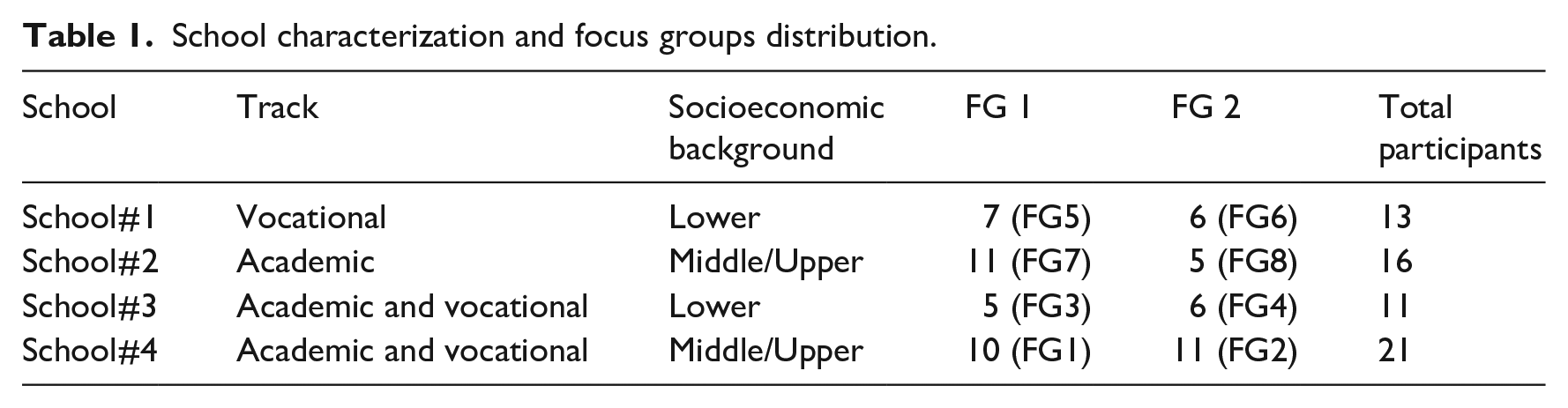
This research included the organization of focus groups in four Portuguese public secondary schools, located in the urban area of Porto (cities of Porto, Vila Nova de Gaia, Matosinhos, and Famalicão), and representing both academic and vocational tracks of studies. These schools were also selected to represent both middle/upper and lower socioeconomic backgrounds (see Table 1). Schools were informed that the research was being developed under the scope of the ‘CATCH-EyoU’ 1 research project, and that the students would have to voluntarily agree to participate. Sixty-one Portuguese students, from the 11th and 12th grades, were selected and the final group of participants included students from both academic (n = 37) and vocational (n = 24) tracks. The participants were asked to sign an informed consent containing all relevant information about their participation and how the collected data would be stored and analyzed. In case of underaged students, their legal guardians were also asked to give their formal consent for participation. Once all ethical requirements were met, two focus groups were organized in each school.
School characterization and focus groups distribution.
Data analysis
The discussions were audio recorded, transcribed, and submitted to a thematic analysis (Braun and Clarke, 2006) that allowed us to identify the specific topics that engaged two or more students in discussion, preferably disagreeing and arguing for different perspectives. This analysis revealed two major categories/themes: (i) democracy in the EU and (ii) terrorism and the refugee crisis. Since the script used to guide the discussions included several questions about the EU, and given that the refugee crisis emerged as a theme after the students were presented, during the ice-breaking activity, with images related to this topic, we cannot say that the emergence of these themes was completely spontaneous. These were, however, the themes that sparked some of the most meaningful and engaging debates amongst the participants. As such, the findings section in this paper will be divided according to these two categories/themes, including quotations that were considered to be representative of the participants’ opinions about the topics included in each one of the categories/themes. The transcripts were translated literally from Portuguese by the authors and all the students’ names presented here are fictitious.
Findings
Democracy in the EU
When asked to discuss the EU, the students argued that, over the last years, some undemocratic patterns have emerged. Although most students seemed to support the original ideals of the European project, many eagerly took the discussion toward the issue of an apparent division inside the EU that is distorting those original democratic values. These students argued that there is a real power imbalance that places Germany at the helm of the EU. In fact, they seem to feel so strongly disappointed (‘I don’t think that’s right’) by these circumstances that one of the students actually used a deeply critical analogy to describe the EU as a ‘gang’.
On the one hand, I agree with the EU but, on the other hand, not so much. For example, a gang (. . .) a group of friends that get together to do something, there is always one that takes the leadership. That is also the case in the EU. Portugal is obviously not the leader.
It’s Germany.
Yeah, Germany is the leader. But that is only because they nominated themselves as leaders. That is not a union. A union in which they rule other countries? I don’t think that’s right.
You think that it is not very democratic. Is that it?
Exactly. If it is really a union, they should help each other and divide the money amongst all the countries evenly. (FG2)
It is safe to say that this criticism is probably rooted in the economic crisis that struck Portugal in recent years (2011–2014) and in the austerity measures that were imposed to the country during this period. To many of the participating students, discussing the EU inevitably leads to discussing its economic implications. In this regard, the following excerpt represents not only the conflicting feelings about the potential economic benefits and constraints associated to Portugal’s integration in the Eurozone, but also reveals the establishment of an interesting connection between those economic circumstances and variations of European identity levels in different member-countries of the EU.
Portugal has the help of the EU. If it didn’t have that help, maybe, it would be harder for us.
Maybe the people living in Germany do not feel as European as us. Because of that help.
I think that they feel more European than us.
You think that the Germans feel that they are more European than the Portuguese. Is that it? Why do you think that?
Because Germany is a very powerful country in Europe. Like France, for instance, or Belgium.
Since we are not as powerful. . .that is why I said that. If we didn’t need help, maybe we wouldn’t feel that we are in the EU as much.
(. . .)
Maybe we wouldn’t have debt at all.
So we would be economically better?
It depends.
No.
I don’t think so.
We would return to our own currency.
So we would be better or worse?
Worse. (FG3)
Since recent public debate in Portugal surrounding the country’s membership in the EU has been marked by economic factors, this tendency to reflect about the impact European economic policies have in their society and in their daily lives actually mimics many of the arguments made in public political discourses regarding this topic. This tendency to focus the debate about the EU in economic factors seems to be significantly shaping the students’ perspectives about the EU, leaving many of them frustrated (‘But why do we only talk about the EU at the economical level?’) with the fact that other social issues are not part of the EU agenda and remain as problems that must, essentially, be addressed at the national level. Nevertheless, some students were able to go beyond this vision of the EU and question not only the very essence of the debates surrounding its values and everyday life implications but also the residual encouragement for their discussion in classes.
Yes. The everyday life of the EU is more economical than anything else.
Than social or political.
At the social level, it is each country for itself and it will only get something from another country if it really needs it.
But why do we only talk about the EU at the economical level?
(. . .)
What we learn about the EU are concepts and. . .ok, we can have questions about the EU: what is it? How things happen? All those “hows”. But, then, there is nobody to confront us with those questions or that may give us some answers. We are simply injected with some concepts and that is it. (. . .).
But we don’t even talk about concepts that make us question. We learn about institutions. Why would we simply want to know their functions and what they are good for and nothing else? (FG1)
Although discussing the EU internal organization does not seem to be particularly engaging for the students, many of them displayed a significant level of creative reflexivity while discussing what they perceive to be some other undemocratic aspects within its institutional framework. The following excerpt was taken from one of the liveliest discussions about the formal aspects of the EU, and can, perhaps, be seen as a good example of how teachers can articulate knowledge transmission about the institutional structure of the EU with a critically challenging pedagogical approach. Departing from arguments that justify either their support or criticism of the EU, four students involved the whole group in a more general discussion about democratic electoral processes.
I will say this: the EU should be a democratic institution and it’s not. Nobody elects the European Commission. It’s all done indirectly. The EU has a supranational character that allows it to overlap the constitutions of some countries. I believe that the democratization within the EU should be reinforced.
(. . .)
Exactly. I think that. . .least of all Portugal, really has the right to demand what you are saying when the non-participation rates for the European elections are what they are.
I don’t care about the non-participation rates. I think we have the right to say what we want to say. If people don’t vote, it is not my fault and I have the right to demand.
Well, you are right about that. But you have to care about what other people think.
(. . .)
For the European Commission. Who chooses it?
The European Commission is nominated.
There you go. It’s nominated. It’s chosen. By whom?
By the governments that you have chosen.
I didn’t choose the German government! I am sorry.
Right. But the German people did.
Alright, that’s great. But I think that it should be direct. Similar to the way we vote for the Portuguese Parliament and for the European Parliament. (FG8)
Some of the students involved in this discussion had previously been involved in extra-curricular activities addressing European topics 2 , which can partially explain the high level of knowledge and reflexive discussion displayed. The willingness and ability to problematize and critically reflect about political issues within the EU, however, does not seem to be dependent on the participation in these types of initiatives. This is further confirmed by the following interaction in which several vocational students, with no previous participation in these types of activities, address the problem of low participation rates in European Parliament elections and how that might connect with a sense of a shared European identity.
Do you feel you are a European citizen?
I do.
You do?
I do. Although I don’t have much of a say in it.
(. . .)
If voting would be compulsory, we would feel it more because we would feel that weight of having to know who we were electing.
You are talking about European elections, right?
Yes. I think it should be compulsory.
Do you think that voting in the European elections should be compulsory?
Yes.
And the rest of you. . .?
I think voting should be compulsory, period.
I agree. (FG5)
Altogether, these discussions indicate that Portuguese secondary students are highly motivated to engage in debates that involve questioning democratic practices within the political framework of the EU. Although the argumentative capabilities of the students in academic tracks seem to be higher, those in vocational courses also displayed good discursive and reflexivity levels when discussing controversial aspects of the current political settings of the EU. More importantly, many participating students displayed significant affective connections with democratic values, like freedom, solidarity and cooperation, and their discourses indicate the emergence of negative emotions, such as frustration (‘It is not for some countries to dominate others’) and disappointment (‘There should be cooperation and not competition’), when they perceive that political actions astray from those values. This is clearly visible in the following statements, in which some students were keen to remind European officials what the original values of the EU are and what they should mean.
Let the refugees in.
The purpose of the EU is peace and harmony.
And cooperation.
Tell NATO to cease to exist.
More?
Do what the EU was created for. It is not for some countries to dominate others.
There should be cooperation and not competition. (FG8)
Terrorism and the refugee crisis
In a post-9/11 international scenario marked by fear of terrorist attacks in Western countries, it is not surprising that the EU’s ability to provide safety to its citizens has been an important topic of discussion amongst the participating students. Many of them seem to believe that being in the EU provides safety, while others argue that recent terrorist attacks in Europe prove not only the EU’s inability to stop terrorist threats within its borders, but also that belonging to the EU might actually increase that risk.
Oh, never mind that. We are also at risk. We are part of the EU.
You have more protection and more help if that happens.
That has nothing to do with it. Look at France. (. . .) all those people still died.
But it’s like that everywhere. I country that is alone, isolated. . .all those that do not belong to the EU or something, are by themselves and nobody cares about them.
But they want people from the EU because, in those countries there are people that want to be a part of the EU, and, then, there are other people that do not want that. And those people that don’t want it are using terrorism so that it doesn’t happen. (FG5)
Just like it has often happened in public debate, and, especially, in populist arguments about these topics, most of the discussion quickly associated security issues within the EU with the recent refugee crisis. The level of discussion that these topics have produced clearly reveals the students’ interest in these issues and generated some of the most controversial moments of discussion. Furthermore, the students’ snappy engagement in these discussions and the way they defended their points of view seem to indicate a significant emotional connection with the topic. In fact, this topic seemed to confront participants with an emotional dilemma, leaving them torn between feelings of compassion and empathy for the suffering and death of asylum seekers and anger toward refugees and the fear of increasing the possibility of terrorist attacks. It is noteworthy that, in spite of being recurrently neglected by educators, these emotions are extensively explored by far-right populist anti-immigration rhetoric.
In fact, most groups recurrently went into emotionally charged debates about these topics, with a clear split between the opinions of students in academic tracks, that advocated mostly for the need for the EU member-states to preserve the lives of those seeking refuge from war, and the prevailing, although disputed, opinion amongst students in vocational tracks, which tended to give in to anger directed at refugees (‘Catch and kill them all’) and fear (‘At least I don’t get killed’) of potential terrorist attacks organized by asylum seekers in Europe.
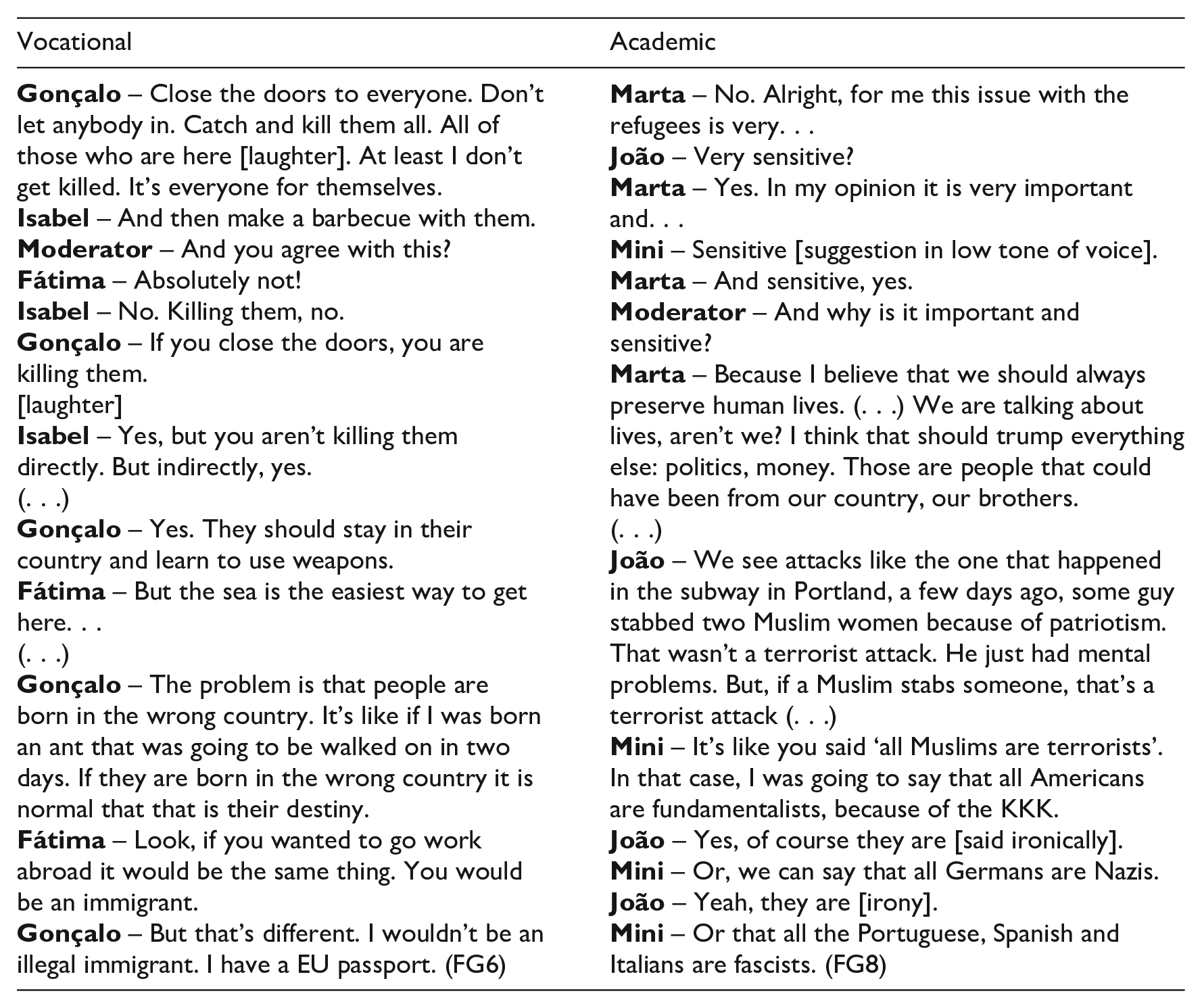
Although far from hegemonic amongst vocational students, opinions like the one expressed by Gonçalo indicate a higher level of vulnerability to anti-immigration and nationalistic propaganda when compared to academic students. Furthermore, even if in the discourses of other vocational students that revealed the existence of some kind of prejudice regarding the refugees, a certain degree of empathy (‘Look, if you wanted to go work abroad it would be the same thing’) toward people in need of assistance and a more general concern with Human Rights seemed to be present, their opinions appeared to be more easily influenced by unsubstantiated, but emotionally charged, arguments recurrently used by populist political actors and movements when they approach migration related issues.
In any case, in general, most of the students were actually very critical about the EU role in both finding a solution for the crisis and in the international circumstances that led to it. Although both academic and vocational students proved to be deeply critical of the EU’s responsibilities in creating these circumstances, the orientation in their criticism was quite different and with varying levels of argumentative complexity, as it becomes evident in the following discourses.
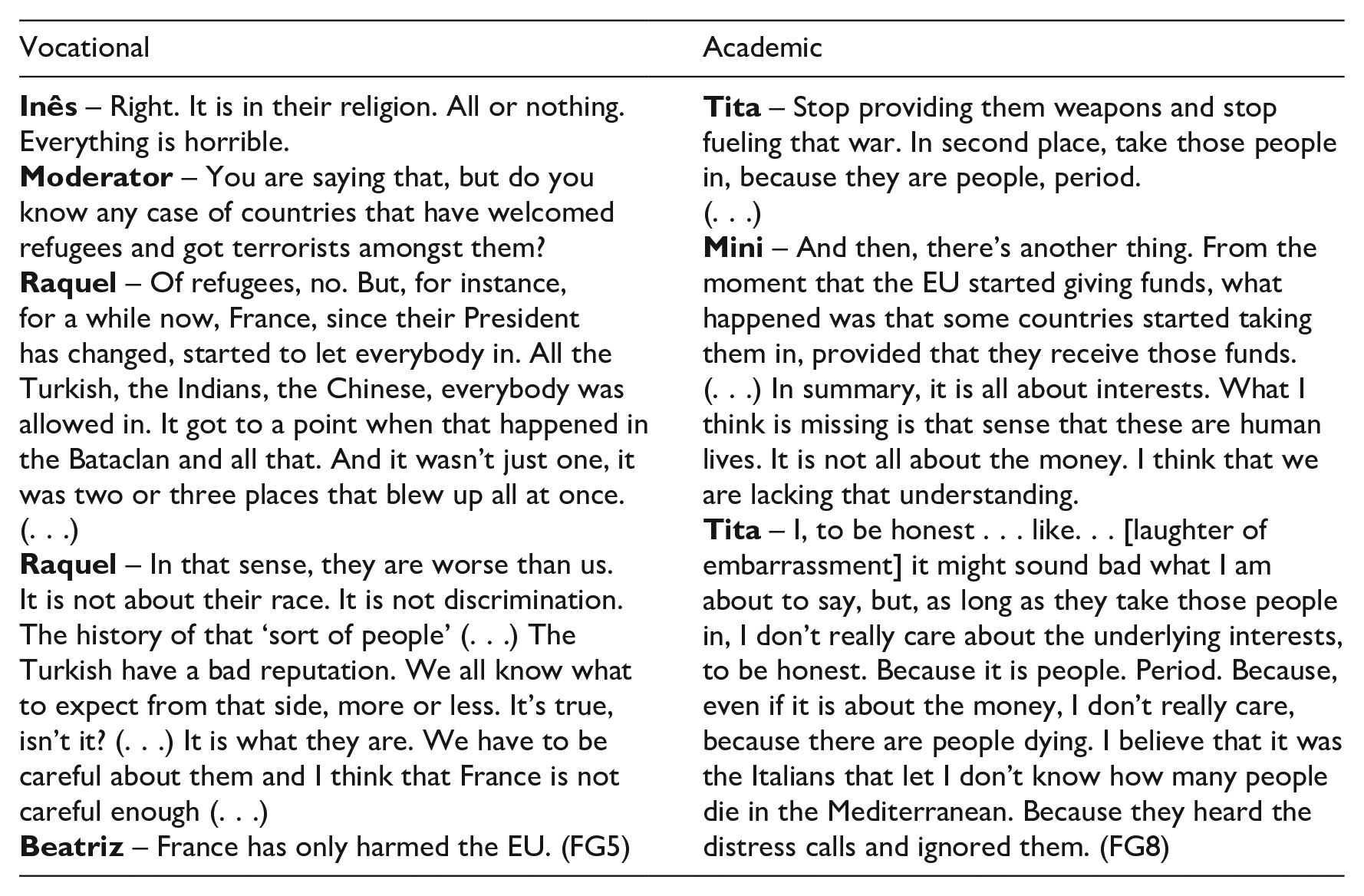
On the one hand, only students in academic tracks seem to believe that the EU has the moral obligation to help the refugees because it has also contributed to the escalation of the war in Syria (responsible for a significant part of the refugee influx). On the other hand, both vocational and academic students seem to give in to an unsettling fear (‘more control so that we can really know if they are people in need of humanitarian aid or with other intentions’) of potential terrorist attacks by advocating for more control over the entrance of refugees into the EU. These differences and similarities are particularly visible when we contrast the following discussion amongst students in academic tracks with the opinions of the students in vocational courses previously presented.
And maybe closing the borders is an exaggeration, but, yeah, more security regarding the refugees’ entrance.
(. . .)
I agree, and I disagree.
Ok.
I agree with the need to have more control so that we can really know if they are people in need of humanitarian aid or with other intentions. And I disagree because. . .it is about more than that. I believe that we should first ask: why does this conflict exist? (. . .) The refugees keep coming. The war continues. Controlling the borders, yes. But it will keep happening. We will have the USA Government involved there. We will have Russia trying to defend. And that will keep spreading. Spreading until it takes even worse proportions. We should get to the root of the problem. (FG7)
This concern with terrorism was common in both groups but, more importantly, although trapped between emotional reactions of empathy, anger, and fear when exposed to these humanitarian and security issues, both groups revealed a significant level of motivation to critically reflect and discuss about these topics, which should be explored by educators by creating spaces for discussing significant and controversial political and humanitarian issues in class.
Discussion
Our data indicates that upper secondary Portuguese students show a significant level of interest in discussing controversial political and humanitarian topics, like undemocratic behavior and social inequalities. The participating students have proven to be critical of power imbalances between member-countries of the EU and of its political actions to solve the recent refugee crisis. In line with previous research, most students in this study have expressed that they believe that better European policies that provide refugee protection while imposing border controls are still necessary (Jeannet et al., 2021). Furthermore, adding to previous knowledge about how emotions influence citizens’ perspectives about the EU (Erisen et al., 2020; Vasilopoulou and Wagner, 2017), the discourses of the participants in this study indicate that initial emotional responses of disappointment, frustration, empathy, anger, and fear are good precursors to engage in critical reflection about EU related topics. The participants’ criticism does not, however, mean that these students do not support the EU. On the contrary, most students seem to support the values they believe are behind the European project and Portugal’s continuity in the EU. This could mean that, in spite of their criticism, the students were able to use their CT skills to reach their own conclusions about the implications, both good and bad, of Portugal’s membership in the EU, which, in turn, could indicate a good level of resilience to attempts of political manipulation through the use of nationalistic arguments and anti-immigration rhetoric (Lubbers and Coenders, 2017).
Since our analysis indicates that the motivation to engage in CT about a specific political topic seems to be aided by an initial emotional response, these findings seem to confirm the importance of emotions in forming political judgments (Marcus, 2002), especially those concerning social justice issues (Kuby, 2013). In this case, when faced with information that indicates unjust or undemocratic behaviors, students seem to be more engaged in questioning the conditions that allowed those behaviors to emerge and to find solutions to the problems that they cause. In this vein, our data also revealed that humanitarian issues seem to be particularly emotionally engaging, generating lively discussions about opposing perspectives and moral values amongst the students.
While the students in academic tracks and in middle/upper socioeconomic contexts schools seem to lean toward empathy, revealing a more humanitarian and less prejudicial discourse regarding the refugees trying to enter the EU, those in vocational education and lower socioeconomic contexts often revealed anger toward asylum seekers and fear of terrorism, evidencing a prejudicial and, in extreme cases, openly xenophobic opinions about those that currently seek asylum in the EU. Although it may be ‘plausible that humanitarian concerns regarding the dangerous journeys of asylum seekers may decrease out-group bias and increase sympathy’ (Kentmen-Cin and Erisen, 2017: 6), these results indicate that educational and socioeconomic variations can deeply influence young European citizens’ attitudes toward immigrants. Adding to previous research (Erisen and Vasilopoulou, 2022), our findings suggest that a combination of rage and fear might be leaving vocational students in lower socioeconomic environments more vulnerable to anti-immigration rhetoric. This can either confirm the argument that people who are more exposed to ‘feelings of economic, cultural, and political vulnerability’ are generally more receptive to populist claims (Spruyt et al., 2016: 344), or it can simply mean that these students are more susceptible to reproducing prejudicial arguments often institutionalized by political elites (Wimmer, 1997) and propagated by the media. In any case, this is particularly worrying if we take into consideration that previous studies have revealed that both teachers and students in Portuguese vocational courses agree that, unlike in academic courses, there is time to discuss these topics in their classes (Piedade et al., 2020). Although these discussions should encourage the participants to consider different perspectives and ways of thinking (Benesch, 1999), they should also help the students to develop the metacognitive skills that may allow them to identify and deconstruct their own prejudicial judgments and ethnic bias. In spite of more favorable conditions for the development of pedagogical activities that stimulate the exercise of the cognitive skills associated with CT, the contrast between the discourses produced by students in both tracks may indicate that CT continues to be ‘relatively underplayed in vocational education’ (Anderson et al., 2001: 3).
It is noteworthy that this study includes only a small sample of Portuguese secondary students, so results should not be seen as being representative of the general student population. Additionally, aside from the socioeconomic contexts in which the four participating schools are integrated, our data collection did not include a methodological tool sensitive to out-of-school contextual variations that might have been determinant in shaping the participants’ perspectives. Given the complexity and wide range of factors that contribute to citizens’ support of anti-immigration claims (Stockemer et al., 2018), these findings should be seen as a departure point for further research on the factors contributing to increase young people’s vulnerability to xenophobic rhetoric. Additionally, since our classification of the emotions expressed during the discussions about terrorism and the refugee crisis was inferential, this analysis should also be complemented by studies that include confirmatory data about the participants’ emotional connections with these topics, namely by asking them what they feel when they think and talk about these issues.
Although CT development can occur in all stages of life, it is crucial to keep in mind that it is also a process that requires a systematic practice of its associated attitudinal dispositions and cognitive skills over long periods of time. Additionally, when thinking critically about topics related to democracy, cultural diversity, and immigration it is important that the critical thinker can engage with the experiences and arguments of those coming from different social and cultural backgrounds. Schools are privileged places to meet these criteria. However, many can still struggle to motivate some students to think critically. The findings in this paper seem to confirm that controversial topics are particularly effective in activating emotional responses that offer a solid basis for students’ motivation to engage in pedagogical activities aimed at developing the cognitive and metacognitive skills associated with CT. Additionally, they also affirm students as ‘political beings’, capable of and willing to critically reflect about social and political issues that they perceive as unjust and in need of sociopolitical change. In this sense, promoting CT about controversial, emotionally engaging, social and political issues can also be seen as an effective educational strategy toward empowering the students to resist attempts of political manipulation and to educate young European citizens that are critical guardians of democratic values and respectful of cultural differences.
Footnotes
Declaration of conflicting interests
The author(s) declared no potential conflicts of interest with respect to the research, authorship, and/or publication of this article.
Funding
The author(s) disclosed receipt of the following financial support for the research, authorship, and/or publication of this article: This work was funded by the European Union, through the European Social Fund, and by national funds, through the Portuguese Foundation for Science and Technology (FCT/MCTES), under the doctoral research grant no. SFRH/BD/123619/2016. This work has also received financial support from the European Commission, through Horizon 2020 Programme, under the research project ‘CATCH-EyoU - Constructing AcTive CitizensHip with European Youth: Policies, Practices, Challenges and Solutions’ [grant agreement no. 649538]. The authors also acknowledge FCT/MCTES for the support under the multi-year funding awarded to CIIE [grants no. UID/CED/00167/2019; UIDB/00167/2020; and UIDP/00167/2020].
