



Abstract
This case study documents the effort to prototype a media literacy curriculum based on Herman and Chomsky (2010)'s Propaganda Model as well as the target students’ environment and need analysis. The course is implemented under a Content and Language Integrated Learning program for 30 first-year undergraduate students in Sophia University, Japan. The objective is to develop students’ awareness of issues facing society they live in, along with the capacity to think critically about media information, deliberate in public discourse via expression of individual opinions, and exchange with others. Evaluation study is conducted upon completion of the course to examine whether, or to what extent, that objective is realized, using qualitative method. Results show positive impacts on students’ learning, providing valuable inputs for further iterations of curriculum design in citizenship and media literacy education.
Introduction
Differences and diversity of needs are the common state of every large-scale human society. How these differences are managed, however, varies across societies, determining their stability and long-term development. For democracy to work, a well-informed, participative citizenry who could contemplate various perspectives and make rational decisions for the common good is required. Media literacy and sensemaking capacity are necessary for citizens to decide the preferred course of actions and cast their votes democratically. As Ayres (1962) argues, the essence of democracy lies in the process of information dissemination, public discussion, and resolution by which accidents of the ballot box are mitigated. Cortes (1992) also believes the mass media teaches in five basic ways: provide information; organize information and ideas; create, reinforce, modify values and attitudes; shape expectations; and provide models for action.
However, in many countries, recent problems of the press, coupling with tyranny of the majority, present a crisis of democracy (McCoy et al., 2018). Fast deterioration of the information system manifests in massive manipulation of information, as well as the current surge of fake news, misinformation, hate speech, and propaganda (Bulletin of the Atomic Scientists, 2020). Since agreement on facts is essential to democracy and effective collective action, the information system's degradation and rising economic inequality could result in populism, tyranny, and worldwide conflicts. Thus, there necessitates the need for a citizenship curriculum that educates for media literacy, in order to help citizens navigate the media landscape to make sense of their sociopolitical situations and participate in public discourse. That is critical to enable their decisions regarding collective actions when confronting urgent, widespread problems, both globally and domestically.
The following case study documents the effort to design a media literacy curriculum treatment implemented under a Content and Language Integrated Learning (CLIL) course for first-year undergraduate students in Sophia University, Japan. Since the university's policy is oriented toward Education for Sustainable Development (ESD), educators often conduct CLIL classes exploring topics related to ESD and citizenship. This serves as a good foundation for researchers to explore citizenship education measures. This curriculum is developed based on analysis of the country in context, so as to customize an approach that is legitimate and relevant to the learners.
Background
Media literacy education
Media literacy education is considered a critical tenet of citizenship education (Mason and Metzger, 2012; McGrew et al., 2018; Stoddard, 2014), especially when liberal democracy faces significant challenges brought by digital media (Bennett et al., 2010; Kahne and Bowyer, 2019). There has been consensus and active effort among many governments as well as regional/international organizations (e.g. UNESCO, the European Union) to develop media education strategy (Jolls and Wilson, 2014).
In terms of conceptualization, three important aspects of media literacy education are widely discussed in the literature. First, the essence of media as a representation (or a construct) of reality is the central notion underlying various conceptual models such as Masterman (1989)'s 18 Basic Principles for media awareness education, Thoman (1999)'s Five concepts, and Wilson and Duncan (2009)'s Eight Key Concepts of media literacy. This constructed nature is tailored in various formats/mediums, entailing commercial, sociopolitical, ideological implications, therefore, necessitates a meaning negotiation process between the audience and creators of media artifacts. Second, media literacy involves both deconstruction (critical reception) and construction (active production), as expressed in the definition put forth by the U.S. National Association for Media Literacy Education (“the ability to access, analyze, evaluate, create, and act using all forms of communication”) (National Association for Media Literacy Education, 2021) as well as media literacy scholars (Hobbs and Jensen, 2009; Mason et al., 2018). Third, media literacy is a communal experience by which individuals gain access to insights and resources of the group, and knowledge is actively created via critical investigations and dialogue (Masterman, 1989; Mihailidis, 2014). Thus, media literacy education should be collaborative learning which provides an understanding of history and dynamics among players in the media system; theoretical framework to help learners analyze media techniques and make sense of media content; as well as the practice of metacognition and critical reflection (Hobbs and McGee, 2014; Mason et al., 2018; Masterman, 1985), in order to develop engaged citizens in a participatory democracy who are critical thinkers, communicators, and agents of social change (Mihailidis and Thevenin, 2013).
In practice, various education initiatives have been organized, focusing on topics such as metacognition strategies and the role of emotion in mindful media consumption (Sivek, 2018); impact of algorithms on media engagement (Cohen, 2018); media literacy education for social studies teacher (Schmeichel et al., 2018); using virtual cross-border exchange for propaganda analysis (Hobbs et al., 2018); youth participation and parental support programs (Bulger and Davison, 2018). In general, studies show media literacy education's positive outcomes in terms of students’ critical thinking skill, behavioral change, civic competence (Jeong et al., 2012; Krahé and Busching, 2015; Webb and Martin, 2012). However, limitations remain in program evaluation, with problems such as the lack of randomized control trials for curricular testing, or false sense of confidence in individuals who self-report their skills (Potter, 2013; Sanchez and Dunning, 2018; Wineburg and McGrew, 2017).
Japan's environment and need analysis
Japan context
In parallel with larger global trends, Japanese society nowadays experiences major issues which need to be dealt with by public awareness and collective actions. On the environmental front, it faces resource poverty and import dependence (Olsen, 2019), reliance on coal power plants, depletion of maritime resources, criticism of the country's controversial pro-whaling stance (Hirata, 2005), and financing of coal power plants overseas by Japanese banks (Sakai, 2020). With regards to war and conflicts, territorial disputes, wartime legacy, and historical problems with nuclear-possessing neighbors such as Russia, China, South Korea, and North Korea fuel the rise of Japanese right-wing politics calling for rearming Japan. Such regressive development in Asian relations largely complicates efforts to sustain peace in Asia. Besides, Japan is under the pressure of technological disruption such as job loss to automation and regulation of emerging technologies such as genome editing, autonomous vehicles (Chikaraishi et al., 2020; Hamaguchi and Kondo, 2018; Tanaka et al., 2020).
Japanese democracy (with one-party domination) is currently subjected to destabilizing impacts of population crisis and stagnant economy (Akram, 2019), rising inequality (Chiavacci, 2018), lower voter turnout, erosion of political trust (Maeda, 2018), controversy over immigration (Kamiyoshi, 2020), issues of Internet hate speech, misinformation, and journalism's legitimacy (Kaur et al., 2019). The diversity of Japanese press is limited due to the domination of media-owning conglomerates, government's influence, and prolonged existence of its press club system. This press club system exerts restraints on journalists via an exclusive membership mechanism (e.g. exclusive access to news sources) (Freeman, 1996; Reporter Without Borders, 2020). Yamakoshi (2019) argues that populist narrative, theatrical politics by mainstream media and growing public distrust constitute a legitimacy crisis of Japanese journalism, which is also a crisis of Japanese democracy.
Youth in Japan
In general, recent studies describe young Japanese with a pessimistic vision about the future, waning interest in global outreach, and low civic participation. Kukita (2019) shows that despite having the wish to contribute, Japanese youth have low interest in volunteering and civic participation. This is due to the view that issues should be handled by the government, the feeling of powerlessness against the state, and low self-efficacy (Kukita, 2019).
In terms of political outlook, young Japanese are characterized by apathy and withdrawal, resulting in low voter turnout (Ministry of Internal Affairs and Communications, 2019). According to the Global Attitudes Survey by Pew Research Center (2017), comparing with older generations, young Japanese are more satisfied with their democracy, and more inclined toward technocratic decision-making by experts. Few Japanese college students believe their involvement in politics would matter. Many were disappointed and others were indifferent.
As the young abstain from voting, politicians are geared toward the elder demographic and might pursue policies whose costs are borne by future generations. Taniguchi (2016) is concerned about potential danger created by generational viewpoint differences, especially when modern Japan also experiences divisions over issues crucial to society such as security, employment, and welfare.
Citizenship and media literacy education in Japan
Analysis of Japanese civics textbooks by Mori and Davies (2015) shows broad coverage of political, economic, and social issues in contemporary domestic and international society, with an emphasis on Japanese traditions, culture, technology, and the three pillars of the Constitution (e.g. people's sovereignty, human rights, and pacifism). However, the authors argue that the emphasis on political participation is largely about voting and participation in the community, while mention of tolerance, or the courage to defend a viewpoint in discourse, which are critical dispositions in the democratic process, is rather weak. In UNESCO; angkok (2020)'s report on policies and practices in media and information literacy education in Asia, media literacy education is said to be a recognized component of national curricula across academic subjects in Japan. However, it is difficult for educators in the country to promote UNESCO's aspiration of citizenship that encourages political engagement via diversity, dialogue, and tolerance, because it might be deemed inappropriate in Japanese culture to bring ideological or political activism into the classroom. Many schoolteachers prefer the safer route, engaging in the production of media content and avoiding sensitive topics. In the university-level media programs, controversial subject matters such as hate speech, war legacy, and discrimination against foreigners can be discussed more freely (UNESCO Bangkok, 2020).
Opinions on education of the young have been raised by various newspapers: left-leaning Asahi Shimbun (criticism that the reduction of voting age is meaningless if young voters do not vote); Mainichi Shimbun (argument on the importance of discussing politics at school instead of discouraging it in the name of political neutrality); right-leaning Yomiuri Shimbun, Sankei Shimbun (concern about the influence teachers and their unions have over students’ political views); and Nikkei Shimbun (the call for schools to deal with the reality of politics by conducting debates and comparison of manifestos by political parties) (Eldridge, 2018). Overall, there is a need to educate for the understanding of politics, contested issues, as well as critical thinking to resist manipulative forces. Social skills and connection with others are also important to the Japanese constituency since politics involves people coming together to decide on matters critical to the collective (Eldridge, 2018).
The curriculum treatment
Based on the Environment and Need analysis, it can be seen that Japan today needs a literate, committed electorate to decide on both domestic and global issues. Therefore, we aim at developing students’ awareness of issues facing society they live in, as well as their capacity to think critically about media information, deliberate in public discourse by expressing individual stances and negotiating with others.
Our media literacy course targeted 30 undergraduate Japanese students (n = 30) at Sophia University (Tokyo, Japan) who had signed up for the Academic Communication course. It was one of the university's general education courses mandatory to all students, irrespective of majors. This course was conducted under the CLIL framework, where students learned a foreign language (English) via the study of a different academic subject/theme (chosen by the teacher) to acquire both content and language skills. These 30 students were divided into 2 classes (15 students/class) taught by the same teacher. There were 19 females (63.3%) and 11 males (36.7%) whose ages ranged from 18 to 20 years: 12 students (40%) were 18; 13 students (43.3%) were 19; and 5 students (16.7%) were 20 years old.
To educate for critical thinking and media literacy, the researcher collaborated with the teacher to develop a curriculum treatment based on the theme of Media and Propaganda. The Propaganda Model developed by Noam Chomsky and Edward Herman (Herman and Chomsky, 2010) was used as the theoretical framework based on which we structure our curriculum. The model and its public relevance had been widely discussed in communication scholarship (Klaehn et al., 2018). It systematically mapped the media ecosystem in terms of stakeholders, their relationships and interactions, as well as likely outcomes of such interactions. Specifically, it specified five filters of the media that shaped our information system and determined public discourse: (1) Size and ownership of corporate media; (2) Advertising; (3) Influence of news sources and agents of power (e.g. government, business, experts, etc.); (4) Flak; and (5) Ideology. Thus, it was intended as a mental model for students’ reasoning.
The curriculum consisted of 28 lessons (about 46.7 h), 100 min per lesson, 2 lessons per week. The course syllabus was divided into three parts: Introduction to Media and Propaganda; Policy Debate; and Student Group Project.
Part I—introduction to media and propaganda
In part I, the issues of propaganda and media bias were introduced via exploration of two topics: Cognitive dissonance and Wartime propaganda (lessons 1–2). First, students learned about the psychological phenomenon of cognitive dissonance—a stress that occurs when we find ourselves having conflicting attitudes/beliefs, or behaviors that are not consistent with those beliefs. There is a human tendency to resolve such stress by denying, explaining away, or reducing the significance of the inconsistencies. By informing students of that tendency, we raised awareness of potential biases/prejudices, paving the way for an open mindset toward diversity of ideas. The subsequent lecture was a historical review of well-known propaganda by governments during periods of war and conflicts (such as in First World War or Vietnam War), explaining motives underlying countries’ war agenda and dynamics of international relations.
Upon such background, the class continued to explore the information landscape regarding modern war and conflicts (terrorist attacks, prolonged unrest in the Middle East, violence toward immigrants, and political dissidents) (lessons 3–5). The practice of comparing media articles (on the same topics) revealed to students how certain media narratives were constructed via different styles of headlines and storytelling techniques (lesson 6–11). Instruction materials (e.g. worksheets, assigned readings, TED talks) provided students with guidelines for reading comprehension. Finally, Chomsky and Herman's Propaganda Model was introduced to help students systematically understand the media ecosystem, make sense of why and how events might be portrayed the way they were (lessons 12–13). Students then applied the model to work in groups, researched Japanese media, and delivered presentations on their findings (e.g. cross-ownership structure in various Japanese media companies such as Fuji TV, Yomiuri Shimbun; heavy influence of government on the public broadcaster NHK; coverage on historical wartime issues with Korea, issues in American military bases, Japanese press club system). This media research activity was done in class (thanks to campus’ broadband Internet which students could access via laptops and mobile phones). It allowed for group discussion of various information sources and timely facilitation by the teacher.
Part II—policy debate
In part II, students utilized knowledge and skills learnt in Part I to engage in policy debates. Literature shows several merits of using policy debate activity in civic education such as stimulating higher order learning skills (e.g. analysis, synthesis, and evaluation) (Galloway, 2007), or develop courage and civic virtue (Hawhee, 2002). Besides, the practice of posing questions, forming value judgements, and negotiating opposite interests helps learners recognize values in positions other than their own. Critical scrutiny of each thesis allows for the development of tolerance toward plurality of opinions and trade-offs we have to make to sustain a peaceful, collective, multifaceted reality (Egglezou, 2019). However, the competitive feature of the debate together with cognitive dissonance involved when students try to resolve contested positions might bring distress and anxiety (Goodwin, 2003); therefore, the role of the teacher as moderator to summarize, reconcile and mitigate is important.
In each class, six student groups took turn to debate about the legalization of three emerging technologies: self-driving cars (lessons 14–15), human gene editing (lessons 16–17), and autonomous weapon (lessons 18–19). Each debate round had two lessons. One involved a lecture on basic scientific concepts of the topics, an announcement of debate questions, followed by media research (in groups) on the advantages and disadvantages of the technology discussed. The teacher assigned two debate teams at the end of the first lesson, who would be responsible for providing the class with two media articles representative of their side. Everyone would read four articles before the forthcoming lesson to get a brief understanding of the discourse and form an initial judgement.
The second lesson consisted of three activities: voting, debate, and town hall type discussion. Already informed of the discourse, everyone cast an initial vote at the beginning of the lesson. Afterward, the two teams started debating. Once the debate reached stalemate (often after three rounds of arguments), the teacher announced a recess. The audience was divided into two groups for town hall type discussion. Each debate team consulted one audience group about key issues in the debate, then consolidated their final statements. The debate was concluded with a second vote. Both votes were conducted anonymously by having students submit their votes via an online poll. Thereupon, initial and final poll results were shown to the class. Finally, the teacher summarized key issues mentioned by students, as well as expanded the discussion toward further inquiries.
In essence, part II addressed topics of media propaganda with regards to technological risks and future conflicts. Through policy debates, students explored the trade-offs and indeterministic nature of technology, their relevance to society, the problem of global cooperation and regulation. They also experienced how public opinion was influenced by different media narratives and political contestation. The delivery of policy debate section was enabled by videos, gamification, and augmented reality applications which demonstrated new technologies to students in an intuitive manner; as well as the use of QR code, Google Slide, and its add-on Slides Poll to make the voting experience seamless. Figure 1 summarizes policy debate activity.
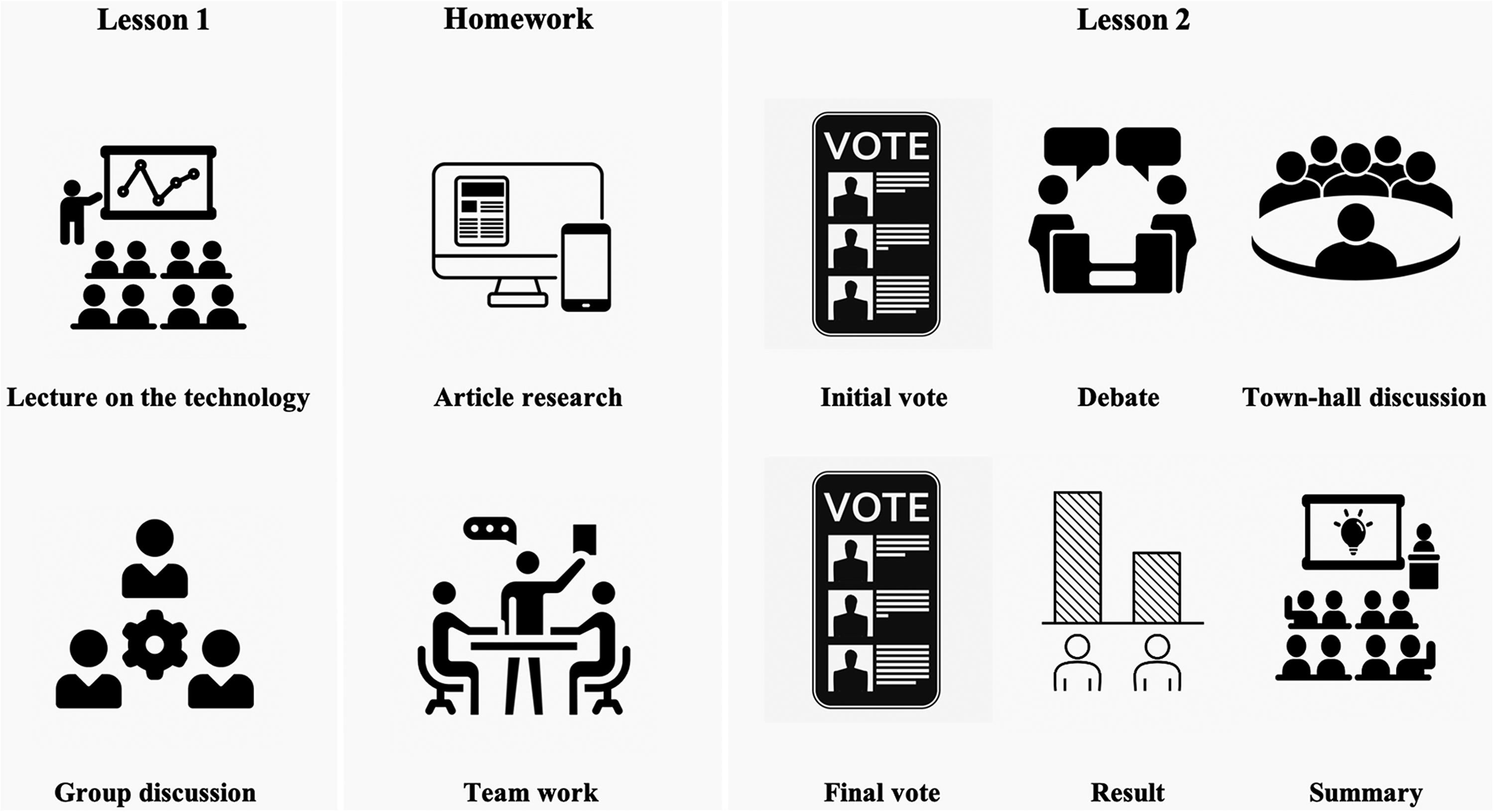
Policy debate activity.
Part III—student group project
In part III, students pursued their own issues of interest. They conducted research in groups and prepared for a final presentation (lessons 20–24). The software MindMeister was introduced to the class to facilitate teamwork and the teacher's supervision. It is a real-time mind mapping application for online collaboration, allowing group members to contribute and organize ideas in the form of a mind map. The teacher was added as a group member in each student project on MindMeister so that he could constantly keep track of students’ progress, comment, and suggest relevant information. After students delivered final presentations, the teacher provided feedbacks and recommendations for improvement (lessons 25–26). Finally, the teacher summarized the course, reviewed key learnings, and assigned a reflection paper (lesson 27). The university-wide English test was conducted in lesson 28.
In brief, the design of this curriculum reflects the learning progression as calibrated in four levels of proficiency (e.g. Retrieval, Comprehension, Analysis,and Knowledge utilization) in Marzano and Kendall (2007)'s framework New Taxonomy of Educational Objectives. Part I addressed the first two stages by introducing events, facts, evidences demonstrating media propaganda landscape to increase students’ awareness of the world (Retrieval); then providing critical questions the readers should ask as well as the Propaganda Model as a toolkit for systematic understanding of mass media ecosystem (Comprehension). As students applied them to study real-life context (e.g. war in the Middle East, Japanese press system), they moved to the third stage (Analysis). Parts II and III continued to develop Analysis capability, while enabled transition to Knowledge utilization, by having students exercise using the Propaganda Model. Based on the model, students conducted media research, formed opinions on social affairs, worked in groups to articulate arguments, and participated in collective decision-making. Given the complex nature of the issues covered, the curriculum was delivered in a deliberate manner. The teacher mainly compared different views. He also constantly emphasized the fact that nobody had the right answer and students, therefore, had to engage in autonomous thinking to decide their own stance and course of action.
Evaluation
This course was an effort to prototype a media literacy curriculum treatment that corresponded to the environmental context and needs of university students in Japan. The objective was to develop students’ awareness of issues facing their society, as well as their capacity to think critically about media information, express personal opinions, and participate in public discussion. The following qualitative method evaluation study was conducted for the abovementioned group of students at Sophia University (Japan). The researcher collected data to examine the extent to which the course's objective was achieved.
Evaluation questions
To examine the extent to which the course's objective was achieved, we asked two questions:
Question 1: What are students’ opinions regarding issues facing domestic and international society? Question 2: How do students reflect upon learning about the media landscape?
Methodology
Instruments
The instruments included a top-of-mind policy survey and a Reflection paper. The top-of-mind policy survey was an open-ended question asking students to list three issues that they thought the Japanese government should prioritize.
The Reflection paper consisted of two essay questions:
What are your thoughts on the issues facing domestic and international society? What are your thoughts upon learning about the media landscape?
Data collection
The top-of-mind policy survey was conducted in class at the beginning and the end of the course. Twenty-nine students answered the survey at the beginning of the course, and 27 students answered it at the end of the course. There were 26 students who answered both times.
The Reflection paper was assigned to students as final homework at the end of the course. The students were asked to reflect on what they learnt and freely choose the topics to write about. It was further explained that the length of the paper could be four–five pages. Students might choose either topics covered during the course (e.g. war and conflicts, technological disruptions, media coverage, and propaganda, etc.), those they had researched for their group projects, or any topic of personal interest. Twenty-seven Reflection papers were collected, whose actual length ranged from 4 to 8 pages. Three students did not submit their responses.
Data analysis
To answer Question 1, data from the top-of-mind policy survey and responses to the first essay question in the Reflection paper were used. To answer Question 2, data from students’ responses to the second essay question in the Reflection paper were used. These qualitative data were analyzed using open coding technique to identify major themes in students’ responses.
Results
Question 1—what are students’ opinions regarding issues facing domestic and international society?
Top-of-mind policies (policies that the Japanese government should prioritize)
Among 29 students who answered the top-of-mind policy survey at the beginning of the course, 9 students came up with 1 answer, 2 students came up with 2 answers, 10 students came up with 3 answers, and 8 students could not come up with anything. It resulted in 43 answers in total, whose concerns were on Welfare such as social security, education, disaster alleviation, child welfare (15 answers); Environmental issues (7 answers); Economic issues such as taxation, poverty, inequality (7 answers); Population issues such as immigration, refugee (4 answers); International relations such as diplomacy, war/conflict (6 answers); Technology regarding AI, robotics (2 answers); Gender issues (1 answer); and Politics (1 answer).
Among 27 students who answered the top-of-mind policy survey at the end of the course, 9 students came up with 1 answer, 18 students came up with 3 answers. It resulted in 63 answers in total, whose concerns were on Welfare such as social security, education, disaster alleviation, child welfare, mental health, public services (19 answers); Environmental issue (9 answers); Economic issue such as wage, government debt, taxation, poverty, inequality (6 answers); Population issue such as low birth rate, immigration (3 answers); International relations such as diplomacy, war/conflict (13 answers); Technology regarding AI, robotics (5 answers); Gender issue (2 answers); and Politics (6 answers).
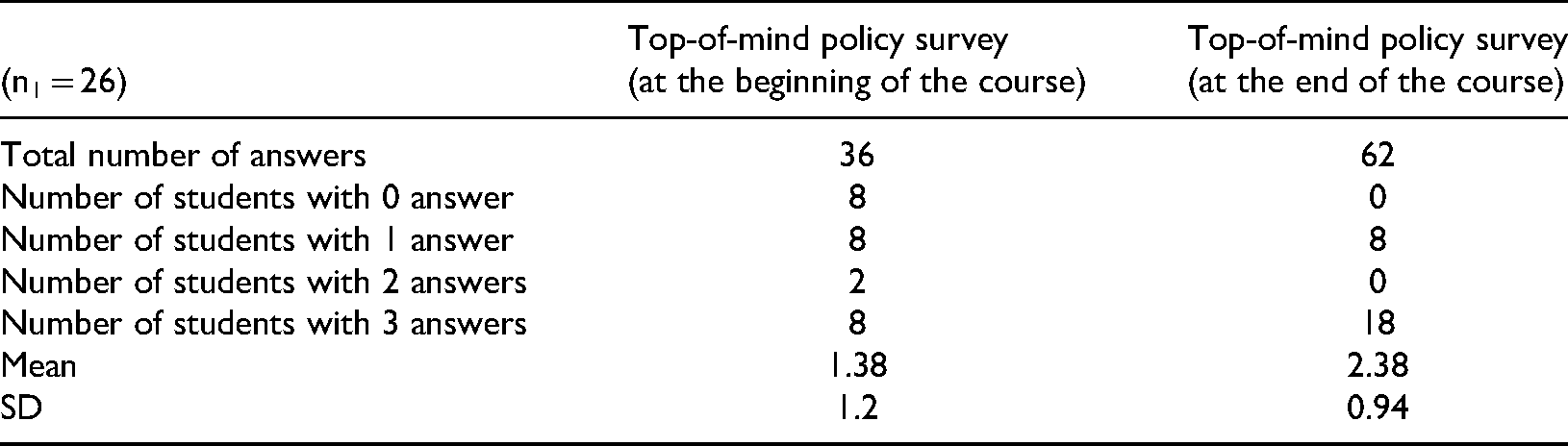
Besides, to compare the results obtained at the beginning and the end of the course, we examined the sample of 26 students who had answered the top-of-mind policy survey twice. Overall, of the 26 responses by these students (n1 = 26), the total number of answers increased from 36 to 62 (26 more answers), the number of students who could not come up with anything dropped from 8 to 0, and the number of students who could come up with 3 answers changed from 8 to 18 (Table 1).
Number of answers on top-of-mind policies (n1 = 26).
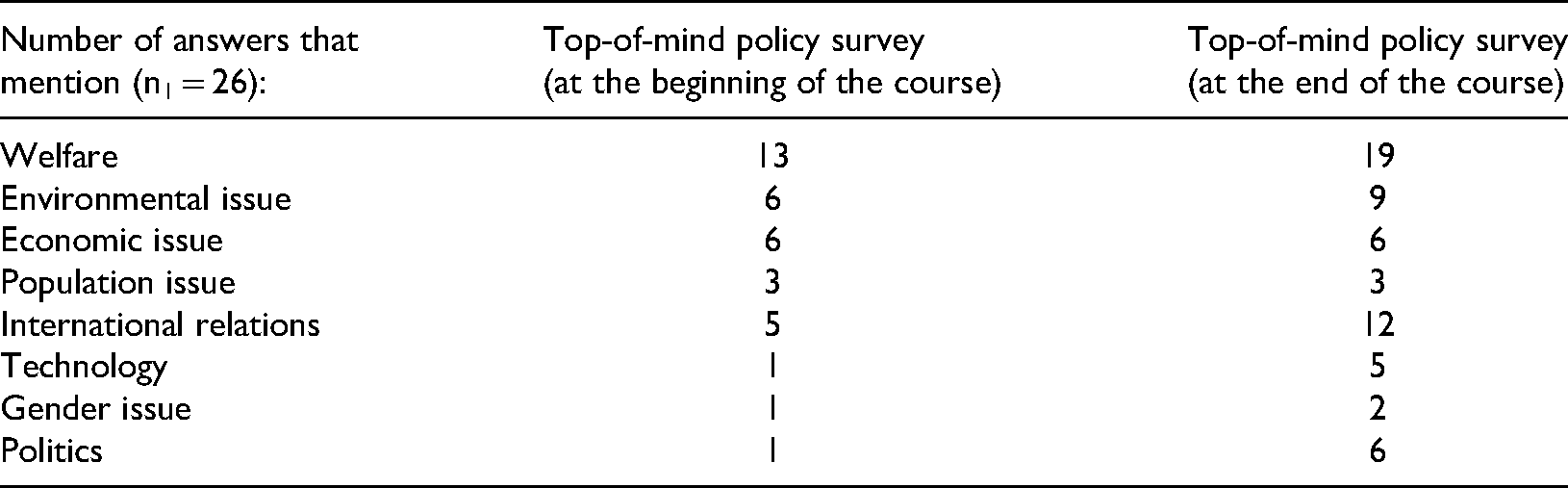
With regards to issues of concern these 26 students had, Welfare remained the most mentioned at both the beginning (13 answers) and the end of the course (19 answers). International relations (especially on improving diplomacy and relationship with neighboring countries) gained more attention, with the number of answers mentioning it rose from 5 to 12. Issues in Politics were also mentioned more (from 1 to 6 answers), citing low voter turnout, government's transparency, corruption, and freedom of expression. The numbers of mentions regarding Technology and Environmental increased by 4 and 3, respectively (Table 2).
Issues of concern (n1 = 26).
Opinions on the issues facing domestic and international society
Responses to the first essay question of the Reflection paper (27 responses) showed students’ awareness and opinions regarding issues facing domestic and international society. Reflecting on learning about situations of other places in the world, students wrote about situations of various countries such as Syria, Libya, Hong Kong, and America. For example: “I’m most interested in 9/11 because I did not know anything about it except for the attack of the building. So when I studied about it I find it important to know history. Before this course I didn't think history is important but it turns out history is important for critical thinking”. “We should know what the situation is now about immigration, why those things happen, what will be the result if we don’t have solutions. Now Japan doesn’t accept immigrants and refugees, but if other countries also do not accept them it will become a big crisis. We should think about it now”.
Furthermore, students also wrote about the issue of new technologies. Sixteen students showed a cautious attitude since the technologies were useful but to be introduced carefully. Some worried that the legal system was not yet equipped to deal with future problems brought by those technologies. Four students shared that they were a bit fearful. In contrast, several students were excited: “Inspiring; I felt interested in such godlike topic.” Overall, students reflected on the current lack of awareness, emphasizing the importance of having public conversations to address both problems and merits, as well as the necessity of global cooperation to regulate emerging risks. For example: “In the lecture about Gene-editing, we talked about the Chinese doctor who used this kind of technology on human and ethical problems. I felt a little bit dangerous with using these kinds of advanced technologies in the future. I thought it is scary because the technology is improving, and I don’t know about it well.” “People should think about whether we can entrust driving to AI. In addition, people have to know AI makes mistakes.”
“It's important to remove people's anxiety and prejudice for self-driving car. In my opinion, people may fear self-driving car because self-driving car's accidents are paid attention to by media. But self-driving car may be safer, less accidents if used appropriately.”
Discussing the petition calling for the ban of autonomous weapons by AI researchers and roboticists on the Future of Life Institute website (mentioned during policy debate activity in class), 12 students said they had signed it because they did not want a proliferation of war and did not find autonomous weapon system lead to more safety. Meanwhile, 10 students said they did not sign the petition because they needed more information, more careful thinking, or because they thought there were certain merits: “AI has a lot of merit on disaster rescue and medical scene. Automatic soldiers might be the solution of killing people in war.”
Question 2—how do students reflect upon learning about the media landscape?
Responses to the second essay question of the Reflection paper (27 responses) showed students’ attitudes and opinions after learning about the media landscape and public discourse in the world as well as Japan. Six major themes emerged from students’ reflection: complexity and mechanisms in the information system; diversity of ideas and perspectives, negative impacts of media biases; the role of the media and the government, the role of the citizens, and personal changes in terms of media consumption.
The complexity and mechanisms in the information system were a theme discussed in 22 students’ responses. Thirteen students wrote about the asymmetry in terms of access to and control of information between the government and the public. They mentioned the difficulties Japanese people had when it came to understanding wartime issues due to political reasons (such as the ban of any reference to wartime sex slaves by Japan's public broadcaster NHK, which reflected the position of Japanese government). Besides, eight students thought that experts and celebrities’ opinions had a big impact on the Japanese public, whether it was about the willingness to buy a product or about their attitude toward Korea. Seventeen students also elaborated on the biased reports and multiple opinions on certain events in Japan, and many emphasized the need to look at the information from various broadcasters or newspaper companies. One reflected on the Japanese media landscape: “Japanese Constitution bans censorship, but sometimes media do censorship independently because they care for their sponsors or viewers. So I’m really surprised to hear about ‘independent media’ which could be free of influence by government or corporate. However, there are few independent media in Japan.”
Diversity of ideas and perspectives was a theme mentioned by 17 students. Twelve of them reported their experiences of such diversity through comparing various media: “Reading various articles made us realized the contradiction and led us to another fact. There is fake news out there and we must consider various points because we don’t know what the right information is. I often learn from article research of different countries’ views.” “To have the initial vote and final vote is very interesting. The university class has so many people, normally students cannot know what others think of the class or the topic. Thus, it is good to know that each group has a reasonable statement, and it's good to know how many people have what opinions.” “I think advance technology is a good thing, it has negative side, but we need progress, I always believe that so I could make a final decision. But other students might not have that firm belief. In our small class we already had that belief swing, so maybe the media is doing the same thing, shaping people's belief.” “Treatment of information is equal and should be given to everyone who wants to know the truth, to make society more informed and prosperous, we need freedom of the press lawfully and equally.”
“It is the obligation of government to ensure diversity of news.”
The role of the citizens was discussed by 23 students. Citizens’ information literacy was considered important (mentioned 18 times) to detect bias, consider various perspectives; have independent opinions; avoid being controlled by those who want to make money; avoid war propaganda and stop going to war. Furthermore, seven students reflected on democratic citizenship, saying that “citizens must beware and make better collective decision via election, to realize democratic politics in the true sense.” Upon reflection of the political situation in Japan, 11 students found the need for young people to express their opinions and engage in politics: “I think young people don’t watch a lot of news because they find those issues too difficult. But Japan has a lot of problems now. If only old people vote, for their own welfare, government policy will focus on old people, while it is also necessary for society to spend resources on young people to help them have a good future.”
“In next year election, I feel I must go. And we need more opinions from other parties, not just the LDP.”
Finally, 24 students reflected on their personal changes in terms of media consumption. The importance of tuning to public discourse was recognized by 20 individuals. Twenty-four students mentioned the development of critical thinking skills. Many of them also elaborated on how they applied five filters of the Propaganda Model in their media consumption. “Before taking the class, I often just read newspaper or watch Youtube about political things and was convinced by their opinions. But now I want to know the source, the background information, and other opinions. Sometimes both sides have clear evidence, and it makes me question which one is right. I think my critical thinking is improved thanks to this class.” “I like debate and discuss. And I liked to work with my team. I get to express my ideas and my friends help me understand a lot of things I don’t know. They make me think critically.” “I want to raise public awareness about the fact that what media say is not always true. I think each person can contribute, whether it's voting in election or a Twitter retweet.”
Discussion and limitations
Overall, general patterns in the evaluation data suggest that the course generates a positive impact on students’ development of media literacy, especially in terms of awareness of social issues and capacity to think critically about media information, express personal opinions, and participate in public discussion.
In Question 1, data on the top-of-mind policies (3 issues students think the Japanese government should prioritize) of 26 students (who answer this survey before and after the course) show an increase in the total number of responses the class comes up with, as well as the attention given to International relations (especially on improving diplomacy and relationship with neighboring countries), Issues in Politics, Technology, and Environment. Students’ responses to the first question in the Reflection paper also reveal learning with respect to world events, situations of war and conflicts in different countries, and various issues of global scale. Especially, their opinions with regards to issues accompanied by the new technologies express a range of attitudes (e.g. fearful, excited, intrigued, or cautious). There lies an awareness of the risks of technological disruption, the need for global cooperation to regulate future conflicts/ technologies, the trade-offs as demonstrated in debates where they hardly find a single correct answer. As students put emphasis on international law, infrastructure, risk management, public education, and global cooperation, they demonstrate an ability to clearly articulate personal opinions and justify their positions with regards to specific social issues discussed.
In fact, the top-of-mind policy choices students made after the course also realistically reflects the situation faced by citizens who must at the same time weigh a bundle of both domestic and global issues, then vote on domestic policies. The prioritization of Welfare, International Relations, Environment, followed by Economic, Political, and Technological issues aligns with findings in the literature about the Japanese context (Environmental and Need analysis), thus reflects students’ thoughtful decision-making with regard to problems facing their society, both domestically and globally.
In Question 2, students’ responses to the second question in the Reflection paper indicate a systematic understanding of the media landscape: its complexity, diversity, the interplay among the media, citizens, and government actors, its critical role in sustaining democracy, as well as negative impacts of media bias and propaganda. Students’ writings also convey confidence, openness, and engagement with issues in politics (concerns about media bias, government's conduct, democracy, motivation to vote, share information). Besides, their self-reports on personal changes demonstrate an open attitude toward diversity of ideas and perspectives, mindful media consumption, participation in public conversation via expression of personal ideas and deliberation with others.
Several conditions set up in the curriculum might have contributed to the observed positive impacts on students’ media literacy. First and foremost, it is the use of the Propaganda Model developed by Noam Chomsky and Edward Herman as the theoretical underpinning for the course design. Learning activities and contents vary, but all are developed to enable constant exercise of this framework. Since it systematically maps the media ecosystem's dynamics, students can do research and analysis based on specified key stakeholders, their relationships/interactions, and likely outcomes of such interactions. The model has thus become a powerful mental toolkit that helps students develop critical thinking while navigating modern information systems. The major themes that emerged in students’ reflection upon learning about the media landscape (e.g. complexity and mechanisms in the information system, diversity of ideas and perspectives, the role of the media and the government, and the role of the citizens) demonstrate literacy of this model.
Second, the presentation of diverse content and contrasting information might help to expand worldview and cultivate an open mindset. Furthermore, group discussion is helpful since the discussion with peers broadens students’ knowledge while allow them to express personal opinions. In addition, cognitive dissonance is an important feature in the curriculum's setting. Constant exposure to contrasting narratives and ideas helps students re-evaluate personal beliefs, practice critical thinking, and intuit the dynamics across the media landscape.
Third, research and presentation skills (constantly practiced during the course work) enable an autonomous learning process by which students pursue inquiries and make decisions by themselves. Additionally, the emphasis that there is not a single right answer to each issue encourages all students to come up with ideas based on evidence and logic.
Fourth, the design of policy debate activity impacts on student's learning of public discourse participation. The debate topics (e.g. Autonomous vehicles, Gene editing, and Autonomous warfare) are global-scale issues of technological disruption. Rather than sensitive issues (e.g. those involving national security and historical conflicts) which might trigger emotional responses, this type of issue is arguably more effective to have students explore humanity's shared future and see the need for global cooperation. Besides, a high challenge, high support, inclusive environment to motivate learning is enabled by the combination of the debate's competitive dynamics and the town hall discussion activity where the audience also participates and helps debate groups develop arguments. The requirement that debate teams present the class with two articles representing their side provides a framework for students to operate based on facts and rational reasoning, thus results in more reliable arguments and logical judgement. Finally, the two-vote mechanism actually shifts the spotlight from the debating teams to the audience, and shifts the purpose of the debate from debating teams showing their skills to the audience making a final decision. This type of public discourse is designed to provide the environment for critical reflection, rational individual, and collective decision-making. It allows students to see others’ opinions, and experience the swing in opinions caused by influential details in the debate. Overall, the debate simulates a healthy public discourse that aims at negotiating differences, trade-offs, and collectively deciding what's optimal for a society.
These conditions of the curriculum and impacts on students are indeed in line with discussions in the media literacy education literature mentioned above. However, several limitations are observed in the implementation of this course. First, there is a language barrier to students’ comprehension of English media articles. Second, the topics discussed in class are of intermediate to advanced level in terms of scientific knowledge and issues’ complexity. Therefore, the course does not match all the students’ capacity. Visual aid, augmented reality, and gamification tools are brought in to help the teachers explain the concepts. However, the lack of English capacity might prevent some students from grasping the knowledge necessary to engage deeply in discussion, or conduct media research.
Regarding the evaluation study, the results must be analyzed with caution due to the lack of control group. It is not possible to prove that this class has solely developed students’ media literacy, because students are often exposed to various stimuli on campus as well as in everyday life. The overseas experience some students had may also contribute to differences in their receptivity to the curriculum. The small sample size also poses a limitation to the interpretation of these results.
However, with this case study, the researcher hopes to explore the practice of building curriculum treatment on the go via ad hoc collaboration with a teacher in the local setting. Curriculum development is an ongoing iterative process tailored to particular inquiry rather than generalized rules. Thus, as we get to know students incrementally, teaching strategies can be adjusted to better reflect students’ ability and needs. For example, depending on student's majors, level of knowledge, and time limit, the content, and workload of the course can be adjusted. Furthermore, though the duration of this course (14 weeks) is standard for the general education courses offered in Sophia University, elements in the course design can be adopted and recalibrated for other settings, or conducted in synergy with other courses in history, political science, global studies, etc. Finally, it should also be combined with civic work to channel students’ energy into healthy democratic politics and exercise of what they learnt.
Conclusion
Facing major challenges in economic, environmental, technological, and political fronts, Japan needs a committed, literate electorate to deliberate on society's collective decisions. To counter the trend of political apathy prevalent in the young Japanese constituency, this research attempts to develop a media literacy curriculum to raise university students’ awareness, interest, and capacity to engage in public conversation. The media literacy curriculum educates for an understanding of the media landscape, social issues, communication and teamwork skills, and participation in public discourse. The observed positive impacts on students’ learning suggest that the use of Herman and Chomsky's Propaganda Model as a theoretical framework to structure the curriculum and this particular curriculum prototype can be valuable for further development of instructional design in citizenship and media literacy education.
Footnotes
Abbreviations
Content and Language Integrated Learning Education for Sustainable Development Liberal Democratic Party (Japan)
Acknowledgments
The author would like to thank Professor Taro Komatsu and Professor Jason McEvoy (Sophia University) for constant support of this study.
Authors’ contribution
The author is responsible for the whole development of manuscript, supporting materials, and accountable for the accuracy and integrity of the work.
Availability of data and materials
All the data and materials are included within the article and supporting materials.
Declaration of conflicting interests
The author declared no potential conflicts of interest with respect to the research, authorship, and/or publication of this article.
Funding
The author received no financial support for the research, authorship, and/or publication of this article.
