




Abstract
Using a Critical Race framework, researchers conducted semi-structured interviews to explore how educational leaders across Texas have made meaning of the impact of George Floyd on their practices. Findings from this study add to the literature by examining administrators’ reflections on race, racism, and their impact on their approaches to leadership. The four of the most prominent themes that emerged from this qualitative study, including Increased Critical Self Awareness and Reflection, Critical Awareness Influencing Decision Making, Disconnect Between What is Known, What is said, and What is practiced, and Racial Battle Fatigue. Despite the resolute and rampant backlash against Critical Race Theory, the findings from this study underscore its relevance to education. Implications of these findings beseech educational leaders and policymakers to consider implementing professional development and accountability measures that center race in educational equity.
The United States saw unprecedented unrest in the summer of 2020 following the police killing of George Floyd. The reckoning with racial injustice prompted new insights and dialog about systemic racism, power, privilege, bias, and inequity. Across the country, while educational leaders were trying to navigate a shift in leadership priorities, an approach brought on by the Covid 19 pandemic, they also had to do some grappling with the way racism impacts their personal and professional lives. Alongside critical reflection would come a resolve for some to reconceptualize their roles to approach educational leadership through a lens of social justice and racial equity in the face of obstinate systemic racism.
Examples of systemic racism that permeates education are the persistent racial disparities in access to high-quality education (Grace, 2020), academic achievement (Merolla and Jackson, 2019), discipline practices (Sanders et al., 2022; Skiba et al., 2014), funding (Sosina and Weathers, 2019), and hiring practices (Goings et al., 2019). Therefore, a qualitative examination of how the death of George Floyd and the racial protests that followed affected educational leaders’ critical awareness about racism and its role in education may provide leaders, policymakers, and leader preparation programs with the insight needed to dismantle structures that perpetuate racism in education. This study examines how educational leaders across Texas make meaning of the impact of George Floyd on their approaches to leadership. It is critical to gain new insights to support leaders as they navigate being agents of social change.
Literature review
This study sought to ascertain an in depth understanding of the ways in which educational leaders center race in dialog and decision making in the aftermath of George Floyd. The reviewed literature provides context of current equity focused approaches to school leadership, and national and state standards for promoting equity, diversity, and inclusion in leadership. Ultimately, the background provided in this section provides for a richer interpretation of the findings and implications.
Equity and social justice focused models of educational leadership
There has been some discussion about which leadership practices are most effective for improving student outcomes; more and more, leading for educational equity has become a focal point. For example, Leithwood et al. (2020) revisited their previous work on effective school leadership. They assert that school leadership is vital to the success of a school (Leithwood et al., 2020). While the authors note their previous research on high leverage leadership practices, they admit to shortfalls in discussion of equity in education and revisit their previous findings to include an explicit focus on equity (Leithwood et al., 2020). While educational equity has become a core focus in leadership research and practice, some researchers claim it is not enough. Welton et al. (2018) contend that in discussions of equity, race matters as it remains a central concern in schools and society in general. The authors argue the importance of centering race to produce successful efforts that truly pursue equitable outcomes for racially and ethnically diverse learners (Welton et al., 2018). Welton et al. (2015) suggest that school districts develop and implement a framework for addressing issues of race. The authors determined that educators are racially conscious of the changes in demographics and disparities in student achievement, but practices to address these changes remain race-neutral (Welton et al., 2015).
Culturally Responsive Leadership (CRL) has been touted as an approach to school leadership that would enable educational leaders to adequately meet the needs of an increasingly diverse student population (Khalifa et al., 2016; Lopez, 2015). Lopez (2015) argues that diversity takes on a greater significance for educational leaders as student populations are changing in Britain, Canada, the United States, and across the globe. Student diversity based on race, ethnicity, sexual orientation, gender, class, and ability requires educational leaders to reflect on and make the necessary edits to their practices (Lopez, 2015). The findings in this qualitative study specify tenets of CRL, including the school leaders’ examination of their own racialized histories, biases, and positionality; advocacy for recognition, revitalization, and community development; addressing resistance, and developing a community of practice (Lopez, 2015).
Similarly, Khalifa et al. (2016) examined the literature on culturally responsive school leadership (CRSL) as it relates to building-level leaders (principals). This work highlighted the culturally responsive behaviors that influence student outcomes (Khalifa et al., 2016). One area that emerged from their review of the literature was critical self-awareness, or the ability of the principal to examine their positionality and biases and how they influence actions and decisions (Khalifa et al., 2016). Another area of focus was the principal’s ability to recruit, sustain, and retain culturally responsive teachers (Khalifa et al., 2016). Khalifa et al. (2016) also emphasized the role of the principal in creating a culturally responsive school environment, including resisting exclusionary discipline and embedding students’ cultural identity in all aspects of schooling to promote inclusivity. Lastly, the authors offer that culturally responsive leaders facilitate a relationship with the community as such, ‘bringing the community into the school and establishing a school presence in the community’. (Khalifa et al., 2016: 1297). The authors suggest that these approaches to leadership would mitigate the array of harmful experiences BIPOC students have, including low school performance, disproportionate discipline, low expectations, and isolation (Khalifa et al., 2016).
Equity and social justice in educational leadership standards
The work of Galloway and Ishimaru (2015) suggests that a radical reentering of equity in national standards for educational leadership creates a sense of urgency in preparation programs to develop the capacity of leaders to address inequity in schools. Galloway and Ishimaru (2015) argued that the national Interstate School Leaders Licensure Consortium (ISLLC) offered guidance on the skills and behaviors that are integral to school leadership yet never addressed issues of race and racial disparities in education, which only serves to reify systemic barriers and disparities in student outcomes. The proposed standards for educational leadership include standards around self-reflection and developing others in equity-focused leadership, centering equity in the vision, teaching and learning, school culture, and equitable allocation of resources (Galloway and Ishimaru, 2015). Around the same time the work of Galloway and Ishimaru (2015) was published, the ISLLC standards underwent a transition. They were renamed Professional Standards for Educational Leaders (PSEL) and now included a standard on Equity and Cultural Responsiveness (National Policy Board for Educational Administration [NPBEA], 2015). Standard 3 of the PSEL standards now included language about ensuring equity in access, critically examining policies, and addressing racial bias (NPBEA, 2015). These standards require an approach to school leadership that centers on equity to eliminate systemic barriers.
It is worth mentioning that the present study took place in Texas, which does not recognize PSEL standards. The Texas Education Agency’s (TEA) approved standards for the principalship include a standard on Ethics, Equity, and Diversity (Texas Education Agency [TEA], 2020). Texas’ standards for educational leaders take a more color-neutral approach and require educational leaders to promote awareness and appreciation and treat all members with respect. There is no wording on examining policies and biases that negatively impact student outcomes, nor any explicit language regarding race. This color-neutral approach to leadership as an expectation of Texas school leaders certainly impacts leader preparation programs, including that of the research team, who designs coursework around the standards.
Theoretical framework
Critical Race Theory (CRT) is a theoretical framework originating in critical legal studies that reject color-evasive and meritocratic epistemologies (Delgado and Stefancic, 2017). CRT posits that laws, policies, and structures that purport to be race-neutral perpetuate racial and ethnic oppression (Delgado and Stefancic, 2017). Ideas such as ‘colorblindness’ or color-evasiveness and meritocracy only exacerbate the marginalization of people of color and further advantages Whites (Delgado and Stefancic, 2017). Color-evasiveness is harmful in that it allows the role of racism and its impact to be circumvented and exempted (Annamma et al., 2018; Dixson and Rousseau, 2005). According to Dixson and Rousseau (2005) CRT:
recognizes that racism is endemic to American life.
expresses skepticism toward dominant legal claims of neutrality, objectivity, colorblindness, and meritocracy.
challenges ahistoricism and insists on a contextual/historical analysis of the law. Critical race theorists adopt a stance that presumes that racism has contributed to all contemporary manifestations of group advantage and disadvantage.
insists on recognizing the experiential knowledge of people of color and our communities of origin in analyzing law and society.
is interdisciplinary.
works toward eliminating racial oppression as part of the broader goal of ending all forms of oppression. (p. 9).
As it relates to education, Ladson-Billings (2006) argued that we owe Black, Indigenous, and People of Color (BIPOC) students an education that will qualify them to thrive academically. This debt is owed due to the economic, social, and moral oppression suffered throughout U.S. history (Ladson-Billings, 2006). CRT provides a framework for understanding institutionalized racism that explains why these disparities still exist despite literature and research from the past few decades that explores the negative impacts of such inequality. The absence of discussion about racism leaves educators unable to address their various privileges and how those privileges may affect their ability to educate all students effectively. CRT recognizes that race matters even as some deny its importance and fail to recognize the many manifestations of racism (Dixson and Rousseau, 2005).
To that end, anti-racism in education extends the CRT framework. The goal of anti-racism is to oppose racist ideologies, policies, and practices that perpetuate racist ideas, actions, and outcomes (Kendi, 2019; Welton et al., 2018). Welton et al. (2018) argue that achieving racial equity in education requires both individual mindset shifts and institutional anti-racist changes. Furthermore, the institutionalization of anti-racism is challenging because it forces institutional members to question how traditional norms and practices they employ may be the cause of racial inequities that prove harmful to marginalized students, staff, and the surrounding communities (Welton et al., 2018). Additionally, Welton et al. (2018) warn that frameworks that broadly include concepts such as diversity, multiculturalism, and social justice, minimize the critical work needed to address race and racism to achieve long-term racial equity.
Furthermore, Swanson and Welton (2019) emphasize that leaders’ acknowledgment of racism is crucial and that acknowledgment must be followed up by action to mitigate the impact of systemic racism. The authors emphasize the necessity of educational leaders to foster the required dispositions and skills such as critical awareness about race, engaging in conversations that center on race, and challenging whiteness to facilitate the implementation of anti-racist policies and practices (Swanson and Welton, 2019). Therefore, educational leaders must deepen their understanding of the role of racism in educational systems and outcomes beyond the surface of diversity and social justice. The qualitative nature of this study from a CRT and anti-racism perspective allowed for such discussions to take place to understand the impact of the tragic events of May 2020 on educational leadership.
Research questions and purpose
The purpose of this qualitative study was to examine the impact of the death of George Floyd and the racial unrest that followed on educational leaders’ ideologies about race. This study may provide educational leadership practitioners, policymakers, and leader preparation programs with the insight needed to support the capacity of leaders to engage in critical dialog about race, examine their own biases and privilege that hinder the examination of problematic practices and policy, and center race in critical data analysis and decision making. The research questions include:
How do educational leaders make meaning of the impact of George Floyd on the pursuit of educational equity?
How do educational leaders describe their critical awareness of racism and its role in the educational landscape?
To what extent do educational leaders consider their own racial biases in their relationships, decision-making, and leadership approaches?
Methodology
The phenomenological method allows for understanding participants’ lived experiences specifically related to their educational leadership experiences and the meanings they attach to them (Creswell, 2013). Moustakas (1994) asserts that the phenomenological study centers on two general questions: What have you experienced in terms of the phenomenon? What situations have influenced your experiences of the phenomenon? The benefit of in-depth interviewing is that it converges on meanings that life events have for individuals and how that meaning guides their future actions (Creswell, 2013).
Setting and participants
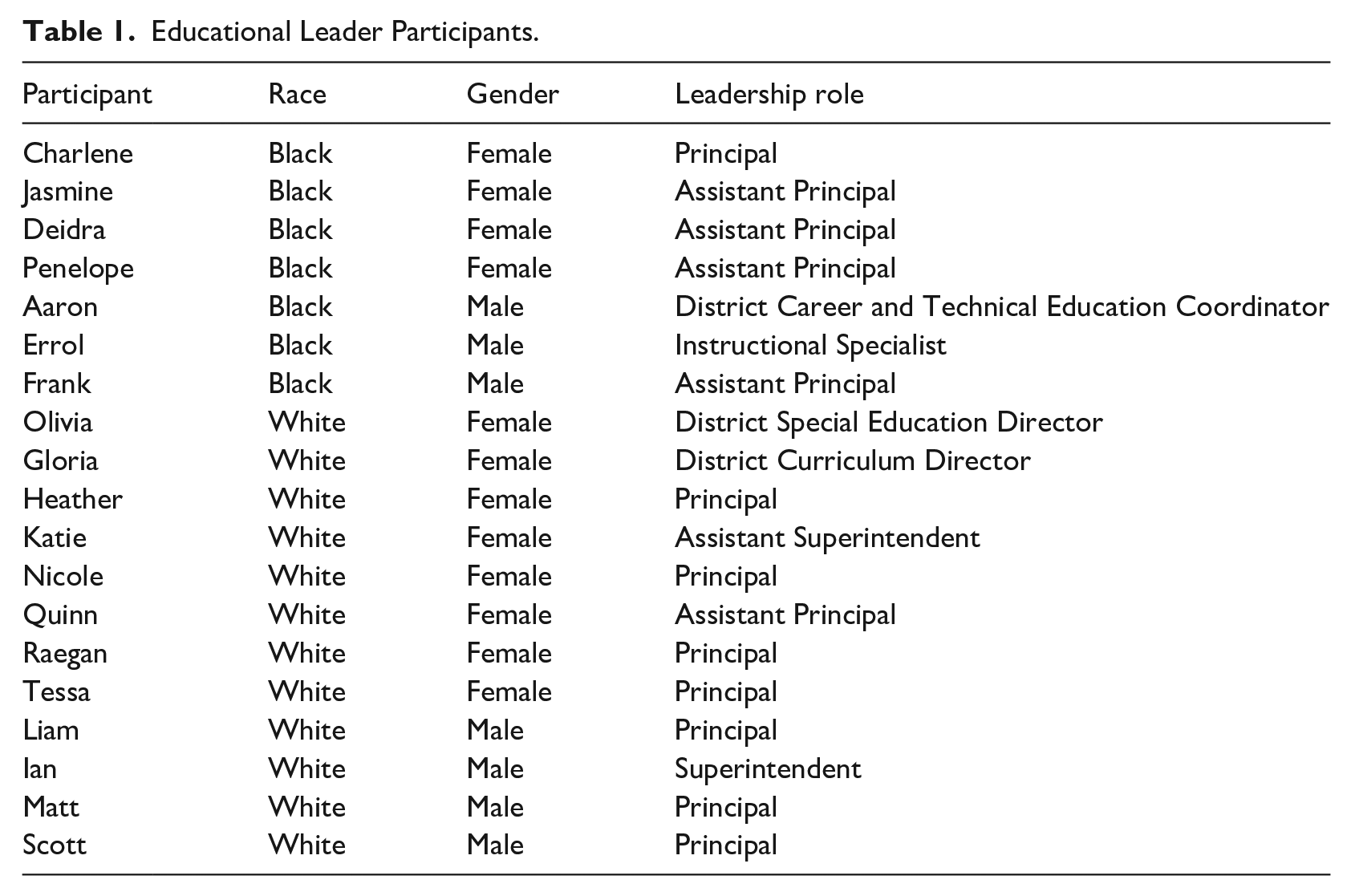
Data collection for this study took place in Texas. Participants were solicited from all areas throughout the state. As part of a more extensive ongoing study concerning educational leaders’ perceptions of racism in schools, 223 leaders were surveyed and asked if they would like to participate in qualitative research to provide more information on their experiences. As a result, there is representation from urban, suburban, and rural school districts across the state. Nineteen participants provided an email address to participate in an interview. The participant pool consisted of four Black females, three Black males, eight White females, and four White males. Their positions included four assistant principals, nine principals, one superintendent, one assistant superintendent, one curriculum director, one career and technical education director, one instructional specialist, and one special education director. See Table 1.
Educational Leader Participants.
Data collection
Each participant engaged in one 90-minute interview. A semi-structured interview guide was developed to gather data from participants. Interview questions asked participants to describe how the death of George Floyd has impacted their critical awareness of racism as individuals and how it has influenced reflections about their practices within their leadership roles. Each participant selected a pseudonym to protect participant identities, and all institutional identifiers, such as names and locations were removed. These interviews were conducted, recorded, and transcribed via Zoom due to the Covid 19 pandemic. Transcriptions were read and reviewed for grammatical and spelling errors by the research team. Next, the research team analyzed transcriptions for categories that further illustrated the research problem.
Lincoln and Guba (1985) suggested that a research study’s trustworthiness is critical in determining its value. Trustworthiness involves establishing credibility, transferability, dependability, and confirmability. The research team utilized member checking to ensure trustworthiness in conducting this study. After each transcription, the researcher sent the interview transcript back to the participant to check for accuracy and clarification. Member checking helped the researchers to gain a deeper understanding of the data.
Data analysis
Using Dedoose coding software, the research team performed data analysis in several steps. Data were analyzed using methods described by Moustakas (1994). First, the data from the study was collected and prepared. Next, researchers read the texts at least once and created memos on the transcripts. The memos helped to determine themes. Following this step, coding was used to help themes emerge from the data collected. The research team used open coding to analyze interview transcripts. After the initial open coding, preliminary codes were identified by the team. Next, the research team re-coded the data and used the codes to search for themes. Similar statements and sentences were clustered together into similar themes and meanings. Merriam and Grenier (2019) offered that reflexivity, or researchers understanding their positions, enhances trustworthiness. During this research study, bracketing took place by keeping memos throughout the data analysis process to explore feelings and biases about the research and the participants’ experiences.
Positionality
The study’s research team includes two female tenure-track professors and two male tenure-track professors. The research team consisted of one Black female assistant professor, one Black male associate professor, one White female associate professor, and one White professor. During this study, all worked within educational leadership preparation programs with aspirant principals and doctoral students. Given the intersectional identities of the individual team members, the interpretation of data was undeniably influenced by individual and collective understandings of each member as a racial being and each individual’s observations of how race influences the world. Nevertheless, the diversity in lived experiences and inherent positionalities provided for a rich and complex analysis of the findings from the perceptions shared by participants.
Findings
Previous research (Swanson and Welton, 2019; Welton et al., 2018) emphasizes the critical need to explore the intersection of anti-racism and school leadership. This section focuses on four of the most prominent themes that emerged from this qualitative study, including Increased Critical Self Awareness and Reflection, Critical Awareness Influencing Decision Making, Disconnect Between What is Known, What is said, and What is practiced, and Racial Battle Fatigue.
Increased critical self awareness and reflection
Participants were asked about any reflections they had in the wake of George Floyd’s death and how it affected them personally and professionally. Many described being more intentional about educating themselves, reflecting on their own biases, and stepping out of their comfort zones to engage in courageous conversations about race and racism. Gloria, a White female curriculum director, attributed reading books by diverse authors as part of her journey in examining her own bias. She mentioned, With the reading I’ve been doing, relatively reading about the Black experience or the Hispanic experience from that those points of view, there’s a whole new understanding of what it means to be considered a person of color in this country, and there’s been a shift in my thinking that comes from being able to hear, in their own voices, the experiences of people.
Nicole, A White female principal, also expressed an increase in reading about racism to help her gain perspective and rethink how she approaches leadership. She said, As a matter of fact, I was like, let me start trying to read some different books, you know, and so I read, ‘So you want to talk about race?’ to try to get a baseline, and then I had all these other books in my cart. I started noticing like who is in our office all the time, and it was Black boys. I mean, they were constantly the ones who were being referred to the office, and so it really helped me to look at what culturally is expected of our Black boys and are we having high expectations for them. I also read a lot about the soft bigotry of low expectations. For years and years in education, we’ve looked at numbers and data, right, nonstop. But do we just look at it like okay well, the Black kids didn’t do as well as the White kids. Or do we really sit down and plan for what we can do about that. Especially after we’re have experienced a whole country in unrest like we can’t not do anything. We’re not going to accept the low expectations and lack of opportunities.
For Nicole, as she continued to educate herself on racial inequity, the status quo of what she saw day to day in education became intolerable and directly impacted her approach to leadership.
Some of the study participants discussed reflecting a lot about their own biases in the wake of the country’s heightened focus on racial injustice. For example, Olivia, a White female special education director, explained, Early in my career, I witnessed the disproportionality, the target, if you will, that I particularly saw with my Black students, and very early on, I became their advocate because I saw it happening. But even in that, I think that there’s a complacency of oh I’ve got this, I’ve done this my entire career, and so especially in light of recent events in the last year, I’ve taken the time to check my own bias and call it out with other staff members, so it’s an ongoing journey.
For Olivia, recognizing and checking her own bias and addressing colleagues about race and racism are crucial to allyship, and true allyship is critical to leadership. One of the takeaways she took from this work is that this is a lifelong process.
In addition to being a lifelong learning process, cultivating an anti-racist mindset is a very personal journey. It is not just identifying racial disparities and talking about racism at work. Sometimes it means being willing to have courageous conversations within close circles. Ian, a White male superintendent, also shared his experiences engaging his family and close friends in courageous conversations. He articulated, The reflections that I’ve had have really been with family members and with some people that I associate with on a regular basis and trying to help them understand, not in a pejorative way or anything like that, but I genuinely believe that most people who look and sound like I do, do not understand the level of access and privilege that we enjoy.
Ian shared that White people must do the work, and that work includes holding family and friends accountable. Liam, a White male principal, discussed how he had been engaging in racial equity work in his professional role for a few years before George Floyd. Still, that incident made him reflect on how he was walking the talk in his personal life. He elaborated, I think I had drawn a little bit of like work/not work line on some of that equity, inclusion, and anti-racism work, and so I’m trying to do a better job bringing that to my personal life and personal interactions. I’m trying to be more aware of my privilege, how I speak, interact, make space for others to speak, and listen. So, I think that’s actually probably the biggest shift is like I like probably gave myself too big of a badge of honor for like I do this work every day in schools, but then didn’t necessarily carry it outside of my work and so I think the prevalence post-May 2020 has probably pushed me to reflect on how to be conscious of these things outside of work.
In these instances, making meaning of the impact of George Floyd meant taking personal inventory of not only the way racism plays out in their professional world but also taking stock of biases, practices, and privileges that operate in their personal lives. For educational leaders engaging in racial equity work, there can be no separation of professional and personal.
In addition to increased critical self-reflection, many of the participants cited increased empathy personally and professionally. Reflecting specifically on George Floyd, Olivia responded, ‘I can empathize with that, especially in light of recent events, you know I kind of pictured that being my son’. Along those lines, Matt, a White male principal, shared, I remember learning of the incident involving George Floyd the day that it happened, so now 13 months ago, and remember thinking at the time that’s awful, and this is going to be significant, and that was early on. I think that it’s possible that good things can come out of a horrific event, and the reflection that has taken place is always to try to put myself in other people’s shoes and try to understand in a way that I’m sure I will never truly understand because I’m not African American. But, nonetheless, it has made me think of our students and families that we serve and how can we do all that we can to make sure we are serving them equitably.
Matt also described becoming more intentional about fostering authentic relationships with Black colleagues, students, and families. One participant suggested that a lack of intercultural relationships influences a person’s ability to acknowledge systems of oppression and have empathy. Ian advised, I think most of my family members and friends who have kind of a negative or overgeneralized characterization of minority populations don’t know any and do not regularly interact with them. I think it is very easy when you operate within an echo chamber to develop a perception that is not only wrong but harmful.
Some of the Black participants experienced a display of empathy from some of their colleagues. Deidra, a Black female assistant principal, recalled, I think that right after the George Floyd incident, within my district, we were virtual anyway, but after that whole aftermath, when we started going back face to face, I did have people reaching out to me asking if I was okay with that whole situation and if there was anything I wanted to talk about or they could empathize.
Deidra shared that empathy opened doors for deepened relationships that made space for critical dialog. Tessa, a White female principal, described one example of critical discussion. She explained the intentionality in stepping into conversations that center race and addressing racism. She conveyed, ‘In my role, stepping up and stepping into conversations is important when typically, white silence can be just as harmful as white supremacy’. For the participants, these illustrations of increased empathy toward one another broke some barriers to conducting meaningful work in racial equity.
Critical awareness influencing decision making
Participants describe how their critical awareness and reflections about race and racism have played a role in their decision-making. One participant even describes his reflections about perpetuating systemic racism in a previous role as a chief academic officer in an urban district. Ian lamented, I knew the demographics and the economics, and I did nothing to broaden our course offerings, even though I also knew that 13 of our 14 high schools had higher than state average dropout rates for minority students. Knowing all of that information and knowing what I know now, it seems unforgivable to me that I was not more aggressive in trying to engage students, that I was obviously losing. And I can sit here and make all kinds of excuses for that, but the bottom line for all of it has to be that I didn’t feel threatened by it because they were brown and Black kids, and I didn’t need to accommodate them. So, I mean, I can try to pretty that up, but the fact of the matter is the reason I felt that way is because of the color of their skin. And it doesn’t make you feel very good at the end of the day, but it is what it is, and you may just think you’re doing your job, but you’re doing your job in a way that’s reflective of institutional racism.
Ian expressed the importance of leaders being accountable for their decisions and how their own racial biases and privilege might impact those decisions or be the motivating factor for inaction.
Errol, a Black male instructional specialist, also pointed out the urgency of increasing representation in the curriculum. He described advocating for more representation and cultural relevance in the curriculum. He shared, ‘In the leadership role, I make sure that within the content we make sure that we teach the curriculum in a way that serves to the students’ cultural relevance’. Katie, a White female assistant superintendent, expanded on ideas about representation and bias in all aspects of schooling. She exclaimed, I think the whole Black Lives Matter movement and the political pressures that have come with that have absolutely forced the issue of really trying to take on that equity lens about everything we do. It’s not just discipline that’s a lagging indicator. It’s also curriculum and instruction, how we engage kids, it’s who have what opportunities, and so I think I’m in a better place of having that equity lens of saying everything we do it’s to be looked at with that lens. I’m looking at being more intentional about making sure that my leadership groups are very adequately represented with our student population. We need to be very much more intentional about considering that when we’re thinking about different people for leadership positions because I think our leadership teams need to be reflective of our community that we serve.
Additionally, Liam emphasized the importance of being intentional about centering race and bias as a lens when working with teachers. He expressed, Your role is to build skills and systems that support the work of classroom teachers, and both of those have to go through filters of race and bias on both the implementer and the receiver. It’s really easy for the bias and race part to be invisible and tell yourself a story of I’m implementing a policy or I’m following what’s best for kids. It’s really easy to go to that rationale and kind of tell yourself a story that eliminates that potential bias or race element, so I think one of the things I have sort of tried to grow into is trying to give that bias and race lens space, but it’s like the work it’s hard.
The participants described a shift in which the murder of George Floyd prompted immediate critical reflection about the role of racism in education and how they may be perpetuating those systems. Their increased critical awareness led to intentionality in decision making affecting their students and staff.
Disconnect between what is known, what is said, and what is practiced
While the participants shared how their own critical awareness and reflection influence their own decision making, they also describe systemic barriers that they still see day to day. While they have been more intentional about ‘doing the work’, not everyone in educational leadership is and there are some glaring disconnects as a result. Participants report noticing a disconnect between known disparities, what is said or in policy, and what is practiced. Quinn shared her reflections on whether her district is actively addressing inequities. She specified, The schools I’ve been assigned to the last two years have been in the highest African American populations section of the city, and I do reflect on I guess how leadership addresses the needs of those communities and how you know, some of these schools have had the same issues academically that are reflected in state testing probably the last at least six or seven years and there’s not a lot of changes going on, and I wonder if that would be happening in a different community. I think there’s a lack of accountability at a district level.
Many participants describe a great deal of inaction in leadership and resources in majority Black schools. Charlene, a Black female principal, added, I think about all of the government agencies that are supposed to be out there to kind of monitor this. Texas educational agencies, government agencies, but it’s not being monitored because it’s not a priority. Even though a lot of the data will tell you something is not right, nobody is taking the time to really look into it. For example, more African American males are sent to an alternative school. Why is that if only 6 or 7 percent of the school district is African American? You see all of this data, but there is no response to the data.
Additionally, Gloria lamented, I hear it talked about. I hear it occasionally. Once a year, it’ll be brought up when they were looking at our data, and things that the state’s telling us are issues I hear it brought up, but other than that, I don’t ever hear it mentioned. I don’t hear people talking about plans on how to change that at all.
In some cases, participants shared being cognizant of messaging that promotes diversity, equity, and inclusion; however, little of that messaging is reflected in daily policy and practices. Aaron, a Black male career and technical education coordinator, spoke about a disconnect between what is said and practiced. He scolded, We celebrated every ethnic group this year. The district released a statement on the website. We believe in fairness and inclusion, we don’t believe anybody should be targeted because of what they look like, etc. Where you could see it on paper? Yes. In the buildings? I’m not sure. I have been in my current district 30 years. When I came here, the problem was decimals, fractions, ratios. That was ‘93. In 2019 that math issues were decimals, fractions, and ratios. Now come on. Everything that needs fixing in our district, we fix it. So, when you tell me you really wanna fix these issues, no, you don’t. We look at Black and brown kids’ scores, and the same things been a problem for over 20 years. I ain’t that smart, but why would we not partner with some of the universities right up the street to try and fix these issues. It blows my mind. You know the problem, then why don’t we do something about it. There ought to be some alerts at the state level that prevent this from lagging on. Things that are a priority you get em fixed.
Similarly, Olivia described a disconnect between training and policy versus what is practiced. She pointed out, ‘Beyond providing the training, the biggest thing was holding expectation and holding that accountability because oftentimes what I see is oh yeah we have that policy but then when are people actually held accountable to it?’ Liam shared a similar sentiment about the disconnect between what is said and what is practiced he described it as, ‘yea, DEI, blah blah blah blah blah and then total horseshit on the ground with it’. These observations emphasize the idea that acknowledgment is not enough. Dismantling system racism requires strategic action and intentionality at all levels of leadership.
Racial battle fatigue
Other critical elements increased in the aftermath of George Floyd include Racial Battle Fatigue. Several Black participants noted the heightened pain and emotional exhaustion that occurred after the death of George Floyd. Deidra admitted, ‘I would say that it hasn’t changed my role any more than it already has in the past because I’m always consciously aware of being the only person of color or only Black person in administration in the district’. Charlene recalled becoming fatigued not only at what she experiences as a Black woman outside of work but also within education. She voiced, When people see me, and I say I’m an educator, they ask if I’m a teacher’s aide, and it’s like, no, I’m an administrator. Where is this thought process coming from? I’ve had parents say to me, ‘I never had a negro for my son’s principal before’. A negro?! We don’t use that word anymore. I charge it to a lack of knowledge. It’s ignorance, and until people become educated and aware of what they are saying and doing, it won’t change. My white colleagues assume that because I am an African American that I should help everybody be educated in that area when we should all be responsible for getting educated on our own.
For Charlene, the repeated microaggressions, in addition to being expected to carry the weight of ‘educating’ everyone about racism, take an emotional toll. Jasmine, a Black female assistant principal, added, It’s very exhausting to have to come to work and deal with colleagues who act like none of this is happening. I won’t say it’s impacted me to the point where I can’t do my job, but it is extremely exhausting to navigate a White centered space. I don’t know if it’s willful ignorance or I’m just not gonna address what’s going on. It’s just been really, really tiring, and it doesn’t make my job fun. Even when our district put out a statement, they never even mentioned George Floyd’s name. It was very generic. The Black people were disgusted when surrounding districts did more. You had this event that was the impetus to the protests and bringing things to light and awareness, you had companies making statements, but you have people embracing willful ignorance acting like if I don’t talk about it, it’s not happening, kind of like the boogeyman.
For Black participants, the death of George Floyd only exacerbated the racial battle fatigue they experienced as educational leaders.
Discussion and implications
While previous research explores the intersection of racial equity and school leadership, this study examines the death of George Floyd as an impetus to extend the idea of social justice leadership to an intentional focus on practicing anti-racism in school leadership. As demonstrated by the reflections of the participants of this study, racial disparities in student outcomes remain an area of concern for educational leaders. Data from this study describes leader reflections on navigating the educational landscape post- George Floyd. Furthermore, it expands on previous work on anti-racist leadership (Swanson and Welton, 2019; Welton et al., 2018). Several themes emerge from this study, including Critical Self Awareness and Reflection, Critical Awareness Influencing Decision Making, Disconnect Between What is Known, What is said, and What is practiced, and Racial Battle Fatigue.
Black participants report no increase in critical awareness about race due to a pervasive critical consciousness about race and racism that existed before the demise of George Floyd. Race is always a focal point and lens in the day-to-day experiences and practices for these participants. This data is consistent with the core tenets of CRT, including that racism is endemic to American life, skepticism toward meritocracy, challenges toward ahistoricism, and emphasis on the experiential knowledge of people of color (Dixson and Rousseau, 2005). One participant likened the avoidance of the topic of race to the way people treat the existence of the boogeyman. This comparison aligns with the work of Annamma et al. (2017) and Doane and Bonilla-Silva (2013), who assert the destructive nature of color-evasiveness by negating the experiences of people of color. While some did experience some empathy from colleagues, the incident still led to exacerbated emotional pain and exhaustion in the face of either color evasion, constant microaggressions, white silence, and in some cases, being made to bear the burden of educating colleagues about racism. These experiences are synonymous with what Smith et al. (2011) refer to as Racial Battle Fatigue. Smith et al. (2011) describe racial battle fatigue as feeling mentally, emotionally, and physically drained due to persistent feelings of stress, strain, frustration, and injustice that stem from racial discrimination.
White participants in this study report an increase in self-reflection, critical awareness about race, and examination of their privilege and bias that has impacted their practice as educational leaders and personal interactions. Additionally, they report increased empathy and awareness that has caused a shift in their decision-making and discernment about accountability in the push for racial equity. These findings are also aligned with CRT and anti-racism in school leadership frameworks which assert the importance of acknowledging racism and following up with actions that work to disrupt structures of systemic racism (Ladson-Billings, 1998; Swanson and Welton, 2019).
Participants also cited an apparent disconnect between known disparities, policies on paper that claim to address them, and what is practiced daily within their districts. This study supports the argument of Welton et al. (2018) that ‘There has been a failure to recognize that anti-racist change is essential to advancing educational equity’. (p. 16). Whereas, overwhelmingly, color-evasiveness has hindered progress toward achieving educational equity, the death of George Floyd has served as a catalyst for increased visibility of racial inequities on a micro and macro level. The critical reflections shared by the participants emphasize the idea that educators acknowledge that society is not post-racial and that this work is complex and ongoing (Welton et al., 2018). Furthermore, Diem and Welton (2021) describe essential skillsets for educational leaders, including developing critical awareness of racial inequity in education, centering race in conversations and decision making, pushing back on resistance, and addressing anti-Blackness and implicit bias with intentionality. Participants highlight their journeys to situate racism in educational equity and develop their capacities to dismantle structures that perpetuate systemic racism.
Despite the resolute and rampant backlash against Critical Race Theory, the findings from this study underscore its relevance to education. Preserving a commitment to unspoken norms under the guise of objectivity is a product of ahistoricism and color-evasiveness (Annamma et al., 2017). Additionally, color-evasive ideology encourages ignoring the voices and experiences of people of color, and the nuances of institutionalized racism, limiting solutions to racial inequity (Annamma et al., 2017). Gillborn (2019) notes, ‘Color evasion is neither innocent nor passive; it is an active refusal to engage with race inequality’. (p. 114). Approaching equity in education reform from a neutral standpoint is dangerous and ill-advised (Ladson-Billings, 1998). Remaining silent on issues of race and racism leaves educators at a disadvantage in understanding their biases and privileges and the impact of those biases and privileges on their professional practice. Unrecognized indicators of racism only preserve a system in which Black and brown students are institutionally oppressed.
Concerning implications for policy and practice, this study advocates increased professional development for educational leaders to deepen their understanding of racial inequity, systems of oppression, implicit and explicit bias, and anti-racist approaches to educational policy. Along these lines, education leadership preparation programs should follow suit and implement coursework and field experiences that provide the necessary skills to engage in courageous conversations about race, examine the impact of implicit and explicit bias in decision making, and anti-racism in educational policy work. State and local level officials should consider accountability measures that more closely monitor lagging and persisting racial disparities in student outcomes and implement strategic audits and initiatives to address and mitigate areas of concern. Prioritizing and normalizing anti-racism in educational leadership by building professional capacity and accountability measures that situate race in educational equity efforts can create a climate conducive to change whereby alleviating some of the trepidation and strain experienced by educators leading this work.
Conclusion
The reflections shared by participants illustrate how educational leaders navigate the intersection of anti-racism and school leadership. Discussions with participants underscored how varying forms of racism permeate various aspects of education, including curriculum, discipline, and the allocation of resources. Traditionally, power structures that perpetuate systemic oppression have been reinforced by color-evasiveness. In recent years this pushback has come in the form of criticism against Critical Race Theory (CRT) in education. However, findings from this study emphasize the relevance of CRT as a theoretical framework for this paper and the importance of centering race in educational leadership. Implications of these findings beseech educational leaders and policymakers to consider implementing professional development and accountability measures that center race in educational equity. Future research may consist of qualitative studies of educational leaders and school communities engaged in anti-racism and racial equity work. Lastly, research should consider studying educational leadership preparation programs and their effectiveness in preparing school leaders to address issues of race and racism.
Footnotes
Declaration of conflicting interests
The author(s) declared no potential conflicts of interest with respect to the research, authorship, and/or publication of this article.
Funding
The author(s) received no financial support for the research, authorship, and/or publication of this article.
