




Abstract
Background:
Research that documents the influence of anti-racism programs on teacher practice shows some desired outcomes, including developing critical consciousness to support students of color and educate others about stereotyping; understanding how racial bias affects one’s teaching and relationships with students; and implementing anti-racist approaches in schoolwide policies and practice. At the same time, research on anti-racist professional development (PD) also highlights the challenges of engaging in this work when white teachers, in particular, respond defensively or dismissively. Studies have shown how these responses can reinforce stereotyping behavior among white participants and reinscribe unequal social relationships.
Research Questions:
This article aims to answer the following questions: (1) How do white educators, if they do at all, display resistance to racial justice work? (2) How does resistance among white educators, if it does so at all, shape the experiences of educators of color? (3) How can schools reduce the potential burden of racial justice work on educators of color?
Research Design:
This article draws on data from a case study of a New York City elementary school that participated in a yearlong racial justice program. Data sources include semi-structured interviews with school and program leaders; focus groups with members of the racial equity committee and other teachers; observations of professional development sessions, racial equity committee meetings, and other program activities; and artifacts related to the implementation of the program to deepen our understanding of the program’s implementation and responses from multiple stakeholders.
Recommendations:
Grounded in critical race theory (CRT), the findings from this study paint a complex picture of the behaviors that white teachers may employ that derail racial justice work, the emotional and professional burden of that resistance on educators of color, and promising approaches for confronting resistance in order to advance racial equity. Beyond identifying the potential costs of engaging in racial justice work, our findings also offer schools and educators promising approaches for challenging white resistance while not perpetuating racial harm. We propose an implementation model that intentionally shields educators of color from the remonstrations of white resistors and the additional toll they can take on their time and well-being. Moreover, given what we know about the outsized role school leaders play in shaping school environments and professional cultures, it is essential that school leaders show commitment to organizational transformation, while developing the skills required to confront varying degrees of white resistance.
In the wake of what many in the mass media coined the “racial reckoning” of 2020 (Haseman et al., 2020), many K–12 districts and schools have turned their attention to establishing or expanding diversity, equity, and inclusion efforts; adding ethnic studies requirements; and training teachers through implicit bias or anti-racist training workshops (Fensterwald, 2021; Howard, 2020). Empirical studies of the latter are promising but few. Research that documents the influence of anti-racism programs on teacher practice shows some desired outcomes, including developing critical consciousness to support students of color and educate others about stereotyping (Schneidewind, 2005); understanding how racial bias affects one’s teaching and relationships with students (Pennington, et al., 2012; McManimon & Casey, 2018); and implementing anti-racist approaches in schoolwide policies and practice (Villavicencio et al., 2022). At the same time, research on anti-racist professional development (PD) also highlights the challenges of engaging in this work when white 1 teachers, in particular, respond defensively or dismissively (Case & Hemmings, 2005; Matias, 2016; Picower, 2009; Yoon, 2012). Studies have shown how these responses can reinforce stereotyping behavior among white participants and reinscribe unequal social relationships (Dover et al., 2020; Legault et al., 2011). Yet, less attention has been paid to how resistance from white teachers can also pose an undue professional and emotional burden on educators of color who are committed to racial justice work.
Contributing to this body of literature, we specifically examine the responses of resistance to, disengagement from, and pushback to racial justice work that white teachers may demonstrate. It is important to note that past research, including our own, has documented how white educators actively work to advance their awareness and allyship (McManimon & Casey, 2018; Villavicencio et al., 2022); however, we intentionally focus in this article on responses of white resistance in order to critically understand how they may impact the work and well-being of educators of color. 2 As more schools engage in racial justice work, we must not only recognize demonstrations of white resistance, but also highlight the voices and experiences of educators of color facing these responses. Moreover, we are interested in exploring ways of productively challenging and navigating through this resistance. Based on a yearlong case study of a racial justice program implemented in an elementary school, we seek to answer the following questions: (1) How do white educators, if they do at all, display resistance to racial justice work? (2) How does resistance among white educators, if it does so at all, shape the experiences of educators of color? (3) How can schools reduce the potential burden of racial justice work on educators of color? Grounded in critical race theory (CRT), the findings from this study paint a complex picture of the behaviors white teachers may employ that derail racial justice work, the emotional and professional burden of that resistance on educators of color, and promising approaches for confronting resistance to advance racial equity.
Literature Review
White Resistance to Anti-Racism Efforts
Whiteness is an ideology, epistemology, and psychology that is socially constructed and that produces and recycles racist power hierarchies by normalizing these elements as invisible (Cabrera, 2022; Leonardo, 2009; Picower, 2009). As an extension of this positionality, white resistance—the reactions and tools that white individuals employ when their whiteness is challenged in order to maintain power and uphold the status quo—can derail racial justice efforts and limit the effectiveness of anti-racist trainings and programs (Bonilla-Silva, 2006; DiAngelo, 2018; Matias, 2016; Picower, 2009; Yoon, 2012). To be sure, research has documented the role that white teachers can play in advancing in anti-racist work. Schniedewind (2005), for example, delivered a 30-hour anti-racism PD with five white teachers and found that the teachers increased their critical consciousness and generated strategies to address racism in their classrooms. Sacramento (2019) observed an ethnic studies program in which white teachers actively worked on their racial identity, awareness of systems of oppression, and classroom practices. Additionally, McManimon and Casey (2018), after a two-year anti-racist PD, found that white educators became more aware of their racialized identities and developed a greater understanding of how their whiteness impacts their curriculum, pedagogies, and relationships with students (see also Pennington et al., 2012). Despite these promising examples, prior research has also illustrated how white participants may respond to these efforts by disengaging from the material, displaying negative emotional responses, or performing in surface-level ways to appear anti-racist without genuine action (Case & Hemmings, 2005; Jupp et al., 2019; Matias, 2016; Picower 2009; Yoon, 2012). In this article, we explore manifestations of resistance specifically to understand their impact on educators of color and racial justice efforts in schools.
White resistance has been conceptualized as emotional, ideological, and performative (Picower, 2009). When white individuals are challenged to examine their own role in perpetuating racism, emotional responses such as guilt, sadness, and anger are common (Spanierman & Cabrera, 2014). In terms of emotional resistance, white teachers who cannot move beyond feelings of shame are more likely to act as victims, and they remove themselves from contexts that produce guilt (Matias, 2016; Matias et al., 2016). Ideological forms of white resistance include, but are not limited to, subscribing to beliefs of race-evasiveness, reverse racism, and individualism (DiAngelo, 2018; Picower, 2009; Yoon, 2012). These ideologies allow some white educators to distance themselves from being identified as racist and ignore how structural racism shapes our society and our schools (DiAngelo, 2018; Solomona et al., 2005). Further, when teachers hold onto these ideologies, they often reject perspectives that challenge their belief systems, preventing them from becoming racially conscious (Jupp et al., 2019). Performative tools of whiteness occur when individuals seem racially aware, but in reality lack understanding of race and racism (Picower, 2009). These individuals may be cognizant of structural racism but refuse to examine their own roles in those systems. They can appear as an ally and receive the social benefits of allyship without truly engaging in meaningful action. Some performative tools include displaying relationships with individuals of color to portray oneself as a nonracist, holding a white saviorism mentality, and claiming to care but refusing to act (DiAngelo, 2018; Matias & Zembylas, 2014).
Overall, this scholarship provides a strong foundation for understanding how white teachers may cling to hegemonic understandings of race and use different strategies to preserve their current worldview. This study contributes to this body of work by depicting demonstrations of white resistance to racial justice efforts in school. We posit that attention to this phenomenon can prepare educators to anticipate and address responses that can take a toll on educators of color and limit the impact of racial justice work.
White Resistance and the Impact on Educators of Color
Past research on white resistance has captured both how it manifests and how it might impede racial justice work. However, the impact of white resistance on educators of color within the context of ongoing anti-racism programs is not as well examined. This is a critical area to explore, given that educators of color are already underrepresented, have higher attrition rates compared with their white colleagues, and experience school contexts as racially hostile environments (Kohli, 2018; Kohli & Pizarro, 2016). In addition, past research demonstrates that teachers of color actively fight against racial injustice in their schools and advocate for more representative curricula and pedagogies, but they often feel isolated and lack support in these actions (Pizarro & Kohli, 2020). Implementing racial justice programs within schools has the potential to support educators of color and contribute to more inclusive and transformative contexts, but more research on the potential costs of these programs is needed. Anti-racism PDs are designed to bring to light individual, interpersonal, and institutional forms of racism; however, in doing so, they may also contribute to and amplify racial battle fatigue (i.e., the psychological, emotional, and physiological toll of dealing with and confronting racism) among teachers of color (Pizarro & Kohli, 2020). Racial battle fatigue is both a process and result of confronting racism as a person of color while unequally shouldering the work and simultaneously encountering internal and external pressures, unwarranted criticism, and isolation (Smith, 2009). In their study, Pizarro and Kohli (2020) found that the constant stress and requirements of this work manifested in multiple racial battle fatigue symptoms, including anger, fear, anxiety, hypervigilance, lower aspirations, trouble sleeping and eating, strained relationships, and leaving the profession of teaching.
Because of the limited scholarship in the field of education connecting white resistance to racial battle fatigue, we draw from social movement and activism research that illustrates how the resistance that activists of color face from fellow white activists produces racial battle fatigue and overall emotional burnout (Chen & Gorski, 2015; Gorski & Erakat, 2019). In a recent study, Gorski and Erakat (2019) broadly interviewed racial justice activists of color on what contributed to their burnout and found that 18 of 22 participants identified white activists as a main source, commenting on the implicit and explicit racism they experienced from white activists despite shared involvement in racial justice work. The forms of racism included harboring unchecked racist views, invalidating the work of activists of color, failing to take action, demonstrating white fragility, and taking credit for the work of others. These aspects contributed to burnout among activists of color because they had to expend time, emotional energy, and resources to address these behaviors. In another study analyzing queer activism engagement and mental health, participants of color also remarked on feeling isolated from and marginalized by white queer activists (Vaccaro & Mena, 2011). Further, Jacobs and Taylor (2012) observed group dynamics of white and Indigenous activists working on enhancing and protecting the rights and heritages of Indigenous people living in Ohio. They observed how white reactions of guilt and distancing not only limited the efficacy of the group’s anti-racism efforts but also created tension among the group and led to Indigenous committee members shouldering more work and responsibilities.
In sum, though this is a relatively understudied phenomenon in education research, existing literature highlights that forms of white resistance may amplify racial battle fatigue and burnout among educators of color, impact their relationships with their colleagues, and exhaust emotional and psychological resources. Building on this emerging literature, this study aims to understand how white resistance impacts educators of color and ways of reducing the potential burden of this work.
Theoretical Framework
In this article, we ground our inquiry in CRT (Bell, 1992; Delgado & Stefancic, 2017). CRT provides an analytic lens to examine how racism is endemic and pervasive across all aspects of U.S. society, including the educational system (Bell, 1992; Delgado & Stefanic 2017; Ladson-Billings & Tate, 1995). The first tenet of CRT—the acknowledgment that racism is ordinary, ubiquitous, and permanent—grounds our attention to the multiple ways that white educators in our study resisted new conceptualizations of race to preserve the status quo. The permanence of racism tenet urges us to assume white resistance as a response to any efforts to disrupt racism; rather than believing it can be circumvented, we aim to identify a direct response to white resistance, given its inevitability. In addition, the tenet of whiteness as property allows us to analyze how whiteness awards intangible benefits to white educators—such as power, belonging, leadership, and voice—in ways that erase the efforts and pain of their colleagues of color. Finally, the critique of liberalism tenet calls attention to how individuals may perpetuate colorblindness, the neutrality of the law (or beliefs in meritocracy), and incremental change (DeCuir & Dixson, 2004). Educators may uphold colorblindness, for example, by claiming not to notice the race; reinforce myths of meritocracy by not acknowledging structural racism; and limit the speed of change through their resistance to racial justice efforts.
Further, our study is inspired by critical whiteness studies (CWS), which complements CRT and provides a lens through which to understand the specific forms of white resistance that manifest in response to anti-racist programming (Cabrera & Corces-Zimmerman, 2019; Leonardo, 2009; Matias & Boucher, 2021). We draw specifically on Picower’s (2009) “tools of whiteness” to analyze, categorize, and make sense of white resistance. As discussed earlier, these include emotional (sadness, shame, anger, distancing), ideological (denial, rejection, reverse racism, individualism), and performative (surface-level engagement, virtue-signaling) tools used by some white teachers to deflect, ignore, and reject their role in racial hierarchies. Second, our work takes up the call by recent scholarship on CWS to “link cause (whiteness and white supremacy) and effect (harm to BIPOC communities)” (Cabrera, 2022, p. 715). To that end, we use CWS to analyze how white resistance affects the experiences of educators of color who are implementing racial justice work, with the aim of identifying approaches for mitigating this harm and promoting anti-racism (Matias & Boucher, 2021).
The Program: Racial Justice in Schools
This article draws on data from a yearlong study of a racial justice program implemented in K–12 schools. The program—Racial Justice in Schools (RJIS)—is designed to develop a racial lens among educators through PD focused on a historical and systemic understanding of race across U.S. society and institutions (including education), and strategies for disrupting racism in schools and classrooms. Unlike other anti-racist trainings, RJIS seeks to create change beyond individual teachers, focusing instead on developing schools as racially just organizations. This emphasis on schoolwide change versus individual growth alone aims to build more sustainable systems and structures that outlast participation in any one program. The program includes five key features: (1) 6-hour professional development (PD) provided to all school leaders, teachers, and staff to develop their racial lens, strengthen their analysis of how racism manifests in schools, and provide opportunities to grapple with real-life racialized scenarios; (2) racial equity committee (REC) comprising a group of 7–10 school leaders, teachers, and parents who oversee the school’s racial justice work; (3) racial equity assessment conducted by program staff via surveys and interviews with teachers, parents, and students to identify areas of strength and improvement with respect to racial equity; (4) racial equity plan, cocreated by the racial equity team and the program staff, that describes changes or concrete actions designed to address racial equity across multiple school dimensions; and (5) ongoing coaching, provided by a RJIS coach and two facilitators, that includes one-on-one sessions for school leaders and ongoing support and resources for all teachers.
RJIS is implemented over a school year and involves multiple phases. At the outset, RJIS staff co-develop a vision with school representatives, establishing broad goals, expectations, and time frames. Further creating the foundation for this work, two rounds of PD are offered—the first for the REC and the second for the entire school, including staff and school safety officers. As the year progresses, RJIS staff assist the school in assessing the school’s racial climate via curricula, interviews with parents, and responses from student and teacher surveys. Based on this assessment, the REC and program staff identify and implement concrete actions to address areas of racial inequity. Throughout the year, coaches and facilitators support the school in carrying out the aims in their racial equity plans.
Methods
This article draws on data from a yearlong case study of a New York City elementary school that participated in RJIS. The study was designed to explore both the implementation and outcomes of the program. This article, however, more specifically seeks to understand the underlying processes of white resistance in response to RJIS and the experiences of educators of color navigating and confronting this resistance. The case study approach allows us to explore this phenomenon in greater depth because these processes are both individual and interpersonal, while manifesting within the dynamics unique to a specific school context (Bartlett & Vavrus, 2017; Creswell & Poth, 2016). Focusing on a single school site also yields rich data on the nuances of white resistance and the complexities of its impact on educators of color, while allowing us to understand the specific conditions that worked to combat or limit harmful responses to racial justice work.
Study Site and Participants
In the year of the study (2018–2019), RJIS was implemented in three schools, and the authors of this article were selected to study barriers to implementation, capture the outcomes of the program (if any), and provide insights into how the program might be improved in future years. One of the three schools was excluded for this study because of its atypically small student enrollment (260). Of the other two participating schools, this article focuses on our case study of Spring Gardens (a pseudonym) because it implemented all components of the program (Villavicencio et al., 2022), including developing a racial equity plan and holding regular REC meetings throughout the year. Spring Gardens is an NYC elementary school that serves 480 students from preschool to third grade (see Table 1 for student and staff demographics). As in many U.S.-based schools, the site represents a cultural mismatch between the students (who are predominantly Asian American 3 ) and the teachers (who are majority white). At the time of the study, 80% of the school’s students were eligible for free or reduced priced lunch, public benefits (such as the Supplemental Nutrition Assistance Program), or both, and just over half were multilingual learners. The local community is predominantly Asian American but has recently become home to immigrants from around the world. The school itself has a strong reputation and high test scores (90% in math and 80% in English). With very little turnover among leadership and staff, the teachers have maintained a seemingly positive work environment. Nearly 90% of teachers responded positively to questions about opportunities to collaborate and questions about effective school leadership. At the same time, the levels of collegiality among teachers seemed to have made the racial justice efforts more difficult, especially for those invested in maintaining a culture of “niceness” versus confronting inequities that lay underneath the surface.
Spring Gardens Student and Staff Demographics.
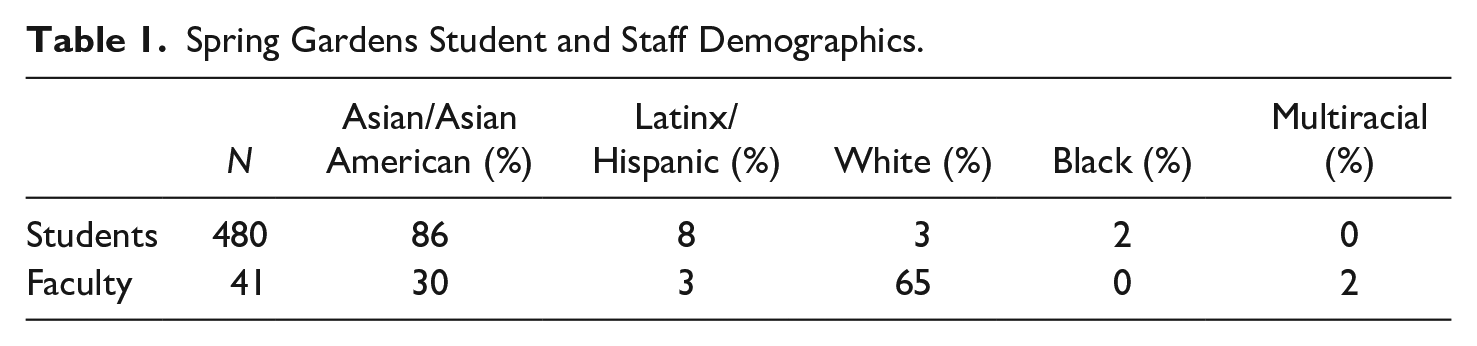
Purposive sampling was employed to interview individuals directly involved in the implementation of RJIS at Spring Gardens, including the principal, assistant principal, and all seven members of the REC. We also invited (via email) non-REC teachers to interview to understand the perspective of individuals who were not directly involved with implementation. While seven non-REC teachers agreed to participate, only four attended the focus group. Finally, we interviewed the RJIS program coach to provide an outside perspective into the school as an organization and the dynamics between its members. In addition to interviews and focus groups, all the teachers and staff participated in either one or two of the RJIS PD sessions. Because we observed both of these PD sessions, we were able to capture comments made in the whole group or in small groups in our field notes without directly interviewing these participants. Table 2 summarizes all participants and their demographics.
Data Collection and Participant Demographics.
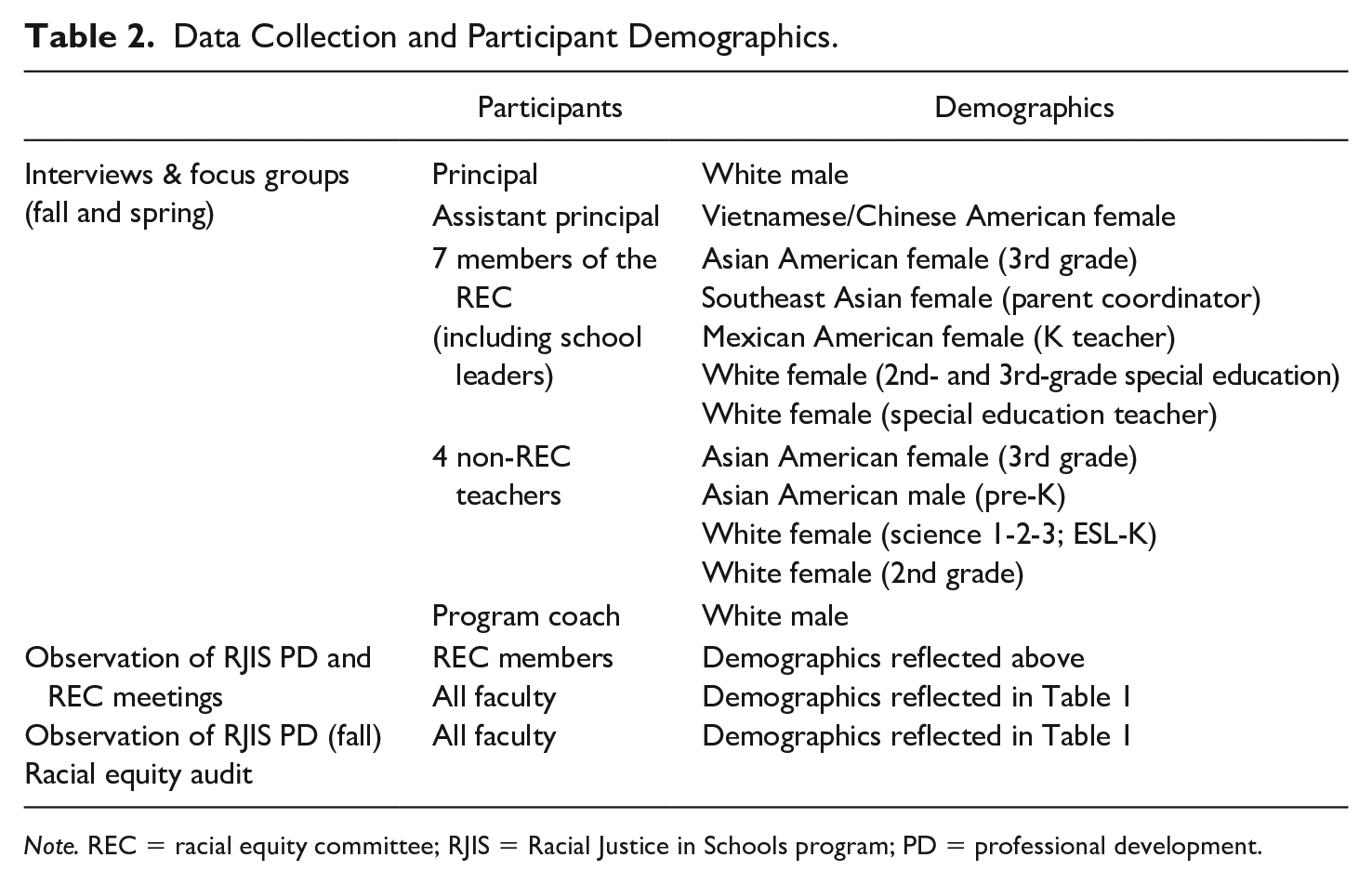
Note. REC = racial equity committee; RJIS = Racial Justice in Schools program; PD = professional development.
Data Collection and Sources
Over the course of the 2018–2019 school year, researchers conducted interviews, focus groups, observations, and document reviews to explore the implementation and outcomes of RJIS. We conducted (1) two 60-minute semi-structured interviews with the principal and assistant principal (AP); (2) two 60-minute focus groups with the REC; (3) two 60-minute focus groups with four non-REC teachers; and (4) two 60-minute interviews with the program coach. Interviews and focus groups were conducted at the beginning and near the end of the program (fall and spring). Protocol questions for school leaders and teachers focused on the school’s motivation to participate; their impressions of the PD and other program supports; targeted areas of improvement related to racial equity; and challenges and successes they faced in forming and implementing their school’s racial equity action plans. Questions for the program coach focused on the school’s racial climate, its engagement with the program, and their own role as a coach within the school. All interviews and focus groups were audio-recorded and transcribed verbatim. In addition, researchers generated reflection memos after each interview to capture any emerging patterns in the data or questions for further exploration.
Further, we conducted observations at the two PD sessions, monthly REC meetings, and other RJIS meetings (e.g., presentation of the racial equity audit, race workshop for parents). We observed the PDs to better understand both the implementation of the PD and the different responses and levels of engagement among participants. Observations of the PD included observing the whole-group session and listening in on small-group exercises and discussions. Observations of the monthly meetings aimed to understand how the school was enacting and responding to the multiple stages of the program, which steps they were taking to address racial equity in the school, and the rationale for those decisions. During each observation, we took field notes to capture a chronicle of events, some verbatim conversation, and nonverbal behaviors. Research members also wrote memos immediately after each observation to provide some initial analysis of the events and interpersonal dynamics. Data sources also included documents and artifacts related to the implementation of the program (e.g., notes from the program coach, racial equity team meeting agendas and minutes, racial equity plan) to deepen our understanding of the program’s implementation, responses from the racial equity team, and the program’s influence on school level policy or practice.
Throughout data collection, observations and interview questions were guided by semi-structured protocols but remained open to document both the intended implementation of the program and its successes, and the unintended responses or unexpected challenges at both the individual and organizational levels. Thus, though we were not specifically examining white resistance, our data collection elicited important information on how it manifested and impacted educators of color. Additionally, while we had more interaction with the participants involved in the implementation of the program, we were able to capture perspectives from other educators of color through three specific data sources: (1) the non-REC focus group, (2) whole-school PD observations, and (3) the racial equity audit (see Table 2 for more details).
Data Analysis
Data analysis began with an initial reading of our reflection memos and meeting as a research team to create a set of deductive codes guided by our broader research questions about implementation (e.g., RJIS support), prior literature on potential school outcomes (e.g., discipline policies), and the theoretical frameworks undergirding the program and our study (e.g., institutional racism). We then read a subset of interviews, field notes, and documents to generate inductive codes based on patterns that emerged in the data (e.g., common language, special education, sustainability). Using a full codebook, we coded another subset of data, modifying, adding, and removing codes through discussion and remaining with 29 codes. The research team then coded the entire data set—transcripts, field notes, and documents—using the coding application Dedoose. Guided by the research questions for this article, we specifically analyzed the Spring Gardens data coded as emotional labor, POC burden, reactions to PD, resistance, teacher relationships, and taking space. Table 3 provides an excerpt of our codebook. Using second-level coding, we created additional subcodes (e.g., fear/anxiety, distancing, tools of whiteness) within each of these codes and generated analytic memos that summarized thematic patterns and provided exemplary quotes or examples. Reading across these analytic memos allowed the research team to draw broader connections across themes and produce the findings presented in this article.
Excerpt of Codebook.
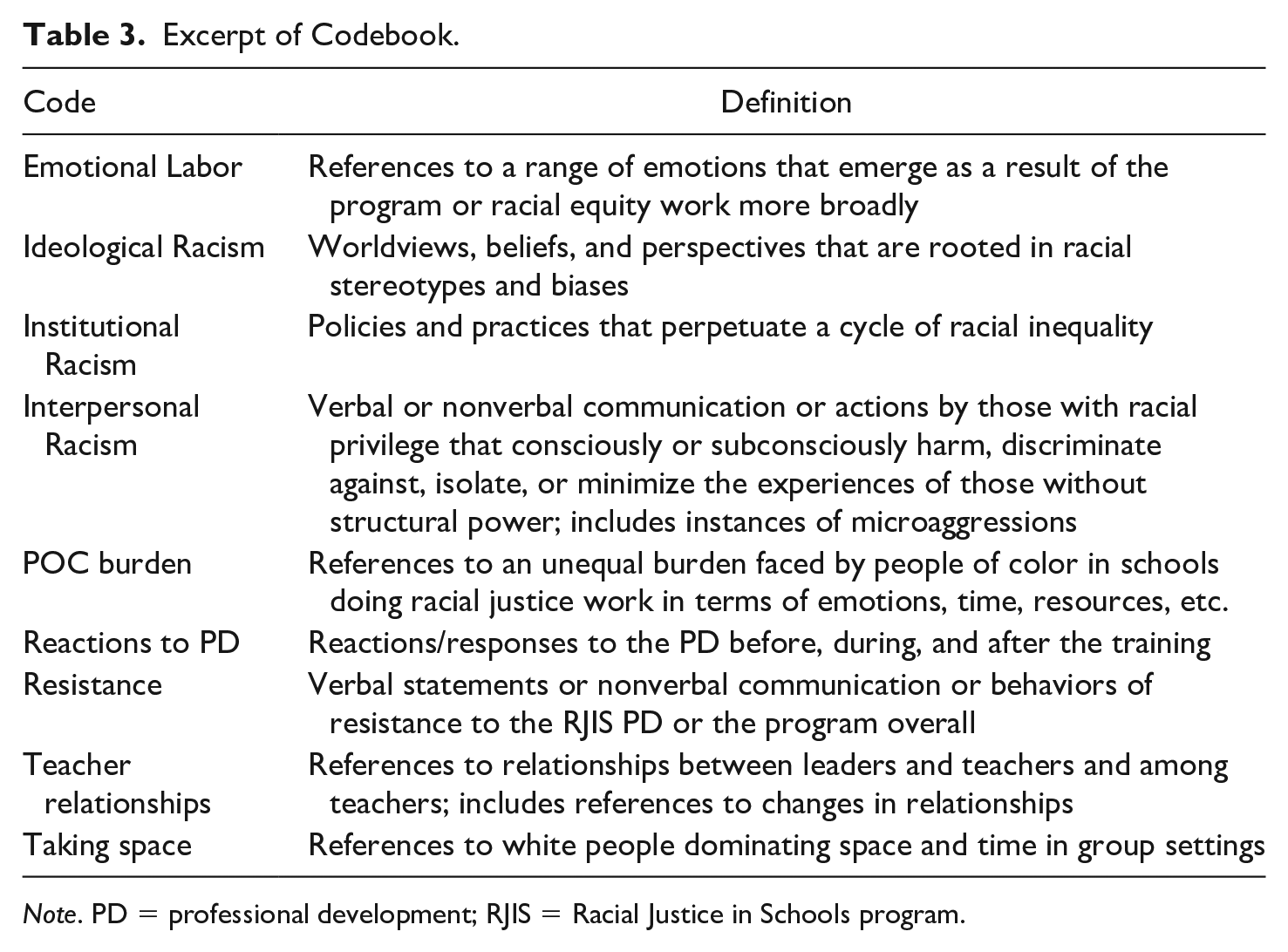
Note. PD = professional development; RJIS = Racial Justice in Schools program.
Positionality
As researchers, we acknowledge that our perspectives and experiences are not separate from research processes or products (Milner, 2007). Our interest in this research stems from our individual experiences in or with school systems and our collective commitment to racial equity in K–12 schools. The lead author is a Latina and former NYC educator who studies the intersection of race, education, and equity. The second author is a Black woman and a former NYC educator who studies policies and practices aimed at fostering greater racial equity. The third author is a white woman who studies anti-racist interventions for K–12 teachers. The fourth author, who identifies as white and Jewish, also served as a teacher and researcher in NYC schools. Three of the authors conducted the study of RJIS in Spring Gardens. The first and third author continue to study RJIS in other contexts. All authors engaged in data analysis and the presentation of findings for this article. As a multiracial and multiethnic team, we bring varying experiences engaging in racial equity work in schools and navigating white resistance (either from peers or within ourselves). As a team, we strived to leverage the differences in our identities and racialization processes to create our instruments, code our data, and interpret our findings to more fully capture the complexities of racial dynamics and responses among study participants. Our research questions were motivated by both noticeable gaps in the literature and an interest in exploring strategies to confront white resistance that do not place additional burdens on educators of color.
Findings
In this study, we aimed to document the responses of resistance to racial justice work that white teachers employed, particularly to understand the potential impact of these responses on educators of color. While several white teachers at Spring Gardens showed no resistance to RJIS and a few actively supported the effort (see Villavicencio et al., 2022), those who did placed an unduly large burden on educators of color. Grounding in CRT, our findings speak to how resistance is an inevitable response to efforts designed to disrupt racism. Specifically, our analysis revealed several emotional and ideological responses among white teachers that contributed to racial battle fatigue among educators of color and threatened the efficacy of the racial justice program. Educators of color also described in detail how these demonstrations of white resistance harmed their professional relationships and their capacity to pursue racial justice work. To answer our third research question, this article also explores promising approaches for mitigating this cost in schools that are committed to engaging in racial justice work without placing an additional burden on already marginalized groups. Drawing on multiple data sources, our findings highlight the voices and perspectives of white resisters, teachers of color in and outside the REC, school leaders, and the program coach who worked closely with Spring Gardens over the life of RJIS.
“I'm Concerned about How People See Me”: Demonstrations of White Resistance
The prevalence and nature of white resistance at Spring Gardens were consistent with other scholarship that has documented statements, interactions, and behaviors from white educators who disengage from or actively resist racial justice work (Jupp et al., 2019; Matias, 2016; Picower, 2009). Grounded in our theoretical frameworks and building on Picower’s (2009) “tools of whiteness,” we describe here how the emotional and ideological responses among white teachers (rejection, shame, and distancing) served to reinforce racial hierarchies. While we describe the statements and behaviors of individual teachers, CRT asserts that we view the acts of individuals as embodiments of a larger system of white supremacy.
Based on our field notes of the PD observations, several white teachers publicly rejected the definitions and concepts presented, falling back on ideological tools of race-evasiveness, reverse racism, and individualism (Bonilla-Silva, 2006; Picower, 2009). As demonstrated verbally and nonverbally, these teachers were especially frustrated by the term “white supremacy,” the concept of white privilege, and the notion that racism is predicated on power. Statements that exemplified this form of outright dismissal included, “Anybody can be racist, not just white people,” and “Every culture is racist.” One teacher claimed reverse racism, recalling, “When I went to school, I was one of the white kids, and the Black kids were racist towards me.” More than a few white teachers described their own disadvantages (or that of their families) to refute the notion of white privilege. One teacher, espousing myths of meritocracy, argued, “Oh, my husband worked really hard to get here. Are you saying that it’s because of the policies that were in place that got him to where he is?” Another teacher similarly dismissed white privilege by stating that racial injustices were a thing of the past: “That's in the past. That's in the past. Let's look toward the future and all the good stuff.” Dismissing historical realities as irrelevant is an attempt to curtail any conversation that would bring attention to how the atrocities of the past persist in other forms of systemic oppression today (Bonilla-Silva, 2006; DiAngelo, 2018; Solomona et al., 2005). Additionally, according to CRT and CWS, these actions directly operate to uphold white supremacy and unequal power dynamics (Cabrera, 2022; Delgado & Stefanic, 2017).
Other white teachers during the PD sessions seemed to engage more fully with the material presented (e.g., the historical origins of racial hierarchies in the United States, policies rooted in structural racism) but were stuck in demonstrations of shame. As recorded in our field notes, one teacher said, “I am a woman in a white body and now, I'm concerned about how people see me.” Her statement reflects a sense of shame and fear of how others might perceive her identity and potential shifts in her collegial relationships as a result. Similar to Matias’s (2016) and Picower’s (2009) findings, rather than focusing on the systemic nature of the harm and the people it has impacted, these teachers used shame as a tactic to center themselves and their emotions. While teachers who outright reject or dismiss the concepts of racial justice work may seem to do the most harm, teachers who become stuck in these feelings of shame can be even more disruptive in that they tend to take space, time, and energy away from efforts to center people of color and proactively effect change (Matias, 2016).
Related to expressions of shame were teachers’ attempts at distancing themselves from their whiteness, a tactic that white educators employ to separate themselves from privilege and power, thus failing to examine how they benefit from racism (Matias et al., 2014; Picower, 2009; Solomona et al., 2005). During the PD, white teachers tended to avoid identifying as white or describing their own racial identities. They also relied on their identities as teachers as another form of distancing. That is, their care for all of their students worked to function as a shield from truly grappling with their racial identities (see also Matias & Zembylas, 2014). One teacher of color, who served as a REC member, made this analogy: You know how the cops say that they have their own color. Cops are blue. It doesn’t matter what race you are. You’re blue. Teachers think that, too. I don't know what color it is, but teachers think we all have a teacher color. And I'm thinking, well, I think white teachers think that; they really don't want to be told that they’re white teachers.
This distancing tactic seemed especially prevalent when confronted with the idea of affinity groups—spaces for teachers of color and white teachers to meet separately to talk about specific racial issues pertaining to each group (Pour-Khorshid, 2018). One teacher, who had always been white-identifying according to her colleagues—tried joining the affinity space for teachers of color by sharing that she was actually of Egyptian descent, while also showing outward hostility to the very existence of the group. Applying CRT and CWS frameworks, we can understand this response as an expression of white privilege that seeks to assert power, while undermining the power and agency of people of color. While she used her heritage to enter the space and distance herself from being identified as white, she displayed no efforts toward engaging in a conversation focused on teachers of color. This behavior not only disrupted the work of that affinity group but also derailed the school’s efforts to create a safe space for educators of color.
As posited by CRT, some level of outward resistance to racial justice work is unavoidable, and avoiding it should not be the aim of racial justice efforts in schools. Grappling with issues of structural racism and white supremacy will likely raise challenging questions for those who have not had to grapple with these realities in their own lived experiences. Moreover, some resistance may signal an interest in engaging with new ideas and may, over time, develop into racial consciousness (Matias, 2016; Villavicencio et al., 2022). At the same time, it is important to examine the potential cost of these processes on educators of color who are sharing the same professional space.
“Feeling Broken”: The Experiences of Educators of Color
As RJIS unfolded at Spring Gardens, our analysis showed that educators of color not only shouldered a larger share of the burden in moving the initiative forward but also were the target of the backlash among some of their white colleagues. Building on the literature related to racial battle fatigue and inspired by recent work in CWS, we detail here the effect that white resistance had on educators of color committed to this work (Cabrera, 2022; Pizzaro & Kohli, 2020). Their experiences underscore the toll that anti-racist work in schools can take if concrete steps are not taken to protect the time and emotional resources of educators of color.
Before the launch of RJIS, Spring Gardens enjoyed a reputation for being close-knit and familial, with a shared set of values and purpose around serving the diverse communities of their neighborhood. Despite this overall atmosphere of cohesion and collegiality, problems in the school’s racial climate lurked below the surface. The school’s RJIS coach, Bill (a white male committed to racial justice work in K–12 schools for over two decades) noted, “I think that people had very warm and strong personal relationships in the professional space, and that the people of color just kind of [kept] their pain and the harm that’s done them on the down low.” His reflection, and the findings from the racial equity audit, suggests that the school community’s semblance of harmony was maintained in part by educators of color being wary of publicly airing their concerns about racism. Consistent with his perception and the audit, Assistant Principal (AP) Pham—a long-standing educator who identifies as Vietnamese and Chinese American—said that she was very committed to racial justice and often discussed it with friends and family, but she described the school as “the one area I couldn’t really talk about and share that it was important to me.” These dynamics are consistent with literature that shows how schools can be hostile environments for educators of color who do not feel free or safe to express themselves (Kohli, 2018; Kohli & Pizarro, 2016).
While teachers rarely had open conversations about race and racism as a staff prior to RJIS, open engagement with these issues revealed how much individual teachers varied in their degree of investment in anti-racist work, rupturing the school’s outward appearance of unity. As Bill put it, the RJIS activities “uncovered and opened up to the sunlight a wound that was already festering.” That is, talking about race and racism exposed an unspoken reality that was nonetheless causing harm. The field notes we took during the first schoolwide PD session—which AP Pham described as prompting teachers to undergo a “deep self-examination” as they developed their racial analysis—exposed differences in how open teachers were to developing and applying a racial justice lens. From these observations and subsequent focus groups, we witnessed how educators of color—both those who were involved in implementing RJIS and those who were not—were deeply affected by the apathy or hostility that some showed toward understanding how racism impacts their lives and those of their students. One educator of color called it “unnerving”; another said, “[it was a] huge area of discomfort to me” and “hard to reconcile” with the friendships she shared with these colleagues. Another non-REC teacher recalled that a few white teachers had responded with “indifferent” when asked what one word came to mind when talking about race. She reflected, “It’s a strong word. It’s an aggressive word. It’s an aggressive tone to say, especially in light of the information shared.” AP Pham similarly recounted how she experienced these responses: “At least half, if not more than half, the white female teachers, I think, walked away actually angry and defensive and have really been aggressive about it . . . it exposed white fragility.”
Reflecting on these reactions and the toll they placed on her staff of color, the AP said, “There are people wondering, how do I have the same conversations with a person, when they didn’t seem like they were invested on that day? There’s a strain on relationships.” This observation speaks to how interpersonal relationships can be affected by engaging in racial justice work, not because talking about race is inherently divisive, but because it can expose difficult truths about where white colleagues or friends stand on issues of race (Delgado & Stefancic, 2017). This dynamic, however, seemed to put more of a strain on educators of color, who consistently reported being in the difficult position of defending the racial justice work at the cost of their relationships. Further, constantly challenging racism in their own work, setting and against colleagues, was emotionally draining. This mirrors Pizarro and Kohli’s (2020) observations on how emotions, stress, isolation, and anxiety related to advancing justice while navigating strained and apathetic relationships amplified feelings of racial battle fatigue (see also Smith, 2009).
Educators of color also tended to feel more pressure to push the racial justice work forward. Given that the teachers at Spring Gardens were predominately white, educators of color were asked to share their experiences with racism, to educate white teachers about its impacts, and to generate strategies for enacting the school’s racial justice plans. Two members of the REC team—the parent coordinator, an immigrant from India, and a Mexican kindergarten teacher—felt at times like they were being “put on display to further an anti-racist agenda” and to talk in staff meetings about why the school was implementing the RJIS program. They felt a responsibility to name racist incidents while also worrying about how their perspectives might alienate resistant white colleagues. Priya, the parent coordinator, said, I find it sometimes challenging to be a Brown person on the REC . . . I’m learning for myself when I feel a certain way that it’s okay for me not to express or that expressing is my choice. I struggle with that sometimes. When I have conversations with the white folks in the building, I feel myself more aware and not necessarily being careful, but choosing what to say.
The tokenizing that she and other people of color described singles out individuals who already occupy a minoritized space, while also requiring more of their time and resources. Priya explained that she’s “more aware” in “choosing what to say,” demonstrating alertness around white colleagues because of her REC position; however, this drains her psychological resources, requiring her time to “struggle” with how she wants to express and present herself. Further, this dynamic may also prompt educators of color to feel like it is their responsibility to lead this work and that if they do not step up, it may be implemented poorly or not at all (Pizzaro & Kohli, 2020).
As described earlier, the school attempted to hold affinity groups to help support educators of color, while creating structured time for all teachers to discuss the complicated set of emotions that emerged as a result of the program. According to its members, the affinity group for educators of color was meant to be a place where people could talk about their feelings of stress, fear, and pain, and perhaps find a shared space to heal. That the first meeting was sabotaged by the white-identifying teacher of Egyptian descent mentioned earlier exacerbated the threat of this work for educators of color. According to Amy, one of the Asian American teachers in attendance and a REC member, the interloper derailed and dominated the conversation and showed open disrespect and hostility to the RJIS facilitator by rolling her eyes, shaking her head, and stomping her feet. Amy shed tears as she recounted the experience at a planning meeting the next day, saying that she “felt broken” and was “so scared” of further backlash. When the REC discussed planning affinity meetings, she wondered if educators of color should hold theirs after school and off campus to avoid a similar situation. “I’m picturing holding it in your office during lunch hour,” she said to Priya, the parent coordinator. “And somebody bursting in saying, ‘How dare you? Why was I excluded?’” Even in a supportive and healing space intentionally designed for educators of color, the behaviors of some of their white colleagues made it clear to these teachers that they still had to be on guard for white backlash and rage. Similar to Pizarro and Kohli’s (2020) findings related to racial battle fatigue, teachers of color had to be hypervigilant in this context to protect their emotional and mental energy.
RJIS facilitators aim to create a “brave space,” as opposed to a safe space, where teachers can openly identify how racism manifests in their schools, and begin to disrupt it (Arao & Clemens, 2013). Working within a CRT framework, they also acknowledge that resistance is typical, normal, and predictable. Even if typical, however, resistance can inflict harm, and “brave” spaces may leave some teachers feeling less safe than others. The implementation of RJIS at Spring Gardens underscores the challenge of positioning teachers of color in anti-racist programs—allowing them the freedom to speak candidly about racism, while shielding them from the emotional and professional burdens created by white resistance. The experiences of the people of color in this school community shed light on the unique costs of this work on the groups who may already be suffering in silence.
“Pour Out the Muddy Water”: Efforts to Unburden Teachers of Color
While prior literature has begun to document the ways that white resistance can take a toll on teachers of color engaged in racial justice work (Cabrera, 2022; Pizarro & Kohli, 2020), less has been discussed about which approaches might serve to mitigate this burden. In the face of the resistance among white teachers at Spring Gardens, the school leaders and RJIS program coach began to take a three-pronged approach: (1) setting clear boundaries in shared spaces, (2) leveraging the coach’s time and white identity to address the concerns of white teachers, and (3) articulating an organizational commitment to change regardless of resistance. Although these were not enough to prevent the negative experiences reported by educators of color, we argue that they do hold promise as strategies to prevent or lessen the impact of white resistance.
Our field notes captured many of the first instances of resistance that took place during the initial PD under the guise of posing honest questions, providing an alternative perspective, or “playing devil’s advocate.” We are not suggesting that all questions or critiques are unnecessary disruptions; some can generate productive conversations or bring to light misconceptions that others in the room may share. PD facilitators were willing to veer from the scheduled set of programming in these cases, but often addressing these responses would take away valuable time from the curriculum and activities. As a result, facilitators decided they needed to set clear boundaries about what types of questions could be asked or discussions could be had during future sessions together. Before facilitating another RJIS meeting, one of the facilitators told teachers that if they wanted to critique the PD or the program, she would provide a separate space for recommendations. Another facilitator would remind participants, “If you’re not engaging, you’re not disrupting”—meaning, if you choose not to engage, at the very least do not disrupt others from doing so. This tactic created more space for teachers to experience the PD session in its entirety, while preventing educators of color from having to listen to colleagues raise “questions” that were often thinly veiled statements of racism. According to Jill, a white teacher and nonmember of the school’s REC, the facilitator made these boundaries quite clear before one of the affinity group meetings. She recalled, “The invitation was, ‘Come if you're going to make the effort to move this forward, whatever you think that means. If you are going to bring negative energy, negative space, resisting, then to say it plainly, you're not welcome.’” By making these expectations explicit, RJIS facilitators helped ensure that white resistance would not derail the school’s efforts to fully engage with this work, nor inflict unnecessary grief on educators of color. Thus, these messages functioned to both prevent harm and create a path forward for those engaged in the work.
When engaging in conversations about (anti)racism, educators of color are often put on the spot, expected to educate their white colleagues about racism and to speak for the students of color they serve by sharing their own painful experiences in K–12 schools. Rather than place this burden on educators of color in shared spaces, the coach conceived of his role, in part, as being an outlet for white resisters. To that end, Bill advocated for dealing with individual teachers separate from the whole group, describing this strategy as “letting the white person deal with the white people.” Principal Williams—a white male and the school’s founding principal—was inclined to take on these conversations himself, but he lacked the expertise to really lead these conversations. Bill told the principal, Stop giving these folks airtime. You can take an hour to talk things through, and the teachers will say it backfired. You think you’re moving them along; they think that by giving them space, they can go and take up more space.
As a result, when issues did come up among white resisters, AP Pham started telling educators of color, “Send them to Bill.” Though the principal would have preferred to continue relying on his personal relationships with teachers, they were not sufficient to address the white resistance in a way that moved the school’s racial justice efforts forward.
Bill’s effectiveness in confronting white resistance was grounded in his beliefs about what it means to be a white person who is anti-racist. When Bill described his aim for the “chat and chew” he hosted for white teachers, he explained, The conversation I want to have is how we’re prone to distancing as white people and that an antidote to distancing is to hold ourselves and our white colleagues accountable and asking what we can do to call them in.
In this conception, white people have the responsibility to hold each other accountable, while “calling in” resistors to disrupt racism, starting with themselves and expanding out to the systems they take part in (Augoustinos & Every, 2010). One metaphor the school’s leaders returned to on a few occasions illustrates the belief that addressing resistance head-on is a critical first step in being able to effectively engage those who would otherwise be unwilling. Bill said, If you want to fill someone’s glass with the clear water of truth and their glass is full of muddy water, then they need an opportunity to pour it out. If they want to vomit all their fears and fragility onto the table, that’s what white anti-racists are for.
This description of being a “white antiracist” means leveraging one’s own whiteness—and the fact that white people are more inclined to listen to other white people (DiAngelo, 2018)—to become a place to pour out the “muddy water.” It remains a question, however, whether any one individual would have the capacity to address resistance at a larger scale or over a sustained period.
In addition to these tactics, the organizational messaging (especially later in the school year) also played an important role in confronting white resistance. Communication from both school leaders became increasingly coherent and consistent. AP Pham called them “mantras” or “taglines”—specific statements that served as reminders for why the racial justice work mattered and why they would press on despite any resistance. She reflected, “We need to just be really clear and say, ‘We’re doing this. We’re moving forward, completely.’ We keep saying that. That’s one of the mantras: ‘We’re moving forward in this work.’” Principal Williams often used the analogy of a train leaving the station—the idea being that you either get on board or get left behind. Inherent in these messages is a commitment to hold steadfast in the face of resistance and a willingness to let individuals leave if they are unwilling to participate in the school’s racial justice efforts. This may have been challenging messaging to deliver, given the historical collegiality among the school faculty. Moreover, the white resisters tended to be the more senior teachers; it was perhaps even more difficult for Principal Williams to tell veteran teachers, “You can choose not to be here.” But the collective messaging from the school leaders seemed to have been received by the wider community. David, an Asian American teacher who was not a member of the REC, suggested that certain teachers either were going to lag behind or would end up leaving. He said, “If you're that uncomfortable doing the work that we're doing here, then go test the water somewhere else.” His statement reaffirms the consistent communication about the inevitability of this work in the face of any resistance.
Discussion
Grounded in our analytic lens, our examination of RJIS revealed multiple demonstrations of white resistance and uncovered the impact of that resistance on educators of color. In describing the demonstrations of resistance among several white teachers at Spring Gardens, we aimed to provide some texture and emotional valence to reactions and responses that may go unspoken or unidentified even as they function to uphold white supremacy in schools. Along emotional and ideological dimensions, acts of resistance included not only outright rejections of definitions and concepts introduced by the PD, but also more covert forms of resistance, such as focusing on shame or hurt feelings. White teachers also used strategies of distancing from whiteness—claiming other identities in an attempt to deny their privilege—which allowed these teachers to argue that racial hierarchies did not apply to them (Case & Hemmings, 2005; Picower, 2009).
This typology of negative responses to the program is, in many ways, consistent with prior research. Moreover, CRT and CWS remind us that resistance is typical and unavoidable because it functions to preserve existing racial hierarchies (Delgado & Stefanic 2017; Matias & Boucher, 2021). These frameworks call attention to how race influences our daily lives, worldviews, and emotions, thus positioning the resistance we observed in this school as inevitable. CRT and CWS further help us understand how the pervasiveness of whiteness and the drive to maintain the status quo among white educators infiltrated anti-racism work at Spring Gardens, such that white resistors may not have fully understood the harm they were inflicting on their colleagues of color. While we cannot minimize the harm that may befall educators of color in the process, acts of resistance, for some, may be a critical part of the consciousness-building process (Warren, 2020). The steps taken in the process of racial identity formation may be complex and dynamic, requiring time and support to take hold and shift perspectives, visions, and actions. Thus, we hold that creating spaces where white teachers can fail, learn, and grow is critical to creating racially just schools, while also arguing that schools should take action to avoid inflicting racial harm on educators of color in this process.
While prior literature has documented white resistance through empirical research, there has been less focus on the impact of that resistance on educators of color—the “cause and effect” as asserted by Cabrera (2022). We argue that shedding light on this aspect of racial justice work is critical in that it elevates the voices and experiences of those who stand the most to lose in these efforts. Describing the experiences of educators of color in this study illuminated the costs that are inherent, but often not discussed, when implementing anti-racism PDs (Matias & Boucher, 2021; Solórzano & Yosso, 2002). Our study illustrates how resistance undermined relationships by exposing to educators of color an unwillingness among some of their white colleagues to examine issues that were so integral to the lived experiences of people of color. At the same time, educators of color simultaneously felt responsibility to help lead and implement racial justice work, including educating white teachers, pushing back against incidents of racism, and making strategic decisions about which forms of resistance to engage with or ignore. Thus, this article furthers our understanding of why and how educators of color experience racial battle fatigue—even in sites with peers who appear collegial but nevertheless thwart efforts to promote racial equity (Pizarro & Kohli, 2020; Smith, 2009).
In addition to uncovering different forms of resistance to racial justice work and the burden this resistance can place on educators of color, the article also contributes to the field by delineating specific approaches that schools can take to minimize that impact and ensure the efficacy of racial justice work. Spring Gardens began to implement three specific tactics that showed some effectiveness in minimizing the potential harm caused by white resistance. First, after previous conversations were derailed by white teachers who wanted to dismiss RJIS or question its necessity in the school, the program facilitators decided to set clear boundaries about how (and which) criticism or concerns could be addressed in shared spaces. These explicit boundaries and guidelines recentered the justice work in shared spaces while also creating separate spaces to address questions and forms of resistance. Second, encouraging white teachers to unload their own anxieties or anger on the white program coach both shielded educators of color from the emotional burden of confronting these responses in shared spaces and leveraged the specific expertise of the coach to address the resistance in ways that were productive (DiAngelo, 2018). Third, while the school leaders—representing both the dominant and minoritized groups—may not have had the skill set to satisfyingly address the concerns of the white resisters, they were steadfast in their communication about the importance of RJIS and their commitment to creating organizational change. In prior research, confronting white resistance has been tackled at the level of the individual through methods of discourse, building trust, and presenting information (Bennett, 2019; Philip, 2011). However, approaches to challenging white resistance in the design and implementation of anti-racism programs or at the level of the organization are severely understudied. This case study begins to illustrate the possibilities for these approaches in other K–12 settings.
Implications for Practice
The implications of these findings for advancing racial justice in schools are multiple. First, schools engaged in this work should anticipate the inevitability of white resistance (as posited by CRT) and proactively prepare tools to disrupt these attempts at preserving the status quo. Schools should not assume that because they have a critical mass of teachers who have bought into the importance of anti-racism or racial justice, these efforts will still not suffer at the hands of a vocal minority. Second, we argue that schools should protect the time and emotional resources of educators of color. Efforts to address or mitigate resistance to racial justice work in schools typically fall on educators of color (Kohli & Pizarro, 2016). Moreover, demonstrations of white indifference, resistance, or outright hostility present additional burdens of time, energy, and resources that could otherwise be invested in achieving the equitable conditions that schools claim to care about. Inviting educators of color to lead racial justice efforts without assuming they will just take it on because they are educators of color is critical, as is creating alternative avenues (e.g., separate spaces and white individuals) for white teachers to channel their anxieties and rage. Providing educators of color with the resources to create their own spaces of healing (e.g., affinity groups) may also help counteract the vulnerability and threat of exposing the “wounds” that were previously covered. We propose an implementation model that intentionally shields educators of color from the remonstrations of white resistors and the additional toll they can take on their time and well-being.
Finally, given what we know about the outsized that role school leaders play in shaping school environments and professional cultures (Khalifa et al., 2016), it is essential that school leaders show commitment to organizational transformation, while developing the skills required to confront varying degrees of white resistance. The former requires that leaders be consistent in their messaging to teachers (as well as parents and students) about the importance of racial justice work, while providing teachers with the time and resources to continue learning and apply what they learn in practice. The latter requires that they, too, pursue professional opportunities to grow their own critical consciousness as individuals and leaders for equitable schooling.
Limitations and Future Research
It is important to consider the limitations of our study—both the specific context of our site and the time frame of our research—when thinking about the transferability of findings to other schools. We recognize that the racialized dynamics that emerge from engaging in anti-racist or racial justice work may vary depending on the racial groups represented by the teaching staff. That the school predominantly serves Asian American students and employs a relatively large number of Asian American teachers may also have influenced the responses to the racial justice program. We might expect, for example, a different set of responses from white teachers in a school with a greater number of Black and Latinx teachers or in a site with an even higher proportion of white teachers. Although this article does not use a comparative design that would allow us to examine the differences in responses as related to the teacher or student population, these are important questions for future research. Spring Gardens is also located in New York City—a school district notable for its racial and ethnic diversity, and one that provides multiple resources to its educators related to talking about racism and structural inequality. Our findings may be context-specific to districts similar to NYC, whereas the same patterns may not emerge in other environments. Still, observing the level of resistance and harm inflicted on educators of color in a setting that many would consider “progressive” raises important questions about how much more hostile responses to anti-racism work might be in other geographical regions and political contexts. Future work should continue to explore the implementation and influence of anti-racism work in other environments to more fully capture the influence of racialized dynamics within schools and the broader forces within a district or region that may help shape racial justice work in schools.
Additionally, this study occurred over the length of a school year. Though RJIS is considered a long-term program relative to other anti-racist interventions, many of the site’s racial equity plans were still in development at the end of the year, and their implementation was planned for the following year. Given the complexity of racial justice work, the inevitable resistance that schools will face, and the demands of this work on both individuals and schools as sites of organizational change, future studies that extend beyond a single school year may provide additional insights into the potential costs and benefits of racial justice work in schools. Relatedly, the timing of the study may also have influenced our findings. Schools engaged in racial justice work after the murders of George Floyd, Breonna Taylor, and Ahmaud Arbery, and the protests that marked the summer of 2020 may experience a different set of responses from teachers, ranging from greater engagement to greater division (Villavicencio et al., 2023). Studying these phenomena in this current political moment may yield a different set of findings that nevertheless expand our understanding of how to better implement anti-racist programs in schools, while not reproducing the harms they seek to dismantle.
Footnotes
Declaration of Conflicting Interests
The author(s) declared no potential conflicts of interest with respect to the research, authorship, and/or publication of this article.
Funding
The author(s) disclosed receipt of the following financial support for the research, authorship, and/or publication of this article: The research reported in this article was made possible (in part) by a grant from the Spencer Foundation (#202200126). The views expressed are those of the authors and do not necessarily reflect the views of the Spencer Foundation.