



Abstract
The paper contributes to current debates about decolonising curriculum and advancing corresponding ‘humanness pedagogies’ in South Africa by developing a capabilitarian approach and foregrounding epistemic justice capabilities. This is aligned with and to fostering a shared African ethic for individual transformation-in-context and for building universities which benefit communities and societies. It is proposed that epistemic justice capabilities are foundational to decolonising curriculum and foundational for pedagogies which mediate disciplinary content and the dismantling of comparative inequalities among students in order to foster humanness. The capabilitarian framework seeks to secure the expanded wellbeing, co-flourishing and agency of all, in this case in and through higher education and a quality, decolonising curriculum oriented to an ecology of knowledges and a generous, inclusive humanity. The paper concludes with suggestions regarding a way forward to dismantle an exclusionary ‘epistemic line’ and associated oppressions.
Introduction
The paper contributes to current debates about decolonising curriculum and advancing corresponding ‘humanness pedagogies’ in South Africa by proposing a capabilitarian approach to evaluate the justice of decolonising efforts, foregrounding foundational epistemic justice capabilities. The article first explains curriculum briefly, before going on to outline how decolonising is understood in the paper and what a capabilitarian analysis might add. This approach is then explored in more detail through the lens of epistemic justice and epistemic capabilities and proposes an aspirational capabilitarian praxis going forward. The paper builds on DeJaeghere (2021) in this journal but takes it in the direction of specifically epistemic justice capabilities in higher education, which has implications for how we might want students to learn (the pedagogical arrangements), what they learn (curriculum), and the corresponding ethical obligation this incurs for university teachers to contribute to student self-formation (Marginson, 2022) towards better futures, and to expanding students’ capabilities.
Curriculum and decolonising
Turning first to curriculum, the choices we make about curriculum and pedagogy as the carrier of curriculum knowledge indicate the kind of university we want to build and the kind of students and citizens we want to form. While the global Sustainable Development Goal 4 (https://sdgs.un.org/goals/goal4) calls for all education sectors to ensure ‘inclusive and equitable quality education and promote lifelong learning opportunities for all’ – it says little about curriculum or the corresponding pedagogies and nothing about decolonising. Put simply, curriculum can be understood as the engagement of students and staff with content (knowledge) and processes (behaviours and identity) in disciplinary contexts (Lange, 2017). Curriculum encapsulates value judgements and values formation about what kinds of knowledge are considered important and legitimate, for example: whether we teach the ethical dimensions of biotechnology innovations; or structure a degree with exposure to arts and sciences for all students; or choose literature only from a narrow canon; or include attention to indigenous knowledge systems. Curriculum is then knowledge-based but also a social practice (Cornbleth, 1990) and hence embedded in intersecting historical, economic and political conditions (Kumalo, 2021a); curriculum ought to take account of this in making choices about knowledge and in implementing pedagogy. Thus, we need to look both at curriculum content but also at who is learning (and their biographies), how they are learning and making meaning of knowledge, and where this is happening (Boughey and McKenna, 2021) and how ‘transformational’ (perspectives and values changing) (Mezirow, 2000) such learning is and for whom. Importantly, university students will also form their present and future understanding of society and their public citizenship values at least in part through the curriculum knowledge made available to them (Ashwin, 2020), as well as through the multiplicity of relations (including curriculum and pedagogical relations) they encounter at university. As Marginson (2022: 12) (and others) have argued higher education is at its core about advancing socially-embedded ‘processes of student self-formation, and student self-formation is a practice of freedom’, always grounded, as Ashwin (2020) argues, in students developing a transformative relationship with the knowledge they study.
Against this background decolonising curriculum is understood as an incomplete and ongoing process (Wa Thiong’o, 1986) rather than an end point (decolonisation). In the same way, humanness (the quality of being and becoming human) is a process not an endpoint. Decolonising problematises a eurocentric epistemic canon for its negative impact on Black and indigenous knowledge systems, arguing for re-centring African knowledge (Kumalo, 2021a; Mbembe, 2016), as well as criticising the persistent structure of Westcentric, colonially shaped universities (Mbembe, 2016) and how colonialism wronged people in their capacity as knowers (epistemic injustice). Thus decolonising works to critique and change the disproportionate legacy of European thought and culture in education. Kumalo (2020: 11) explains that a decolonial approach (to curriculum) ‘entails challenging the socio-political norms of society, specifically in a context such as South Africa- where the racialized subjectivities instituted by colonial discourses and structures. . ..continue to be reproduced in our institutions’; thus distorted human relationships need to be corrected. Nor is this only a challenge for curriculum content. As Kumalo (2021b) explains further, pedagogies ought to harness the epistemic agency of all students in a context where the agency of some has been marginalised and arrested. Pedagogy, he argues, ‘is ethically obliged to deliver on social justice’ (Kumalo, 2021b: 182). Through the decolonising process, ‘epistemic freedoms’ are sought, that is, ‘the right to think, theorise and interpret the world, develop own methodologies, and write from where one is located’ (Ndlovu-Gatsheni, 2018: 17), together with valuing diverse knowledges in what De Sousa Santos (2014) calls an ecology of knowledges. It would require epistemic decolonising of subject fields and curriculum and the corresponding pedagogies would be tasked with upholding justice and fostering the human-ness of all students (Kumalo, 2021a). Finally, an African ethic such as that of ubuntu ‘which rests on some core values of humanness, caring, sharing, respect and compassion’ (Matolino and Kwindingwi, 2013: 199) would be needed to foster a shared ethical intuition about the value of epistemic justice (Kumalo, 2020) with epistemic freedoms for all students as a curriculum and pedagogy goal. Such an ethical intuition would further be oriented to the South African Constitution’s values of freedom, equality and human dignity. These are significant challenges for universities as they are.
A capabilitarian approach offers a fruitful way forward in this decolonising project, if we incorporate Kumalo’s (2020) normative concern with an African ethic and education’s meta-theoretical commitment to social justice. However, the capability approach has been insufficiently explored thus far in decolonising higher education debates, evident in a recent comprehensive comparative review on decolonising curriculum and pedagogy where none of the cited texts adopt this framework conceptually or in operationalising decolonisation (Shahjahan et al., 2022). Similarly, in a recent special issue of Teaching in Higher Education (see Hayes et al., 2021) capabilitarian theory is not engaged and only one paper mentions epistemic inequalities without exploring these in much depth (Motala et al., 2021). Nor has the capabilitarian higher education literature to date said much about curriculum or about decolonising higher education. In my own earlier work (Walker, 2012) curriculum was explored but only in relation to questioning thin market exchange norms in higher education policies, proposing that a human capital approach and a narrow focus on knowledge and skills is insufficient to capture the full range and potential of a university curriculum and that capabilities formation offered a richer perspective on what it means to be human and on the kinds of graduates universities should educate. Epistemic justice was not considered. DeJaeghere (2021: 100, this journal) usefully explores capability ideas but in relation to excluded secondary school youth in Tanzania and Uganda, nonetheless helpfully pointing out that capabilities involve more than knowledge and skills but are rather ‘the real opportunity sets that an individual can consider and/or act on to achieve her valued wellbeing’ (in this case though decolonising curriculum and pedagogy).
Further, as DeJaeghere explains, the approach does not polarise the individual and society but rather understands that forming capability sets requires changing social structures and the environment in which higher education takes place and in which the person is embedded and exercises her agency to learn and succeed (as Kumalo also argues, albeit not from a capabilitarian perspective). A capability should then be understood as a relational capacity by which persons enable each other to be ‘capable’ and are constituted through their relationships with each other; students ‘come into being and are rendered capable’ (Bozalek and Zembylas, 2017: 62) through relationships, ‘becoming-with each other in the process of teaching and learning’ (p. 65), a co-flourishing’ (p. 66). I would add, too, that Marginson’s self-formation requires this capacity to act in relation (to others, to knowledge). Thus, if students work together in curriculum spaces they can relationally enhance each other’s capabilities and thrive educationally, consistent with an African ethic as explained earlier.
Capabilities and the curriculum decolonising project
I thus approach curriculum decolonisation from my South African context normatively in terms of how decolonising higher education curriculum ought to translate into opportunities for all students to form their capabilities, functionings (achieved capabilities) and agency (Sen, 1999) in and through their higher education. Briefly, the context is one of persistent colonial and apartheid inequalities manifest in widespread multi-dimensional poverty (exacerbated by the pandemic), one of the highest unemployment rates in the world, and wealth and income inequality. This influences higher education conditions; while by headcount the majority of students are now black, by participation rate the numbers are still skewed for black and white students, while low-income students have biographies of poor quality schooling and severe material challenges which do not prepare them well for university participation or for their wellbeing in higher education in the face of worries about money and about the academic work (Walker et al., 2022). Then, in 2015 student protests began at the University of Cape Town in protest against the statue of Cecil Rhodes, and spread across the country as students demanded decolonisation of the curriculum and fees-free higher education (Jansen and Walters, 2022), continuing their protests into 2016 and recurring year on year since over financial exclusions at the point of registering for the new academic year.
This context shapes what a student can do with the resources she has in order to learn and succeed in higher education. A capabilitarian analysis takes this into account in its conceptualisation of social (for example schooling, geography) and personal (effort and talents) conversion factors (Sen, 1999). Each person develops an individual capability set that refers to all the things she can do or be and which shapes her life choices. In this sense, the capability approach is sensitive to the importance of diverse agents who make choices, who decide under specific contextual circumstances. These contextual conversion factors embed individual lives to show how lives take shape in social and policy arrangements, in the historical and geographical context, and in the capacity of a person to take advantage of opportunities (for example their own learning efforts). Such factors may enable or constrain capability sets and young people’s agency to be and to do, including affecting the material inequalities which shape student access to and participation in university. There may be general factors of race, gender and social class; these will intersect and work out differently in each person’s life. For example, a black student from a family with no history of education who has experienced poor quality schooling will fare differently at university from a black student who attended a very good school and has close family members who know how higher education learning works, although both may experience racism. As Sen (1992: 85–86) explains, ‘[v]ariations related to sex, age, genetic endowments, and many other features, give us very divergent powers to build freedom in our lives even when we have the same bundle of primary goods’. Curriculum and pedagogical processes need to take this considerable diversity of biographies into account for equitable opportunities.
Curriculum and pedagogy themselves constitute a significant conversion factor – unevenly experienced and realised – for student learning and achieved outcomes at university; a decolonising curriculum ought to constitute an opportunity not an obstacle. This would require in turn broadening the informational basis on which we make judgements about curriculum change to include capability sets and functionings as our measure – who has more or less opportunity through curriculum and pedagogy to be who they want to be and do what they want to do. Sen calls this ‘the territory of [curriculum] justice’, and explains that, ‘[t]he informational basis of judgment identifies the information on which the judgment is directly dependent. . . [it] determines the factual territory over which considerations of justice would directly apply’ (Sen, 1990: 111). In short, the key justice question to ask is: what is each person able to be and to do in this higher education setting with the bundle of resources (including income or funding) and entitlements available to her? To what extent is she able to convert those resources into opportunities and the opportunities in turn into valuable achievements? What is enabling personally, socially and environmentally for her, and what barriers stand in her way?
There is then a case to be made for using capabilities as an attractive framework for the territory of curriculum justice. More specifically, attention to epistemic justice (Fricker, 2007, 2015) and its actualisation as an epistemic justice capability takes us in the direction of decolonising curriculum and social justice. Epistemic injustice is ‘a distinctive class of wrongs. . ..in which someone is ingenuously downgraded and/or disadvantaged in respect of their status as an epistemic subject’ (Fricker, 2017: 53). Thus an epistemic relation which disadvantages someone specifically in her capacity as a knower, specifically here, in her experiences of curriculum and pedagogy at university. Two (somewhat overlapping) forms of epistemic injustice are explained by Fricker (2007): testimonial (identity prejudice) and hermeneutic (structural) both producing epistemic oppressions and reducing epistemic agency. Moreover, both forms can have secondary effects in how people are treated non-epistemically (for example in social interactions in universities, or in access to a political voice on campus), so that wrongs reinforce each other.
Testimonial injustice occurs, Fricker (2007) explains, when identity prejudice (of race, class, gender, language and so on) leads a hearer to assign a reduced level of credibility to a person when they speak. For example, one student in our recent research project (Walker et al., 2022) explained that, because she is ethically Mpondo, she was regarded as being ‘farm people’ and ‘ignorant’ by other black students in her classes. Or, a black, rural student may not be able to articulate her question or her ideas because of her lack of confidence in using English (itself a colonial cognitive conversion factor). She is then heard as being less capable and often less intelligent, but the prejudice lies in the judgement of the hearer who does not regard the student as able to contribute credible knowledge. The student may end up being silenced or silencing herself to avoid epistemic humiliation. To take an example from the same research project (Walker et al., 2022), one of the participating students, Anathi recounted that: My English teaching assistant . . . is more friendly to those white girls, she explains to them. Whenever it’s a black child, if its me, I’m going to ask a question, you will see her facial expression, like she’s bored or she doesn’t want to answer me. But then if it’s those white girls, they would laugh, they would do those things, and she would answer them.
We found that English acted as a colonial epistemic barrier for students for whom it was not their first language. Many students in the project struggled in silence during the first years of university because they lacked confidence in speaking English, as well as, more generally, the confidence to speak up and to claim their epistemic place. Rimisa said he did not feel confident to speak in class because his ‘English language was poor’; Ntando ‘just did not get along with English’; Nyikiwa explained that ‘here at university we don’t use our (home) language’. Yet, even those students who had a good command of English did not engage in class discussions; they did not feel credible as knowers under the prevailing university and pedagogical conditions. For example, Kamohelo said, ‘sometimes I’d really have this burning question in my chest but I wouldn’t ask it’, while Sonto who spoke English very well said she’d ‘never said a word’ during lectures.
When students pluck up the confidence to speak, injustice can occur where someone ‘expresses a personal opinion to a hearer, or airs a value judgment, or tries out a new idea or hypothesis’ (Fricker, 2007: 60) and is then exposed to a ‘prejudicial credibility deficit’. Such prejudice confirms identity stereotyping (in South Africa because of a speaker’s race, ethnicity, nationality, spoken accent and so on), affecting how a speaker is perceived, whether as a trustworthy contributor to knowledge who is to be listened to and taken seriously, or not. In middle-class, white spaces like universities, working class and black students may be constructed as not being credible contributors of information or interpreters of the common knowledge pool either by their lecturers, or other students, or both.
We can find many more examples. For example, Calitz (2017) cites a student from her study talking about a lecturer who does not regard her – as a low-income black student – as credible, challenging whether the essay she had submitted was her own work. The student recounts that ‘It’s like we’re not capable of writing this essay. If something sounds intelligent, or it sounds like it makes sense, it’s not yours. . . [because of] how you speak in class’ (quoted in Calitz, 2017: 165). Worryingly, identity prejudice can be resistant to counterevidence, that the speaker is credible by any reasonable measure with regards to the matter at hand (she wrote a good essay). Or a student may offer their view on epistemic materials – in a small group project, a topic under discussion in class, and so on – but their credibility is reduced owing to prejudice in the hearers. Some students are seen to lack the right kind of ‘credibility markers’ (Anderson, 2012: 169) by lecturers and in some cases, their peers, such that confidence is deflated over time. Less advantaged students then experience repeated testimonial exclusions. These can also operate when a student struggles to locate themselves in relation to the curriculum content offered in a course; hence the calls in South Africa to decolonise the curriculum.
Epistemic ‘slighting’ (Kumalo, 2021a) can extend also to lecturers. Consider the undermining of black lecturers who are not regarded as credible by some students, especially in elite (formerly white) universities. Hein Gerwel (quoted in Paterson, 2019: 1), a researcher at the elite, formerly Afrikaans-only Stellenbosch University, recounted this incident at his lecture. Gerwel was about to begin when a white student rudely told him to, ‘just get away [from the front of the room], the lecturer is coming’. Undermining by other academic staff, who ‘continually question my ideas’, also posed a problem, said Gerwel. In these ways, Gerwel and others are undermined testimonially in their transactions as university teachers. Thus decolonising curriculum must take account of and work to correct such testimonial harms.
Fricker’s (2007) second form of epistemic injustice is hermeneutical, which is structural and harder to shift. She (Fricker, 2007: 5) defines hermeneutical injustice as ‘the injustice of having some significant area of one’s social experience obscured from collective understanding owing to a structural identity prejudice in the collective hermeneutical resource’. For example, what it means to be a black student in an elite formerly white university or the painful experiences of feeling black, or being a low-income poorly dressed student. As Badat (2016) writes, white students do not see or feel any problems in such universities and are largely oblivious about how universities work for black and disadvantaged students who are in turn not able to communicate their feelings of black pain: discomfort, alienation, disempowerment and exclusion. Herein lies the structural hermeneutic injustice of white privilege. Structural prejudice arises from gaps in the collective hermeneutical resource and hence the asymmetrical ability of some groups to affect the ways in which a university community makes sense of the world. Epistemic resources are unevenly distributed and unevenly recognised and members of the disadvantaged group are hermeneutically marginalised by the dominant. The whole engine of collective meaning is thus ‘effectively geared to keeping obscured [black] experiences out of sight’ (Fricker, 2007: 6). Even though those who experience the injustice may be able to articulate their experiences of feeling and being black in an elite, formerly white university and have the hermeneutical resources to do so, hermeneutical injustice can still arise because the injustice is not communicable to those with greater epistemic power if they assert a ‘wilful hermeneutic ignorance’ (Pohlhaus, 2012). While dominant groups may be more or less ignorant about their exclusionary actions, deliberate ignorance does not excuse injustice. Someone is responsible. Someone contributes to the injustice. This can generate epistemic oppressions, that is, the ‘persistent epistemic exclusion that hinders one’s contribution to knowledge production’ and ‘the unwarranted infringement on the epistemic agency of knowers’ (Dotson, 2014: 115). It further exposes the lack of a shared ethical intuition in the university community – as assumed by Fricker – that Kumalo (2020) points out as problematic.
Why advancing epistemic capability is a decolonial concern
The overall point is that if anyone is excluded - for epistemically irrelevant reasons – then the frustration of their epistemic capability reveals the wider structures of inequality manifest in and through curriculum, that is who gets access to what knowledge under what conditions and with what outcomes. Constitutional values of human dignity, equality and freedom cannot then be operationalised in higher education spaces. The strength and reach of Fricker’s approach lies in the way she identifies intrinsically epistemic forms of curriculum injustice. In the context of higher education where the knowledge project is foundational, this is significant. It is hard to see how decolonising curriculum can be operationalised, absent securing student’s epistemic capabilities under just curriculum conditions, bearing in mind that to be marginalised or excluded as a knower affects dignity, a shared way of life, and a person’s humanity. It can cut deep, as Fricker (2015) explains. Indeed, anticipating many of the current debates on epistemic justice, the late South African activist and philosopher, Biko (1978: 49), wrote of apartheid that ‘the most potent weapon in the hands of the oppressor is the mind of the oppressed’, not least where students self-silence in the face of puzzling and unfair epistemic conditions. As Biko pointed out, those who hold political and social power, whether in the broader society or in higher education institutions (or both), also wield epistemic power and hence curriculum power.
Compare also Wa Thiong’o (1986) who wrote that under colonialism the ‘most important area of domination was the mental universe of the colonised, the control, through culture, of how people perceived themselves and their relationship to the world’. The epistemic also matters for the reverse – freedoms and more expansive and generous ways of seeing, thinking and knowing in university teaching and learning practices – epistemic pluralities that could strengthen curriculum in equitable and inclusive ways and form new subjectivities. Thus, Biko (1978) emphasised the importance of a psychological liberation advocating self-confidence, pride and assertion of group power to rise and attain what he called ‘the envisaged self’. For Fanon (1961/1990), decolonisation offered the space for a new personhood self-formation, and a humanity, capable, generous, ethical, and more compassionate. Thus, epistemic capability is humanising, ‘envisaged’, generous and disrupts colonial and apartheid history, as well as contemporary power and privilege in which the full humanness of all is not recognised nor fully developed.
Exclusionary epistemic conditions are not conducive to decolonising curriculum or to epistemic agency. The upshot is, that ‘while some people are enabled by evenly spread social uptake to make their epistemic contributions across the board, others find their capability thins or vanishes altogether in some [higher education] contexts’ (Fricker, 2015: 85). Thus, epistemic justice capabilities which position all students as credible knowers and legitimate speakers are crucial for curriculum transformation and a substantive (as opposed to formal) decolonising process. Epistemic justice and the corresponding capability is understood as integral to acquiring knowledge, to co-flourishing and to participatory citizenship in a just university community, and hence to an education which advances lifelong learning, and a quality, decolonising curriculum in higher education (SDG goal 4). On the other hand, epistemic inequalities in universities reduce human dignity and a regard for complex diversity; they deny the possibility for everyone to develop their full human capabilities to act and participate in higher education knowledge processes and to develop critical agency which questions norms, structures and oppressive conditions (Sen, 1999).
In short, epistemic wellbeing is assessed in terms of students’ capability to achieve valuable epistemic functionings, that is to be and to do as a credible knower and contributor to knowledge. Acquiring curriculum knowledge and engaging critically with knowledge requires participation conditions and epistemic agency (asking questions in class, small group discussions, group projects and so on), which in turn requires that others affirm the integrity and credibility of our intellectual capacities. We learn to engage critically, to understand and reason about curriculum knowledge not simply through our own efforts but intersubjectively with others in a collective enterprise in which we recognise each other relationally as worthy interlocutors and co-construct flourishing and student identities. It is aligned both with incompleteness and non-universalism in knowledge claims so that all knowledges are potentially in the pool (De Sousa Santos, 2014), and with the incompleteness that Sen advocates for the capability approach.
Fricker’s epistemic contribution capability
As Fricker (2016: 147) notes, epistemic arrangements shaped by testimonial injustice generate a (university) system ‘in which ignorance will repeatedly prevail over potentially shared knowledge, despite speakers’ best efforts’ and will thwart attempts at epistemic decolonisation. Thus, Fricker (2015) argues for the importance of an architectonic capability, that of being able contribute epistemic materials to the shared common resource as fundamental to human wellbeing; all students should be able to make epistemic contributions, to function as epistemic contributors, and to have their contributions taken up fairly, not rejected or undervalued by others. Fricker’s (2015: 70) ‘epistemic contribution capability’ in higher education would require that all participants ought to be able ‘to contribute to the common cognitive store. . ..giving and receiving informational and interpretive materials – and thereby enjoy the mutual regard and trust that go with that kind of epistemic reciprocity’. The process is relational, reciprocal, and recognitional. Further, as Kelly (2015: 151) reminds us, critical thinking is a ‘genuinely collective enterprise’ in which all student participants should be recognised as capable knowers, able to gain, contribute and evaluate knowledge. Kelly (2015: 151) explains that, ‘[t]his means that participants are under ethical pressure to recognise one another as capable of challenging, scrutinising, and evaluating the bases of knowledge claims. They must recognise one another as worthy interlocutors’. Such processes nurture ‘epistemic courage’ (Fricker, 2007) fostered through speaking out, having a point of view, being confident about expressing oneself, dealing with the unfamiliar. Recently Fricker (2016: 3) has elaborated on the knowledge [curriculum] elements of epistemic injustice, pointing out that epistemic injustice not only blocks the flow of knowledge but also ‘the flow of evidence, doubts, critical ideas and other epistemic inputs’. Thus, the epistemic capability must include questions about what knowledge is included in informational and interpretive materials for what they offer us in understanding and changing ourselves and our social world. If we agree with Collini (2012) that, whatever else they might do, universities are dedicated to the pursuit of understanding through open-ended inquiry, then even at this minimalist level, we should foster epistemic capability for all students as a core dimension in curriculum decolonising.
By linking epistemic justice to the capability approach though advocating for an architectonic epistemic contribution capability and corresponding epistemic agency, recognising the coloniality of political, historical and social conversion factors, and incorporating an African ethic to foster a shared intuition, we would adopt a strategy wherein we must evaluate what each student is able to be and to do epistemically, and what helps or gets in her way, thereby concretising decolonising efforts. What can this student and this group of students do and be? Further, by understanding the capability relationally, we emphasise pedagogies which both advance the critical acquisition of curriculum knowledge, together with co-flourishing and co-capacitating.
While Fricker does not herself discuss the corresponding functioning, that of actually being an epistemic contributor, in higher education this is arguably as significant as the capability. It is not enough to have the capability if the freedoms to exercise it are not also in place for all students. Epistemic functioning can be thwarted. Unequal epistemic participation of both the hermeneutical and testimonial forms may be systemic and wide-ranging across all university activities, or incidental and localised one-off moments of powerlessness (Fricker, 2007). In both cases, universities and the people in them wrong others in their capacity as knowers – intentionally or otherwise the effects seem the same – they deflate generative epistemic conditions in the university and wrong persons in their capacity as epistemic subjects. As Jansen and Walters (2022) claim, radical decolonisation was derailed by institutional inertia, by ‘staid institutions’; there was no institutional decolonisation functioning left in place. Yet, as a capabilitarian analysis points out, conversion conditions in the university space ought to enable epistemic justice, not reduce it. The challenge is both transactional and structural (Anderson, 2012) because as individuals we cannot always easily recognise or set aside our own prejudices, while on our own we can neither change oppressive structures nor fully develop our epistemic justice capabilities or shift curriculum. Changing how people interact with each other – co-flourishing – and changing how they understand each other is tremendously important; it is necessary to cultivate these epistemic virtues (Fricker, 2007) but not sufficient without also changing the institutional conditions under which transactions take place. As DeJaeghere (2021: 100) confirms too, ‘enhancing capability sets requires also changing social structures and the environment in which an individual’s life takes shape’. We need an epistemic capability and functioning praxis of action and reflection towards decolonising curriculum.
Nor should we ignore the ethical responsibility of those who teach. Still, some might argue that such a responsibility is not relevant in higher education as students will have already developed as agential knowers, unlike in basic education. Students certainly bring agency into the higher education space (but then they do this too in basic education, albeit differently) but they also bring diverse biographies and experiences of schooling (good and bad) or family histories of university. In the South African context, we simply cannot assume a decontextualised student (see Boughey and McKenna, 2021) who has full agency as an individual in pursuing her course of study. This is simply not the case and the quality and commitment of teaching is crucially important in designing and decolonising the curriculum and important in fostering epistemic capability in all students.
What can we do: Decolonising curriculum and an aspirational capabilitarian praxis?
That Jansen and Walters (2022) argue that in the 5 years since the student protests in 2015/16 the curriculum is still more or less the same, that educational transactions in classrooms remain much the same, and that power and privilege persist in the received curriculum, suggests that we are some way off an actualised decolonisation of the curriculum or deep change, and some way off epistemic justice as a core dimension, and some way off capability aspirations which might inform a theory of curriculum and pedagogic action and wider institutional shifts. Hayes et al. (2021: 898) point out that we shoot for decolonial praxis, that is, ‘an approach that emphasises the connection between significant personal change and concrete teaching strategies, resources and practices’. A decolonial capabilitarian praxis would then foreground and advance the formation of capabilities especially epistemic capability as foundational to a quality decolonised higher education curriculum, grounded in critical knowledge. Here, then, are five intersecting, broadly sketched ways in which we might proceed in the direction of an aspiration for a decolonising capabilitarian curriculum.
Firstly, we need an overall understanding of what higher education is for: a higher education grounded in the basic idea of the pursuit of understanding through open-ended (decolonised) critical inquiry is not for profit and market values ‘but the humanization of people’ (Gracia-Calandín and Tamarit-López, 2021: 9); reflexive student self-formation (Marginson, 2022); and, fostering a transformative relationship with knowledge through who students are and what they can be and do in the world across all disciplines (Ashwin, 2020). Here we can also incorporate an African ethic as foundational to the values of the university and its practices. As Sen (2006: 2) emphasises, the ability to exercise our epistemic freedom (capability and functioning) ‘may, to a considerable extent, be directly dependent on the education we have received’. Education, processes and outcomes ought to make each person’s life ‘richer with the opportunity of reflective choice’, ‘enhancing the ability of people to help themselves and to influence the world’ (Sen, 2006: 7). Access to knowledge through the curriculum, potentially expands the ‘reach of reason’ (Sen, 2006: 5) and can form democratic and solidarity citizenship values. Education is intrinsically valuable and should embrace ‘an appreciation of the importance of freedom and reasoning as well as friendship’ (Sen, 2006: 6) to individuals and their communities, for the good of both. Understood in this rich way, decolonising higher education can foster individual human flourishing, co-flourishing to make people truly capable, as well as helping to build a more generous and decent society in which the wellbeing of all is important. While this is not guaranteed, it is possible. It means enabling all students, to the greatest degree possible, to have an equal opportunity to choose and to live the valuable lives they wish to live and to experience.
Secondly, curriculum should be grounded in an ecology of knowledges in a ‘pluri-versity’ where a plurality of knowledge co-exists (De Sousa Santos, 2014), as a core working principle for all subject fields in order to develop a decolonising curriculum aligned to the epistemic justice capability and functioning, dismantling the domination of some over others, including through advancing only particular knowledge traditions and generating psychological oppressions (De Sousa Santos, 2014). As Mbembe (2016) and Wa Thiong’o (1986) explain, the issue in South Africa concerns the re-centring of Africa rather than a blanket rejection of Western ideas; the epistemic project of decolonisation does not mean a comprehensive refusal of Western knowledge. We can draw on knowledge resources from both the South and North, recognising how interwoven and entangled the knowledge resources available to us are for thinking differently about curriculum and epistemic capability, to understand for example that philosophy outside the western-centric canon is not ethno-philosophy or culture or development studies, but philosophy. The idea is neither a valorisation nor a rejection of knowledge but an epistemic openness so that knowledge-making will include indigenous frameworks but also cognitive resources available in other cultures, turning them to our own South African purposes. Moreover, as Sen (1999) argues, a plurality of voices (and of knowledges) generates productive epistemic dissidence by means of a diversity of interpretative resources and practices and the inclusion and consideration of as many positional objectivities as possible. Enabling pedagogical arrangements should support this acquisition of critical knowledge and the values to exercise that knowledge responsibly (as doctors, scientist, teachers and so on) and ethically with concern for the wellbeing and agency of others.
Thirdly, curriculum knowledge, however transformed and inclusive, is necessary but not sufficient if pedagogical relationships remain untransformed and epistemically unjust. Hermeneutical and testimonial injustice is interactive and performative, it is produced in communicative spaces (Medina, 2017), and as this paper has noted, epistemic capability formation is relational; we should nurture relationships, connections and solidarities. Given the fundamentally social nature of learning, relationships enable the development of the epistemic capability in education and may even be intrinsically good beyond being instrumental for the capability, valued for their own sake, and worth pursuing for their own sake (Hoffmann and Metz, 2017). The way to help another person is to foster her personhood, and more specifically, in this case, her epistemic capability. In the education case, developing the capability understood in this relational way only in some students at the expense of others, would mean that for all students the capability would be reduced and not fully developed. Thus, my own epistemic wellbeing and flourishing ought to be understood as interwoven with the epistemic capability of others if we are to advance a rich, relational epistemic justice. A capabilitarian pedagogy would provide conditions on which epistemic capability could be advanced in all the ways that Hoffmann and Metz (2017) include for developing ethical personhood: co-operation, taking pleasure in the achievements [learning] of others, judging others to have dignity, compassion, and so on to advance capabilities so that all have their contributions taken up, neither rejected nor under-rated. Epistemic capability formation requires pedagogical opportunity, training and repetition to learn to reason logically, to scrutinise one’s own reasons and those of others, to hold one’s own beliefs and prejudices open to question and change, to make informed judgements, to listen carefully and respectfully, and to recognise all in the dialogue as worthy and equal interlocutors. Decolonising curriculum content – on its own – cannot do this work.
Instead, this requires transformative learning (Mezirow, 2000), with critical reflection and dialogue to transform our frames of reference (away from coloniality, racism, sexism and so on). As Mezirow explains, we need to be agents who become critically reflective of our own assumptions and those of others. The goal of higher education pedagogical praxis ‘is the process of helping learners become more aware of the context of their problematic understandings and beliefs, more critically reflective of their assumptions and those of others, more fully and freely engaged in discourse, and more effective in taking actions on their reflective judgments’ (Mezirow, 2000: 31). For Mezirow thinking in this way – especially coming to a critical understanding of one’s own taken-for-granted assumptions and changing them – is essential for full citizenship in a democracy.
Fourthly, all of us working in universities need to accept our responsibility as agents for epistemic practices which enable or constrain student development and learning, and for how universities need to change. The point is that epistemic wrongs do not simply happen; they are not, as Fricker (2007) suggests, simply the outcome of gaps in the collective hermeneutical resource in higher education ethos and culture but also of ignorance and refusal on the part of highly educated persons to acknowledge how the workings of privilege and power are to their benefit. Power and privilege would necessarily need to be dismantled to open up epistemic freedoms for all. Epistemic injustice does not allow any group (including ourselves) which complies with, or assists in producing epistemic oppression, to get a ‘free pass’. Thus, Young (2011: 96) advances a ‘social connection’ model of responsibility, ‘that all those who contribute by their actions to structural processes with some unjust outcomes share responsibility for the injustice’. We (universities) ought to be held responsible for working towards removing epistemic injustice. Curren and Metzger (2017: 80) put it this way, that institutions (in this case, universities), ‘exist to enable all of its members to live well and should provide opportunities sufficient to enable all to do so and thereby provide each other such opportunities’.
Fifthly, we can work practically for Sen’s (2009) non-ideal and comparative assessments of justice, rather than first working out ideal curriculum justice. Ideals that we reach and strive towards – such as decolonised higher education – would still inform development but we do not have to wait for ideal structures and institutions to be in place before acting towards justice. This approach works well for education as a space in which we must act now and not delay change while we wait for perfection in our education practices and institutions. As Sen (2009: 401) cautions, ‘We go as far as we reasonably can’ for justice; he advocates ‘incompleteness’. Indeed, in education, we should not expect the perfection of a decolonised capabilitarian curriculum, but we can ask that educators and students work in learning spaces to take us towards rather than away from capability-enabling curriculum and pedagogical conditions of possibility.
Taken together these five intersecting dimensions constitute the epistemic capability ‘wheel’ for decolonising curriculum (see Figure 1).
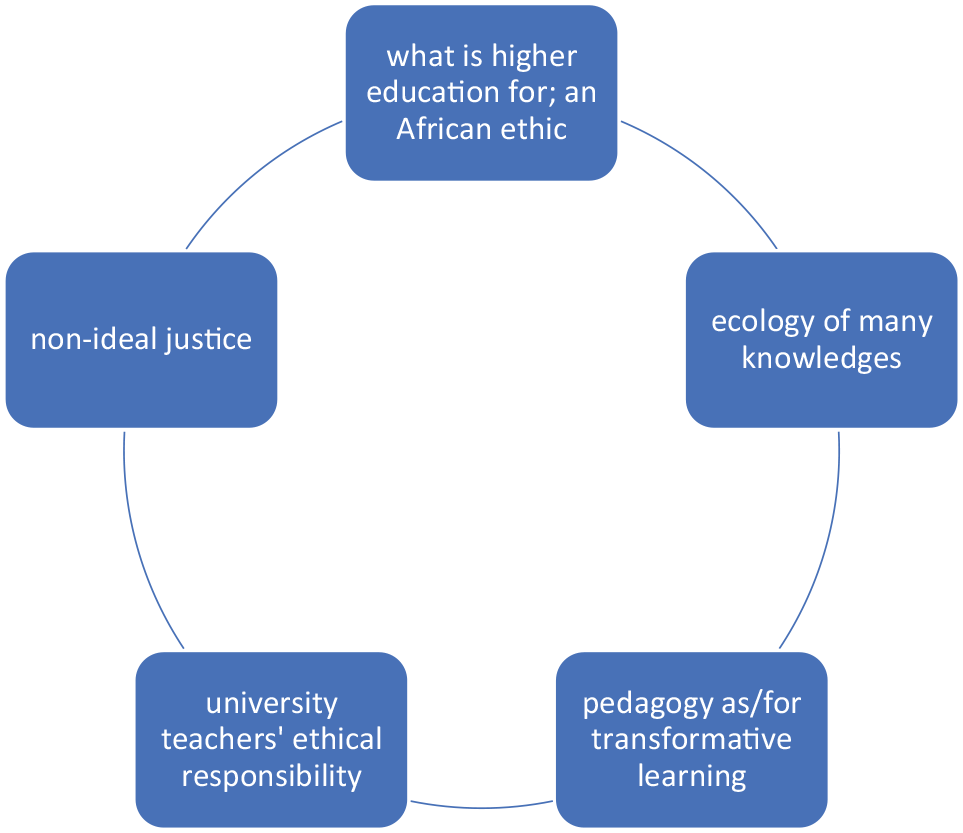
Epistemic capability wheel for decolonising curriculum.
In conclusion
Educational institutions can and should undertake capabilitarian curriculum work in decolonising curriculum; indeed, understood this way to decolonise curriculum equitably is to form capabilities and functionings that enable students to participate fully and meaningfully in higher education. The university can enable critical knowledge, epistemic justice and the multiplicity of social practices and experiences of the world in hospitable and generous epistemic engagements, genuinely inclusive, but also radically incomplete. Nor should we overlook that changing epistemic relations in universities has the potential also to import changes into the broader society. A decolonising capabilitarian curriculum then matters for its effects not only on epistemic capability in higher education spaces, but also for the wider impact on a democratic culture. At its worst, epistemic injustice can prop up unequal societies in which dominant prejudices flourish. Of course, education spaces act in contradictory ways, with the potential to empower co-existing with the potential to oppress and marginalise. The point is we need to work for more of the first and less of the second.
In the article I have proposed a multi-dimensional evaluative epistemic capability wheel and an approach to decolonising curriculum grounded in decolonial debates and advancing the capabilities and functionings of students as the measure of justice and epistemic freedoms, specifically the epistemic contribution capability as the informational basis of decolonising curriculum judgements. I have shown why and how epistemic justice is central to decolonising curriculum. As Ndlovu-Gatsheni (2018) argues, the challenge of the 21st century is that of the ‘epistemic line’, which denies the full humanity and voices of those on the wrong side of the line, including in universities. A capabilitarian approach to decolonising curriculum in which epistemic capability is formed and operationalised would contribute to dismantling this line and unequal knowledge power relations and privileges in university spaces and in the broader society. Following Sen’s (2009) deliberately incomplete theory of justice, the aim is not for conceptual closure but rather to contribute to open-ended and ongoing conceptual exploration. I offer an account of decolonising curriculum certainly not the account, opening a capabilitarian window to add to ideas around curriculum knowledge, pedagogical arrangements and connections, and who we might be and become through our higher education experiences as reflexive persons and deliberative citizens.
Footnotes
Declaration of conflicting interests
The author declared no potential conflicts of interest with respect to the research, authorship, and/or publication of this article.
Funding
The author disclosed receipt of the following financial support for the research, authorship, and/or publication of this article: The research on which this paper is based is funded by the National Research Foundation Grant Number 86540.
