




Abstract
The duty to monitor ‘the failure to uphold British Values’ in the Prevent strategy, introduced in the Counter-Terrorism and Security Act 2015, is itself an attack on British democracy. This article explains the contradictory nature of the Prevent Duty. First, the current state of democracy in Britain is examined and contrasted to a common teaching topic, the Suffragettes. Under Prevent, Suffragettes’ extremist tactics place a burden on teachers to explain how terrorist activities may have once been legitimate. Second, Prevent’s focus on extremism and radicalization assumes a moral consensus, which is confirmed by its incorporation into the Safeguarding agenda. The article, however, argues that fear of radicalization does not create a new moral universal. Democracy involves a struggle to influence parliament both in expanding the suffrage in the 19th century and in the contemporary discussion of political power. Prevent’s insistence on the importance of democracy, while denying the contestation of ideas which is integral to the working of a democracy, further evacuates the concept. Democracy is described as separate from the struggles that created it, a ‘value’ that everyone shares, rather than a means by which the majority can struggle to construct policy.
Introduction
The Counter-Terrorism and Security Act 2015 made the Prevent Duty mandatory in two ways: not only do all schools, childcare providers, and more recently universities now have a duty to ‘prevent radicalisation’ and ‘promote British values’ but also educational institutions have to be able to demonstrate that they are fulfilling this duty and show that they are monitoring their progress. While these requirements to demonstrate and monitor are onerous in themselves, this article is concerned with how the Prevent Duty both shapes our conception of democracy and in so doing consolidates democracy’s current weakened state.
The Prevent Duty insists that democracy is a ‘British value’ and so this article considers what it means to understand democracy in this way, particularly in the contemporary context, where democracy has been seen to be “in crisis”.
Given that schools have to fulfil the Prevent Duty in their teaching, how is their presentation of the history of democracy going to fit with the idea that democracy is a ‘British value’? So in this article, I consider the way that history teaching resources and textbooks present the development of democracy in Britain. Historically, in seeking the extension of democratic control, the ‘values’ of the time were challenged, often by small groups, sometimes larger ones, with a great variety of tactics and their struggle often led to violence. This article focuses on the dilemma faced by many teachers in trying to examine the historical issues of the development of democracy in Britain, while upholding a certain view of ‘British values’.
The difficulty of assessing what democracy may have meant in the past is exacerbated by the lack of democratic involvement today. The decline in political activity in Britain is widely perceived as constituting a ‘democratic deficit’. Some have looked at the technical aspects of voting (for example, voting systems, referenda and constituencies) as solutions to the disaffection with the democratic process, but this has tended to obscure the substance of democracy as a means to determine the content of law and policy. Real democratic control requires a political struggle within the population to affect policy, but it is this contested nature of democracy that is being denied in the concept of democracy as a ‘British value’. Insisting that democracy is a value, as Prevent does, I argue, will only evacuate the concept of democracy further, encouraging the alienation and disaffection from the democratic process that is already the key source of the problem that Prevent purports to tackle.
The contemporary climate
It could be argued that with universal suffrage established, democracy became an important ‘common value’ that we can now share. However, recent politics suggest that democracy has only become a ‘value’ precisely as it has less meaning and even less connection to most people. A ‘value’ is something that can be held to be important in and of itself, independent of its context, and timeless, whereas democracy, to be meaningful, needs to engage actual living people and involve their commitment and their intention to influence government and create a better society (although there will be contestation about what constitutes a better society).
The first report of a ‘crisis in democracy’, originated with the 1975 Trilateral Commission report, concerned that democracies in advanced nations were not able to incorporate the desires of the emerging middle classes that had flourished around civil rights issues (Crozier, 1975). The sense of a crisis in Western democracies (attributed to a wide range of causes) has created a substantial literature, ever increasing, which includes (not considering journals) book titles such as the following: Disaffected Democracies (Pharr and Putnam, 2000), The End of Politics (Boggs, 2000), The Vanishing Voter (Patterson, 2002), Diminished Democracy (Skocpol, 2003), Post-Democracy (Crouch, 2004), Political Disaffection in Contemporary Democracies (Torcal and Montero, 2006), Hatred of Democracy (Rancière, 2006), Why Politics Matters (Stoker, 2006), Why We Hate Politics (Hay, 2007), The Rise of the Unelected (Vibert, 2007), Democracy: Crisis and Renewal (Ginsborg, 2008), Democracy in Crisis (Gaon, 2009), The Life and Death of Democracy (Keane, 2009), Don’t Vote! It Just Encourages Them (O’Rourke, 2010), Democratic Deficit (Norris, 2011), Uncontrollable Societies and Disaffected Individuals (Stiegler, 2012), Is Democracy a Lost Cause? (Mastropaolo, 2012), Democracy without Politics (Bilakovics, 2012), Democracy in Retreat (Kurlantzick, 2013), The Confidence Trap (Runciman, 2013), Ruling the Void (Mair, 2013), Democracy in Crisis? (Papadopoulos, 2013), Can Democracy be Saved? (Della Porta, 2013), The Crisis of Social Democracy in Europe (Keating and McCrone, 2013), Challenges to Democratic Participation (Campos and André, 2014), Democracy Disfigured (Urbinati, 2014), Undoing the Demos (Brown, 2015)
Ever since Alexis De Tocqueville (1835) considered democracy in America, it has been argued that ‘there are no countries in which associates are more needed, to prevent the despotism of faction or the arbitrary power of a prince, than those that are democratically constituted’ (p. 38). To make democracy work, it is essential, argued Tocqueville, that people are involved in the process, and become ‘associates’ in the democratic practice. The problem today is the accumulation of almost 40 years of decline in democratic involvement.
Robert Putnam and Theda Skocpol were the first to really highlight how many sorts of social and political forms of engagement had declined since their high point in the 1960s (Putnam, 2000; Skocpol, 2003), but the question of electoral turnout in the United Kingdom had been an issue since the 1980s and reached a low point in 2001, at 59%, the lowest turnout since 1918 (Bromley and Curtice, 2002: 142). Pippa Norris (2002) has argued that these fluctuations may not be transformational trends, but it is still the case that the legitimacy of the democratic arrangement rests on participation. The authority of government is undermined when they have been elected on 9.5 million votes, while 17 million registered voters abstained, as happened to the Labour Party in 2005 (Power Inquiry, 2006: 33).
A majority of the public still feel that they have a duty to vote, although this is only a bare majority at 57%, fairly constant since 2009, when it was 58%, but significantly down from the 76% that it was in 1987 (Phillips and Simpson, 2015: 1). Perhaps more importantly, trust in governments has dropped since the 1980s, and reached a low point in 2009, after the member of parliaments (MPs) expenses scandal when 40% said that they ‘almost never trusted government’. Five years later this still remains the view of one-third of the population surveyed (Curtice and Ormston, 2016: 14).
One of the initial responses to the ‘democratic deficit’ was to look at how the electorate had changed, how they were better educated (Butt and Fitzgerald, 2014: 7), less socially and geographically fixed and had become ‘critical citizens’, whose expectations were not met in reality (Norris, 2011: 5). The Rowntree Trust’s Power Inquiry suggested that people were not apathetic, however, and that the main problem was the alienation felt from political parties and political institutions (Power Inquiry, 2006: 16). The Power Inquiry raised some important consequences of the decline in involvement in politics, which affects how democracy is then experienced. They feared that the alienation from politics would lead to a loss of mandate and authority for the government, a loss in political equality as some groups were even less represented than others, a loss of dialogue between sections of society, a loss of political recruitment as only a narrow social group engaged with politics and the risk of both the rise of undemocratic forces and quiet authoritarianism as government would be less scrutinized by public involvement (Power Inquiry, 2006: 33–35). Some of these trends have also been identified as causes of the problem of the democratic malaise. So, Colin Hay and Gerry Stoker (2009) see the low levels of trust in politicians, and thereby government, as a causal factor, while Andre Campos and José André (2014) have brought together a collection of authors looking at the way that disaffection is a challenge for democracy.
Political recruitment has also narrowed, although again, it is difficult to determine whether this is a cause or effect. Participation in political parties has shown a sharp downturn since the 1980s (see Figure 1 below), and notwithstanding the Labour Party’s recent revival in membership, figures are historically still very low (Keen and Audickas, 2016: 6).
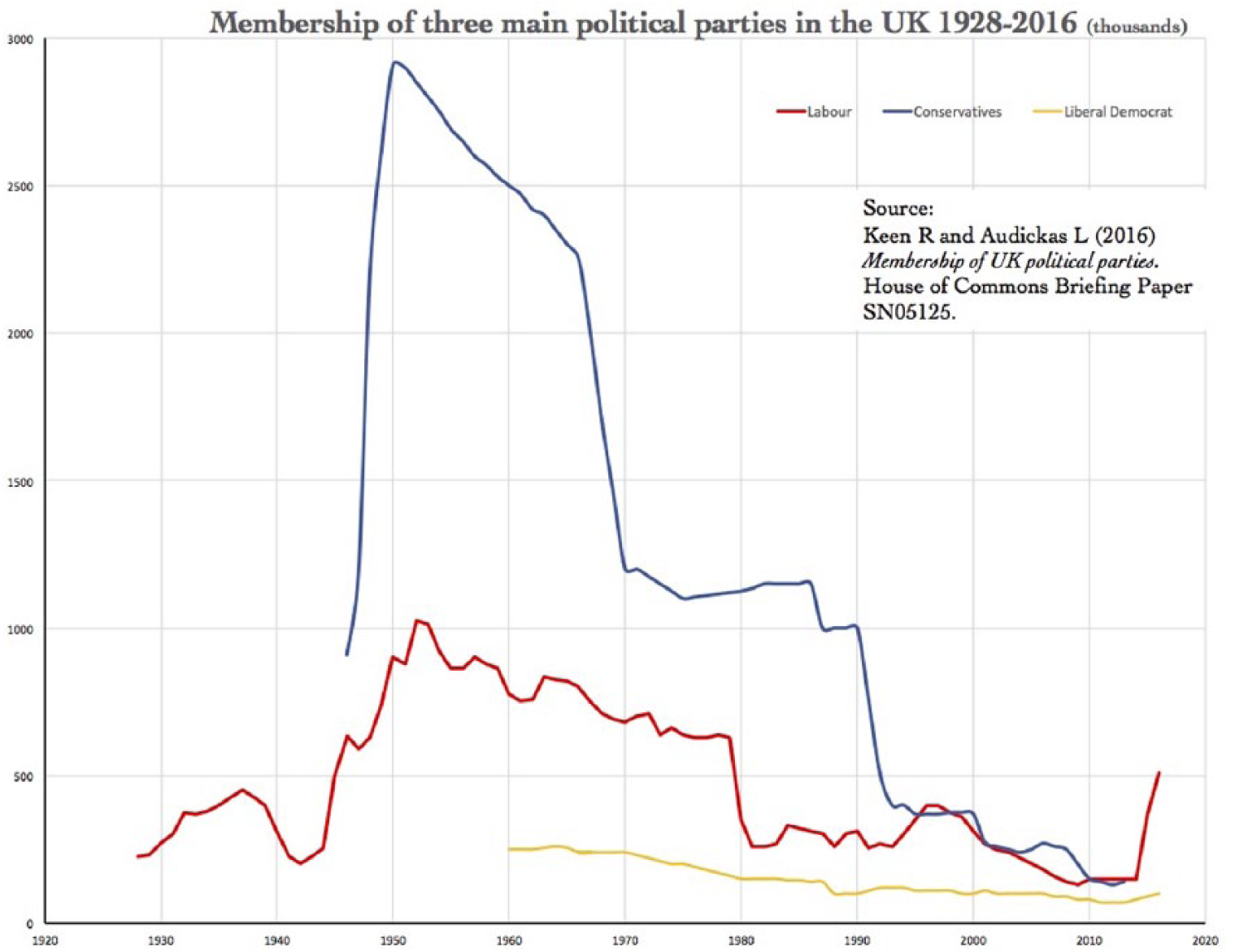
Membership of the Conservative, Labour and Liberal Democrat* parties 1928–2016.
Paul Whiteley (2009) has argued that the decline in political engagement is a serious problem for democracy, as the level of partisanship across 36 countries has been correlated with the effectiveness of their governments (p. 254). Certainly, as parties have tended to look towards the centre ground of politics, to appeal to the most voters, looking for common denominators to bring people together, so they have lost touch with those who felt commitment to a particular project. Once the parties lose their activists to inspire others and encourage voting, they find it increasingly difficult to generate a meaningful discussion of policies. Gerry Stoker and Mark Evans (2014) have categorized five forms of ‘political alienation’ that weakens democracy in both Australia and Britain. Without the feedback that arises from engagement with the constituency of an active political party, it is difficult for governments to assess the impact of policies and even sometimes to ensure that a particular policy is practised.
In the 1950s, the proportion of the electorate actively involved with a political party was almost 10%, whereas in 2015, it is barely 1% (up from 0.8% in 2013; Keen, 2015: 4). The lack of political participation has a big impact on what democracy means in people’s lives. Unsurprisingly, without any connection with the political process, most people (84%) do not believe that the government will listen to their complaints (Curtice and Ormston, 2016: 10).
The current disillusion with democracy as the best way of constructing good policy is the context in which the Prevent Duty insists that democracy is a ‘fundamental British value’. This proclamation has been issued when more people are abstaining from elections than electing the winning government and when not even 1% of the electorate are members of a political party, compared to 10% in the past. This is the context in which teachers today have to teach the Suffragette movement and consider how their pupils will interpret the Suffragette tactics, when their own experience of politics is so minimal. Anyone younger than their mid-50s (which includes a good number of teachers), has not experienced a society where a significant proportion of people were actively engaged or desired any engagement in politics. While each younger cohort votes less than their elders, teachers have to hope that pupils can imagine a historical period when women risked their lives for the right to vote. I think it is useful to consider for a moment the issues raised in the teaching resources to fully understand the dilemma of teachers trying to conjure up a period when being part of democracy was important, while having a mind to the Prevent Duty and the problem of extremism.
In this article, I have looked at the teaching resources for Key Stage 3 (years 7–9 at school, or aged 11–14 years) and Key Stage 4 (taking General Certificate of Secondary Educations (GCSEs), years 10–11, aged 14–16 years). The National Curriculum (Gov.uk, 2013) encourages use of the Times Educational Supplement (TES) Teaching Resources. I will look at how these resources and other commonly used teaching materials, such as BBC Bitesize and other teaching textbooks, treat some of the topics covered by the National Curriculum to provide examples of how the history of democracy is likely to be understood in a school environment.
The Suffragettes
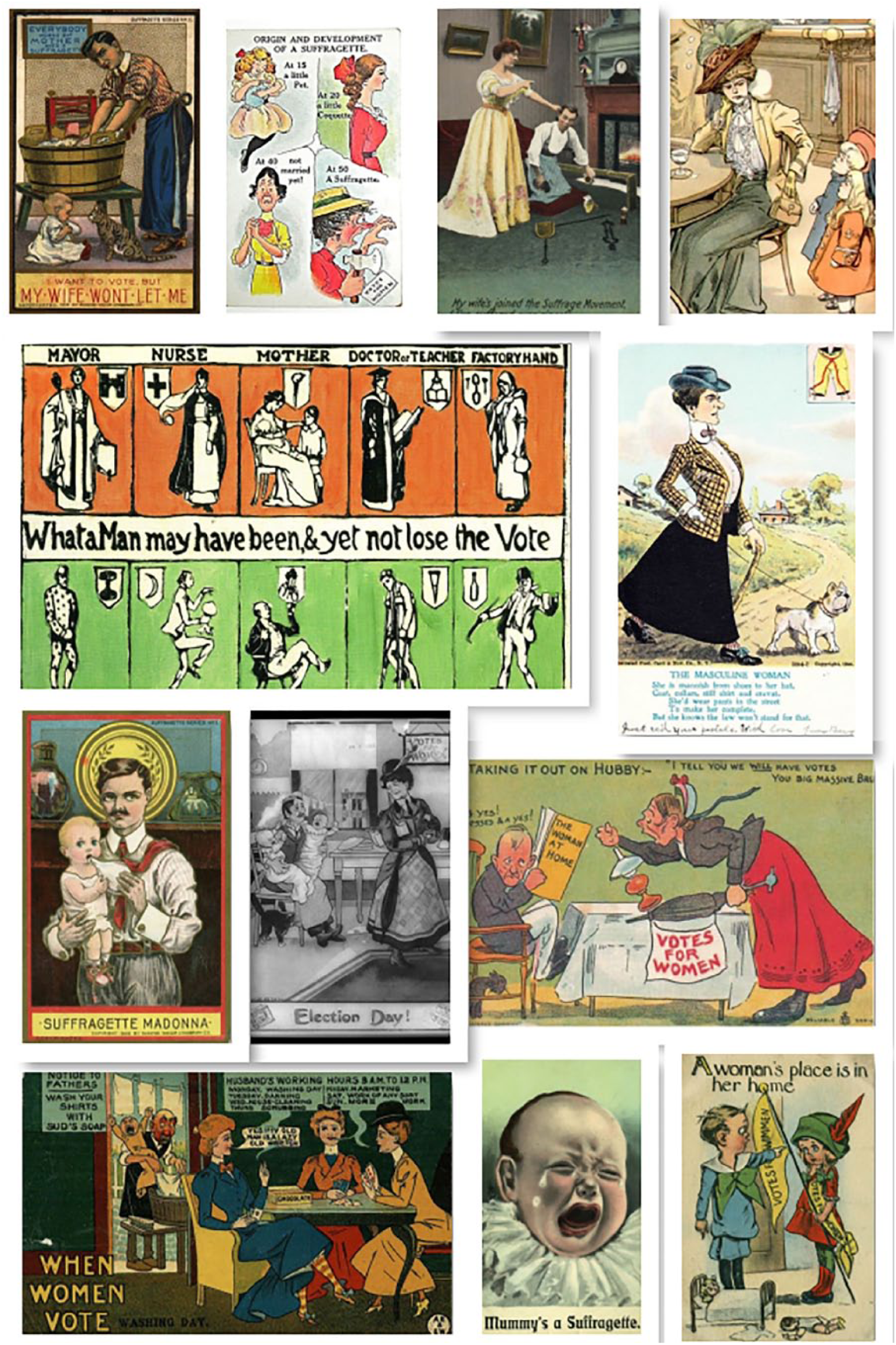
The experience of the Suffragettes, and their campaign, is a popular teaching topic, where 288 out of 379 TES resources on general suffrage (i.e. 76%) focus on the women’s suffrage movement. It fulfils the National Curriculum requirement of ‘Challenges for Britain, Europe and the wider world 1901 to the present day e.g. women’s suffrage’ (Gov.uk, 2014). BBC Bitesize includes a list of the tactics of the Suffragettes who ‘heckled politicians, held marches, … chained themselves to railings, attacked policemen, broke windows, slashed paintings, set fire to buildings, threw bombs and went on hunger strike when they were sent to prison’ (BBC Bitesize, 2016b). Today, these tactics would be associated with ‘extremists’. One TES resource provides a first-hand account of the force-feeding of women prisoners on hunger strike, giving a particularly vivid description of the treatment of political prisoners for secondary school pupils (ChulmleighCommunityCollege, 2014) and another photographs the objects used for force-feeding (TheBritishMuseum, 2016a). Another resource directly focuses on the question of whether the Suffragettes could be classed as ‘terrorists’ (ccking, 2012), and another on whether Emily Davison intended to martyr herself (having experienced force-feeding 49 times) under the King’s horse at the Derby, and although she had a return train ticket in her pocket, notes that she was ‘prepared to die for her beliefs’ (DanielWillcocks, 2014). Davison’s martyrdom is considered by some as the turning point of the campaign (Cox, 2013). Certainly, cartoons and postcards of the time give a sense of the vitriol of both sides and the intensity of feelings:
Collage of postcards (TheMindCircle, 2016)
The UK Parliament Education Service has put together its own collection of Suffragette resources to ask ‘students to think about the inequalities faced by women in the past and to be aware that action can bring about change’ (UK Parliament, 2013b). Another of their lesson plans asks students to evaluate both the lawfulness of the Suffragette protests and their effectiveness in drawing attention to the issue (UK Parliament, 2013a). It seems right that school children are asked to consider how ‘action can bring about change’, but at the same time this puts teachers in an awkward position. Being in favour of democracy and universal suffrage suggests we should side with the Suffragettes, but would they have been successful if they had not been prepared to go on hunger strike and even die for their cause? Is martyrdom and violence today an expression of extremism, whereas then it was an expression of their determination for democracy?
Challenging extremist views
Prevent requires those who work with children and young people (the Prevent Duty also applies to universities) to demonstrate that the institution is ‘promoting British values and enabling them to challenge extremist views’ (Department of Education, 2015: 5), where extremism is defined as follows: Extremism is vocal or active opposition to fundamental British values, including democracy, the rule of law, individual liberty and mutual respect and tolerance of different faiths and beliefs. (Department of Education, 2015: 5)
The Suffragettes were arguing that British democracy was not really democracy without universal suffrage, and so they were opposed to the fundamental British values of their time and constituted extremists. Their actions were occasionally extreme and although subsequently it has come to seem normal that everyone has a right to vote, it was not normal then and those that campaigned for change were in a small minority for many years. The postcards bring to life the popular disgust at the thought that women could act like men. Teaching the Suffragettes puts teachers in a difficult position, where teachers may want to champion the expansion of the suffrage, but might fear too much discussion of why it was not already law or the impact of the Suffragette’s tactics for fear of transgressing the Prevent Duty. Can students safely ask whether the tactics to gain a democratic system were justified?
Objections to Prevent has been raised by the National Union of Students, who have complained that ‘students are not suspects’, claiming that Prevent encourages ‘the prospect of racial profiling and state-sponsored Islamophobia’ (Asquith, 2015). Arun Kundnani argues that the Prevent Duty is not just counterproductive but dangerous: The great risk is creating an atmosphere of self-censorship – where young people don’t feel free to express themselves in schools, or youth clubs or at the mosque. If they feel angry, or have a sense of injustice but nowhere to engage in a democratic process and in a peaceful way, then that’s the worst climate to create for terrorist recruitment. (Khaleeli, 2015)
While Kundnani’s point is important, the problem with Prevent is deeper than its self-defeating character in practice. Whatever its practical effects on young people, the Prevent Duty is itself inherently anti-democratic in that it makes it difficult to have an honest discussion about what constitutes British democracy, and this has implications for everyone.
Before the present government introduced the Counter-Terrorism and Security Act 2015, the government consulted widely and encouraged comments on their proposed entrenchment of the Prevent Strategy. In total, 1792 written responses were received, and 316 delegates attended the consultation events, and while most responses were from Local Authorities, virtually all the responses were concerned with how to operate the Prevent strategy, rather than questioning it as an appropriate statutory response.
There were some concerns about the definition of ‘British values’ and ‘extremism’ and about the possible conflict between the responsibility of higher education institutions to uphold free speech and still meet the requirements of the Prevent strategy, and also how to preserve religious freedom in educational institutions, but no one was then recorded as pointing out any dangers to British democracy (HM Government, 2015a: 7).
However, the core problem at the heart of the Prevent Duty is that it insists that democracy is a ‘fundamental British value’, which means that the purpose of democracy – to help us reach better policies because they involve the majority of the population – is pushed aside in favour of presenting democracy as a shared value: a place of agreement rather than the environment of struggle, contestation and argument about what government should do. The idea that democracy is a place of agreement and an abstract value that we can all share, forgets the intensity of disagreement about what democracy meant only one hundred years ago. By presenting extremism as the opposite of democracy, it seems easy today to imagine that we can take sides with one against the other. The actual champions of democracy in the past, however, were not always so easy to spot. After all, were not the Suffragettes among the terrorists of their day?
The practice of force-feeding, developed against the hunger-striking imprisoned Suffragettes, was used also against the conscientious objectors during the First World War, another group who were denied the right to vote until 1923. The idea of ‘one man, one vote’, or rather ‘one person, one vote’, was not finally established in British law until 1948, when the multi-member constituencies were abolished along with the principle that individuals could vote in more than one place. Eventually, the age of majority, at which you could vote, was lowered to 18 years with the Representation of the People Act 1969 (House of Commons Library, 2013: 54). So, although the existence of a Parliament has a long history in Britain, universal suffrage is less than a century old, which suggests that majority representation is barely old enough to qualify as a tradition. We may value democracy today but clearly we had to struggle against the ‘British values’ of the past to gain the vote for everyone.
Prevent imagines that democracy is a ‘shared value’ in two ways. The first, as we have seen, is to pose democracy as if it were an abstract moral value which everyone agrees upon. While the historical development of universal suffrage does not support this image, it is nonetheless plausible because we have now agreed that democracy sounds like a good idea. The fact that democracy is not actually in such good health (more of this later) almost certainly helps the image because the question about what democracy entails is not, unfortunately, a generally engaging topic and in its uncontested state, appears as something that might be agreed upon. Second, Prevent suggests that democracy does not include extremism. In fact, Prevent imagines a consensus by being against extremism. We can see this more clearly in the development of Prevent and why it became part of safeguarding practice to establish itself as part of the existing consensus against harm to children.
Prevent and safeguarding
The current British counter-terrorism strategy, named CONTEST, was initially a response to the terrorist attacks in New York in 2001 and in London in 2005. There are four parts to CONTEST: Prevent, Protect, Pursue and Prepare, and in 2010, the Home Affairs Committee set out to conduct a review of Prevent (HM Government, 2011). The review of Prevent was partly prompted by the criticism that Prevent had been too focused on Muslims in Britain and contained an ‘unhealthy conflation of law enforcement with integration policy’. These concerns prompted the Home Affairs Committee to further investigate the issue of radicalization in some detail and investigate why the ‘reasons … some British-born and raised individuals are vulnerable to violent radicalisation remain unclear’ (House of Commons Home Affairs Committee, 2012: 3).
The new investigation into the Roots of Radicalization by the Home Affairs committee involved organizing many seminars, a conference and examining evidence from a wide range of contributors. It concluded, however, that ‘it is clear that individuals from many different backgrounds are vulnerable, with no typical profile or pathway to radicalisation’ (House of Commons Home Affairs Committee, 2012: 43). Instead of being able to identify those at risk, Rashad Ali, from the counter radicalization agency Centri, said simply ‘it could be anybody’ (House of Commons Home Affairs Committee, 2012: 9). It was widely thought that ‘grievance’ might contribute to the process of radicalization, but the Committee did not question the way in which Prevent itself was viewed, despite a ‘lingering suspicion about the Prevent Strategy amongst Muslim communities, many of whom continue to believe that it is essentially a tool for intelligence-gathering or spying’ (House of Commons Home Affairs Committee, 2012: 46), thereby intensifying the sense of alienation between Muslim communities and their sense of belonging in Britain. As Abbas (2011) has pointed out, Wider society has placed an emphasis upon the apparent unassimilability of Muslims, a policy focusing on ‘community cohesion’ as opposed to eliminating deep-seated structural inequalities, while there is a general widening of economic and social divisions in society as a whole. These attempts have placed the attention onto Muslims and not the workings of society. Policies seek to modify, improve or develop the behaviours of Muslims and the ways of Islam but not always the attitudes of majority society. (p. xvii)
Prevent, far from creating a consensus, seemed to be accentuating the differences between communities. Without consensus, it was difficult for even the Home Affairs Committee to claim that Prevent was working to strengthen fundamental British values. However, despite the impossibility of deciding what causes radicalization, the Home Affairs Committee noted one apparent success; Prevent could be included as part of safeguarding procedures with little difficulty: The view came across strongly in our evidence that Prevent is most successful at the local level where it is mainstreamed into local safeguarding procedures, youth services, neighbourhood policing and so forth. We support this approach and encourage the Government to do the same. (House of Commons Home Affairs Committee, 2012: 46)
This is exactly the direction that the Prevent strategy has subsequently taken. Earlier focus on police activity has been replaced by the focus on its position in education. Section 26 of the Counter-Terrorism and Security Act 2015 introduces a requirement for all schools and all childcare providers (including nurseries) since 1 July 2015, and since 18 September 2015, for also all universities, to have ‘due regard to the need to prevent people from being drawn into terrorism’ (Department of Education, 2015: 6). This is now known as the Prevent Duty and Compliance, the duty to show that the institution is monitoring and demonstrating their ‘due regard’, and this is monitored by Ofsted for schools and nurseries and by the Higher Education Funding Council for England (HEFCE) for higher education. By placing Prevent in the context of safeguarding and education, there is recognition in Prevent that there is no agreement about who or what constitutes the threat, and instead, the need to protect children from harm provides the sense of moral consensus, indeed currently the only unchallenged consensus.
It is important to recognize how important the concept and practice of safeguarding has been in schools. The Children Act 1989, established in law the idea that adults have a duty of care to ‘safeguard’ children and promote their welfare. Through the Children Act 2004, the Education Act 2002 (section 175) and the Children and Families Act 2014, this duty has been extended from parents to teachers and other people working with children on a regular basis and has been monitored by Ofsted in schools and Local Authorities (while the process of checking previous records of adult individuals has been taken over by the Disclosure and Barring Service (DBS)). ‘Safeguarding’ is a specific term that includes, according to government guidelines, the following: protecting children from maltreatment; preventing impairment of children’s health or development; ensuring that children grow up in circumstances consistent with the provision of safe and effective care; and taking action to enable all children to have the best outcomes (HM Government, 2015b: 5).
The safeguarding revolution is more than a new legal framework; it is an extensive practice of training and multi-agency cooperation to identify children at risk of harm and to work with the families of vulnerable children. Safeguarding now constitutes a regular practice and training for everyone working in education, health and any other areas where young people are present. Adults who work regularly with children not only have to be cleared with the DBS but also undergo regular safeguarding training. The focus of this training is learning to identify ‘at-risk behaviour’ and possible ‘signs of radicalization’ (even though these have yet to be reliably identified). More importantly, the multi-agency cooperation has already become regular practice, encouraging regular communication between Social Services, schools, Child and Adolescent Mental Health Services (CAMHS) and local police. Teachers, for example, are encouraged to report minor incidents and suspicions to a local hub which can coordinate local information to build up a picture of what might be happening to particular children. The Prevent Strategy slots another set of issues into this information-gathering infrastructure, as the Department of Education (2015) advises, Protecting children from the risk of radicalisation should be seen as part of schools’ and childcare providers’ wider safeguarding duties, and is similar in nature to protecting children from other harms (e.g. drugs, gangs, neglect, sexual exploitation), whether these come from within their family or are the product of outside influences. (p. 5)
Reporting concerns may take two forms: first, reporting to Local Safeguarding Children’s Boards (LSCBs) and then, for particular Prevent worries, individuals may be referred to Channel, a national programme designed to ‘support’ those who may be vulnerable to radicalization. Channel is a formal local arrangement of multi-agency partners who coordinate support for individuals perceived as vulnerable to radicalization (Home Office, 2015). In this way, Prevent simply adds to the issues where children may be considered to be ‘at risk’. By adding radicalization to the list of risks, Prevent presupposes that there is no content to the radicalization. Radicalization is presumed to be counter to democracy, thereby further entrenching the view that democracy is not about strongly held views or political contestation, but also Prevent is imagining an easy consensus by posing something strange and unfamiliar as outside the realm of acceptability, and indeed as a ‘risk’.
Fortunately, risks today are uncommon, and therefore relatively easy to pose as dangerous and abnormal. Indeed, Prevent pretends that by imagining that radicalization as a danger, so we can create a common consensus against this danger. The danger is presented as external to democracy. But let us consider now the problem again facing teachers, trained in the need to spot signs of radicalization, also wanting to teach the history of democracy. The radicalization of people demanding the right to vote happened within the British Parliamentary system, and the harm to the protesters came very directly from the government resisting change and in particular resisting the question of who should control Parliament. And once we have looked at this question historically, we should look at this question of control of political decisions in contemporary politics. It turns out that the question of the control of policy is still an important question and cannot be left to the past, and perhaps radicalization should not be assumed to be outside the norm. The concept of democracy, both historically and now, has to include the question of who affects policy.
Parliament and democracy
In the 17th century, when the issue of Parliament’s power was contested in the Civil War, voting was a very limited privilege. Confined from 1430 to 1832 to ‘forty-shilling householders’, only those who owned property worth at least 40 shillings (a considerable sum at the start), could vote (and could vote in every location that they owned property). During the Civil War, both the Levellers and the Diggers criticized Cromwell for his failure to extend suffrage and give non-propertied men the right to vote. The vote, however, remained confined to few, albeit with increasingly varied interpretations of what a ‘40s householder’ constituted, until the First Reform Act of 1832 attempted to bring consistency across Britain.
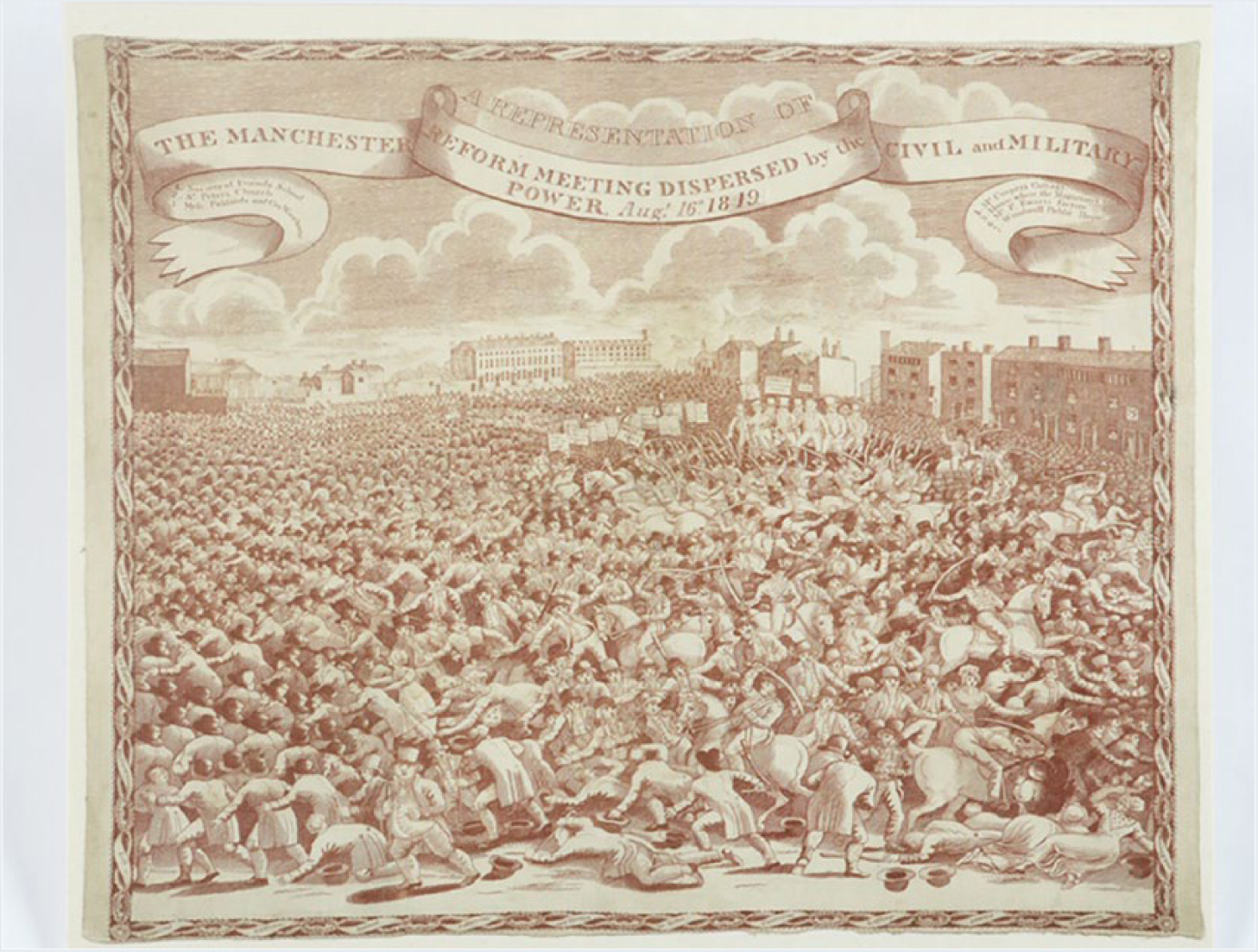
Famously, Britain had lost its colony in North America for failing to listen to the demand ‘No taxation without representation’. The experience of the War of Independence had not induced, however, a wiser attitude to the question of fair representation in Britain. As the towns grew in the north of England, so representation looked even more unequal, as many boroughs continued to have representation in Parliament with fewer than a hundred electors while urban areas with tens of thousands could elect no one (Old Sarum in Wiltshire and Dunwich in Suffolk elected MPs with only two voters, while urban areas such as Manchester and Stockport had to share their MP with the surrounding countryside). Patronage, where landowners dictated terms to MPs was common (Oldfield, 1816). Not surprisingly, the landowners voted for the Importation Act 1815, commonly known as the Corn Laws (raising the price of corn and bread), which only served to reinforce the undemocratic nature of Parliament at the time. Many opposition groups formed to oppose the Corn Laws and to demand electoral reform. Attempts to meet peacefully to argue for reform were met with harsh punishment and repression. The banner ‘Taxation without Representation is Unjust and Tyrannical’ adorned the speakers’ stage in the middle of St Peter’s Field in Manchester where local people came to hear the call for universal suffrage on 16 August 1819 (Working Class Movement Library (WCML), 2010).
The Peterloo Massacre, as the subsequent event was called, is used as a teaching resource, although noticeably less by teachers and more by institutions providing useful documentation, such as the Working Class Movement Library or the British Museum’s pictures of commemorative objects, such as the Peterloo handkerchief and pottery (TheBritishMuseum, 2016b). Accounts of the massacre from both sides exist, with the cavalry arguing that they had to defend the constabulary who were attempting to arrest the speakers, and claiming the injured (over 500) and deaths (18) were caused largely by the crush of the 60,000 people (about half of Manchester’s population was there) trying to flee. The fact that the injuries were largely recorded as sabre wounds paints a different picture. As does the call by the Manchester Patriotic Union, who had called the assembly, that demonstrators should come in their Sunday Best to present themselves as a picture of ‘Cleanliness, Sobriety, Order and Peace’ with a ‘prohibition of all weapons of offence or defence’ (Frangopulo, 1977: 31). The local magistrates were convinced that a ‘general rising’ was imminent, however, and came with 600 cavalry, another cavalry unit with guns, 400 volunteers from Cheshire, 400 special constables, several hundred foot soldiers and another volunteer cavalry unit from Manchester.
The Peterloo Handkerchief (TheBritishMuseum, 2016).
The final impetus to agree to some electoral reform was Catholic emancipation – once Catholics were no longer disallowed from taking political office under the Roman Catholic Relief Act 1829, even the Tories became responsive to the idea of giving northern Protestant non-conformist cities representation in Parliament to counter Catholic representation (which had been conceded to avoid revolution in Ireland; Cheyney, 1922: 678). The battles over the Reform Acts of the 19th century, therefore, do not indicate much official willingness to embrace democracy as a ‘British value’, quite the contrary, the British Parliament attempted to restrict its relationship to landowners, only conceding some influence to the towns to counter the influence ceded to the Irish.
The Duke of Wellington, the victor of Waterloo over Napoleon in 18 June 1815, when prime minister, lost a vote of no confidence in November 1830 when he tried to assert that the electoral system needed no reform, claiming that ‘the legislature and the system of representation possessed the full and entire confidence of the country’ (Cheyney, 1922: 680). Even the King was twice forced to pressurize Parliament by creating new governments before the reform could be pushed through, as the House of Lords continued to resist the very moderate reform proposed. The House of Lords only conceded in 1832 because contemporaries had a ‘genuine fear that some great social upheaval was about to take place’ (Lowe, 2009: 57) and the King had threatened to appoint new Lords to shift the balance to the Whigs. The 1832 Reform Act, however, only increased the electorate to 5.8% of the population of Britain, from about 500,000 to 813,000 eligible male voters (about one in five men could vote), and rapidly Chartism emerged to continue the campaign for suffrage for a wider section of the population. Feargus O’Connor, one leading Chartist, argued that Chartists needed to be prepared to die for their cause and only violence would achieve the vote (BBC Bitesize, 2016a). Despite many more bloody campaigns and several more reform acts during the 19th century, it was almost another hundred years before universal suffrage was passed in Britain, and male suffrage in Britain lagged behind several European countries during most of the 19th century.
The desperate and sometimes violent elite resistence to universal suffrage throughout the 19th century suggests that democracy was not really a ‘British value’ at this time. In fact, it is hard to draw many ‘British values’ from this period except that only the committed efforts of a minority ensured that suffrage was extended and many lost their lives in the struggle. Like the Suffragettes, history seems to support the view that commitment to a cause, determination and sometimes martyrdom are factors that, like radicalization, may bring about change.
More interestingly, also, the struggle over influence in Parliament echoes today. The question of who affects policy is not a settled issue where it is clear, as you might expect in a democracy, that the majority determine policy. Indeed, one of the main discussions of the cause of the contemporary malaise of democracy is precisely the way in which the current democratic arrangement does not appear to be creating a good democracy. The examination, and at times critique, however, of the state of current democracy is at odds with the requirement to ‘uphold British values’ in Prevent.
The loss of political power
David Beetham and David Whyte have blamed the process of privatization since the 1980s for reducing accountability in the process of government (Whyte, 2015). Government activities have been outsourced and become matters of confidential commercial agreements, which has, at the same time, deprived government of the skills, experience and personnel and left them at a disadvantage in negotiating contracts, leading to ‘the distortion and subversion of the public realm in the service of private interests’ (Beetham, 2013: 3). Examples of recent corruption scandals include mislabelling of meat by the big supermarkets, GlaxoSmithKline (GSK) fined £297 million for bribery (BBC News, 2014), rate-fixing and mis-selling by the banks (Tyler and Bank, 2012), evidence-falsification by the police in the case of Hillsborough (Slack, Tozer and Walker, 2012), Stephen Lawrence (Dodd, 2015) and Jimmy Saville (Press Association, 2014), while politicians have been shown to be open to certain lobbyists (BBC News 2013) and rather too closely associated with companies benefiting from Private Finance Initiatives (PFI) (Owen, 2016), before considering the scandals of the ‘cash for questions’ and MPs’ expenses’ scandals (Whyte, 2015: 1–3). The problem is not just one of looking to experts for information, as Frank Vibert (2007) explains, the expertise has become the source of legitimacy: Instead of the care of the public interest being delegated by citizens to politicians whose credentials rest on electoral legitimacy, it seems as though the function has been delegated to the nonelected whose claim to legitimacy rests on their expertise. (p. 58)
At first, expertise promises to solve the organizational problem, as it appears to bring non-partisan ideas to the table to provide solutions. In a context where both sides have been seen to lie, stepping outside the political bubble appears the way forward. But the ‘experts’ do not have a connection or a responsibility to the people since they haven’t been elected, as Robert Dahl (1998) spells out, just ‘Because experts may be qualified to serve as your agents does not mean that they are qualified to serve as your rulers’ (p. 73). Expertise looks as if it has inherent legitimacy, but the understanding that experts have is not necessarily connected to the citizens’ experience and the experts are not necessarily thinking about the impact of their ideas. More importantly, once expertise is presented as the justification for the decision, then people have been side-stepped out of the equation of democratic rule.
Interestingly, the argument about experts is surprisingly similar to the arguments given in the 19th century against the extension of the franchise. In both cases, education and experience were given as justification for excluding the views of the many. Their argument seems to have a point – in the 19th century, the majority of the population were largely illiterate, while in the 21st century, there is much debate over the political astuteness of the population. The problem is that instead of including more people in discussion of local practices and improving political experience and social understanding, the trend in recent years has been to further remove political control and to privatize activities that were once the province of the state. The reduction in political control is itself an attack on democracy, but this is an undermining of democracy from the very establishment, the government that now requires the teachers of today to uphold “British democracy” in the Prevent Duty.
The depoliticization has not just occurred within government, it is also affecting the opposition and campaigning groups. Many campaigns have sought to professionalize their work, ending up being organized by lobbying and marketing experts, while the public involvement is reduced to signing petitions, letters and funding. This process of ‘membership to management’ has been well described by Skocpol (2003: 128), and even the campaigns to promote accountability and transparency are generally professional organizations with few members (Hay and Stoker, 2009: 231). On the other side, lobbying and government-insider knowledge has become a professional activity for major companies; Google has apparently hired so many government staff and has had staff hired by governments that they have weekly access to the White House (Campaign for Accountability, 2016), and plan to do the same in the United Kingdom and Europe (Doward, 2016). Google’s influence over political decision-making is in contrast to Beetham’s test of democracy where people exercise control (Beetham, 1994: 159). Recently, however, the demand for control appears to have motivated a significant increase in voting intentions for the EU referendum (Hansard Society, 2016: 6).
Government-at-a-distance has become the norm in both government and opposition. The British government has responded to the criticism of short-termism or sectionalism not by confronting the argument but by conceding and even pre-empting. Instead of justifying political decisions, successive governments have sought to out-source their decisions. Since 1997, interest rates have been decided by the Bank of England in an attempt to avoid political manipulation. Education, finance, water, railways and telecommunications are overseen and regulated by ‘independent’ bodies. The idea that the organization of our society should be ‘independent’ of political control suggests that the politicians are not to be trusted, or are not able to understand what is happening. The politicians have been ‘inadvertently blaming themselves by subcontracting decision-making to others on the basis that those others are more competent, independent and reliable’ (Hay and Stoker, 2009: 234).
The desire to look elsewhere for legitimacy is described by Peter Mair (2013) in Ruling the Void, where he notes Lord Falconer’s stated aim of ‘depoliticizing of key decision-making’ (p. 173). Given less feedback, as fewer people are involved, decision-making becomes more difficult and prone to sudden realizations of unpopularity, and almost a spectator sport. We watch politicians, as Streeck (2014) says, reducing democracy to ‘the rule of law and public entertainment’ (p. 5). It becomes increasingly difficult to project a positive agenda, especially when it is easier to connect with anti-political sentiments.
In contrast, when political parties grew at their fastest rate during and just following the Second World War, both sides of the political spectrum imagined the state was key to changing society. Old time conservatives, hanging on to the British Empire, exported the concept of welfare and development to legitimize colonial rule (Wolton, 2000). Left-wing politicians, spurred on with the progress towards welfare in health and employment, visualized a socialism organized by a welfare state. The repressive aspect of being dependent on state largesse did not dent their enthusiasm, however, and while the middle classes continued to pursue state-led projects to change cultural norms, they lost connection with those who suffered the patronage of state welfare. Insa Koch’s (2015) cites a young woman capturing the experience: I tell you why I hate it so much. It’s like the state has just replaced the man. But at least when it was a man you didn’t have to fill in them forms every year; you could rent out your room to somebody else to make a bit of money … But if the state pays: it is the state’s and nobody [else]’s rights. (p. 84)
When the political right reinvigorated itself with anti-state rhetoric, their ‘neo-liberalism’ keyed into the disillusionment of a post-war generation let down by the failure of state-led development. Privatization of nationalized industries and services has given the semblance of momentum to a project of abandoning political responsibility. As ‘value’ was thought to be best determined by the market, so it squeezed out other ways in which significance might be evaluated (Flinders, 2016: 188). The political left, meanwhile, had pursued a state-led policy of cultural reform, increasingly distant from people’s experiences, as Wolfgang Merkel (2016) explains, The left has been increasingly preoccupied with what it has perceived as a post-distributive progressivism centered on issues such as gender equality, ecology, minority and gay rights. I do not want to be mis-understood: These policies have indeed led to significant cultural modernization, but they have also lulled traditional social democracy into complacency with respect to the old and new question of class. (p. 68)
Unfortunately, the orientation towards state-led reform disarmed the left in being able to counter the right’s agenda as their last ally, the state, has been restricted by the requirement to satisfy the financial markets first. Indeed, both sides of the political spectrum have ended up restricting their own actions. Nadia Urbinati (2014) has noticed that the anti-politics of the protest movements mean that they too are ‘as strong in their appearance they are weak and powerless in their impact on political decisions’ (p. 227). In locating power elsewhere, Wolfgang Merkel (2016) explains how Democratic political actors have disempowered themselves through their own decisions vis-à-vis the economy. Global firms and financial markets, unsettled by economic recession and so-called public debt crises, are demanding states to take on a certain political form, namely that of ‘market-conforming democracy’ (Angela Merkel) or ‘consolidation state’ (Wolfgang Streeck). (p. 63)
In consequence, government is narrowed by the needs of the economy, which in recent practice has been heavily weighted to the demands of finance rather than industry, while the opposition is hampered in two ways: its hope for a benevolent bureaucracy looks utopian in the face of state-led austerity measures but its only connection with people is through their distrust of politics and disbelief in positive state action. Both left and right political positions have implied that democracy is unjustified. The right presuppose that the economy dictates politics, while the left complain that the economy is too powerful, imagining their weakness before it is tested. No wonder all sides agree that there is a ‘crisis of democracy’ and now it is hard to imagine that democracy has much to offer. This is the context in which democracy reappears as a ‘value’: it is only possible because it is an abstract idea unconnected with people’s actual desires or plans.
Perhaps democracy as an activity is absent, but does it still exist as an ideal? Might Prevent connect to such an imagined concept? Currently, democracy is perceived as more important to British identity than having been born in Britain or having British ancestry (Butt and Fitzgerald, 2014: 2), and the majority of people in Britain consider that it is ‘extremely important to live in a democracy’, but at the same time people rate the actual British democracy as only average or below average (Butt and Fitzgerald, 2014: 3). Just in the same way that the Prevent Duty conceives of democracy, it has become a ‘value’ that we don’t actually do anything about.
Steven Bilakovics (2012) takes us back to Tocqueville to re-evaluate the importance of citizen politics, particularly to realize how hollow democracy becomes without it: The open society proves to be the cynical society. In the absence of politics, we imagine ourselves equally free and powerless. (p. 236)
As individuals, ideologically unconnected with each other, we are but individual customers occasionally able to vote with our feet but only if alternatives are on offer. Dismay with this situation, and disillusion with the ideas that used to offer change, leaves only further disaggregation and fragmentation. The activity of democracy, the aim of working out a common good, is not possible when democracy is considered merely a ‘value’, something that is good in itself, but not entangled with real people, real ideas and most likely real arguments and disagreements. For democracy to work, citizens need to be involved in many ways and almost certainly their involvement will rest on their commitment to contrasting ideas and beliefs that make them think about a ‘greater good’ and something more than individual pursuits.
Conclusion
First, the set of ‘British values’ to be taught according to the Prevent Duty are hard to identify. Looking at the history of democracy in Britain does not show institutional or elite support for the development of universal suffrage. The history of democracy was many hard won battles, fought for with people’s lives in many instances. Democracy emerges as the result, a struggle to be part of the process of determining policy, not a ‘value’ passed down through generations.
Second, the concept of ‘British values’ implies a shared common moral standpoint, a moral consensus that does not emerge from the historical development of universal suffrage in Britain. At a particular time, there is a diverse view of what is right and what is wrong, and it is the contestation of these standpoints that is the substance of democracy. The history of democracy as it is taught in schools is bloody, difficult and full of ‘extremists’ arguing for their suffrage. The democracy that they fought for meant being part of the process by which policy was discussed and developed and through which government policy could be scrutinized. Decisions were often contested and could not be seen as ‘values’ precisely because there was not an easy consensus.
Central to the debate over suffrage was the question of control of policy. Democracy is about who decides and the negotiation between different parts of society can be intense. The issue of who may have influence in Parliament is not a dead history, determined in the 19th century which can now be taught as settled and decided. One of the current causes of the ‘democratic deficit’ is the disillusionment of both right and left with the possibility of being able to affect change. The disengagement with democracy is one of the reasons that Prevent’s duty to uphold a ‘value’ can look plausible, but the establishment of the practice of the Prevent Duty will only consolidate the contempt with which democracy is widely viewed.
The Prevent Duty implies that there is a clear concept of ‘British values’. Such a concept, however, is logically opposed to democracy because it is fixed and identifiable, whereas democracy is by its constitution needs to be affected and contested by the changing views of the population. And indeed, the viewpoint that we can’t change government policies is probably the one of the main causes of cynicism, disenchantment and possible radicalization against the current political system.
Footnotes
Declaration of Conflicting Interests
The author(s) declared no potential conflicts of interest with respect to the research, authorship, and/or publication of this article.
Funding
The author(s) received no financial support for the research, authorship, and/or publication of this article.