




Abstract
Many effective psychological interventions change maladaptive interpretations of oneself or of one’s context by offering more adaptive narratives, which are associated with desirable responses and outcomes. Psychologically wise interventions from the social-psychological tradition have used this approach to great effect in improving important outcomes across a variety of life domains—including, but not limited to, academic performance, physical and mental health, relationships, organizational culture, and civic behavior. Although these psychologically wise interventions target people’s narratives, they do not focus on teaching effective strategies for pursuing valued goals—let alone a sustained mental habit of considering strategies that can make goal pursuit generally more effective. How might we better support and maintain adaptive narratives that psychologically wise interventions offer, especially in goal-directed, effective, and generalizable ways? I propose a complementary approach: guiding people to ask and answer strategic questions. These are questions that can elicit strategy generation, access, and use. As I explain, asking and answering strategic questions can elicit adaptive appraisals and responses to adversity. Importantly, people can learn an orientation toward self-prompting strategic questions. Understanding and intervening on strategic questioning and answering offers new frontiers for research and practice.
People are inherently motivated to make sense of who they are, the experiences they encounter, and the world around them (Dweck, 2017; Walton & Wilson, 2018). To understand themselves and their circumstances, they often ask themselves meaning-making questions, such as “Can I succeed in this?” “Do I belong here?” or “Am I loved?” (Walton & Wilson, 2018). These meaning-making questions may be about attributes, events, a sense of fitting in within a particular social context, relationships, or other parts of life.
When people ask questions about existential topics (e.g., “Who am I?”) or issues that are central to people’s lives (e.g., “Am I a good parent?”), their answers to these questions can especially come to define their identities, relationships, and important life outcomes (Walton, 2025). For example, some may answer their meaning-making questions with answers such as “I am just stupid at math,” “People like me don’t belong here,” or “I’m a terrible parent.” Their answers reflect underlying narratives (or interpretations) that they construct about themselves or their situations (Wilson, 2015). Although people’s answers may come instinctively at times, their resultant responses could be maladaptive (e.g., decreased persistence and goal commitment, disengagement from the relationship or organization) and result in undesirable outcomes (e.g., poor performance at work, dropping out of school, abusive parenting practices).
Psychological interventionists use psychological approaches to influence the processes or outcomes of intrapersonal or social problems. A premise of psychological-intervention studies—especially those from, but not limited to, the traditions of social and clinical psychology—is that people’s answers to such meaning-making questions predict downstream responses. Therefore, changing maladaptive answers to more adaptive ones can improve people’s responses and outcomes (Beck, 2011; Walton & Crum, 2020; Walton & Wilson, 2018).
For example, social psychologists who work in the tradition of psychologically “wise” interventions predict when people commonly bring to mind meaning-making questions and help them answer the questions adaptively (Walton, 2025; Walton & Wilson, 2018). As Walton (2025) put it, “wise” refers to being “sensitive to the defining questions that people face about themselves, other people, and the social structures that they seek to navigate” (p. 20). For example, many minoritized students who start college at institutions where they are not the majority often feel uncertain about their belonging and may wonder: “Do people like me belong here?” With this question on their minds, they are prone to interpret experiences of difficulty during the transition to college as cues of nonbelonging. To counter this narrative, the social-belonging intervention guides minoritized students to interpret difficulties during the transition to college as a normal, transient experience that will get better over time instead of a fatalistic indicator of nonbelonging and misfit (Walton & Cohen, 2011; Walton et al., 2023).
Similarly, clinical psychologists and therapists have practiced a long tradition of identifying and changing maladaptive cognitions and behavior, such as through cognitive-behavioral therapy (CBT; Beck, 2011). CBT generally involves the patient recognizing and purposefully seeking treatment for a problem, and the psychotherapy interventions tend to be administered across multiple one-on-one sessions with a trained therapist (Beck, 2011). Although both wise interventions and CBT target maladaptive narratives, psychologically wise interventions from the social-psychological tradition usually address commonly asked questions and maladaptive answers that can arise amid everyday challenges—ranging from parenting to civic behavior. Recipients of psychologically wise interventions do not necessarily need to recognize that they currently have, or will have, a problem for the intervention to be effective (e.g., Walton & Cohen, 2011; Walton & Wilson, 2018). Here, I focus on these psychologically wise interventions and discuss their implications for addressing the diverse challenges that people face across a wide range of life domains.
Effective psychologically wise interventions have produced impressive benefits (especially relative to their brevity and cost) to people’s sense of belonging, motivation, self-regulation, physical and mental health, relationship longevity, civic engagement, academic performance, school dropout rates, and even achievement trajectories over years (for a review, see Walton & Wilson, 2018). These psychologically wise interventions can be administered by researchers or psychologists or even self-administered by people in everyday life through short exercises. For example, individuals including psychology researchers, educators, organization leaders, coaches, students, parents, and employees are capable of developing and communicating a growth mindset (i.e., the interpretation of a personal attribute as malleable and within the person’s control to change instead of as a fixed, unchangeable, innate quality; Blackwell et al., 2007; Dweck, 2006, 2017; Dweck & Yeager, 2019; Schleider & Weisz, 2018; Yeager et al., 2019).
However, a current limitation of psychologically wise interventions is that they generally do not emphasize effective strategies through which individuals can improve themselves or their situations—let alone a sustained mental habit of considering more effective approaches to attain important goals. For example, the values-affirmation intervention focuses individuals on writing about what values are most important to them and why (Cohen & Sherman, 2014; Cohen et al., 2006, 2009) but does not mention specific strategies to channel motivation into goal achievement. Wilson and Linville’s (1982) attributional intervention conveyed to college freshmen that college GPAs generally improve over time but did not explicitly explain how or why (Wilson & Linville, 1982). The social-belonging and growth-mindset interventions may suggest a few methods for improvement but do not aim to provoke purposeful strategizing about how, when, or where to apply those strategies effectively (Walton & Cohen, 2011; Walton et al., 2023; Yeager et al., 2019).
As these examples illustrate, such strategizing about the various approaches available, which methods might be most effective, and how, when, and where to use them is merely suggested or absent altogether in some psychologically wise interventions. In addition, to my knowledge, most interventions do not aim to make such strategic self-questioning (and answering) an internalized, sustained habit. Despite being offered more adaptive narratives, some people may invest their efforts unproductively or inefficiently.
How might we better support and sustain the adaptive interpretations that psychologically wise interventions offer, especially in goal-directed, effective, and domain-generalizable ways? If the purpose is to help people achieve goals that they have in life, especially important, long-term goals (e.g., receiving an A in a challenging class; graduating with an engineering degree; maintaining a mutually respectful, harmonious, and supportive relationship; being a supportive, authoritative parent), then removing a psychological barrier or increasing motivation may be necessary but not sufficient. What could be just as important is planning, using, and adjusting one’s strategies to channel motivation effectively toward a goal—and being able to generalize that strategic thinking process across a variety of important contexts.
To complement better answers (which psychologically wise interventions target), what if we helped people to ask more adaptive questions—questions that orient them to respond with more adaptive thoughts, feelings, and actions? I suggest a different, complementary approach to interventions that change people’s maladaptive narratives: guiding them to ask more strategic questions—that is, questions that elicit strategy generation, access, and use. Marrying strategic questioning with psychologically adaptive answers could potentially increase and sustain the effects of existing social-psychological interventions.
In the next sections, I introduce the distinction between less adaptive “diagnostic” questions and more adaptive “strategic” questions. I describe empirical evidence showing that asking and answering strategic questions is associated with better self-regulation and benefits across multiple domains of goal pursuit. I then share cutting-edge research that shows that people can learn a mental habit of frequently asking strategic questions—a “strategic mindset.” Last, I propose practical applications that may benefit from strategic questioning as well as future empirical directions that will be important in building our theories and evidence on strategic questioning.
Diagnostic Questions Versus Strategic Questions
Asking questions such as “Am I smart enough?”, “Do I belong here?”, and “Do they love me?” invites self-evaluations of innate ability and of a diagnostic fit or lack thereof. I term these “diagnostic” questions. In attribution terminology, such diagnostic questions invoke appraisals of personal traits or of person–situation fit as uncontrollable and predetermined (Weiner, 1985). These kinds of questions can orient one toward self-diagnosing, often in a yes/no fashion, whether you inherently possess enough intellectual ability or talent to succeed and whether you naturally fit with that environment (which could be another person in a relationship, a group, a social setting, an organization, a culture more broadly, and more).
Asking diagnostic questions (such as those in the form of “Am I/Do I/Can I . . .”) tends to invite answers about one’s ability or (mis)fit (e.g., “I am just stupid at math,” “I don’t belong in college”). The answers to such diagnostic questions can potentially lead to less adaptive motivational and self-regulatory patterns during goal pursuit—such as lower motivation, less effective strategy use, and reduced commitment to the goal or relationship (as described in the left-hand column of Fig. 1). To be clear, questions do not necessarily have to start specifically, or only, with “Am I” or “Do I” to evoke self-evaluations of innate ability or fit; there may be other framings that also similarly orient people toward such maladaptive responses (e.g., “Is this even important?”) that may undermine motivation. What matters is that they are diagnostic and evaluative in nature. Table 1 offers more examples of diagnostic questions that can be asked in different domains and some possible answers that follow from them.
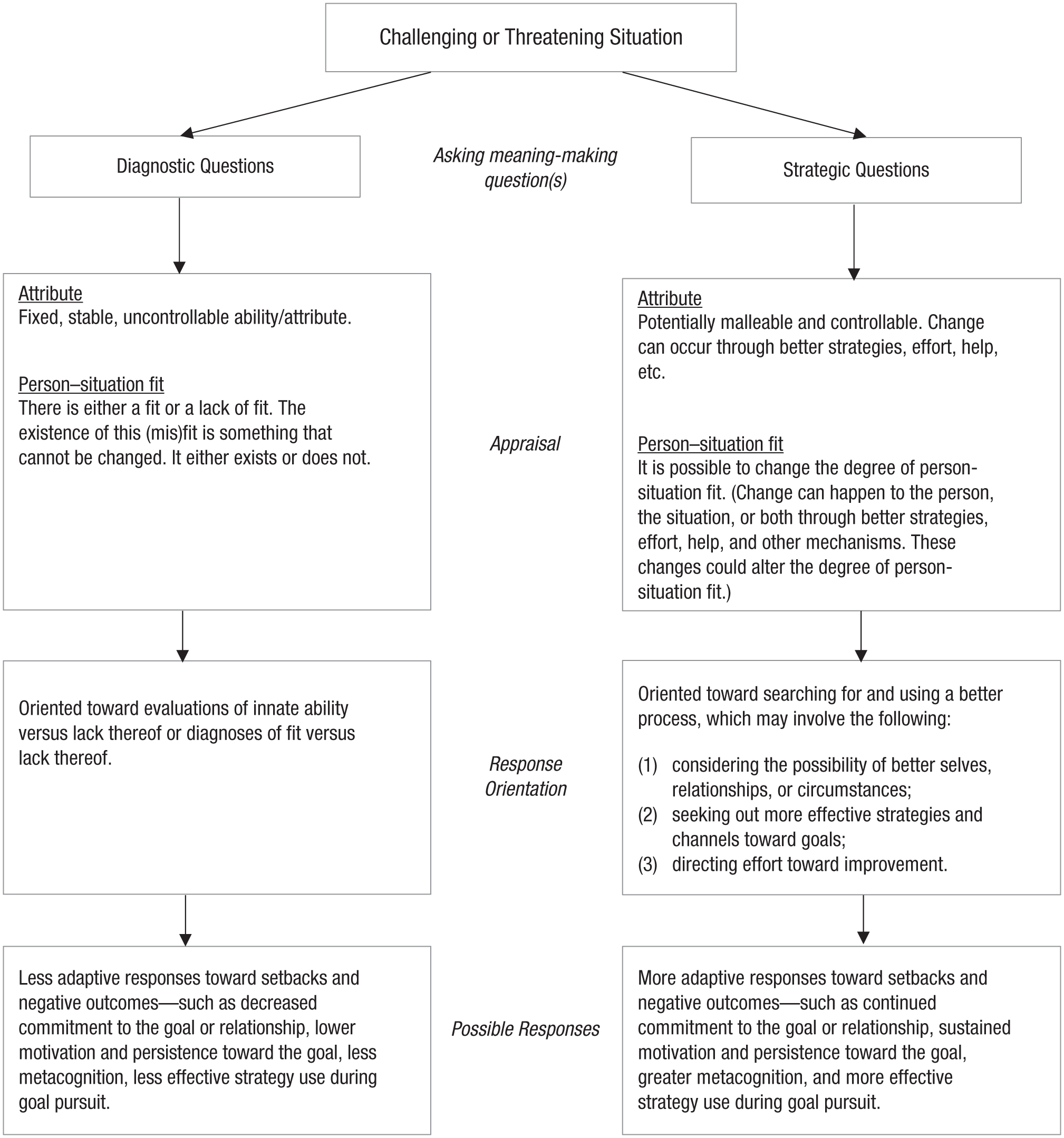
Summary of the psychological process of asking and answering diagnostic versus strategic questions.
Sample of Diagnostic Questions Versus Strategic Questions and Their Possible Answers to Challenges Encountered in Different Domains
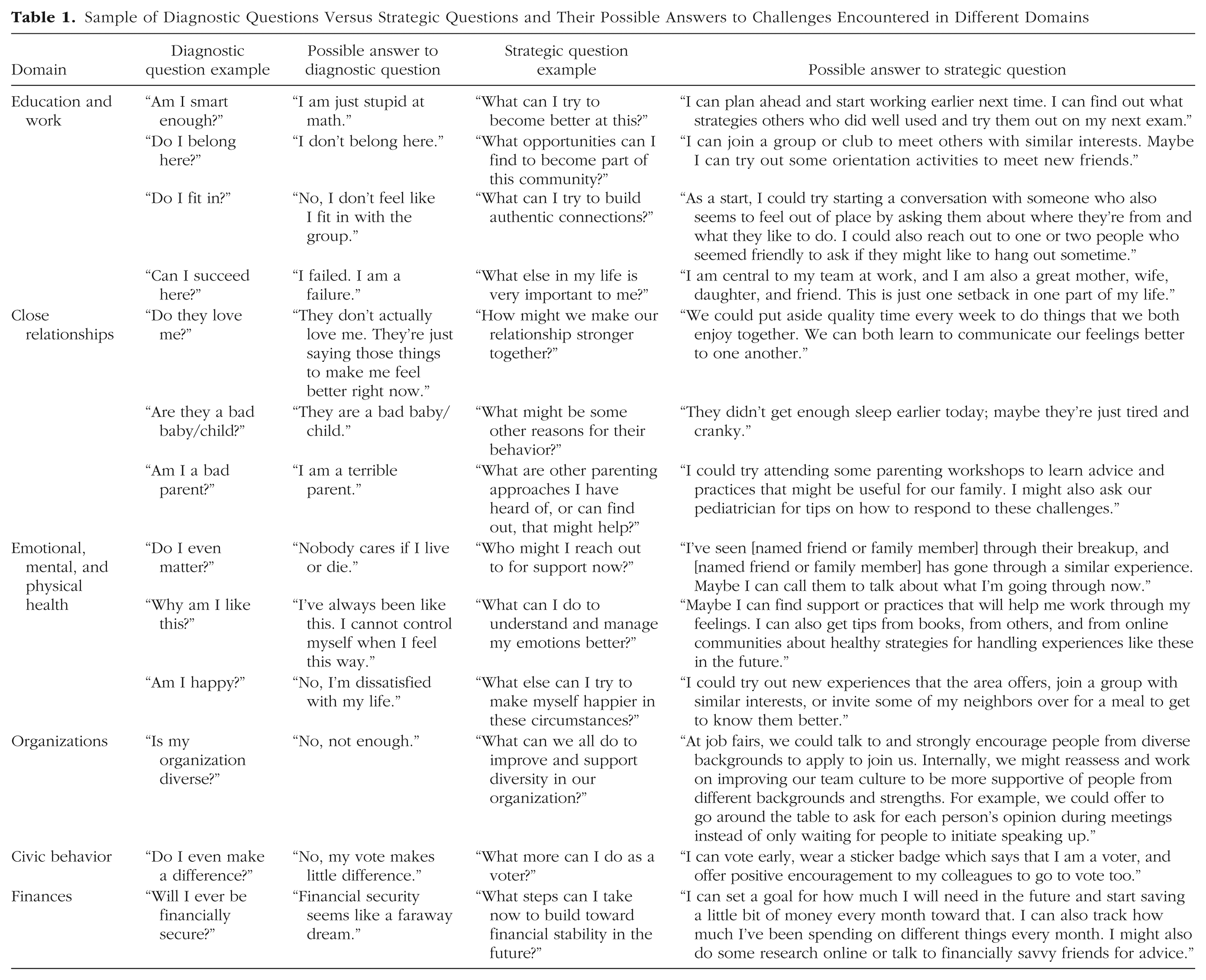
Contrast asking diagnostic questions with asking strategic questions, such as “What can I try to become better at this?”, “What opportunities can I find to become part of this community?”, or “How might we make this relationship stronger together?” In attribution terminology, strategic question-framing could potentially invoke internal, controllable, and unstable appraisals that can be more adaptive for motivation and self-regulation than internal, uncontrollable, stable appraisals (Dweck & Leggett, 1988; Graham & Weiner, 1996; Weiner, 1985). These strategic questions channel attention and focus on more effective, goal-directed, process-oriented approaches; on investing effort toward improvement; and on the possibility of better selves, relationships, or circumstances. Therefore, asking strategic questions can catalyze greater goal-directed motivation, more metacognition, and more effective strategy use during goal pursuit (as described in the right-hand column of Fig. 1). Table 1 offers further examples of strategic questions that can be asked in different domains and some possible answers that follow from them.
How do existing, psychologically wise interventions work vis-à-vis such questions? As people navigate experiences in their lives, moments of difficulty, setbacks, or unproductivity can trigger diagnostic questions (e.g., “Am I smart enough?”). Even what might seem to be benign events to others could be interpreted by some as threatening when they elicit diagnostic questions (e.g., “Do people like me belong here?”) that may prompt detrimental answers (e.g., “People like me don’t belong here”; Walton, 2025). When, or even before, maladaptive appraisals arise in response to these diagnostic questions, well-timed psychologically wise interventions redirect them into more adaptive appraisals. Such interventions short-circuit the pathway from asking diagnostic questions to maladaptive appraisals.
Ideally, psychologically wise interventions succeed at improving the way individuals perceive challenging or threatening situations to begin with—such as by anticipating and reducing perceived threat (e.g., Cohen et al., 1999, 2006, 2009; Walton & Cohen, 2011; Yeager et al., 2014) or by altering the way people perceive challenges as desirable opportunities instead (e.g., Dweck & Leggett, 1988; Dweck & Yeager, 2019; Molden & Dweck, 2006). This could potentially reduce the likelihood that individuals will ask themselves diagnostic questions when faced with a similar situation again. Some recursive interventions operate this way, preventing the maladaptive process of asking (and responding to) diagnostic meaning-making questions when faced with similar challenging or threatening situations (Yeager & Walton, 2011).
However, not all interventions have such in-built recursivity, nor can I imagine does everyone who receives an intervention once easily avoid asking diagnostic questions altogether. For example, even after receiving an intervention, people who face repeated failures or setbacks may find themselves questioning whether they could ever succeed; in the middle of another difficult experience, individuals may become uncertain about their belonging again; when an exhausted parent experiences what feels like the hundredth episode of their baby fussing for the day, it may be easy to slip into familiar, but maladaptive, responses toward their child. Changing people’s interpretations of a situation is indeed important, but it can be hard at times to sustain the adaptive narratives that such psychologically wise interventions convey, especially under stress or threat. Learning to pose strategic questions could offer a complementary way to redirect maladaptive appraisals and responses. Strategic questions—especially those that support alternative, adaptive appraisals of the situation or those that target the mechanisms by which psychologically wise interventions work—could potentially help to sustain long-term intervention effects.
Walton and Wilson’s (2018) concept map of psychologically wise interventions illustrates important meaning-making questions that individuals tend to ask about themselves, about others, and about the world. I propose that, in each domain, many of such meaning-making questions can be framed to be more strategic. For example, when people are stuck on a difficult problem, instead of asking and answering “Does struggle mean I can’t do it?” they could ask a more strategic question such as “How can I make my efforts more productive?” When a child refuses to eat, their parents might want to replace the diagnostic question “Is my child a fussy eater?” with more strategic questions such as “What else can we try to help them eat their food?” Table 1 offers more examples of how diagnostic questions might be reframed as strategic questions. Learning to ask strategic (instead of diagnostic) meaning-making questions could complement, and perhaps even augment, the effects of psychologically wise interventions that offer more adaptive answers.
In addition, it could also be valuable to ask strategic questions that specifically target the mediating mechanisms that underlie the interventions’ efficacy. For instance, strategic questions in the case of the social-belonging intervention could be about building relationships with mentors (Brady et al., 2020), such as “Who might be a good mentor to me in college, and how might I develop a relationship with this person?” These mechanism-directed strategic questions could potentially help to strengthen and sustain the effects of psychologically wise interventions.
Of course, goal pursuit in different domains may call for slightly different variations in the strategic questions that people ask themselves, with the same aforementioned principles to be effective, namely considering the possibility of better selves, relationships, or circumstances; focusing on more effective strategies and channels toward their goals; and directing effort toward improvement. The more we can frame questions to make these principles accessible, the more likely people will respond to them with adaptive answers and behavioral responses (see Fig. 1). In the subsequent sections I highlight individual differences in strategic questioning and then focus on interventions that guide people to ask and answer strategic questions.
Individual Differences in Spontaneous Strategic Questioning
Do some individuals spontaneously ask themselves strategic questions more frequently than others? Recent and ongoing research suggest so. My research team and I asked adolescents and adults from three different cultures (North America, South America, and Southeast Asia) to rate how frequently they tend to ask themselves strategic questions, such as “What can I do to make myself better at this?”, “What are other ways I can think of trying?”, and “What can I do to help myself?”, on a scale from 1 (never) to 5 (most of the time). This tendency to spontaneously and frequently self-prompt strategic questions is called a “strategic mindset” (Chen et al., 2017). We discovered observable and considerable variation in the frequency at which people reported asking themselves such strategic questions in everyday life (Chen et al., 2020, Chen, Teo, et al., 2025; Goldstein et al., 2025; Ng et al., 2023).
Importantly, among the different cultures that were studied, a strategic mindset was associated with adaptive responses and desirable outcomes across multiple domains of life (Chen et al., 2020; Chen, Teo, et al., 2025; Chen, Chua, et al., 2025; Chen & Teo, 2024; Goldstein et al., 2025; Michaelis et al., 2021; Ng et al., 2023). Having more of a strategic mindset was associated with greater metacognition (Chen et al., 2020, Study 1), more self-regulated behavior (Chen et al., 2020, Study 3; Chen, Chua, et al., 2025; Goldstein et al., 2025; Ng et al., 2023), greater self-reported use of effective learning strategies (Chen, Teo, et al., 2025), greater reported progress toward personally important goals (Chen et al., 2020, Study 2), better mental health (Chen, Ong, et al., 2025), and higher academic achievement (Chen, Chua, et al., 2025; Chen, Teo, et al., 2025).
Given the many benefits of strategic questioning, can people learn to ask and answer strategic questions? Accumulating evidence across different domains suggests that they can. First, I describe illustrative examples of studies that have used external prompts (such as trained facilitators or self-administered online exercises) to teach people to ask and answer strategic questions. Then I share more recent research that has focused on teaching people a strategic mindset as an internalized mental habit of self-prompting strategic questions on their own.
Learning to Ask and Answer Strategic Questions
Prompting strategic questions predicts adaptive responses and goal achievement
Empirical research across social, educational, cognitive, developmental, organizational, and clinical psychology has shown that asking and answering strategic questions is related to more adaptive self-regulation and goal achievement (e.g., Chen et al., 2017, 2020; Duckworth et al., 2013; King, 1991; Marquardt et al., 2017; Stadler et al., 2009; Wells, 2009). This is especially evident in metacognitive interventions, which show that working through strategic questions supports the consideration and use of effective strategies toward a goal (e.g., Bembenutty, Kitsantas, & Cleary, 2013; Bembenutty, White, & Vélez, 2013; Chen et al., 2017; Duckworth et al., 2013; Marquardt et al., 2017; Stadler et al., 2009).
For example, in the Strategic Resource Use intervention, college students were prompted to think about, and to answer, the following strategic questions about their learning resources: “What resources (such as study materials and people who can help) do you think will help you prepare for your exam most effectively?”, “Why do you think these resources will be helpful for your exam preparation?”, and “When, where, and how will you use the resources to prepare for your upcoming exams?” (Chen et al., 2017, 2022). Across two challenging college statistics classes, students randomly assigned to answer these strategic questions performed, on average, one third of a letter grade (3.45 and 4.65 percentage points) higher in their classes than students in the control group who did not receive the questions before their exams (Chen et al., 2017). Moreover, answering these strategic questions not only improved academic performance but also had positive effects on emotion regulation and motivation: Compared with the control group, students who answered the strategic questions reported lower negative affect toward their upcoming exams and higher perceived control over their performance (Chen et al., 2017).
As another example, in the domain of parent-child relationships, Bugental et al.’s (2002) cognitive retraining intervention used strategic questions and answers to lower the likelihood of child abuse among at-risk mothers. In their intervention, home-visitation staff posed at-risk mothers a series of questions that were meant to guide these mothers to find benign reasons for their children’s challenging behavior and to come up with solutions that they might try to address the problem. At-risk mothers were encouraged to think of different reasons for their children’s challenging behavior that did not involve blaming themselves or their children and that allowed for better ways of coping (e.g., “Maybe he is hungry” instead of “He is a bad, fussy child”). The home-visitation staff would then ask these mothers strategic questions, such as “What are some of the things you have heard about or thought about that might help?” and “What do you think you would like to try?” Answering these strategic questions with support empowered mothers to consider different possible approaches for handling their children’s challenging behavior, search for helpful parenting resources, and implement better parenting methods. Such guided strategic questioning and answering produced a significant reduction in incidences of physical abuse and greater benefits to children’s health compared with approaches that simply directed at-risk mothers to community support sources or asked at-risk mothers to participate in an educational program about healthy child development without the strategic questions (Bugental & Schwartz, 2009; Bugental et al., 2002).
Might people be able to self-administer an intervention of this nature? Translational field studies suggest that this is possible. The Strategic Resource Use intervention was offered to more than 12,000 students across 14 STEM and economics college classes as a free online “Exam Playbook” app. Students could choose whether and how they wanted to use it and when and where to access it. Across the 14 classes, students who self-administered the intervention (“users”) performed an average of 2.17 percentage points (i.e., a standardized effect size of 0.18) higher than nonusers on their class exams. Performance benefits were evident even when controlling for students’ college entrance exam scores (Chen et al., 2022). We have observed similar patterns of results in ongoing research with more than 50,000 college students from 76 STEM and economics classes across nine semesters (Chen, Rutten, et al., 2025).
How do strategic questions promote more effective self-regulation and better outcomes? Amid difficulty or setbacks, people may not know what to do, feel helpless about their situation, or even give up (Dweck & Leggett, 1988). Even those with prior knowledge of effective strategies may fail to recall or apply these strategies when they feel stuck (McDaniel & Einstein, 2020). In these situations, asking strategic questions (e.g., “What can I try to be better at this?”, “What ways can I find to do this even better?”) could focus people on what is controllable and changeable about the situation and motivate them to consider various resources or approaches that they might try. The process of answering those strategic questions could help people to generate, seek out, or recall and then apply task-appropriate, effective strategies that could help them work more productively toward their goals (Chen, Chua, et al., 2025).
To illustrate this psychological process, the effectiveness of Bugental et al.’s (2002) cognitive retraining intervention can be attributed to two key psychological ingredients. First, the intervention changed mothers’ maladaptive patterns of blaming themselves or their children as inherently bad. Instead, it redirected these mothers’ attributions toward reasons and actions that they could control. Second, the intervention focused mothers’ attention and efforts on finding and using more effective parenting strategies to address their children’s challenging behavior. By repeatedly asking and answering strategic questions under the guidance of home-visitation staff, at-risk mothers gained “repeated experience in finding new ways (directed away from self- or child-blame) of explaining problems and in finding new ways of resolving those problems” (Bugental et al., 2002, p. 247).
Likewise, students in previous experiments who were asked to answer strategic questions about their resource use reported more perceived control over their academic performance (an appraisal of internal controllability). Compared with those who were not asked strategic questions, these students scored higher on their use of effective metacognitive strategies (e.g., tailoring the way they were learning to be effective in the class, monitoring how effectively they were learning, and adjusting the way they were studying when their approaches were unproductive; Flavell, 1979; Pintrich et al., 1991). The more students applied these metacognitive strategies, the more effective their reported resource use was when studying (illustrating the process of more adaptive, effective responding). Consequently, they achieved higher scores on their exams (Chen et al., 2017). These examples underscore the psychological processes that strategic questions catalyze: changing situational appraisal and orienting people toward using more effective processes for goal pursuit.
Some existing psychologically wise interventions may already incorporate strategic questions. In these interventions, strategic questions are usually posed by an external party to help individuals form and articulate more adaptive narratives. However, their purpose has not been to specifically teach people to pose strategic questions on their own, let alone to develop an internalized habit of doing so. In the values-affirmation intervention, for example, students essentially answer the questions “Which of the following values are most important to me?” and “Why are they important to me?” (Cohen et al., 2006; Miyake et al., 2010). Through the process of identifying and elaborating on enduring, personally important values, students are reminded that they are worthy, competent individuals with multifaceted identities larger than any single adverse event (Cohen & Garcia, 2008; Cohen & Sherman, 2014). Such self-affirmation bolsters students’ self-integrity, helping them to remain resilient amid academic challenges and to perform better in school compared with their peers who do not receive such questions about their personal values (Cohen & Sherman, 2014; Cohen et al., 2006, 2009). Notably, the control group typically chooses a value that is important to someone else and explains why it may be important to others—that is, they answer similar questions that are not self-relevant.
These nonexhaustive examples illustrate that across different domains answering strategic questions that are self- and goal-relevant can causally produce more adaptive affective, cognitive, and behavioral responses, as well as more desirable outcomes. When externally prompted, people can produce answers that are associated with more adaptive narratives and responses.
Learning a strategic mindset—an orientation toward being strategic
Can people learn to proactively and frequently pose strategic questions to themselves? Yes, experimental evidence suggests that adults, adolescents, and even young children can learn to self-prompt strategic questions and to leverage moments of difficulty, challenge, or unproductivity as cues to trigger such strategic self-questioning (Chen et al., 2020, Study 3; Chen, Chua, et al., 2025; Chen, Teo, et al., 2025; Ng et al., 2023, Study 2). That is, people can learn a strategic mindset.
In a laboratory experiment, adults were taught a strategic mindset through an online, popular-science-style article. In the article, they read that one crucial psychological ingredient to success in life is a strategic mindset—the wisdom to take a step back from a problem and ask strategic questions, such as “Are there ways to do this even better?” or “How else can I do this?” They learned why this mindset works and read scientific and anecdotal evidence of the value of strategic questioning. Notably, the article did not teach task-specific strategies; instead, it emphasized the value and process of strategic questioning more generally. After reading the article, these adults were asked to summarize its main takeaways as if they were sharing the takeaways with others on social media. This saying-is-believing writing exercise is a common technique used in social psychology to promote self-persuasion and internalization of a message (Aronson et al., 2002; Walton & Cohen, 2011; Wilson, 1990).
Compared with their counterparts in a control group who were not exposed to the strategic mindset message, adults who were randomly assigned to read (and share) the article about a strategic mindset subsequently reported implementing more effective metacognitive strategies on a challenging, unfamiliar task. Their self-reported metacognition was corroborated by their actual, observed strategy-use behaviors, which were coded by independent observers. And the more metacognition these adults applied to the task, the faster they actually accomplished the task (their performance goal). Additionally, adults who learned a strategic mindset also exhibited more practice behaviors before performing the task than did adults in the control group (Chen et al., 2020, Study 3).
Is it possible to learn this strategic mindset from a young age, and might it have any implications beyond problem-solving? Experiments that have investigated the effect of learning a strategic mindset on preschool children’s delay of gratification suggest so. We taught 5- to 6-year-old preschoolers a strategic mindset by reading to them a storybook about applying a strategic mindset whenever waiting felt hard. Our strategic mindset storybook contained three scenarios in which a character had to wait for things that they wanted—specifically to open a present, for their favorite ice cream flavor, and for their turn on the playground slide. Whenever the character had to wait, they chanted a strategic mindset mantra: “What can I try? What can I try? What can I try to be better at this?” Then they would “think of one way, then another way, and then an even better way” to help themselves wait. The stories purposefully omitted mentioning specific waiting strategies because we did not want to prime children with any ideas for enacting self-control. To help each child remember and internalize the strategic mindset mantra, the experimenter invited them to chant the mantra along with the character as the stories unfolded. Additionally, each child received a sticker with the mantra “What can I try?” written on it to remind them to ask themselves strategic mindset questions whenever waiting felt hard. After reading the storybook, the children underwent two different delay-of-gratification tasks: one that involved waiting for consummatory treats and another that involved waiting to watch a YouTube video.
Children who had read the strategic mindset storybook spontaneously generated and applied more effective self-control strategies (such as distracting themselves by singing, dancing, or playing with their feet), compared with children who had read a similar storybook without the strategic mindset mantra. Consequently, the children who had learned a strategic mindset waited longer, on average, on both delay-of-gratification tasks. They seemed to be able to apply the strategic mindset to different delay-of-gratification tasks on their own—suggesting that young children may be able to generalize this strategic mindset across tasks (Chen, Chua, et al., 2025).
Recent evidence suggests that interventions can be used to teach adolescents a strategic mindset—albeit to varying degrees of effectiveness among different kinds of students and classroom contexts. In one study, my research team and I randomly assigned 1,070 adolescents between the ages of 13 and 17 across 6 Singapore secondary schools to self-administer either an approximately 40-min strategic mindset online intervention or a control online exercise of the same structure and duration but without the strategic mindset idea (Chen, Teo, et al., 2025, Experiment 4). In the strategic mindset intervention, students read about common academic challenges that many students at their education levels often face—such as struggling to understand everything in class, getting stuck on homework problems, and feeling disappointed with their exam grades. Importantly, the intervention emphasized that a secret to overcoming and improving, which are goals that many students shared, is to frequently ask strategic questions (e.g., “How can I learn even better?”) and then to think deeply about one’s approaches to learning. Students read testimonials from other students like them who had leveraged academic challenges as opportunities to pose themselves strategic questions, and they were also presented with scientific evidence in support of strategic approaches to learning.
To engage students and encourage them to apply a strategic mindset, we also asked students to answer open-ended questions about which strategic questions they might find helpful to ask themselves when studying, and how they might answer their strategic questions with even better ways of learning. Students then wrote a letter to another struggling student to share this strategic mindset advice, as a way of supporting their internalization of the mindset.
Shortly after their final exams, which occurred about a month after the intervention, students were asked to report how much they had used various effective learning strategies (e.g., summarizing facts in their own words, identifying key ideas, and connecting new ideas to prior knowledge) to prepare for their final exams. This variable served as a proxy of how effectively students were learning. Students’ final exam scores were collected at the end of the school year as the performance outcome.
Among more academically prepared students or when classroom conditions were more conducive for concentration, self-administering the strategic mindset intervention was beneficial for learning and, in turn, academic performance (Chen, Teo, et al., 2025, Experiment 4). More academically prepared students may have practiced the strategic mindset more frequently both because they were motivated to excel and because they had a broader repertoire of effective learning strategies to draw on (as our evidence suggests). Additionally, a conducive classroom context may be a critical factor in ensuring the fidelity and efficacy of self-administered, online interventions (for similar moderating effects of classroom peer norms on intervention efficacy, see Yeager et al., 2019). These findings indicate a promising start to the development of self-administered, scalable strategic mindset interventions. Nevertheless, as our heterogeneity analyses showed, there is room for improvement in further customizing and strengthening the intervention to be beneficial for diverse students across different learning contexts.
To build even better strategic mindset interventions, we have been exploring how we might synergize a strategic mindset with a growth mindset. Our integrated “growth-and-strategic mindset” intervention (Teo & Chen, 2025) is based on the theory that both the motivation to invest effort as well as task-appropriate strategies are useful for accomplishing important, challenging goals. In fact, these processes can be complementary. Cultivating a growth mindset of intelligence motivates people to believe that they can improve beyond their current limitations or difficulties, and a strategic mindset helps them to reflect on how to channel their efforts effectively toward improvement.
We tested the efficacy of this integrated “growth-and-strategic-mindset” intervention in a randomized, controlled field experiment with more than 900 secondary-level students (Teo & Chen, 2025). Across two intervention sessions, each of which lasted between 25 to 60 min, students self-administered online exercises that included reading about growth mindset and strategic mindset ideas, as well as peer testimonials, professional role models, and relevant scientific findings. For example, students learned that their brains can grow stronger by practicing effective ways of learning. They were encouraged to form a habit of asking themselves strategic questions—such as “What can I do to help myself learn this well?”, “How else can I approach my learning to be even more effective?”, and “Is there a different way to solve this problem?”—especially when challenged or unproductive. They learned that asking strategic questions can help them to continually improve the way they learn and empower them to become more effective at pursuing important goals in life. To support their internalization and application of these ideas, students completed saying-is-believing and application exercises.
Our results showed that this integrated growth-and-strategic-mindset intervention simultaneously promoted both growth and strategic mindsets in students, relative to a control condition that did not receive an intervention for either mindset. The integrated growth-and-strategic-mindset intervention significantly increased students’ reported metacognitive strategizing about their learning, which predicted greater reported use of effective cognitive learning strategies and, in turn, higher final exam performance among students (Teo & Chen, 2025).
This integrated growth-and-strategic-mindset intervention is one example of how interventionists and practitioners might synergize the strengths of strategic questioning with those of other psychologically wise approaches. Another example is the parenting intervention described earlier that combines cognitive reframing (or “attribution retraining”) with guided strategic questioning (Bugental et al., 2002; Bugental & Schwartz, 2009). Future interventions could combine strategic self-questioning with yet other kinds of interventions—such as skills training, therapy, threat-reducing interventions, or the provision of better infrastructure, support, and resources. Investing in this exciting frontier of psychological intervention research could potentially benefit many lives.
What This Theory Is and Is Not
Answers that orient people toward adaptive responding are, of course, crucial for beneficial outcomes, and they are also part of what makes strategic questioning impactful. What I am proposing here is not to replace existing interventions that focus on changing maladaptive answers but instead to complement their efficacy. There are various points at which strategic questions could be especially helpful, such as (a) when (possibly diagnostic) questions are just forming and (b) after intervening on maladaptive answers to maintain or boost the gains provided by more adaptive narratives. Another possibility is using strategic questioning as an early preventive measure. What if we can teach people not to even ask diagnostic, threat-inducing questions to begin with? Is it possible that teaching a strategic mindset early on might make people less susceptible to undesirable appraisals? These are exciting possibilities that future research may pursue.
The psychological process of, and more general orientation toward, strategic questioning that I emphasize here is not skills training. This is not simply about telling people what specific strategies they should use for a particular challenge or instructing them in how to use those strategies (e.g., Dunlosky et al., 2013). It is also not about getting people to simply rely on external guidance for which strategy to use in every challenging situation they encounter. Instead, the goal of strategic questioning is to empower individuals to think for themselves and to help themselves whenever they encounter challenging situations (especially when such external direction is not immediately available or the “right” method is not evident in the moment). Although strategy training is important in itself, it is also important to cultivate a psychological stance toward being strategic in general (Chen et al., 2020). Frequently asking, and then answering, strategic questions may help people to seek out and find task-appropriate strategies to achieve their goals with greater autonomy and competence over time.
This theory should not be confused with construal-level theory (Fujita et al., 2006, 2015; Trope & Liberman, 2011). Construal-level theory sometimes uses similar questions to induce and compare higher level construals (e.g., “why” questions to prime people to think about the abstract purpose or meaning of their experiences) against lower level construals (e.g., “how” questions to invite recollections of concrete procedures and occurrences; e.g., Fujita et al., 2006; Lee & Ybarra, 2017; Trope & Liberman, 2011). However, here I focus on the comparison between diagnostic questions that are evaluative of one’s abilities (or fit) and strategic questions that orient one toward effective strategies, productive effort direction, and growth. It seems possible to frame diagnostic questions in high-level (e.g., “Why should I even bother?”) as well as low-level (e.g., “How did I become so pathetic?”) ways. It is also possible to come up with strategic questions in each of these ways (e.g., high-level construal: “Why is this useful for my learning?”; low-level construal: “How can I work toward the career that I want?”). What crucially differentiates the diagnostic versus the strategic questions are the appraisal patterns and response orientations they invoke, which I described earlier and which are also summarized in Figure 1.
New Frontiers for Scientific Inquiry and Practical Application Tips
There are many opportunities to develop our scientific understanding of asking and answering strategic questions and to build practically useful interventions. In this section, I discuss additional ideas that may stimulate future scientific inquiry and application.
Motivation regulation
Do I feel like doing this right now? Am I even going to use this in the future? Do I like [practicing/doing my homework/writing]? Diagnostic questions like these can potentially be fatal for motivation. When it comes to motivating oneself, constantly monitoring how motivated you feel at any moment could possibly backfire; asking whether something is useful or even relevant may already signal the start of disengagement. Instead, perhaps reframing these questions to be more strategic in nature could be more effective for igniting that motivation—for example, “How can I make this more interesting?”, “What else can I do to make this more enjoyable?”, or “How can I make this relevant to my life?” Future research could compare a strategic framing against a diagnostic framing of questions related to various motivation-regulation strategies, expectancy, value, or cost, and to experimentally test strategic questions as motivational interventions.
Transfer
Transfer occurs when people apply a concept that they have learned in one context to another (Barnett & Ceci, 2002; Blume et al., 2010; Gick & Holyoak, 1980, 1983; Perkins & Salomon, 2012). Such transfer of learning is more likely to happen when, during learning, people understand the underlying principle and then later recognize that the principle is also applicable to a similar problem in a different context. To facilitate better transfer of learning, it may be useful to ask strategic questions during encoding, such as “What is the rule here?” 1 and “When does it apply?” These questions could prompt the learner to focus on what the underlying, generalizable principle is as well as its conditionality—key conditions under which transfer is more likely to occur (Barnett & Ceci, 2002; Blume et al., 2010; Gick & Holyoak, 1980, 1983). During problem-solving, asking strategic questions such as “What rules might apply here?”, “Where have I seen something like this before?”, and “What kinds of problems does this seem similar to?” may also be helpful in facilitating the application of learned principles to new contexts. As evidence shows, transfer occurs more effectively when people recognize that a theory is applicable to problems with underlying structural similarity (Corral & Carpenter, 2020; Kurtz et al., 2013). Future research could shed light on whether asking such strategic questions during learning or application can support effective transfer.
Teaching a strategic mindset to young children with real-world benefits
As described, studies have shown that children even as young as 5 to 6 years of age can learn to pose strategic questions—and that doing so can produce observable changes in their behavioral strategy use and self-regulatory outcomes (Chen, Chua, et al., 2025). The next step is to teach children this strategic questioning-and-answering process with real-world outcomes. Some children’s media offers ideas for how we might encourage children to ask and answer strategic questions as a mental habit. For example, in Disney’s Mickey Mouse Clubhouse series, Mickey and his friends model for young children a habit of asking which tool would help them solve a problem. In the Disney movie Finding Dory, when Nemo and Marlin find themselves in a difficult situation, they ask aloud, “What would Dory do?” Asking this strategic question helps them generate problem-solving strategies to get themselves out of challenging situations. Testing how we might help children to ask and answer strategic questions adaptively and habitually, as well as what effects it might have in developmentally important areas, is an important future direction. This may provide an early preventive measure before people even develop a habit of asking diagnostic questions.
Posing better questions for others
Although I have extensively discussed what it means for an individual to adopt a strategic mindset, it is also valuable to learn how to pose strategic questions to others whom we might guide or mentor (e.g., “What might you do differently the next time you study for a test?”), within our relationships (e.g., “What might we each do differently, or together, to strengthen our relationship?”), as members of groups (e.g., “How else can we try to encourage diverse voices to speak up during meetings?”), and even within organizations (e.g., “What might a more efficient process look like?”). For example, teachers and parents could learn to pose strategic questions, such as “What else can you try when waiting for your turn?” or “What are some things you could try to make your time in class more enjoyable?”, to their students and children. Teachers might make a regular class routine out of having students take turns to ask and to answer strategic questions about different topics, which could support students’ internalization and flexible application of this strategic mindset.
In a similar vein, mentors could consider starting their lessons with strategic questions. Before offering instructions, they might first ask their mentees, “What do you think you’ve been doing well and where do you think you can further improve? How do you plan to work on those areas?” Inviting mentees to answer such strategic questions first could encourage greater self-regulated learning. Coaches and team leaders could also pose strategic questions to the team—for example, “How else can we improve our team performance?” or “What can we do differently to make our meetings more productive and supportive?” Starting these conversations with strategic questions and involving team members in answering them together might promote greater autonomy, engagement, and commitment to the team’s goals.
Metacognition, motivation, and internalization in addition to habitual practice
To have long-term positive impact, strategic questions and answers need to be personally relevant, adaptive, acceptable, and sustainable. Can we condition a strategic mindset by simply getting people to repeat strategic questions? Perhaps. Learning to repeat strategic questions and then to produce them when needed might be a step toward internalizing a mental habit of strategic questioning, especially among young children or people who are new to this stance. But ideally, developing a strategic orientation should go beyond that. Especially among older adolescents and adults, it may also be important to have metacognitive awareness (Schraw & Dennison, 1994) and motivation to be strategic (McDaniel & Einstein, 2020), in addition to knowing how and when to execute strategic questioning. They need to see the value in strategic questioning, to trigger strategic questioning when needed, and to generate strategic answers that are relevant to their lives. To foster buy-in, application, and internalization, many of the aforementioned interventions use persuasive techniques characteristic of psychologically wise interventions (e.g., saying-is-believing exercise, application to one’s goals, or norms messaging). But there may yet be other effective ways to guide, foster, and sustain an orientation toward asking and answering strategic questions.
Changing narratives with empathy
Like many social psychological principles, the effectiveness of strategic questions and answers depends on how personally, contextually, and culturally appropriate they are. People’s narratives about the same experience, condition, or situation may differ; some may have more adaptive narratives, whereas others might subscribe to maladaptive ones. It is important in designing interventions, as well as in prescribing advice, to take the perspective of the recipient—that is, to empathize with how they interpret the situation. This includes their beliefs, goals, meaning-making questions, interpretations and perspectives in context, habitual patterns, and cultural narratives. If the goal is to have recipients accept, internalize, and apply more adaptive narratives, then we (as psychologists, interventionists, and advice givers) should convey adaptive narratives in ways that are acceptable to them. Part of our mission is to persuade them, with empathy, to take on these adaptive narratives for themselves.
Minimizing diagnostic questions and increasing strategic questions in social media use
Given the pervasive role of technology in contemporary life, it is worthwhile to investigate how social media use may influence diagnostic versus strategic ways of thinking. Many social media platforms are structurally designed to highlight social comparison, self-presentation, and public evaluation (Haferkamp & Krämer, 2011; Kross et al., 2021; Vogel et al., 2014)—all of which could potentially encourage diagnostic questioning, especially among adolescents and young adults. For example, exposure to curated content may encourage users to compare themselves with others and to ask diagnostic questions, such as “Am I as attractive/successful/privileged as they are?” or “Am I likeable?” Social-evaluation metrics (e.g., likes, follower counts) may give the impression of social approval or lack thereof, potentially leading to negative affect when success is not immediate or visible (Tiggemann et al., 2018; Weinstein & James, 2022). Over time, repeated exposure to such evaluative, diagnostic cues could potentially reinforce diagnostic narratives, leading to negative affect, reduced motivation, and other negative outcomes.
That said, certain online communities and creators explicitly share stories of personal development, effective strategies, and their process toward success—values that align with strategic thinking. For example, some online communities (e.g., in fitness, education, or writing) may encourage users to reflect on strategic questions—such as “What worked for you?” or “What else can I try?”—and to share their answers with the community. Similarly, content creators who share behind-the-scenes failures, skill-development journeys, or strategies for overcoming setbacks may implicitly model strategic thinking and responding. These kinds of digital environments may provide supportive spaces that motivate strategic goal pursuit.
Future research could examine whether exposure to comparison-heavy social media content could increase the salience of diagnostic questions and maladaptive answers over time, as well as whether strategic mindset interventions may buffer these detrimental effects. It may also be fruitful to explore whether embedding strategic prompts (such as “What might you try differently next time?”) into social media platforms could encourage more adaptive answers.
Conclusion
Psychological wisdom teaches us that one must first ask the right questions to get appropriate answers (Bradburn et al., 2004; Schwarz & Strack, 1991; Schwarz et al., 2012). Psychologically wise interventions have generally been successful at improving people’s answers to important meaning-making questions amid many of life’s challenges (Walton, 2014; Walton & Wilson, 2018). Learning to pose more strategic questions could potentially synergize with these efforts to more effectively and sustainably orient people toward adaptive responding. Instead of simply being at the mercy of contextually driven cues or self-defeating appraisals, this synergistic approach may empower people to better control the meaning-making process to their benefit.
Footnotes
Acknowledgements
I extend my deepest gratitude to my editor and reviewers, as well as the following people who have provided me with invaluable feedback and encouragement: Desmond C. Ong, Patty X. Kuo, Luke Rutten, Yang-Hsin Fan, Carol S. Dweck, and Gregory M. Walton. Thank you for believing in me and my ideas.
Transparency
Action Editor: Katarzyna Adamczyk
Editor: Arturo E. Hernandez
