




Abstract
The outcomes of social interactions among members of different groups (e.g., racial groups, political groups, sexual orientation groups) have long been of interest to psychologists. Two related literatures on the topic have emerged—the intergroup interaction literature and the intergroup contact literature—in which divergent conclusions have been reported. Intergroup interaction is typically found to have negative effects tied to intergroup bias, producing heightened stress, intergroup anxiety, or outgroup avoidance, whereas intergroup contact is typically found to have positive effects tied to intergroup bias, predicting lower intergroup anxiety and lower prejudice. We examine these paradoxical findings, proposing that researchers contributing to the two literatures are examining different levels of the same phenomenon and that methodological differences can account for the divide between the literatures. Further, we introduce a mathematical model by which the findings of the two literatures can be reconciled. We believe that adopting this model will streamline thinking in the field and will generate integrative new research in which investigators examine how a person’s experiences with diversity unfold.
The outcomes of social interactions among members of different groups—termed intergroup or cross-group interactions—have long been of interest to psychologists. Within this literature, the term group represents a social category (e.g., race, religious affiliation, sexual orientation), with ingroup denoting a social category that can be used to categorize one’s self and outgroup denoting other social categories. Two related literatures on the topic of intergroup interactions have emerged: the intergroup interaction literature and the intergroup contact literature. Although intergroup interaction and intergroup contact essentially have the same definition (i.e., social interaction among members of different groups), 1 the two literatures yield contradictory conclusions when it comes to whether intergroup interactions positively or negatively impact intergroup relations. In the present article, we use the term intergroup bias as an overarching construct that represents relatively negative beliefs (e.g., stereotypes), feelings/evaluations (e.g., prejudice), and behaviors (e.g., discrimination) toward an outgroup. Although multifaceted, the term intergroup bias is used to represent general negativity toward outgroups. Intergroup interaction is typically found to exacerbate intergroup bias, producing heightened stress, anxiety, or outgroup avoidance (Shelton, Dovidio, Hebl, & Richeson, 2009; Trawalter, Richeson, & Shelton, 2009). Intergroup contact, however, is typically found to reduce intergroup bias, predicting lower intergroup anxiety and lower prejudice (Pettigrew & Tropp, 2006). The paradoxical nature of these findings is rarely recognized and has yet to be systematically examined. We propose that methodological differences may account for this divide and that these two literatures can be integrated by considering an overall model of negotiating intergroup experience over time. We expect that adopting this model will streamline thinking in the field and will generate integrative new research in which investigators examine how a person’s experiences with diversity unfold.
Intergroup Interaction Versus Intergroup Contact
For the current purposes, we use the term intergroup interaction to describe social interactions among group members in which the social interaction itself is directly observed (Avery, Richeson, Hebl, & Ambady, 2009; Blascovich, Mendes, Hunter, Lickel, & Kowai-Bell, 2001; Hyers & Swim, 1998; Littleford, Wright, & Sayoc-Parial, 2005; Shelton, 2003; Shelton, Richeson, & Salvatore, 2005; Shelton, West, & Trail, 2010; Vorauer & Kumhyr, 2001). We use the term intergroup contact to describe individual differences in the quality and quantity of intergroup interactions, most typically operationalized as the amalgamation of past intergroup interactions (Barnard & Benn, 1987; Bettencourt, Brewer, Croak, & Miller, 1992; Clunies Ross & O’Meara, 1989; Dhont & Van Hiel, 2009; Hodson, Harry, & Mitchell, 2009; Islam & Hewstone, 1993; Johnson & Johnson, 1985; Page-Gould, 2012; Pettigrew, 1997; Shook & Fazio, 2008; Turner, Hewstone, & Voci, 2007; K. West & Hewstone, 2012; Wilder, 1984). This nomenclature is common in the intergroup literature and reflects the most frequent uses of the terms. Accordingly, we use this operationalization. However, these two constructs have not been rigorously disambiguated in either the contact or interaction literatures, including some notable examples of a complete merging of the two constructs (Wilder & Thompson, 1980). We see these constructs as naturally conflated, but they nonetheless have disambiguating features.
In intergroup interaction studies, researchers typically examine short interactions between ingroup and outgroup members. By design, these studies are typically stranger interactions (i.e., neither participant knows each other) that take place in a laboratory setting. These interactions are often structured or guided by researchers, in which interaction partners complete tasks such as playing a party game (Blascovich et al., 2001) or answering questions provided by researchers (Avery et al., 2009; Hyers & Swim, 1998; Littleford et al., 2005; Page-Gould, Mendoza-Denton, & Tropp, 2008; Shelton, 2003; Vorauer & Kumhyr, 2001). In some cases, however, these interactions are unstructured (Ickes, 1984), which has the potential to amplify anxiety (Avery et al., 2009; Stephan, 2014). Both during and after the interaction, the quality of the interaction and its downstream consequences are measured subjectively (e.g., self-reported affect; Shelton, 2003; Stephan & Stephan, 1985), behaviorally (Plant & Devine, 2003; Richeson & Shelton, 2003), or physiologically (Blascovich et al., 2001; Littleford et al., 2005; Mendes, Blascovich, Lickel, & Hunter, 2002; Page-Gould et al., 2008). In the majority of these studies, researchers have examined interactions among people belonging to different ethnic or racial groups (i.e., interracial interactions; Avery et al., 2009; Littleford et al., 2005; Mallett, Wilson, & Gilbert, 2008; Plant & Devine, 2003; Richeson & Shelton, 2003; Shelton, 2003; Vorauer & Kumhyr, 2001; but for an exception, see Blascovich et al., 2001, Experiments 1 and 2).
Generally, these studies demonstrate that intergroup interactions produce negative outcomes for individuals, such as anxiety and discomfort. People report that they feel anxious during intergroup interactions (i.e., intergroup anxiety; Stephan & Stephan, 1985, 1989). Even anticipating intergroup interactions can induce concerns about being viewed negatively by one’s partner (Vorauer, Hunter, Main, & Roy, 2000) and avoidance of the interaction, which is detrimental for the individual as well as society at large (Mallett et al., 2008; Plant & Devine, 2003). Actually engaging in these interactions can produce anxiety (Hyers & Swim, 1998; Littleford et al., 2005; Shelton, 2003), a threatened social identity (Shelton, Richeson, & Vorauer, 2006), and patterns of physiological responses consistent with threat (Blascovich et al., 2001; Mendes et al., 2002; Page-Gould et al., 2008). The conclusion from the intergroup interaction literature is that intergroup interactions are stressful and anxiety-provoking and that these reactions predict increased intergroup bias (Paolini, Hewstone, Voci, Harwood, & Cairns, 2006).
The findings from intergroup contact studies, however, typically reflect long-term contact with outgroup members (Pettigrew & Tropp, 2006). Most often, participants provide self-reports of the quantity and quality of interactions they have had with outgroup members. Some measures of intergroup contact specify the content of the intergroup interactions (e.g., “How often have you had informal conversations with . . .”; Islam & Hewstone, 1993), but many intergroup contact measures are designed to assess the quantity of intergroup contact without regard to the content or goal of the intergroup interactions that comprised the contact (Harwood, Hewstone, Paolini, & Voci, 2005). Typically, researchers of these studies aim to estimate the association between this contact and some form of intergroup bias (e.g., prejudice, intergroup anxiety, discriminatory behavior). When intergroup contact is actually observed rather than assessed through self-reports, the contact is typically structured or guided by researchers (Barnard & Benn, 1987; Bettencourt et al., 1992; Clunies Ross & O’Meara, 1989; Johnson & Johnson, 1985; Wilder, 1984); however, in some cases, observed contact is allowed to be unstructured (Shook & Fazio, 2008). Several types of intergroup contact have been examined, including contact among people with dissimilarities in race (Dhont & Van Hiel, 2009; Page-Gould, Mendes, & Major, 2010; Pettigrew, 1997; Tropp, 2007), sexual orientation (Herek & Capitanio, 1996; Hodson, Harry, & Mitchell, 2009; K. West & Hewstone, 2012), or religion (Islam & Hewstone, 1993; Tam et al., 2007).
Intergroup contact studies portray a positive picture of how intergroup interactions relate to intergroup bias. Across hundreds of studies, there is a consistent, small negative relationship between intergroup contact and prejudice (Pearson’s r = −.21; Pettigrew & Tropp, 2006), suggesting that contact is beneficial for individuals, interpersonal relations, and society overall. Contrasting the heightened anxiety observed in intergroup interactions, contact studies typically demonstrate that intergroup contact is associated with less intergroup anxiety (Islam & Hewstone, 1993; Paolini, Hewstone, Cairns, & Voci, 2004; Voci & Hewstone, 2003) and more positive attitudes toward outgroups (Pettigrew & Tropp, 2006). Moreover, lower intergroup anxiety explains some of the relationship between contact and lower prejudice (Binder et al., 2009; Paolini et al., 2004; Pettigrew & Tropp, 2008; Voci & Hewstone, 2003), and lower prejudice also leads to increased contact (Binder et al., 2009). Overall, therefore, the negative relationship between intergroup contact and intergroup bias is explained in part through the promotion of positive intergroup interactions.
At first glance, it appears as if studies on intergroup interaction and intergroup contact contradict each other, but this is simply a matter of scale. An intergroup interaction is the atomic unit of intergroup contact. People who have any degree of intergroup contact (e.g., ranging from none at all to daily) can engage in an intergroup interaction, but not all people who find themselves in intergroup interactions would be said to have much intergroup contact. It is possible that people at the low end of intergroup contact are pulling down the average quality of intergroup interactions. In other words, when a person has his or her first few intergroup interactions, his or her experiences may be quite variable. After a certain critical number of good intergroup interactions have occurred, then subsequent intergroup interactions are likely to be positive (Blascovich et al., 2001; Page-Gould et al., 2008), and more positive intergroup interactions improve intergroup attitudes (Paolini et al., 2006). That is, we predict that after someone has reached a certain degree of intergroup contact, then the small linear relationship observed across the intergroup contact literature (Pettigrew & Tropp, 2006) will describe the relationship between intergroup interactions and intergroup bias. We label this the contact threshold (which we elaborate on later). In other words, there may be short-term “costs” to intergroup interactions (e.g., heightened anxiety) but long-term intergroup gains (e.g., lower prejudice). People may reach a point or threshold whereby intergroup interactions are no longer costly to individuals or society at large but are, instead, beneficial for intergroup relations.
Accounting for the Divide
Although the terms intergroup interaction and intergroup contact have been used interchangeably—and not erroneously so—their differing conclusions suggest that they are capturing two distinct processes. We propose that this is because different levels of the same phenomenon are being examined in the two literatures. Concomitant with this difference in scale, studies on intergroup interaction and intergroup contact systematically differ in their methodological approaches. As a result, one or more interrelated methodological differences between the two literatures, as we discuss later, may account for their divergent conclusions (see Table 1 for a summary of these differences).
Summary of Differences Between the Literatures
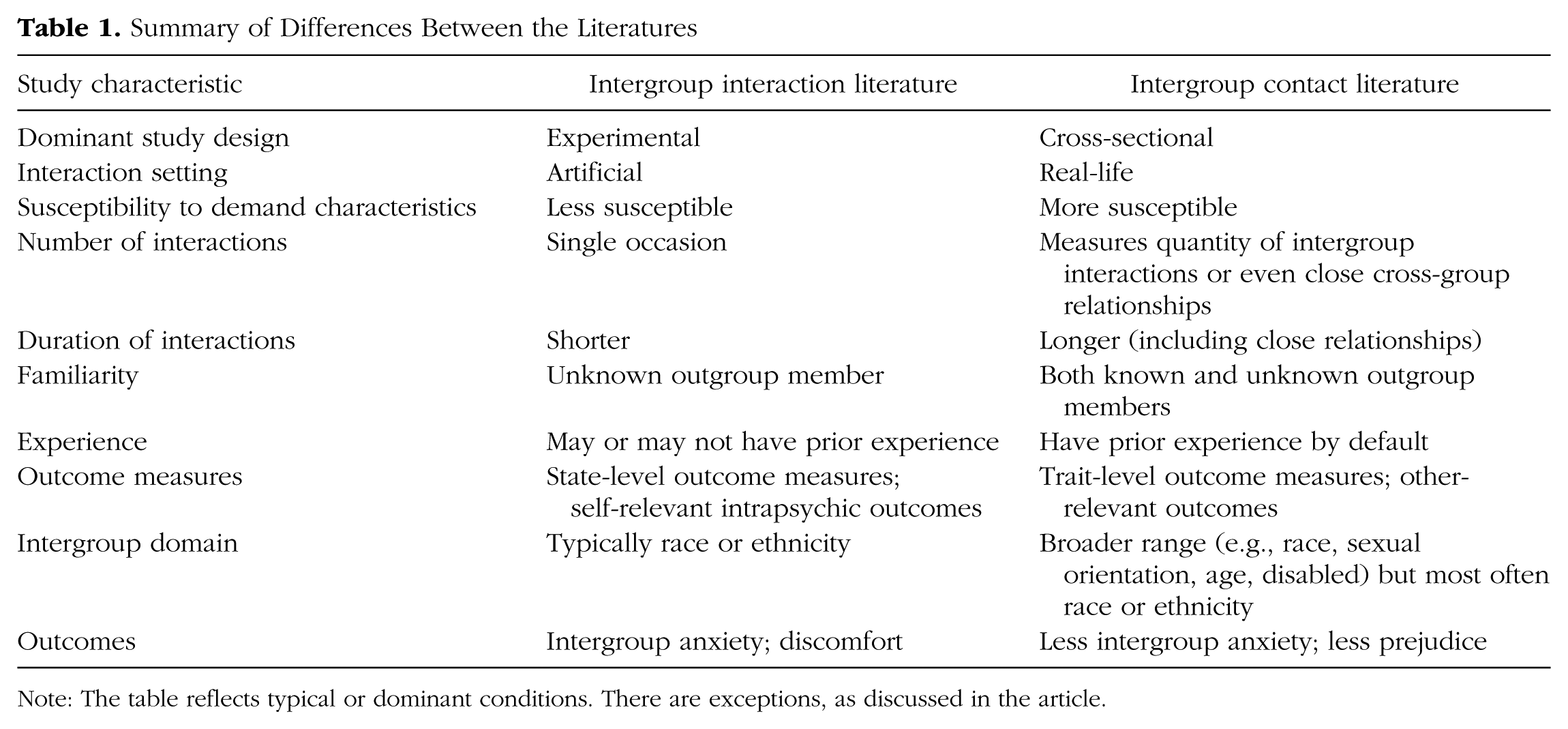
Note: The table reflects typical or dominant conditions. There are exceptions, as discussed in the article.
Context
The dominant study designs in the intergroup interaction and intergroup contact literatures—experimental and cross-sectional, respectively—may partially account for the divide between the two literatures. Next, we discuss two potential reasons for this.
Artificial versus real-life setting
Intergroup interactions in the laboratory are inherently artificial because the experimenter stages them. When people are reporting their intergroup contact, however, they are most likely reflecting on real intergroup interactions that occurred and progressed naturally. Although the experimental control afforded in laboratory-based intergroup interaction studies provides superior evidence for causal inference, it also limits ecological validity (see Blascovich et al., 2002, for discussion of more ecologically valid, laboratory-based approaches). Intergroup interactions in artificial settings may produce more negative outcomes (e.g., stress, anxiety) than those occurring in more natural settings because laboratory participants (a) may have few past contact experiences, (b) have no control over the laboratory situation (Amat et al., 2005; S. Cohen, 1980), (c) may experience evaluation apprehension (Weber & Cook, 1972), and (d) may typically avoid intergroup interactions in everyday life (Mallett et al., 2008). In other words, those self-reporting more intergroup contact are likely to be lower in intergroup anxiety and less likely to avoid intergroup contact, whereas participants in laboratory studies may have little past contact and may even actively avoid intergroup interactions until they find themselves in the anxiety-provoking laboratory setting, inflating the negative effects observed.
Indeed, laboratory-based intergroup interactions produce threat reactions primarily among those with little intergroup contact, with those reporting more intergroup contact experiencing less threat (Blascovich et al., 2001). Some evidence also suggests that intergroup contact not only reduces intergroup anxiety but that intergroup anxiety reduces intergroup contact (Swart, Hewstone, Christ, & Voci, 2011), suggesting a selection bias consistent with the observed bidirectional association between intergroup contact and intergroup bias (Binder et al., 2009; Swart et al., 2011; but for an exception, see van Laar, Levin, Sinclair, & Sidanius, 2005). Further, given the apparent anxiety plaguing intergroup interactions (Shelton et al., 2009), increased anxiety and conflict would be expected in real-life intergroup versus ingroup interactions. This main effect of intergroup context on anxiety and conflict, however, is only sometimes observed in longitudinal studies of intergroup interactions (cf. Cook, Calcagno, Arrow, & Malle, 2012, and Shelton et al., 2005, with Page-Gould, 2012, and Shelton et al., 2010). If people who are prone to anxiety in intergroup interactions avoid these interactions, then most intergroup interactions that occur outside the laboratory may be among people who are least apprehensive about intergroup interactions. It is possible that, in the real world, intergroup interactions may not be any more stressful than ingroup interactions because (a) the people who are stressed by intergroup interactions avoid them and (b) the people who are not stressed by intergroup interactions approach them because they are equipped to handle any negativity that may arise (Page-Gould, 2012; Page-Gould, Mendes, & Major, 2010; Paolini et al., in press). 2 Of course, when real-life intergroup interactions are not easily avoidable, evidence suggests that they are indeed more stressful than ingroup interactions (Shelton et al., 2010; Trail, Shelton, & West, 2009). However, to the extent that people can avoid intergroup interactions in everyday life, then this avoidance will likely not occur randomly (i.e., the people who elect to avoid will be those with low intergroup contact and high intergroup anxiety, whereas the people who choose to have intergroup interactions will be people that tend to have more positive interactions). Therefore, it is possible that natural (unavoidable) intergroup interactions are just as stressful as laboratory-observed intergroup interactions for people who are prone to negative responses to intergroup interactions through prejudice or intergroup anxiety, but these may be avoided when feasible. Simply put, it may be that most naturally occurring intergroup interactions are positive and facilitate ongoing reductions in intergroup bias, because contact begets contact, so they are occurring mainly among people who elect to have those types of interactions.
Susceptibility to demand characteristics
In within-subjects designs, participants have all the information they need to guess the researcher’s hypothesis because they are presented with all the constructs that are relevant to the hypothesis. In contrast, in between-subjects designs, participants only know the conditions that they were randomly assigned to receive. Thus, participants in within-subjects research have greater amounts of information, on the basis of which they are likely better able to accurately guess the researcher’s hypothesis. Correlational research (i.e., in which there is no experimental manipulation) is akin to a within-subjects design, as all participants are exposed to the same information.
Applied to research on intergroup interactions and contact, between-subjects designs do not give access to the information needed to know that the intergroup context of the social interaction or intergroup contact was being systematically manipulated. It is more likely, then, that participants may report less anxiety, less bias, and more contact in within-subjects studies relative to between-subjects studies because participants can more accurately infer the hypotheses. However, accurate suspicion is certainly possible in between-subjects designs (Vorauer, Martens, & Sasaki, 2009). All the same, it comes down to information: The hypothesis in much of intergroup relations research is concealed because the research topic is typically controversial. Participants have access to all variations of the independent variables in within-subjects designs, but they will see at least one independent variable as being invariant in between-subjects designs. Research on intergroup interaction has relied less on survey and within-subjects designs than research on intergroup contact, despite plenty of examples of between-subjects designs in intergroup contact research. Of course, the measurement of contact itself cannot be solely attributable to demand characteristics or controlled responding because observer reports suggest that self-reports of intergroup contact are accurate (Hewstone, Judd, & Sharp, 2011) and that socially desirable responding is a concern in all studies in which intergroup bias is assessed. We suggest, however, that socially desirable responding is greater in survey and within-subjects studies, which are more common in the intergroup contact than intergroup interaction literatures. Nevertheless, we want to emphasize that many intergroup contact studies have used other methods than self-reports (Barnard & Benn, 1987; Clunies Ross & O’Meara, 1989; Johnson & Johnson, 1985) and that not all intergroup interaction studies take place in the laboratory (Shelton et al., 2005, 2010).
Frequency
Researchers of intergroup interaction studies typically observe intergroup interaction on a single occasion (Avery et al., 2009; Blascovich et al., 2001; Hyers & Swim, 1998; Littleford et al., 2005; Shelton, 2003; Vorauer & Kumhyr, 2001), whereas intergroup contact is typically operationalized as the quantity of intergroup interactions or even close cross-group relationships that a person has or has had in his or her past (Islam & Hewstone, 1993; Page-Gould, Mendes, & Major, 2010; Pettigrew, 1997; Turner et al., 2007; K. West & Hewstone, 2012). Frequent intergroup interactions may produce more positive individual, interpersonal, and societal outcomes than occasional intergroup interactions for a number of reasons.
Number of interactions
Intergroup interactions manipulated in the laboratory could be a rare event in the life of someone who is low in intergroup contact while being more natural to someone who has a relatively high degree of past intergroup contact. Naturally occurring intergroup interactions are more likely for people with a high degree of past contact. Therefore, experiences during laboratory intergroup interactions may be quite variable because they could be either a person’s first intergroup interaction or his or her thousandth intergroup interaction. Supporting the idea that frequent interactions facilitate the positive effects of intergroup contact, researchers of studies involving multiple intergroup interactions have observed a greater reduction in intergroup bias compared with a single intergroup interaction (Barnard & Benn, 1987; Clunies Ross & O’Meara, 1989; Johnson & Johnson, 1985; Toosi, Babbit, Ambady, & Sommers, 2012). Cross-group friendships, which by definition involve multiple intergroup interactions as a friendship develops, are especially effective in reducing intergroup bias (Davies, Tropp, Aron, Pettigrew, & Wright, 2011). More frequent intergroup interactions may attenuate the use of group stereotypes (Shelton & Richeson, 2006), encouraging more intimate and personalized interactions and hence less intergroup bias (Brewer & Miller, 1984, 1988; Miller, 2002). Engaging in more frequent intergroup interactions also equips people with the social skills and resources to appraise intergroup interactions as nonstressful (Mendes, Blascovich, Hunter, Lickel, & Jost, 2007), which can promote subsequent intergroup contact and more positive intergroup relations (Page-Gould, 2012; Page-Gould, Mendes, & Major, 2010; Page-Gould et al., 2008; Trawalter et al., 2009).
Interaction duration
Intergroup interaction studies typically involve short interactions among group members (e.g., often lasting less than 10 min; Avery et al., 2009; Blascovich et al., 2001; Hyers & Swim, 1998; Littleford et al., 2005), whereas intergroup contact studies are better able to measure contact among group members that lasts for a longer period of time (e.g., meetings that last for hours, long-term close relationships; Islam & Hewstone, 1993; Pettigrew, 1997; K. West & Hewstone, 2012). Interacting with an outgroup member for a long duration may result in less intergroup bias by facilitating bonding (Wright, Aron, & Tropp, 2002; Wright, Brody, & Aron, 2005) or the adoption of the outgroup member’s perspective, which is associated with lower intergroup anxiety (Aberson & Haag, 2007). Relative to longer term intergroup contact, an interaction lasting only a few minutes may not provide enough time to achieve these outcomes. Although under certain circumstances less intergroup bias has been observed following relatively short intergroup interactions (Gaertner et al., 1999; Grack & Richman, 1996), we suggest that longer duration interactions are likely to have the most positive impact on intergroup bias, especially when these interactions occur repeatedly as per the preceding section on interaction frequency. We expect that the relationship between interaction duration and intergroup bias is linear overall, but we recognize that, like any time-based process (S. G. West & Hepworth, 1991), this linear trend will only be apparent in the long run, after short-term, periodic increases and decreases have been taken into account.
Familiarity
Intergroup interaction studies typically involve an anticipated or actual interaction with an unknown outgroup member (i.e., a stranger), whereas intergroup contact measures do not commonly distinguish between contact with both known and unknown outgroup members. Outcomes are more likely to be positive when the outgroup member is familiar because the interaction partner is more readily predictable and interpretable. A more predictable partner is less threatening and less anxiety-provoking than an unpredictable outgroup member (Mendes et al., 2007). Moreover, when people judge their current and previous intergroup contact, they likely consider familiar people more than unfamiliar people, given the chronic salience of close others (Andersen, Glassman, Chen, & Cole, 1995). Thus, research on intergroup contact captures variance in partner familiarity. For example, someone could have a lot of interreligious contact because (a) he or she has family members who practice different religions, and therefore he or she interacts repeatedly with the same outgroup members, or (b) he or she holds a retail job in a religiously diverse community and interacts repeatedly with many different outgroup strangers. By contrast, in intergroup interaction research, the partner is almost always unfamiliar.
Experience
Participants in intergroup interaction studies may have less experience interacting with outgroup members because the interaction could be one of their first intergroup interactions. By default, participants who report more contact in intergroup contact studies have prior experience with intergroup interactions. Intergroup experience may promote positive outcomes for individuals in new intergroup interactions by making these interactions equally predictable as ingroup interactions. When interactions are predictable versus unpredictable, they are less demanding and less stressful (Bettencourt, Dill, Greathouse, Charlton, & Mulholland, 1997; Mendes et al., 2007). This may partially account for the increased anxiety observed in intergroup interactions relative to intergroup contact.
Outcome measures
Intergroup interaction and intergroup contact studies typically are concerned with different overall questions, and thus, different outcomes are assessed. First, researchers of intergroup interaction studies typically use state-level outcome measures (e.g., measuring how anxious participants feel during the interaction), whereas researchers of intergroup contact studies typically use trait-level measures (e.g., measuring participants’ general expectations of anxiety during intergroup interactions). Second, researchers of intergroup interaction studies typically focus on self-relevant intrapsychic or individual outcomes (e.g., one’s emotional reactions), whereas researchers of intergroup contact studies focus on other-relevant or societal outcomes (e.g., intergroup attitudes). Third, researchers of intergroup interaction studies typically compare these outcomes in intergroup interactions with those observed in same-group interactions, but most researchers of intergroup contact studies assess intergroup contact without comparisons with ingroup contact. Integrating across the literatures, participants may experience changes in state affect during a single intergroup interaction, but as a whole, intergroup interactions may lessen anticipatory intergroup anxiety at the trait level. That is, intergroup interactions may have short-term, self-relevant costs but long-term, other-relevant gains.
There are a number of notable exceptions to the typical set of outcome measures used in each literature. Many researchers of intergroup interaction studies have assessed trait-level or intergroup outcomes, and many researchers of intergroup contact studies have assessed state-level or intrapsychic outcomes. For example, Sinclair, Lowery, Hardin, and Colangelo (2005) found that interracial interactions reduced racial bias; Trawalter, Adam, Chase-Lansdale, and Richeson (2012) found that intergroup contact can be associated with increased personal stress; and Trail et al. (2009) found that students engaging in intergroup versus same-group contact experienced less positive emotions. These findings suggest that the typical outcome measures examined within each literature may account for their seemingly paradoxical findings.
Intergroup domain
Intergroup interactions typically involve an interaction with a racial or ethnic outgroup member (for reviews, see Shelton & Richeson, 2006; Shelton et al., 2006; Trawalter et al., 2009; Vorauer, 2006), most often examining White–Black interracial interactions (Toosi et al., 2012). Intergroup contact studies, however, have examined contact with a broader range of outgroup targets. In their comprehensive meta-analysis of intergroup contact, Pettigrew and Tropp (2006) found that 51% of samples examined contact with a racial or ethnic outgroup member, whereas the remaining samples examined contact with another type of outgroup member (e.g., including contact with older adults, people with dissimilar sexual orientation, people with mental illness, and people with disabilities). However, the effect size for intergroup contact was small and negative for all outgroup targets examined, with interracial contact having essentially the same effect size (i.e., Pearson’s r = −.21) as the effect size across all forms of contact (i.e., r = −.21; Pettigrew & Tropp, 2006). Thus, it is possible that research in which interethnic relations are examined is reasonably generalizable to other intergroup domains.
The impact of target group may have downstream consequences for the quality of intergroup interactions, all the same. As laboratory intergroup interactions have almost exclusively involved nonconcealable groups (e.g., ethnicity, sex), participants in these studies had immediate awareness of the intergroup nature of the interaction, potentially evoking intergroup anxiety (Stephan & Stephan, 1985, 1989) that would not exist as readily in the case of concealable groups. When the intergroup nature of an interaction is not readily apparent (e.g., sexual orientation or religious outgroups), as may have been the case for some interactions reported by participants in intergroup contact studies, this interaction may be approached as an ingroup interaction. Hence, the interaction may not generate intergroup anxiety and negativity, at least not upfront (Buck & Plant, 2011; Kaufman & Libby, 2012; King, Reilly, & Hebl, 2008; but for an exception, see MacInnis & Hodson, 2014). It may also be that interracial interactions are simply more stressful than other types of intergroup interactions (Critcher, Mazziotta, Dovidio, & Brown, in preparation). Regardless, the proportion of different intergroup domains examined across the intergroup interaction and intergroup contact literatures may account for their differing conclusions.
Integrating the Literatures
Overall, the intergroup interaction literature demonstrates that, in the short term, contact with outgroup members has a negative impact on intergroup bias, producing heightened stress, intergroup anxiety, or outgroup avoidance (Shelton et al., 2009; Trawalter et al., 2009); however, the intergroup contact literature demonstrates that intergroup interactions have a positive impact on intergroup bias in the long run, predicting lower intergroup anxiety and lower prejudice (Pettigrew & Tropp, 2006). Considering the methodological differences between the two literatures noted earlier, we introduce a novel model by which these seemingly paradoxical findings can be unified. Specifically, we propose that one’s first intergroup interaction with a stranger is anxiety-provoking, with some exceptions (e.g., those high in self-expansion motives; Wright et al., 2002), consistent with the intergroup interaction literature (Littleford et al., 2005; Stephan & Stephan, 1985, 1989), and this anxiety leads to the avoidance of subsequent intergroup contact (Gaertner & Dovidio, 2000; Plant & Devine, 2003; Stephan, Ybarra, Martinez, Schwarzwald, & Tur-Kaspa, 1998). We propose that if subsequent intergroup interactions occur, however, that stress and anxiety are progressively reduced (Page-Gould et al., 2008; White & Abu-Rayya, 2012). Engaging in these subsequent interactions promotes the building of resources to cope with stressful intergroup interactions (Mendes et al., 2002; Page-Gould, 2012; Page-Gould, Mendes, & Major, 2010; Trawalter et al., 2009) and increases the familiarity of intergroup interactions, which also likely reduces the stress of intergroup interactions (Mendes et al., 2007). At some point, a threshold will be reached whereby a person’s history of intergroup interactions assumes the properties of intergroup contact. That is, intergroup interactions eventually produce positive outcomes, such as less intergroup anxiety and more positive intergroup attitudes (Binder et al., 2009; Pettigrew & Tropp, 2006, 2008), and these positive outcomes are maintained through the ongoing facilitation of positive intergroup interactions by past intergroup contact.
Essentially, we posit that a threshold in experience with intergroup interactions is reached whereby the initially negative effect of intergroup interactions on intergroup bias progressively approaches the inverse linear relationship estimated from the intergroup contact literature (Pettigrew & Tropp, 2006). Similar thresholds have been described in the field of organizational behavior. For example, according to critical mass theory, when a minority group reaches a certain size (e.g., ranging from 10% to 35% of a larger society), a qualitative change occurs whereby the previously conforming minority group members become influential and assertive within the larger society (Studlar & McAllister, 2002). Similarly, some support has been demonstrated (P. B. Jackson, Thoits, & Taylor, 1995; Stichman, Hassell, & Archbold, 2010) for tokenism theory (Kanter, 1977), which posits that workplaces marked by group conflicts become more harmonious when the proportion of employees from historically underrepresented groups reaches a tipping point of 15%. In the specific context of historically male-dominated symphony orchestras, Allmendinger and Hackman (1995) found that several outcomes, including relationship quality, steadily worsened as the proportion of women in the orchestra increased. As the proportion of women approached a threshold of 50%, however, orchestra functioning no longer decreased, and for some outcome measures, it improved. Comparable with these group composition thresholds, we propose that there are many objective and subjective factors that lead to individual variance in the onset of the contact threshold we describe, which provides many avenues for future research.
The Limiting Function of Intergroup Interaction and Intergroup Contact
Ultimately, we posit that intergroup contact reflects the state of intergroup bias as the number of intergroup interactions approaches infinity. Pettigrew and Tropp (2006) predicted that the impact of intergroup contact on prejudice reduction would eventually asymptote, essentially reflecting the idea that intergroup contact can only keep reducing prejudice while a person still has prejudice to reduce. We build off this work by proposing that the linear relationship between intergroup interactions and intergroup bias is itself asymptotic. Specifically, as a person continues to have more intergroup interactions, the relationship between this past contact and intergroup bias takes the form of an oblique asymptote, which is a slanted linear asymptote (Howison, 2005; see Figure 1). The asymptote reflects the well-established negative association between intergroup contact and intergroup bias (i.e., r = −.21; Pettigrew & Tropp, 2006), and the curve function that approaches the asymptote reflects the volatile relationship between intergroup interactions and intergroup bias when intergroup interactions are close to zero. When intergroup interaction quantity is low, the association between intergroup interactions and intergroup bias will be quite variable. As intergroup interactions increase, the association between intergroup interactions and intergroup bias becomes more reliable and consistent with relations observed in the intergroup contact literature.
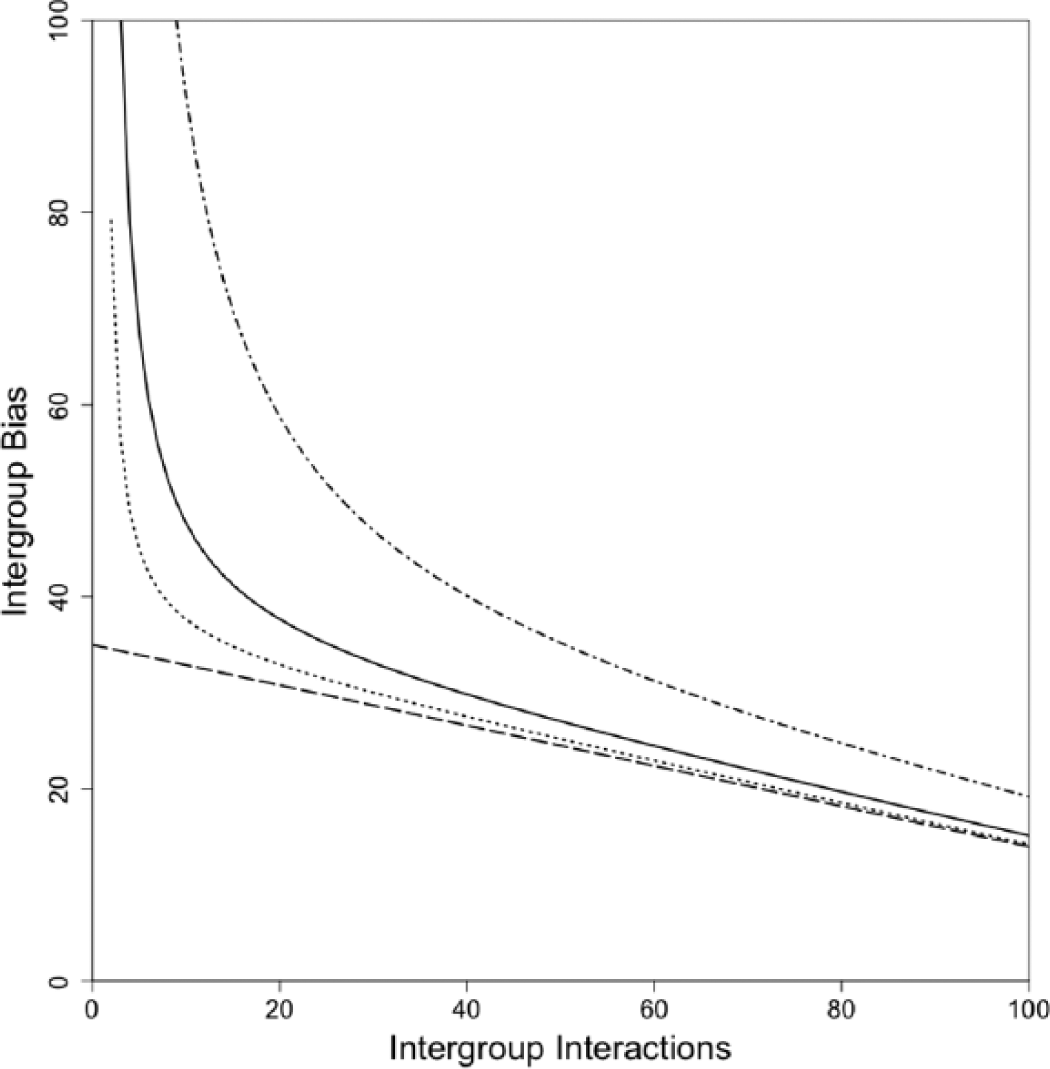
Graph representing the relationship between intergroup interactions and intergroup bias as an oblique asymptote. The dashed line represents the oblique asymptote. The dotted line represents the curve function under good conditions (e.g., multiple high-quality interactions with the same outgroup member with little time between interactions). The dotted-and-dashed line represents the curve under relatively poorer conditions (e.g., superficial interactions with different group members with a long time period between interactions). The solid line represents the curve function on average.
For Figure 1, the asymptote is plotted with the equation,

where y represents intergroup bias; the intercept, Default Intergroup Bias, is a constant that represents the default level of intergroup bias in the absence of any intergroup contact; and the Contact Effect is the slope, which represents the relationship between intergroup contact and intergroup bias. For the purposes of this article, we assume the Contact Effect is equivalent to the effect size for contact that has been estimated through meta-analysis (−.21; Pettigrew & Tropp, 2006). Finally, x represents a count of a person’s lifetime intergroup interactions. The intercept of the asymptote is expected to vary depending on the intergroup bias outcome measure used (e.g., implicit attitudes, behavioral intentions) and its measurement scale (e.g., bias measured with a 100-point feeling thermometer may use an intercept of 35; bias measured with an implicit associations test may use an intercept of D = .7). Given its meta-analytic origins, we chose to use Pettigrew and Tropp’s (2006) well-established −.21 correlation that represents the small but reliable association between intergroup contact and prejudice as the standardized slope of intergroup interactions predicting intergroup bias. Of course, the asymptote may vary when zeroing in on a specific intergroup domain (e.g., r = −.27 for contact with heterosexual–homosexual people; r = −.24 for contact with people with physical disabilities; and r = −.18 for contact with older adults; Pettigrew & Tropp, 2006). However, we chose a slope of −.21 for Figure 1, given that it represents the mean effect size across group domains, recognizing the limitation that interracial interactions were examined in 51% of the studies in Pettigrew and Tropp’s meta-analysis. Further, we recognize that prejudice is only one component of intergroup bias (e.g., stereotyping and discrimination being other components) and that the slope of the asymptote may also vary depending on the measure of intergroup bias used. Although we recognize that differences in default levels of intergroup bias will exist across different types of outcomes, we expect that the association between intergroup contact and other forms of intergroup bias is generally similar (i.e., reliably negative and small).
After hundreds of studies and thousands of participants, we believe that the fields of intergroup contact and intergroup interaction are both sufficiently rich. At this point, researchers in the field can benefit from formalizing our knowledge. This equation could be used to prospectively predict intergroup bias at varying amounts of intergroup interactions. However, as represented by the curve function that approaches the oblique asymptote, we expect that the relationship between intergroup interactions and intergroup bias is neither linear nor homoscedastic, such that early intergroup interactions are likely to produce more variable and more negative individual and societal outcomes. Thus, we propose that the true relationship between intergroup interactions and intergroup bias is curvilinear, approaching a linear relationship as intergroup interactions approach infinity. The contact threshold is the point at which the tangents of this curve function become effectively parallel to the oblique asymptote.
We hypothesize a general form for the curve function to be as follows:

where y and x represent the same variables as in Equation 1 (i.e., intergroup bias and the count of a person’s lifetime intergroup interactions, respectively), and Rate represents the rate at which intergroup interactions progressively approach the asymptote. This rate parameter is analogous to the degree to which a single interaction leads to a proportional decrease in intergroup bias, and we suspect that the rate parameter is most directly affected by contact quality, although we later discuss the role of contact quality along with other factors affecting the rate parameter. Figure 1 depicts this curvilinear function with three different rate parameters of Rate = 10 (dotted line), Rate = 100 (solid line), and Rate = 500 (dotted-and-dashed line) to represent higher, average, and lower quality interactions leading to faster, average, and slower routes to the contact threshold, respectively. That is, each curve will eventually become effectively parallel to the −.21 slope but each at a different rate. Each curve can be considered effectively parallel at the point where the discrepancy between the curve and the asymptote cannot be disambiguated from the reliability of the measures used. Although we believe that interaction quantity and quality cannot be divorced from one another, with each dimension augmenting and amplifying the other, we expect the rate parameter to be heavily influenced by quality of interactions. If interactions are of higher quality, the rate parameter will be smaller; if interactions are of lower quality, the rate parameter will be larger. All the same, our model predicts that being “high” on quantity or quality can result in reaching the contact threshold, even in the absence of the other (but see Barlow et al., 2012; Shook & Fazio, 2011; Stark, Flache, & Veenstra, 2013; Trail et al., 2009). However, we expect that the contact threshold will be reached most quickly when both contact quantity and quality are optimized, which may be why close intergroup relationships, such as cross-group friendship, are more strongly related to intergroup contact (Davies et al., 2011).
The numerical constants in the curve function also have semantic meaning and should be amended through empiricism. Two of the numbers are necessary to force the function to approach the asymptote as intergroup interactions increase to infinity: −0.21 is the slope of the asymptote, and we have plotted our example figures with an outcome measure on a 0–100 scale of intergroup bias and with 35 as the intercept of the asymptote, arbitrarily on the basis of values reported on a feeling thermometer by Dasgupta and Greenwald (2001). The denominator in Equation 2 represents the stochastic nature of intergroup interactions. By subtracting the constant of “1” from the current number of intergroup interactions, two specific purposes are served: (a) A vertical asymptote is created at the first intergroup interaction, suggesting that we cannot predict how the first intergroup interaction a person ever has will relate to his or her intergroup bias; (b) symbolically, this also represents that the current intergroup interaction is a function of the number of intergroup interactions a person has previously had in his or her lifetime.
Note that we are not necessarily proposing an asymptote at “zero” prejudice like Pettigrew and Tropp (2006) did. Although we expect that the zero point is rarely crossed, we want to allow for the possibility that intergroup bias and perceived group membership can entirely shift in favor of outgroups (e.g., expatriates who chose to live in a different culture solely for internal reasons). Our model predicts that the state at which a person begins to ally with outgroups more than ingroups will only be observed at the higher end of the intergroup contact continuum; however, we suspect that this exceptional behavior is driven as much if not more by social experiences with ingroup members than with outgroup members.
Altogether, the curve function (Equation 2) reflects the hypothesized relationship between intergroup interactions and intergroup bias in natural data, and the oblique asymptote (Equation 1) represents the relationship between intergroup interactions and intergroup bias as intergroup interactions approach infinity. We generally plot these functions on an axis representing contact quantity because intergroup interactions are discrete, observable events in a person’s life. However, we expect that contact quality, which is inherently subjective, is one of the primary contributors to the rate parameter in the curve function. Putting these ideas together, using our model we predict that contact quantity is the primary dimension that determines whether a person’s intergroup interactions reflect processes of intergroup contact, but contact quality more strongly determines how each intergroup interaction affects intergroup bias and advances a person toward the contact threshold. Future research is necessary to determine factors influencing the speed at which one reaches the contact threshold (i.e., when the slope of the curve becomes almost parallel to the oblique asymptote) and, thus, to determine these actual values. Next, we discuss such potential factors as well as means by which to detect the threshold itself.
Exploring the Contact Threshold: Avenues for Future Research
Our proposed model introduces a variety of new questions for intergroup researchers. To bridge the gap between the intergroup interaction and intergroup contact literatures, we need to explore the nature of the contact threshold. As a starting point, we introduce three specific research questions for future examination, providing potential, falsifiable answers to these questions.
What factors influence when the contact threshold is reached?
Next, we identify potential factors that influence how many intergroup interactions a person must have before more intergroup interactions have positive, rather than negative, individual, interpersonal, and societal intergroup bias outcomes, such as lower prejudice, lower intergroup interaction avoidance, and lower intergroup anxiety. We discuss each factor independently, but we recognize that these factors probably covary and may interact with one another to have an impact on the contact threshold.
Factors expected to influence the Rate parameter of Equation 2
Artificial versus real-life setting
We speculate that the contact threshold can be achieved through either laboratory-based or real-world intergroup interactions. However, given the quantity and quality of interactions that are likely required to give a person relatively high intergroup contact, the contact threshold is likely to be reached more readily when interactions occur in real-world versus laboratory settings. Although laboratory-based interactions afford empirical control, they also are more contrived, are more unpredictable, and, as noted earlier, may be more anxiety-provoking. Real-world intergroup interactions have the possibility of being chosen by each interaction partner, whereas laboratory interaction partners are rarely chosen by the participant. In addition, it is resource-intensive to manipulate multiple intergroup interactions in the laboratory. However, it is more difficult to manipulate intergroup interactions in the field, limiting causal inferences on the impact of intergroup interaction versus any social interaction. Overall, therefore, a combination of both laboratory and real-world intergroup interactions may provide the most accurate picture of intergroup interactions.
Future researchers should unpack the contact quantity question systematically to answer the question of the amount of interactions required before a change on intergroup bias is observed (i.e., the point at which the contact threshold is reached), considering moderating factors such as laboratory-based and real-world settings. We expect contact setting to impact the Rate parameter in Equation 2. Specifically, we expect that fewer real-world versus laboratory-based interactions would be required, but this remains an open question. Researchers may identify procedures wherein laboratory-based interactions can result in a rapid reaching of the contact threshold, which could be applied as a prejudice intervention strategy. For example, it may be necessary to manipulate the quality of laboratory interactions (Page-Gould et al., 2008) for laboratory intergroup interactions to affect intergroup bias.
Time between interactions
Although it has not been addressed in the extant literature, we propose that, in addition to the amount of interactions, the time between these interactions is an important factor contributing to when the contact threshold is reached. We speculate that a shorter time interval between intergroup interactions results in fewer intergroup interactions being needed to reach the contact threshold. If multiple intergroup interactions occur within a short time interval wherein the initial interactions are still accessible in working memory, subsequent interactions may be more familiar and predictable and, hence, less stressful (see Mendes et al., 2007) than the same number of intergroup interactions that were separated by greater expanses of time. Given familiarity and predictability, resources to effectively deal with an intergroup interaction and to appraise it as nonstressful are likely to be built more quickly, and hence the contact threshold is likely to be reached more quickly. We suspect that even if there are days or weeks between intergroup interactions, the contact threshold will be reachable, but the point at which the threshold is reached will depend on between-interactions time intervals. When the time between intergroup interactions moves beyond weeks and spans months or years, we expect that intergroup interactions would remain relatively unfamiliar and that each intergroup interaction would be as stressful as the last. Extended time intervals between intergroup interactions likely render the accumulation of resources to effectively manage intergroup interactions more difficult. Indeed, those reporting rare intergroup interactions report more intergroup bias (Islam & Hewstone, 1993; Pettigrew & Tropp, 2006). Thus, it is possible that people who engage in intergroup interactions only every few months or years may never reach the contact threshold, such that they continually have anxiety-prone intergroup interactions that feed avoidance of future intergroup interactions.
We anticipate that time between interactions will influence the Rate parameter of Equation 2. We hypothesize that the relationship between inter-interaction interval and benefits that come from accumulated intergroup interactions will be related to normal processes of memory decay. Using experimental or daily diary methods, researchers could examine the impact of time intervals between intergroup interactions on intergroup bias. Shorter versus longer time intervals between intergroup interactions may result in a quicker reduction of intergroup bias, indicating a faster reaching of the contact threshold. Consistently, with especially extended time intervals between intergroup interactions, intergroup bias may be unchanged, indicating a failure to reach the contact threshold. It is also possible, however, that the contact threshold is robust to these time intervals and that the threshold will be reached by merely engaging in multiple intergroup interactions, regardless of the interval between interactions.
Factor expected to influence the x parameter of Equation 2: Number of interactions
It is almost a certainty that multiple intergroup interactions are necessary to arrive at the contact threshold. For most people, the first intergroup interaction will produce at least some intergroup anxiety, given that the first intergroup interaction represents an unfamiliar and potentially threatening situation (Mendes et al., 2007; Stephan & Stephan, 1985, 2000). The degree to which a person’s first intergroup interaction is threatening probably highly depends on the degree of stigma involved in the intergroup domain (Blascovich et al., 2001). We propose that the specific number range or proportion of intergroup interactions (i.e., out of all social interactions) required to reach the contact threshold can be identified by conducting intermediate and long-term longitudinal work that has enough resolution to observe the number of intergroup interactions that an individual has. In laboratory or field contexts, the number of intergroup interactions that have occurred before a change is observed in intergroup bias (e.g., intergroup anxiety, prejudice) will provide insight into the number or proportion of intergroup interactions required to reach the contact threshold. There is likely a minimum number of intergroup interactions that a person must have before his or her history of intergroup interactions assumes the properties of intergroup contact.
One initial guess at the necessary number of intergroup interactions before a change in intergroup behavior is observed is three intergroup interactions. Page-Gould et al. (2008) found that implicitly biased participants exhibited physiological stress to an initial intergroup interaction with an ethnic outgroup stranger, but they did not respond with physiological stress to two subsequent intergroup interactions with the same person. Furthermore, after engaging in these three intergroup interactions, participants who were initially prejudiced initiated more intergroup interactions—responses consistent with decreased intergroup bias. Of course, Page-Gould et al. (2008) examined intergroup interactions that were relatively long (i.e., each interaction was 1 hr) and designed to promote interpersonal closeness through self-disclosure (Aron, Melinat, Aron, Vallone, & Bator, 1997), thereby amplifying the normal development of familiarity. In addition, each intergroup interaction was invariantly 1 week apart, so inferences cannot be made about the impact of the timespan between interactions on the contact threshold. The number or proportion of intergroup interactions necessary to reach the contact threshold will likely depend on the duration and quality of the interactions, with more short, superficial interactions being required than long, intimate interactions. Regardless, initial research in which multiple intergroup interactions are examined suggests that positive outcomes from intergroup interactions may appear between the first and second intergroup interactions, assuming those interactions facilitate closeness and are 1 week apart. These past findings likely reflect the earliest stage in the development of an ongoing relationship with an outgroup member and, thus, may provide a good starting point for examining the point at which the contact threshold is reached. Future researchers examining the number of interactions should also vary whether multiple interactions occur with the same outgroup member or a series of outgroup strangers. The number of interactions is the x parameter of Equation 2.
Factor expected to influence the slope of the asymptote: Intergroup domain
The contact threshold we describe refers to outgroups in general. We recognize, however, that the contact threshold may differ by intergroup domain (e.g., race, sexual orientation). It may even be necessary to calculate a different contact threshold for each specific group domain (e.g., an interracial contact threshold, an intersexual orientation threshold). We expect that different intergroup domains would moderate the slope of the asymptote itself (i.e., having an impact on the Contact Effect parameter). Although our focus is on a general contact threshold, we believe it would be fruitful for future researchers to examine specific group domains separately as well.
Factors expected to have multiple influences
Form of contact
Intergroup interactions can take many forms. Imagined contact (i.e., mentally simulating positive contact with outgroup members; Crisp & Turner, 2012), extended contact (i.e., knowledge of ingroup members who are friends with outgroup members; Wright, Aron, McLaughlin-Volpe, & Ropp, 1997), and media contact (i.e., viewing or reading about positive intergroup contact in the media; Ortiz & Harwood, 2007) represent indirect forms of contact, with more substantial forms of contact including direct, face-to-face intergroup interactions and online intergroup contact (MacInnis & Hodson, 2014). We expect that the more psychologically investing the form of contact, the faster the contact threshold will be reached, with direct contact representing the fastest route. Engaging in multiple forms of contact versus only one form may also positively impact the rate at which the threshold is reached. We anticipate that contact form will have an impact on the asymptote itself or the Rate parameter in Equation 2, but these are empirical questions. Future researchers can compare the influence of these different forms of contact on the contact threshold.
Familiarity/experience
As noted earlier, multiple intergroup interactions are required to reach the contact threshold whereby intergroup interactions assume the properties of intergroup contact. These interactions, however, may take three possible forms: (a) multiple interactions with the same outgroup member, (b) multiple interactions with different members of the same outgroup, and (c) multiple interactions with different members of different outgroups. We predict that each of these forms of intergroup interactions will result in the contact threshold being reached but that multiple interactions with the same outgroup member will produce the largest and most positive effect on intergroup bias, representing the fastest route to the threshold. Multiple interactions with the same outgroup member likely increase familiarity and experience such that the outgroup member becomes more predictable and hence less threatening (Mendes et al., 2007). Outgroup members likely become more familiar and predictable through Forms b and c of intergroup interaction as well, but we expect that this process occurs more quickly through Form a. Indeed, Pettigrew and Tropp (2006) found generalization patterns whereby interactions with single outgroup members are associated with less bias toward the outgroup as a whole (relevant to Form b), and interactions with outgroup members are associated with less bias toward other outgroups (relevant to Form c). These generalization or “secondary transfer” effects, however, are often limited to similar or related outgroups (Pettigrew, 2009). Further, Pettigrew and Tropp (2006) found that the ameliorative effects of intergroup contact on intergroup bias were strongest for intergroup friendships, which involve repeated interactions with the same outgroup member (relevant to Form a).
Cross-group friendships are widely recognized as powerful means by which to reduce intergroup bias (Davies et al., 2011). Outgroup friends may represent positive exemplars of outgroup members that modify initial bias toward the outgroup. When an outgroup friend is made, one has an outgroup member whom they associate with acceptance, positive affect, and positive attitudes (Mendoza-Denton, Page-Gould, & Pietrzak, 2006). This new information is likely to replace previous negative information about the outgroup (Wright et al., 1997). Thus, multiple interactions with the same outgroup member that result in a cross-group friendship may induce a change whereby intergroup interactions are less strongly associated with bias and stress. Indeed, having a cross-race friend predicts less discomfort in everyday interracial interactions, such that comfort in cross-race interactions was on par with comfort levels reported in same-race interactions (Cook et al., 2012). The contact threshold is likely to be reached sooner with this unique form of intergroup interaction relative to other forms.
Researchers can examine the degree to which engaging in interactions with the same outgroup member, multiple members of the same outgroup, or multiple members of different outgroups has an impact on the point at which the contact threshold is reached. This may have an impact on the intercept (Default Intergroup Bias) or Rate parameters of Equation 2, or it may have an impact on the way that the x-axis is operationalized in both equations. As we speculate, multiple interactions with the same individual may represent the fastest route to the contact threshold. Of course, multiple interactions with different members of the same outgroup, or multiple interactions with different members of different outgroups, may allow the contact threshold to be reached just as quickly. Alternatively, it is possible that engaging in a combination of all three intergroup interaction forms rather than only one form allows the contact threshold to be reached most quickly. Future laboratory experiments, diary studies, and field studies are necessary to examine these possibilities.
Individual differences
Individual differences, which can strongly influence both intergroup bias and intergroup contact (Hewstone, Rubin, & Willis, 2002; Hodson, Costello, & MacInnis, 2013), are also likely to influence the point at which the contact threshold is reached. We expect these individual differences to have an impact on not only the Rate parameter of Equation 2 but also the intercept (Default Intergroup Bias).
Two individual differences that have been identified as strong predictors of intergroup bias and moderators of the relationship between intergroup contact and intergroup bias are likely to be especially influential: right-wing authoritarianism (RWA) and social dominance orientation (SDO; Hodson et al., 2013). RWA is characterized by conventionalism, submission to authority, and aggression toward norm violators (Altemeyer, 1996), whereas SDO is characterized by the support of group hierarchies and group inequality (Pratto, Sidanius, Stallworth, & Malle, 1994). Although the motivational goals underlying prejudice differ for those relatively high in RWA or SDO (Duckitt, 2005), in general, individuals relatively high in RWA or SDO tend to avoid interacting with outgroup members, preferring instead to interact with similar others (Hodson et al., 2013). However, when contact with outgroup members is unavoidable, it is associated with significantly lower intergroup bias for those high in RWA (Dhont & Van Hiel, 2009; Hodson, Harry, & Mitchell, 2009) and for those high in SDO (Dhont & Van Hiel, 2009; Hodson, 2008; but for an exception, see Asbrock, Christ, Duckitt, & Sibley, 2012). In fact, it has been suggested that intergroup contact best reduces prejudice among those high in RWA or SDO (Hodson et al., 2013). That is, intergroup contact is most beneficial to those who have the most to gain: those who are prone to prejudice.
These findings suggest, on the one hand, that it may take longer for the contact threshold to be reached among people high in RWA or SDO, given that these individuals avoid interacting with outgroup members. If there are no intergroup interactions or only very rare intergroup interactions, it is unlikely that the contact threshold will be reached. On the other hand, however, given that contact is strongly associated with less intergroup bias among those high in RWA or SDO (Hodson et al., 2013), only a small amount of interactions may be required to reach the contact threshold for these individuals. A third possibility is that the contact threshold can never truly be reached among those high in RWA or SDO. Whereas intergroup bias is reduced more so for these individuals relative to the reduction in bias observed for people low in RWA or SDO or people high in RWA or SDO who do not engage in contact, intergroup contact may not be associated with low intergroup bias for those high in RWA or SDO in an absolute sense. That is, repeated interactions may result in a relative reduction in intergroup bias, but a complete lack of bias or positivity toward the outgroup (i.e., the contact threshold) may never be achieved, given the inherent susceptibility of these individuals to intergroup bias.
It is imperative that these possibilities be reconciled to understand the impact of these individual differences on the point at which the contact threshold whereby intergroup interactions assume the properties of intergroup contact is reached. This research will be especially difficult in naturalistic settings, given the tendency of people high in RWA or SDO to avoid outgroup members (Hodson et al., 2013). However, experimental studies, or studies of environments in which intergroup interaction is unavoidable, will be informative. Researchers can investigate the amount of intergroup interactions required among those high in RWA or SDO before a qualitative reduction in intergroup bias is observed. Future researchers can also examine other individual differences related to bias or intergroup contact that may have an impact on the point wherein the contact threshold is reached, such as openness to experience (Hodson, Hogg, & MacInnis, 2009), conservatism (Van Hiel, Pandelaere, & Duriez, 2004), or need for self-expansion (Wright et al., 2002).
What observations can be used to identify when the contact threshold has been reached?
In addition to determining factors influencing the point at which the contact threshold is reached, it is important to uncover observable means by which to identify exactly when the threshold has been reached.
Quantitative observations
Quantitatively, the contact threshold has been reached when reductions in intergroup bias as a function of intergroup contact are not significantly different from a standardized slope of −.21. A t value can be hand-calculated from the results of a regression equation. Assuming the appropriate data have been collected, intergroup bias can be regressed on the number of intergroup interactions, and the unstandardized slope of intergroup interactions and its standard error should be saved. Normally, the unstandardized slope is divided by its standard error to obtain a t statistic that can be used to test whether the slope is significantly different from zero. Thus, to determine whether the slope is significantly different from −.21, this value should be subtracted from the unstandardized slope, and this difference would be divided by the standard error to obtain a t value for this test. The probability of observing this t value can be obtained with the same degrees of freedom that were used to estimate this slope in the original regression, although this approach would only be legitimate in sample sizes large enough to detect a very small effect (J. Cohen, 1992). Bayesian linear modeling can also be used to estimate the slope given an observed set of data, and this approach would be preferable in small to moderate sized samples. In this case, the researcher would conclude that the contact threshold had been reached if the 95% highest posterior density interval derived from Bayesian Markov chain Monte Carlo simulations of the slope did not include −.21.
Qualitative observations
Reaching the contact threshold likely involves a number of qualitative changes in a person, whereby intergroup interactions no longer produce intergroup bias and may even promote positivity toward the outgroup. There are likely identifiable means to pinpoint when this shift has occurred or is imminent. Next, we discuss two possible means to determine that the contact threshold has been reached.
Initiating contact
One behavioral “marker” demonstrating that the contact threshold has been reached is the initiation of intergroup interactions. Individuals high in intergroup anxiety and intergroup bias generally are unlikely to initiate contact with outgroup members (J. W. Jackson & Poulsen, 2005; Stephan et al., 1998). However, once intergroup bias begins to decrease with successive intergroup interactions, a person is likely to become more comfortable initiating intergroup interactions. Self-expansion theory purports that people are motivated to “expand” the self to include resources, identities, and perspectives that will enhance their self-efficacy and personal value (Aron, Norman, & Aron, 1998). This theory has been extended to the intergroup domain, such that developing closeness with outgroup members and including outgroup members in the self can represent a means of self-expansion (Wright et al., 2002). One likely has to reach a point in which connecting with outgroup members represents a worthwhile means of self-expansion, however. The contact threshold may be this point. That is, once bias begins to dissipate following multiple intergroup interactions, one may seek out interactions with outgroup members as a means of self-expansion. Future researchers may investigate this possibility by measuring who initiates daily social interactions.
Viewing outgroup members as friends or potential friends
Another possible indicator that the contact threshold is reached is that outgroup members become viewed as friends or potential friends. Pettigrew (1998) suggested the opportunity for friendship as an essential condition for intergroup contact. When outgroup members are viewed as potential friends, subsequent intergroup interactions are more likely, providing more opportunity to reduce intergroup bias and to maintain positive intergroup attitudes (Pettigrew, 1998). Feelings of friendship or closeness with outgroup members have also been described as the means by which contact reduces intergroup bias (Wright et al., 2005). At least some initial intergroup interactions would likely be required before outgroup members are viewed as potential friends, and indeed we have argued in this article that repeated friendly interactions with the same outgroup member would produce a relatively faster reaching of the contact threshold. Further, it may be that a defining characteristic of the contact threshold is viewing outgroup members as potential friends. Once this occurs, future intergroup interactions are unlikely to be plagued by intergroup bias but instead to be approached with positivity (i.e., the contact threshold is reached). Future researchers could test this speculation by asking about friendship potential when measuring intergroup interactions or contact.
Do the effects of reaching the contact threshold disappear if intergroup contact is ceased?
One interesting question for future research concerns whether the effects of reaching the contact threshold are permanent. If intergroup contact decreases significantly or ceases completely (e.g., if a person moves from a diverse to nondiverse area), the effects of the contact threshold may be lost over time. That is, ongoing intergroup interactions may be required to maintain the contact threshold. Without regular intergroup interactions, a person may return to his or her original, prethreshold levels of intergroup bias—or the effects of the contact threshold may be permanent. Three possible answers to this question are discussed next.
The effects of the contact threshold would disappear completely
It is possible that if intergroup contact is ceased, the effects of the contact threshold would disappear. That is, a person may reach the contact threshold by partaking in multiple intergroup interactions but eventually return to initial levels of intergroup bias if intergroup interactions stopped altogether. If this person then resumed intergroup interactions after a period of no intergroup interactions, just as many interactions as were originally required to reach the contact threshold may be needed again. The ideal means to test this possibility would be longitudinal work in which researchers follow people over many years or cross-sectional work in which researchers examine people who have recently moved between geographical areas that differ in diversity. If the intergroup bias of those who significantly reduce or cease intergroup contact completely returns to baseline levels, this possibility would be supported.
The effects of the contact threshold would not completely disappear and would be recovered quickly
Another possibility is that once the contact threshold is reached, an individual will never return to his or her original level of intergroup bias, even if he or she ceases intergroup contact completely. The effects of the contact threshold may remain intact or decay only somewhat, given that one would likely retain a behavioral script for intergroup interactions (Abelson, 1981; Husnu & Crisp, 2010; Schank & Abelson, 1977) in procedural memory. Procedural memory is relatively robust to decay (M. D. Cohen & Bacdayan, 1994). Thus, even after ceasing intergroup contact, one would maintain the resources to evaluate intergroup interactions as predictable and nonstressful and continue to view outgroup members as potential friends. In this way, once the contact threshold is reached, intergroup interaction may be something like riding a bicycle—one never forgets how to do so effectively. This could be investigated through longitudinal work. If the intergroup bias of those having previously reached the contact threshold is unchanged or changed only slightly when intergroup contact is significantly reduced or ceased, then this possibility would be supported. Further, in the event that the effects of the contact threshold decay somewhat, they may be recovered quickly similar to “savings” effects of memory (Nelson, 1978). That is, when intergroup contact ceases, a person who had previously reached the contact threshold may reach it more quickly when resuming intergroup interactions than a person who has never reached the threshold. This could also be examined in longitudinal work.
It depends
The degree to which the effects of the contact threshold endure when intergroup contact is ceased may depend on several factors. First, this could depend on individual differences. Those individuals particularly prone to intergroup bias (e.g., those high in RWA or SDO; Duckitt, 2005) may be more susceptible to returning to their original levels of intergroup bias when intergroup contact ceases than those who are not especially prone to bias. These bias-prone individuals may revert back to original intergroup bias levels after only a short period without intergroup contact. Another individual difference that may be relevant is motivation to respond without prejudice (Plant & Devine, 1998). Individuals high on this construct actively strive to appear nonprejudiced for internal or external reasons. Such individuals may be especially motivated, when reaching the contact threshold, to actively maintain the positive effects obtained. Thus, those higher on motivation to control prejudice may be more likely to retain the positive effects of the contact threshold even in the absence of intergroup contact. By contrast, the construct of motivation to respond with prejudice has begun to be recently explored (Forscher & Devine, under review). For individuals who are highly motivated to be prejudiced toward an outgroup for either normative or personal reasons, the contact threshold may be particularly permeable.
The degree to which the effects of the contact threshold endure following a stoppage of intergroup contact may also depend on whether an individual engages in alternative forms of contact. Although environments completely devoid of any type of intergroup interactions are likely rare, engaging in some alternative form of contact may serve to maintain the positive effects of the contact threshold for people with a complete lack of intergroup interaction. Imagined contact (Crisp & Turner, 2012), extended contact (Wright et al., 1997), and media contact (Ortiz & Harwood, 2007) may prove effective in reducing intergroup bias when there are no opportunities for direct intergroup contact. An individual who engages in one or more of these alternative forms of contact may be more likely to maintain the positive effects of the contact threshold. Again, longitudinal work in which researchers follow those who have reached the contact threshold will be necessary to investigate these possibilities.
Limitations
There are a number of limitations existing across the intergroup interaction and intergroup contact literatures that warrant examination. First, although wide varieties of social groups have been examined, the largest proportion of work across the literatures has focused on racial or ethnic groups (Pettigrew & Tropp, 2006; Toosi et al., 2012). The field would benefit from more balanced coverage of social groups to further expand the understanding of intergroup interactions in general. Second, researchers of both intergroup interaction and intergroup contact studies primarily use majority group members as participants. Although this is likely a more practical approach, it is incomplete given that the association between intergroup contact and intergroup bias is substantially weaker among minority group members (Tropp & Pettigrew, 2005). Our model is limited by the research in which it is grounded. Additional research is necessary to examine intergroup interactions from the perspective of minority group members.
Although we point out discrepancies between the intergroup interaction and intergroup contact literatures, it would be inaccurately simplistic to infer that one literature is “right” and one literature is “wrong.” Indeed, both literatures have produced valuable and informative results, with each perspective providing its own unique contributions to the understanding of intergroup processes. A greater proportion of intergroup interaction studies, for example, have been experimental and have provided a degree of control and causal inference that is impossible in cross-sectional studies. Researchers of a greater proportion of intergroup contact studies, however, have assessed contact in everyday, natural settings that provide ecological validity that is impossible to obtain in laboratory studies. Each literature provides findings that we consider true, but these findings are specific to the given context in which they are situated. That is, the findings of the intergroup interaction literature are, for the most part, specific to first-time, short interactions with an unknown outgroup member. In the same vein, the findings of the intergroup contact literature are, for the most part, specific to longer term, more frequent, and familiar intergroup interactions. As a result, it may be ineffective to extrapolate the findings from intergroup interaction studies to intergroup contact contexts and vice versa. For example, it cannot be assumed, on the basis of the intergroup interaction literature, that a person’s interaction with his or her long-term, cross-group friend will produce greater anxiety than interactions with a same-group stranger. Likewise, it cannot be assumed, on the basis of the intergroup contact literature, that a person’s first interaction with an outgroup member is going to immediately result in less prejudice toward that outgroup. In the absence of recognizing the divide between the intergroup interaction and intergroup contact literatures, such inferential errors are common.
Is Reaching the Threshold Enough?
When reaching the contact threshold, intergroup interactions are associated with lower intergroup bias, consistent with the intergroup contact literature (Pettigrew & Tropp, 2006). With intergroup contact considered by some as “our best hope” for improving intergroup relations (Wright et al., 2005, p. 119), reaching the contact threshold might be considered an ideal outcome. However, assuming an overall goal of intergroup harmony, is reaching the threshold enough? Intergroup contact is not exclusively associated with positive outcomes. As noted earlier, the association between intergroup contact and intergroup bias is weaker for minority group members. Further, given its tendency to blur group differences, intergroup contact can reduce the likelihood that disadvantaged group members will engage in collective action, which is a critical strategy for achieving social change (Saguy, Tausch, Dovidio, & Pratto, 2009; Wright & Lubensky, 2008). Thus, reaching the contact threshold may have a small positive impact on bias but nonetheless maintain group inequality.
For intergroup contact to not undermine collective action, an explicit recognition of intergroup inequality as illegitimate during intergroup interaction appears to be key (Becker, Wright, Lubensky, & Zhou, 2013). We speculate that this is most likely to occur naturally in cross-group friendships, which involve a strong interpersonal connection, sense of shared reality, and inclusion of other in the self (Davies, Wright, Aron, & Comeau, 2013; Page-Gould, Mendoza-Denton, Alegre, & Siy, 2010; Turner, Hewstone, Voci, & Vonofakou, 2008). Although reaching the contact threshold is not a panacea for intergroup relations, it may represent a starting point to more harmonious intergroup relations by promoting cross-group friendships and encouraging subsequent intergroup contact. Reaching the contact threshold may be associated with heightened openness to making cross-group friends. We suggest viewing outgroup members as potential friends as a possible defining feature of the contact threshold. If, when reaching the threshold, one indeed develops a cross-group friendship or friendships, this is likely to be much more beneficial to intergroup relations as a whole than reaching the threshold alone.
Conclusion
Decades of research have demonstrated that intergroup interactions have a negative impact on intergroup bias in the short term but a positive impact in the long term. Although this apparent paradox has been recognized elsewhere (Finchilescu, 2010; Page-Gould, 2012), we provide a unique and timely contribution to the scientific study of intergroup relations, presenting means by which the discrepant findings from the intergroup interaction and intergroup contact literatures can be resolved and reconciled. Essentially, researchers of intergroup interaction and intergroup contact studies examine the same constructs but on different scales. Whereas researchers of intergroup interaction studies typically assess one intergroup interaction, researchers of intergroup contact studies typically assess a person’s history of intergroup interactions. Given these different levels of analysis, the methodological approaches of the two literatures have varied substantially, likely accounting for their discrepant results. Overall, we demonstrate that two literatures that seem to produce very different outcomes may simply tell different parts of the same story.
To clarify the complex association between intergroup interactions and intergroup bias then, we propose a mathematical model that will reconcile the differences between the two literatures and generate innovative new research avenues. Specifically, we describe the relationship between intergroup interactions and intergroup bias as an oblique asymptote, and we use this model to identify the point at which the curvilinear function produced by natural data aligns with the linear relationship identified through meta-analysis (Pettigrew & Tropp, 2006). We refer to this point as the contact threshold, whereby intergroup interactions assume the positive bias-reducing properties of intergroup contact. We propose that thinking about the connection between intergroup interactions and intergroup contact in terms of the contact threshold is a useful means to integrate the seemingly paradoxical findings of the intergroup interaction and intergroup contact literatures. We hope that researchers will use and amend this framework to deepen people’s understanding of the way that social interactions affect the health of intergroup relations in this diverse world.
Footnotes
Acknowledgements
We would like to thank Miles Hewstone for his valuable comments on an earlier draft of this article.
Declaration of Conflicting Interests
The authors declared that they had no conflicts of interest with respect to the authorship or the publication of this article.
Funding
This research was supported by a Social Sciences and Humanities Research Council postdoctoral fellowship to Cara MacInnis and a Social Sciences and Humanities Research Council Insight grant to Elizabeth Page-Gould.