



Abstract
Background:
In the United States, Black women face racial stressors that significantly undermine their well-being and contribute to poor mental health outcomes.
Objectives:
The current study examines how racial stressors (i.e., racial violence exposure through social media, vicarious racism, and interpersonal racism) are associated with racial trauma and dysphoria (i.e., depression, anxiety, and hostility) and the moderating role of emotion-focused coping self-efficacy (e.g., suppression of unpleasant thoughts and emotions) among Black women (Mage = 35, N = 283).
Design:
The study employed a quantitative, cross-sectional, analytical design.
Methods:
A cross-sectional online survey was administered to Black women aged 18 and over in the Northeast US between March and July 2024. Participants from diverse socioeconomic backgrounds were recruited. Data were collected via Qualtrics and analyzed using IBM SPSS version 29.0. A hierarchical regression analysis assessed the association between racial stressors (social media violence, interpersonal racism, and vicarious racism), racial trauma, and dysphoria, with emotion-focused coping self-efficacy as a moderator.
Results:
Greater exposure to racial stressors and the suppression of unpleasant thoughts and emotions were associated with higher dysphoria. Interpersonal racism was positively linked to racial trauma, while social media exposure to racial violence was associated with lower trauma. Interaction effects showed that Black women who reported high social media violence exposure and suppressed unpleasant thoughts experienced less trauma. Similarly, those who reported higher vicarious racism and felt confident in suppressing unpleasant thoughts also experienced less trauma. Conversely, those who felt less efficacious in suppressing unpleasant thoughts were more likely to endorse racial trauma symptoms.
Conclusion:
Black women’s racial stressors, dysphoria, and racial trauma are linked. However, the psychological effects of racial violence exposure through social media depend on available coping resources. Suppressing unpleasant thoughts and emotions is a conditional coping strategy that may mitigate racial trauma when accompanied by high coping self-efficacy, especially in situations involving vicarious racism and social media-based racial violence exposure. Conversely, low confidence in suppressing distress is associated with heightened racial trauma, highlighting the importance of emotion-focused coping self-efficacy in shaping psychological vulnerability.
Plain language summary
Introduction
Black women in the United States face a unique set of challenges due to the intersection of their racial and gender identities. In the United States, they are subjected to racial stressors, which can lead to chronic stress, anxiety, depression, and racial trauma.1,2 Racial stressors are pervasive and can include microaggressions, overt discrimination, and systemic inequalities.3,4 These experiences contribute to significant mental health disparities, making it imperative to identify protective factors that can mitigate the adverse effects of racial stressors on their mental health. 5 These experiences of racism can accumulate over time, leading to chronic stress and a heightened risk of mental health disorders. 6 The exploration of resilience mechanisms in Black women offers a crucial lens for understanding how they navigate and overcome adversities. 7
Coping self-efficacy, defined as an individual’s belief in their ability to effectively manage and overcome stressful situations, has emerged as a critical protective factor against the negative impacts of stress. 8 Literature suggest that coping mechanisms serve as a protective factor for Black women, with some research documenting the protective role of specific coping processes. Brondolo et al. 9 found that coping via social support seeking buffered the negative impact of racism on mental health outcomes. More specifically, examining the relationship between perceived racial discrimination and depressive symptoms among Black women, it was found that coping styles (e.g., problem-focused and avoidant) significantly moderated the relationship between racial discrimination and depressive symptoms. Coping reduced the negative impact of racial discrimination on depressive symptoms while avoidant coping exacerbated the relationship between racial discrimination and depressive symptoms. 10
The present study builds on the existing literature by examining the impact of racial stressors on dysphoria and racial trauma, and the role of coping self-efficacy via emotion-focused coping (i.e., self-confidence in ability to suppress negative thoughts and emotions) among Black women. The study will investigate how racial stressors are associated with racial trauma and dysphoria, and how coping self-efficacy, via emotion-focused coping, moderate these relationships. The findings will enhance understanding of racial stress in Black women and underscore the role of coping self-efficacy in well-being, informing culturally responsive mental health interventions.
Black women and the burden of racial stress
Black women encounter racial stressors, which significantly affects their psychological well-being. 7 For instance, Black women face more instances of racism in comparison to non-black women due to their intersecting identities of racism and sexism.11,12 Racial stressors can lead to elevated levels of allostatic load (e.g., chronic stress indicator). 13 These elevated levels of racial stressors are associated with higher levels of trauma and include gendered racial microaggressions, workplace discrimination, and perceived racism in social interactions among Black women.14 –16 Additionally, Black women report higher levels of psychological stress compared to White women, with race-and gender-related stress significantly contributing to their experiences. 17 This chronic stress can lead to increased cardiovascular reactivity and traumatic stress symptoms.15,16 In addition to the direct effects of racial stress, Black women often face systemic barriers and socioeconomic challenges that exacerbate their stress levels, resulting in significant psychological distress. 18
Interpersonal racism
The historical vestiges of slavery and Jim Crow laws have shaped Black Americans’ experiences in society, which are deeply influenced by their social positioning in terms of race, class, and gender. 19 In addition to Black Americans experiences with racism, 76% reported feeling angry because of these encounters, with 80% of Black women specifically stating that racism made them feel angry. 20 In addition to the negative impact of racism, some of the incidents that Black Americans report when they experience racial discrimination include being followed throughout a store, being racially profiled, hair discrimination, and workplace racial discrimination. 21 Moreover, the frequency of interpersonal racism has harmful impacts on well-being. For instance, chronic exposure to racism leads to increased psychological and physiological stress.22,23 Also, studies have found associations between racism and various health outcomes, including mental health. 24 For instance, experiences of racism among African Americans have been linked to greater feelings of isolation, higher levels of race-based PTSD, and increased symptoms of depression and anxiety.25,26 Beyond these general experiences of racial discrimination, Black Americans—particularly women—also face racialized and gendered forms of discrimination that shape how they report and experience racism. 27 For instance, assumed incompetence 28 and institutional hair discrimination 29 are common experiences for Black women and are associated with increased risk of depression, anxiety, and PTSD symptoms.16,30,31 Coping strategies play a crucial role in moderating the effects of perceived racial discrimination on mental health, with emotion-focused coping self-efficacy potentially buffering negative effects and avoidant coping exacerbating them. 10
Vicarious racism
Vicarious racism refers to the secondhand or indirect experience of racism, often reported through others’ accounts or mediated by external sources such as media or conversations with family and friends. 32 Research has established that vicarious racism is associated with higher rates of depression, anxiety, and other mental health issues among Black Americans.33,34 While there is substantial literature on interpersonal racism and its detrimental effects on mental health, recent studies have begun to explore the psychological impact of vicarious racism.35,36 For example, among Black women, vicarious racism is linked to elevated levels of health outcomes.33,37 For instance, Moody et al. 38 found an association between vicarious racism experienced by Black women and elevated psychological distress. Similarly, Brown et al. 39 identified a link between vicarious racial discrimination, exemplified by the geographic proximity of Freddie Gray’s death, and increased emotional eating among Black women. Furthermore, Verdugo et al. 40 established a connection between vicarious racism and adverse mental health outcomes. Additionally, studies have shown that Black Americans are more likely to report various forms of racial discrimination (e.g., interpersonal, institutional, and cultural), including hearing about or indirectly experiencing racism and how this can significantly influence how they perceive their social environment. 41
Thus, understanding the impact of vicarious racism, particularly among Black American women, is essential, especially considering how social media exposure to high-profile incidents of racial violence—such as the cases of Michael Brown, George Floyd, and Freddie Gray—can have negative effects on their well-being. 42 Thus, vicarious experiences of racism can be just as harmful and can result in psychological distress that mirrors the impact of direct discrimination. 43 This study will contribute to the growing literature by examining dysphoria and racial trauma as a potential outcome of vicarious racism, specifically how exposure to secondhand accounts of racial discrimination—whether through media or indirect conversations—significantly affects the mental health of Black American women.
Witnessing racial violence in digital spaces
In addition to examining the effects of interpersonal and vicarious racism, similarly worth considering is the impact of exposure to racialized violence—particularly through social media. Racial violence refers to acts of physical harm, intimidation, or destruction motivated by racial hatred or bias.42,44 These acts can occur on multiple levels, personal (e.g., hate crimes, physical assaults), institutional (e.g., police brutality), and collective (e.g., race riots, lynchings, or massacres) and can have far-reaching psychological and emotional consequences for individuals and communities. 42 The widespread dissemination of recorded instances of racial violence through smartphones and social media platforms have amplified the experience of vicarious racism, especially within the Black community. 45 While racial violence may involve direct interpersonal experiences, it can also be experienced vicariously. For example, an African American watching a video of police brutality—such as the killings of George Floyd, Breonna Taylor, or Sonia Massey—may experience psychological distress, including fear, anxiety, or depression, despite not being directly involved. These vicarious experiences are amplified when the violence is highly publicized or occurs repeatedly in communities of color. Importantly, such exposure can be especially harmful for Black women, who face the intersectional burden of racism and gender-based discrimination, as seen in the cases of Sandra Bland and Breonna Taylor.42,46 –48 Also, the frequent exposure to media coverage of anti-Black state violence can serve as a constant reminder of racial trauma, potentially triggering or exacerbating existing psychological distress among young Black women. 42 The intersectional experiences of Black women, navigating both racism and sexism, create unique vulnerabilities and mental health challenges. 49 Racial violence, then, can encompass both interpersonal and vicarious forms of racism, and it often triggers trauma in observers from the same racial group. Hate crimes, racial profiling, and other personal attacks are also forms of racial violence and are deeply consequential to Black Americans’ mental health.50,51
This study aims to advance scholarship by centering three interconnected racial stressors: interpersonal racism, vicarious racism, and racial violence exposure through social media. We also contribute to the literature by examining dysphoria among Black women, using the Multiple Affect Adjective Checklist—Revised (MAACL-R). Dysphoria, as measured by the MAACL-R, is defined as a composite affective state that includes symptoms of depression, anxiety, and hostility. 52 This construct remains underexplored in this population, and the current study fills a critical gap by investigating how racial stressors—whether direct, vicarious, or violent—contribute to dysphoria and racial trauma. In addition to understanding the impact of racial stressors on mental health, we also seek to examine the role of emotion-focused coping self-efficacy (i.e., suppression of unpleasant thoughts and emotions).
Coping self-efficacy as a buffer in the lives of Black women
To date, research has documented specific coping strategies and how they play a critical role in the lives of Black women. Coping mechanisms are the cognitive and behavioral efforts individuals employ to manage stressors, adapting over time and varying with context, with hundreds of diverse methods identified. 53 More specifically, empirical studies have documented that Black women employ various coping strategies to deal with racism, whether it be social support or confrontation.10,53,54 For instance, the various coping strategies employed by Black women range from social support, spirituality, confrontation, to avoidance.53,54
In the current study, we examine coping self-efficacy, as defined by Chesney et al. 55 which refers to a person’s perceived ability to cope with challenges and/or stressors. Three domains capture an individual’s confidence in their ability to manage challenges: support from family and friends, problem-focused, and emotion-focused. Additionally, several studies have noted the important role of coping self-efficacy. For instance, West et al. 10 found that problem-focused coping buffered the negative effects of racism on depression, while avoidant coping exacerbated them. Ball et al. 56 found that greater emotion-focused coping was associated with less general psychological distress and depression among Black mothers who were infected with HIV. With regard to the protective role of coping and racial trauma, Plummer and Slane 57 found that Black Americans use more problem-focused and emotion-focused coping in comparison to White Americans in racially stressful situations. In more recent studies, Holmes et al. 58 found that strategies such as self-care, mindfulness, and social support buffered the negative impact of racial stress on psychological well-being.
In this study, we use Chesney et al. 55 conceptualization of coping self-efficacy or rather one’s confidence related to their ability to engage in emotion-focused coping (i.e., suppressing unpleasant thoughts and emotions), building upon West et al. 10 to understand the role of this specific coping self-efficacy strategy. For instance, in the context of racial stressors, how does the suppression of unpleasant thoughts and emotions either buffer or exacerbate the relationship between these stressors and mental health outcomes, such as dysphoria and racial trauma? Thus, we contribute to the scholarship by examining how suppressing unpleasant emotions and thoughts serves as a moderator between racial stressors, dysphoria, and racial trauma.
Integrating transactional stress processes and Black feminist theory
The current study draws on two models to understand the racialized and gendered experiences of Black women, with a particular focus on coping self-efficacy in the emotion-regulation domain, operationalized as the perceived ability to suppress unpleasant thoughts and emotions. To further understand, we draw on the Transactional Theory of Stress and Coping Model 59 and Black Feminist Thought. 60 More specifically, drawing on the Stress and Coping Model, coping self-efficacy is conceptualized as a key factor through which racial stress (i.e., interpersonal racism, vicarious racism, and racial violence exposure through social media) influences mental health outcomes (i.e., dysphoria) and racial trauma. In the current study, we use the conceptualization of coping self-efficacy from Chesney et al. 55 and we extend this to a racialized trauma context. For instance, problem-focused coping self-efficacy is the belief in one’s ability to take action to manage or change a stressful situation. 61 For emotion-focused regulation, this is the belief in one’s ability to manage distress triggered by a stressor (suppressing unpleasant thoughts and emotions), and social support, which is the belief in one’s ability to seek access and to use social support (seeking support from family and friends). 61 Thus, we integrate emotion-focused coping self-efficacy with the Transactional Theory of Stress and Coping Model (e.g., appraisal to coping capacity to outcomes). Emotion-focused coping self-efficacy, the extent to which Black women suppress unpleasant emotions and thoughts, is used to understand how various racial stressors affect the buffering role of emotion-focused coping between the relationship of racial stress, dysphoria, and racial trauma. Additionally, we center the experiences of Black women by drawing on Black Feminist Thought. 60 Grounded in Black Feminist Thought, coping self-efficacy is reframed not as an individual-level trait, but as a contextually situated belief shaped by the intersecting systems of racism and sexism. Importantly, in the context of interpersonal racism, vicarious racism, and racial violence exposure through social media, it is hypothesized that coping self-efficacy, more specifically emotion-focused coping, such as suppressing unpleasant thoughts or emotions, will reflect Black women’s perceived capacity to engage in emotion-focused coping self-efficacy beliefs that preserve psychological safety amidst persistent and collective racial harm (see Figure 1).

Conceptual model.
In the current study, drawing on the Transactional Theory of Stress and Coping Model, 59 we contribute to this body of literature by examining emotion-focused coping, such as the suppressing of unpleasant emotions and thoughts, as a protective factor between the relationship of racial stress (i.e., interpersonal racism, vicarious racism, and racial violence exposure through social media) on dysphoria and racial trauma. Previous literature has noted that Lazarus and Folkman’s Transactional Theory of Stress and Coping 59 indicates that the appraisal process generates emotions when stimuli in the environment are appraised as threatening, challenging, or harmful, which then leads to coping strategies to manage stressors. 61 Primary appraisal determines the meaning and significance of the stressors, and the secondary appraisal is when an individual uses their coping resources. Prominent in distress and coping literature are the two strategies that are used: problem-focused coping and emotion-focused coping. In this study, we use emotion-focused coping, which in the research literature has been found to be associated with negative outcomes such as anxiety and emotional exhaustion. 62 However, there has been caution in the interpretation of emotion-focused coping as being adaptive or maladaptive, particularly in the case of emotion-focused coping. For example, Folkman and Moskowitz 63 suggested that emotion-focused coping leads to short-term adaptive effects when appraisals are caused by intense emotional distress and in situations where it is uncontrollable. Thus, consistent with Lazarus and Folkman’s Transactional Theory of Stress and Coping, 59 coping self-efficacy reflects the secondary appraisal processes involving perceived capacity to manage stress-related demands, and in the context of racial stress characterized by the chronicity and limited controllability as a result of the lived experiences of Black Americans, 19 emotion-focused strategies like suppressing negative emotions and thoughts may function as a contextually adaptive process. Thus, using a Black Feminist lens in centering the experiences of Black women, we hypothesized that higher levels of racial stressors will be associated with increased levels of dysphoria and racial trauma. Additionally, we hypothesize that coping self-efficacy—specifically, the ability to suppress unpleasant thoughts and emotions—will moderate the relationship between racial stressors, racial trauma, and dysphoria. Under conditions of high racial stress, Black women who report higher levels of coping self-efficacy (e.g., suppressing unpleasant thoughts and emotions) are expected to report lower levels of dysphoria and racial trauma compared to those with lower levels of coping self-efficacy.
Methods
The data for the study were analyzed from a cross-sectional online survey administered to Black adults, 18 years and over, in the Northeast region of the United States between March and July of 2024. Black adult participants were recruited from diverse areas in the Northeast; the sample includes a socioeconomically diverse sample of Black Americans who represent a range of income and education levels, making it more possible to examine the impacts of income, educational level, and community characteristics. By including Black adults from different ecological settings, such as urban, suburban settings, and rural settings, the study captures a wide range of characteristics and potential influence on the outcomes being studied. The highest level of educational attainment was some college (M = 4.42, SD = 1.32). The average income ranged between $50,000 and $74,999 per year (M = 2.85, SD = 0.74). Approximately 97.2% of Black women reported being married. Additionally, 94.7% resided in urban areas, 4.2% suburban, and 0.7% rural. The survey is provided as a separate Supplemental file. The survey instrument was developed for use with Black American parent–child dyads as part of a larger National Science Foundation funded study (#2045937). For the purposes of the present pilot study, the survey was administered only to parents residing in the Northeast region of the United States. The instrument had not been previously validated; therefore, this pilot phase was designed to assess feasibility, item clarity, and comprehension when administered to parents only. Feedback from the pilot administration resulted in minor wording revisions to improve item clarity.
Participants
The current analyses utilize a subsample drawn from a larger study of 602 Black American adults. The study included 317 Black men and 285 Black women; however, given the study’s focus on the racialized and gendered experiences of Black women, analyses were conducted exclusively with women participants. The final analytic sample consisted of 283 Black women (Mage = 35). The percentage of missing data was 1% for Black women. About 98.4% of Black women identified as African American, 0.4% identified as African, and 1.1% identified as Caribbean. The inclusion criteria for the study were that participants had to reside in the Northeast region of the United States, which was defined as Northeast. They had to identify as Black or African American, be over the age of 18, and then have a child between the ages of 5 and 10 years of age. The exclusion criteria were not identifying as Black or African American, being under the age of 18, reporting having no children, and not living in the Northeast region. To ensure that we were not including persons outside of the inclusion criteria, we also excluded participants if the reCAPTCHA score (a tool used to detect automated or bot responses) was lower than 0.5, which indicates a high likelihood of bots. We also wanted to be sure that the IP addresses were in the Northeast region of the United States. Despite the substantial sample size of 602 individuals (Black American males and females), the study was conceptualized as a pilot investigation to advance theory regarding racial stress, coping self-efficacy, and mental health outcomes among Black Americans. Consistent with this exploratory objective, formal a priori power analysis was not conducted. Instead, the study was designed to identify meaningful patterns and potential mechanisms to inform a subsequent, fully powered investigation. Therefore, the results should be interpreted as provisional and used to guide future confirmatory research.
Procedure
For the current study, participants completed surveys online. The surveys took approximately 45 min to 1 h to complete, including demographic and individual surveys about their racialized and gendered experiences, parenting, racism, racial identity, racial socialization, and mental health. Prior to participation, participants were informed that their participation in the study was completely voluntary and anonymous. Informed consent was obtained online. Once participants expressed interest in participating in the study, they were directed to Qualtrics to learn more about the study and, if interested, provided consent. Upon obtaining consent, participants completed the online survey. Rutgers University Institutional Review Board approved this study (Pro20240000006). Fliers were distributed to school districts, family agencies, and community organizations—including those represented in the National Pan-Hellenic Council (e.g., Divine 9). Fliers provided information about the study and contact information to address any questions or concerns about participation in the study. Participants followed the link on the flier, provided consent to participate, and completed the surveys online. Participants were recruited over a 4-month timeframe. The reporting of this study conforms to the Strengthening the Reporting of Observational Studies in Epidemiology guidelines for reporting observational studies. 64
Measures
Demographics
Age, household income (1 = less than $25,000, 2 = $25,000–$50,000, 3 = $50,000–$75,000, 4 = $75,000–$100,000, and 5 = more than $100,000), and education level (1 = junior high school or less, 2 = some high school, 3 = received high school diploma, 4 = some college, 5 = associate/trade/technical degree, 6 = bachelor’s degree, 7 = master’s degree, and 8 = PhD/MD/JD) were collected as demographic variables.
Racial stressors
Direct racism
The Racism and Life Experiences Scales was used to assess participant experiences with racial discrimination. 65 The scale taps into the frequency of racial discrimination and ranges from (0 = never happened to me) to (6 = once a week or more). There is a total of 18 racial hassles (e.g., in the past year, how often did it happen to you because of your race . . . “ignored or overlooked,” or “treated suspiciously in a store”?). In previous research, 66 the alpha values ranged from 0.85 to 0.90. The items were summed and averaged across the 18 items. The alpha for this scale is 0.88.
Vicarious racism
The Vicarious Racism Scale 33 is a 4-item measure designed to assess emotional distress related to learning about racial discrimination events that happen to other Black people (e.g., how distressed or bothered were you about the following situations?). Participants respond to each item using a 4-point Likert scale (0 = Not at all to 5 = Very Much). The items are: (1) hearing about people being the victim of racism in the news, (2) hearing about family members or friends who experienced racism, (3) seeing other people in public being treated unfairly because of their race, and (4) seeing racism depicted in movies or television shows. The alpha is 0.76.
Racial violence media exposure
The Racial Violence Media Exposure Scale measures the frequency of exposure to media coverage of violence against Black individuals. 67 It is a 3-item scale that assesses exposure through various media sources (e.g., news, social media). The three items are: (1) during the past year, I have seen images or videos of others from my ethnic group being beaten, (2) during the past year, I have seen images of videos of others from my ethnic group being arrested or detained, and (3) during the past year, I have seen a viral video of a Black person being shot by a police officer. Items are rated on a 5-point scale (1 = never to 5 = almost every day). The alpha is 0.68.
Moderator
Coping self-efficacy
The Coping Self-Efficacy Scale assesses perceived self-efficacy in coping with life’s demands and stressors. 55 The scale measures three areas: the use of problem-focused coping strategies, emotion-focused coping (i.e., suppressing unpleasant emotions and thoughts), and access to family support and resources. The scale is comprised of 26 items and ranges from 0 = cannot do at all to 10 = certain can do (e.g., sort out what can be changed, and what cannot be changed). For the current study, we used the emotion-focused coping self-efficacy (i.e., stopping unpleasant thoughts and emotions) subscale and the alpha is 0.94.
Mental health outcomes
Dysphoria
The MAACL-R was used to assess dysphoria. 52 The instrument consists of 132 adjectives describing mood. Participants were asked to mark those adjectives that best described the way they feel about racial injustice. Participants were asked, “Below are some feelings that parents/people may feel in response to racial injustices. Choose the words that describe how you feel in response to racial violence against Black Americans (e.g., police brutality, hate crimes, etc.). Racial violence can bring up a lot of different emotions—we want you to check all the words that describe your feelings.” Scores from the test are then converted into three mood scales including anxiety, depression, hostility, positive affect, and sensation seeking. In the current study, the dysphoria subscale was used by combining anxiety, depression, and hostility subscales. The alpha for the scale is 0.90.
Racial trauma symptoms
The Trauma Symptoms of Discrimination scale was used to assess psychological and emotional distress reactions to racism. The scale is comprised of 22 items. 26 The responses ranged from 1 = never to 4 = often (e.g., “Due to past experiences of discrimination, I often cannot stop or control my worrying”). The full scale was used, and the items were summed and averaged across the 22 items. The alpha is for this scale is 0.91.
Results
Data analyses plan
The study used IBM SPSS Statistics, Version 29.0 to conduct hierarchical regression analyses, examining how demographic factors, including age, education, and household income and primary predictors (i.e., interpersonal racism, vicarious racism, and racial violence exposure through social media) were associated with dysphoria and racial trauma. Additionally, the moderating role of coping self-efficacy (i.e., suppressing unpleasant thoughts and emotions) was investigated.
Means, standard deviations, and correlations for the primary study variables are presented in Table 1. Black women reported on average receiving an associate’s degree and a household income of $50,000–$74,999 per year. Black women reported some exposure to racial violence through social media, vicarious racism, interpersonal racism, and racial trauma. In addition, Black women endorsed moderate levels of coping self-efficacy (i.e., suppressing unpleasant thoughts and emotions). The dysphoria average t-score was 61.71 and falls within the range of mildly to moderately elevated levels of symptoms for this sample. T-scores have a mean of 50 and a standard deviation of 10 (see Table 1).
Mean and standard deviation.

Education level = 4.42 (associate’s degree) and household income = 2.85 ($50,000–$74,999 per year).
p < 0.05. **p < 0.010.
Correlations
There were statistically significant correlations between the independent, moderation, and outcome variables (see Table 1). Perceiving higher amounts of interpersonal racism were associated with higher levels of dysphoria and racial trauma. Higher levels of vicarious racism were associated with higher levels of dysphoria but lower levels of racial trauma. Racial violence exposure through social media was associated with higher levels of dysphoria and lower levels of racial trauma. Coping self-efficacy (i.e., suppressing unpleasant thoughts and emotions) were associated with higher levels of dysphoria and lower levels of racial trauma.
Racial stressors, coping self-efficacy, and dysphoria
The outcome variable in the model was dysphoria. In block 1, age, education, and household income were entered. In block 2, interpersonal racism, vicarious racism, and exposure to racial violence through social media was entered. In block 3, coping self-efficacy (i.e., suppressing unpleasant thoughts and emotions) were entered, and the three interaction terms were entered in block 4: interpersonal racism x coping self-efficacy, vicarious racism × coping self-efficacy, and racial violence social media exposure × coping self-efficacy. The variables were centered before being entered into regression models, as advised by Aiken and West, 68 when testing interaction effects. Significant interaction effects were examined by plotting the slope of dysphoria regressed on coping self-efficacy (i.e., suppressing unpleasant thoughts and emotions) estimated at selected conditional values (M + 1 SD and M − 1 SD) of interpersonal racism, vicarious racism, and racial violence exposure through social media. 69
Overall, the results showed that the first model was significant. At the first step, demographic variables (age, education, and household income) were entered, explaining 22% of the variance, R2 = 22%, F(3, 279) = 27.60, p < 0.001. Older Black women and those with higher education reported higher levels of dysphoria. In the second step, interpersonal racism, vicarious racism, and exposure to racial violence through social media were added to the model, which accounted for an additional 26% of the variance, ∆R2 = 0.26, F(3, 276) = 47.49, p < 0.001. Interpersonal racism, vicarious racism, and exposure to racial violence through social media was associated with higher levels of dysphoria. In the third step, coping self-efficacy (i.e., suppressing unpleasant thoughts and emotions) was entered. The addition of coping self-efficacy (i.e., suppressing unpleasant thoughts and emotions) was associated with higher levels of dysphoria. The model accounted for an additional 4% of the variance, ∆R2 = 0.038 F(1, 275) = .32, p < 0.001. In the final model, three interaction effects were included: interpersonal racism × coping self-efficacy, vicarious racism × coping self-efficacy, and racial violence exposure through social media × coping self-efficacy, accounting for 2% of the variance, ∆R2 = 0.02, F(3, 272) = 3.76, p < 0.011. There were no significant interaction effects. Overall, racial stressors were associated with higher levels of dysphoria. Lastly, endorsing higher levels of coping self-efficacy (i.e., suppressing unpleasant thoughts and emotions) was associated with higher levels of dysphoria (see Table 2).
Hierarchical regression for racial stressors, coping self-efficacy, and dysphoria.

p < 0.05. **p < 0.01. ***p < 0.001.
Racial stressors, coping self-efficacy, and racial trauma
The outcome variable in the model was racial trauma. In block 1, age, education, and household income were entered. In block 2, interpersonal racism, vicarious racism, and exposure to racial violence through social media were entered. In block 3, coping self-efficacy (i.e., suppressing unpleasant thoughts and emotions) were entered, and the three interaction terms were entered in block 4: interpersonal racism × coping self-efficacy, vicarious racism × coping self-efficacy, and racial violence exposure social media exposure × coping self-efficacy. The variables were centered before being entered into regression models, as advised by Aiken and West, 68 when testing interaction effects. Significant interaction effects were examined by plotting the slope of racial trauma regressed on coping self-efficacy (i.e., suppressing unpleasant thoughts and emotions) estimated at selected conditional values (M + 1 SD and M − 1 SD) of interpersonal racism, vicarious racism, and racial violence exposure through social media. 69
Overall, the results showed that the first model was significant. At the first step, demographic variables (age, education, and household income) were entered, explaining 24% of the variance, R2 = 24%, F(3, 279) = 29.66, p < 0.001. Older Black women and those with higher education reported lower levels of racial trauma. In the second step, interpersonal racism, vicarious racism, and exposure to racial violence in the media were added to the model, which accounted for an additional 6% of the variance, ∆R2 = 0.6, F(3, 276) = 8.72, p < 0.001. Interpersonal racism was associated with higher levels of racial trauma. Conversely, exposure to racial violence through social media was associated with lower levels of racial trauma. In the third step, coping self-efficacy (i.e., suppressing unpleasant thoughts and emotions) was entered. The addition of coping self-efficacy (i.e., suppressing unpleasant thoughts and emotions) was not associated with racial trauma. The model accounted for an additional 1% of the variance, ∆R2 = 0.01 F(1, 275) = 2.987, p = 0.085. In the final model, three interaction effects were included: interpersonal racism × coping self-efficacy, vicarious racism × coping self-efficacy, and racial violence exposure through social media × coping self-efficacy, accounting for 14% of the variance, ∆R2 = 0.14, F(3, 272) = 23.72, p < 0.001. There were two significant interaction effects: vicarious racism × coping self-efficacy and racial violence social media exposure × coping self-efficacy. For the vicarious racism × coping self-efficacy, both high and low slopes were statistically significant (b = 0.34, t = 4.09, p = 0.001) and (b = −0.35, t = −4.29, p = 0.001), respectively. For the racial violence social media × coping self-efficacy, the high slope was statistically significant (b = −0.27, t = −3.61, p = 0.001; see Table 3). Overall, Black women who reported higher levels of vicarious racism and felt highly confident about their ability to suppressing unpleasant thoughts and emotions experienced less racial trauma. Conversely, Black women who felt less efficacious about their ability to use coping self-efficacy (i.e., suppressing unpleasant thoughts and emotions) were more likely to endorse symptoms of racial trauma (see Figure 2). The findings also revealed that Black women who reported high levels of racial violence exposure through social media and greater use of coping self-efficacy (i.e., suppressing unpleasant thoughts and emotions) experienced less racial trauma (see Figure 3).
Hierarchical regression for racial stressors, coping self-efficacy, and racial trauma.

p < 0.05. **p < 0.01. ***p < 0.001.
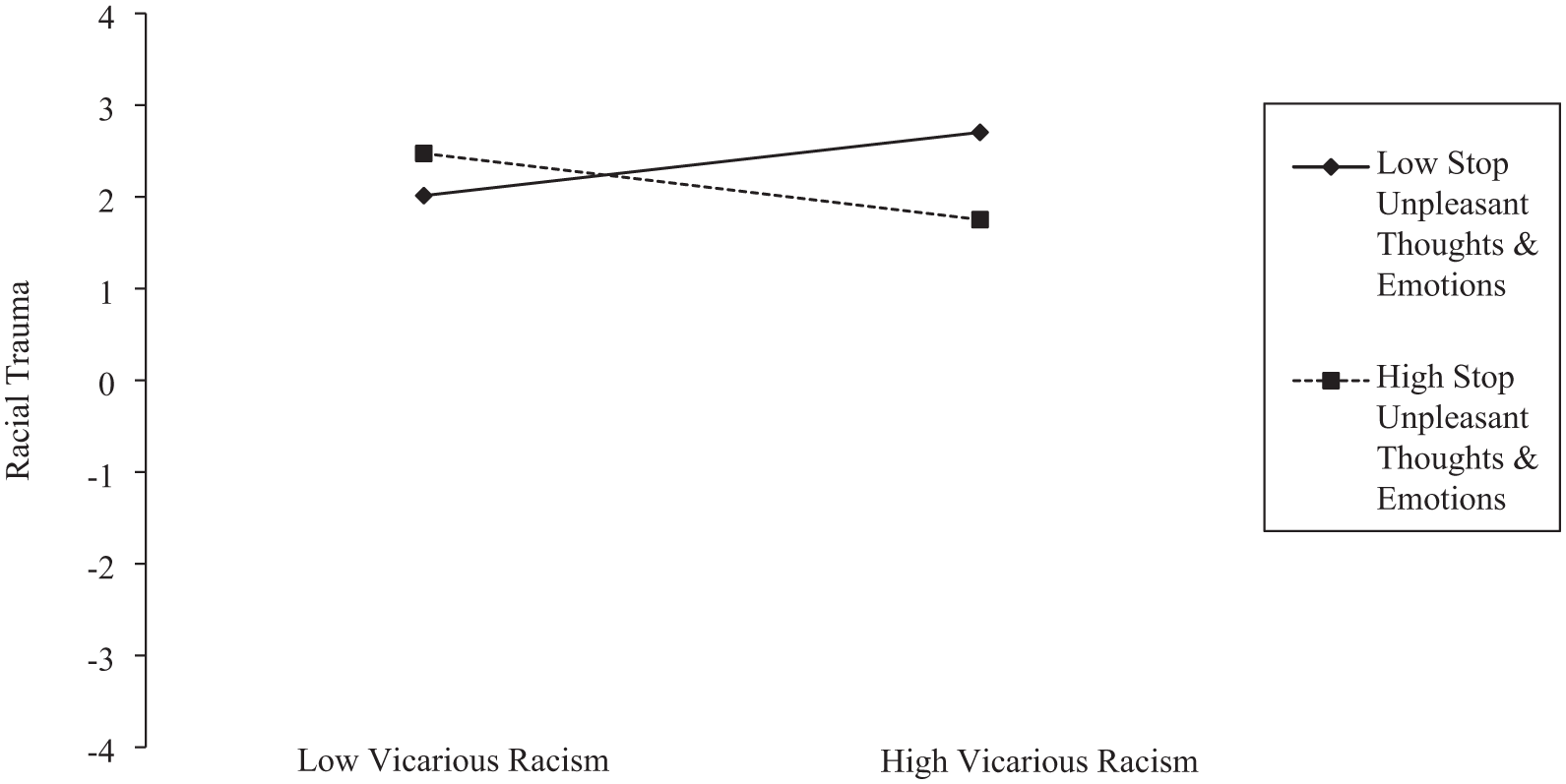
Vicarious racism × coping self-efficacy (suppressing unpleasant thoughts and emotions).

Racial violence (media) × coping self-efficacy (suppressing unpleasant thoughts and emotions).
Discussion
Overall, this study examined racial stressors such as interpersonal racism, vicarious racism, racial violence exposure through social media, and the impact on dysphoria and racial trauma, and the protective role of coping self-efficacy (i.e., suppressing unpleasant thoughts and emotions) among Black women. The Transactional Theory of Stress and Coping Model 59 and Black Feminist Thought 60 served as the guiding frameworks to understand how racial stressors, which can be considered extreme chronic stressors, impact the well-being of Black women. These frameworks also recognize the protective role of coping self-efficacy (i.e., suppressing unpleasant thoughts and emotions), which refers to the ability of Black women’s perceptions of their ability to suppress unpleasant thoughts and emotions in the context of racial stress. Overall, the findings of the study revealed that racial stressors (i.e., interpersonal racism, vicarious racism, and racial violence exposure through social media) were significantly associated with higher levels of dysphoria among Black women. Also, racial violence exposure through social media was associated with lower levels of racial trauma, and interpersonal experiences of racism were associated with higher levels of racial trauma. Lastly, we found that under conditions of high exposure to vicarious racism, Black women who endorsed higher levels of their ability to suppress unpleasant thoughts and emotions reported lower levels of racial trauma; however, Black women who used less or felt less capable of their ability to suppress unpleasant thoughts and emotions reported higher levels of racial trauma. The findings also revealed that under conditions of exposure to higher levels of racial violence through social media, Black women who also reported suppressing unpleasant thoughts and emotions tended to report lower levels of racial trauma. These findings contribute to the development of preventive interventions by highlighting the importance of identifying and utilizing adaptive coping mechanisms that serve as protective factors for Black women in the context of racial stress.
The psychological toll of racial stressors
Overall, the study findings corroborate previous literature documenting the negative impact of racial stressors on Black Americans’ well-being. In the current study, we found that interpersonal racism, vicarious racism, and exposure to racial violence through social media had a significant impact on Black women’s well-being. To our knowledge, this is one of the first studies that have examined the impact of racial stressors on Black women’s mental health outcomes by intentionally centering dysphoria. According to the American Psychiatric Association, 70 dysphoria is the state of unease, dissatisfaction, and emotional distress. It can often refer to a profound sense of discomfort or discontent, and it is associated with mental health outcomes such as depression, anxiety, or trauma-related disorders.
In the current study, we use the conceptualization of the MAACL-R dysphoria (anxiety, depression, and hostility) to understand how racial stressors were predictive of dysphoria. Studies that have documented dysphoria as a complex emotional state have noted its relationship to irritability, tension, depression, paranoid tendencies, anxiety, and hostility. 71 Racial stressors significantly impact well-being, and our findings contribute to the existing literature by further illuminating this relationship. For instance, Matheson and Anisman 72 found that dysphoria was associated with higher levels of emotion-focused coping. Given the significant association between racial stressors and dysphoria in our study, this may explain the process by which racial discrimination leads to poor mental health outcomes. In addition to the negative impact of interpersonal and vicarious racism on the mental health outcomes of Black women, our findings also extend the literature by identifying the impact of racial violence exposure on social media, which has become an increasingly concerning type of racial stressor, particularly for Black women.
The risk of emotional suppression for Black women’s mental health
Additionally, for dysphoria, Black women who reported higher levels of coping self-efficacy that pertained to their confidence in their ability to suppress unpleasant thoughts and emotions reported higher levels of dysphoria. One possible explanation is that the items included in the coping self-efficacy subscale for stopping unpleasant thoughts and emotions may reflect the desire to hide emotions, which could be considered emotional suppression. For instance, studies have found that using thought suppression—the idea of attempting to stop or avoid unpleasant thoughts as a coping strategy—is associated with higher rates of depression and psychological distress.73,74 More specifically, thought suppression has been associated with heightened brooding, rumination, and unwanted thoughts.75 –77 Regarding Black women, Erving et al. 78 found that anger suppression was associated with higher risk for depressive symptomatology. Relatedly, the Strong Black Women or “superwoman” schema refers to the view that Black women are perpetually strong, resilient, stoic, and invulnerable.78 –80 The findings of this study support existing literature by demonstrating that coping self-efficacy—specifically, Black women’s perceived ability to suppress unpleasant thoughts and emotions—can be detrimental to their health.
Additionally, because suppression might be a form of avoidant coping, it is important to consider additional coping strategies drawing on culturally strength-based resources and assets that would promote mental health outcomes. For instance, strategies that have been documented are social support, 53 spirituality and faith-based practices, 81 activism and critical consciousness, 82 and mental health services that are culturally responsive. 83 Thus, Black women can engage in spaces that validate their lived experiences and be able to facilitate critical dialogue around healthy strategies to resist internalizing the Strong Black Woman schema.
Coping under pressure: Racialized stress and trauma in the lives of Black women
Racial trauma refers to the psychological and emotional distress resulting from racism, including microaggressions, violence, and systemic inequities. Cumulative experiences of racism can lead to trauma-related symptoms. 41 Racial stressors have a detrimental impact on racial trauma for Black Americans. 2 Moreover, race, gender, and social class intertwine to produce unique stressors impacting coping mechanisms and overall health and well-being in Black women. 14 In our study, our findings corroborate previous literatures. More specifically, we found that interpersonal racism was associated with racial trauma. Additionally, we also found that exposure to racial violence through social media was associated with lower levels of racial trauma. Although we initially expected that it would be associated with higher levels of racial trauma. It is possible that Black women who report exposure to racial violence through social media have developed some sort of numbing, such as desensitization. 2 Exposure to racial violence through social media might prepare Black women with what they must do to be resilient, resistant, or for what might happen to them. This may lead to increase conversations around racial socialization—messaging to their family, friends, and adolescents about their racial identity, experiences with racism, and strategies to cope with racism.44,84
Thus, exposure to racial violence through social media might be perceived as preparing Black women for the realities of racism. Although the current study assessed for racial trauma, it is possible that this desensitization can be a form of protection.31,42,49 Future research is needed to understand the nuances of racial violence exposure through social media. The findings of our study highlight the importance of a desensitization or numbing effect, increased awareness and preparedness, social connection and collective coping, and sociopolitical awareness and critical consciousness.
Reevaluating the protective role of suppressing negative emotions and thoughts in relation to racial trauma
Despite the literature noting that suppression of thought is associated with poor mental health outcomes, 2 our findings show that the act of suppressing unpleasant thoughts and emotions serves as a protective factor for Black women who encounter racial stressors and racial trauma. More specifically, findings indicated that Black women who reported higher levels of vicarious racism and coping self-efficacy (i.e., confidence in their ability to suppress unpleasant thoughts and emotions), reported lower levels of racial trauma, while those with lower levels of coping self-efficacy reported higher levels of racial trauma. Because vicarious racism involves the indirect racialized experiences of racism—from either hearing about them from others, witnessing them, or the anticipation of experiencing racism—suppression of emotions and thoughts may buffer the relationship between vicarious racism experiences and racial trauma. One of the ways in which racial trauma manifests is through hypervigilance, which is the state of excessive alertness and heightened sensitivity to one’s surroundings.
Thus, because vicarious racism involves witnessing or learning about acts of racism, hypervigilance might serve to remain aware of one’s surroundings. Moreover, the use of smartphones and social media has led to increased documentation and dissemination of discriminatory events, underscoring the importance of understanding vicarious racial discrimination and its effects on Black well-being. 45 Because racial trauma encompasses direct and indirect experiences of racism, hypervigilance may serve as a coping strategy to downplay the impact and or prepare themselves in ways to engage in emotion regulation. Similar findings were noted regarding exposure to higher levels of racial violence. More specifically, we found that Black women in our study who reported higher levels of exposure to racial violence through social media—and who also reported higher levels of stopping unpleasant thoughts and emotions—reported lower levels of racial trauma. Thus, exposure to racial violence through social media may serve as a form of desensitization, functioning as a protective mechanism. Additionally, this exposure might also help prepare Black women for what to expect and how to respond accordingly. The impact of vicarious racism, where individuals experience racism indirectly through witnessing or hearing about the experiences of others, can significantly affect mental health and well-being. 43 However, the role of coping self-efficacy (i.e., one’s belief in their ability to suppress unpleasant thoughts and emotions) serves as a protective factor for Black women encountering indirect exposure to racial stressors. Future research is needed to understand the complexities of vicarious racism experiences, the belief in one’s ability to suppress unpleasant thoughts and emotions, and exposure to racial violence through social media.
Limitations
Although this study provides important insights into the impact of racial stressors, coping strategies, dysphoria, and racial trauma in Black women, there are limitations. The study used a cross-sectional design, which limits the ability to determine causality. Utilizing a longitudinal design would help determine causality and how racial stressors impact racial trauma across the life course. For instance, using longitudinal and mixed-methods designs will further contribute to our understanding of Black women racialized and gendered experiences and the role of suppressing unpleasant emotions and thoughts over time. Emotion-focused coping is typically described as exerting a short-term adaptive effect when stressors are chronic and uncontrollable. 61 Therefore, while suppressing unpleasant thoughts and emotions may be protective in the short term for Black women, it is unclear what suppression of emotions reveals over time and its potential negative health outcomes. Furthermore, a mixed-methods design will enable us to provide a more comprehensive and in-depth understanding of the meaning-making surrounding the suppression of unpleasant emotions and thoughts in the context of racial stress. Both methods will contribute to our understanding of stress and coping, while also centering the experiences of Black women, which can help us comprehend the impact on health outcomes.
Also, our sample included Black women whose age range spanned from 25 to 49 years of age. Future studies should consider emerging adulthood, middle adulthood, and older adulthood to understand how racial trauma differs across development. 85 Additionally, the sample consisted of Black women residing in urban areas in the United States, which may limit the generalizability of the findings to Black women in rural areas or in other countries. 31 There were also limitations related to the measures used in the study. For instance, although we discuss the racial and gendered experiences of Black women, our measures were not intersectional. For example, the racial stressor scales did not ask about the racialized and gendered experiences of Black women. Thus, utilizing Black Feminist Thought, 60 the use of intersectional measures is important to understand the nuance of Black women’s racialized and gendered experiences. Although the coping self-efficacy measure in the current study demonstrates adequate psychometric properties, this measure was not originally developed to capture the intersectional realities of Black women’s racialized and gendered experiences. Additionally, the coping self-efficacy construct used (i.e., suppressing unpleasant thoughts and emotions) may only partially reflect ways that Black women respond to interpersonal racism, vicarious racism, and racial violence exposure through social media. For example, coping strategies such as emotional suppression or cognitive disengagement may be interpreted as maladaptive within dominant stress frameworks, yet function as contextually adaptive or protective within racialized and gendered power structures. Even in the short-term period, this mismatch raises important questions about construct validity, as existing measures may not capture culturally specific meanings, functions, and consequences of Black women. Future research will benefit from the development of validation of intersectionality, grounded measures, and measures that explicitly center Black women lived experiences, strengthening the conceptual and empirical alignment between Black Feminist Thought, measurement, and observed health and racial trauma outcomes. Likewise, our coping scale and racial trauma scale did not capture racialized or gendered nuances. Future studies should consider using racialized and gendered specific scales.
Additionally, research on racial identity (e.g., racial centrality) may uncover intricate relationships that impact the well-being of Black women. Racial centrality, which refers to the significance of race in an individual’s identity, can serve as both a risk and a protective factor. 86 Elevated racial centrality is associated with heightened exposure to racial discrimination 87 and intensified psychological distress in instances of discrimination.88,89 Racial centrality also mitigates the adverse effects of discrimination and anticipates heightened emotional responses to racism, particularly anger and disgust.87,90 This heightened awareness, particularly stereotype awareness, negatively affects mental health and self-care practices. 89 Future research should examine racial identity to understand how Black women perceive and encounter racism as threatening. Higher racial centrality may make race more salient and intensify emotional responses, but it can also buffer against distress and affirm group belonging. Overall, attention to racial identity offers a critical lens for clarifying how Black women’s anticipatory expectations of racism, heightened vigilance to bias, and emotional resilience are shaped and sustained. In conclusion, given the exploratory nature of examining the moderating role of emotion-focused coping self-efficacy, a formal a priori power analysis was not conducted. The study was designed to assess the preliminary interaction effects and inform future confirmatory research. However, the absence of power estimation constitutes a methodological limitation. Consequently, this should be considered a limitation when interpreting the findings.
Implications for future research
This study has several implications for future research. First, future research should examine the role of other coping strategies—such as seeking social support, problem-solving, and cognitive restructuring—in the relationship between racial stressors, dysphoria, and racial trauma. More specifically, our findings advance the understanding of racial stressors (interpersonal racism, vicarious racism, and exposure to racial violence through social media) and how they uniquely impact the mental health and well-being of Black women. Thus, culturally relevant interventions are needed, along with the development of measures that address the intersectional experiences of Black women. Our findings also contribute to the dearth of research on how dysphoria and racial trauma manifest in Black women who encounter racial stressors, and how suppression of unpleasant thoughts can be detrimental for mental health (i.e., dysphoria). Culturally responsive approaches can inform the development of preventive interventions that affirm and create space for Black women to process their gendered racialized experiences in ways that foster both resistance and thriving. Additionally, this study has implications for clinical practice. Mental health professionals should be aware of the unique challenges that Black women face and should be trained to provide culturally competent care. 2 By understanding the impact of racial stressors on mental health and race-based trauma, clinicians can develop more effective interventions to help Black women cope with these experiences and support the need for culturally nuanced and trauma-informed practices in healthcare and community-based organizational settings. Additionally, while developing intersectional measures and research designs to assess racial stress and coping processes among Black women, such approaches alone are insufficient for addressing the lived consequences of the impact of racism. Intervention-based studies, particularly those that are culturally responsive and strength-based, are a critical next step by testing mechanisms of change and identifying actionable pathways to improve the well-being of Black women. These approaches move beyond documenting harm to actively examining how culturally strength-based interventions can be leveraged to mitigate racial trauma and dysphoria.
Conclusion
In conclusion, this study highlights the importance of addressing racial stressors and coping mechanisms to promote the mental health and well-being of Black women. We found that racial stressors (i.e., interpersonal racism, vicarious racism, and racial violence exposure through social media) were significantly associated with higher levels of dysphoria among African American women. While racial violence through social media was linked to lower levels of racial trauma, interpersonal racism was associated with higher levels of racial trauma. Additionally, under conditions of high exposure to vicarious racism or racial violence, Black women who reported a greater ability to suppress unpleasant thoughts and emotions reported lower racial trauma, whereas those with lower coping self-efficacy reported higher trauma.
Yet, despite, the protective mechanism of suppressing negative emotions and thoughts; it is important to note that suppression may serve as a short-term protective regulatory mechanism, reducing racial trauma in the context of racial stress. Thus, it is important to note that suppressing negative thoughts and emotions serves as emotional regulation in the face of racial stress, not as emotional absence. Importantly, the protective effects observed here must be understood within racialized environments characterized by chronic exposure, limited control, and social penalties for emotional expression, especially for Black women, as they are often perceived as hostile and angry. While this regulatory strategy may reduce racial trauma, sustained reliance on suppressing emotional responses may carry long-term emotional and physiological costs, particularly when opportunities for processing, validation, and collective care are restrained. Thus, these findings should not be interpreted as indicating that emotional numbness or desensitization is healthy or a desirable coping mechanism for more Black women. Rather, they highlight how adaptive responses emerge in contexts where full emotional expression is often unsafe or unsupported. Overall, culturally strength-based responsive interventions should not aim to eliminate suppression, but to expand the conditions under which Black women can safely express process and heal from racial stress without additional harm. Thus, our findings contribute to scholarship on the experiences of Black women and racial stress. Future research should continue to explore the complex interplay between racial stressors, coping strategies, and mental health outcomes to develop effective interventions that support the resilience and well-being of Black women.
Supplemental Material
sj-pdf-1-whe-10.1177_17455057261442095 – Supplemental material for Weathering the storm: Coping self-efficacy, racial trauma, and dysphoria among Black women facing racial stress
Supplemental material, sj-pdf-1-whe-10.1177_17455057261442095 for Weathering the storm: Coping self-efficacy, racial trauma, and dysphoria among Black women facing racial stress by Sheretta T. Butler-Barnes, Ivy Smith and Marlena Debreaux in Women's Health
Footnotes
Acknowledgements
The research team thanks the families that participated in the project.

Ethical considerations
The study is approved by the Institutional Review Board (Pro20240000006) of Rutgers University.
Consent to participate
For participants completing the survey online, informed consent was obtained electronically. Participants reviewed the online consent by selecting an agreement option before proceeding to the survey. For participants completing the study in person, written informed consent would be obtained prior to participation. All participants completed the informed consent online via Qualtrics. Before participating in the study, participants were provided with the Prinicipal Investigator’s (PI) contact information so they could ask questions.
Consent for publication
Consent for publication was included and obtained via the consent form.
Author contributions
Funding
The authors disclosed receipt of the following financial support for the research, authorship, and/or publication of this article: The study was supported by Rutgers University School of Social Work.
Declaration of conflicting interests
The authors declared no potential conflicts of interest with respect to the research, authorship, and/or publication of this article.
Data availability statement
The data shown here are provided according to the appropriate demand by the researcher. To obtain access to the raw data analyzed in this study, contact the corresponding author (STB-B).
Supplemental material
Supplemental material for this article is available online.