



Abstract
Background:
Women’s sexual and reproductive rights are crucial for achieving gender equality and promoting women’s rights. Husbands’ knowledge and involvement are key in helping women practice their sexual and reproductive health rights. Across East Africa, there are limited studies about husbands’ knowledge of their partner’s reproductive rights and their associated factors. Hence, this study aimed to determine husbands’ knowledge of their partners’ reproductive health rights.
Objective:
To assess husbands’ knowledge of their partners’ reproductive rights and associated factors in Gurage Zone, Central Ethiopia, 2023.
Design:
A community-based cross-sectional study was conducted among 632 husbands in Wolkite town from March to April, 2023.
Methods:
Multi-stage stratified sampling, along with systematic random sampling techniques, was employed to select study participants. A structured, interviewer-administered questionnaire was utilized to gather the data, and then SPSS version 26 was employed for analysis. Bivariate and multivariable analyses were performed to identify variables associated with the husband’s knowledge of his partner’s reproductive rights using the binary logistic regression model. Statistical significance was declared at a p-value <0.05.
Results:
The overall good knowledge of partners’ reproductive health rights was found to be 47.8% (95% confidence interval (CI): 43.8, 51.8). Age of the husbands 25–35 years (adjusted odds ratio (AOR): 2.7; 95% CI: 1.10, 6.6), below primary educational status (AOR: 2.4; 95% CI: 1.3, 4.3), primary educational status (AOR: 5.98; 95% CI: 3.10, 11.4), secondary educational status (AOR: 2.1; 95% CI: 1.01, 4.3), above secondary education status (AOR: 8.0; 95% CI: 4.3, 15.2), discussion with a partner (AOR: 3.2; 95% CI: 2.0, 5.2), and vehicle as a means of transport (AOR: 3.3; 95% CI: 2.2, 4.9) were statistically significant for good husbands’ knowledge of partners reproductive health rights.
Conclusion:
These findings indicate that more than half (52.2%) of the study participants had a weak understanding of their partners’ reproductive rights. So, counseling and education should be offered to husbands to enhance their knowledge of reproductive rights.
Introduction
Reproductive rights are the freedom to choose about reproduction without discrimination, coercion, or violence, and include 12 basic human rights such as life, liberty, security, privacy, equality, consent to marriage, health, access to education, family planning, and scientific progress based on the International Conference on Population and Development (ICPD) frame work.1–3 The United Nations has prioritized gender equality and the empowerment of women and girls as Goal 5 to ensure universal access to sexual and reproductive health rights, aiming to achieve the Sustainable Development Goals (SDGs) by 2030. 4 In the mid-1990s, the ICPD held in Cairo marked a shift by recognizing men’s shared responsibility in advancing women’s reproductive rights. 5
Globally, approximately 30% of women experience reproductive rights violence, particularly by their intimate partner. 6 Despite these global efforts, violence against women’s reproductive rights remains a significant challenge, particularly regarding physical and sexual access to reproductive education, services, and contraceptive use.1,2 The abuse of reproductive rights by these partners presents a public health concern, particularly in African countries where reported rates range from 20% to 70%.7,8 Many women believe that one of the main causes of intimate partner violence is a lack of knowledge and assistance about sexual and reproductive health rights and services. 9 Furthermore, intimate partner sexual violence among married women is one of the root problems of reproductive rights. 10 The Women’s reproductive rights violations are attributed to husbands’ insufficient knowledge, lack of reproductive education, and lack of spousal discussions on reproductive issues. 11 Studies across countries have consistently revealed that husbands generally have low levels of knowledge regarding reproductive health rights and are less engaged in their partners’ reproductive healthcare.12–14
In many developing countries, men influence women’s access to resources, and studies show that husbands’ involvement in reproductive rights improves women’s access to maternal healthcare services. 15 The Ethiopian Federal Ministry of Health, in line with the WHO, has set seven strategic directions to prevent women’s reproductive and other human rights violations. 16 A 2013 WHO study found Ethiopia had the highest rate of intimate partner reproductive rights violations among 10 countries, with 53.7% experiencing sexual, physical, or both violations within 1 year and 70.9% over their lifetime. 17 The study found that 29.6% of intimate partners violated their reproductive health rights in the Southern Nations, Nationalities, and Peoples’ Region of Ethiopia. 15
The evidence revealed that limited knowledge among husbands about their partners’ reproductive health rights is associated with women’s increased risk of physical violence, which in turn correlates with adverse reproductive health outcomes.15,17 Studies conducted in Ethiopia indicated that husbands’ knowledge of their partners’ reproductive health rights ranged from 48.3% to 50.6%.18,19 Insufficient knowledge among husbands regarding their partners’ reproductive health rights contributes to delayed or absent care-seeking, unmet contraceptive needs, insufficient menstrual and sexual health support, restricted autonomy in women’s decision-making, poor spousal communication, financial constraints, and low participation in sexual and reproductive health programs.20-23
Understanding reproductive rights enables husbands to plan and intervene in maternal healthcare, use modern scientific developments like contraception, prevent diseases (sexual transmitted infection (STIs) and HIV/AIDS), and promote pleasant sexual lives. 9 Conversely, limited husbands’ knowledge has a significant detrimental impact on the implementation of their partners’ reproductive health rights. These gaps lead to low health service usage, lack of access to reproductive-related knowledge and utilization of scientific progress, such as contraception and other reproductive rights, resulting in a high burden of maternal morbidity and mortality.2,24
Generally, despite the influence of men on their partners’ use of reproductive rights and the associated consequences, the level of husbands’ knowledge and related factors has not been achieved as required, both nationally and in the study setting. As a result, the importance of this study was to help plan good interventions for women’s reproductive health rights against poor reproductive health services to achieve better health outcomes. Therefore, this study aimed to determine the level of knowledge regarding reproductive rights and factors that influence them among husbands in Wolkite town, central Ethiopia.
Objective of the study
To assess husbands’ knowledge of their partner’s reproductive health rights and associated factors in Wolkite town, Central Ethiopia, 2023.
Materials and methods
Study area and period
The research was conducted in Wolkite town between March and April 2023. The city of Wolkite is situated in the Gurage Zone in Central Ethiopia. It is the zone’s capital and is situated 158 km south of Addis Ababa on the route to Jimma town. Two rural and six urban Kebeles serve as the town’s administrative hubs. The town’s population is estimated to be 79,987, according to the 2007 Ethiopian census projection for 2019/2020, with 15,997 households.
Design and population of study
A community-based cross-sectional study was conducted. The source populations were all husbands who had reproductive-age partners in Wolkite town. All husbands who had reproductive-age partners during the study period were included in the study. Husbands who were critically ill were excluded from the study.
Sample size determination
The sample size was calculated using a single population percentage formula based on frequency assumptions (husband’s knowledge of partner sexual and reproductive rights (48.3%) from a study conducted in Harar city, 18 95% confidence interval (95% CI), 5% margin of error, 10% non-response rate, considering the design effect of 1.5, which yielded 632). Sample size determination for the second objective; the factors for husbands’ knowledge of partners’ reproductive rights were obtained from the same study and calculated by Epi Info 7 stat calculation, with assumptions of 95% CI, 80% power, and exposure to the unexposed ratio of 1:1. Since the sample size for the single population proportion (632) was greater than the sample for associated factors (115, 201, and 320), the ultimate sample size for this study was 632.
Sampling procedures
Wolkite town has eight Kebeles, of which four Kebeles were selected by simple random sampling. The town’s Kebeles were first divided into urban and rural categories. Then, using the basic random selection approach, one out of two rural and three out of six urban Kebeles were chosen from each stratum. The study used a family folder of Kebele administration households with reproductive-age women as a sampling frame, which is regularly updated. The first household was selected using a lottery method between 1 and K, where K = 10445/632 = 16. The study participants were chosen by keeping the class interval at 16 and including all eligible husbands until the required sample size was reached. A lottery was employed to choose one eligible participant from households with more than one eligible member (Figure 1).

Schematic presentation of sampling procedure of study participants at Wolkite town, central Ethiopia, 2023.
Study variables
Outcome variable
Husbands’ knowledge of partners’ reproductive health rights.
Predictor variables
Sociodemographic characteristics such as age, religion, residence, educational level, occupation, family size, and discussion on reproductive issues. Health service and information-related: Husband’s reproductive service experience, mass media use, access to the reproductive education program, type of health facility present nearby, means of transportation, and distance to reach a health facility.
Operational definitions
Women’s reproductive rights
The right of women to make free decisions and choices on the 12 basic human rights. 4
Husband’s knowledge
The husband’s knowledge was assessed by 11 questions adapted to determine husbands’ understanding of their partners’ reproductive rights, and each correct answer has a score of one, while each incorrect response the answer has a score of zero. Based on the summative scores from questions designed to determine the participants’ overall knowledge of husbands on their partner’s reproductive rights, they were categorized as having poor or good knowledge.9,18,19
Good knowledge
Husbands who scored equal to the mean value or higher on correct knowledge questions were considered to have good knowledge of their partners’ reproductive health rights. Those who scored less than the mean value, on the other hand, were considered to have poor knowledge of their partners’ reproductive health rights.
Reproductive service user experience
In this study, reproductive service user experience was measured as a binary variable (1 standing for Yes, 0 standing for No), indicating whether the husband had ever utilized reproductive health services. This measure was used to assess service exposure rather than satisfaction or quality of services. 18
Kebele
Kebeles designated as rural by the town administration and not meeting urban criteria are considered rural, whereas Kebeles are considered urban if they have a population of more than 2000, are administered by a municipality, have income-generating economic activities, and most residents are engaged in non-agricultural activities. 25
Data collection tool and procedures
A structured questionnaire administered by an interviewer was adapted from other literature created for a similar purpose by various authors.9,18,19 The content validity was checked by field experts and professionals for relevance, clarity, and completeness of the tool, and the reliability of the questionnaires was checked using Cronbach’s alpha value, which was 0.86. The questionnaire contains two parts: sociodemographic characteristics and knowledge of reproductive rights. Eight health extension workers and two supervisors (BSc midwives) were chosen from Wolkite town for the data collection task based on their background in data collection and fluency in the local languages, Guragigna and Amharic. Two days of training were given to supervisors and data collectors on the purpose, objectives, confidentiality, rights of respondents, informed consent, and interviewing techniques. After that, data collectors gave study participants an explanation of the purpose, objectives, confidentiality, and their right to decline or withdraw. After all, study participants gave their signed and written consent, and data collectors used a pretested questionnaire to gather data from eligible study participants and set up a convenient time for a follow-up when respondents were unavailable at home. The principal investigator and supervisors follow the data collection procedure on each day of the study.
This study was reported in accordance with the Strengthening the Reporting of Observational Studies in Epidemiology (STROBE) guidelines for cross-sectional studies. 26
Data quality control
The principal investigator provided comprehensive training to data collectors and supervisors on data collection procedures, ethical considerations, data validity risks, and each question included in the study to ensure data quality.
The questionnaire was pretested on a 5% sample size at Addis Hiwot Kebele before the actual data collection period to assess its simplicity, sequence, coherence, clarity, and time to complete. Later, any ambiguity, complex words, and differences in comprehension were revised based on pretest experience. Participants were given a detailed explanation of the study’s purpose, procedure, confidentiality, and benefits to obtain informed consent and reliable data.
Finally, after ensuring that the data were complete and properly coded with a unique identification number, each response was entered into the software for analysis. EpiData was used for data entry because it has an error detection mechanism built in. To ensure data consistency, two separate data clerks double-entered the information. Data were stored in the form of a file in a secure location where only the principal had access to it.
Statistical analysis
Data entry was done using EpiData version 4.1. The entered data were checked and exported to SPSS version 26 for data analysis. Different frequency tables, graphs, and descriptive summaries were used to describe the study variables. In bivariate analysis, a crude odds ratio with 95% CI was used to identify the candidate variables for multivariable analysis by using the binary logistic regression model. The result was presented as a crude odds ratio to show the strength of the association between the independent variable and the dependent variable. Independent variables with a significance level of p-value <0.25 at 95% CI in bivariable analysis and which were fit for the model of regression were retained for inclusion into the multivariable logistic regression to control all possible confounders.
Multicollinearity was checked to see the linear correlation among the associated independent variables by using the variance inflation factor (VIF) and standard error. VIF of >10 or standard error of >2 was considered suggestive of the existence of multicollinearity. No multicollinearity was detected during the analysis. For all independent variables, the multicollinearity effect was checked by collinearity diagnostic statistics via VIF and tolerance test with a maximum value of 2.34 and a minimum value of 35.6%, respectively.
In multivariable analysis, the multivariable logistic regression model was used to control the confounders. The Hosmer–Lemeshow goodness-of-fit test was done to check for model fitness with a p-value of 0.542, which indicates the model was fitted. Adjusted odds ratio (AOR) with 95% CI was estimated to show the strength of association between the independent variables and the dependent variable after controlling for the effects of confounders. The results were considered statistically significant at a p-value <0.05. Finally, tables, graphs, and narration were used to present the findings.
Ethical approval and consent to participants
Ethical clearance was obtained from the Institutional Health Research Ethics Review Committee of Bahir Dar University, with reference number IBRERC/008/23. The study was conducted based on the ethical standards of the Declaration of Helsinki. The ethical letter was given to the Gurage Zone health office and the Wolkite town health office to get permission for the data collection process. The purpose of the study, participants’ right to refuse, confidentiality, and voluntary participation were explained in detail to the study participants, and informed written consent was obtained. Moreover, consent from participants with no formal education was obtained after the information sheet was read aloud in the local language by data collectors and documented by thumb impression with a witness. Additionally, written informed consent was obtained from the legally authorized representatives of all under the age of 18 years before enrollment. Coding was implemented to remove respondents’ names and other personal identifiers throughout the study to ensure participant confidentiality.
Results
Among a total sample of 632 study participants, 628 were interviewed and gave a response rate of 99.4%, and the results were presented as follows under subheadings.
Sociodemographic characteristics of the study participants
The minimum and maximum ages of the respondents were 20 and 60 years, respectively, with a mean age of 36.94 ± 7.67 years. The minimum and maximum ages of the partners were 18 and 45 years, respectively, with a mean age of 30.1 ± 6.16 years. Regarding educational status, about 164 (26.1%) respondents have no formal education (Table 1).
Sociodemographic characteristics of respondents in Wolkite town, Central Ethiopia, 2023 (n = 628).
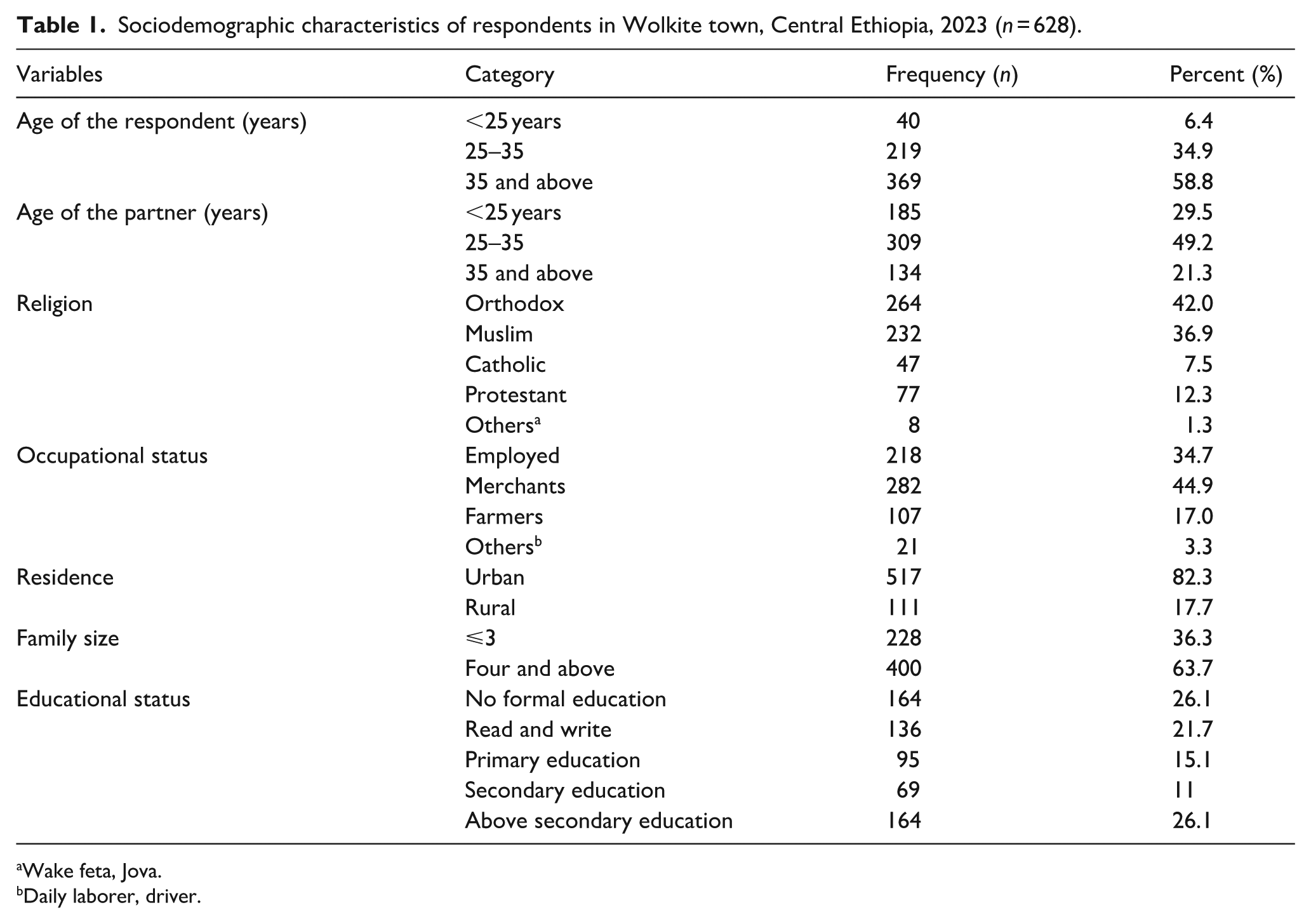
Wake feta, Jova.
Daily laborer, driver.
Health service and information-related factors
Of the respondents, 593 (94.4%) utilized mass media. When calculating the time, it takes to get from their homes to medical facilities, 79 people (12.0%) take longer than 30 min. In addition, 376 (59.9%) and 274 (43.6%) of the husbands have experience with using reproductive services and have available reproductive education programs, respectively. Similarly, 433 (68.9%) of the respondents have a discussion on reproductive health-related matters with their partners (Table 2).
Health service and information-related factors among the respondents in Wolkite town, Central Ethiopia, 2023 (n = 628).

Other means of transport are on foot and by animal.
Husbands’ knowledge of partners’ reproductive health rights
The prevalence of husbands’ good knowledge of partners’ reproductive rights was 47.8% (95% CI: 43.8, 51.8). About half of the respondents were aware that married women have the complete right to obtain all reproductive healthcare without their husbands’ permission (Figure 2).

Level of husband’s knowledge on their partner’s reproductive health rights in Wolkite Town, Central Ethiopia, from March 1 to April 30, 2023, GC.
Almost one-fourth of the husbands (24.4%) were aware that married women have a right to the confidentiality of their reproductive health information.
Factors associated with husbands’ knowledge of their partners’ reproductive rights
In this study, candidate variables were selected with a p-value <0.25 in bivariate analysis.
Among the variables, the age of the respondent, partners’ age, educational status, family size, nearest health facility, means of transport, availability of reproductive health (RH) program, discussion with RH matters, and experiences of using RH services were candidate variables for the multivariable analysis.
Among the candidate variables, the age of the respondent, the educational status of the respondent, discussion with RH matters, and means of transport were statistically significant with the outcome variable. Husbands between the ages of 25 and 35 were 2.7 times more likely to be knowledgeable about their partners’ reproductive rights than those under the age of 25 (AOR: 2.7; 95% CI: 1.10, 6.60).
Husbands who can read and write were two times more likely to have good knowledge when compared to those with no formal education (AOR: 2.4; 95% CI: 1.3, 4.3). The odds of having good knowledge about partners’ reproductive rights among husbands who have primary education were 5.98 times more likely than those with no formal education (AOR: 5.98; 95% CI: 3.1, 11.4). The husbands who had learned secondary school were two times more likely to have good knowledge as compared to those with no formal education (AOR: 2.1; 95% CI: 1.0, 4.3). Moreover, husbands who had completed above secondary education were eight times more likely to have good knowledge about their partners’ reproductive rights than those without formal education (AOR: 8.0; 95% CI: 4.3, 15.2).
Husbands having good knowledge who discussed reproductive health matters with their partner were three times more likely to do so as compared with those who had not discussed reproductive health matters (AOR: 3.2; 95% CI: 2.0, 5.1). Respondents who have used vehicles as a means of transport were three times more likely to have good knowledge as compared with those who use other means of transport (AOR: 3.3; 95% CI: 2.2, 4.9; Table 3).
Factors associated with husbands’ knowledge of their partner’s reproductive rights in Wolkite town, Central Ethiopia, 2023 (n = 628).

CI: confidence interval, COR: crude odds ratio, AOR: adjusted odds ratio, RH: reproductive health.
Discussion
Husbands’ knowledge regarding their partners’ reproductive health rights is critical for better reproductive health outcomes. Limited husbands’ knowledge is a root cause of low reproductive health services, which contribute to maternal morbidity and mortality. This study shared the goal of the SDGs and the ICPD program of action, which emphasizes men’s shared responsibility in achieving reproductive health and gender equality by 2030. 4 By assessing husbands’ knowledge of their partners’ reproductive health rights, this study contributes to advancing the SDG target for countries to reduce the maternal mortality ratio to less than 70 per 100,000 live births by 2030 and to realizing the ICPD vision of equitable participation in reproductive decision-making. 5 This community-based cross-sectional study identifies factors associated with husbands’ knowledge of reproductive health rights. In the present study, the age of respondents, educational status, means of transport, and discussion of RH matters were associated with husbands’ knowledge of their partners’ reproductive health rights.
The prevalence of husbands’ good knowledge of their partners’ reproductive rights was 47.8% (95% CI: 43.8, 51.8). This finding is consistent with studies conducted in Harar and Bahir Dar, which found that 48.3% and 50.6% of husbands had good knowledge of their partners’ reproductive rights.18,19 This consistency may be due to similarities in the target population, study design, and sampling technique. Furthermore, it could be because government intervention tactics are consistent throughout the country, through the expansion of the Health Extension Program, which aims to achieve universal primary healthcare coverage by increasing knowledge for disease prevention and promoting overall health and well-being. As a result, the work of health extension professionals involves raising awareness of reproductive health rights.27,28
This finding is higher than that of the study conducted in Nepal, which revealed that 9.1% of husbands have good knowledge of their partners’ reproductive rights. 29 These differences might be due to the assessment tools used, variations in socioeconomic status, differences in study periods, and variations in government intervention strategies between the two countries. Furthermore, they may be attributed to the presence of well-trained health extension workers providing reproductive health services as part of a community engagement project conducted by Wolkite University in the present study setting. In contrast, the results of the current study were lower than those of the studies conducted in South Africa (56.1%) and Ghana (53.8%).30,31 This discrepancy might be due to variations in educational level. All respondents in South Africa and Ghana were university students, whereas in this study, most respondents had an education below the secondary level. This difference may be explained by the fact that students attending higher education are more likely to have the ability to analyze and understand reproductive health rights. 29
Husbands aged 25 to 35 were 2.7 times more likely to be knowledgeable about their partners’ reproductive rights than those under 25. The possible justification may be attributed to higher educational attainment, greater awareness of reproductive and sexual health rights, and increased exposure to marital life, family interactions, and healthcare systems, all of which contribute to a better understanding of reproductive health issues. Additionally, husbands aged 25–35 are more likely to have financial stability, stronger communication with their partners, and broader exposure to cultural and social norms, thereby enhancing their knowledge and engagement in reproductive healthcare services. This is supported by the Social Cognitive Theory, which suggests that husbands exposed to social norms and health systems may adopt positive reproductive health behaviors by observing others, accessing information, and developing self-efficacy to participate in reproductive health decisions. 32
Regarding educational status, husbands with higher levels of education were more likely to have good knowledge of their partners’ reproductive rights compared to those with no formal education. This might be related to the higher educational status of husbands, which may encourage behaviors that go beyond traditional cultural beliefs. In addition, it could be due to greater information sharing, increased exposure, and improved communication on reproductive health rights through their educational advancement. 33 Similarly, higher education may enhance individuals’ understanding of reproductive health rights and positively influence related knowledge and behaviors. 33 This is supported by the Theory of Planned Behavior, as higher education can enhance husbands’ attitudes, awareness of social norms, and perceived control, thereby improving their knowledge and engagement in reproductive healthcare. 34
Husbands who discussed reproductive health issues were three times more likely to have good knowledge of their partners’ reproductive health rights compared to those who had not engaged in such discussions. This research finding aligns with studies conducted in Wolaita Soddo 9 and Adet Tana Haik. 33 This finding is also consistent with a study conducted in Harar, which showed that partners who openly discussed reproductive health were twice as likely to be knowledgeable about their partners’ reproductive rights compared to those who did not engage in such discussions. 18 This may be related to increased awareness of reproductive health rights. Through dialog, individuals can exchange thoughts, opinions, and information on reproductive health issues.2,35 This can be explained by the fact that sharing experiences during conversations may help individuals learn more about reproductive rights.28,36 This finding can be explained through the lens of interpersonal communication theory, which suggests that open dialog and exchange of experiences between partners enhance understanding and awareness of reproductive health rights. 35
Respondents who used vehicles as a means of transport were 3.3 times more likely to have good knowledge compared to those who used other means of transport. This may be related to the economic status of the respondents, as most of those who preferred to walk or use animals had limited financial means to pay for transportation. 36 Although access to health facilities can influence individuals’ perceptions, beliefs, health norms, and practices, economic constraints may still limit exposure and knowledge.37–39 They may not prefer to visit health facilities due to fear or lack of transportation fees, which hinders them from gaining knowledge about their partners’ reproductive rights. 37 Furthermore, rural settings were highly affected in terms of access to education, media, health facilities, exposure to awareness programs, social norms, and gender expectations, as compared to urban residents, which had an effect on access to reproductive health services knowledge. 39 This result is supported by the Health Belief Model, which suggests that perceived barriers, such as financial constraints or lack of transportation, can prevent individuals from accessing health facilities and acquiring knowledge about their partners’ reproductive rights.40,41
Strengths and limitations of the study
Strength of the study
The strengths of this study include the inclusion of men of various ages, socioeconomic statuses, and employment backgrounds, as well as the use of a randomly selected sample. Therefore, the results of this study are representative of the population. Potential biases were minimized through the use of clear objectives, pretested and validated questionnaires, training provided to data collectors and supervisors, a random sampling method, an adequate sample size, and statistical adjustments (multivariable regression) to control for confounding variables. Finally, ethical guidelines were followed to ensure unbiased participation.
Limitations of the study
This study was based on the survey data that was self-reported and may be influenced by potential bias from social desirability, since men may report responses that are more acceptable. Since a cross-sectional design was used, the cause-and-effect relationship could not be established.
Conclusion
In the present study, less than half of the husbands (47.8%) are knowledgeable about their partners’ reproductive health rights. Furthermore, the age of respondents, educational status, discussion on RH issues, and means of transportation were significantly associated with the husbands’ knowledge of their partners’ reproductive health. Incorporating reproductive health rights into community women’s affairs and early childhood education should increase knowledge of these rights and promote reproductive rights discussions between couples.
Recommendations
The following recommendations were given based on the findings to the concerned bodies:
Healthcare authorities
Policymakers should prioritize the development of policies that promote male participation and knowledge in reproductive health policies and programs at the Woreda and Kebele levels. Expanding health facilities to increase access to reproductive health services for nearby communities. Furthermore, strengthen the role of women’s affairs offices to involve men in promoting gender equality and shared decision-making.
Community health workers
Encourage open communication between spouses by organizing culturally acceptable discussion forums. Additionally, train male community leaders and health extension workers to serve as role models and educators on reproductive health rights.
Healthcare providers
Integrate reproductive health rights into education programs with simple, culturally relevant information aimed at men with low literacy. Develop age-appropriate reproductive health education by engaging both younger and older men through youth clubs, social media campaigns, community meetings, and religious programs, respectively.
For researchers
A longitudinal study and a qualitative study should be conducted to identify factors and gain a deeper understanding of men’s knowledge regarding their spouses’ reproductive health rights, using an ideal sample size.
Supplemental Material
sj-pdf-1-whe-10.1177_17455057261425785 – Supplemental material for Husband’s knowledge on partner’s reproductive rights and associated factors in Wolkite town, Central Ethiopia: A community-based cross-sectional study
Supplemental material, sj-pdf-1-whe-10.1177_17455057261425785 for Husband’s knowledge on partner’s reproductive rights and associated factors in Wolkite town, Central Ethiopia: A community-based cross-sectional study by Selamawit Nigatu, Wudit Wasu, Mangistu Abera, Zigijit Azene, Tigist Derebe and Aberash Beyene Derribow in Women's Health
Footnotes
Acknowledgements
The authors would like to thank Bahir Dar University for giving us the opportunity to conduct the research and for granting ethical approval. The authors also extend their gratitude to study participants, data collectors, and the supervisor for their unreserved efforts and willingness to participate in this research study.

Ethical considerations
Ethical clearance was obtained from the Institutional Health Research Ethics Review Committee of Bahir Dar University, with reference number IBRERC/008/23. The study was conducted based on the ethical standards of the Declaration of Helsinki.
Consent to participate
The ethical letter was given to the Gurage Zone health office and the Wolkite town health office to get permission for the data collection process. The purpose of the study, participants’ right to refuse, confidentiality, and voluntary participation were explained in detail to the study participants, and informed written consent was obtained. Moreover, consent from participants with no formal education was obtained after the information sheet was read aloud in the local language by data collectors and documented by thumb impression with a witness. Additionally, written informed consent was obtained from the legally authorized representatives of all under the age of 18 years before enrollment. Coding was implemented to remove respondents’ names and other personal identifiers throughout the study to ensure participant confidentiality.
Consent for publication
Not applicable.
Author contributions
Funding
The authors received no financial support for the research, authorship, and/or publication of this article.
Declaration of conflicting interests
The authors declared no potential conflicts of interest with respect to the research, authorship, and/or publication of this article.
Data availability statement
Data that support the findings are available from the corresponding author upon a reasonable request.
Supplemental material
Supplemental material for this,” article is available online.
References
Supplementary Material
Please find the following supplemental material available below.
For Open Access articles published under a Creative Commons License, all supplemental material carries the same license as the article it is associated with.
For non-Open Access articles published, all supplemental material carries a non-exclusive license, and permission requests for re-use of supplemental material or any part of supplemental material shall be sent directly to the copyright owner as specified in the copyright notice associated with the article.
