




Abstract
Background:
Anemia is a major complication associated with cancer that can lead to various side effects in patients. It is caused by multiple factors and has a significant impact on public health. Although anemia frequently occurs during cancer treatment and can affect the prognosis of female cancer patients, data are scarce regarding its prevalence and related factors among female cancer patients.
Objectives:
To assess methodologically the occurrence of anemia and its causes in female cancer patients in Ethiopia.
Design:
Systematic reviews and meta-analyses.
Data Sources and Methods:
The Preferred Reporting Items for Systematic Reviews and Meta-Analyses (PRISMA) guidelines were followed for this review. A total of 5249 articles were retrieved using Scopus, PubMed, Web of Science, Science Direct, and National Digital Library repositories from December 1, 2024, to May 30, 2025. In addition, searches were conducted on Google Scholar and from Ethiopian university research repositories, supplemented by manual reference checks. Data extraction were carried out using an Excel form and subsequently imported into STATA version 11for analysis. Techniques such as forest plots, Cochran’s Q test, and subgroup analysis were utilized to evaluate heterogeneity among the included studies. Publication bias was examined through funnel plots and Egger’s regression test. The random effects model was implemented to estimate the outcome variables.
Results:
Twenty-one studies involving 8672 participants were included in this review. The overall pooled prevalence of anemia among women with cancer was 41.48% (95% confidence interval 34.10, 48.87). Advanced cancer stage (>2), use of high number of cycles of chemotherapy, and long duration of cancer (more than 12 months) were identified as significant determinants.
Conclusions:
The combined prevalence of anemia in female cancer patients was significant. Therefore, individuals displaying the aforementioned risk factors should be closely monitored. Preventive strategies are encompass optimizing nutritional status and addressing deficiencies in iron, folate, or vitamin B12. Healthcare providers properly align with the treatment protocols of cancer patients to effectively prevent complications arising from chemotherapy. Such alignment ensures a comprehensive approach to patient care, ultimately enhancing treatment outcomes and quality of life. The study is registered in the PROSPERO database under the number CRD42024569783.
Background
Cancer is anticipated to be the leading cause of death worldwide by 2024, with an estimated 10 million deaths and 19.3 million new diagnoses. 1 The most common types of cancer in women include breast, cervical, and ovarian cancer. 2 Thanks to advancements in cancer detection and treatment, the number of cancer survivors has risen significantly over the past decade, resulting in a higher proportion of survivors in developed countries. Effective cancer management tailored to the disease stage can improve patient outcomes. 3 This evidence-based approach is crucial for formulating policies and interventions aimed at controlling anemia in cancer patients, ensuring a better quality of care, and potentially enhancing overall prognosis.
Anemia is often a coexisting condition in cancer patients, frequently exacerbated by the side effects of chemotherapy. 4 This condition can arise from multiple causes, significantly impacting public health. It is particularly prevalent among those undergoing cancer treatment, being one of the most common conditions related to chronic disease-related anemia, notably in cancer patients. For example, the European Cancer Anemia Survey (ECAS) revealed that around 39.3% of Chinese women with solid tumors experienced anemia, with the numbers reaching as high as 63.2% in specific cohorts. 5 In Africa, studies demonstrate that anemia is also widespread among female cancer patients, highlighting a pressing health issue that warrants further investigation and attention. 6 The precise mechanism for cancer-associated anemia remains unknown, and the feasible strategy to target cancer-associated anemia synergizing with immunotherapy needs to be clarified. 7 The precise mechanism for cancer-associated anemia remains unknown, and the feasible strategy to target cancer-associated anemia synergizing with immunotherapy needs to be clarified. Despite its impact on female cancer patients, treatment complications remain a critical public health concern in developing nations, including Ethiopia.8,9
Anemia, a common complication of female cancer and its treatment, can significantly impact oncology treatment outcomes by causing delays or prolongation in chemotherapy cycles, potentially leading to poorer patient survival. 10 It is a frequent occurrence during cancer treatment and can significantly affect the prognosis of women. Anemia can also critically impact the success of cancer treatments, particularly radiation therapy. 11 Along with elevated platelet and neutrophil counts, anemia is associated with poor outcomes in female cancer patients. 12 This relationship might be due to lower oxygen levels in tissues, which can reduce sensitivity to radiation. 13 This relationship might be due to lower oxygen levels in tissues, which can reduce sensitivity to radiation. 14 Additionally, insufficient oxygen supply can stimulate tumor growth and diminish the effectiveness of chemotherapy drugs. 15
There have been various primary studies conducted on the prevalence of anemia in Ethiopia.9,16–18 However, these studies have revealed inconsistent findings, with the prevalence of anemia among female cancer patients varying significantly from 11.8% 19 to 75.4%, 18 and showing varying degrees of quality scores. 20 Despite this inconsistency in findings, there has been a lack of comprehensive data on the prevalence of anemia, specifically among female cancer patients in Ethiopia. Hence, anemia is a major complication affecting female cancer patients, leading to significant public health challenges.
Anemia can significantly impact survival, and its effects are influenced by various factors such as tumor hypoxia, fatigue, sleepiness, depression, shortness of breath, rapid heartbeat, and dizziness. These symptoms may delay chemotherapy cycles and negatively affect female patients’ quality of life, ultimately reducing the effectiveness of radiation and chemotherapy.21,22 Additionally, several elements contribute to the risk of anemia in female cancer patients, including the duration of the disease, cancer stage, and details of chemotherapy treatment, like frequency and cycles. 23 Research indicates that early-stage patients presenting with significant anemia before treatment often have poorer prognoses. 24 Despite its common association with cancer treatment, particularly among women, there is a significant lack of comprehensive data regarding the prevalence and determinants of anemia among female cancer patients in Ethiopia. This systematic review seeks to bridge that gap, being one of the few studies to focus on the prevalence of anemia and related factors in Ethiopian women with cancer. Our review aims to address this noticeable absence in the available literature.
Methods
This study was conducted using the Cochrane Handbook for Systematic Reviews and the Preferred Reporting Items for Systematic Reviews and Meta-Analyses (PRISMA) checklist, 2020 (Supplemental Material S1). 25 This review is registered in the PROSPERO database under the number CRD42024569783.
Search strategy and data sources
The authors (AMZ, WCT, YAF, GAT, YAG, JBA, and MTA) assess the occurrence of anemia and its causes in female cancer patients in Ethiopia using 35,079 articles that were retrieved from Scopus, PubMed, Web of Science, Science Direct, and National Digital Library repositories from December 1, 2024, to May 30, 2024. To ensure that no primary studies were overlooked, a confirmatory search was conducted via Google Scholar. Additionally, a review of the digital collections at the Ethiopian University of Science and Technology was carried out to identify any gray literature on the topic. After eliminating duplicate articles, the titles and abstracts of all retrieved records were screened for relevance. Additionally, the reference lists of the identified articles were reviewed to find other potentially relevant studies. Studies that did not clearly meet the established inclusion criteria were excluded from further consideration. The full texts of those articles deemed potentially relevant were then retrieved and independently evaluated by three researchers. For studies that had been located in the database searches, additional available data were cross-checked and matched with our datasets to ensure completeness.
The qualifying standards for this review were established using the modified population-comparison-outcome-type of study-context following framework (anemia prevalence/magnitude among women cancer patients, determinants, or predictors in Ethiopia; see Table 1). The search employed specific medical subject headings to identify relevant literature, utilizing terms such as “magnitude anemia,” OR “anemia prevalence,” OR “anemia,” OR “blood loss,” AND “anemic,” OR female cancer patients, AND associated factors, OR determinants, “AND” Ethiopia. After a thorough review and discussion among the authors, following predetermined criteria, a total of 21 articles were selected for the final analysis. Subsequently, a systematic review and meta-analysis were conducted.
Framework for determining the eligibility of studies (PCOT).

PCOT: population-comparison-outcome-type.
Study inclusion and exclusion criteria
In this review, we concentrated on cross-sectional and cohort studies conducted in Ethiopia that reported on the prevalence of anemia and its determinants among female cancer patients. We included only full-text articles that were freely accessible and published in English. Studies that lacked clear definitions of outcome measures, involved populations other than female cancer patients, or were review articles, case series, letters, comments, or editorials were excluded. Additionally, any studies that did not report anemia prevalence as an outcome variable were omitted. The final review included only eligible articles addressing anemia in Ethiopian women with cancer.
Outcome of interest
The main outcome of interest was the prevalence of anemia, defined according to hemoglobin levels of ⩽11 g/dl or a decrease of ⩾2 g/dl from baseline, consistent with guidelines from the National Comprehensive Cancer Network (NCCN). 26 This study aims to illuminate the pressing issue of anemia in this specific population, considering its potential complications and impact on treatment outcomes.
Study screening and selection
First, two researchers (AGM and WCT) evaluated the studies using specific inclusion and exclusion criteria. Any disagreements that arose during the screening process were resolved through group communication. They started by analyzing the titles and abstracts of the studies found in the different databases. All identified articles were imported into EndNote version 7, where duplicates were systematically removed. Following this initial review, the full titles and abstracts of the remaining articles were screened (Table 2).
Characteristics of the included studies to estimate the pooled effect of the prevalence and of anemia among women with cancer in Ethiopia.

CSS: cross-sectional study; RC: retrospective cohort.
Quality assessment
A Newcastle-Ottawa Scale designed specifically for studies was employed to evaluate the quality of each publication. 42 This tool comprises three major components. The first section, consisting of five stars, assesses each study’s methodological quality, considering factors like sampling process, sample size, response rate, and exposure or risk factor determination. The second section rates the study’s comparability, with a potential of two stars. The final component measures the outcomes and statistical tests of the primary study, offering a possibility of three stars. Overall, the quality assessment tool includes nine risk of bias items, with scores ranging from a maximum of 9 to a minimum of 0. Risk of bias is categorized into low risk (scores less than 6) or high risk (scores between 7 and 9). Furthermore, quality assurance checks were conducted by two authors (YAF and YAG), and any disagreements regarding the articles were resolved through discussions among all authors.
Statistical analysis
Standardized data were extracted using the Standard Microsoft Excel format by two authors and subsequently exported into STATA version 11 for analysis. The extracted data from the included studies encompassed details such as the primary author’s name, publication year, and country, region of study, sample size, study population, outcome, design, prevalence, and determinants of cancer prevalence. The second author (YAF) carefully revised the extracted data, and discussions were held between the data extractors to ensure accuracy. To synthesize the outcome data from the accepted studies, a random effects model was employed by the authors. A pooled prevalence odds ratio (POR) with a 95% confidence interval (CI) were calculated using a random effects framework employing the Der Simonian–Laird random-effects method. 43
Cochran’s Q and I2 statistics (0%–25% might not be important, 25%–50% may represent moderate heterogeneity, 50%–75% may represent substantial heterogeneity, and 75%–100% may indicate considerable heterogeneity) were used to determine heterogeneity between studies. 44 We employed the subjective funnel plot method and Egger’s test to evaluate publication bias. In terms of statistics, publication bias was identified at a p-value less than 0.05. By assuming that there were no differences between the groups. A sensitivity analysis (leave-one-out) was conducted to examine the impact of a single study on the pooled prevalence. 45 Subgroup analysis was carried out according to the study design.
Results
Description of the studies
A comprehensive search yielded a total of 5249 articles from various databases, including PubMed, Web of Science, Science Direct, African Journal Online, Google Scholar, and the Wiley Online Library. From this total, 1297 articles were removed due to duplicates and different study populations. Furthermore, 3931 articles were excluded due to the eligibility criteria. Finally, 21 articles were retained in this review (Figure 1).

PRISMA flow chart for the systematic review and meta-analysis.
A comprehensive analysis of anemia in Ethiopia was conducted through a review of 21 studies, incorporating data from a total of 8672 participants. This review comprised 5 cross-sectional studies and 16 retrospective cohort studies, with sample sizes ranging from a minimum of 72 to a maximum of 1655 participants. The findings contribute valuable insights into the prevalence of anemia among cancer patients in the region, highlighting a significant public health concern (Table 2).
The pooled prevalence of anemia among women with cancer patients
The overall pooled prevalence of anemia among women with cancer in Ethiopia was found to be 41.48% (95% CI 34.10, 48.87). This figure indicates a notable level of heterogeneity in the data, with I² calculated at 69.2% (p = 0.000). This considerable variability suggests that factors affecting the level of heterogeneity may differ significantly among the studied populations (Figure 2).

The pooled estimates of the incidence of anemia among women with cancer in Ethiopia.
Subgroup analysis
To address the considerable heterogeneity observed in the findings, a subgroup analysis was conducted. The results indicated that cross-sectional studies reported a higher prevalence of anemia among female cancer patients, with a prevalence of 44.75% (95% CI: 33.72, 55.78). In contrast, retrospective cohort studies showed a lower prevalence of 40.44% (95% CI: 31.24, 49.63). This difference highlights the importance of study design in assessing the prevalence of anemia in this population (Figure 3).

Subgroup analysis (by study design) of study included in the meta-analysis.
Sensitivity analysis
A sensitivity analysis was performed utilizing the random effects model to evaluate how individual studies influenced the overall incidence of anemia in Ethiopia. The findings from the sensitivity analysis indicated that individual studies did not significantly affect the pooled prevalence of anemia among female cancer patients (Figure 4).

Result of the sensitivity analysis of 21 studies.
Publication bias
The asymmetrical observation of the funnel plot in Figure 5 indicates that there was publication bias among the included studies, as demonstrated by the subjective visual inspection of the funnel plot. Similarly, the results of Egger’s test (p = 0.000) for the presence of publication bias were statistically significant (Figure 6).

Graphical representation of publication bias using funnel plots of all included studies.

Result of Egger’s test for women with cancer.
Determinant factors of the prevalence of anemia
Figure 7 illustrates the factors associated with anemia in female cancer patients. The data suggest that employment status, duration of living with cancer, length of time since diagnosis, cancer stage, and frequency of chemotherapy all independently predict anemia in these patients. However, a notable finding is that only three combined factors demonstrated a significant prevalence of anemia on a national scale in Ethiopia. The meta-regression analysis identified advanced cancer stage (greater than stage 2), high cycles of chemotherapy regimens, and long cancer duration (exceeding 12 months) as the primary influences driving the occurrence of anemia in female cancer patients.
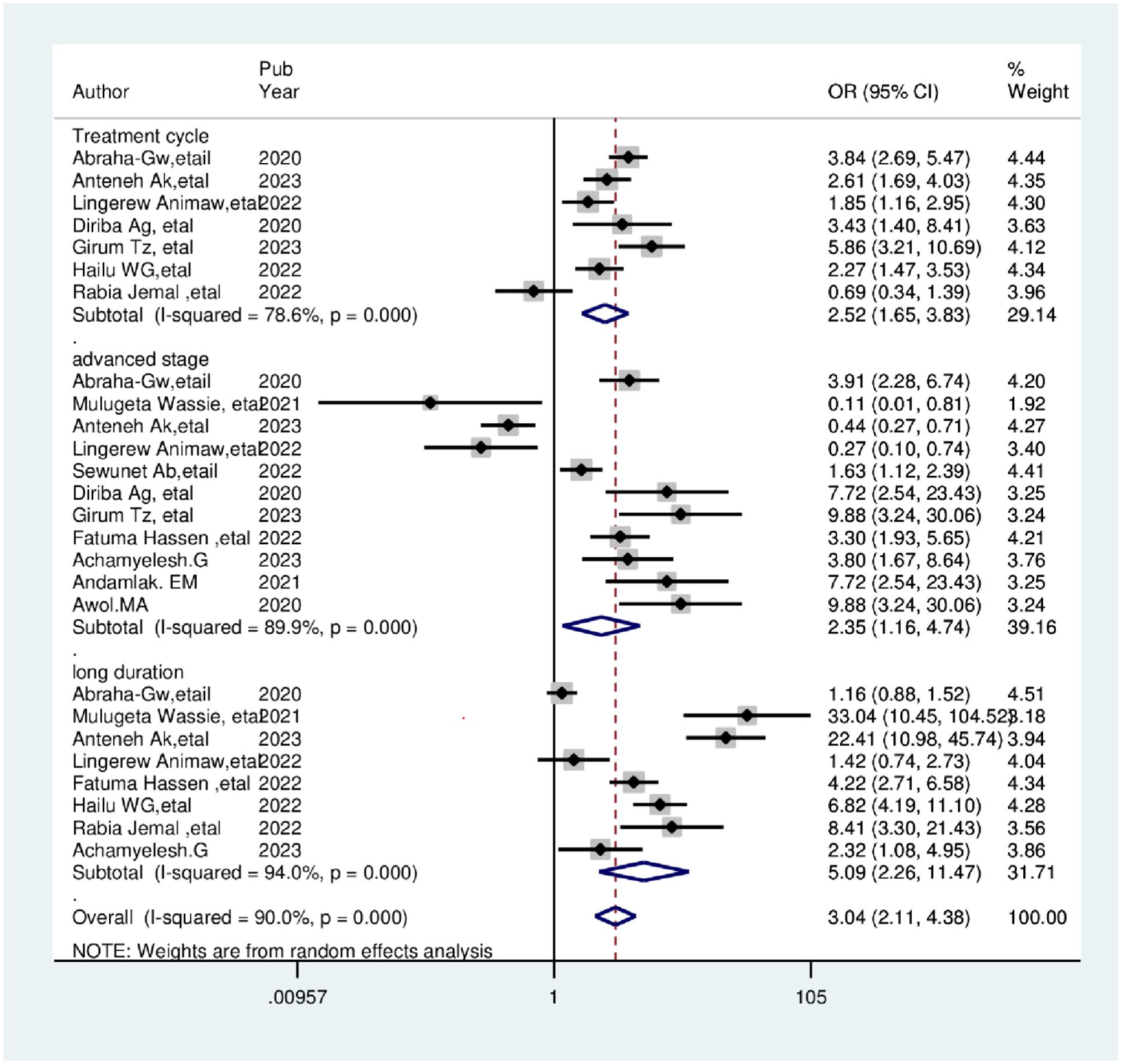
Forest plot showing the pooled odds ratios of the association between the prevalence of anemia among women with cancer in Ethiopia, 2024.
A meta-analysis was conducted to examine the associations between anemia prevalence and advanced cancer stages in female cancer patients, drawing from seven studies. The findings indicated that women with advanced-stage cancer had a pooled prevalence of anemia that was 2.35 times higher (POR = 2.35; 95% CI: 1.16, 4.74) compared to those with earlier stages of the disease.
To account for variability among the studies, a random effects analysis was employed, revealing substantial heterogeneity (χ2 = 28.09, df = 6, p = 0.000, I2 = 78.6%).
Additionally, the analysis showed that female cancer patients undergoing a higher number of chemotherapy cycles were significantly more likely to experience anemia. Specifically, those treated with many chemotherapy cycles had a POR of 2.52 (95% CI: 1.65, 3.83), indicating they were 2.52 times more likely to develop anemia than those receiving fewer cycles. Given the considerable variability across the studies, this analysis also utilized a random effects model, with heterogeneity characterized by χ2 = 99.40 (df = 10, p = 0.000) and I2 = 89.9%.
Anemia was a major complication faced by female cancer patients, significantly affecting their health outcomes. A meta-analysis of eight studies found that women with a longer duration of cancer were 5.09 times more likely to experience high prevalence of anemia compared to those with shorter cancer durations (POR: 5.09, 95% CI: 2.26, 11.47). The studies included in this analysis displayed considerable variability, indicated by a χ2 value of 116.50 (df = 7) and a p-value of 0.000, with an I2 measure of 94.0%. To account for this heterogeneity, we employed a random effects analysis. This highlights the urgent need for more targeted research on anemia prevalence and its implications for female cancer patients in Ethiopia (Figure 7).
Discussion
Anemia is a significant issue that arises from a deficiency of healthy red blood cells, leading to lower levels of hemoglobin, red blood cells, or hematocrit than normal. A recent systematic review and meta-analysis aimed to determine the prevalence of anemia and identify its risk factors among female cancer patients in Ethiopia. The study focused on the occurrence of anemia and related factors, carefully reviewing 21 articles from 8 regions of the country, which collectively included 8672 participants.
The findings showed that the combined prevalence of anemia among Ethiopian women with cancer was strikingly high at 41.48%, with a 95% CI between 34.10% and 48.87%. This highlights the critical need for attention to anemia in the management and treatment of female cancer patients in Ethiopia. This finding is consistent with those of studies conducted in Kenya (38.6%), 46 Thailand (41.1%), 47 Iran (43.1%), 4 and the Republic of Korea (42.4%). 48 However, these findings are greater than those of studies conducted in Italy (13.6%), 49 Malaysia (13.8%), 50 and Australia (33.0%). 51 A possible explanation for this discrepancy might be differences in the study settings and diagnostic and screening techniques. Another explanation for the discrepancy with the results could be the difference in methodology, study paired, stage of cancer, and cancer type of female patients. Studies in Italy, Malaysia, and Australia were primary studies. This may have led to a smaller sample size in those studies. Emphasizing the importance of understanding the pathological and pathophysiological aspects in managing women’s cancers is essential for enhancing diagnosis and treatment.
This meta-analysis revealed that the number of Ethiopian women with advanced-stage cancer was 2.35 times greater than that of women with less than two stages of cancer. This result is in line with the findings of studies in Canada, 52 Korea, 48 Poland, 53 and Japan. 54 The possibility might be as cancer progresses, there may be bleeding related to the cancer that can lead to anemia due to blood loss. Another possible explanation is that as the cancer progresses, the number of malignant cells increases, leading to increased competition for nutrients. This contest will lower the patients’ hemoglobin levels and result in anemia. Angiogenesis, a process involving the formation of new blood vessels, also occurs. Angiogenesis requires red blood cells, which may result in anemia.55,56
Based on these findings, seven research studies indicated that female cancer patients who received high doses of chemotherapy had a 2.52 times greater likelihood of developing cancer-related anemia than did those who received low doses of chemotherapy. One potential explanation could be linked to progress in treatment, as well as improvements in early screening and preventive measures. The differences may be attributed to the malnutrition-related anemia can occur due to bone marrow depression caused by multiple chemotherapy treatments. The use of chemotherapy was strongly linked to detecting early the prevalence of anemia and its interactions. Our findings paralleled those of the ECAS 57 and the American Cancer Anemia Survey (ACAS), 58 in which 38.9% and 41% of anemic patients received treatment before starting anticancer therapy, respectively. This rate was higher than that observed in Thailand, 47 where only 22.3% of anemic patients received treatment for anemia before beginning anticancer treatment. Transfusion was the primary method of treatment for correcting anemia, with a usage rate of 25.8%, which is consistent with findings from Thailand 47 and ACAS (36%). 58 Other studies have also shown that the variety of chemotherapy treatments administered is a significant factor in predicting anemia in a clinical setting. This outcome was anticipated since chemotherapy is known to suppress bone marrow and has strong toxic effects. The effects of using different chemotherapy treatments on anemia rates could also be influenced by the use of chemotherapy to manage cancer-related bleeding, which means that radiation therapy could have varying effects on anemia rates. 59
Furthermore, the combined odds ratio from eight studies indicated that women with prolonged cancer duration had a 5.09 times greater incidence of anemia than women with shorter cancer duration. Multidisciplinary interventions targeting cancer education for reproductive health women should be prioritized to reduce cancer prevalence and enhance social mobilization on cancer risk and screening. The potential causes could be that the participants in the study who had been living with cancer for more than 12 months experienced prolonged episodes of bleeding in patients with carcinomas. Other types of cancers can result in reduced food consumption through various means, such as loss of appetite, digestive issues, feeling sick, tiredness, discomfort, blockages in the digestive system, or irregular bowel movements, all of which contribute to inadequate nutrient absorption and malnourishment. This might be one of the mechanisms by which cancer-related anemia develops. In addition to increase digestive dysfunction, unnoticed and prolonged bleeding often occurs in digestive tract carcinomas, which could explain the higher rate of anemia in patients with gynecological cancer. Therefore, insufficient nutrition could be a key factor in the onset of anemia in cancer patients. Our study recommends focusing more on improving food intake and nutrition to address cancer-related anemia, particularly during and after anticancer treatment, as chemotherapy and radiotherapy can worsen digestive function and exacerbate nutritional deficiencies. Research in southwestern China has indicated that enhancing food intake and nutrition can benefit cancer patients, particularly elderly individuals. 60
Strength and limitation of study
Until this systematic review, there has not been a comprehensive study on the prevalence of anemia and its associated factors among women cancer patients in Ethiopia. It is among one of the scarce reviews that specifically concentrates on Ethiopia. Before this research, there was lack of clear and comprehensive data on the frequency of anemia and related factors in female patients. To our knowledge, this review is the first to aggregate findings from 21 primary studies, offering updated insights into the national prevalence of anemia among female cancer patients in Ethiopia. Despite these strengths, the review has several limitations, including some of the cross-sectional nature of the included studies, which prevents the establishment of causality. Although anemia is thought to be common and has connections with cancer treatment, we cannot evaluate the status of all regions in Ethiopia. Additionally, the meta-analysis encountered publication bias, though we took steps to minimize its effects during our analysis. There remains a need for scoping reviews to improve the comparability of study settings and to better understand the risk factors and protective measures in future research endeavors.
Implications for public health and policy
The low prevalence of anemia among women with cancer in Ethiopia has notable implications for public health and policy. It is crucial for public health strategies to emphasize regular blood tests and ongoing monitoring for anemia, particularly among vulnerable populations.
A standard chemotherapy treatment protocol to prevent anemia in cancer patients includes several critical steps. Initially, it requires a thorough baseline assessment using complete blood counts and iron studies before starting chemotherapy. Following this, regular monitoring is essential before each chemotherapy cycle to identify any early hematologic changes.
Preventive strategies are key and encompass optimizing nutritional status and addressing deficiencies in iron, folate, or vitamin B12. For patients at high risk of chemotherapy-induced anemia, particularly those receiving palliative care, it may be beneficial to consider the prophylactic use of erythropoiesis-stimulating agents, always ensuring adequate iron supplementation accompanies their use.
In addition, support with growth factors, making necessary dose adjustments, and minimizing exposure to myelosuppressive drug combinations whenever possible are integral to the management plan. Red blood cell transfusions are typically reserved for cases that are symptomatic or severe. This comprehensive approach aims to maintain hemoglobin levels consistently, enhance the overall quality of life for patients, and guarantee that chemotherapy can be administered at the appropriate dose and schedule without interruptions.
Conclusion and recommendation
Anemia among women with cancer in Ethiopia is a significant concern, as highlighted by recent systematic reviews and meta-analyses. The pooled prevalence rates indicate that this population is particularly vulnerable, with several factors contributing to the elevated risk of anemia. Notably, advanced-stage cancer (stage >2), multiple cycles of chemotherapy, and prolonged cancer duration have emerged as key risk factors.
These findings underscore the importance of close monitoring for women with these risk factors to manage their health effectively. By paying attention to these indicators, healthcare providers can take proactive steps to address anemia and improve the quality of care for female cancer patients in Ethiopia. The insights gained from this research also have the potential to inform and enhance treatment protocols, ultimately benefiting patient outcomes in this critical area of medical practice. Treatment conditions and treatment options include understanding the importance of adhering to supplementation and maintaining regular follow-ups. By tailoring treatment strategies to both the clinical needs of the patient and the available resources, healthcare providers in Ethiopia can optimize care for those facing chemotherapy-induced anemia.
Supplemental Material
sj-docx-1-whe-10.1177_17455057251387429 – Supplemental material for Anemia and associated factors among women with cancer patients in Ethiopia: A systematic review and meta-analysis
Supplemental material, sj-docx-1-whe-10.1177_17455057251387429 for Anemia and associated factors among women with cancer patients in Ethiopia: A systematic review and meta-analysis by Agerie Mengistie Zeleke, Yeshiwas Ayale Ferede, Getnet Azanaw Takele, Jember Ayelgne Beyene, Yosef Aragaw Gonete, Moges Tadesse Abebe and Worku Chekol Tassew in Women's Health
Supplemental Material
sj-docx-2-whe-10.1177_17455057251387429 – Supplemental material for Anemia and associated factors among women with cancer patients in Ethiopia: A systematic review and meta-analysis
Supplemental material, sj-docx-2-whe-10.1177_17455057251387429 for Anemia and associated factors among women with cancer patients in Ethiopia: A systematic review and meta-analysis by Agerie Mengistie Zeleke, Yeshiwas Ayale Ferede, Getnet Azanaw Takele, Jember Ayelgne Beyene, Yosef Aragaw Gonete, Moges Tadesse Abebe and Worku Chekol Tassew in Women's Health
Footnotes
Acknowledgements
The authors would like to thank the authors of the included primary studies, which were used as sources of information to conduct this systematic review and meta-analysis

Ethical considerations
Not applicable.
Consent to participate
Not applicable.
Consent for publication
Not applicable.
Author contributions
Funding
The authors received no financial support for the research, authorship, and/or publication of this article.
Declaration of conflicting interests
The authors declared no potential conflicts of interest with respect to the research, authorship, and/or publication of this article.
Data availability statement
All relevant data generated and analyzed in the analysis process.
Artificial intelligence policy
We used ChatGPT for correction of grammatical problems.
Supplemental material
Supplemental material for this article is available online.
References
Supplementary Material
Please find the following supplemental material available below.
For Open Access articles published under a Creative Commons License, all supplemental material carries the same license as the article it is associated with.
For non-Open Access articles published, all supplemental material carries a non-exclusive license, and permission requests for re-use of supplemental material or any part of supplemental material shall be sent directly to the copyright owner as specified in the copyright notice associated with the article.
