



Abstract
Introduction:
The provision of well-woman services to women is a very good intervention for promoting good health and well-being among women. Despite data needed to inform increasing accessibility to well-woman services, there is limited information about client’s satisfaction with well-woman services.
Objective:
This study was conducted to determine factors influencing women’s satisfaction with well-woman services at Manhyia Government Hospital.
Design:
An analytical cross-sectional study was conducted among women attending the well-woman clinic at the Manhyia Government Hospital, Kumasi from 10 May 2023 to 15 November 2023.
Methods:
A systematic sampling method was employed. A pretested structured questionnaire was used to collect data on participants’ socio-demographic and clinical characteristics, health-facility-related factors, barriers to utilization and client satisfaction. A face-to-face interview was conducted for every woman included in the study. Data were analyzed using multivariable logistic regression analysis. p-Value for statistical significance was set at p < 0.05.
Results:
Of the 344 women who were recruited for the study, majority (65.7%) of them were satisfied with care at the well-woman clinic. About 59.3% of the women were willing to continue care at the clinic. The age range was 18–60 with mean of 34.6 ± 12.0 years. Some of the challenges the women reported in accessing well-woman services at the clinic included long waiting times (17.7%) and inadequately skilled staff (8.1%). After adjusting for significant variables in the multivariable logistic regression analysis (adjusted odds ratio (AOR)), comfortability of the waiting area (AOR: 7.71, 95% CI: 1.54–38.60), <6 months duration of accessing care (AOR: 8.82, 95% CI: 3.25–23.98) and friendly attitude of health workers (AOR: 27.03, 95% CI: 4.28–170.83) were significantly associated with the client’s satisfaction with well-woman services.
Conclusion:
There was high satisfaction with well-woman services at the clinic, and this was associated with factors such as duration of service, comfortability of the waiting area and the attitude of health workers. Training more skilled staff and expanding the clinic will help improve well-woman services.
Plain language summary
What satisfies a woman who visits a clinic specially created for their special health needs.
Improving women’s access to a clinic fully dedicated to their sexual, contraceptive and other reproductive health rights is a herculean task in a culture where women are not empowered. This study is to improve access to such clinics for preventive health care which is cheaper than treating advanced health issues. Determining factors that influence their satisfaction at such clinics may help improve these specialized clinics.
Introduction
Well-woman services are an important intervention which focuses on assessment designed to improve the general wellness, lifestyle and welfare of women. Utilizing the well-woman services is critical for identifying any potential future health-related risk for early intervention for female health issues. Getting early intervention may be important for preventing the occurrence of such health-related risks among women. Well-woman services are an emerging concept in the healthcare setting aimed at improving women’s health and the ability to provide quality services which meet the level of satisfaction of the client may be significant for increasing its utilization.
Client satisfaction with service provision in recent years has gained tremendous momentum and has become the pillar of service utilization. It is also one of the most important metrics for assessing the calibre of services, both within and outside the healthcare setting. 1 All hospital’s core customers are their patients, and providing care that meets their satisfaction is their main goal. 2 A patient’s decision to utilize the services of a particular healthcare facility is a true testament to the effectiveness of its leadership.
Client satisfaction is the extent of how much a patient is content with the medical care received from their healthcare providers. Globally, the influx of healthcare facilities has created competition for the provision of services which has shifted the attention from just providing healthcare services to patients to operating it as a business. This is because managers of healthcare facilities are now looking at creating avenues that will persuade patients to choose their facility as their primary healthcare provider 3 and also suggest them to other relatives and colleagues. One of the significances of paying attention to client satisfaction is that it can be used to spot a failing healthcare system. This is because a patient who is not satisfied with a service may not come back to utilize the service and probing for feedback can help managers to improve on their weakness. The patient’s experience at a facility is always crucial to enhancing the provision of high-quality medical care. 2 Furthermore, if patients are pleased with the calibre of care received, they will likely purchase more of those services, boosting sales and profitability. 4 As a result, increased service quality influences client retention and the decision to select a healthcare facility based on the image of the business. Ultimately, this affects the organization’s ability to thrive in a setting that is becoming more and more competitive.4 –6
Multiple factors including facility-related, individual factors, etc. can influence one’s decision to utilize healthcare and keeping a decent portion of the market and getting to know them are essential.2,7,8 Waiting times, the conduct of medical personnel and other clinical staff, the presence of specialists and a clean atmosphere all significantly impact patient care and the decision to utilize the services of a hospital.3,7 –9 The ability of a healthcare facility to identify these contributory factors is important for them to review potential strategies to improve patient utilization of their services.
Despite the significance of the well-woman intervention, its progress may be hindered by certain barriers including cost of care, poor staff attitude, lack of privacy and proximity to health facility.10 –12
The well-woman health concept mostly aims at preventive healthcare. 13 Some of the gynaecological and medical conditions identified at the clinic are in their early stages and more likely to respond to treatment. Sustaining such innovations in the healthcare system requires continual research and improvements based on these studies.
In Ghana, inadequate healthcare workers and financial difficulties have been reported as major barriers facing the healthcare sector.14,15 These obstacles mostly impact the use of medical facilities. 10 Given that well-woman services are a relatively new component of the medical landscape, little is known about them notwithstanding the proliferation of research on the obstacles to using primary healthcare coverage on a worldwide scale. In light of this, the study’s objectives are to evaluate client satisfaction, related variables and obstacles preventing women from using well-woman services at Ghana’s Manhyia Government Hospital.
Methods
Study design
Analytical cross-sectional study design was used. The study was conducted among women at a well-woman clinic at the Manhyia Government Hospital, Kumasi from 10 May 2023 to 15 November 2023. The STROBE guidelines were followed in the preparation of the manuscript.
Profile of the study area
The research was conducted at the Manhyia Government Hospital, specifically, the well-woman clinic. The hospital is located in Kumasi in the Ashanti region which is the second largest city in Ghana. Ghana is located in West Africa.
The Manhyia Government Hospital is located near the Manhyia Palace in the Kumasi metropolis. Kumasi is the regional capital of Ashanti region which is the second most populous region in Ghana with a population of 5,440,463 inhabitants. The population of Kumasi metro area from the 2021 population and housing census was 443,981. The Manhyia hospital is a government-owned hospital and serves as a major referral centre for nearby health centres and clinics. The hospital is endowed with a wide range of healthcare workers with different expertise. It provides a 24-h service including maternity, antenatal clinic, postnatal clinic, child welfare clinic, obstetrics and gynaecology clinic and family planning service. It also runs specialist clinics like human immunodeficiency virus and acquired immunodeficiency syndrome, hypertension and diabetes, physiotherapy and surgery. The well-woman clinic at the hospital offers cervical and breast cancer screening, adolescent counselling in sexual and reproductive health and genital warts treatment.
The well-woman clinic was created in September 2022 to provide wellness services to women in and outside the district. Data from the well-woman clinic shows that on average about 150 women utilize the well-woman services on monthly basis. The clinic offers screening services for cervical cancer, including pap smears, human papillomavirus tests, acetic acid visual inspections, breast exams and sex education. Three healthcare professionals make up its strength: a midwife, a nurse and a gynaecologist. The healthcare staff has received instruction in digital literacy, critical thinking and communication techniques. The clinic is open from 8:00 am to 4:00 pm, Monday to Friday.
Study population
This study involved women who were 18 years old and above accessing well-woman services at the Manhyia Government Hospital.
Inclusion criteria
Women who were 18 years old and above who attended the clinic within the study period.
Exclusion criteria
Women who looked too ill were excluded from the study and referred to the main outpatient department for evaluation and treatment.
A woman was excluded from the study if she was making her first visit to the clinic.
Those who did not consent to participation.
Sample size estimation
The sample size for the study was estimated using Epi Info version 7.2.4.0 (Centers for Disease Control and Prevention, USA) with a margin of error of 5%, a power of 80.0% and a 95% confidence interval. Assuming these factors associated with client satisfaction with the well-woman services was similar to the ones reported by Amporfro et al. 16 in Ghana; provider friendliness (odds ratio (OR): 4.48), secondary education (OR: 3.52) and ease of getting care (OR: 2.63), then a sample size of 314 would have adequate power (of more than 80%) to detect these factors (Table 1). After adjusting for a contingency rate of 10%, a total of 344 women accessing well-woman services were recruited for the study.
Sample size estimation.

Sampling procedure
A systematic sampling strategy was used to determine the number of consumers who were utilizing the clinic’s well-woman services. Because women using the well-woman services reported to the clinic at various times of the day, this sampling strategy was chosen. The sampling interval was determined by dividing the number of patients who satisfied the inclusion criteria and were receiving well-woman services at the clinic by the anticipated daily number of participants to be gathered from the clinic. The first patient to be recruited each day was determined through balloting (simple random sample). The remaining research subjects were chosen in the preset order until the estimated sample size was obtained.
Data collection tools and procedures
The study data were gathered by in-person interviews with every woman who fell into the inclusion criteria utilizing a pretested structured questionnaire. For the individuals who could not speak English, the interviews were conducted in both the local language (Twi) and English. The questionnaire was utilized to gather information on the following: clinical data; facility-related factors (staff attitude, hospital equipment availability, cost of care, waiting time, etc.); client satisfaction with well-woman services and socio-demographic characteristics of the participants (age, marital status, income level, etc.). Data on the barriers or challenges encountered by the patients in accessing the service were also collected.
The interviews were conducted by two research assistants (one nurse and one midwife) at the Well-woman Clinic. They were taken through a 2-day training to ensure that they were conversant with the data collection instrument and Twi translation of the questionnaire. This was done to ensure that there was consistency in the data collected.
Validity and reliability of data collection tools
To increase the internal reliability and validity of the data collecting tool, pretesting was conducted among 55 women (15% of the women population) who were receiving well-woman services in Suntreso Government Hospital. Before the questionnaire was used to collect study data, corrections were performed.
Study variables
Dependent variable
The dependent variable for the study was client satisfaction with well-woman services. This was measured by asking study participants their overall satisfaction with well-woman services with responses including very satisfied, satisfied, neutral, unsatisfied and very unsatisfied.
Independent variables
The facility-related parameters, clinical data, socio-demographic factors and obstacles to care consumption were the independent variables.
Data quality control
For quality assurance and analysis, data were entered into an Excel spreadsheet and then imported into Stata version 16 (StataCorp LLC, Texas). To improve the quality of the data, errors and duplicate items were fixed after it was verified that the data was full.
Statistical analysis
The study data were summarized using descriptive and inferential statistics and were presented as means and standard deviations for continuous variables and frequencies and percentages for categorical variables. To provide ORs with 95% confidence intervals, multivariable logistic regression analysis was utilized to identify the variables linked to the client’s satisfaction with well-woman services. Initially, a bivariate analysis was conducted, which was followed by a multivariable logistic regression model which took into account all variables with a p-value of less than 0.05 (statistical significance).
Ethical approval
After getting formal authorization from Manhyia Government Hospital’s management, the Committee on Human Research, Publications and Ethics (CHRPE), School of Medicine and Dentistry, Kwame Nkrumah University of Science and Technology, Kumasi (reference number: CHRPE/AP/988/23), there was an assurance given to each study participant about the complete confidentiality and privacy of the study data. All of the study participants were informed by the research assistants that this was a study and that they could choose to participate or not without incurring any penalties. Before being enrolled in the trial, each subject gave written informed consent.
Assumptions
The researcher investigated under the guidance of the following assumptions:
The women who were recruited for the study were a true representation of those accessing well-woman services at the clinic.
All the women understood the questions that were asked by the research assistants and they provided the right responses.
Results
Demographic characteristics of the study participants
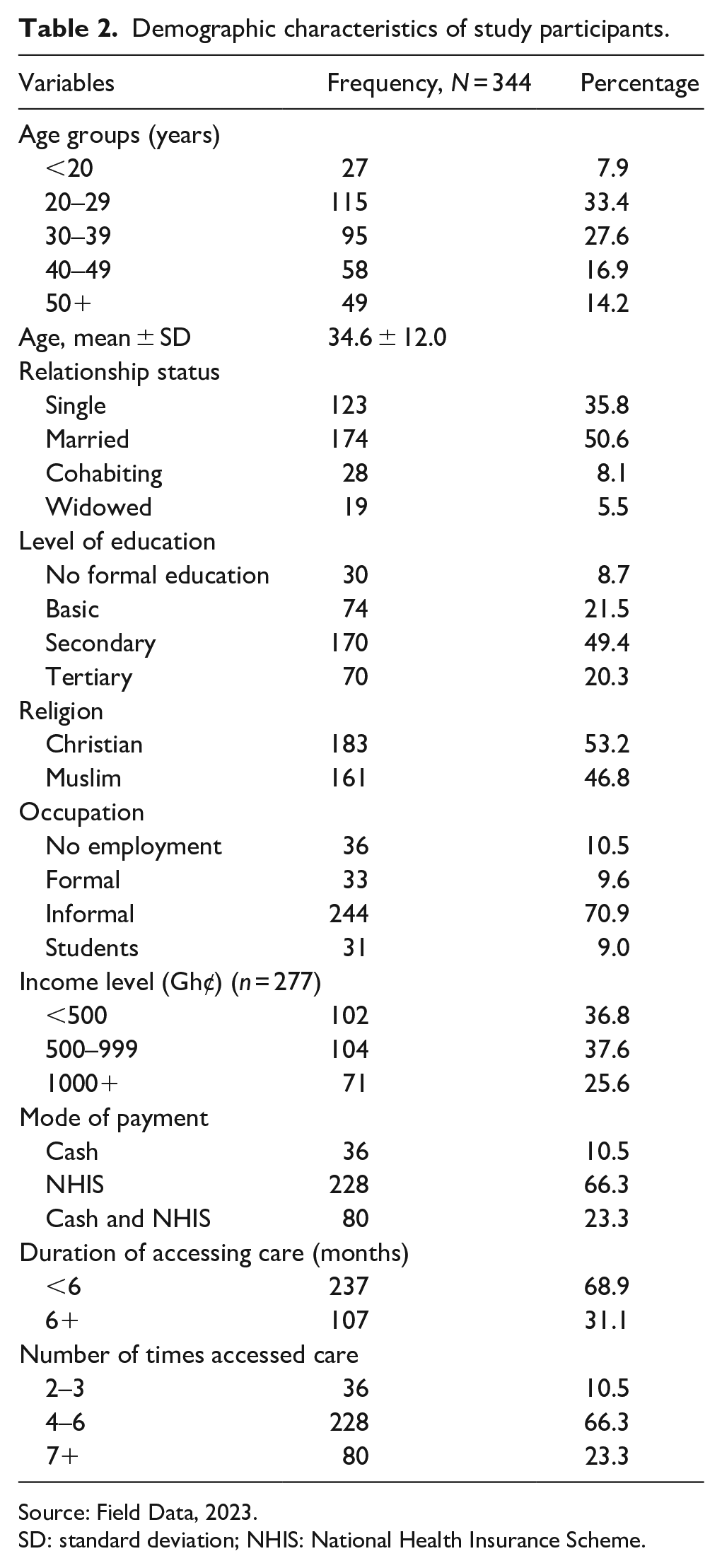
The total number of women recruited into the study was 344. The women’s ages ranged from 18 to 60 years old, with a mean of 34.6 ± 12.0 years. Approximately 33.4% of the 344 women who were recruited were in the 20–29 age range. Nearly half (49.4%) of the women had completed secondary education, and over half (50.6%) were married. About 66.3% of them said they paid through the National Health Insurance Scheme. More than two-thirds (68.9%) of the women stated that they had been using the clinic’s well-woman services for fewer than 6 months (Table 2).
Demographic characteristics of study participants.
Source: Field Data, 2023.
SD: standard deviation; NHIS: National Health Insurance Scheme.
Facility-related factors among the study participants
The facility-related characteristics among the study participants are displayed in Table 3. More than 77.3% of the 344 women who were enrolled in the study reported visiting the well-woman clinic for 30–60 min. Over half of the ladies (57.6%) said it was simple to get care at the clinic. The majority of the women (95.9%) said that the clinic’s employees were kind. The majority of the ladies, or about 70.3%, thought the clinic was reasonably clean (Table 3).
Facility-related characteristics among study participants.

Source: Field Data, 2023.
Satisfaction with well-woman services among the study participants
Table 4 presents the satisfaction with well-woman services among the study participants. Of the 344 women, majority (65.7%) of them were satisfied with the care they received at the well-woman clinic. Majority (76.7%) of the women rated the customer care at the clinic as good. About 59.3% of the women were willing to continue care at the clinic. Over 44.5% of the women reported that they accessed care at the clinic based on a recommendation by someone (Table 4).
Satisfaction with well-woman services among study participants.

Source: Field Data, 2023.
Barriers/challenges to accessing well-woman services
Table 5 presents the barriers/challenges in accessing well-woman services among the study participants. Some of the challenges the women reported in accessing well-woman services at the clinic included long waiting times (17.7%), inadequately skilled staff (8.1%) and inadequate knowledge of well-woman services by themselves (7.0%). The study participants suggested increasing staff strength (16.6%) and expanding the facilities (14.2%) as possible ways to address the challenges in accessing care at the clinic (Table 5).
Barriers/challenges in accessing well-woman services among study participants.

Source: Field Data, 2023.
Multiple responses.
Factors associated with satisfaction with well-woman services
The variables linked to research participants’ satisfaction with well-woman services are shown in Table 6. Some variables, including payment method, length of time spent receiving care, attitude of medical staff, cleanliness of the well-woman clinic and clinic waiting area, were linked to the client’s satisfaction with the well-woman services in the univariate logistic regression analysis (crude odds ratio). The client’s satisfaction with well-woman services was significantly associated with the comfort of the waiting area, the length of time it took to receive care and the attitude of the medical staff, even after controlling for significant variables in the multiple logistic regression analysis (adjusted odds ratio (AOR)). In comparison to women who stated the health staff were unfriendly, those who reported the opposite were almost 27 times (AOR: 27.03, 95% CI: 4.28–170.83) more likely to be satisfied with the well-woman services. Compared to women who had been receiving care at the institution for more than 6 months, those who had been receiving care for less than 6 months were approximately nine times (AOR: 8.82, 95% CI: 3.25–23.98) more likely to be satisfied with the services. Compared to those who said the waiting area was uncomfortable, those who said it was comfortable were approximately eight times (AOR: 7.71, 95% CI: 1.54–38.60) more likely to be satisfied with the service (Table 6).
Factors associated with satisfaction with well-woman services among study participants.

Source: Field Data, 2023.
OR: odds ratio; NHIS: National Health Insurance Scheme.
Discussion
Client’s satisfaction with well-woman services among the study participants
Previous research has indicated that a highly relevant indication for assessing the calibre of healthcare delivery is the level of satisfaction that clients have with maternal healthcare services.17,18 According to this survey, the majority of women were either very satisfied (20.1%) or satisfied (65.7%) with the well-woman services they obtained from the clinic. In addition to expressing general satisfaction with the well-woman services they received at the clinic, the majority of study participants also expressed satisfaction with customer care and appreciation for the well-woman services they received.
The study’s high level of satisfaction with well-woman services is consistent with research conducted in Ghana’s Ketu South Municipality, where most women seeking maternal healthcare services indicated pleasure with the care they received. 19 In the Sissala East Municipality of Ghana, another study observed over 80% of women were satisfied with healthcare delivery. 20 However, the satisfaction with well-woman services found in this study is higher than the satisfaction with cervical cancer screening which was reported among women in Ethiopia (40.3%). 21 The variations in the study findings could be attributed to the difference in the healthcare system, cost of treatment, healthcare workers and the component of the satisfaction considered.
The majority of the women in this research indicated that they would be either extremely willing (35.8%) or willing (59.3%) to keep using the clinic’s well-woman services. The results of this study confirm earlier findings that patients who are happy with the care they receive are more likely to return to the same hospital in the future.21 –23 This could be important for achieving Universal Health Coverage (UHC) as patients are likely to establish good relationships with their healthcare providers as well as improve the quality of care.
Barriers/challenges in accessing well-woman services among the study participants
The Susteinable Development Goal (SDG) target 3.8 aims at achieving UHC by 2030 across the globe. 24 The barriers/challenges in accessing well-woman services could be a setback for the progress of UHC. Identifying these barriers/challenges is important for designing potential strategies to improve its coverage.
In this study, long waiting times and inadequately skilled staff were identified as some of the barriers/challenges in accessing well-woman services at the clinic. Long waiting times pose a significant threat to achieving UHC and could adversely affect population health. 25 This is due to the possibility that extended stays at the hospital could discourage others from visiting the hospital in the future. Aside from that, patients having to wait longer before being attended to by a physician could be hectic and stressful which all adds up to affecting service utilization. 26 Sometimes patients have to wait for either half a day or the whole day which can also affect their daily activity which could affect one’s decision to utilize well-woman services.
One of the causes of long waiting times at a health facility is inadequate health staff, and this was evident in the findings of this study as study participants reported inadequate skilled staff as a perceived barrier to accessing well-woman services at the clinic. The inadequate number of skilled staff means that there will be few health workers to attend to a lot of patients which may delay the services. This can be even more problematic, especially when there are a lot of patients accessing the same service. This can lead to the creation of unnecessary long waiting times for patients. In Nigeria, a study reported a lack of healthcare workers as a cause of long waiting times at a university teaching hospital. 26 Inadequate skilled staff not only lead to long waiting times but also affects the quality of service delivery and patient safety. 27
Factors associated with satisfaction with well-woman services among study participants
In this study, it was found that staff attitude, comfortability of the waiting area and duration of accessing care were independently associated with satisfaction with well-woman services. In this study, participants who reported that the attitude of the health workers was friendly were about 27 times more likely to be satisfied with the well-woman services compared to those who said they were unfriendly. This is in line with previous studies which reported staff attitude as a significant determinant of satisfaction with maternal healthcare services.17,28,29 Health workers play a significant role in the delivery of healthcare services. It is therefore worrisome if the key actors in the provision of the service become an obstacle to satisfaction. Demonstrating an unfriendly attitude towards patients may not be helpful for the patients to establish a bond with them which can also make it difficult for them to communicate their problems freely with them. There is therefore a need for health workers to establish a cordial relationship with their patients so that they can always report back to them with their problems. Achieving UHC involves continuity of care and the very people to push this agenda are health workers which makes it important for health workers to exhibit a positive attitude towards their patients so that it can inform their decision to continue to utilize healthcare.
Generally, every patient expects that the hospital environment be clean and failure to meet this expectation may negatively affect their experience and overall satisfaction with the service. 30 In this study however, cleanliness of the clinic was not independently associated with client satisfaction. In Ethiopia, a previous study also reported that patients who perceived the hospital environment to be clean were about four times more likely to be satisfied with the antenatal care service received compared to those who said it was not clean. 31 The cleanliness of health facilities is one of the important aspects of the provision of care due to its significance in the prevention of hospital-acquired infections among patients, relatives and healthcare workers.30,32,33 The variance in association could be due to the method used to ascertain cleanliness of the service area. While other studies asked client to choose between clean and unclean, our study rather used clean and fairly clean as the variables. These differences in the questionnaire may influence outcome.
In this study, the comfortability of the waiting area was associated with increased odds of client satisfaction. This finding resonates with studies conducted in Ethiopia which found that patients who perceive the waiting area of a hospital are comfortable are more likely to be satisfied with the service compared to those who perceive it as not comfortable.34,35 This finding implies that ensuring that the waiting area of the clinic is comfortable for clients is extremely important for their satisfaction. Hence, the management of hospitals must pay critical attention to ensuring that the waiting area meets the expectations of the clients.
In this study, duration of care was identified as a significant predictor of client satisfaction with well-woman services. Women who had accessed care at the clinic for less than 6 months had increased odds of satisfaction compared to those who had accessed care for more than 6 months. It could be possible that those who had accessed care at the clinic for more than 6 months may be fed up with some aspects of the services and hence were more likely to be unsatisfied. Further study is needed to explore why the long duration of service affects client satisfaction.
Limitations of the study
The use of a cross-sectional study design limited the ability to determine causality for client’s satisfaction with well-woman services. It was more difficult to investigate how the obstacles/challenges impacted their use of the clinic’s well-woman services because of the quantitative study design. The potential introduction of social desirability bias as a result of hospital staff members (research assistants) participating in data collecting and clinic interviewing represents another research constraint for this study. This might have an impact on a few of the study participants’ responses.
Conclusions
In general, most of the women expressed satisfaction with the well-woman services provided by the clinic. Of particular importance, most of them rated the customer care as good, and the majority of them were willing to continue to access well-woman services at the clinic.
This study identified long waiting times and inadequately skilled staff as the major barriers/challenges to accessing well-woman services at the clinic by the study participants. Inadequate knowledge of study participants about well-woman services was also identified as a barrier/challenge in the utilization of care.
Staff attitude, duration of service and comfortability of the waiting area were identified as the independent factors which were significantly associated with client satisfaction with well-woman services. These outcomes not only provide useful information for improving well-woman services but also increase the utilization of the service at the clinic.
Supplemental Material
sj-docx-1-whe-10.1177_17455057251320425 – Supplemental material for Factors influencing women’s satisfaction with well-woman services at the Manhyia Government Hospital, Ghana
Supplemental material, sj-docx-1-whe-10.1177_17455057251320425 for Factors influencing women’s satisfaction with well-woman services at the Manhyia Government Hospital, Ghana by Agnes Ampofo Agyei, Seth Amponsah-Tabi, Edward Tieru Dassah, Eric Sarpong Ansong, Maxwell Kankam, Amponsah Peprah, Charles Senaya, John Jude Kweku Annan, Roderick Larsen Reindorff and Henry S Opare-Addo in Women’s Health
Footnotes
Acknowledgements
The authors are grateful to staff of the Manhyia Government Hospital as well as research assistants and volunteers who contributed in diverse ways to the successful implementation of the study. They acknowledge the input of Mr. Douglas Anning Opoku of the Department of Epidemiology and Biostatistics, School of Public Health, KNUST concerning data entry and analysis.
Declarations

Supplemental material
Supplemental material for this article is available online.
References
Supplementary Material
Please find the following supplemental material available below.
For Open Access articles published under a Creative Commons License, all supplemental material carries the same license as the article it is associated with.
For non-Open Access articles published, all supplemental material carries a non-exclusive license, and permission requests for re-use of supplemental material or any part of supplemental material shall be sent directly to the copyright owner as specified in the copyright notice associated with the article.
