



Abstract
Background:
Intimate partner violence (IPV) is widespread and is influenced by individual-specific factors. However, the impact of spousal sociodemographic disparities (age, earnings, education) remains understudied.
Objectives:
This study investigates the relationship between spousal sociodemographic disparities and women’s IPV experiences in 29 developing countries in South Asia, Sub-Saharan Africa, and the Middle East and North Africa.
Design:
We used a cross-sectional design, analyzing data from the Integrated Public Use Microdata Series-Demographic and Health Surveys (IPUMS-DHS).
Methods:
We conducted logistic regression to assess associations between spousal disparities and four forms of IPV including less severe physical violence (LSPV), severe physical violence (SPV), emotional violence (EV), and sexual violence (SV) based on spousal age, earnings, and education disparities.
Results:
The analysis revealed that spousal education disparities are significantly associated with increased IPV odds. Women with more educated husbands faced higher odds of LSPV (OR = 1.044, 95% CI = 1.01, 1.08; p < 0.05) and SV (OR = 1.085, 95% CI = 1.04, 1.14; p < 0.01), with no significant association for SPV or EV. Larger spousal age gaps were consistently associated with a reduced probability of all IPV forms, particularly LSPV (OR = 0.765, 95% CI = 0.72, 0.81; p < 0.001) and SV (OR = 0.656, 95% CI = 0.58, 0.74; p < 0.001). Earnings disparities also played a crucial role: women earning more than their husbands faced higher odds of LSPV (OR = 1.361, 95% CI = 1.23, 1.50; p < 0.001), EV (OR = 1.573, 95% CI = 1.42, 1.74; p < 0.001), and SV (OR = 1.624, 95% CI = 1.42, 1.86; p < 0.001). When husbands earned more, women also faced higher odds of IPV, although these associations were weaker.
Conclusion:
The findings underscore the need for targeted policies to prevent IPV, particularly in low- and middle-income countries, by addressing spousal disparities in age, earnings, and education to promote gender equality.
Plain language summary
Background: Intimate partner violence (IPV) is common worldwide and is affected by personal factors. However, the impact of differences between spouses in age, earnings, and education is not well understood. Objectives: This study examines how differences in age, earnings, and education between husbands and wives relate to women’s experiences of IPV in 29 developing countries across South Asia, Sub-Saharan Africa, and the Middle East and North Africa. Design: We conducted a cross-sectional study using data from the Integrated Public Use Microdata Series-Demographic and Health Surveys (IPUMS-DHS). Methods: We used logistic regression to explore the relationships between spousal differences and four types of IPV: less severe physical violence, severe physical violence, emotional violence, and sexual violence, based on differences in age, earnings, and education between spouses. Results: Our analysis showed that when husbands are more educated than their wives, women are more likely to experience certain types of IPV. Specifically, these women faced higher odds of less severe physical violence and sexual violence, but there was no significant link with severe physical violence or emotional violence. Larger age gaps, where husbands are much older than their wives, were associated with a lower likelihood of all forms of IPV, especially less severe physical violence and sexual violence. Earnings differences also had a significant impact: women who earned more than their husbands were more likely to experience less severe physical violence, emotional violence, and sexual violence. Women whose husbands earned more also faced higher odds of IPV, but these associations were weaker. Conclusion: These findings highlight the need for targeted policies to prevent IPV in low- and middle-income countries by addressing differences in age, earnings, and education between spouses to promote gender equality.
Keywords
Introduction
Intimate partner violence (IPV) is a widespread social and public health issue that significantly impacts women worldwide. 1 Globally, the proportion of women who encounter IPV at some point in their lives is alarming. 2 This form of abuse, which manifests itself as physical, emotional, or sexual violence, is responsible for 38% of all female homicides. 3 The prevalence of IPV varies between different regions and countries, but remains alarmingly high across the globe. African and South Asian countries show the highest prevalence of IPV, with approximately 37% women who have been in a relationship experiencing physical, sexual, or emotional abuse. According to surveys conducted in 87 countries between 2005 and 2016, a significant number of women continue to face abuse, with 1 in 5 women who were ever married or in an intimate relationship reporting physical, sexual, or emotional abuse. 4
IPV profoundly affects the physical and mental well-being of the victims. The World Health Organization notes that IPV can lead to various health disorders, including depression, physical injuries, mental health disorders, sexual health problems, and even suicide. 3 Furthermore, IPV experienced during pregnancy can cause complications such as miscarriages, premature births, and unhealthy deliveries, subsequently contributing to mental health disorders in children.5 –7 Victims often remain in abusive relationships for multiple reasons, including fear of solitude, lack of financial support, inadequate support from friends and family, fear of losing custody of their children, and the hope that their abusive partner may change. 8
The impact of IPV extends beyond personal health and family stability to the socioeconomic domain. The World Economic Forum reports that the costs associated with containing, preventing, and dealing with the consequences of violence amount to 13. Three percent of the world GDP. 9 This equates to a staggering $1875 per person per year, down to an expenditure of $5 per person every day for an entire year. This contrasts starkly with the fact that 10.7% of the world’s population lives on less than $2 a day, highlighting the critical seriousness of the issue and its grave economic implications. The considerable impact of IPV on women’s well-being worldwide underscores the urgency for comprehensive solutions. 3
Literature review
IPV is a complex issue influenced by various factors that can exacerbate the risk of violence within relationships. Evolutionary perspectives suggest that men’s perceptions of threats to paternity certainty or diminished parental roles increase the likelihood of committing physical and sexual violence against their partners. 10 Specifically, concerns over paternity and reduced paternal investment are associated with higher risks of IPV, indicating evolutionary motivations behind such violent behaviors. Environmental factors also significantly contribute to IPV risk. Early exposure to violence—such as witnessing parental conflict or experiencing child abuse—predisposes individuals to engage in or become victims of IPV in adulthood. 11 Patriarchal social norms further exacerbate this risk by perpetuating gender-based power imbalances and normalizing abusive behaviors within communities. 11
Psychological and behavioral dynamics within relationships also play a critical role. Communication deficits, such as disengagement behaviors during conflicts, predict increased psychological and physical IPV perpetration. 12 Mental health issues, such as undiagnosed attention deficit/hyperactivity disorder, are associated with increased aggression and increased IPV perpetration. 13 Personality disorders, including dependent and insecure attachment styles, foster maladaptive relationship dynamics that increase the risk of IPV.14,15 Additionally, emotional dependence and addictive behaviors contribute to the perpetuation of violent relationships, making individuals more likely to remain in or return to abusive situations. 16
While these individual and relational factors are well-documented, less attention has been given to sociodemographic disparities between spouses—specifically differences in age, education, and earnings—and how these disparities influence women’s experiences of IPV. Spousal disparities can exacerbate power imbalances within relationships, potentially increasing the risk of IPV. For example, in South Asia, mothers-in-law often influence decisions regarding women’s employment and contraceptive use, leading to earning differentials between spouses that heighten power imbalances and IPV risk.17,18 Similar familial dynamics contribute to spousal disparities and IPV risk in regions such as Sub-Saharan Africa (SSA) and the Middle East and North Africa (MENA).
Age disparities
Age differences between spouses emerge as a crucial factor that influences the occurrence of IPV. Some studies suggest that larger age gaps, particularly where the husband is older, may reinforce traditional power structures and reduce the likelihood of IPV due to clearer role expectations and established authority hierarchies.19,20 For example, a study in Nigeria found that a significant age difference between spouses was associated with lower instances of IPV. 19 In contrast, other research indicates that significant age disparities can increase women’s vulnerability to IPV, especially when younger women marry much older men, resulting in power imbalances and increased potential for control and abuse.2,21 A study on social norms highlights that child brides tend to be less educated and poorer, often facing elevated levels of IPV from older husbands. 21
Educational disparities
Disparities in educational attainment between spouses can impact IPV dynamics by introducing tension due to discrepancies in social status and expectations. The impact of educational disparities on IPV is complex and appears to be influenced by cultural contexts and gender norms. 22 Research suggests that when one partner is significantly more educated than the other, it may disrupt traditional power dynamics and challenge societal norms, potentially leading to conflict and an increased risk of IPV.23,24 A study in India and Bangladesh found that women more educated than their husbands experienced higher rates of IPV. 23 In contrast, some studies indicate that higher levels of education in both partners are associated with lower IPV rates, 25 suggesting that education can be a protective factor.
Earnings disparities
Economic factors, particularly earnings disparities between spouses, play a crucial role in shaping power relationships within intimate relationships.26,27 Differences in earnings may disrupt traditional power dynamics, potentially leading to conflict and IPV. Studies indicate that when women earn more than their husbands, it may challenge societal norms and traditional gender roles, provoking tension as men may feel their provider role is threatened.26,27 A study in Tanzania observed that women’s income was associated with a higher risk of IPV. 26 In contrast, women’s employment and financial independence can serve as protective factors against IPV by reducing financial vulnerability. 28 Furthermore, when both partners are employed, the IPV rate tends to decrease, possibly due to a more balanced power dynamic within the relationship. 29
The existing literature indicates that sociodemographic disparities between spouses—age, education, and earnings—are significant factors influencing IPV, but their effects are complex and context-dependent. Despite extensive research, gaps remain in understanding how these disparities interact across different cultural contexts, particularly in developing countries in South Asia and Africa. This study aims to fill this gap by examining the specific ways in which spousal sociodemographic disparities relate to women’s experiences of IPV, utilizing data from 29 developing countries.
Theoretical framework
Building on the complexities highlighted in the literature review on how sociodemographic disparities between spouses influence IPV, this study employs a theoretical framework that assigns a distinct theory to each type of disparity. Drawing on the Resource Theory of Power in Families,30 –33 we hypothesize that earnings disparities alter power dynamics within relationships, potentially increasing IPV when traditional roles are challenged or reinforced, regardless of whether the husband or wife earns more. Status inconsistency theory34 –36 provides a framework for understanding how educational disparities may create tension due to discrepancies in social status, thus increasing the risk of IPV when one partner is significantly more educated than the other. Lastly, Age Stratification Theory37 –42 explains how age differences impact relational hierarchies and power structures, influencing the likelihood of IPV; notably, larger age gaps where the husband is older may reinforce traditional power structures, potentially reducing conflict and the risk of IPV.
Earnings disparities within a marriage can heighten power imbalances and increase the risk of IPV, as posited by the Resource Theory of Power in Families. A study on family power dynamics suggests that disparities in economic resources can disrupt traditional spousal power dynamics, leading to conflicts that may manifest as IPV when established roles are challenged or reinforced. 30 A study on family power emphasizes that significant imbalances in resource distribution influence family power structures, provoking tension and aggression regardless of which spouse is the higher earner. 31 The critiques by Wilkening 32 and Safilios-Rothschild 33 highlight that the relative value of resources affects decision-making power, and such disparities can contribute to marital conflict irrespective of gender. A study in Bangladesh notes that in various cultural contexts, both the resources of husbands and wives impact power ratios within marriage, supporting the notion that earning inequalities elevate the risk of IPV regardless of which partner holds more resources. 43
Status Inconsistency Theory provides a framework for understanding how educational disparities between spouses can generate significant marital tension and conflict, potentially culminating in IPV. When one spouse attains a higher level of education than the other, this discrepancy can disrupt traditional role expectations and power dynamics within the relationship, fostering feelings of inadequacy or resentment. 34 A study on marital quality examines how educational inconsistencies impact relationships, suggesting that such imbalances may strain marital quality and elevate stress levels, particularly when educational attainment is highly valued. 35 Additionally, it is highlighted that status inconsistencies are associated with proximate stresses, such as role conflict and anger, which are critical precursors to aggressive behaviors like IPV. 34 Another study on status inconsistency further emphasizes that in modernized communities, these inconsistencies are more likely to be perceived as stressful, thereby increasing the risk of violent interactions. 36
Age Stratification Theory offers a framework for understanding how age disparities influence relational hierarchies and power structures, thereby affecting the likelihood of IPV. Dowd 37 discussed how age structures within society impact individual relationships, suggesting that larger age gaps where the husband is older may reinforce traditional power dynamics, potentially stabilizing relationships and reducing conflict. Youmans 38 examined value orientations across age strata, indicating that alignment with societal age expectations can facilitate harmonious interactions. Cain 39 critiqued the age stratification model but acknowledged its role in highlighting how age-related hierarchies affect social interactions. Foner 40 and House et al. 41 explored how age structures influence family dynamics and stress, implying that adherence to traditional age roles may reduce tensions that lead to IPV. Kohli et al. 42 further suggested that when age differences align with societal norms—such as husbands being older—they can contribute to stable power hierarchies within marriages.
Objectives
An analysis of disparities between spouses necessitates a focus on IPV as a pervasive global issue for women. Previous research underscores the significant role of factors such as age, education, and employment in IPV incidents.2,21,29 Despite extensive analysis of these factors as individual correlates of IPV, a critical gap remains in understanding how disparities between spouses in these areas contribute to IPV.
According to recent Integrated Public Use Microdata Series of Demographic and Health Surveys (IPUMS-DHS) data, 44 significant spousal disparities in age, education, and earnings exist, potentially increasing the risk of IPV. About 28% of husbands are more educated than their wives, while only 12% of wives have higher education. Age differences are also notable, with 35% of couples having an age gap of 5–9 years and 11% with a gap of over 15 years. Additionally, 73% of husbands earn more than their wives, highlighting substantial earning disparities. These imbalances may reinforce power dynamics that elevate the risk of IPV, making it critical to explore their effects further.
The objectives of this research are threefold. First, we aim to analyze the impact of earnings disparities between spouses on women’s experiences of IPV. Second, we seek to quantify the effect of age differences between spouses on the prevalence of IPV. Lastly, we aim to examine how disparities in educational attainment between spouses influence the risk of IPV, particularly in cases where the husband has higher education than the wife.
Methods
Study design
The study employs a cross-sectional design with a complex survey sampling approach, incorporating stratification and clustering to ensure representativeness.
Setting
The study setting encompassed data from the IPUMS-DHS, covering approximately 40 countries across SSA, South Asia, the Middle East, and North Africa. However, only 29 countries were selected based on the availability of information on IPV and spousal disparities. The data collection occurred between 2003 and 2018, capturing a harmonized set of individual and household variables consistently coded across all regions. Recruitment for participation in the surveys took place within this time frame, with 71% of the interviews conducted in the sample year and 29% conducted in the year preceding the sample.
Participants
The participants of this study comprised women aged 15–49 years who were selected for the domestic violence module of the DHS. The DHS program developed a special module for domestic violence questions. 45 In line with ethical guidelines provided by the World Health Organization, only one eligible woman per household was randomly selected to participate in the domestic violence module, ensuring safety and ethical considerations. 45
The inclusion criteria were women who reported being ever-married or having ever had an intimate partner. Participants were excluded from the study based on several criteria to ensure data quality and relevance. Women outside the 15–49 age range were omitted to focus on the reproductive and economically active demographic pertinent to intimate partner dynamics. Additionally, individuals who had never been married or had no history of an intimate partnership were excluded, as the study specifically examines IPV and spousal disparities. Further exclusions applied to observations lacking essential data, including plausible spousal age differences (ages 18–95), standardized education categories, or clear earnings comparisons between partners, to maintain consistency and accuracy in the analysis. To uphold ethical standards and prioritize participant safety, only one eligible woman per household was randomly selected to participate in the IPV module, resulting in the exclusion of additional eligible women within the same household.
Variables
Outcome variables
Our outcome variables consist of four distinct types of IPV: less severe physical violence (LSPV), severe physical violence (SPV), emotional violence (EV), and sexual violence (SV). All four measures of IPV have been dichotomized with “No” as the base outcome. EV includes humiliation, insults, and threats of harm by a husband or partner. 45 LSPV is identified by whether the woman has experienced any of several specific acts, such as being pushed, shaken, having something thrown at her, slapped, punched, kicked, dragged, or having her arm twisted or hair pulled. 45 SPV involves more extreme acts, including attempts to strangle or burn the respondent, attacks or threats with a knife, gun, or other weapon, and kicking, dragging, or beating up the respondent. 45 SV includes instances where a husband or partner has ever physically forced the woman to have sexual intercourse when she did not want to or forced her to perform any sexual acts she did not want to. 45
Explanatory variables
Our primary explanatory variables pertain to the socioeconomic disparities between spouses, focusing on the following three areas: age difference, education level, and earnings. We assess age difference in terms of the age gap between the partners, categorized into four groups: husband/partner 0–4 years older, husband/partner 5–9 years older, husband/partner 10–14 years older, and husband/partner 15+ years older. Since only 2% of the women in our data were older than their husbands/partners, we only considered those cases where spouses were of the same age, or the husband was older than the woman. The difference in education is analyzed according to three categories: both partners having the same level, wife having less education, and husband/partner having less education. For the difference in earnings, we consider scenarios where both partners earn the same, the wife earns less, or the husband/partner earns less. 46
Confounding factors
Following previous literature,47,48 we included several confounding variables such as women’s empowerment, history of the father abusing the mother, household wealth status, number of children, women’s justification of violence, women’s property ownership, and urban/rural residence. These variables were also sourced from IPUMS-DHS.
Constructing a measure of women’s empowerment involves several theoretical and empirical challenges. Jennings et al. 49 noted that women’s empowerment is a latent concept, inferred from observable indicators. It is also a multidimensional concept, 50 with its conceptualization varying by context. 51 Many studies have measured women’s empowerment by her say in decisions about her health, visiting family and friends, and household purchases.49,51 –54
In our study, women’s empowerment is measured as an index of decision-making in three key areas: health, large household purchases, and visits to family and friends. Building on previous literature,52,54 –57 we constructed the variable in two steps. First, we categorized the three variables (final say on healthcare, large household purchases, and visits to family or relatives) into three categories: (i) decisions made by someone else (“not empowered” coded 0), (ii) decisions made jointly with others (“partially empowered” coded 1), and (iii) decisions made alone (“fully empowered” coded 2).
While “not empowered” and “fully empowered” are clear concepts, “partially empowered” is less so. For instance, if a woman must negotiate with her partner on all family decisions, she might be closer to “not empowered.” However, having no say in all three areas is an extreme lack of empowerment and can be considered a distinct category. Previous literature has used joint decision-making, analogous to our “partially empowered,” as a distinct measure of women’s empowerment. 57
Following previous literature, 52 we summed the three variables to create an empowerment scale ranging from zero (no say in all three areas) to six (decision-making alone in all three areas). The scale’s internal stability was high, with a Cronbach’s α of 0.81. Since only 6.21% of women made sole decisions in all three areas, we split the scale into a binary variable: the base category (not empowered) for women with no say in decision-making, and an alternative category (empowered) for women with partial or complete say in any of the three areas.
Following previous literature, 47 we developed an index to measure women’s justification of IPV based on five specific scenarios where a husband might be justified in beating his wife: if she goes out without telling him, neglects the children, argues with him, refuses sex, or burns the food. Respondents answered each scenario with “Yes” or “No.” We summed these responses to create a scale from zero (no justification in any scenario) to five (justifying violence in all scenarios). For our analysis, we then converted this scale into a binary variable, categorizing women who do not justify partner violence as the base category.
Data sources
All variables in our study were obtained from IPUMS-DHS. Exposed groups included women who reported experiencing any form of IPV, while unexposed groups included women who did not report any violence. Sociodemographic disparities were assessed by categorizing age, education, and earnings differences. Comparability of assessment methods was maintained across both exposed and unexposed groups by using standardized coding and identical survey questions. The DHS program conducted elaborate sample size estimations and power analyses for each survey, ensuring the data were statistically reliable and representative of the target populations, accounting for complex survey designs such as stratification and clustering. 45
Bias
The study addressed potential sources of bias through a complex survey sampling approach involving stratification and clustering for representativeness. Random selection of one eligible woman per household for the domestic violence module minimized selection bias, while consistent coding and standardized survey methods across countries reduced measurement bias. Rigorous sample size estimations and power analyses ensured data reliability. 45
Study size
The study initially included 41 countries (N = 2,811,923), but was restricted to 29 countries based on the availability of data on IPV types. Specifically, 28 countries had data for SV (N = 437,793) and EV (N = 440,685), while 29 countries had data for SPV (N = 445,883) and LSPV (N = 446,005). The variables of interest, such as spousal age differences (N = 1,354,557), educational differences (N = 1,672,400), and earning differences (N = 270,346), were analyzed to explore their associations with IPV.
Even though different variables had varying numbers of observations, the regression analysis was restricted to cases with complete data across all relevant variables, including spousal disparities (age, earnings, and education), IPV types, and contextual variables. The significantly larger number of observations reported in the regression analysis was due to the complex sampling approach, which involved weighting and accounting for stratification and clustering, thereby enhancing representativeness and robustness of the estimates.
Quantitative variables
All variables in our study were categorical, with the distinct categories defined in Table 1.
Bivariate association between spousal sociodemographic disparities and other factors with various types of intimate partner violence.

The p-value of the design-based f-test is greater than 0.05 only for spousal educational differences in the case of emotional violence, and for the women’s empowerment variable in both emotional violence and sexual violence. All other associations are significant at the 0.001 level. LSPV: less severe physical violence; SPV: severe physical violence; EV: emotional violence; SV: sexual violence.
Statistical analyses
To examine the relationship between spousal sociodemographic disparities and additional socioeconomic and spatial demographic risk factors with diverse forms of violence, we utilize bivariate analysis. This method provides valuable insights into individual risk factors and helps us choose the appropriate factors for the regression analysis.
Given that the four types of IPV under consideration—LSPV, SPV, EV, and SV—were binary variables, logistic regression was utilized in our analysis. This was augmented by a complex sampling methodology involving weighting, stratification, and clustering, aimed at improving the representativeness and robustness of the resultant estimates.

In this equation,
Each type of spousal disparity—age, earning, and education—may independently influence IPV through distinct mechanisms grounded in different theoretical frameworks. 58 By initially analyzing each disparity in separate models, we can isolate their individual effects on IPV. Combining all disparities in the final model allows us to assess their collective impact and potential interactions, providing a comprehensive understanding of how multiple sociodemographic factors contribute to IPV. To enhance clarity and manage the extensive analysis, we organized the results into two tables: Table 2 for LSPV and SPV, and Table 3 for EV and SV.
Logistic regression relating spousal sociodemographic disparities and other factors with various types of physical violence (odds ratios with 95% confidence interval).

Exponentiated coefficients; 95% confidence intervals in brackets. LSPV: less severe physical violence; SPV: severe physical violence.
p < 0.05. **p < 0.01. ***p < 0.001.
Logistic regression relating spousal sociodemographic disparities and other factors with various types of emotional and sexual violence (odds ratios with 95% confidence interval).
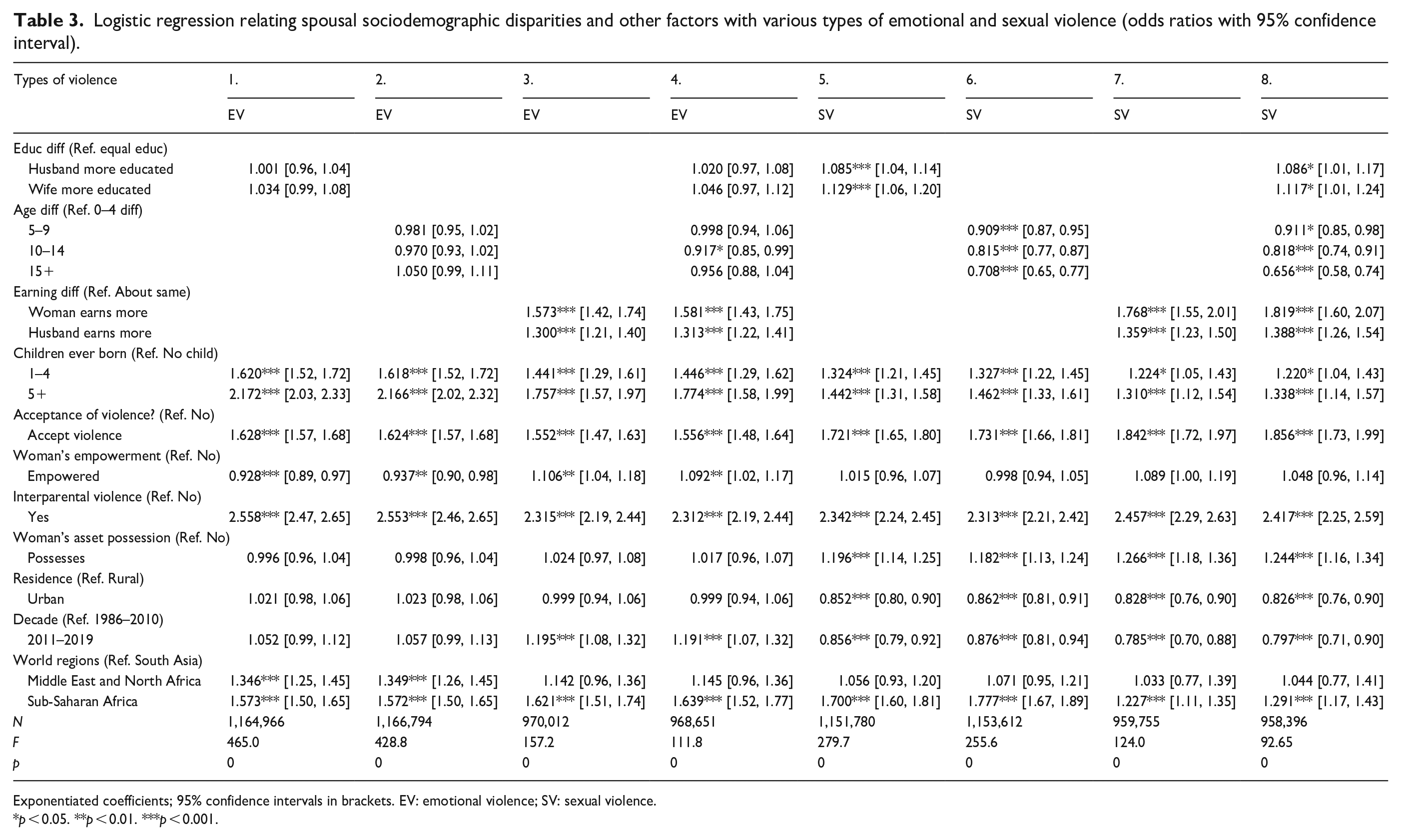
Exponentiated coefficients; 95% confidence intervals in brackets. EV: emotional violence; SV: sexual violence.
p < 0.05. **p < 0.01. ***p < 0.001.
The reporting of this study conforms to the STROBE statement. 59
Results
Table 1 examines the correlation between IPV types and potential explanatory variables. Disparities between spouses are significantly associated with all types of IPV at the 0.01% significance level, except for spousal education differences, which are not significantly related to EV. Additionally, all control variables show significant associations with the different forms of violence, except for women’s empowerment, which is not significantly linked with EV and SV. Nevertheless, women’s empowerment will be retained in the logistic regression model for comparability across violence types, as it is significantly associated with physical violence.
Figure 1 presents the distribution of various forms of IPV across numerous countries and timelines. The data shows significant variability in IPV prevalence. The lowest instances of SPV against women are found in Myanmar, Ghana, Jordan, Senegal, Egypt, and Burkina Faso (4%, 3%, 2%, 3%, 2%, and <1%, respectively). In contrast, Uganda, Tanzania, and Afghanistan report higher percentages (20%, 17%, and 18%). LSPV is least common in Myanmar, Nigeria, South Africa, and Burkina Faso (below 15%), and most common in Afghanistan, Congo, Uganda, and Zambia (nearing 50%). EV is least reported in Burkina Faso, Nepal, and Senegal (under 10%), while Uganda has the highest levels (around 40%). SV is lowest in Myanmar, Nigeria, South Africa, Egypt, and Burkina Faso (under 5%), but exceeds 25% in Burundi, Congo, and Uganda.

Distribution of intimate partner violence against women.
Figure 2 illustrates educational differences between spouses across various countries and years. Educational equality is most common, with Mali in 2012 showing the highest proportion (77.42%) and Nepal in 2016 the lowest (45.4%). When husbands are more educated, the highest proportion is in the DR Congo in 2013 (47.44%), and the lowest in Mali in 2012 (12.57%). For wives being more educated, Jordan saw an increase from 21.21% in 2007 to 23.02% in 2012, with a slight decrease to 21.69% in 2017. The lowest figures were in Afghanistan in 2015 and Nepal in 2011 (5.78% and 6.49%). Overall, there is a trend toward more educational equality or even wives being more educated over time in several countries.

Distribution of educational disparities between spouses.
Figure 3 provides insight into earning differences between spouses across several countries and years. Generally, husbands earn more, with the highest percentage in Burkina Faso in 2010 (92.29%) and the lowest in Jordan in 2017 (40.86%). Equal earnings are least common, peaking in Jordan in 2017 (35.26%) and reaching a low in Burkina Faso in 2010 (2.42%). Wives earning more is most pronounced in Jordan in 2012 (26.91%), with the lowest instance in Nigeria in 2013 (5.41%).

Distribution of earning disparities between spouses.
Figure 4 shows age differences between spouses across several countries and years. A trend toward smaller age differences (0–4 years) is observed, with the highest in Myanmar in 2015 (65.4%) and the lowest in Mali in 2012 (12.63%). Age gaps of 15+ years are least common, peaking in Mali in 2012 (28.21%) and lowest in Myanmar in 2015 (2.54%). Intermediate age differences (5–9 and 10–14 years) show various patterns, such as an decrease in 5- to 9-year gaps in India from 40.79% in 2005 to 37.16% in 2015.

Distribution of age disparities between spouses.
Table 2 presents the results of logistic regression analysis, exploring the relationship between IPV and spousal sociodemographic disparities in age, education, and earnings, specifically when the outcome variable is LSPV and SPV. Table 3 reports the results for EV and SV. When husbands are more educated than their wives, women face significantly higher odds of experiencing LSPV. Specifically, women married to more educated husbands have 1.044 times higher odds of experiencing LSPV (OR = 1.044, 95% CI = 1.01, 1.08; p < 0.05). A similar pattern is observed for SV in Table 3, where women face 1.085 times higher odds of experiencing SV when their husbands are more educated (OR = 1.085, 95% CI = 1.04, 1.14; p < 0.01). However, no significant relationship is found between husbands’ higher education levels and SPV in Table 2 or EV in Table 3. When wives are more educated than their husbands, there is no significant effect on any form of IPV, as seen across both Table 2 and Table 3.
A larger age gap between spouses is consistently associated with lower odds of IPV. As reported in Table 2, when the age difference between spouses is 5–9 years, the odds of experiencing LSPV decrease by 7.4% (OR = 0.926, 95% CI = 0.90, 0.96; p < 0.001). The same protective effect is seen for SPV in Table 2, EV, and SV in Table 3. For instance, when the age gap is 15 years or more, the odds of LSPV decrease by 23.5% (OR = 0.765, 95% CI = 0.72, 0.81; p < 0.001), and the odds of SV decrease by 34.4% (OR = 0.656, 95% CI = 0.58, 0.74; p < 0.001).
Earnings disparities also play a significant role in IPV, as seen in both Tables 2 and 3. Women who earn more than their husbands face significantly higher odds of experiencing IPV. As reported in Table 2, they are 1.361 times more likely to experience LSPV (OR = 1.361, 95% CI = 1.23, 1.50; p < 0.001) and 1.624 times more likely to face SV (OR = 1.624, 95% CI = 1.42, 1.86; p < 0.001) as reported in Table 3. Women earning more than their husbands have 1.573 times greater odds of experiencing EV (OR = 1.573, 95% CI = 1.42, 1.74; p < 0.001) in Table 3.
Women whose husbands earn more than them are also at increased odds of experiencing IPV, though the associations are generally weaker than when women earn more. In Table 2, women whose husbands earn more have 1.194 times higher odds of experiencing LSPV (OR = 1.194, 95% CI = 1.07, 1.33; p < 0.001), and in Table 3, they have 1.388 times higher odds of experiencing SV (OR = 1.388, 95% CI = 1.26, 1.54; p < 0.001). The odds are similarly increased for SPV (OR = 1.212, 95% CI = 1.09, 1.35; p < 0.001) in Table 2, and for EV (OR = 1.300, 95% CI = 1.21, 1.41; p < 0.001) in Table 3. These results suggest that earnings disparities in both directions, whether women earn more or their husbands earn more, are linked to increased odds of IPV, the risk being stronger when women earn more.
Those who justify IPV have higher odds of experiencing LSPV, SPV, EV, and SV. Empowered women have higher odds of experiencing LSPV, SPV (Table 2), and EV (Table 3). Women with more than one child have higher odds of experiencing LSPV, SPV (Table 2), EV, and SV (Table 3). A woman owning property is at greater risk for all IPV types, except EV (Tables 2 and 3). Urban-dwelling women are less likely to experience all types of IPV compared to those in rural areas.
Compared to South Asia, women in the MENA region and SSA are significantly less likely to experience LSPV and SPV (Table 2), but in some specifications, they have higher odds of experiencing EV (Table 3). However, women in SSA are less likely to experience LSPV and SPV (Table 2), yet more likely to experience both EV and SV (Table 3).
Discussion
This study aimed to explore how disparities in earnings, education, and age between spouses influence IPV against women in South Asia, the MENA, and SSA. Our findings reveal that these disparities are significantly associated with various forms of IPV, and these associations can be understood through distinct theoretical frameworks. While these results enhance our understanding of the dynamics of IPV in these regions, it is important to consider the limitations inherent in our study.
First, due to the observational nature of the data, causal relationships between socioeconomic disparities and IPV cannot be definitively established. Second, recall bias may affect the accuracy of responses, as participants might not accurately remember or might misreport past events. Additionally, cultural norms and personal comfort levels could influence the willingness of respondents to disclose information about IPV, even with efforts to ensure privacy and minimize biases. The DHS do not perform power analysis for determining sample sizes; instead, they base sample sizes on achieving precision for national and subnational estimates of key indicators. This design choice prioritizes descriptive accuracy but may limit statistical power for analyses involving smaller subgroups or less common outcomes. These factors must be considered when interpreting the results, as they can impact the reliability and generalizability of the findings.
Regarding earnings disparities, women who earn more than their husbands face significantly higher odds of experiencing LSPV, EV, and SV. This supports the Resource Theory of Power in Families, which posits that disparities in economic resources can disrupt traditional power dynamics within relationships, potentially leading to conflict and violence.30,31 In sociocultural contexts where male breadwinning is the norm—common in many parts of South Asia and Africa—women out-earning their husbands may challenge established gender roles, resulting in a perceived threat to male authority and an increased risk of IPV.
Conversely, when husbands earn more than their wives, we also observe higher odds of IPV, though to a lesser extent. This suggests that significant earning disparities, regardless of direction, can exacerbate power imbalances and contribute to IPV. The Resource Theory underscores that it is not merely who holds more resources, but the imbalance itself that destabilizes relationship dynamics.32,33 Furthermore, previous evidence suggests that both women earning more than their husbands (transgression) and earning less (submission) are risk factors for IPV, with these terms highlighting how imbalanced economic resources—whether challenging traditional gender roles (transgression) or reinforcing them (submission)—can contribute to heightened risk. 60 However, the implications of these disparities are not uniform across contexts. In some African regions where women’s economic participation is more culturally accepted, the impact of earnings disparities on IPV may be less pronounced compared to South Asian settings with stricter gender roles.
When examining educational disparities, the study reveals that when husbands are more educated than their wives, women have higher odds of experiencing LSPV and SV. Previous evidence also supports this result. 61 This finding aligns with the Status Inconsistency Theory, which suggests that discrepancies in social status, such as educational attainment, can create tension and conflict within relationships.34,35 Educational disparities may reinforce patriarchal norms and exacerbate power imbalances, increasing the risk of IPV, particularly in contexts where education is highly valued and linked to social status.
However, these findings are not blanket explanations across all settings. In some regions, higher male education correlates with progressive attitudes that discourage IPV. For instance, in certain urban areas of SSA, educated men may be more supportive of gender equality, 62 potentially mitigating the risk of IPV. This divergence highlights that the influence of educational disparities on IPV is mediated by cultural attitudes toward education and gender roles, which vary significantly across countries and even within regions.
Regarding age differences, our analysis shows that larger age gaps, where husbands are significantly older than their wives, are associated with reduced odds of IPV. Existing evidence also supports the notion that spousal age difference is inversely related to the risk of IPV. 19 According to the Age Stratification Theory, age differences can reinforce traditional power hierarchies, potentially stabilizing relationships and reducing conflict.37,38 In many South Asian and African cultures, age is associated with authority and respect, and larger age gaps may lead to clearer role expectations and less contestation of power within the relationship.
However, there may be other explanations for this protective effect. Research suggests that older husbands may experience less competition and are often in more established positions of authority, which can reduce the likelihood of conflicts that lead to IPV. This idea aligns with the social-ecological theory, which posits that factors at the relationship level, including the balance of power between partners, are crucial in understanding the dynamics of IPV. 63 In relationships where the husband is significantly older, deference to his authority and the stability it brings can act as protective factors against violence. Older men are often perceived as wiser and more authoritative, leading to less tension and fewer challenges to their authority within the marriage.19,64 Furthermore, studies in various cultural contexts have highlighted that the power imbalance created by a significant age gap can reduce the incidence of IPV. For instance, in Nigeria, IPV was less likely in marriages where the husband was much older, as traditional social norms discourage younger wives from challenging their older husbands, thus maintaining peace in the relationship. 19 Additionally, masculinities research indicates that younger men are more prone to taking risks and may exhibit violent behaviors as part of masculine identity construction, contributing to higher IPV rates in relationships with younger husbands. 65
Our study also observes that there has been a significant decrease in SV in the post-2010 period compared to the pre-2010 period, although SPV has increased during the same period. The increase in physical violence against women by intimate partners, coupled with a decrease in SV, can be attributed to distinct socioeconomic and sociocultural factors. Economic stressors, such as rising male unemployment, have been linked to increased incidences of physical violence, as men may resort to physical aggression to assert control when their traditional roles as providers are threatened. This phenomenon, often described as male backlash, highlights the strain that economic hardship places on relationships, potentially leading to an increase in physical violence. 26 On the other hand, societal attitudes toward SV have shifted, with greater awareness, legal deterrents, and societal condemnation likely contributing to a decrease in SV by intimate partners. 66 As these changes in societal norms evolve, they may have a more immediate impact on reducing SV, while the economic and psychological stressors exacerbating physical violence remain potent. Thus, the contrasting trends between physical and sexual IPV may reflect a complex interplay between economic pressures and evolving societal attitudes.
Several covariates were identified as significant factors influencing IPV, and their effects may vary by region, underscoring the importance of contextualization. Women who justify violence have higher odds of experiencing all types of IPV. This aligns with existing evidence, and this attitude may be more prevalent in regions with deeply ingrained patriarchal values, such as parts of South Asia, where cultural norms may condone or excuse men’s violent behavior. 47 Women’s empowerment was unexpectedly found to be associated with higher rates of LSPV, SPV, and EV. This could reflect a backlash effect, where men’s perceived loss of control leads to increased violence. 67 This phenomenon might be particularly acute in transitioning societies where traditional gender roles are being challenged, a scenario common in urban areas across Africa and South Asia.
Women with more than one child have higher odds of experiencing IPV. In many cultures, having multiple children increases household stress and financial burden, 68 potentially escalating conflicts. Women who own property are at greater risk for LSPV, SPV, and SV, except for EV. Property ownership can shift traditional power dynamics, possibly provoking violence in societies where male ownership is the norm. 67 This is particularly relevant in rural areas of South Asia and Africa, where land ownership is closely tied to status and power. Urban-dwelling women are less likely to experience all types of IPV compared to those in rural areas. Urban areas often offer better access to education, support services, and legal protections, which can mitigate IPV risk. However, the urban–rural divide varies by country; in some African nations, urbanization is associated with higher levels of social stress and crime, potentially influencing IPV rates differently.
The study also observes significant regional differences. Women from the MENA and SSA are less likely to experience LSPV and SPV compared to those from South Asia. However, women in SSA have higher odds of experiencing EV and SV in some cases. These variations may be attributed to differing cultural norms, legal frameworks, and societal attitudes toward gender and violence. For example, South Asia has documented issues with dowry-related violence and strict gender roles, possibly contributing to higher IPV rates. 69 In contrast, some SSA countries have made legislative strides in protecting women’s rights, 70 which might reduce physical violence but not necessarily EV or SV due to lingering cultural stigmas.
Conclusion
Our study examined the association between spousal sociodemographic (age, education, and earning) and various forms of IPV. We demonstrated that husbands with higher educational levels are more likely to inflict LSPV and SV on their wives, possibly due to the elevated socioeconomic status and income associated with education. Interestingly, a larger age gap between spouses appears to reduce the risk of IPV, potentially due to the increased authority of the older spouse. Conversely, relationships with minimal age differences are more prone to violence, possibly because women are less likely to be submissive and may challenge their spouse’s authority or discriminatory social norms.
A disparity in spousal earnings, regardless of whether the wife earns more or less, has adverse effects on women’s social, physical, and psychological well-being. Husbands who earn more are more likely to inflict violence on their wives, with the odds ranging from 16% for LSPV to 39% for SV. Conversely, women who earn more than their husbands face higher odds of violence, ranging from 36% for LSPV to 82% for SV.
These findings carry significant implications for policymaking. The fact that men’s education does not serve as a protective factor against IPV indicates deep-seated issues within the education system and within patriarchy, particularly in developing countries. Higher education and earnings should ideally be accompanied by greater tolerance for dissent and effective domestic conflict resolution. Therefore, public education on IPV against women needs to be more thoroughly integrated into the education system.
The issue of disparity in earnings among spouses also needs to be addressed. While the ideal earnings level that provides protection against IPV is subjective and context-dependent, efforts to increase women’s earnings should be part of a broader, more inclusive initiative. The patriarchal system’s dominance undermines the protective effect of higher income for women, emphasizing the need for socioeconomic institutions to raise public awareness about the severity of violence against women.
