




Abstract
Fertility preservation is a major concern for women with ulcerative colitis who require surgical treatment. Previous studies have shown that the risk of infertility after restorative proctocolectomy is approximately four times higher. However, this risk appears to be lower in patients who undergo minimally invasive approaches, such as laparoscopic surgery. The benefits of laparoscopy have led to a debate on whether robotic-assisted surgery could offer better results in terms of fertility. Surgical robotic platforms can provide improved visualization of the pelvis and more precise dissection of anatomical structures. In theory, this could reduce tissue damage and the inflammatory response, leading to lower adhesion formation and fallopian tube blockage, thereby preserving fertility.
Keywords
Ulcerative colitis (UC) is a chronic idiopathic inflammatory bowel disease characterized by relapsing and remitting mucosal inflammation, typically manifesting in the rectum and extending in a continuous pattern to proximal colon segments. 1 Despite notable advancements in the medical therapy arsenal, an estimated 15%–20% of patients will undergo surgical intervention throughout their lifetime, primarily due to medically refractory disease, acute severe colitis, or colorectal neoplasia. 2
Total proctocolectomy with ileal pouch-anal anastomosis (IPAA) is the procedure of choice for patients with UC requiring surgery. Although the complete removal of the colon and the rectum is considered curative for the intestinal manifestations of UC, IPAA is associated with not negligible rates of complications, such as anastomotic leakage, fecal incontinence, pouchitis, fistula formation, and pouch failure.2,3
Another concern regarding IPAA in female patients is the effect of the surgery on fertility and fecundity. This is thought to be caused by extensive surgical manipulation in the pelvis, leading to adhesions and fallopian tube occlusion.2,4 In 2011, Rajaratnam and colleagues conducted a meta-analysis to assess the impact of IPAA on female fertility. The study included patients with UC and familial adenomatous polyposis (FAP) and found a 3.91-fold increased risk of infertility after IPAA. 5 Ten years later, Sriranganathan and collaborators conducted a meta-analysis specifically evaluating patients with UC undergoing restorative proctocolectomy (RPC). Thirteen studies were included, which accounted for 793 patients pre-pouch and 802 patients post-pouch. The relative risk of infertility following RPC was found to be 4.17, with the mean rate of infertility almost reaching 43% in the post-pouch group, compared to 13% in the pre-pouch group. 6
A minimally invasive approach to IPAA seems to be beneficial in reducing infertility rates when compared to open surgery, probably because of a lower generation of pelvic adhesions.2,7 A cross-sectional study involving centers from the Netherlands and Belgium demonstrated that 55% of the patients with UC undergoing laparoscopic IPAA became pregnant within 12 months of attempting, compared with 35% in the open group. 8 Data extracted from a fertility questionnaire answered by 161 patients who underwent RPC at the Cleveland Clinic Ohio and the Cleveland Clinic Florida from 1983 to 2012 demonstrated that postoperative infertility rates were higher regardless of type of surgical access. However, laparoscopy was associated with a significantly reduced time to conceive compared with the open approach. A significant limitation of this study was the small number of patients who underwent laparoscopic IPAA, which was only 18. 9
The described advantages of laparoscopy have sparked a discussion on whether robotic-assisted surgery could offer superior results in terms of fertility.
In recent years, there has been a notable increase in the adoption of robotic systems in colorectal surgery, especially in rectal cancer resection. Robotic surgery offers several technical advantages in comparison with laparoscopy, such as stable and highly magnified 3-dimensional vision, enhanced hand-eye coordination, surgeon-controlled field, optimized ergonomics, multi-articulating instruments, motion scaling, and physiological tremor filtering.10,11 Additionally, updated versions of the DaVinci (Intuitive Surgical Inc., Sunnyvale, CA, USA) platform enable multi-quadrant approaches by providing nearly 360° boom rotation, long instrument shafts, camera port hopping ability, and table motion technology. 12
The capabilities of robotic platforms make them highly effective for operating in the pelvis, an area with complex anatomical and technical challenges. This technology allows surgeons to perform precise dissections in this narrow space. 11 As a result, in addition to its advantages in rectal cancer resection, robotic-assisted surgery emerges as a potential method of choice for performing IPAA.
Lightner and colleagues documented the outcomes of 132 patients who underwent minimally invasive IPAA. Fifty-eight patients had laparoscopic IPAA, and 74 underwent robotically assisted procedures. Nearly 80% of the patients were diagnosed with UC. No differences were identified regarding superficial surgical site infection, anastomotic leak, readmission, or reoperation. There was a trend toward a decreased rate of length of stay for patients who underwent robotic IPAA. They also reported that compared with conventional laparoscopy, the robotic approach was associated with a clinically significant decrease in the rate of pelvic sepsis (15.5% versus 6.8%). 13
In 2023, Deputy and collaborators published the St. Mark’s Hospital early experience in robotic ileoanal pouch surgery with robotic intracorporeal single-stapled anastomosis for patients with UC and FAP. All operations were completed robotically among the 20 patients undergoing IPAA. The potential strengths of this technique over the double-stapled technique are the precision in determining the level of the rectum transection and the ability to place the purse-string sutures in the narrow confines of the pelvis. In addition, the robotically assisted intracorporeal single-stapled anastomosis avoids multiple stapler firings and the formation of “ear-dogs.” 14 Intuitively, those technical improvements may lead to reduced rates of anastomotic leaks and pelvic sepsis.
To the best of our knowledge, to date, no study has evaluated the effects of robotic-assisted surgery on reducing infertility rates after IPAA. However, the potential benefits seem quite reasonable (Figure 1). Better visualization of the pelvis generates a more precise dissection of the structures, reducing tissue damage and inflammatory response. Virtually, it would lead to lower adhesion generation and fallopian tube occlusion. Additionally, robotic IPAA may be associated with a reduced rate of anastomotic leak and pelvic sepsis, which are important causes of pouch failure. 13 According to a retrospective Danish registry-based cohort study of patients with UC, those with a failed IPAA have significantly lower success rates with in vitro fertilization compared to other UC patients. 15
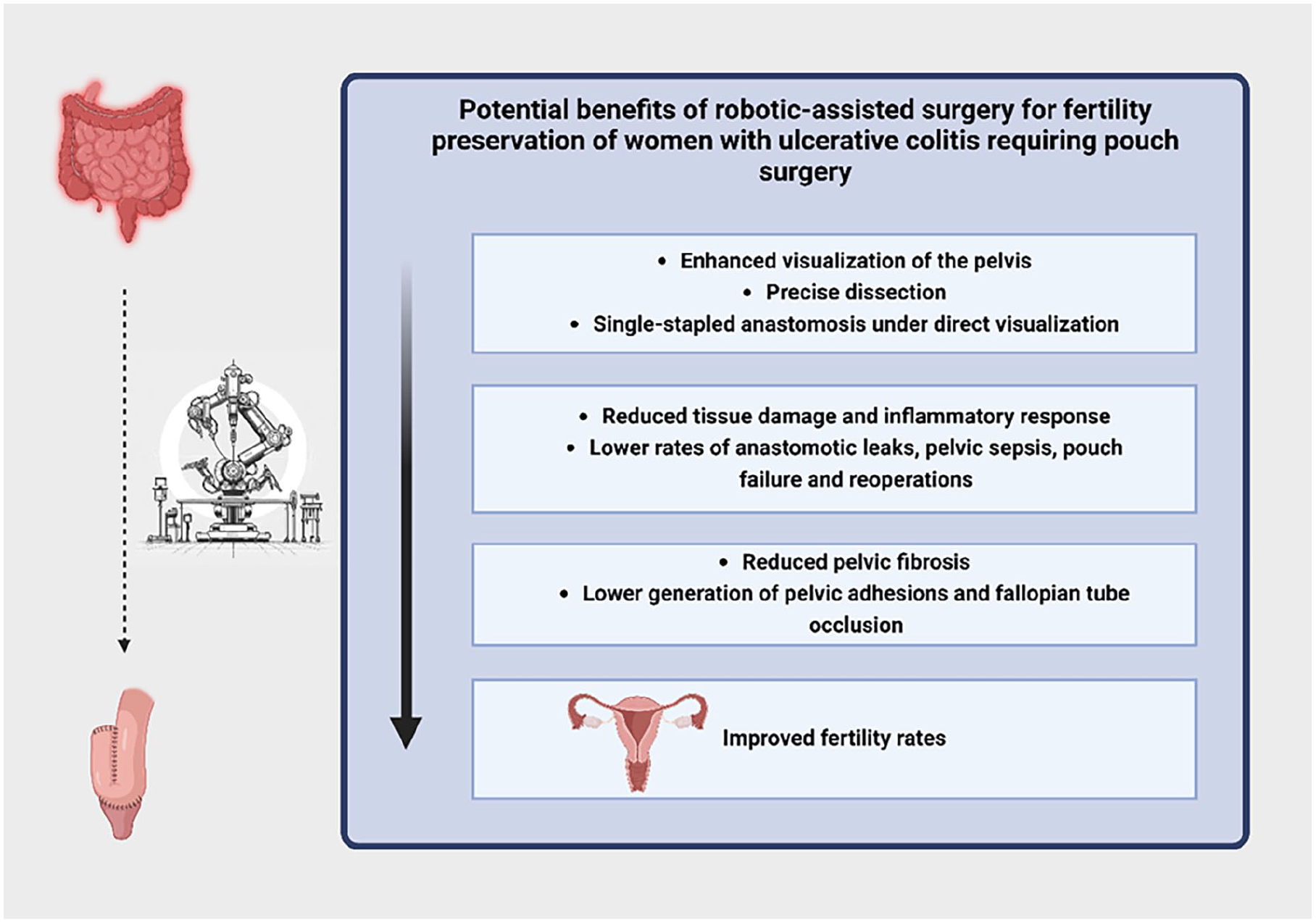
The potential benefits of robotic-assisted surgery for fertility preservation of women with ulcerative colitis requiring pouch surgery.
The extrapolated data from gynecological surgery shows promising outcomes regarding robotic-assisted surgery and fertility preservation. A single-center experience with 401 cases of reduced-port robotic myomectomy demonstrated that 80% of the patients who attempted to conceive after surgery became pregnant either naturally or through assisted reproduction. 16 Recent meta-analysis on clinical and fertility outcomes of multi-port robotic-assisted laparoscopic myomectomy demonstrated pregnancy rates after surgery ranging from 50% to 80%, with the majority of pregnancies originating from spontaneous conception. 17
While robotic-assisted surgery may not provide the ultimate solution for addressing fertility issues in women undergoing IPAA, this approach holds promise in handling the complex technical aspects of pelvic anatomy and pouch creation. Hopefully, in the years to come, we anticipate a more widespread adoption and technological advancement of surgical robotic platforms, leading to robust clinical evidence on the outcomes of robotic surgery in pouch surgery.
