




Abstract
Background:
Although menstruation is a monthly biological phenomenon, it is shrouded in stigma and shame which directly impacts health, education, gender equality, decent work, and economic growth. However, there is scarce evidence on how personal agency, an individual’s ability to access resources, may act as a protective factor to adequate menstrual health and hygiene practices. Therefore, we assess the association between attitudes toward menstruation and personal agency among very young adolescent girls.
Methods:
We use cross-sectional data from the Global Early Adolescent Study in São Paulo, Brazil, among 10- to 14-year-old girls who have experienced menarche (n = 325) and completed a home-based self-administered questionnaire in 2021. “Attitudes toward menstruation” was created based on five indicators on a Likert scale, with a higher score indicating more positive attitudes. The main covariate was personal agency, comprised of three scales and modeled as three continuous variables: voice, decision-making power, and freedom of movement. Data were analyzed using multivariable linear regression.
Results:
Attitudes toward menstruation mean score was 12.5 (range 5–19). Older adolescents (12–14 years-old) had higher mean scores (more positive) than younger adolescents (10–11 years-old) on attitudes toward menstruation, whereas no other sociodemographic or menstrual health indicator (knowledge or access to products) were associated with attitudes toward menstruation. In the multiple regression model, older age and higher freedom of movement remained positively associated with attitudes toward menstruation (βadjust = 0.5; 95%CI 0.1 to 0.8).
Conclusion:
Positive attitudes toward menstruation are associated with higher freedom of movement among very young Brazilian adolescent girls. The promotion of personal agency should be recognized as key strategies to accelerate young girls’ positive approaches to their own menstruation and, consequently, well-being.
Plain language summary
Our results show that positive attitudes toward menstruation among very young adolescent girls are associated with personal agency, measured through freedom of movement. This information can inform strategies to accelerate young girls’ positive approaches to their own menstruation and, consequently, well-being.
Keywords
Introduction
Menarche signs pubertal development among adolescent girls worldwide. While menstruation is a landmark of physical development during adolescence, the cultural experience of menstruation has emerged as an essential aspect in the scope of adolescents’ sexual and reproductive health. 1 Menstrual health is central to girl’s/women’s health from menarche to menopause and is particularly salient to healthy sexuality development during adolescence, starting in young adolescence, when people start acquiring the competencies in the form of knowledge, attitudes, and skills that support sexual wellbeing in relation to themselves and others. 2
The recent interest in the experience of menstruating relies on the fact that many girls who are socially marginalized face personal, social, and structural barriers to safely and adequately address their menstrual health and hygiene (MHH) needs.3 –7 The secrecy and stigma surrounding menstruation leads to inadequate social and environmental support, violating multiple human rights 8 and impeding progress toward several sustainable development goals including education, gender, health and water, sanitation, and hygiene. 9
In addition to the precarious conditions for the management of menstruation, many adolescents also experience their periods surrounded by taboos and stigmas.3,10,11 Studies have shown that menstruation is often seen as “dirty” and “impure,” and therefore a reason for shame and discretion. These stigmas may make individuals isolated or solitary while managing their menstruation, which contributes to an extremely unpleasant experience. 12 Inadequate information and negative values about menstruation can also lead to poor self-image, 13 which poses barriers to girls’ health and sense of dignity.4,6,14 Many of these stigmas are reproduced and reinforced in the families and communities in which adolescent girls live, 13 reinforcing unequal gender norms and weakening the social structures in which adolescent girls could build and strengthen their personal agency.15,16
Defined as the “personal ability to act and make free and informed decisions in order to achieve a certain goal,” 17 personal agency plays an important role in improving health conditions and well-being during adolescence.18,19 However, there is a complex relationship with agency increasing an individual’s ability to access resources while stigma and shame reduces girls’ sense of self-worth and their ability to build assets that support their agency.
In Brazil, menstrual health is poorly documented and period poverty remains a significant concern among low-income populations with less than half of elementary students disposing of the necessary materials to manage their periods. 20 Beyond period poverty, little is known about early adolescents’ experiences of menstruation related to their personal agency as they undergo puberty. 21 These relations have direct relevance for adolescents’ sexual and reproductive health programing as well as understanding how negative norms may shape future health and well-being, given potential connections with women’s empowerment.
In this study, we seek to address these gap by exploring young adolescent girls’ attitudes toward menstruation and its association to their personal agency, consistent with the domains prioritized by the World Health Organization. 14 We hypothesize a positive association, such that adolescents, who have more voice, more freedom of movement, and greater decision-making power over their daily life, also express positive attitudes toward menstruation compared to their counterparts.
Methodology
Study sample
This is a cross-sectional study in which data from the Global Early Adolescent Study (GEAS) in Brazil was used. GEAS is the first international study examining gender socialization on health during adolescence (https://www.geastudy.org/). The GEAS conducted across five continents, investigates an exponentially growing population of adolescents living in impoverished urban communities, who likely suffer an urban health penalty. This study focuses on Brazil, which included a non-probabilistic sample of 523 ten- to fourteen-year-old girls who completed home-based interviews in São Paulo city from August to November 2021. This study focuses on girls who reported experiencing menarche (n = 325), as questions related to “attitudes toward menstruation” were only asked to those who reported menarche. The only difference between those who menstruate and who did not was age (p < 0.001) (Supplemental File 1).
Trained interviewers (nurses or midwives accompanied by community health agents) invited adolescents registered across eight primary healthcare facilities to take part in the study. Eligibility criteria included the ability to read and write. Those who agreed, self-completed the instrument in Brazilian Portuguese on tablets (Supplemental File 2). The survey took around 1 h to complete. There were no refusals, but 10 adolescents were excluded due to 15% or more survey data missing. The Strengthening the Reporting of Observational Studies in Epidemiology (STROBE) guidelines for reporting cross-sectional studies were followed in this manuscript (Supplemental File 3).
Measures
The dependent variable is “attitudes toward menstruation.” A composite continuous variable was created from five indicators exploring pride (two items), shame (one item), secrecy (one item), and comfort (one item). Item responses, which followed a 4-point Likert scale (from very true to not true at all) were summed to form a score ranging from 5 to 20, after two negatively worded indicators were reverse coded (Table 1). A higher score indicated more positive attitudes toward menstruation.
Definitions of attitudes toward menstruation and agency measures: item and answer options by sub-domain.
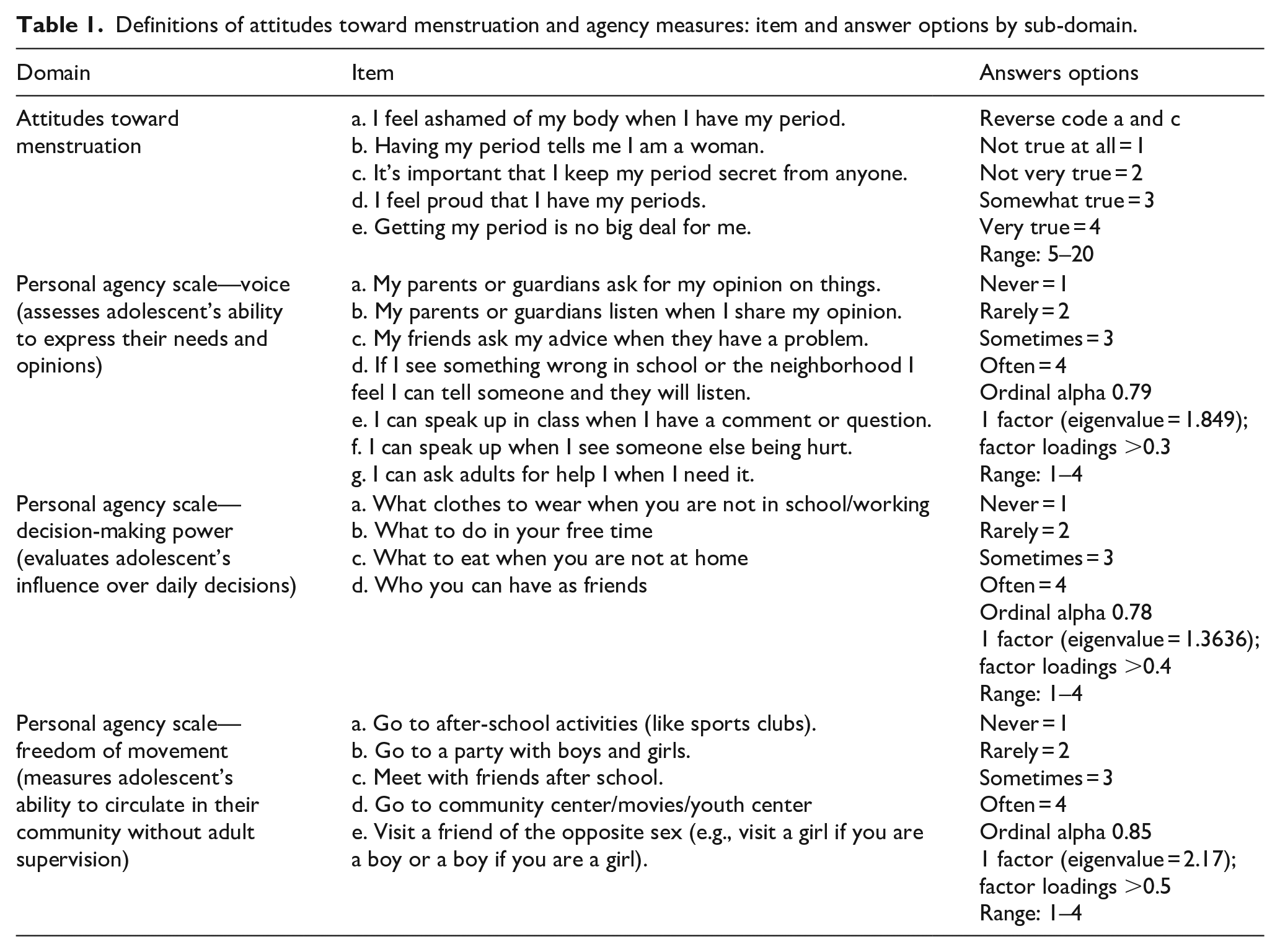
The main independent variable was personal agency, in the form of three subscales: voice, decision-making power, and freedom of movement, developed and validated in the formative phase in the GEAS study. 22 Each scale was defined as a continuous variable by summing up 4-point Likert responses for each item, with higher score indicating higher agency. Missing values ranged from 4% to 14% (responses “don’t know” or “refuse to answer”) and were uncorrelated with sociodemographic characteristics. We replaced missing values for each item with the mean score of the item. All scales had high internal reliability, with ordinal Cronbach’s alphas ranging between 0.78 and 0.85 in the Brazilian context (Table 1).
We considered other competencies or consequences related to menstrual health, including knowledge about where to get information about menstruation (dichotomous), use of menstruation specific supplies at last period (dichotomous), and whether the participant has been absent from school due to menstruation (dichotomous).
We also considered a number of sociodemographic characteristics such as age, self-identified skin color (black and non-black); religiosity (very important, somewhat important, and not important); family structure (cohabitation with both parents and has older sister—dichotomous); and parent employment status (not working, one working, both working).
Statistical analysis
We first described the adolescents’ sociodemographic characteristics. Mean scores and distributions of “attitudes toward menstruation” and personal agency domains were computed, and we checked the normal distribution of “attitudes toward menstruation” using Shapiro–Wilk test (p = 0.841). Furthermore, we conducted bivariate and multiple linear regression analysis to identify the covariates of “attitudes toward menstruation.” Finally, we examined bivariate and multivariate associations between the three domains of agency (separately and conjointly) and “attitudes toward menstruation,” adjusting for covariates found to be significant (p < 0.05) in the univariate models, due to our small sample size. The final model was adjusted by age. We present unadjusted and adjusted beta coefficients with respective 95% coefficient interval for each category.
Results
The majority of girls were aged 13 or 14 years (61.0%), self-identified as black (62.8%), cohabited with both parents (51.1%) and had an older sister (76.0%). Few reported neither knowing where to obtain information about menstruation (8.0%) nor having used specific products to manage their menstruation during their last period (7.8%). A little less than a third reported ever missing school due to menstruation (Table 2). Finally, adolescents had higher voice (mean = 3.1 (SD = 0.6)) and decision-making about daily life (mean = 3.4 (SD = 0.6)), in comparison to freedom of movement (mean = 2.2 (SD = 0.8)) (data not shown in Table).
Sociodemographic, socioeconomic characteristics, and menstrual behavior of very young adolescent girls.
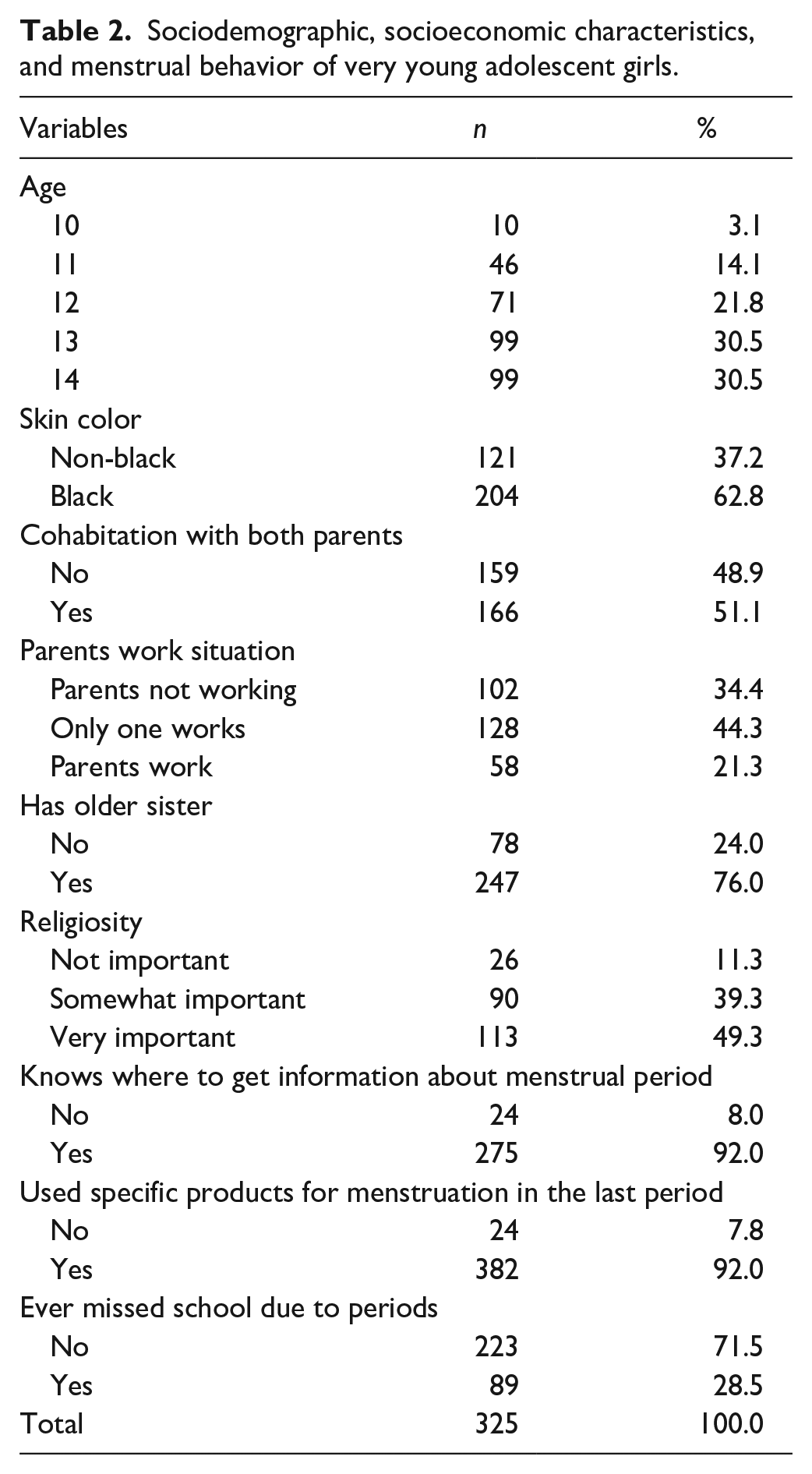
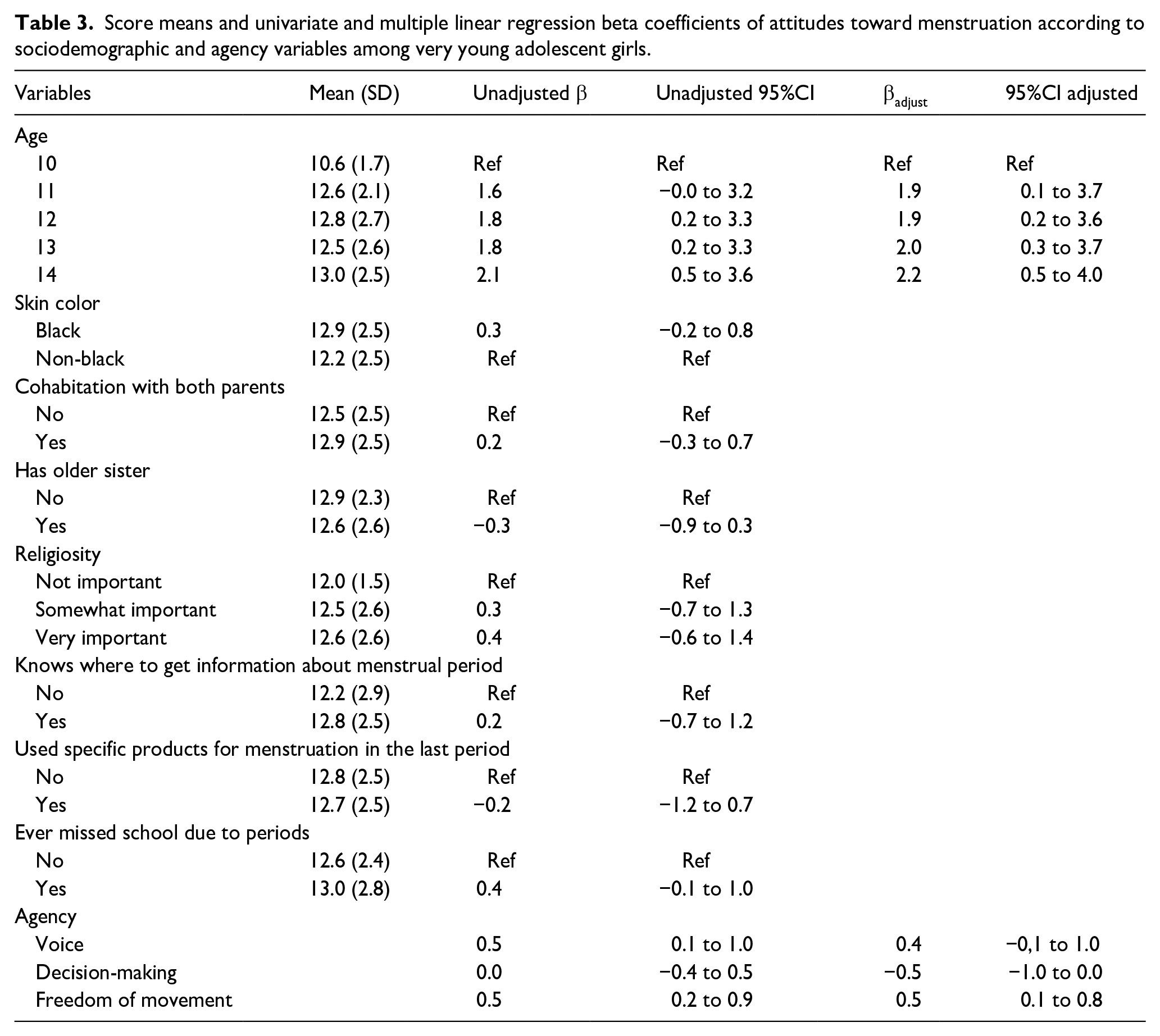
Figure 1 shows the scores on attitudes toward menstruation. The scores ranged from 5 to 19, with a mean of 12.5 (SD = 2.4). Table 3 shows that older adolescents (12–14 years-old) had higher mean scores (more positive) than younger adolescents (10–11 years-old) on attitudes toward menstruation, whereas no other sociodemographic or menstrual health indicator (knowledge about menstruation or access to products) were associated with attitudes toward menstruation. Additionally, higher voice and freedom of movement were associated with positive attitudes during menstruation in the unadjusted analysis. In the multiple regression model, older age and higher freedom of movement remained associated with positive attitudes toward menstruation (βadjust = 0.5; 95%CI 0.1 to 0.8).
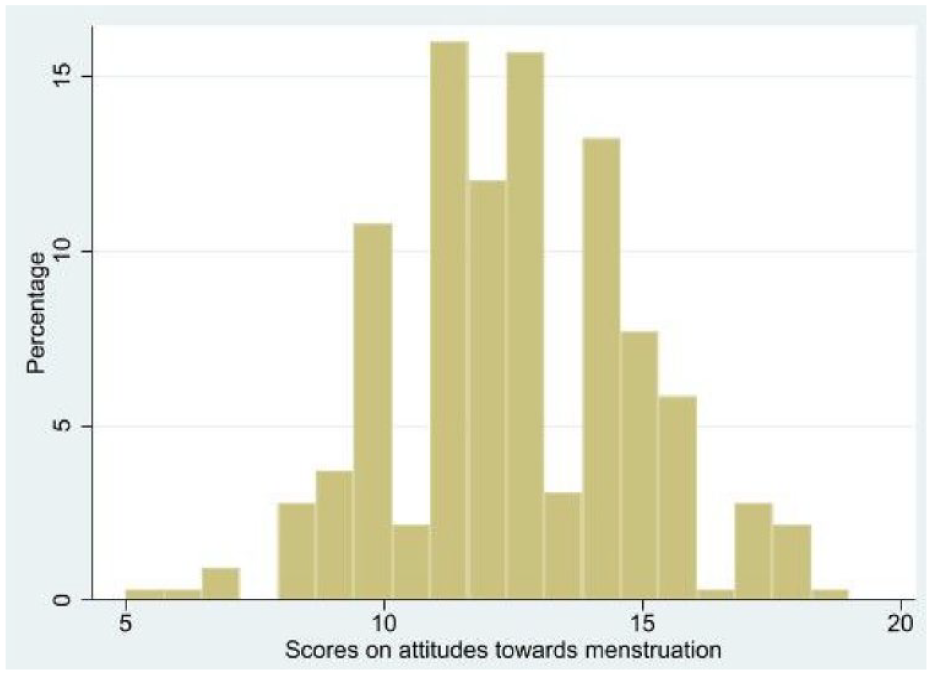
Distribution of scores on attitudes toward menstruation among very young adolescent girls.
Score means and univariate and multiple linear regression beta coefficients of attitudes toward menstruation according to sociodemographic and agency variables among very young adolescent girls.
Discussion
This study complements the growing body of evidence about MHH during adolescence, specifically among very young urban poor adolescents living in a middle-income country. Our results point to a range of experiences from low to high levels of attitudes toward menstruation, which rises with age and personal agency. These results have important implications in the Brazilian context, where menstrual dignity is a rising topic of debate and beyond as the interrelation provides novel information, informing a broader framework of healthy sexuality development.
This study finds that personal agency domains differ within individuals. We observed that adolescent girls had greater levels of voice and decision-making power than freedom of movement. Freedom of movement, the ability to move unrestricted within the environment, likely reflects a context of neighborhoods that may not be safe to navigate alone. 22 This is a reality in Brazilian large and very unequal cities that account for high rates of violence and homicides, 23 just as the scenario of this study. Additionally, unequal gender norms, which intensify during puberty, narrate that boys navigate the social spheres, whereas girls are “protected.” 24 These movement restrictions may occur due to the belief that girls face greater risks related to their sexual and reproductive health once they achieve puberty, so they have been considered as needing greater protection.25,26 Other studies using GEAS data across different cultural settings have also confirmed this finding related to restriction of girl’s movement during puberty. 26
Our results revealed greater effects of freedom of movement on attitudes toward menstruation than decision-making power and voice. These findings about the activities outside of the home (freedom of movement) may represent an important relationship that involves the parents and adolescent girls. In general, it seems that the relationship of trust, security regarding the daughter’s autonomy—represented by movement in the community—play an important role on the transformations that the adolescent girl experiences in the transition to adulthood,26,27 including menarche. Parental actions about their adolescent attitudes can considerably impact adolescents’ reaction to their pubertal experience. 28 Girls’ positive attitudes about menarche, for example, contribute to non-self-objectification, good relationship with their own body and agency in making decisions. 1 On the other hand, in conservative families in which this relationship may be limited, adolescents may need greater agency to overcome social barriers in conversations about sexual and reproductive health. 29
Such scenarios shape expressions of agency among adolescent girls. The girl’s empowerment is a specific tool to reduce violence against women,30,31 so raising girls’ agency may prevent gender-based violence. 32 Although there is increasing interest in empowering adolescents to become the agents of their own lives, there is little understanding of how agency relates to the changes that occur at this stage of the life course. In this way, this study adds to the limited literature exploring menstruation and agency among very young adolescents, which remains largely understudied, especially in a poor neighborhood of a middle-income country.
Our results also point out that a small proportion—but not less important—did not use specific supplies for menstruation management in the last period, and nearly a third had missed school because of menstruation. According to the 2013 National Health Survey, many girls in Brazil stop going to school, playing, or doing household chores due to menstrual restrictions. 33 The option to stay home is justified since the school environment can be hostile for students who menstruate. As they are still growing and developing, cycles are often irregular, which can cause an unexpected flow of blood. This situation may make girls a target for jokes and stigma. In addition, in most Brazilian schools, there is a lack of adequate hygiene infrastructure to meet their basic needs. 33 The “Menstrual Poverty in Brazil” study, conducted by United Nations Population Fund (UNFPA) and United Nations Children’s Fund (UNICEF) showed that four million students do not have access to basic menstrual care items in schools—around 321,000 students do not even have bathrooms in good conditions of use. 20 The situation is even worse when we take into account that 713,000 Brazilian adolescents do not have access to any bathroom (with shower and toilet) at all in their homes. 20 This denotes that the country has been neglecting the minimum conditions to guarantee the dignity of adolescents by ignoring their physiological needs.
Our results need to be interpreted with some limitations. First, the small sample size prevented more refined analysis of the positive attitudes regarding menstruation. Second, this study was conducted in only one site in Brazil and the subsample utilized in this study may affect the generalizability of our findings. Lastly, the cross-sectional nature of the study prevents a causal understanding between attitudes toward menstruation and personal agency. Thus, further research with representative samples and longitudinal data is needed to fully understand the dynamics between attitudes regarding menstruation and their relation to personal agency.
Despite these limitations, this study is one of the first to assess the association between girls’ personal agency and menstruation related attitudes, using a variety of validated measures. Menarche is recognized as a marker of reaching young adulthood in many settings, 26 and in this context, our results call for public health interventions that target adolescents. However, puberty interventions should pay special attention particularly to adolescents who are less able to express their voice or have limited decision-making and freedom of movement in order to guarantee that they obtain adequate information about sexual and reproductive health.
Conclusion
The promotion of agency is recognized as key strategies to accelerate gender equality as a human right and a process for achieving the sustainable development goals. Few studies have examined how agency relates the antecedents of the competencies young girls need to acquire and build a sense of self-worth and navigate safe and respectful relations. This study, therefore, adds to the limited literature exploring menstruation and agency—especially one of its domains, that is freedom of movement—among very young adolescents showing these concepts are positively interconnected at an early stage, supporting positive approaches to sexuality education.
Supplemental Material
sj-docx-1-whe-10.1177_17455057241274895 – Supplemental material for Understanding the association between menstrual health and hygiene attitudes and personal agency among very young adolescents in Sao Paulo, Brazil: A cross-sectional study
Supplemental material, sj-docx-1-whe-10.1177_17455057241274895 for Understanding the association between menstrual health and hygiene attitudes and personal agency among very young adolescents in Sao Paulo, Brazil: A cross-sectional study by Ana Luiza Vilela Borges, Christiane Borges do Nascimento Chofakian, Cristiane da Silva Cabral and Astha Ramaiya in Women’s Health
Supplemental Material
sj-docx-2-whe-10.1177_17455057241274895 – Supplemental material for Understanding the association between menstrual health and hygiene attitudes and personal agency among very young adolescents in Sao Paulo, Brazil: A cross-sectional study
Supplemental material, sj-docx-2-whe-10.1177_17455057241274895 for Understanding the association between menstrual health and hygiene attitudes and personal agency among very young adolescents in Sao Paulo, Brazil: A cross-sectional study by Ana Luiza Vilela Borges, Christiane Borges do Nascimento Chofakian, Cristiane da Silva Cabral and Astha Ramaiya in Women’s Health
Footnotes
Acknowledgements
First, the authors would like to thank Dr. Caroline Moreau for her valuable input and suggestions. Second, the authors are also grateful to all the community health agents that accompanied the nurses and midwives to conduct the interviews during a global pandemic. Third, and most importantly, the authors would like to acknowledge the participants who agreed to be part of the study and provided us with information presented in this manuscript.
Declaration

Supplemental material
Supplemental material for this article is available online.
References
Supplementary Material
Please find the following supplemental material available below.
For Open Access articles published under a Creative Commons License, all supplemental material carries the same license as the article it is associated with.
For non-Open Access articles published, all supplemental material carries a non-exclusive license, and permission requests for re-use of supplemental material or any part of supplemental material shall be sent directly to the copyright owner as specified in the copyright notice associated with the article.
