



Abstract
Background:
An exclusive breastfeeding period is a time when the infant’s feeding depends on only breast milk. Inadequate maternal nutrition during this period could lead to insufficient infant feeding, which can further lead to childhood undernutrition and developmental restrictions. Evidently, the burden of maternal undernutrition was higher in resource-limited countries, including Ethiopia.
Objectives:
This study aimed to assess the proportion of undernutrition among exclusive breastfeeding mothers and its associated factors in Southwest Ethiopia.
Design:
The study used a community-based cross-sectional design.
Methods:
The study was conducted among 442 nursing mothers from 10 to 30 June 2022. The participants were selected using multistage sampling techniques. An interviewer-administered structured questionnaire was used to collect information. Statistical software EpiData version 3.1 and SPSS version 20 were used for data entry and analysis, respectively. The factors associated with undernutrition were identified using a binary logistic regression analysis. In the bivariable analysis, a p-value of less than 0.25 was used to include the variable in the multivariable analysis, whereas p-value less than 0.05 was an odds ratio used to declare an independent association at a 95% confidence interval.
Results:
The proportion of undernutrition among the participants was found to be 24.8% in the study area. Poor intake of extra meals (adjusted odds ratio = 2.104; 95% confidence interval: 1.208, 3.664), poor dietary diversity habits (adjusted odds ratio = 3.605; 95% confidence interval: 2.112, 6.153), a lack of nutrition information (adjusted odds ratio = 1.853; 95% confidence interval: 1.070, 3.212), and household food insecurity (adjusted odds ratio = 4.424; 95% confidence interval: 2.639, 7.417) were identified as factors enhancing undernutrition among exclusive breastfeeding mothers in the area.
Conclusion:
A quarter of exclusive breastfeeding mothers were undernourished in the area. Poor dietary diversity habits, poor intake of extra meals, a lack of nutrition information, and household food insecurity were found to be the factors determining undernutrition. Hence, it is important to reinforce nutrition intervention programs, including maternal nutrition education and counseling.
Plain Language Summary
Adequate nutrition for a nursing mother is crucial for the health of both the baby and the mother. Frequent breastfeeding, especially in exclusive breastfeeding (EBF) mothers, increases the physiological demand for nutrients. Consequently, inadequate nutrition during this period can lead to undernutrition. Undernutrition during this crucial period can result in the detriment of a newborn’s growth and development. The problem is common in resource-limited settings, including Ethiopia. The study was conducted to assess the magnitude of undernutrition in the general nursing period. However, this problem, in particular the EBF period, was poorly studied before including the study area. A community-based cross-sectional study was conducted to assess the prevalence of undernutrition and its associated factors among EBF mothers in southwest Ethiopia. Accordingly, of the total of 435 participants involved in the study, about 108 (24.8%) of EBF mothers were undernourished. The participants’ poor intake of extra meals (adjusted odds ratio (AOR) = 2.104; 95% confidence interval (CI): 1.208, 3.664), poor dietary diversity habits (AOR = 3.605; 95% CI: 2.112, 6.153), a lack of nutrition information (AOR = 1.853; 95% CI: 1.070, 3.212), and household food insecurity (AOR = 4.424; 95% CI: 2.639, 7.417) were identified as factors enhancing undernutrition among EBF mothers in the area. Generally, the study identified about one-fourth of EBF mothers as undernourished in the area. Hence, the concerned bodies need to strengthen nutritional information dissemination to the community. Moreover, food supplementation should be planned for food-insecure households in the area.
Introduction
Adequate nutrition for a nursing mother is crucial for the health of both herself and the baby. 1 Women are considered nutritionally vulnerable during pregnancy and breastfeeding. 2 Breast milk quality can be affected by maternal nutrition during prenatal, antenatal, and postnatal periods. 3 There is a link between the mother’s body mass index (BMI) and the fat in her breast milk. 4 Both the mother’s and the baby’s physiological requirements can only be met with additional energy and nutrient supplements.5,6 In addition, these demands uniquely increase during exclusive breastfeeding (EBF) periods. 7 For instance, the body energy need during this time increases by 640 kcal per day.2,3 The mother’s reserves provide the nutrients through breastfeeding for the first 6 months, irrespective of their nutrition status.5,8
Maternal nutritional status is primarily assessed anthropometrically by measuring the mother’s BMI. 9 This anthropometric measurement is uniquely important for predicting an adult’s chronic energy malnutrition.10 –12 However, this technique is not suitable for estimating nutritional status during pregnancy because pregnancy-related weight gain during this period can affect the consistency of the measurement. 13 Depending on the BMI, the nutritional status is categorized as severely malnourished (BMI: < 16 kg/m2), moderately malnourished (BMI: 16–16.9 kg/m2), mildly malnourished (BMI: 17.0–18.49 kg/m2), normally nourished (BMI: 18.5–24.9 kg/m2), over nourished (BMI: 25–29.9 kg/m2), and obese (BMI: ⩾ 30 kg/m2). 14
Undernutrition during pregnancy and lactation causes a considerable amount of illness and death for both the mother and her baby. 15 Globally, undernutrition accounts for more than 3 million deaths among mothers and babies. 16 For instance, about 35% and 20% of child and maternal morbidity are related to undernutrition, respectively. 17 The burden of maternal undernutrition is common in resource-limited countries. 18 In sub-Saharan Africa, maternal undernutrition accounted for 11% of the global burden of disease. 19 More than 22% of reproductive-age women were undernourished during the 2016 Ethiopian Demographic and Health Survey (EDHS). 20 Similarly, about a quarter (24.7%) of women were undernourished in Oromia regional state. 20 Micronutrient deficiencies during lactation are more likely to affect the composition of breast milk and the development and growth of infants. 6
Undernutrition is attributed to sociodemographic factors, obstetric factors, food insecurity, and dietary diversity scores (DDSs). For instance, a lower level of education, household food insecurity, poor family income, a lower DDS, and larger family size were identified as factors that increase the likelihood of undernutrition among nursing mothers.21 –24
The government of Ethiopia has implemented a number of nutritional intervention initiatives to alleviate the problem. For example, to tackle the double burden of malnutrition among pregnant women and nursing mothers, the National Nutrition Program (NNP) was amended in 2016. 25
In Ethiopia, various studies, including systematic reviews and meta-analyses, were conducted on the status of nursing mothers’ nutrition. 26 However, little has been known about the nutritional status of EBF mothers, particularly in the Dabo Hana district. Therefore, the aim of this study was to assess undernutrition and associated factors among EBF mothers in the Dabo Hana district of southwest Ethiopia.
Method and materials
Study period, design, and setting
From 10 to 30 June 2022, a community-based cross-sectional study was executed. The findings of this study were written and reported according to the Strengthening the Reporting of Observational Studies in Epidemiology (STROBE) statement. The study was conducted in the Dabo Hana district of southwest Ethiopia. It is situated in the Oromia Region, about 519 km southwest of Addis Ababa, Ethiopia’s capital. The estimated total of reproductive-age women in the area was 14,326. 27 The estimated number of EBF mothers in the area was about 3934. Agro ecologically, more than three-fourths (76.63%) of the study area is Woina Dega, whereas the rest is Kola (hot) (500–1500 m), which makes up 23.33% of the district’s land area. The area is known for the cultivation of various types of agricultural products. For instance, it is known for producing cereals (teff, wheat, barley, maize, and sorghum), vegetables (garlic, onion, cabbage, and green pepper), and tubers, such as potatoes. Regarding health facility coverage, the district has 2 health centers and 15 health posts. The district had 8 health officers, 20 nurses, 8 midwives, and 40 health extension workers (HEWs) at the time of study period.
Population and eligibility criteria
The source population consists of all EBF mothers who resided in the Dabo Hana district of southwest Ethiopia, whereas all selected mothers who resided for at least 6 months in the area and who had infants aged less than 6 months (180 days) and were exclusively breastfeeding were considered the study population. However, those who were severely sick at the time of data collection and encountered stillbirth or early neonatal death were not included in this study.
Sample size determination
A single population proportion formula,
Sampling technique
The study participants were selected using a multistage sampling technique. In the first stage, 5 kebeles (lower administrative units) were randomly (using the lottery method) selected from the 15 kebeles of the district. After obtaining the total number of households having nursing mothers in each selected kebele from the HEWs, the sample was then proportionally distributed for each of the selected kebele. In the final stage, every nineth (calculated by 3934/442) households were selected using a systematic random sampling technique (Figure 1). Participants in the selected household were interviewed. In the event that the selected household did not have an EBF mother, the next household was contacted. If there were more than one EBF mother, one participant was randomly selected.
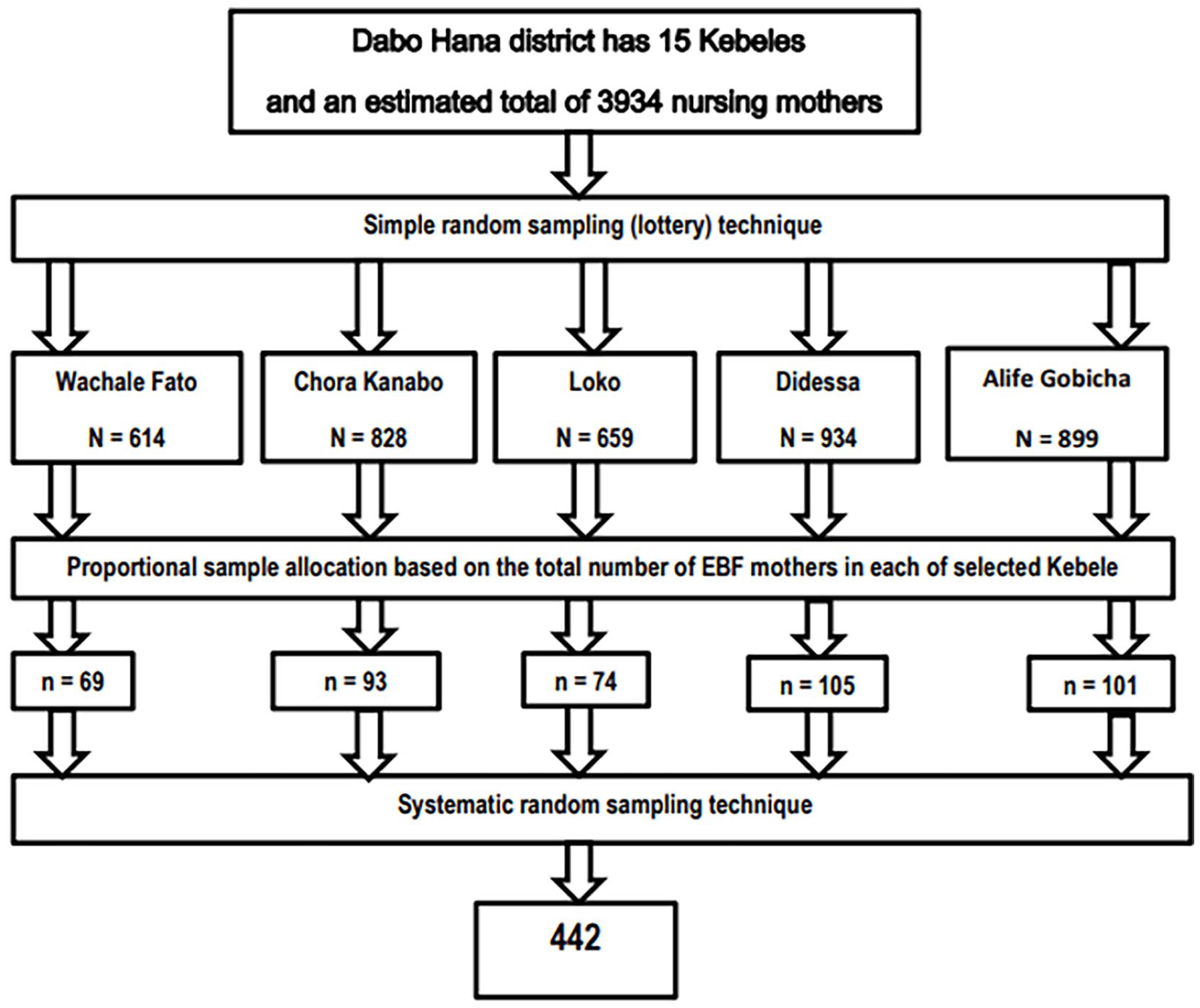
Schematic presentation of sampling procedures used to assess undernutrition among EBF mothers and its associated factors in southwest Ethiopia.
Study variables
Undernutrition of nursing mothers was the dependent variable, whereas the sociodemographic characteristics (age, family size, marital status, family income, educational status, occupation, and food security status), maternal healthcare characteristics (antenatal care (ANC) follow-up, birth interval, place of delivery, and maternal workload), maternal feeding practices (dietary practice, extra meal, and food taboos), nutrition-related health information, and sanitation and hygienic characteristics of the mother (drinking water source, handwashing after toilet utilization, and waste disposal) were independent variables tested against the dependent variable.
Operational definition
Data collection tool and procedures
Three HEWs and two degree holder public health professionals executed face-to-face interviews and supervised the data collection process, respectively. A structured and previously validated questionnaire that was adapted from similar literature was used for this study.23,28,35 –37 The questionnaire has the following parts: namely sociodemographic characteristics, maternal healthcare practice, maternal feeding practice, sanitation, and hygiene-related characteristics. The HHFIAS tool includes (1) whether the respondent worried about food; (2) whether the household ran out of food; (3) whether the respondent reduced food variety and was forced to eat similar food; (4) reduced the amount of food intake and skipped a meal; (5) the participant or another adult did not have enough to eat; and (6) felt hungry without food for 24 h.35 –37
The “yes” and “no” responses were coded into “1” and “0,” respectively. Then, the household food-insecurity index was estimated by summing up each participant’s score and dichotomized into “food-insecure households” (a score > 0) and “food-secure households” (a score = 0). The Federal Democratic Republic of Ethiopia(FDRE) Ministry of Health’s tool, used to conduct a health service utilization and expenditure survey, was used to estimate the household’s monthly income. 32
The participants’ nutritional status was estimated by calculating their BMI. It was simply calculated by dividing each participant’s weight (kg) by their squared height (m2). The height was measured while the participant was standing up with shoulders level, hands at their sides, thighs and heels comfortably together, buttocks, scapulae, and head, and a sliding head bar was used to make contact with the vertical backboard. The heights were then reported to the nearest 0.1 cm. The participants’ weight was measured using a digital weight scale, which was calibrated using a known weight each morning prior to data collection. Before each measurement, the weight scale reading was made strictly zero.
Data quality control
A pre-test was conducted among 43 (10% of the sample size) EBF mothers in one of the none-selected kebeles of the district. To increase the questions understandable by the participants, the English version questionnaire was translated into Afan Oromo (a local language), and back to English by two language experts. In addition, 1 day training was given for the data collectors and supervisors on the issues of study objectives and ethical considerations.
Statistical analysis
After the completion of data collection, the data were checked for missed values. Statistical software EpiData version 3.1 was used for data entry, whereas SPSS version 20 was used for data analysis. The descriptive findings were presented using frequency tables and a pie chart. A binary logistic analysis was used to determine the factors that explain undernutrition among EBF mothers. Multicollinearity between the independent variables was diagnosed using a variance inflation factor (VIF). Accordingly, VIF values greater than 10 were considered to be indicative of collinearity. All the variables found to have a p-value of less than 0.25 in the bivariate logistic regression analysis were further analyzed in the multivariate logistic regression models to control potential confounders. The Hosmer–Lemeshow goodness-of-fit test was used to select an appropriate model. The strength and direction of the association was checked by the odds ratio (OR) at 95% CI, and statistical significance was stated at a p-value of less than 0.05.
Results
Participants’ sociodemographic characteristics
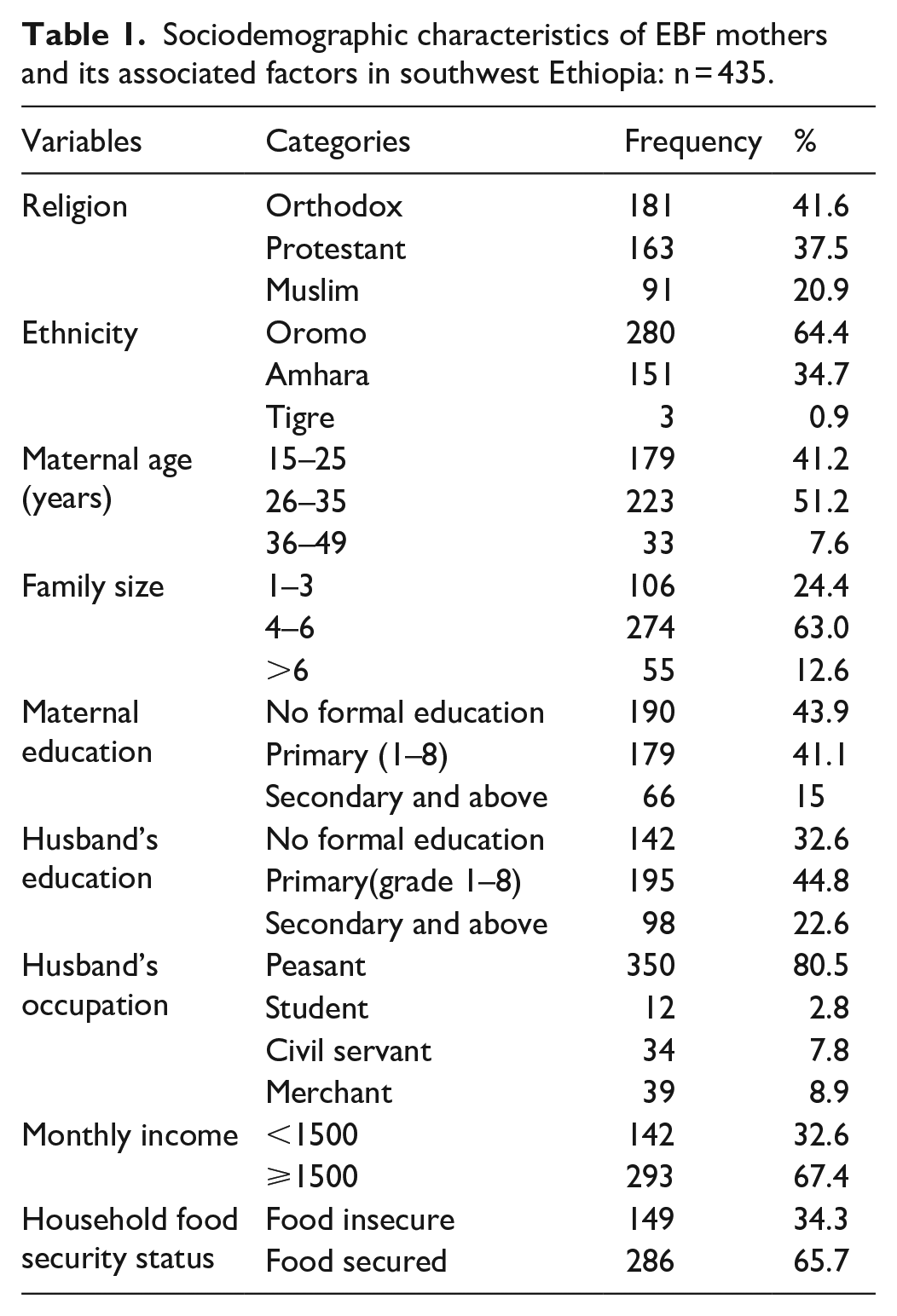
Of the total of 442 sampled EBF mothers, 435 participated in this study. The average age of participants was 30.23 (SD = ± 4.8) years. About 190 (43.7%) participants did not attend school. About 149 (34.3%) of the participants were food insecure. The majority, 181 (41.6%), of the study participants were Orthodox religion followers, and 280 (64.4%) were Oromo in ethnicity. However, 195 (44.8%) of their husbands had primary education, and 80.5% of their husbands’ occupation was a farmer. Less than two-thirds (65.7%) of them have no food insecurity (Table 1).
Sociodemographic characteristics of EBF mothers and its associated factors in southwest Ethiopia: n = 435.
Participants’ healthcare-related characteristics
About 283 (65.1%) participants reported that they attended ANC during last pregnancy; of these, 130 (46.2%) had more than four ANC visits. About 179 (41.1%) of participants had a birth interval of at least 36 months. Regarding gravidity, more than two-thirds (65.3%) of participants gave birth to two to four children. About 259 (59.5%) of participants gave birth to their index child at a health facility (Table 2).
Maternal healthcare-related characteristics of EBF mothers and its associated factors in southwest Ethiopia: n = 435.

The proportion of undernutrition among participants
In this study, about 24.8% (95% CI: 20.4, 29.7) of EBF mothers were undernourished (Figure 2).
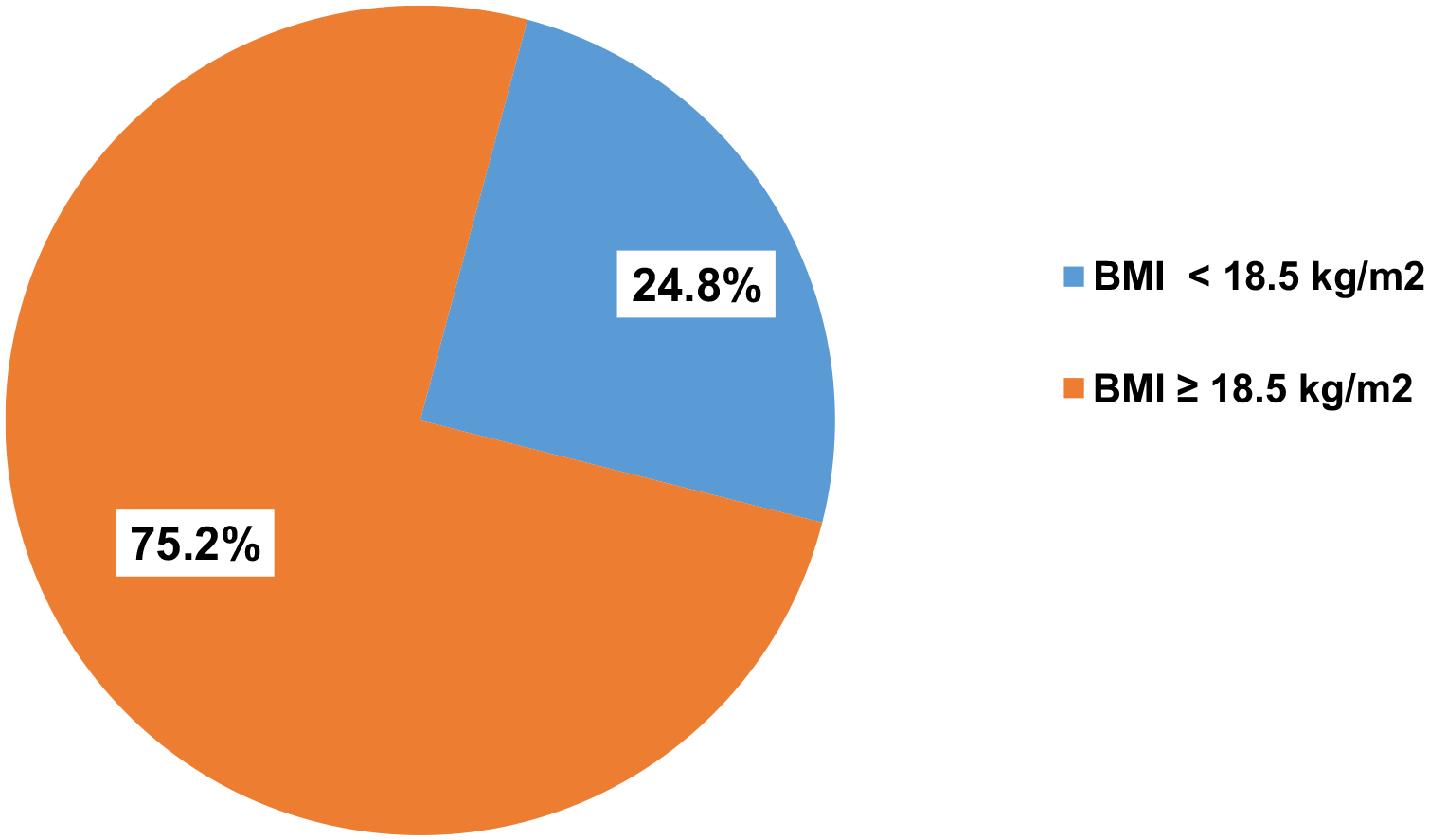
Nutritional status of EBF mothers and its associated factors in southwest Ethiopia: n = 435.
Participants’ feeding practices
More than half, 254 (58.4%), of the participants received at least one extra diet daily during nursing. The participants’ average DDS was found to be 5.17 (SD ± 1.37). About 204 (46.9%) of participants did not meet the WDDS. In terms of the food groups most consumed by the participants, starchy staples, dark green vegetables, and roots and tubers were about 96.1%, 90.6%, and 89%, respectively. About three-fourths of the study participants consumed cereals, whereas about two-thirds (65%) used dark green vegetables. Nearly two-thirds of the participants received nutrition-related health information (Table 3).
Dietary practice of EBF mothers and its associated factors in Southwest Ethiopia: n = 435.

Participants’ sanitation and hygienic practices
The majority, 371 (85.2%), of the households had a latrine. All (100%) of these latrines were pit types, and the majority (96%) of them were functional during the study period. Regarding solid waste disposal habits, about 237 (54.5%) of households dispose of it in the open space inside the compound. All participants (100%) practiced handwashing prior to food preparation and eating, of which 71 (16.3%) used soap. Regarding the type of drinking water source, more than half were piped water sources. About 313 (72%) of the study participants used protected springs, 83 (19%) used unprotected springs, and 39 (9%) used spring water sources.
Factors associated with undernutrition
The bivariate logistic regression analysis found that eight variables were associated with undernutrition at a p-value of less than 0.25. These variables include maternal educational status, husband educational status, ANC follow-up, birthplace, nutrition-related health education, household food security, WDDS, and extra dietary intake. However, extra dietary intake, WDDS, nutrition-related health education, and household food insecurity maintained their independent associations at a p-value of less than 0.05 in the multivariable logistic regression analysis. Accordingly, the likelihood of undernutrition was about twofolds (AOR = 2.104; 95% CI: 1.208, 3.664) higher among participants who did not consume extra diets in the breastfeeding period than those who added extra diets. The probability of undernutrition was about 3.6 times (AOR = 3.605; 95% CI: 2.112, 6.153) higher among participants who did not meet the DDS compared to their counterparts. The odds of undernutrition were nearly twofold (AOR = 1.853, 95% CI: 1.070, 3.212) higher among participants who did get a nutrition-related health education compared to those who did not. Moreover, the odds of undernutrition were more than four times (AOR = 4.424, 95% CI: 2.639, 7.417) higher among participants who encountered household food insecurity compared to those who were food secured (Table 4).
Univariable and multivariable analysis of factors associated with undernutrition among of EBF mothers and its associated factors in Southwest Ethiopia: n = 435.

The bold values in the table simply highlight the study’s significantly associated variables.
Discussion
This study assessed the prevalence of undernutrition among EBF mothers in the Dabo Hana district of southwest Ethiopia. Accordingly, about one-fourth (24.8%) of participants were malnourished in the area. This figure is comparable with the studies conducted in Wolayita Ethiopia (22.9%), 35 Tigray (24.6%), 28 and North East Ethiopia (25.4%). 37 However, it is lower than the findings from Tigray (50.6%), 38 Jimma (40.6%), 39 and the Afar region (32.8%). 40 The discrepancy could be attributed to advances in nutritional information, socioeconomic advancements, and differences in environmental settings. However, the finding of this study is higher than those of the studies conducted in Pakistan (15.1%), 36 India (16%), 41 Nigeria (1.25%), 42 Offa district (15.8%), 35 Moyale district (17.7%), 33 Ambo district (21.5%), 22 Dega Damot district (21.8%), 43 and Raya-Alamata district (17.5%). 28 The disparity might be due to the differences in socioeconomic rank, geographical location, and seasonal change. Also, this finding relates to the fact that frequent breastfeeding depletes maternal nutrient reserves in the mother’s body, resulting in maternal depletion. 4
In this study, the participants’ DDS was shown to have an association with undernutrition. Being undernourished was more than threefold higher among participants who did not meet DDS than their counterparts. This finding is in line with the findings from the Jimma zone, 22 the Borena zone, 23 and the Tigray region. 28 This is a plausible association that is linked to the fact that individuals who consume diversified diets obtain sufficient amounts of macro- and micronutrients.
According to this study, the probability of undernutrition was more than fourfold higher among participants from food-insecure households compared to those who were from food-secure households. This finding is connected to the universal fact that undernutrition is a consequence of food insecurity. However, a previous study from the West Shoa zone did not identify an independent association between undernutrition and participants’ household food security. 39
In this study, taking extra or additional meals during the EBF period was significantly associated with undernutrition. Accordingly, the likelihood of being undernourished was more than twofold among the participants who did not take extra or additional meals. A finding from the Borena zone supported the current finding. 22
Moreover, the odds of undernutrition were nearly twofold higher among participants who got nutrition-related health education than those who did not. A study from Nekemte town supported this finding. 21
Although in the previous studies,44,45 factors such as ANC visit, delivery place, and birth interval were shown to have an independent association with undernutrition, the current study did not show such an association.
Strengths and limitations
Being a community-based study and using anthropometric measurements to estimate undernutrition were thought to be the strengths of this study. Since this survey was executed during the fasting season, the proportion of undernutrition and dietary diversity practices of participants could be affected.
Conclusion
About one-quarter of EBF mothers were undernourished in the study area. The identified factors that determine undernutrition were poor dietary diversity practices, poor intake of extra meals, a lack of nutrition information, and household food insecurity. Hence, all concerned entities need to reinforce maternal nutritional education and counseling and ensure access to food supplementation for mothers in food-insecure households.
Moreover, we suggested further researchers in the field to identify additional variables using strong designs, such as longitudinal.
Supplemental Material
sj-docx-1-whe-10.1177_17455057241231478 – Supplemental material for Undernutrition among exclusive breastfeeding mothers and its associated factors in Southwest Ethiopia: A community-based study
Supplemental material, sj-docx-1-whe-10.1177_17455057241231478 for Undernutrition among exclusive breastfeeding mothers and its associated factors in Southwest Ethiopia: A community-based study by Riyad Ahmed, Samuel Ejeta Chibsa, Mustefa Adem Hussen, Kenbon Bayisa, Bilisumamulifna Tefera Kefeni, Wubishet Gezimu and Kebebe Bidira in Women’s Health
Footnotes
Acknowledgements
The authors thank everyone who contributed time and effort to this study, including the supervisors, data collectors, and study participants, and believe that this study would be impossible in their absence. In addition, they appreciate the cooperation and participation of Dabo Hana district health office throughout the project.
Declaration
ORCID iDs

Supplemental material
Supplemental material for this article is available online.
References
Supplementary Material
Please find the following supplemental material available below.
For Open Access articles published under a Creative Commons License, all supplemental material carries the same license as the article it is associated with.
For non-Open Access articles published, all supplemental material carries a non-exclusive license, and permission requests for re-use of supplemental material or any part of supplemental material shall be sent directly to the copyright owner as specified in the copyright notice associated with the article.
