




Abstract
Background:
Although women remain historically underrepresented in medical achievement awards, gender distribution of award recipients in ophthalmology in Canada remain to be explored based on research productivity metrics.
Objective:
To characterize the gender distribution of award recipients among the main Canadian national ophthalmological societies and subspecialty affiliates based on research productivity, graduate degrees, affiliated institution, and award type.
Design:
Retrospective, observational study.
Methods:
Award recipients were selected from the Canadian Ophthalmological Society (COS), Canadian Association of Paediatric Ophthalmology and Strabismus (CAPOS); Canadian Cornea, External Disease, and Refractive Surgery Society (CCEDRSS); Canadian Council of Ophthalmology Residents (CCOR) Research Proposal Award; and Canadian Glaucoma Society (CGS). The recipients’ gender was determined by web search for the gender-specific pronoun, profile photograph check, or using Gender-API. Outcomes included gender distribution of recipients per award, society, year, and training level and differences in research productivity.
Results:
Thirteen special awards were given to 255 recipients (215 individuals) from 1995 to 2022. In total, 31% of recipients were women, the majority being from Canada. Women had a significantly lower median h-index (2.0 (0–62) women versus 4.0 (0–81) men, p = 0.001) and number of published documents (3.0 (0–213) women versus 8.0 (0–447) men, p < 0.001). On stratified analyses by type of award (research or lifetime achievement) and level of training (trainee or ophthalmologist), significant differences were found for mean h-index and number of publications for awardees within the research category (p = 0.01 and p = 0.02, respectively) and trainee level (p = 0.01 and p = 0.02, respectively). Overall, women’s proportion rates in awards did not reach parity in 27 out of the 28 years analyzed.
Conclusion:
Women were confirmed to be historically minored in proportion among the prominent society awards in Canada, with attested research disparity possibly explaining some of this bias. These findings require further confirmation in larger cohorts accounting for additional educational, institutional, and provincial factors.
Registration:
Not applicable.
Introduction
Since women started entering ophthalmology in Canada in the 1950s, the number of Canadian women physicians and ophthalmologists has steadily increased. 1 By 2019, the women’s workforce comprised almost 60% of medical students, 45% of physicians, and 30% of Canadian ophthalmologists.2 –4 Despite that, women remain historically neglected and underrepresented in academic achievement awards, whereby a phenomenon called “The Matilda Effect,” defined by Margaret W. Rossiter in 1993 as academic bias toward recognizing men but not women scientists, has been acknowledged.5 –23
Medical awards range from a variety of categories, such as clinical care, research, education, global health, and service. These recognition prizes, however carrying limitations, can advance recipients’ careers by leveling work impact and visibility, being also valued by certain committees for academic promotion and financial support.10,19,24,25 With the increasing awareness of gender disparities permeating medical practice and academia, recent studies have pointed to gender asymmetries in awards offered by medical societies.6,9 –14,16,17,19 –21,23 Background causes for this problem have been listed, mostly related to historical access barriers to educational and work opportunities, yet insights suggest a systemic problem that touches on women’s participation in research and the shared recognition of their production.
Research productivity scores are essential analytical tools in gender-disparity studies for providing a comparative look into scientific production. 25 While metrics such as the h-index, also known as the Hirsch index and linked to the number of citations, have been considered limited for some potential interpretation bias, the m-quotient (h-index/number of years in practice) may offer additional contextualization by factoring in time to the calculations.25 –28 In this study, we aim to determine the gender distribution of award recipients of major national Canadian ophthalmology prizes and evaluate background research productivity metrics, a potential explanation for award bias, using the number of published documents, h-index, and m-quotient.
Materials and methods
Study design and eligibility criteria
This retrospective, observational, comparative study utilized publicly available data about the awards offered by the Canadian Ophthalmological Society (COS) since 1995. Data were curated in the last day of April 2022 from the society’s official website (www.cos-sco.ca/cos-membership/awards), covering January 1995 to April 2022. In cases of incomplete data or discrepancy, the authors directly communicated with COS for clarification. Awards included in the analyses were either given by the COS or another Canadian subspecialty society, for example, CAPOS: Canadian Association of Paediatric Ophthalmology and Strabismus; CCEDRSS: Canadian Cornea, External Disease and Refractive Surgery Society; CCOR: Canadian Council of Ophthalmology Residents; CGS: Canadian Glaucoma Society; and CSOS: Canadian Society of Oculoplastic Surgeons, as detailed in Supplemental Table 1. The Canadian Retina Society (CRS) awards were omitted, as they were not mentioned in their annual meeting brochures. CRS further confirmed that research awards have not been consistently granted nor reported over the years. Awards distributed by nonprofit foundations (e.g. Fighting Blindness Canada) were not included. Awards mentioned by COS or a Canadian subspecialty society but promoted by another entity were excluded—for example, Outstanding Humanitarian Service Award given by the American Academy of Ophthalmology, Champion for Change given by Women in Ophthalmology, Dr. Alain P. Rousseau Award by the Fondation des maladies de l’oeil.
Data collection
Details about the included awards, such as general criteria, society/subspecialty, category (achievement versus research), population (trainees versus senior ophthalmologists), prize, list of recipients, affiliations, educational degree, number of recipients, and award years (start and end dates), were collected. In the case of the COS Awards for Excellence in Ophthalmic Research, only bolded individuals—the presenters of the top three articles and three posters accepted for the annual meeting—were considered as award recipients, given these awards often represent the work of a group.
To evaluate the awardees’ research productivity, the h-index and number of documents were extracted from the Elsevier Scopus database (Elsevier B.V., Radarweg, Amsterdam, NL, https://www.scopus.com) using the researcher’s score by the year in which the award was granted. The m-quotient was then estimated by dividing the h-index by the estimated years of practice tracked on Scopus. The h-index was chosen for gauging a scientist’s research impact and influence as it encompasses the publication quantity and citation counts; however, this metric tends to favor senior scholars with longer publication records in comparison with junior researchers. Meanwhile, the m-quotient aims to rectify the h-index’s bias by accounting for career duration, despite not comprehensively capturing the subtleties of an individual’s research impact. To assess gender distribution, the award recipients’ gender was determined by web search and profile photograph check upon academic, research, and professional-network profiles—for example, university, conference, private practice, LinkedIn, Twitter, and ResearchGate pages. In case of the inconsistent or unavailable information, the Gender-API application (https://gender-api.com/), with estimated 98% accuracy, was used for most likely gender ascertainment.29,30
Statistical analyses
Primary study outcomes included general distributions by gender, award name, award year, award category (achievement versus research awards), recipient level of training (trainee versus ophthalmologist), educational level, and country of institutional affiliation. Secondary outcomes assessed gender general and award-specific differences in research productivity metrics determined by number of documents, h-index, and m-quotient. Comparative rates of women workforce in ophthalmology were obtained from the Canadian Medical Association reports (https://www.cma.ca/physician-data-centre), with data available only for uneven years covering 1995–2019.
Statistical analyses were performed with SPSS (v.25; IBM, Chicago, IL, USA) with reported central (median) and dispersion (range) values. Comparisons used Mann–Whitney U testing to assess differences between continuous variables (nonparametric). Spearman’s rank correlation was utilized to measure the relationship between time and women awardees proportions. Significance was assigned as p < 0.05.
Results
A total of 13 Canadian ophthalmology awards were included in the analyses, with prizes detailed in Figure 1. A total of 255 recipients were distributed to 215 individuals. Of these, 78 (30.6%) of 255 awards were granted to women. The majority of prizes were destined to trainees (204/255, 80.0%) as opposed to fully licensed ophthalmologists (51/255, 20.0%). In terms of educational background, 40 (15.7%) of 255 awardees had a master’s degree, 27 (10.6%) of 255 had a Ph.D., and 10 (3.9%) of 255 had both master’s and Ph.D., and the remaining 178 (69.8%) of 255 recipients were categorized either as a medical student or as an ophthalmologist without a master’s or Ph.D. degree. Most of the winners were reportedly affiliated to a Canadian institution (233/255, 91.4%), while foreign awardees were distributed as coming from the United States (10/255, 3.9%), Brazil (2/255, 0.8%), India (2/255, 0.8%), and the United Kingdom (2/255, 0.8%). Single individuals were also listed from France, Israel, Singapore, South Korea, and Spain (1/255 each, 0.4%), as depicted in Supplemental Figure 1.

Gender distribution of award recipients by award name and society, 1995–2022.
Considering the number of awards, 187 (87.0%) of 215 researchers obtained a single award during their lifetime, being 61 of these (32.6%) women. This was followed by 21 (9.8%) of 215 individuals receiving two awards (4/21, 19.0% women) and 7 (3.25%) of 215 receiving three awards (2/7, 28.6% women). During the 28 years examined in this historical cohort, the annual proportion of awards granted to women ranged from zero (1995, 1996, 1999, 2004, and 2007) to 66.7% prizes (1997), the latter being also the only year in which women surpassed men awardees; parity was otherwise not observed in any of the remaining years, as demonstrated in Figure 2. In 10 of the 13 years (76.9%) in which gender information about the Canadian physician workforce in ophthalmology was available, women awardee rates matched or surpassed specialty averages (1997, 2001, 2003, 2005, 2009, 2011, 2013, 2015, 2017, and 2019). On the correlation analyses, there was no relationship between the proportion of women awardees with time between 1995–2022 (ρ = 0.37 and p = 0.05), despite a trend for increase over the past decade, as shown in Supplemental Figure 2. Subgroup correlation analysis by level of training indicated a significant relationship for trainees (ρ = 0.50 and p = 0.006), but not for ophthalmologists (ρ = 0.37 and p = 0.05). By type of award, there was a positive significant correlation for achievement (ρ = 0.44 and p = 0.02), but not for research (ρ = 0.15 and p = 0.44).

Distribution of women award recipients by year, 1995–2022.
In terms of research productivity, women awardees had a median number of published documents of 3.0 (0–213), which was significantly smaller compared with men counterparts (8.0, 0–447) (p < 0.001). Prized women also presented significantly lower h-index compared with men: 2.0 (0–62) versus 4.0 (0–81) (p = 0.001). No difference was noted for estimated median m-quotient among women (0.69, 0–2.2) versus men (0.75, 0–7.0) (p = 0.09). In subgroup comparisons by the level of training, there was a significant difference in the number of documents and h-index (p = 0.01 and p = 0.02, respectively), but not for m-quotient (p = 0.13) for trainees; no differences were found either for the number of documents (p = 0.99), h-index (p = 0.94), and m-quotient (p = 0.87) for ophthalmologists.
In Figures 3 and 4, gender and research productivity differences are categorized by awardees’ level of training and type of award. Significant gender differences were identified for awards based on the h-index within the research and trainee-level award categories (p = 0.02), as well as based on the number of publications within the research and trainee-level award categories (p = 0.01). No significant gender differences based on the m-quotient were noted within achievement (p = 0.45), research (p = 0.12), or awards by level of training (p = 0.12 for trainees and p = 0.87 for ophthalmologists). None of the other research productivity metrics showed differences by gender within ophthalmologist-level awards.
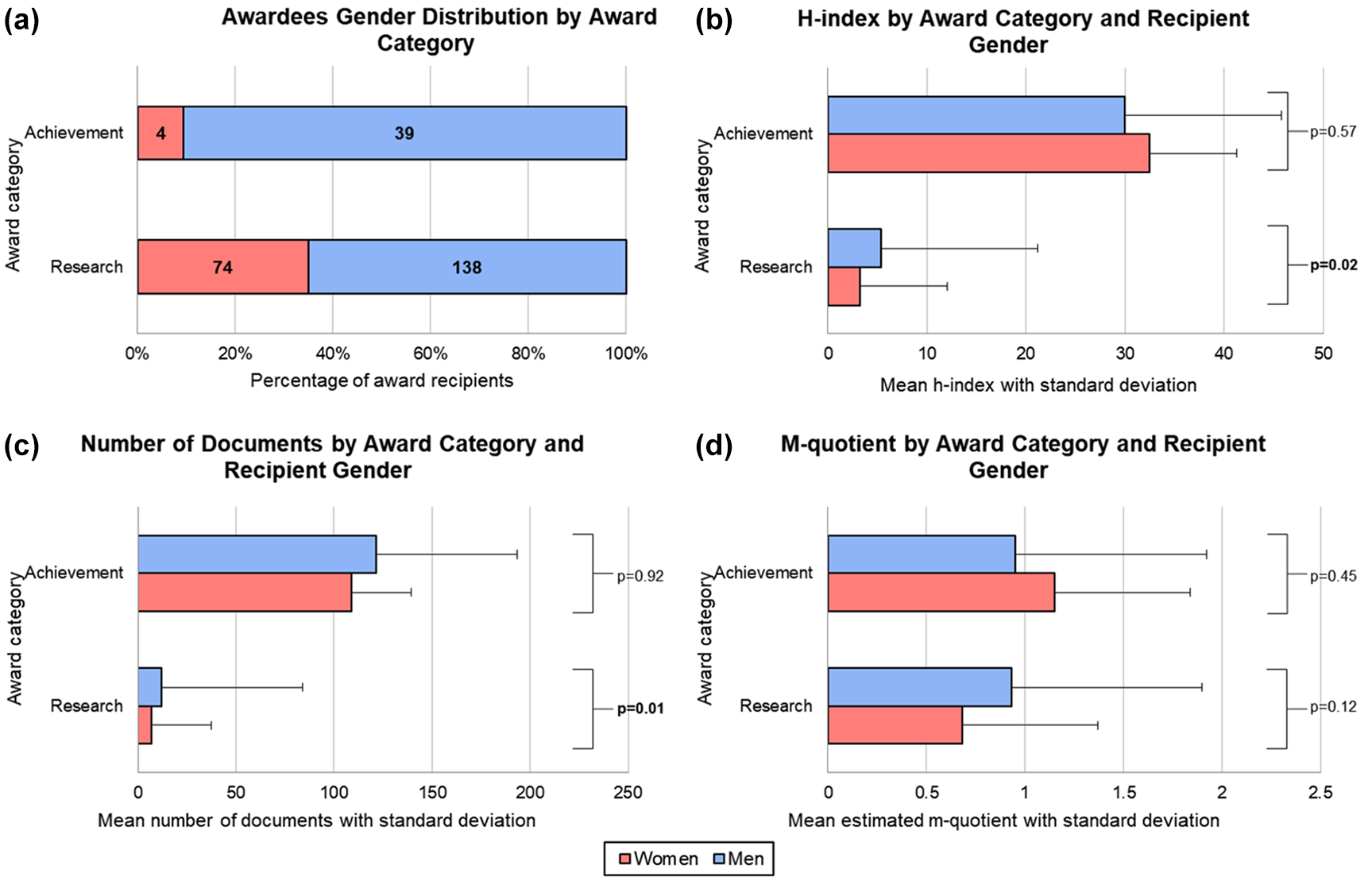
Gender distribution by award category based on: (a) gender; (b) h-index; (c) number of documents; and (d) m-quotient.
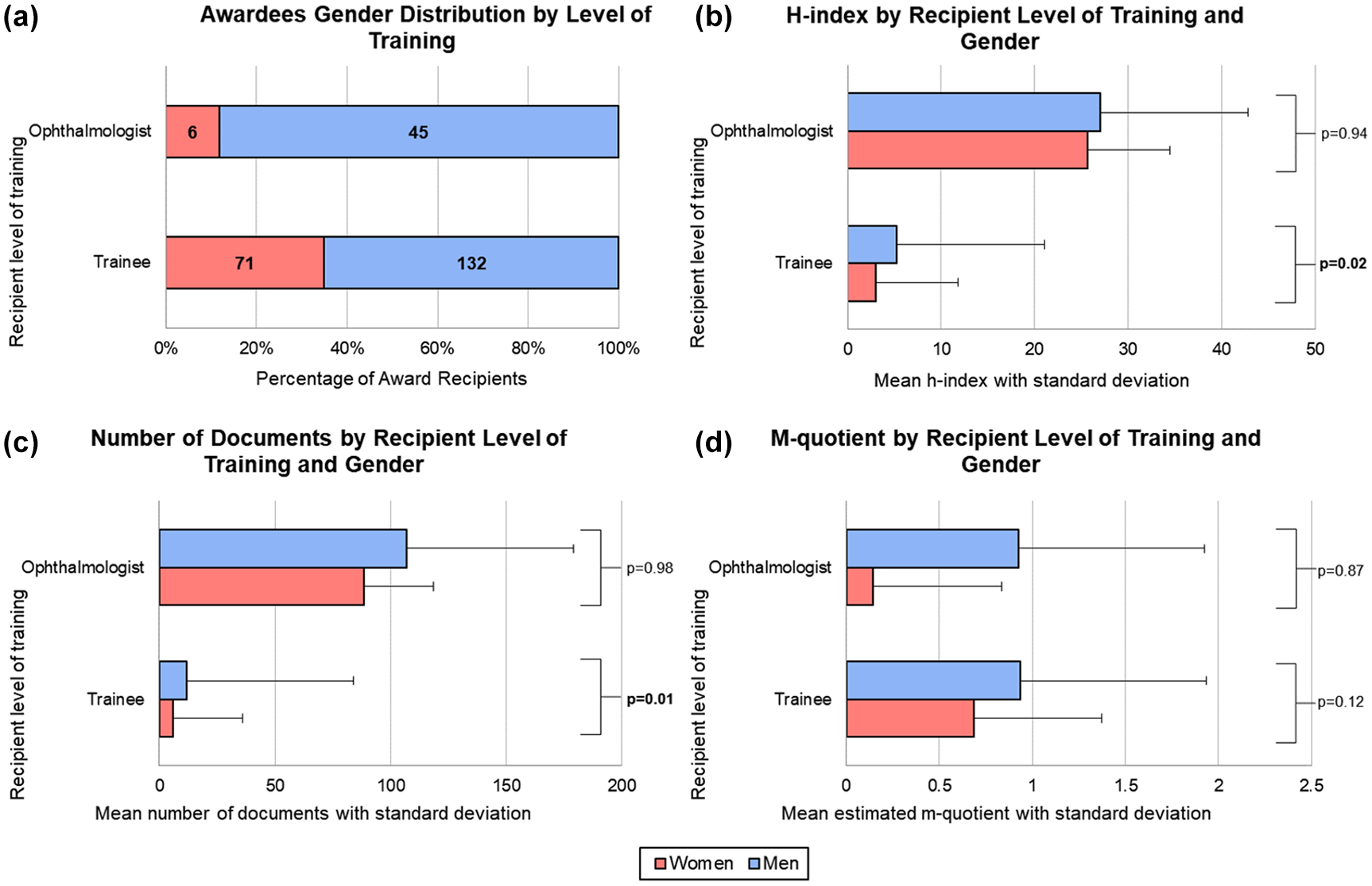
Gender distribution by awardee training level based on: (a) gender; (b) h-index; (c) number of documents; and (d) m-quotient.
Discussion
This study is the first to assess gender distribution and background research productivity in recognition awards given by the leading Canadian ophthalmology societies. Our findings support previous evidence of systemic gender bias in medical society awards, as demonstrated by fewer awards granted to women in the totality but 1 year covered by this historical cohort.6,9 –14,16,17,19 –21,23 These findings also seem consistent with prior studies focusing on gender bias in medicine and ophthalmology in which women not only received less awards than men but were more commonly offered early career awards as opposed to achievement awards.7,18
Considering the historical disproportion of women in medicine and ophthalmology, our findings might reflect the disproportional workforce and restrictive scenarios in specific medical careers such as ophthalmology.3,18,31 –34 Interestingly, the correlation analysis did not confirm a growing trend for an increased women’s proportion among award recipients over the years, particularly for the category of ophthalmologists and research awards. These awards might represent senior categories in which efforts towards equity, diversity, and inclusion are challenging.
The proportion of women in trainee-specific awards is also another key finding in our study. This number could reflect higher rates of women enrolling in the ophthalmic career in the past decades and thus being awarded.18,33 However, this may also hint to a potential follow-up issue related to women workforce retention in surgical careers and marginalization in medicine. Retention problems increase as women grow in participation in clinical and academic positions.33,34 By extent, another interpretation could point to implicit or explicit bias still influencing equity in the ophthalmic field, as noted by the reduced number of women seen among achievement and research-level awards.
In examining gender differences in research metrics, women had an overall smaller h-index and number of publications compared with men, which seems to go along with previous research. 25 However, when considering the m-quotient, which adjusts the h-index by the number of years active, women had no significant difference in research productivity than men. Furthermore, in the stratified analyses, research productivity differences seemed less prominent, with women being vastly underrepresented in awards either taken under the perspective of training level or award category. While a cause–effect between research production and award granting is not always observed in practice, the presented research productivity asymmetries point to potential hindering factors in the backdrop of the gender bias in award spanning over stereotypes and preconceptions, implicit bias, underrepresentation, unequal networking and mentoring opportunities, peer review bias, and historical disparities. One should also underscore a number of limitations of these research quantifiers in clearly accounting for authorship significance and recognition.25,26
In the context of these results, which specifically explore the Canadian landscape, one should consider variations between regions/provinces and institutions that could influence the proportion of award recipients by gender. In ophthalmology, the proportion of women eligible for the subspecialty award may also vary based on uneven women proportions within different ophthalmic subspecialties. Women have been reportedly less represented in specific fields such as surgical retina, oculoplastics and cornea. 33 While data detailing women’s participation by ophthalmic subspecialties are not available in Canada, this might have also been limited by the small number of award recipients per subspecialty allowing for calculations.
This study carries a number of limitations in terms of the retrospective design and data heterogeneity when comparing women’s national proportion in ophthalmology in Canada to the awardees. Despite methodology to maximize accurate gender assignment, award recipients could have also been misclassified using the applied binary gender assignment. Awardees mobility between institutions and factors such as the possibility that several of these awards’ nominations might be voluntary in nature, with men better marketing the value of their scholarly work when appointing themselves to some of these awards, 35 are also to be accounted in the results interpretation. Other qualitative and longitudinal analyses focusing on women awardees in society prizes could confirm and expand these conclusions.
Conclusion
In summary, this study reveals that women are acknowledged in awards at approximately similar or higher rates than the Canadian workforce gender distribution. Women continue to be remarkably represented among trainee-level and research-category awards as opposed to ophthalmologist-level and achievement-level awards. Implicit bias is due to be addressed in award descriptions, composition of selection committees and societies’ leadership while ensuring accessibility to mentorship and sponsorship to better equip women in accessing leadership positions and proper recognition.
Supplemental Material
sj-docx-1-whe-10.1177_17455057231219613 – Supplemental material for Gender and research productivity of award recipients among Canadian national ophthalmology and affiliate subspecialty societies
Supplemental material, sj-docx-1-whe-10.1177_17455057231219613 for Gender and research productivity of award recipients among Canadian national ophthalmology and affiliate subspecialty societies by Anne Xuan-Lan Nguyen, Golnaz Zahedi-Niaki, Leonardo Lando, Cindy ML Hutnik and Albert Y Wu in Women’s Health
Supplemental Material
sj-tif-2-whe-10.1177_17455057231219613 – Supplemental material for Gender and research productivity of award recipients among Canadian national ophthalmology and affiliate subspecialty societies
Supplemental material, sj-tif-2-whe-10.1177_17455057231219613 for Gender and research productivity of award recipients among Canadian national ophthalmology and affiliate subspecialty societies by Anne Xuan-Lan Nguyen, Golnaz Zahedi-Niaki, Leonardo Lando, Cindy ML Hutnik and Albert Y Wu in Women’s Health
Supplemental Material
sj-tif-3-whe-10.1177_17455057231219613 – Supplemental material for Gender and research productivity of award recipients among Canadian national ophthalmology and affiliate subspecialty societies
Supplemental material, sj-tif-3-whe-10.1177_17455057231219613 for Gender and research productivity of award recipients among Canadian national ophthalmology and affiliate subspecialty societies by Anne Xuan-Lan Nguyen, Golnaz Zahedi-Niaki, Leonardo Lando, Cindy ML Hutnik and Albert Y Wu in Women’s Health
Footnotes

References
Supplementary Material
Please find the following supplemental material available below.
For Open Access articles published under a Creative Commons License, all supplemental material carries the same license as the article it is associated with.
For non-Open Access articles published, all supplemental material carries a non-exclusive license, and permission requests for re-use of supplemental material or any part of supplemental material shall be sent directly to the copyright owner as specified in the copyright notice associated with the article.
