



Abstract
Ghana’s 2019 educational reform aims to instil in children a renewed sense of citizenship for deepening democracy and moving the nation out of poverty. These priorities are pertinent for primary schoolteachers in Ghana’s capital city, Accra, faced with the immediate challenge of reversing high youth unemployment, which is intensifying urban poverty. Based on interviews with 26 primary schoolteachers across three government schools, this study reveals how African Indigeneity, as part of these Ghanaian teachers’ Indigenous heritage, gave meaning to a more authentic, historic expression of citizenship in relation to their learners. Despite tensions around the inclusionary and exclusionary aspects of Indigeneity, as a key site of ethnic difference, these teachers sought to evolve it as a pedagogical tool for fostering unity in difference. The paper contends that foregrounding local epistemologies enables teachers to reinterpret citizenship in Accra, positioning them to reimagine their learners’ futures on their own African, Indigenous terms.
Introduction: Revisiting citizenship in Accra, Ghana
Ghana’s 2019 educational reform prioritises instilling ‘a new sense of identity’ in children as future citizens (NaCCA/MoE, 2019: 3). This is borne out of the Ghanaian President, Nana Dankwa-Akufo Addo’s ambition to inspire children to deepen democracy and create new economic opportunities, moving the coming from dependence on Western aid towards an entrepreneurial, self-sufficient nation. Such priorities are especially pertinent for primary schoolteachers working in the capital city, Accra. Located on the southern coast of Ghana, West Africa, almost half of Accra’s population is under 24 years old, and a significant proportion make up 7.8% of the nation’s unemployed, intensifying urban poverty (GSS, 2021b: 45). Consequently, the new curriculum positions Ghana as a nation with possibilities, in which primary schoolteachers are central to its enactment.
However, emerging scholarship asserts that what is missing from the study of the Ghanaian state-citizen relationship is a deeper understanding of the African expression of Indigeneity (Paller, 2019; Smail, 2024). In the case of Accra, while it is well-known that the Ga people are indigenous to the city, Paller (2019: 253) asserts that Indigeneity, an organising principle of ‘who settled first’, is profoundly understudied. The Ga people largely inhabit one of six Indigenous settlements which together constitute the modern city. In his political study, Paller (2019) demonstrates how Indigeneity, seen in the informal civic life of Accra, is constantly intersecting with formal models of citizenship and continues to shape understandings of ethnic identity and difference. He calls for more research into how these informal norms play out in formal institutions of the Ghanaian State, such as schools. This reflects a similar call within Comparative and International Education, which emphasises the importance of Indigeneity in African schools as a means of offering alternative conceptions of African citizenship and nationhood – and, more importantly, offers a ‘political form of [decolonial] resistance’ (Dei and Jaimungul, 2020: 5).
To respond, my study asks the following questions: ‘What can be learned from government primary schoolteachers in three schools in Accra, Ghana about citizenship, in relation to their learners’? and ‘How do teachers understand their role in fostering citizenship and the purpose of education’? The findings, as part of a wider study from Smail (2024), reveal that revisiting Indigeneity, integral to these Ghanaian teachers’ Indigenous heritage, gave meaning to a more authentic, located expression of citizenship. The decision to research each school separately, based on the school’s proximity to one of the six Ga Indigenous settlements, and to employ Braun and Clarke’s (2021) Reflexive Thematic Analysis, revealed these teachers’ nuanced understandings. This paper offers critical insights into how these Ghanaian teachers are negotiating the ‘post-colonial dilemma’ in constructing citizenship in their city, presenting possibilities for other teachers in their African urban classrooms (Arnot et al., 2018: 117).
Understanding Indigeneity in Accra: A conceptual framework
Revisiting the meaning of African Indigeneity
Aligning with the decolonial turn in scholarship, the notion of African Indigeneity has gained increasing prominence (Dei and Jaimungul, 2020; Paller, 2019; Smail, 2024). According to Dei and Jaimungul (2020: 5), Indigeneity within the African context is best described as ‘a recourse to ancient and historical landscape and the lessons of the Land’. As an organising principle of who settled first, it is also intricately tied not just to land, but more specifically, to place. As the authors explain, place is symbiotic with ‘where we define a sense of belonging and identity’ as well as embodying ‘culture, histories, and memories’ of Indigenous/non-Western ways of being and knowing (Dei and Jaimungul, 2020: 5). With ethnicity being the main group-based identification in Ghana, Indigeneity symbolises therefore what is distinct to an ethnic group specific to place (i.e. culture, heritage, knowledge, and language), and what is shared between them (Keese, 2015). For context, ethnic group-based identity formation is typically constituted and performed at cultural activities held at the respective Indigenous settlement; namely, festivals, marriage, and funerals (Coe, 2020; Lentz, 2001).
A growing body of research highlights the importance of the African principle of Indigeneity in contemporary Ghana, as a way of sustaining their pre-colonial Indigenous heritage (Dillard, 2020; Smail, 2024). Smail’s (2024) recent research illustrates this. Working with Ghanaian teachers, she found that the teachers colloquially understood Indigeneity as ‘Rootedness’ (Smail, 2014: 14). According to the participants, it was the means of how Ghanaians ‘locate themselves actually and metaphorically in terms of the site (where are you from?) and the source (who are you from?)’ (Smail, 2024: 14). A notable finding of the study is how participants described the intricacies of Indigeneity and its enactment at the local, national, and global levels. To effectively situate this discussion, I now turn to the current context of Accra.
Revisiting the ‘indigene’ of Accra
With a rising population of 5.46 million, Accra has the most ethnically diverse population in Ghana (GSS, 2021a). This is in context to the nation having over 70 ethnic groups. The Akan ethnic group comprise the majority (41%) of the city’s ethnic population, followed by the Ga-Dangme (25%), and the Ewe (20%), amongst others. Yet, it is the Ga people (part of the Ga-Dangme ethnic group) who are known as the indigene of the city. To be precise, the Ga people are indigenous to specific settlements across the city, signifying the ‘importance of first arrival or who came first to Accra’ (Paller, 2019: 85). There are six settlements in total. Ga Mashie, meaning Indigenous Ga, is known as the first settlement of the early Ga people who settled in the fifteenth century (GSS, 2014a). The other five Ga settlements (La, Osu, Nungua, Temi, and Teshie) formed later during the seventeenth century. However, under the official ruling of the British colonials from 1874 until 1957, when Ghana gained Independence, spatial segregation was used to enforce ‘nativeness and Europeanness’, inciting disputes between the Ga people over land that did not exist prior (Pierre, 2012: 27).
In contemporary Accra, Paller (2019: 252) asserts that the norms of Indigeneity ‘are still part of the historical struggle for political space’ for the Ga people, due to rapid urbanisation. This is exacerbated by the legacy of ethnic politics, despite its outlawing in the most recent 1992 Constitution that transitioned Ghana into a liberal democratic state (Sefa-Nyarko, 2020). In his ethnographic study of Accra’s poorest neighbourhoods, including of one Ga settlement, Paller (2019: 205) offers the ‘Insider-Outsider’ paradigm to help contextualise. Ga people are the ‘insiders’ because ‘Accra is their ancestral home’ (Paller, 2019: 205). Outsiders are peoples of different ethnicities (who are not the indigene), despite having been born in Accra and still living in the city. At the surface level, this creates difference, redirecting these other ethnic groups to their own Indigenous settlement in Ghana, where their ethnic identity and belonging is reproduced along similar lines.
However, as Paller (2019) observes, these norms permeate deeper. He further finds that, within Ga settlements, ‘civic life is governed along [Ga] ethnic lines’, (Paller, 2019: 206). This is in contrast to the other areas interspersed between these settlements, where ‘civic life develops along multi-ethnic lines’, although the land is still customary to the Ga peoples (Paller, 2019: 20). According to Paller (2019), these informal norms can carry an inclusionary and exclusionary effect on its citizens, with significant consequences for the urban poor. While economic deprivation is not specific to one ethnic group, it is noteworthy that urban poverty across the city is highest in Ga Indigenous settlements and where the Ga people generally dominate (GSS, 2021b). Equally, Paller (2019) suggests that acknowledging Indigeneity can open important conversations on difference, fostering a more authentic citizenship in the city. Thus, naming difference is to simultaneously challenge its intimate relationship to power, located in their histories and still surfacing in daily life in the city, and to foster unity in difference.
Building on Paller’s (2019) research, the extent to which these norms carry into schools needs greater attention, and the teachers of my study are well-positioned to shed light on this. Before doing so, a review of the educational literature is required.
Literature review: Citizenship-making in schools in the city
Existing research on Ghanaian primary teachers’ views on citizenship is sparse, however. For this reason, the educational literature below draws from a wide search criterion, spanning across Basic Education (from Kindergarten, Primary, Junior, and Senior High School), and any related topics about citizenship in schools. Nonetheless, the available research offers useful insight.
‘Being Ghanaian’ for economic development
For Arnot et al. (2013), the nexus of citizenship, rights, and poverty is most pronounced for youth in Accra. Interviewing 26 Ga men and women (aged 16–25) in one of the Ga Indigenous settlements, the authors found that, due to these youths’ ‘precarious lives’ arising from increasing unemployment rates and the uncertainty of state-based provision, their search for citizenship, as a right and a status, was heightened (Arnot et al., 2013: no pagination). However, contrary to assumption, these Ga youth were adamant, nonetheless, that ‘Being Ghanaian’ was representative of ‘making them all equal’ (Arnot et al., 2013). In this regard, their citizenship had a multifaceted meaning. Firstly, it was a reminder of the obligation of the State to provide basic provisions. Secondly, it represented ‘sacrifice’ for the country that would contribute towards individual and national economic development (Arnot et al., 2013). This justified these youths seeking entrepreneurial opportunities that would eventually lead to financial independence and transcend their socio-economic status into ‘becoming somebody’ (Arnot et al., 2013). As the authors note, the youths’ responses carried a distinct neoliberal undertone.
The effect of neoliberalism on Accra’s poorest communities is further explored in other literature. Drawing on his ethnographic study of Oxford Street, one of Accra’s most globalised commercial districts, Pierre (2012); Quayson (2014: 152) calls this effect the ‘discourse of enchantment’. He argues that, while the Ghanaian Government continues to promote a rhetoric to the youth that aspiring towards self-sufficiency demonstrates their commitment to nation-building, the reality remains simply that: aspirational. Quayson (2014) further highlights how the neoliberal narrative of commodification, including of land and property, has created a contradiction for the Ga people, whose identity and sense of belonging is inherently place-based. Those living in extreme poverty are vulnerable to its stratifying effects. This justifies these authors’ call for greater research into Accra’s poorest communities to explore these norms of citizenship-making that are unofficial to the rest of Ghana: a gap this study aims to fill.
Indigenous knowledges in citizenship education
To respond to this narrative, emerging literature asserts that there is an urgent need to address the underlying tension between Western (liberal and neoliberal/colonial) and non-Western concepts of citizenship, yet to be reconciled (Arnot et al., 2018). Quaynor (2018) suggests that greater integration of Indigenous Knowledges in schools, transmitted through folktales, proverbs, and the Adinkra symbols, to name a few, would reconcile this tension. This is because, while such knowledges are distinct to an ethnic group, there is, quite uniquely, a commonality between them that facilitate a deeply relational ontology and helps to foster unity (Dei and Simmons, 2016; Quaynor, 2018). For Dei and Simmons (2016: 16), re-integrating Indigenous Knowledges would also equip teachers in better critiquing the enduring ‘colonial imbued spaces of citizenship’, which, in particular, remain in key sites of ethnic identity and difference.
The literature also calls for equipping teachers in the Indigenous language of where they teach (Dei and Simmons, 2016; Owu-Eshie and Eshun, 2019). Dei and Simmons’ (2016) study highlights, for example, how youth continued to value Indigenous languages precisely because they preserve Indigenous knowledges, which imbue a more located sense of self and community. Notably, the consequences of a lack of language policy are raised in a recent MoE (2018) report, justifying its inclusion in the new educational reform. This is in context to Ghana being multi-linguistic, with 11 government-sponsored languages spoken in schools including English, and 80 languages existing more widely. According to the MoE (2018: 63), the issue has been exacerbated by the limited consideration from the Ghana Education Service (GES) of teachers’ deployment ‘in terms of their qualification level and mother tongue language’, resulting in the local needs of children going unmet. As Dei and Simmons (2016) contend, the need for Indigenous languages in schools as a means of preserving indigenous expressions of citizenship is self-evident.
Culture for nationhood
A final theme of the related literature considers how teachers understand the role of Indigenous Knowledges in relation to culture as a way of promoting nationhood in schools. Coe (2006, 2020) gives attention to the issue. In her research in the Akuampem Region, Coe (2006, 2020) simply asked teachers and elders to define culture. In doing so, a discrepancy was found. According to the elders and chieftaincy, culture was sacred knowledge, ‘not available to children and non-royals’ (Coe, 2020: 222). While teachers understood this, trying to convey the meaning of culture to children as prescribed by the curriculum had become challenging. This led to the teaching of culture being abstract, with ‘little concreteness of points of fixture in people’s everyday lives’ (Coe, 2006: 8).
While the teachers were usually outsiders to the community because of deployment, (as a working condition of the GES), they ensured that certain cultural activities, including participation in festivals, artwork, dancing, and drumming, were accessible to the children as a way of transmitting this locational knowledge. However, with culture seen as ‘located in the past’, Coe (2020: 224) argues that there is risk of distancing children from their own everyday experiences, making them unable to become producers of new knowledge.
Nonetheless, while Indigenous Knowledges are relatively simplified in the Government’s promotion of national culture, Coe (2020: 230) observes its ability to sustain national cohesion and peace: It… seems to me that fifty years of cultural programming in schools in Ghana has been a partial success in generating a sense of nationhood which frames and contains local and ethnic loyalties. Thus, when ethnic violence breaks out, it is relatively local and small scale… The state in Ghana has been partially successful in associating Indigenous Knowledge with the nation, reifying both culture and the nation-state, and as a result, containing potential divisions.
Such arguments raised in the literature review emphasise the inherent complexities of citizenship-making for Ghanaian teachers in their post-colonial classrooms.
Research methodology
Research methods
To explore how the teachers defined citizenship, the research was best suited to a qualitative methodology. Being especially cognisant of the power imbalance between us due to coloniality, with me being a white, British researcher and the teachers, as (Black) Ghanaian, flexibility in my approach was required. This was to provide space for the teachers to construct their own epistemological and ontological lens, and any local forms of knowledge to surface. For this purpose, I chose to conduct semi-structured interviews and to adopt Braun and Clarke’s (2021: 333) Reflexive Thematic Analysis (explored in Section 4.4).
The interview questions were developed to answer the key research questions, with a sample of these below:
The research gained ethical approval by the College of Social Sciences Research Ethics Committee, University of Glasgow in April 2019.
Sampling of schools and teachers
Purposive sampling was used to select the schools, based on the following criteria: • Approximately 3–5 government primary schools located in Accra or within the Greater Accra Region (and who teach the National Curriculum) • A minimum of one school located in a Ga Indigenous Settlement • Approximately 5–10 teachers per school from Lower Primary (B1-B3) and Upper Primary (B4-B6) (with diverse teaching experience) • Headteachers included in the sampling, offering a different insight to the teachers
Upon arriving in Accra, I consulted officials from the Ghana Education Service (GES) to identify the schools most suited to my research, whilst also gaining permission to conduct the fieldwork. Once approved, the GES Regional Office further facilitated contact with the headteachers of the three schools in the respective districts.
An Overview of the Three Schools’ Locations in Accra, Ghana (Citing Paller, 2019: 20, 206).
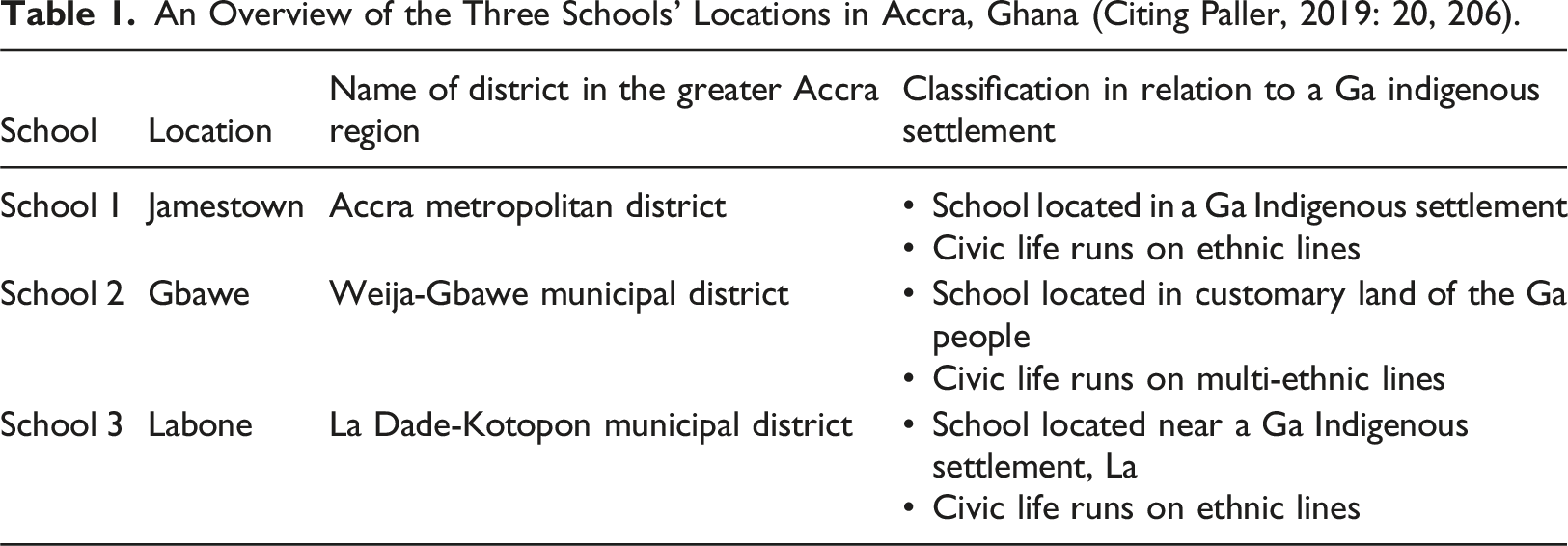
To help contextualise the three schools and their localities, a brief overview is provided below.
School 1
School 1 was in Jamestown, situated within the relatively central area of the city, and along the coastline. Jamestown is one of two areas within the district of Ga Mashie, known as the original Ga Indigenous settlement (GSS, 2014a). This is why Jamestown holds cultural significance, hosting the Ga kings, the sacred stool, and the Homowo festival (Lentz, 2001). School 1 admitted children from the immediate locality, inhabited predominantly by Ga people. A further 47% were migrants (born elsewhere in the Greater Accra Region or other regions of Ghana) (GSS, 2021a). The community’s population lived in extreme poverty, marked by overcrowding, inadequate sanitation, low education rates, and unstable employment (GSS, 2021b). The school admitted approximately 530 children, with class-sizes ranging from 60 to 80 children.
School 2
School 2 was located in the area of Gbawe within the Weija-Gbawe Municipal District, with a large compound and an intake of approximately 1000 children. Approximately 20 km distance from the city centre, the school was located on customary land invested in the Ga people but not located in a Ga Indigenous settlement (GSS, 2014b). This municipality had the largest number of migrants from other regions of Ghana (68% of the population), compared to the other schools’ localities, suggesting a more ethnically diverse population, although the Ga still inhabited the area. Some of the children from School 2 lived in households experiencing extreme poverty, but notably lower than in School 1. The children’s socio-economic status was generally higher, with 71.1% of the adult population registered as economically active (GSS, 2021b). Class-sizes ranged from 80 to 90 children.
School 3
School 3 was located in the relatively new municipal district of La Dade-Kotopon, in the heart of Accra, close to the city’s cosmopolitan Oxford Street, CBD, and the wealthy residential area of Labone, which accounted for the district’s population of non-Ghanaian nationals (2.9%) (GSS, 2014c). However, the school’s intake drew from a different area, mostly from nearby La (or Labadi), one of the six Ga Indigenous settlements, classified as an urban slum (GSS, 2021b). While the governmental data states that only 8.9% of the district’s population lived in multidimensional poverty, the economic deprivation of the La settlement is often masked by the wealth generated in the surrounding opulent neighbourhoods (GSS, 2021b). The expansion of the city’s CBD has increasingly led to reduction of land in the La settlement, intensifying overcrowding and poverty. However, due to the overall wealth of the district, School 3 was better resourced compared to the other schools, reflected in lower teacher-pupil ratios, smaller class-sizes, and adequate sanitation.
The interview process
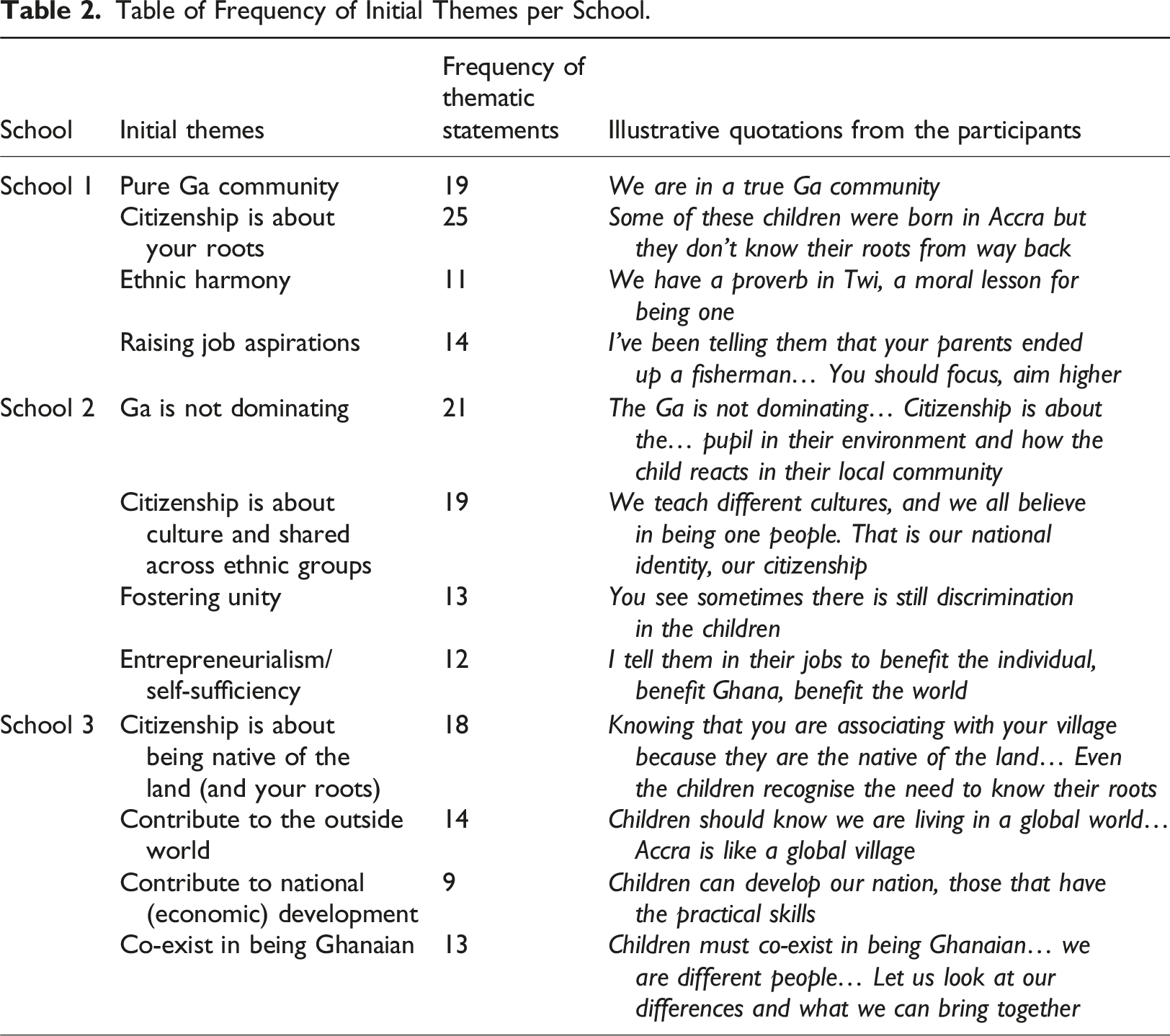
Table of Frequency of Initial Themes per School.
Reflexive thematic analysis
Faced with how to analyse, it is unavoidable that my Western Knowledge would attempt to dominate the teachers’ knowledges in their post-colonial contexts. For this purpose, I employed Braun and Clarke’s (2021: 333-334) ‘Reflexive Thematic Analysis’. My approach is described below.
Phase 1: Familiarising yourself with the dataset
The initial phase concerns reading and re-reading the transcriptions. This included examining my own epistemological and ontological stance to reveal where my subjectivity and bias might risk essentialising the teachers’ responses. With access to a few of the Ghanaian teachers and academics after my fieldwork, I was able to begin sense-checking my initial interpretations of the data.
Phase 2: Generating codes… That evoke important features of the data
To generate codes, I started with the basic question of how teachers understood citizenship in relation to their learners. However, Indigeneity was disrupting my entire technique, demanding me to rethink the coding process. Instead, I began by examining how the teachers described the school’s location in proximity to a Ga Indigenous settlement, as an indicator of how they understood Indigeneity. A series of participant-inspired codes soon emerged (see Figure 1 for an extract). Extract of generating initial codes in one participant’s transcription.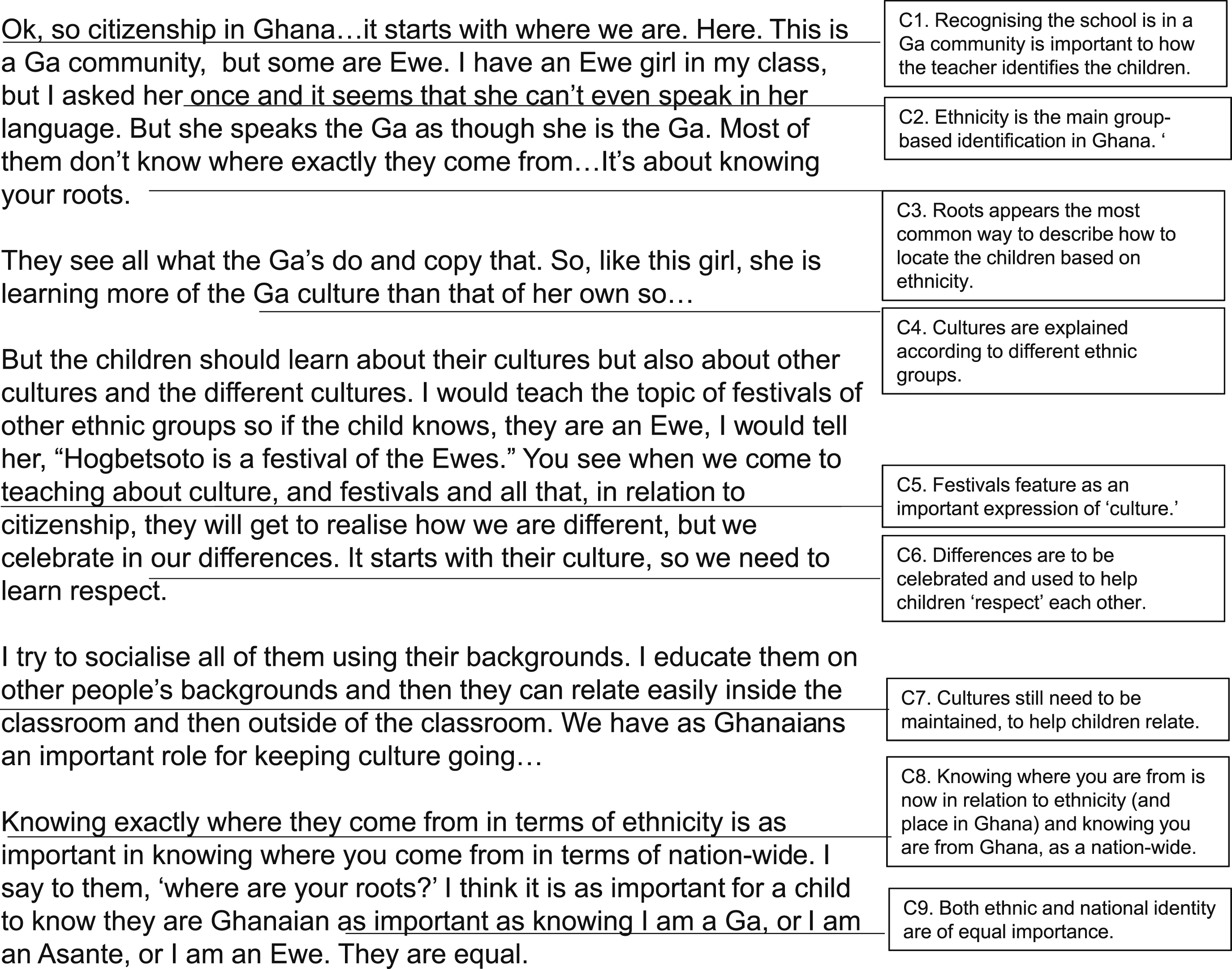
Phase 3: Generating initial themes and broader patterns of meaning
Following the initial code generation, the teachers’ actual language, in terms of their words and phrases, was substantive enough to begin generating initial themes specific to each of their schools. The frequency of thematic statements was important to this process. This gave a wider meaning to how Indigeneity intersected with the teachers’ explanations on citizenship specific to their locality, whilst further revealing how they viewed the purpose of education for their learners, again specific to their immediate locality.
Phase 4: Developing and reviewing potential themes: Telling the convincing ‘story’
Capturing full meaning across the dataset was challenging because of the numerous competing and co-existing epistemological and ontological stances that underpinned teachers’ meanings. Upon looking for the ‘central organising concept’, it was evident that Indigeneity, which teachers called ‘knowing your roots’, was giving nuance to the potential themes within each school but also gave meaning to these teachers’ overarching ‘story’ of Ghanaian citizenship (Braun and Clarke, 2021: 342).
Phase 5: Redefining themes: Determining the ‘story’
This enabled me to now finalise the themes that were entirely participant-inspired and, importantly, articulated their Indigenous expressions of citizenship. Here, I relied on a few of the teachers to question and re-affirm my final themes with the aim to develop a thematic map which answered my key research questions (Figure 2). Finalised thematic map demonstrating the key themes for each school.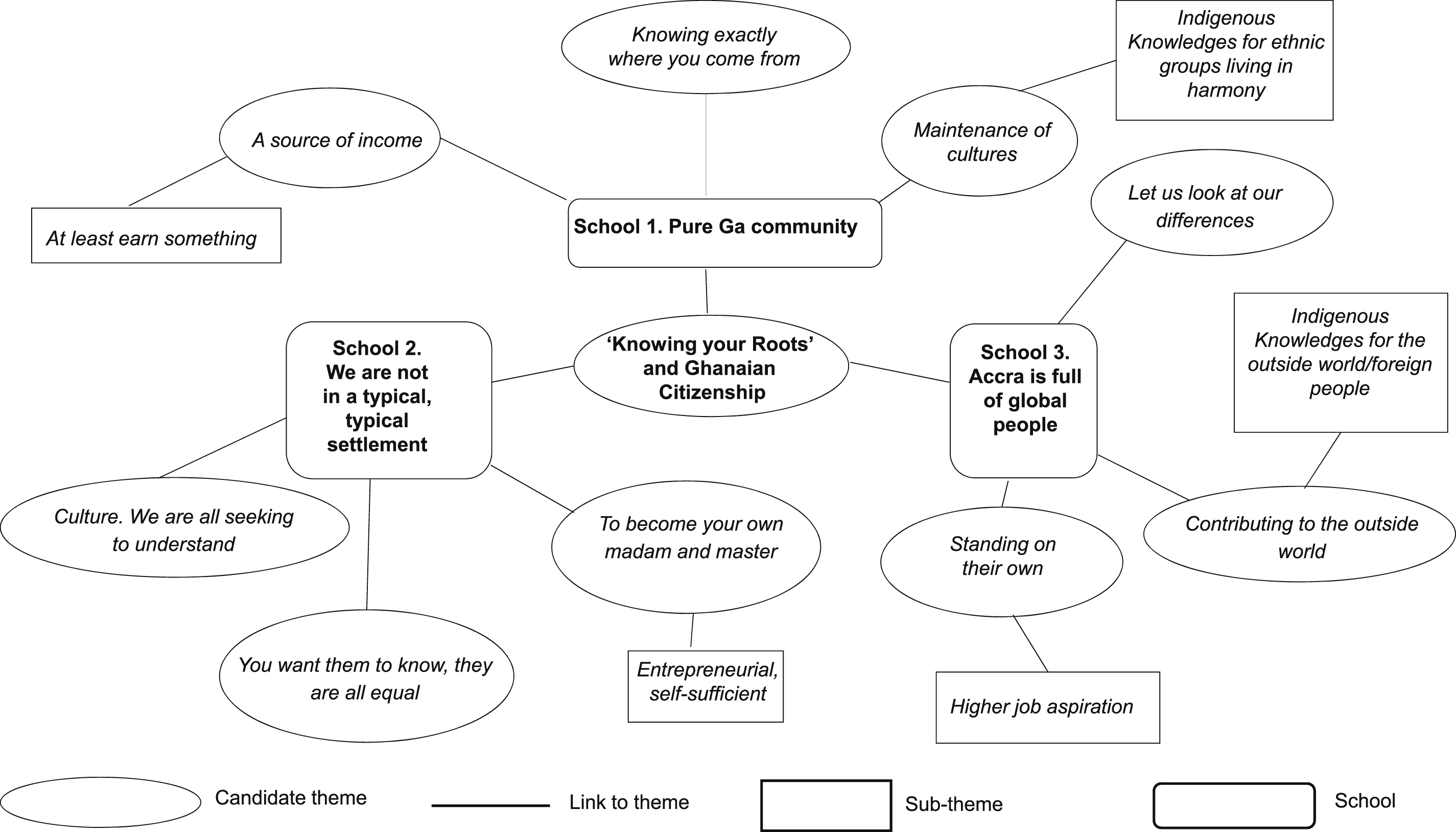
Phase 6: Writing up: Weaving together the analytic narrative
Upon seeking the analytic narrative to weave the story together, it was apparent that these teachers sought to sustain Indigeneity, as part of their Indigenous expression of citizenship, to revisit key differences with their learners (i.e. ethnic, economic, language, and cultural differences). In the process, I was able to identify the types of pedagogies that teachers used in their classrooms to foster unity in their differences.
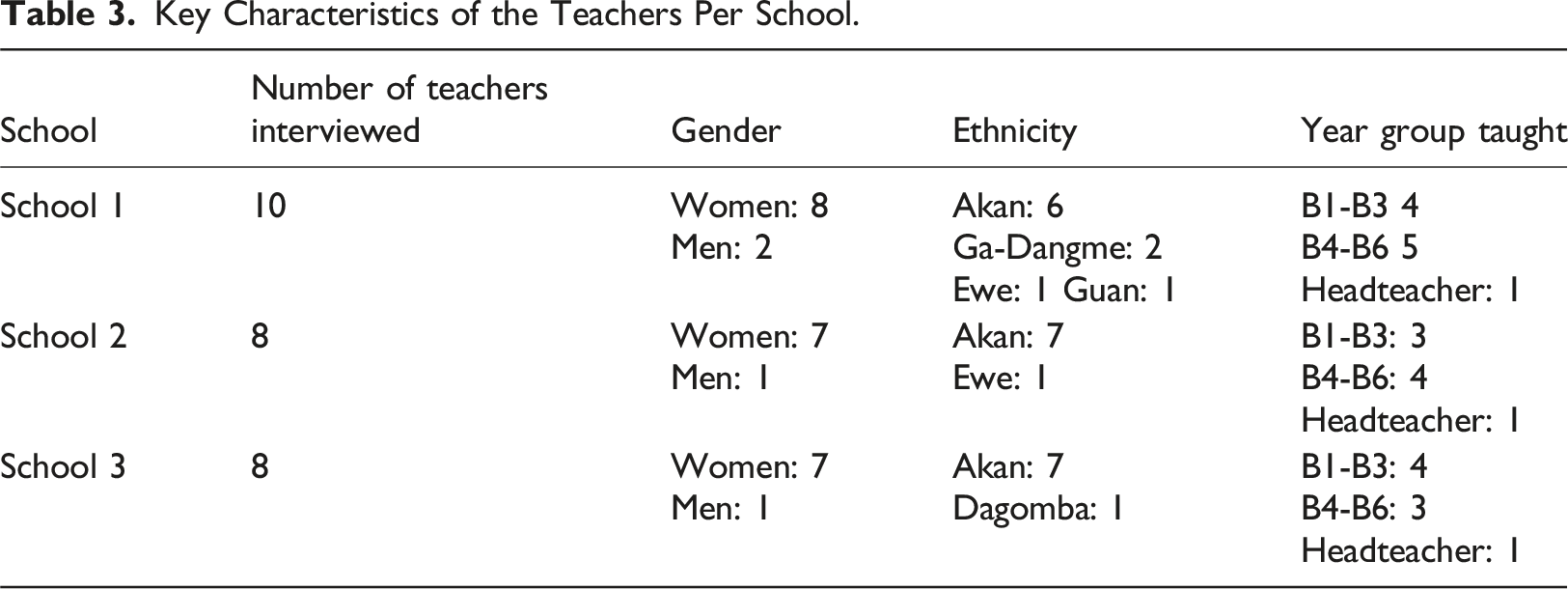
Teachers’ profiles
Key Characteristics of the Teachers Per School.
Presentation of the findings: ‘Knowing your roots’
The findings indicate that defining and enacting citizenship in Accra was a complex process for these teachers, due to the prevailing norms of Indigeneity, articulated as ‘knowing your roots’. While the three schools were located relatively near each other, their proximity to one of the Ga Indigenous settlements was significant in shaping their definitions, as well as how they defined their learners’ identities and differences. To unpack this, the findings are presented according to each school. Pseudonyms are used in place of the teachers’ actual names.
School 1
‘Knowing exactly where you come from’
For teachers in School 1, Ghanaian citizenship was associated with ethnic and national identity, both of equal importance. All teachers immediately linked the concept of ethnicity to a specific place in Ghana to historically locate where the group had originated. In doing so, they appeared to evoke a collective memory in a cohesive sense of national belonging. This was defined as ‘knowing your roots’, as Blessing, a B1 teacher, remarked: Knowing exactly where you come from in terms of ethnicity, as your roots, is as important as knowing where you come from in terms of nationwide, with Ghana as your roots.
Given the intricacy of how ethnic and national identities intersect, the teachers contextualised their discussions within Jamestown, the school’s local community. Samuel, a B6 teacher, described the area as a ‘typical, typical settlement’ belonging to the ‘pure Ga’. Reference to the ‘pure Ga’ did not appear to carry discriminatory connotations; rather, it served to distinguish Ga children in Jamestown from those in other Ga Indigenous settlements. Linda, who identified as a Ga herself but coming from La (another Indigenous Settlement and closer to School 3) elaborated on this distinction: ‘You cannot compare a Ga child from Jamestown to a Ga child from La’. While other ethnicities inhabited the area, Akua, a B2 teacher and an Akan, drew on her personal experience to further illustrate the complexity of who lives and who belongs: I was born in Accra. But, you see, I identify with them in my village back in the Ashanti Region. I’m not of them here. You see, I know my roots from way back.
While the distinction between living and belonging did not appear to complicate how these teachers perceived their role in fostering identity and belonging in their classrooms, a few citations contradict this. Blessing’s interview is one example: I have an Ewe [of the Volta Region] in my class… She was born here but it seems that she can’t even speak her language… In their house, they may have been told, ‘You are an Ewe’, but she doesn’t know exactly where in the Volta Region she is from because she speaks a lot of Ga. They see all that Ga people do around them, so she is learning more of the Ga culture than that of her own.
As Blessing also affiliated as an Ewe, her comment illustrates where Indigeneity might carry an exclusionary effect on learners from other ethnicities.
‘Maintenance of cultures’
Another defining feature of these teachers’ understandings of the purpose of citizenship was what Eric, a B6 teacher, explained as the ‘maintenance of our cultures’. Most teachers used the term cultures, in the plural, and understood them as distinct to ethnic groups across Ghana, again citing Jamestown to contextualise their views. Ameyo, who identified as a Guan from the Volta Region, commented: This is a Ga community. Jamestown is Ga. Each tribe has its own culture and a way of doing things. The way they dress, our food, then our dance… our festivals... so the Ga way of doing things is different from the Akans in the Volta Region.
Most noticeable was how the teachers consistently located their learners’ cultures to different regions of Ghana, because of Indigeneity. The city was rarely spoken about in this process, suggesting such norms were particularly pronounced in the area, and even influencing these teachers’ own sense of belonging to their respective regions. References to observing Ga customs, including the Homowo festival, seemed to reinforce this. For example, Eric, a Krobo (who still identified as part of the Ga-Dangme ethnolinguistic group with whom the Ga affiliate), explained, ‘We have to respond to their culture because you really are a visitor’. His point on being a ‘visitor’, despite his own ethnic affiliation, is significant, suggesting an exclusionary effect of Indigeneity, not just for their non-Ga learners but also for teachers not indigenous to the locality.
Most of the teachers’ inability to speak the Ga language was seen to exacerbate the problem, hindering their goal of fostering unity. As Samuel explained: I don’t speak Ga… The way they treat you is quite different from someone who can speak Ga… If I am to speak the language… they will value you, because they can identify you… Language is the most important unifier.
Nonetheless, it was claimed that teaching about Indigenous Knowledges, including of the Ga peoples, along with their cultures and traditions, would help foster unity. Chosen for their ‘moral lesson of being one’, Victoria, an Akan from the Eastern Region, described how she integrated folktales, proverbs, and stories into her pedagogy. Eric, speaking about his B6 class, further commented that teaching about Indigenous Knowledges would enhance his learners’ sense of belonging at the national level, since these knowledges are locational across different regions of Ghana. This would, in turn, eradicate the lingering effect of ‘tribalism’ on the children and instead enhance their ‘living in harmony together’, as Samuel asserted.
‘A source of income’
In context to their learners’ realities of living in extreme poverty, these teachers attributed their learners’ future citizenship to helping them aspire toward gaining an income. Blessing explained, ‘My hope is that the children will have a source of income… to grow up where they can fend for themselves, at least earn something’. Learners’ knowledge and skills were primarily tied to the ability to earn. The teachers also appeared to promote the notion of putting self above nation, rather than nation above self. This was discussed in relation to observing the detrimental effects of poverty on their learners’ future aspirations. Arguably, their learners’ socio-economic identities were particularly pronounced because they lived in contrast to ‘rich Accra’, as Isaac, a B5 teacher, commented.
The neoliberal norms of land-as-commodity were also reflected in the headteacher’s descriptions of the ‘place as densely populated… They struggle over everything… where you sleep, where you eat… Poverty here is very hard’. For Elizabeth, the lack of space had intensified competition for basic resources and infrastructure, impacting the children’s, indeed, their parents’ ability to claim basic rights. Victoria, a B6 teacher, expressed concerned that ‘The Ga parents don’t value education’, but also described them as ‘lazy’, indicating ethnic stereotyping. While the association between the Ga peoples’ poverty and stereotyping remained relatively unchallenged, it seemed, quite paradoxically, that these teachers’ separation of the child from the community aimed to raise economic aspiration. Linda, also a B6 teacher, shared the same concern. Her comments reflect both the challenges and opportunities in these learners’ future citizenship in Jamestown: Fisherman… seamstress…hairdresser… Aim higher… teacher… doctor… banker…The problem in our area is they don’t want to go beyond what they know... They have never seen role models… You see plenty of children who are just roaming… I mean let’s enrol them… and then we might be able to achieve something.
School 2
‘Culture. We are all seeking to understand’
In School 2, citizenship was about evolving culture. While these teachers still recognised different cultures of ethnic groups, they also acknowledged culture at the national level. Their understanding of national culture was about finding commonality and, in doing so, underpinned a shared narrative of ‘Being Ghanaian’. Comfort, a B3 teacher, encapsulated this: ‘Being Ghanaian… it has everything to do with Ghana. The culture…Every ethnic group has a specific way of living, but we are all seeking to understand’.
Indigeneity, similarly, described as ‘knowing your roots’, also featured within these teachers’ understandings of citizenship. As in School 1, culture was associated with place, where ethnic group-based identities (and their cultures) were sustained. However, for these teachers, different cultures needed to evolve. Vincent, a B6 teacher, explained: ‘So in as much as we have our differences… we consolidate and evolve our culture universally’. This reflected these teachers’ aspirations for their learners’ present and future citizenship, signifying the ability of Ghanaians to co-exist.
While Indigeneity was for sustaining different cultures as part of their ethnic heritages, Jennifer, a B6 teacher, argued that the ‘essentialising of cultures’ should be challenged, particularly when fuelling superiority of one ethnic group above another. Eunice, drawing on her 25 years of experience teaching across multiple regions of Ghana, reinforced this view: It is culture that unites us… Because we are living as national now, we teach different cultures, and we all believe in being one people. That is our national identity... You don’t impose that somebody’s culture is better than the other. We teach about the rich cultures to understand the nation.
One possible factor shaping these teachers’ perspectives was that School 2 was not located in one of the ‘typical, typical settlements of Accra’, as Comfort, a B3 teacher, and an Akan (herself being born in Accra but whose ‘home village’ was in the Asante Region) noted. As Augustina, also an Akan, argued: ‘Citizenship is about the pupil in their local community’. The term ‘local community’ conveys its multi-ethnic composition and civic life appeared complimentary to this. While all teachers acknowledged that the Ga people were indigenous to the city, the norms of Indigeneity appeared less influential in their specific locality because ‘the Ga people were not dominating’, as Vincent observed. The Ga language was rarely spoken in the school for this reason. Except for their headteacher, Mary, most teachers challenged the influence of Indigeneity on their learners’ identity formation and sense of belonging to the city.
‘You want them to know, they are all equal’
Another defining aspect of citizenship in School 2 was the emphasis on instilling respect for difference in learners. Uniquely, while naming difference was for fostering respect, it was also for naming unequal power, which these teachers seemed more astute to in terms of how it manifested in the classroom. As Eve, a B4 teacher and an Ewe, observed: ‘Here in Ghana, they like their tribalism… that division of ethnicity… always looking down on other cultures’. This perspective explains why the teachers further aspired for greater acceptance of ethnic as well as religious difference, particularly in relation to Ghana’s dominant religions: Christianity, Islam, and African Traditional Religion. Joy, a B2 teacher, explained: ‘I tell the children that Ghana is not one religious state…We must give room for everyone… freedom of association’.
To challenge discrimination within the classroom, teachers continued to emphasise the importance of observing and respecting Ga traditions in Accra. However, they placed particular value on their learner’s diversity as a pedagogic resource, in itself, when teaching. Teaching about the different ethnic festivals across Ghana was seen as a key resource to foster national cohesion, especially since many learners of different ethnicities regularly travelled outside Accra to attend their ethnic-specific festivals. For Eunice, this would also benefit the Ga children: ‘They have to know other people’s cultures too, not just the Ga because it is a Ga community’.
Distinct to School 2, teachers also spoke frequently about the city, emphasising its different cultures and being ‘more flexible in its thinking’, as Vincent asserted. This would help foster a greater degree of respect for multiple ethnic heritages. According to Joy: ‘The city is from everyone from all over the country… all walks of life, every tribe [and] foreigners with different cultures… it keeps stretching our understanding’.
‘To become your own madam and master’
Like in School 1, citizenship was also framed in terms of economic development, again revealing the influence of neoliberal rhetoric. However, these teachers emphasised the importance of teaching children to put nation above self (not self above nation). It is possible that the children’s marginally higher socio-economic backgrounds were influencing their views. According to Jennifer, the school’s neighbouring community was ‘middle class’, although this is relative to Ghana being a low middle-income country. Yet, unlike School 1, there was less sense of urgency among these teachers in needing to equip their learners with core skills in case of early dropout.
Both Joy and Augustina aspired for their learners to be ‘independent’ and ‘self-sufficient’ so ‘you’ll be your own madam or master’, representing a relatively liberating option for their learners’ futures. Equally, there was a sense of realism about what becoming an entrepreneur demanded, given the poor economic conditions and structural inequalities in the city. For Eve, it was a message she regularly endorsed to her learners: We tell them, ‘Not all the hands that feed you are equal. There will be business people, traders, whatever you do, try your best… so when you grow, you become a good citizen and everyone can benefit from you’.
Subsequently, the purpose of education was to foster entrepreneurial skills in their learners. As Augustina explained, it was to ‘benefit the individual’ but also to ‘benefit Ghanaians, and then it will benefit the whole world’. This framing of entrepreneurialism through ‘benefitting’ at the individual, national, and global levels is of interest, as neoliberalism is overtly individualistic. Augustina might be redefining entrepreneurship on Indigenous terms, where the notion of the individual remains attached to the community than separate from it, and, with this, carrying economic responsibility.
School 3
‘Contributing to the outside world’
In School 3, teachers’ definitions of citizenship were connected to ‘contributing to the outside world’, as articulated by Emmanuel, a B5 teacher. Being near the global hub of the city, it is reasonable to assume that the school’s location was shaping their views and may explain why they had a more global outlook. According to Esther, a B6 teacher, the city’s diverse ethnic and multi-national composition, and the growing demographic of ‘whites’, was diffusively exposing these children to the ‘outside world’. This composition was further reflected in the school’s demographic, with some learners coming from Nigeria, South Africa, and Togo. For Esther, ‘Citizenship means that you should get to know the other cultures and others that are different, to then know what unites us as one’.
Perhaps expectedly, these teachers’ definition of culture, in relation to Ghana, was still specific to an ethnic group and tied to place, as in Schools 1 and 2. Knowing about the cultures of different ethnic groups, as being locationally tied to regions of Ghana still mattered. Emmanuel, with over 25 years of teaching, stated, ‘Citizenship is about… [the children] needing to know their roots and their ancestry and associating with the native of the land’. His comment is pertinent, as it consolidates the influence of Indigeneity on teachers’ understandings of citizenship across the three schools.
Distinct from the other schools, Grace explained that their learners needed to know about the city’s culture to help them relate to ‘global people’. As a Fante (an ethnic group originating west of Accra), Grace’s comments contrast with Linda’s (identifying as a Ga from School 1), where culture referred to her learners needing to relate to their immediate community. Grace noted, ‘Knowing about their culture is in relation to being global. You just don’t know who you might meet in the future’. Also unique to School 3, the role of Indigenous Knowledges was seen as integral to helping their learners relate to a diversity of people, including ‘foreign people’. Ayisha, a B2 teacher, spoke fervently about incorporating the Adinkra symbols, indigenous to the Akan, in her teaching practice for their representation of fostering relatedness and helping her learners negotiate citizenship in their complex global city: We have symbols… that you should learn for the outside… As for the Adinkra symbols, it teaches you an exchange between going outward and inward. So, they also get a picture that it is not just my locality… But as for what entails in that bigger world is yet for them to discover.
‘Let us look at our differences’
Similar to the other schools, these teachers’ aspirations for their learners’ future citizenship were to ‘co-exist in being Ghanaian’, as articulated by Abena, the headteacher. These discussions surfaced upon talking about learners’ differences and were aimed at forging unity through them. To achieve this vision within the classroom, it was apparent that naming difference was used to name unequal power, and, specifically, to identify the grounds for discrimination. Abena added: [The learners’] difference is real so we can’t behave as if it’s not there, brush over them. I have to set my vision on what and who these children are… We have to recognise that national identity is to counter discrimination.
Most teachers also spoke about their learners’ socio-economic differences compared to the rest of the city, alluding to the disparities caused by urbanisation, which were creating discrimination against them. Amba spoke extensively on this issue, likely due to having lived in the city for a while. Her concern was the ‘inequalities of planning’ in Accra, with its stratifying effects on those living in extreme poverty and, in particular, its impact on the Ga people because ‘the place is theirs’. Referring to the school’s immediate community, she contrasted the ‘well-endowed’ Labone with the nearby ‘poor’ Ga Indigenous settlement of La, ‘a typical, typical settlement from way back’. Due to neoliberal reforms, the rise of private schools was also serving the ‘elite, the Akan as they can afford [it]’ while public schools were a ‘mop-up of those that can’t’.
Following on from this conversation, Amba claimed that education should aim to foster ‘inter-tribe relationships’. Ayisha also spoke passionately about this, due to her ethnic identity as a Dagomba from the Northern Region. Her vision for change was rooted in her personal experience of ethnic discrimination, which was further exacerbated by her inability to speak the Ga language. She explained, ‘In the GES, they move you… But they don’t consider language… It’s hard to relate to the children when they aren’t from where I’m from’. For Esther, a way forward was to draw upon the diverse backdrop of the city, echoing similar comments from School 2: You see in Accra… we think the culture here is good… the tribes here come together to form one nation… and then we are living in a global world, so the more that you get to know about, not only your culture but that of others, it will really help you.
‘Standing on their own’
Lastly, citizenship, as articulated by Emmanuel, was for learners to become ‘positive contributors for national development’. Similar to School 2, entrepreneurship framed these teachers’ vision for their learners’ futures. Jessica, a B3 teacher, explained, ‘They should not depend on the Government. They must be standing on their own’. However, unlike the other schools, the city was seen as a source of job aspiration for the children, with the nearby hub of Oxford Street creating economic opportunities for their futures. As Ayisha observed, the children’s own parents were serving as role-models, working as ‘petty traders and hawkers’, although noted that ‘their income is low’. To prepare for their futures, learners needed to be equipped with the right skills for the right industry, while having their expectations managed. This was how the teachers sought to address youth unemployment, prevalent in their city. Like in School 2, these teachers aimed to cultivate an attitude of putting the nation above self. Teaching about all jobs would help to challenge an unrealistic fixation on valuing the highest professions while rejecting others. Ayisha asserted: I mean, how many industries do we have to absorb those youth? So that was causing the brain-drain. So, we acquired the skill but there was no job. It’s high time that we tell our minds to develop our country. It’s not bookish knowledge. It’s practical.
This view sat in tension with the headteacher’s, Abena, who criticised the influence of this mentality on the children. Instead, her vision was that ‘education, and its role in producing citizens, is about more than getting a job. You have to affect society’.
Discussion of the findings: Indigeneity for revisiting difference
By virtue of being in Accra, Indigeneity was clearly shaping the meaning that teachers attributed to citizenship in relation to their learners, and, arguably, permeating their multiple expressions of citizenship at the local, national, and global levels. Findings also show that the teachers sought to sustain the principle of Indigeneity in their teaching to revisit their learners’ differences and to foster unity in their differences. These differences were articulated in multiple ways, as analysed below.
Revisiting ethnic differences
Within their urban classrooms, these teachers’ understandings of ethnic identity and difference, as integral to Ghanaian citizenship, were clearly intersecting with the principle of Indigeneity, or ‘Knowing your Roots’, echoing Smail’s (2024) research. The Ga people were unequivocally understood as the original claimants to the city and differentiated further in relation to their settlements. This was evident in the teachers’ positioning of their schools in proximity to one of the six ‘typical, typical settlements’.
While all schools had a multi-ethnic composition, the norms of Indigeneity appeared to create an entirely different context for fostering in learners an equal sense of belonging to their immediate community. In the case of School 2, where these norms seemed weaker because ‘civic life develops along multi-ethnic lines’, as Paller (2019: 20) notes, the locality was more conducive to cultivating an equal sense of belonging. In contrast, where Indigeneity was more pronounced, as in the case of School 1, promoting an equal sense of belonging among learners seemed far more complex. In School 3, teachers were negotiating a different process altogether, where Indigeneity was intersecting with the globalising norms of the city, exposing their learners to a more ethnically and racially diverse population. Yet across all three locations, teachers shared in their constant negotiation of the indigenous core of the city in their classrooms.
This had left teachers questioning what this meant for learners’ everyday citizenship and what it meant to belong. To some extent, Indigeneity had an inclusionary effect, by way of preventing the homogenising of Ghana’s multiple ethnic groups, a goal enhanced through these teachers’ efforts to teach their learners what was shared between them. Some teachers were even pushing these boundaries around ethnic identity, incorporating religion into how they defined identity and recognising it as a site of discrimination. By creating space for and equalising other intersectional identities as a means for reconciling relationships fractured by ethnic politics, it appears that these teachers’ definitions on Ghanaian citizenship were evolving.
Revisiting language differences
Revisiting the role of Indigenous languages as a way of sustaining their learners’ ethnic identity and difference was also central to these teachers’ discussions on citizenship-making in Accra. Yet it was apparent that these teachers’ inability to speak the Ga language risked the Ga children being subject to exclusion, firstly, in their general comprehension of learning, and secondly, in preserving their own Indigenous cultures and heritages. The use of English in schools would have further created an exclusionary effect for the Ga children, though for different reasons (and for children of different ethnicities, for that matter).
Offering a way forward, these teachers asserted that speaking the Ga language would enable them to relate more effectively to their Ga learners, as well as help preserve Ga culture in their classrooms. These teachers’ views offer insight into a longstanding argument by the Ga Traditional Council, which claims teachers in the Greater Accra Region should be supported to learn the Ga language (Graphic, 2021). At the same time, these teachers remained conscious of their limitations in responding to the wider call for speaking Indigenous languages in schools, and what this meant for fostering inclusivity in their ethnically diverse classrooms. This builds on previous research (Dei and Simmons, 2016; Owu-Eshie and Eshun, 2019). Arguably, the potential of these teachers, as non-Indigenous to their immediate locality (due to the conditions of deployment under the GES), yet seeking to learn from their learners, cannot be underestimated. This represents an area for future study.
Revisiting economic differences
Ghanaian citizenship was also for accelerating economic development, and with this, to revisit their learners’ economic differences. According to these teachers, this began with teaching about self-sufficiency and entrepreneurship, indicating the influence of the neoliberal agenda. Their everyday realities of working with their learners living in extreme poverty clearly underpinned their views and fuelled the immediate need to equip learners to participate actively in the market due to the risk of early dropout. On the one hand, echoing Arnot et al.’s (2013) research with Ga youth, Ghanaian citizenship served as a constant reminder of the State’s commitment to their learners’ economic freedom in helping them become self-sufficient. On the other hand, placing emphasis on the market-citizen relationship rather than the state-citizen relationship seemed to be a pragmatic response in the absence of basic state-based provisions, representing an attempt to empower their marginalised learners.
Despite the teachers’ vision of inspiring their learners to build the local economy, the neoliberal agenda, with its universalising effect, risks depersonalising them and detaching from their locality. To counter this, Rashied and Bhamjee (2020: 107) suggest that Indigenous ontologies offer the potential to stimulate ‘meaningful self-reliance without coloniality’ due to their emphasis on mutual reciprocity and welfare rather than ‘individual gain and uniformity’. Arguably, the potential lies in how these teachers framed economic development not as something to be achieved at the expense of individual economic freedom, but as something intended to benefit both the community and the nation. At the same time, a more immediate tension remains: how can the intricacies of Indigeneity in Accra be observed within these teachers’ local communities, which are increasingly affected by the neoliberal impacts of urbanisation and the commodification of land – both of which continue to disproportionately affect those living in urban poverty?
Revisiting cultural differences
Lastly, these teachers sought to revisit their learners’ cultural differences which, when intersecting with Indigeneity, became a means of creating a cohesive, unifying narrative of Ghanaian citizenship. Given the ethnic diversity of both the teachers and learners, Indigeneity appeared to be understood at both the local and the national levels. Building on Coe’s (2020) research, my findings indicate that Indigeneity was used to perform and constitute the identities of ethnic communities, specific to their regions, through cultural activities such as festivals. In fact, it was the act of teaching about festivals that created a ‘sense of extended community’ through an ‘urban-rural connection’, while also renewing these paths of Indigenous knowledge-gathering within and between Ghanaians (Clarke-Ekong, 1997: 51). The teachers’ willingness to incorporate aspects of Indigenous Knowledges into their teaching must therefore be acknowledged. This is arguably why national culture, that reified Indigenous Knowledges such as folklore, Adinkra symbols, and proverbs, was seen to promote national unity. As Coe (2020) similarly concludes, the potential for national culture lies in it not belonging to one particular ethnic group above others.
My research further reveals that teaching in a global, multicultural city served as a catalyst for the evolution of these teachers’ conceptions of citizenship. Indigeneity, in particular, provided a means of fostering in their learners a sense of relatedness to the city’s cosmopolitan demographic. While not explicitly articulated, this appeared to permeate into how these teachers understood global citizenship. As Levi and Durham (2015) explain, the relationship between indigeneity and global citizenship often appears inherently contradictory. Yet, they assert that ‘notions [of] indigeneity and globality [can] exist in a dialectical rather than contradictory relation to each other’, of which my research with Ghanaian teachers in Accra demonstrates in ‘concrete terms’ (Levi and Durham, 2015: 424). Arguably, this offers a way forward for these teachers as much as their learners, who are navigating a unique form of citizenship in Accra, where the city’s ‘translocal spaces’, sustained through the African principle of Indigeneity, ‘migration and diaspora all aptly characteris[e] the indigenous [Ghanaian] experience today’ (Levi and Durham, 2015: 423-424).
Conclusion
This research has demonstrated what can emerge from revisiting Indigeneity in modes of citizenship-making with teachers in Accra, Ghana, and, by using a methodology that foregrounds local epistemologies. It has further illuminated alternative ways of reinterpreting Accra, grounded in these teachers’ own African, Indigenous terms.
Of course, key limitations of this study must be acknowledged. Firstly, the research did not observe how the effects of Indigeneity, both inclusionary and exclusionary, played out in the classroom. Secondly, it did not fully explore how other identity-categories, such as religion and gender, intersect with Ghanaian citizenship – another area for future research.
To conclude, I contend that through these teachers’ reclamation of African Indigeneity, they were embracing an epistemic openness to critiquing and evolving both Indigenous and Western ontological models of citizenship. In doing so, these teachers were arguably voicing a form of ‘decolonial resistance’ in what they envisioned for their learners’ citizenship, thereby re-positioning Ghana as a nation with possibilities, which is long overdue (Dei and Jaimungul, 2020: 5).
Footnotes
Author’s note
Please note: the author no longer works at the University of Glasgow, since completing the research. The author now works at the Department for Curriculum, Pedagogy and Assessment, IOE, UCL’s Faculty of Education and Society.
Acknowledgements
The author would like to thank the anonymous reviewers for their insightful feedback. The author would also like to thank Prof. Michele Schweisfurth, University of Glasgow, and Dr Robert Aman, Linkoping University for their invaluable support throughout this research.
Declaration of Conflicting Interests
The author(s) declared no potential conflicts of interest with respect to the research, authorship, and/or publication of this article.
Funding
The author(s) disclosed receipt of the following financial support for the research, authorship, and/or publication of this article: The fieldwork for this PhD research was undertaken with funding from British Association for International and Comparative Education, granted through the Student Fieldwork Grant, 2019. Without their financial support, this research would not have been possible.
