




Abstract
I present here an assessment of African Psychology (AP) to give insights about how it has been conceptualised and practised thus far as well as what its future holds. I begin with a focus on the centrality of culture and how AP treats the concept of culture. I will then attempt to respond to some concerns often raised by Africa-based psychologists who do not operate in and from a multiracial space about the relevance and legitimacy of AP. Theoretically, multiracial space is conceptualised not to mean the mere presence of people from diverse races in a particular space but also to the uneven distribution of power in spaces such as a country, state, university, or any community of people. Further, I attempt to argue for positioning of AP to contribute to global psychology. I will discuss implications for theory development, practice, curriculum design, and pedagogical practices as well.
Keywords
Black people had ways of understanding themselves that predate scientific psychology as understood in the Anglo-American or Western orientation (Oppong, 2017). It is quite accurate to say that early systematic studies on Black people began with European scholars, notwithstanding the observed human nature reflected in African proverbs and adages. The efforts by these European scholars served to dehumanise Black people (Allen, 2008; Dei, 2012; Eze, 2014; Jennings, 2002; McKenzie, 2012; Thiong’o, 2004). Early studies on Africa sought to decouple Africa from ancient Egypt to eliminate any possibilities of agency ascribed to Black people (Diop, 1955/1974, 1981/1991; Obenga, 2004). Anton W. Amo’s master’s thesis on the rights of Black people in Europe (in 1729) and doctoral dissertation on the apathy of the human mind (in 1734) were part of the early efforts by Africans to study themselves and as an example of early psychological studies by Africans (as cited in Oppong, 2017). Similarly, the work by Alexander Crummell (1819–1898), Edward Wilmot Blyden (1832–1912), W. E. B. Du Bois (1868–1963), and Marcus Garvey (1887–1940) are part of that history. All of the above-mentioned studies were psychological in nature to the extent that they focused on the minds and behaviours of Africa-descended people. These studies received a boost from the Negritude movement (from 1930s to 1960s), led by Léopold Sédar Senghor (1906–2001) along with Aimé Césaire (1913–2008) and Léon-Gontran Damas (1912–1978). Cheikh Anta Diop’s (1923–1986) work (1981/1991) on the origin of the human race, precolonial African culture, and the cultural biases that inhere in scientific research redefined the African past and African achievements. Additionally, Frantz Omar Fanon’s (1925–1961) Black Skin, White Masks (1952) also contributed to understanding the psychology of the colonised people. Thus, these works created the setting within which African psychologists began to resist the negative characterisation of African humanity within Western narratives.
African American scholars also began work to redeem Blackness in psychology. Robert V. Guthrie (1930–2005) systematically studied the historical evolution of the African/Black psychology (McKenzie, 2012; Williams, 2008). Guthrie’s Even the Rat was White (2004a) is a classic text in the study of the impact of racism on Blacks (Belgrave & Allison, 2006). Further, Guthrie (2004b) examined the psychology of African Americans through historical analysis while Myers (1993) and Nobles (1986) provided foundations upon which psychology could redeem itself by attending to the Afrocentric worldview. Equally important is Hilliard’s (1992) questioning of the concept and measurement of intelligence. Akbar (2003) also explored suitable approaches for conducting research among African Americans that paved the way for new methodological possibilities. Though these studies formed part of the initial motivations for the emergence of AP, it is not to be implied that AP only emerged after the emergence of US-based Afrocentric psychology. African psychologists also recognised the lack of fit between the mainstream theories with their practices and African realities. Nwoye (2014) argues that the work of some Africa-based scholars independently inspired a resistance to the continual exclusion of African approaches in psychology. Again, AP has also benefited from the realisation among some Western and Asian psychologists that hegemonic psychology is a Western-situated knowledge and praxis “masquerading as universal psychology” (Nwoye, 2014, p. 58). Thus, AP benefited from both internal and external forces.
Some semblances between African American psychology and AP exist and I need to make a distinction here. African American psychology tends to largely deal with the experiences of African Americans and does not necessarily have the explanatory power to account for the experiences of continental Africans or even people from the Caribbean (Maynard, 2013). African psychologists find African American psychology different in the sense that African American psychology appears, understandably so, to reconnect with long-lost traditions and knowledge systems of Kemet or the Kushite. 1 African psychologists tend to be preoccupied with creating psychological knowledge situated in the culture, history, and material concerns of contemporary ways of living in Africa.
I acknowledge that “not many students and scholars of psychology in Africa identified with the urgent call for the Africanization of psychology” (Nwoye, 2014, p. 61). Indeed, it is often easier for Africa-based psychologists in multiracial spaces to easily comprehend the Euro-American hegemony, coloniality, and the pursuit of decolonialism. Multiracial space is conceptualised here not to mean the mere presence of people from diverse races in a particular space (i.e., a collective whose members exist and interact over a period of time with the uneasy option of nonparticipation), but also to the uneven distribution of power in such spaces as country, state, university, or any community of people. Racism structures the lived experiences of people situated within a multiracial space (Salter et al., 2017), implying that the less dominant group becomes more sensitive to how race relations structure interactions within the community. The historical and contemporary realities of African psychologists based in multiracial space ensure sensitivity to the effects of coloniality and metacoloniality on the state of knowledge production. On the other hand, those living in monoracial communities are less likely to recognise the existence of inequalities in knowledge production, let alone attribute such inequalities to race. Beyond that, Africans tend to suffer from a crisis of self-perception and identity (Adams & van de Vijver, 2017; Bulhan, 2015; Oppong, 2020a), holding an outward orientation (Ake, 2012; Yankah, 2012) while also being in denial of metacolonialism in the postcolonial era (Bulhan, 2015; Oppong, 2019a).
In the rest of this article, I attempt to delineate contemporary representations of AP by continental African scholars. Further, I position culture as central to the Africanisation project while arguing for the positioning of indigenous psychology (IP) in Africa to contribute to global psychology. I also respond to the concerns often raised by Africa-based psychologists, particularly those who do not operate in and from a multiracial space, about the relevance and legitimacy of an African-oriented IP. In addition, I will present futuristic projections with a view to shaping that future and considering the implications for theory development, practice, curriculum design, and pedagogical practices in the context of continental Africa.
Contemporary representations of African psychology
Many scholars speak of indigenisation or decolonisation in Africa. What does it mean to decolonise or indigenise? To decolonise is to dismantle the colonial institutional structures (with their associated power dynamics) that assign epistemic centre status to select groups or geographic regions or languages in a postcolonial world (Oppong, 2021a). Pickren and Taşҫı (2022) also argue that “Decolonization is aimed at states, institutions of the state, land, place, or what is instantiated or material” (p. 12). Therefore, “To decolonize is to seek to replace or supplant the governance of those institutions [universities, journals, disciplines, societies, etc.] or at least gain recognition from them” (p. 12). On the other hand, to indigenise is to embrace the perspectives and methods of knowing inherent in a local culture as valid ontology and epistemology (Oppong, 2021a). Similarly, Teo (2013) views indigenisation as a “general process, by which theories and concepts from outside of a particular cultural setting are accommodated into any local context” (p. 1). Thus, indigenisation is one of the approaches to decolonisation (see Pickren & Taşҫı, 2022).
What does IP mean then? Allwood (2018) defines IP as representing “an approach to research in psychology which stresses the importance of research being grounded in the conditions of the researcher’s own society and culture” (p. 1). Moreover, Nwoye (2014) defines AP as “the systematic and informed study of the complexities of human mental life, culture and experience in the pre- and post-colonial African world” (p. 57). He listed the goals of AP to include theory development, research and documentation, critical engagement with extant literature, and realigned and improved clinical and professional practice (Nwoye, 2015). To Ratele (2017a), AP refers to “ways of situating oneself in the field of psychology in relation to and from Africa” (p. 274). In other words, AP is situated knowledge and practice within Africa. Further, Ratele (2017a, 2017c) identifies four types of African psychology (AP), namely: (a) Western-oriented AP, which is dominant on the continent of Africa now; (b) psychological African studies; (c) cultural AP; and (d) critical AP. Oppong (2016) also defines pan-African psychology (PAP) as “a branch of psychology where the population of interest is persons of African origin, and/or where the target population resides either on the continent of Africa or in the Diaspora” (p. 10). PAP seeks to indigenise psychology in Africa by: (a) developing African-centred theories and concepts, (b) reconstructing Black people in the history of psychology, (c) choosing context-relevant topics of inquiry, (d) reforming research methodologies, and (e) revising curricula to include African-centredness (Oppong, 2017).
Sometimes, critical psychology (CP) is confused with IP (Teo & Wendt, 2020). Teo and Wendt (2020) argue that CP emphasises power and the societal dimensions of human behaviour while IP emphasises culture and, to a lesser extent, power in its theorising and praxis. However, Ratele (2017a, 2017c) views CP (in the form of critical AP) as a variant of AP. Thus, there is a symbiotic relationship between CP and IP (Teo & Wendt, 2020). Despite the contestations, it is possible to identify some recurring themes in these definitions of AP or PAP, or IP. For instance, AP, PAP, and IP represent an orientation to research and practice in psychology coalescing into a monolith comparable to what we might call Western or hegemonic psychology, if there is such a thing.
AP should be understood as an orientation that adopts a culture-conscious approach to the selection of research questions, design, data analysis, and interpretation of results. It should also be understood that internationalisation of psychology is asymmetrical. Internationalisation in psychology seeks “to promote, distribute or impose psychological knowledge of a very specific Western territorial and cultural origin to the other parts of the world territory and socio-cultural landscape” (Jovanović, 2005, p. 78). Thus, Western psychology is nothing more than American psychology because of the dominance of the United States post-Second World War (Arnett, 2008; Pickren, 2009; Pickren & Taşҫı, 2022; Teo, 2013), with its individualistic underpinnings (Christopher et al., 2014). Again, the supposed universal applicability of mainstream psychology has been challenged (Arnett, 2008; Brady et al., 2018; Jovanović, 2005; Marsella, 2009, 2013; Oppong, 2015, 2016, 2019a, 2019b, 2020b; Rad et al., 2018; Teo, 2013). Intelligence testing is one domain in which the hegemony of mainstream theorising and praxis have been challenged (Oppong, 2020b; Oppong et al., 2022; Scheidecker et al., 2021; Serpell, 2000). It means that all psychologies are culturally bound and are, therefore, indigenous to the cultures in which they arise and are sustained (Christopher et al., 2014; Marsella, 2013). In many ways, the values of the middle-class, Western, Christian, male, Whites (MWCMW) dominate psychology as the frame of reference (Oppong, 2020c).
But for whom is AP? Malherbe and Ratele (2022) point out that “decolonising African psychology should, therefore, encourage disidentification with coloniality from all people and, with respect to Africa” (p. 124) because “Decoloniality demands our material and psychic disinvestment in identifications with White, cisgendered, heteropatriarchal capitalist modernity/coloniality” (p. 124). They acknowledged that decolonising psychology in and for Africa entails a loss of power and “renders it a project that is potentially for everyone” (Malherbe & Ratele, 2022, p. 124). Even though AP should serve everyone, the attempts at decolonisation are a struggle for power between a Black elite (predominantly educated, middle-class males) and the Western elite. If we acknowledge that MWCMW values dominate psychology, we can also agree that even the so-called Western psychology has not been for everyone in its truer sense. However, Western psychology appears to benefit most members of Western societies in some way, though the more powerful groups benefit most. Even though AP seems to be about power struggles between an African elite and Western scholars, it might be liberating for most Africans.
Centrality of culture in defining African psychology
But what is culture? Is there a monolithic African culture? Spencer-Oatey (2008) views culture as a shared, ambiguous set of assumptions and orientations to life that influence behaviour and its interpretations among a group of people. Similarly, Kluckhohn and Kelly (1945) defined culture as the “designs for living . . . which exist at any given time as potential guides for the behaviour of [humans]” (p. 97). Poortinga (2021) argued for dispensing with the term “culture” in (cross-)cultural psychology because it is vague when used psychologically. Culture needs to be “defined in terms of specific variables or behavior domains rather than in terms of some poorly defined part of the behavior repertoire” (p. 25).
By referring to culture in AP, one is not necessarily thinking of a monolithic African culture, as, in Africa, there are myriad ethnic groups with varied observable cultural practices. Indeed, Allwood (2018, 2019) has questioned whether: (a) there are common continental traits and (b) it is scientifically possible to identify such traits. However, increased interactions among Africans leave one with an impression that there is a shared worldview. Given that culture manifests at different layers of depth (observable artefacts and behaviours, values, basic underlying assumptions; Schein, 1984), observers are usually confronted with various observable behaviours. In this regard, it is possible to speak of a monolithic African culture in terms of the underlying, invisible, preconscious, basic assumptions. Indeed, it is at this deeper level of analysis that commonalities in African ways of living amid variations emerge.
Drawing on my lived experiences as an Akan (the largest ethnic group in Ghana), interacting with members of other ethnic groups in Ghana, and living in Liberia and Botswana, as well as travelling extensively through La Côte d’Ivoire, I acknowledge the differences in observable cultural practices as stemming from similar sources. In his philosophical analysis, Gyekye (2003) drew on proverbs from diverse African traditions to construct a set of African cultural values. Similarly, Mkhize (2013) argues that African scholars are not in agreement about the existence of unifying African worldview or metaphysics. . . . Although there may not be a unifying African metaphysics, there is nevertheless an approach to reality [emphasis added] shared by a number of Africans. Its central tenets about beliefs about God, the universe and notions of causality, person and time. (pp. 34–35)
Empirically, Oppong (2020b), through a systematic review of ethnographic studies of conceptions of cognitive abilities in Eastern, Western, and Southern Africa, was able to outline shared patterns across Africa. This provides preliminary evidence that it is possible to spot the monolithic nature of African culture at a deeper level of analysis. Thus, studies aiming at outlining a shared African approach to reality should do so at a deeper level than the basic underlying assumptions.
With regard to engagement with culture, Sher and Long (2015) recount that Africa-based psychologists utilise culture as prehistoric (indigenous knowledge and praxis), an organism (background upon which AP must evolve), a resource (something to be used such as identity), artificial (purposefully constructed), dilemmatic (relativism–universalism discourse), a constituent (multiplicity of identities), and paradoxical (something to be simultaneously focused on and ignored in order to grow). The methodology to demonstrate the influence of culture among one group of people (to be developed by African psychologists) can be said to be at the inception stages. For instance, Oppong (2021b) developed a set of culturally adapted road warning signs by treating culture as an organism while focusing on a group of commercial vehicle drivers within one country. Sher and Long (2015) only show the various discourses around culture but we have not successfully translated them into actual culture-informed methodologies for our research.
Responses to some concerns about indigenous psychology in Africa
There is no doubt that key commentators on AP agree that there is a need to indigenise psychology in Africa. Some colleagues have already commented on some of the concerns associated with AP (see Allwood, 2018; Azuma, 2000; Long, 2016; Makhubela, 2016; Nwoye, 2015; Oppong, 2016; Ratele, 2017a, 2017b, 2017c). For instance, Long (2016), a psychologist based in a multiracial South Africa, argues that an Africanisation project in South African psychology (and by extension AP) will ultimately fail if its main premise is to emphasise the cultural differences between White and Black people. He rather locates the main problem in the “customary indifference to the question of class” (Long, 2016, p. 431) and further argues that decolonisation of psychology can only be achieved “through a searching examination of the material conditions of oppression—and their disastrous psychological sequelae” (p. 431). Granted that Long (2016) is right in drawing our attention to class oppression, he only points out a form of AP coalescing around what Ratele (2017a, 2017c) calls critical AP. Long’s (2016) argument does not negate efforts in psychological African studies and cultural AP but seems to privilege critical AP over the others. At this point, it is not clear which strand of AP (psychological African studies, cultural AP, or critical AP) is more suited to decolonise psychology in Africa. At best, we need to think of the different orientations as equal partners to the Africanisation project. Culture of poverty evolves as the oppressed class finds ways to cope with poverty (see Lewis, 1966). Attending to the culture of the oppressed class will appear to mean attending to the class oppression. In this sense, Long’s (2016) argument that attending to culture undermines Africanisation of psychology fails to consider culture in all its forms and shapes.
Let us now address concerns often raised by African psychologists in monoracial contexts. One concern is the perception that IP in Africa appears to stem from a deep inferiority complex. This agrees with Ratele’s (2017a) question: “Is the name African psychology not limiting?” (p. 274). Generally, the label AP invokes negative stereotypes about Africa, which results in treating AP as a special case (see Ratele, 2017a) and not on par with Western psychology. Ratele (2017a) responds to this by arguing that the use of “AP” enables Africa-based psychologists to “redefine the relation between psychology and Africa; . . . energetically and more sophisticatedly locate Africa in global psychology; and . . . to highlight the situatedness of all psychological knowledge and practice” (p. 274). In addition, we need to remind ourselves that all psychologies are indigenous to their contexts (Allwood, 2018; Danziger, 2006; Marsella, 2013) and, therefore, constitute a situated knowledge and practice in every sense. Therefore, American psychology is indigenous psychology, specific to Americans.
Some colleagues have also questioned whether AP does not constitute reviving certain long-lost, better forgotten customs such as the activities of sangoma or okomfo. 2 At best, the concerns are framed in a way that projects such an approach as unscientific and primitive. However, cultural African psychologists can begin to study the therapeutic benefits of some of these indigenous healing practices. African indigenous healing practices can then be incorporated into practice and teaching of clinical and counselling psychology in Africa (see Baloyi & Ramose, 2016). It will be similar to how mainstream psychology has studied and recommended certain rituals associated with Eastern religions (such as Buddhism) as ways for improving well-being (Brennan et al., 2020; Ross & Thomas, 2010; Shonin et al., 2014). Why can we not study the therapeutic benefits of African indigenous healing practices? The perception that it is devilish and primitive is best understood as nothing more than the effect of metacolonialism on African agency (Ake, 2012; Bulhan, 2015; Oppong, 2013; Yankah, 2012). Indeed, Pickren and Taşҫı (2022) argue that embracing decoloniality also calls for IP practitioners and researchers to fully embrace what hegemonic psychology considers to be “the sign of the primitive” (p. 13), including a worldview “deeply rooted in local practices and relegated to the realm of the mythological, collective, religious, traditional, philosophical, irrational, primitive, imaginative, and cultural” (Bhatia, 2019, p. 111). Mkhize (2013) settles this issue by arguing that “it is high time the world open [sic] to traditional African lenses of viewing the world, in the same way that it has considered similar mystic philosophical traditions from the East” (p. 46).
Other colleagues have also asked why psychology cannot be inclusive, allowing all voices to be heard instead of promoting one at the expense of others and Balkanising it into situated practices linked to different geographies. It is reasoned that pursuing AP does not lend itself to an inclusive psychological science. Granted, AP further fragments psychology, but it is equally true today that internationalisation of psychology has been moving largely in one direction (Jovanović, 2005). The claims of globalisation are false, as it involves projecting one local way of life or culture onto the global stage (Oppong, 2013, 2019a; Yankah, 2012). Thus, IP in Africa rather contributes to expanding the current narrow views about human nature through expanding the interpretative power of psychology (Brady et al., 2018) so that psychology can truly be a science of all Homo sapiens (Rad et al., 2018) or a truly global human science (Oppong, 2019a).
It is also sometimes argued that decolonisation is too political, too emotional, and is activism rather than a real science. Though true to some extent, this may be constitutive in some ways that reflect critical AP’s more materialistic and political nature because it lends itself to the study of the material conditions of living. In this sense, this characterisation best describes one strand of IP orientation in Africa and says nothing about psychological African studies and cultural AP. Critical AP is not even by any means the mainstream orientation in IP in Africa. Another way to understand this characterisation is to historically explore how movements are founded in the discipline. Founding a movement in science is a deliberate and intentional act that requires personal abilities and characteristics that differ from those necessary for brilliant scientific contributions (Kuhn, 1970; Schultz & Schultz, 2012). Founding a movement in science requires: (a) integrating prior knowledge, (b) publishing and promoting the newly organised material, and (c) selling that great idea to the scientific community (Schultz & Schultz, 2012). Thus, founding a movement in science requires that one becomes a scholar–activist. In congruence with the Kuhnian theory of paradigm shift (Kuhn, 1970), scientific revolution is not unexpected after anomalies and crises emerge in a normal science. Characteristics of scientists who play active roles in a normal science differ significantly from those who are energetically involved in the stages of anomalies, crises, and revolutions. Often scientists involved in the paradigm-shifting stages tend to be seen as rabble-rousers or nonconformists; they are often ridiculed as being less dedicated to their mainline research, which often coincides with their primary area of specialisation and research training; and they are “perceived by their colleagues as less serious, and their work is seen as less rigorous” (Hu, 2016, para. 14). However, the “desire to improve the culture of the science community” (Hu, 2016, para. 17) motivates such scientists in their work. Scholarly or thought leaders who develop the theories and set the trends for others to follow often exhibit characteristics that could pass for activism (Adair, 1999; Oppong, 2013). Perhaps, we should also remind ourselves that Western psychology is currently dominated by political leanings towards the left or to neoliberalism (Duarte et al., 2015; Sugarman, 2015). Thus, it is not uncharacteristic nor ahistorical for those at the forefront of IP in Africa to be viewed in the same light. In fact, it will even be unthinkable if this characterisation does not hold.
Positioning indigenous psychology in Africa to contribute to a global psychology
Pickren and Taşҫı (2022) problematise the idea of IP contributing to a universal psychology. Pickren and Taşҫı (2022) argue that IP researchers wish to claim equal status “within the terms and rules set by the colonial powers” (Bhatia, 2019, p. 111). Perhaps this is the dilemma that IP researchers find themselves dealing with on an ongoing basis. However, this discussion of contributing to a universal psychology is cast within the understanding that IP can expand our narrow perspectives about human nature (Oppong, 2019a). It is not a quest for an intellectual space alone but also the ability to produce different frameworks to understand human nature and experiences. In addition, Bhatia (2019) has argued that IPs need to build epistemological bridges that consolidate the different IPs around the world to fortify their explanatory power in accounting for the varied experiences of people in postcolonial settings. Generally, AP would improve the success of applying psychological knowledge to African clients as well as produce an accessible knowledge base for non-African psychologists interested in serving African clients. The knowledge base would coexist with hegemonic psychology so that African and non-African psychologists could choose from this menu of knowledge the most optimal approach to apply to African clients. Everything within the hegemonic psychology is not necessarily bad. “To encourage wholesale rejection of Western psychology is to throw away the baby with the dirty water” (Oppong, 2016, p. 8). Let us turn our attention to what African psychologists can do to position IP in Africa in the global context.
There is a need for a clearer discussion on what the concerns associated with AP mean for AP as well as positioning it to contribute to global psychology. African cultures differ from Western cultures and these differences are not only at the level of observable artefacts, behaviours, and values but also at the deeper level of underlying basic assumptions. We also must appreciate that the basic assumptions underpinning Western culture give rise to a study of human nature that differs from a situated understanding of human nature in non-Western cultures (Brady et al., 2018; Greenfield, 2000; Nsamenang, 2000; Oppong, 2016, 2019a; Rad et al., 2018; Serpell, 2018; Serpell & Nsamenang, 2014). For instance, Nwoye (2015) speaks about Western psychology as one that emphasises: (a) “the use of objective, quantitative measuring or data gathering instruments”; (b) “defines humans only in material, measurable, or observable terms”; (c) that human behaviour has “no significant meaning beyond what is actually observed”; and (d) that the human mind dies with the death of the body (p. 107). This is opposed to AP, as it emphasises: (a) the study of humans and their relationships with their contexts that expands to include invisible and intangible realities, (b) spirituality as an important source of influence, (c) the meaning of actions to self and others, and (d) the death of body does not equate to the death of the mind and memory (Nwoye, 2015). This leads to a view that Western-situated psychology is a poor fit within the African cultural context. Thus, there is a need for African psychologists to work to ground their theorising, research, and praxis in the existential realities of Africans. African psychologists have a duty to contribute psychological understanding of phenomena rooted in the cosmology of the African to increase the usefulness of the knowledge and professional practices that we develop. This way, global psychology benefits from diverse perspectives about human nature. This has the potential to assist non-African psychologists with practice and interest in Africa to gain useful insights to become culturally competent in their practice. It is true that Africans may be or become the clients of psychologists from other cultures.
Ancillary to the above is the notion of the sheer mimicry of Western psychology in most of AP. Ratele (2017c) argues that Western-oriented AP skews “nearly all theoretical explanations, frames what is taught, influences what is published and the research approaches and analyses” (p. 319) and the praxis; it accentuates a universal, decontextualised, apolitical, value-free approach to research and praxis. Beyond that, Western-oriented AP asks “the same questions, asked by others elsewhere in the world” (Ratele, 2017c, p. 319). Naidoo (1996) suggests that the unwillingness to challenge the basic assumptions of Western-oriented AP is partially due to fears that doing so will undermine psychology’s scientific status while ignoring, at the same time, that the discipline has implicit assumptions; this results in a double standard. Given that scientific psychology is a colonial import, after training in Western-situated psychological practices, the first batch of psychologists tend to prove their competence by utilising the same methods to which they were exposed to investigate the same problems of interest to the Western psychologists as well as their assumptions about science (see Adair, 1999). Home-grown psychologists tend to share similar views because of the influence of the first-generation psychologists on them. This explains why Western-oriented AP dominates, even though several African universities have postgraduate programmes in psychology that train people in Africa. Much of the psychological research in Africa fails to speak to the living conditions of the research participants to whom the research findings will be ultimately applied. This ontological gap has increasingly been recognised by practising psychologists in Africa as Western-situated understanding fails to fully account for the lived realities of the African person (Naidoo, 1996, 2000; Oppong, 2016, 2020b; Oppong Asante & Oppong, 2012). They are forced to make alterations to praxis informed by their experience and familiarity with the culture (Peltzer & Bless, 1989). However, these alterations often go undocumented, and this affects systematic inquiries into what works and does not work in the African context. Perhaps, it is important for practising psychologists in Africa to systematically document their experiences with the models, tools, and knowledge they apply as well as the adaptations they make to them to fit the lived realities of the African person. This way, there will be an increase in case studies to use to teach and create new insights for research by both African psychologists and those outside of the continent.
If practising African psychologists systematically document their experiences for dissemination, it can improve the teaching and learning of African-situated knowledge and praxis in psychology. Notwithstanding, African academic psychologists must also inquire into the experiences of practitioners. When incorporated into the training of the next generation of African psychologists, such knowledge will enable students to relate to the materials they learn. Similarly, by pursuing Western-oriented AP instead of other strands of African psychologies (psychological African studies, cultural AP, or critical AP), African psychologists risk playing catch-up with developments in Western psychology instead of contributing meaningfully to an expansion of the current perspectives about human nature in the discipline (Oppong, 2019a). This leaves African psychologists at the mercy of the imperialistic practices and tendencies of social science knowledge production (Ake, 2012).
It is acknowledged that the current Western perspectives about human nature are valid, as they speak to the lived experiences of one set of humans, but they are not sufficient to account for the lived experiences of all humans, including Africans (Oppong, 2019a). Thus, African-situated psychological knowledge and practices only seek to expand the existing perspectives so that psychology can adequately speak to the lived experiences of Africans. This will also benefit students of psychology elsewhere as they learn to apply their knowledge to people of all races, ethnicities, and cultures. Western psychologists are usually among the experts dispatched to help in the aftermath of disasters in low-income settings and are usually ill-prepared to help (Christopher et al., 2014). For instance, the failure of U.S. psychologists to acknowledge the cultural situatedness of their knowledge and practices while working abroad resulted in the failure of their interventions (Christopher et al., 2014). In this way, the knowledge generated could be helpful in expanding the understanding and practice of non-African psychologists with clients based in Africa, particularly when they come to Africa to offer assistance during disasters. This will ensure that well-meaning non-African psychologists can do “good” better.
There is also a growing recognition that psychology has limited interpretative power. Brady et al. (2018) have called on their fellow North American psychologists to pursue culture-conscious science to expand the interpretive power of psychology by asking culture-conscious research questions, utilising culture-conscious research designs, and performing culture-conscious data analysis and interpretation. This is based on the recognition that the findings from current psychological studies are based on participants largely drawn from Western, educated, industrialized, rich, and democratic (WEIRD) countries (Rad et al., 2018; Sam, 2014). In addition, AP contributes to eliminating epistemological violence (EV) in psychology (Teo, 2008, 2010). EV is said to occur when speculative explanations for observed group differences present a privileged group as superior to the disadvantaged group, while ascribing to those speculations the status of facts (Oppong, 2020c). Current practices in psychology unwittingly (and sometimes deliberately) result in such speculations with their attendant effects on self-perceptions and self-awareness. African psychologists ought to position themselves in a way to take advantage of the current trends in psychology. This will involve doing work that continually centres Africa and takes advantage of the existing goodwill to seek funding support for Africa-centred projects, be it research or applied projects. Failure to do this will compel the same Western psychologists to colonise AP by taking advantage of the current wave for funding support to displace Africa-based psychologists in doing projects on Africa. It is not bad per se for Western psychologists to fill the void created by the unwillingness or inability of African psychologists to act, except that such projects risk being framed within a Western narrative, regardless of good intentions. Oppong (2020c) makes a distinction between intentional and accidental EV; accidental EV comprises such practices by Western psychologists with good intentions, but that end up imposing a Western narrative that dehumanises.
Future of IP in Africa and the world
What does the future hold for IP in Africa? One thing is certain; it is less likely to fade out. Makhubela (2016) argues that “Decolonizing psychological science should therefore not merely be about de-Westernization” (p. 11) but should “seek recourse in the replacement of epistemic coloniality and provincialism for heterodox thought that is embracive of genuine pluriversalism” (p. 12). At this moment, a well-articulated objective of AP would be to generate situated knowledge and practices that will contribute to pluriversal perspectives on human nature and by so doing, psychology will become a truly global science of all humans, not only some humans (Oppong, 2019a). Allwood’s (2019) argument that no “national (continent) characters are scientifically credible as identifiable empirical phenomena” (p. 95) is equally applicable to hegemonic or mainstream Western psychology: it is false and scientifically not credible to assume that you can identify human characteristics that are universal by studying a small section of humans. Many studies of culture only focus on expressions of the basic assumptions that manifest according to the socioecology in which people find themselves. IP in Africa recognises the limitations of the unscientific and unethical practice of decontextualised research practices in hegemonic or mainstream Western psychology. In this regard, IP in Africa will die an uneasy death given the growing awareness among psychologists, both inside and outside of Africa, of the need for IP (see Serpell, 2016).
IP is transforming psychology as we know it. Perhaps, we do not notice the changes unfolding due to change blindness (Simons & Rensink, 2005). Some universities in Africa, ranging from the well-known to the lesser known, have introduced modules on AP into their curricula. One such well-known university in Africa that has introduced modules in AP is the University of KwaZulu-Natal in South Africa. A lesser-known university in Africa such as Eswatini Medical Christian University in Eswatini has introduced a module on AP in its undergraduate programme in psychology. Finding resources such as a sample course outline or syllabus and readings to guide course content development is generally challenging (B. B. Boahen-Boaten, personal communication, April 13, 2020). I have presented a summary of a course outline for an AP Module (see Appendix) for the guidance of those intending to introduce such a module in their undergraduate programme. The course outline, presented here, is meant to be illustrative rather than typical.
Like African philosophy, AP is likely to blossom into a niche area needing workers across the globe. This means that there will be a need for current teachers of psychology in Africa to equip themselves to rise to the occasion and to respond to the requests by their students for the exploration of topics in IP. For instance, a U.S.-based college, Randolph-Macon College, offers a module on culture and psychology focusing on an African perspective. More evidence is the recent search for a Black scholar at York University (York University, n.d.). It would be sad if AP establishes itself as a niche area and African psychologists are not among the key players. Lessons should be learned from African studies; most of the thriving departments or institutes of African Studies are located outside of the continent of Africa (Hountondji, 2009; Olukoshi, 2007). Regrettably, Olukoshi (2007) writes: The power relations within African Studies have produced hierarchies that are also contiguous with the existing North–South asymmetries that underpin the broader interaction between Africa and the West. It is out of these asymmetries that questions have been posed within African Studies as to who may legitimately speak for Africa: Africans or non-Africans? These questions are important in their own right and, when posed by Africans, should not be dismissed lightly or glibly as constituting a one-sided claim to an “entitlement” that is anchored on an imagined ideology of “nativitism” [sic] or “authenticity” and which, inexorably, results in parochialism. . . The import of the questions lies in the fact that African Studies continues to be suffused with unequal power relations that play to the advantage of non-African high priests of the field and which have been accentuated by the context of the severe weakening of institutions of advanced research in Africa. (p. 10)
Failure on the part of the current and future psychologists in Africa to take charge of this development may result in a too familiar occurrence (see Hountondji, 2009; Olukoshi, 2007). I, therefore, appeal to African psychologists to accept the challenge to become thought leaders to avert the emergence of the power relations that has evolved in African Studies.
Conclusion
The idea that AP has come to stay is no longer contestable. However, it behoves current teachers of psychology in Africa to begin to assist their students to interrogate the current content of psychology they teach. Current teachers of psychology in Africa are specifically being called upon to treat AP issues as widespread issues and allow students to question theories from their perspectives as members of African societies (Oppong, 2013; Pheko, 2017). This practice has the effect of enhancing the relevance of what we teach to our students. It is, perhaps, also important to indicate that a good dose of history of psychology, philosophy of (social) science, the science of science, and sociology of knowledge is a good preparation for critical engagement with the literature. Related to this is the need to adopt a boundaryless orientation to the study of human nature. This transdisciplinary approach helps to uncover gaps as well as evidence emerging in cognate disciplines for a better understanding of human nature as a situated body of knowledge and practice.
It is equally useful to note that AP has implications for policy work in Africa. Given that AP generates situated knowledge and practice, the psychology practitioners in Africa will have the needed knowledge to assist policymakers in policy analysis, implementation, and evaluation. One cannot make empirically supported recommendations in the absence of AP that generates the situated knowledge. In view of this, AP has the potential to contribute to the development of Africa. The growth of AP is tied to the process of transforming the living conditions of African people.
AP should also contribute to global psychology. One thing that is certain is that global psychology benefits from diverse perspectives and views about human nature. Knowledge generated through AP can expand psychological understanding of all peoples of the world. AP has the potential to assist non-African psychologists interested in Africa to gain insights that will help with their practice. This will help non-African psychologists to become culturally competent in their practice.
Footnotes
Appendix
Content extracted from the African Psychology Module developed at Eswatini Medical Christian University.
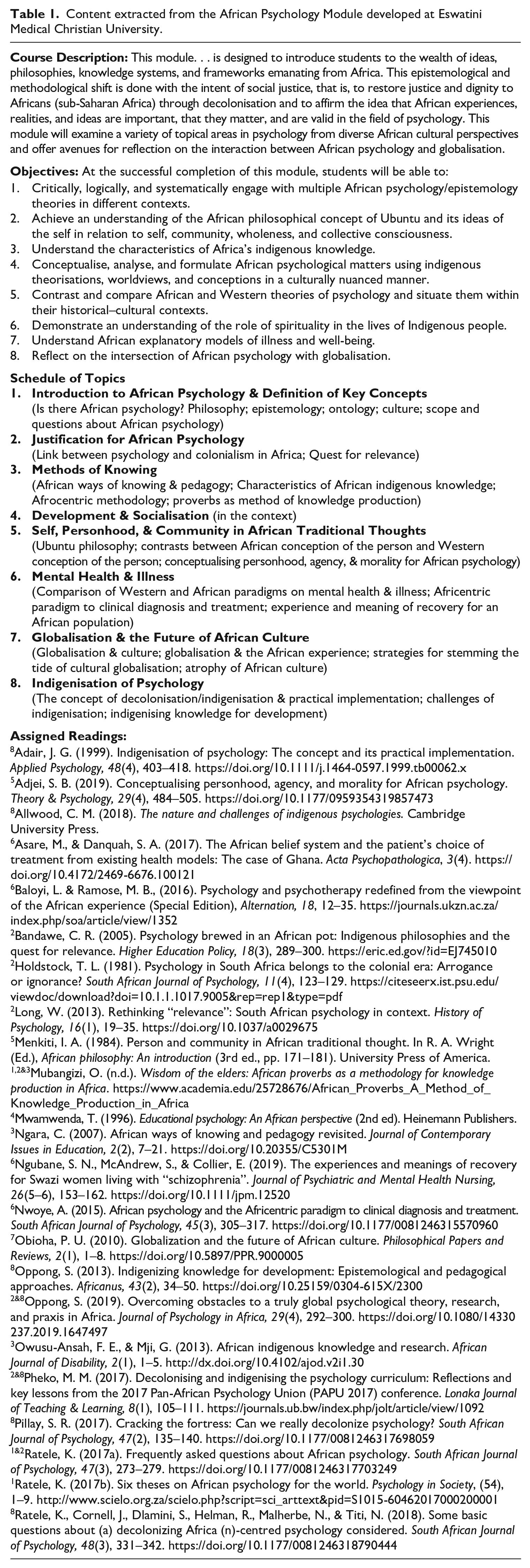
1. Critically, logically, and systematically engage with multiple African psychology/epistemology theories in different contexts. 2. Achieve an understanding of the African philosophical concept of Ubuntu and its ideas of the self in relation to self, community, wholeness, and collective consciousness. 3. Understand the characteristics of Africa’s indigenous knowledge. 4. Conceptualise, analyse, and formulate African psychological matters using indigenous theorisations, worldviews, and conceptions in a culturally nuanced manner. 5. Contrast and compare African and Western theories of psychology and situate them within their historical–cultural contexts. 6. Demonstrate an understanding of the role of spirituality in the lives of Indigenous people. 7. Understand African explanatory models of illness and well-being. 8. Reflect on the intersection of African psychology with globalisation. (Is there African psychology? Philosophy; epistemology; ontology; culture; scope and questions about African psychology) (Link between psychology and colonialism in Africa; Quest for relevance) (African ways of knowing & pedagogy; characteristics of African indigenous knowledge; Afrocentric methodology; proverbs as method of knowledge production) (Ubuntu philosophy; contrasts between African conception of the person and Western conception of the person; conceptualising personhood, agency, & morality for African psychology) (Comparison of Western and African paradigms on mental health & illness; Africentric paradigm to clinical diagnosis and treatment; experience and meaning of recovery for an African population) (Globalisation & culture; globalisation & the African experience; strategies for stemming the tide of cultural globalisation; atrophy of African culture) (The concept of decolonisation/indigenisation & practical implementation; challenges of indigenisation; indigenising knowledge for development) 8Adair, J. G. (1999). Indigenisation of psychology: The concept and its practical implementation. Applied Psychology, 48(4), 403–418. https://doi.org/10.1111/j.1464-0597.1999.tb00062.x 5Adjei, S. B. (2019). Conceptualising personhood, agency, and morality for African psychology. Theory & Psychology, 29(4), 484–505. https://doi.org/10.1177/0959354319857473 8Allwood, C. M. (2018). The nature and challenges of indigenous psychologies. Cambridge University Press. 6Asare, M., & Danquah, S. A. (2017). The African belief system and the patient’s choice of treatment from existing health models: The case of Ghana. Acta Psychopathologica, 3(4). https://doi.org/10.4172/2469-6676.100121 6Baloyi, L. & Ramose, M. B., (2016). Psychology and psychotherapy redefined from the viewpoint of the African experience (Special Edition), Alternation, 18, 12–35. https://journals.ukzn.ac.za/index.php/soa/article/view/1352 2Bandawe, C. R. (2005). Psychology brewed in an African pot: Indigenous philosophies and the quest for relevance. Higher Education Policy, 18(3), 289–300. https://eric.ed.gov/?id=EJ745010 2Holdstock, T. L. (1981). Psychology in South Africa belongs to the colonial era: Arrogance or ignorance? South African Journal of Psychology, 11(4), 123–129. https://citeseerx.ist.psu.edu/viewdoc/download?doi=10.1.1.1017.9005&rep=rep1&type=pdf 2Long, W. (2013). Rethinking “relevance”: South African psychology in context. History of Psychology, 16(1), 19–35. https://doi.org/10.1037/a0029675 5Menkiti, I. A. (1984). Person and community in African traditional thought. In R. A. Wright (Ed.), African philosophy: An introduction (3rd ed., pp. 171–181). University Press of America. 1,2&3Mubangizi, O. (n.d.). Wisdom of the elders: African proverbs as a methodology for knowledge production in Africa. https://www.academia.edu/25728676/African_Proverbs_A_Method_of_Knowledge_Production_in_Africa 4Mwamwenda, T. (1996). Educational psychology: An African perspective (2nd ed). Heinemann Publishers. 3Ngara, C. (2007). African ways of knowing and pedagogy revisited. Journal of Contemporary Issues in Education, 2(2), 7–21. https://doi.org/10.20355/C5301M 6Ngubane, S. N., McAndrew, S., & Collier, E. (2019). The experiences and meanings of recovery for Swazi women living with “schizophrenia”. Journal of Psychiatric and Mental Health Nursing, 26(5–6), 153–162. https://doi.org/10.1111/jpm.12520 6Nwoye, A. (2015). African psychology and the Africentric paradigm to clinical diagnosis and treatment. South African Journal of Psychology, 45(3), 305–317. https://doi.org/10.1177/0081246315570960 7Obioha, P. U. (2010). Globalization and the future of African culture. Philosophical Papers and Reviews, 2(1), 1–8. https://doi.org/10.5897/PPR.9000005 8Oppong, S. (2013). Indigenizing knowledge for development: Epistemological and pedagogical approaches. Africanus, 43(2), 34–50. https://doi.org/10.25159/0304-615X/2300 2&8Oppong, S. (2019). Overcoming obstacles to a truly global psychological theory, research, and praxis in Africa. Journal of Psychology in Africa, 29(4), 292–300. https://doi.org/10.1080/14330237.2019.1647497 3Owusu-Ansah, F. E., & Mji, G. (2013). African indigenous knowledge and research. African Journal of Disability, 2(1), 1–5. http://dx.doi.org/10.4102/ajod.v2i1.30 2&8Pheko, M. M. (2017). Decolonising and indigenising the psychology curriculum: Reflections and key lessons from the 2017 Pan-African Psychology Union (PAPU 2017) conference. Lonaka Journal of Teaching & Learning, 8(1), 105–111. https://journals.ub.bw/index.php/jolt/article/view/1092 8Pillay, S. R. (2017). Cracking the fortress: Can we really decolonize psychology? South African Journal of Psychology, 47(2), 135–140. https://doi.org/10.1177/0081246317698059 1&2Ratele, K. (2017a). Frequently asked questions about African psychology. South African Journal of Psychology, 47(3), 273–279. https://doi.org/10.1177/0081246317703249 1Ratele, K. (2017b). Six theses on African psychology for the world. Psychology in Society, (54), 1–9. http://www.scielo.org.za/scielo.php?script=sci_arttext&pid=S1015-60462017000200001 8Ratele, K., Cornell, J., Dlamini, S., Helman, R., Malherbe, N., & Titi, N. (2018). Some basic questions about (a) decolonizing Africa (n)-centred psychology considered. South African Journal of Psychology, 48(3), 331–342. https://doi.org/10.1177/0081246318790444 |
Declaration of conflicting interests
I have no conflict of interest to disclose.
Funding
The author received no financial support for the research, authorship, and/or publication of this article.
