



Abstract
International universities often promote inclusive learning environments to aid their sojourners’ social integration and improve their well-being. However, little is known about how social experiences with inclusion and integration (SEII) unfold for international PhD candidates in Dutch research universities (DRUs). This study uses the narratives of twenty IPCs to understand the factors that play a role in their SEII in a DRU. Findings suggest that nine factors may define SEII among the participants. Two factors—prior experiences in an ILE and identity in PhD role—played a role in participants’ early SEII, while seven factors played a role in participants’ early and later SEII. These included IPCs’ social participation level, intercultural interaction dynamics, shared language adaptation, cultural events, university’s international campus climate, social support, and perceived prejudice and stereotypes. IPCs and their international universities should align expectations to promote an inclusive social climate to foster social integration of IPCs.
Keywords
Introduction
Dutch research universities (DRUs) continue to attract international PhD candidates (IPCs) from around the world. In 2019, more than 40% of all PhD candidates had non-Dutch backgrounds (Mattijssen and Van Doorn, 2020). Attracting international talent for PhD programs brings numerous advantages to DRUs. IPCs contribute unique knowledge, skills, and perspectives to their projects due to their diverse cultural backgrounds (Chung et al., 2020; Stahl et al., 2010). They also help in developing intercultural competencies, such as cultural awareness and cultural intelligence, among the groups they interact with (Lantz-Deaton, 2017). Additionally, they enhance the institutions’ research output (Larivière, 2012). There are also long-term benefits: approximately 62% of IPCs remain in the Netherlands one year after completing their PhD, and 32% are still working and living there after ten years (Rud et al., 2015). Thus, IPCs contribute a highly skilled labor force to the Dutch job market.
PhD candidates often face significant psychological, physical, and emotional pressures during their adjustment to a new environment, making the pursuit of a PhD a complex and demanding process (Mattocks and Briscoe-Palmer, 2016). Compared with other groups in society, PhD candidates are six times more likely to develop mental health issues, particularly depression and anxiety (Evans et al., 2018). A well-being survey by Mattijssen et al. (2020) involving 1601 PhD candidates in the Netherlands found that 47% of all respondents and 56% of IPCs were susceptible to psychiatric disorders and mental health problems during their doctorate. Additionally, 40% of candidates reported having considered quitting their PhD. The situation is often more challenging for IPCs, who must navigate not only the typical challenges of a PhD but also the socio-cultural and psychological demands of adjusting to an international learning environment and a new society (Pannell et al., 2018; Rodríguez et al., 2019.
Sociological research on sojourner adaptation suggests that an inclusive environment can facilitate sojourners’ social integration, which includes their personal efforts to adapt and be incorporated into the social structures of the university. Studies indicate that social integration can mitigate the psychological and academic challenges faced by sojourners in higher education and is associated with higher levels of subjective well-being (Rienties et al., 2011; Ruud et al., 2018). In a study of 4454 IPCs at Russian universities, Abdul-Rahaman et al. (2022) found that IPCs with high levels of social integration were more likely to defend their thesis within the normal timeframe and experienced fewer psychological and social problems.
Furthermore, from the perspective of integration as a two-way process between migrating individuals and the host society, an inclusive international learning environment (ILE) addresses sojourners’ needs to connect with others, be accepted for their unique values, and have equitable access to resources, opportunities, and treatment (Berry, 2005; Gilani et al., 2020; Inglis, 2011; Leask and Carroll, 2011). Conversely, sojourners also contribute by making personal efforts to integrate into the ILE, complementing the inclusive efforts of international universities (Berry, 2005). Successfully included sojourners can thus integrate more easily into the new social system while retaining their distinctive cultural values (Berry, 2005; Tienda, 2013).
However, there is limited knowledge about how IPCs’ social experiences with inclusion and integration (SEII) specifically unfold in the Dutch context and the factors influencing these experiences. This research aims to address this gap by exploring the lived, first-hand experiences of a sample of IPCs at a DRU using a narrative inquiry approach. Therefore, our research question is: What factors play a role in the SEII of IPCs, as a unique group of sojourners, within the international learning environment (ILE) of a DRU?
This research is important as it provides insights into how IPCs, who are often overlooked in discussions of inclusive education (Pannell et al., 2018), navigate SEII in a DRU. Such insights can help DRUs understand and support the unique social needs of IPCs in international higher education.
Literature review
IPCs as a unique group of sojourners in academia
IPCs have similarities with international bachelor’s and master’s students. Like other international students, IPCs are sojourners: People who have temporarily migrated to a new society for international education and experiences (Dentakos et al., 2017). However, there are also noteworthy differences. IPCs are often older compared to bachelor’s and master’s students. As a result, they have more specialized skills and more experience (Ketefian et al., 2005) and may have higher and more specific expectations (Caffarella and Barnett, 2010). Some IPCs must also manage familial responsibilities during their PhD programmes (McCutcheon and Morrison, 2018).
In addition, unlike bachelor’s and master’s programmes, most research-based PhD programmes do not have a formal curriculum (Elliot et al., 2016) since IPCs often choose individual learning trajectories in consultation with their supervisors. Furthermore, most universities have standard starting dates for bachelor’s and master’s students (e.g., the start of every academic year), while IPCs may start their trajectories at any time throughout the year. During their programme, IPCs have more frequent and intensive contact with their supervisors (Lindén et al., 2011) and face greater pressure to publish compared to bachelor’s and master’s students (Larivière, 2012).
Optimal distinctiveness theory: Belongingness and uniqueness as components of perceived inclusion
Shore et al. (2011) define inclusion as “the degree to which individuals experience treatment from the group that satisfies their need for belongingness and uniqueness” (p. 1265). This definition is grounded in Optimal Distinctiveness Theory (ODT, Brewer, 1991), which proposes that individuals constantly strive to balance their need for belonging with the desire to maintain a sense of distinctiveness. The theory suggests that people select social identities and groups that enable them to achieve this balance by seeking those that offer a mix of similarity and dissimilarity to others. ODT, therefore, generally explains how individuals navigate the tensions between fitting in with the group and standing out as unique.
Jansen et al. (2014) identified three key dimensions in the conceptualization of inclusion. First, inclusion involves meeting individual needs within a group, community, or society. Second, inclusion is comprised of two thematic elements: belongingness (connectedness) and uniqueness (authenticity). Third, the responsibility for including the individual lies with the group, not the individual.
Theoretical relationship between social inclusion and social integration in academia
Within the context of social experiences in ILEs, social inclusion refers to the extent to which sojourners feel connected to others at the university through their social interactions and are recognized for their distinguishing values (e.g., personal, religious, or cultural practices such as dress code or dietary restrictions) (Berry, 2005). While social inclusion is a subjective perception of how well the environment accommodates sojourners’ needs to connect and feel unique, social integration pertains to the adjustment process that sojourners themselves undergo. This process involves the personal efforts sojourners invest in establishing and maintaining meaningful relationships that satisfy their social inclusion needs within an ILE (Blanco and Diaz, 2007). Golde (2000) describes social integration in higher education as: “The process of making friends and becoming part of the departmental, and for some, university-wide, community. Activities promoting integration might include attending social events, hanging out in the lounge, and interacting informally with faculty” (p. 201).
Social integration unfolds differently for each IPC. Tinto (2012) asserts that, compared with other student groups, there is a stronger social component to the academic experiences of PhD candidates, particularly in the later stages of the PhD program. During this time, “social interaction with peers and faculty becomes closely linked not only to intellectual development but also to the development of important skills required for doctoral completion” (p. 232).
Development of research and practice approaches to social inclusion and integration of sojourners
The academic and policy approaches to sojourners’ adjustment process and outcomes have advanced in recent years. Early approaches focused on assimilation, whereby sojourners adjust to the mainstream societal values often to the detriment of their own values (Berry, 2005; Gilani et al., 2020; Inglis, 2011). To address this pitfall, subsequent integration approaches were employed so that sojourners can retain their own distinguishing values while navigating the social values of the new society. However, this approach still placed the responsibility of adjusting solely on the migrant (Inglis, 2011). Therefore, the discourse of student integration has expanded towards the receiving environment recognizing the differing needs of sojourners and playing active roles in promoting an inclusive social climate in which their sojourners can thrive (Berry, 2005; Gilani et al., 2020). This can be accomplished by making the ILE not just conducive for learning but also accepting of sojourners in having equitable access to opportunities, resources, and treatment (Ghosh and Galczynski, 2014).
Rahman and Alwi (2018) noted that international universities with diverse foreign student groups have embraced implementing inclusive policies that acknowledge and accept students’ diverse backgrounds, values, and identities; creating an environment where learning and social interaction can foster. As a result, sojourners may integrate more easily within an inclusive environment in which everyone feels connected and unique at the same time (Berry, 2005; Shore et al., 2011). Thus, social inclusion can serve as an accommodating attribute of higher education institutions in reacting to an expanding and culturally diversified learning environment, and how international universities can help sojourners adjust more easily to the new social system where they can participate and thrive.
Studies on IPCs’ inclusion and integration in an ILE
Dai and Hardy (2021) explored the unique experiences of a Chinese doctoral student in Australia, focusing on the micro-political aspects of their narrative experiences within a cultural framework. Drawing upon theories of intercultural adjustment and “in-between space” to analyze the sense of “in-betweenness” as a sojourner. The study found that an international doctoral student’s experience may be shaped by cultural barriers and power dynamics in their supervisory relationships. And, that the student’s journey involved changes in identity, agency, and belonging, leading to a constant state of in-betweenness.
In another study, Moran et al. (2021) focused on female international postgraduate students at an Irish university and found that they excel in adapting to new educational environments when they have a positive view of internationalization for its benefits to their career, language skills, and intercultural experiences. However, they may feel underappreciated by academic staff and students and face challenges in accessing adequate support services. The study found that international postgraduate students desire more personalized support and recognition of their contributions, suggesting the need for an internationalized curriculum and opportunities for cultural exchange.
Furthermore, Tsouroufli (2015) explored how IPCs in an English university manage emotions and navigate hybrid identities in intercultural encounters. The study concludes that IPCs’ social engagements with conational, national, and international individuals within and outside their university were instrumental to their perceived connectedness to the university. In another study conducted at two universities in the United Kingdom, Mittelmeier et al. (2018) explored how social support networks contribute to IPCs’ transition in three areas: socializing with fellow doctoral candidates, connecting with university staff, and seeking support outside of the university. The study found that regular campus attendance, workspace availability, student-only communication spaces, and community leadership affect IPCs’ social connections with peers.
However, there has been limited research specifically addressing how IPC’s personal integration efforts interact with the inclusive practices of the ILE at a DRU. This includes the roles of university staff, students, other PhD candidates, participants in socio-cultural associations, and individuals engaged in social activities and events within the ILE.
Method
Research design: Narrative inquiry
To address the research question, a narrative inquiry approach was adopted. This method allows participants to freely provide in-depth, descriptive narratives of their personal experiences, perspectives, and feelings within a social context (Owen, 2014), in this case, the ILE of a DRU. Narrative inquiry is also advantageous in revealing shared meanings from combined experiences in a social context but may have limited generalizability since it often targets a particular context or group (Pinnegar and Daynes, 2007). The research was approved by the Ethics Committee of the University of Twente.
Semi-structured interview
Specifically, semi-structured interviews were used to gather narratives from participants. Prior to the interviews, we collected background information through an online questionnaire, which included details such as nationality, age, gender, country of residence, faculty, PhD duration, and year of study. In the Netherlands, while not all PhD candidates receive a salary from the university—some are funded externally, through scholarships, or are self-funded—everyone is officially considered an employee. To capture this distinction, we also included a question on how participants self-identified at their university (as an employee, a student, or both).
Interview guide and process
The aim of the interviews was to understand participants’ SEII since the start of their PhD programme at the university. Questions specifically addressed (1) experiences which gave them a “sense of belonging/connectedness” and a “feeling of uniqueness/authenticity” as sojourners at the university, (2) interpersonal, social contact experiences at the university, (3) social integration efforts and experiences, (4) challenges in their SEII at the university, (5) general social well-being, and (6) subjective understanding of what social inclusion and social integration mean. The audio-recorded interviews, conducted in January 2021, lasted about 60 min on average.
The current case: IPCs at the DRU
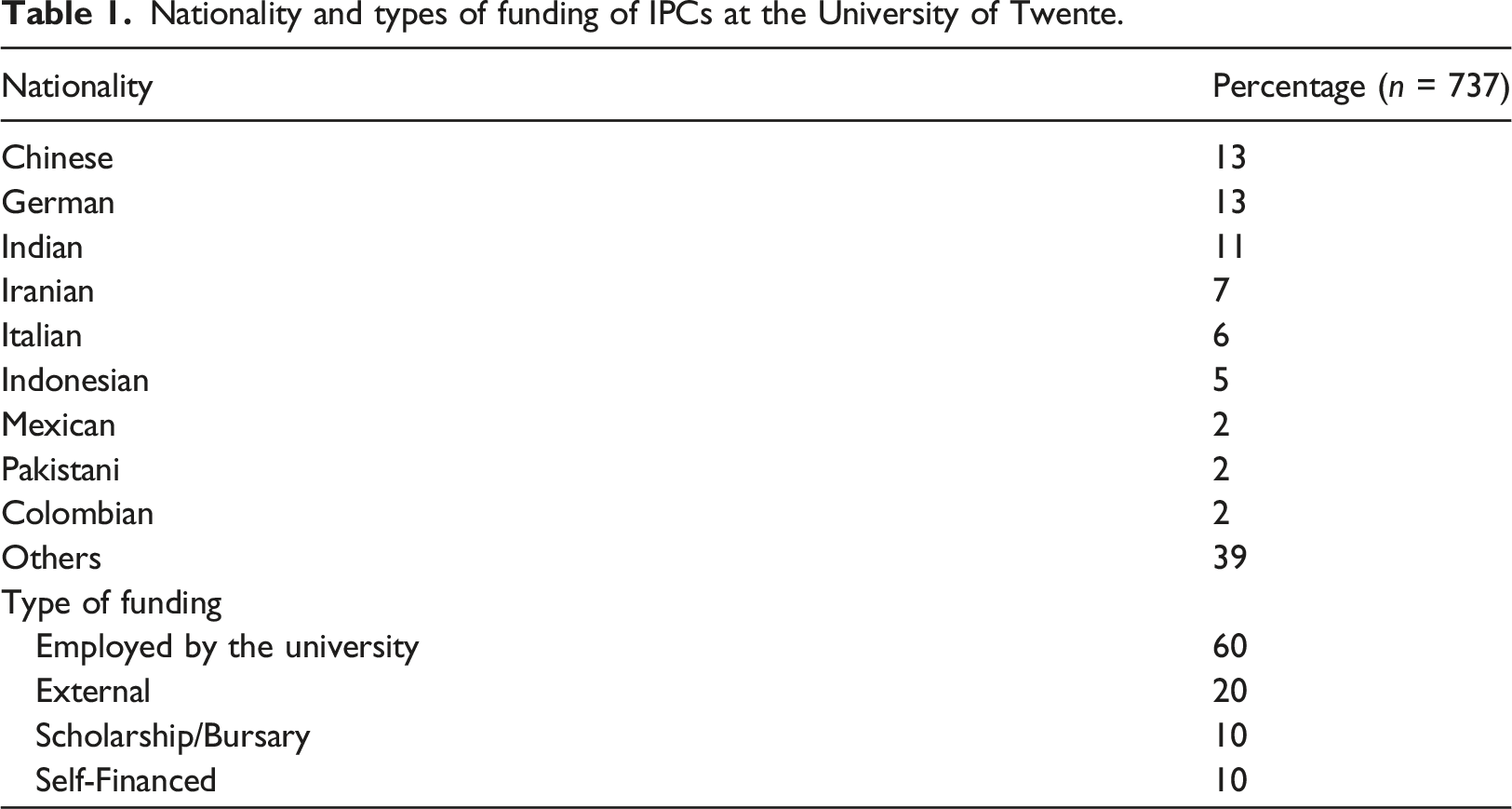
Nationality and types of funding of IPCs at the University of Twente.
Participants
Twenty purposively selected IPCs participated in the research. We specifically sought IPCs who did not hold dual Dutch nationality and who had been in their PhD program for more than a year. We considered one year to be a reasonable timeframe for PhD candidates to have noteworthy SEII at the university. Additionally, we ensured that participants were representative of all five faculties within the university.
Participants’ background characteristics.
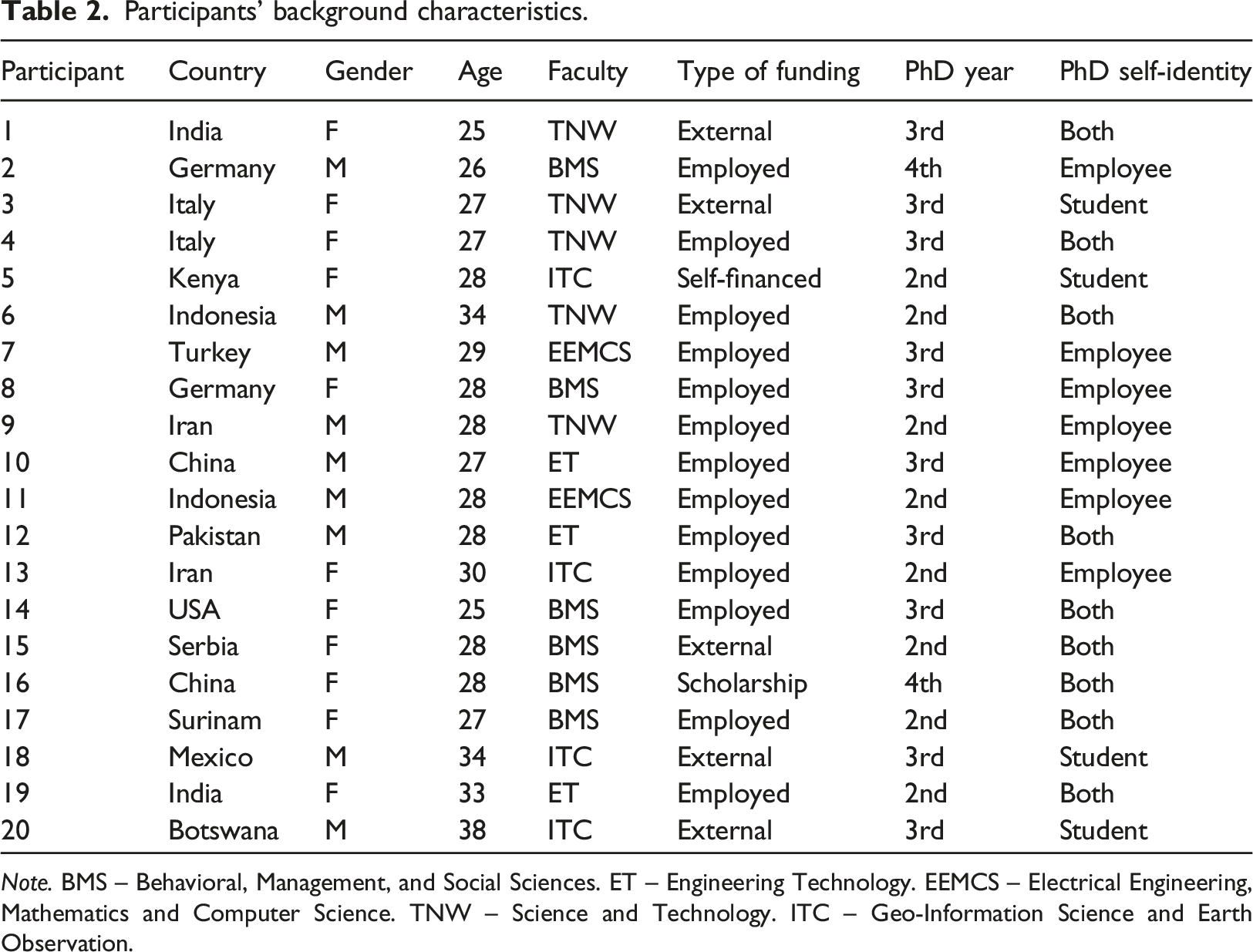
Note. BMS – Behavioral, Management, and Social Sciences. ET – Engineering Technology. EEMCS – Electrical Engineering, Mathematics and Computer Science. TNW – Science and Technology. ITC – Geo-Information Science and Earth Observation.
Data analysis
We employed Owen’s (2014) method for thematic analysis of the semi-structured interviews, which involves transcription, data reduction, thematic coding, categorization, labeling, and writing. A second coder reviewed two transcripts (10% of the total), achieving acceptable agreement rates of 0.72 for factors of inclusion and 0.79 for integration.
Findings
Factors that play a role in IPCs’ SEII in a DRU
Analysis of the interview data revealed nine factors which play a role in participants’ SEII with two factors being relevant only at the start of their university experience: prior experience in an ILE and identity in their PhD role. The remaining seven factors were relevant at the participants’ early and later SEII: intercultural interaction dynamics, shared language adaptation, social participation level, cultural events, the university’s international campus climate, social support and perceived prejudice and stereotypes.
Factors that play a role in participants’ SEII.
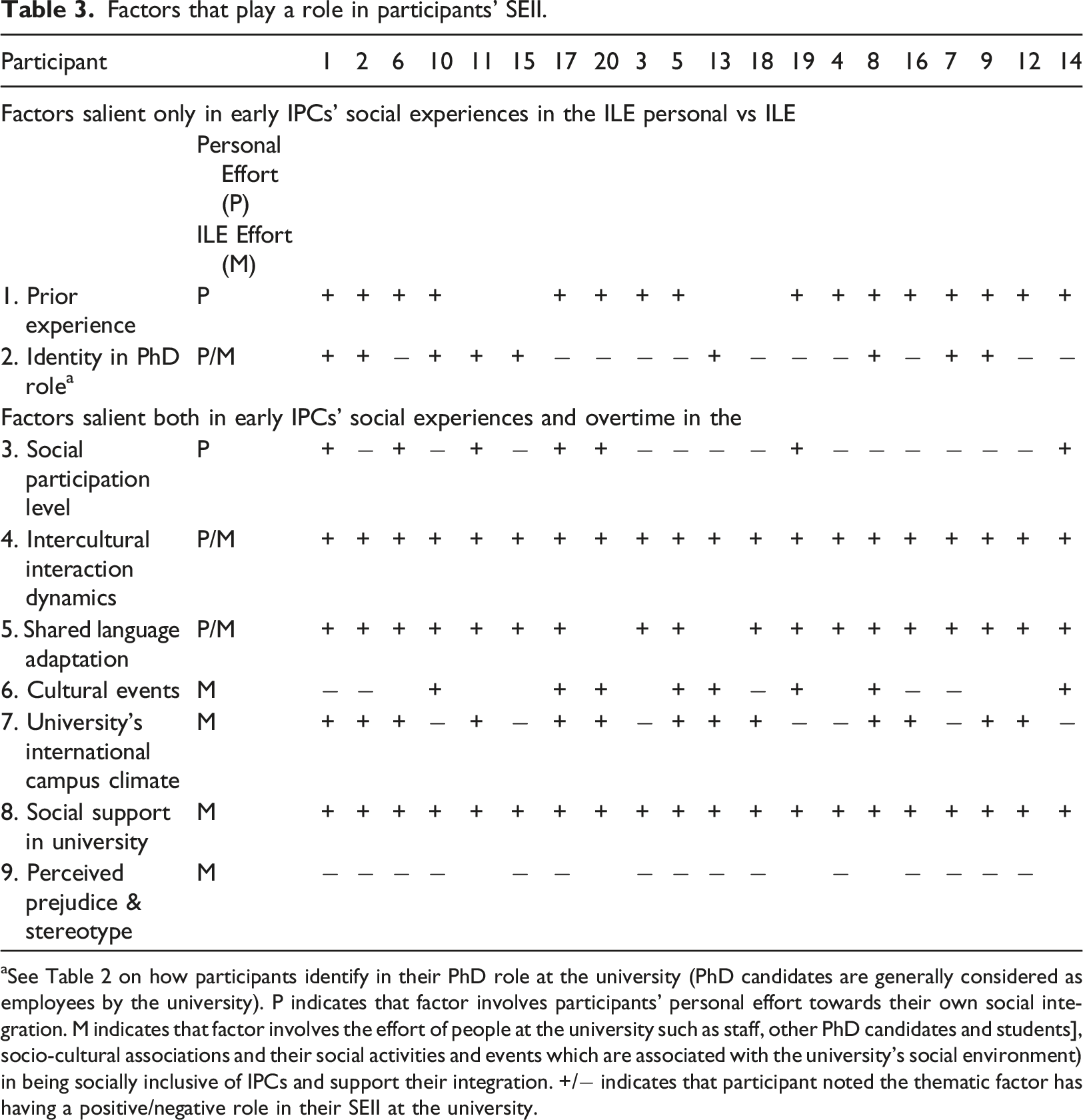
aSee Table 2 on how participants identify in their PhD role at the university (PhD candidates are generally considered as employees by the university). P indicates that factor involves participants’ personal effort towards their own social integration. M indicates that factor involves the effort of people at the university such as staff, other PhD candidates and students], socio-cultural associations and their social activities and events which are associated with the university’s social environment) in being socially inclusive of IPCs and support their integration. +/− indicates that participant noted the thematic factor has having a positive/negative role in their SEII at the university.
Factors salient only in IPCs’ early SEII in an ILE
Two factors, IPCs prior experience in an ILE and how they identify in their PhD role, were important in the early SEII of participants especially in terms of their expectations around social interactions that could facilitate feeling of connectedness within their immediate faculties and at the community level of the university.
Prior experience in an ILE
Some participants with prior study experience in an ILE either in the Netherlands or in other foreign countries reported feeling confident to manage social contacts with the domestic and other international people at the university. They noted that they use their prior experience as social capital during social interactions with people from different countries which helps their personal efforts to integrate. One participant said: I have been living in Europe for nine years in several different countries - Italy, Denmark, and the Netherlands. I believe that with my experience, especially when I first started the PhD programme, I was able (to) manage interacting with many cultures and build connections in a social way. I would sometime share interesting stories from my international experiences, and this was how I endear myself when I meet new people at the university. My experiences abroad help me. But for people who are living abroad for the first time, they do need lots of help to integrate with other people at the university. [P10]
Participants who had already completed a master’s degree in a DRU adjusted easily as they were generally familiar with the country’s university social systems and already had established social networks.
I have been here (in the Netherlands) for a while, so I already have some friends here at the university. I can say it got easier for me socially to adjust because of this. I’m already familiar with how things work here and in the Netherlands in general; places to go; who to ask when you need help. I feel for international people who are here just very recently and those who are going abroad for the first time. They will struggle in finding connection and PhD is a very personal thing…but they will adjust at the end of the day. [P2]
Contrarily, newly arrived IPCs had challenges to establish meaningful social contacts (e.g., friendships) early in their individual trajectory because their contact experiences were limited to the faculty and their contacts with colleagues and supervisors. One participant said: When I got here, I did not know anyone. It was my first-time outside China. I don’t have experience in an international university. I expected to meet a lot of people from different countries and make some friends. I was welcomed by the secretary. She helped me in the department to answer my questions and my supervisors were nice too. These were my contacts with the university at the beginning. But most of the time I was alone in my office. People were nice to me, but we were not like friends. But we have a lot of people from China and many of them help me with information- where to shop for Chinese food and we like to help each other out. But it was hard to have a friend who was not Chinese. Now I do, she is Spanish, but at first, I was with only other people from China. [P16]
Identity in PhD role
Regardless of their sources of funding for their PhD, how participants personally identify in their PhD role (as an employee, as a higher-level student or a mix of both) at the university had an impact on their initial expectations of the social environment of the university, especially in helping to facilitate their social contact at the university and help them to socially integrate. Of the 13 participants directly employed by the university, seven identified only as employees and six as both an employee and a higher-level student at the university. Three of the five participants funded by external organizations identified as students at the university, while two identified as both students and employees of the university. Participant 5, who was self-funded, identified only as a student, while Participant 16 had the dual identity of being an employee and student at the university. The mismatch between how the university identifies the PhD candidates and how the participants self-identify contributed to a mismatch between IPCs’ expectations of the university’s contribution to their initial SEII and the real experiences. Some participants expected to not be treated as employees when they partly or solely self-identify as higher-level students. Participants who solely or partly self-identify as higher-level students had the expectation to be included in social activities organized for bachelor’s and master’s students, such as the welcoming activities organized at the start of every academic year where students can interact within diverse cultural groups and have the potential to develop friendships and build their social networks. When this was not the case, participants noted feeling disappointed and socially disconnected at the university. I am on scholarship. Here they tell us we are employees, but I feel like a student. So, I am both. At my department, in the beginning when I felt like a student, I expected other people to make the effort to meet me so I can feel accepted, but socially it was not easy for me to fit in…. I had most contact with other Chinese and many of them are still my friends. At the beginning, I thought we would also have a special welcome like the bachelor’s and master’s students. I wanted to meet people that way. Many of them make friends from different countries and with the Dutch people. We didn’t have that. So, at that time, I felt like it was not inclusive enough. [P16]
Furthermore, participants who identified only as employees felt connected with their department’s staff and had reduced interactions with students. They, therefore, often skip social events organized by bachelor’s and master’s students due to feeling out of place. I feel like an employee. I can draw a boundary between the student and the worker. It is a bit of a different experience compared with when you are doing master’s or bachelor’s. Therefore, I don’t join those social events that the master’s, bachelor’s organize, even though everyone is included and mostly free to join. For me, it really does not feel like I belong to the ‘student group’ anymore. [P8]
Factors salient in both IPCs’ early SEII and overtime in the ILE
These are factors that were present from the start of participants’ social contact experiences at the university, and which remained important in their later SEII. Seven factors were noted and the mechanisms of their roles in the participants’ SEII are explained below.
Social participation level
How actively and frequently IPCs engage in social activities on campus was an important aspect of how connected they were to others within their faculty and to the general university community. Most of the participants feel the university promotes inclusivity by providing physical spaces for social interactions like lounges, cafeterias, and sporting facilities. However, it was participant’s personal responsibility to take advantage of inclusive opportunities through active and frequent participation in social activities at those facilities. Thirteen of the participants noted that they participate less in social activities and events organized within their work and at the wider campus community. Seven participants who actively participated in social events and extracurricular activities (e.g., sports) noted that the more they participated the more they felt connected to other people at the university. However, participants who deliberately or unknowingly excluded themselves from inclusive opportunities had more challenges establishing and maintaining social contacts. I felt excluded at the beginning because I expected people to come talk to me but that didn’t really happen. They were very nice but not like we were friends… and later I realized that it was also my fault because I was really closed in the beginning to do things with other people. [P3] For social activities people go to drink beer together at the weekend. Everyone is free to join. So, I can say that I feel included because I am invited but I don’t join because it is not allowed in my religion to drink. [P6]
Intercultural interaction dynamics
The frequency and the quality of intercultural interactions on campus were vital for IPCs’ sense of inclusion and social integration at the university. Participants noted they had intercultural interactions during their activities within their departments (e.g., with research group/department colleagues, supervisors, other teaching/non-teaching staff) and in their general social interactions with people at the university—within and outside of their academic work. Within their research groups, the dynamics of their intercultural interactions differ per participant based on group size and group diversity. Every time the group evolves (with new members) we all play a part in how we make others from different cultures feel welcome through our interactions with them. For example, inviting them often to join lunch or drinks. Engaging with people is nice. This helps them feel like they belong. I see that it helps them also adjust to the group because we are there to help them. They can also have some social contacts from the start of their PhD here at the university. [P17]
All participants observed that being part of culturally diverse work groups—whether composed solely of international members or a mix of Dutch and international members—helped prevent any feelings of exclusion. The inherent diversity and the inclusiveness of these groups fostered a welcoming environment. Participants noted that, with the acceptance they received from their work groups, they felt a responsibility to contribute to this inclusiveness. They did so through interactions within the work group, with friends and acquaintances, and by participating in formal, organized university events. This active involvement helped strengthen the inclusive framework for both current and future members. There’s a very good balance of Dutch and international people I interact with. I try to be accepting and inclusive of others too whether you are Dutch or international. One example, the Dutch and international people in my group have a music band together. We have drinking nights or virtual gaming nights. So that is a social collaboration or social mixing. The interaction was very positive because you are not just staying with people from your country. I’ve gotten very open-minded since getting here. [P1]
Additionally, positive interactions with Dutch and international university members fostered a sense of connection for some IPCs and developing and maintaining intercultural friendships also aiding in feeling connected to the university community. The more you interact well with other people, not people from your country, the better you can make diverse friends. You can also build goodwill with your colleagues and supervisors when you interact not just about the project but also personal, casual interactions during lunch or when having drinks. This is also how you learn to be sensitive to others so you can make everyone feel welcome whether they are Dutch or international. It is also our job, even as internationals, to make people feel included when we have those social interactions, so they can integrate better into the system. I take every opportunity to meet people who are not from India, even though I also have some friends from there. [P19]
Shared language adaptation
Some participants noted that they felt included when people use a shared language during intercultural social. This provides a level playing field for members to communicate and interact, and everyone can participate. This made it easy to have interactions and participate in social activities. According to some participants, while English is the official and common language at the university, it was common for cultural groups to speak their native languages amongst themselves while non-speakers of the language, in some instances, were present. Participants noted that this often occurs unintentionally. However, they noted feeling included when people in the group were not only aware that non-native speakers were present but were willing to switch to a shared language to include them. This is illustrated by the following quotes: Before we used to have meetings in Dutch …Now all is in English because there is at least one person that does not speak Dutch. I am not afraid to also say: ‘please switch to English’ and so on. [P8] People speak different languages and sometimes it is the internationals who are excluding the Dutch, maybe not on purpose. We can be more conscious of other people when we speak so we can include them in the conversation and not isolate them socially. I sometimes try to tell others to switch to English or I take it on myself to interpret what is being said in English to the person who doesn’t speak my language. [P4]
Cultural events
Participants noted that cultural events specifically organized at the university (such as the Indonesian food festival and Indian light festival) attest to its diverse nature and to a considerable extent its inclusiveness, because everyone can participate, engage with others, and exchange cultures in a relaxed social setting. This opened opportunities for developing culturally diverse friendships and to build and maintain supportive social networks. At ITC, our social events have many cultural aspects. It can be food and traditional music or dance. Take one example, we have the traditional days that we all can dress in our cultural clothes…. Cultural events really make me feel like I am part of something and unique at the same time…You can interact with lots of people and learn about them, their culture…make new friends…get new contacts. It makes everything easy in a way. Working together is more fun after these types of experiences. I enjoy that the most. [P20]
However, some participants believe the university dedicates more attention and support to international bachelor’s and master’s students than to IPCs. Therefore, they occasionally do not see or seek the opportunities to engage in social and cultural activities organized at the university. This is because they do not perceive these activities as specifically designed to include them. I have never received any direct information from the university about their social, cultural inclusion or integration programmes, you know about Pride Day, and you see the flag but that is not cultural. So, the university can be more open about its plans to make internationals from various cultures feel more welcome in that specific cultural way. This can better help us feel like we belong here- like somebody has thought about us. With this type of feeling you can adjust better because you are comfortable to be here…. They (the events) are managed by study groups or associations of the bachelor’s, master’s students. I don’t think they organized those events with us in mind. [P7]
University’s international campus climate
This is how open to and accepting of internationals, participants feel the university is. Participants were evenly split on their perceptions of the university’s international campus climate, and this is also reflected in their perception of the inclusiveness of the university. Two perceptions were evident. First, some IPCs see the university as officially functioning as a Dutch system, which may limit differentiation to a considerable extent. They point out that the university was still in the initial stages of transitioning to being fully internationalized, especially when considering that diversity decreases higher up in the university’s management structure. Thus, some participants perceive that these more senior levels have less potential for inclusion. They also feared that there was limited representation of internationals at the upper echelons of the university and that consequently any decision by the university towards inclusiveness may lack the cogent perspective that cultural diversity can offer in core decision-making. Some IPCs believe their interests may not be well represented, meaning that more credible social solutions to inclusion and integration may be impeded due to a bias perception of the system. I think they hire mostly internationals for PhDs because management level is fully Dutch. This automatically affects who you interact with. Up there where you have more long-term and permanent positions is mostly Dutch. There are some faculties that are very much Dutch dominated, some faculties I hear are more international. So, until management and even some higher professors are international, I wouldn’t say the university is international and fully inclusive. I feel like a temporary worker. From the very beginning it felt like an inclusive environment, but I cannot say I am part of the team because I am temporary. There is a major complaint about this issue. Higher up is mostly Dutch. [P7]
Participants agreed that the university is welcoming to and accepting of internationals and does make attempts to make them feel included. This also helps in their adjustment because there are social events IPCs can participate in along with bachelor’s and master’s students. This created avenues for interaction which helped with their social adjustment. I can say the university atmosphere is very inviting, welcoming, and just accepting. You know you’re in an international safe space for meeting people and to be yourself. Take an example, officially my boyfriend who is Slovak is part of the Indian Student Association. We practice inclusiveness by allowing that. We allow everyone to join our events so we can diversify. The idea of having these associations is not just to create events but also encourage intercultural engagement. So, we don't want to actually ‘force the culture bubble’ but try to bring people together. [P1] At ITC, there are not so many Dutch professors and supervisors. Most of the staff and students are international. So at least from the social angle, it was easy to feel at home and build that shared connection with other people there. Many of the people I know are friends in a way. [P20]
Social support at university
The type of social support that participants get from supervisors, university friends, and colleagues, especially when experiencing academic or psychological difficulties, was instrumental to their perceived inclusion and social integration experiences. These experiences are illustrated by the following quotes: There was a time I was stressed, and I spoke with my promotor who took me to lunch and had some light but nice discussions about culture and food…then I spoke with a psychologist at the university and the advice was to do some mental exercise but also many social things like cooking with friends, some of them are also my colleagues. I got a lot of support from people at the university, and this made me feel like I am included and so it helped me feel I am an important part of the university, I think. [P16] I am a Muslim and I pray five times a day. Sometimes my colleagues are the ones who casually remind me, “hey it’s time to pray.” It feels good that they accept that. The department provides us with a room for prayers. I appreciate that very much. [P6] PhD is hard for internationals. Most of us are away from our friends, our families and loved ones…. The friends I made here are the ones who help when everything was too overwhelming for me…. Just planning a dinner with my international friends helps with the stress. [P20]
Perceived prejudice and stereotypes
These are the personal or observed experiences of prejudice against IPCs at the university in social situations. Participants gave no evidence of personally having experienced any explicit discrimination at the university. However, many of the participants noted that occasional stereotyping or prejudice do occur in the form of culturally offensive comments, jokes and innuendos, or stereotypes which may sometimes affect their connectedness to other people at the ILE. This induced a feeling of inferiority in some participants. While this does not rise to the level of discrimination, there is subtle evidence of persons from certain cultural groups (Chinese, Taiwanese, and Vietnamese were particularly mentioned across the interviews) often being isolated from the groups, which in many instances leads to them clustering with their own cultural groups. The prejudice people face is not only coming from the Dutch alone. Other internationals also say things that are not so nice, especially to people from China, Vietnam or India. It paints a negative picture. We can see that it also affects how they interact. In most cases, they stay within their group. [P2]
Participants noted that these IPCs also had more social integration problems because they excluded themselves from group activities that were designed to strengthen the bond within the group and were hesitant to ask for help from the group. In the wider social context of the university, participants noted that prejudice and stereotypes were present at the university, but mostly subtle. There is a stereotype that some people from certain countries cluster. When they realize people have this feeling about them, they cluster even more, and don’t look like they belong. That can affect their adjustment because if one of them does not join an activity, then most of them usually don’t. They make their own parallel plans, which are often apart from the group. [P13]
Discussion
This study examined factors that play a role in IPCs’ social experiences with inclusion and integration (SEII) in a Dutch research university (DRU). It focused on the personal efforts made by IPCs to socially integrate into an international learning environment (ILE) and the university’s efforts to promote inclusivity and support the social integration of IPCs. Findings suggest that nine factors play a role in IPCs’ SEII experiences. Four factors were exclusive to the efforts of the DRU accomplished through its actors, and their activities at the university. These factors include cultural events, university’s international campus climate, social support, and perceived prejudice and stereotypes. Also, two factors were exclusive to the personal efforts of IPCs in their own integration. These include prior experience in an ILE and social participation level. And three factors related both to efforts of the IPC and those of the ILE; suggesting that the forces of integration (personal effort) and inclusion (ILE effort) can complement or hinder one another. These factors include IPCs’ identity in their PhD role, the dynamics of their intercultural interaction and adapting to a shared language during social encounters.
Furthermore, some factors have solely positive effects (e.g., prior experience in an ILE and language adaptation during social contact) or negative effects (perceived prejudice and stereotypes), while others are dialectic, having positive effects on some IPCs and negative effects on others (e.g., level of social participation and university’s international campus climate).
Additionally, the timeframe (i.e., when in the SEII) of factors discovered was crucial, as some play a role at the beginning (prior experience and an ILE and IPCs’ identity in their PhD role) of IPCs’ transition to the university, while the other factors continue to play a role over time.
Specifically, prior experience can help IPCs better navigate and integrate into their new academic community, fostering a sense of inclusion and acceptance among their peers. Additionally, having already experienced living and studying abroad, these candidates are often more open and adaptable to diverse social situations, leading to more meaningful interactions and relationships with their peers (Ward et al., 2009).
Furthermore, the way IPCs identify in their PhD role can influence their SEII. A mismatch between how IPCs self-identify in their PhD role and how they are perceived by other university actors can impact their SEII. Psychological research indicates that people generally navigate multiple identities depending on their roles at any given time. Tsouroufli (2015), for instance, highlights the challenge IPCs face in managing multiple transnational identities, given that identity is often shaped by group membership (Tajfel and Turner, 2004). In this study, although PhD candidates are typically identified as employees, some IPCs perceived themselves more or partly as advanced students. This discrepancy affected their expectations regarding the university’s efforts to include them and support their integration, particularly during the initial transition. Berry (2005) and Van et al. (2004) suggest that alignment between IPCs’ expectations and their responsibilities within the ILE can help explain why some IPCs adjust more successfully than others.
Our findings further affirm that social participation is crucial for the social integration of IPCs. Higher levels of participation can lead to positive experiences and opportunities to build relationships, while lower levels can result in isolation and difficulties in adjusting to the ILE. Moreover, social participation is often examined as an outcome of the integration process. However, our finding suggests that social participation may also be part of the integration process as well as the outcome of inclusion and integration.
Intercultural interactions were perceived as bilateral factor, where the IPC shows willingness to have positive (interpersonal-) intercultural contact and at the same time expect people from other cultures (including the Dutch) to engage positively with them. IPCs first must ensure that their contact experiences and participation is not restricted to their conational group because they can benefit more from frequent and positive cross-cultural encounters. As an example, studies have found that diversified working and social groups in ILE contexts allow students to develop their intercultural competence, which, in turn, is predictive of their social adjustment (Acquah and Commins, 2016; Mejri, 2019).
Shared language adaptation was perceived as an integrative and inclusive behavior with efforts coming from the IPCs and from other actors at the university. Language is essential in all verbal communication among interacting groups. IPCs operate at a higher level of competence and are expected to have a good command of the shared language, which, in this case, is English. In this study, IPCs felt connected with others in the ILE when people during social contacts were sensitive (conscious) towards adapting to a shared language to include them. Likewise, IPCs behaved in this way to include others and foster inter-group cohesion and understanding which contributes to their own feeling of connectedness. The experience was negatively judged when people were not conscious of the language used. This aligns with Lou and Noels’ (2019) study on sensitivity to language-based rejection, in which they found that language mindsets can affect how migrants interact with people from other cultures and adapt their own language.
Also, our findings show that cultural events are opportunities for IPCs to participate and have intercultural contact; thus, can improve cultural knowledge, expand intercultural competence, and maximize inter-group understanding thereby facilitating integration (Gudykunst and Bond, 1997).
On the university’s international campus climate, ILEs as part of their inclusive efforts, must be open, accepting, and welcoming to different diverse groups. Tavares (2021) noted that the university must provide student groups equitable access to resources and treatment and address their need to be recognized as valuable members.
The findings also show that the support infrastructure IPCs have through their supervisors, colleagues, and university friends plays this role on behalf of the ILE. Studies on sojourner adaptation and wellbeing (e.g., Mittelmeier et al., 2019) have documented the significance of having a supportive network not only to address the emotional and practical needs of IPCs but also to provide them with a sense of community and belonging; thus, enabling their integration.
Prejudice and stereotypes were noted as a negative and enduring factor in SEII of IPCs. This factor can affect the personal efforts of IPCs to participate in social activities and can mitigate their social contact outside of their conational group, as Mittelmeier et al. (2018) similarly noted.
Noteworthy is that, perceived inclusion is not only based on what IPCs expect from the group, but the inclusive role IPCs themselves also play within the group to accommodate others and strengthen inclusivity within the group. This inclusive role, therefore, might become integrative in nature; thus, enhancing their SEII.
Recommendations for future research
While this study employed a qualitative approach, more quantitative studies are necessary to assess the impact of inclusion on the social adjustment of international students. Research should also focus on how students from diverse cultural backgrounds navigate their identities at different institutions, considering factors like acculturation motivation and the long-term effects of inclusion experiences on international students. Additionally, investigations into how religion, sexual orientation, gender, economic status, personal interests, and external influences affect the social integration of international students are recommended for future studies.
Recommendations for practice
Universities need to take proactive steps to improve inclusion for international and culturally diverse students by conducting pre-arrival assessments, setting realistic expectations through orientations, encouraging participation in cultural events, and diversifying staff. These efforts are essential for achieving genuine inclusion. Some students may feel excluded from social activities due to personal, cultural, or religious reasons, so universities should offer alternative activities to accommodate their preferences and promote inclusivity.
Limitations
Our study has limitations due to its small sample size. The use of the narrative inquiry method also limits the generalization of the findings. While we found shared factors among participants, our findings may only offer insight into IPC experiences at the university and may not be generalizable to other universities with different socio-cultural and physical (location) contexts. Thus, IPCs’ SEII may differ by how rural or urban the physical location is, which may affect the degree of cultural diversity present. We also did not specifically explore cultural differences’ impact on IPCs’ SEII, which is critical to the discourse on international higher education.
Conclusions
This study explored how IPCs understand their SEII in an ILE, with inclusion potentially playing a predictive role. While the IPC is responsible for social integration, the university must make formal policy adjustments to promote social inclusion. Informally, actors in the ILE must also contribute to creating a welcoming environment for cultural exchange, teamwork, and acceptance of others. All members of the ILE should celebrate differences and strive to nurture a positive learning environment.
Footnotes
Declaration of conflicting interests
The author(s) declared no potential conflicts of interest with respect to the research, authorship, and/or publication of this article.
Funding
The author(s) disclosed receipt of the following financial support for the research, authorship, and/or publication of this article: This work was supported by the Include-U Project, PhD Network, University of Twente.
