




Abstract
This study examines how international students from different cultural groups perceive their International Learning Environments (ILE) in three institutions located in the Netherlands, Türkiye, and Malaysia. Data were collected from 292 international students pursuing bachelor's and master's degrees using the standardized MILES survey, with 31.8% of responses from the Netherlands, 34.9% from Türkiye, and 33.2% from Malaysia. We used the Kruskal-Wallis Test and ANOVA for quantitative data analysis, and content analysis for the qualitative data. Results indicate that, across the three universities, international students scored highest in the goal direction domain and lowest in the relationships domain. No significant differences in goal direction or relationship domains among the three institutions or by cultural groups, but variations were found in supporting services. The main differences lie in the English proficiency of support staff. The study contributes to developing support services to enhance the ILE.
Keywords
Introduction
The internationalization of higher education (IoHE) has gained increasing attention from institutions and countries for decades. Student mobility has become a primary focus of many host institutions and countries within the broader context of internationalization. Recent numbers indicate a significant movement of students, with nearly five million students studying abroad each year (Jing et al., 2020; Organisation for Economic Co-operation and Development [OECD], 2024). Student mobility benefits many stakeholders, especially receiving countries in terms of economic and cultural diversity (Bastien et al., 2018; Jing et al., 2020; Spencer-Oatey & Dauber, 2019). Students accumulate social and cultural capital while studying abroad, leading to social mobility and employability (Di Pietro, 2015; Kaufmann & Audikana, 2020; Schäfer, 2022; Thi Tran et al., 2021). Students’ motivation to study abroad may not be limited to gaining an academic degree, it also involves other aspects, which include their overall learning experience within the International Learning Environment (ILE).
Moreover, students who leave their own country and study abroad face multiple challenges ranging from arrival, living, learning, and accessing support services (Ammigan & Jones, 2018; Liu et al., 2023; Sato et al., 2024; Worae & Edgerton, 2023). These challenges include socialization, maintaining overall well-being, and social integration (Du et al., 2024; Spencer-Oatey & Dauber, 2019;). Some may lack a sense of belonging to a community (Rusticus et al., 2023; Tavares, 2024), and others experience perceived discrimination (Arandas et al., 2019; Park et al., 2017). International students also face challenges in coping with academic work, such as language barriers (Bastien et al., 2018; Dryden & Dovchin, 2024; Gebru & Yuksel-Kaptanoglu, 2020), learning style and academic challenges (Alzahrani, 2018; Cho et al., 2023; Gebru & Yuksel-Kaptanoglu, 2020), lack of support and engagement from faculty members and poor group dynamics (Ahrari et al., 2019; Rusticus et al., 2023). Some of these challenges, if not effectively managed, may result in students’ withdrawal (Özoğlu, Gür & Coşkun, 2015).
This study aims to examine how international students from different cultural groups perceive their ILE in three countries, the Netherlands, Türkiye, and Malaysia representing non-native English-speaking countries. This study focuses on three research questions: (1) How do international students perceive their international learning environment in terms of goal directions, relationships, and supporting services? (2) Is there a significant difference in their perception between three examples of non-native English-speaking host countries Turkey, Malaysia, and the Netherlands? (3) Is there a significant difference in their perception between the cultural groups?
Understanding the learning environment perception of diverse cultural groups can enable universities to tailor their strategies and facilitate the adjustment and adaptation of international students. This, in turn, can enhance the students’ overall experience by creating a more comfortable and pleasant learning environment. Research has shown that a positive learning environment is associated with increased student satisfaction (Ammigan & Jones, 2018), improved academic performance and success (Cayubit, 2022), as well as the positive emotional well-being of students (Tharani et al., 2017). As a result, this eventually helps institutions to attract and retain international students.
Literature Review
Coping with the challenges or adjustments at host institutions/countries may differ based on the cultural background of international students. For instance, in the Netherlands, students from Europe and America may have similar levels of integration as Dutch students. In contrast, students from Southern Asia, particularly Confucian Asia, have lower academic and social adjustment scores (Rienties & Tempelaar, 2013). In addition, the study by Ong and Cheong (2018) indicated international students from Pakistan and Bangladesh experience greater cultural difficulties than those from other nations while studying in Malaysia. Asian international students represented by China, India, and Malaysia demonstrated lower social integration, academic integration, and intercultural skills while studying at six universities in the UK, the Republic of Ireland, Belgium, and Germany (Spencer-Oatey & Dauber, 2019). Besides, learning a local language in a non-native English-speaking country is another challenge for international students, and the degree of difficulty certainly varies across cultural groups (Alpaydin, 2018; Ambrósio et al., 2019; Calikoglu, 2018). For example, within the international student population in Türkiye, students from Turkic republics can easily learn Turkish, while students from other countries may find it much more challenging (Alpaydin, 2018). Therefore, the adjustment and adaptation to ILE differ based on cultural groups (Spencer-Oatey & Dauber, 2019).
The IoHE in non-native English-speaking host countries has received significantly less attention than in English-speaking countries (de Wit, 2019). The United States, the United Kingdom, and Australia are undoubtedly the most popular English-speaking study destinations for international students (Ammigan & Jones, 2018). Although internationalization is much more diverse than Western cultures, the Anglo-Saxon, English-dominated paradigm is still the norm (de Wit, 2019). However, conventional international student mobility patterns have been challenged by the emergence and the rise of regional hubs in the twenty-first century (Barnett et al., 2016; Kondakci et al., 2018). Non-native English-speaking countries are increasingly attracting international students from neighboring countries (Barnett et al., 2016; Kondakci et al. 2018). Therefore, to achieve more inclusive internationalization, it is important to increase the focus on non-native English-speaking countries and to understand non-Western countries and cultural backgrounds (de Wit, 2019).
Theoretical Framework
Moos’ human environment framework is a theoretical framework applicable to the learning environment (Moos 1984). In this framework students’ perceptions include goal direction, relationships, and system maintenance/change (Moos, 1984; Xu et al., 2022). These three domains concern the learning objects, the extent to which people are involved in their environments, and the applicable institutional regulations (Moos, 1984; Rusticus et al., 2023; Xu et al., 2022). Applying Moos’ human environment framework to research IoHE allows for a structured analysis of how learning goals, interpersonal relationships, and system regulations shape student engagement and adaptability in diverse global academic environments (Xu et al., 2022). This study applies Moos’ theoretical framework to enhance the investigative structure to understand students’ perspectives.
Methodology
This study adopts a quantitative method through a survey questionnaire. The survey instrument used in this study, the Measure of the International Learning Environment Status (MILES), was developed based on Moos’ theoretical framework to measure learning environments (Xu et al., 2023). The development of MILES went through a rigorous validation process. It includes content analysis among former instruments, an international Delphi procedure to ensure the comprehensive coverage of Moos’ theoretical framework, and a first questionnaire evaluation in a university in the Netherlands (Xu et al., 2023). The involvement of international Delphi panel members also assures its application across countries. We used 45 items from MILES that measure the three domains, goal direction (13), relationships (15), supporting services (17), and demographic questions that include cultural groups. The detail instrument development of MILES is reported in Xu et al. (2023). The survey also includes three open-ended questions: “How do you feel as an international student in your institution?”, “How do you evaluate the support of your university to international students?” and “What are the main challenges of being an international student in your institution”. The open-ended questions aim to gather further explanation on students’ perception towards the ILE. The population of this study is international students who are studying at each university in the Netherlands (Netherlands U), Türkiye (Türkiye U), and Malaysia (Malaysia U). Before data collection, ethical permission was obtained for Netherlands U and Türkiye U. Malaysia U does not require ethics approval if consent is obtained from participating respondents. We conducted all questionnaires in English. English is used as the medium of instruction at the three universities. We calculated Cronbach's Alpha to test the reliability of the MILES when applying to the three different institutions. Descriptive statistics were used for the first research question. To answer the second and third research questions, we used the Kruskal-Wallis Test and two-way ANOVA to assess whether international students from different cultural groups and institutions perceive the international learning environment differently. The quantitative analysis was conducted using SPSS 28. To further explain the students’ perceptions towards the ILE, we conducted content analysis (Merriam, 1998; Miles & Huberman, 1994) through an open coding system for the answers to the open-ended questions. The main themes and subthemes were generated to organize these codes. Instead of presenting the whole list of codes, we provided quotations related to research questions to triangulate the quantitative results.
We chose the Netherlands, Türkiye, and Malaysia as the three case countries for non-native English-speaking host countries. The Netherlands is a highly internationalized country in terms of higher education with 115,068 international degree students enrolled in Dutch public higher education in the 2021–2022 academic year (14% of all university students). The top 15 countries of origin of international students studying in the Netherlands in 2021–22 include mostly European countries (Germany being at the top), China, India, and Türkiye (Elfferich et al., 2022). Türkiye stands as an emerging regional hub within global international student mobility considering its performance in recent years; from 15,805 international students in 2000 to 301,694 in 2023. The top sending countries among the international student population in Türkiye are Syria, Azerbaijan, Iran, Turkmenistan, Somalia, Egypt, Afghanistan, Kazakhstan, and Yemen (Council of Higher Education, 2023). Similarly, Malaysia has emerged as an attractive study destination in line with its aspiration of becoming an international education hub, doubling the number of inbound international students between 2007 and 2022 and reaching 97,235 (Ministry of Higher Education Malaysia, 2008, 2022). Of this enrolment, the top 10 sending countries in 2020 were China, Indonesia, Bangladesh, Yemen, Pakistan, Nigeria, India, Egypt, Sri Lanka, and Iraq (World Bank, 2022).
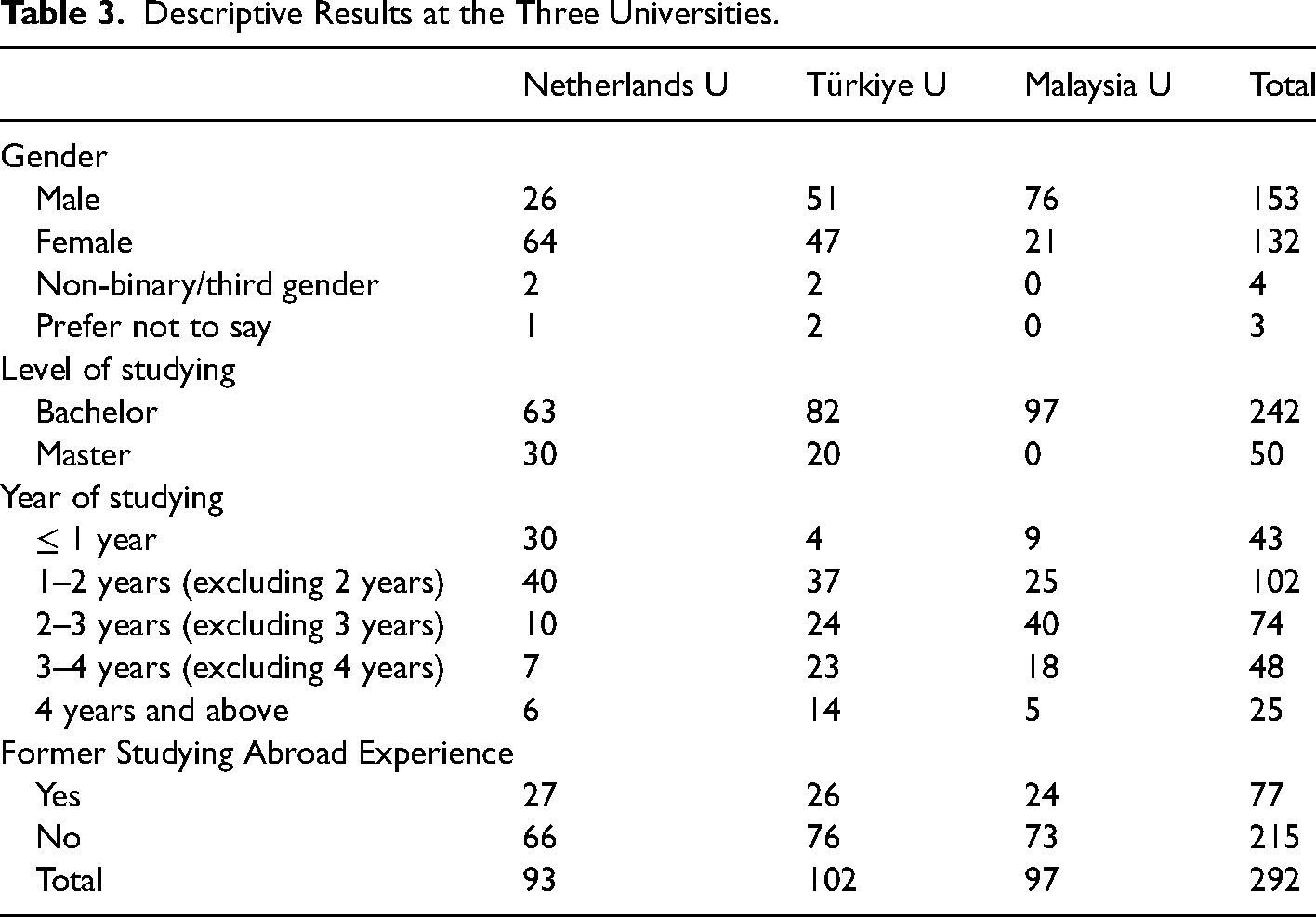
The participants of the Netherlands U come mostly from Eastern Europe (38), while only a few come from the Nordic (4) or Middle East (4). The participants of the Türkiye U are mostly from Middle East (57), while none of them come from Latin America. The participants of the Malaysia U come mostly from Middle East (75) as well. All cultural groups are represented but with limited numbers from Germanic Europe (4) and Latin America (4). The three countries were chosen to represent the different regions of host countries as Europe, Middle Eastern, and Asia, to increase the respondents’ diversity of cultural groups. Respondents were international degree-seeking students, enrolled in undergraduate and master's programs, which are physically conducted on campus. This is consistent with the objective of the study in measuring the learning environment which also includes the physical campus environment. The data collection was carried out from September to December 2022 via online and face-to-face surveys in classes at respective campuses. After data cleaning, the usable responses are 292, approximately equally distributed with 31.8% (the Netherlands), 34.9% (Türkiye), and 33.2% (Malaysia). The ratio between male (N=153) and female (N=132) respondents is also balanced, while seven respondents prefer not to disclose or use third gender. Respondents are from ten different cultural groups (see Table 1) and are allowed to choose more than one cultural group. The categorization of cultural groups is based on the Global Leadership and Organizational Behavior Effectiveness (GLOBE) (House et al., 2002).
Respondents’ Cultural Group by Universities.
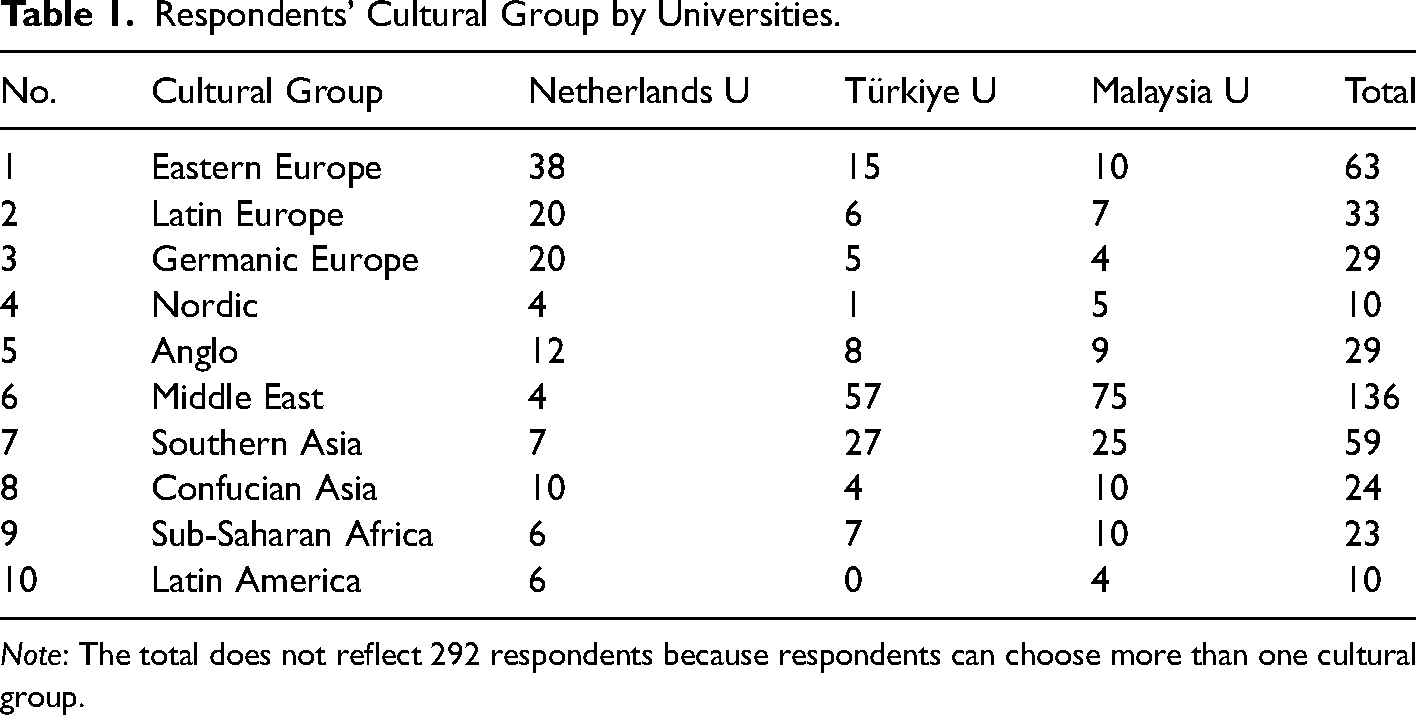
Note: The total does not reflect 292 respondents because respondents can choose more than one cultural group.
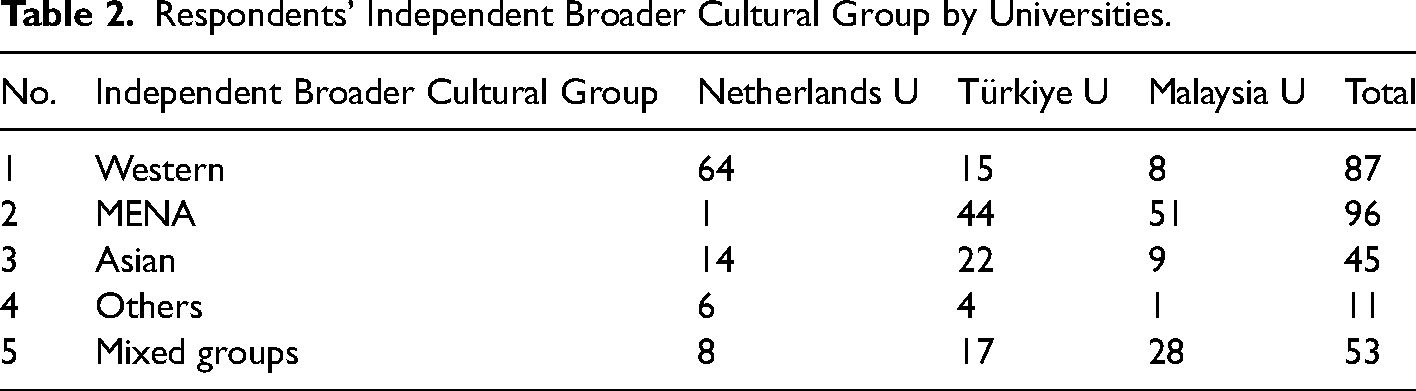
Due to the small number of certain cultural groups, close cultural groups were combined to form broader cultural groups for data analysis purposes. Hence, there are five independent cultural group categories which comprise (1) Western (Eastern Europe, Latin Europe, Germanic Europe, Nordic, and Anglo); (2) MENA (Middle East and North Africa); (3) Asian (Southern Asia and Confucian Asia); (4) Others (Sub-Sharan Africa and Latin America) and (5) Mixed groups (students who chose more than one broader cultural groups) (see Table 2). We used the independent broader cultural group to do the two-way ANOVA to identify the cultural differences by institutions. Open-ended questions provide further explanations for students’ perceptions. The qualitative analysis of the open-ended questions was presented as quotations and all qualitative answers were given a number based on their participation ranks from 1–266. We provide our complete questionnaire in the supplementary material (ST1).
Respondents’ Independent Broader Cultural Group by Universities.
Results
International Student Composition at the Three Universities
All items measuring the three domains show a good reliability score, with Cronbach's Alpha score of 0.905 for goal direction, 0.919 for relationships, and 0.916 for supporting services. The descriptive information about respondents at the three universities is presented in Table 3. The majority of respondents, specifically 249 (85%), have gained over a year's worth of experience at the host campus. Additionally, 242 (83%) of respondents are currently pursuing a bachelor's degree, with 50 (17%) enrolled in a Master's program. There are 215 (73%) respondents with no prior study abroad experience. Besides, as stated in Table 2, the Western group (64) is the largest cultural group for international students at Netherlands U, while the MENA group dominates at Türkiye U (44) and Malaysia U (51).
Descriptive Results at the Three Universities.
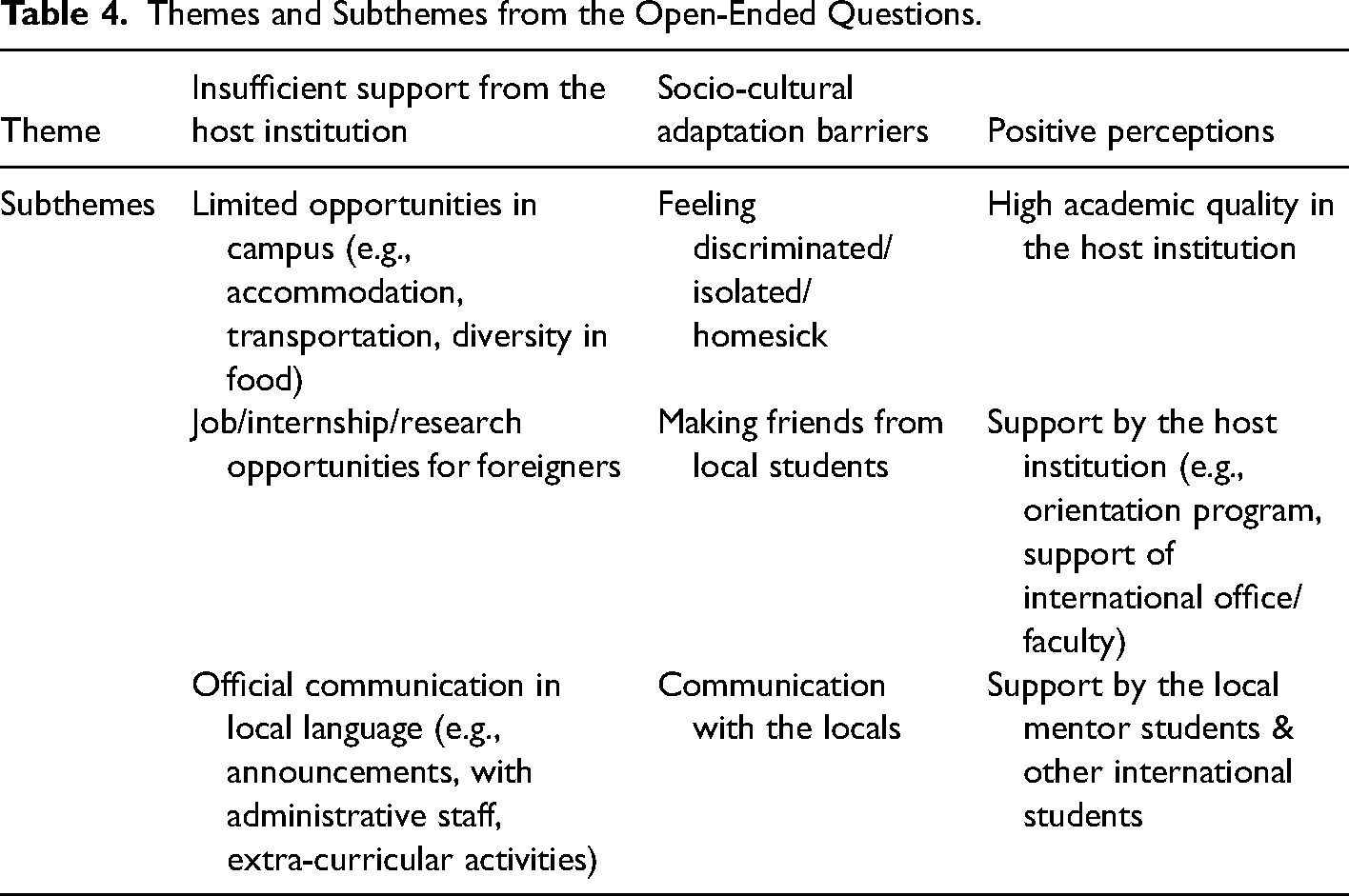
The results of the quantitative analysis of the answers to the MILES survey are provided below (Table 4). Students’ 712 responses were categorized into three main themes: insufficient support from the host institution, socio-cultural adaptation barriers, and positive perceptions. Each main theme has three subthemes. In the following section, we provided the quotations related to MILES survey results to explain the quantitative results.
Themes and Subthemes from the Open-Ended Questions.
International Students’ Perceptions of the International Learning Environment
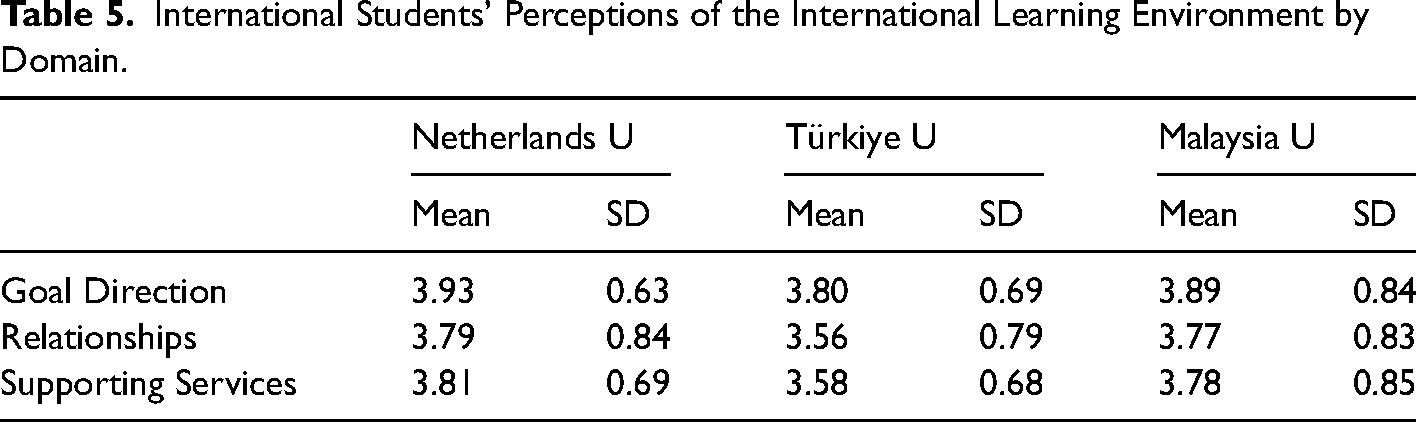
The results show that within Netherlands U, international students have the highest perception scores in the goal direction domain (3.93) and the lowest perception scores in the relationships domain (3.79). The same patterns are also identified in the other two universities (see Table 5).
International Students’ Perceptions of the International Learning Environment by Domain.
Results by items in detail have been provided in the supplementary material (ST1), for the goal direction domain, students at Netherlands U have the highest scores in item G5 “This higher education institution (HEI) helped me to learn new ways of thinking and acting in my field” (Mean=4.30; SD=0.79). At Türkiye U item G3 “This HEI helped me to acquire analytical skills and problem-solving techniques” has the highest mean score (Mean=4.17; SD=1.08). Lastly, at Malaysia U, the highest mean score was in item G4 “This HEI helped me to develop my ability to adapt to new circumstances and deal constructively with differences” (Mean=4.15; SD=0.98).
Meanwhile the lowest scores of goal direction domain, students from three universities have the lowest scores for item G8 “This HEI pays attention to considering issues from different cultural viewpoints” (Netherlands U: Mean=3.53; SD=1.19; Türkiye U: Mean=3.16, SD=1.32; Malaysia U: Mean=3.56, SD=1.12). This result is consistent with data collected from the open-ended questions below. The recent surge of distrust, discomfort, and general unease toward all foreigners in Türkiye has had a toll on me personally. Most of the conversations make me feel unwanted in the country, even if the person involved in the conversation does not intend it (Student 111, Lebanon, Türkiye U). The challenges I face are racism and arrogance towards international students, and there is no help. I had conditions a year ago, and my wife passed away, and I told him about that in order to get me to postpone some exams, and they refused to do so (Student 248, Saudi Arabia, Malaysia U).
On the other hand, item R12 “This HEI encourages domestic students to help their international peer students” has the lowest scores at all three universities (Netherlands U: Mean=2.67; SD=1.10; Türkiye U: Mean=2.88, SD=1.34; Malaysia U: Mean=3.31, SD=1.32). The below quotations also confirm this feeling as international students have difficulty getting support from domestic students: International students are very open and friendly. Dutch students not so much… international students are often left out. The University doesn't support much integration (Student 99, Italian, Netherlands U) In the University, I feel like there are fewer intercultural activities that help us make and connect with our local peers. There is segregation, most of the time, between locals and international students. (Student 14, Pakistani, Türkiye U)
In contrast, item S6 “This HEI has adequate support services available to help the international student adjust to the host country” perceived the lowest scores at Netherlands U (Mean=3.10; SD=1.20) and Malaysia U (Mean=3.46; SD=1.30). Additionally, item S16 “At this HEI, non-academic (supporting) staff members know and speak English” (Mean=1.65; SD=0.94) has the lowest score at Türkiye U. This issue was also reflected in the open-ended questions, and two striking examples were provided below: Really bad. I was planning to quit my studies because a housing company that the university advertise in their website was being abusive and the living conditions were really poor. … Besides not being supportive, the university created obstacles and enable the company to keep illegal behavior towards international students. A letter that I wrote to the rector was simply ignored. These things would never happen with a Dutch student (Student 128, Brazilian, Netherlands U) Other than International Students’ Office which continuously and effectively supports international students, I did not get any support from my department or any other unit since everything proceeds in Turkish and initially I did not know Turkish. The support of the university for international students is insufficient in most of the facilities like dorms, healthcare services, sport centers, cafeteria …the university has to implement an administrative system which does not pose a language barrier for international students. (Student 108, Iranian, Türkiye U)
Comparison of International Students’ Perceptions at the Three Universities
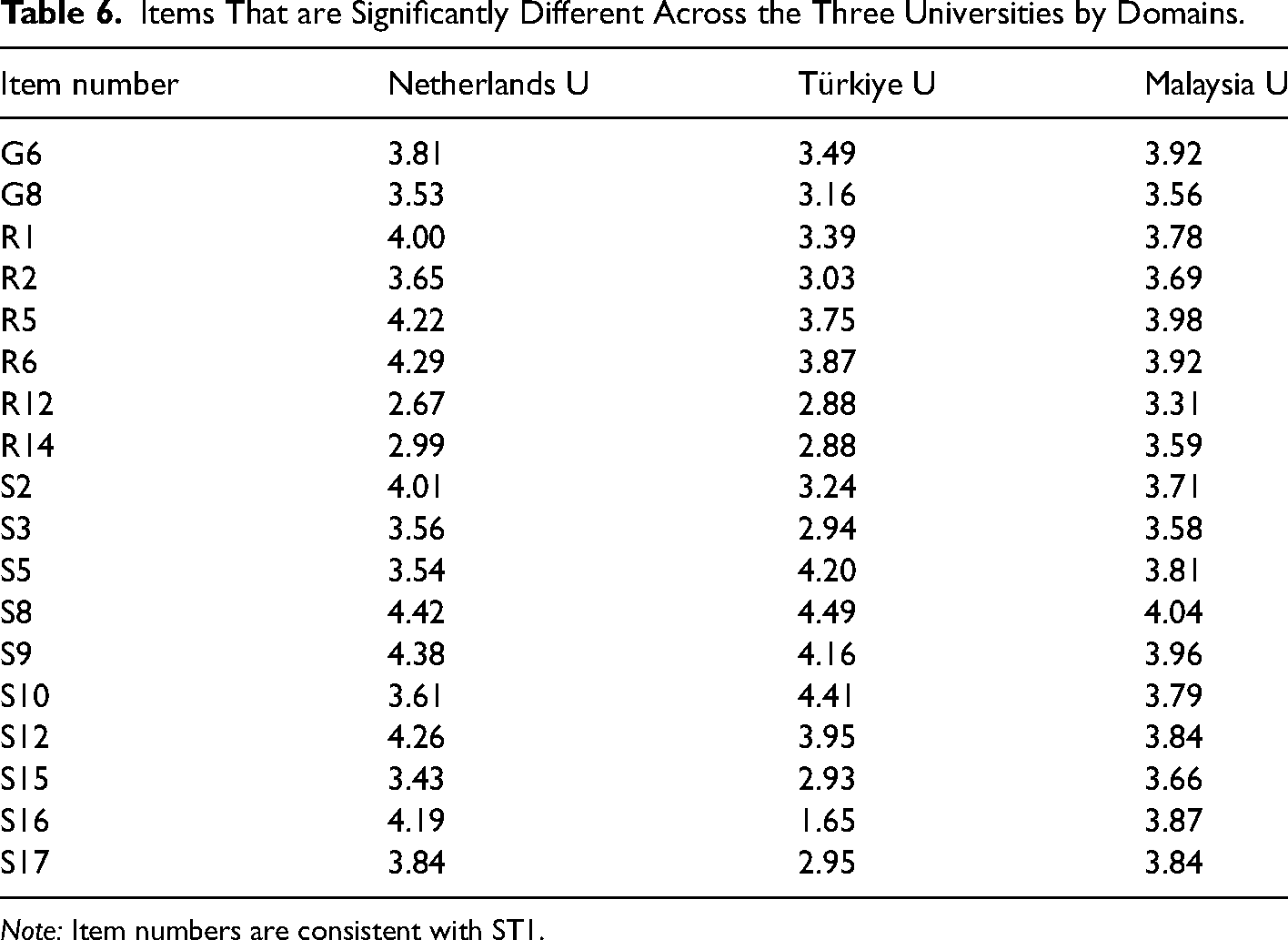
The results of the Kruskal-Wallis Test show that international students’ perceptions of their ILE differed across the three universities in the domain of supporting services (p=0.045), while no significant differences were found in the domains of goal direction (p=0.165) and relationships (p=0.060). When comparing the international student perceptions of each item across three universities, significant differences were identified in 2 items within the Goal Direction domain, 7 items within the Relationships domain, and 10 items within the supporting services domain (Table 6).
Items That are Significantly Different Across the Three Universities by Domains.
Note: Item numbers are consistent with ST1.
In the domain of goal direction, Türkiye U perceived significantly lower scores than the other two universities in item G6: “The teachers in this HEI provide valuable feedback” and item G8 “This HEI pays attention to considering issues from different cultural viewpoints”.
In the domain of Relationships, Netherlands U perceived significantly higher scores in items R1 “This HEI facilitates that students build intercultural friendships”, R5 “At this HEI, I feel comfortable to work in groups and share my ideas”, and R6 “This HEI offers a comfortable atmosphere that facilitates contributing to class discussions”. Malaysia U received significantly higher scores in item R12 “This HEI encourages domestic students to help their international peer students” and R14 “This HEI organizes social activities to help international students to get to know domestic students”. By contrast, Türkiye U has significantly lower scores than the other universities in these items (R1,R2,R5,R6, R14).
In the supporting services domain, item S16 “At this HEI, non-academic (supporting) staff members know and speak English” appears to be a big difference across the three universities with Netherlands U having a score of 4.19 and Türkiye U perceived as 1.65. Additionally, Türkiye U perceived significantly higher scores than the others in item S5 “This HEI supports international students with orientation programs” and item S10 “At this HEI, the International Student Office provides support for international students”.
Cultural Group Influence on International Students’ Perceptions
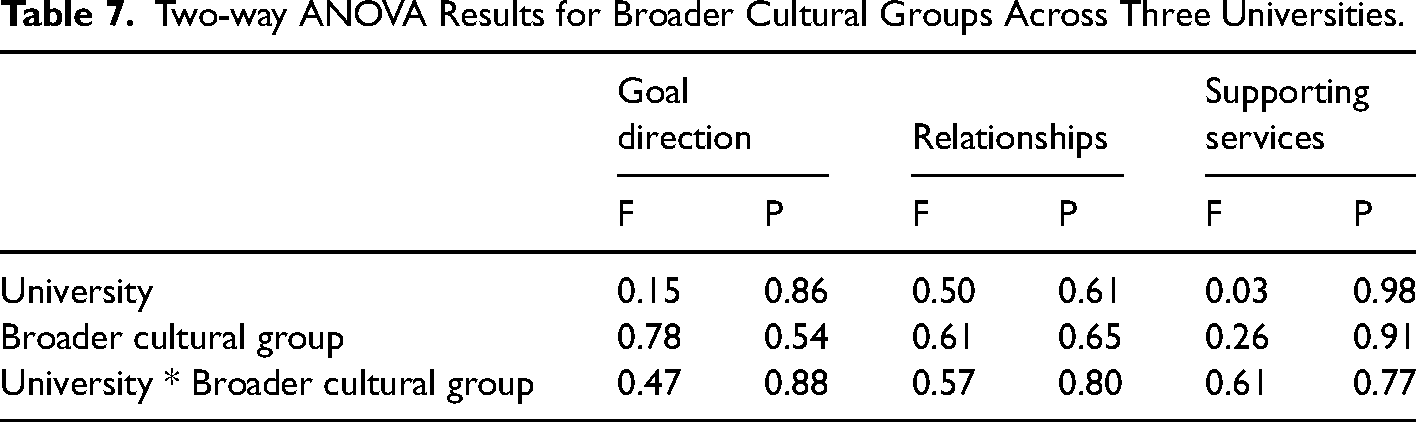
The descriptive statistics further illustrate the cultural backgrounds of international students at the studied institutions. The two-way ANOVA results show no significant difference in the perceptions of international students from different cultural groups about their ILE (see Table 7).
Two-way ANOVA Results for Broader Cultural Groups Across Three Universities.
Qualitative evidence could be found in the answers to open-ended questions that students perceived no difference by cultural groups. Its quality overall is satisfying and you can tell it's a point of focus and that the environment is highly internationally friendly. I feel treated equally with my Dutch colleagues and I sense no differences based on cultural background in how we're treated (Student 247, Romanian, Netherlands U).
Discussion
This study focuses on international students’ perceptions of the ILE at three universities from the Netherlands, Türkiye, and Malaysia, which represent three different cultural backgrounds. The MILES questionnaire designed based on the Moos (1984) theoretical framework was used to comprehensively assess international students’ perceptions of the ILE in three domains: goal direction, relationships, and supporting services (Xu et al., 2023). We identified common patterns and highlighted differences in international students’ perceptions of their experiences in these three non-native English-speaking countries. These findings are corroborated by the qualitative data from our study.
The analysis of the three domains of the MILES survey sheds light on the adaptation of international students to their new ILE. International students’ perceptions of their host institutions in the domain of goal direction show no significant differences among the three universities. Compared to their perceptions in the other domains, the scores in this domain are higher at all three universities. Overall, the ILE has helped these students in their personal growth and development. These include learning new ways of thinking, acquiring analytical and problem-solving skills, and adapting to new circumstances. In addition, through ILE, students developed cross-cultural communication skills and how to work in a cross-cultural environment. This is consistent with a former study on the impact of study abroad where students gained intercultural competence and personal development (Maharaja, 2018). However, HEIs need to be attentive to “considering issues from different cultural viewpoints” within the learning content. Previous studies have also suggested that the IoHE involves helping students to develop a broad international perspective through the understanding and appreciation of different cultural perspectives, while the homogenous internationalization of education and the mimicking of Western-style education should be avoided (de Wit, 2019).
The relationship domain highlights the environment that affect interpersonal ties, social support and interactions among persons. Among the three domains of the ILE, the relationship domain received the lowest rating. It confirms that relationship-building and socialization challenges are common for many international students (Sato et al., 2024; Spencer-Oatey & Dauber, 2019). Consistent with other research, it highlights the significant difficulties international students face in forming intercultural friendships with domestic peers (Ammigan & Jones, 2018). This suggests that institutions may be failing to create sufficient opportunities, such as social events or group projects, for students from diverse backgrounds to build friendships.
Significant differences emerge in the supporting services domain, with Netherlands U outperforming Türkiye U overall. A key factor contributing to this variance is the proficiency of staff in English, impacting international students’ access to resources, and sense of belonging. The language used on campus relates to whether international students can get equal information and access to all the resources within the learning environment. This underscores the universal importance of effective support services, including a supportive International Student Office, comprehensive orientation programs, and language accessibility, in facilitating a positive ILE experience for all students, irrespective of cultural background (Martirosyan et al., 2019; Rusticus et al., 2023; Dryden & Dovchin, 2024; Tavares, 2024). These perceptions are also supported by the qualitative results of our study. Students criticized the insufficient support from the host institution, sometimes due to bureaucratic obstacles or language barriers. In addition, international students also experience social-cultural adaptation barriers (e.g., being homesick, feeling isolated, being discriminated against or alienated) problems that domestic students experience with less frequency. Although English is used as the medium of communication, both the host universities and the inbound students are of non-native English-speaking origin. Hence communication in English between lecturers and non-academic supporting staff may cause some difficulties. English language support is critical to improving the ILE (Ammigan et al., 2021; Dennis & Ammigan, 2022).
When comparing the three participating institutions, Netherlands U has the highest score in the three domains followed by Malaysia U and Turkiye U. The Netherlands U performed better in delivering academic services. These include courses aligned to students’ needs and aspiration relevant to their future job and career. In the delivery of lessons, students perceived a positive classroom environment which include a safe space for discussion, sharing of ideas and approachable lecturers. In addition, lecturers speak in English that is understandable and at a comfortable pace. Previous studies confirm that English proficiency significantly correlates with international students’ academic adjustment (Cong & Glass, 2019) and improving their ILE (Ammigan et al., 2021; Dennis & Ammigan, 2022). Malaysia U scored better in cultivating students’ intercultural competence, where institution helped students how to work in a cross-cultural environment and to develop cross-cultural communication skills. The heterogeneous society in Malaysia has provided the environment to cultivate cross-cultural skills to international students. Although, the overall score for each domain for Turkiye U is lower than for other institutions, the institution demonstrates its strength in helping international students in the adjustment and adaptation of international students on campus. Turkiye U scored highest in services at the International Office, orientation program, providing adequate information to students, helpful lecturers and a safe campus for its students. These five elements are extremely important in helping international students when they first arrived and adjust to their new learning environment (Cong & Glass, 2019).
Moreover, the comparison across universities representing diverse cultural backgrounds indicates that while cultural affinity with the host institution may influence certain domains such as goal direction and relationships, supporting services remain independent of cultural elements. HEIs in non-native English-speaking countries should prioritize the enhancement of supporting services to ensure an inclusive and supportive learning environment for international students, fostering their academic success and cultural integration.Additionally, the descriptive statistics of the participants portray the cultural groups of international students at those institutions. We found that international students at Netherlands U and Türkiye U mostly come from cultural groups closer to the host country's cultural group. This finding is consistent with national reports on inbound international students. Three out of four international students arriving in the Netherlands are from Europe, and the top sending countries to Malaysia are neighboring developing countries in Asia (Elfferich et al., 2022; World Bank, 2022) Most of the inbound students to Turkish universities are from Syria, Azerbaijan, Turkmenistan, Iraq, and Iran (Council of Higher Education, 2023). Although studies indicated that pursuing different experiences are one of the factors for international students to choose their destinations (Haisley et al., 2021; Wu et al., 2021), students would also consider the cultural commonality and historical links between home and host countries (Mazzarol & Soutar, 2002). For instance, Chinese students will choose to study at Malaysian universities because they have the same cultural background (Ming et al., 2020). Most international students who finally choose non-native English-speaking countries as their destination to study abroad are from cultural groups with low cultural distance from the host countries. This indicates that regionalization could be a direction of good practice for non-native English-speaking countries. The distribution across cultural groups in these three universities reinforces the picture in line with the literature's expectation that emerging regional hubs are attractive to potential international students due to their geographical, historical, or cultural proximity to the sending country (Kondakci, 2011).
Limitations
This study is unique as it is an international comparative study from three universities located in different regions, which represent the Western, MENA, and Asian. Although this study has shed some light on the cultural group of students in their perception of the ILE, it also has its limitations. One limitation of this study is the need for greater diversity in the demographic profile of respondents. Almost half of the respondents come from Western and MENA cultural groups and there is a very small number of respondents from other cultural groups such as Sub-Saharan Africa and Latin America. Additionally, this study is an institutional investigation and not representative at the national level. Given the sample size of 292, caution is warranted when generalizing these findings to the national level.
Implications for Practice and Future Research
Students studying abroad would have accumulated social and cultural capital by building relationships with local students, lecturers, support staff, and the community. This study revealed limited interaction between local students and support staff with international students. Nonetheless, lecturers did play their role in supporting and facilitating cultural mixing in the classroom by encouraging local students to help the international students, creating a safe and comfortable environment for dialogue and discussion in the classroom. Moreover, the supporting services provided by institutions, play a critical role in helping international students adjust on campus, especially in non-native English-speaking countries where non-academic staff have lower English language proficiency. Staff, especially those at the front line or help desk should acquire a decent level of English proficiency. With a better command of English, we can reduce barriers to communication between staff and international students. Services from the international office, counselors, accessibility to information, and an orientation program would provide a supportive learning environment for international students.
The internationalization effort should be part of the institutional strategy. This will lead to many strategies and implementation of all divisions and departments in providing a pleasant ILE to international students and should not be the sole responsibility of the International Office. This is because international students do not only engage with the International Office, they need to register for courses at the Registrar's Office, make payment of fees at the Finance Department, booking of accommodation with the Student Affairs Department, and many other services and engagement with staff on campus.
Aiming at providing an inclusive learning environment for all students, institutions should put more effort into building relationships and interaction between local and international students as this study revealed that there is a lack of interaction between them. Local students can be helped by their educators to appreciate the diversity of the campus and build relationships with international students. Enhanced intercultural knowledge, skills, and competence will benefit students in their future careers. Some suggestions for future study include gathering more diversity among respondents in terms of the cultural groups, gender, level, and discipline of study. It will be interesting to uncover factors that influence the loose relationship between local and international students. In addition, to have a better understanding of the international study experience, it is recommended to expand the study to include the external living environment of the host country besides the learning environment on campus, as international students will also spend their time out of campus.
Supplemental Material
sj-docx-1-jsi-10.1177_10283153251343129 - Supplemental material for How International Students Perceive the International Learning Environment in the Netherlands, Türkiye, and Malaysia
Supplemental material, sj-docx-1-jsi-10.1177_10283153251343129 for How International Students Perceive the International Learning Environment in the Netherlands, Türkiye, and Malaysia by Xiaoming Xu, Pui Yee Chong, Betül Bulut Şahin, Erdem Ceydilek and Nico A. Bos in Journal of Studies in International Education
Footnotes
Acknowledgment
We appreciate Prof. Ed Peile for English editing throughout the manuscript.
Declaration of Conflicting Interests
The author(s) declared no potential conflicts of interest with respect to the research, authorship, and/or publication of this article.
Funding
The authors received no financial support for the research, authorship, and/or publication of this article.

Supplemental Material
Supplemental material for this article is available online.
Author Biographies
References
Supplementary Material
Please find the following supplemental material available below.
For Open Access articles published under a Creative Commons License, all supplemental material carries the same license as the article it is associated with.
For non-Open Access articles published, all supplemental material carries a non-exclusive license, and permission requests for re-use of supplemental material or any part of supplemental material shall be sent directly to the copyright owner as specified in the copyright notice associated with the article.
