



Abstract
Considering internationalisation of doctoral education and the crucial role of supervisors in doctoral journeys, this paper explores the perspectives of international doctoral students regarding the qualities of a good supervisor. Semi-structured interviews were conducted with 11 students from Angola, Brazil, East Timor and Mozambique, attending a PhD Program in Education at a Portuguese university. Results from thematic analysis show that students value intrapersonal, interpersonal and communicative qualities associated specifically to pursuing a doctorate overseas. Within those, they underline: knowledge of their origin contexts (cultural characteristics, educational backgrounds and research traditions); acknowledgement of the influence of those contexts in learning and research approaches; and flexibility regarding students’ variety of Portuguese language. Directly related to this, qualities such as personal and emotional support, availability, commitment and empathy are highly appreciated. Findings highlight the importance of supervisor professional development for intercultural doctoral supervision.
Keywords
Introduction
This paper addresses a gap in the literature on doctoral education and training regarding international doctoral students’ (IDS) perspectives on the desirable qualities of a good PhD supervisor. Although in the past two decades, there has been a burgeoning of research on doctoral supervision, there is still little focusing on IDS (Marijanović et al., 2021).
The greater diversity of students enrolling in PhD Programs worldwide, allied to the critical issue of students’ satisfaction and the successful completion of their degree, which are important issues for assessing Higher Education Institutions (HEI) excellence in postgraduate research supervision, has posed challenges to supervisors and institutions. Research has been addressing IDS doctoral journeys focusing on their motivations and expectations (Xu and Grant, 2017) and challenges and difficulties in taking a PhD overseas (Pinto, 2021). Nevertheless, IDS’ perspectives on the qualities of supervisors remain an understudied area in general and in the Portuguese context in particular.
Against this background, this paper explores the perspectives of 11 IDS from the Community of Portuguese Language Countries (CPLP) attending a PhD Program in Education at a Portuguese university regarding the qualities of a good supervisor. Within an interpretative approach (von Wright, 1971), the study was informed by individual in-depth interviews which were thematically analysed. The main purpose is to shed light on an issue which is under-represented in the field of doctoral education internationalisation, by giving voice to IDS.
Doctoral supervision: Supervisors’ qualities
Doctoral supervision has been a focus of great amount of research in the past decades, being attached a central role in students’ doctoral experiences and being perceived as a demanding task. Studies highlight supervisor’s multifaceted roles (mentor, coach, advisor, expert, manager, facilitator, critical friend, career guide, counsellor, etc.) who must assume multiple responsibilities that coexist with today’s extensive administrative, research, teaching and administrative responsibilities (Schneijderberg, 2021). Grounded on supervisors and candidates’ perspectives, research has been drawing links between supervision and students’ progression and degree completion rates (Martinsuo and Turkulainen, 2011), satisfaction (Dericks et al., 2019; Gruzdev et al., 2020), career development (Carriero et al., 2023; Pearson and Brew, 2002), inclusion in the research community and construction of researcher identity (Byram and Stoicheva, 2020; Foot et al., 2014).
This emphasises doctoral supervision as a complex task requiring a set of disciplinary and transversal qualities. Over the last three decades, studies in various contexts and using diverse methodologies have shown that person-related human qualities in doctoral research supervision acquire a great importance for doctoral students. Among those, we find interpersonal and intrapersonal competences such as personal support, empathy, patience, kindness, accessibility, flexibility and respect considered key issues in students’ progression and PhD completion (Bastalich and McCulloch, 2022; Buirski, 2021; Dimitrova, 2016; Holmes et al., 2020). Within interpersonal competences, communication skills, whether verbal or written, and timely and clear feedback provision have also been identified as key qualities (Chugh et al., 2021; Fillery-Travis et al., 2017), including intercultural (communicative) competence (Wang and Byram, 2019), and a number of studies have been showing that the quality of communication between supervisors and students is vital to successful degree completion (Hodgson, 2020; Masek and Alias 2020). Overall, research has been showing that interpersonal and intrapersonal qualities are the most valued by PhD students but, and acknowledging that a broad goal of doctoral education is developing expertise in a field of study, discipline-specific knowledge and expertise have also been identified as key qualities for doctoral students’ research progress (Dimitrova, 2016; Fillery-Travis et al., 2017; Holmes et al., 2020). Alongside with those, research skills and methodological expertise (research process, data collection procedures, data analysis methodologies and tools, analytical skills, presentation skills, report writing and questioning skills) have also been underlined by recent research (Bastalich and McCulloch, 2022; Holmes et al., 2020). Other studies show the importance of supervisors’ digital skills that comprise knowledge and creative use of digital tools and resources to achieve supervision goals (Fillery-Travis et al., 2017; Maor et al., 2016). Management skills as to the doctoral supervision process also arise in some studies, namely, the ability to manage time, the research PhD project and multidisciplinarity (Chiappetta-Swanson and Watt, 2011; Doğan and Bıkmaz, 2015).
In Portugal, studies regarding doctoral research supervision are scarce, namely, studies focusing on the qualities of a good supervisor. Baptista (2013) built an integrative framework on the quality of doctoral research supervision particularly regarding supervisors and students’ quality profiles in terms of the competences they should possess and further enhance. The framework, grounded on both theoretical and empirical data (supervisors and mainly national doctoral students’ voices), divided supervisors’ competences in three main categories: academic and research competences, interpersonal and communicative competences, and intrapersonal competences. Academic and research competences include, for example, discipline/methodological knowledge; intellectual honesty; critical thinking; creativity and innovation; reflection as to his/her role as supervisor; enriching and rigorous feedback/discussion; rigour; promoting students’ autonomy and questioning. Interpersonal and communicative competences comprise involving students in research groups; promoting scientific discussions; motivating, listening and supporting students emotionally; providing timely and constructive feedback; negotiating research options with students; promoting students’ oral and written skills. Intrapersonal competences include intrinsic motivation to supervise; flexibility and open-mindedness; responsibility; commitment; adaptation to students’ personal and academic profile; respect for students’ interests and motivations.
Hence, a broad overview of the literature reveals that research has made significant contributions as to disciplinary and transversal qualities that doctoral supervisors in general are required to have. This research, using diverse methodologies (such as closed ended surveys, interviews and focus groups) and developed across a range of socio-cultural contexts (with a greater prevalence in Australia, USA and UK), presents remarkably consistent results even across disciplines. Predominantly, students value intrapersonal, interpersonal and communicative qualities which poses a greater emphasis on the relational/affective dimension of supervision. Moreover, considering the role of supervisors in student academic success, career, satisfaction and well-being, research has underlined the need for supervisor professional development programs, a responsibility to be taken by higher education institutions (Baptista, 2013; Halse, 2011; Marijanović et al., 2021).
Nevertheless, and although a growing body of research focuses on IDS and on challenges and difficulties faced in their doctoral experiences (e.g., Doyle et al., 2017; Hu et al., 2016; Laufer and Gorup, 2019; Pinto, 2021; Winchester-Seeto et al., 2014; Yang and MacCallum, 2021), research dealing specifically with the qualities for supervising IDS is scarce, and in Portugal, it is inexistent. The general qualities and competences put forward in the literature seem adequate to supervising IDS, but as highlighted by Adrian-Taylor et al. (2007), supervisors are central figures in IDS’ journeys since these ‘tend to have fewer social supports to help them cope with the many challenges they face while studying abroad’ (p. 92). Challenges are related to the need to adjust to a whole new social and academic reality and to the encounter of different academic, pedagogic, research, epistemological and communicational cultures (Pinto, 2020). These challenges underline the need to research IDS’ perspectives on supervisors’ qualities which may support the improvement of the quality of supervision processes.
International doctoral students and intercultural supervision
In the context of doctoral education internationalisation, the concept of intercultural doctoral supervision has been defined as a social and relational space where different cultures meet and where supervisors acknowledge students’ prior intellectual, cultural and personal histories (Manathunga, 2014). In this line of thought, Bell (2016) perceives it as ‘…the complex art of encouraging students to incorporate their own cultural knowledges, that adapts to their cultural interaction styles, that acknowledges the places they come from’ (p. 194) and Xu and Grant (2017) as ‘… a zone of mutual learning in which student and supervisors keep exchanging the role of supervising and scaffolding and the supervisory relationship becomes more dynamic and reciprocal’ (p. 7).
These conceptualisations are based on an ethno relative perspective focused on developing mutual, transcultural, transformative learning which arises from the encounter of different knowledge, skills and values within a ‘dialogic space’ (Robinson-Pant, 2009). The emphasis is on the acknowledgement of the cultural knowledge and intellectual resources students bring to host universities as central features of effective supervision. This perspective considers that dialogic interaction between supervisors and students’ cultures provides distinctive opportunities for both to learn from each other (Elliott and Kobayashi, 2018; Manathunga, 2017). In this sense, intercultural doctoral supervision ‘can be understood as a pedagogical site of rich possibility’ (Grant and Manathunga, 2011: 351).
In spite of the increasing number of students taking their PhD overseas, there is still little literature on the intercultural dimensions of doctoral supervision and most studies have been conducted in Australia and New Zealand. The works of Grant and Manathunga stand out drawing on the concepts of post-colonialism, power and identity to explore intercultural supervision, perceiving doctoral supervision as a site to develop intercultural competence (Grant and Manathunga, 2011; Manathunga, 2017). Focusing on the Australian context, Tran et al. (2017) outline good practice principles for supervisors. Those principles underline qualities required from IDS’ supervisors such as knowledge of IDS’ cultural backgrounds, IDS’ ways of learning, communicating and dealing with personal matters, skills such as observing and analysing cultural differences, discussing the influence of cultural, educational, professional and personal backgrounds on research approaches, assisting IDS to develop connectedness and a sense of belonging to the research community and the host society, and attitudes of respect, understanding, empathy, flexibility and openness.
Methodology
Research setting and research objective
In Portugal, HE internationalisation has become a major concern and universities have received a growing number of international students mainly from the CPLP, due to special access regimes within cooperation agreements and protocols supported on historical and cultural ties between Portugal and Lusophone countries. National policies to attract international students from the CPLP (for an overview, see Pinto, 2021) has led to a progressive increase of international students in Portuguese HEI, currently representing 16.6% of the total number of students (DGEEC, 2021). Students from the CPLP represent the largest share of this growing percentage: while in 1995/96, there were 4,000, in 2011/2012, they were around 15,000 (DGEEC, 2015), and in 2019/2020, they were close to 39,000, thus around 60% of all international students (DGEEC, 2021). In this context, the highest percentage is from Brazilian students (representing 35.3% of all international students), followed by Cape Verdeans (7.7%), Angolans (6.6%), Guineans (5.7%) and Mozambicans (2%). Historically, students from Angola and Cape Verde were the two largest groups of Portuguese HEI, but the participation of Brazilian students has increased significantly in recent years as a result of public policies adopted in Portugal and Brazil.
The increase of CPLP students is visible not only at graduation and master levels but also in doctorate programs: since 2005/06, there has been a growth in the number of CPLP PhD students at a cumulative annual rate of almost 30%. In 2019/2021, a total of 21,639 students were enrolled in doctoral studies at Portuguese HEI and 7,732 were international. Of these, 5,152 students (66.6%) come from CPLP countries, mainly Brazil (representing 53.7% of all international students enrolled in doctoral studies), Angola (6.8%), Mozambique (3.7%) and Cape Verde (1.6%) (DGEEC, 2021). With regard to the scientific areas of training at the doctoral level, and according to the latest data provided by the DGEEC (2015), there is a clear predominance of CPLP doctoral students in the area of Social Sciences, Commerce and Law (33.9%), followed by Education (13.8%) and Arts and Humanities (13.5%).
At the university where the study took place, doctoral education and its internationalisation have been a key mission since 2006. Currently it offers 51 curricular based PhD programs organised in 3–4 years, with a duration of between six and eight semesters, corresponding to 180–240 ECTS units (European Credit Transfer and Accumulation System). In the first year, students attend courses, and in subsequent years, they develop research projects and write their theses. This university is one of the Portuguese HEI in which CPLP doctoral students have a higher relative weight. In 2021, there were 1733 students enrolled in its Doctoral Programs, of which 665 were international, mainly from Brazil (39% of the total number of IDS), Iran (15%), Angola (6%), Mozambique (5.5%) and China (4.5%) (University’s Decision Support). The PhD Program in Education was attended by 87 IDS (53% of the total number of students), and of those, 78% were from the CPLP, especially from Brazil (62%), Angola (28%) and Mozambique (10%) (University’s Decision Support).
Against this background and considering the dearth in research in the Portuguese context on doctoral supervision of IDS, this study aimed at understanding the perspectives of IDS from the CPLP attending a PhD Program in Education at a Portuguese university regarding the qualities of a good supervisor. Hence, the approach undertaken is interpretative aiming at understanding as to “grasp the individual and unique features” of the object of study (von Wright, 1971: 5).
Participants and data collection
Overview of the participants.
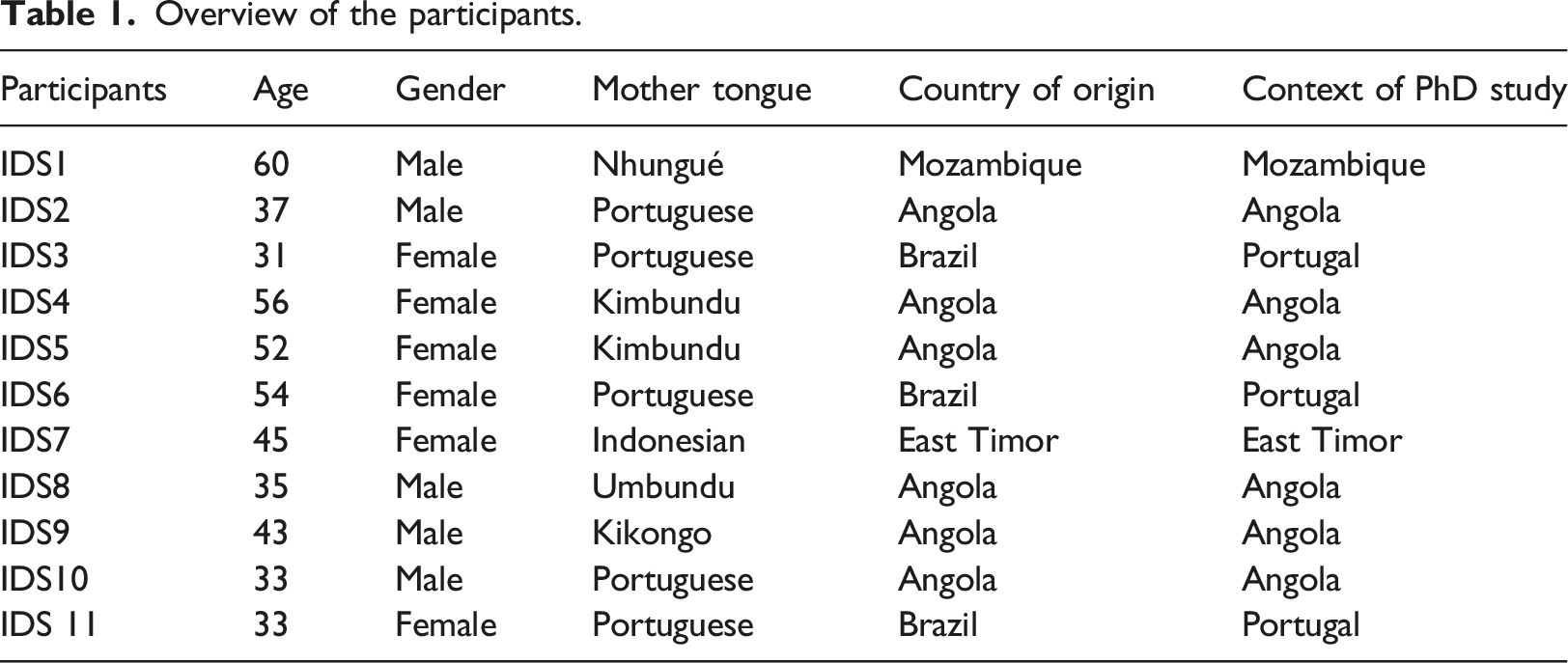
Three students had finished their PhD and eight were nearly finishing. Six came from Angola, three from Brazil, one from East Timor and one from Mozambique and were aged between 33 and 60 years. Their mother tongues were diverse: Portuguese (five students), Kimbundu (two), Nhungué (one), Umbundu (one), Kikongo (one) and Indonesian (one). Six were female and five were male. Six of them were carrying out the empirical study in Angolan context, three in Portuguese context, one in East Timor and one in Mozambique. Eight worked as teachers at HEI in their home countries while three had not a professional occupation.
Data were collected by interviewing IDS. The overall aim of the semi-structured interviews (conducted in Portuguese) was to explore their experiences of completing a doctorate in a different linguistic, cultural and academic context and how this experience influenced their research work, focusing on the intercultural and plurilingual dimensions of supervision and research processes. Concerning specifically the qualities of supervisors, the focus of this paper, the participants were asked what they saw as the characteristics and competences their supervisors should have. IDS’ responses to the question were followed-up, when needed, by questions aimed at providing more detail. National and international experts in the areas of internationalisation, doctoral education and qualitative approaches reviewed the interview schedule which was, then, subject to reformulations. All interviews were audio-recorded and transcribed by the researcher who conducted the interviews (average interview time was approximately 60 min). For trustworthiness, all transcripts were sent back to participants for accuracy verification and they had the option of reviewing their interview transcripts to confirm that their words and meaning were accurately represented.
Following the General Data Protection Regulation of the European Union (Regulation 2016/679) and national laws, participants were informed of the study objectives and how data might be used. All data was treated confidentially and anonymously. All participants signed an informed consent before the interview with the option of withdrawing from the study at any time and they were given the transcripts for review.
Data analysis
The interviews were submitted to thematic analysis following some essential phases: (i) the researcher became familiar with the data by reading the interview transcripts; (ii) the coding process was initiated which involved generating initial descriptive codes for important features of the data according to the study objective guiding the analysis; (iii) themes were created and the researcher collated all the coded data relevant to each theme; and (iv) themes were reviewed in order to check compliance with both the coded extracts and the full data-set. These phases were informed by an iterative process that combined a systematic and rigorous analysis of transcripts with literature review, namely, with Baptista’s framework (2013). Hence, themes derived from a combination between inductive and deductive approaches (Proudfoot, 2023). The following overarching themes concerning the qualities of a good supervisor emerged: • Intrapersonal qualities refer to personal characteristics and traits. It includes statements related to knowledge of IDS’ origin contexts; acknowledgement of the influence of the origin context and of cultural, linguistic, educational, professional and personal backgrounds in research development; flexibility regarding students’ variety of Portuguese language; respect for students’ interests and motivations; contextual knowledge of the host institution; commitment and availability. • Interpersonal and communicative qualities refer to the relationship and interaction with students, research groups/networks and supervisory teams. It comprises statements referring to the promotion of students’ integration in the host institution; the ability to motivate students; the ability to provide personal/emotional support; the provision of timely and constructive feedback; negotiation of research options with students; empathy. • Academic and research qualities refer to intellectual skills, knowledge and attitudes inherent to scientific work, to the process of doing research at doctoral level and the supervisory process. It includes statements that refer to discipline, research and methodological knowledge and skills; rigour; the ability to promote students’ autonomy and questioning; creativity and innovation.
Findings
Findings are organised according to the themes of analysis and data are discussed by providing an account of IDS’ voices. Students are identified with the letters IDS followed by a number (e.g. IDS1). Statements are illustrated by quotes affording fairly representative perspectives of the group and which were translated from Portuguese into English. The author asked a bilingual researcher in the area to translate the statements: she was given the selected quotes for translation and the relevant text fragments to help her understand the interview context. Afterwards, the author and this bilingual researcher discussed the translated quotes, and translation refinement was done between both.
Intrapersonal qualities
Knowledge of IDS’ origin contexts
All IDS find intrapersonal qualities as the most relevant and, within this, eight emphasise the need for supervisors to know deeply their origin contexts, specifically the characteristics of educational systems which is obviously related to the fact that IDS attend a PhD Program in Education and most intend to contribute to the improvement of the teaching and learning processes in their institutions and countries. In this sense, IDS value supervisors’ previous professional experiences in their origin contexts, namely, in teaching and in supervising other IDS: “My supervisors know my context because they were teachers there at a master’s degree in the ambit of a cooperation protocol with this University. I think that allowed them to understand better the Angolan educational system which is essential.” (IDS8). “My co-supervisor has been in Angola for a few times and she has supervised Angolan students which allowed her to become familiar with Angolan educational system. I find very important for supervisors to know their students’ countries so they can provide them a contextualised supervision.” (IDS4).
It is important to highlight that when asked about the purpose of their research projects, eight IDS emphasise they want to contribute to the development of the teaching and learning processes in their home institutions and countries.
IDS also underline the relevance of supervisors’ knowledge regarding their countries history and political issues as those may affect IDS’ research work: “My supervisor knows Mozambique’s situation and he tries to calm me down. Mozambique has gone through a phase of military conflict and now we are living a period of truce from military hostilities… I feel that teachers and supervisors look at me and see more than just a person who got on the plane and came here… they understand that there is a whole specific context, a difficult context, that makes part of who I am and how this may affect my performance as a PhD student.” (IDS1).
Acknowledgement of the influence of the origin context and of cultural, linguistic, educational, professional and personal backgrounds in research development
In addition to knowledge regarding origin contexts, IDS also emphasise the importance of supervisors acknowledging the influence of those contexts in approaches to learning and research. More precisely, they refer to the need for supervisors to acknowledge that IDS have diverse learning backgrounds and are used to different teaching and learning methodologies, for instance, concerning written feedback and plagiarism: “I was used to do this way: when teachers asked me to correct an assignment, I had to keep their comments, the track changes. I corrected it but I kept their comments there. It is a question of respect. Because of this, I had serious problems with my supervisor.” (IDS4). “I sent a power point presentation to my supervisor and I kept the sentences as they had been written by the authors and she said “Oh my God, be careful with this! Looks like you are the author of the papers”. In Angola, I never learned this is wrong.” (IDS9).
Furthermore, IDS appreciate supervisors’ ability to acknowledge the research and knowledge cultures they bring to their studies, namely, regarding the construction of theoretical frameworks and research tools: “My supervisor values the perspectives I bring from my context. For example, the construction of the data collection instrument has to be based on normative documents from my context. She encourages readings of Angolan researchers so that the thesis may present different views. This is very important.” (IDS10).
Next, IDS underline the importance of supervisors’ knowledge regarding students’ linguistic backgrounds, emphasising that not having Portuguese as mother tongue or not dominating European Portuguese causes several difficulties and tensions related, mainly, to thesis writing. Because of this, they find important for supervisors to acknowledge their linguistic backgrounds and difficulties with (European) Portuguese: “Speaking Portuguese and writing in Portuguese is quite different. My thoughts are done in my mother tongue and only then in Portuguese. My linguistic spontaneity only exists when I’m using my mother tongue. Writing, grammar, spelling… this is a new learning step and every day I’m learning to write European Portuguese.” (IDS1). “As I have many difficulties in Portuguese language, I need a supervisor who understands my situation. The first time I tried to read an article in Portuguese, I translated it into my mother tongue with the help of an online translator and even so it was difficult to understand the content. Supervisors and teachers should be aware of this.” (IDS7).
Moreover, they show that languages intervene in doctoral research activities specifically in the construction of data collection instruments to be applied in their research contexts, as perceived in the following voice: “When we discussed my questionnaire, I said: ‘Maybe in Portugal this is the correct way to ask the question, but in Angola you cannot do it like that. My students will not understand.’ Hence, we had to change the instrument. For instance here you use the word ‘items’ but we do not use this word; we use the word ‘alínea’.” (IDS8).
Flexibility regarding students’ variety of Portuguese language
In this line of thought, IDS underline the importance of supervisors’ flexibility regarding students’ variety of Portuguese language. While Brazilian IDS state that their supervisors show an openness regarding their variety, Angolan and Mozambican IDS report on some episodes that show students feel impelled to use the European variety to comply with imposed linguistic norms: “Angola has not adhered to the Orthographic Agreement and I write for the Angolan context. My supervisors said “you have to write like a Portuguese”. I replied “but I am Angolan”. Anyway, we discussed this and I understood her viewpoint.” (IDS9).
IDS also report on difficulties in written and oral interaction with their supervisors. They underline sociolinguistic, syntax, phonology and prosody differences between the varieties of Portuguese language that sometimes result in misunderstandings and distress that affect the supervisory relationship: “I felt offended several times because I did not understand. In a meeting with my supervisor he said ‘siga, força!’ I thought he was telling me to leave his office immediately. I was very upset. Then I looked for the meaning of that sentence and it was an incentive!” (IDS3). “Sometimes I send a message to my supervisors and they ask me what I mean. They do not understand sentence construction. As far as I am concerned, it is correct and if I send that same message to an Angolan he will understand it.” (IDS4). “At times I felt lost in interaction. It was so fast that sometimes I didn’t understand and the fear of asking kept me quiet, agreeing and saying ‘everything is just fine’.” (IDS9).
It is important to recall that the Portuguese language has two described and codified national linguistic norms, the Brazilian and the Portuguese. Angolan and Mozambican norms are still emerging, but they are not yet codified or explicitly assumed by these countries’ authorities.
Availability and commitment
Availability and commitment are underlined by five IDS who value regular meetings and underline the need for supervisors to set aside adequate time for them: “A key characteristic is commitment. A supervisor is not supposed to do your work but is supposed to feel responsible and be a supervisor, monitoring the research, being present, assisting students when they feel lost. He must have time!” (IDS10).
Finally one IDS points out respect for students’ interests as one of the main qualities of a supervisor (‘A supervisor must know the student and his research interests’, IDS3) and another underlines the need for contextual knowledge regarding the host institution (‘It must be someone who knows how a particular institution works’, IDS4).
Interpersonal and communicative qualities
Interpersonal and communicative qualities are underlined by nine IDS. They mainly stress supervisors’ ability to provide personal and emotional support, a need related to the fact that they are foreign students who must adapt to different pedagogical/academic and research cultures and who suffer from feelings of solitude and distress at being separated from their families and friends: “Our way of working is not limited to the relationship between student and supervisors. It is more than that, it’s a family relationship. Apart from research work, my supervisors are constantly worried about me because I am far from my family.” (IDS8). “I usually say my supervisor was sent to me by God, it seems to me that I have a mother in Portugal. She picked me up at the airport, taught me how to get to the university, she arranged a room in the university residence.” (IDS9).
Personal and emotional support are related to empathy, perceived as a key dispositional quality in establishing an environment that makes candidates feel personally supported: “Mainly, the supervisor should be empathetic with the student because when we get here we feel so lost. So we must firstly establish an empathetic relationship that will support a trust relationship.” (IDS6).
Three IDS emphasise that supervisors ‘…should be constant motivators, making students believe they can do it because writing a thesis is really lonely’ (IDS3). IDS 7 recalls some moments in which she thought about giving up and stresses her supervisor’s role in leading her in the way: ‘Sometimes I felt like quitting but my supervisor was always giving me reasons not to do so and arranging strategies to keep me on track. This was the most important in this journey’!
High levels of motivation are related to provision of timely and constructive feedback. Two IDS emphasise this and show the anguish and frustration they feel when their supervisors do not provide prompt feedback: “When you send your work to the supervisor and he spends weeks without giving you feedback you feel frustrated. We feel forgotten and we get demotivated.”(IDS2). “If our supervisors had any idea about the professional and economic sacrifices we do to be here, this would be different. We need supervisors to be present, giving us feedback regularly.” (IDS10).
Besides being present, supervisors are asked to be able to negotiate research options with IDS, mainly considering students’ provenience and research contexts: “I produced the interview guide and sent it to validation and my supervisors gave me feedback and then we discussed and reached a consensus because they understood, by listening to me, that Angolan educational context is different, so instruments must be adapted.” (IDS9).
Finally, three IDS highlight supervisors’ ability to promote students’ integration in the host institution, assisting them to develop connectedness and a sense of belonging which is considered crucial: “Since my first day at the university, my supervisor took me to her office and I worked with her directly. This helped a lot because if I had stayed at home, everything would have been more difficult. Sometimes I forget that I am a foreign student because my supervisors made all efforts to integrate me.” (IDS11).
Academic and research qualities
Seven IDS emphasise the importance of supervisors’ academic and research qualities. Mainly, they value discipline knowledge, research skills and methodological expertise: ‘A supervisor must have both theoretical and methodological knowledge in the field of research so that he can guide the PhD student’. (IDS11). This is seen as a doorway to students’ academic and professional development: ‘My supervisor is my guide because sometimes I feel blind as to methodological knowledge. With her expertise she helps me in the thesis but also professionally’. (IDS9). This quote also highlights an important aspect for these IDS, the fact that they find important for supervisors to have expertise in the methodologies required in their research more than expertise in the precise topic of their research.
Rigour is highlighted by four IDS who perceive this quality as a trigger to improve students’ learning and as a contribution to research project and thesis quality: “I have always liked teachers who are demanding, who always require more from you. That is how we learn, right?” (IDS3). “It is up to the supervisor to instigate the PhD student, to be critical and demand rigour. That is what my supervisor does, when she does not like something she immediately tells me. I get more confident that the work is going to be good.” (IDS6).
At the same time, IDS underline that rigour must be allied to supervisors’ ability to stimulate students’ autonomy and questioning as a way to make PhD students (future) independent researchers who are able to decision making: “On the one hand, the supervisor should be demanding and directive but on the other hand he has to give his students autonomy. So, a supervisor should be aware of the PhD student’s role and responsibilities. We must learn how to be researchers and this means that we must also think and decide on our own.” (IDS3).
This same IDS also emphasises that a supervisor is asked to be creative and innovative: ‘Bringing in new research perspectives is very important, you know, opening research possibilities to PhD students’. (IDS3).
Discussion
Results show that IDS value mostly intrapersonal and interpersonal and communicative qualities which are interdependent, although they have been coded and classified separately to get a better understanding of IDS’ perspectives. As Davis (2019) underlines … ‘person related human qualities in postgraduate research supervision have greater valence for students than does discipline/research expertise’ (p. 431). Although person-related qualities pointed out by IDS meet those previously identified in other studies (Baptista, 2013; Buirski, 2021; Dimitrova, 2016; Holmes et al., 2020), in this study, these qualities acquire specific configurations associated to doing a doctorate overseas. Hence, more than supporting previous empirical findings, results reveal that IDS require supervisors to have qualities related to their condition of ‘foreign students’ such as acknowledgement of the influence of their cultural, linguistic, educational, professional and personal backgrounds in research development, flexibility regarding IDS’ variety of Portuguese language and integration of IDS in the host institution.
Indeed, IDS face diverse challenges related to integration into a different pedagogical/academic culture, adaption to a different research culture, language, loneliness and homesickness (Pinto, 2021) which underline the need for intrapersonal and interpersonal qualities related to intercultural doctoral supervision. Hence, IDS in this study showed to have a clearly honed sense of the qualities they want in a supervisor, relating them to their condition of ‘foreign students’.
This is noted when IDS underline that their supervisors should know profoundly their origin contexts as to cultural characteristics, research traditions and educational backgrounds. In this sense, they emphasise the need for supervisors to have experience in teaching and researching in their home countries. More than knowledge regarding origin contexts, IDS demand supervisors to acknowledge ‘the cultural, historical and linguistic knowledge that [they] bring to their studies’ (Kidman et al., 2017: 1210), specifically concerning the construction of theoretical frameworks and research approaches. In fact, what IDS are requiring is that supervisors acknowledge the profound influence of their origin contexts in approaches to learning and research. These qualities acquire a great importance for IDS who have different educational backgrounds, are not familiar with the Portuguese academic system and who bring culturally inflected ways of constructing knowledge (Wisker, 2012). A few previous studies have shown that often both IDS and supervisors consider this diversity a deficit when responding to academic demands in ‘Western’ host institutions, causing feelings of distress and incapability (Manathunga, 2011; Pinto, 2020; Tran, et al., 2017).
In this context, being flexible, available, committed, personally and emotionally supportive, empathetic, motivating and encouraging are seen as crucial supervisors’ qualities which highlights the importance of personal supervisory interaction for IDS, especially if we consider international students’ feelings of solitude and distress at being separated from their families and friends (Pinto, 2021). As shown by literature, these feelings are often heightened by a sense of invisibility in the host university, which hampers students’ integration in the academic community (Dang and Tran, 2017). It is then expected that in our data, IDS highlight supervisors’ ability to promote their integration in the host institution, namely, in diversified research dynamics, helping them to develop connectedness and a sense of belonging.
Another important issue that arises in IDS’ voices concerns the need for supervisors to be flexible regarding their variety of Portuguese language. As stated in the methodology section, for many of these IDS, Portuguese is their second language and they speak different varieties of Portuguese. This poses them several challenges as to oral and written interaction with supervisors, to thesis writing and as to construction of data collection instruments and field work (Hu et al., 2016; Pinto, 2021). Findings show that significant differences regarding orthography, lexicon, phonology, prosody and sociolinguistic features are put forward by IDS as intervening in academic learning and in the supervisory relationship, reporting to episodes of linguistic insecurity and misunderstandings between supervisors and IDS.
Research has acknowledged that languages are one of the main challenges faced by IDS since they have deep implications in several doctoral research activities (Byram et al., 2020; Doyle et al., 2017; Pinto & Araújo e Sá, 2020) and has highlighted that poor proficiency in the language of the host institution affects doctoral work as well as interpersonal relationships, ‘promoting misunderstandings, mismatched expectations, and conflict between supervisors and candidates’ (Winchester-Seeto et al., 2014: 615). We can see this mainly in the voices of Angolan and Mozambican IDS, those who most require supervisors’ provision of timely and constructive feedback and affirm to need a trustful and guiding relationship with their supervisors.
Therefore, IDS seem to value qualities that meet what Manathunga (2014) calls of transculturation in supervision pedagogy defined as ‘as moments of creativity when culturally diverse students may carefully select those parts of Western knowledge that they find useful and seek to blend them with their own knowledge and ways of thinking’ (p. 369). When they require supervisors to know their origin contexts, to acknowledge the influence of those contexts in approaches to learning and research, and to negotiate research options considering those same contexts, IDS are demanding for the creation of spaces where they have the agency to decide learning and researching paths within their doctoral journeys without being inducted into existing research procedures and paradigms, discourses and practices.
Conclusion
This study aimed at understanding the perspectives of IDS from the CPLP attending the PhD Program in Education at a Portuguese University regarding the qualities of a good supervisor. For this matter, individual semi-structured interviews were conducted with 11 students from Angola, Brazil, East Timor and Mozambique. Results show that IDS emphasise intrapersonal, interpersonal and communicative qualities specifically related to pursuing a doctorate overseas.
Findings emphasise the need for institutional reflection and discussion on the intercultural dimension of doctoral research and supervision. The growing number of CPLP doctoral students in Portuguese universities, namely, at the university where this study was developed, has not been accompanied by a reflection-action on the challenges this poses to supervisory processes and the needed qualities of supervisors (Pinto and Araújo e Sá, 2020). It is up to Portuguese universities to promote this reflection-action involving their management structures, doctoral schools, directors of doctoral programs, supervisors, professors and students. A shared reflection-action can enhance the creation of ‘dialogic spaces’ (Robinson-Pant, 2009) where heterogeneity and the encounter of different ways of thinking, learning and researching can empower all those involved by allowing reciprocal learning.
This reflection-action has to encompass a collective institutional responsibility (McAlpine, 2013) in the investment in supervisors’ professional development as to intercultural doctoral supervision. Supervisors should be supported to know their doctoral students’ cultural contexts, research traditions, and educational backgrounds as to value their previous learning, knowledge and competences, and to acknowledge the importance of heterogeneous and plural perspectives in training and research. This involves training actions to develop doctoral supervisors’ intercultural communicative skills and skills to supervise across languages and cultures (Manathunga, 2011), allied to the ‘the processes and nature of the learning that supervisors actually acquire through the practice of doctoral supervision’ (Halse, 2011: 559). Furthermore, considering the importance attached by IDS to supervisors’ flexibility regarding their varieties of Portuguese language, it would be important to provide opportunities for supervisors to deepen knowledge regarding Portuguese language diversity which could allow deconstructing the representations of linguistic heterogeneity as a deficit and of European Portuguese as the default referent. Such a discussion could contribute to the acknowledgement of the mediating role of languages and cultures in teaching and research processes.
This study has a main limitation related to the small sample, but simultaneously it has the value of an in-depth analysis of qualitative data from a single case. Secondly, the study only considers students’ perspectives. Future studies should comprise supervisors’ perspectives on their needed competences to supervise across languages and cultures.
Footnotes
Declaration of conflicting interests
The author(s) declared no potential conflicts of interest with respect to the research, authorship, and/or publication of this article.
Funding
The author(s) disclosed receipt of the following financial support for the research, authorship, and/or publication of this article: This work was supported by the Fundação para a Ciência e a Tecnologia,in the scope of the framework contract foreseen in Numbers 4, 5, and 6 of Article 23, Decree-Law 57/2016, August 29, changed by Law 57/2017, July 19.
Author biography
