



Abstract
This paper investigates an emerging professional role transformation in Vietnamese universities, whereby English language teaching (ELT) lecturers transform themselves into English medium instruction (EMI) lecturers in a discipline new to them. Through interviews with five ELT/EMI lecturers working in separate universities and different disciplines, the study investigates reasons for their decision to engage in such professional mobility, their role transformation experience, and its implications for educational quality. We argue that participants’ move into EMI was shaped by the strategic imperative for higher education internationalisation, and the mistaken belief that EMI alone can achieve the English language development students require for academic success. It is also argued that the transformation option made available to the participants was not the best use of their skills, and that a profound change of perspective is needed at the institutional level to most effectively use the strengths of ELT lecturers to support educational quality.
Keywords
Introduction: Internationalisation and English medium instruction
Fundamental to many higher education institutions (HEIs) over the last few decades, ‘internationalisation’ remains a buzz word, yet the process itself is not consistently conceptualised and practised. While Hudzik (2015) argues for a comprehensive internationalisation integrating international and comparative perspectives throughout the teaching, research and service missions of higher education, this is still a work in progress across the world. Nevertheless, over time, internationalisation of HEIs has moved beyond its traditional dimensions, such as student and staff mobility, mutual cooperation and benefits, and capacity building, and has taken on new dimensions. These range from enhancing intercultural competence (Bennett 2014; Gundling et al., 2015; Yershova et al., 2000) and global engagement (Paige et al., 2009; Jon and Fry 2021) to more localised dimensions such as institutional competition, reputation building and global ranking (Hoang et al., 2018; Maruša 2019). Whereas initially the internationalisation process was ‘an aggregation of dispersed activities within higher education institutions’ (Gao 2015: 183), it has now shifted from this ‘marginal and minor component to a global, strategic, and mainstream factor’ (Knight and De Wit 2018: 2) and ‘from a reactive to a proactive strategic issue’ (De Wit et al., 2015: 4). There is no sign that the impetus of this internationalisation process will ease in the foreseeable future. On the contrary, there is often a sense of ‘strategic imperative’, with non-educational objectives such as income and reputation being prioritised over educational quality (Bowles and Murphy 2020; Pham and Doan 2020; Pham 2022).
In many countries where English is neither the official language nor necessarily even a secondary one, as in the case of Vietnam, the strategic imperative has been dominated by the use of English as the medium of instruction (EMI) (Dearden 2014), often without adequate preparation (Nguyen et al., 2017; Pham and Barnett 2022). Nevertheless, the growing global phenomenon of English medium instruction is considered ‘the single most significant current trend in internationalising higher education’ (Parr 2014) and some have even seen EMI ‘as a panacea’ for institutions to catch up with high-speed internationalisation (Chapple 2015: 1). In Vietnamese higher education, for example, EMI has grown so fast that it lies ‘at the heart of the internationalisation agenda’ and internationalisation has been ‘seen predominantly as the use of EMI’ (Tran and Nguyen, 2018: 94). In some parts of Asia, the term EMI can even be used interchangeably with internationalisation (Duong and Chua 2016).
This inappropriate foregrounding of English creates a discourse of ‘internationalisation-as-EMI’ which is pervading many HEIs in the region (Bradford 2019) and neglects important educational objectives, such as building international and intercultural understanding and skills of interaction, by sidelining the agenda of internationalising the curriculum itself (Leask 2008, 2015). Thus, it risks omission of ‘the purposeful integration of international and intercultural dimensions into the formal and informal curriculum’ (Beelen et al., 2015: 69), or alternatively integrating only Western English-dominant cultural dimensions at the expense of regional and world-wide ones, since ‘it is not just the language and the content that are imported, but also ways of thinking and understanding the world’ (Barnett and Pham 2022: 5). At the same time, internationalisation-as-EMI sidelines discourses of ‘learner-centred internationalisation’ (Coelen, 2016), which aim to provide an environment conducive to ‘learning outcomes associated with international awareness and intercultural competence’ (Coelen 2016: 40). EMI by itself does not ensure those broader educational outcomes.
In this context, there are numerous reports internationally of EMI challenges for both students and staff (e.g. Chou 2018; Phuong and Nguyen 2019; Rowland and Murray 2020) suggesting that educational quality may be reduced rather than enhanced by EMI (Bukhari 2021; Ismailov 2022; Tajik et al., 2022). According to British Council reviews of EMI, what is needed are ‘systems which provide ongoing support for students’, and which emphasise ‘the relationship between content and language’ (Veitch 2021: 11), as well as being ‘context specific, ideally, based on needs analyses’ (Curle et al., 2020: 44). This call has recently been addressed in several ways. One involves English language lecturers providing English for Specific Academic Purposes (ESAP) courses, defined as: ‘An approach that targets discipline or subject specific needs of students by focusing on genres and skills that are relevant for their academic success in a specific course’ (Galloway 2021: 6). Being context specific in terms of disciplinary content, this approach is more closely related to student needs than generic English for Academic Purposes courses, and also requires the English language lecturer to build up some discipline familiarity. Another approach is through Content and Language Integrated Learning (CLIL) where the discipline lecturer adopts a role as both content and language teacher. While this is a role that few discipline lecturers are ready to take on (Airey 2012; Moncada-Comas and Block 2021), some, importantly, have been willing to try out a ‘CLIL-ised approach’ (Moncada-Comas and Block 2021; Block and Moncada-Comas 2019; Thanh and Barnett 2022), progressively incorporating some CLIL pedagogies through professional development support.
In addition to these approaches, there is strong evidence that ‘joining forces in collaboration may well be the key to the successful implementation of EMI’ (Dearden 2018: 336), recognising that: English Language teachers can play a vital role in ensuring the successful delivery of EMI at university level in terms of language knowledge, language awareness and interactive pedagogy skills. They possess the skills to support students with EAP and ESP, monitor and communicate students’ language levels to EMI academics, provide language support for EMI academics, share interactive pedagogy skills and raise linguistic awareness. (Dearden 2018: 331)
Nevertheless, the conflation of EMI and ELT reported by Bradford (2019) in Japan has been widely reported elsewhere in terms of an assumption by institutional decision makers that students following an EMI program would automatically develop the necessary English fluency without the need for targeted English language teaching (Vu and Burns 2014; Nguyen 2017; Rose and Galloway 2019). This not only disadvantages students but has direct implications for the status and prestige of ELT lecturers, and consequently for their employment prospects. For example, Dearden (2018) refers to a university in China that saw EMI as superseding English language teaching, and requested its English staff to re-train in another academic discipline. In Vietnam, ELT lecturers in higher education are concerned for their profession and some are transforming themselves into EMI lecturers in disciplines for which they have no prior expertise. Little is known about this, but across the five Vietnamese universities where authors of this study are employed, there have been over 60 such transfers in recent years. The concern is that if internationalisation-as-EMI is combined with a view of EMI-as-English-language-learning, then it is almost certainly to the detriment of both internationalisation and English language learning.
Given the historical experience in Vietnam where teachers of French, and subsequently teachers of Russian, found themselves having to re-train, we think it important to look into this trend in Vietnamese higher education, especially in light of recent research showing the importance of utilising the skills of English language lecturers in order to achieve successful EMI (Dearden 2018). To make a start, we conducted a small scale empirical study, reported here, involving five ELT/EMI lecturers working in separate Vietnamese universities and in different disciplines. The study investigates the drivers underpinning participants’ decision to engage in such professional mobility, their actual experiences of role transformation, and the kinds of transformation achieved.
Literature review: EMI role transformations within higher education
While we have been unable to locate any research into the EMI role transformation of English language lecturers, insights can be gained from studies related to the EMI role transformation of discipline lecturers. These have chiefly focused on the challenges encountered (e.g. Nguyen et al., 2017; Pham, 2022; Pham et al., 2022), variations in classroom interaction (e.g. Lo and Macaro 2012; Hu and Duan 2019; Pun and Macaro 2019; Ismailov 2022) and the pedagogies needed (Dearden 2018; Macaro et al., 2020). It must be noted that such studies of EMI role transformation have emphasised the use of English and the types of thinking valued in Western curricula, with little attention paid to developing intercultural competence and internationalising the curriculum, thus reflecting the afore-mentioned flawed equation of internationalisation with EMI (Bradford 2019) and the lack of attention to internationalising the curriculum (Leask 2008, 2015; Beelen et al., 2015; Coelen 2016).
In regard to the professional skills needed for effective EMI, a recent British Council review affirms that: Many of the pedagogical techniques and skills highlighted by research as important in lecturer support systems focus on language: the use of language-aware pedagogies, scaffolding and accommodation strategies, and basic language teaching skills. (Veitch 2021: 11)
Many of the academics called upon by their institutions to act as EMI lecturers have found themselves unable to meet such expectations, notably clarity in conveying disciplinary content, scaffolding learning, and being creative and flexible in teaching (Nguyen et al., 2016; Nguyen 2017). Others who were confident in their disciplinary English were not willing to adopt recommended EMI pedagogies, and persisted in teacher-centred pedagogies (Sahan et al., 2022). Even where academics have adopted basic EMI pedagogies such as providing translation and glossaries, they have still tended to firmly maintain their priority role as content lecturers (Airey 2012), refusing ‘to inhabit an English language teacher identity’ (Moncada-Comas and Block 2021: 1).
Based on the empirical research to date, we see such EMI role transformations as works in progress, some more progressed than others. They generally appear to represent what Mezirow (1995) referred to as a ‘straightforward transformation’ learned through existing meaning schemes, as distinct from a ‘profound transformation’ which ‘alters deeply held perspectives and world views and has long-term efficacy’ (Terblanche 2022: 269). A profound EMI role transformation would require firstly rejection of the notion that learning and teaching in a foreign language merely involves a change of code or ‘interface’ (Aguilar-Pérez and Arnó-Macià 2020; Arnó-Macià and Aguilar-Pérez 2020), secondly appreciation of the important relationship between content and language (Veitch 2021: 11), and thirdly pedagogical action responsive to those beliefs.
It is difficult to determine whether or not such a profound transformation is occurring among EMI lecturers in Vietnam, but a number of empirical studies certainly indicate professional role transformation heading in that direction. One example is the review of eight teachers’ practices as they first engage with EMI in a multidisciplinary university (Hoang and Tran 2022); other examples include CLIL-ised pedagogy in an electrical engineering class (Thanh and Barnett 2022); and two EMI teachers’ considered use of pedagogical translanguaging (Nguyen H-A et al., 2022). Primarily providing student perspectives, other examples include learning experiences derived from a teacher educator’s application of sociocultural learning theory in EMI (Vo 2022), and translanguaging practices from the perspective of student agency (Ngo 2021).
Drawing on such empirical data and on informal personal observations, we take the position that current EMI role transformation occurs as ‘a subjective and socially situated experience of change’ (Lipura 2021: 255) and a ‘constant becoming’ (Kang 2018: 807), ‘taking place and being generated and accumulated at multiple points and on numerous occasions where and when the personal, sociohistorical, the social and one’s reflections, experiences and relationship with others and with the world come together’ (Phan and Fry 2021: 202). This multidimensional understanding proposes professional role transformation as personal, ongoing and contextualised, in turn suggesting the need for a theoretical framework specific to English medium education in higher education contexts.
Theoretical premises: Dimensions of English medium education (EME)
We use the term English medium education (EME) to refer to the context in which academics transform their professional role. This is because the term ‘instruction’ in EMI excludes learners and their learning resources, and risks legitimising a teacher-centred approach. EME is also the term favoured by Dafouz and Smit (2016, 2020) in their ROAD-MAPPING framework, which distinguishes the dimensions of EME in higher education. The intersecting relationship of the six identified dimensions of EME is shown in Figure 1, with the acronym components given in capitals. The ROAD-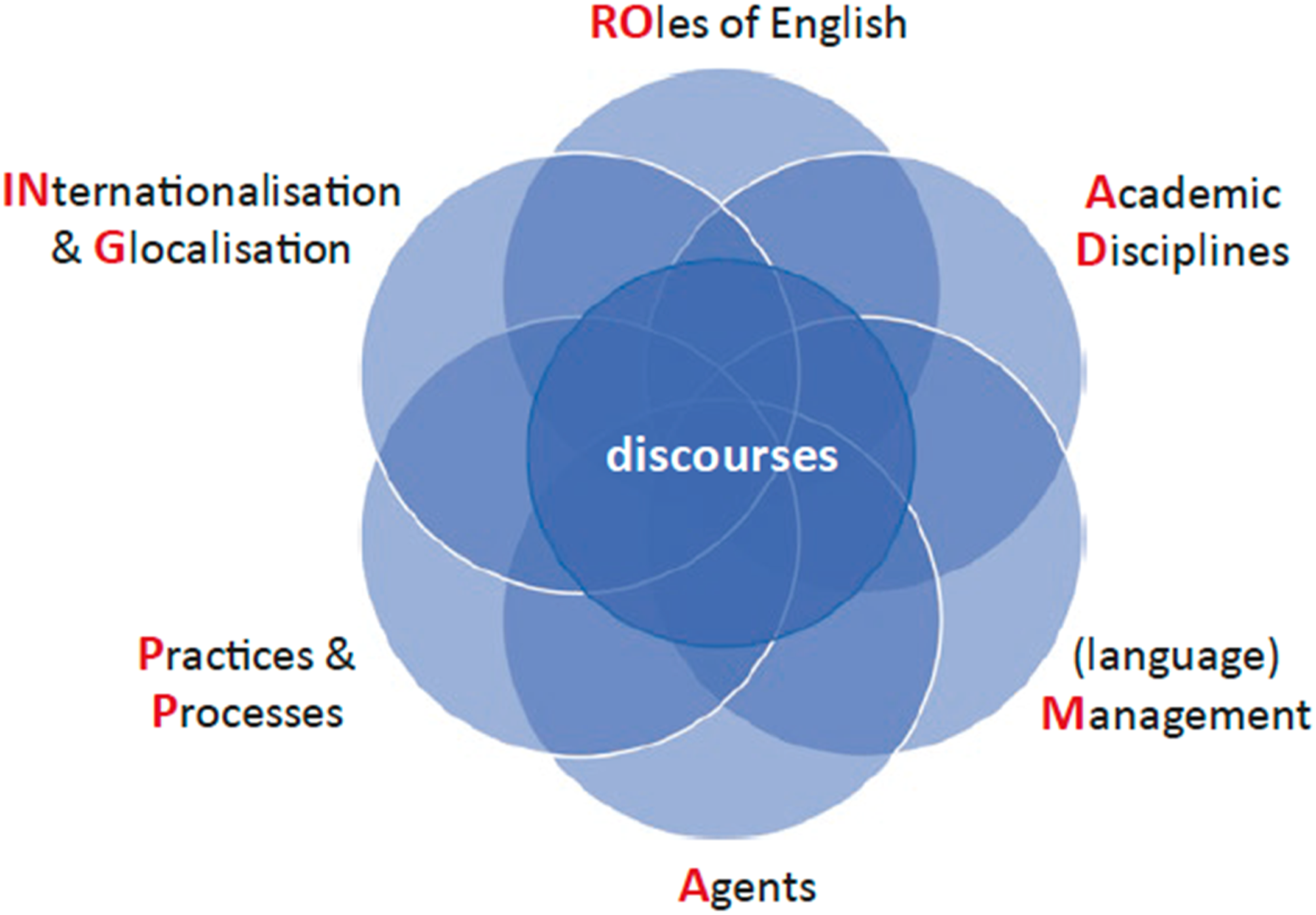
As indicated in Figure 1, the dimensions in the ROAD-MAPPING framework are accessed through the central ‘discourses’ component. In this study, there are two key sources of such discourses: (a) EME scholarly research and theorisation, particularly as related to the Asian region, and (b) the interview data in which the research participants present their own constructions of their decision-making and experiences. Use of the ROAD-MAPPING framework is demonstrated in the next section through a brief description of the research context and subsequently as a tool for data analysis.
Because the focus of the study is on professional role transformation, the analysis is primarily grounded in the agent dimension of the framework and how the participating ELT/EMI lecturers connected with and were impacted by the other dimensions, and by the discourses that shaped those dimensions. From the perspective of agent, transformation of professional role is closely linked to studies of teacher identity and can therefore be expected to incorporate aspects such as a lecturer’s worldview, values, perceived efficacy, personal and social goals (Timperley and Alton-Lee 2008), as well as their emotions, satisfaction and openness to new teaching practices (Southerland et al., 2011), and their sense of self or conception of who they are (Capps et al., 2012). Taking these aspects into consideration sheds light on the forms that role transformation may take and how they may relate to educational quality.
Research design, context and methods
Phan and Fry (2021: 203) suggested ‘mobilities as a pivotal lens through which transformation is enabled and shows its diverse colours in ways that are often unexpected and easy to be overlooked’. While this lens has mostly been applied to student mobility internationally (e.g. Kang 2018; Lipura 2021), here it is applied to the staffing of internationalisation in Vietnamese higher education, thus highlighting the previously overlooked phenomenon of ELT/EMI professional role transformation. Contributing to a better understanding of such professional mobility is imperative for high quality EME to serve both the domestic demand and the emerging mobility of Asia-Pacific students.
The study aims to add to the body of empirical studies which provides close accounts of practices and processes in the current implementation of EME in Vietnamese universities and has a dual focus: the drivers underpinning ELT lecturers’ decision to undertake role transformation, and the ways in which ELT/EMI lecturers construct their experiences of role transformation. Given that the study is framed by the national context of EME in Vietnamese higher education, the following section outlines this context, using the ROAD-MAPPING dimensions, before introducing the participants and research methods.
Research context
In terms of internationalisation and glocalisation, the aim of EME across Vietnamese universities has been to ‘promote international exchange, increase revenue, raise the quality and prestige of educational programs, and provide a well-qualified, bilingual workforce for Vietnam’s rapidly-developing economy’ (Nguyen et al., 2017: 37). Nevertheless, it must be acknowledged that the implementation of EME in a number of universities was initially as a remedy to financial pressures (Nguyen et al., 2016; Pham and Doan 2020), in other words as a strategic imperative. Central to the success of that imperative were the intended roles of English within the internationalisation initiatives, as a means both of attracting students from other countries and improving the English of domestic students. According to policy documents reviewed by Tri and Moskovsky (2019), it was assumed that students’ English language proficiency would automatically benefit, an assumption parallelled elsewhere internationally (Rose and Galloway 2019), but manifestly questionable (Curle et al., 2020: 44). Again as elsewhere, the emphasis on English and western-centric curriculum (Beck 2013; Majee and Ress 2020) has tended to sideline glocalisation. However, since the COVID-19 pandemic there are signs in Vietnamese universities of an emergent ‘place-based’ internationalisation (Phùng and Phan 2021: 252) which brings glocalisation more to the fore through ‘commitments related to local/community engagement, student wellbeing, and care’. Through policies, curriculum design guidelines and professional development, institutional management of language will need to play a large part in this transformation, replacing the inertia and neglect of recent years (Nguyen et al., 2017), where staff have been given incentives to engage in EME but not guided by clear policy nor provided with targeted professional development (Macaro et al., 2020; Pham and Doan 2020), and where students have often been insufficiently supported to develop their English proficiency for academic and specific disciplinary purposes (Arnbjörnsdóttir, 2017; Lin and Lei, 2021; Tran and Hoang, 2019). Across Vietnam, students as agents in EME bring with them diverse and often limited levels of both general and academic English proficiency, making it difficult for them to access the curriculum effectively and to learn through English (Phuong and Nguyen 2019a; Sahan et al., 2022).
As Aguilar-Pérez (2022: 171) points out, ‘the top-down implementation of EMI in Vietnamese higher education [is in] a context characterised by two key realities: students’ low proficiency and a teacher-centred pedagogical tradition’. Taking account of these realities, committed EMI practitioners tend to shift their practices and processes towards ‘a student-centred and interactive instructional pedagogy, which is conducive to the perception of EMI as an agent of modernising and democratising teaching and learning’ (Aguilar-Pérez 2022: 172). Nevertheless, practices and processes of EME implementation in Vietnam vary widely from one institution to another, often depending on their location and national ranking. In full EME programs, what is known in Vietnam as Advanced Programs (where overseas curricula are modified and delivered under an agreement between the local institution and foreign partner), students as agents of EME are usually supported through a preliminary intensive English course, either in General English or, more appropriately, in English for Academic Purposes (EAP) and or English for Specific Purposes (ESP). However, this is not the case where individual EME courses are incorporated into largely Vietnamese medium of instruction (VMI) programs where students typically are only required to take one or two courses in General English. In full EME programs, and sometimes even in programs with only 30% EME courses, students may be offered credit-bearing courses in English for Specific Academic Purposes (ESAP), in what Macaro (2018) refers to as a ‘concurrent model’. Linking closely to students’ academic disciplines, ESAP has obvious educational and motivational strengths as compared with General English courses or non-specific EAP courses.
Practices and processes not only vary according to program, but also according to the academic discipline and its associated cultural features, employment pathways and professional literacies, as well as the extent to which it engages in ‘curriculum borrowing or foreign curriculum transfer’ (Tran and Marginson 2018: 7). In this regard, the current Vietnamese version of internationalisation ‘invokes an existing more or less neocolonial network of relations shaped by mobilising Western ideas and forms’ (Phùng and Phan 2021: 235). Individual faculty lecturers and leaders have a major role to play in the extent to which this happens, acting as key agents through the choices they make regarding curriculum, resources, pedagogy, language use and assessment practices. Nonetheless, it must be remembered that they do this in a low-cost, limited resource environment and must constantly take account of students’ varied and often inadequate academic English proficiency.
Research participants
Participants’ EMI employment.
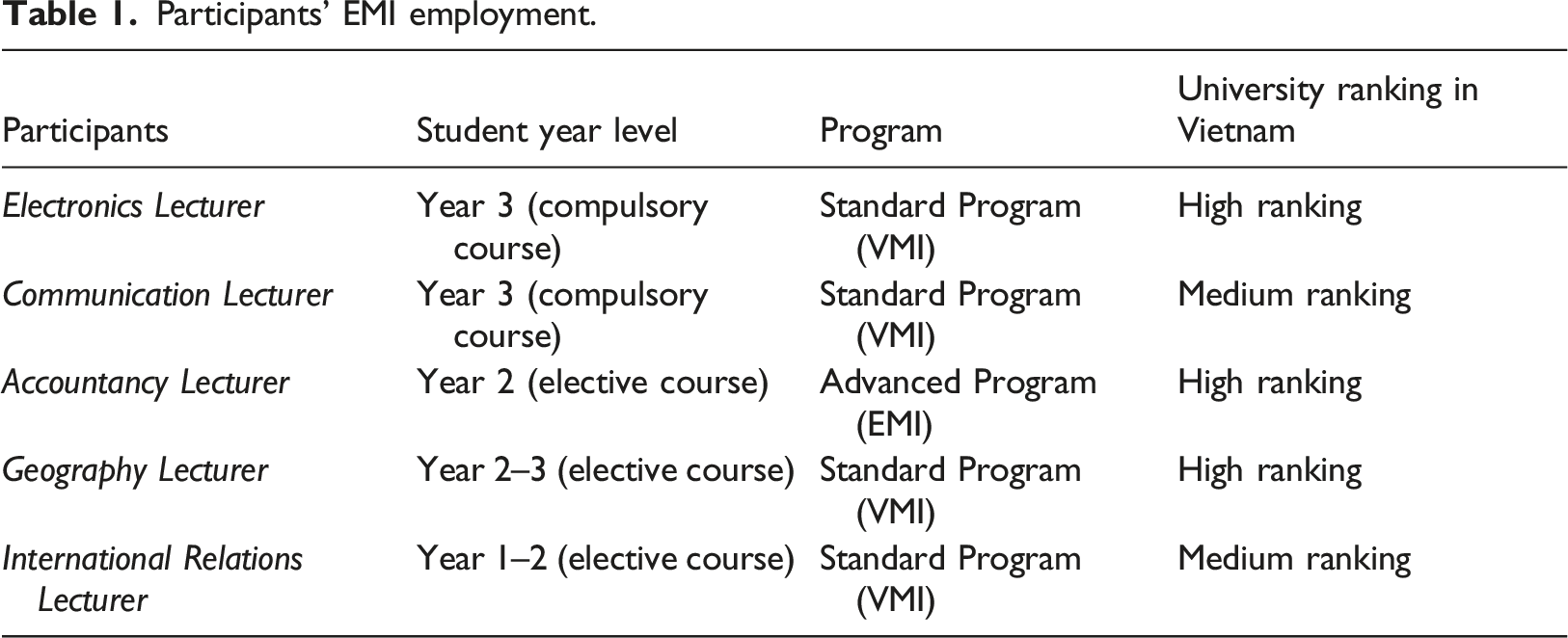
The participants are named according to the discipline they worked in; however, the courses they taught varied in regard to the extent of specialised content and terminology required. For example, the Accountancy lecturer did not teach accountancy itself, but topics relevant to the use of accountancy in employment settings, whereas the Electronics Lecturer dealt with quite technical content. Four out of the five participants taught some topics related to culture, whether of English-speaking countries, or of organisations or businesses.
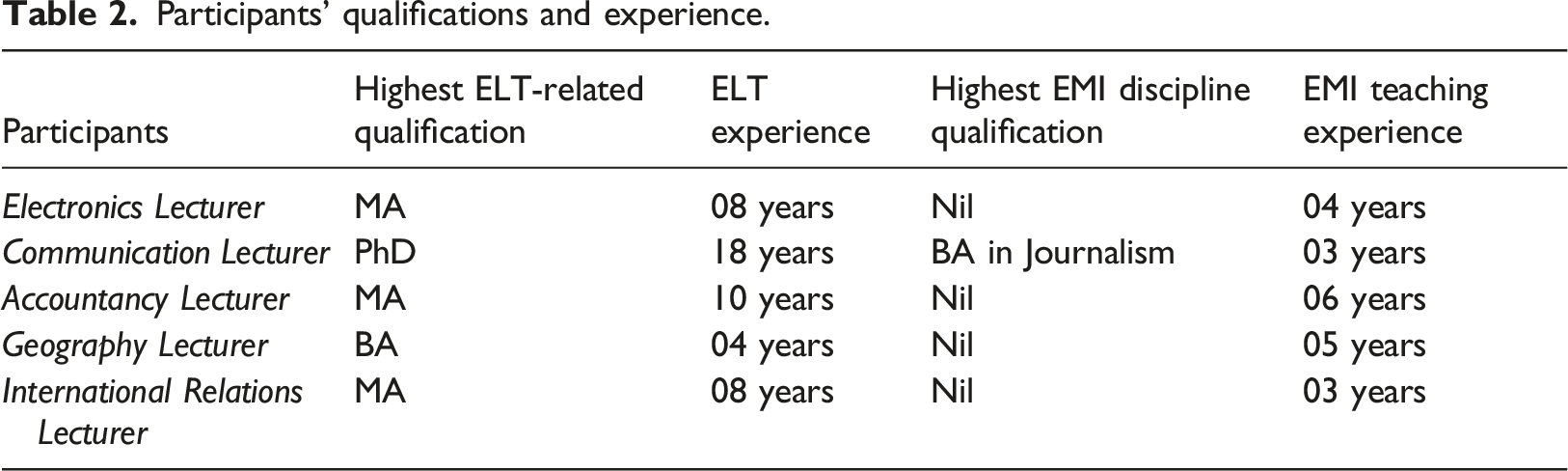
Participants’ qualifications and experience.
Methods of data generation and analysis
Data for this study were derived from individual semi-structured interviews conducted online using the Zoom platform with visual connection, but recording only the audio component. The flexibly structured interview process allowed participants to expand on topics (Smith 1995), while use of Vietnamese allowed the interviewer and research participants to express their questions and responses comfortably and accurately. English was also used from time to time, especially when referring to terms or concepts that may not be translated into Vietnamese effectively, such as ‘scaffolding’ and ‘zone of proximal development’. The flexible use of both languages was a strength in the data generation as the participants said it made it easy for them to convey what they wanted to say. The audio recording was returned to each participant to check the clarity and accuracy of their responses, and all confirmed that they did not want to change any information.
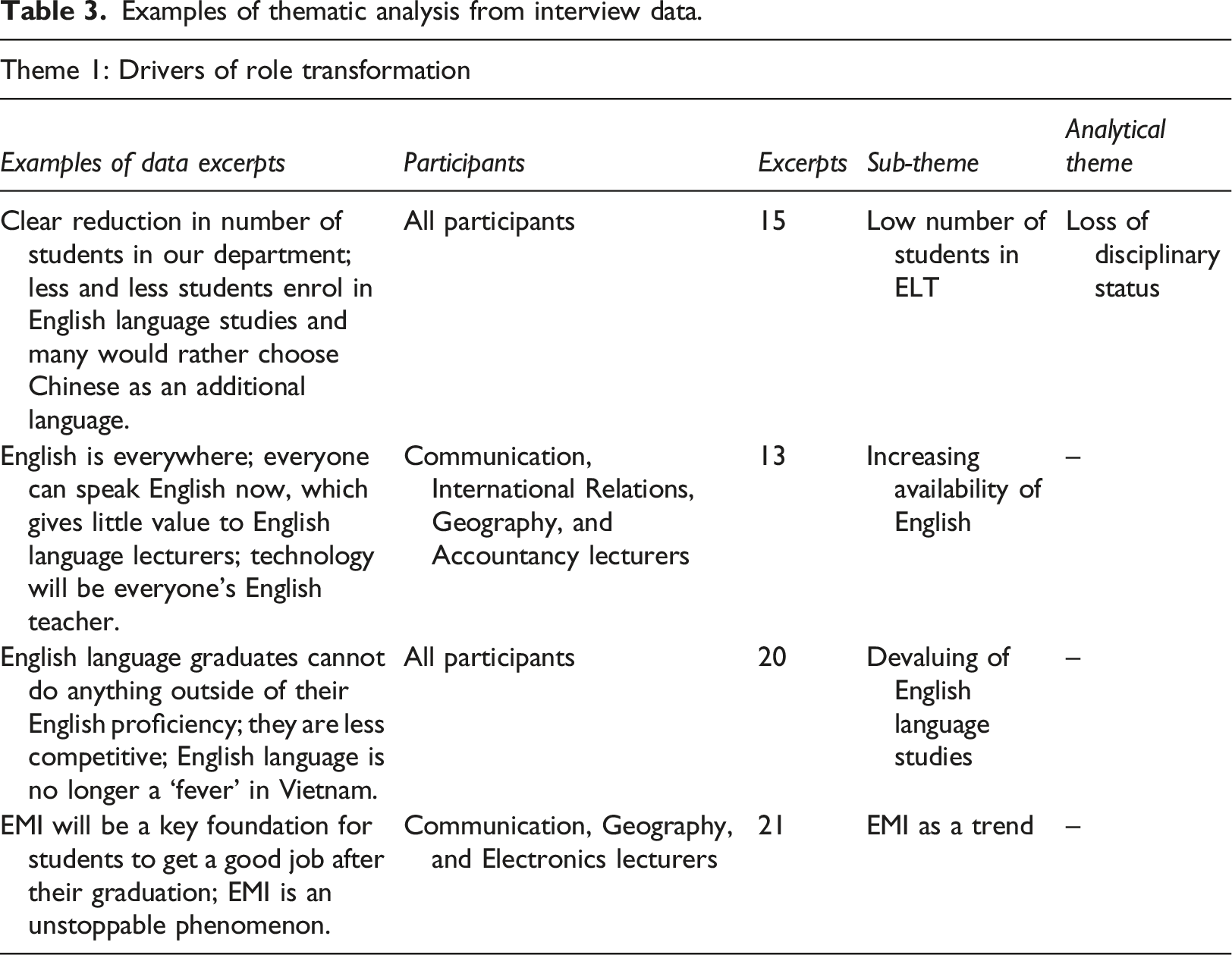
Examples of thematic analysis from interview data.
Findings: EMI role transformation
Initial data analysis identified particular themes relating to the two research questions: drivers of ELT/EMI role transformation and how participants constructed their actual experiences of that role transformation. The key themes are further analysed using the context-embedded ROAD-MAPPING dimensions of English medium education.
Drivers of role transformation
Drivers of ELT/EMI role transformation.
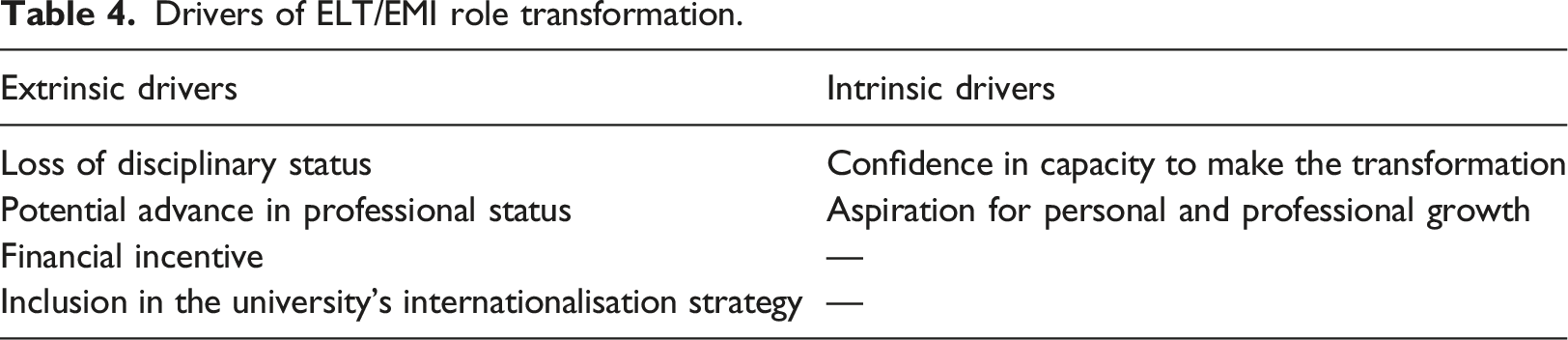
Extrinsic drivers
All five lecturers were deeply concerned that the roles of English in the Vietnamese academic world were diminishing and that English on its own was no longer considered a viable academic field. For example, the Geography Lecturer pointed out that: There is a general belief that English language graduates cannot do anything outside of their English proficiency. They do not have other discipline knowledge and skills; and therefore, they are less competitive in the globalised labour market.
Two additional drivers were related to the management of language dimension of EME. One was the financial incentive and encouragement offered by participants’ institutions. The other was the potential to become more involved in the institutional move to internationalisation, from which four of them appeared to feel marginalised. Their universities only wanted them to teach General English courses to students across the disciplines, while they themselves wanted to more actively contribute to the internationalisation process. The Communication Lecturer saw making such contribution as part of her professional duties, explaining that ‘lecturers have to innovate their pedagogies and throw themselves into new courses for the development of the institution-just part of our job-and I chose to teach EMI also for that reason’.
Intrinsic drivers
Participants’ confidence in their capacity to make the transformation was based initially on confidence in their English language competence. For instance, one participant stated: ‘I can deliver the lesson more smoothly with my English competence. That’s one of the main reasons why I am willing to challenge myself in a new field (Communication Lecturer). All interviewees also had confidence in their effective pedagogic practices. For example, the International Relations Lecturer commented: Being a language teacher, I think I am good at a student-centred approach and making class activities interactive and fun. I can also support students with other skills such as reading articles, paraphrasing, and essay writing. Compared to other content colleagues, I think my English speaking skill may be easier for students to understand me in class.
A further advantage of English proficiency in making the switch to EMI was confidence in being able to ‘access updated knowledge in the content field by reading research publications’ (International Relations Lecturer). As shown in Table 2, none but the Communication Lecturer had any discipline qualification related to their EMI courses, so capacity to gain knowledge through such reading in the content field was essential. For the Electronics Lecturer, knowing she had access to support networks (‘discipline lecturers, alumni students and friends working in this field’) for gaining content knowledge also gave her confidence in her capacity to transfer.
The second intrinsic driver for becoming EMI lecturers was the opportunity it offered for personal and professional growth within the move to internationalisation. Participants felt they were stagnating in ELT: I was fed up with teaching General English courses. I could see I was not learning anything new from teaching English. I felt that both I and my English were deteriorating. I felt an urge to do something different. EMI was a great idea – it combines both of my wishes: doing something with English and learning new things. (International Relations Lecturer).
Experiences of EMI role transformation
Within the ROAD-MAPPING framework of EME dimensions, four themes emerged as significant in terms of participants’ professional mobility and role transformation: shift in academic discipline content, shift in the roles of English, shift in sense of efficacy as agent, and lack of management support. The first three of these had a direct relationship to the fourth.
Shift in academic discipline content
As agents of EME the participants all considered content knowledge ‘the crucial’ or ‘decisive factor’ in the success of their new role, and the most challenging aspect. With the exception of the Accountancy Lecturer who appeared quite confident in the content knowledge for her topics, learning the disciplinary course content required for Years 1, 2 or 3 of an undergraduate program was a huge undertaking in the initial stages of the transition to EMI. As I am teaching what I am not trained for, I must learn everything from scratch. In addition, no matter how much time I spend preparing for the lesson, it seems never enough. (Geography Lecturer)
Teaching a Year 3 compulsory course, the Electronics Lecturer had encountered several technical concepts she was unsure if she ‘understood accurately’ and thus found extremely difficult to explain to students. Similarly, the International Relations Lecturer, teaching a Year 1–2 elective, confessed that ‘there were things [content] that I was uncertain about but I still had to explain to my students. Needless to say how ineffective it was’. The Communication Lecturer, teaching a Year 3 compulsory course, was not only ‘not confident about the content’ that she was teaching, but, because of that, had difficulty finding relevant examples to illustrate the course topics. This of course impacted on her classroom practices and processes, as happened also for the Electronics Lecturer, who, when a group of students were presenting on a self-selected content topic, rapidly had to Google to look for information about it: ‘I was truly grateful to Google. After that I asked my students to hand in their presentation slides in advance’. In sum, there was ‘just too much to learn’ (International Relations Lecturer) and participants’ workload was consequently very high, just as it was for a native English speaker in a Japanese university teaching a course for which he did not have specialist content knowledge (Bradford 2016).
Not surprisingly, their lecturers’ lack of content knowledge did not go unremarked by students, the other key agents in the EME project. For example, the International Relations Lecturer suffered the humiliation of being asked by a student whether she understood the content topic, while the Accountancy Lecturer was told that lecturers should improve their content knowledge to avoid impeding students’ learning. This reflects a wider expectation among students that lecturers should be able to convey their disciplinary content effectively through English (Duong and Chua 2016; Phuong and Nguyen 2019). However, most of the time, these teachers were learning and teaching the subject content at the same time, keeping step with their students, or catching up with them when students used academic concepts they had never heard of before (Geography Lecturer). Because of this, they became somewhat reliant on students to support their own learning. For example, the International Relations Lecturer acknowledged herself as ‘a newbie… When it comes to content knowledge, I am no different from my students, we learn together’. In terms of classroom practices and processes, this created a space for co-learning, changing the traditional dynamics of Vietnamese higher education.
The objectives and content scope for each course provided the immediate frame for the disciplinary knowledge and skills that lecturers needed to acquire. As the Geography Lecturer explained, Most of the time, I search for a syllabus of a similar course on the internet, from various universities across the world. I collect the reading list, and may make some adjustments to better suit the students’ ability.
Through this process, the lecturer realised that ‘the content in the EMI course was Westernised while the same version of the course in VMI (Vietnamese medium instruction) was still “traditional”’. This is in line with research indicating that internationalisation tends to foster Western-centric curriculum (Beck 2013; Majee and Ress 2020), requiring EMI lecturers to navigate their own and students’ intercultural learning.
All participants found the internet to be a key resource to self-learn the subject content, finding collegial networks, particularly content colleagues, similarly valuable: ‘new knowledge, new contacts, motivation to work’ (Accountancy Lecturer). These were clear gains from their ELT/EMI transfer, as well as broader ‘opportunities to learn and know about the world, therefore, to open up my thinking and world view’ (Geography Lecturer), which suggests both professional and personal growth.
Roles of English in the EMI experience
While initially all participants had confidence in their English language competence, the actual experience of EME soon made most of them doubt that confidence, realising that their English was not suited to effective content teaching. They tended to use conversational English in EMI lectures when they should have used specific discipline terminology and the language of abstract thinking. I used to think that my English was good, at least good enough to express what I wanted to communicate. However, I now realize that I am truly not yet fully prepared for EMI. I usually find the lengthy explanations in each lesson too overwhelming. I am lost in communication sometimes. (International Relations Lecturer) I was trained in ELT, but I still feel linguistically unprepared for EMI, especially when I have to explain terminology, and give examples (case studies) which require lots of technical vocabulary. (Geography Lecturer)
These participants reasoned that their ‘linguistic unpreparedness’ mainly stemmed from lack of disciplinary content knowledge. This is borne out by the fact that the Accountancy Lecturer, who was confident with her content knowledge, was the only one who appeared to be confident with her discipline English, only needing ‘to double check the pronunciation, meaning and use of difficult disciplinary terms’. In contrast, the other four participants found that almost all specialist disciplinary terminology constituted a challenge, one that was increased by needing to explain such terminology in a way comprehensible to students. As Bradford (2016) points out, many EMI lecturers have difficulty with the English required for classroom activity such as leading students to understanding of new concepts. However, for those trained in the discipline the issue is restricted to English language proficiency, whereas for these ELT/EMI lecturers it includes their lack of content competence.
Like many colleagues in diverse EMI settings, all participants found it necessary to use L1 in consideration of students’ limited English proficiency, and saw that practice as ‘normal and acceptable’, although it was thought that compared to discipline lecturers ELT/EMI lecturers ‘do communicate more in English during class (90%)’ (Accountancy Lecturer). In addition, translanguaging was not always easy for these lecturers who had read the content in English and now found it challenging to explain in Vietnamese: I sometimes find myself lost in words. I just can’t find the vocab for what I need to explain. However, my Vietnamese is not any better when it comes to explaining terminology. I guess because I often read material in English, so the knowledge that I take in is in English. Consequently, I don’t know how to translate or talk about that knowledge in Vietnamese. (Geography Lecturer)
In fact, this difficulty reflects an important issue in terms of appropriate internationalisation and glocalisation of curriculum, since graduates will need to be able to effectively use the disciplinary discourses of both languages in their professional lives.
Sense of efficacy as agent of EMI
Due to their inadequate content knowledge and command of disciplinary language, four out of five of these ELT/EMI lecturers were uncertain of their efficacy in terms of ability to teach EMI courses. One saw herself as sometimes functioning merely as a translator in class (Electronics Lecturer) while another saw herself operating as ‘instructor, not lecturer’ (Accountancy Lecturer). More directly self-critical, the Geography Lecturer sometimes considered herself a ‘loser’, elaborating that: Frankly, I can just learn something new the previous night, and the next morning I talk about it as if I have learned it long ago. So, I sometimes feel like such a hypocrite.
The reality of the classroom experience made these ELT/EMI lecturers question their ability and undermined their sense of efficacy. From having been highly experienced seniors in the field of ELT, they were floundering in their EMI teaching, making them question their own professional credibility.
Early in their transition to EMI lecturers, several participants found their previous ELT discipline was dominating their classroom practice, to the detriment of the discipline content. The Electronics Lecturer recalled that: At some of my very first EMI classes, I thought I explained the grammar and vocab of English language too much so I thought that was an English lesson rather than an EMI lesson. After that, I changed my approach to guide my students to learn more about English grammar and vocab by themselves before the class. (Electronics Lecturer)
Along similar lines, the International Relations Lecturer recalled that in her initial year of EMI teaching she had ‘accidentally taught academic English writing’ rather than teaching students ‘about their content topic’. Nevertheless, these lecturers quickly adapted, noting that it was important to become ‘aware of differences between EFL and EMI, be willing to confront challenges’ (Communication Lecturer), to recognise that English is ‘only small part of what you will have to do’ (International Relations Lecturer), and that EMI involves not only language but ‘pedagogies, professional development, materials, and even policies’ (International Relations Lecturer). These perspectives support Susser’s (2017) emphasis on the need for a fundamental shift of mindset, ‘what a teacher believes that he/she is doing in a course’ (p. 201), in other words moving away from language teaching to content teaching and treating students as language users rather than as language learners. This shift in mindset occurred for all participants and was central in transforming their practices and processes.
Participants emphasised the importance of interactive activities and using pedagogical techniques ‘flexibly to keep the students interested in the content and provoke their critical insight’ (Communication Lecturer). At the same time, they habitually used their English language expertise to build students’ academic English proficiency within the coursework. Specific mentions of pedagogy included ‘raising students’ awareness of language aspects in terms of pronunciation, grammar, vocab, language in use’ (Electronics Lecturer), ‘knowing how to simplify terminology without having to use the mother tongue’ (Communication Lecturer), and ‘assisting students to build up or rephrase their answers or arguments to make them more comprehensible’ (Accountancy Lecturer). Such pedagogies all align with existing research into successful EMI pedagogies (Dearden 2014, 2018; Nguyen et al., 2016; Nguyen 2017; Sahan et al., 2022), which suggests that participants’ initial pedagogical confidence was well justified. Indeed, several indicated that their pedagogical skills were openly validated by content lecturers: ‘When my colleagues asked me for advice and experience in EMI teaching, I felt valued and thought I really had chosen the right path to continue my teaching profession’ (Electronics Lecturer). Some also found that their professional status had increased, with the Electronics Lecturer having the ‘feeling of being better valued by students and other colleagues’ as an EMI content lecturer.
Nevertheless, while the EMI experience appears to have become less stressful over time, none of these research participants have ever yet considered themselves fully EMI practitioners – in other words, the role transformation is not complete in their eyes. This is not because of the fact that they all still teach in the ELT field as well as EMI, but because of their belief that they have not been ‘good enough’ even after several years. For them, an effective EMI practitioner is one who is highly competent in both English language and content knowledge as well as effective in teaching method, and this ideal prototype of an EMI lecturer is what they aim to become. Whilst sometimes feeling overwhelmed by the task, none of them regret having made the transfer: ‘All in all, it’s worth it’ (Geography Lecturer); ‘It’s time consuming, tiring but also rewarding. You get opportunities to learn and grow yourself’ (International Relations Lecturer); ‘I see a new me’ (Communication Lecturer).
Lack of management support for role transformation
In terms of institutional support for participants’ role transformation, it is noteworthy that none of the employing universities had developed a specific EME-related policy to guide pedagogy. This reflects a more general lack of appropriate policy and explicit guidelines for EMI implementation in Vietnamese higher education (Tri and Moskovsky 2019; Pham and Doan 2020). Providing direct evidence of the institutional conflation of EMI and ELT reported in the literature (Dearden 2018; Bradford 2019), the Geography Lecturer commented: ‘To be honest, I don’t think our university is aware of the differences between EMI and ELT’.
Related to this, the absence of a formal EME community in their institutions provoked feelings of isolation and anxiety in three of the lecturers, with the Communication Lecturer suggesting that institutions should formalise networks for EMI professional development rather than relying on staff independently developing personal relationships to connect with other EMI colleagues. On a similar note, the International Relations Lecturer suggested a need to ‘start raising voices to the managers so they can understand how challenging EMI teaching is’, in other words challenging for all lecturers involved. We want to have more EMI professional support. EMI lecturers are struggling to find their own paths without having sufficient support from our institution and professional associations. (Communication Lecturer)
The only professional development offerings made available were ad hoc and one-off workshops or seminars often provided by a third party such as the British Council or the United States Embassy, which, according to the International Relations Lecturer, were either insufficient or decontextualised, if not ‘westernised’. This reflects a wider situation of insufficient and unsuitable professional development internationally (Lauridsen 2017; Macaro et al., 2018). However, Burns (2022) insists that if students ‘are to truly thrive in the EMI classroom, a major priority must be for Vietnamese universities to offer substantial and targeted professional development to their teachers’.
Discussion: What kind of role transformation?
This study first investigated the decision by five English language lecturers to attempt a new career path as EMI content lecturers, each in a different university and a different discipline. The extrinsic drivers of these lecturers’ decision to transition into EMI were fourfold: loss of disciplinary status, potential advance in professional status, financial incentive, and inclusion in the university’s internationalisation strategy. All four drivers are shaped by three overarching factors: the strategic imperative to internationalisation, the flawed equation of English medium education with internationalisation, and the misconception that students’ English language will automatically be improved through EMI without additional provisions to support students’ required academic English development. These contextual factors also indirectly shaped participants’ aspiration for personal and professional growth, and perhaps contributed to the other intrinsic driver they identified, namely, confidence in their capacity to make the intended role transformation.
The lived realities of participants’ professional ELT/EMI role transformation, shaped both by the broad national context of Vietnamese higher education and the more immediate institutional context of the new discipline, involved more discrepancies than parallels between participants’ intrinsic drivers or expectations and their actual experience of role transformation. However, it is important to view the discrepancies in the light of participants’ overriding commitment to continuing in the EMI role and the benefits they affirmed in terms of heightened prestige and status, interesting and exciting professional growth, and life-long learning.
According to the interviews, participants’ initial confidence in their capacity to transform did not match the reality of their experience. First, none of them had anticipated the extent of the content learning required in order to teach their EMI courses. Second, they had been overconfident regarding their readiness in terms of English language proficiency, since all but one struggled with the disciplinary language of their new courses, and with the task of explaining academic concepts. This led to a third issue – uncertainty as to their efficacy as EMI lecturers in terms of providing educational quality for students. Related to that, they had not anticipated the amount of help they would need to manage the role transformation, and the absence of professional development support from their universities.
These gaps between expectations and realities suggest transformations ‘that come from struggles, adaptations and “discomforts” experienced’ (Leve 2021: 321). As we have seen, participants struggled with lack of content knowledge, linguistic unpreparedness, lack of self-efficacy, and lack of management support. Mobilising themselves out of their professional comfort zone (Boler and Zembylas 2003) of ELT into the new arena of EMI, they experienced frequent ‘discomforts’ in trying to explain content, as well as embarrassment when students were critical of their performance. In response to their struggles and discomforts, the key adaptation all of them made was to invest a great amount of time and effort into building capacity in regard to disciplinary knowledge. They worked many hours in preparation for classroom teaching, choosing learning materials that were not too challenging for students or for themselves, and constructing an interactive classroom culture of co-learning with their students. Collaborative relationships with colleagues and ready access to the internet assisted them in these transformative efforts, as did their fluency in conversational English and their ELT pedagogical skills. Unlike many content lecturers, who do not accept the role of language teachers within their disciplinary teaching (Airey 2012; Vu and Burns, 2014; Pham and Doan 2020) and are unwilling to comment on language features (Horie 2018), these ELT/EMI lecturers showed themselves well able to do so, and received acknowledgement from colleagues in confirmation. This provides endorsement for the position put forward by Susser (2017) that ELT expertise does offer some compensation for lack of disciplinary expertise.
Nevertheless, while the participants received satisfying responses from disciplinary colleagues in regard to their EMI skills, they frequently experienced feelings of incompetence, self-doubt and lack of professionalism. Navigating through such feelings made their role transformation emotionally intense, as they felt they were not providing adequate educational quality for their students. This unwelcome realisation they internalised as a personal matter, whereas we argue that it should be seen as an effect of the combination of strategic imperative and financial inadequacies that have led universities to incorrectly believe that EMI can itself achieve the English language development necessary for students’ academic success. With support to develop course content knowledge prior to the time of transition, and with ongoing EMI professional development, this flawed transformation process could be considerably improved.
Conclusion
This small empirical study makes a start on providing a research-informed position on professional ELT/EMI role transformation as an emerging phenomenon of internationalisation in Vietnamese higher education. While the sample is limited to five, these ELT/EMI lecturers were working in different high and medium ranking universities in Vietnamese metropolitan centres, and also in different disciplines. Four participants taught EMI courses within standard Vietnamese medium programs, while one taught in a predominantly EMI program. This is quite representative of current EMI offerings across Vietnamese higher education, although it would be valuable to look more closely into whether or not more ELT/EMI transfers occur in standard VMI programs than in predominantly EMI programs, and what differences are experienced, if any.
The case study approach and the multidimensional ROAD-MAPPING analysis used in this study have offered some initial insights into the contextual factors involved, bridging the disconnect between the global move to internationalisation and its local manifestations (Knight and De Wit 2018), offering a new perspective on mobilities in higher education in the context of internationalisation, and laying some groundwork for further research into ELT/EMI role transformations.
Together the five participants provided valuable and rich insights that contribute to a deeper understanding of the complex process of professional ELT/EMI role transformation in the current context of internationalisation in Vietnamese higher education. First is that by engaging in professional mobility and taking themselves out of their ELT comfort zone into the new arena of EMI, lecturers are likely to find themselves in considerable discomfort, struggling to cope with their insufficient content knowledge and linguistic unpreparedness for disciplinary teaching, experiencing associated feelings of professional uncertainty and self-doubt, and working extremely hard to adapt to the situation and build professional capacity in the new role. Over time, it is likely this would lead to considerable professional growth, and quite possibly to educational quality for students.
Nevertheless, we argue that, rather than encouraging ELT lecturers to transform themselves into EMI lecturers, institutions wishing to excel in the internationalisation process would do better to capitalise on the already existing strengths of ELT lecturers (Dearden 2018). Universities can make excellent use of ELT expertise by establishing staffing positions and accredited curriculum pathways that develop the English language needed for students’ academic purposes. This would directly address insufficiencies in student support related to the flawed assumption that EMI leads automatically to English language improvement. We advocate a concurrent support model with credit-bearing English for Specific Academic Purposes (ESAP) courses as an integral part of the overall curriculum. Such ESAP courses would be taught by English language lecturers who have either co-taught in the discipline or studied it sufficiently to be able to integrate content within their language teaching, with the aim of developing English for academic success. ‘Recognising the need for extensive EAP training and providing it’ to students has been identified (Linn et al., 2021) as one of the key conditions for English medium education to succeed. This would be supported by such an ELT/ESAP role transformation properly resourced with appropriate training, access to an EME community; and dedicated time for collaboration between content lecturers and ESAP lecturers.
An innovation of this kind would require on the part of Vietnamese universities a profound perspective transformation (Mezirow 1981), rejecting any suggestion that EMI might be sufficient on its own to develop students’ academic English proficiency to the degree required for effective content learning, and recognising the multiple ways in which English language lecturers can serve the successful implementation of English medium education and internationalisation more broadly. We argue that such a perspective transformation at the level of university management is essential if educational quality is to be achieved within the internationalisation project.
Footnotes
Declaration of conflicting interests
The author(s) declared no potential conflicts of interest with respect to the research, authorship, and/or publication of this article.
Funding
The author(s) received no financial support for the research, authorship, and/or publication of this article.
