



Abstract
Despite years of investigation on international students’ adjustment, cultural distance and cultural intelligence, the definitions of and the relationship between these concepts are not yet sufficiently well established. This article further explores the three concepts and their possible interrelations. We propose a hypothesized model that considers subjectively perceived cultural distance (PCD) a variable of specific importance, and wherein we assume that the relationship between PCD and international students’ adjustment is moderated by students’ cultural intelligence (CQ). Our model aims to better explain the dynamics between these variables; it posits that students’ CQ level will affect whether and how PCD may influence international students’ psychological, sociocultural and academic adjustment in the host country. Consequently, the model offers several implications for future research and possible interventions to support international students’ adjustment in higher education.
Keywords
Introduction
For decades, there has been growing interest in the group of students who move abroad to pursue higher education (Brunsting et al., 2018; Cao and Meng, 2022; Church, 1982; Erturk and Luu, 2022; Smith, 1955). Initially called foreign students (Smith, 1955), they have been referred to as international students in recent studies. International students are ‘students who have physically crossed an international border between countries for study’ (OECD, 2019; UNESCO UIS, 2020). The term also includes ‘students who are not residents of their country of study or who received their prior education in another country’ (OECD, 2013). As the number of international students has grown worldwide, from less than 2 million in 1998 to more than 6 million in 2019 (UNESCO UIS, 2022), the number of scientific studies conducted to monitor and better understand them has increased as well.
One of the key issues in research on this growing population is their adjustment. Adjustment is a process that takes place when individual moves or has contact with a new environment (Mesidor and Sly, 2016). In the context where different cultures are involved, adjustment is often understood as the opposite pole of culture shock (Church, 1982). Better adjustment helps students to persist and achieve success in their education (Korobova and Starobin, 2015; Rienties et al., 2012; Rienties and Tempelaar, 2013). It also increases their overall satisfaction with their experience (Shafaei and Razak, 2016; Yu and Wright, 2016). On the other hand, problems in adjustment could result in severe negative outcomes, such as stress, depression and anxiety symptoms, loneliness and negative well-being (Brunsting et al., 2018; Jackson et al., 2013; Li et al., 2014; Sawir et al., 2008; Wang and Hannes, 2014). Consequently, enhancing our understanding international on students’ adjustment appears to be beneficial to ensure their mental health and academic success.
A better insight into the students’ adjustment also bears the potential to benefit the institutions and countries involved. While attracting students to come to a host country is not the only form of internationalization of higher education (Altbach and Knight, 2007; Knight, 2012), it has become one of the priorities of higher education institutions (Pawar et al., 2020). Not only may international students contribute to increasing diversity in communities and to promoting cultural understanding; they can also provide us with more globalized workforces, leaders and additional financial resources (Chavoshi et al., 2018; De Wit et al., 2015; Guo and Guo, 2017; Korobova and Starobin, 2015; OECD, 2019, UNESCO, 2018). Ensuring better adjustment of their current international students may also help universities attract more international students in the future. Studies have shown that international students are more willing to recommend their host country and educational institution when they have a better adjustment (Shafaei and Razak, 2016) and higher satisfaction (Merola et al., 2019). Recommendations from fellow students will then increase the chance of attracting prospective students (Özoğlu et al., 2015).
However, to better understand international students’ adjustment, studies in the field need a more integrated theory for the construct. As pointed out by previous studies (Bierwiaczonek and Waldzus, 2016; Schartner and Young, 2016), the literature on international students is not yet integrated and lacks of common direction. Even the conceptualization of international students’ adjustment construct is still far from unequivocal (Bastien et al., 2018; Bierwiaczonek and Waldzus, 2016; Chavoshi et al., 2018; Church, 1982; Erturk and Luu, 2022; Mesidor and Sly, 2016; Shu et al., 2017). This ambiguity might hamper the efforts to understand international students, as it is difficult to interpret, compare and integrate the available findings (Chavoshi et al., 2017). Thus, this article aims to provide support for a more integrated conceptualization of international students’ adjustment and its relationship with two proposed predictors: cultural distance and cultural intelligence. While the two predictors are assumed to influence students’ adjustment, the nature of their relationship still needs further investigation.
International students’ adjustment
To date, the term ‘adjustment’ is often used interchangeably with other terms, such as adaptation, acculturation, or accommodation (Bierwiaczonek and Waldzus, 2016; Brunton and Jeffrey, 2014; Presbitero, 2016; Searle and Ward, 1990; Smith and Khawaja, 2011; Yu and Wright, 2016). Even though these terms may have relatively similar definitions, they still have differences that make one term more suitable than others in a specific research context (Bierwiaczonek and Waldzus, 2016; Matsumoto and Hwang, 2013; Schartner and Young, 2016; Wang and Mallinckrodt, 2006; Zhang and Goodson, 2011b). Nevertheless, the term ‘adjustment’ has already been explicitly introduced in the international students’ context since decades ago (Smith, 1955). One of the recent studies (Schartner and Young, 2016, 2020) has proposed that adjustment represents the process experienced by students during sojourning, while adaptation is the result of that process. Agreeing with this conceptual differentiation, and to avoid confusion, the present article will only use the term adjustment, or international students’ adjustment (ISA), specifically.
Amid the variety in definition and operationalization of adjustment in the context of intercultural mobility (Bhaskar-Shrinivas et al., 2005; Bierwiaczonek and Waldzus, 2016; Church, 1982; Mesidor and Sly, 2016; Ruben and Kealey, 1979), this article will firstly reconsider the definition proposed by Searle and Ward (1990). Considered one of the most influential works in the cross-cultural adjustment literature (Bierwiaczonek and Waldzus, 2016), they define and operationalize adjustment as a two-dimensional concept comprising psychological and sociocultural adjustment. Psychological adjustment is defined as the affective response to an individual’s new environment (Searle and Ward, 1990; Ward and Kennedy, 1993). In simpler words, it refers to how comfortable and happy, or anxious and out of place, a person feels in a new culture (Demes and Geeraert, 2014). Meanwhile, sociocultural adjustment refers to how well an individual can manage daily life, or to ‘fit in’, in the new cultural context (Berry, 2005; Demes and Geeraert, 2014; Ward and Kennedy, 1993, 1994). Compared to other definitions, this two-dimensional conceptualization of adjustment has also been applied most frequently in studies on international students (Brunsting et al., 2018; Hirai et al., 2015; Jackson et al., 2013; Wang et al., 2018; Ward et al., 1998; Zhang and Goodson, 2011a, 2011b). However, as we will argue below, whether the two-dimensional conceptualization of adjustment covers all relevant aspects and provides the most comprehensive definition for ISA is questionable.
ISA is distinct from the adjustment of other sojourners or intercultural travellers; international students face particular challenges as they fulfil their new role as students in the next level of education. Not only do they need to get used to the culture and social environment of the host country in general, they also must accustom themselves to their new educational institution and academic environment. For instance, international students may have to deal with academic lifestyles, academic demands, teaching styles, assessment methods, or educational services that differ from their earlier experience (Anderson et al., 2016; Smith and Khawaja, 2011). Academic adjustment is essential for international students to perform well academically and obtain their targeted achievement (Kağnıcı, 2012); its importance was already emphasized even in the earliest studies on international students (Sewell and Davidsen, 1956; Smith, 1955). However, as pointed out by previous studies (Mudhovozi, 2011; Rienties and Tempelaar, 2013; Yu and Wright, 2016), academic challenges faced by international students are different from social challenges. Therefore, we can conclude that this aspect is not yet represented by the psychological and sociocultural dimensions of adjustment.
Consequently, academic adjustment needs to be included in the investigation and measurement of adjustment in the international students’ context. Even though investigating the academic adjustment of international students has been conducted in several previous studies (Bastien et al., 2018; Cao and Meng, 2022; Suprapto et al., 2019; Yu and Wright, 2016), available studies have not yet measured all three dimensions together. Just like how studies on expatriates initiated the differentiation between work adjustment with general and interaction adjustment (Black, 1988; Black and Stephens, 1989), the academic adjustment should also be included as an independent aspect of adjustment for international students. In line with the work of Schartner and Young (2016, 2020), this article proposes to conceptualize ISA as consisting of three dimensions: psychological, sociocultural and academic. Therefore, international students’ adjustment, or ISA, can be defined as the process that students go through to perform their tasks and achieve comfort in their psychological, sociocultural and academic aspects while pursuing education in the host university and living in the host country.
Cultural distance as a predictor of international students’ adjustment
Cultural distance
Quite extensive studies have been conducted to understand what factors can influence or predict ISA. Some of these factors can be categorized as students’ personal resources factors (Cao and Meng, 2022), such as language proficiency, personality traits, or self-efficacy (Andrade, 2006; Bastien et al., 2018; Hu et al., 2020; Kağnıcı, 2012; Mesidor and Sly, 2016; Shu et al., 2017; van Niejenhuis et al., 2018). Demographic factors have also been linked to ISA (Cao and Meng, 2022), including age, gender, country of origin, or the duration of stay in the host country (Aldawsari et al., 2018; Bastien et al., 2018; Gebregergis et al., 2019; Kağnıcı, 2012; Taušová et al., 2019). Finally, ISA have been related to several sociocultural or contextual factors (Bierwiaczonek and Waldzus, 2016; Cao and Meng, 2022). These factors include, among others, social support, discrimination and cultural distance (Bierwiaczonek and Waldzus, 2016; De Araujo, 2011; Jackson et al., 2013; Mesidor and Sly, 2016; Zhang and Goodson, 2011b). This last category of potential predictors of ISA, and herein specifically cultural distance, will be at the core of the present article.
Cultural distance (CD) refers to ‘the degree to which cultural values in one country are different from those in another country’ (Sousa and Bradley, 2006); ‘differences in cultural values’ (Engle and Nash, 2015); or ‘overall difference in values and attitudes between two countries’ (Ambos et al., 2019). In the context of ISA, we can define CD as the degree to which the cultures of students’ home country, or country of origin, and their host country differ.
Cultural distance has been studied as one of the predictors of cross-cultural adjustment, mostly in the context of international business or expatriates (Beckerman, 1956; Beugelsdijk et al., 2018; Bierwiaczonek and Waldzus, 2016; Jenkins and Mockaitis, 2010; Shenkar, 2012). However, international students have distinct characteristics that differentiate them from other groups of sojourners (Bierwiaczonek and Waldzus, 2016; Bochner, 2003; Smith and Khawaja, 2011). At the least, they are different from expatriates and more permanent immigrants in their motive (Zlobina et al., 2006), choice power (Guðmundsdóttir, 2015; Özoğlu et al., 2015), and duration of stay (Cox, 1988; Hofhuis et al., 2019). Therefore, the results of previous studies on the relationship between CD and adjustment may not be directly generalized and applied to international students.
The need for further investigating the relationship between the CD and ISA is also generated by inconsistent findings from previous studies. To date, the Cultural Distance Hypothesis, which presumes a negative relationship between CD and adjustment, is still the most popular and best-supported hypothesis in intercultural studies (Hemmasi and Downes, 2013), including in the context of students (Babiker et al., 1980; Brunton and Jeffrey, 2014; Furukawa, 1997; Galchenko and Van de Vijver, 2007; Suanet and Van de Vijver, 2009; Taušová et al., 2019; Ward and Kennedy, 1993). This hypothesis states that the degree to which the home and the host environment are perceived to differ will affect students’ adjustment: more perceived differences will go together with more difficulties to adjust. However, there are also a considerable number of studies reporting no significant relationship between CD and adjustment of international students (Bastien et al., 2018; Cetinkaya-Yildiz et al., 2011; Ladum and Burkholder, 2019; Selmer and Lauring, 2009); therefore, we suggest that the relationship between the two constructs may have been influenced by another factor.
However, before going further into this proposition, we need to consider that the inconsistent findings could also be based on how CD has been conceptualized and measured. Overall, there are two types of CD usually investigated in the literature: country-level CD (CCD) and perceived CD (PCD). The two types of CD tap into different aspects of the concept (Suanet and Van de Vijver, 2009), and, accordingly, they define and measure CD differently. Country-level CD assumes that every country has its own national culture and that its distance to other countries can be measured objectively (Beugelsdijk et al., 2018). Therefore, CCD is usually measured by an aggregate index of agreed measures of countries’ culture (De Santis et al., 2016; Engle and Nash, 2015; Felix et al., 2019; Hofstede, 1983; Jenkins and Mockaitis, 2010; Kogut and Singh, 1988; Selmer and Lauring, 2009; Stahl and Tung, 2015). Frequently, CCD is also operationalized such that students are grouped based on their country or geographical regions of origin (Alemu and Cordier, 2017; Bastien et al., 2018; Cerna and Pavliushchenko, 2015; Rienties and Tempelaar, 2013).
Perceived CD, on the other hand, focuses on the subjective experience of cultural differences. It emphasizes an individual’s perception of a host country’s culture based on their experience in their immediate environment (Ambos et al., 2019; Babiker et al., 1980; Demes and Geeraert, 2014). Perceived CD is sometimes referred to as psychic distance (Ambos et al., 2019; Sousa and Bradley, 2006). Thus, PCD is usually measured through individuals’ self-assessment regarding more specific and primary aspects that directly associate with one’s life, such as climate, food, language, clothes, religion and leisure activities (Babiker et al., 1980; Demes and Geeraert, 2014; Galchenko and Van de Vijver, 2007; Mahfud et al., 2018; Taušová et al., 2019). It can also tap into perceived cultural differences in personal and social values (Albada et al., 2021).
From the two types of CD, this article will mostly focus on PCD as the predictor of ISA. A previous study has proposed that CCD concept is better applied at the country level than at the individual level (Sousa and Bradley, 2006). The differences between countries, represented by CCD, may not to the same extent be perceived as differences by the students (Naumov and Puffer, 2000). Because diversity also exists within a country, assuming a country’s culture to be homogenous may be misleading. Moreover, as the world, in general, has become significantly more diverse, it is highly possible that even people from the same country perceive cultures (theirs or others) differently. Therefore, assuming countries’ cultural values based on past ratings, such as using the results of the 1970s, 1980s or even 2000s survey (Hofstede, 2011) in the current year, maybe not be relevant anymore. Furthermore, PCD is an individual-level concept, which is more equivalent to adjustment that is also based on individual, subjective perception and evaluation. Thus, PCD is presumably a better fit to measure CD in the future investigation of ISA.
Nevertheless, it still seems plausible to assume that students’ subjective perception of cultural differences is affected by CCD; on average, greater CCD should also enhance the probability of higher PCD. As CCD indexes (De Santis et al., 2016; Hofstede, 2011; Hofstede and Bond, 1984) are originated from a large number of individual responses, they may also, at some levels, portray the score of individuals in it. In line with the Bronfenbrenner’s Development Ecology theory (1979), individual’s development cannot be separated from their macrosystem, which includes cultural values in their society (Vélez-Agosto et al., 2017). A collective culture perceived by society would impact individually perceived culture (PCD). Presumably, how individual evaluate other cultures, to determinate the distance between cultures (PCD), could also be affected by the societal perception of other cultures.
As ISA represents the process a student goes through to manage their tasks and achieve comfort when faced with different cultures in their new environment, the extent to which PCD may affect ISA will depend on their ability to understand, learn about, or deal with those differences. This view is also in line with one of the popular approaches in the acculturation model: The Culture Learning Theory (Shafaei and Razak, 2016). This approach views that adjustment happens as individuals actively interact with their environment, and they can learn and acquire culture-specific skills to overcome the challenges and difficulties they face in the new environment. The individual’s ability to deal with and react appropriately and effectively to cultural differences is usually referred to as intercultural competence (Hammer et al., 2003; Spitzberg and Changnon, 2009; Wang et al., 2015).
Among various constructs introduced as proxies of intercultural competence (Dunn et al., 2006; Hammer et al., 2003; Wang et al., 2003), cultural intelligence (CQ) is the concept that has been studied more extensively and supported by more empirical evidence (Leung et al., 2014; Li, 2020; Matsumoto and Hwang, 2013; Ott and Michailova, 2018). Therefore, we suggest that CQ may be the moderating variable in the relationship between PCD and ISA.
Cultural intelligence
Proposed by Earley and Ang (2003: 9), CQ is defined as ‘an individual’s capability to function and manage effectively in culturally diverse settings’ (Ang and van Dyne, 2008). The definition was further elaborated into ‘an individual’s capability to detect, assimilate, reason, and act on cultural cues appropriately in situations characterized by cultural diversity’ (Van Dyne et al., 2012). Other definitions of CQ also refer to a capability helping people to be more effective than others in a different cultural context (Fang et al., 2018; Ott and Michailova, 2018; Thomas et al., 2008). In summary, CQ refers to an individual’s ability to act effectively and appropriately when faced with different cultures.
Several researchers have stated that CQ is different from other forms of intelligence previously used to explain intercultural adjustments (Crowne, 2013; Lin et al., 2012), such as emotional and social intelligence. While social and emotional intelligence can provide individuals with the ability to behave appropriately within their own cultural frame of reference, CQ enables individuals to comprehend the behaviours and patterns ingrained in an unfamiliar culture (Earley and Ang, 2003). We expect that CQ plays a valuable role when individuals are situated in a culture different from their own and when they perceive cultural differences in an otherwise familiar environment. Consequently, we assume that a higher degree of CQ will facilitate international students’ adjustment.
Support for a link between CQ and aspect(s) of ISA has been indicated in several studies (Gebregergis et al., 2019; Lin et al., 2012; Rana et al., 2020; Shu et al., 2017). However, related to the inconsistency of ISA’s conceptualization in previous studies, achieving a sound conclusion regarding its relationship with all aspects of ISA is rather intricate. In addition, further analyses have also shown diverse results as to which of the four dimensions of CQ have a significant power to predict students’ adjustment (Lin et al., 2012; Rana et al., 2020; Shu et al., 2017). Hence, while CQ can be viewed as a single construct, it may be beneficial to consider its multidimensionality.
The four components of CQ: cognitive, metacognitive, motivational and behavioural, categorize different capabilities that together form the entire construct (Ang et al., 2007; Ang and van Dyne, 2008; Earley and Ang, 2003; Engle and Nash, 2015; Rockstuhl and Van Dyne, 2018; Van Dyne et al., 2012). Cognitive CQ reflects individuals’ general knowledge about cultures and cultural differences, including the norms, practices and conventions of different cultures (Ang et al., 2007; Van Dyne et al., 2012). Metacognitive CQ reflects the ability to process one’s cognition during multicultural interactions consciously and acquire, understand and evaluate cultural knowledge (Ang et al., 2007). Motivational CQ indicates the capability to direct attention and energy towards learning, functioning and performing in intercultural situations (Ang et al., 2007; Van Dyne et al., 2012). Finally, behavioural CQ refers to an individual’s capability to exhibit appropriate verbal and nonverbal actions when interacting with people from different cultures (Ang et al., 2007). Measuring and analysing each of CQ’s dimensions independently could be beneficial by providing more rich information about this concept (Engle and Nash, 2015; Rockstuhl and Van Dyne, 2018) and its link with ISA or other predictors of ISA.
As we will describe in more detail in the next part, we assume that students with better CQ will be more aware and knowledgeable about different cultures, more motivated to learn and engage, and able to react more effectively and appropriately when faced with different cultures. Accordingly, CQ can moderate the relationship between PCD and ISA. Even though higher PCD may lead to lower ISA, the negative relationship between PCD and ISA will be weaker under higher CQ.
Hypothetical model of the relationship between perceived cultural distance, cultural intelligence and international students’ adjustment
To further our understanding of the relationship between PCD, CQ and ISA, we propose a hypothetical model representing two sub-hypotheses: (1) that PCD will predict all dimensions of ISA, and (2) that CQ will moderate this link (see Figure 1). The visualization of hypothetical model on the relationship between PCD, CQ and adjustment of international students.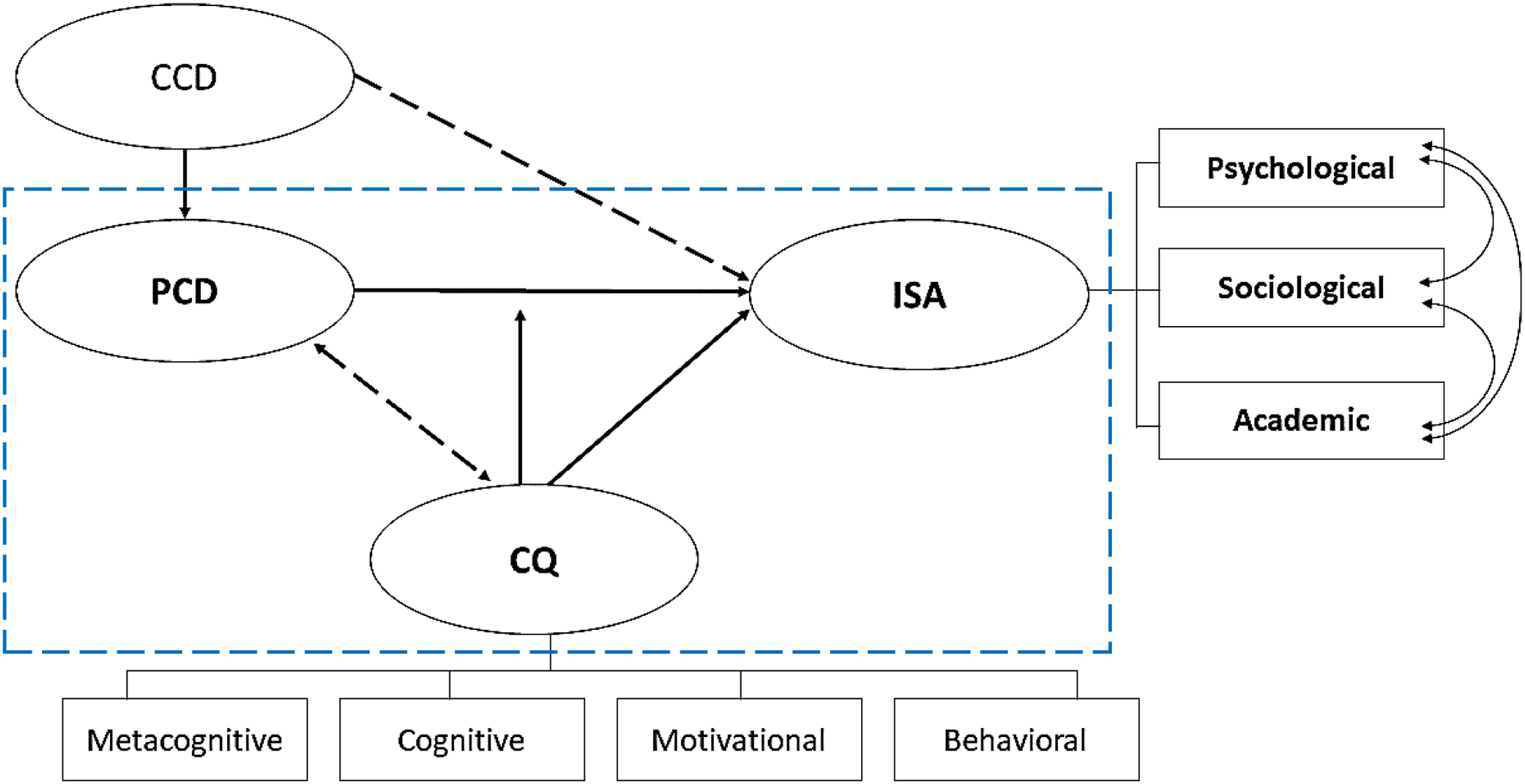
First, as shown in Figure 1, in line with the cultural distance hypothesis, the proposed model assumes that there is a direct and negative link between PCD and ISA. We hypothesize that PCD is a predictor to all aspects of international students’ adjustment: psychological, sociocultural and academic. The more cultural differences between their home and host countries students perceive, the more challenges and difficulties they may experience in managing and getting accustomed to their new daily life. For example, they may find it harder to build new social networks with locals or to understand their different customs. Therefore, larger PCD should be associated with lower sociocultural adjustment. Regarding psychological adjustment, we assume that the more differences between cultures the students subjectively experience, the higher the chance that they will experience a culture shock, and, relatedly, feel distressed and will need more time to feel comfortable in their new environment. Finally, PCD may also affect academic adjustment as the larger cultural differences students perceive, the more difficult it may be for them to feel comfortable with their new role and to manage their academic environment. For example, they may need more time to get used to the new learning styles they encounter in the class when they are perceived to be very different from what the students used to do in their previous education. Moreover, as the three aspects of ISA are interrelated, the impact that PCD has on one of the aspects may also spread and affect the other aspects. Hence, overall, higher PCD is hypothesized to be associated with more difficulties in adjustment (lower ISA).
The model also illustrates another central hypothesis, namely that CQ will moderate the relationship between PCD and ISA. We suggest that the level of students’ CQ may influence the nature of how PCD will affect ISA. More specifically, we assume that high CQ will decrease the negative effect of PCD on ISA. Even though students may perceive significant cultural differences between their own and the host country, they may nonetheless adjust well if equipped with a high level of CQ. Their cognitive CQ will help them to interpret and understand different cultures they may encounter in the host country. Their metacognitive CQ will help them strategize on how to learn and understand the local cultures. It will help them realize what they already know and what they have not; what knowledge they should gain that may help them adjust to the cultural differences. Their motivational CQ will affect their interest and energy to learn more about their host country, which, in the end, will help them to handle the cultural differences better. Lastly, their behavioural CQ will determine which verbal and nonverbal actions they will display in the host country and whether they will perform behaviours that may help or hinder their adjustment to different cultures. Therefore, with a high level of CQ, the negative relationship between PCD and ISA may be lessened. On the contrary, international students that are equipped with only weak CQ should be especially prone to be burdened by high levels of PCD in all three domains of their adjustment.
As shown in Figure 1, and as discussed in this article’s earlier parts, our model incorporates multi-faceted definitions of each construct. International students’ adjustment is conceptualized as comprising three dimensions: psychological, sociocultural and academic adjustment. We assume that these three dimensions are distinguishable but interrelated. Likewise, besides conceptualizing CQ as an aggregate concept, our model explicitly distinguishes its four dimensions: cognitive, metacognitive, motivational and behavioural. Therefore, while CQ as a single score may moderate the relationship between PCD and international students’ adjustment, our model also assumes that each of its dimensions may play a specific role in the moderation. While all dimensions are candidates to moderate the link between PCD and ISA, some dimensions may have a more powerful impact than others.
Our model also includes some additional links between the three core variables. First, it includes the direct and positive link between CQ and ISA: The higher students’ CQ, the better they should be able to adjust when in a different cultural context. Secondly, as already stated further above, we assume that CCD affects PCD, such that there is a positive correlation between CCD and PCD: Students from countries categorized as high in cultural differences from the host country should also be more prone to perceive such differences. Therefore, as shown with the dashed arrow in Figure 1, our model assumes an indirect relationship between CCD and students’ adjustment through the PCD, such that PCD mediates the link between CCD and ISA. Lastly, the model also presents the possibility of exploring a potential relationship between CQ, or its dimensions, and PCD. For example, it is probable that students’ cognitive CQ relates to PCD. Their knowledge of their own culture and the host country’s culture may influence their perception of how the two cultures differ or are similar.
Discussion
The proposed model can integrate previous studies' results and offer some new hypotheses regarding ISA. It aligns with the studies supporting a negative relationship between PCD and ISA and a positive relationship between CQ and ISA. Nevertheless, the model goes beyond previous studies that support the negative relationship between PCD and one or two aspects of ISA, especially psychological adjustment and sociocultural adjustment (Furukawa, 1997; Galchenko and Van de Vijver, 2007; Suanet and Van de Vijver, 2009; Taušová et al., 2019; Ward and Kennedy, 1993). Following the proposed conceptualization of the ISA, the model hypothesizes that PCD negatively affects all aspects of ISA: psychological, sociocultural and academic adjustment. Simultaneously, and different from previous research, this model puts much less stress on the direct relationship between CCD and ISA. Instead, it sees country-based cultural distance as a variable that feeds into the perceived cultural distance. Hence, we assume an indirect relationship between CCD and adjustment, with a mediating role of PCD.
Another central hypothesis illustrated in the model is the role of CQ as a moderator of the relationship between PCD and the adjustment of international students. While CQ has been mostly placed as an antecedent or an outcome of variables in available studies on international students (Ott and Michailova, 2018), our model places CQ as a moderating variable. The placement of CQ as a moderator in our proposed model is fairly in line with the approach of Cultural Learning Theory (CLT) in understanding acculturation model (Shafaei and Razak, 2016). As stated previously, according to the CLT, individual plays an active role in coping with changes in their environment by using their ability. As CQ refers to individual’s ability in the face of different cultures, it is suitable to place it as a variable that can affect the relationship between PCD and ISA. The adverse effect of higher PCD on ISA may be reduced when students have higher CQ.
The placement of CQ as a moderator in our proposed model is also in line with the result of a previous empirical study on the adaptation of international students in Australia (Presbitero, 2016). This study showed that CQ could act as a buffer to lessen the impact of a culture shock on adaptation. Since culture shock may happen when individuals encounter a culture different from theirs (Church, 1982), this experience can be considered closely linked with PCD. Plausibly, students are more prone to experience a culture shock the more significant differences they perceive between their home and host countries. Therefore, if CQ can lessen the strength and impact of a culture shock, we argue that CQ may also serve as a buffer to lower the adverse effects of PCD on ISA. Rather than on culture shock, our hypothesis focuses on PCD as the predictor of adjustment because culture shock is more likely to result from, rather than preceding, PCD; as the other pole of adjustment (Church, 1982).
There are more studies that provide (partial) support for our proposed model. A study on a college course with diverse students (Magnusson et al., 2014) has shown that motivational CQ moderated the relationship between PCD and team performance in the course. When students perceived higher CD between team members, motivational CQ prepared them to expect more challenges and, consequently, to invest greater effort into their team project, resulting in better team performance. Similarly, another study in an international class (Ng et al., 2019) indicated that CQ mitigated CD’s negative effect on students’ willingness to communicate in group work. This study revealed that students with lower CQ levels engaged less in speaking-up activities with people perceived as more culturally different. Motivation to put more effort into group tasks and willingness to initiate communication in group work can be considered as indicators of students’ academic and social adjustment. Hence, these studies’ results serve as additional affirmation for placing CQ as a moderating variable in the relationship between PCD and ISA.
Nevertheless, it is also important to point out that attempts to explain the dynamics between CD, CQ and cross-cultural adjustment have also been done in the field of expatriate and human resource development (Song et al., 2021; Zhang, 2013). However, unlike our proposed model, the previous works placed CD as the moderator of the relationship between CQ and adjustment. Zhang (2013) hypothesized that cultural distance would moderate the relationship between CQ and expatriate adjustment. To be precise, it was suggested that the relationship between CQ and adjustment would be more reliable when individuals move from a less authoritarian cultural context to a more authoritarian cultural environment than the other way around (Zhang, 2013). Meanwhile, the study conducted by Song et al. (2021) suggested that CD negatively moderates between motivational CQ and expatriates’ cross-cultural adjustment.
Even though the previous works are related to our proposed model, we cannot directly compare their model with ours because they focus on CCD, not PCD. The hypothesis by Zhang (2013) even specifically categorically divided the cultural contexts based on their level of authoritarian nature. Also, as the hypotheses in both previous works developed for the context of expatriates, they defined adjustment differently from the one in our proposed model. Our model suggests the importance of including academic adjustment in defining international students’ adjustment (ISA). Hence, we cannot directly generalize the previous works to our context. Besides that, one of the two studies (Song et al., 2021) limits the focus to only one aspect of CQ: the motivational aspect. Thus, as our proposed model was developed using previous studies about international students, and as it is intended specifically to explain the ISA (with three dimensions), PCD and CQ (and all four dimensions) relationships, it may fit more into the context. However, once we test our hypotheses, we can also investigate whether it captures the interplay between the variables better than other hypotheses (Song et al., 2021; Zhang, 2013).
We also realize that the model has some limitations, simultaneously providing opportunities for future studies. While we consider it worthwhile to explore the dynamic of each component of CQ with the relationship between PCD and each dimension of ISA, there is a limitation on available studies to offer hypotheses on those specific links. Therefore, our proposed model currently focuses on the primary constructs. After empirical support for this proposed model is available, we can explore deeper the relationship between the dimensions of the construct involved. Additionally, the model also suggests the need to explore the relationship between CQ and PCD; one could assume that higher CQ could go together with less PCD, as people are more aware of the shared characteristics of people from different cultures. However, alternatively, CQ could also sharpen people’s perception of cultural differences while at the same time affecting the evaluation of these differences. Thus, there is a chance that different aspect of CQ has a different relationship with PCD.
Implications for future research on international students’ adjustment
The proposed model is intended to stimulate further empirical research to enrich our knowledge on internationalization in higher education, and specifically on international students’ adjustment. First, our central hypothesis urges future studies to further investigate the relationship between international students’ adjustment and (P)CD by involving CQ as a moderating variable. The future investigation should be conducted rigorously by employing variety of methodological advances. Not only utilizing different measurement methods (for example, adding peers’ rates to measure CQ rather than just using a self-report), future studies could also use different sources of data (international students from the same country residing in different countries or from different countries residing in a same country). They could also investigate in more extensive time frames (for example, by measuring the relationship between PCD and adjustment for longer period/longitudinal study or by measuring them at different times: PCD at the beginning of arrival and adjustment at the middle or end of the study period). We are optimistic that providing more empirical evidences will shed more light on the seemingly inconsistent findings regarding the relationship between CD and adjustment.
In line with what we propose in our model, forthcoming studies should do more than merely comparing students from different countries assumed to be culturally different. Rather, we suggest to focus especially on perceived cultural differences (PCD), to better understand the relationship between CD and adjustment. Such an approach considers that international students from the same home country, coming to the same host society, may nonetheless differ substantially in their subjectively experienced cultural differences. Hence, a focus on PCD ensures a more accurate representation of students’ perceptions. Future studies measuring both CCD and PCD could also investigate how these concepts are related and whether PCD acts as a mediator between CCD and students’ adjustment.
Our model also recommends that future studies should be more consistent in defining and measuring international students’ adjustment on three dimensions: psychological, sociocultural and academic. A thorough empirical examination, such as by conducting factor analysis, to test whether these three dimensions really compose the international students’ adjustment or how these three dimensions relate to each other, would provide valuable insight into the construct. It might also eventually provide a more consistent conception of international students’ adjustment and offer clearer directions for research on these sojourners (Bierwiaczonek and Waldzus, 2016; Chavoshi et al., 2017; Schartner and Young, 2016). Consequently, by defining and measuring ISA as three dimensions, future studies should also investigate more on how PCD and CQ, and each of its dimensions, are related to each of these dimensions.
Similarly, as our model approaches CQ as a multi-factorial concept, it can encourage future investigations to not only measure CQ as a total score from its four dimensions, but also to analyse each dimension separately. By doing so, we can provide more empirical evidence to examine the bi-factor CQ model (Rockstuhl and Van Dyne, 2018). We will better understand the role of each CQ’s dimension on each aspect of students’ adjustment. Furthermore, we may also be better able to identify each dimension’s role in moderating the relationship between PCD and adjustment. Some dimensions of CQ may play more significant roles in moderating the relationship between PCD and aspects of ISA. Understanding the dynamics will enrich our knowledge of the adjustment of international students.
Lastly, while it is not explicitly visualized in our model, we have mentioned in the introduction that ISA is a predictor of many outcomes of the international students’ experience. These outcomes include, among others, their academic performance, achievement, retention and satisfaction (Korobova and Starobin, 2015; Rienties et al., 2012; Rienties and Tempelaar, 2013; Shafaei and Razak, 2016; Yu and Wright, 2016). They also include the students’ well-being and mental health (Brunsting et al., 2018; Jackson et al., 2013; Li et al., 2014; Sawir et al., 2008; Wang and Hannes, 2014). Thus, further studies could also extend the model to include the outcomes of ISA in all its aspects.
Practical implications for the practice of internationalization of higher education
As proposed in our hypothetical model, students’ adjustment consists of academic, sociocultural and psychological aspects. Therefore, universities should provide a comprehensive support system that meets students’ needs on all three dimensions to help them adjust better. Unfortunately, in practice, many universities focus mostly on providing practical support services, such as assistance in the immigration process (Choudaha, 2016). While this kind of support is certainly valuable, it does not cover all international students’ adjustment dimensions. Ideally, universities should provide support to help their students adjust academically, socially and psychologically. For example, supporting the acquisition of relevant study skills and language competence will fulfil students’ academic needs (Bartram, 2008) and benefit their academic adjustment. Similarly, providing students with sufficient opportunities for social networking and culturally appropriate counselling services will address students’ sociocultural and psychological needs (Bartram, 2008; Shadowen et al., 2019; Studies in Higher Education, 2017) and facilitate their adjustment.
Furthermore, our model suggests that supporting international students’ adjustment may also be achieved by enhancing their cultural intelligence (CQ). Available literature has provided evidence that CQ can be developed through cross-cultural experiences, experiential learning, or cultural learning and training (Hong et al., 2021; Kadam et al., 2020; Leung et al., 2014; Wang et al., 2021). Moreover, a recent study has shown that exposing students to multicultural situations does not automatically improve their CQ; a well-developed cultural-educational program is necessary (Hong et al., 2021). By ensuring the integration of such programs or activities within their internationalization programs, universities will play a significant role in developing their students’ CQ (Wang et al., 2021), thereby not only supporting their international students but also benefitting their local students (Choudaha, 2016; Studies in Higher Education, 2017).
Footnotes
Acknowledgements
We acknowledge and would like to thank LPDP (Lembaga Pengelola Dana Pendidikan/Indonesia Endowment Fund for Education) for its support as the scholarship provider for the first author’s doctoral study.
Declaration of conflicting interests
The author(s) declared no potential conflicts of interest with respect to the research, authorship, and/or publication of this article.
Funding
The author(s) disclosed receipt of the following financial support for the research, authorship, and/or publication of this article: This work was supported by Lembaga Pengelola Dana Pendidikan.
