



Abstract
Higher education is expected to contribute to graduates becoming active citizens of democratic societies. Still, little is known about how heterogeneities within higher education are connected to political participation. This study centres on differences in the type of institution, kind of degree and field of study and their relationship with variations in political participation. Considering five European countries – Austria, Croatia, the Czech Republic, Malta and Norway – it investigates how civic skills and social background explain differences in political participation. The results indicate an impact of higher education characteristics on political participation. University graduates, master’s-level graduates and graduates in humanities and social sciences have higher participation levels. Counter-intuitively, there is no universal association of civic skills with participation. The comparative perspective reveals that mechanisms differ by country. Norway, as a less segregated country, shows a weaker association of political participation and type of institution than Austria, as a more segregated country.
Introduction
A major function of education is to prepare individuals to become active citizens; consequently, a key demand in the 1960s vis-à-vis a perceived education crisis in many European countries and beyond was to provide more education, culminating in the famous demand by Dahrendorf (1965) to provide ‘education as a civil right’ (Meifort, 2014). Education appears as a main prerequisite for active political participation and the development and maintenance of democracy as education informs people and enables them to deal with political issues (Lipset, 1959). Thus, policymakers voice pronounced expectations of higher education in socialising ‘active, critical and responsible citizens’ (European Higher Education Area, 2020: 4) of democratic societies. This general call has become even more salient in recent years as democratic values are perceived to be subjected to ‘multiple threats’ (European Higher Education Area, 2020: 3) while at the same time being crucial for the ‘transition into green, sustainable and resilient economies and societies’ (ibid.: 3). Politically skilled and participating citizens are required for functioning democracies (Alemàn and Kim, 2015; Benavot, 1996) and democratic stability (Boix and Stokes, 2003), making the question of how active citizenship can be fostered in (higher) education institutions an issue of high relevance.
The scientific debate on the general link between higher education and political participation – according to the review by Persson (2015) – mainly centres on three different explanations. a) Higher education results in a higher level of civic skills and, thus, greater political participation. b) Higher education students come from more privileged social backgrounds or, in other words, more often self-select into higher education institutions than people from lower social backgrounds. The socialisation experiences of higher education students relate to a higher likelihood of possessing and further developing certain civic skills. c) A higher education level links to a higher socioeconomic status; not education directly but status and related interests shape political participation. The latter two arguments imply that there is no direct link between higher education and political participation as an outcome but that ‘higher education is a proxy for pre-adult experiences and influences, not a cause of political participation’ (Kam and Palmer 2008: 612).
While most studies compare people with different educational levels (e.g. Becker, 2004; Hadjar and Schlapbach, 2009; Persson, 2012), we will focus on heterogeneities within higher education as a less investigated topic. This approach allows us to study certain mechanisms (civic skills and social background) in which intra-higher education differences may be rooted but that at the same time may be drivers of the more general education–political participation link. While the empirical relationship between higher education and greater political participation is well observed, the mechanisms are much less well understood.
In detail, we investigate how higher education characteristics, namely, the type of institution (research-centred universities vs. universities of applied sciences), field of study (e.g. social sciences vs. engineering) and kind of degree (e.g. bachelor’s vs. master’s), are associated with different participation levels and which mechanisms are behind this relationship. Regarding the potential mechanisms, we will draw attention to civic skills (addressing a direct education–participation link in the sense of Persson, 2015) and social background (using parents’ education as a proxy following Kam and Palmer, 2008). Furthermore, different countries are compared to determine whether such links are universal or country specific. Our main argument regarding country differences in the link between these higher education characteristics and political participation relates to the segregation/stratification level of the higher education system (Shavit et al., 2007). We assume that, in less segregated (and more inclusive) higher education systems, such as the Nordic systems, the link between the mechanisms described above is weaker than in more strongly segregated systems. A related argument is that in countries with a less segregated and more inclusive higher education system, secondary education is less stratified/externally differentiated. This would mean smaller differences in political participation in general and more equal resources for the different student groups in higher education.
Analysing the question of how different characteristics of higher education are interrelated with political participation, we will make use of the data of the EUROGRADUATE Pilot Survey. 1 Empirical research often fails to investigate further how higher education’s features can contribute to active citizenship because current datasets rarely provide detailed information on both the nature and quality of higher education and on political values and behaviours. The EUROGRADUATE data allow such an analysis. Furthermore, the data offer the rare opportunity to analyse the impact of higher education on political participation in several countries. By comparing five European countries, this paper sheds more light on the mechanisms between higher education and political participation and considers how these mechanisms work in different context conditions.
In the next section, we will elaborate on the links between characteristics of higher education and political participation from a theoretical perspective. Subsequently, we will introduce the EUROGRADUATE data and measurements before presenting our results and finally drawing conclusions for further research and possible policies to foster political participation.
Heterogeneity within higher education
Focusing on heterogeneity within higher education, it is nevertheless meaningful to elaborate first on the general link between education and political participation. Even within higher education, differences in levels of education are not only horizontal but may also be vertical.
General approaches: Education and political participation
Defining political participation, we refer to van Deth’s (2016: 1) definition centring on ‘citizens’ activities affecting politics’. Employing a broad definition, there is a wide range of activities from activities that are directly related to politics, including taking part in elections, referendums or political demonstrations, to activities that are at first sight non-political but are politically motivated, such as ‘political consumption, street parties, or guerrilla gardening’ (Van Deth, 2016: 1).
Theorising the link between education and political participation and considering the criticism by Kam and Palmer (2008) mentioned in the introduction, it makes sense to distinguish between (at least three) different aspects of education: firstly, education in terms of knowledge and skills; secondly, education as an instrument in status attainment processes with status and income as outcomes and thirdly, education as a proxy for certain (political) socialisation environments.
The first argument relates to the fact that education bestows more knowledge, competences and skills. According to the civic voluntarism model of political participation (Verba et al., 1995), being able to participate in political processes is a key driver of participation. A higher education level implies greater political competences and thus facilitates access to politics (Krimmel, 2000: 628) as searching for information and reflecting on different political attitudes and decisions and eventually dealing with political issues are less costly due to stronger information-processing and reflection skills. The core mechanism is higher actual and higher perceived political efficacy (Balch, 1974; Vetter, 1997) among more highly educated individuals (Becker, 2004; Caprara et al., 2009; Hadjar and Schlapbach, 2009), namely, the perception of being capable of dealing with political processes and participating in political activities and a perceived higher probability of successfully engaging in political reflection and political behaviour and reaching political goals. Furthermore, more highly educated people may less often feel powerless towards political actors, are less likely to be socially isolated and are less prone to believe in conspiracy theories (van Prooijen, 2017).
The second argument relates to the important role of education in status attainment processes, particularly regarding labour market chances and income according to the postulated education–productivity–income link in the human capital theory of Becker (1974). As emphasised in the classical standard socioeconomic model of participation (Verba et al., 1978), this argument suggests that different education levels are accompanied by certain economic resources and status positions. These positions within the societal hierarchy relate to social strata that are characterised by certain interests (Weber, 1978/1921). These different interests may also be drivers of different political participation levels. Furthermore, economic capital facilitates political participation as certain political participation forms require a certain amount of financial and other resources (Armingeon, 2007) and facilitate better access to political networks and influential decision-makers (Rasmussen and Norgaard, 2018: 26).
The third argument links to socialisation in educational institutions and in groups with similar education levels (e.g. families or peer groups that are characterised by certain homogamy), which function as socialisation environments and expose the members affiliated to them to particular levels of political communication, political reflection and political participation but also to certain social values and preferences (Inglehart, 1990). Being part of more highly educated networks implies being more politically mobilised. In such networks, political issues are often topics of conversation and the social values are more postmaterialist and thus more directed towards active citizenship, freedom of speech and other universalistic preferences (Inglehart, 1977, 1990). A similar argument relates to socio-psychology research, which concludes that more highly educated socialisation environments also allow for specific moral development patterns characterised by greater responsibility and motivation to care about political issues (Lind, 1985).
The mechanisms described are primarily useful for explaining the differences between graduates with different educational levels. However, they can also be applied to differences within higher education. By testing these mechanisms for the group of higher education graduates, a contribution can be made to a better understanding of how higher education leads to more political participation.
Heterogeneity in the characteristics of higher education and political participation
Type of higher education institution
According to conceptual considerations and empirical evidence, different levels of political participation can be expected for graduates of different types of higher education. Basing our argument on the previous work by Witschge et al. (2019) on the link between types of (secondary) education and political attitudes and engagement, we mainly focus on the distinction between more vocationally related academic institutions and more general academic institutions. Witschge et al. (2019) postulate differences between general and vocationally oriented secondary education based on three mechanisms. First, cognitive skills and political literacy, which are needed to engage in politics following our arguments above (e.g. Verba et al., 1995; Hadjar and Schlapbach, 2009), are fostered to a larger extent by the more demanding curriculum of general education than the more applied curriculum that is followed in vocational education. ‘Students in college-bound general secondary education receive more civic learning opportunities, such as access to government and civics classes, frequency of political discussion, service learning and participation in school councils’, as Witschge et al. (2019: 302) point out regarding the state of research. In relation to higher education, general research universities follow the Humboldtian tradition (Anderson, 2004) aiming to foster autonomous citizens and focus on the development of reflection skills that are also beneficial for political participation, while this is less the case for universities of applied sciences. Research indicates that active reflection is fostered more in general education settings than in more vocationally oriented settings (e.g. ten Dam and Volman, 2003). For Finland, the findings of Ursin et al. (2021) show that generic skills, such as critical thinking and problem-solving, are less developed among students of universities of applied sciences than among university students. Second, the student population differs between general and vocationally oriented education, with more students of low socioeconomic status (SES) following the vocational track. The networks of those students inside and outside their educational settings also comprise more low-SES students. As SES is linked to political participation, one can expect lower political participation for graduates of the vocationally oriented types. The third (not entirely convincing) argument of Witschge et al. (2019: 303) relates to the stigmatisation of vocationally oriented types of education as ‘stigmatisation of vocational education could also lead to less development of other dimensions of civic and political engagement’. Following the arguments and findings of Van Houtte and Stevens (2008), it appears to be plausible that stigmatisation and low expectations regarding future positions lead to more misconduct and less engagement. According to Klages (1984), it could, in contrast, be expected that stigmatisation leads to a response, specifically that people who feel stigmatised and less satisfied would engage in politics to change these conditions as dissatisfaction is a driver of political interest and engagement. However, this argument may apply more strongly to high-SES students than to low-SES students given their higher degree of political mobilisation (Hadjar and Schlapbach, 2009). Other empirical findings suggest that perceptions of social injustice or of being treated unjustly lead to less political efficacy and less political participation rather than encouraging political participation to achieve political change (Mühleck 2009).
Finally, linking these statements regarding secondary education with higher education, (research) universities are less vocationally oriented than applied tertiary educational institutions, such as universities of applied sciences. Furthermore, in some countries, the student population of the latter more often originates from vocationally oriented secondary education and lower-SES backgrounds, while the student population of research universities more often originates from upper-secondary general pathways and privileged social backgrounds (Dar and Getz, 2007; van de Werfhorst et al., 2001). The possible link between type of institution and political participation may thus result from differences in the kind of education, from differences in the social composition of students or from a mix of the two. In terms of the three theoretical mechanisms described above, an effect of the type of institution could result from all three mechanisms, differences in acquired skills, differences in status attainment motives and differences in (political) socialisation. Regarding the state of research, Witschge et al. (2019) highlight studies that indicate that general (secondary) education seems to foster civic engagement more strongly than vocational education (Eckstein et al., 2012; Hoskins and Janmaat, 2016). However, they stress that a major mechanism behind this finding is selection effects, specifically that vocational higher education is more frequently chosen by students with an on average lower socioeconomic background (Persson, 2012).
Graduates of research-oriented higher education institutions show a higher level of political participation than graduates of applied higher education institutions.
Field of study
The content of the study programme, and thus the field of study, may also be linked to political participation as certain contents – for example, social and political reflections on the society as a core element of the social sciences – are more likely to foster orientations towards society and the political system. In contrast, the contents of science, technology, engineering and mathematics (STEM) programmes are not likely to foster a self-image of a politically interested and active person, although there may also be links to certain political issues that relate to such subjects appearing to be more distant from politics (e.g. the role of medicine in the COVID-19 pandemic). Social sciences as well as arts and humanities could build civic skills due to the prevalence of specific modes of teaching (e.g. seminars with presentations and open discussions). Students in certain fields of study are more likely to engage in voluntary activities. The latter are, as we argue below, further drivers of political participation. Empirical evidence indicates greater prevalence of voluntary engagement among students of health sciences, social sciences, teacher education and the humanities (Khasanzyanova, 2017). Another mechanism may relate to time resources – in addition to study content – to engage in political activities: Patel (2011) concludes from his study that for ‘science majors and students in the School of Engineering and Applied Sciences, academic obligations can be quite limiting, especially because these obligations, unlike in the social sciences, do not relate to, encourage, or involve civic engagement or political participation’.
Furthermore, modes of teaching and learning may differ between study programmes. Programmes that rely strongly on lectures and an objective notion of knowledge are less likely to push reflection and communication skills that are relevant to political participation. While presenting students with non-reflected facts and data in a lecture may not foster reflection skills, self-guided learning strategies and problem-solving tasks may be more beneficial regarding civic engagement. This argument is also highlighted by Klemencic (2010: 22): ‘Ex-cathedra lecturing may be less conducive to active citizenship than methods which procure a visible shift from receptive teaching to active learning by students. Seminar-type programmes, self-study or group work, internships, project design and project management may prove more useful curricular or didactic devices to foster personal initiative, participation, collaboration, interaction with society at large or with specific social sectors’. Settings that allow students to become active learners and to voice their opinions openly – in terms of open classrooms – also foster political participation (Campbell, 2008). Such open classrooms are more common in social science and humanities settings than in STEM settings.
At the same time, graduates of subjects like social sciences may already have had higher levels of political interest and political support before undergoing higher education. With the data at hand, we will not be able to control for such selection effects very well, but they should be kept in mind.
Political participation differs by field of study. Specifically, high levels of political participation are expected for subjects closely related to social and political issues, such as the social sciences. The choice of subject fields is to some extent related to individuals’ social background and obviously related to their social status after higher education. However, hypothesis 2 primarily postulates an effect of subject fields due to specific contents. Thus, if hypothesis 2 is confirmed, this would suggest that the first mechanism (i.e. development of skills) and/or the third mechanism (i.e. political socialisation) are driving the differences in political participation.
Level of higher education degree
According to the core arguments on why education should be positively linked to political participation (e.g. Verba et al., 1995), longer exposure to higher education – as reflected in different degree levels of higher education – should be associated with higher political participation. Longer exposure to higher education could lead to more political participation via all three theoretical mechanisms described above: (1) having higher levels of (civic) skills, (2) having a higher social background or having achieved a higher social status and (3) being socialised for more active citizenship. Thus, higher-level degrees, such as a master’s or a doctoral degree, may mobilise even more political participation than a bachelor’s-level degree.
Higher levels of higher education degrees lead to more political participation. Theoretical considerations lead us to assume that the level of political participation among higher education graduates differs according to three characteristics of higher education. In the following, we will focus on two key mechanisms that may explain why these differences in higher education characteristics result in differences in political participation, namely, civic skills and social background. By incorporating these factors into our empirical models jointly with the higher education characteristics, we can test whether these mechanisms are at work.
Civic skills
The higher education characteristics treated so far primarily have indirect effects on political participation. In contrast, civic skills appear to drive political participation more directly and are themselves influenced by higher education characteristics.
The development of knowledge and skills is a major task of higher education institutions. This relates not only to subjective-specific skills but also to generic skills, such as analytic reasoning and evaluation, problem-solving, writing effectiveness and writing mechanics (Ursin et al., 2021) and civic skills. While critical reasoning, evaluation and problem-solving skills may also indirectly function as political mobilisers and foster interest and political participation (Hadjar and Schlapbach, 2009), civic skills are situated in even closer proximity to these political aspects. Higher levels of civic skills, such as communication or team-working skills, are expected to push political participation. In sum, students with a higher level of civic skills show a higher level of political participation.
Students with a higher level of civic skills show a higher level of political participation. Following the arguments above, the extent to which civic skills are promoted in higher education differs by the type of institution (research universities vs. universities of applied sciences), kind of degree (master’s vs bachelor’s) and field of study (e.g. social sciences and humanities subjects vs. STEM). Accordingly, civic skills would appear as a mediator, as described in Hypothesis 4a.
Differences in political participation between graduates structured by the type of higher education institution, field of study and type of degree are partly explained by differential levels of civic skills.
Social background
The social background of graduates is expected to exert an impact on their level of political participation for the reasons outlined above in relation to approaches such as the concept of Verba et al. (1995). The theoretical mechanisms behind this connection are the status attainment motive and political socialisation. Graduates with a higher social background are interested in keeping the political system that keeps their privileged position stable and thus engage in politics. Moreover, they are more likely to have the resources for such activities. The socialisation mechanism postulates that highly educated families socialise their offspring for more political participation. Both mechanisms lead to the same hypothesis.
Students with more educated parents show a higher level of political participation. Particularly in stratified (higher) education systems, students of different educational backgrounds select differentially into different types of higher education institutions (e.g. Auspurg and Hinz, 2011; Duru-Bellat et al., 2008), with high-SES students whose parents have a higher education level more often graduating from (research) universities and being overrepresented in master’s programmes and in certain fields of study, such as law or medicine. Combined with the assumption that students with a higher parental social background show a higher level of political participation, this leads to the following argument: social background – in our study operationalised in terms of parents’ education – appears to be another mediator and is assumed also to explain part of the link between institutional higher education factors and political participation.
Differences in political participation between graduates structured by type of higher education institution, field of study and type of degree are partly explained by differential social backgrounds.
How do political participation and its drivers differ across five European higher education systems?
From a comparative perspective, we deal with two research issues: firstly, whether a larger share of higher education graduates has a higher level of political participation and secondly, whether the mechanisms linking higher education and political participation are the same across countries.
Regarding the level of political participation, theoretical considerations and empirical findings suggest a general positive effect of higher education on political participation. The expansion of education has led to political mobilisation as education increases people’s interest in political issues and political skills (Hadjar and Becker, 2009; Hadjar and Schlapbach, 2009). In particular, the size of university education seems to make a difference (Hannum and Buchmann, 2005), while, in general, a greater number of more highly educated people in a country is accompanied by higher levels of democratisation and engagement (Dalton, 1984). Accordingly, we would expect countries with a relatively large higher education sector to show, all other things being equal, higher levels of political participation. However, this does not mean that all groups of an educationally advanced society have equally high political participation rates. Particularly, in more selective and inequality-prone education systems, higher education graduates could show relatively high levels of political participation compared with other groups (e.g. less educated people) due to being a more exclusive and homogeneous group with a relatively high social status. Moreover, other factors could affect cross-country differences in political participation, for example, historical experience, political culture or recent political incidents arousing or diluting political activity. In their review paper, Hannum and Buchmann (2005) mention the question of how democratisation is measured as a methodological issue in the analysis of the education–democratisation link on the country level. They argue that the content of education in the different systems is a crucial factor, highlighting the existence of countries that invest substantially in education but are non-democratic systems. In sum, while the level of political participation of higher education graduates is an interesting empirical question, theoretical reasoning does not lead us to clear-cut hypotheses for cross-country differences. However, we will state a working hypothesis centring on the idea of political mobilisation.
Among the five countries investigated in this paper, Norway has the largest higher education sector (2017) and is even the European country with the highest expenditure on its higher education system (2016), while the Czech Republic showed a comparably low higher education enrolment rate and much lower higher education expenditure at the same time points (European Commission, 2020).
The political participation level among higher education graduates in Norway is higher than that in the other countries. Regarding the link between higher education characteristics and political participation, theoretical considerations suggest that country differences are due to differences in tracking (or, synonymously used, in stratification (Hadjar and Gross, 2016) or in external differentiation (Van de Werfhorst and Mijs, 2010)) as well as the size of higher education systems, that is, the proportions of students who participate in and graduate from higher education (Witschge and Van der Werfhorst, 2020). Why is that? It was argued above that (higher) education fosters political participation by boosting income, social status and resources for political participation. Social groups with a high social status are interested in keeping this advantageous system and in influencing it in accordance with their interests. Financial and other resources allow them to become politically active. Networks among high-status groups facilitate politically relevant information and encourage political participation as a social value. More generally, a higher social status increases perceptions of external political efficacy, that is, the belief that politicians listen to ‘people like me’. The strength of this relationship within the group of higher-educated persons depends on the strength of the link between different higher education characteristics and social status. In more stratified systems, this link is stronger; that is, the differences in the social status of graduates with different degrees or from different types of institutions are more pronounced. This is partly due to more clear-cut differences within higher education (e.g. universities being clearly more prestigious than universities of applied sciences) and partly due to larger differences in the social composition of groups of graduates. In more stratified systems, persons with a less privileged social background are more likely to visit universities of applied sciences (rather than universities), to end higher education with a bachelor’s (rather than a master’s or a doctoral) degree and to pick certain fields of study (e.g. arts and humanities or social sciences). Thus, in countries with a more stratified education system, political participation should be driven to a larger extent by the mechanism of status attainment; that is, the educational background should have a greater impact on political participation and – due to stronger social segregation of the higher education system – higher education characteristics such as the type of institution, level of degree and field of study should have a greater impact on political participation. Among the five countries investigated in this paper, Norway represents the ideal type of the Scandinavian welfare state with little stratification, high participation in higher education and generally little social inequality. Austria, in contrast, represents the ideal type of the conservative welfare state with early tracking, strong stratification and relatively little participation in higher education. The Czech Republic, Croatia and Malta fall less clearly into either of these ideal types. An interesting characteristic of the Czech higher education system is, however, that universities of applied sciences are relatively rare and that higher education is clearly dominated by universities. This leads to a country-specific hypothesis regarding an interaction effect of the level of segregation of a country’s education system and the link between higher education characteristics and political participation:
In countries with a highly stratified education system, the link between higher education characteristics (type of institution, level of degree and field of study) and political participation should be stronger. Higher stratification should also lead to a stronger connection between civic skills and political participation. In highly stratified systems, differences in the levels of civic skills should already be stronger before higher education. In addition, in highly stratified systems, such differences can be expected to be kept or even amplified within higher education as persons with a lower social background are more often channelled towards certain types of institutions, subjects or degrees.
In countries with a highly stratified education system, the link between civic skills and political participation should be stronger. In line with this reasoning, there should be a further interaction effect of the level of segregation of a country’s education system and the link between social background and political participation:
In countries with a highly stratified education system, the link between social background and political participation should be stronger. Among the countries investigated in this study, Norway represents the case of an education system with little stratification while Austria represents the case of a highly stratified education system.
Data and methods
For our empirical analysis, we use data from the EUROGRADUATE pilot survey. This project surveyed graduates of the cohorts of the academic years 2016/17 and 2012/13 in winter and autumn 2018/19, that is, about one and five years after graduation. The members of the target group were all graduates of higher education institutions in their respective countries with a degree at ISCED level 6 (bachelor’s level) or 7 (master’s level). In Malta, additionally, graduates at ISCED level 5 (short-cycle degrees) were included. For a detailed description of the data, see Mühleck et al. (2021).
All in all, the survey obtained 16,582 usable cases in eight pilot countries. The participating countries were Austria, Croatia, the Czech Republic, Germany, Greece, Lithuania, Malta and Norway. We will focus on five countries, namely, Austria, Croatia, the Czech Republic, Malta and Norway, for theoretical and methodological reasons. Due to our theoretical considerations, we need countries with strong (Austria) and weak (Norway) stratification in the (higher) education system. Another point is to consider countries with different historical backgrounds, such as having been a former socialist country (the Czech Republic and Croatia) or not (the rest) as this may affect political attitudes and political behaviour. A good regional dispersion of countries often makes sense as countries in regional clusters have a number of similarities or dissimilarities (Northern, Eastern, Central, South-Eastern and Southern Europe). The Czech Republic, in addition, is an example of a higher education system with a very small sector of universities of applied sciences. Malta is an example of a particularly small higher education system. Compared with the other countries, Norway clearly has the largest proportion of persons with higher education in the population.
Germany would have been a good alternative to Austria, being another example of a country with early tracking in schools and strong stratification. However, for Germany, only the cohort of 2016/17 participated in the EUROGRADUATE pilot survey. As we wanted to include both cohorts, we decided to study Austria instead. We did not consider Greece and Lithuania for methodological reasons. Generally, the response rates achieved in the EUROGRADUATE pilot survey were only modest to weak (gross response rate 16.2% and net response rate 12.0%). For these two countries, the response rates were particularly low and the problems encountered in identifying and contacting respondents cast some doubts on the quality of the data. Reducing the data set to the five countries in question and leaving out cases with missing values for the variables in our models, we obtained an analytical sample of 11,006 cases in total.
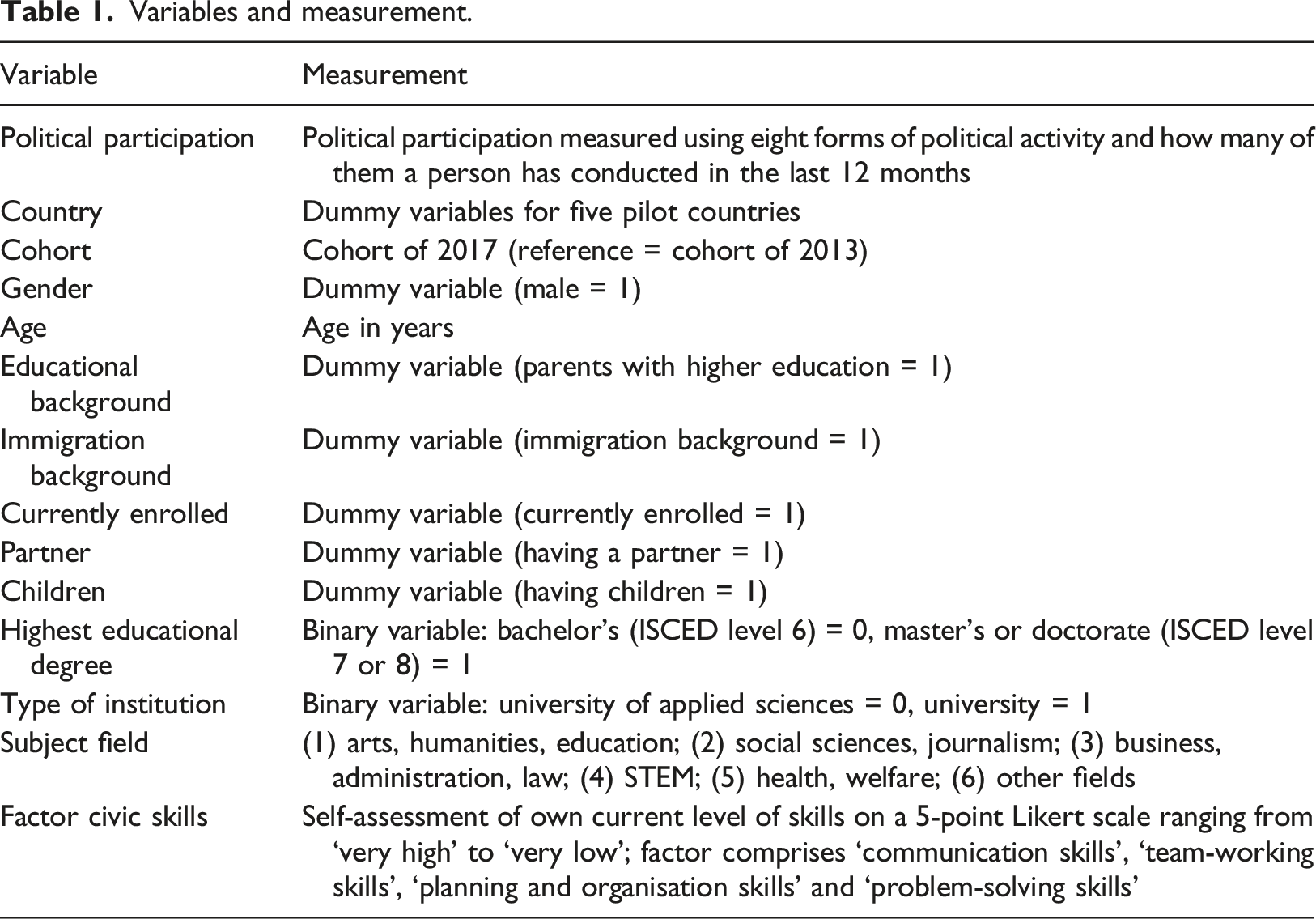
The dependent variable of our analyses is political participation, measured with eight forms of political activity (e.g. participating in a demonstration, posting online on political issues or having contacted a politician) and how many of them the respondent has performed in the last 12 months. On average, the respondents in our analytical sample conducted 1.5 political activities in the last 12 months, with a range from zero to eight activities.
This dependent variable was analysed through OLS regressions, including explanatory variables stepwise. Regression models were calculated jointly for all countries using dummy variables for the countries. In joint models, the interaction effects of country dummies and specific higher education variables were used to test whether the effects differ significantly by country. Additionally, we calculated country-specific models to understand more easily which explanatory factors are relevant (or irrelevant) in the respective country. We used Wald tests to test for differences in specific coefficients across regression models.
Variables and measurement.
Results
Overall country differences in political participation
Figure 1 gives a visual impression of the country differences in the political participation of higher education graduates. The average level of political participation in Austria (the reference country) is 1.85 activities in the last 12 months. This is the highest level of political participation observed in the five countries. Without control variables, graduates in all the countries show significantly lower levels of participation but to notably different degrees. While graduates in the Czech Republic have more or less the same level of political participation as those in Austria, graduates in Malta and Norway diverge somewhat more strongly. The lowest level of political participation is observed for Croatia. Coefficient plot for the effect of country dummies on political participation (reference = Austria). Control variables: Cohort, gender, age, educational background, immigration background, enrolment status, partner, children, civic skills, degree, type of institution, and field of study.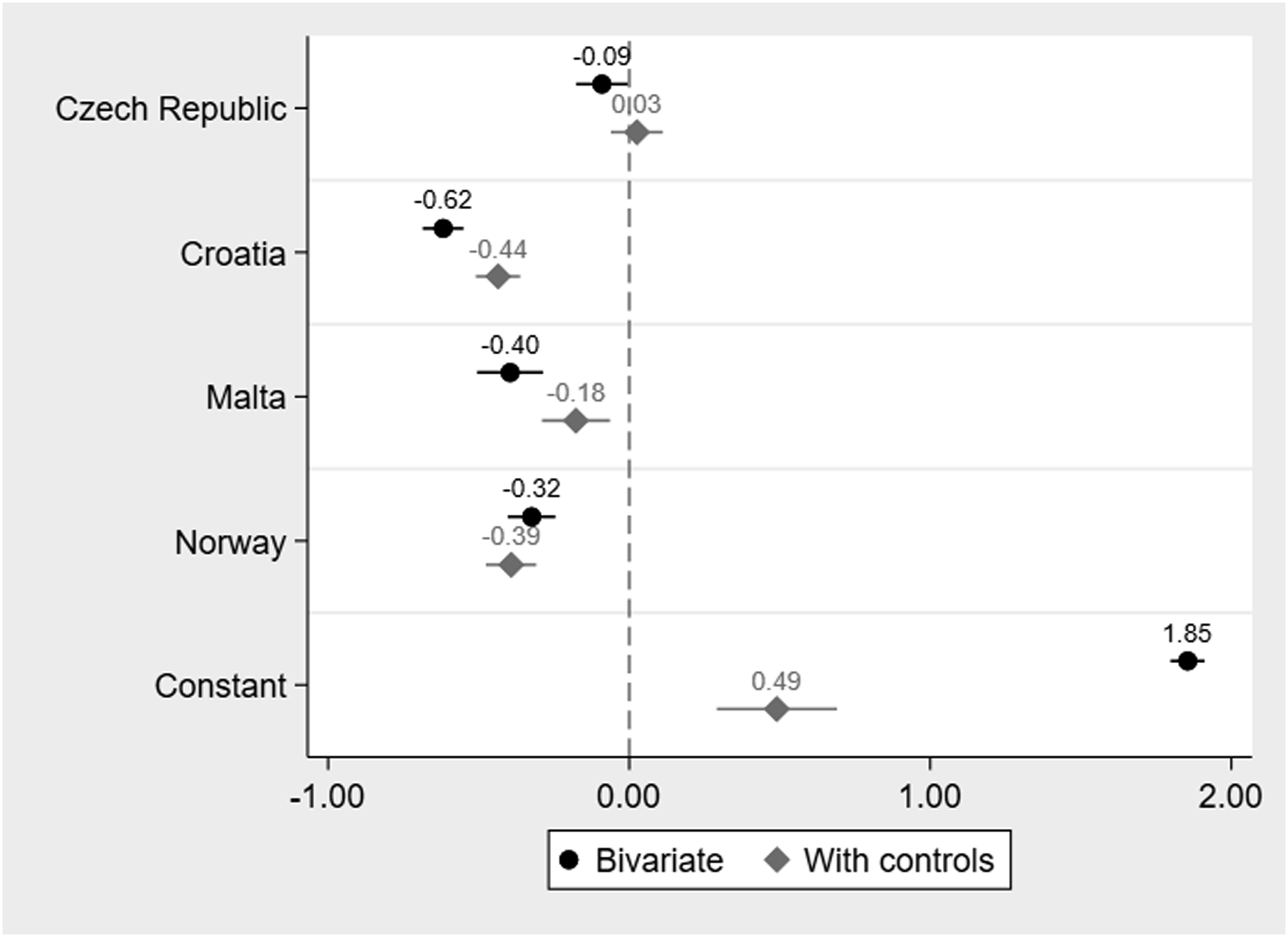
Comparing the coefficients from the bivariate model with the coefficients from the full model with control variables shows that our model explains some of the country differences for Croatia and Malta but few for the Czech Republic and Norway. 2 Which variables are relevant for explaining some of the level differences? For Croatian graduates, the lower level of political participation compared with Austrian graduates is, amongst others, associated with the enrolment status and the fields of study. Compared with all the other countries, the proportion of enrolled graduates is largest in Austria and enrolled graduates are more likely to become politically active. Moreover, graduates in Croatia to a lesser extent have study fields like arts and humanities or social sciences, both of which are associated with higher levels of political participation. For Malta, the variable with the largest impact on the country’s difference from Austria is the educational background. Graduates of Malta have by far the smallest share of graduates with a higher education background, with less than 20%. A higher education background increases the likelihood of becoming politically active.
Besides the variables in our model, there are obviously other reasons for the differences in the level of political participation, like the country’s history, the political culture or political issues at the time of the survey. This point is beyond the scope of this paper, but, quite generally, the country differences in political participation reflect the country differences in political interest observed for our respondents.
Drivers of political participation
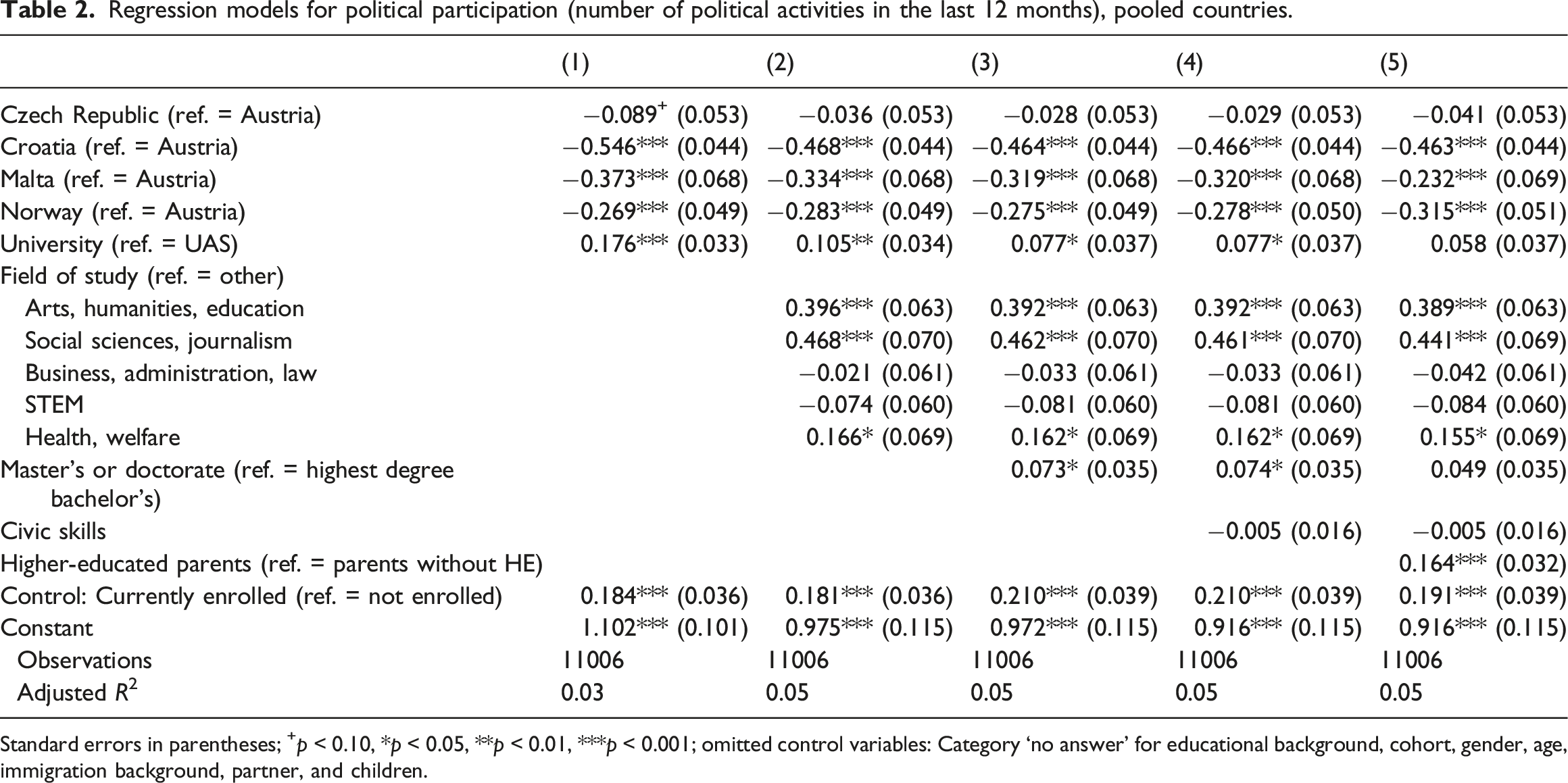
Regression models for political participation (number of political activities in the last 12 months), pooled countries.
Standard errors in parentheses; +p < 0.10, *p < 0.05, **p < 0.01, ***p < 0.001; omitted control variables: Category ‘no answer’ for educational background, cohort, gender, age, immigration background, partner, and children.
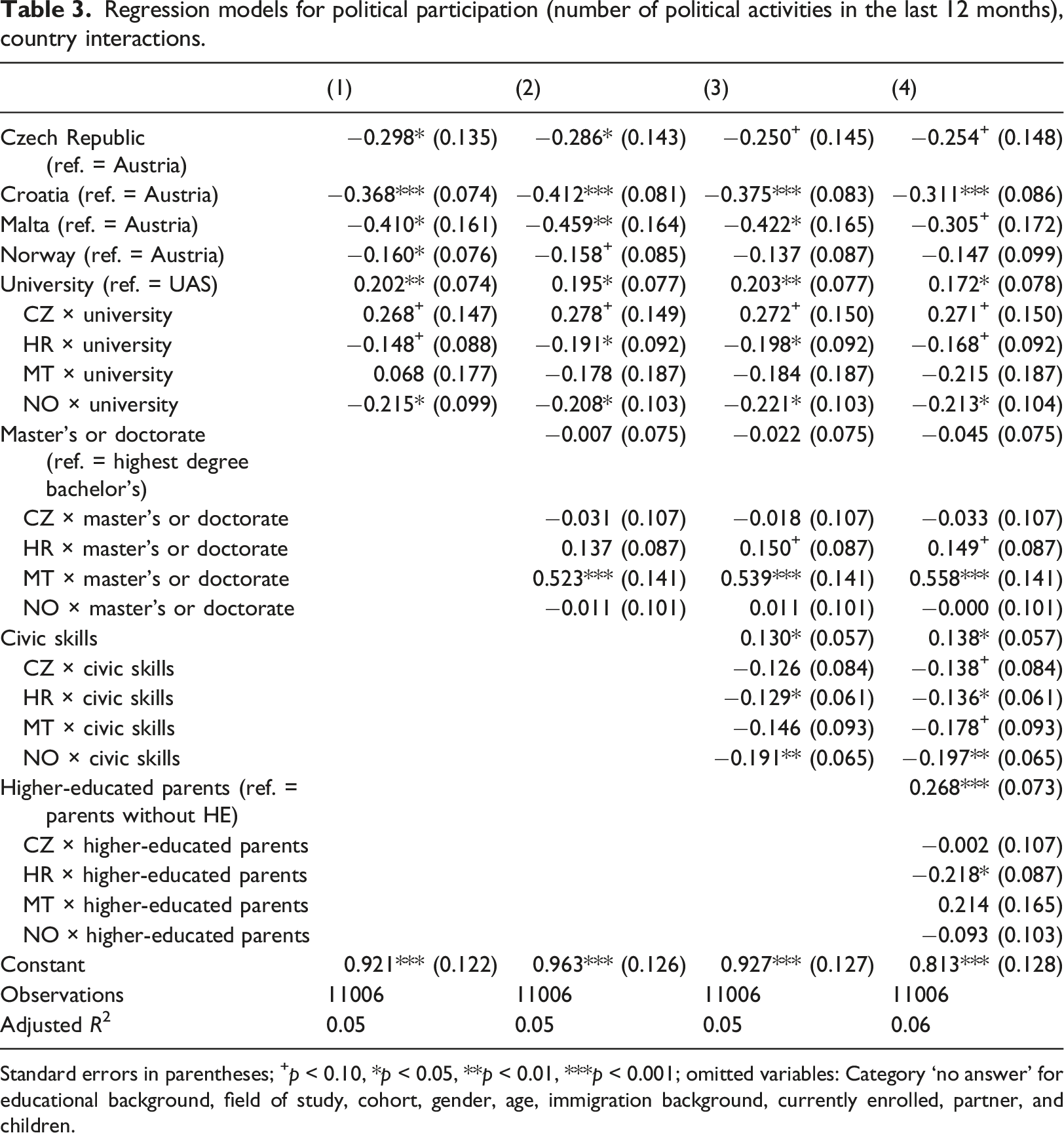
Regression models for political participation (number of political activities in the last 12 months), country interactions.
Standard errors in parentheses; +p < 0.10, *p < 0.05, **p < 0.01, ***p < 0.001; omitted variables: Category ‘no answer’ for educational background, field of study, cohort, gender, age, immigration background, currently enrolled, partner, and children.
For all the models, the same set of control variables is applied. We control for socio-demographic characteristics, specifically gender, age, immigration and current situation and living conditions, that is, being enrolled, having a partner and having children. While the latter two have no significant effect on the level of political participation (coefficients are omitted from the tables), being enrolled has a strong positive effect throughout all the models (see Table 2). Apparently, higher education as an environment is enabling political activism to flourish. Student groups are bringing about opportunities to participate politically. A spirit of free and critical thinking, which we hope is prevalent in higher education, could fuel political activity as well. Being a student and thus usually not being employed full time may also leave more time to become politically active.
Individual-level drivers of political participation
The first three models of Table 2 investigate the effects of higher education characteristics. Model 1 introduces the type of institution and shows that being a (research) university graduate is accompanied by a higher level of participation than having graduated from a university of applied sciences. This seems to confirm hypothesis 1 (for a final evaluation of our hypotheses, the comparative perspective will be taken into account as well). The interplay of this variable with the factors that are added in the subsequent models is interesting.
After adding field of study in model 2, the effect of the higher education institution loses some of its strength (the difference is statistically significant). This indicates that the gap in the political participation of the graduates of these two types of institutions is to some extent due to differences in the fields of study or study programmes offered. As suspected, arts, humanities and education as well as social sciences and journalism seem to be the subjects that lead to a comparable higher political participation level. This corroborates hypothesis 2, although not in the sense of a causal effect as we do not know the extent to which graduates of such subjects have already differed in aspects relevant to political participation before studying.
Type of degree, added in model 3, has a significant effect as well. Master’s and doctoral graduates show higher political participation than bachelor’s graduates; more and longer exposure to higher education seems to have the expected positive effect (hypothesis 3). Again, we observe a certain drop in the effect of the type of institution when adding this variable; however, it is insignificant.
Model 4 reveals that the civic skills variable does not seem to have any impact on political participation. As a robustness check, civic skills were regressed on political participation in a variety of variable configurations, but the null effect is a stable finding. Table 3 below shows that the effect differs by country, but, in the overall analysis, hypothesis 4 is rejected. Hypothesis 4a is rejected as well. According to our analysis, the effect of higher education characteristics (type of institution, field of study and kind of degree) is not partially explained by civic skills as a possible mechanism.
In model 5, the educational background is added as another explanatory factor. As assumed, even among academics, the educational background has an impact on the level of political participation. Graduates with parents with higher education are politically more active than graduates with parents with lower levels of education. Even though we may, based on a broad range of research, assume that having participated in higher education will have added to the political activism of all graduates, it does not fully mitigate the group differences in participation due to the social background.
In model 5, the effect of the higher education institutions is no longer significant. As the gradual decline shows, the lower level of political participation of graduates of universities of applied sciences can be explained fully by the specific (more technical) subjects taught, the lower level of higher education degrees and the social composition of students, with a larger proportion of low-SES students attending universities of applied sciences. We tested for differences in the coefficients of models 4 and 5. The effects of type of institution, field of social sciences and journalism, and type of degree become statistically significant smaller when controlling for social origin. This means that some of the observed differences in political participation of higher education graduates are due to social selection rather than the higher education characteristics in question.
Country differences in drivers of political participation
In the second step, we look at country differences (Table 3). The country dummies indicate that Austria is the country with the highest level of political participation in the sample (model 1). Although Norway does not significantly differ from Austria in models 2 and 3, it shows a moderate level of participation only and hypothesis 6 is clearly rejected.
The focus of Table 3 is to test for country differences in the drivers of political participation by means of interaction effects. Note that no interaction effects are included for fields of study as there are no statistically significant country differences (see Table A1 in the appendix). This is an interesting finding as it shows that the positive association of certain fields of study (arts, humanities and education as well as social sciences and journalism) with political participation works independently of the national context (for the five countries investigated).
In model 1, we consider the interactions between country dummies and the type of higher education institution as well as the type of degree. As in the overall analysis presented in Table 2, the main effect (i.e. the effect for Austria as the reference country) confirms the higher political participation of university graduates. The interaction effect for Norway shows that the type of institution makes less of a difference to political participation than it does in Austria. This supports hypothesis 7, which suggested a stronger effect for countries with early tracking and strong segregation (Austria) than for countries with low segregation (Norway). In Croatia, the difference in political participation between university graduates and graduates of universities of applied sciences is smaller than that in Austria as well. The largest effect is observed for the Czech Republic. Note that country differences in this regard resemble differences in the social composition of graduates (analyses not shown). In the Czech Republic, graduates of both types of institutions differ most strongly in their educational background. Substantial differences can also be observed in Austria and, as an exception to the pattern, Croatia. In Norway and Malta, the educational background does not differ significantly between graduates of the two types of institutions.
The results for the type of degree in Table 3 reveal a surprise (model 2). While the results of Table 2 lead us to assume an overall positive effect of the level of higher education on political participation (in line with hypothesis 2), Table 3 shows that this effect only occurs in Malta. Maltese graduates with a master’s or a doctoral degree are indeed much more politically active than their peers with a bachelor’s degree, but this pattern is not repeated across countries where the effect of more (higher) education beyond the bachelor’s degree seems to be negligible. In most countries investigated, more than 60% of the graduates in our sample have a degree at the master’s (or doctoral) level. In contrast, in Malta, the proportion of master’s- and doctoral-level graduates is slightly below 50%. These higher-level degrees seem to be more exclusive in Malta than in the other countries.
Civic skills as a mechanism are considered in model 3. While, in the models without interaction effects, this factor did not show a significant effect (Table 2), in Table 3, we observe the expected positive effect on participation – but only for Austria. The interaction effects for all the other countries are negative and significant, leading to a suppression effect in the overall model in Table 2. This confirms hypothesis 8, which states that civic skills have a stronger effect in more segregated countries (like Austria), keeping in mind the qualification that the effect is only observed in Austria.
Model 4, finally, considers the interaction effects between the level of parental educational and the country dummies. The coefficients indicate that the social background matters less for political participation in Croatia than in Austria. In hypothesis 9, we assumed a stronger effect of the social background for countries with high stratification. This seems to be the case to some extent, but the effect for Austria does not differ significantly from the effect for Norway as a country with low educational stratification. Note that the education system of Croatia is described as relatively stratified with persisting social inequalities in access to higher education (Doolan et al., 2017; Matković, 2010). At the same time, the comparative perspective of Table 3 confirms these results and provides the additional insight that graduates with academic parents are more politically active in all countries but Croatia.
Discussion and conclusions
The objective of this paper was to investigate the link between higher education and political participation by studying heterogeneities within higher education. Considering only higher education graduates, we focused on the mechanisms that could contribute to differences in the levels of political participation of this group. Three theoretical mechanisms were suggested that could contribute to such differences: (1) improved skills for political participation, (2) status attainment motivation and (3) political socialisation experiences in the context of families, peer groups or educational institutions. How can we evaluate our hypotheses against the backdrop of our empirical findings and what do the results tell us about the mechanisms at stake?
Hypothesis 1 suggested that graduates of research universities participate more in politics than graduates of universities of applied sciences due to a more general orientation of the education in universities but also due to social selectivity, which channels persons with a higher social background to universities. By and large, this hypothesis is confirmed. The results of the overall analysis as well as those for Austria, Croatia and the Czech Republic support the assertion that higher education graduates differ in their political participation in relation to the type of institution that they attended. No such differences were observed for Norway and Malta. Regarding the theoretical mechanisms mentioned above, all three could cause the difference in graduates of both types of institutions: more skills of university graduates, a higher social background or political socialisation. The effects of other explanatory factors (discussed below) and the interplay with the effect of the type of institution shed some more light on the mechanisms at work.
Hypothesis 2 postulated that graduates of fields of study close to the social and political realm show higher levels of political participation. Indeed, graduates in arts, humanities and education as well as social sciences and journalism show significantly higher levels of political participation. This clearly hints at mechanisms 1 (skills) and 3 (socialisation) being relevant to the political participation of higher education graduates. We do not know the extent to which graduates in such fields of study already differed from graduates in other fields before higher education in characteristics that foster political participation. In fact, it is very likely that students in such fields had a stronger political interest or self-image as a politically active person before studying. At the same time, it is quite unlikely that studying subjects closer to political and social topics would not have fostered such characteristics. Thus, recalling that the effect of the type of institution dropped significantly when controlling for fields of study, one could argue that the differences between fields of study suggest that skills effects and socialisation effects are relevant to the differences in political participation among higher education graduates.
Regarding hypothesis 3, we only found some support in the data from Malta that the level of the higher education degree is associated with higher political participation. In all the other countries, this hypothesis is clearly rejected. Apparently, for the group of highly educated persons, adding even more education does not make much of a difference for political participation. An interesting finding is that graduates with a master’s-level degree reported even lower levels of political participation than their peers with a bachelor’s-level degree if we did not control for enrolment status. We considered enrolment status, having a partner, having children and age in our models to control for the different life circumstances of graduates with different degrees. Thus, we assume that our finding on the effect of the level of higher education is relatively robust.
In theory, civic skills are highlighted as a key factor for the link between (higher) education and political participation (hypothesis 4). Our results indicate a rather weak role of civic skills for higher education graduates, however. Only in Austria were civic skills shown to boost the level of political participation among graduates. Hence, by and large, hypothesis 4 is rejected. Moreover, hypothesis 4a postulated a mediating role of civic skills. Accordingly, civic skills would partially explain the differences in political participation observed for graduates with different higher education characteristics (type of institution, kind of degree and field of study). This, though, is not the case. Our data do not confirm such a mediating effect of civic skills. Given the key role of civic skills in theories of political participation, these findings are surprising. A possible reason is that civic skills vary too little among academics. This interpretation is in line with our finding that the level of the higher education degree has no effect in most countries. In any case, our findings do not support skills as an important mechanism, which is in contrast to the theoretical expectations. Note, however, that we only measured civic skills directly and could not control for other kinds of skills.
Hypothesis 5 suggests that graduates with a higher social background are politically more active. Our findings confirm that hypothesis. Hypothesis 5a postulated a mediating role of the social background. In fact, our results show that the social background accounts for some of the differences in political participation among higher education graduates, namely, the type of institution, the kind of degree and the social sciences and journalism fields.
To sum up, our results show that higher education graduates systematically differ in their political participation regarding their type of institution, field of study and social background. Moreover, the social background explains some of the differences in the type of institution, field of study and degree. Thus, our results clearly confirm status attainment motivation and socialisation in the family as relevant mechanisms for political participation. In contrast, the degree of higher education and civic skills are only relevant in one country each. This indicates that the mechanism of improved skills does not play a major role in explaining the differences in levels of political participation within the group of highly educated persons. Note that this is not to say that the level of education and skills is generally irrelevant to political participation. As we are only considering the group of higher education graduates, we cannot test the extent to which higher education generally provides the skills necessary for political participation.
Theoretical reasoning did not lead us to a clear hypothesis on country differences in the level of participation of graduates. However, we postulated working hypothesis 6, suggesting that graduates in Norway are most politically active due to the overall level of education in the country. This hypothesis is clearly rejected. Graduates in Austria show the highest level of political participation, followed by graduates from the Czech Republic. Norwegian graduates instead show a medium level of participation among the five countries investigated. Apparently, other factors are relevant to the cross-country differences in the level of political participation of higher education graduates, for example, the political culture and current political issues. As argued above, it could also be the case that a more selective higher education system leads to comparatively high levels of political participation within the group of higher education graduates due to having more of an elite status than those in comprehensive systems. Finally, our finding could be due to the measurement of political participation, which does not consider the most common form of participation in democracies, namely, voting.
Hypotheses 7 to 9 postulated interaction effects of countries and explanatory factors of political participation. We assumed that, in countries with a highly stratified education system, the link between explanatory factors and political participation would be stronger. Hypothesis 7 predicted such an interaction effect for higher education characteristics. All in all, hypothesis 7, concerning a stronger effect of higher education characteristics in countries with high stratification, is confirmed with qualifications only. We observe such a difference for the type of institution but not for the kind of degree or field of study. Hypothesis 8 predicted a similar interaction effect for civic skills. This hypothesis is confirmed. For Austria, we observe a significant positive relationship of civic skills with political participation, and for Norway, the coefficient is significantly smaller. It should be kept in mind, however, that civic skills had a positive effect in Austria only. Hypothesis 9, finally, postulated that the link between social background and political participation should be stronger in countries with a highly stratified education system. This is confirmed with qualifications. The effect of parents’ education was positive in Austria and insignificant in Norway. The difference between the two effects was not significant, but the effect of the educational background was relatively small in Norway and significantly smaller than in Malta.
Last but not least, our results show that the effects of some factors are moderated by the country context while others are more universal in nature. The effects of the type of institution and educational background are related to the level of stratification of the education system. In contrast, the differences between graduates of different fields of study seem to be more universal in nature.
An important limitation of our results relates to the cross-sectional design of the study, which does not allow us to see how political participation changes over individual trajectories through higher education. Furthermore, the low number of countries in the EUROGRADUATE data only allows for a comparison of single countries and does not enable us to draw conclusions regarding the variety of higher education systems in Europe. Due to the low number of countries, we also had to refrain from multilevel analysis, modelling how the higher education system features in a country shape the political participation of the graduates.
Drawing final conclusions from the results, policymakers should be aware that vocationally oriented fields of study as well as studying at universities of applied sciences mitigate the effect of higher education on political participation. Moreover, graduates with a lower social background report a lower level of participation. Policymakers could consider specifically encouraging the participation of such groups during higher education, for example, through targeted grant programmes. Moreover, highly stratified education systems aggravate social differences in political participation. Measures to reduce educational stratification could therefore contribute to equitable participation and vivid democracies at the same time.
Footnotes
Acknowledgement
We thank the editors for patiently coordinating the special issue. We are indebted to two anonymous reviewers for their constructive comments, which considerably contributed to improving the paper.
Declaration of conflicting interests
The author(s) declared no potential conflicts of interest with respect to the research, authorship, and/or publication of this article.
Funding
The author(s) received no financial support for the research, authorship, and/or publication of this article.