



Abstract
Research in second language teacher education (SLTE) is critical for making short- and long-term policies and decisions about SLTE programs, materials, methods, etc. Therefore, it is essential to know the “what,” “how,” and “where” of SLTE research. Hence, the purpose of this synchronic study was to investigate research topics (what) and the research methodologies (how) of SLTE papers published in international and Iranian journals (where) between 2014 and 2020. To that end, we investigated a corpus, including 100 articles, consisting of 50 SLTE papers published in seven international journals and 50 SLTE papers published in seven Iranian journals. Results indicated that while there were significant differences in using qualitative and quantitative research methodologies by SLTE papers published in international and Iranian journals, there were no significant differences in using mixed methods in those journals. Moreover, results showed that the most frequent SLTE topics addressed in the papers published in international and Iranian journals were teacher professional development, teacher psychology, teacher identity, teacher cognition, teacher belief, teacher knowledge, practitioner research, teacher education design, sociocultural theory, teacher practice, and teacher and culture. However, there were no significant differences in SLTE topics addressed in the SLTE papers published in international and Iranian journals.
Keywords
Introduction
Teacher education comes into view in the mid-nineteenth century. Research played a significant role in different aspects of teacher education, especially in examining what kind of knowledge and skills teachers need to teach appropriately (Cochran-Smith and Demers, 2008). Therefore, research as one of the complex concepts is a key requirement for developing teachers’ new knowledge (Smith, 2015). According to Cochran-Smith and Demers (2008), the history and development of research in teacher education shifted from “teacher behavior to teachers’ knowledge, learning, thinking, and ideas” (1010). The shift shows that research in teacher education is not static, but it is a dynamic phenomenon. The shifts, therefore, can be influential in emerging new research categories in teacher education or putting an end to them.
There can be mentioned several categories for research in teacher education. There are different questions, aims, and methods for each category. It can be essential for researchers to reach better sense of choices by understanding the differences among categories. In addition, there should be a link between the choices and what the researchers know about the current issues in the field (Floden, 2008). Hence, there is a critical demand for examining research in teacher education to understand which categories should be emphasized and which ones are not the primary focus of the researchers. The main objective can be to obtain the needs, importance, scope, and context of teacher education, such as program evaluation, teacher proficiency, and knowledge. This objective can turn into the focus of research in teacher education across disciplines such as second language teacher education.
Second language teacher education (SLTE) was coined by Richards (1990), covering second language teachers’ preparation, training, and education. Developing SLTE programs can be addressed by researching SLTE objectives such as program evaluation, curriculum preparation, and materials development. Therefore, it is essential to find a comprehensive view of the research done in SLTE to see “what” is done, “where,” and “how” to obtain a rigorous understanding of what should be done in SLTE research. While there is a large body of studies concerning different aspects of SLTE, there are a few studies about research topics and methodologies of teacher education research (e.g., Livingston and Flores, 2017), especially regarding SLTE research (e.g., Demir and Koçyiğit, 2018). Therefore, there is a lack of comparable studies about research topics and methodologies in SLTE published in local (national) and global (international) contexts.
Consequently, to reach a comprehensive picture of research topics and methodologies used in SLTE papers published in local and global contexts, it is essential to conduct studies examining the SLTE papers published in local and international journals. Moreover, it is crucial to know which topics have been addressed locally and globally and which ones have not. By so doing, the interrelationships between SLTE topics and methodologies in the locally and globally published SLTE papers can be revealed. Therefore, the current study’s purpose was to synchronically investigate the research topics and methodologies of the SLTE papers published in international (global) and Iranian (local) journals from 2014 to 2020. We addressed this study synchronically since we believed that the time interval that we examined (from 2014 to 2020, 6 years) was not enough to show us the turning points (Sahragard and Meihami, 2016) in the research methodologies and topics of the SLTE papers published in international and Iranian journals. Moreover, one more reason for addressing the study synchronically was that some Iranian and international journals did not publish SLTE papers in some years, making it unreliable to set the data analysis and interpretations diachronically (Rashidi and Meihami, 2018).
It is also critical to mention why we examined SLTE papers from 2014 to 2020. Firstly, since we compared the research topics and methodologies of SLTE papers in the international and Iranian journals, we needed to set a starting point shared by all the journals to select the papers. It was not difficult for the international journals because they had a longer publication history compared to Iranian journals. However, when it came to Iranian journals, finding a shared starting point was difficult since they had different starting points of publication. Since 2014 was shared by the seven Iranian journals we wanted to examine, we set 2014 as the starting point of this synchronic investigation. Secondly, we wanted to obtain a more recent picture of SLTE research topics and methodologies; therefore, we selected the most recent available interval, 2014–2020. Moreover, it should be notified that the journals’ 2020 volumes were completed at the time of doing this study (June 2021); consequently, we set the shared final point of publication at 2020 for all the journals, including international and Iranian.
Based on the rationales mentioned above, the main significance of the study is multidimensional. First, the findings can show us the trends of SLTE topics and research methodologies in the international and Iranian SLTE communities of practice. Second, the interrelationships between SLTE topics and research methodologies are provided to develop our understanding of which research methodologies are used to address which SLTE topics. Third, the co-occurrences among the SLTE topics are obtained to provide the SLTE practitioners with the multilayered SLTE topics. Accordingly, and to achieve such significance, we sought to provide answers to the following questions: (1) What were research methodologies used in SLTE papers published in international and Iranian journals between 2014 and 2020? (2) What were research topics addressed in SLTE papers published in international and Iranian journals between 2014 and 2020? (3) How were the SLTE topics co-occurrences in SLTE papers published in international and Iranian journals between 2024 and 2020? (4) How were the topics and research methodologies co-occurrences in the SLTE papers published in international and Iranian journals between 2014 and 2020?
Methodology
The corpus of the study
To address the research questions of this study, we examined a corpus of SLTE papers published in Iranian and international journals between 2014 and 2020. We used different criteria to create a reliable corpus representing SLTE papers published in Iranian and international journals. The first criterion was related to selecting the journals to be included in the corpus. The selected journals met the following criteria: ➢ The international applied linguistics journals’ whose Scimago ranks were within the interval of 1–50 in 2020 (See the Link). ➢ The Iranian applied linguistics journals, whose ranks were A and B by the Iranian Ministry of Science, Research and Technology in 2020 (See the Link). ➢ Both international and Iranian journals published SLTE papers between 2014 and 2020. ➢ Both international and Iranian journals should include SLTE in their aims and scopes. ➢ Both international and Iranian journals should have peer-review procedures.
Based on the first set of criteria, seven international and seven Iranian applied linguistics journals were selected (Table 1). The selected papers also met the following criteria: ➢ The papers were published between 2014 and 2020. ➢ The papers should be within the realm of SLTE. ➢ The papers should be research articles; therefore, the reviews, commentaries, communications, etc. were not included. ➢ The topics should include language teachers, language teachers’ learning and professional development, language teacher cognition, emotion, agency, motivation, language teachers’ pedagogical practice, etc. ➢ For the Iranian journals, the authors of the papers had to be Iranian. However, for the international journals, the authors could be international ones, including Iranian researchers. ➢ The authors had to mention their research objectives and methodologies in their studies explicitly. ➢ The mentioned research methodologies by the authors need to be in line with the definitions and descriptions of those research methodologies provided in the Corpus Analysis section (See below). Information of the journals used to create the corpus.
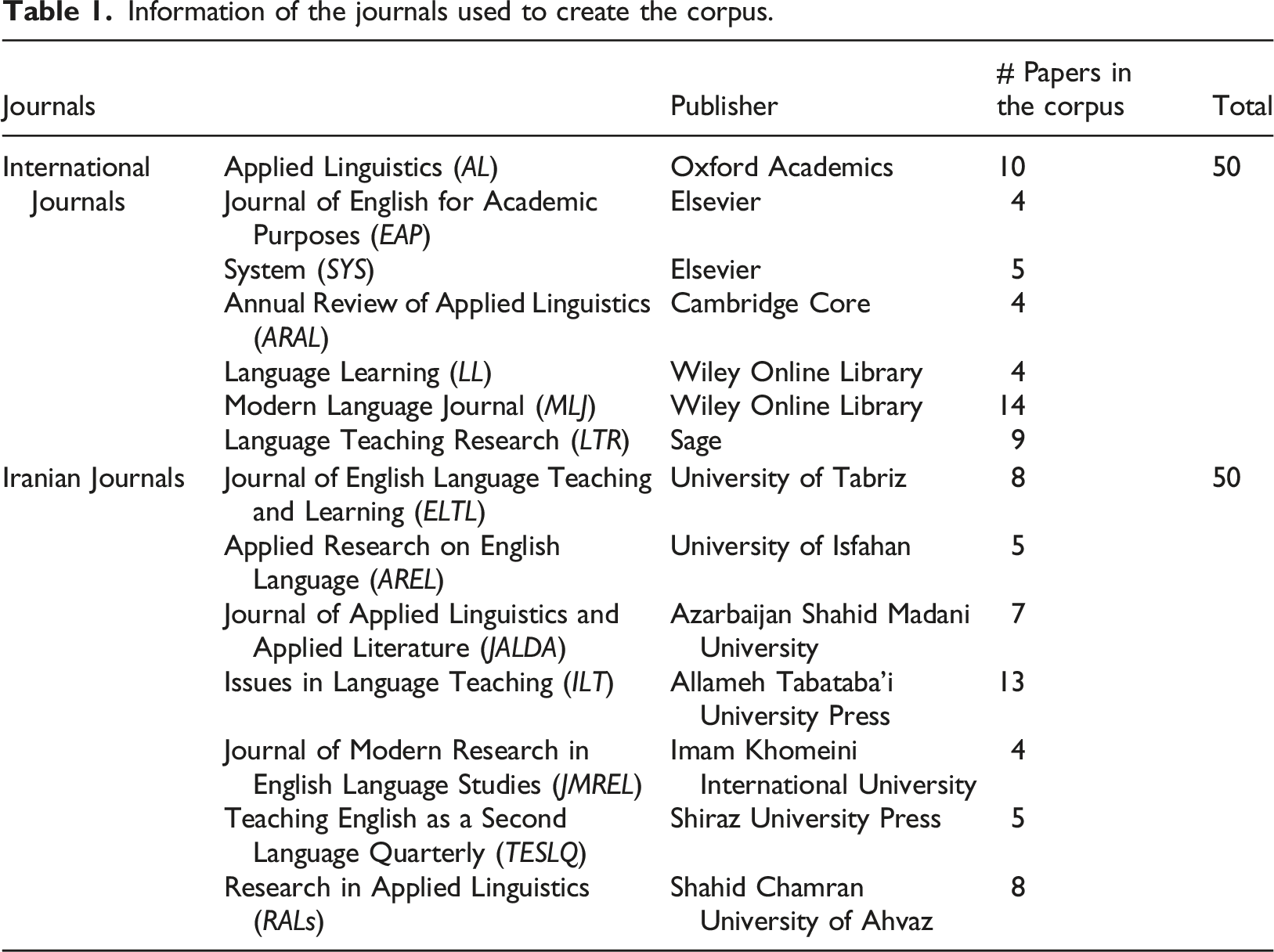
By addressing these criteria, we chose 50 SLTE papers published in seven Iranian journals that met the criteria and 50 SLTE papers published in the seven international L2 journals, which sufficed the criteria. These papers were in line with all of the mentioned criteria. Table 1 indicates the information about the corpus of the study.
Corpus analysis: codifying the data deductively
We conducted a corpus analysis to answer the four research questions. We codified the data gathered in the corpus to obtain the research topics and methodologies of the SLTE papers published in Iranian and international journals. Moreover, we attempted to obtain the interrelationships and co-occurrences among the SLTE topics and the research methodologies by codifying the data. We codified the data to obtain the research methodologies deductively, meaning that we used the definitions and descriptions of different research methodologies and topics to assign each paper to a research methodology and a topic.
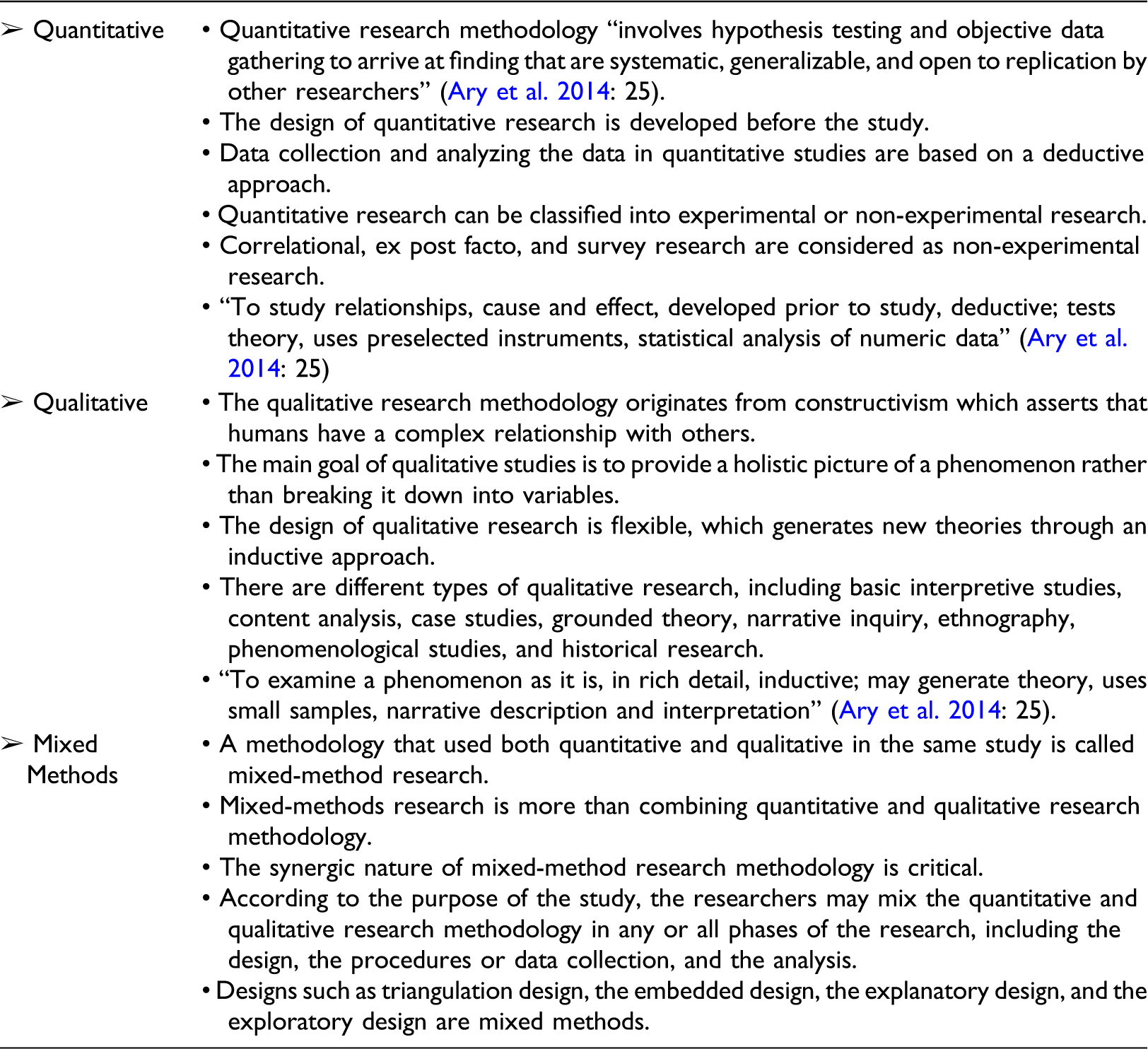
Based on these definitions, descriptions, and accounts, we codified the research methodologies. For example, we codified the study entitled “bringing a social semiotic perspective to secondary teacher education in the United States” (Accurso, 2020; published in EAP) as a mixed-method study since Accurso (2020: 1) explicitly stated, “based on a mixed methods study of this approach, this article highlights two longitudinal findings…” The explicit utterances of the researchers whose papers were included in our corpus helped us develop the codifications’ credibility.
We followed the same procedure to codify the topics of SLTE papers. To do so, we created some codes related to the main topics of SLTE papers. It is important to note that we used the scholars’ academic definitions as the criteria for each code. For instance, we codified SLTE papers related to teacher knowledge when (1) the authors explicitly mentioned that their paper is about teacher knowledge and (2) when the topics were related to the following definitions, descriptions, and accounts: ➢ Borg (2006) stated that teacher knowledge is related to what the teachers think, know, and believe. Thus, “Terms such as pedagogical knowledge (Gatbonton, 1999), content knowledge (Grossman, 1989), pedagogical content knowledge (Shulman, 1986), personal practical knowledge (Connelly and Clandinin, 1987), knowledge about language (Borg, 2005), knowledge in action, theories for practice, personal theories (Sendan and Roberts, 1998), knowledge base for teaching (Freeman and Johnson, 1998), professional knowledge in action (Wette, 2010), among many other variants, have all attempted to capture different aspects of what a language teacher thinks, knows, believes” (Woods and Çakır, 2011: 383).
For example, the paper authored by Van Canh (2018) entitled “remapping the teacher knowledge-base of language teacher education: A Vietnamese perspective,” which was published in LTR, met the two criteria to be codified as teacher knowledge and teacher education design. First, it is related to teacher education design since Van Canh (2018: 1) mentioned explicitly that “this article argues that rather than sideline knowledge of learners in favor of subject matter knowledge and pedagogical content knowledge as the basis of the knowledge base of LTE.” Second, the paper addressed the relationships between subject-matter knowledge, pedagogical knowledge, and learners’ knowledge, which can be categorized under teacher knowledge based on the aforementioned concepts.
It is critical to mention three important points in this section. First, when a paper has more than one topic, we codified it several times, meaning that we assigned the paper to more than one code. Second, we used MAXQDA 20 to analyze the corpus. This software helped us find the interrelationships and co-occurrences between/within the topics and research methodologies. Third, to develop the inter-coder reliability of the analysis, both researchers codified the corpus. The codifications were done through the TeamWork tools of MAXQDA 20. Then, we obtained the coder agreement which was 90%. The high inter-coder agreement was due to the discussions and practices that the researchers had about the procedures of codifications before starting it.
Results
The following paragraphs provide the corpus analysis results associated with each research question.
What were the research methodologies used in SLTE papers published in international and Iranian journals between 2014 and 2020?
We addressed the first research question by obtaining the frequencies of research methodologies used in each SLTE paper. We used Subcodes Statistics provided by MAXQDA 20, in which the SLTE papers were codified based on research methodologies. Figures 1 and 2 indicate the results of the research methodologies used in SLTE papers published in international and Iranian journals between 2014 and 2020. Research Methodology of the SLTE Papers Published in International Journals During 2014–2020. Research Methodology of the SLTE Papers Published in Iranian Journals During 2014–2020.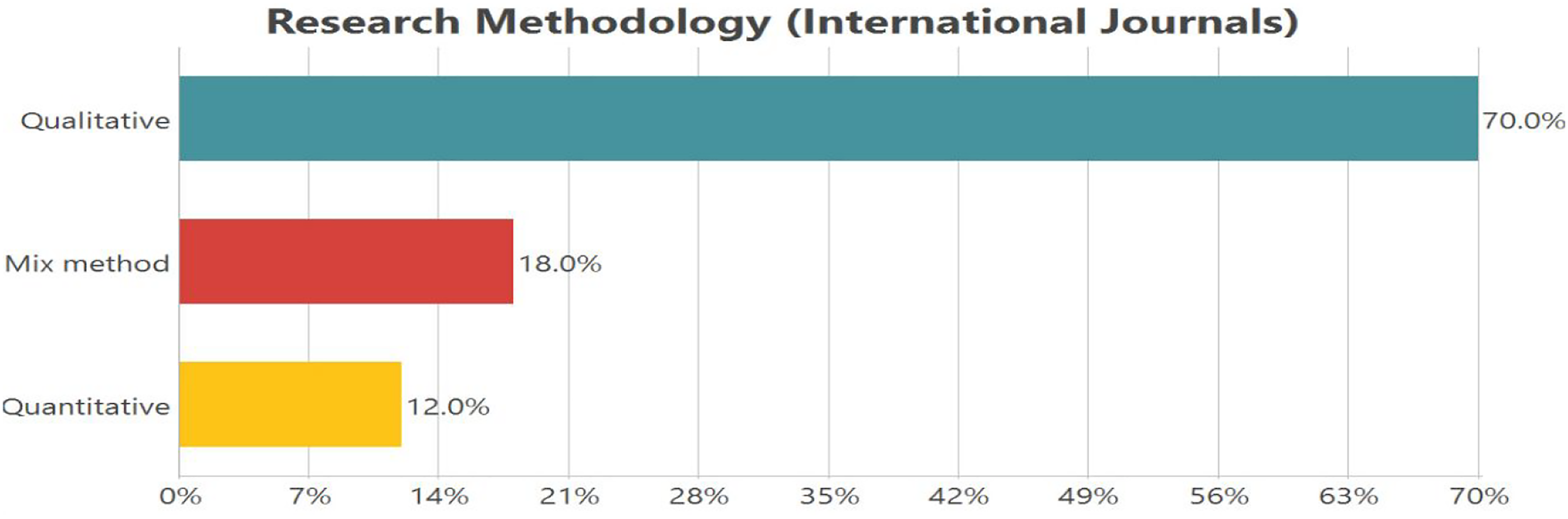
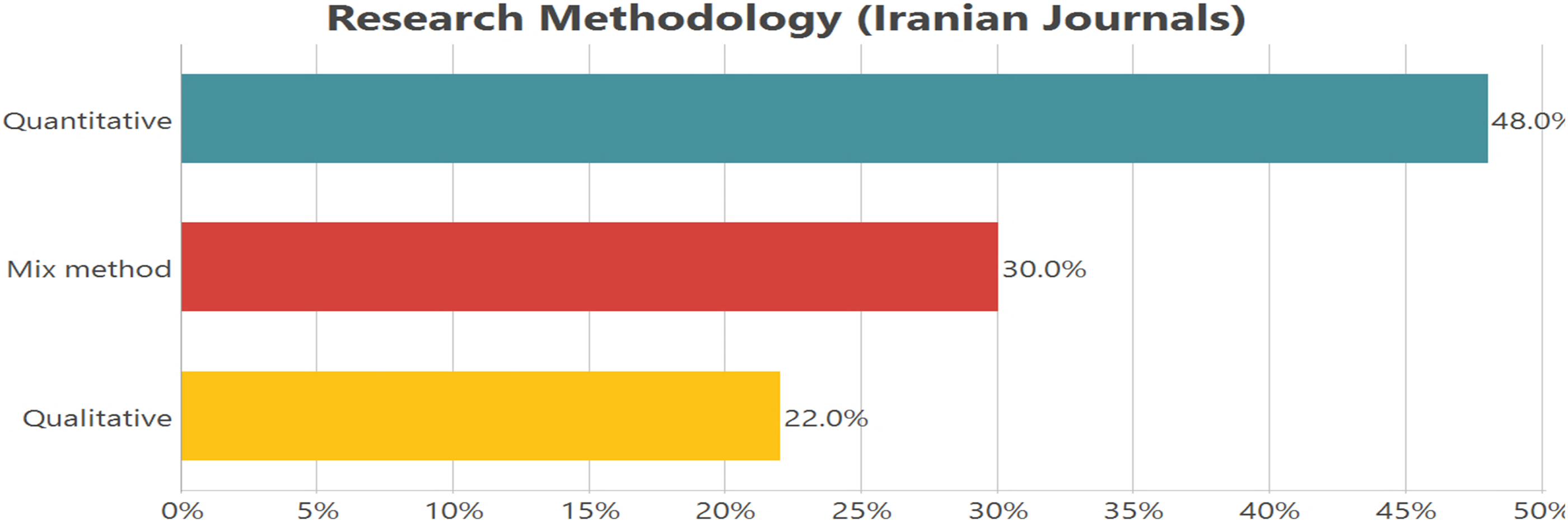
Figures 1 and 2 show the differences in the research methodologies used in the SLTE papers published in international and Iranian journals. While 70% of the international SLTE papers had a qualitative methodology, only 22% of the SLTE papers published in Iranian journals followed a qualitative methodology. Moreover, whereas SLTE papers published in Iranian journals used 48% of quantitative methodology to address their purposes, only 12% of the SLTE papers published in the international journals followed quantitative methodology. Finally, Figures 1 and 2 indicate that 30% of the SLTE papers published in Iranian journals used mixed-methods research, while 18% of the SLTE papers published in international journals used this research methodology.
Document group * research methodologies crostbulation.
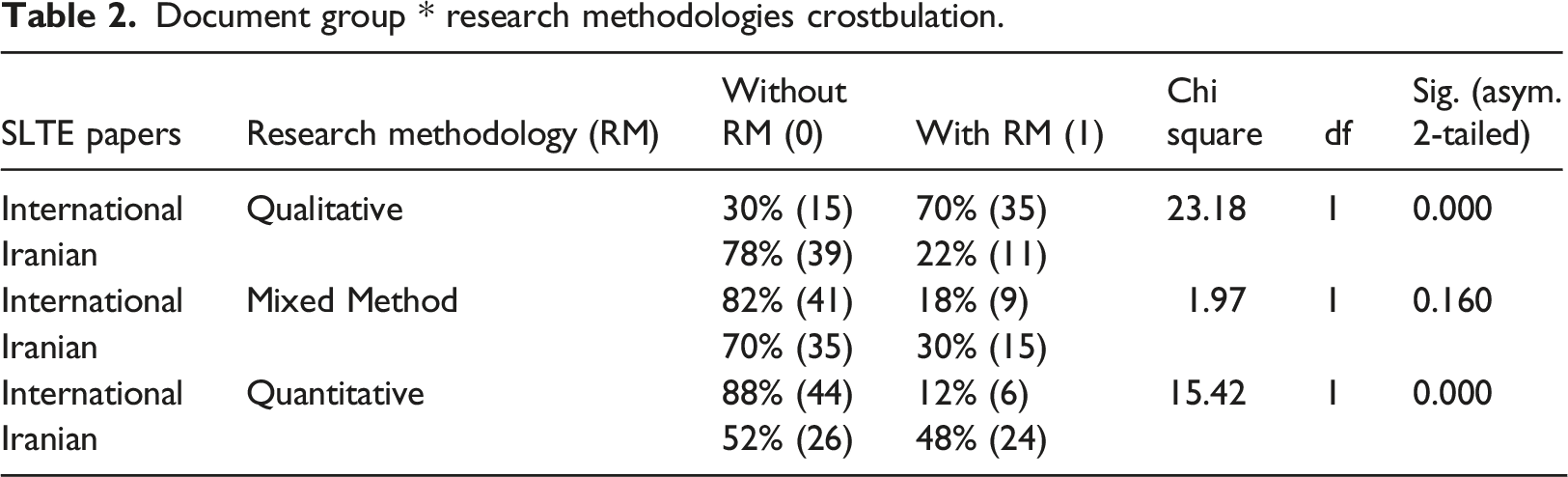
Table 2 shows significant differences between international and Iranian SLTE papers that used qualitative methods (χ2 (1, n = 100) = 23.18, p = .000). Moreover, Table 2 indicates significant differences between international and Iranian SLTE papers that used quantitative methods (χ2 (1, n = 100) = 15.42, p = .000). However, it was revealed that there were no significant differences between international and Iranian SLTE papers that used mixed methods (χ2 (1, n = 100) = 1.97, p = .160). Therefore, it can be stated that the SLTE papers published in international and Iranian journals were significantly different in using qualitative and quantitative methods, while no such differences were observed concerning using the mixed-methods research.
What were research topics addressed in SLTE papers published in international and Iranian journals between 2014 and 2020?
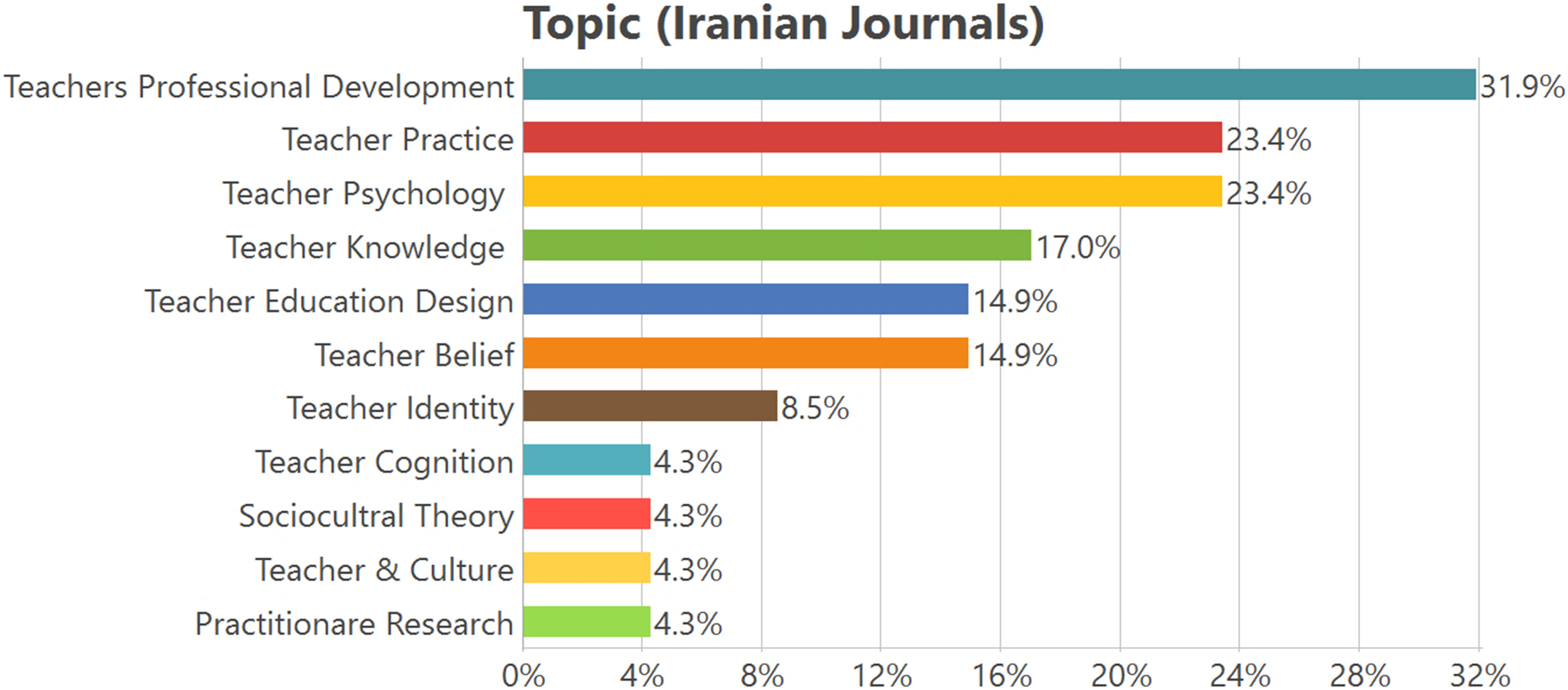
We addressed the second research question by obtaining the frequencies of topics addressed in each SLTE paper. We used Subcodes Statistics provided by MAXQDA 20, in which the SLTE papers were codified based on SLTE topics. Figures 3 and 4 indicate the results of the research topics addressed in SLTE papers published in international and Iranian journals between 2014 and 2020. Research Topics of the SLTE Papers Published in International Journals During 2014–2020 (Note: Since some of the papers addressed more than one topic; therefore, the total percentage is more than 100). Research Topics of the SLTE Papers Published in Iranian Journals During 2014–2020 (Note: Since some of the papers addressed more than one topic; therefore, the total percentage is more than 100).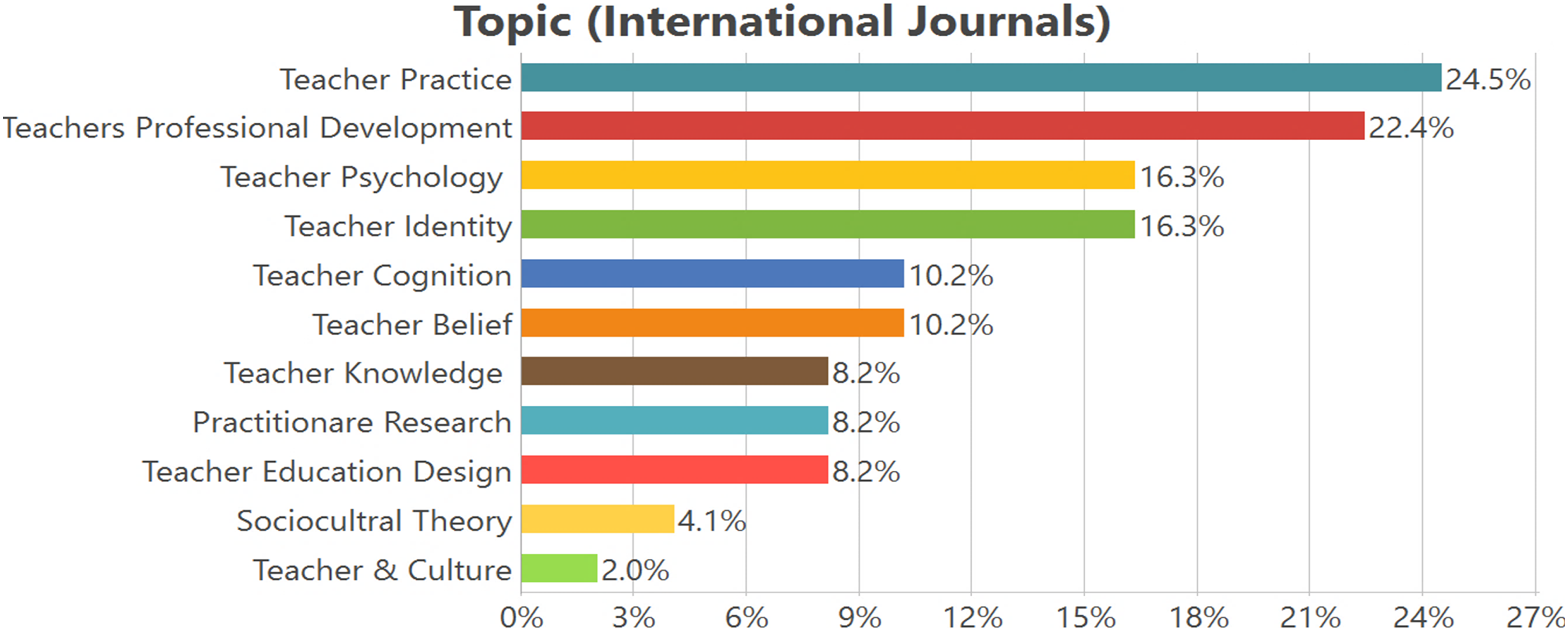
Document group * research topics crosstabs.
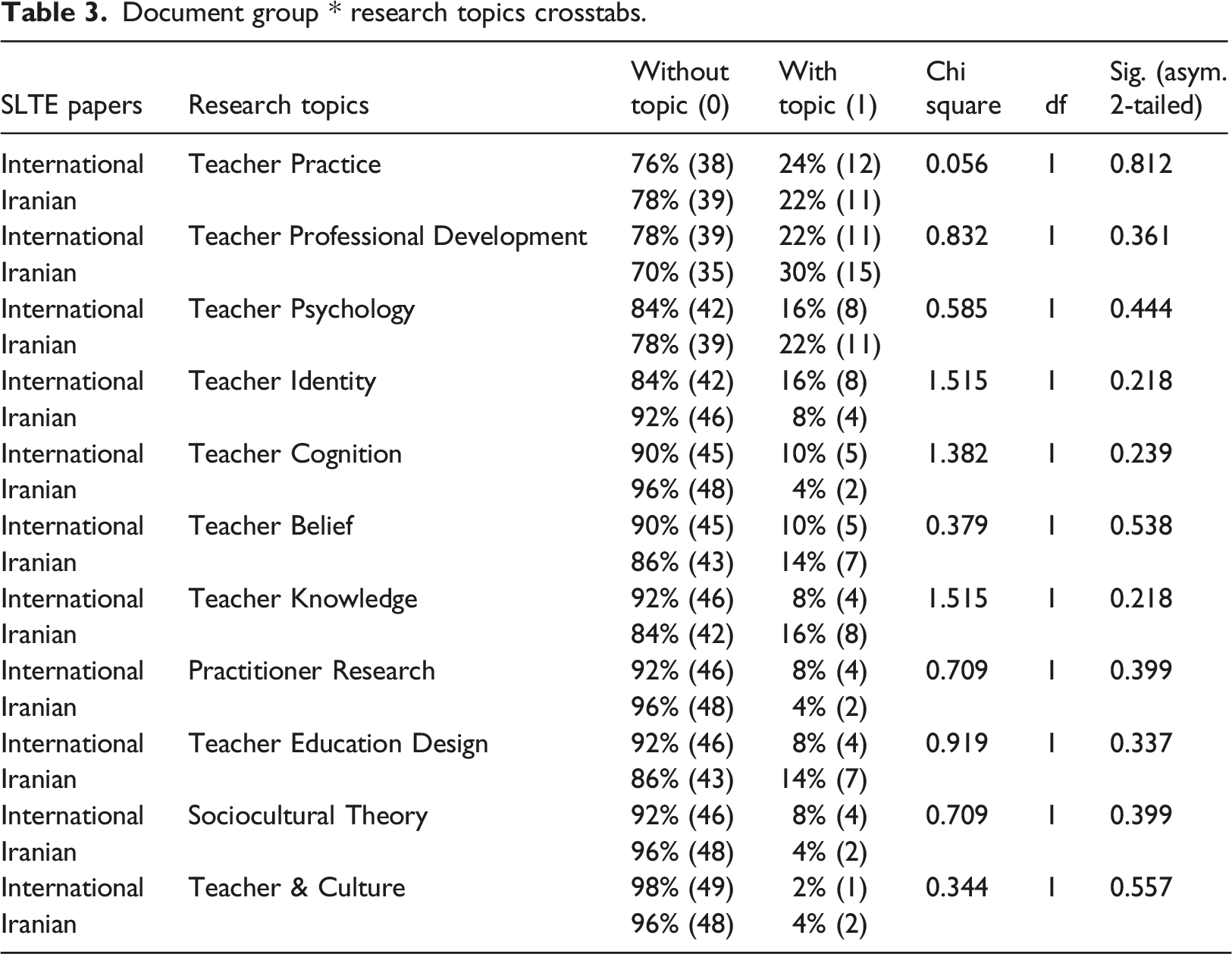
Table 3 indicates that there were no significant differences in the SLTE topics addressed in the SLTE papers published in international and Iranian journals during 2014 and 2020 (teacher practice: χ2 (1, n = 100) = 0.056, p = .812; teacher professional development: χ2 (1, n = 100) = 0.832, p = .361; teacher psychology: χ2 (1, n = 100) = 0.585, p = .444; teacher identity: χ2 (1, n = 100) = 1.515, p = .218; teacher cognition: χ2 (1, n = 100) = 1.382, p = .239; teacher belief: χ2 (1, n = 100) = 0.379, p = .538; teacher knowledge: χ2 (1, n = 100) = 1.515, p = .218; practitioner research: χ2 (1, n = 100) = 0.709, p = .399; teacher education design: χ2 (1, n = 100) = 0.919, p = .337; sociocultural theory: χ2 (1, n = 100) = 0.709, p = .399; and teacher and culture: χ2 (1, n = 100) = 0.344, p = .557). The results show that although SLTE topics were addressed with different priorities by international and Iranian researchers, the differences were not significant.
How were the SLTE topics co-occurrences in SLTE papers published in international and Iranian journals between 2014 and 2020?
One of the quests of this study was to investigate the co-occurrences among the SLTE topics. We have already understood from Figures 3 and 4 that some of the SLTE papers published in international and Iranian journals addressed more than one topic (it can be figured out through the total percentage, which was more than 100). Therefore, we run Code Relation Browser (CRB) to visualize the relationships between codes. CBR illustrates how many segments were coded with the row’s and column’s codes. Simply, it shows the co-occurrences of the codes in documents. Each circle is the symbol of the co-occurrence of two codes; therefore, the larger the symbol, the more the number of co-occurrences of the two codes. Figure 5 shows the results of CRB for the SLTE papers published in international and Iranian journals. The Interrelationships Among the Topics of the SLTE Papers Published in International and Iranian Journals.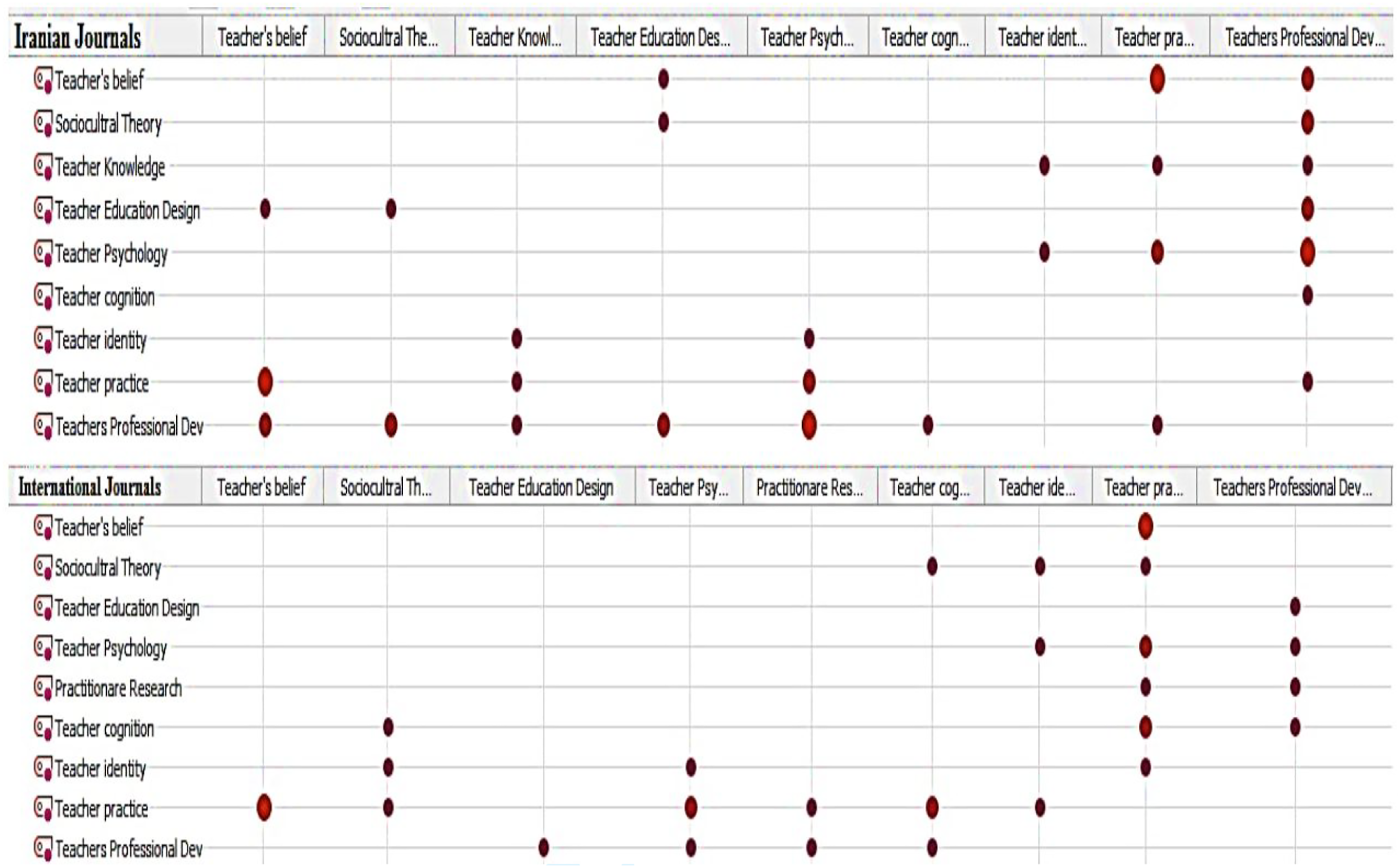
Figure 5 shows that the SLTE papers about teacher professional development published in Iranian journals had topic co-occurrences with all of the topics, except for teacher identity. In contrast, SLTE papers about teacher professional development published in international journals had topic co-occurrences with teacher education design, teacher psychology, practitioner research, and teacher cognition. SLTE papers about teacher practice published in Iranian journals had topic co-occurrences with teacher beliefs, teacher knowledge, teacher psychology, and teacher professional development. In contrast, SLTE papers about teacher practice published in international journals had topic co-occurrences with all of the topics, except for teacher education design and teacher professional development. Moreover, Figure 5 shows that SLTE papers about teacher identity published in Iranian journals had topic co-occurrences only with teacher knowledge and teacher psychology, while SLTE papers about teacher identity published in international journals had topic co-occurrences with sociocultural theory, teacher practice, and teacher psychology. The only topic that co-occurred with teacher cognition in SLTE papers published in Iranian journals was teacher professional development, whereas two more topics, including sociocultural theory and teacher practice, co-occurred with teacher cognition in the SLTE papers published in international journals. Concerning the SLTE topics related to teacher psychology, there was a similarity between the paper published in Iranian and international journals in that teacher psychology co-occurred with teacher identity, teacher practice, and teacher professional development.
Furthermore, Figure 5 shows that SLTE papers about teacher education design published in Iranian journals had topic co-occurrences with teacher belief, sociocultural theory, and teacher professional development, while SLTE papers about teacher education design published in international journals only co-occurred with teacher professional development. SLTE papers about teacher knowledge published in Iranian journals had topic co-occurrences with teacher identity, teacher practice, and teacher professional development, whereas SLTE papers published in international journals about teacher knowledge had topic co-occurrences with no other topic, so it is not shown in Figure 5. Additionally, SLTE papers about sociocultural theory published in Iranian journals had topic co-occurrences with teacher education design and teacher professional development, whereas SLTE papers about sociocultural theory published in international journals had topic co-occurrences with teacher cognition, teacher identity, and teacher practice. Finally, SLTE papers about teacher belief published in Iranian journals had topic co-occurrences with teacher education design, teacher practice, and teacher professional development, whereas SLTE papers about teacher belief published in international journals had only topic co-occurrences with teacher practice. It should be stated that SLTE papers about practitioner research published in international journals had topic co-occurrences with teacher practice and teacher professional development, whereas SLTE papers about practitioner research published in Iranian journals had topic co-occurrences with no other topic, so it is not shown in Figure 5.
How were the topics and research methodologies co-occurrences in the SLTE papers published in international and Iranian journals between 2014 and 2020?
Our final quest in this study was to examine the probable co-occurrences between topics and research methodologies of the SLTE papers published in international and Iranian journals between 2014 and 2020. To do so, we run another CBR. The CBR finds the co-occurrences of the SLTE topics with the research methodologies. Figure 6 shows the CBR results showing the co-occurrences between topics and research methodologies of the SLTE papers published in international and Iranian journals between 2014 and 2020. The Interrelationships Among the Topics and Research Methodologies of the SLTE Papers Published in International and Iranian Journals.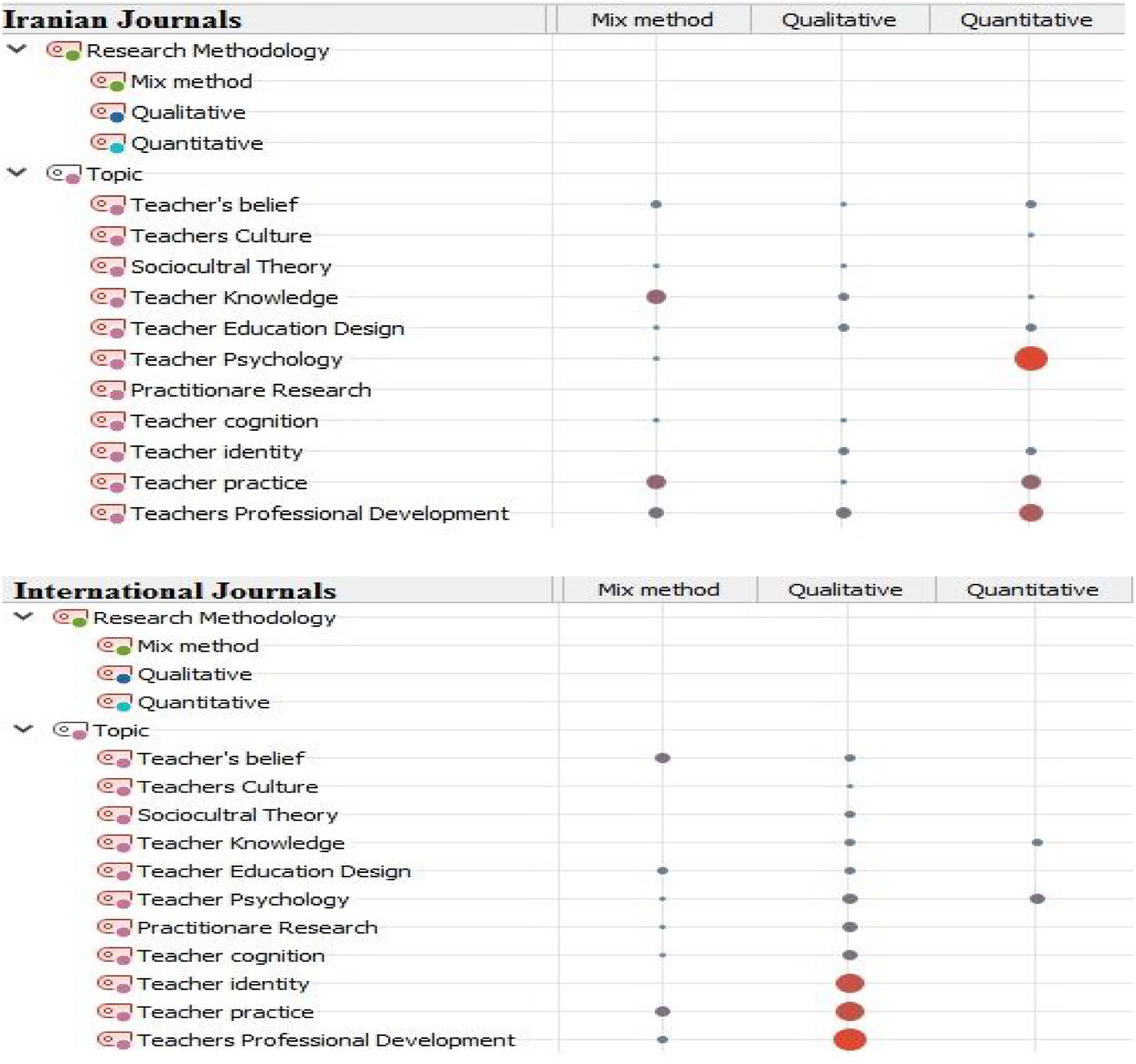
Figure 6 shows the interrelationships between topics and research methodologies of the SLTE papers published in international and Iranian journals. First, it can be seen that while SLTE papers published in Iranian journals used quantitative research methodologies to address all SLTE topics (except for sociocultural theory, practitioner research, and teacher cognition), SLTE papers published in international journals used quantitative research methodologies only to address teacher knowledge and teacher psychology. On the one hand, SLTE papers published in international journals used qualitative research methodologies to address all SLTE topics; on the other hand, SLTE papers published in Iranian journals used qualitative research methodologies to address some of the SLTE topics, including teacher belief, teacher knowledge, sociocultural theory, teacher education design, teacher practice, teacher professional development, teacher identity, and teacher cognition. Finally, SLTE papers published in Iranian journals used mixed-methods methodologies to address all SLTE topics, except for teacher and culture, practitioner research, and teacher identity, while SLTE papers published in international journals used mixed-methods methodologies to address all SLTE topics, except for teacher and culture, sociocultural theory, teacher knowledge, and teacher identity. Qualitatively speaking, we can observe larger symbols under quantitative research methodologies for the SLTE papers published in Iranian journals, while this is the case for qualitative research methodology for the SLTE papers published in international journals. Consequently, it supports what we have already reported in Table 2, in which there were significant differences between the use of qualitative and quantitative research methodologies in SLTE papers published in international and Iranian journals.
Discussion
The results of this study indicated significant differences in using qualitative and quantitative research methodologies by SLTE papers published in international and Iranian journals, but there were no significant differences in using mixed methods in those journals (Table 2). The results showed that the most frequent SLTE topics addressed in the papers published in international and Iranian journals were teacher professional development, teacher psychology, teacher identity, teacher cognition, teacher belief, teacher knowledge, practitioner research, teacher education design, sociocultural theory, teacher practice, and teacher and culture (Figures 3 and 4). Furthermore, the results illustrated that the SLTE topic that had the most co-occurrences with other SLTE topics in SLTE papers published in Iranian journals was teacher professional development, while it was teacher practice that had the most co-occurrences with other SLTE topics in SLTE papers published in international journals (Figure 5). Finally, the results showed that international researchers addressed SLTE topics mostly through qualitative methodology.
The study’s findings concerning the significant differences in using qualitative and quantitative research methodologies in SLTE papers published in international and Iranian journals can be argued in some ways. First, there are various issues with conducting qualitative research, such as methodological, technical, and ethical issues (Bakhshi et al., 2019), which might hinder Iranian researchers from framing their SLTE studies based on qualitative methodology (Meihami, 2020a). Second, since international journals selected in this study were among the top-tier journals of applied linguistics, it can be stated that the most experienced researchers would publish in such journals. Therefore, these experienced researchers were expert enough to tackle the methodological, technical, and ethical issues of addressing SLTE topics and using qualitative research methodology to conduct their studies. Furthermore, these experienced researchers were expert enough to tackle the methodological, technical, and ethical issues of qualitative research methodology to conduct their SLTE studies. Thus, based on the argument, the significant difference between Iranian and international journals concerning using qualitative research methodologies to address SLTE topics might be due to the larger number of experienced qualitative researchers who published in international journals compared to Iranian journals (Meihami, 2020a). It is also in line with the international dissertations published in applied linguistics that follow more qualitative approaches (Anderson et al., 2020). It shows that there is an international tendency toward using qualitative research methodology in applied linguistics that requires professional development on the part of the researchers.
Another argument for the differences observed in using qualitative and quantitative methodologies to address SLTE topics can be the overall preferences of the community of practice (CoP) (Wenger, 1998). SLTE topics are mostly addressed by applied linguists who are members of applied linguistics CoP. In the current study, although all of the SLTE papers were published in applied linguistics CoP, we can argue that there were two CoPs, a macro CoP that was the international journals and a micro CoP which was the Iranian journals. Although some differences can be observed between micro and macro CoPs, some commonalities are also possible. It can be argued that while the international journals, as the representations of the macro CoP, followed the qualitative methodology as the preferred research methodology in the recent decade (Benson et al., 2009) to address SLTE topics, Iranian journals tended to follow quantitative methodology, as the preferred research methodology in the past decades (Meihami, 2020b), to address SLTE topics. However, the insignificant differences observed in using the mixed-methods methodology and SLTE topics covered by Iranian and international journals show the commonality between these micro and macro CoPs.
A relevant argument to CoP which can be used to argue the results obtained in this study is situational options, refereeing to the constraints imposed by journals, as the representations of applied linguistics CoP, on researchers’ practices (Ortega and Iberri-Shea, 2005). One of such constraints is the journals’ sensitivity to research methods (Atai et al., 2018) that may be interested in publishing papers with specific research methodologies, such as qualitative or quantitative. Such methodology-related constraints imposed on the CoP might be rooted in the journals’ editorial policies (Whissell, 2013). It seems that most Iranian journals of applied linguistics, as the main venues to publish SLTE papers, tend to publish quantitative studies addressing SLTE topics (Amini Farsani and Babaii, 2018), while international journals of applied linguistics prefer SLTE papers with a qualitative methodology. The commonality of the Iranian and international journals regarding publishing SLTE papers is the mixed-methods methodology. One reason that mixed-methods methodology is the common research methodology between the Iranian and international journals to publish SLTE papers is that it can suffice the preferences of both quantitative and qualitative proponents (Hashemi, 2012). Moreover, mixed-methods research extends the research instruments, data analysis, and findings (Hashemi and Babaii, 2013) which can enhance the quality of inferences (Tashakkori and Teddlie, 2008), convincing Iranian and international researchers to design their SLTE research by using mixed-methods research.
The SLTE topics co-occurrences observed in the current study highlight the developmental nature of SLTE (Burns and Richards, 2009). This developmental nature presents many unexplored topics in SLTE (Johnson and Golombek, 2011) that need to be addressed. SLTE researchers, locally and globally, understand the associations of the SLTE topics, so they attempt to address such associations to obtain a more comprehensive understanding of SLTE. However, they have addressed the topics with different research methodologies to seek the objectives of their studies. Therefore, according to the current study’s findings and the discussions made above, the points of commonality of the SLTE papers published in Iranian and international journals are the SLTE topics. However, the points of departure are the research methodologies that the researchers used to investigate the SLTE topics in their studies. The results specify that SLTE research can benefit from a developmental research nature if researchers investigate the associations among SLTE topics (Rashidi and Meihami, 2018).
Conclusion and implications
Our work has led us to conclude that the Iranian and international researchers address similar SLTE topics by using different research methodologies. The evidence from the study suggests that there were no significant differences among the SLTE topics published in Iranian and international journals. However, it seems that Iranian researchers tended to address the SLTE topics through quantitative methodology while the international researchers showed a qualitative methodology preference.
Therefore, it can be concluded that Iranian and international researchers tend to cultivate their SLTE topics through different research methodologies. The study has enhanced our understanding of the differences and similarities observed in using research methodologies to address SLTE topics in the SLTE papers published in Iranian and international journals. To name the reasons, researchers’ experiences, the overall preferences of CoP, situational options, and the developmental natures of SLTE topics are influential in how SLTE topics are addressed in Iranian and international journals.
Furthermore, we conclude that Iranian SLTE researchers tend to choose their SLTE topics based on international trends, yet they choose the research methodologies to address those topics that adhere more to the local trends. That said, the Iranian SLTE researchers play their role in both international and local CoPs since they choose their topics in line with those of international CoP and do their studies based on the local CoP.
There are some implications for SLTE practitioners based on the current study results. First, we think that Iranian SLTE researchers need to consider qualitative methodology to be able to delve deep into the complex SLTE topics. Doing so may help them find a complete understanding of the challenges of SLTE in Iran. Moreover, by considering qualitative research methodology, Iranian SLTE researchers can provide a more comprehensive overview of the SLTE topics to be used in quantitative and mixed-methods research. Second, the SLTE topics obtained through the analysis of the Iranian and international applied linguistics journals can provide a good view of the critical SLTE topics for novice researchers interested in doing SLTE studies. Third, the editorial boards of Iranian applied linguistics journals need to know that if they want to be in line with the global trends concerning SLTE research, they need to make policies to direct their journals’ publications toward more qualitative studies in SLTE.
The current study is not without its limitations. First, since we tended to compare Iranian journals with international ones, we had to set the time interval between 2014 and 2020. We did so since not many Iranian journals were published before this interval. By setting the interval between 2014 and 2020, we could include a larger number of Iranian journals. However, on a wider level, we recommend that research is also needed in other countries that have applied linguistics journals with a longer history of publishing SLTE papers to examine the SLTE topics and research methodologies diachronically. We also believe that it is vital to investigate SLTE researchers’ assumptions in addressing different SLTE topics through using different research methodologies, both locally and globally, to enhance our understanding of SLTE research. Finally, although we showed the co-occurrences among the SLTE topics, we did not argue the “why” of such co-occurrences. Therefore, future researchers can design their studies to clarify the reasons for co-occurrences in SLTE topics.
Footnotes
Authors contributions
HM has done the theoretical aspects. FH has done data collection and analysis. The final manuscript has been compiled by both HM and FH.
Declaration of conflicting interests
The author(s) declared no potential conflicts of interest with respect to the research, authorship, and/or publication of this article.
Funding
The author(s) received no financial support for the research, authorship, and/or publication of this article.
