



Abstract
Educational researchers are increasingly expected to focus on their research productivity as per their professional performance. Such a trend may have influenced their professional identities and activities, especially in the Global South, where researchers have not been immersed in the new research culture and where their assumed primary role may be to increase teaching efficacy instead. The pervasive focus on research productivity is detrimental to the equitable research-practice relationship whereby two groups of professionals—practitioners and researchers—collaboratively work to achieve the common goal of student learning. This teacher-researcher epistemological clash may exist within individual researchers when they have abundant teaching experience prior to becoming educational researchers. Through the lens of activity theory, we report on a case study of educational researchers’ lived experiences and struggles of navigating teacher-researcher identities in Chile, entailing their boundary-crossing of teacher-researcher identities, internal and external identity conflicts, and beliefs and actions related to the ideal research-practice relationship. In conclusion, we call for changes at the institutional level to promote an equitable and manageable research-practice relationship as well as at the individual level to reflect the ultimate purpose of educational research.
Keywords
In the current academic world, professional evaluation and success for researchers are largely determined by their research productivity in the form of academic publications (Leal Filho et al., 2021; Rose, 2019). This occupational scheme, fueled by the higher education and publisher industries, may cause tension between the two primary commitments that educational researchers supposedly assume—that is, to further our theoretical understanding of learning-related issues and to solve pedagogical issues that teachers in the classroom face on a daily basis (Ball, 2012). Such an “identity dilemma” (Barkhuizen, 2021, p. 374) or “epistemological clash” (Sato & Loewen, 2022, p. 514) may exist particularly within educational researchers who are (a) new to the researcher community after having taught in the real-world classroom and/or (b) situated in Global South contexts where the Western norm of knowledge creation has recently affected the governmental and institutional policies regarding professional evaluation of researchers. In an article entitled “[t]he epistemic decolonial turn,” Grosfoguel (2007) stressed the importance of “studies with and from a subaltern perspective” (p. 211: emphasis in original) rather than Western researchers conducting studies about the Global South. Following this call, we, as local researchers, investigated researcher identities in Chile as a case study (see online Appendix A for our positionality). The participating researchers’ (and our) research area was applied linguistics. Like other educational subjects, applied linguistics is concerned with learning and teaching issues with a focus on second languages (e.g., Spanish as a second language in the United States, English as a second language around the globe, multilingual education in Europe, and indigenous language education).
In exploring the professional identity of educational researchers, the current study used the framework of activity theory designed to understand “different kinds of human practices as development processes, with both individual and social levels interlinked at the same time” (Kuutti, 1996, p. 25). Activity theory, developed by Engeström (1999), explains human goal-oriented behaviors with six interrelated elements—namely, subject (the person or the group who carries out the activity), object (goals that guide the action that the person takes), mediating artifacts (physical or symbolic tools that mediate the person’s activity system), community (the community that the person belongs to), rules (regulations and norms dictated by the context), and division of labor (roles and responsibilities that the community members take on). Due to its holistic approach to human activities, activity theory has been widely used to understand the professional identity of various occupations such as medical doctors; nurses; social workers; and, most prominently, teachers (e.g., Anastasiou & Hajisoteriou, 2022). We believe that activity theory is an ideal framework for understanding educational researchers’ professional identities for two reasons. First, the theory is suited for understanding the relationship between research and practice that inherently involves an intricate relationship between individuals (researchers), communities (e.g., university and academic networks), and social environment (e.g., professional requirements and expectations). Second, activity theory is useful for investigating identity conflicts (stress or dilemma) when an external force intervenes in one’s life, including a career change from a teacher to a researcher (Engeström, 1999).
In this article, we operationally use the term “researcher” to refer to a professional whose presumed duties include conducting and disseminating research in the form of academic publications. Unless otherwise specified, we use the term “teacher” to mean a professional whose primary duty is to teach a subject matter at the school level.
The Research-Practice Relationship
For decades, researchers have debated issues related to the lack of research use in practical settings across disciplines (e.g., medicine, engineering, and social work; see Head, 2010). The issue is often debated within the frameworks of evidence-based practice, evidence-based policy, and knowledge mobilization, all of which were conceptualized and supported by Western researchers in the hope that research evidence could be used for solving real-world issues (Mitchell et al., 2020). This effort is implemented by local governments and individual universities as, for instance, outreach. Despite the researchers’ concern, the research-practice gap remains to exist (see McLean & Sen, 2019), and several obstacles have been pointed out from teachers’ and researchers’ sides, albeit not from professionals’ perspectives who possess multiple identities as teacher and researcher (i.e., the target of the current investigation).
From teachers’ standpoints, primary obstacles are practical. First, with their multiple duties and daily tasks, they do not have time to actively search for research evidence, interpret the findings, adjust the findings to their local context, and devise pedagogical materials (see Sato & Loewen, 2022). Second, teachers may not be afforded physical and conceptual accessibility to research. Journal articles are often behind costly paywalls, and even when teachers have physical access to research, technical writing with jargon and complex statistical information prevents them from incorporating research evidence (Borg & Liu, 2013). In addition to practical obstacles, some teachers hold negative views about researchers. A teacher in Tavakoli and Howard’s (2012) study said, “I doubt most theoreticians have any understanding of the daily work load teachers face.” A teacher in Sato and Loewen’s (2019) study believed that researchers were “in their own circle.” In general, some teachers consider researchers as being “aloof within the ivory tower, espousing ideals and the principles that govern them” (Smagorinsky et al., 2003, p. 1399), leading to teachers’ emotional rejection of research and researchers (see Guilfoyle et al., 2020). In the current study, we explored researcher identities who used to be teachers. We suspected that their former identities as teachers may mediate the ways in which they navigate their current professional lives as researchers.
From the researchers’ standpoint, the primary obstacle is arguably the publication culture. Due to cultural and institutional expectations stemming from higher education and publisher industries, researchers’ professional success is largely defined by publications in highly ranked journals (Compagnucci & Spigarelli, 2020). Consequently, researchers’ attention and time are directed toward research production (McIntosh et al., 2019). This “neoliberal pushes for universities” (McKinley & Rose, 2018, p. 2) regarding knowledge creation has trickled down to the Global South in recent years (see Amutuhaire, 2022; Mitchell et al., 2020). In those contexts, educational researchers may not have gone through the incremental cultural change that the Western world has and may consider their primary professional duty to be to increase pedagogical efficacy in real-world classrooms. Note, however, that in the field of applied linguistics, researchers used to focus on pedagogical issues until the 1990s, when the field experienced rapid theoretical and methodological advancements (see Gass et al., 2021). As a result, more recent research issues tend to be detached from classroom teaching, although this does not mean that researchers disregard the pedagogical relevance of their research.
To counter those obstacles, more recent frameworks emphasize a balanced relationship between researchers and practitioners whereby two groups of professionals equally contribute to achieving the shared goal of student learning. These frameworks include research-practice partnership (see Sjölund et al., 2022), practice-based research (see Sato & Loewen, 2022), and design-based research (see Tinoca et al., 2022), all of which problematize the knowledge flow being conceived as unidirectional from researchers to practitioners. Despite these welcoming efforts, left in the middle of this conversation are professionals who possess experience and knowledge as both teachers and researchers. The current study examined how those professionals perceived and potentially mitigated issues related to the research-practice relationship.
Epistemological Clash of Professional Identities
The participants of the current study used to be school-level teachers prior to becoming educational researchers, so it is possible that their teacher identity is still alive and mediates with their researcher identity. Research has shown that teacher identity is affected by multiple factors, which in turn influence how teachers conduct themselves in their professional environments (Hiver & Whitehead, 2018). Several mediating factors for teachers’ agentive role have been reported. For one, when teachers feel “little prestige and/or privilege” (Slay & Smith, 2011, p. 85), their identity may be threatened and stigmatized. For another, people around them can influence their identity by reinforcing or challenging their current practices (Beauchamp & Thomas, 2009). Teachers’ local context influences their identity as well. In the current study’s context, Chile, Ávalos, and Sotomayor (2012) conducted interviews with Chilean teachers and reported that while the teachers valued the role of directly contributing to society, they also struggled with the tension between their goal of student learning and outcome measures (i.e., standardized tests scores). In another study in the Chilean context, Carrasco Aguilar et al. (2019) revealed that the participating teachers did not appreciate that people who are not in-service teachers (e.g., researchers and policymakers) tell them what to do in their classrooms. If the local society does not appreciate teaching jobs in general or there exists a tension between teacher identity and the local sociopolitical expectations, teachers may take action to change their occupation, including choosing to pursue an academic career (see Barkhuizen, 2021).
Research into professional identities, which is often conducted within the framework of activity theory, has shown that professional identity is constantly changing and often exhibits internal conflicts (e.g., Liu & Xu, 2011). A conflict can emerge when a professional’s epistemological beliefs seemingly do not align with evidence produced by educational researchers (Livingston, 2016). This seems to be the case, especially for those who cross the identity boundary between teacher and researcher. For instance, Wang and He (2022) investigated the identity of three school-level teachers who participated in a university-school collaboration project in which they were paired with researchers in responding to the Chinese governmental curriculum reform. The teachers were guided by researchers to carry out reform-related research in their respective schools. The interview data revealed that their activity systems evolved from teacher-focused to researcher-focused in a spiral manner by being immersed in the researcher community and conducting research by themselves. Although the study did not report any “identity stress” (i.e., questioning one’s own identity: see Pennington & Richards, 2016) by being a teacher and a researcher at the same time, the teachers clearly regarded the researchers as a source of knowledge who assume a higher social status.
Research on researcher identity is scarce, although some studies have focused on researchers’ beliefs of and attitudes toward teaching and teachers. In Vanderlinde and van Braak’s (2010) interview study with various stakeholders, the researchers expressed that communication with practitioners was not their primary concern; rather, they devoted their time to journal publications as mandated by their universities (see also Mula et al., 2022). Merga and Mason (2020) added that researchers had difficulty writing up their research in accessible language. In the Chilean context, Contreras Contreras et al. (2018) explored critical incidents (i.e., situations that cause destabilization of identity) of university-level instructors. The incidents included the multiple roles they were responsible for (e.g., teacher trainer, teacher, researcher, and administrator) and articulation of educational theories for preservice teachers who need practical teaching skills.
Yet, studies reported that researchers tend to be fairly confident in the practical value of their research (e.g., Ion et al., 2019; McLean & Sen, 2019). In the field of applied linguistics, Sato et al. (2022) conducted a survey with 217 researchers around the globe, 95% of whom used to be teachers. The exploratory factor analysis resulted in two distinct factors, one explaining researchers in general and the other the respondents themselves. Drawing on “person perception”—a theory that explains the phenomenon that people tend to value themselves (individual self) more favorably than the group they belong to (collective self), Sato et al. suggested a possibility that educational researchers may be holding onto their former teacher identity and, consequently, exhibit an ambivalent feeling toward their own researcher community.
The Current Study
Over a decade ago, Levin (2013) pointed out the irony of the research-practice research, saying: “The debate over the use of research is itself not well informed by research” (p. 4). Since then, a number of research studies have examined practitioners’ use and perceptions of research. However, research on researchers is still scarce. This is counterintuitive and counterproductive when researchers are considered stakeholders in the relationship (see Sato, 2023). The current study, therefore, narrowly focused on those who are transitioning from teacher to researcher so as to arrive at an understanding of how teachers’ everyday pedagogical challenges are considered (or forgotten) after they become researchers. The current study explored such a possibility in a case study in Chile, where educational researchers’ professional duties and expectations are rapidly changing in recent years. The following research questions guided the investigation.
RQ1: How do educational researchers in Chile develop and navigate their professional identities?
RQ2: How do their professional identities mediate their approaches to the research-practice relationship?
Methods
Context
Although Chile is currently considered part of the Global South, the country has been characterized by its stable economy and sustainable educational development (The World Bank, 2023). In 2019, the Chilean government spent 3.1% of its GDP on education, which is comparable to the G20 countries, whose average spending was 3.2% (Organisation for Economic Co-operation and Development, 2023). Meanwhile, in response to the global trend toward research productivity, the Chilean government created the Ministry of Science, Technology, Knowledge, and Innovation in 2018. The ministry oversees “research and development” of the country and took over the roles of another governmental unit that belonged to the Ministry of Education (i.e., Comisión Nacional de Investigación Científica y Tecnológica). The new ministry’s mission statement underscores “the generation of knowledge as result of research based on science-technology” (Agencia Nacional de Investigación y Desarrollo, 2023). Since then, increasing pressure for research productivity has been imposed on universities, partly because of the global trend as well as the local accreditation body, which primarily assesses universities’ research productivity (two out of five overall criteria). Indeed, Barra’s (2019) analysis showed a positive linear relationship between the years of accreditation and the number of publications in the Chilean context. These directions have trickled down to individual researchers. Troncoso et al. (2022) analyzed research incentive policies of the 18 state universities in Chile and found that 15 universities had monetary incentive policies for publications in journals listed in WoS. Similarly, the current participants’ universities’ longitudinal strategic plans now include wordings such as “the internationalization of knowledge,” “the promotion of a culture of research,” and “the generation of high-level knowledge.” Consequently, Chilean researchers are implicitly or explicitly expected to publish in indexed journals as per their main professional performance.
Participants
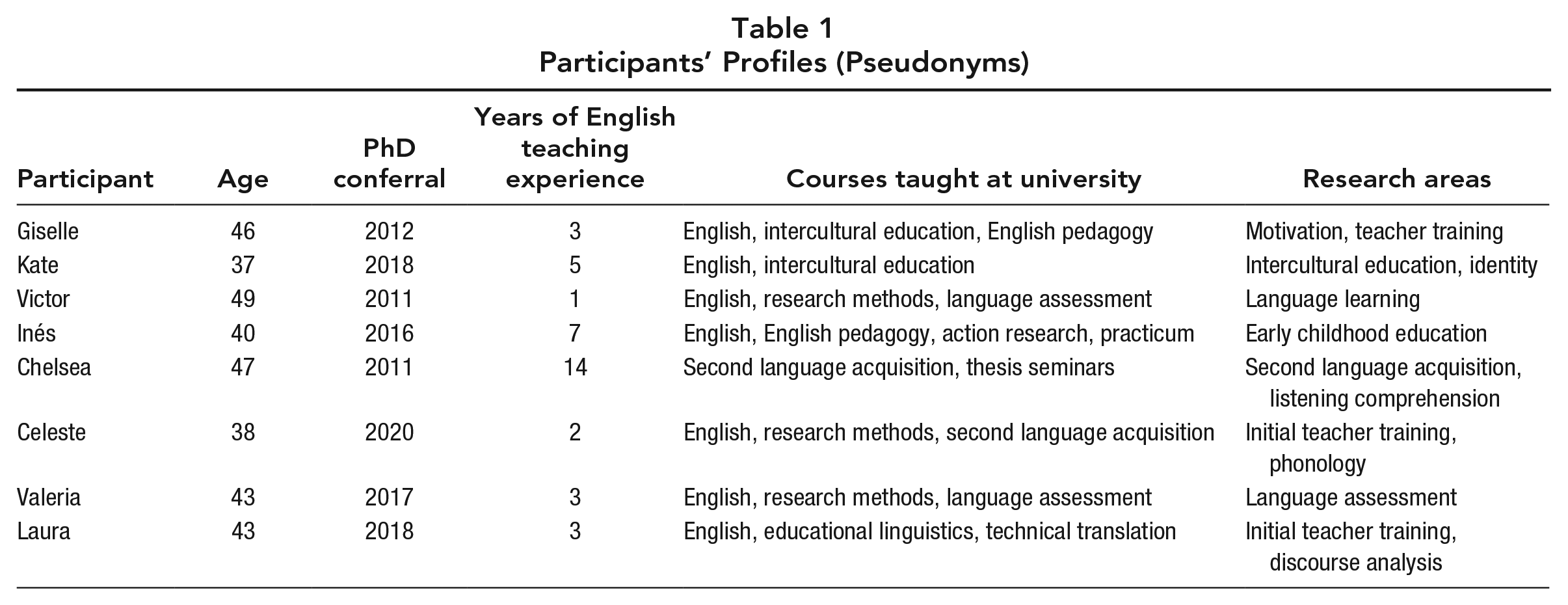
The participants were eight full-time faculty members who belonged to a Chilean university. In selecting the participants, we set four criteria: (a) holding a PhD, (b) working for a Chilean university, (c) having taught the subject (i.e., English as a second language), (d) having published in a WoS and/or Scopus-indexed journal, and (e) being a second language user of English. The last criterion was added due to the additional challenge faced by second-language users of English publishing in academic journals in English (see Kubota, 2022). With these criteria, we contacted 10 major comprehensive universities that offered teacher education programs in second languages (e.g., TESOL). The directors of the programs provided us with 17 instructors in total who fit our criteria. We contacted all of them. Table 1 summarizes the participants’ backgrounds. The universities (six universities) were located in different cities in Chile. The participants obtained their doctoral degrees between 2011 and 2020, with five of them receiving Chilean government scholarships for their degrees. Four of them completed their PhD programs outside Chile (the United Kingdom, the United States, and Germany) and the rest in Chile. They all had years of English teaching experience at the school level prior to embarking on their academic careers (M = 5.00 years; SD = 4.44). They all taught the subject matter of English as a second language at their universities after getting their academic positions (see the background questionnaire in online Appendix B). We explain our positionality in online Appendix A.
Participants’ Profiles (Pseudonyms)
Data Collection and Analysis
We collected data from multiple sources (i.e., background questionnaire, governmental documents, participants’ university websites, and their personal websites), but semistructured interviews served as the main data source. The development of interview prompts was guided by (a) activity theory and its six subcomponents (e.g., subject, object, division of labor) and (b) researcher- and teacher-identity literature. A more detailed procedure and the complete list of interview prompts are included in online Appendix C. The final protocol comprised 21 questions, and the interviews were conducted in the participants’ first language (i.e., Spanish). Each interview took 50–60 minutes, totaling 427 minutes of recorded data. The data was analyzed in iterative coding stages that started with line-by-line action coding. First, we categorized the comments by identifying the six elements of activity systems. Second, axial coding was conducted within each first-order category, which allowed for the reduction of fewer themes. Finally, the generated categories and themes were combined to answer the research questions that focused on the research-practice relationship. For instance, the first-order category of mediating factors for professional identity was a combination of mediating artifacts and division of labor. After arriving at specific themes, 10% of the data was shared with another researcher. The intercoder reliability reached κ = .72. Disagreements were resolved by the authors by discussing the discrepancies.
Findings
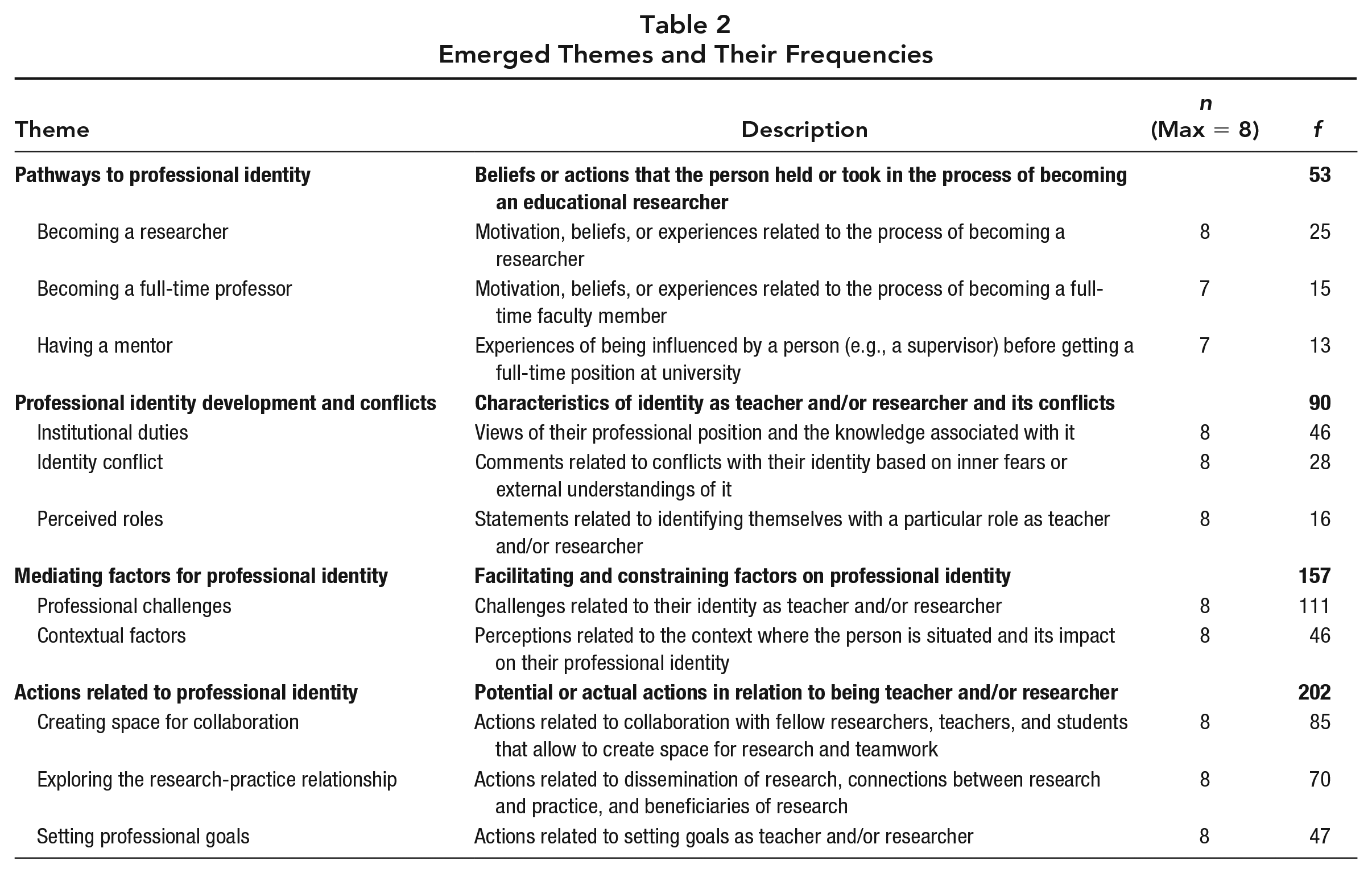
The analysis resulted in four overarching themes with 502 coded comments. First, pathways to professional identity included the participants’ beliefs and actions that they held or took in the process of becoming a full-time faculty member and an educational researcher. Second, professional identity development and conflicts pertained to characteristics of their identity as teacher and/or researcher and its internal conflicts. Third, mediating factors for professional identity emerged from comments describing specific factors related to their professional identity. Fourth, actions related to professional identity explained specific actions that the participants either considered taking or have taken in combating the teacher-researcher identity dilemma. Table 2 details the themes and their frequencies in the dataset. In the following, we share educational researchers’ lived experiences with representative comments on each theme.
Emerged Themes and Their Frequencies
Transformation and Boundary Crossing of Professional Identities
After years of teaching at the school level, the participants decided to pursue their academic careers. Three types of motivation for this lifetime decision emerged from the data (coded under pathways to professional identity). The first type of motivation was intellectual curiosity, which was mentioned by all participants. For instance, Celeste said: “I am interested in human experience” from a research perspective. Some participants used words such as “passion” (Inés) and “curiosity” (Valeria) for their specific research topics. The second type of motivation was incurred by a mentor figure who influenced the participants’ career decisions. Seven participants (out of eight) recalled a person who they observed to be their ideal future selves. Those figures included an advisor for their undergraduate or MA project, a doctoral supervisor, and a researcher with whom they happened to interact at different settings (e.g., an academic conference). For Chelsea, her MA supervisor “means a lot” for her life. Those mentors motivated the participants to apply for a doctoral program and remain influential figures in their current professional identity.
The third and most important motivation stemmed from a concern about student learning and local society, which intersected the researchers’ subject, object, and community in their activity systems. Prior to becoming an educational researcher, the participants envisioned using research in order to inform practice, evidenced by comments such as “how something can be turned into something that can be shared with others” (Giselle). Celeste explained how important it is for research to influence the local community, saying: “What motivates me is the dialogue, working with others. The thing is that the topics that one [educational researcher] can investigate can indeed have relevance to the community.” Rather nostalgically, Inés stated that early childhood education “motivates me, it moves me. Working with kids is what moves me.”
After becoming an educational researcher (coded under professional identity development and conflicts and mediating factors for professional identity), however, some participants (reported by four) eventually realized that their intellectual curiosity was a double-edged sword. Although intellectual curiosity drove their internal motivation to continue pursuing their research agenda, the researchers felt intellectualization to be a barrier to conducting a type of research with which they initially hoped to engage. Chelsea, who taught for 14 years at local schools, said: “Here in Chile, people like theoretical frameworks. . . . This part was difficult for me to understand. I wanted to know how far I had to go.”
Another common perception that the participants shared throughout the transformation of their professional identities was the social status they perceived that educational researchers receive in their local society. In their activity systems, community influenced subject and object strongly. Without a specific prompt, all participants referred to the Chilean culture specifically to its hierarchical nature. Valeria, for instance, said: “Here in Chile, of course, being a researcher has more weight [than being a teacher]. Obviously, they have a higher status.” Kate’s and Celeste’s comments depict how educational researchers are perceived by the larger society and compared against teachers: “If someone asks me ‘what do you do?’ and I say, ‘I am a teacher,’ then, people look at me in a certain way. But if I say, ‘I am a researcher in a university,’ then they are like ‘Oh, Wow! That’s incredible’” (Kate); “We [teachers] are a bit below others [researchers] in this regard” (Celeste). Celeste obtained her PhD degree in 2020 and was relatively new to the researcher community. She momentarily switched back to her teacher self as evidenced by her use of the pronoun “we.”
Struggles With the Research-Practice Relationship
The participants encountered a variety of obstacles to bridging the gap between research and practice and took actions to narrow the gap (coded under mediating factors for professional identity and actions related to professional identity). First of all, all participants expressed their concerns about the gap regardless of their educational background, teaching experience, and current career stage.
Giselle recalled her experience while doing her doctoral studies in the United Kingdom, saying: “In England, teachers talked about inclusion, inclusion, and inclusion. On [research] papers, everything looked good. But in schools, I saw all those kids with different syndromes and difficulties and they were not included at all.” Three of them mentioned the quality of research studies in relation to their impacts on education. Giselle, for instance, said: “You can publish a lot of things that look good in terms of numbers, but not necessarily have the depth and weight that can really make a real contribution [to society].” Six of them were critical of the role that universities and the government serve in the local society. For instance, Laura mentioned that “the universities are in a different intellectual sphere, and they forgot to communicate with schools. And, the Ministry is the Olympus and it works on its own.” Olympus, in this quote, refers to the home of gods in Greek mythology.
Another obstacle was related to researchers’, but not necessarily their own, attitudes toward society. Inés said: “People in the university don’t have any idea. They don’t really know about the reality. Or, we forgot what it means to work under pressure and to face emergent issues inside the classroom.” Although Inés had been working for her university for six years, she used the pronoun “people” to refer to researchers, as though she did not belong to the researcher group. However, instantly, she switched her perspective and included herself in “we.” Valeria’s remark implies researchers’ lack of effort in communicating with teachers: “A researcher who doesn’t do any networking [with teachers] is not really useful in the sense that you can do your own stuff but at the end of the day it is not for yourself.” While the participants were critical of researchers, they distanced themselves from other researchers as a group of professionals.
Their critical stance toward researchers and their culture—ivory tower—appeared at the moment when they switched their perspective from a researcher to a teacher. After explaining how researchers are perceived in Chilean society, Valeria said: “They [researchers] are more distant, people who are full of themselves.” Laura’s comment explains her identity dilemma: “When someone asks me, I usually say I am a teacher, so they think I work in a school. . . . There is a certain privilege associated with working in a university. I don’t want them to think that I am arrogant.” On the one hand, those comments indicate that they embraced their newly earned social and professional status. On the other hand, they perceived their new status as an obstacle to communicating with practitioners—that is, their former profession. In their activity systems, therefore, different types of community influenced their identities (subject) in different ways. While the prestige that the local society gives to researchers formed an important part of their identity, the educational researchers did not want to project themselves as professionals whom they used to be skeptical of when they belonged to the teacher community.
Most importantly, research productivity, which all participants expressed as an external, systemic, and unwelcoming pressure for their profession, emerged as a major obstacle for bridging the research-practice gap. In general, they expressed that publication pressure is a structural issue, although they acknowledged that it is part of the social status that they currently enjoy. Valeria expressed a sentiment that many educational researchers may share: “Here in Chile, you have to produce like you are sick. If you had funding, three papers a year. I don’t support this so much. Research projects take time and writing also requires time.” Similarly, Giselle claimed that “with the pressure [to publish] that one feels a lot here in Chile in the academia, if it overwhelms you, you don’t even have time to think [about teachers].” Giselle summarized that “if the system asks you to do, of course, you comply.” Ultimately, their frustration led to a researcher-teacher identity conflict (outcome in their activity system), as expressed by Inés: “Some generate knowledge [publications] that is clearly elitist. I have always questioned myself for whom I am doing research.” Although Kate explained that pressure to publish internally motivated her, she also framed it as a result of external motivation (i.e., perceived duties and rules): “Even though my contract doesn’t force me to meet the academic commitment [of publications], it is there where I want to move toward. It is like what I would like to do and what others want a researcher to achieve.” Victor’s comment seems to summarize the struggles related to publication pressure:
I think we are a bit like prey. Prey of productivity. For good or bad. I think it is draconian. The world of research sometimes tempts you to betray your own principles and leads you to do research on matters that seem futile. Because I am part of the establishment [university and researcher communities], if you would like to see it like that, I also represent Big Brother to those effects.
Unique Features of Global South
Against our prediction, the data suggested only a few features that are potentially specific to the Chilean context. Nonetheless, all of the local issues had significant impacts on researchers’ activity systems. First, seven participants shared their frustration related to the lack of colleagues in their immediate working environment, as expressed by Valeria: “Nobody here [Chile] seems interested in my area. So, I am left alone. I am forced to look for peers in the international community.” Even when there were researchers with similar interests, they struggled to find collaborative relationships. In referring to local educational researchers, Giselle stated: “They feel envy because someone bought a big car with the money they got for their project. . . . They say things like, oh, he bought this big car even though the project may not have an impact on the society.”
Half of the participants mentioned the lack of training and mentorship. Victor recalled challenges at the beginning of his academic career, saying: “It was a lonely process, weakly guided, not systematically.” The lack of mentorship was felt hard, especially because of their multiple identities: “I’ve had to learn to deal with these roles [publishing research] because I am a teacher” (Kate). Another collaboration-related issue was the limited number of graduate students whom they wished to have as their research assistants and also as their mentees for training purposes (which is mandated by the national grant agency). Celeste explained that “there is no research culture in Chile. People don’t get what it means to do research.” In Chelsea’s case: “I have my own research group made up of undergraduate students. It is not easy to work with undergraduate students.” Those comments show that a necessary community and effective division of labor were missing in order to fulfill their research career (object). Giselle depicted the current Chilean environment for educational researchers:
They are sometimes like “oh, how nice that you can do research, I am happy for you” . . . As if it is my hobby. That’s how I feel. I don’t know if it is just my idea, or because I spend most of my time with colleagues who don’t do that much research.
Another local issue was time. This issue is seemingly shared by researchers around the globe. However, in the Chilean context, where the government and universities are currently shifting their evaluation targets from teaching to research production, the researchers struggled to manage their time because research production is an added demand without necessary adjustments such as a reduction of teaching loads. For instance, Victor said: “I would love to have more time to reflect on my research, on my findings, to be able to implement my findings . . . time is always an obstacle.” Kate, who was teaching eight courses per year, shared her frustration, saying: “it is very time consuming to do both teaching and research at the same time. I think both demand a lot of time. And, on top of that, at least in my case, I have an administrative role. I am an academic coordinator.”
Ecosystem as an Ideal Research-Practice Relationship
All participants pointed to the sense of community as a necessary setup for practitioners and researchers to benefit from each other. First, six of them mentioned how a research project should be developed and executed. Victor referred to research topics that educational researchers choose to investigate: “One [a researcher] has to do research about those things that they want to and believe that would be a contribution [to the society].” Laura recommended that researchers change their approaches to teachers: “I have to take off my badge [PhD]. Otherwise, they [teachers] are not going to take me seriously, right?” Similarly, with respect to the social status that researchers enjoy in the Chilean context, Inés summarized:
The researcher who wants to work with teachers needs to get down from the altar and acknowledge he is not better. And, if he is really interested, he has to create space to work collaboratively with school teachers. This work has to be long term, collaborative, and bidirectional . . . I am convinced that the knowledge I am generating can make a change in public policy or issues that school teachers have been talking about for a long time.
In making a collaborative relationship emerge, four participants were explicit about their previous experience as a teacher as a useful tool. For example, Laura said: “I have to put in practice the knowledge that I developed through my teaching. It is so nice to share what I have learned! Not just through a paper that nobody reads but to take it to the classroom. And, it [research] turns into something valuable for the students.”
The term “community” appeared multiple times (24 times), as exemplified by Valeria’s comment: “You have to create a community, found an academy, put together interdisciplinary projects, collaborate with another university, get to know people, and create projects.” Laura called for “real communication between the Ministry, universities, and schools,” and Celeste felt that “bilaterality between university and schools” needed to be strengthened. This community involved mentoring early-career researchers and graduate students. Laura commented that “one thing to improve is that researchers who are younger don’t know how to write a FONDECYT [the Chilean governmental grant] project. They need more help.”
The participants’ overall recommendations for an equitable research-practice relationship included changes by different stakeholders—that is, researchers, university administrators, teachers, and policymakers. First, all participants agreed that universities should change so that communicating with practitioners would be more feasible for them. Giselle said: “I hope he [the new rector] understands that we have to restructure this [outreach agenda] in a different way so that it doesn’t take away time from people who have to do other things.” Second, the involvement of schools and teachers was repeatedly mentioned. Giselle said: “I try to gather the experience of school teachers here and bring them to national and international audience.” Inés also said: “One has to generate those spaces of trust. . . . This is the only way. Not only because they [teachers] know your research but because you create affective bonds. It [research] is something we do together and not a one-off for my own benefit.” The importance of a collaborative mindset and its impact on society was evident in Kate’s remark:
I think any collaborative work, either between research and teaching or between teachers and researchers, would enrich the development. This collaboration enriches how I understand what I am teaching, what I am researching, and what I am disseminating. I try to understand that we do not work alone. We need each other.
Discussion
The current study was set out to explore the professional identities of educational researchers in Chile by using activity theory. Our inquiry focused on how their teacher-researcher identities mediated their beliefs and actions related to the research-practice relationship. Overall, the participants’ resulting outcome in their activity systems was conflicting teacher-researcher identity (see Pennington & Richards, 2016). At the initial stage of professional identity transformation, they envisioned being engaged with the learning of specific topics related to second language teaching and resolving pedagogical issues that they used to face every day in the classroom. Over time, however, their intellectual curiosity and passion for enhancing student learning were met by intellectualization (see Rose, 2019). They did not appreciate researchers’ tendency to theorize classroom issues, and they perceived intellectualization as an obstacle to discovering more efficient and effective pedagogical techniques. They were also critical of researchers who “forgot” the classroom reality, depicting their identity struggles (Barkhuizen, 2021; Sato, 2023). Despite their critical views on (other) researchers, they did not mention any specific effort that they personally have tried out to close the research-practice gap. From their comments, it is clear that while educational researchers are aware of the importance of and obstacles to an effective research-practice relationship, their professional reality prevents them from taking concrete actions to communicate with practitioners (see Ion et al., 2019). Consequently, object in their activity systems was conflicting: Is my job to contribute to education or to produce more research?
Such an identity conflict (or subject in their activity systems) was evident from their critical opinions of researchers-as-a-group while preserving their own contribution to society relatively intact (see Sato et al., 2022). Perhaps the tendency on the part of educational researchers to distance themselves from their own professional community is related to how researchers are perceived in the larger society, including the local teacher communities. On the one hand, they depicted how highly researchers are regarded in their local society. On the other hand, they cited the ivory tower as being a major issue for an equitable research-practice relationship. The primary cause of this tension was the pressure for research publications. They felt that getting published, which increases their social status and advances their researcher career, is their professional duty (rules), although focusing on publications may place them in the ivory tower. Hence, the educational researchers took an ambivalent position toward the research community to which they belong, with the hope that their own research would contribute to teaching practices.
Unlike our prediction, we did not find many features that are unique to the Chilean context. It is encouraging that they now have access to academic journals. It was also surprising that none of them mentioned English as a major obstacle to publishing their research. As Flowerdew (2019) claimed, the quality of academic writing may not be determined by the researcher’s first language; rather, writing a manuscript requires a unique set of skills that researchers can develop regardless of their first language. However, one context-specific feature that emerged in the dataset was the lack of a research community including other researchers and graduate students (division of labor). The participants were arguably the first generation to become educational researchers in their field (applied linguistics) in Chile. Having limited daily communication with other researchers and research assistants for their projects prevented them from not only conducting research but also creating mentorship opportunities for future generations. Another unique feature was related to the fact that the researchers in the current study taught the subject matter of their research area—English as a second language—after becoming full-time faculty members (i.e., teaching English to their students who are second language learners of English and preservice English teachers at the same time). Unlike other research-oriented institutions and educational researchers of other subject matters (e.g., mathematics and science), this unique professional responsibility served as a mediating artifact to balance their teacher and researcher identities. Such an academic position, however, exists in many universities in the world where English (or any other second language) is a required course for undergraduate students. Finally, time was an issue. It appears that, on the one hand, Chilean universities increasingly expect educational researchers to publish more, sometimes with monetary incentives. On the other hand, universities have not reduced other duties (teaching and service). In the resulting activity system, researchers have less time to produce research or communicate with practitioners. These practical obstacles, involving rules, community, and division of labor, to bridging the research-practice gap may not exist in Western research-oriented institutions in which researchers’ primary responsibility of producing research is more clearly defined and supported.
In order to resolve the tension in their activity systems, all participants emphasized the importance of an ecosystem whereby multiple stakeholders engage in a bidirectional, constructive, and mutually beneficial dialogue. Their critiques on researchers’ “altar” and policymakers’ “Olympus” suggest attitudinal and epistemological beliefs that different professional groups hold against each other. Based on their professional experience as teachers and researchers, they upheld a collaborative mindset as the key to an effective research-practice relationship (Sato & Loewen, 2022). In order for a research-practice ecosystem to emerge, it seems better to localize such an effort (McLean & Sen, 2019). For many interview questions, the participants prefaced their comments with “Here in Chile . . .” Indeed, the local society has its own perceptions of researchers, the local government has its own policies, and the local university has its own regulations, all of which mediate how educational researchers approach the research-practice relationship and what they are afforded to do with it. Localizing an ecosystem aligns with the claim that empirical evidence of educational research is often difficult to generalize to other contexts than where the study was conducted (Levin, 2013). Also, by localizing an ecosystem, Global South countries may be able to make unique contributions to the decolonization of the Western knowledge production system and, in turn, resolve their own unique pedagogical challenges.
In sum, the findings showed that as the educational researchers developed a new professional identity (subject), every element in their interrelated activity systems underwent transformation. The new rules entailed extra effort and time commitment to publications, which was further riddled with the intellectualization of classroom issues. To advance their career, they lacked a local research community (community) and research assistants (division of labor). They were not afforded adequate tools to resolve those issues by their universities (mediating artifacts), although being an instructor of their research topics (i.e., second language education) helped them preserve their teacher identity. They called for an ecosystem in which multiple stakeholders work together to establish an equitable research-practice relationship. Despite their hopeful object of contributing to the local society and achieving professional success, the resulting outcome was largely a conflicting teacher-researcher identity. Figure 1 depicts educational researchers’ activity system based on the current study’s findings.
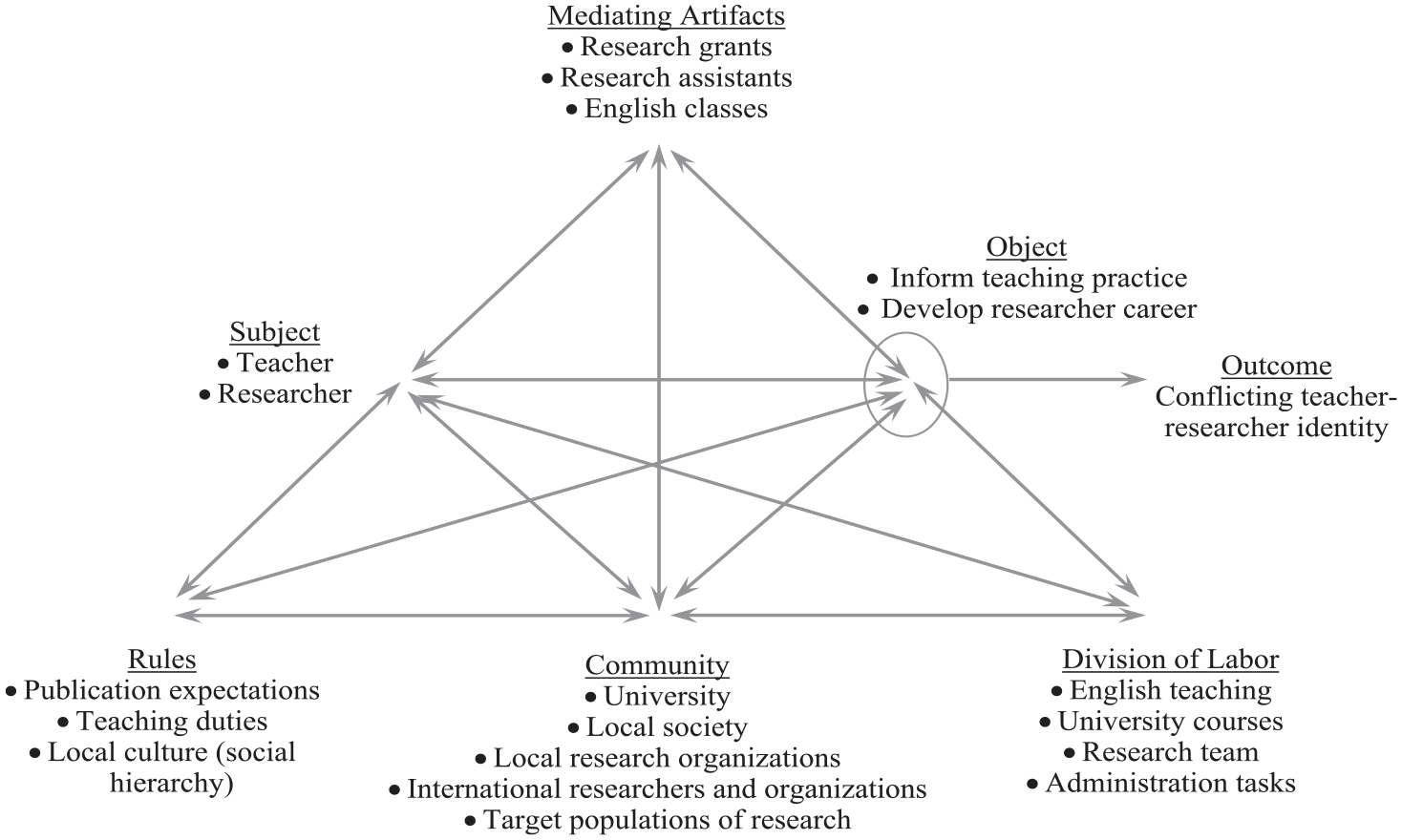
Activity system of educational researchers (adapted from Engeström, 1999).
Conclusion and Limitations
This study was set to explore educational researchers’ identities and activity systems with a focus on the research-practice relationship. We focused on Chile as a case of the Global South, where Western academic culture, especially its focus on research productivity, has recently changed professional duties and expectations for educational researchers. The research area of the participating researchers was second language education, which added an additional layer to their identities because of their teaching experience of the subject (i.e., English) and the language classes they taught after becoming researchers. Results showed that although the researchers were internally motivated (a) to know more about their research topics and (b) to connect research and practice, they perceived a variety of challenges in pursuing these goals.
We believe that the profile of the current study’s participants is shared by many educational researchers around the globe. Though precise statistics are not available as to how many universities in the world have implemented research productivity as an evaluation criterion for educational researchers, it seems to be the case that the Western higher education industry and culture have pervasively changed how educational researchers perceive their professional identities and duties in recent years. We suspect that a similar professional identity crisis may exist in different parts of the world who (a) are not originally from a Western country, (b) obtained their doctoral degree at a Western university, and (c) decided to go back to their home country to pursue their academic career. Researcher identity crisis may exist not only in other Global South countries (e.g., China and Iran) but also in contexts where publications in high-impact journals were not deemed to be important until recently (e.g., Japan). This impact may be felt in Western universities that traditionally did not focus on research productivity as well.
If so, it is likely that educational researchers in those contexts are also experiencing tensions in their activity systems. Given that the current productivity norm will persist in the foreseeable future, additional support for identity transformation is much needed, most of which can be done at the institutional level (i.e., university and government). Also important is the consideration of the research-practice relationship. Based on the frustration shared by the participants in relation to the difficulties in marrying their teaching experience and research-related activities, we recommend that universities consider rewarding practically relevant research as well as researchers’ efforts in bridging the research-practice gap. Those two recommendations conflict with each other: if a researcher is expected to publish more, they would have less motivation and time to work on the research-practice relationship. Although specific ways of achieving the two goals are beyond the scope of the current article (see research-practice partnerships in Farrell et al., 2022; design-based research in Hoadley & Campos, 2022; practice-based research in Sato & Loewen, 2022), we believe that only when an equitable research-practice infrastructure is set up can educational researchers flourish in their profession and contribute to society.
Supplemental Material
sj-pdf-1-edr-10.3102_0013189X241231548 – Supplemental material for Be(com)ing an Educational Researcher in the Global South (and Beyond): A Focus on the Research-Practice Relationship
Supplemental material, sj-pdf-1-edr-10.3102_0013189X241231548 for Be(com)ing an Educational Researcher in the Global South (and Beyond): A Focus on the Research-Practice Relationship by Masatoshi Sato and Benjamín Cárcamo in Educational Researcher
Footnotes

Authors
References
Supplementary Material
Please find the following supplemental material available below.
For Open Access articles published under a Creative Commons License, all supplemental material carries the same license as the article it is associated with.
For non-Open Access articles published, all supplemental material carries a non-exclusive license, and permission requests for re-use of supplemental material or any part of supplemental material shall be sent directly to the copyright owner as specified in the copyright notice associated with the article.
