



Abstract
This study supplements the existing conceptualisation of skills mismatch based on cognitive evaluations (being underskilled or overskilled) with an affective aspect that captures how workers cope with skills (mis)match situations (feeling overchallenged or underchallenged) and an analysis of skills mismatch situations’ influence on job satisfaction of workers with higher education (HE) and vocational education and training (VET). Using the German BIBB/BAuA Employment Survey 2018, the results indicated that underskilling by itself was not negatively associated with job satisfaction; however, underskilling in combination with feeling overchallenged exerted a significant negative influence on job satisfaction. This corroborates the approach of differentiating challenging (i.e. non-detrimental) jobs from overchallenging jobs. Overskilling was associated with penalties regarding job satisfaction, whereas overskilling in combination with underchallenging jobs produced a remarkably larger negative impact on job satisfaction. Moreover, overskilled HE workers received larger penalties regarding job satisfaction than those received by overskilled VET workers.
Keywords
Introduction
Labour market mismatch has been extensively analysed in social and economic research and its importance with respect to education and labour market policies has been highlighted (McGuinness et al., 2018; Quintini, 2011). Nevertheless, as there is no consensus on how to conceptualise and measure labour market mismatch, there are intrinsic challenges to its research.
Skills mismatch occurs if the level of jobholders’ skills endowments is above or below the level required for their job (i.e. overskilling or underskilling). Although underskilling has received less attention in the literature as compared to overskilling (Flisi et al., 2017; McGuinness et al., 2018), considering the two conditions is crucial for a comprehensive study of skills mismatches given the differing causes and effects of overskilling and underskilling. Overskilling is caused by underutilisation of job skills and is negatively related to wages and job satisfaction (Allen et al., 2013; Perry et al., 2014). On the other hand, underskilling shows no effect on wages (Allen and Van der Velden, 2001) and shows a slightly negative to no effect on job satisfaction (Allen and Van der Velden, 2001; Van der Velden and Verhaest, 2017) and may even be slightly positively correlated with job satisfaction in some conditions (Sánchez-Sánchez and McGuinness, 2015). These differences challenge the understanding of skills mismatch as a phenomenon associated with overall negative consequences for workers and labour markets; however, the different associations have remained underexplored in previous studies that measured skills mismatches based on cognitive evaluations of skills endowments and requirements.
Additionally, studies focussing on affective aspects that capture how workers cope with their specific situation regarding skills (mis)match (i.e. either being underskilled or overskilled) are scarce. The present study complements the commonly employed cognitive evaluations of skills mismatch with an affective aspect of skills mismatch (feeling overchallenged or underchallenged) and analyses how these aspects of skills mismatch affect job satisfaction differently. This study argues that complementing cognitive skills mismatches with affective skills mismatches is helpful to shed light on the complex phenomenon of skills mismatch and to make adequate policy recommendations. This strategy is particularly important to evaluate the understudied phenomenon of underskilling to obtain evidence on whether workers appointed to a job for which they are underskilled actually feel overchallenged.
Underskilling implies that jobs are challenging and require higher-level skills than those currently possessed by workers. With such challenging jobs, workers may feel motivated to learn by doing and gain expertise in certain skills; this is conditional upon their not feeling overchallenged due to their underskilled status. This in turn could explain why underskilling is not necessarily detrimental to job satisfaction. Conversely, underskilled workers might become dissatisfied with their jobs if they feel overchallenged by higher requirements, if they are unable to adequately adapt to the requirements or if they are unable to increase their skills levels. In this vein, previous analyses focused on the importance of the degree of underskilling for job satisfaction by suggesting that workers in jobs with small skill deficits (i.e. with a low degree of underskilling) can learn from challenging tasks and are not less satisfied than matched workers, whereas more severe skill deficits lead to job satisfaction penalties (Van der Velden and Verhaest, 2017). The present study builds further on this learning perspective to propose the affective dimension of skills mismatches as necessary to disentangle challenging and overchallenging jobs: underskilling should be no problem as long as workers see it as challenging; whereas overchallenging may occur as soon as the underskilling is more serious, and it may lead to stress and less job satisfaction. In doing so, the present study helps explain the associations between skills mismatches and job satisfaction.
The findings of the present study for workers with vocational education and training (VET) and higher education (HE) (hereinafter referred to as ‘VET workers’ and ‘HE workers’, respectively) suggest that underskilling by itself is not negatively associated with job satisfaction, whereas underskilling in combination with feeling overchallenged exerts a significant negative influence on job satisfaction. This evidence supports this study’s approach to distinguish challenging and overchallenging jobs, since challenging jobs are not necessarily detrimental regarding job satisfaction. The underutilisation of job skills through overskilling is associated with job satisfaction penalties, with penalties being particularly large among HE workers. When overskilled workers simultaneously feel underchallenged, penalties regarding job satisfaction are even larger.
This study makes three important contributions to the skills mismatch literature. First, it develops indicators capturing affective skills mismatches that have not been considered to date together with cognitive skills mismatches considering all conditions (being ‘over’ or ‘under’, that is, above or below job requirements). The approach followed in the present study emphasises that overskilling and underskilling should be evaluated differently, given that overskilling is intrinsically negative for worker satisfaction, as it implies an underutilisation of job skills, whereas underskilling can be evaluated from the perspective of challenging jobs providing learning opportunities to workers.
Second, this study provides insightful results to better explain the relationship between job satisfaction and skills-to-job match by analysing the simultaneous effects between affective and cognitive skills mismatches. By providing new evidence on the important differentiation between challenging (i.e. pertaining to underskilling) and overchallenging (i.e. pertaining to underskilling and feeling overchallenged) jobs, the results suggest that challenging jobs are not necessarily detrimental to the job satisfaction of underskilled workers. Additionally, as the underutilisation of job skills through overskilling is unsatisfactory for workers, this study proposes that this should be evaluated as an undesirable labour market phenomenon.
Third, the analyses of skills mismatches on job satisfaction additionally include educational mismatches (both horizontal and vertical educational mismatches). In doing so, this study acknowledges the differing conceptualisation of educational and skills mismatches and some previous studies’ statement that the match between skill requirements and skill endowments – and not the match between educational degrees and qualification requirements of jobs – is the main driver of workers’ job satisfaction (Allen and Van der Velden, 2001; Mavromaras et al., 2013).
Focussing on the distinctions between cognitive evaluations and affective experiences, the present study broadens the scope of skills mismatch analyses and contributes to a transparent debate on the match between skills and jobs. The subsequent section discusses the existing research on skills mismatch.
Literature review
The existing research on labour market mismatch lacks consensus on the measurement and homogenised terminology of the phenomenon. Acknowledging these difficulties should improve the understanding of this phenomenon and stimulate a more focused discussion, resulting in deciding an appropriate terminology for the same.
Labour market mismatch can be analysed from horizontal and vertical perspectives (e.g. Konietzka, 1999). On the one hand, the horizontal perspective focuses on educational fields by comparing the field in which workers have been educated with the occupational field in which they work (e.g. Levels et al., 2014; Van de Werfhorst, 2002; Witte and Kalleberg, 1995; Wolbers, 2003). This horizontal approach is found in the mismatch literature (Montt, 2015) or, more generally, in the literature on occupational changes and occupational mobility (e.g. Konietzka, 2002; Solga and Konietzka, 2000).
On the other hand, vertical mismatch is the most commonly used approach, and is based on a comparison between levels of job requirements and levels of job holders’ endowments. Analyses are categorised depending on whether those levels refer to formal education (educational mismatch) or to workers’ set of skills (skills mismatch). Although educational mismatch has traditionally represented the fundamental pillar of mismatch research (McGuinness et al., 2018), researchers have argued that education certificates do not adequately reflect workers’ skills and competencies (e.g. Allen and Van der Velden, 2001) and that skills mismatch is a superior approach when capturing individuals’ work-related human capital (Allen et al., 2013; Levels et al., 2014; McGuinness et al., 2018; McGuinness and Wooden, 2009). Additionally, promoted by improved data and recent evidence suggesting that education and skills mismatch are different phenomena (Allen et al., 2013; Flisi et al., 2017; McGowan and Andrews, 2015) with low statistical correlations (Allen and Van der Velden, 2001; Green and McIntosh, 2007; Quintini, 2011; Rohrbach-Schmidt and Tiemann, 2016; Flisi et al., 2017; Sloane and Mavromaras, 2020), the focus in research and policy has shifted to skills mismatch (McGuinness et al., 2018; Quintini, 2011). This reflects an intention to capture what makes workers adequately ‘matched’ to a workplace (Green and McIntosh, 2007; Sloane and Mavromaras, 2020).
From a conceptual perspective, skills mismatch means that misalignments between skills supply (i.e. skills endowments and skills formation) and skills demands (i.e. skills requirement of jobs) exist. While overskilling means that workers’ existing skills are not fully utilised, underskilling relates to a lack of skills. Although the theoretical foundations of skills mismatch are not as established as those of educational mismatch, recent research has focused on changes in skills demands induced by ongoing technological developments. Indeed, digitalisation and automation processes are shaping the skills that are in demand in the labour market (Nedelkoska and Neffke, 2019). Well-known theories of skill-biased technical change (SBTC) and task-biased technological change (TBTC) cover the impact of technological progress on skills endowments, skill requirements and job contents (Autor et al., 2003; Autor and Handel, 2013; Autor, 2013; Acemoglu and Autor, 2011). Thus, skills mismatch may increase if workers and training systems are not capable of updating and meeting the changing skills requirements (Fregin et al., 2020; Allen and Van der Velden, 2002).
Skills mismatch can also stem from the depreciation of human capital over time (Forster and Bol, 2018), whereas the appearance of new technologies requiring new or higher skills may accelerate the depreciation of actual skills endowments. In this sense, technological change would affect the depreciation process of skills in vertical (levels of skills) and horizontal (skill content) ways, resulting in various types of mismatches, such as skill gaps and skill shortages (McGuinness et al., 2018).
In addition to theoretical considerations, skills mismatches influence relevant labour market outcomes, such as wages, job satisfaction, job turnover (Allen et al., 2013; Allen and Van der Velden, 2001; Perry et al., 2014) and general productivity (OECD, 2013). Simultaneous investigations of both mismatch phenomena have demonstrated that education and skills mismatch produce separate monetary effects (Allen and Van der Velden. 2001; Levels et al., 2014); additionally, overskilling effects are of minor size and relevance (OECD, 2013; McGuinness and Sloane, 2011; Sánchez-Sánchez and McGuinness, 2015). Some studies combined the concepts of educational mismatch and skills mismatch to depict the potential heterogeneity of mismatched workers in terms of their abilities and skills (Berlingieri and Erdsiek, 2012; Green and McIntosh, 2007; Green and Zhu, 2010; Quintini, 2011; Sloane and Mavromaras, 2020) or to include measures of general cognitive skills in overeducation analysis (Borgna et al., 2019; Mateos-Romero and Salinas-Jiménez, 2017). Thus, heterogeneity in general skills can partly explain the differences in the incidence of overeducation (e.g. Allen et al., 2013), reaffirming the consideration of skills mismatch and educational mismatch as different phenomena.
When separately analysed, both education mismatch and skills mismatch show consequences regarding job satisfaction, with overskilling being negatively associated with job satisfaction (Green and Zhu, 2010; Mavromaras et al., 2012). However, results regarding job satisfaction are less clear in analyses which simultaneously consider overeducation and overskilling, pointing to the more important role of skills mismatch as opposed to educational mismatch in explaining workers’ job satisfaction (Mavromaras et al., 2013).
This study focuses on skills mismatches and their consequences on workers’ job satisfaction. Acknowledging the differing but interrelated nature of educational mismatch and skills mismatch, it integrates educational mismatch into the analysis. By proposing new measures to capture the evaluative-cognitive and the affective dimension of skills mismatch, this study provides a step forward towards a comprehensive conceptualisation of this phenomenon. The subsequent section clarifies the previous approaches and this study’s proposed conceptualisation of skills mismatch.
Conceptualising and measuring skills mismatch
Previous measurement approaches
Measurement approaches for skills mismatch can be categorised into subjective and objective approaches (Perry et al., 2014).
Subjective approaches are based on self-reported skills mismatch (workers’ self-assessments of skills mismatch) (Allen and Van der Velden, 2001; Green and McIntosh, 2007; Green and Zhu, 2010; Halaby, 1994; Rohrbach-Schmidt and Tiemann, 2016). However, the concrete operationalisation varies strongly between different indicators and datasets.
Taking Quintini (2011) as an example and using the European Survey of Working Conditions, workers are considered overskilled if they ‘have the skills to cope with more demanding duties at work’ and underskilled if they ‘need further training to cope well with duties at work’ (Quintini, 2011: 17). Similarly, the widely used Programme for the International Assessment of Adult Competencies (PIACC) also contains indicators for self-reported skills mismatch, focussing on the need for further training to define skills mismatch (Pellizzari and Fichen, 2017). The most prominent example of subjective measures of skills is the recent European EUROGRADUATE pilot survey (European Commission, 2020), which contains self-reported measures of the required as well as acquired levels of nine important competencies, focussing exclusively on HE European graduates.
Other examples of subjective self-reported indicators, such as the European Flexible Professional in the Knowledge Society (REFLEX) database, focus on overall skill utilisation and need for further training (McGuinness et al., 2018: 989), also integrating employers’ perspectives in analyses, mentioned as ‘skill gaps’ (McGuinness and Ortiz, 2016).
The main disadvantage associated with self-reported measurements is that this approach is prone to individual reporting bias (Hartog, 2000), mainly because of social desirability in cases where respondents avoid admitting as being underskilled. Consequently, this desirability bias depends on the extent to which questions are worded in a neutral manner. The European Skills and Jobs survey is an example of this effort to reduce possible bias, phrasing the question of underskilling in a more neutral manner instead of relating it to the need for further training (Cedefop, 2015). Moreover, self-reported measurements of skills mismatches may be correlated with other subjective indicators like job satisfaction, which makes the causal direction between feeling dissatisfied and reporting mismatch more difficult. If workers feel dissatisfied with their jobs, they may tend to be more critical about the skills requirements of their jobs and more often report a mismatch.
However, the main advantage of self-reported measures is that they consider heterogeneity at the workplace level (Hartog, 2000; McGuinness, 2006). Comparisons between skills endowments and requirements are evaluated at the job level, considering that workplaces within the same occupational group may vary in requirements and that workers in the same occupational group may differ in their skills endowments (Leuven and Oosterbeek, 2011). An additional advantage of individual self-assessments is that they are more prone to capture labour market requirements that are up-to-date in a fast-changing labour market as compared to experts’ information on skills requirements.
Skills mismatch can also be measured directly using an objective approach (i.e. job analysis approach). Specifically, studies which follow both objective and subjective approaches for the analysis of education/skills mismatch (Flisi et al., 2017) are insightful. For the objective approach, the quantification of workers’ skills and required skills levels is necessary. On the one hand, to measure the level of workers’ skills, the majority of international comparisons use the PIAAC survey, which assesses several cognitive skill domains that are considered key information-processing competencies (OECD, 2013). In Germany, the National Education Panel Study (NEPS) also assesses this type of information on skills (Perry et al., 2014). These skills are an approximation of the skills relevant to workplaces based on general cognitive skills.
On the other hand, to measure the level of required skills, one can use a job requirement approach that considers information on skill use, which is also available in the PIAAC. This information on skill use is sourced from workers reporting skills requirements in their concrete jobs; this is also prone to be biased by social desirability if workers tend to overvalue their own jobs’ requirements. In an attempt to minimise this bias, alternative operationalisations of skill requirements have emerged by aggregating direct measures of workers at a higher occupational level (similar to the realised matches approach from the educational mismatch literature). Pellizzari and Fichen (2017) conceived an OECD skills mismatch indicator combining a self-reported approach towards the overall skills mismatch with direct measures of the level of workers’ skill (skill proficiency). A new concept, termed as ‘effective skill’, was recently developed by Van der Velden and Bijlsma (2019) by interacting skill proficiency and skill use in literacy and numeracy by using the PIAAC data. Nevertheless, concerns have been expressed due to the limitations of measuring mismatch with general skill domains instead of focussing on mismatch related to workplace-specific skills (OECD, 2013: 172; Perry et al., 2014).
An increasing number of recent studies have integrated a horizontal perspective into their analyses of skills mismatch, acknowledging the occupational specificity of skills. This is insightful, especially regarding German cases, since vocational skills are of central importance in the occupationally segmented German labour market (Konietzka, 1999). Using the concept of job tasks, Kracke and Rodrigues (2020) measured actual work requirements by classifying occupations in Germany by their required main tasks. In this sense, tasks are related to certain skills and competencies essential to performing these tasks in each occupation. The mismatch measure thus refers to a horizontal dimension, defining cognitive mismatch when the main task in the training occupation differs from the main task in the current occupation. Similarly, Kracke et al. (2018) used the concept of skills transferability between training and current occupation to calculate the degree of similarity (total, partial or no similarity) of occupational skills based on information on core requirements at the occupational level. The previous work by Gathmann and Schönberg (2010) also adopted this perspective of skills transferability between occupations and employed the task approach, aggregating individual assessments of task use (skill requirement) at an occupational level.
While adopting a horizontal perspective on skills mismatch, scholars have usually aggregated information on skills requirements at a higher level than individual workers or workplaces (mainly at levels of occupational groups). Otherwise, direct measures of worker endowments and corresponding skills requirements at the workplace level would require an immense amount of information to calculate skills mismatch indicators for specific workplaces and individual workers. The only exception to this, to the best of the authors’ knowledge, is the study of Sánchez-Sánchez and McGuinness (2015), who simultaneously combined the vertical (overall self-reported skills mismatch) and horizontal (mismatch of specific work-related skills comparing individual skill acquisition and usage) approaches.
Following this reasoning, it can be argued that horizontal approaches implicitly use a more formalised conceptualisation of acquired skills and of human capital: which skills are common within the same occupation, or which skills do graduates from the same degree or training occupation possess in common? In this sense, skills mismatch captures either the deviation of individual tasks from the average tasks performed in a certain occupation or the difference between the task content in the training curricula of occupations which workers have learned and the occupations in which these workers are actually working. Thus, the main difference of this measure from workers’ self-assessment is that tasks are not being compared between workplaces, but between workplaces and occupational-level averages. In other words, all jobs in the same occupation are assumed to be homogeneous. This has implications for the conceptualisation of skills mismatch, since skills acquired through non-formal or informal channels are not included in the calculation of the match between skills requirements and endowments. Consequently, the merits of the objective approach based on job analysis depend ‘on the level of aggregation, the time lag in the observation, and the care and precision of the measurement procedure’ (Hartog, 2000: 133).
In this study, the authors’ focused on the vertical dimension of skills mismatch (i.e. downward and upward mismatch) by measuring self-reported comparisons between workers’ skills endowments and skills requirements of workplaces. Thus, this study acknowledges the importance of the different skill contents of occupations and implicitly considers skills differences between and within occupations. Such an evaluation of specific skills mismatch at the workplace and worker level should assist in grasping the complexity of comparing work requirements with skills endowments.
Challenging or overchallenging jobs? Cognitive and affective skills mismatches
Previous studies have traditionally conceptualised skills mismatches as comparisons between skills requirements levels and skills endowment levels. These cognitive-evaluative skills mismatches can be understood as a reflective judgement of how skills endowments match requirements. Specifically, when applying subjective approaches based on self-reported skills mismatch, workers need to create a reference framework for what constitutes the skills requirements of their job and compare them with the skills possessed by them. Nevertheless, cognitive skills mismatch does not capture how workers cope with these situations of mismatches; in other words, it does not consider the affective dimension capturing the mismatch-related emotional statuses of workers.
This study proposes to complement cognitive evaluations of the relationship between skills endowments and requirements with affective experiences (see Figure 1), thus broadening the scope of skills mismatch analysis. For this distinction, knowledge sourced from the socioeconomic literature on labour market security and subjective well-being is employed. Specifically, this study adapts the concepts of evaluative-cognitive and affective dimensions of subjective well-being (Diener, 1984; Diener et al., 2009; Knabe et al., 2016) as well as approaches comparing workers’ cognitive and affective job security evaluations (Hipp, 2016, 2020; Klandermans et al., 2010) to shed light on the phenomenon of skills mismatches.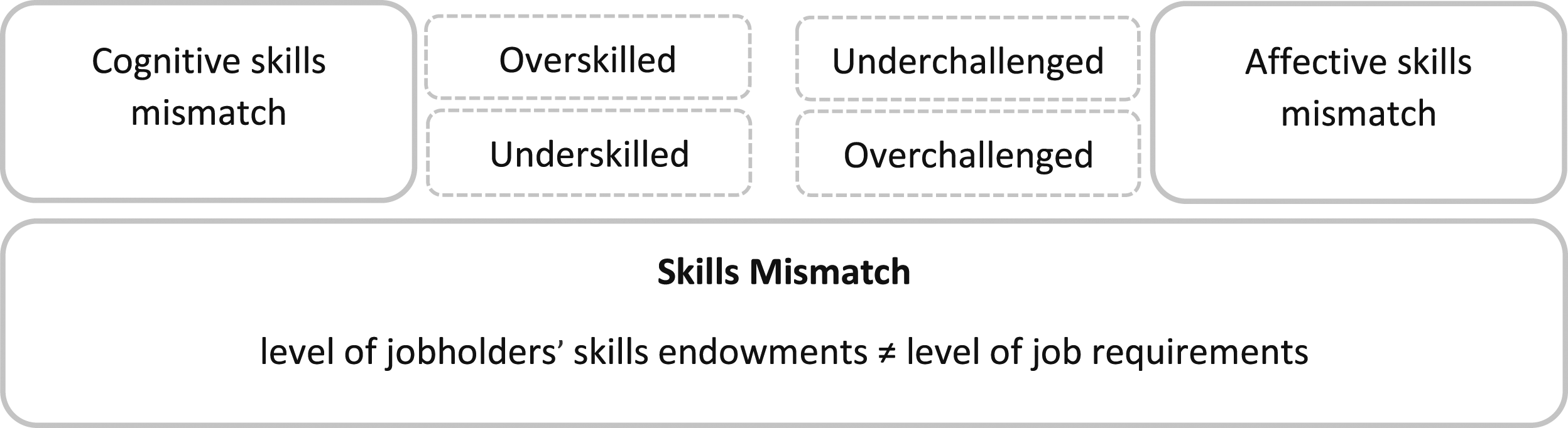
The distinction between cognitive evaluations and affective experiences is insightful for the analysis of job satisfaction. Workers are underskilled when their jobs require higher skills levels than they currently possess.
On the one hand, jobs are challenging if underskilled workers are capable of upskilling and adapting their skills with respect to the higher job requirements. In challenging jobs, workers may become motivated to learn on the job and to gain expertise in workplace-relevant skills. This sense of purpose through the improvement of valuable skills does not necessarily lead to penalties regarding job satisfaction, considering the situation wherein workers feel challenged and not overchallenged by their underskilled status.
On the other hand, underskilled workers who are unable to adapt to the job requirements or increase their skills level might feel overchallenged by the higher requirements; therefore, they would have an overchallenging rather than a challenging job. The traditional approach towards skills mismatches based on cognitive evaluations does not consider the affective aspect of how workers cope with their skills-to-job mismatch situation.
Alternative analyses focused on the degree of underskilling to show that underskilling is not inherently costly for workers: whereas high levels of underskilling may lead to a stressful situation in which workers feel overchallenged and less satisfied with their jobs, low levels of underskilling are not detrimental for job satisfaction because workers can learn from demanding tasks in their ‘zone of proximal development’ (Van der Velden and Verhaest, 2017). In a similar spirit, other studies focused on the importance of on-the-job learning by suggesting that complex and demanding tasks increase workers’ skill development (Russo, 2017). The present study builds on this evidence and presents the affective dimension of skills mismatches as necessary to disentangle challenging and overchallenging jobs and to explain the association between skills mismatch and job satisfaction.
Following the theoretical arguments outlined in the present study, it is expected that the simultaneous occurrence of affective and cognitive skills mismatches leads to lower levels of job satisfaction compared to the occurrence of cognitive skills mismatch only. Thus, it is expected that overskilling is associated with job satisfaction penalties, with penalties being particularly large when overskilled workers simultaneously feel underchallenged. Moreover, underskilling by itself should not be negatively associated with job satisfaction, whereas underskilling in combination with feeling overchallenged should be detrimental for job satisfaction.
Therefore, in the present study, the authors investigated the influence of cognitive and affective skills mismatches on workers’ job satisfaction.
Data, variables and empirical strategy
Data
This study used data from the BIBB/BAuA Employment Survey 2018 (Hall et al., 2020), a probability-based sample of the core employed population in Germany, that is, persons who were active employed in Germany with a minimum of 10 working hours per week at the time of the survey, excluding apprentices (Hall et al., 2020). The dataset contains the necessary information to capture the cognitive and affective skills mismatches analysed in this study, in addition to data related to the educational mismatch and rich data of characteristics of jobs and job holders. Given the focus of the analyses on workers with a formal educational degree, the full sample of more than 20,000 individuals was first restricted to the VET and HE workers covered in the dataset (11,231 and 7,640 persons, respectively). In a further restriction, a listwise deletion of observations with missing data on the central variables of skills mismatch and job satisfaction was applied (a sample of 11,042 VET and 7,502 HE workers remained). After additionally excluding cases with missing information on the control variables relevant to this study, the total sample size was 15,142 (9,019 VET workers and 6,123 HE workers).
Main variables
The dependent variable was job satisfaction, which was based on the question of overall job satisfaction phrased as following: ‘all in all, how satisfied are you with your work?’ with ‘very satisfied, satisfied, less satisfied or not satisfied’ as possible answers. This information was dichotomised to measure a high-level job satisfaction using a dummy variable, that is, very satisfied with the job versus other job satisfaction categories. In addition to overall job satisfaction, the analyses also include alternative dependent variables that measure workers’ satisfaction with different dimensions of their jobs, namely, skills use (i.e. ‘the possibilities to apply your skills’), task content (i.e. ‘type and content of activity’), income (i.e. ‘the income from this activity’) and occupational position (i.e. ‘the occupational position’). The variables measuring different dimensions of job satisfaction were dichotomised as well to indicate a high satisfaction with the concrete job dimension.
The predictor variable refers to skills mismatches. This study proposed an indicator with five categories that relied on worker self-assessments to capture cognitive-evaluative and affective skills mismatches. In doing so, this study became capable to evaluate the simultaneous effects of cognitive and affective skills mismatches, that is, when both skills mismatches occur simultaneously. For the cognitive skills mismatch, the evaluation was based on the following question: ‘If you now compare the requirements in your activity with your current occupational knowledge and skills, what would you say?’ with three possible responses: ‘the requirements correspond to my occupational knowledge and skills’, ‘the requirements are higher’ and ‘the requirements are lower’. Therefore, workers needed to assess whether the requirements in their workplace were higher (underskilling), lower (overskilling) or equal (match) to their occupational knowledge and skills. It is important to highlight that the exact wording of the question for skills mismatch is made in a neutral manner, without relating to the need for further training. More importantly, the question captures occupational knowledge and skills, that is, skills that are specific and necessary for the job. By referring to occupational knowledge and skills instead to more general, less job-specific skills, social desirability bias regarding underskilling should be reduced. Consequently, one could expect rates of underskilling to be larger than what is usually found with other measures of mismatches that capture less job-specific skills.
This study measured affective skills mismatch (i.e. the affective dimension of skills mismatches) by using a different question meant to capture how workers felt about balancing job requirements versus own endowments. Workers were asked the following: ‘Do you feel your job performance is usually up to the requirements of your occupational knowledge and skills, rather than being overchallenging or underchallenging?’ Compared to the question about the cognitive judgement of skills endowments and skills requirements, this is phrased differently, targeting affectiveness by using the expression ‘to feel’. The final variable for skills mismatch contained the following five categories: (1) skills match, (2) only underskilled, (3) only overskilled, (4) underskilled and overchallenged and (5) overskilled and underchallenged.
In addition to skills mismatch, this study included measures of horizontal and vertical educational mismatch in the analysis to ensure that the job satisfaction effects of skills mismatches were not driven by educational mismatches. Vertical educational mismatches were measured by comparing workers’ assessments of the level of education required to perform their job with the workers’ educational level. The workers’ assessments of the level of education required to perform their job is based on the following question ‘What type of training is usually required for performing your activity as <current activity of the worker >? A completed vocational training, a university of applied sciences degree or university degree, an advanced training degree, e.g. as a master or technician, or is no vocational training degree required?’ If the educational level acquired by the workers was higher than the education level required at their workplace, they were classified as overeducated. Conversely, if the educational level was found to be lower than the required educational level, they were considered undereducated. An education match occurred if the required and acquired education levels matched. Horizontal educational mismatches measured the similarity between training and current occupation of workers based on the following question: ‘If you now compare your current occupational activity with your training <last training of the worker>, what is your opinion?’ with three possible answers for measuring the degree of similarity, namely ‘The activity corresponds to my training’, ‘the activity is related to my training’ and ‘the activity is not related my training in any way’. This information was classified to determine whether there was a total occupational change, partial occupational change or no occupational change.
As mentioned in Previous measurement approaches, the main criticisms of subjective approaches to education and skills mismatch point out that self-assessments are prone to subjective bias, especially if workers overstate their job requirements (Leuven and Oosterbeek 2011), and that it is not always clear whether respondents also think of other skills when responding to the question related to work-related skills, thus skewing the results (McGuinness et al., 2018). Consequently, measures of skills mismatches and education mismatches are highly sensitive to the exact wording of the question and response items. However, compared to alternative objective approaches based on job experts’ analyses or on statistical distributions of education or skills levels in occupations, workers’ self-assessments are the only approach which makes it possible to take workplace heterogeneity into account (Hartog, 2000; McGuinness, 2006). Given that differences exist between workplaces in the same occupational group, other approaches necessarily assume homogeneity in the skills and task requirements to be performed on jobs across a common occupational group. Ignoring workplace heterogeneity may induce a loss of valuable information, consequently hindering a deep understanding of the mismatch phenomenon.
Thus, instead of general skills, the present study measures skills that are required for the workplace, implicitly taking into account that requirements are specific to each workplace and different between and within occupations.
Moreover, the affective judgement of skills mismatch can only be measured by workers’ self-assessments. Measuring the affective indicator at the workplace level, and measuring the cognitive skills mismatch at the occupational level (with an objective measure) would lead to a misconception and to biased results. As both cognitive and affective skills mismatches should be measured at the same level to avoid measurement errors, measures at the workplace level are the only approach to ensure comparability.
An additional advantage of this study’s measures of skills mismatch is the results from the response categories. All mismatch questions in the survey gave respondents three options, from which they selected one option; in other words, if workers self-reported as being overskilled, they conscientiously excluded themselves from being underskilled or skills-matched. In contrast, other studies based their measures of overskilling und underskilling on different items, categorising well-matched workers by exclusion and not by direct self-report of that status.
When measuring the evaluative judgement of skills mismatch, the possibility that respondents relate to skills endowments other than the skills relevant to the job cannot be ignored. However, the question employed in the study attempts to minimise distortionary wording impacts by emphasising ‘the skills requirement for adequate job performance’.
Furthermore, this study’s subjective approach to educational mismatch is an indirect assessment of the overeducation and undereducation status, since workers assess the educational level requirement and do not directly evaluate their education-job match. It is reasonable to assume that workers’ indirect self-assessments produce a robust measure of educational mismatch (Büchel, 1998; McGuinness, 2006). Similarly, the measure for cognitive skills mismatch is phrased in a neutral tone, clearly separated from implying the need of job training in cases of underskilling (e.g. Cedefop, 2015).
Control variables
The analyses included several control variables to account for the workplace and worker characteristics. A separate analysis was conducted for VET and HE workers and an additional proxy was considered for human capital, such as school final grade and labour market experience. Furthermore, a dummy variable was introduced for labour market interruptions lasting longer than 6 months. Due to different labour market structures and individual satisfaction levels, this study additionally considered economic sectors and whether the job was located in East or West Germany. The analyses included fields of education, which were classified by occupational sectors, based on the German Classification of Occupations 2010, which considers the occupational segmentation of the German labour market (Matthes et al., 2015). The following socio-demographic characteristics of workers acting as possible confounders were also controlled for in this study’s models: gender, age groups, migration background and marital status.
To analyse skills mismatch, it is essential to consider the complexity of jobs (Rohrbach-Schmidt and Tiemann, 2016). This study also controlled for the tasks performed at the workplace. These tasks were categorised into five tasks groups following the ALM-tasks schema (Autor et al., 2003); subsequently, the main task of workplaces (which can be of a routine-cognitive, routine-manual, non-routine-cognitive, non-routine-manual or of an interactive nature) was determined. In this sense, under the assumption that tasks are related to certain skills that are essential to perform them, a measure for skill content of the jobs was included, measured at the workplace level. Recently, Kracke and Rodrigues (2020) similarly used the concept of job tasks to analyse the horizontal dimension of skills mismatches, integrating tasks into the measure of ‘cognitive mismatch’. This study chose an alternative focus and used cognitive tasks as a proxy to control for the cognitive complexity of the jobs.
Empirical strategy
This study applied binomial logistic regression models separately for VET and HE workers to uncover possible differential effects of skills mismatches on job satisfaction across educational levels. First, the mismatch indicator on job satisfaction was regressed for both worker groups. In the second and third steps, the control variables and the indicators for horizontal and vertical educational mismatches were added. In doing so, this study assessed whether educational mismatches and other control variables (partially or totally) explain the association between skills mismatch and job satisfaction. To interpret and compare the different regression coefficients, average marginal effects (AME) were computed (Mood, 2010).
Results
Descriptive results
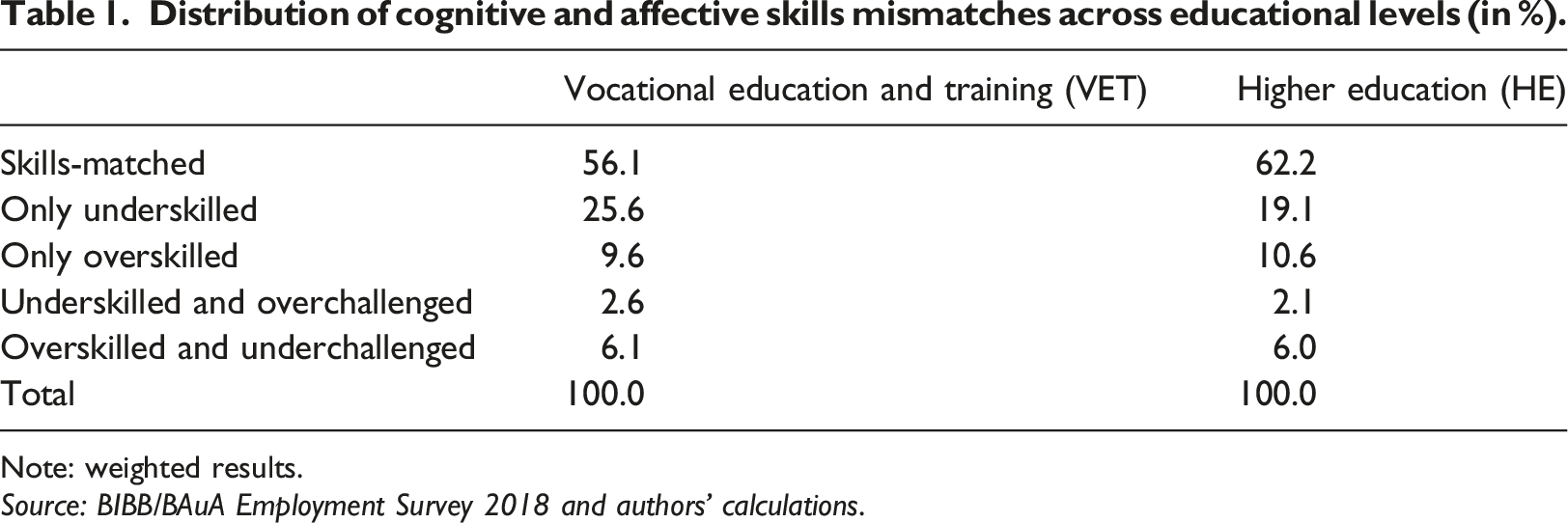
Note: weighted results.Source: BIBB/BAuA Employment Survey 2018 and authors’ calculations.
Multivariate results
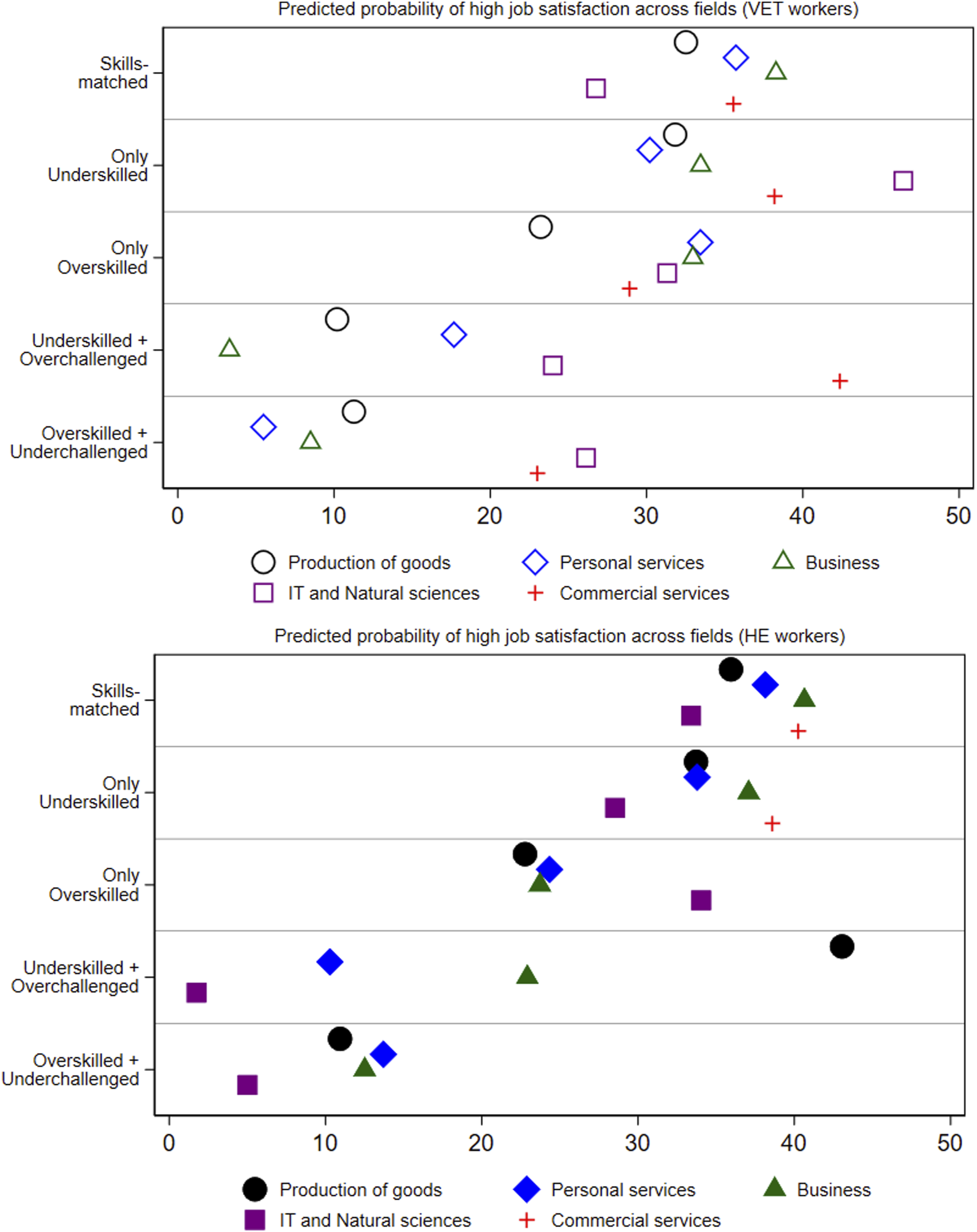
To visualise how a worker’s probability of being highly satisfied with their job is distributed across the different categories of skills mismatches, the predicted probabilities of job satisfaction by affective and cognitive skills mismatches for HE and VET workers are plotted in Figure 2. As shown in Figure 2, skills-matched workers have the highest probabilities (38% for HE and 35% for VET workers) of being highly satisfied with their jobs. Interestingly, the predicted probabilities of job satisfaction are also significantly high for underskilled workers, with 35% of underskilled HE workers and 33% of underskilled VET workers being highly satisfied with their jobs. Working in a challenging job (i.e. being underskilled) does not seem to reduce the probability of achieving a high job satisfaction. Conversely, the underutilisation of skills through overskilling relates to lower probabilities of being satisfied with the job. Additionally, some differences across educational levels are observed: for HE workers, the probability of being satisfied with the job (21%) is lower than that for vocationally educated workers (29%). Overskilling is the only mismatch category where HE workers show lower probabilities of job satisfaction than VET workers; in all the other mismatch categories, HE workers generally achieve higher probabilities of job satisfaction. Overskilling may be particularly detrimental to the job satisfaction of HE workers since they have invested, on average, more resources to attain a higher level of education as compared to VET workers in order to get jobs that allow them to use their acquired higher-level skills. Differences across educational levels may also be driven by differences in educational fields of VET and HE workers.
2
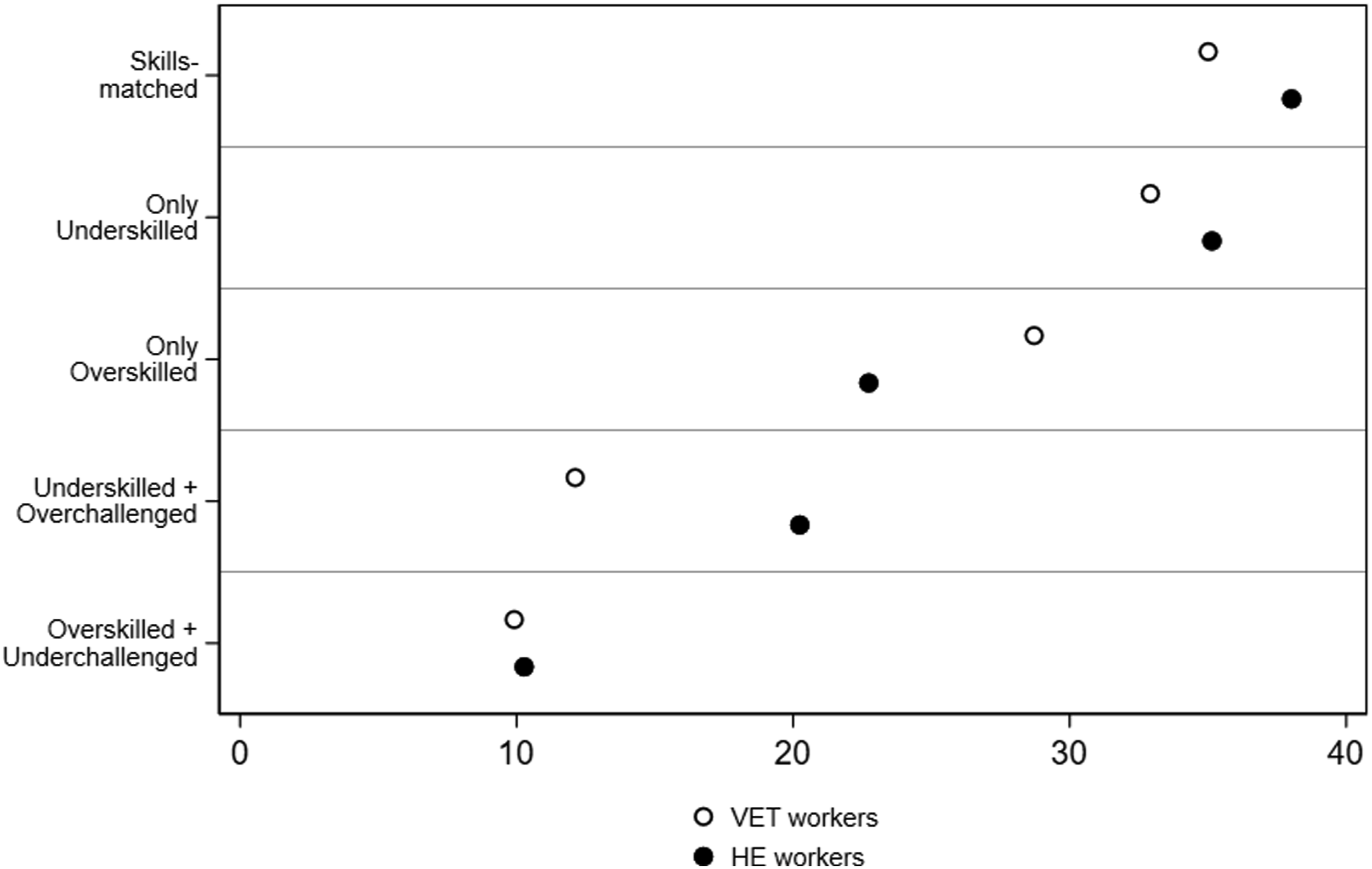
The simultaneous occurrence of cognitive and skills mismatches is related to lower probabilities of job satisfaction. In this vein, workers who are underskilled and simultaneously feel overchallenged show lower probabilities of being highly satisfied with their jobs, compared to that of only underskilled or overskilled workers. The simultaneous occurrence of overskilling and being underchallenged seems to be even more detrimental to the probability of being satisfied with the job.
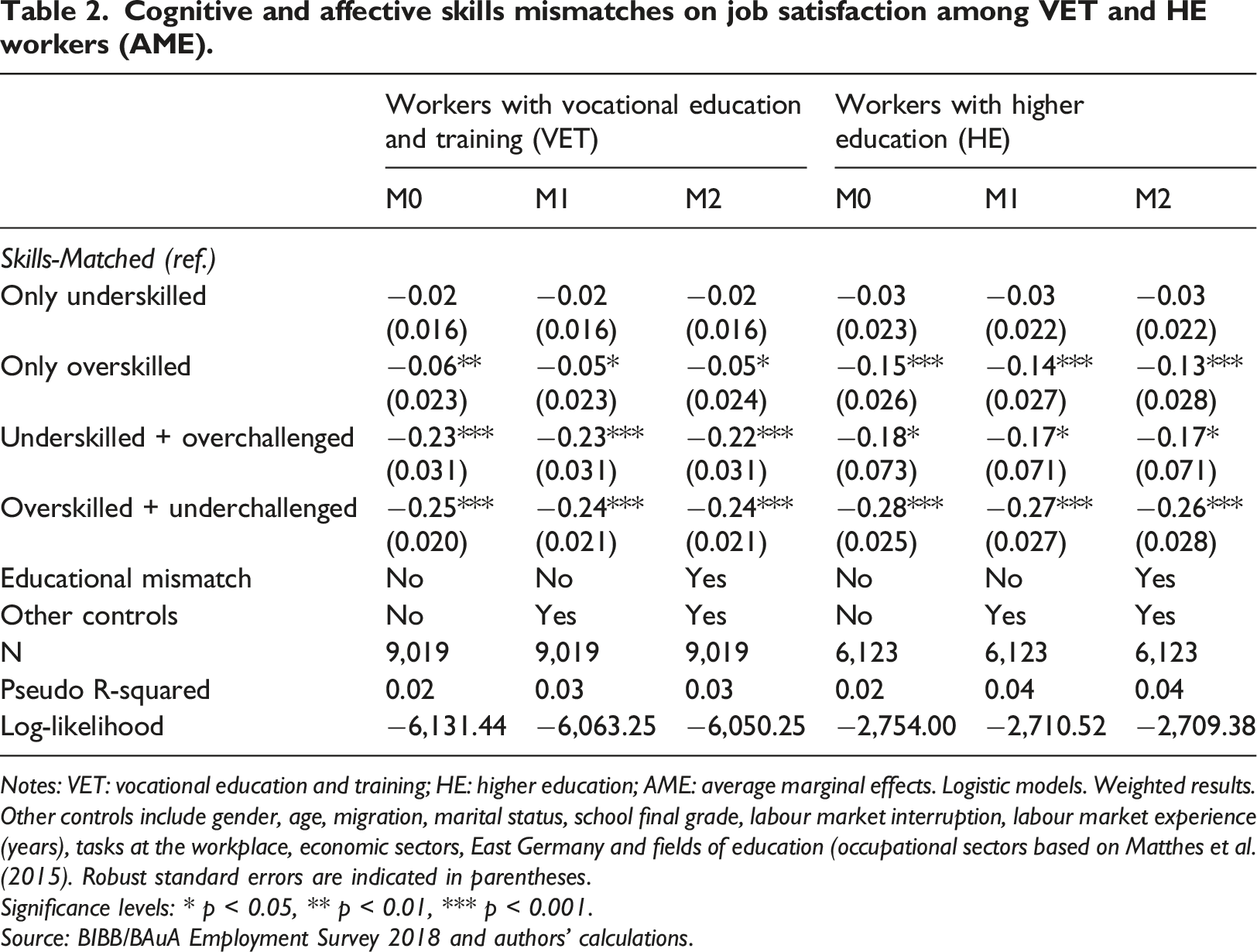
To analyse whether cognitive and affective skills mismatches affect job satisfaction in a significantly different manner, this study ran stepwise binomial logistic models and calculated the AME.
Notes: VET: vocational education and training; HE: higher education; AME: average marginal effects. Logistic models. Weighted results. Other controls include gender, age, migration, marital status, school final grade, labour market interruption, labour market experience (years), tasks at the workplace, economic sectors, East Germany and fields of education (occupational sectors based on Matthes et al. (2015). Robust standard errors are indicated in parentheses.
Significance levels: * p < 0.05, ** p < 0.01, *** p < 0.001.
Source: BIBB/BAuA Employment Survey 2018 and authors’ calculations.
The job satisfaction penalty for underutilising job skills is higher for HE than for VET workers, and this might be driven by the different investments in human capital of high -and medium-skilled workers. In other words, given that HE workers usually invest more time and resources in their educational attainment as compared to VET workers, the underutilisation of their human capital should have a greater impact on job satisfaction levels among the group with the highest educational investments. 3
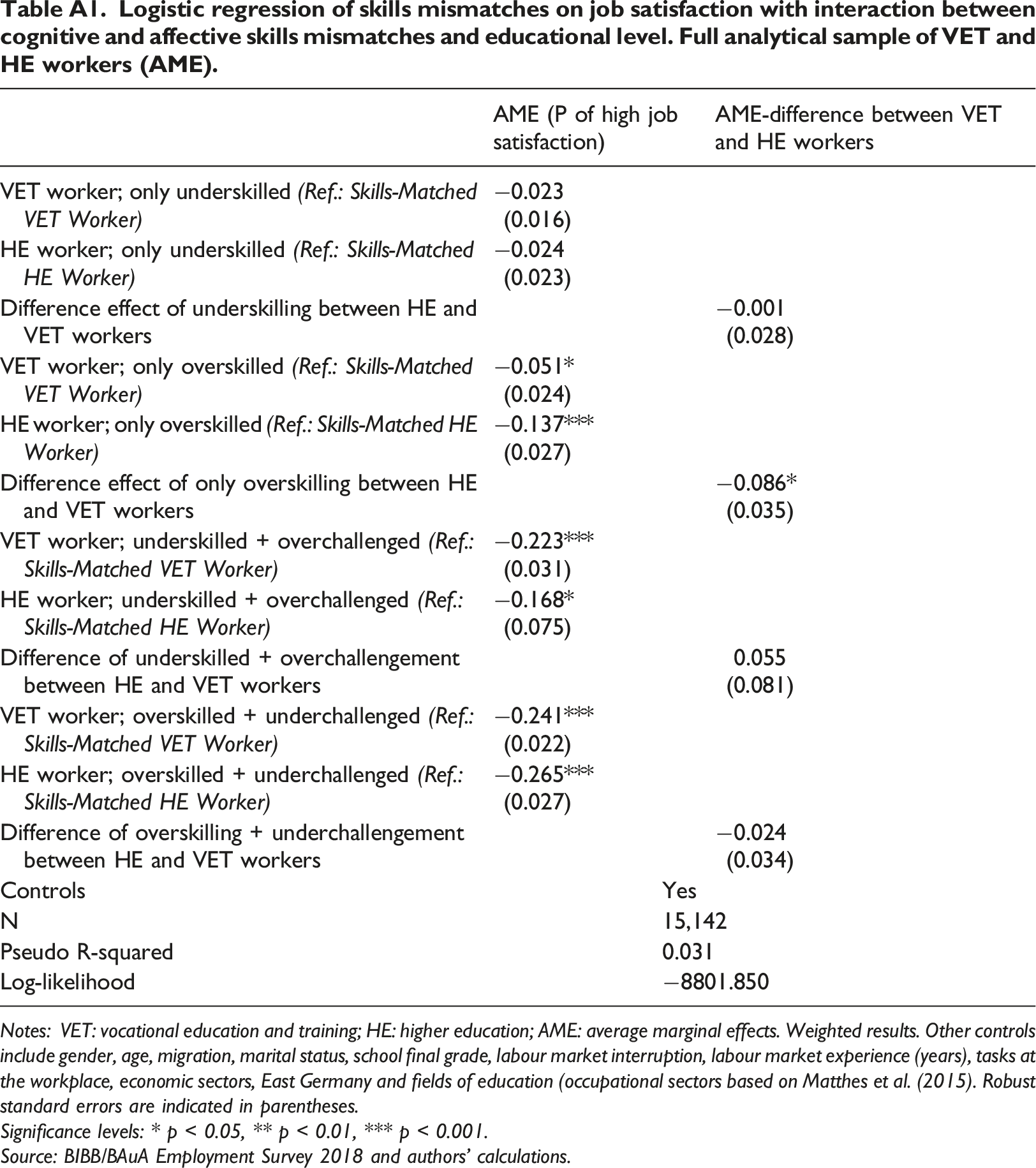
Moreover, overskilled workers who simultaneously feel underchallenged experience significantly high job satisfaction penalties as compared to those experienced by skills-matched workers. The penalties for overskilled workers feeling underchallenged are significant for both educational groups: whereas overskilled VET workers and HE workers are (5 and 13 percentage points, respectively) less likely to be satisfied with their jobs than skills-matched workers, overskilled workers in the same educational group feeling underchallenged are even (24 and 26 percentage points for VET and HE workers, respectively) less likely to be satisfied with their jobs (see model M2 in Table 2). This result can be interpreted as the penalty of job satisfaction for jobs with low skills requirements which do not allow workers to adequately use their skills. This means that when having higher skills levels than required for the job (i.e. being overskilled), and feeling underchallenged with the lower job skills requirements, produces an additional negative impact on job satisfaction (i.e. job satisfaction penalty of underchallenging jobs). This penalty associated with overskilling thereby relates to a sense of unused general potential (Sánchez-Sánchez and McGuinness 2015). Nevertheless, irrespective of affective mismatches, underutilisation of skills through overskilling is detrimental to job satisfaction and should be considered as a negative labour market phenomenon.
Changing the focus on the other skills mismatch conditions, that is, on the group of underskilled workers, it appears that underskilled workers achieve the same levels of job satisfaction as those achieved by their skills-matched counterparts (AME are not statistically significant for both educational groups). Working in a job requiring higher skills levels than those possessed by workers (i.e. being underskilled) is not detrimental to job satisfaction. Interestingly, however, underskilling in combination with feeling overchallenged is associated with high job satisfaction penalties. This supports this study’s approach to differentiating challenging jobs from overchallenging jobs. Underskilling, that is, having lower skills requirements than required at the workplace, is the only mismatch condition that is not negatively associated with job satisfaction.
Moreover, the results for underskilled workers feeling overchallenged also align with the juxtaposition of challenging and overchallenging jobs. Thus, the simultaneous occurrence of underskilling with feeling overchallenged is associated with a larger job satisfaction penalty: VET and HE workers are found to be (22 and 17 percentage points, respectively) less likely to be satisfied with their jobs than their skills-matched counterparts (see model M2 in Table 2). Considering affective skills, mismatches strengthen the assumption that underskilled workers feel capable for fulfilling job requirements that they find challenging that offer them the opportunity to acquire higher skills. In contrast, if underskilled workers feel overchallenged by those higher requirements, they have overchallenging jobs that strongly reduce their job satisfaction.
This study concluded that both the combination of skills mismatches yields insightful results for an explanation regarding job satisfaction, and represents a step forward for a comprehensive understanding of the skills mismatch phenomenon. Nevertheless, even though the dependent variable captures valuable information about how workers evaluate their jobs in general, general job satisfaction does not provide direct information on the sub-dimensions of jobs that are more directly affected by a mismatch of skills, such as task complexity, job position, income and especially, the possibility of using skills acquired by them through education on the job.
In this vein, to allow for a more complete picture of how cognitive and affective skills mismatches affect worker satisfaction, in this study’s models, alternative dependent variables are additionally considered that measure worker satisfaction with different dimensions of their jobs, namely, skills use, task content, income and occupational position. The full model was reran with all the control variables (M2 in Table 2) for the different dimensions of job satisfaction. Instead of presenting the results in a table as the AME, Figure 3 plots the predicted probabilities of all logistic regression models with the different job satisfaction measures as the dependent variable, separated by VET and HE workers. For the sake of comparability, Figure 3 also includes the predicted probabilities of the overall job satisfaction based on M2 (see the column for M2 in Table 2).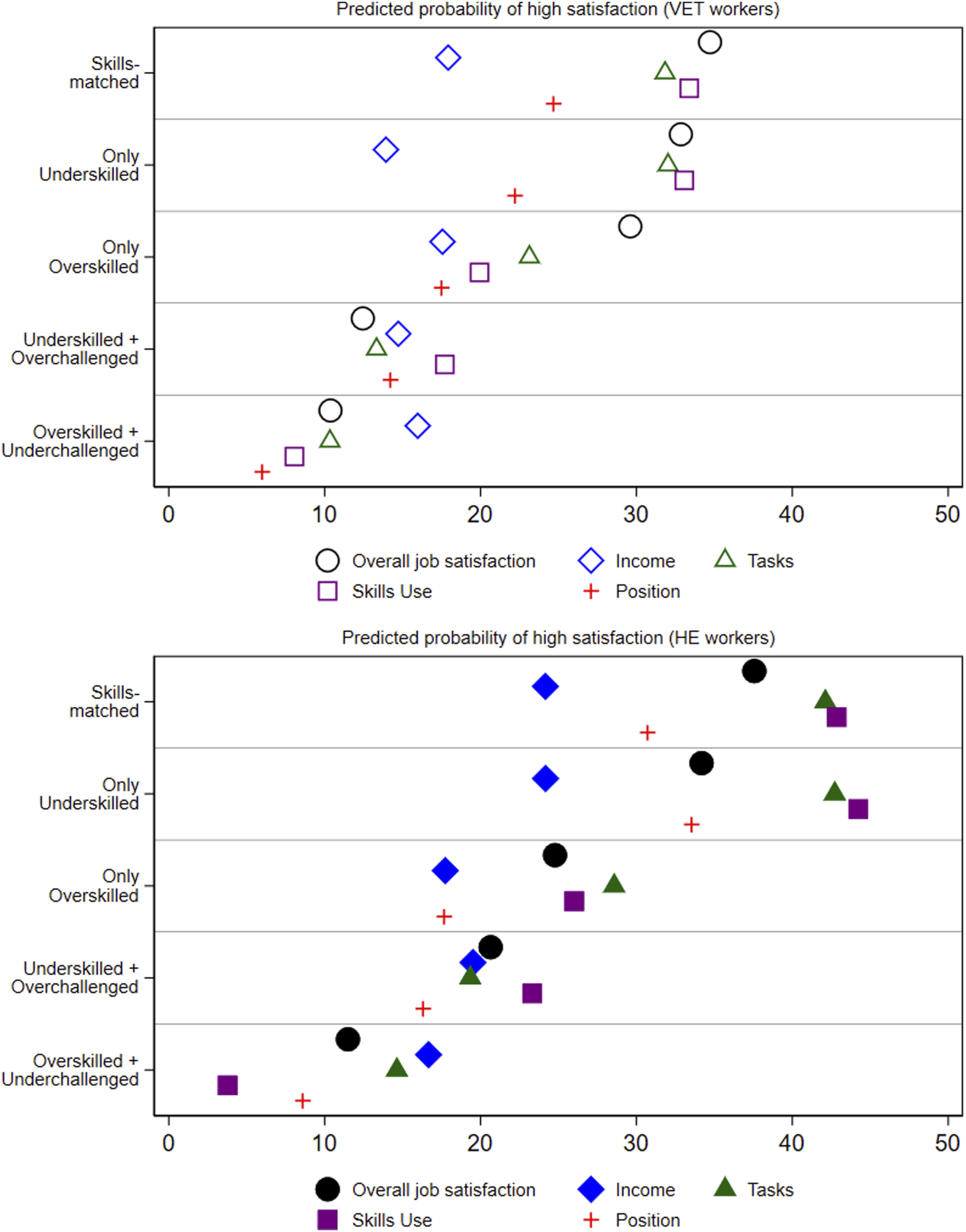
The results in Figure 3 indicate the same conclusions drawn from the results of Table 2 regarding general job satisfaction. Taking the satisfaction with skills use and with the task content of jobs as examples, Figure 3 indicates that VET and HE workers in skills-matched jobs achieve similar satisfaction levels regarding their skills use and task content than those of underskilled VET and HE workers in challenging jobs.
If workers underutilise their skills through overskilling, the probabilities of achieving high levels of satisfaction regarding their skills use or job tasks are lower as compared to skills-matched or underskilled workers. Moreover, the simultaneous occurrence of cognitive and affective mismatches (i.e. underskilling with feeling overchallenged and overskilling with feeling underchallenged) additionally makes it less likely for workers to be highly satisfied regarding the skills use and job tasks. Furthermore, it is important to mention that satisfaction regarding income follows a slightly different pattern compared to the other satisfaction dimensions; therefore, skills mismatches appear to be less related to differences in satisfaction regarding income. Although a mismatch between skills endowments and requirements may affect the income level of workers, an evaluation of the different satisfaction dimensions supports the interpretation that mismatches are more strongly related to the satisfaction dimensions capturing job content rather than to dimensions capturing the monetary conditions of jobs. In addition, those results on different job satisfaction measures support the robustness of the subjective indicators of skills mismatches used in the present analysis. Establishing a causal direction between subjective measures like skills mismatches and job satisfaction is difficult because they tend to be correlated, that is, workers who feel dissatisfied with their jobs tend to be more critical about their job requirements and mismatch situations. Nevertheless, the robustness of the subjective indicators of skills mismatches are supported by results from Figure 3, which show same patterns for satisfaction with skill use and job task, but not for satisfaction with income. Thus, the skills mismatch measures and results seem not to be biased by response style of workers or overall negative feelings about the job.
In summary, the general picture emerging from the analyses in the present study is straightforward. All results hint at the importance of complementing skills mismatches with affective aspects to evaluate mismatches’ associations with job satisfaction and shed light on potential mechanisms underlying these associations. Thus, differentiating challenging from overchallenging jobs is essential in designing adequate labour market policies: while underskilling by itself is not detrimental to job satisfaction, underskilling in combination with feeling overchallenged as well as underutilisation of skills (i.e. overskilling) are negative, job satisfaction-reducing phenomena.
Conclusions and discussion
Previous studies have shown that skills mismatches influence relevant labour market outcomes, such as wages, job satisfaction, job turnover (Allen et al., 2013; Allen and Van der Velden, 2001; Perry et al., 2014) and general productivity (OECD 2013). However, while the existing research tends to focus on overskilling, its higher incidence, and its more negative impact on outcomes as compared to those of underskilling (Flisi et al., 2017), the opposite is true for policy recommendations (McGuinness et al., 2018). Differentiating the conditions of skills mismatches is important, given that findings on overskilling suggest negative associations with job satisfaction due to underutilisation of job skills (Sánchez-Sánchez and McGuinness, 2015), whereas findings for underskilling remain more inconclusive.
The present study complements the commonly used approach based on cognitive evaluations in the skills mismatch literature by introducing an affective aspect that captures how workers cope with their specific mismatch situation regarding skills requirements and endowments. This study argues that a distinction between affective and cognitive skills mismatches is helpful in shedding light on the complex phenomenon of skills mismatches and in deriving adequate policy recommendations. In other words, this study considers whether or not workers feel overchallenged in a job for which they are underskilled, or whether they feel underchallenged in a job for which they are overskilled, and analyse how these different dimensions influence job satisfaction. Moreover, given the influence of job satisfaction on workers’ productivity, analysing what adds value to workplaces from the perspective of workers is essential in the context of labour policies.
This study’s results show that both affective and cognitive skills mismatches negatively affect workers’ job satisfaction, with the noteworthy exception of underskilling. The largest job satisfaction penalties are found for workers who are simultaneously overskilled and feel underchallenged. More importantly, analyses of both skills mismatches are a step forward towards a comprehensive understanding of the skills mismatch phenomenon.
On the one hand, while underskilling by itself is not negatively associated with job satisfaction, underskilling in combination with feeling overchallenged exerts a significantly large influence on the job satisfaction of VET and HE workers. This corroborates this study’s approach to differentiating between challenging and overchallenging jobs.
On the other hand, being overskilled is detrimental to job satisfaction as the underutilisation of skills has a greater impact on job satisfaction among HE workers as these include workers with the highest educational investments, than among VET workers. Moreover, the job satisfaction penalty is even larger when overskilling is present in combination with feeling underchallenged.
Thus, while overskilling is always detrimental to job satisfaction (irrespective of simultaneous affective skills mismatches), underskilling is a matter of concern only if the worker feels overchallenged. It is reasonable to argue that as workers can learn from more demanding tasks, they have learning opportunities in challenging jobs; therefore, underskilling is not inherently costly for workers (Van der Velden and Verhaest, 2017). Employers may also benefit from maintaining job tasks at a challenging level. Underskilled workers inherently have learning opportunities through continuous training and learning by doing, fostering skill accumulation (Ferreira et al., 2017). The fact that underskilling is more prevalent among young workers and within high-skilled occupations (Livanos and Núñez, 2017) supports the importance of considering on-the-job learning when assessing underskilling. The opposite applies for overskilled workers, for whom a feeling of being underchallenged due to their underutilisation of skills might be a fundamental source of low job satisfaction. By identifying underutilisation of skills and challenging and overchallenging jobs, employers can design continuous training strategies, especially targeted at the skills that workers need to acquire to increase productivity and workers’ job satisfaction.
As this study’s results are derived from vertical and horizontal educational mismatch effects, they are in line with previous findings suggesting that it is the match between skill requirements and skill endowments, as opposed to the match between education degrees and formal qualification requirements of jobs, that drive workers’ job satisfaction (cf. Mavromaras et al., 2013).
However, this study has several limitations. First, because of the cross-sectional structure of the data, the potential unobserved (time-invariant) heterogeneity of workers cannot be ruled out. Although important control variables that depict workplace and worker characteristics (such as task content, educational mismatch, occupational sector and educational fields) are included in the analyses, a purely causal interpretation of the results is not conducted. Second, the analyses focus on workers’ self-assessments of the total skills needed for the job. However, it remains unclear as to which type of skills have been implicitly analysed. While the results do not allow for skills-specific statements and do not solve the ‘black box’ problem in the skills mismatch literature, they offer the first evidence of cognitive and affective skills mismatches (and more specifically, evidence regarding challenging and overchallenging jobs). Future research could build on this study’s findings to offer further insight into the types of skills that are required and possessed by workers across different occupational contexts. In this vein, datasets that already contain valuable information on required and acquired levels of competencies, like REFLEX or the EUROGRADUATE pilot survey, may be further enriched by including measures of cognitive and affective skills mismatches.
Finally, considering the affective dimension of skills mismatch together with cognitive evaluations extends the research of skills mismatch and job satisfaction. From a policy perspective, the focus on cognitive skills mismatches can be complemented by simultaneously considering the affective dimension of skills mismatches. Given the high relevance of workers’ job satisfaction, employers and policy-makers should incorporate the level of challenges presented by jobs (i.e. overchallenging or underchallenging) into the debate of skills mismatches, as well as consider the important differences between underutilisation of skills and challenging jobs. This study broadens the scope of skills mismatch analyses by contributing to clarifying this complex phenomenon, and facilitating future analyses to expand on this new perspective.
Footnotes
Declaration of conflicting interests
The author(s) declared no potential conflicts of interest with respect to the research, authorship, and/or publication of this article.
Funding
The authors received no financial support for the research, authorship, and/or publication of this article.

Notes
Author biographies
Appendix
Notes: VET: vocational education and training; HE: higher education; AME: average marginal effects. Weighted results. Other controls include gender, age, migration, marital status, school final grade, labour market interruption, labour market experience (years), tasks at the workplace, economic sectors, East Germany and fields of education (occupational sectors based on Matthes et al. (2015). Robust standard errors are indicated in parentheses.
Significance levels: * p < 0.05, ** p < 0.01, *** p < 0.001.
Source: BIBB/BAuA Employment Survey 2018 and authors’ calculations.
AME (P of high job satisfaction)
AME-difference between VET and HE workers
VET worker; only underskilled (Ref.: Skills-Matched VET Worker)
−0.023
(0.016)
HE worker; only underskilled (Ref.: Skills-Matched HE Worker)
−0.024
(0.023)
Difference effect of underskilling between HE and VET workers
−0.001
(0.028)
VET worker; only overskilled (Ref.: Skills-Matched VET Worker)
−0.051*
(0.024)
HE worker; only overskilled (Ref.: Skills-Matched HE Worker)
−0.137***
(0.027)
Difference effect of only overskilling between HE and VET workers
−0.086*
(0.035)
VET worker; underskilled + overchallenged (Ref.: Skills-Matched VET Worker)
−0.223***
(0.031)
HE worker; underskilled + overchallenged (Ref.: Skills-Matched HE Worker)
−0.168*
(0.075)
Difference of underskilled + overchallengement between HE and VET workers
0.055
(0.081)
VET worker; overskilled + underchallenged (Ref.: Skills-Matched VET Worker)
−0.241***
(0.022)
HE worker; overskilled + underchallenged (Ref.: Skills-Matched HE Worker)
−0.265***
(0.027)
Difference of overskilling + underchallengement between HE and VET workers
−0.024
(0.034)
Controls
Yes
N
15,142
Pseudo R-squared
0.031
Log-likelihood
−8801.850