Abstract
Because of the high social relevance of an economics education, many countries now focus on the enhancement of economic competencies in schools. International results show strong deficits in basic economic knowledge, especially for students in upper secondary education, who usually enter higher education. Furthermore, it is not clear what effects these competencies have on subsequent transitions, which is primarily due to a lack of longitudinal studies. Against this background, this article systematically embeds findings from a Swiss longitudinal study in the international context. Thereby, Switzerland is systematically compared with other countries that also provide substantial research on economic education (e.g., the U.S. and Japan). Lessons learned from the Swiss case will be discussed from an international perspective, and implications for future international research will be derived.
Keywords
Introduction
For many decades, economic education has been gaining increasing importance in numerous countries (e.g., Aprea et al., 2016; Brückner et al., 2015a; Miller et al., 2015; Walstad, 1998; Walstad and Watts, 2015; Wuttke et al., 2016). One of the main reasons is the increasing complexity of national economies with constantly expanding economic globalization and their increasing interrelatedness with social and political institutions so that capable social and political participation is hardly conceivable without a basic understanding of economics (e.g., Achtenhagen et al., 1993; Jappelli, 2010; Jenkins and Sharp, 2003; Organisation for Economic Cooperation and Development, 2014; Walstad et al., 2013; Wuttke et al., 2016). Against this background, economics education becomes important on different levels: private (e.g., for the role as a consumer), vocational (e.g., for the role as an employee or employer), and societal, as a so-called economically competent citizen (e.g., Schumann et al., 2017). This understanding of economics education strongly relates to the concept of economic literacy (e.g., Walstad et al., 2013; Wuttke et al., 2016), which is widely understood internationally and is an important basis of this article. Considering the question of enhancing economic competencies, researchers strongly suggest implementing a stronger focus on economics education in upper secondary schools (e.g., Walstad, 1994, 1998; Wuttke et al., 2016). There are several reasons for this suggestion. The main reason is that students at this level are typically nearing the end of their compulsory education and are thus at the transition from upper secondary to higher education or into the employment system. Following the debate about the developing educational expansion that can be observed in many industrialized countries (e.g., Hannum and Buchmann, 2005; Trow, 2006), the successful transition from school to university in particular is becoming increasingly important (see Coertjens et al., 2017). For higher education, the field of economics 1 is one of the most popular degree programs worldwide (e.g., Organisation for Economic Cooperation and Development, 2017a). Against this background, many studies worldwide are now investigating economic competencies in higher education. Many of those studies are focusing either on the role of the gender gap (e.g., Brückner et al., 2015b; Johnson et al., 2014) or on the role of prior economic education (e.g., Happ et al., 2016a; Happ et al., 2018; Jüttler, 2020a; Jüttler & Schumann, 2019; Swope & Schmitt, 2006; Zlatkin-Troitschanskaia et al., 2013). A frequently asked question in these studies is to what extent previous economic education or higher economic competencies at the end of secondary education can predict the appropriate choice of an economics degree program and success in such a program. However, from an international perspective, there are strong differences regarding (1) the definition and understanding of economic education or economic competencies and (2) the transition from secondary to higher education. Based on these considerations, there are already a few studies that have addressed the international developments in the research with regard to economic education at both the secondary and the tertiary levels (e.g., Beck & Krumm, 1994; Happ & Zlatkin-Troitschanskaia, 2021; Jappelli, 2010). However, to the best of our knowledge, no study exists that systematically examines this influence. In a longitudinal sample that is representative of the German-speaking part of Switzerland, the influence of upper secondary school students’ economic competencies on their aspiration, choice, and success in an economics degree program was systematically investigated for the first time (see Jüttler et al., 2016; Jüttler, 2020a; Jüttler and Schumann, 2019). To date, there has been no systematic embedding of these findings in international research. The aim of this paper is therefore to summarize these findings and transfer them to the international context. This information helps to enable international researchers to derive empirical indications. Possible implications for future international research are the final point of this paper.
This paper starts by providing an overview of transitions from school to university in Switzerland, which builds a basis for the underlying empirical study. It then summarizes the theoretical underpinnings of economic competencies as well as their implications for transitions from secondary to higher education, addressing key international differences. Next, an overview of the current research is provided. This method builds the foundation for the international embedding of the underlying study of this paper, which will subsequently be presented. Finally, possible transfers of this study to other countries are systematically discussed, identifying research desiderata.
Theoretical background
The transition from school to university in Switzerland
In Switzerland, three central transitions from school to university exist. The first, the "classic” path, leads via the general education track, the baccalaureate school (BS). Graduates of this track acquire a “gymnasiale Maturität” (Matura; equal to high school diploma), which enables them to study at a Swiss university without restrictions in any course of study 2 . This free choice of study program is legitimized primarily by a historically low Matura rate of approximately 20% (Swiss Coordination Centre for Research in Education (SCCRE), 2018). Consequently, this is associated with strong performance-based selection when transferring to a BS. Because of these special aspects, the general educational track is also referred to as the “royal path.” There is a high transition from BS to universities of approximately 90% of a cohort within two years after graduation (ebd.).
The second important path from school to university leads via the vocational track, the so-called federal vocational baccalaureate schools (FVBS). Following this path, students obtain a domain-specific qualification for entrance into universities of applied sciences (UAS) in addition to their vocational training.
The third pathway is represented by upper-secondary specialized schools. These are similar to the BS but with significantly lower entry restrictions and less professional specialization, which typically leads to a UAS (SCCRE, 2018). However, they make up only a small percentage of the general education qualifications at the upper secondary level. FVBS and upper-secondary specialized schools are difficult to compare with other countries because of their special features and particularities within the Swiss educational system as forms of hybrid qualifications (c.f., Deissinger et al., 2013).
Because of these restrictions and the fact that most transitions from school to university occur after the BS, this paper focuses especially on BS students 3 .
Taking a look at higher education, besides Humanities and Social Sciences as well as exact and natural sciences, Economics and Law is one of the most popular fields with approximately 25% of a cohort at both universities and UAS (OECD, 2021; SCCRE, 2018).
Another particularity of the Swiss educational system must be seen in the prominent role of economics education. All BS students have to choose an advanced course at school. Advanced courses include Ancient Languages, Modern Languages, Physics and Mathematics, Biology and Chemistry, Philosophy/Pedagogy/Psychology, Art and Music, as well as Economics and Law. If Economics and Law is not chosen as an advanced course, it must be taken as a basic course. Therefore, all BS students gain at least a basic economic education at school and thus a basic understanding of economic principles. This considerable importance of economic education is similarly recognized for FVBS, but the profiling is primarily based on vocational courses so that there is no separate decision for the advanced course at the school level. The difference between advanced and basic courses lies in the number of weekly lessons. Depending on the canton, the number of lessons for advanced courses is four to six lessons, while for basic courses, it is between one and two lessons.
International perspective on economic competencies at the upper secondary level
Considering the relevance of economic education, the theoretical and empirical assessment of economic competencies has received comparatively high attention in the course of international research on economics education. In this regard, the concept of economic education (or economic competencies) is by no means a novelty and has a relatively long tradition (see, e.g., Schumann et al., 2017; Soper and Walstad, 1987; Walstad and Rebeck, 2002; Wuttke et al., 2016). Following international research, a multitude of definitions have been established, whose terminology (especially competence, literacy, (basic) education) and demarcations remain mostly blurred and imprecise. Wuttke et al. (2019) categorize this range of different approaches as follows: 1. Economic competencies in the sense of economic literacy. 2. Economic competencies in the sense of financial literacy. 3. Economic competencies in the sense of general business literacy. 4. Economic competencies in the sense of business-accounting literacy.
Due to their primarily occupational relevance, approaches (3) and (4) can also be summarized as "occupational and commercial competencies.” This paper will focus on the first approach, since from an international perspective, economic literacy represents one of the most widespread approaches and in some ways can be seen as the “greatest common divisor.”
Economic literacy denotes an economic education that addresses basic economic understanding, which should enable students to act as responsible and mature economic citizens in a modern society (e.g., Achtenhagen et al., 1993; Jenkins and Sharp, 2003; Wuttke et al., 2016). However, from a historical perspective, a fundamental problem with this approach lies in its empirical accessibility. A first milestone can be seen in the report published in the U.S. by the Committee for Economic Development (1961), in which the Test of Economic Understanding (TEU; Council on Economic Education (CEE), 1964) and—approximately 15 years later—the Test for Economic Literacy (TEL; Soper, 1978, 1979) emerged. Based on the TEU and TEL, it was possible for the first time to empirically measure the basic economic knowledge of adolescents and adults. Empirical findings then identified a significant lack of economic literacy among the U.S. population, often referred to as “economic illiteracy” (Scheer, 1974). In the following years, the TEL was revised by Soper and Walstad (1987) and Walstad and Rebeck (2001) and used in numerous other studies (for an overview, see Happ and Zlatkin-Troitschanskaia, 2021). Today, the TEL is in its fourth edition (Walstad et al., 2013). The revisions of the TEL provided an important foundation for further validations and translations, resulting in the TEL being used internationally alongside other test instruments. Based on its international utilization, similar results to those for the U.S. could be found in other countries. Despite an overall large heterogeneity between countries (Jappelli, 2010), a significant knowledge deficit in the economic field is found across countries (e.g., Lüdecke-Plümer and Sczesny, 1998; Walstad et al., 2007; Yamaoka et al., 2010b), with Germany and the U.S. showing the lowest values (Beck and Krumm, 1994; Lüdecke-Plümer and Sczesny, 1998). However, Asian students show above-average results (ebd.). An important international comparison is provided by Jappelli (2010), who compares the economic literacy of 55 countries based on the evaluation of business leaders of the corresponding countries. This relatively simple approach offers the possibility to systematically compare different countries. Additionally, in this study, the highest scores are reached by East Asian countries (e.g., Japan), while other large industrialized countries such as Germany and the U.S. are rather mediocre. Furthermore, there is a broad, cross-national consensus regarding gender differences, with men tending to perform better than women on competency tests (Arnold and Rowaan, 2014; Asarta et al., 2014; Brückner et al., 2015b; Förster et al., 2018; Johnson et al., 2011, 2014).
The most recent international comparison based on the fourth edition of the TEL is provided by Happ and Zlatkin-Troitschanskaia (2021), who used equivalent, country-specific versions of this test to compare economic literacy and its subdomains (principles of economics, microeconomics, macroeconomics and international relations) in the four largest industrialized countries of the world: Germany, the U.S., Japan, and China. Based on their study, several findings can be derived. First, like other studies have shown, Asian countries (e.g., China and Japan) perform significantly better than Germany and the U.S. Second, the well-known gender effect in favor of men is reversed in Asian countries, that is, women perform better than men. Third, for the first time, there are also differentiated analyses regarding various subdomains of economic literacy. In Germany, for example, deficits are primarily found in the area of basic economic principles and in microeconomics, while Asian countries and the U.S. perform worse in macroeconomics. The importance of considering subdomains is also emphasized by Yamaoka et al. (2007) in a study of a U.S.–Japan comparison, where U.S. students perform better in TEL 3 than Japanese students. This is attributed to the fact that the content in TEL 3 (including scarcity and entrepreneurship) plays only a minor role in the Japanese school curriculum.
As mentioned at the beginning of this paper, only a few studies investigate the effects of economic competencies, or economic literacy, on the transition from school to an economics study program. Therefore, international differences in the transition from secondary to higher education are briefly described in a first step. This will also serve as the foundation to enable the embedding of national findings (here: Switzerland) into an international context. Afterwards, the state of research on the effects of economic competencies on choosing an economics study program will be presented in more detail.
International differences in the transition from secondary to higher education
Because of great national differences regarding the transition from secondary to higher education, it is almost impossible to describe all countries and their characteristics. For this purpose, the countries that have also been focused on for comparison are Switzerland, Germany, the U.S. and Japan. All of these countries are part of the OECD, which provides broader, more accessible and more comparable data.
International comparison of different characteristics regarding the transition from secondary to higher education.
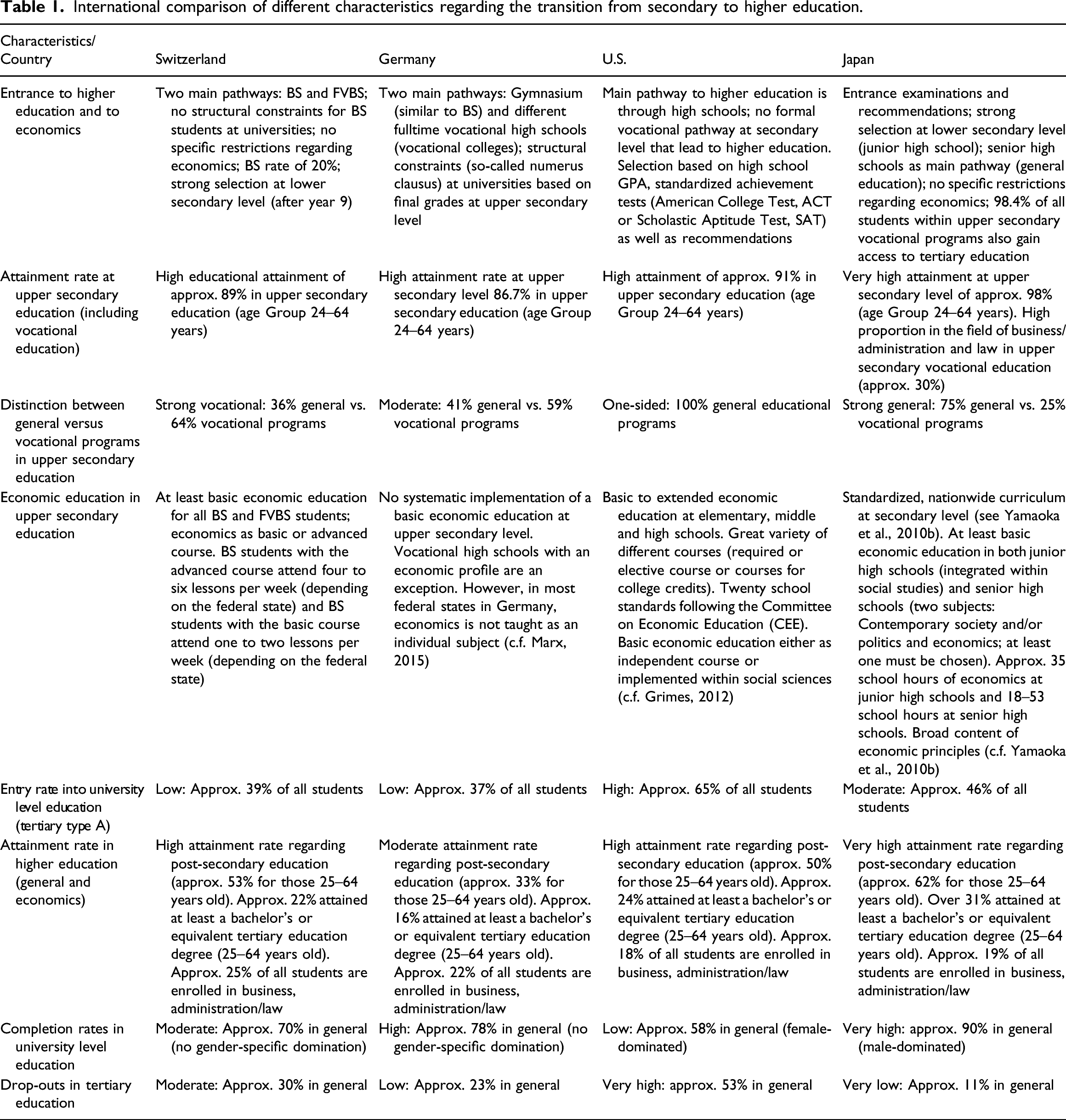
Comparing the results from Table 1, various differences, as well as some similarities, between the countries must be explained.
Most likely, the greatest differences can be found in terms of access to higher education and economic education at the upper secondary level. Considering economic education, Switzerland, Japan and the U.S. show the strongest standardized precollege or pre-university economic education at the secondary level. However, it is difficult to compare the different curricula in terms of content since students at this level can often choose between different subjects. In Switzerland, there is strong profiling in schools, which is not the case in the U.S. or Japan. Germany, in contrast, shows no systematic integration of economic education in general education, which can also be seen in deficits regarding the understanding of economic principles (according to the CEE; see Happ and Zlatkin-Troitschanskaia, 2021). With the exception of Switzerland, there is a broad discussion regarding a considerable deficit in the training of economics teachers, who often do not meet the necessary domain-specific requirements for the adequate teaching of economics (e.g. for Germany: Marx, 2015; Wuttke et al., 2016, for Japan: Yamaoka et al., 2010b; for the U.S.: Grimes, 2012; Walstad, 2001). Considering access to higher education, in Japan and Switzerland, there is a strong selection at the transition from lower to upper secondary schools. This selection typically results in easier access to higher education for students who are more successful at this early stage of education. In contrast, the systems in Germany and the U.S. provide more restrictions at the transition between the upper secondary and tertiary levels. This results in structural constraints such as numerus clausus or college admission tests with which students are confronted after graduation from school. However, students in Japan also have to take examinations after graduating from upper secondary school, which characterizes a strong performance orientation in Japan.
All countries have a high graduation rate at the upper secondary level. A fundamental distinction, however, is found in the extent to which these degrees can be attributed to the general or to the vocational education system. While in the U.S., there are only general education degrees; in Germany and especially in Switzerland, vocational degrees predominate, which in turn can provide alternative access to higher education. In addition to a moderate to high participation rate in higher education across all countries, there are significant differences in completion and dropout rates. The very low dropout rate in Japan is remarkable, whereas it is very high in the U.S.
International perspective regarding the effects of economic competencies on the transition from school to an economics study program
The state of international research on the effects of economic competencies at the upper secondary level on the transition to study in economics must be described as rudimentary. This is primarily because previous studies have mostly focused on either secondary (e.g. Holtsch and Eberle, 2016; Jüttler and Schumann, 2016; Walstad et al., 2013; Wuttke et al., 2016; Yoo, 2007) or tertiary education (e.g. Förster et al., 2015a; Förster et al., 2015b; Förster et al., 2016; Happ and Zlatkin-Troitschanskaia, 2021; Schlax et al., 2020). The few exceptions to this consider only the formal prior economic education of first-year economics students (e.g., Happ et al., 2016a; Happ et al., 2016b; Happ et al., 2018), which is supposed to serve as a proxy for prior economic knowledge. Following this research approach, there are positive effects of economic pre-education on the prior economic knowledge of first-year students in different countries (e.g., Brückner et al., 2015a; Yamaoka et al., 2007). However, from an international perspective, various problems can already be found here, as prior economic education differs considerably across educational systems (Brückner et al., 2015a), which makes it difficult to systematically compare the results. Reasons for international differences on the transition from secondary to higher education are now described. First, educational systems already differ in the way they select students at the transition from primary to lower secondary and from lower secondary to upper secondary levels. From relatively weak selections, such as in Germany, to strong selections, such as in Japan and Switzerland, the selection process has significant impacts on which students are at each level. Second, there are strong curricular differences with respect to economic (basic) education. These range from curricula in which economic education is only partially integrated into general education (e.g., Germany) to curricula in which basic economic education is compulsory (e.g., Switzerland). Finally, the importance of studying economics in different countries can be discussed. On the one hand, it is emphasized that such courses of study are primarily taken for personal benefit (e.g., better and higher employment opportunities, see Yamaoka et al., 2010a). On the other hand, there is extensive research that identifies many other reasons used to explain the choice of study (e.g., interests, attitudes, and self-concept, Eccles and Wigfield, 2002; Johnson and Muse, 2017; Wang, 2013; Wang and Degol, 2013). However, to observe such effects in detail, longitudinal data based on proven decision models must be provided. Considering international studies on the long-term effects of economic competencies on the transition from school to an economics study program, to the best of our knowledge, no such research exists.
As already mentioned, the first analyses of the effects of economic competencies at the end of schooling on aspiration, choice and success in economics studies are provided for Switzerland (Jüttler et al., 2016; Jüttler, 2020a, 2020b; Jüttler & Schumann, 2019). A summary of these analyses is presented in the results section of this study, which will be systematically embedded into the international context.
Research question
Based on these theoretical considerations on economic competencies, the transition from school to university (and to an economics study program) as well as the systematic international differences, the focus of this paper is to integrate the longitudinal results from Switzerland into an international context. Therefore, Switzerland is systematically compared to Germany, the U.S., and Japan. Against this background, the paper will answer the question, how the longitudinal effects of economic competencies at the end of upper secondary school on the transition to an economics study program observed in Switzerland can be transferred to other countries. Accordingly, a synopsis of the method and the most important results of the study are presented at first. Based on this, the results from Switzerland will be embedded into the international context.
Methods
Study design
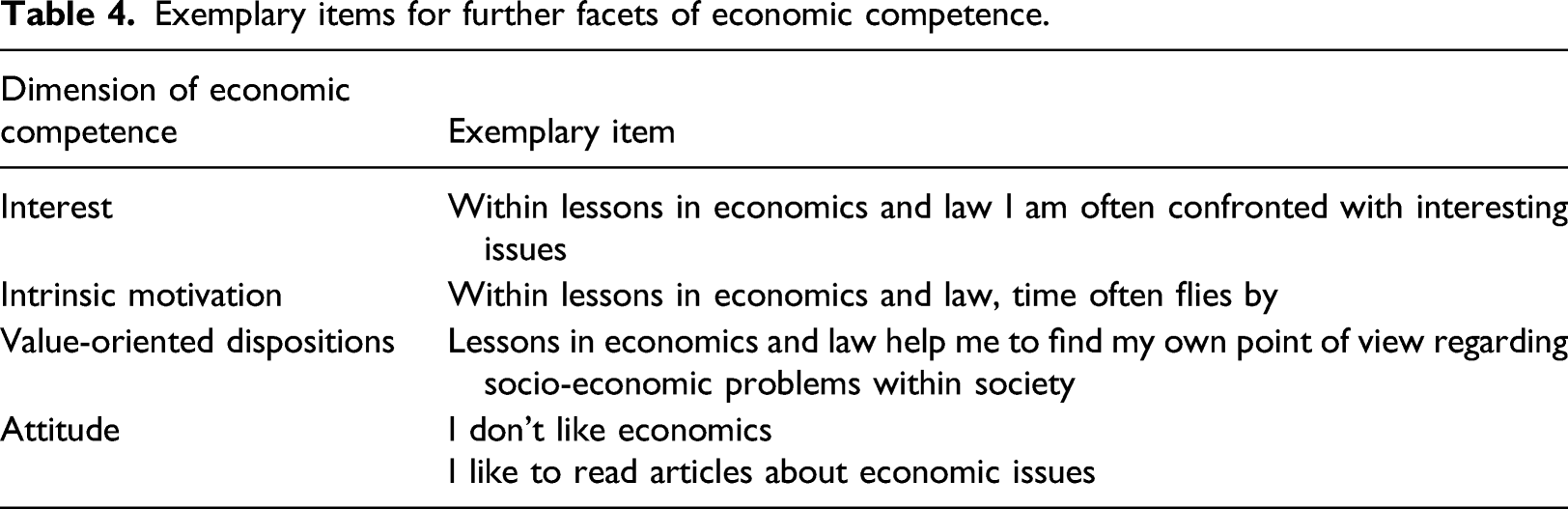
The underlying study follows a longitudinal design over a period of approximately 5 years (2011–2016). It includes two points of measurement (T1 and T2), with T1 taking place at the end of school year in summer 2011 and T2 taking place approximately 5 years later in spring/summer 2016. At T1, the students were in their last school year, shortly before obtaining their qualification for university entrance. At this time, students were asked and tested about their economic competencies, mathematical and verbal skills, and cognitive abilities (test duration approximately 180 min). Furthermore, they were asked about further facets of economic competence (interest, motivation, attitude, and value-oriented disposition), different socio-demographic variables (e.g., age and migration background) and their future plans (e.g., study aspirations). At T2 (“OEK-Transition” project, see Jüttler, 2020b), students’ educational pathways from summer 2011 to summer 2016 were queried. The main focus was on students’ study choices. Additionally, students’ academic success (e.g., academic integration) and further control variables (e.g., perceived family support) were queried. The overall survey duration at T2 lasted approximately 45 min.
Sample
At T1, 1277 BS students from 79 classes participated (Schumann and Eberle, 2014). This is based on a randomized sampling of a total of 100 BS classes (1838 students) from the population (Angelone and Berger, 2011). There are no structural differences between the classes/students that participated and the ones that did not (Schumann et al., 2013). The population comprises 10,091 BS students (584 school classes) and consists of all BS students of the German-speaking part of Switzerland who graduated in summer 2011 (Angelone and Berger, 2011). The sampling was based on two explicit strata: (1) BS students with the advanced course “Economics and Law” (BS advanced) and (2) BS students with another advanced course (BS basic). Within each stratum, gender, canton, and class size served as implicit strata. From these two strata, an equal number of classes was randomly drawn. This led to the result of a sample that was not proportional to the population. Therefore, stratum-specific weightings were calculated to reconstitute the representativeness of the sample (Kish, 1992).
Analysis sample (weighted).
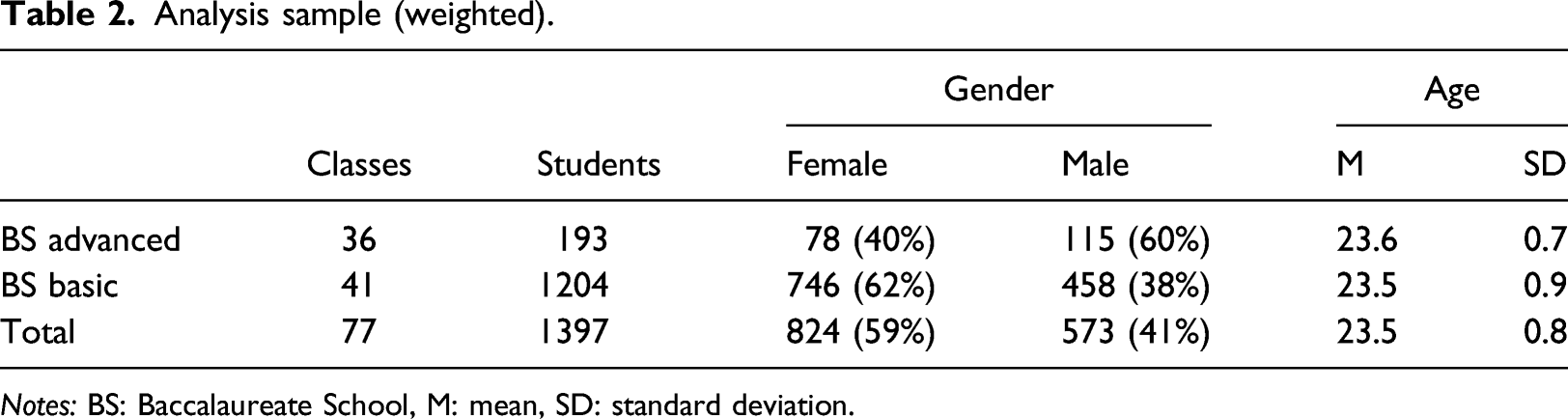
Notes: BS: Baccalaureate School, M: mean, SD: standard deviation.
Measurement instrument
Extract of measurement instruments in T1 and T2.
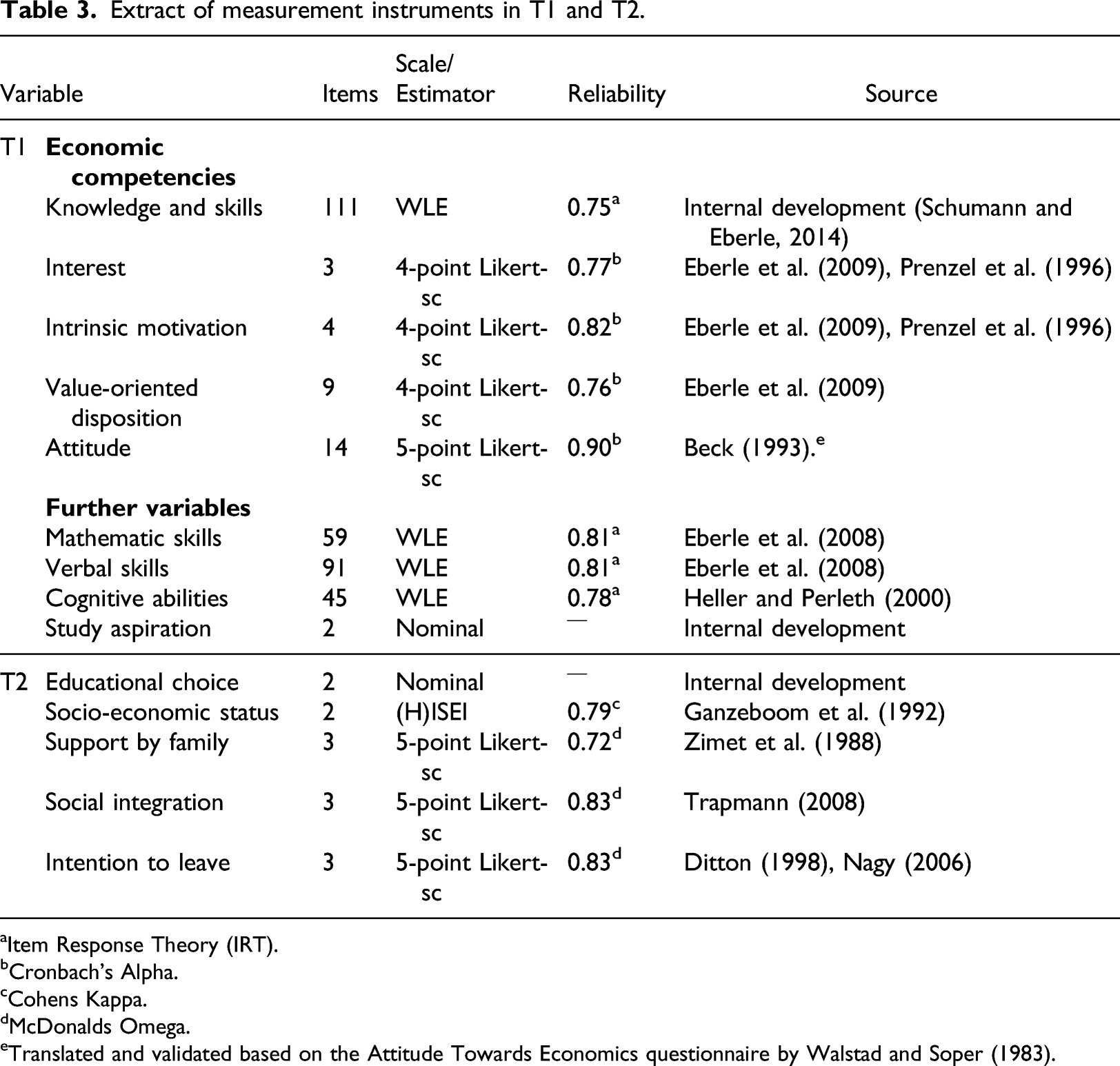
aItem Response Theory (IRT).
bCronbach’s Alpha.
cCohens Kappa.
dMcDonalds Omega.
eTranslated and validated based on the Attitude Towards Economics questionnaire by Walstad and Soper (1983).
Exemplary items for further facets of economic competence.
Further variables at T1: School grades were self-reported by the students and are represented by the Swiss Grading System. They range from 6 (very good) to 1 (very bad). The school profile distinguishes between students with the advanced course “Economics and Law” and students with another advanced course. Mathematic and verbal skills as well as cognitive abilities are also measured one-dimensionally using validated achievement tests.
Study Aspiration: The study aspiration was asked based on three items. The first two items include questions about the desired and alternative field of study. The third item is a 4-point Likert scale that asks about the probability of taking up a course of study (1 = “quite sure,” 2 = “probably,” 3 = “probably not,” and 4 = “definitely not”). In the present study, students intend to study economics if they (1) (probably) wish to study and (2) named a study course in economics in the first or second question.
Study Choice: In this paper, the first chosen field of study after school is considered. The subject catalog of the Swiss Federal Statistical Office (2017) is used to categorize the named subjects into fields. In the present study, this variable is also dichotomized by distinguishing between students who named a subject that belongs to the field of economics (=1) and those who did not (=0).
Exemplary items for academic success.

Further variables at T2: The socioeconomic background was measured using the standardized International Socio-Economic Index of Occupational Status (ISEI; see Ganzeboom et al., 1992), which ranges from 0 (low) to 100 (high). In addition, students’ perceived family support was measured based on a 5-point Likert scale (exemplary item: “My family truly tries to help me.”).
Missing values
There are missing values (item nonresponse), especially for cognitive abilities, mathematical and verbal skills and further facets of economic competencies of approximately 23–30%. These were addressed by multilevel multiple imputation with chained equations using the R package mice.2 L. pan (Van Buuren and Groothuis-Oudshoorn, 2011). School classes were used as a cluster variable. To formulate single equations, at least 10 predictors per outcome variable were considered to generate 20 values for each missing value (see Rubin, 1987; Van Buuren and Groothuis-Oudshoorn, 2011). Based on this approach, fixed and random effects, class mean effects of individual cognitive variables and the individual and stratum-specific weights (see above) were considered within the chained equations.
Analyses
Calculations for students’ mathematical and verbal skills, economic knowledge and skills as well as their cognitive abilities were based on weighted mean likelihood estimation (WLE, Warm, 1989). The calculations were performed using the software program “ConQuest” (Wu et al., 2007) based on a one-dimensional Rasch model (Rasch, 1980). To calculate descriptive statistics and bivariate analyses, the program Statistical Package for the Social Sciences (SPSS) was used. To calculate the estimators for predicting study aspiration, decision and success, different regression models were calculated using the software MPlus (Muthén and Muthén, 2017). Particularities of the different models are summarized in the Results chapter. For detailed information on the different approaches, see Jüttler and Schumann (2019) and Jüttler (2020a). All calculated estimators showed at least satisfactory reliability (see Table 3).
Nested data structure
To control for the nested data structure within multivariate analyses, standard errors were adjusted by using school classes as the cluster variable. To calculate standardized regression estimators, maximum likelihood estimation with robust standard errors (sandwich estimator; MLR) was used based on MPlus (Muthén and Muthén, 2017).
Results
Findings from Switzerland
The following is a synopsis of the most important international publications based on the OEK transition project (see Methods section). Detailed information on the referred studies can be found in Schumann and Jüttler (2015), Jüttler et al. (2016), Jüttler and Schumann (2019) and Jüttler (2020a).
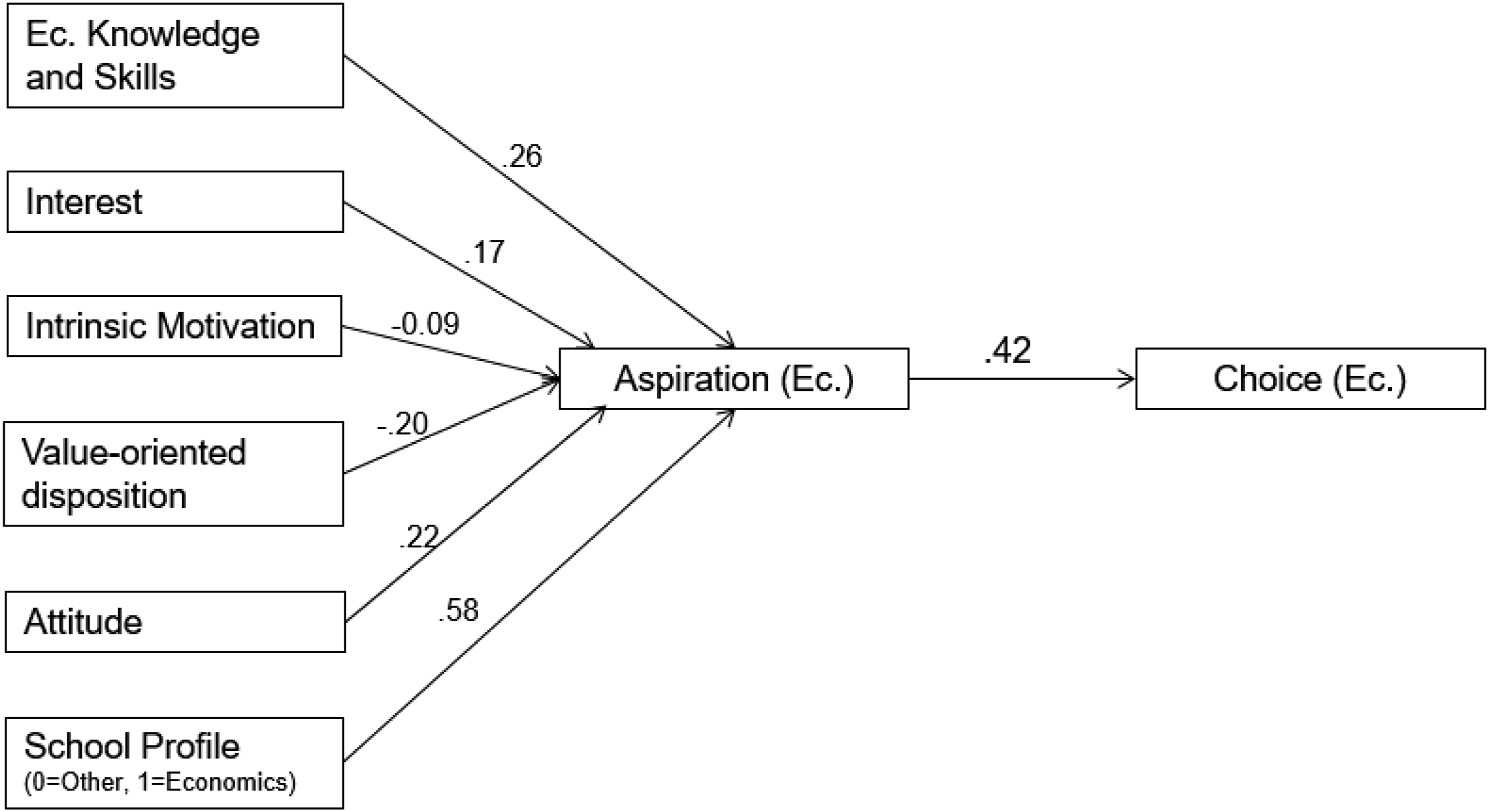
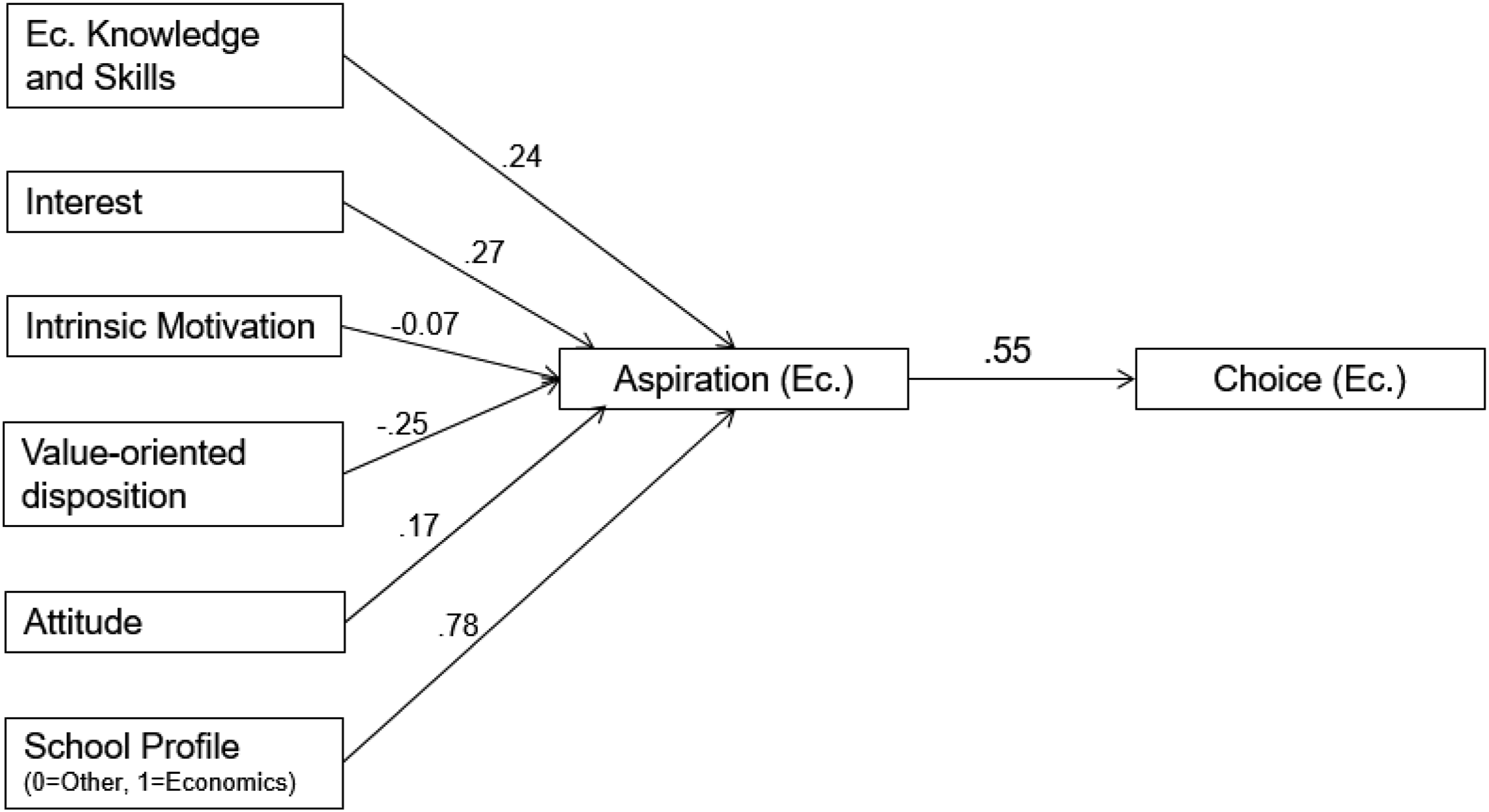
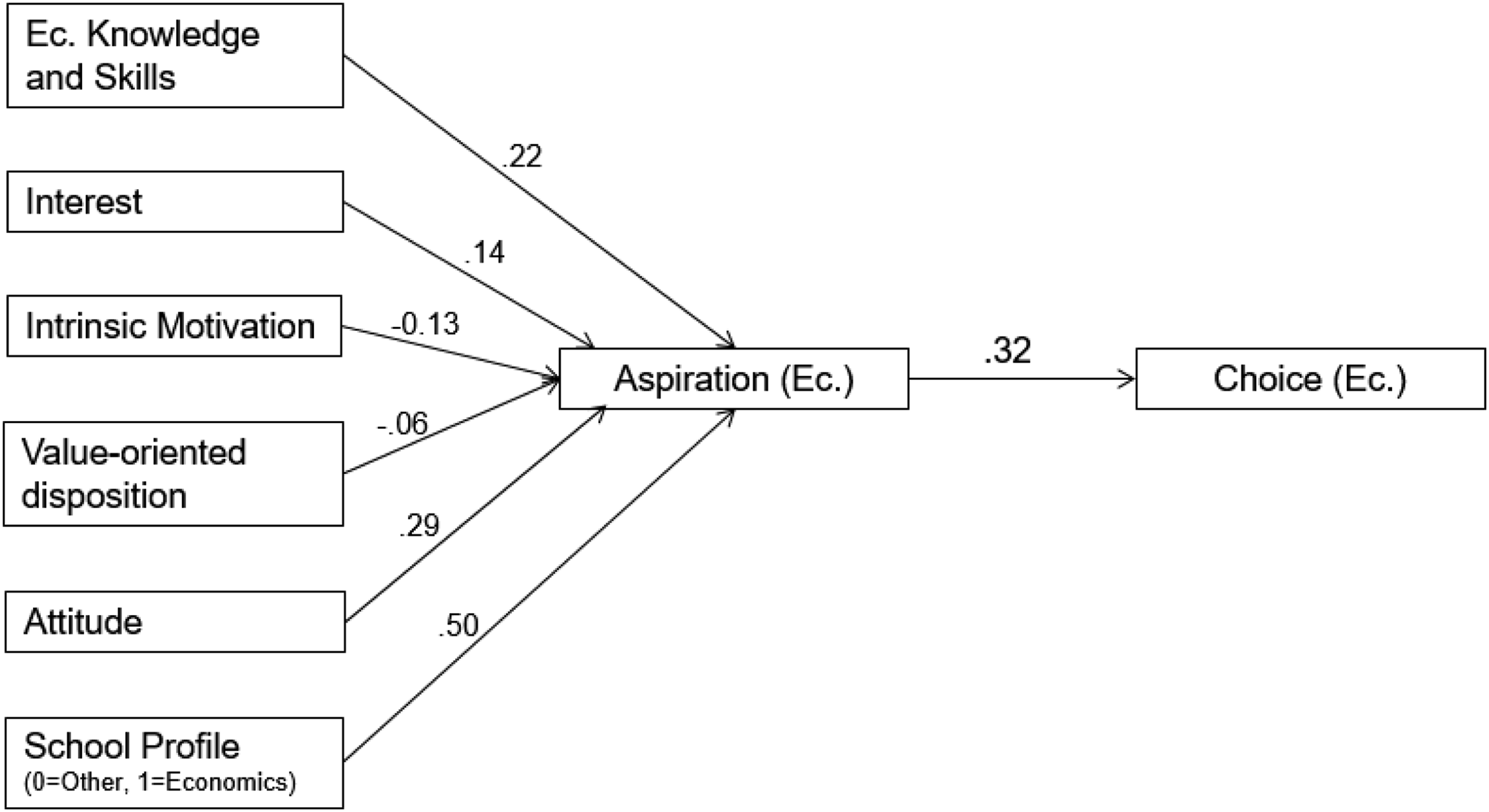
Following these studies, the findings can be subdivided into three categories: 1. Aspiration to study economics (see Jüttler et al., 2016; Schumann & Jüttler, 2015) 2. Choice to study economics (see Jüttler & Schumann, 2019) 3. Study success in economics (see Jüttler, 2020a)
Means and standard deviations (in brackets) of economic competencies between students with and without the aspiration to study economics.
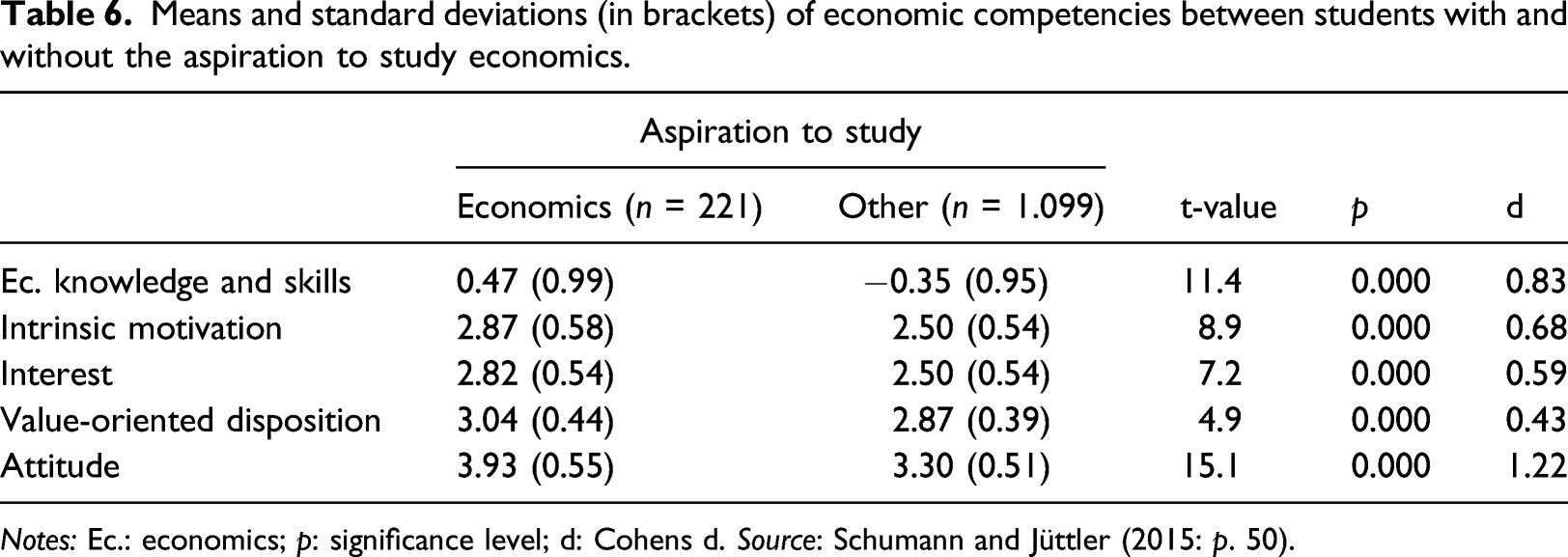
Notes: Ec.: economics; p: significance level; d: Cohens d. Source: Schumann and Jüttler (2015: p. 50).
Means and standard deviations (in brackets) of economic competencies between students with and without the choice to study economics.
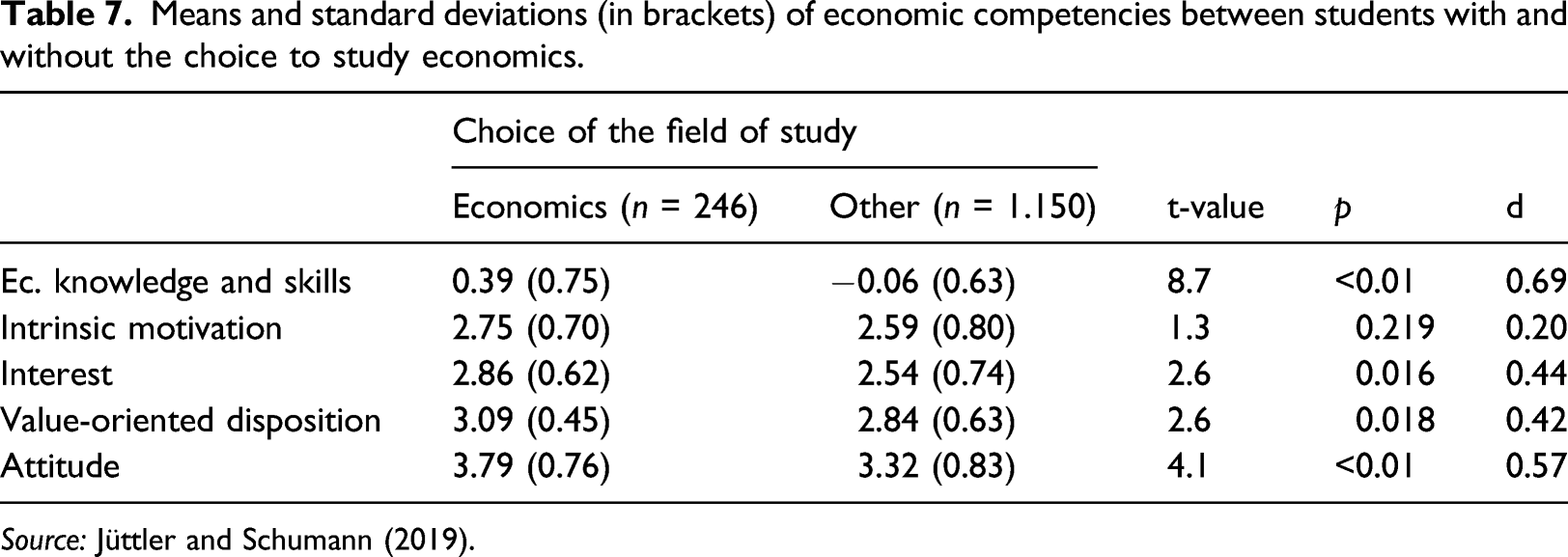
Source: Jüttler and Schumann (2019).
Means and standard deviations (in brackets) of economic competencies between male and female students who chose economics after graduation from upper secondary education.
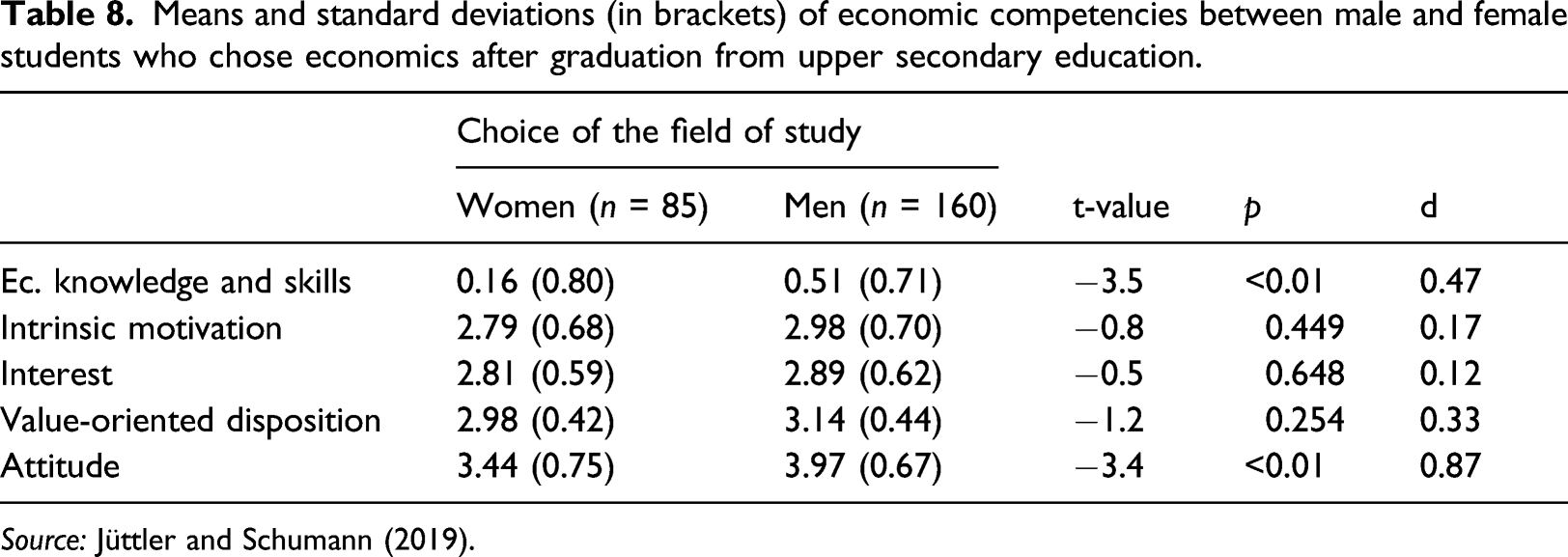
Source: Jüttler and Schumann (2019).
Finally, significant influences can be identified regarding academic success in an economics program 5 years after graduation (see Jüttler 2020a). A particularity of this study is that only students whose latest field of study was economics were considered (weighted sample n3 = 538). Because of this subsample, FVBS students were also considered. Consequently, the effect of school type (BS vs FVBS) was further controlled. Structural equation models (SEMs) were used to answer the research question, with facets of economic competencies latently modeled. Due to the latent modeling, it was not possible to empirically separate the facets besides economic knowledge and skills, which is why they were combined into one factor with satisfactory reliability using three parcels (see Little, 2013; McDonald’s Omega = 0.79; c. f. Jüttler 2020a).
There are moderate correlations between economic knowledge and GPA but not between further facets of economic competencies (see Jüttler, 2020a). 6 Based on SEM, there is a moderate positive influence of economic knowledge on grades in an economics study program, which results in an indirect influence of economic knowledge on retention in economics (see Jüttler, 2020a) 7 . Again, there are no effects of the further facets of economic competencies. It is important to note that the results cover a time span of 5 years, which is why even small or moderate effect sizes should not be underestimated. Central limitations are the missing implementation of process variables during the study period (e.g., initial and future commitment with the study program, see Tinto, 1993) as well as the simultaneous measurement of academic/social integration and the intention to dropout.
Integration of the findings in Switzerland into the international context
To embed the presented results from Switzerland in the international context, the comparative criteria made in the theoretical section will be used in the following. To better structure the specific results, they are divided into the following three sections: (1) economic competencies, (2) gender effects, and (3) profile effects.
Economic competencies
First, the results will be examined against the background of country-specific differences regarding the effects of economic competencies at the end of upper secondary education on aspiration/choice for and academic success in economics. A main characteristic of the Swiss educational system is that BS students do not face any structural constraints when choosing a study program. This is different in Germany, where students often need a certain average grade to be allowed to study in the program and university they want (the so-called numerus clausus). Since there is only a small correlation between economic competencies and school grades (e.g., Jüttler and Schumann, 2019), the effects of economic competencies in countries with such structural constraints will be overlaid by a stronger effect of GPA on the choice of an economics study program. However, focusing on economics at the tertiary level, such constraints are rare in Germany. Therefore, specifically for choosing to study economics, a similar effect of economic competencies as in Switzerland must be assumed for Germany. Following current studies in Germany on the effects of an economic education on students’ attitudes towards economics (see, e.g., Oberrauch and Seeber, 2021), positive effects can be observed. The attitude towards economics, in turn, is a strong predictor for the intention and the choice of economics at the tertiary level (see, e.g., Jüttler and Schumann, 2019).
In Japan and the U.S., structural constraints must be observed in entrance examinations and recommendations that are required. Since admission tests often also refer to domain-specific knowledge, the effect of economic knowledge and skills might be stronger in the U.S. and Japan, if such a test is used. Additionally, it must be noted that entrance examinations for higher education also influence teaching and learning at the secondary level (“teaching to the test”, e.g., Kuramoto & Koizumi, 2018), which could further increase the effects of test performance. These tests strongly focus on knowledge but not on attitudes, interest or motivation. Accordingly, it must be assumed that the effect of economic knowledge and skills on the intention and choice of economics at university is stronger in Japan and the U.S. than in Switzerland. Because of these strong constraints based on student admission tests, the effects of facets other than economic knowledge (e.g., interest or attitudes) are probably weaker. The positive effects seen in Germany (see Oberrauch & Seeber, 2021) can also be found for the U.S. when fostering the economics or financial education of young adults (see, e.g., Gill & Gratton-Lavoie, 2011; Brown et al., 2014; Stoddard & Urban, 2019). However, because of the importance of entrance examinations, it is still unclear whether attitudes towards economics positively affects the choice of economics in countries such as the U.S.
In addition to these differences at the university level, another main point refers to differences in economic education at the secondary level. Switzerland is characterized by the fact that students are generally educated in basic economic principles; differences are mainly found in school profiling. A similar situation is also found for the U.S. and Japan. Germany, on the other hand, has not yet systematically implemented economic education at the secondary level. This is also reflected in the fact that German economics students perform the worst in an international comparison. Looking at different subdomains, there are also significant differences between countries, which are probably related to having different curricula at the upper secondary level. For example, Japanese economics students score above average in microeconomics, which is also a curricular focus in secondary education (Happ and Zlatkin-Troitschanskaia, 2021). For Switzerland, such comparisons are difficult on the basis of the data since the test follows a different approach and includes not only economic content but also business administration and accounting (see Methods section). Therefore, it can be assumed that the effect of economic knowledge differs depending on which specific subdomains are considered. A central issue with regard to these country-specific differences in the transition from school to university concerns the question of who ultimately decides to study economics.
Given the mentioned differences in access to higher education, it is reasonable to assume that this group of students strongly differs between countries. Therefore, it is difficult to transfer the effects of economic competencies on student success in economics that were observed in Switzerland. This is also because completion and drop-out rates across these countries strongly differ. For Japan, it must be assumed that although economic competencies might positively influence academic integration, they will not influence student retention in economics because of their overall low drop-out rates. However, economic competencies probably play a crucial role for U.S. students due to a low completion rate at the university level. Here, first-year student retention plays an important role in student success (Tinto, 1993, 2012), which is probably positively influenced by higher economic competencies at the end of high school. Considering the overall low economic knowledge and the stronger focus on GPA in Germany, it must be assumed that students who enter an economics study program at university strongly differ in their economic competencies. For this reason, a stronger effect of economic competencies on study success must be assumed for Germany. There is no study yet that specifically observed the long-term effects of economic competencies at the end of upper secondary education on study success in economics at university in those other countries. However, many studies have observed positive effects of prior economic education on study success in economics (Germany: Happ et al., 2018; Kühling-Thees et al., 2020; Japan: Yamaoka et al., 2007; U.S.: Brückner et al., 2015a; Gill & Gratton-Lavoie, 2011), which will be discussed in more depth regarding profile effects.
Against this background, although it is difficult to quantify the effect of these constraints on subject choices, it must be assumed that the effects of economic competencies, as found in Switzerland, are significantly mitigated by these constraints. This is also because university entrance examinations are often correlated with GPA, basic cognitive abilities, and mathematical and verbal skills (e.g., Frey & Detterman, 2004; Koenig et al., 2008; Mau & Lynn, 2001). This could also be the reason why there is no effect of mathematics and verbal skills or cognitive abilities on the choice of economics in Switzerland.
Gender effects
Similarities between the countries can be found in particular in the well-observed gender gap (with the exception of Japan) and its discussed solutions (e.g., Brückner et al., 2015b). In this respect, economics still seems to be a male-dominated domain, although at the level of higher education, the proportion of women in economics is approximately the same (with the exception of Japan). Thus, it can be assumed that gender-specific effects of economic competencies on the choice of an economics degree are likely to be comparable across countries but probably smaller for Japan, that is, that women in Japan also choose an economics degree if they have comparable economic competencies. Considering gender-specific effects on study success in economics, there are no specific evaluations for Switzerland thus far. Therefore, it is not possible to embed specific results for Switzerland into an international context.
Profile effects
It must also be emphasized that access to a study program in economics also differs in terms of whether students can obtain such a program through a general or vocational pathway. Based on the data from Switzerland, there is a very strong profile effect, especially for students from vocational education, which is because these students have already decided on a specific subject when choosing their course of study (Jüttler et al., 2016). However, a strong profile effect is also found for BS students. In countries without such school profiles (e.g., the U.S. or Japan), it seems likely that graduates select themselves more on the basis of their individual competencies rather than their affiliation with a specific profile. According to these considerations, different motives for choosing economics at university must be assumed. For instance, Yamaoka et al. (2010b) noted that students in Japan most likely choose to study economics at university because of the usefulness and career security it offers, which strongly corresponds to the value-oriented dispositions of the presented study. This consideration relates to effects for male students in Switzerland when choosing economics. Consequently, attitudes and interests might play a less important role, which has a greater influence in the Swiss context. Furthermore, there is no (or at least no strong) vocational track in the U.S. as well as Japan, where the focus lies on a general educational track. Against this background, it must be assumed that there are not as strong profile effects in Japan or the U.S. as there are in Switzerland. In contrast, Germany shows stronger similarities to Switzerland. In both countries, students are able to choose an economic profile at specialized vocational high schools at the upper secondary level (the so-called “Wirtschaftsgymnasium”). Accordingly, students in Germany may also enter economics through the vocational education sector (see also Brückner et al., 2015a).
Furthermore, this strong profile effect is also evident regarding the prediction of study success in economics in Switzerland. As described before, this result corresponds with studies that found that students with a prior economic education perform better at the university level. However, Germany is the only country without a systematic integration of a basic economic education at the upper secondary level. Accordingly, it must be assumed that students in Germany with an economic school profile receive comparatively much higher economic competencies than students without a prior economic education, which would result in a stronger profile effect than in Switzerland, where students without an economic school profile at least gain a basic economic education. For Japan and the U.S., most students also gain at least a basic economic education. Furthermore, there is no strong distribution of school profiles. Accordingly, similar or perhaps even smaller profile effects on study success must be expected for these countries.
Overview of the country-specific evaluation of the results in Switzerland.
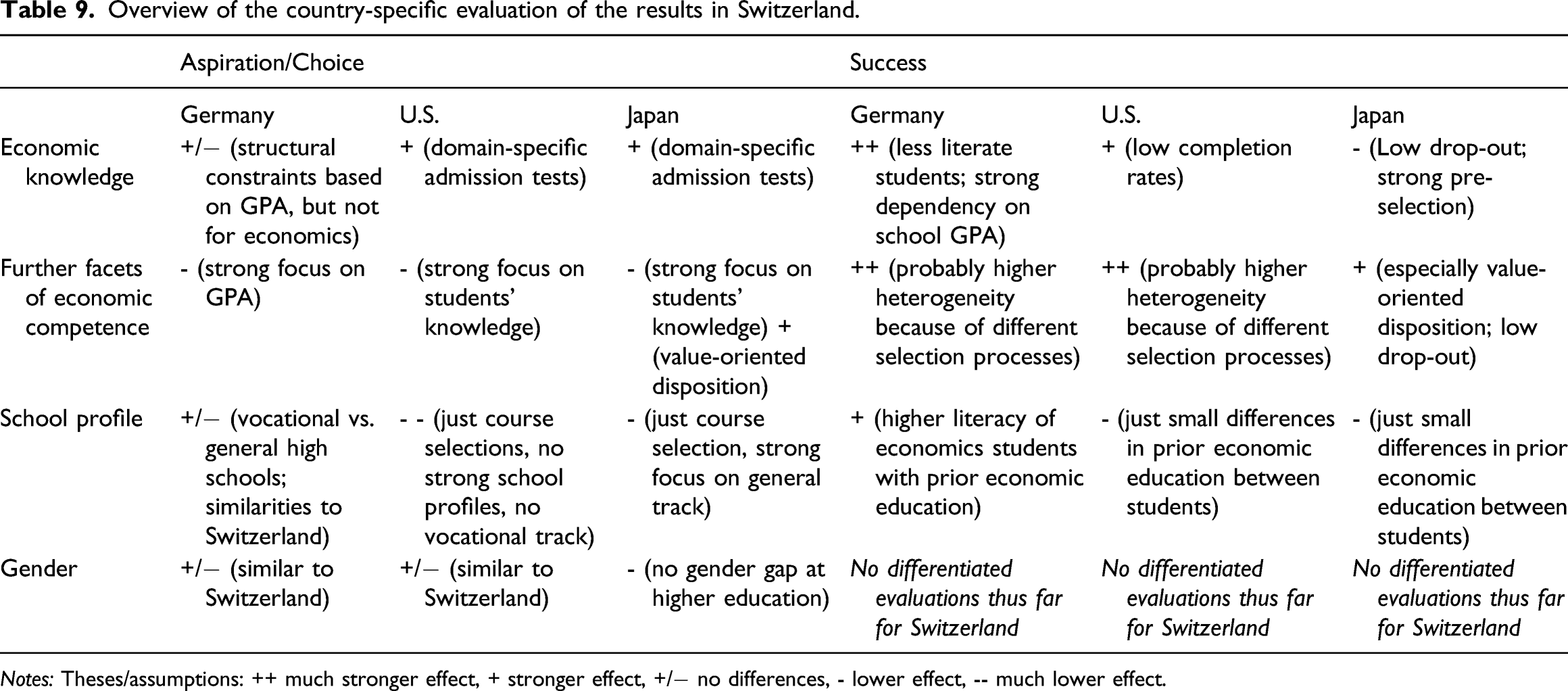
Notes: Theses/assumptions: ++ much stronger effect, + stronger effect, +/− no differences, - lower effect, -- much lower effect.
Conclusion, limitations, and implications
International comparative studies of economic competencies can provide a crucial basis for the improvement of education systems with the aim of educating students to act as responsible citizens within modern societies. Studies devoted to such comparisons are extensive and face numerous substantive and methodological challenges. To date, few studies exist on this topic. These studies often exclusively focus on individual educational sectors, such as secondary or higher education. The analysis of the influence of students’ economic competencies at the end of compulsory school on the transition from secondary to higher education was investigated for the first time based on comprehensive competency measurements in Switzerland (Jüttler, 2020b). Thus, this research provides important empirical evidence on the influence of economic competencies across the abovementioned educational sectors. One deficit of previous analyses was the lack of the international embedding of these findings, which were limited exclusively to the specific situation in Switzerland. This study aimed to close this gap to enable the linking of these results to international comparative research.
Based on a comprehensive elaboration of country-specific characteristics, it was found that the Swiss-specific results can only be transferred to other countries to a limited extent. Strong differences can already be found in access to higher education, structural constraints on the choice of a field of study, prior economic education at the secondary level, and success as well as dropout or completion rates in higher education. Nevertheless, these differences provided a crucial basis to formulate county-specific theses and assumptions for the effects of economic competencies that could be derived based on Swiss data.
What can we learn from Switzerland for international research?
First, it should be noted that the results from Switzerland entail a different approach to the modeling and measuring of economic competencies than the majority of other studies. This has certain advantages but also disadvantages. A key advantage is that the facets of economic knowledge and skills are not limited to basic economic principles. In addition, this approach takes national characteristics into account and includes topics of business administration and accounting. This is especially important because the social relevance of economic education must already be rated differently in terms of specific national content. A disadvantage, on the other hand, can be seen in international comparability, and adapting such tests proves to be extraordinarily time-consuming. However, the question must be asked whether a uniform test is at all useful for making international comparisons taking into account national differences regarding the importance of economic education - a question that has received little or no attention in previous research. Furthermore, it has been shown that the consideration of other competence facets, such as interest, attitude, or value-oriented disposition, is of central importance. The fact that subject choices and academic success cannot be attributed to subject knowledge and general study ability alone makes the consideration of these other competence facets a necessary condition and this has hardly been taken into account in international research to date. It would be important for international researchers to address such competence facets of students at secondary and higher education levels to gain more accurate assessments of international differences in economic competencies. This would also allow national studies to be better embedded in an international context.
It is apparent that the correlations between the economic competencies and the aspirations are significantly stronger than the subject choices, which is mainly because the aspirations were measured at the same time as the economic competencies. Therefore, a temporal separation between the measurement points of time should be realized in future research. Other issues (see Table 9) to be considered are structural constraints, prior economic education and school profiling, the popularity of studying economics (e.g., career prospects), gender differences at both secondary and tertiary levels, and the national quality in teacher education, which is still critically discussed in countries but is not systematically considered in the Swiss study. Based on this comparison, it must be assumed that economic competencies are an important predictor for student success in most countries, while the prediction of the choice of economics is probably strongly influenced by country-specific constraints, which is of great importance for future international research.
Against this background, the international context of the Swiss study offers numerous options for future research. A main task of future research must involve international replications of this study to compare results in both directions and to systematically prove the country-specific suggestions drawn from this study.
Footnotes
Acknowledgments
The opinions, results, and conclusions in this paper are those of the author(s) and are independent from the funding sources. The reported findings serve purely scientific purposes.
Declaration of conflicting interests
The author(s) declared no potential conflicts of interest with respect to the research, authorship, and/or publication of this article.
Funding
The author(s) disclosed receipt of the following financial support for the research, authorship, and/or publication of this article: This work was supported by the Baden-Württemberg Stiftung (see  ) under Grant FP017/14 (Duration: 11/2015-10/2016) and the Swiss National Science Foundation (SNSF) under Grant 130301 (Duration: 05/2010-07/2012).
Data availability statement
Access to the data must be approved in advance by the Baden-Württemberg Foundation (www.bwstiftung.de). An enquiry can be made using the official application form (see ) stating the project number (FP017/14). If approval has been granted, the raw data can be transmitted in encrypted form in order to fulfill the data protection standards of the organization.
Ethics statement
All relevant national standards concerning the recruitment and information of the participating adolescents, schools, and organizations were respected (with written informed consent). Participation in this study was voluntary. At the first point of measurement, the school administrations approved all surveys consistent with the Swiss standards for school surveys at the time. In addition, all participants were older than 16, and most of them were already of legal age. Since our research project is not associated with any risks or burdens, no additional consent was required from legal representatives (Art. 24,1 HFG). For the second measurement date, all Swiss standards for data collection were also complied with. All participants were of legal age, fully informed, and agreed to participate.
Notes
Appendix
Interrelation between economic competencies and study aspiration (BS; logistic regression). Notes: Estimators calculated with SPSS; no consideration of nested data structure (no robust standard errors); missing values are estimated by SPSS using multiple imputation with five estimators per missing value (for details see Schumann and Jüttler, 2015). Source: Schumann and Jüttler (2015: p. 53). Path analysis of the influence of students’ economic competencies on their aspiration and choice to study economics. Notes: Further control variables within the model (not displayed) are mathematics and verbal skills, cognitive ability, school grades in mathematics, first language (German), economics and law and HISEI. Source: Jüttler and Schumann (2019: pp. 9 ff.). Path analysis of the influence of female students’ economic competencies on their aspiration and choice to study economics. Notes: Further control variables within the model (not displayed) are: mathematic and verbal skills, cognitive ability, school grades in mathematics, first language (German) and Economics and Law as well as HISEI. Source: Jüttler and Schumann (2019, pp. 9 ff.). Path analysis of the influence of male students’ economic competencies on their aspiration and choice to study economics. Notes: Further control variables within the model (not displayed) are: mathematic and verbal skills, cognitive ability, school grades in mathematics, first language (German) and Economics and Law as well as HISEI. Source: Jüttler and Schumann (2019, p.: 9 ff.).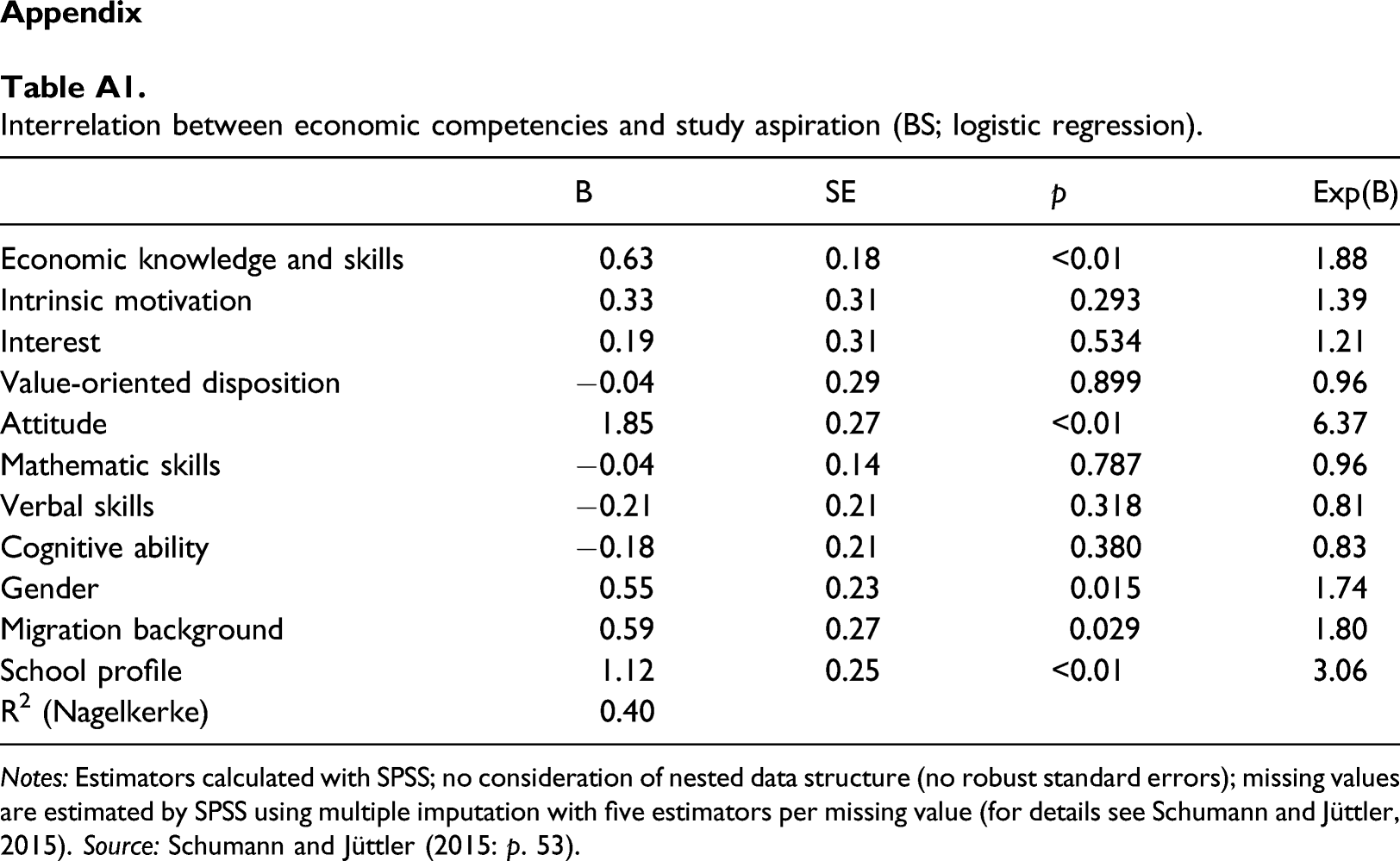
B
SE
p
Exp(B)
Economic knowledge and skills
0.63
0.18
<0.01
1.88
Intrinsic motivation
0.33
0.31
0.293
1.39
Interest
0.19
0.31
0.534
1.21
Value-oriented disposition
−0.04
0.29
0.899
0.96
Attitude
1.85
0.27
<0.01
6.37
Mathematic skills
−0.04
0.14
0.787
0.96
Verbal skills
−0.21
0.21
0.318
0.81
Cognitive ability
−0.18
0.21
0.380
0.83
Gender
0.55
0.23
0.015
1.74
Migration background
0.59
0.27
0.029
1.80
School profile
1.12
0.25
<0.01
3.06
R2 (Nagelkerke)
0.40